



You pick up a bottle in a Japanese liquor shop and turn it around. On the back, you find a column of kanji and numbers: Junmai Ginjo, 55%, 15%, Yamada Nishiki, +3. So learning how to read a sake label means spotting which clues matter, and what each says about the drink.
To read a sake label, first check five things: the grade name, polishing ratio, alcohol percentage, rice variety and special terms such as nama or genshu. A lower polishing ratio means the mill removed more rice, while a positive nihonshu-do usually points drier. These clues suggest a style, but they do not guarantee taste or quality.
What a Japanese Sake Label Can Tell You
A Japanese sake label is a compact data sheet. Some items appear because Japanese rules demand them, while others appear because the brewery wants you to know. Together, they point toward style, strength, freshness and origin.
Quick Facts: Reading a Sake Label
- Normally on the bottle
- Category word (seishu or nihonshu), ingredients, alcohol, volume, and producer information.
- Grade names
- Eight special designations, each with its own legal rules.
- Key number
- Polishing ratio, which must appear whenever a grade name does.
- Taste numbers
- Nihonshu-do, acidity and amino acidity, although all three are voluntary.
- Freshness words
- Nama, nama-chozo and hiyaoroshi, as well as genshu for strength.
- Date
- Optional since January 2023.
- Rule maker
- Japan’s National Tax Agency (NTA).
Why does it look so hard, then? For one thing, most of the text is Japanese, and export stickers often translate only part of it. On top of that, the same idea can show up in kanji, romaji or a brand’s own English.
This guide works like a decoder. First, it covers grade names, rice polishing, ingredients, alcohol and rice varieties. Then it moves on to taste numbers, freshness terms, dates and regional marks. Finally, it explains what a label cannot tell you, which matters just as much.
Here is the good news, though. Within a few minutes, you can learn to read most of the useful information on a bottle. You will not need fluent Japanese, either. Instead, you only need to recognize about a dozen words and understand a handful of numbers.
This page stays on the reader’s side of the bottle. Our guide to sake bottling, by contrast, covers the legal and technical side, including why each item must appear. Here, then, the question is simpler: what do you do with the information once you see it?
The Five Things to Check First
Nobody needs twenty label terms on day one. Five items tell you most of what matters, and they appear on many premium bottles. Start with these, then add the rest as your curiosity grows.
- Grade or designation特定名称Junmai, Ginjo, Daiginjo or Honjozo, which describe legal production rules rather than a quality ranking.
- Polishing ratio精米歩合A figure such as 60% or 50%, where lower numbers mean more milling.
- Alcoholアルコール分Usually 15 to 17 percent, although higher figures often hint at undiluted sake.
- Rice variety使用米Names like Yamada Nishiki or Gohyakumangoku, which point to the raw material.
- Special terms生・原酒・無濾過Words like nama, genshu, muroka or koshu that flag freshness, strength or aging.
Read together, these five clues sketch a rough profile. For example, a Junmai Ginjo at 55% with 15% alcohol may point toward a refined, aromatic style. Cool or lightly chilled service is then a sensible place to start. A Junmai at 70% with 17% alcohol, however, points somewhere else, perhaps fuller and sturdier.
That profile is a starting point, not a verdict. Still, it narrows a wall of fifty bottles down to the handful worth asking about. In a busy shop, that alone saves a lot of guessing.
If a bottle shows only one or two of these items, don’t worry. Many everyday sakes skip the extras, and some small breweries also keep their labels minimal on purpose.
Anatomy of a Japanese Sake Label
Most bottles split their information between two labels. On one side, the front label carries the brand name, the grade and the artwork. The back label, meanwhile, holds the fine print, and that is usually where the useful numbers live.
Front Label vs Back Label
Think of the front label as the sales pitch. Expect a large brand name in calligraphy, perhaps a grade such as 純米吟醸, and sometimes a seasonal word. Many breweries also print their town or prefecture here.
By contrast, the back label informs. It lists the legal items in small type, often in a fixed order. Breweries that like to share data also add polishing ratio, rice variety, nihonshu-do and acidity. Some even include serving tips, so it pays to read them before you buy.
A Label, Item by Item
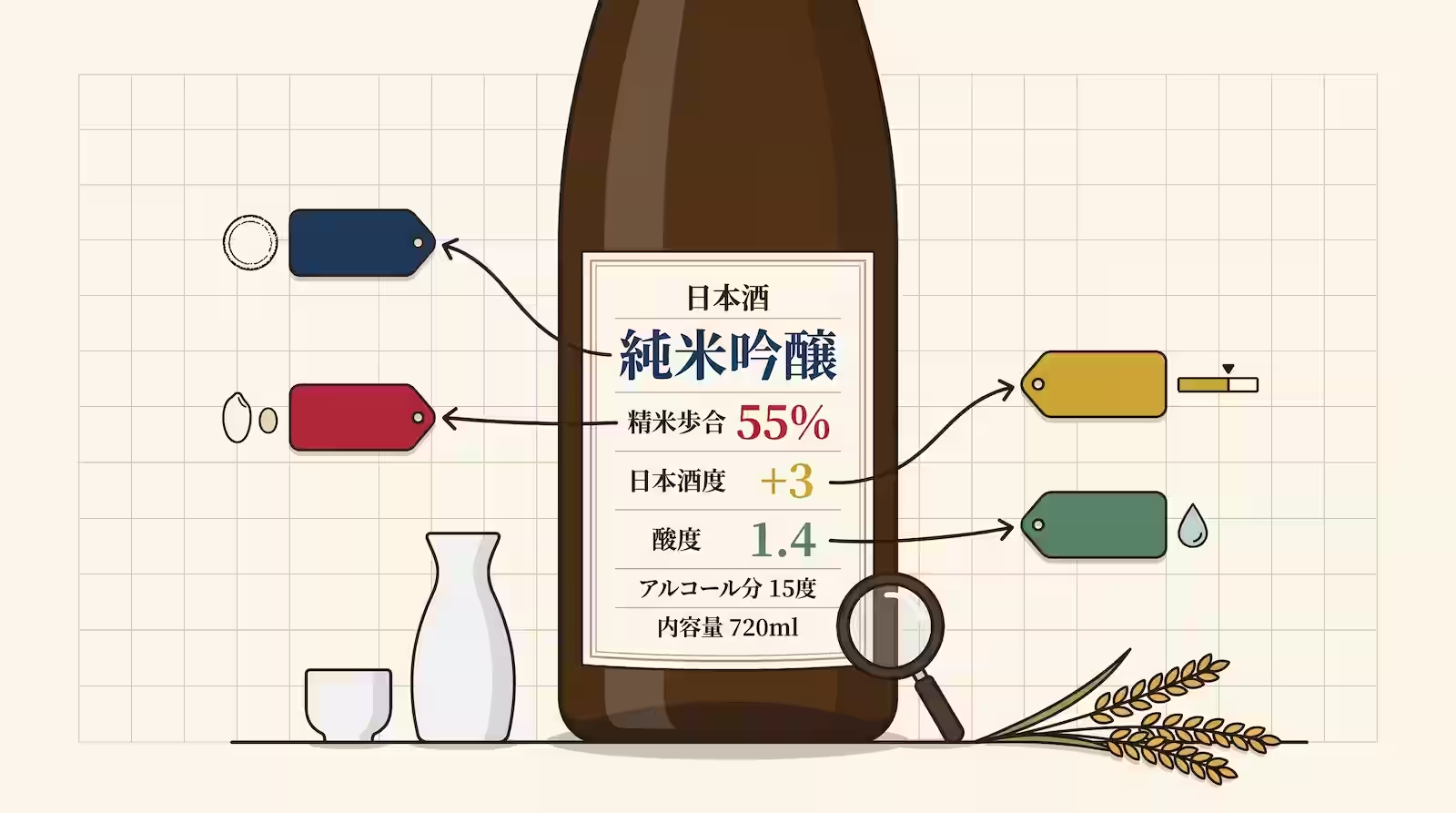
The mock back label below shows where each item typically sits. Real labels vary, though, so treat the layout as a map rather than a rule.
- Grade name: the sake designation, often beside the brand.
- Ingredients: rice and rice koji, plus brewer’s alcohol when used.
- Polishing ratio: mandatory once a grade name appears.
- Alcohol: written with 度 or %.
- Rice variety: optional, but it must show its share.
- SMV and acidity: optional taste data.
- Volume: commonly 720 ml or 1.8 liters.
- Production date: optional since 2023.
- Producer: the brewery’s name and address.
- Storage note: here, keep refrigerated.
- GI mark: only when the sake meets a GI’s rules.
- Age warning: found on retail containers in Japan, where drinking under 20 is illegal.
Items 2, 4, 7 and 9 normally appear on a standard retail bottle sold in Japan, together with the word seishu or nihonshu. The polishing ratio, meanwhile, becomes mandatory once a grade name appears. Everything else depends on the brewery’s choices and the product type, and imported sake follows extra rules of its own.
One quirk surprises many readers. Water never shows up in the ingredient list, even though brewing uses a great deal of it. According to Japan’s sake brewers’ association, labeling rules simply do not count water as an ingredient.
Mandatory vs Optional Information on a Sake Label
Not every item on a bottle comes from a legal requirement. A standard retail bottle sold in Japan normally shows its legal category, ingredients, alcohol content, volume and producer information. Extra rules apply to products such as unpasteurized or imported sake. Other items appear because the rules allow them, or simply because the brewery wants to talk to you.
Must appear
- Category word, 清酒 or 日本酒, plus the country of origin for imports
- Ingredients
- Alcohol content
- Volume
- Producer name and address
- Underage drinking warning, on applicable retail containers in Japan
- Polishing ratio, when a grade name appears
- Storage notes, when the sake skipped heat treatment
Brewery’s choice
- Rice variety and its share
- Production area
- Production date and years stored
- Yeast
- SMV, acidity and amino acidity
- Brewing method
- Serving temperature and food ideas
- The brewery’s story
Optional does not mean unreliable. Breweries still cannot print misleading claims. For example, NTA rules ban industry-wide superlatives such as 最高 (best) or 第一 (number one).
Words like 極上 (superior) can appear, but only as a brewery’s internal ranking between its own products. Since 2023, the NTA has also banned wording that makes a sake look award-winning or government-endorsed when it is not.
Yeast names deserve a quick word, too. Labels sometimes mention a numbered yeast, such as No. 7 or No. 9, or a prefectural strain. That detail hints at aroma style, although our yeast guide explains why it is only a hint.
Sake Type Names: Junmai, Ginjo, Daiginjo and Honjozo
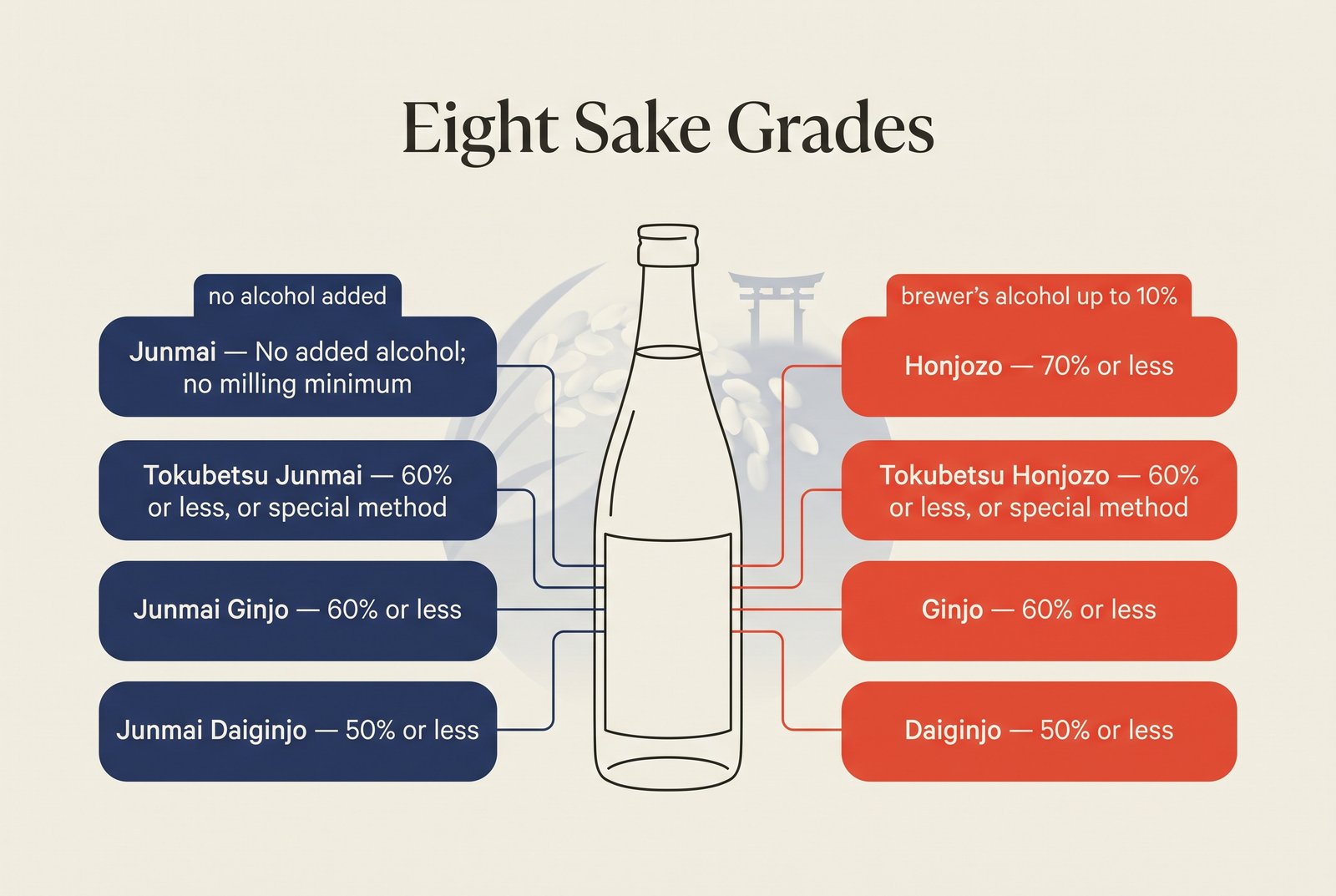
Grade names cause more confusion than anything else on a bottle. They are not brand names, and they are not taste descriptions either. Instead, each one is a legal category with its own requirements.
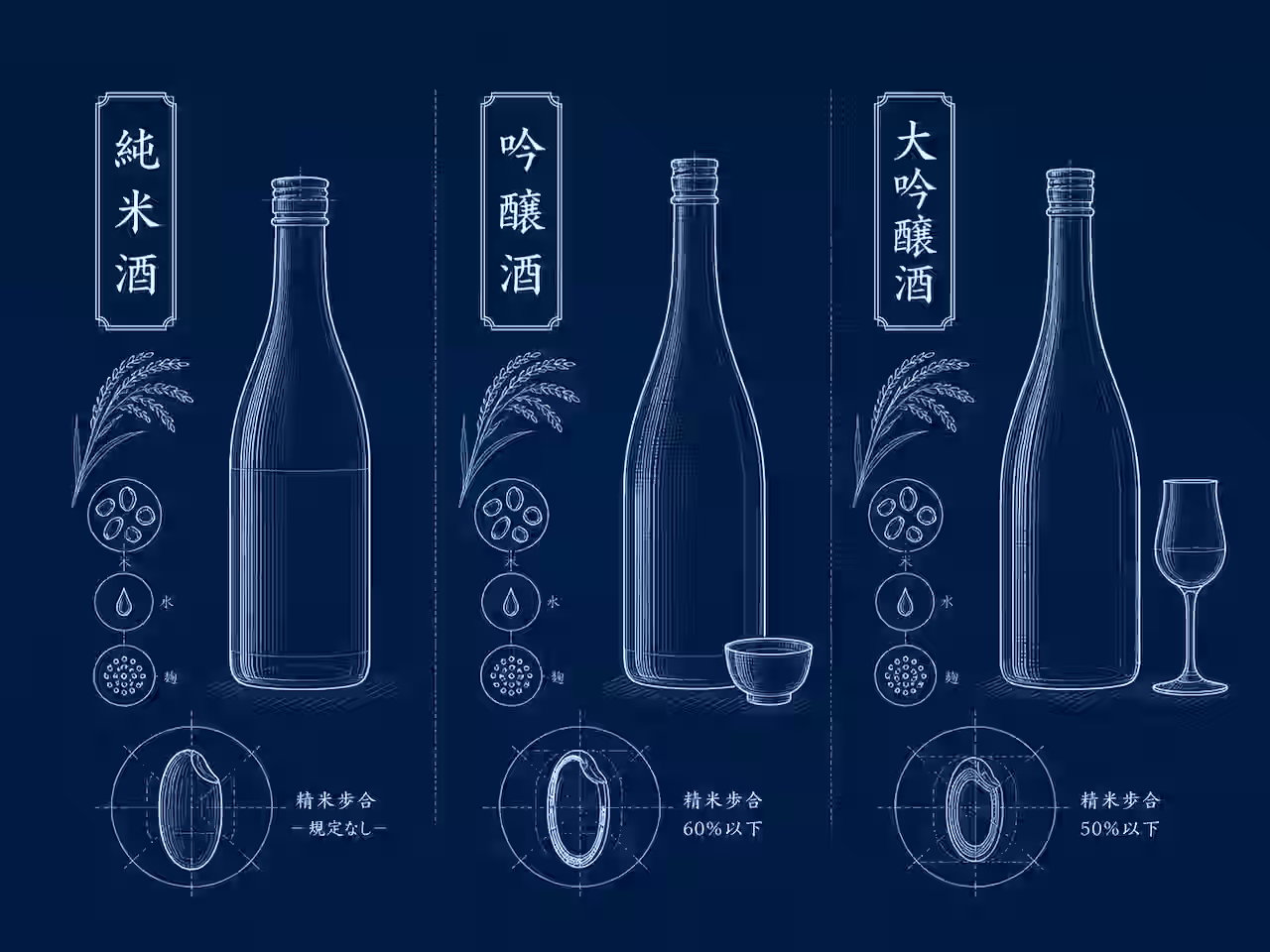
The NTA’s labeling standard lists eight special designations, known in Japanese as tokutei meishoshu (特定名称酒). A brewery may print one only when the sake meets that category’s rules. Every grade also needs at least 15% koji rice. In addition, the rice must grade third class or higher under Japan’s inspection system.
| Designation | Brewer’s alcohol | Polishing ratio | Other conditions |
|---|---|---|---|
| Junmai (純米酒) | None | No minimum | Good flavor and appearance |
| Tokubetsu Junmai (特別純米酒) | None | 60% or less, or a special method | Especially good flavor and appearance; any special method explained on the label |
| Junmai Ginjo (純米吟醸酒) | None | 60% or less | Ginjo brewing, distinctive aroma |
| Junmai Daiginjo (純米大吟醸酒) | None | 50% or less | Ginjo brewing, especially fine aroma |
| Honjozo (本醸造酒) | Up to 10% of rice weight | 70% or less | Good flavor and appearance |
| Tokubetsu Honjozo (特別本醸造酒) | Up to 10% of rice weight | 60% or less, or a special method | Especially good flavor and appearance; any special method explained on the label |
| Ginjo (吟醸酒) | Up to 10% of rice weight | 60% or less | Ginjo brewing, distinctive aroma |
| Daiginjo (大吟醸酒) | Up to 10% of rice weight | 50% or less | Ginjo brewing, especially fine aroma |
The Junmai Family
Junmai (純米) is often translated as pure rice. On a label, it means the brewer used rice, rice koji and water, without adding brewer’s alcohol. It does not mean the sake was made without water.
Since a 2004 revision, plain Junmai has no minimum polishing ratio. Before then, the rules demanded 70% or less. A Junmai label today must still show its ratio, but that number can be anything. Junmai Ginjo and Junmai Daiginjo then add the ginjo method and tighter milling.
Grades With Brewer’s Alcohol
Honjozo, Ginjo and Daiginjo, on the other hand, allow a small addition of brewer’s alcohol. The NTA caps it at 10% of the polished rice weight, calculated as 95% alcohol. As a result, these grades stay close to their rice-based roots.
So why add it at all? According to the NTA, a measured dose lifts aroma and gives a crisper taste. It also helps suppress hiochi bacteria, which can spoil sake. Our Honjozo guide goes deeper into the style.
What Ginjo Actually Means
Ginjo (吟醸) is not only about polishing. The NTA describes ginjo-zukuri as fermenting well-milled rice slowly at low temperatures to build fragrance. Brewers call the resulting fruity, floral aroma ginjo-ka.
So a Ginjo label promises two things at once. First, the rice kept 60% or less of its weight. Second, the brewer used the careful, cold method that aims for aroma. Daiginjo then raises the milling bar to 50% or less.
What Tokubetsu Adds
Tokubetsu (特別) means special. It appears in two grades, Tokubetsu Junmai and Tokubetsu Honjozo. To earn it, either the rice kept 60% or less of its weight, or the brewer used a special method. In that case, the label must explain the method. Both grades also require especially good flavor and appearance, a step above plain Junmai or Honjozo.
Futsushu and Everything Else
Most sake, however, carries no grade name at all. Drinkers and brewers call it futsushu (普通酒), or ordinary sake, although the word is not a legal label category. Because it sits outside the special designations, it can contain more brewer’s alcohol and other permitted ingredients.
One trap deserves a mention. Phrases like 米だけの酒 (sake from rice only) can appear even when a bottle does not qualify as Junmai. When that happens, NTA rules require a clear note nearby saying the sake is not a special designation.
A Higher Grade Is Not Automatically Better
This point matters more than any table. The designations describe production rules, not quality rankings for your own taste. A Daiginjo shows more milling and a specific method. However, it does not promise that you will enjoy it more.
Plenty of drinkers prefer a sturdy Junmai with grilled fish, or a warm Honjozo in winter. Neither choice is a step down. So think of the grade names as style signals, and the picture becomes much clearer.
Rice Polishing Ratio: What Does 60% Actually Mean?
This is the most misread number on a sake bottle. Seimai buai (精米歩合) shows how much of each grain remains after milling. In other words, it does not show how much the brewer removed.
Reading the Number the Right Way
The NTA defines the ratio as the weight of polished rice compared with the original brown rice. So 60% means 60% of the weight remains, and the brewer milled away 40%. At 50%, likewise, the mill takes half the grain.
For comparison, the NTA says household table rice sits around 92%. Rice for sake, however, usually goes to 75% or lower. That gap explains why sake milling feels so extreme to newcomers.
Why mill so much? The outer layers hold more protein, fat, minerals and vitamins. Brewers need some of these, but too much can dull aroma and taste, according to the NTA.
What Polishing Changes, and What It Does Not
In general, heavier milling leads toward a cleaner, lighter and more aromatic sake. Lighter milling, by contrast, tends to leave more rice character and body. That pattern is real, yet brewers work around it all the time.
A low number also costs money, because the brewery needs more rice for the same volume. That partly explains why Daiginjo prices climb. However, price and milling still do not tell you which bottle suits your table.
If you want the science behind milling, our rice polishing guide covers it step by step. On this page, though, just remember one rule: the number shows what remains.
Ingredients: Rice, Rice Koji and Brewer’s Alcohol
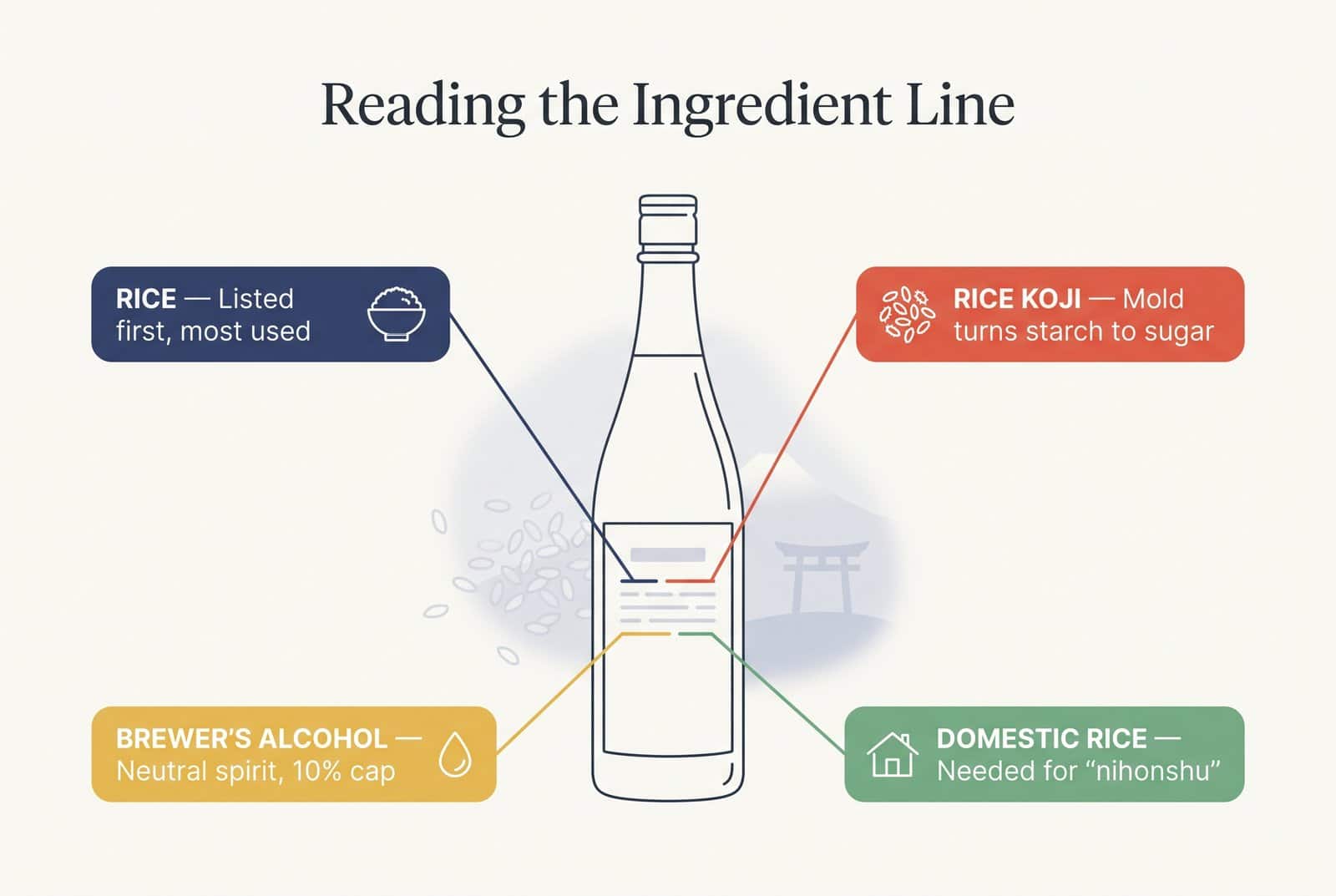
To begin with, look for 原材料名, the ingredient line. On most premium bottles it reads like a short recipe. The order follows the amount used, from largest to smallest.
Rice and Rice Koji
米 (kome) means rice, while 米こうじ (kome koji) means rice koji. Koji starts as steamed rice, and then a mold called Aspergillus oryzae grows through it. That mold breaks starch into sugar for the yeast.
Brackets such as (国産) simply mean domestic, and that detail matters more than it looks. Under NTA rules, only sake brewed in Japan from domestic rice may use the word 日本酒 (nihonshu) on its label.
Brewer’s Alcohol Without the Myths
醸造アルコール (jozo alcohol) worries many overseas drinkers. It sounds industrial, and some assume it means cheap filler. The reality, however, is more ordinary than that.
The NTA defines brewer’s alcohol as alcohol made by fermenting and distilling starchy or sugary material. In practice, then, it works as a neutral spirit. In Honjozo, Ginjo and Daiginjo, it also stays within the 10% cap mentioned above.
Is it bad, then? Not by definition. Brewers add a measured dose to lift aroma and create a crisper finish, according to the NTA. Official judging run by Japan’s regional tax bureaus even includes a Ginjo category that permits it. Our Daiginjo guide shows how the technique works at the top end.
When the List Grows Longer
Ordinary sake may list more items, though. NTA guidance allows labels such as 糖類 (sugars), 酸味料 (acidulants) and 調味料(アミノ酸) (seasoning, amino acids). If you see these, you are holding futsushu, and the brewer used them to adjust taste.
None of this stays hidden, because the rules make brewers list these additions. As a result, the ingredient line doubles as a quick honesty check.
Alcohol Percentage: What 15% or 17% Tells You
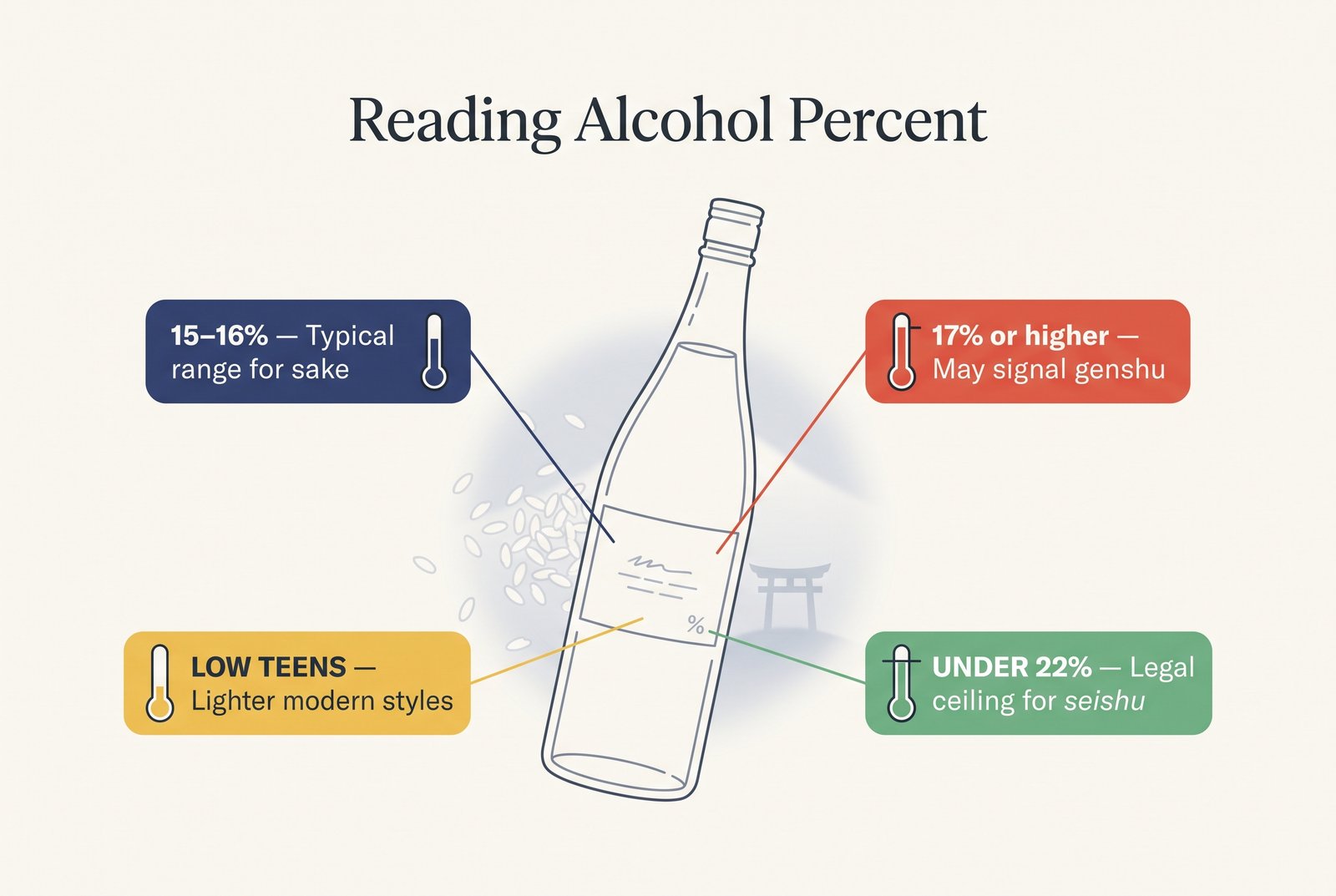
アルコール分 shows alcohol by volume. Most sake lands around 15% to 16%, and legally, seishu must stay under 22%. You will also see the figure written with 度 (do), which works like a percent sign here.
Freshly pressed sake usually comes out around 18% to 20%. Brewers then add water, a step called warimizu, to reach the target strength. So a bottle at 17% or higher can hint at genshu, meaning the brewer skipped that dilution. Confirm it by looking for 原酒 on the label, because some genshu sit below 17%.
You may also find lighter bottles in the low teens, especially among newer releases aimed at wine drinkers. Some taste surprisingly full, which catches people off guard.
Two cautions apply, though. First, Japanese rules let breweries print a single figure within one degree either way, so 15% is an approximation. Second, higher alcohol does not always taste stronger. Sweetness, acidity and serving temperature can hide or highlight the heat.
Rice Varieties: Yamada Nishiki, Gohyakumangoku and More
A line such as 使用米 山田錦100% names the rice. It is voluntary, but plenty of breweries print it because drinkers look for it.
How Variety Labeling Works
The NTA sets a clear rule here. A brewery may name a variety only if it makes up over half the rice. It must also show the share. So 山田錦100% means all of it, while 山田錦60% leaves room for another rice.
Some labels split the details even further. For example, you might see 麹米 (koji rice) and 掛米 (rice for the main mash) listed separately. That shows which rice went into the koji and which went into the main fermentation.
Five Names Worth Recognizing
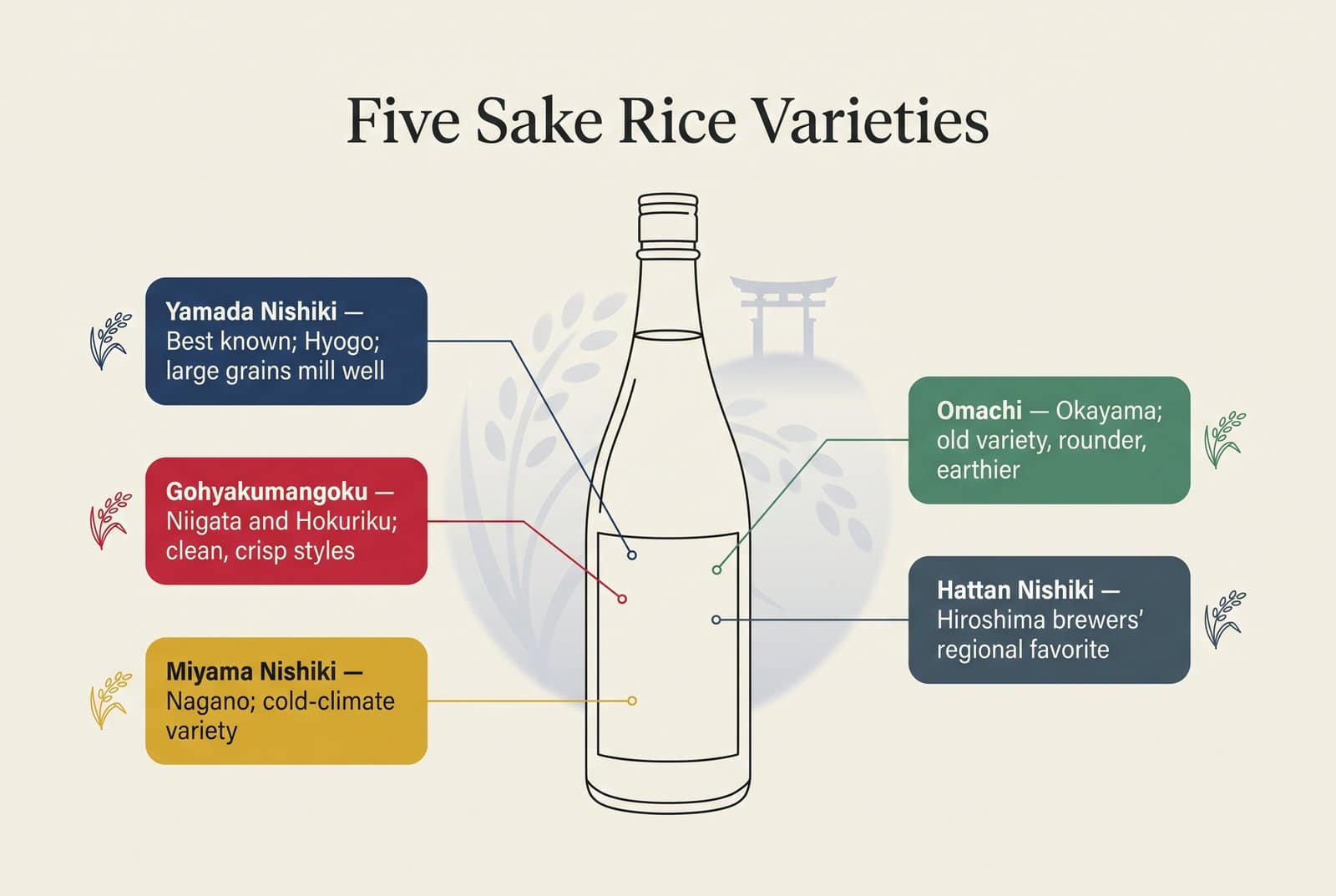
Japan grows around a hundred brewing varieties, yet a few dominate. According to Japan’s farm ministry (MAFF), the 2024 crop gave about 95,000 metric tons of sake rice. Yamada Nishiki and Gohyakumangoku alone made up more than half. The prefectures below are the areas most associated with each variety. They do not guarantee where the rice in your bottle grew.
- Yamada Nishiki (山田錦): the best-known brewing rice, especially associated with Hyogo, although several prefectures grow it. Its large grains mill well.
- Gohyakumangoku (五百万石): strongly associated with Niigata and the neighboring Hokuriku prefectures, and often linked with clean, crisp styles.
- Miyama Nishiki (美山錦): a cold-climate variety associated with Nagano, and common across central and northern Japan.
- Omachi (雄町): an old variety historically associated with Okayama, often described as giving rounder, earthier sake. Other regions grow it too.
- Hattan Nishiki (八反錦): a regional favorite among Hiroshima brewers.
What a Variety Can and Cannot Promise
Rice variety tells you something about the brewer’s raw material. It hints at a style, much like a grape name on a wine bottle. Even so, it does not guarantee a particular taste.
After all, yeast, water, milling, fermentation and blending all pull flavor in different directions. Two Yamada Nishiki sakes from different breweries can therefore taste nothing alike. Our sake rice guide explains why brewers value these varieties in the first place.
Nihonshu-do: The Sake Meter Value
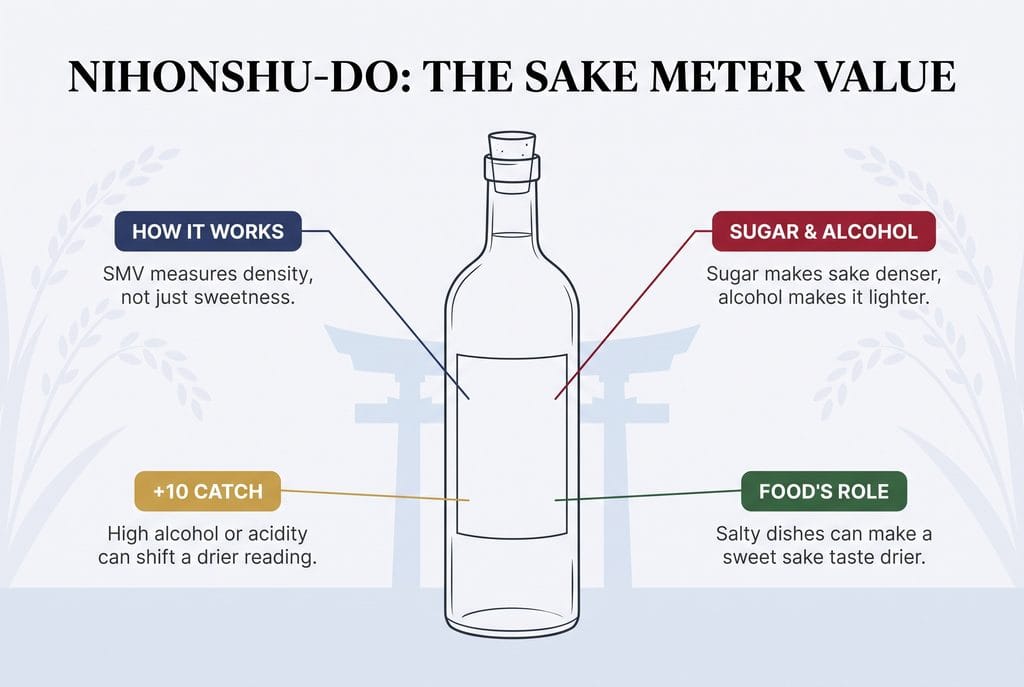
Nihonshu-do (日本酒度), or sake meter value (SMV), is the plus-or-minus number on many back labels. At first glance, it looks like a sweetness score. That impression is half right, which is exactly why it misleads.
How the Number Works
SMV measures density. Under the NTA’s official analysis method, a hydrometer reads the sake at a fixed temperature. A formula then turns that reading into the familiar scale, where denser sake gets a lower number.
Sugar makes sake denser, while alcohol makes it lighter. A sake with more leftover sugar therefore tends to read minus, whereas a drier one tends to read plus. That relationship explains why shops use SMV as a sweet-to-dry guide.
A rough direction rather than a taste score, because acidity, alcohol and temperature can shift how dry a sake feels.
Why +10 Is Not Always Bone-Dry
Here is the catch, though. Density reflects sugar and alcohol together, plus other dissolved substances. As a result, a high-alcohol genshu can read well into the plus range while still tasting round.
Acidity matters too. A 1974 study at the NTA’s brewing research institute modeled sweetness from sugar and acid content. It found that more acid pushed the score toward dry, even when sugar stayed the same.
Food and temperature shift perception as well. For instance, a sake that tastes gently sweet when chilled can seem drier beside salty dishes. So treat SMV +10 as probably dry, not guaranteed dry. Our blending guide also shows how brewers fine-tune these numbers before release.
Acidity and Amino Acidity
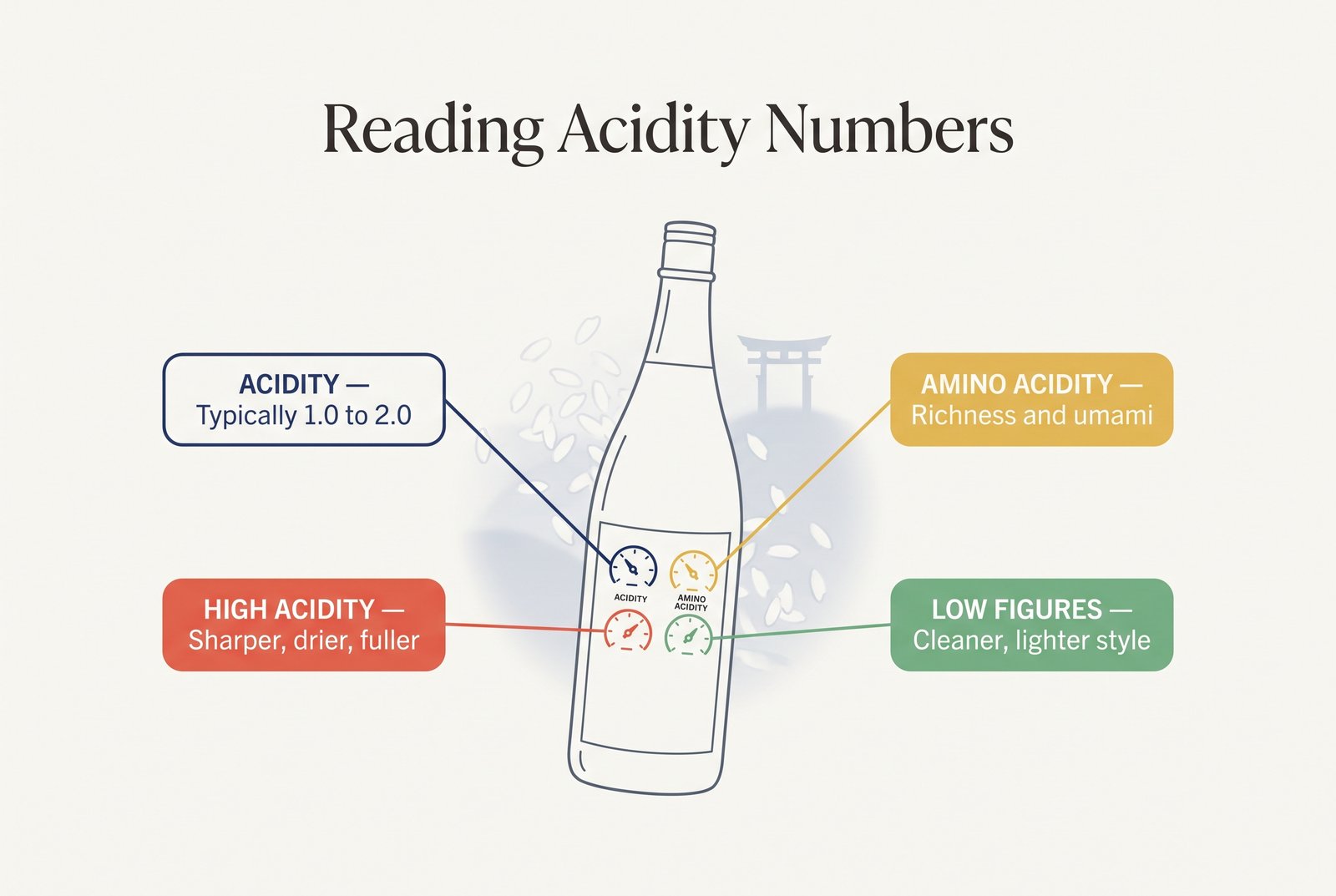
If SMV is the headline number, acidity and amino acidity are the supporting cast. Both appear less often, yet they fill in the picture nicely.
Acidity (酸度)
Sando measures total acids such as succinic, malic, lactic and citric acid. It comes from a laboratory neutralization measurement, so it is not the same thing as pH. Most labels you meet will show something between about 1.0 and 2.0.
Higher acidity often makes sake feel sharper, drier and fuller at once. The same 1974 study found that acid raised perceived richness as well as dryness. Traditional kimoto and yamahai starters often push acidity higher, while low acidity usually reads as soft and gentle.
Amino Acidity (アミノ酸度)
Amino acidity is an analytical value used as a rough indicator of amino-acid-related richness and umami. Aichi Prefecture’s industrial research center notes that individual amino acids behave differently. For example, alanine leans sweet, while arginine leans bitter.
A higher figure usually points toward a fuller, savory sake that may handle warming. A lower figure, on the other hand, suggests a cleaner, lighter profile. Ginjo styles often sit low, which fits their aromatic focus.
Reading the Numbers Together
No single number works alone. Instead, SMV hints at sweetness, acidity shapes how that sweetness lands, and amino acidity adds weight. Alcohol and aroma then change everything again.
Try combining them. For instance, SMV +2 with acidity 1.2 suggests a smooth, lightly dry sake. SMV +2 with acidity 1.9, however, points toward something sharper and more structured. Same SMV, different glass.
Remember that these numbers describe components rather than the full sensory experience. Still, they are clues, and good ones at that.
Nama, Nama-Chozo, Hiyaoroshi and Other Freshness Terms
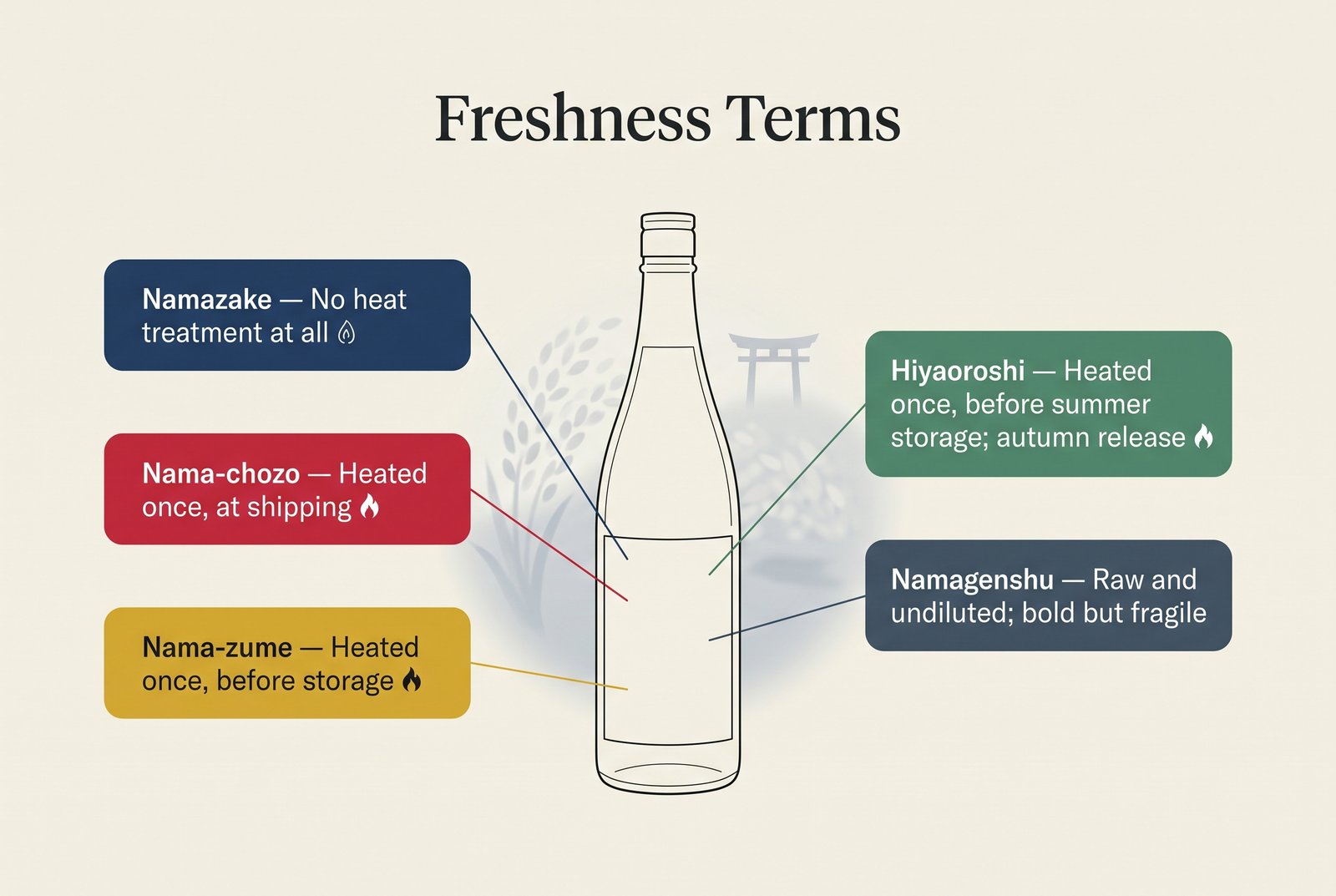
According to the NTA, most sake goes through two gentle heat treatments, once before storage and once before shipping. Freshness terms tell you when a brewer skipped one or both. That, in turn, tells you how to store the bottle. Our pasteurization guide also covers the process itself.
| Term | Heat treatment | What it means for you |
|---|---|---|
| Namazake (生酒) | None | Keep it cold and expect lively, fresh aroma. |
| Nama-chozo (生貯蔵酒) | Once, at shipping | Stored raw, then heated before release. |
| Nama-zume (生詰め) | Once, before storage | Heated early, then bottled without a second heating. |
| Hiyaoroshi (ひやおろし) | Once, before summer storage | An autumn release after resting through summer. |
| Namagenshu (生原酒) | None | Raw and undiluted, so both bold and fragile. |
Which Terms Are Legal Definitions?
Namazake and nama-chozo carry definitions in the NTA standard. Nama-zume and hiyaoroshi, on the other hand, are industry terms. Breweries use them fairly consistently, but the labeling rules do not define them.
Since 2023, combined terms such as 生原酒 and 生貯蔵原酒 may also appear. The NTA added that option in the same revision that made the production date voluntary.
Storage Clues on the Label
Sake shipped with no heat treatment must carry storage or drinking precautions. In practice, you will often see 要冷蔵, which means keep refrigerated. So if you spot it, buy the bottle from a chilled shelf and get it home quickly.
Our namazake guide explains why raw sake changes quickly. Meanwhile, our namagenshu guide covers the raw, undiluted version.
Genshu, Muroka, Nigori and Other Production Terms
This group of words describes how the brewer finished the sake. Each entry below follows the same path: the term, its basic meaning, what it suggests, and where to read more.
Genshu 原酒
MeansNo dilution after brewing, apart from a tweak under 1% alcohol.
SuggestsHigher alcohol and fuller body, so chilled or on ice is a good starting point.
Muroka 無濾過
MeansNo conventional charcoal filtration, although it is not a legal term.
SuggestsPossibly more color and grip, yet it is still clear sake.
Nigori にごり酒
MeansCoarse pressing leaves rice solids in the bottle.
SuggestsCreamy and often sweeter, so mix gently unless the label warns otherwise.
Taruzake 樽酒
MeansRests in a wooden cask until it picks up wood aroma.
SuggestsCedar notes, even when it reaches you in glass.
Koshu 古酒
MeansA general industry term for aged sake, often a year or longer, with no single statutory age threshold.
SuggestsPossibly amber color and deeper, savory notes.
Kimoto and Yamahai 生酛・山廃
MeansTraditional yeast starters that rely on natural lactic acid.
SuggestsOften firmer acidity and savory depth, too.
Kiippon 生一本
MeansJunmai brewed entirely at one brewery.
SuggestsA statement about origin rather than taste.
A few cautions help here. For example, muroka does not mean nigori, and it does not mean raw either. A bottle can say 無濾過生原酒, which stacks three separate ideas: no charcoal filtration, no heat treatment and no dilution.
Pressing-Stage Terms
Some labels also name a part of the press run. Arabashiri is the first free-running portion, often lively and a little rough. Nakadori comes from the middle and usually shows the most balance. Finally, seme, the last pressed portion, tends to taste firmer.
These words come from brewery practice rather than law. So read them as the brewer’s own description, which is usually honest but follows no fixed standard.
How to Read the Date on a Sake Bottle
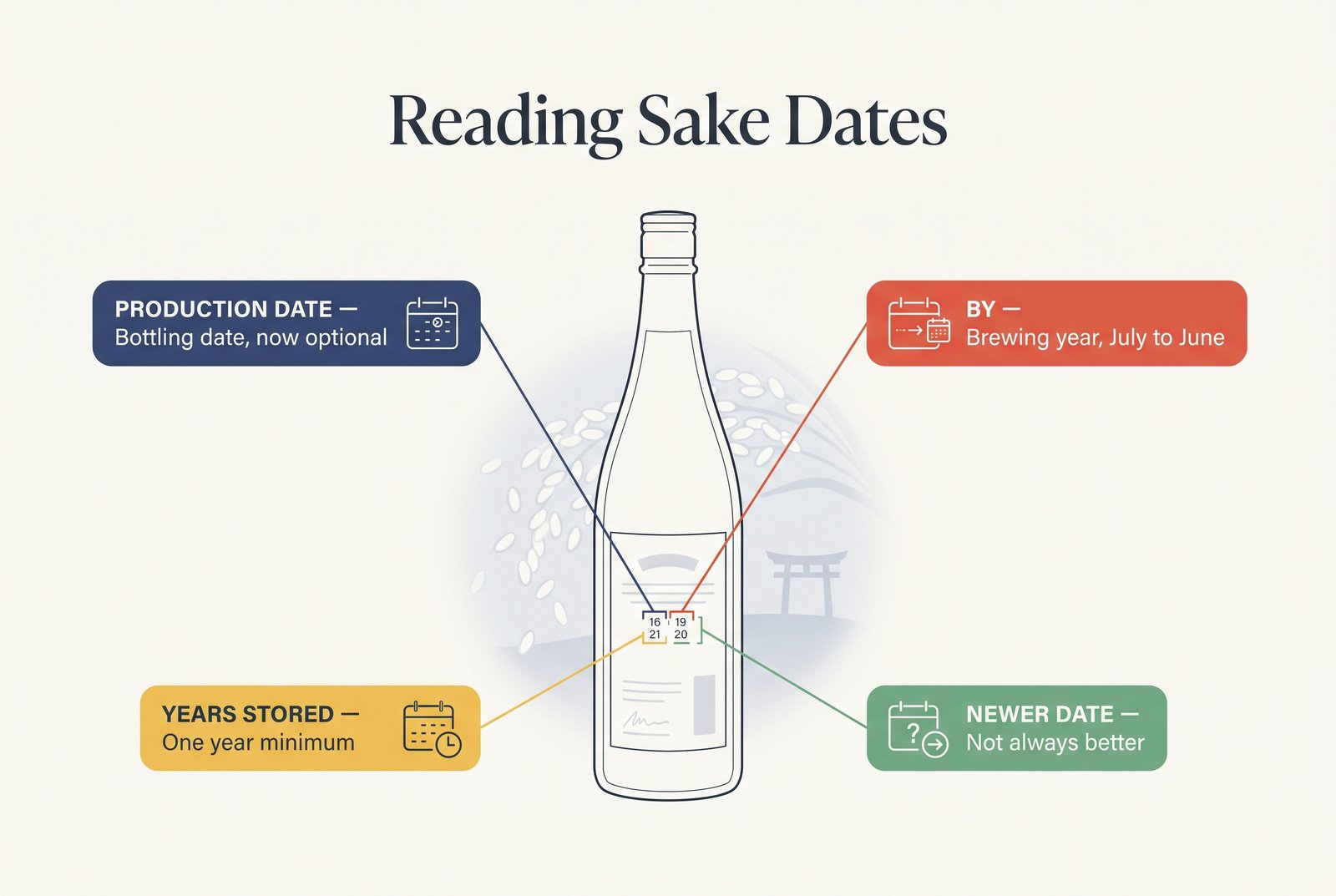
Dates confuse almost everyone. In most cases, the number you see is not an expiry date, and it is not the brewing date either.
Production Date vs Brewing Year
製造年月 (seizo nengetsu) means production date. The NTA defines it as the time the brewery filled and sealed the container for sale. In practice, then, it works like a bottling date.
Since January 1, 2023, this date has been optional. The NTA made the change so brewers could choose dates that suit each product. As a result, newer labels may drop it, while older bottles on a shop shelf will likely still carry it.
Brewing year is different. Labels sometimes show BY, as in R6BY or 2024BY. Because Japan’s brewing year runs from July 1 to June 30, R6BY covers July 2024 to June 2025.
Does a Newer Date Mean Better Sake?
Not always. Fresh, aromatic styles and namazake usually shine early, so a recent date helps. Sturdier styles and deliberate koshu, by contrast, can gain depth with maturation.
You may also see 貯蔵年数, the number of years stored. The NTA allows it only after at least one year, and brewers must round down.
A bottle filled 18 months ago has not necessarily deteriorated, either. How the shop stored it matters far more. A dusty bottle under hot lights deserves more suspicion than an older bottle in a cold case.
Geographical Indications: Where the Sake Comes From
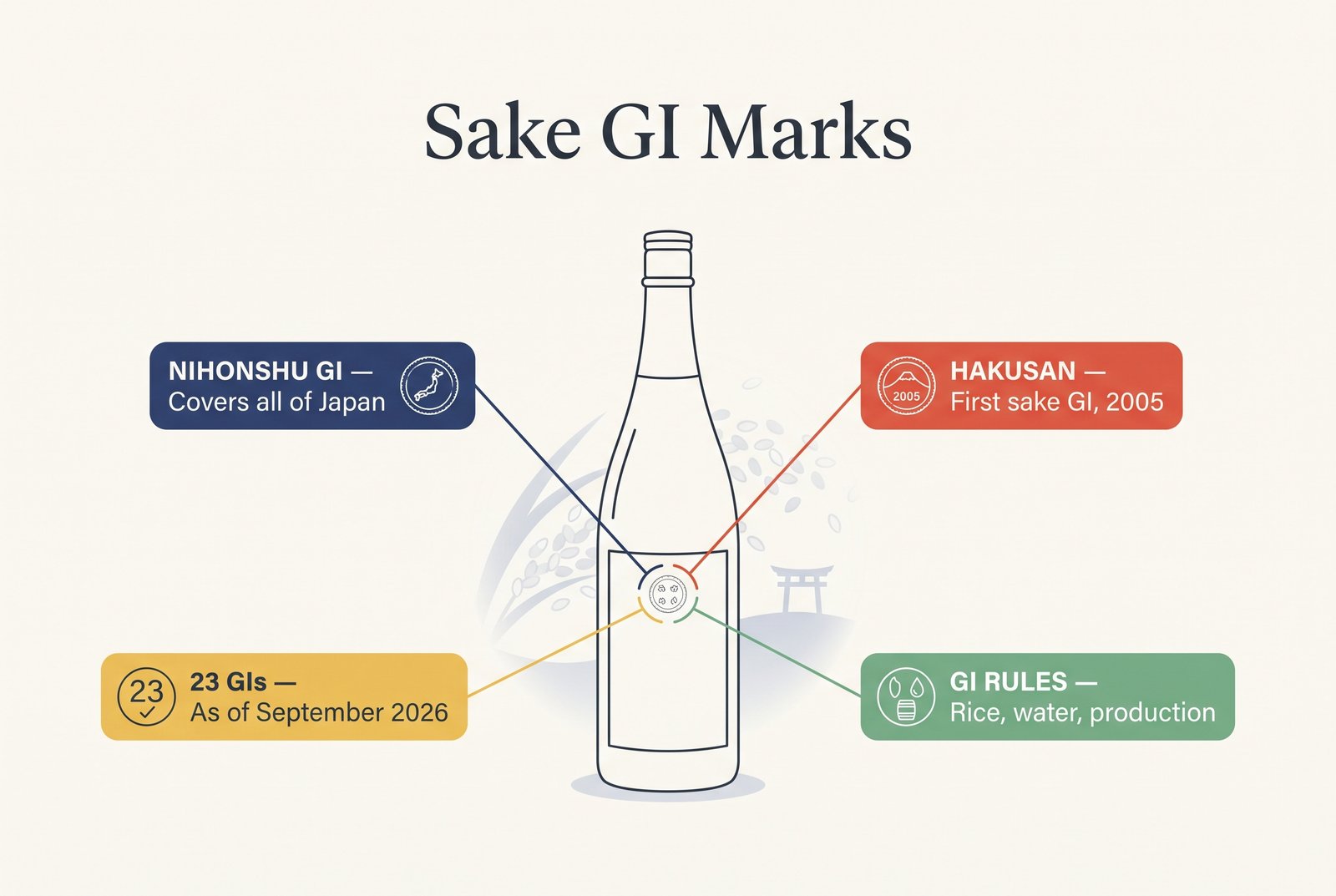
A GI mark links a sake to a place and a set of rules. Japan’s NTA grants these indications when a product shows qualities tied to its region. A local producers’ group then sets standards that each bottle must meet.
Hakusan in Ishikawa became the first sake GI in 2005. Later, in 2015, the name Nihonshu itself became a GI covering all of Japan. Since then, the list has expanded across the country. As of September 2026, the NTA register lists 23 sake GIs, including the nationwide GI Nihonshu and 22 regional designations. Prefecture-wide names include Yamanashi, Yamagata, Niigata, Nagano, Saga, Mie, Shiga, Iwate, Shizuoka, Aomori, Kyoto, Tottori and Fukuoka. Smaller districts include Hakusan, Nada Gogo, Harima, Itami, Hagi, Tone Numata, Minamiaizu, Kitakata and Shinano Omachi.
Kyoto, Tottori and Fukuoka joined most recently, on October 1, 2025. The list keeps growing, so check the NTA’s current GI register for the latest designations.
What a GI Mark Actually Promises
Here is the key point. A sake from Yamagata cannot print GI Yamagata automatically. Instead, it must meet that GI’s rules on ingredients, water and production, and those rules differ from place to place.
For example, the NTA’s summary of GI Yamagata requires water from inside the prefecture. The brewery must also produce, store and bottle the sake there. Because other GIs set their own conditions, the mark always means more than an address.
Region Names Without GI
Many labels name a prefecture or town without any GI. Under the NTA standard, a brewery may name an area only if it brewed all the sake there. So a blend from several regions cannot claim one place.
Regional style is real, but it is loose. Our guides to Yamagata, Hyogo, Nagano and Saga sake show how water, rice and habits shape each area.
Three Example Labels: Predicting Style From a Bottle
This is where everything comes together. We invented the three mock labels below for practice, so none of them evaluates a real product. For each one, the question stays simple: what does the label confirm, what does it suggest, and what stays unknown?
Light and aromatic
- KnownRice, rice koji and water only, milled to 55%
- LikelyA refined, aromatic style, so cool service is a good start
- UnknownThe aroma type, the rice and the yeast
Rich and structured
- KnownJunmai with a kimoto starter, 70% milling, 17% alcohol
- LikelyFuller body and firm acidity, so it may be worth trying warm
- UnknownSweetness, rice variety and storage history
Strong and fresh
- KnownUndiluted, unpasteurized and 18% alcohol
- LikelyBold aroma and body that change quickly once opened
- UnknownThe grade, since no designation appears, and the taste itself
These are broad tendencies, not tasting guarantees. Each label narrows the range of likely styles, yet none describes the exact taste.
Label One: Junmai Ginjo at 55%
The grade confirms rice, rice koji and water only, milled to 55%. The ginjo method suggests fragrance, and SMV +1 with acidity 1.3 hints at soft balance near the middle. A reasonable starting expectation is a refined, aromatic sake that suits cool service.
What stays unknown is the aroma type, whether melon, apple or something quieter. The label names no rice and no yeast, so texture and depth remain open questions too.
Label Two: Junmai With a Kimoto Starter
This label hides its biggest clue in a small phrase, 生酛造り. That single term points toward a savory, acidic backbone before you even check the acidity figure. Lighter milling at 70% and 17% alcohol then suggest more rice character and weight, so gentle warming may suit it.
Even so, the label cannot say how sweet the sake is, because it lists no SMV. Nor can it say which rice went in, or whether the shop kept it well.
Label Three: Namagenshu at 18%
Here, the words 生原酒 and 要冷蔵 matter more than any number. Together, they confirm that the sake is undiluted and unpasteurized, which usually means bold aroma and body. Keep it refrigerated before and after opening, and reseal it promptly. Then watch for changes in aroma and flavor rather than relying on one fixed number of days.
Notice what is missing, though. No grade name appears, so you cannot tell whether it is Junmai, Honjozo or futsushu. The gap between what a label confirms and what it suggests is where your own palate, and a shop clerk’s advice, come in.
Practice with real bottles next time you shop. The patterns start to feel familiar faster than most people expect.
What a Sake Label Cannot Tell You
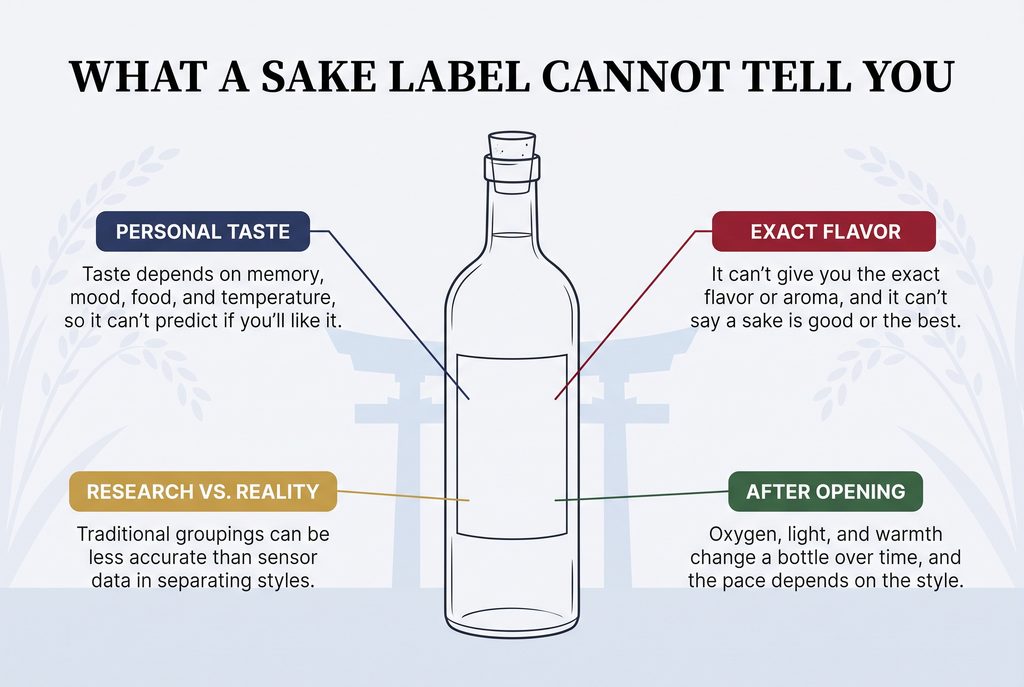
This section may be the most useful one on the page. After all, a label cannot tell you that a sake is the best, or even that it is good. It cannot give you the exact flavor or aroma either.
It also cannot predict whether you personally will like it, because taste depends on memory, mood, food and temperature. A perfect pairing on paper can fall flat at the table, and the reverse happens just as often.
Research backs up this caution. A 2022 study of 100 Japanese sakes compared the classic SMV-and-acidity grouping with taste-sensor readings. The traditional method crowded an unusually large share into one rich-and-dry group, whereas sensor data separated styles more clearly.
Labels also cannot show what happens after opening. Oxygen, light and warmth change a bottle over days and weeks. Since the pace depends on the style, fixed rules about days rarely hold.
A label is a map, not a complete tasting note. It helps you find the right neighborhood, but you still have to walk in and look around.
A 30-Second Sake Label Reading Method
In a hurry? Run through these seven steps in order. Once you know where to look, each one takes only a few seconds.
- Find the grade name.Junmai, Ginjo, Daiginjo, Honjozo, or none at all.
- Read the polishing ratio.Then think of it as what remains of each grain.
- Glance at the alcohol.Around 17% or higher can hint at genshu, so look for 原酒 to confirm.
- Look for a rice variety.Also note its share, such as 100% or 70%.
- Scan for special terms.Nama, genshu, muroka, koshu and kimoto matter most.
- Compare SMV and acidity.Do this only when the brewer lists them.
- Note any storage instruction.Above all, watch for 要冷蔵, keep refrigerated.
That is the whole routine. It works in a restaurant, a specialist liquor shop or a supermarket aisle. With a little practice, it really does take about thirty seconds.
If the label leaves you stuck, simply ask. Staff in specialist sake shops often enjoy the question, and pointing at the back label works in any language.
Common Misconceptions
Most label myths come from reading one number in isolation. Here are the ones that trip people up most often.
Myth60% polishing means the brewer removed 60%.
FactInstead, 60% of the grain remains, so the mill took away 40%.
MythDaiginjo is automatically better than Junmai.
FactThe grade describes production rules rather than universal quality.
MythJunmai means the brewer used no water.
FactBrewing needs plenty of water, but Junmai means no brewer’s alcohol.
MythSMV +10 means extremely dry.
FactSMV reflects density, so acidity, alcohol and temperature shape dryness too.
MythA newer date always means better sake.
FactStyles age differently, and storage matters more than the date.
MythBrewer’s alcohol means cheap sake.
FactIn fact, capped amounts appear even in Daiginjo.
MythThe label tells you exactly how it tastes.
FactIt offers clues about style rather than a full sensory description.
Read the whole label, however, and these myths tend to fall apart on their own.
Final Thoughts
You do not need to understand every Japanese word on a sake bottle. Instead, start with a few key numbers and terms, and let them work as clues. Grade name, polishing ratio, alcohol and one or two special terms will carry you a long way.
Admittedly, the first few bottles may still feel like a puzzle. That is normal. Each label you read makes the next one easier. Before long, the back label starts to read like a short note from the brewer.
From here, follow the path that interests you most. The type guides explain each grade in depth, while the brewing guides show where those numbers come from. The rice and regional guides then connect a bottle to the fields and towns behind it.
So next time a shop shelf feels overwhelming, turn one bottle around. More often than not, the answer sits right there on the back.
Sake Label FAQ
Grades and Ingredients
- What information must appear on a Japanese sake label?
-
A standard retail bottle sold in Japan normally shows the category word, ingredients, alcohol content, volume, and producer information. A grade name also requires a polishing ratio next to the ingredients. Sake shipped without heat treatment must add storage or drinking precautions, and imports must show their country of origin. Everything else, from rice variety to SMV, is the brewery’s choice.
- What does brewer’s alcohol mean?
-
Brewer’s alcohol, or jozo alcohol, is a neutral spirit that producers make by fermenting and distilling starchy or sugary material. In the non-Junmai special designations, including Honjozo, Ginjo and Daiginjo, the cap is 10% of the polished rice weight, calculated at 95% alcohol strength. Junmai grades cannot use it at all. Brewers add it because it lifts aroma and sharpens texture. It also helps protect sake against spoilage bacteria.
- What does the 60% or 50% number on a sake bottle mean?
-
That figure is the rice polishing ratio. It shows how much of each grain remains after milling, so 60% means the brewer removed 40%. Lower numbers usually lead toward lighter, more aromatic sake. They do not, however, guarantee a better bottle.
Numbers on the Bottle
- What does +5 mean on a sake label?
-
A figure like +5 is the nihonshu-do, or sake meter value. Positive numbers usually point to a drier sake, while negative numbers suggest more sweetness. Because the value measures density, alcohol and acidity also play a part. Treat +5 as a hint toward dry rather than a promise.
- What does the date on a sake bottle mean?
-
The 製造年月 date marks when the brewery filled and sealed the bottle for sale. It is neither a brewing date nor an expiry date. Since January 2023, printing it has been optional, so newer labels may omit it. A BY figure, by contrast, refers to the brewing year from July to June.
Special Terms and Storage
- What do Genshu, Nama and Muroka mean?
-
Genshu means the brewer did not dilute the sake with water, apart from a tiny adjustment. Nama means the sake skipped heat treatment entirely. Muroka indicates no conventional charcoal filtration, although the term has no legal definition. A label can combine all three, as in 無濾過生原酒.
- What does Yamada Nishiki mean on a sake label?
-
Yamada Nishiki is Japan’s best-known brewing rice, especially associated with Hyogo Prefecture, its leading production area. The variety is also grown elsewhere, so the rice name alone does not prove Hyogo origin. A brewery may name it only when it makes up over half the rice, and it must state the share. On its own, it does not fix the taste.
- How do I know if a sake needs refrigeration?
-
Look for 要冷蔵, which means keep refrigerated, or for the words 生酒 or 生原酒. Because unpasteurized sake must carry storage precautions, those notes are your clearest signal. Heat-treated sake is more forgiving, yet cool, dark storage still helps. After opening, most sake keeps better in the fridge.
- Can you tell if a sake is good just from the label?
-
Not really. A label tells you about ingredients, method, strength and origin, but it cannot measure quality or your personal taste. Research on sake taste classification also shows that label numbers lump many different sakes together. Use the label to narrow your choices, then trust your palate.
References
Government and Official Sources
- National Tax Agency – Overview of the Labeling Standards for Manufacturing Process and Quality of Seishu (「清酒の製法品質表示基準」の概要) (Accessed September 2026)
- National Tax Agency – Labeling Standards for Manufacturing Process and Quality of Seishu, NTA Notice No. 8 of 1989 (清酒の製法品質表示基準を定める件) (Accessed September 2026)
- Consumer Affairs Agency – NTA Report on Revisions to Liquor Labeling Rules, October 2022 (国税庁報告資料) (Accessed September 2026)
- National Tax Agency – Interpretive Notice, Article 86-6: Liquor Labeling Standards (第86条の6 酒類の表示の基準) (Accessed September 2026)
- National Tax Agency – Interpretive Notice, Article 86: Alcohol Content Labeling (第86条 関係通達) (Accessed September 2026)
- Tokyo Regional Taxation Bureau – 2025 Liquor Evaluation Competition: Categories and Brewing Year (令和7年 酒類鑑評会) (Accessed September 2026)
- National Tax Agency – Interpretive Notice, Article 3: Definitions of Acidity and Amino Acidity (第3条 その他の用語の定義) (Accessed September 2026)
- National Tax Agency – Official Analysis Methods for Liquor, Section 3: Seishu (国税庁所定分析法 3 清酒) (Accessed September 2026)
- Ministry of Agriculture, Forestry and Fisheries (MAFF) – The Situation of Rice for Sake Brewing, January 2026 (日本酒原料米をめぐる状況) (Accessed September 2026)
- National Tax Agency – Information on GIs Protected in Japan (Accessed September 2026)
- National Tax Agency – What Is the Geographical Indication System for Liquor Products? (pamphlet, March 2026) (Accessed September 2026)
Industry and Academic Sources
- Japan Sake and Shochu Makers Association (JSS) – How to Read Sake Bottle Labels (Accessed September 2026)
- National Research Institute of Brewing (NRIB) – Glossary of Terms on Sake Bottle Labels (Accessed September 2026)
- Aichi Center for Industry and Science Technology – On the Analysis of Sake: Acidity, Amino Acidity, SMV and Alcohol (清酒の分析について) (Accessed September 2026)
- J-STAGE – Sato, Kawashima and Maruyama (1974), Studies on the Taste of Sake, Report 3: Multiple Regression Equations for Sweetness and Richness, Journal of the Brewing Society of Japan 69(11) (清酒の味覚に関する研究 第3報) (Accessed September 2026)
- J-STAGE – Mapping and Classification of Sake Taste Based on Taste-Related Data, Science and Technology Research 11(1), 2022 (味関連データを基にした日本酒の味のマッピングと分類化) (Accessed September 2026)
Related Articles
- Bottling (瓶詰め): How Sake Becomes a Product (Surveyed: September 2026)
- Rice Polishing (精米歩合) (Surveyed: September 2026)
- Pasteurization (火入れ / Hiire): Stabilizing Sake with Gentle Heat (Surveyed: September 2026)
- Junmai Sake (純米酒) (Surveyed: September 2026)
- Ginjo (吟醸酒) (Surveyed: September 2026)
- Genshu (原酒) (Surveyed: September 2026)
- Namazake (生酒) (Surveyed: September 2026)
- Sake Rice (酒米): The Foundation of Premium Sake (Surveyed: September 2026)
- Types of Japanese Sake (Surveyed: September 2026)





Comments