Nagano Prefecture sits at the heart of Japan’s main island, surrounded by mountains on every side. Most visitors kNagano Prefecture sits at the heart of Japan’s main island, surrounded by mountains on every side. Most visitors know it for ski resorts and hot springs. Fewer realize it carries one of Japan’s most active and historically significant sake brewing traditions.
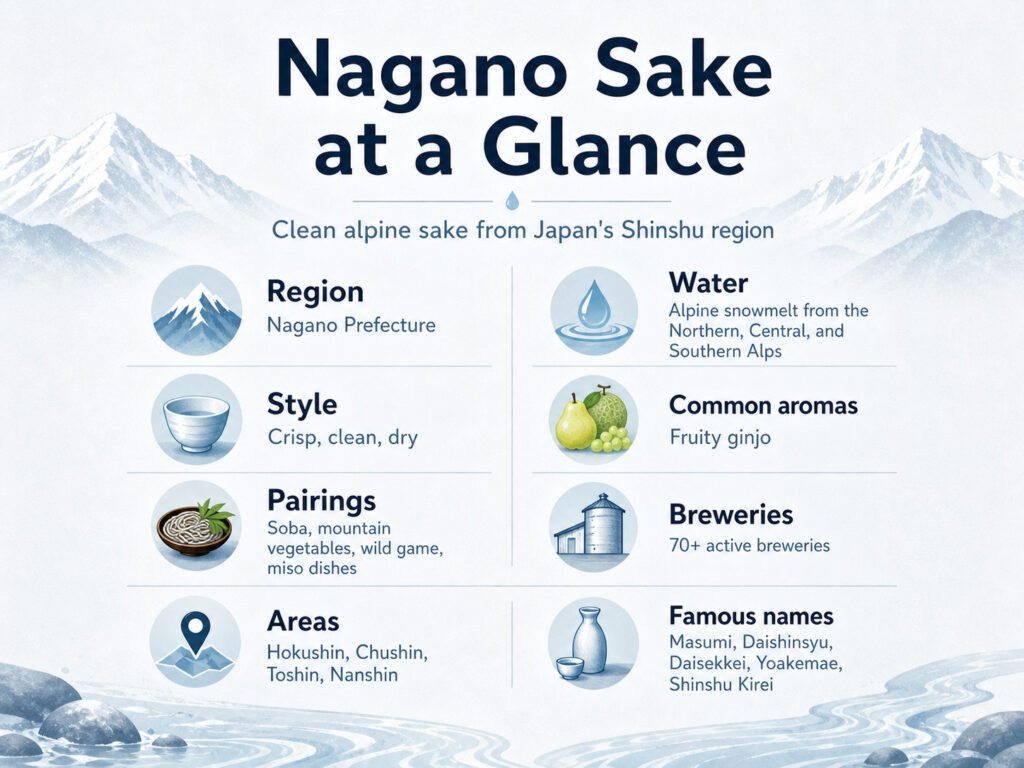
Sake from Nagano shares a second name: Shinshu sake. This name draws from the region’s historical designation as Shinano Province. That inland territory was shaped by alpine geography and cold, clear water. Today, Nagano hosts over 70 active sake breweries. That places it second in Japan by brewery count, behind only Niigata Prefecture. The density reflects a brewing culture grounded in local geography, not trend.
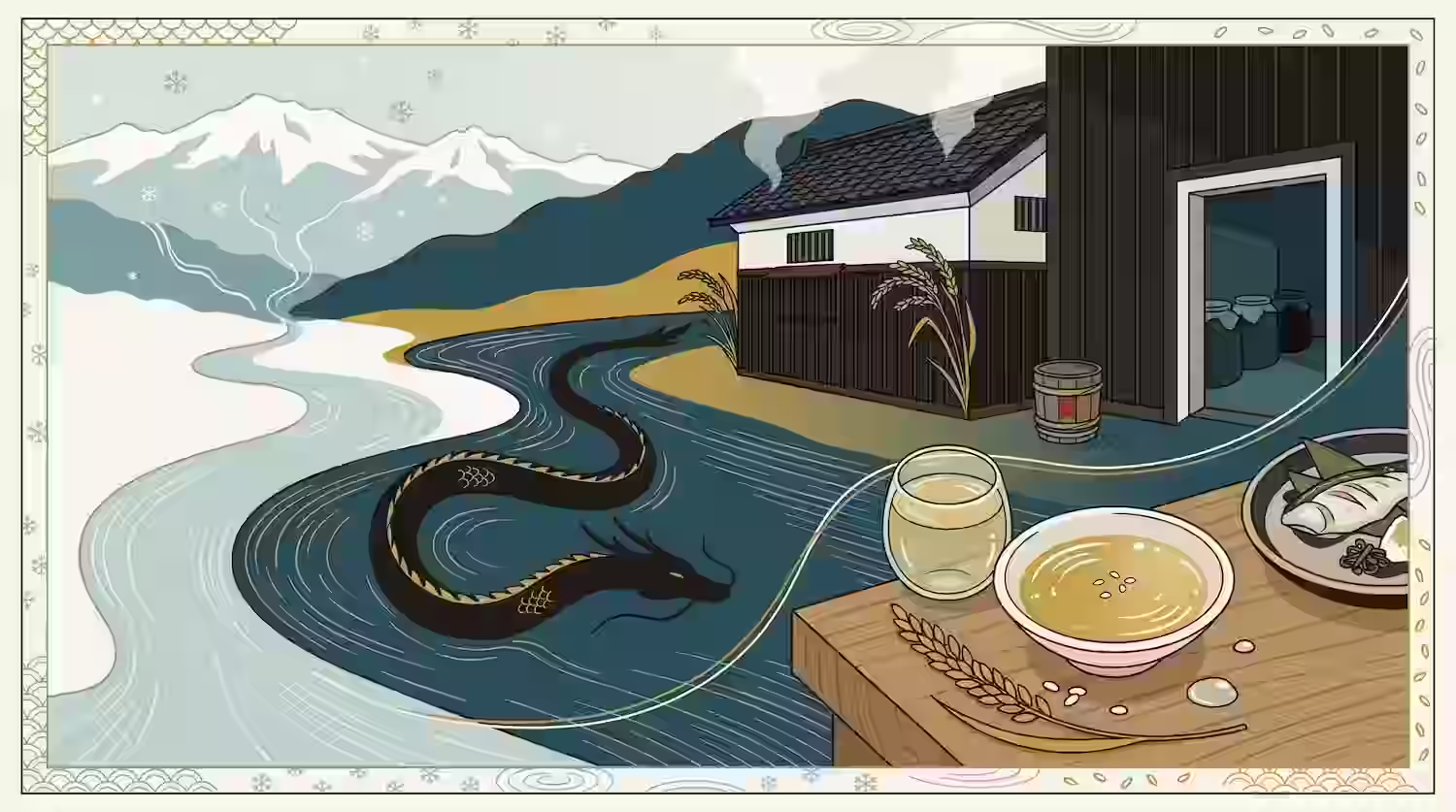
The core factors are straightforward: alpine snowmelt water, cold winters suited to fermentation, and generations of locally grown sake rice. Those same conditions still shape what ends up in the glass.
Water sits at the center of any serious discussion about Shinshu sake. The Japan Alps divide into three ranges surrounding much of the prefecture. These are the Northern Alps (Hida Range), the Central Alps (Kiso Range), and the Southern Alps (Akaishi Range). Snowmelt from all three feeds the rivers, lakes, and underground aquifers that local breweries draw from every season.
Much of this water falls into the soft-water category. Soft water is gentler on yeast during fermentation. This quality tends to produce sake with a refined, clean texture. Some pockets of medium-hard water also exist in eastern Nagano, giving structure to certain styles from that sub-region.
Cold winters provide a second structural advantage. Traditional sake brewing requires stable, low fermentation temperatures. Nagano’s mountain climate delivers this naturally, particularly from December through February. Many Nagano breweries use the traditional cold-weather brewing season known as kandori to its fullest extent here. Altitude reinforces the effect at higher-elevation sites around Matsumoto and Azumino.
Rice completes the picture. Nagano grows its own sake rice suited to high-altitude cultivation. Miyamanishiki is the most significant of these. It was developed in Nagano for cold-climate growing conditions and remains widely used across the prefecture. Other varieties include Hitogokochi and Kinmon Nishiki, both adapted to Nagano’s shortened growing season and wide daily temperature swings.
One historical event deserves specific attention. In the mid-1940s, the head brewer at Masumi’s Suwa brewery isolated a particularly vigorous yeast strain. The Brewing Society of Japan later registered it as Kyokai 7-go, or Brewing Society Yeast No. 7. This became one of the most widely used yeasts in Japanese sake production. Its origin at a Nagano brewery placed the prefecture at the center of postwar sake’s technical development.
Flavor Profile and Style Characteristics
Shinshu sake covers a wide stylistic range. Certain tendencies do appear consistently, though. Clean and crisp describe most Nagano junmai expressions. Good acidity runs through the body of many. The finish tends to be refreshing rather than heavy or rich.
Aromatic styles appear with genuine frequency in two specific areas. Fruity and aromatic ginjo from Nagano is particularly common around Suwa and in eastern Nagano near Ueda and Saku. These often show floral and stone-fruit notes with a lighter texture. It is worth noting that style diversity within the prefecture is greater than most regional sake categories in Japan.
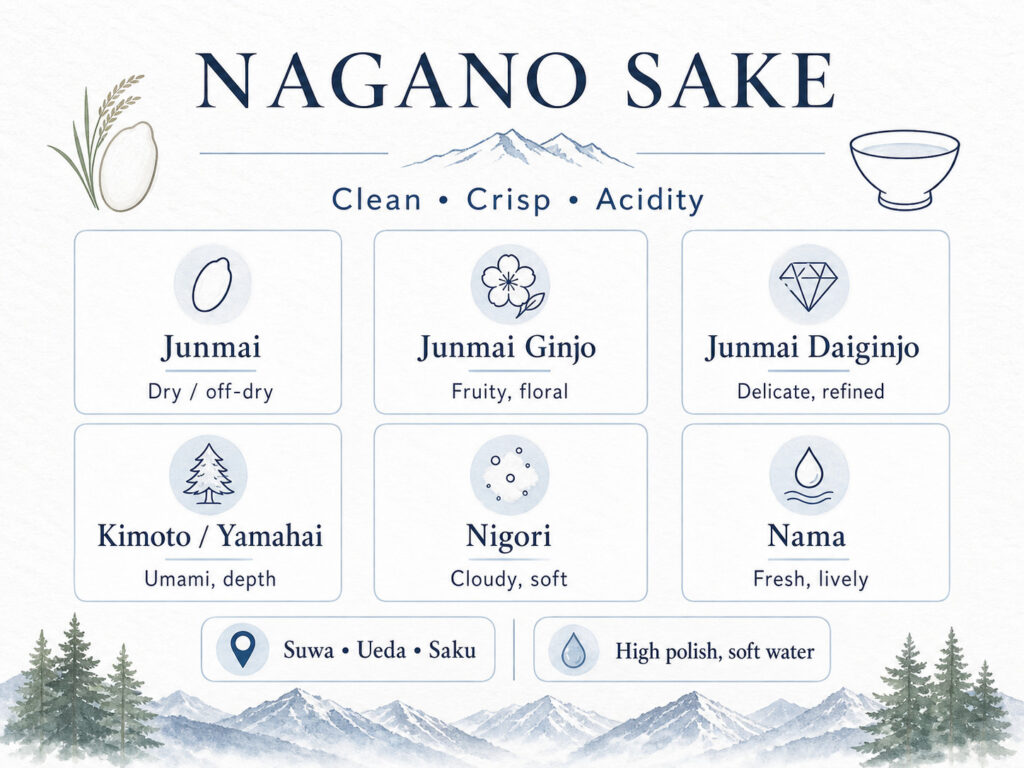
Here is a breakdown of typical characteristics by classification:
Premium Nagano junmai daiginjo performs well in national and international competitions. High polishing ratios combined with alpine soft water produce sake of real delicacy. Polishing philosophy varies across breweries, with some emphasizing expressiveness over convention. Nagano sake resists easy categorization, which is part of what makes systematic exploration rewarding.
The History of Sake in Nagano
Sake production in Nagano stretches back at least to the Edo period (1603 to 1868). Pinning down exact origins is difficult. What historical records make clear is that the Suwa region emerged as an early and important brewing hub.
The Suwa Taisha Grand Shrine, one of Japan’s oldest Shinto shrines, held significant cultural authority across the Suwa basin. This influence stretched across centuries. Festival culture tied to this shrine generated steady local demand for sake. Breweries began clustering around Suwa and neighboring Shiojiri during the 18th century. Many of those same operations continue today.
The Meiji era (1868 to 1912) reorganized sake production at a national scale. Government licensing replaced the informal structures of the Edo-period brewing economy. Several Nagano breweries expanded during this industrial transition period. Rail access after 1900 opened distribution channels beyond the mountains for the first time. Regional sake could move to Tokyo and Osaka markets with reasonable efficiency.
Postwar recovery brought the most consequential development in Nagano’s sake history. The isolation of Yeast No. 7 at Masumi in the mid-1940s gave the prefecture a central role in modern sake’s technical evolution. Interest in premium sake during the 1970s and 1980s created demand for clean, water-driven styles. Nagano breweries produced these naturally and benefited accordingly.
Today, Nagano sake holds a respected position in Japan’s premium market. Export volumes have grown, with particular traction in the United States, the European Union, and Taiwan. The mountain water narrative translates clearly to international consumers seeking authenticity.
The Four Brewing Regions of Nagano
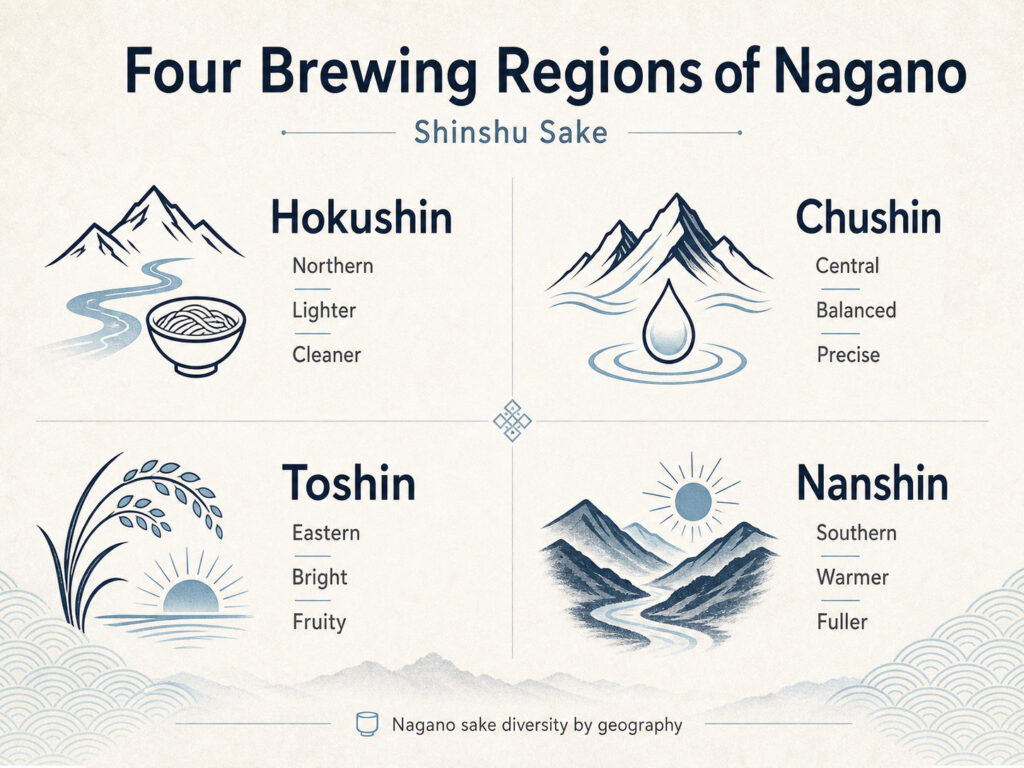
Nagano’s geography creates four recognizable brewing sub-regions. Understanding these helps explain the diversity within Shinshu sake as a category.
Hokushin (Northern Nagano) Nagano City, Suzaka, and the upper Chikuma River basin define this northern zone. Breweries here tend to produce lighter, cleaner styles. Endo Sake Brewery, maker of Keiryu sake, operates in Suzaka within this area. Food culture in the north centers on soba, mountain vegetables, and preserved foods, and local sake reflects those preferences.
Chushin (Central Nagano) The Matsumoto basin and Azumino anchor central Nagano. Daishinsyu Sake Brewery operates in Matsumoto. Daisekkei Sake Brewery operates in Azumino, directly below the Hotaka peaks of the Northern Alps. Water character in this sub-region is particularly clean. Sake from Chushin tends toward precise structure with good balance between body and finish.
Toshin (Eastern Nagano) Ueda, Komoro, and the Saku valley occupy eastern Nagano. Okazaki Shuzo, maker of Shinshu Kirei sake from Ueda, Nagano, and Saku no Hana Shuzo both base here. Rice cultivation in the broad Saku basin at altitude supports local ingredients. Toshin sake often shows brighter acidity and more pronounced fruity aromatics compared to western and northern styles.
Nanshin (Southern Nagano) The Ina Valley and Iida City define the southernmost zone. Relative to other areas, temperatures here run warmer. Sake from Nanshin tends toward fuller body. This area sees less brewery tourism than Suwa or Matsumoto, but local followings for its breweries remain strong.
Famous Nagano Sake Breweries and Brands
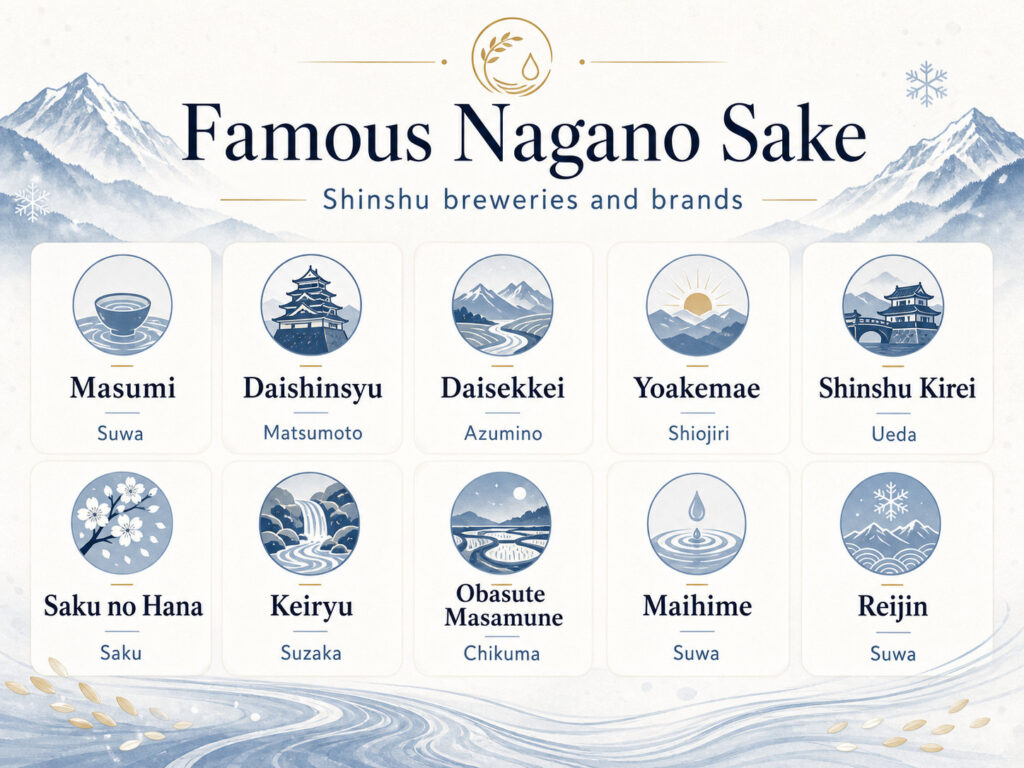
Nagano’s 70-plus breweries span from centuries-old institutions to newer craft operations. The following represent the most recognized names in Shinshu sake.
Masumi (真澄) – Miyasaka Brewing, Suwa
Miyasaka Brewing has operated in Suwa since 1662. Masumi sake by Miyasaka Brewing in Suwa, Nagano holds international recognition across multiple export markets. The brewery’s role in isolating Yeast No. 7 in the mid-1940s contributed something foundational to modern Japanese sake production. Masumi junmai ginjo from Suwa, Nagano is widely considered a regional benchmark. The brewery regularly exports to the United States and Europe.
Based in the Matsumoto basin, Daishinsyu focuses on premium junmai and daiginjo expressions. Daishinsyu daiginjo sake from Matsumoto, Nagano appears on high-end restaurant lists and specialty sake shop menus across Japan. The brewery draws water directly from Northern Alps sources.
Daisekkei (大雪渓) – Daisekkei Sake Brewery, Azumino
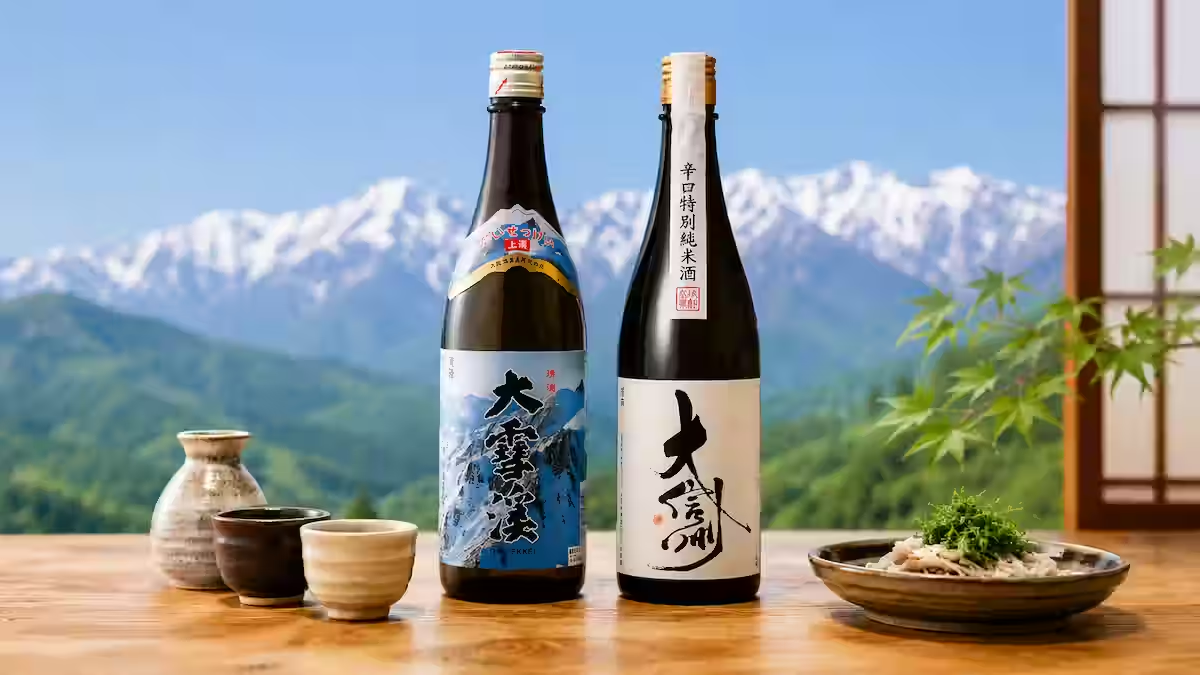
The name Daisekkei translates to “Great Snow Gorge,” referencing the dramatic snowfields above Azumino on the Hotaka massif. Daisekkei sake from Azumino is brewed with Northern Alps snowmelt water from this drainage. The brewery’s identity is inseparable from its alpine water source. Few sake producers in the prefecture express terroir this directly.
Yoakemae (夜明け前) – Ono Shuzo, Shiojiri
Yoakemae translates to “Before Dawn.” Ono Shuzo has operated in Shiojiri, at the convergence of the Kiso Valley watershed and the Matsumoto basin, for generations. Yoakemae premium sake from Shiojiri, Nagano balances junmai rice character with clean ginjo fragrance in its flagship expressions.
Shinshu Kirei (信州亀齢) – Okazaki Shuzo, Ueda
Okazaki Shuzo operates from the historic castle town of Ueda in eastern Nagano. Shinshu Kirei sake from Ueda, Nagano has seen strong domestic demand growth and steady export expansion in recent years. The brewery’s fruity, clean profile reflects the character of the Toshin sub-region well.
Saku no Hana (佐久乃花) – Saku no Hana Shuzo, Saku
Saku no Hana Shuzo works from a rice-growing basin at altitude. The brewery produces sake with a distinctive freshness. Cool fermentation temperatures and clean spring water at elevation shape its style.
Keiryu (渓流) – Endo Sake Brewery, Suzaka
Keiryu sake from Endo Sake Brewery in Suzaka reflects the lighter, cleaner style of northern Nagano. The brewery has operated for multiple generations. Its sake represents the understated quality found in the Hokushin zone with consistency.
Obasute Masamune (姨捨正宗) – Nagano Meijo
Named for the Obasute hillside in Chikuma City, a landscape associated with centuries of Japanese poetry and moonlit rice terraces, Nagano Meijo carries a cultural weight that few regional breweries match. The literary connection is part of the brand’s identity.
Maihime (舞姫) – Maihime Shuzo, Suwa
Maihime operates within the concentrated cluster of Suwa breweries. Its sake reflects the lake-basin character of central Suwa. The name translates to “Dancing Princess,” referencing local performing arts traditions tied to Suwa Taisha.
Reijin (麗人) – Reijin Shuzo, Suwa
Reijin rounds out the five breweries concentrated in Suwa City, collectively known as the Suwa Gojo. Its positioning toward aromatic, elegant profiles gives it a distinct niche within the cluster. The Suwa Gojo concentration makes this small city one of the most brewery-dense locations in Japan.
Sake Styles to Know
Nagano breweries produce most major sake types. Some styles appear with greater regional frequency.
Junmai and junmai ginjo dominate the premium lineup at most Nagano craft breweries. A crisp and clean Nagano junmai with good acidity is perhaps the single most representative style of the region. Ginjo expressions from Suwa and eastern Nagano lean toward floral and fruit-forward profiles.
Premium Nagano junmai daiginjo sits at the top of most brewery lineups. High polishing ratios and soft alpine water produce sake of real delicacy. Multiple Nagano breweries hold national competition awards in this category.
Kimoto and yamahai styles are available from select producers for those wanting deeper, more complex expressions. These traditional methods use natural lactic acid starters. The resulting sake carries higher acidity and richer umami than standard fermented styles.
Seasonal releases offer further range. Nama (unpasteurized) sake, shiboritate (freshly pressed), and hiyaoroshi (autumn-matured) styles cycle through the year at many breweries. These give reason to return to favorite Nagano producers multiple times annually.
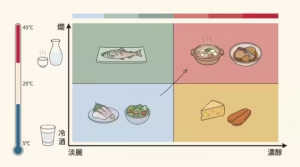
Food Pairings with Nagano Sake
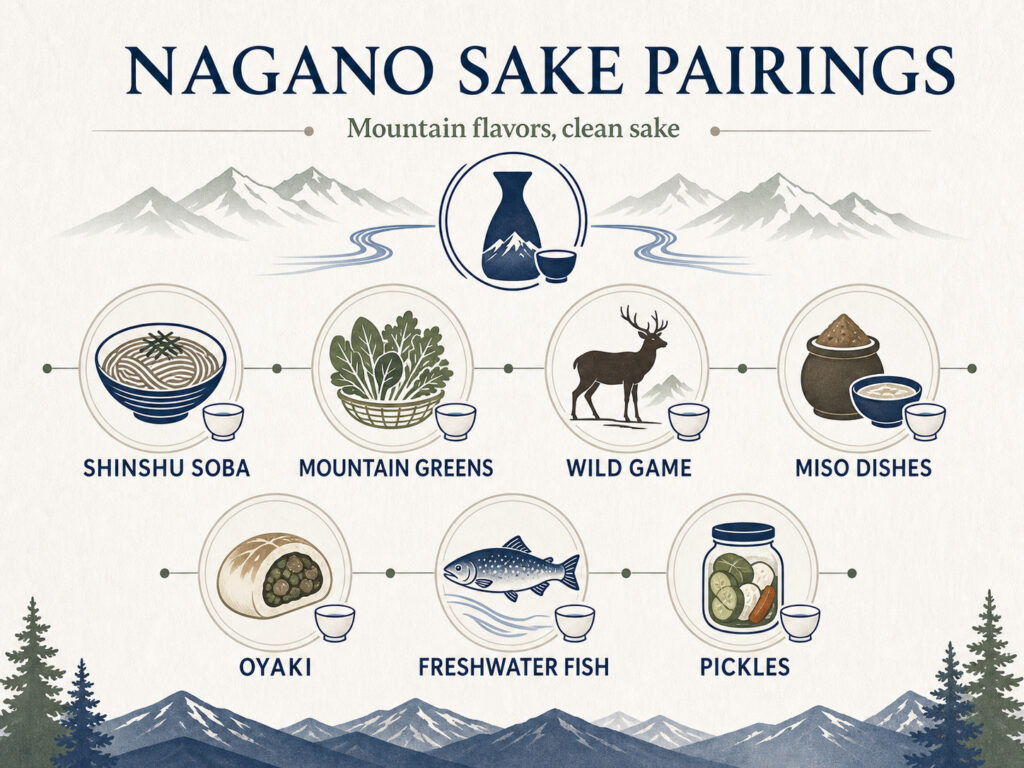
Nagano’s mountain food culture works naturally alongside its sake. The region’s cooking tradition centers on preserved foods, foraged ingredients, and hearty preparations suited to cold winters.
Shinshu Soba
Soba from Nagano ranks among the most respected in Japan. Buckwheat noodles carry earthy depth that matches the clean acidity of junmai sake without competing with it. Sake bars and soba restaurants across the prefecture pair the two as a matter of course. Togakushi-style soba and Shinshu zaru soba both work particularly well with dry, crisp sake styles.
Mountain Vegetables (Sansai)
Spring brings a range of foraged mountain greens to Nagano tables. Warabi (bracken fern) and taranome (angelica shoots) carry mild bitterness. This characteristic pairs cleanly with crisp, dry sake styles. The slight astringency of sansai finds balance in a clean-finishing junmai.
Wild Game
Venison and wild boar dishes are common in Nagano’s mountain towns. Heavier proteins call for more substantial sake styles. Yamahai junmai or kimoto expressions hold up well against these richer preparations. The elevated acidity in such styles cuts through fat without the sake disappearing into the background.
Miso-Based Dishes
Miso-zuke, the Nagano tradition of marinating fish and vegetables in miso, creates dishes with deep fermented character. Aged sake styles or kimoto expressions are the natural counterpart. The fermented depth in both the food and the sake creates a coherent pairing logic.
Oyaki
Oyaki are stuffed, griddled dumplings filled with vegetables, miso, or pickled greens. They are one of Nagano’s most distinctive local foods. Light, clean sake complements the savory filling without overpowering the subtle dough character.
Freshwater Fish
Rivers and lakes in Nagano yield iwana (char) and yamame (stream trout). Lightly chilled ginjo alongside grilled river fish is a pairing found at many traditional inns throughout the mountain areas. The combination is simple and effective.
Tsukemono and Pickled Foods
Nozawana pickles from northern Nagano are crisp and lightly sour. Dry junmai sake holds its own against this acidity. A related specialty, kasuzuke, uses sake lees as the pickling medium, creating 34qa natural flavor connection back to the sake itself.
Experiencing Nagano Sake
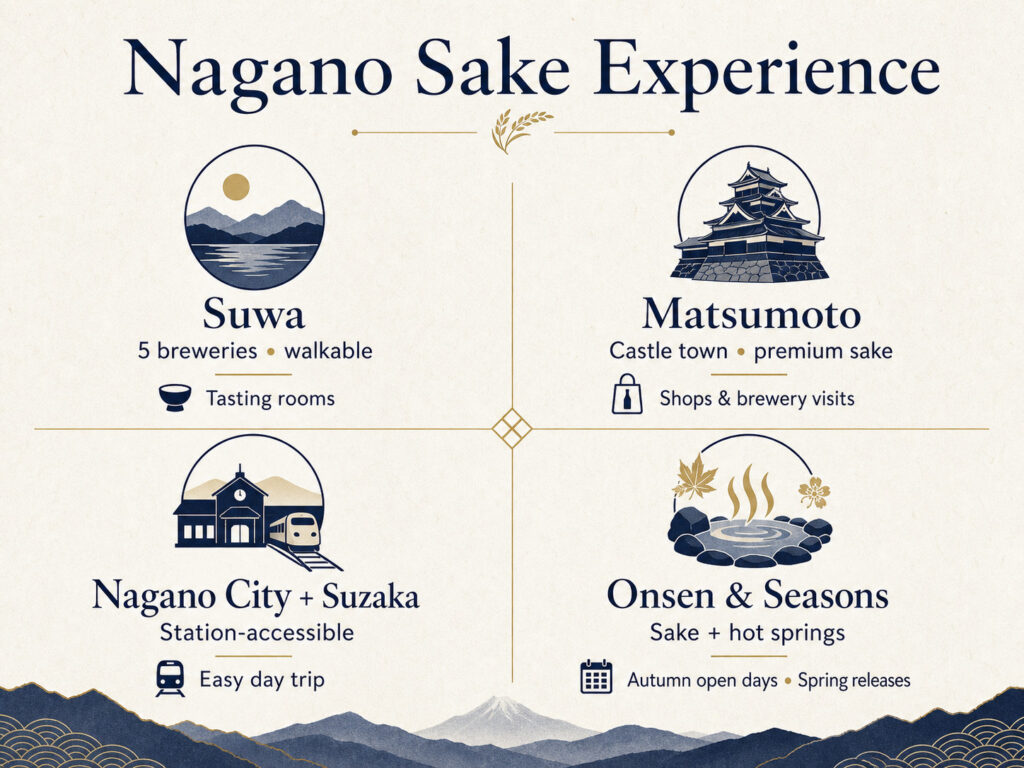
Suwa: Five Breweries Within Walking Distance The Suwa Gojo brewery route connects Masumi, Maihime, Reijin, and two additional breweries within the compact center of Suwa City. This Suwa five sake breweries course is among the most accessible brewery-hopping experiences in Japan. Most locations maintain tasting rooms. Lake views, cultural sites, and concentrated sake access combine here. Together they make Suwa a natural starting point for Shinshu sake tourism and brewery hopping in Nagano.
Matsumoto Matsumoto City combines sake access with broader cultural draws. Matsumoto Castle and the city’s arts district provide context beyond the breweries. Specialty sake shops and select brewery visitor facilities operate within the central city. Daishinsyu’s presence makes it a natural stop for premium sake seekers.
Nagano City and Suzaka Station-accessible sake breweries in Nagano within 15 minutes on foot from their respective train stations make these two stops practical for rail travelers. Nagano City and Suzaka are close enough to visit on the same day. The northern brewing style found here differs enough from Suwa to justify the side trip.
Sake and Onsen Traditional inns in onsen towns, including Nozawa Onsen, Shiga Kogen, and Yudanaka Onsen, serve local sake as part of multi-course kaiseki meals. The Nagano sake and onsen experience has become a recognized draw for domestic Japanese tourism. Autumn foliage season and winter are the peak periods. The pairing of cold mountain sake with a hot spring bath carries a practical logic that visitors remember.
Seasonal Open Days and Festivals Several Nagano breweries participate in autumn open-house events tied to hiyaoroshi sake releases. Spring events celebrating new-brew sake also occur at select locations. These events provide access to expressions that rarely appear outside the prefecture.
Final Thoughts
Nagano sake is harder to summarize than most regional categories in Japan. Its diversity, spread across four sub-regions and over 70 active breweries, covers much of the sake spectrum. The thread connecting most of it is water: alpine snowmelt character that runs through nearly every bottle in some form.
The Masumi yeast discovery of the mid-1940s adds historical depth that most visitors overlook. Nagano is not simply a scenic sake region. It contributed something foundational to modern Japanese sake production. That history deserves acknowledgment alongside the scenery.
For anyone exploring Japanese sake seriously, Nagano rewards sustained attention. Its breweries are diverse, its food culture coherent, and its mountain landscape gives the sake a strong sense of place. That sense of place translates clearly in the glass, which is ultimately what regional sake is supposed to do.
Nagano Sake FAQ
Why does Nagano have so many sake breweries?
Nagano benefits from alpine snowmelt water, cold winters suited to fermentation, and established local sake rice cultivation. These conditions supported brewing culture from the Edo period onward. The prefecture now ranks second in Japan by brewery count, with over 70 active producers.
What is the difference between Nagano sake and Shinshu sake?
There is no meaningful difference. Shinshu is the historical name for Nagano Prefecture, derived from its identity as Shinano Province. Shinshu sake refers to sake produced across any of Nagano’s four sub-regions. Both terms appear on labels and in regional marketing.
What type of water goes into Nagano sake?
Most Nagano sake uses alpine snowmelt from the Japan Alps. Water character varies by location. Suwa and Matsumoto area breweries typically use soft water, which produces clean, elegant sake. Some eastern Nagano sources run slightly harder, lending more structure to those styles.
Which Nagano sake brand has the broadest international recognition?
Masumi by Miyasaka Brewing in Suwa has the widest international distribution, reaching the United States, Europe, and across Asia. Shinshu Kirei has grown its export presence more recently and appears on a growing number of overseas sake menus.
What is the Suwa Gojo?
The Suwa Gojo refers to five sake breweries operating in close proximity in Suwa City. Visitors can walk between them. The concentration of breweries in one small city reflects Suwa’s long history as a brewing center tied to Suwa Taisha shrine culture.
What food pairs best with Nagano sake?
Shinshu soba is the most natural and historically grounded pairing. Mountain vegetables, freshwater fish, wild game, miso-marinated dishes, and nozawana pickles all work well with different Nagano styles. Crisp junmai expressions pair broadly with the prefecture’s mountain food culture.
What is Yeast No. 7 and why does it matter for Nagano sake?
Kyokai Yeast No. 7 was isolated at Miyasaka Brewing (Masumi) in Suwa during the mid-1940s. The Brewing Society of Japan registered and distributed it to breweries nationally. It became one of the most widely used yeasts in Japanese sake production. Its Nagano origin is a significant piece of modern sake history that the region deserves credit for.
Is Nagano sake generally dry or sweet?
Most Nagano sake leans toward the dry side, particularly in junmai styles. Ginjo and daiginjo expressions may show sweetness on entry but typically finish clean. The dominant impression across most Shinshu sake is crisp and refreshing rather than rich or heavy.
References
Nagano Sake Brewers Association (長野県酒造組合): https://www.nagano-sake.or.jp/ (Surveyed: 2024; regional classification data and active brewery count)
National Tax Agency of Japan (国税庁): https://www.nta.go.jp/ (Surveyed: 2023; licensed sake brewery count by prefecture, annual statistics)
Japan Sake and Shochu Makers Association (日本酒造組合中央会): https://www.japansake.or.jp/ (Surveyed: 2024; sake production statistics, regional classification, and export volume data)
Brewing Society of Japan (日本醸造協会): https://www.jozo.or.jp/ (Surveyed: 2023; Kyokai yeast registry, Yeast No. 7 history and distribution record)
Nagano Prefecture Agricultural Affairs Department (長野県農政部): https://www.pref.nagano.lg.jp/ (Surveyed: 2023; Miyamanishiki and local sake rice varietal data)
Ryo Iwa is the founder and editor of foodinjapan.org. Born and raised in Japan, he writes from regional travel, market visits, and Japanese-language primary sources that rarely reach English readers, including brewing institute publications and industry glossaries. Where a figure cannot be traced to a source, the article says so.
He has been a Google Maps Local Guide for over 10 years, with more than 1,800 reviews and over 41,000 photos viewed hundreds of millions of times. He previously spent two decades as an IT consultant in Japan, the US, and the UK.













Comments