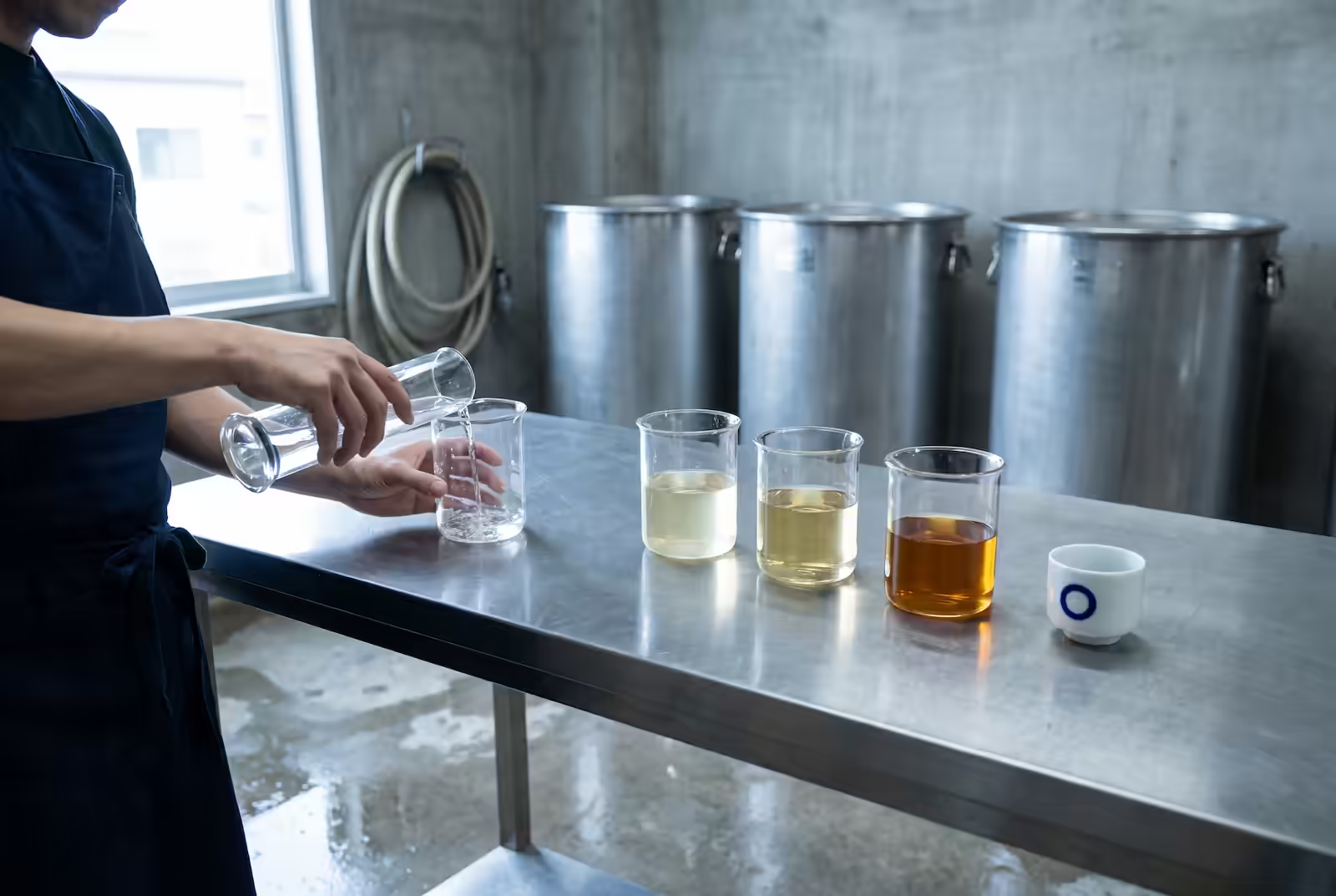
Two tanks of sake sit side by side in a storage building. Same rice, same yeast, same recipe, same brewing season. Yet one tastes rounder, while the other carries sharper acidity. So what happens next? Somebody tastes both, then decides how the finished sake should reach the bottle.
That decision belongs to chogo (調合), the blending and adjustment work that gives sake its final shape. This article explains what chogo covers, how it differs from warimizu and from the brewer’s recipe, and why breweries bother with it at all.
TOC
What Is Chogo (調合) in Sake Brewing?
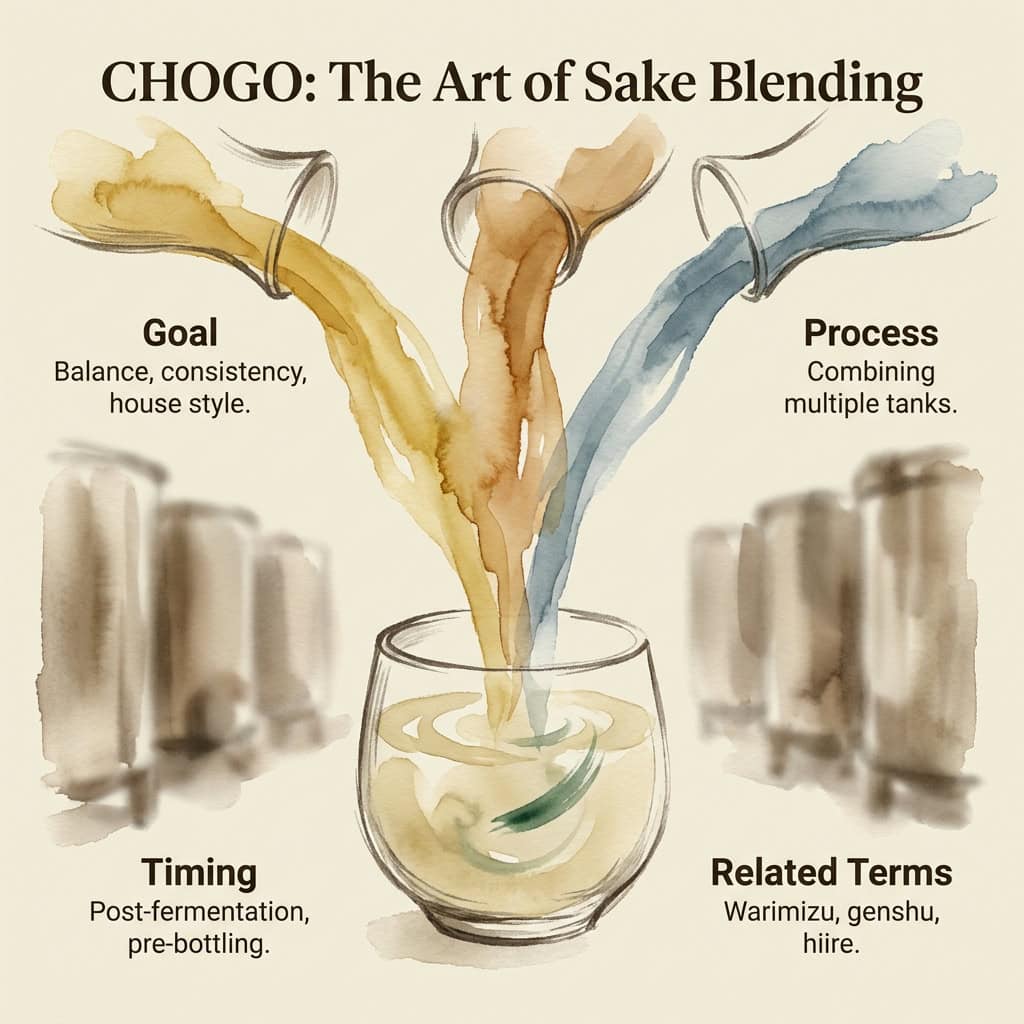
Illustration of sake blending process highlighting goal, process, timing, and related terms.
Chogo (調合) is the post-fermentation blending and refinement stage of sake brewing, in which liquid from different storage tanks is combined and balanced to reach a consistent house style and defined analytical specifications before bottling. Brewers may also fine-tune a single lot rather than combine several. In many breweries the wider finishing stage carries the longer name chogo-seisei (調合精製), meaning blending and refining.
Quick Facts
Japanese
調合
Romanization
Chogo
English
Blending / adjustment
Main purpose
Final composition and quality adjustment
Stage
Post-fermentation, pre-bottling (finishing phase)
Related terms
Warimizu, Genshu, Shikomi-haigo, Orisage, Hiire
Typical tools
Blending tanks, small trial blends, sensory tasting, chemical analysis
Goal
Balance, consistency, and the brewery’s intended style
A working term rather than a legal one
One point deserves care here. The National Research Institute of Brewing publishes a standard English list of sake terminology, and chogo does not appear on it. That list does include shikomi-haigo, warimizu, genshu, orisage and hiire, each with its own separate meaning. In other words, chogo is a practical shop-floor word rather than a defined technical category.
So this article treats chogo carefully. It means blending and final adjustment, and it often sits beside filtration and water addition. It does not mean every act of quality control in a brewery.
More than mixing two bottles
Chogo normally means combining several tanks, though the term stretches a little further in practice. People often picture it as pouring tank A into tank B, and that picture is not wrong, yet it is thin. The tank blending process can also mean combining pressing fractions, or holding back a small volume for later correction. Breweries sometimes apply the same finishing judgement to a single lot, under the wider heading of chogo-seisei. Straightforward dilution or filtration on its own, however, keeps its own name rather than becoming chogo.
Where chogo sits in the brewing calendar
Timing separates chogo from the noisy part of the season. Brewing runs through winter, and pressing follows in late winter or early spring. Storage then occupies the quiet months.
Blending happens when a product is due for release, which may be weeks or years after pressing. So the blending room stays busy long after brewing inside the traditional sake brewery known as a kura has finished for the season. In larger companies the two teams may barely overlap, and different people handle each stage.
What the seisei half covers
Seisei (精製) means refining, and it involves more than settling out sediment. Breweries adjust colour and aroma here with powdered activated charcoal, a treatment called tanso-roka, or carbon filtration. Polishing filters usually follow.
So chogo-seisei describes blending and refinement together. The two words travel as a pair because they happen in the same room, on the same tanks, under the same tasting judgement.
Chogo Compared With Other Sake Adjustments
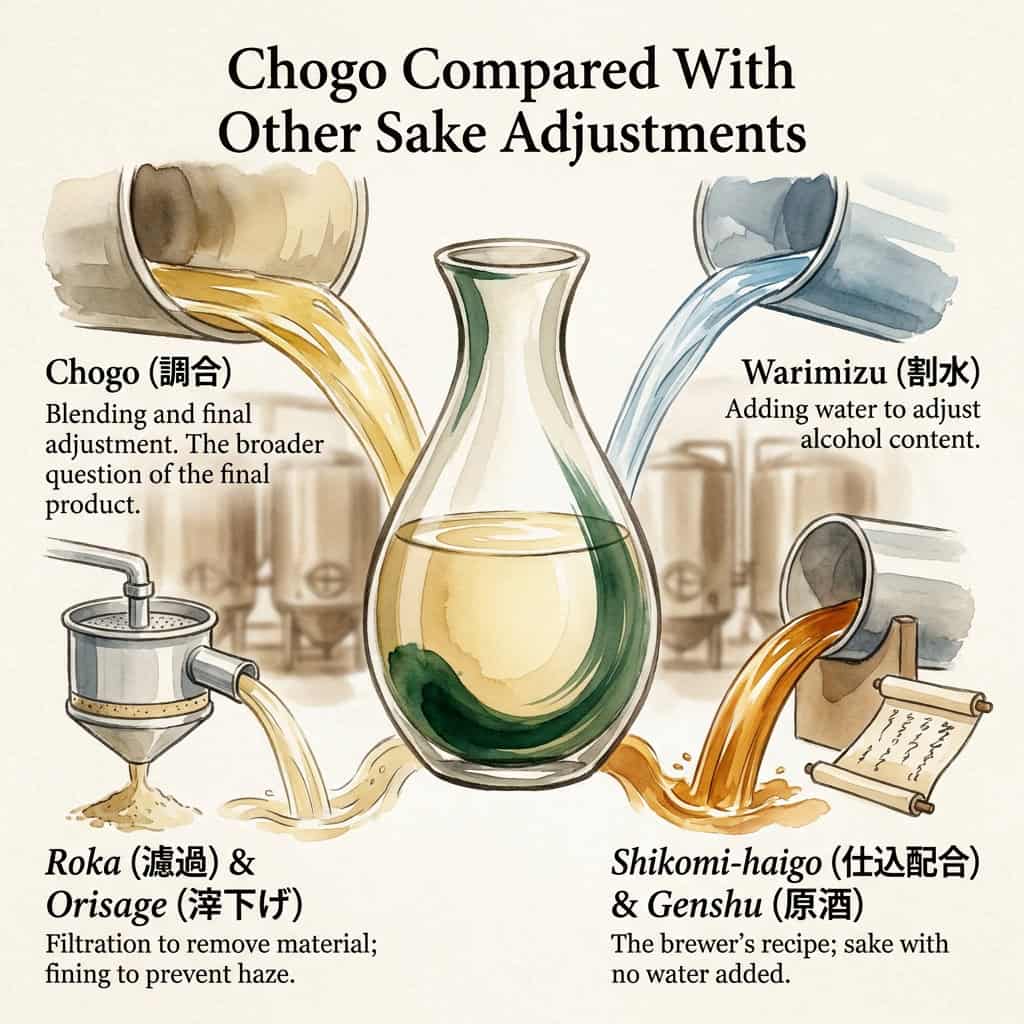
Illustration showing different sake blending and adjusting methods for consistent quality.
English-language sake writing blurs these words constantly. The Japanese terms, by contrast, stay quite tidy. Keeping them apart makes the finishing stage far easier to follow.
Concept
Japanese
Meaning
Chogo
調合
Blending and final adjustment
Warimizu
割水
Adding water to adjust alcohol content
Genshu
原酒
Sake with no water added for alcohol adjustment
Shikomi-haigo
仕込配合
The brewer’s recipe, set before fermentation
Roka
濾過
Filtration, including charcoal treatment
Orisage
滓下げ
Fining, to prevent haze after bottling
Why the overlap causes trouble
Each of these steps changes the liquid, so writers lump them together. Still, they answer different questions. Warimizu answers one question only: what should the alcohol content be? Filtration asks what should come out of the liquid. Orisage asks whether the sake will stay clear in the bottle.
Chogo asks something broader. Given what these tanks actually taste like, what should the final product be? Because that question sits above the others, chogo often appears in the same breath as them. Even so, it is not a synonym for any of them.
Not every addition of water is chogo
Adding water to lower alcohol has its own name, and that name is warimizu. A brewery might do warimizu without blending anything, or blend without adding water. The dedicated section further down covers that relationship in full.
Filtration and fining answer separate questions
Roka, or filtration, removes material from the liquid. Charcoal treatment belongs here, and it lightens colour as well as flavour. Orisage works differently, since it targets dissolved protein that would later turn the sake hazy.
Neither step blends anything. Both, however, run in the same building and often on the same day. That physical closeness explains why writers merge them, even though brewers keep the words apart on their records.
Why Do Brewers Blend Sake?
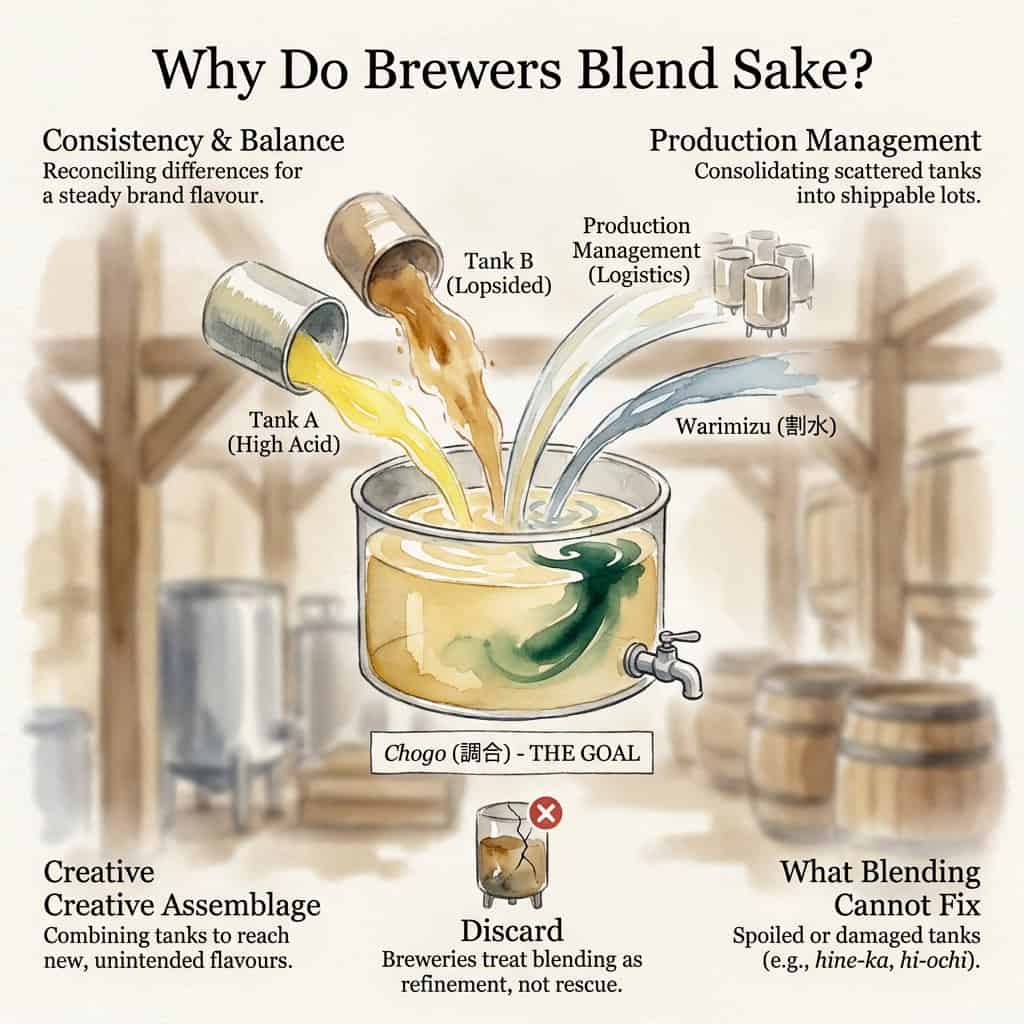
Illustration of sake blending process highlighting tanks, management, and discard methods.
The honest answer is unglamorous. Fermentation does not produce identical results, so somebody has to reconcile the difference between what came out and what the label promises.
Consistency across a brand
A drinker who buys the same bottle twice expects the same experience. Wine drinkers accept vintage variation happily. Sake drinkers, on the whole, do not. Blending lets a brewery deliver a steady flavour year after year, which is exactly what many customers want.
Balance and intended style
Sometimes a tank is simply lopsided. Acidity runs high, or aroma sits thin, or the finish drags. A second tank may lean the other way. Together they can give something better than either alone. That is the appealing part of chogo, and brewers talk about it with real pleasure.
Practical production management
Breweries also blend for ordinary reasons. Large producers run dozens or hundreds of storage tanks. Bottling lines need volumes that rarely match a single tank. Blending therefore turns scattered tanks into shippable lots, which is quiet logistics rather than artistry.
Blending across brewing years
Sake carries a brewing year, or BY, which Japan’s National Tax Agency defines as 1 July to 30 June of the following year. Products aimed at consistency may draw on more than one year, provided the sake has been stored properly.
Cross-year blending sounds like cheating to some drinkers. In practice it stabilises a brand through a difficult harvest, and it uses matured stock that would otherwise sit idle. Breweries pursuing a single-year identity avoid it deliberately, and they usually say so on the label.
Blending to create something new
Not all blending chases uniformity. A growing group of brewers treats sake assemblage as a creative act, combining tanks to reach flavours that no single fermentation produced. Craft sake producers and small experimental labels have pushed this hardest.
The logic here mirrors winemaking more than routine production. One tank supplies acidity, another supplies aroma, and the blend becomes the intended product rather than a correction. Such releases usually say so on the label, since the blending is the selling point.
Sake assemblage compared with wine and whisky
Comparisons with other drinks help, provided they are handled carefully. Bordeaux assemblage combines grape varieties into a wine, and the vintage stays part of that wine’s identity. Whisky vatting and solera systems instead build a house character across many casks.
Sake blending sits closer to the whisky model. Most sake assemblage aims to hold a brand steady rather than to express a particular year. Vintage variation certainly exists, yet breweries usually absorb it rather than advertise it. That difference explains why sake labels rarely mention a harvest at all.
Worth remembering: blending does not automatically improve sake. A careless blend can flatten character just as easily as a careful one can round it out. The skill lies in the judgement, not in the act.
What blending cannot fix
Blending corrects imbalance, yet it cannot repair a damaged tank. A spoiled lot stays spoiled, and spreading a fault across a larger volume simply spreads the fault. Several problems resist it entirely.
Oxidised aromas, known in Japanese as hine-ka
Microbial spoilage, including hi-ochi, the spoilage caused by ethanol-tolerant lactic acid bacteria
Harsh bitterness or heavy astringency
Off-flavours carried over from poor koji or a stalled fermentation
Breweries therefore treat blending as refinement rather than rescue. If a tank fails at tasting, it usually leaves the product line altogether. Some of it goes toward lower-grade sake, and some heads for distillation or disposal. The decision is costly, since a full tank represents months of work.
Why Do Different Sake Batches Taste Different?
Batch-to-batch variation is the reason chogo exists at all. Two tanks built from the same written recipe will not match exactly. Brewers take this for granted, and it surprises almost everyone else.
Where the differences come from
Rice from different fields, or different harvest years
Small variation in polishing, washing and soaking
Koji that grew slightly faster or slower
Yeast behaviour and starter condition
Fermentation temperature and duration
Pressing timing and which fraction was collected
Storage temperature and how long the tank rested
Each factor shifts things only a little. Together, though, they add up. The behaviour of koji mould during koji making matters most, since enzyme activity drives everything downstream. Sake fermentation then amplifies whatever the koji handed over.
Even a single tank is not uniform
Pressing adds another layer of variation, and this surprises people. Sake does not leave the press as one consistent stream. The first run is arabashiri, the free-run sake that emerges before real pressure is applied, and it tastes lively and slightly rough. Next comes nakadori, the balanced middle portion of the pressing. Later pressings run heavier and firmer.
Brewers can keep these fractions apart or recombine them. Recombining is itself a small act of blending, though it happens well before storage. So variation exists inside one batch, not only between batches. Chogo therefore starts from a more complicated raw material than most descriptions suggest.
A recipe is not a guarantee
Brewers write down rice weights, water volumes and target temperatures in careful detail. Even so, sake is a living process. Microbes respond to conditions that no document can fully control. Technical material published by Asahi Shuzo, the Niigata maker of Kubota, makes the same point: sake behaves as a living thing, and flavour differs subtly between storage tanks even within one brand.
That gap between plan and outcome is precisely the space chogo occupies.
Chogo and the Brewer’s Recipe (Shikomi Haigo)
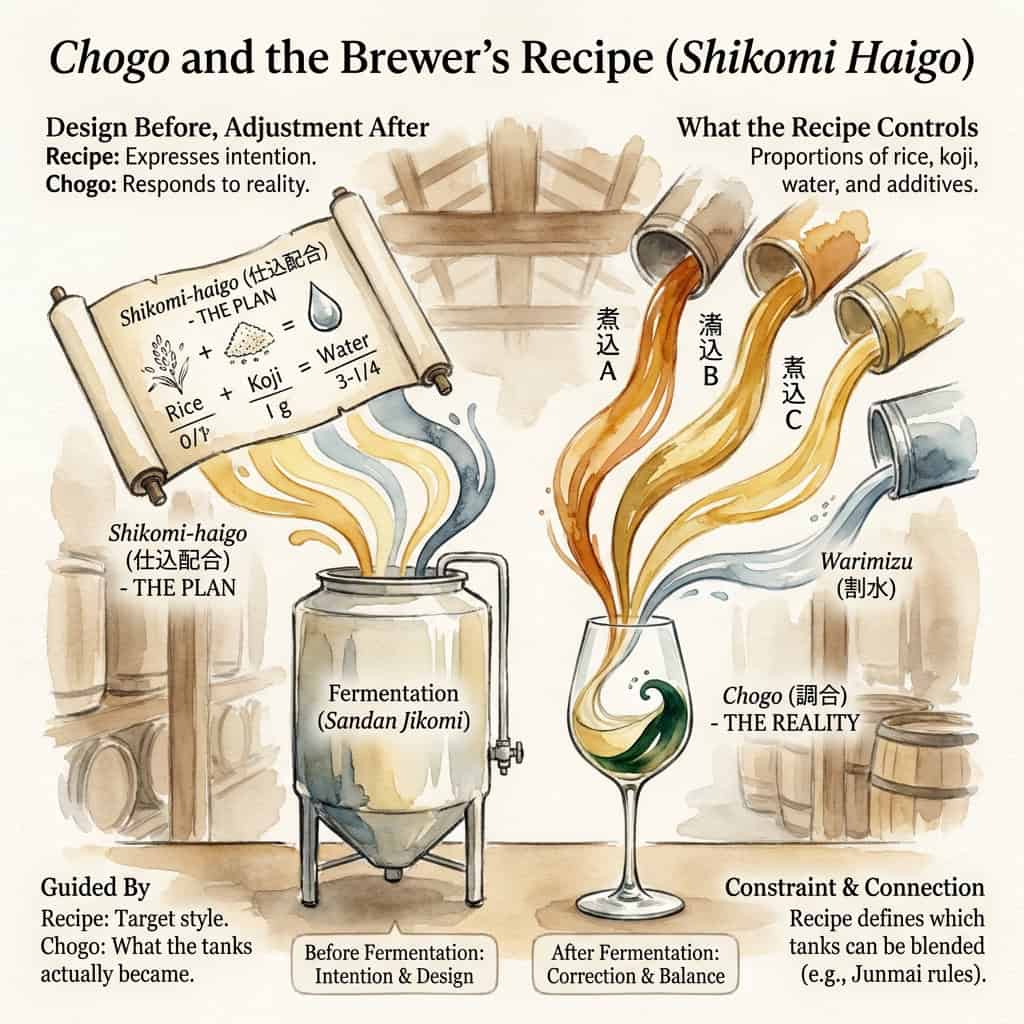
Shikomi-haigo (仕込配合) is the brewer’s recipe. According to the National Research Institute of Brewing, it comprises the amounts of steamed rice, koji, water, and additives such as alcohol. It is a plan, written before anything ferments.
What the recipe controls
The recipe sets proportions rather than outcomes. It fixes how much rice becomes koji, and how much water joins the mash. The plan then splits additions across the stages of the three-step mashing method known as sandan jikomi. Finally, it records whether brewing alcohol will appear, and in what quantity.
Our separate guide to the shikomi haigo covers those numbers in more depth. For now, one distinction matters above all.
Design before, adjustment after
Shikomi-haigo
Chogo
When
Before fermentation
After fermentation
Acts on
Raw materials
Finished sake
Nature
Design decision
Corrective decision
Guided by
Target style and experience
What the tanks actually became
Effect on alcohol
Indirect, through fermentation design
Direct, alongside warimizu
Reversibility
Irreversible once fermentation starts
Adjustable through trial blends
Put simply, the recipe expresses intention. Chogo responds to reality. A brewery that gets the recipe right still needs the second stage, because fermentation never obeys perfectly.
Why the recipe still matters at blending time
Blending decisions lean on the recipe even months later. If two tanks share a recipe, their differences came from execution rather than design. That narrows the search when something tastes wrong.
Recipes also constrain what a brewery may combine. Junmai cannot absorb sake containing brewing alcohol without losing its designation. Ginjo cannot take material milled at a lower rate. In practice, therefore, the recipe defines the pool of tanks available for any given product.
Chogo and Warimizu
Warimizu deserves its own explanation, since it is the step most often mistaken for chogo.
From genshu to bottling strength
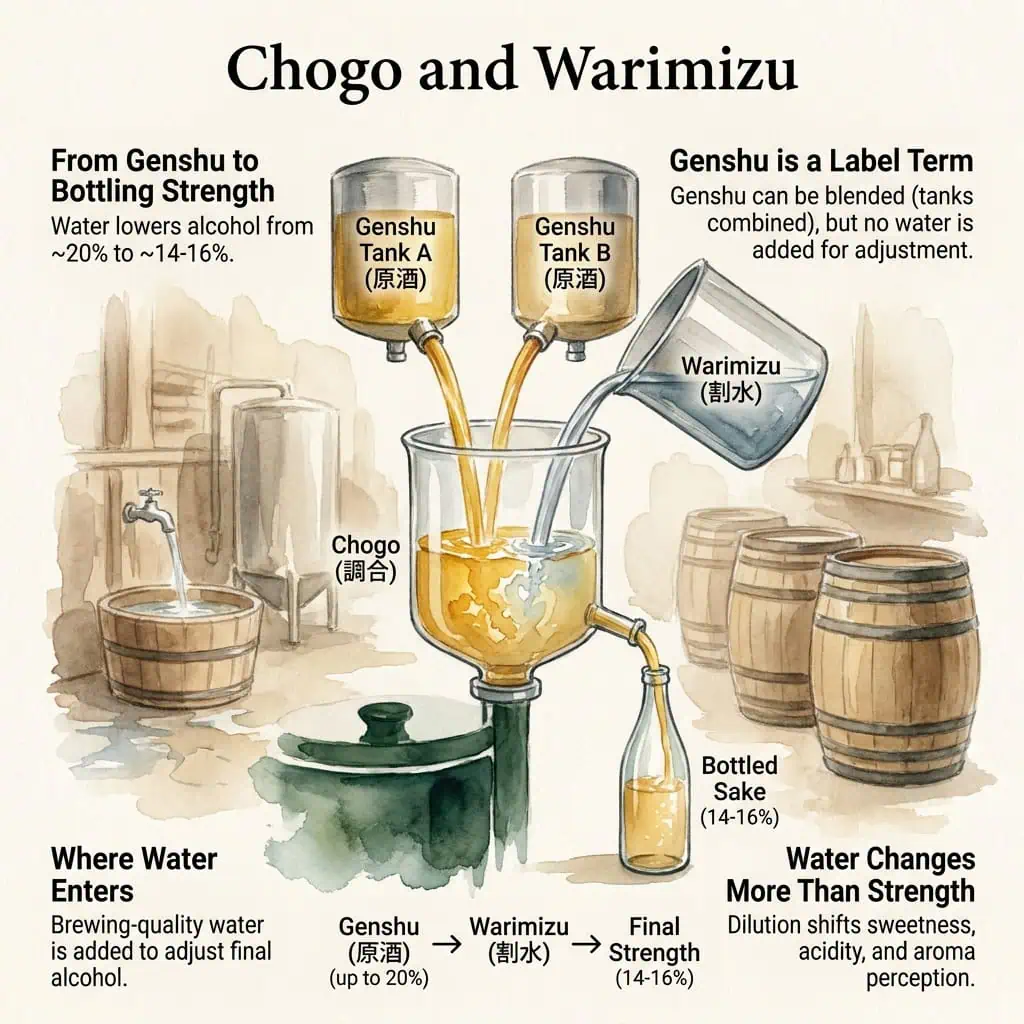
Sake leaves the press at high strength. The National Research Institute of Brewing notes that undiluted sake contains up to 20 percent alcohol, and that brewers usually bring it down to 14 to 16 percent before bottling. Water does that work, and Japanese calls it warimizu.
Where water enters
Genshu Pressed sake, no water added for alcohol adjustment
Warimizu Brewing-quality water added
Final strength Usually around 14 to 16 percent
Genshu is a label term, not a rejection of blending
Genshu can be blended, which surprises many drinkers. The term means no water was added for alcohol adjustment, so it says nothing about whether tanks were combined. Japanese labelling rules also allow one narrow exception, since breweries may adjust alcohol within a range of less than one percent to even out batch variation. A brewery can therefore blend two genshu tanks and still label the result genshu.
Water quality matters as much as quantity, incidentally. Our guide to water in sake brewing explains why breweries treat dilution water with the same care as brewing water.
Water changes more than strength
Dilution is never neutral. Lowering alcohol shifts how sweetness, acidity and aroma register on the palate. A sake that felt tight at 18 percent may open up considerably at 15.
Volume explains the caution. Water can account for a substantial share of the finished liquid, so poor water leaves a mark. Iron is the classic enemy, since even small traces darken sake and dull its aroma. Breweries therefore filter and test dilution water carefully, and many treat it as an ingredient rather than a utility.
Chogo and Brewing Alcohol
Brewing alcohol, or jozo alcohol, is distilled alcohol used in certain sake. The topic attracts strong opinions, so it helps to separate fact from folklore.
When it enters, and why
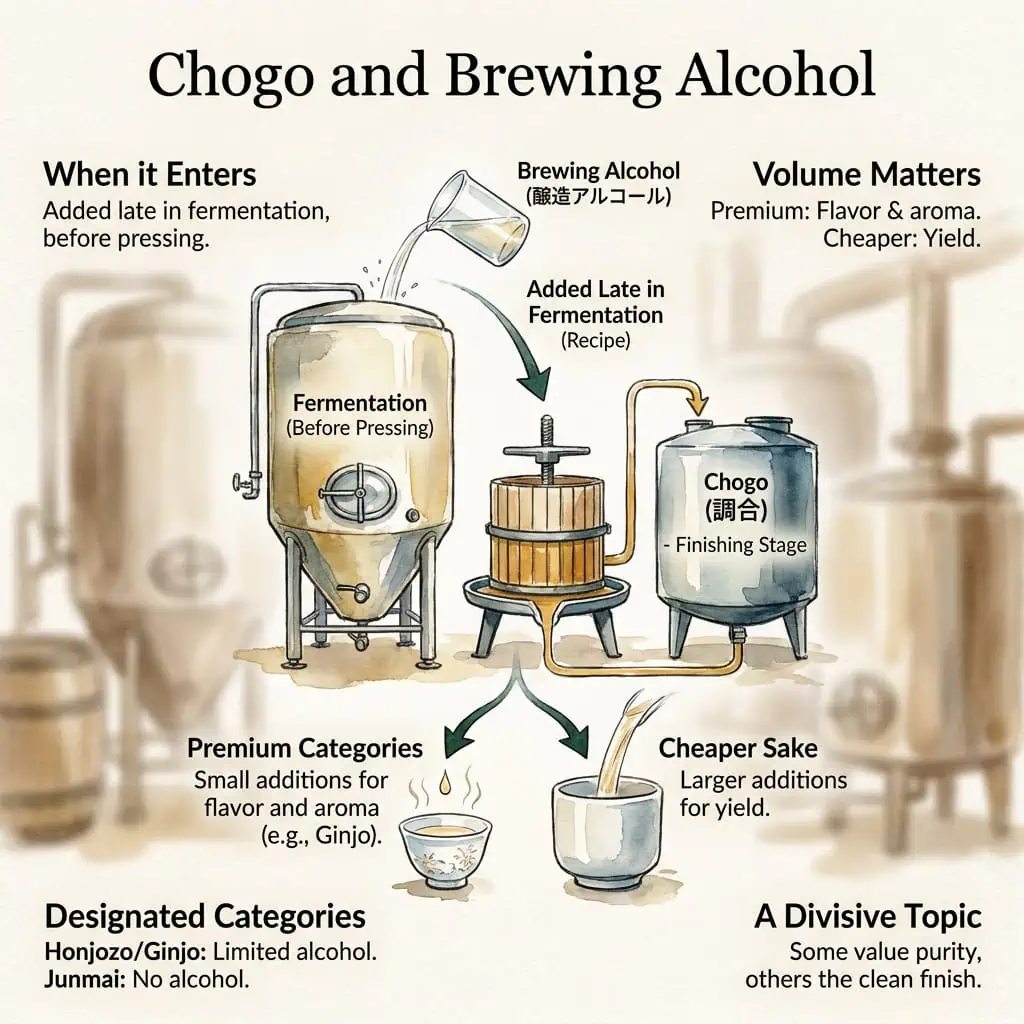
Brewers add it late in fermentation, before pressing. So it belongs to the recipe rather than to chogo, strictly speaking. Small additions pull aromatic compounds out of the mash and into the liquid. The result often reads as lighter and cleaner, with sharper aroma.
Volume matters enormously. In premium categories the addition stays small and serves flavour. In cheaper sake it may serve yield instead, which is a different exercise entirely.
The link to designated categories
Honjozo permits a limited amount of brewing alcohol, while junmai permits none. Ginjo and daiginjo may include it, again within limits. Junmai sits apart because it uses rice and koji only.
None of this makes brewing alcohol a shortcut. Plenty of award-winning daiginjo contains a measured addition, and tasters rarely object.
A subject that still divides drinkers
Opinions run warm here, and both sides have a case. Some drinkers value junmai for its purity of method. Others find that a small alcohol addition produces exactly the clean finish they enjoy.
The practical point is narrower. Whether alcohol appears at all belongs to the recipe, not to the finishing stage. Confusing the two leads people to imagine brewers topping up tanks with spirit at the end, which is not what happens.
Blending and Sensory Evaluation
Tasting decides chogo, while numbers only guide it. Japanese brewers call that formal sensory evaluation kikizake (利き酒), and it runs alongside every analytical check.
What tasters actually judge
A taster works through aroma first, then sweetness, acidity, umami, alcohol sensation, body and finish. Balance sits above all of them. The traditional vessel is the janome-choko, a white porcelain tasting cup marked with blue concentric rings on its base. Those rings make colour and clarity easy to read.
This stage remains the most human part of sake production. A blender stands at a tank, sips, pauses, then commits to a decision that thousands of bottles will carry. No instrument replaces that pause.
Trial blends before the real thing
Sensible breweries never blend blind. They prepare small trial blends first, taste them, and only then commit the full tanks. Asahi Shuzo describes running miniature test blends through a small filter before committing to production volumes. That rehearsal protects a great deal of sake.
Tasting continues afterwards too. Breweries check the liquid at blending, at filtration, at transfer, and again after water addition. Repetition sounds tedious, yet it catches problems while correction remains possible.
Training a palate takes years
Nobody arrives able to do this well. Blending staff learn by tasting the same brands repeatedly across seasons, building a mental reference for what each product should be.
Calibration matters too. Palates drift with fatigue, temperature and time of day, so breweries taste under consistent conditions. Sensory panel testing helps here, since several tasters compare notes before anyone commits. Disagreement is useful rather than awkward, because it exposes assumptions that a single taster would never question.
This is where sake finally becomes sensory rather than technical. Aroma sits at the front, umami spreads across the middle, and the finish either lingers or fades. Getting that shape right is genuinely difficult, and palate fatigue arrives faster than most people expect.
Scientific Parameters Used in Sake Adjustment
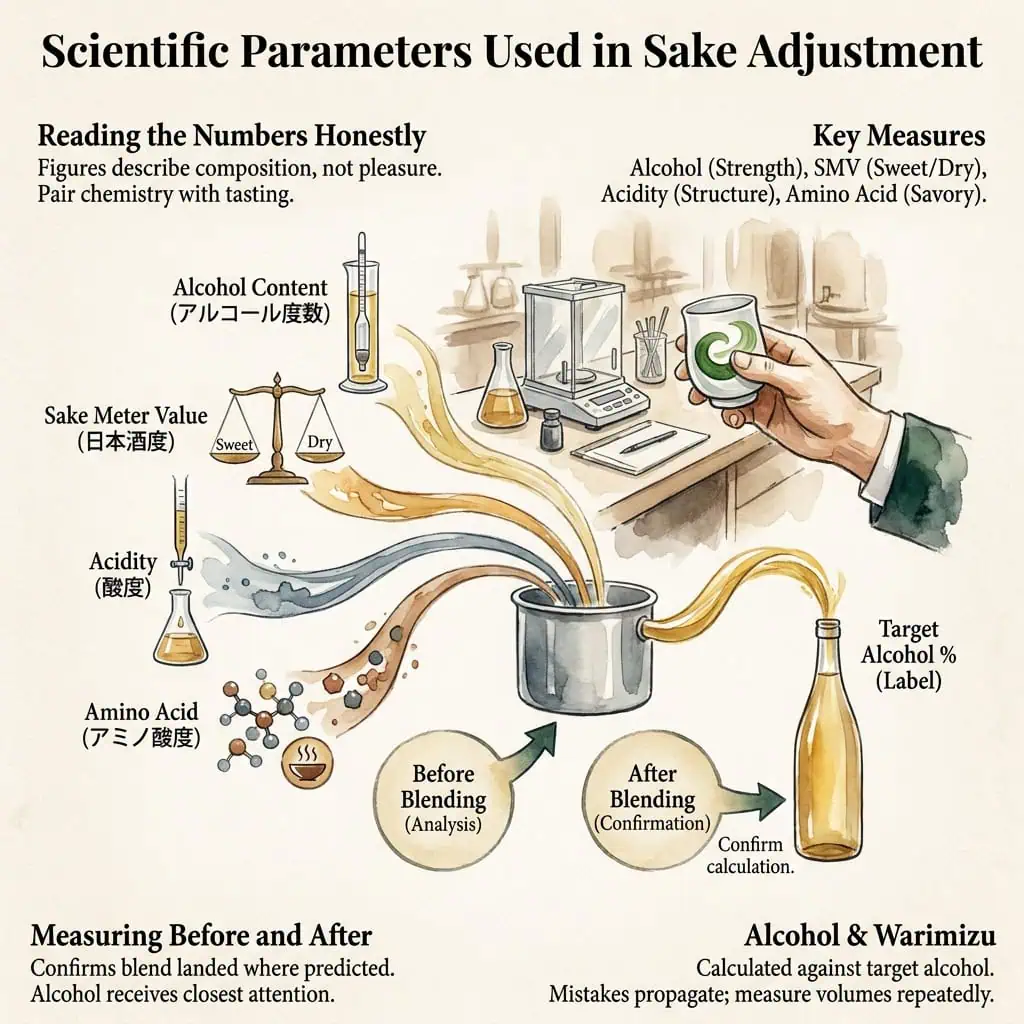
Alongside tasting, breweries measure. The National Research Institute of Brewing lists the standard analytical values, and blending decisions lean on several of them.
Measure
Japanese
What it indicates
Alcohol content
アルコール度数
Strength, and the target for warimizu
Sake meter value
日本酒度
Specific gravity, read as sweet or dry
Acidity
酸度
Titratable acid, affecting structure
Amino acid content
アミノ酸度
Roughly, savoury weight
Reading the numbers honestly
These figures describe composition, not pleasure. Sake meter value indicates sweetness through density, and it can mislead when acidity runs high. A dry-looking number may taste soft, while a sweet-looking one may finish crisp.
So breweries pair chemistry with tasting rather than choosing between them. Analysis tells you where the liquid sits. Tasting tells you whether that position is any good.
Measuring before and after
Breweries analyse tanks before blending and check the result afterwards. The second measurement confirms that the blend landed where the calculation predicted. Occasionally it does not, which usually points to an error in volume rather than chemistry.
Alcohol content receives the closest attention, since Japanese labelling states it. Warimizu is calculated against that target, so a mistake at blending propagates straight into the dilution step. For that reason breweries measure volumes repeatedly, then stir thoroughly before sampling again.
Blending for Consistency
Consistency deserves a closer look, because it is the reason most blending happens.
A simple conceptual example
Blending balances opposing tanks against each other. Imagine two tanks of the same junmai. Tank A shows lifted aroma and firm acidity, while tank B feels softer, rounder and a little quiet. Neither matches the house style on its own.
Blended, they may land close to the target. Aroma gains support from A, and texture gains softness from B. The brewer tastes, adjusts the ratio, then tastes again. This example is deliberately abstract, since real blending ratios vary by brewery and stay confidential.
Consistency is not sameness
A steady product still moves a little between years. Rice changes, and seasons change with it. What blending offers is a narrower range, not a frozen one. Careful drinkers notice small differences anyway, and many enjoy spotting them.
Holding back a reserve
Experienced blenders rarely commit everything at once. Instead they keep a portion of a strong tank aside, then use it later to correct a weaker lot.
Storage makes this possible, since properly kept sake changes slowly. Maturation also gives the brewery a second lever, because a tank that seems awkward in spring may settle by autumn. Time, in other words, is part of the blending toolkit. Patience often beats intervention, though a schedule does not always allow it.
The Mathematics of Blending
Some parts of chogo really are arithmetic. Others resist it completely, and telling the two apart is useful.
What averages out
Alcohol content behaves predictably. Blend 100 litres at 18 percent with 100 litres at 16 percent, and the result lands near 17 percent. Volume-weighted averaging works well enough for planning, and acidity behaves similarly as a first approximation.
V is the volume of each lot, and A is its alcohol percentage. The same form extends to three or more tanks, and it works for acidity too.
What refuses to average
Perception is another matter. Aroma compounds interact, and some mask others. Sweetness and umami shift depending on acidity and alcohol. Two pleasant tanks can produce a muddled blend, while a slightly awkward tank can lift a dull one.
Because of that gap, calculation sets the starting point only. Tasting settles the rest, which is exactly why trial blends exist.
Sake meter value behaves awkwardly
Nihonshu-do, the sake meter value, illustrates the problem neatly. It derives from specific gravity, so a blended figure can be calculated from component volumes exactly as alcohol content can.
Perceived sweetness refuses to follow that arithmetic. Acidity pushes a sake toward the dry end of experience, while amino acids add weight that reads as richness. Two blends with identical sake meter values can therefore taste noticeably different. So the calculation is sound, yet the number still misleads anyone reading it alone.
Chogo and Different Sake Styles
Does blending sit oddly with premium categories? Not really, though the assumption is widespread.
Designation depends on ingredients and polishing
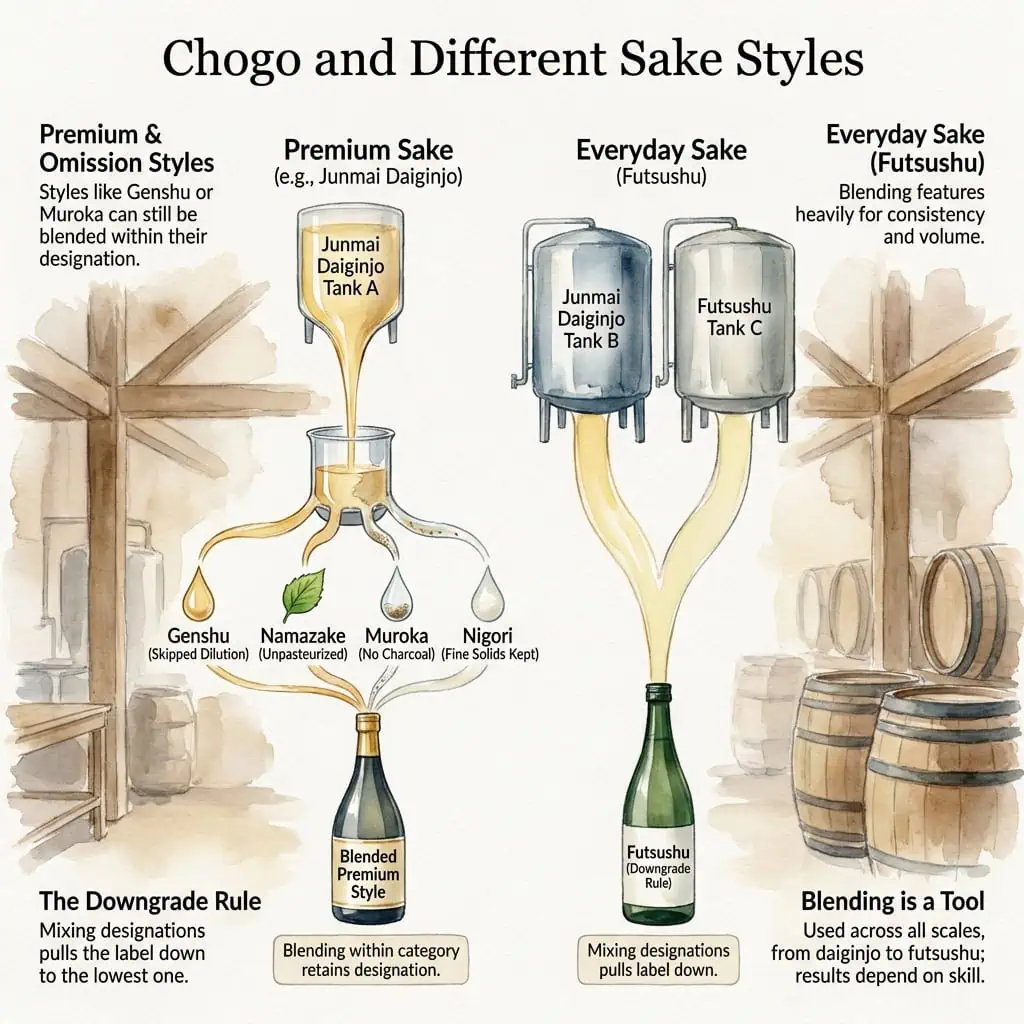
Specially designated sake, or tokutei-meisho-shu, rests on rice-polishing rate, ingredients and production method. Blending does not create a designation on its own. A blended junmai daiginjo stays junmai daiginjo, provided every contributing lot satisfies the same conditions.
The downgrade rule
Mixing designations pulls the label down to the lowest one. If a brewery blends junmai daiginjo with standard junmai, the whole lot must be labelled junmai. The same logic runs across the other categories, since the finished sake has to satisfy every claim it carries.
That rule shapes what breweries are willing to combine. Adding a little ordinary sake to a premium lot would cost the designation outright, so blending pools stay inside a category. Our guide to the special designations that define Japanese sake types sets out those conditions in detail.
Style terms that describe what was skipped
Several familiar words describe an omission rather than an action. Genshu skipped dilution. Namazake, the unpasteurised style, skipped heat treatment. Muroka skipped charcoal filtration. Nigori kept fine solids that pressing usually removes.
None of those terms rules out blending. They limit specific treatments, which is a narrower claim than drinkers often assume.
Everyday sake and premium sake alike
Futsushu (普通酒), the standard sake that falls outside the special designations, accounts for a large share of what Japan actually drinks. Blending features heavily in that category, since consistency and volume both matter there.
Premium bottles use blending too, though usually across fewer tanks. A daiginjo lot may combine three or four tanks rather than thirty. The scale differs sharply, yet the underlying logic stays the same. Blending is a tool, and its results depend entirely on the hands using it.
What Labels Say About Blending
Sake labels stay quiet about chogo, and that silence is worth explaining.
Why blending goes unmentioned
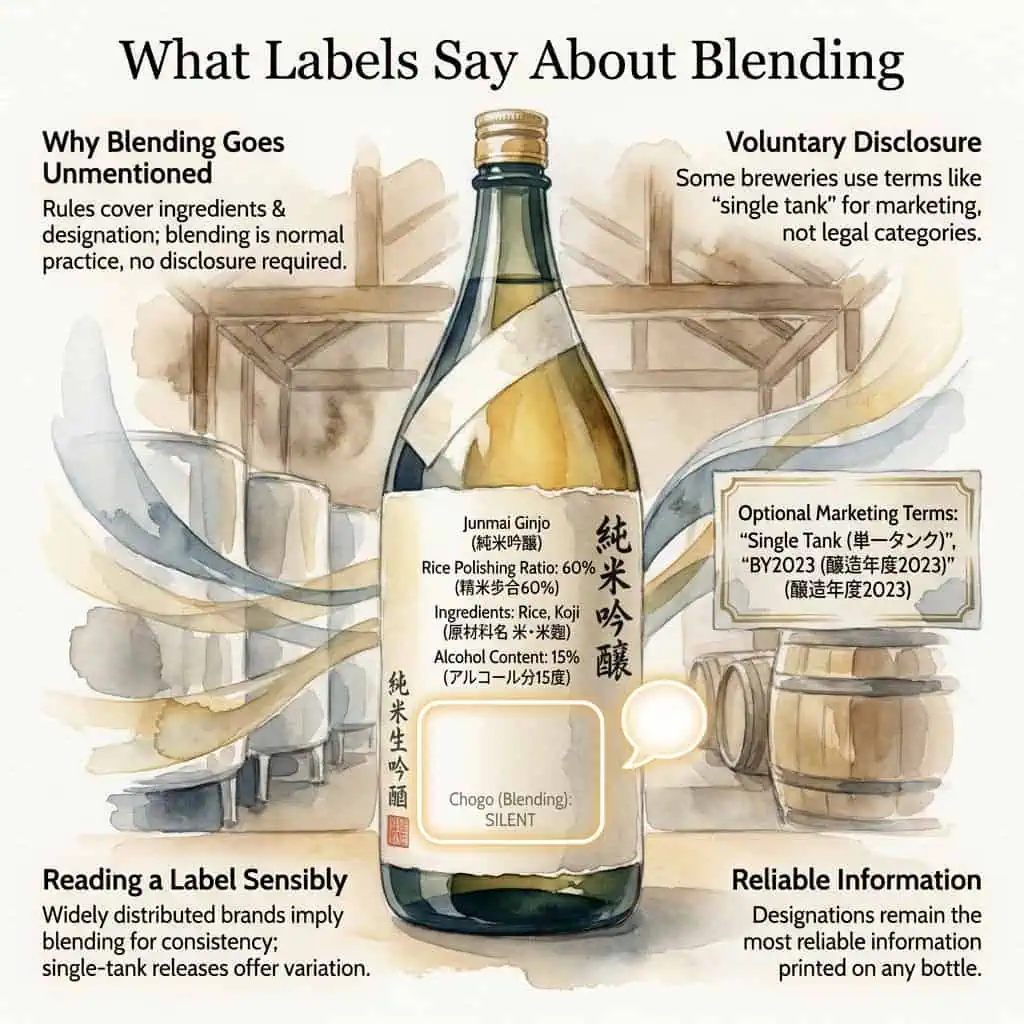
Japanese labelling rules cover ingredients, rice-polishing rate, alcohol content and designation. Blending is normal production practice, so no rule requires disclosure. A label therefore tells you what the sake is, rather than how many tanks contributed.
Some breweries volunteer more anyway. Terms such as tank number, single tank, or a specific brewing year signal an unblended or narrowly sourced bottle. Those phrases are marketing language rather than legal categories, though, so their meaning varies between producers.
Reading a label sensibly
If consistency matters to you, a widely distributed brand is a safe bet, since blending underpins it. If variation appeals instead, look for single-tank releases and seasonal bottlings. Neither choice is more authentic than the other.
Our guide to sake types covers the designations themselves, which remain the most reliable information printed on any bottle.
Chogo and Bottling
Chogo sits near the end of a long sequence, though the sequence bends from brewery to brewery. Our guide to bottling covers the filling stage itself in detail.
A common finishing order
Pressing Clear sake separates from the lees
Oribiki Racking, which draws clear liquid off settled solids
Filtration Clarity, colour and aroma adjust, often with charcoal
First pasteurisation Standard practice before storage
Storage The sake rests and matures
Chogo Tanks combine and the composition settles
Orisage Fining, which precipitates haze-forming protein
Warimizu Water brings alcohol to target, where applicable
Final pasteurisation Heat stabilises the sake at or near bottling
Bottling The sake goes into glass, sealed and inspected
Standard sake takes heat twice, once before storage and once at or near bottling. Namazume keeps only the first treatment, nama-chozo only the second, and namazake takes neither. Our guide to hiire, the gentle heat treatment used to stabilise sake, explains how those choices shape the final style.
The two clarification steps also differ, despite similar names. Oribiki (滓引き) is gravity racking, which removes settled solids after pressing. Orisage (滓下げ) is fining, which precipitates heat-unstable protein so the sake does not turn hazy after bottling. Our guides to sake racking and late fining before bottling cover each in turn.
Treat the order itself as a common pattern rather than a rule. Maturation in tank can come before or after blending, and some breweries move filtration later still.
Why the order varies
Each brewery arranges these steps around its own equipment and goals. Namazake skips heating entirely, so its schedule looks nothing like a standard product. Nama-chozo and namazume each involve a single pasteurisation, timed differently.
Blending position moves accordingly. Some breweries blend before storage, letting the combined lot mature together. Others blend at the very end, immediately before dilution and binzume. Both approaches produce good sake, and arguments about which is better rarely settle anything.
Chogo and Quality Control
Blending is also the last practical chance to catch a problem. Once sake enters bottles, options narrow sharply.
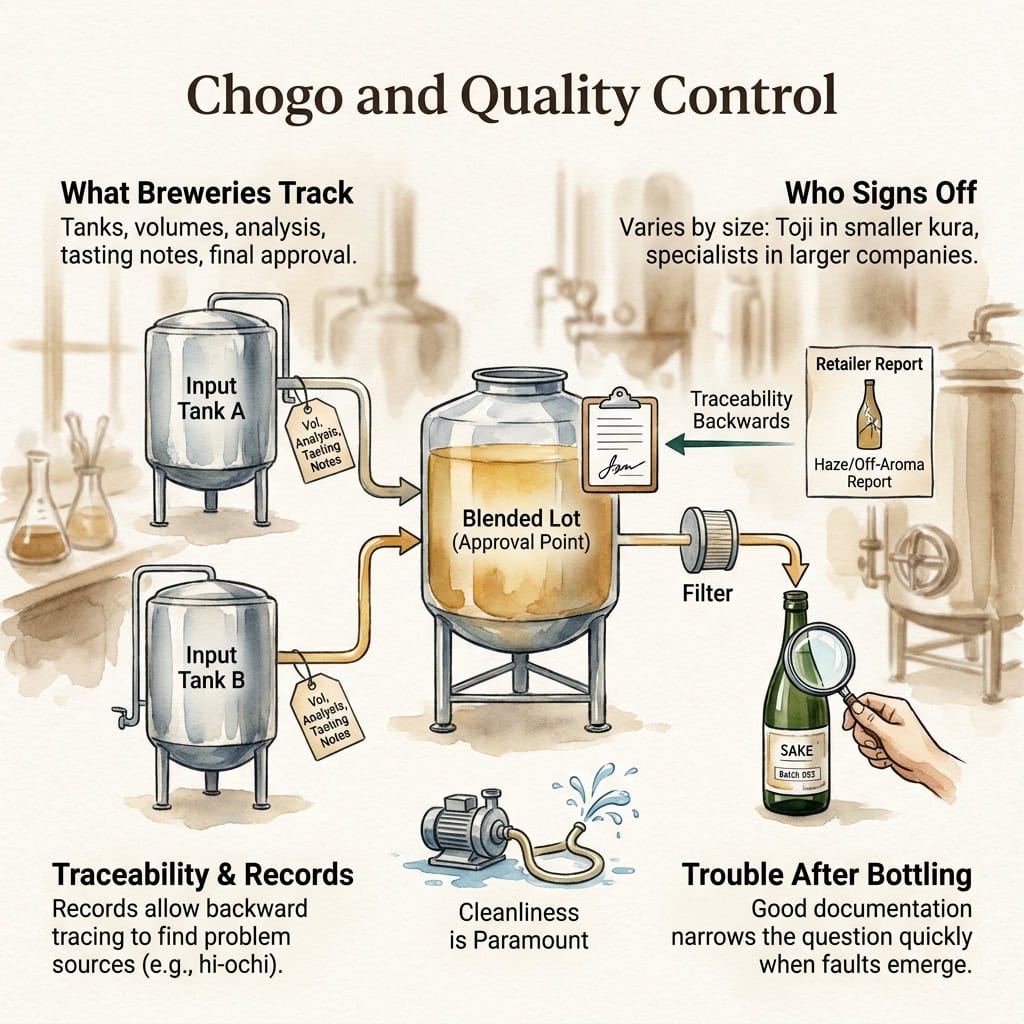
What breweries track
Which tanks entered which lot, and in what volumes
Responsibility varies by brewery size. In smaller kura the toji often decides personally. Larger companies run dedicated blending departments, staffed by specialists who never touch the fermentation floor. Both models work, and both rely on tasting.
Cleanliness underpins all of it. Blending moves sake through hoses, pumps and tanks, and each transfer creates an opening for contamination. Breweries wash equipment obsessively for that reason. A single neglected fitting can undo an entire season, which is not an exaggeration.
When trouble appears after bottling
Occasionally a fault emerges only once bottles reach shops. Haze forms, or an aroma turns strange in warm storage. Blending records then become the first place a brewery looks.
Good documentation narrows the question quickly. Which tanks entered the lot, on which day, at what analytical values? If one tank appears across several problem lots, the cause is usually clear. Without that trail, the investigation stalls, and breweries know it.
A Short History of Consistency in Sake
Blending for consistency sounds modern, yet the underlying problem is old.
Reproducibility was the hard part
Before microbiology, brewers could make excellent sake without being able to repeat it. Spoilage struck unpredictably, and a good season offered no guarantee for the next one. Records from the period describe ruined tanks with grim regularity.
Japan founded a national brewing research institute in 1904, and improving the stability and quality of sake was a central aim. Scientific study of yeast, koji and lactic acid gradually replaced guesswork. As a result, breweries gained tools for making the same sake twice.
From survival to style
Once reproducibility became achievable, expectations shifted. Distribution widened, brands grew national, and drinkers began expecting a familiar bottle in any city. Blending answered that expectation directly.
The historical detail here deserves caution, since brewery practice varied enormously by region and era. What seems clear is the direction of travel. Sake making moved from hoping for a good batch toward designing a repeatable one, and chogo belongs firmly to that second world.
Traditional and Modern Sake Blending
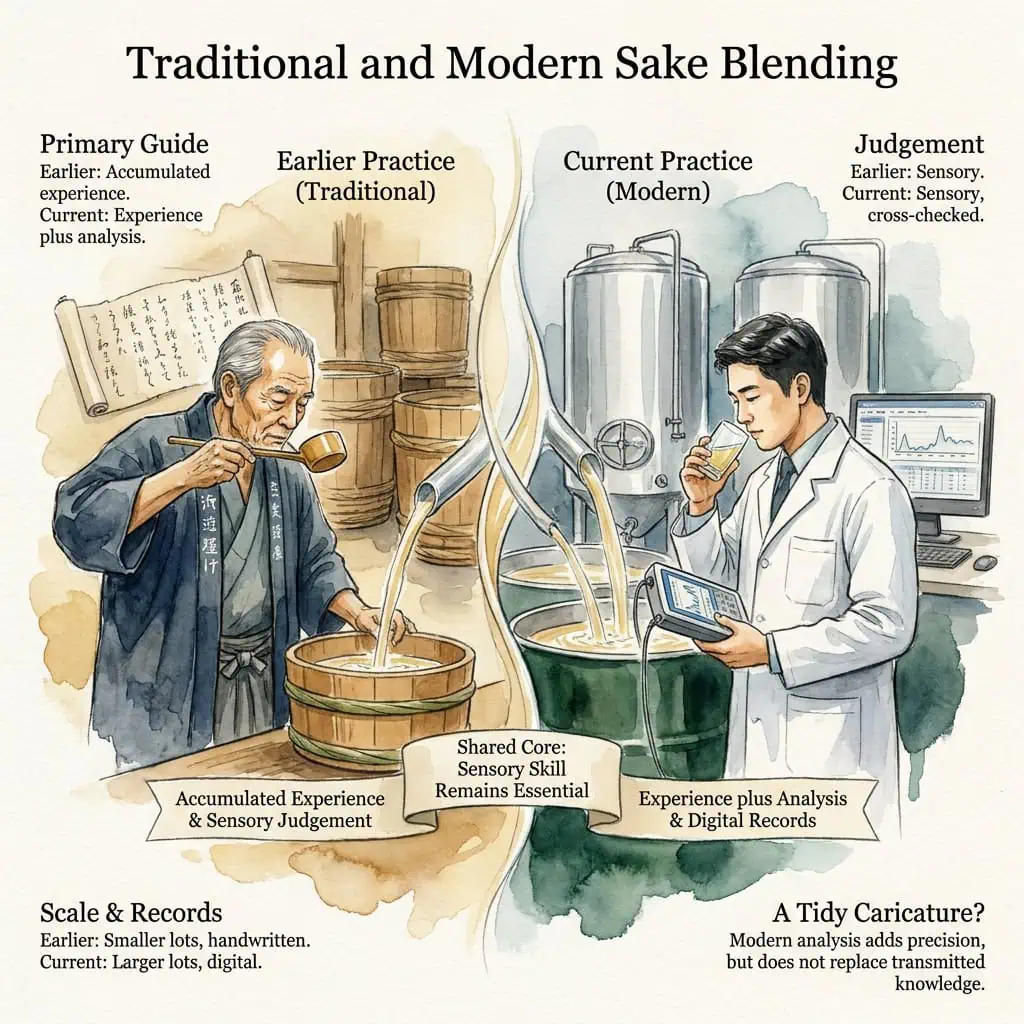
Descriptions of old and new brewing often turn into a caricature. Instinct on one side, instruments on the other. Reality was never that tidy.
Emphasis
Earlier practice
Current practice
Primary guide
Accumulated experience
Experience plus analysis
Judgement
Sensory
Sensory, cross-checked
Scale
Smaller lots
Often much larger lots
Records
Written by hand
Usually digital
Older brewers were not guessing. They worked from a detailed body of transmitted technique, refined across generations and tested every season. Modern analysis added precision and repeatability, yet it did not replace that knowledge. Anyone who has watched a kurabito assess a tank by smell alone understands the point.
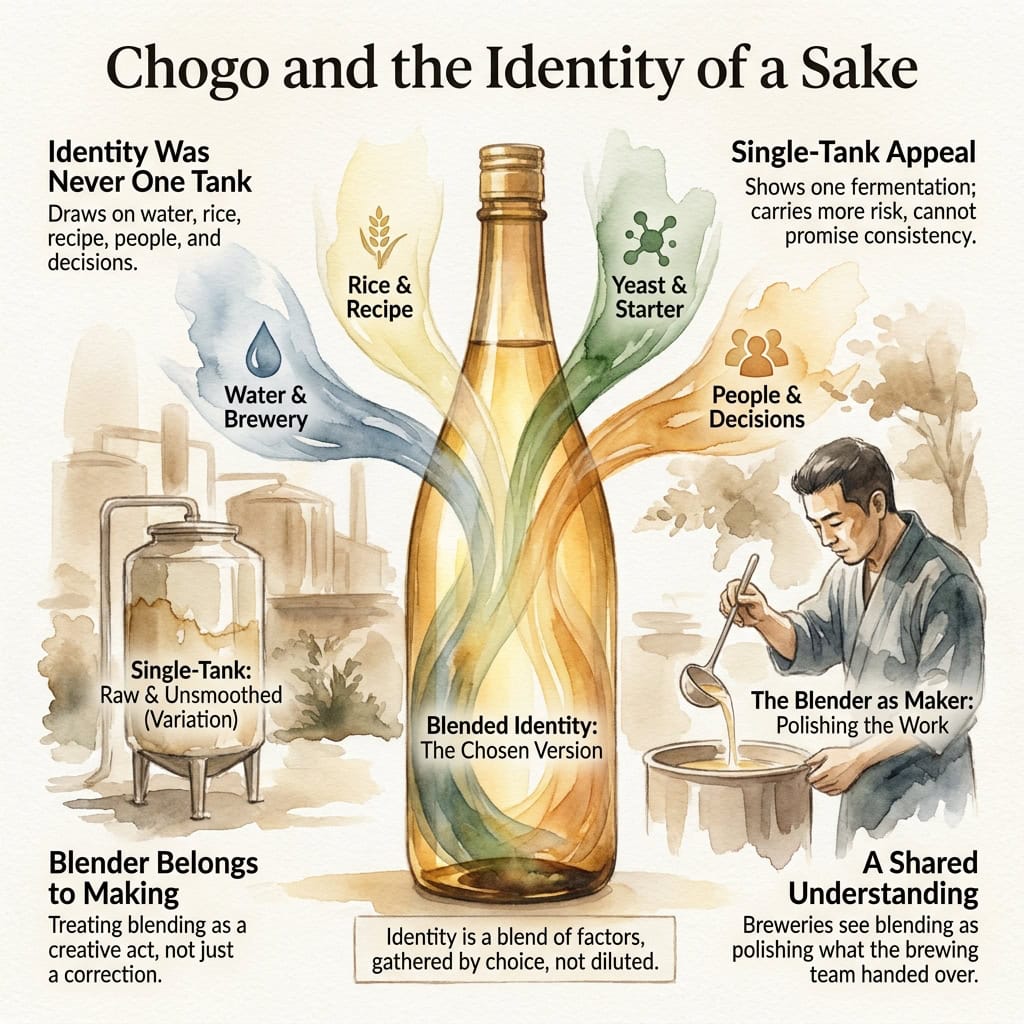
Chogo and the Identity of a Sake
Here is the question that lingers. If sake from several tanks becomes one product, what exactly is that product?
Identity was never tied to one tank
Sake identity draws on many things at once. Start with the brewery and its water. Rice and recipe come next, followed by yeast, starter method and season. Then add the people who made the decisions, along with the ones who judged the result.
A single tank is one expression among several. Blending gathers those expressions into the version the brewery chooses to release. That is a decision about identity, not a dilution of it.
Why single-tank bottlings still appeal
Some breweries release unblended single tanks, and drinkers enjoy them for good reason. Such bottles show what one fermentation produced, unsmoothed. Yet they also carry more risk, and they cannot promise consistency. Both approaches are legitimate, and the market has room for each.
The blender belongs to the making
One habit worth dropping is treating blending as something done to sake after the real work finished. The person choosing ratios is making the sake, in the same sense that the person tending the mash is.
Breweries seem to understand this better than commentary does. Blending staff often speak about their work with obvious pride, describing it as polishing what the brewing team handed over. That framing is a fair one, and it explains why the stage rewards attention rather than suspicion.
Common Misconceptions About Chogo
Blending means using up leftovers
Not so. Breweries blend planned lots toward a defined target, and poor sake makes a blend worse rather than better.
Blending always lowers quality
It can, if done carelessly. It can also correct imbalance and produce something better than either component alone.
Chogo just means adding water
Adding water for alcohol adjustment is warimizu, and it has its own name for a reason.
Genshu cannot be blended
Genshu describes the absence of dilution. Combining two undiluted tanks does not change that.
Every brewery blends the same way
Methods differ widely. Tank sizes, staffing, timing and philosophy all vary, and so does the amount of blending itself.
Blended sake has no character
Most sake on the market involves some blending, including bottles people prize. Character comes from decisions, and blending is one of them.
Conclusion: Why Chogo Matters in Modern Sake Brewing
Chogo is easy to overlook, partly because labels rarely mention it. Fermentation gets the attention, and understandably so. Yet the gap between a fermentation tank and a finished bottle is real work, and somebody has to do it.
The tools involved are strikingly ordinary. A cup, a nose, a small trial blend, a set of numbers, and a decision. Nothing dramatic happens. Still, that quiet stage determines what most drinkers actually experience.
There is also something reassuring in it. Fermentation is unpredictable by nature, and no brewer fully controls a living mash. Chogo is where human judgement answers that unpredictability, calmly and without much ceremony.
So it helps to hold the terms apart. Shikomi-haigo plans the sake. Fermentation creates it. Warimizu sets its strength. Chogo, meanwhile, decides how that sake is finally presented. Once those roles are clear, the finishing stage stops looking like a vague afterthought and starts looking like what it is, which is the last and most deliberate act of sake making.
Frequently Asked Questions About Chogo
What is chogo, and how does it differ from simple blending?
Chogo is the blending and adjustment of finished sake before bottling. It goes beyond mixing two lots, since it also covers the refinement work around that decision. Filtration and water addition often sit alongside it in the same session. Even so, those steps keep their own separate Japanese names.
What does the word chogo mean in Japanese?
The characters 調合 mean adjusting and combining. Japanese uses the same word for compounding medicines and mixing ingredients. In a brewery it refers to bringing sake together toward a target. Many breweries prefer the longer form chogo-seisei, meaning blending and refining.
Why do sake brewers blend different batches, and does blending guarantee consistency?
Tanks rarely match each other, so blending narrows that batch-to-batch variation and holds a brand steady. It also lets brewers balance acidity, aroma and body, and it turns many small tanks into practical bottling volumes. Consistency is a narrower range rather than a guarantee, though. Rice quality and storage still shift between years, and attentive drinkers notice.
Is blending a common practice in sake?
Yes, and it is entirely routine. Most commercial sake involves some degree of blending. Larger breweries run dedicated facilities for the tank blending process. Smaller kura may blend only occasionally, depending on how many tanks they fill.
Does blending reduce the quality of sake?
Not by itself. A careless blend can flatten character, while a thoughtful one corrects imbalance. Blending cannot rescue a spoiled tank, however, so breweries remove failed lots instead of diluting them. Small trial blends come first precisely to avoid a poor outcome.
What is the difference between chogo and warimizu?
Warimizu means adding water to adjust alcohol content. Chogo means blending and adjusting the sake more broadly. A brewery can do one without the other. Japanese keeps the terms separate, so English should follow.
What is shikomi-haigo?
Shikomi-haigo is the brewer’s recipe. It sets the amounts of steamed rice, koji, water and any additives such as alcohol. Brewers write it before fermentation begins, and it cannot be revised once the mash starts. Chogo, by contrast, responds to what fermentation actually produced.
Can premium sake and genshu be blended?
Both can, and both frequently are. Genshu means no water was added for alcohol adjustment, so combining two undiluted tanks keeps the term, and Japanese rules permit minor adjustment within a range of less than one percent alcohol. Premium designations follow their own logic. Mixing categories forces the lower label, so blending junmai daiginjo with standard junmai produces junmai.
Is brewing alcohol part of chogo?
Usually not. Brewers add jozo alcohol late in fermentation, before pressing. That places it within the recipe rather than the finishing stage. The two topics overlap in discussion, yet they belong to different points in production.
How do brewers decide the blending ratio?
They start from analytical values such as alcohol content and acidity, then calculate a weighted average by volume. Small trial blends follow, and tasters assess each one. Ratios shift until the result matches the target. Sensory panel testing settles the final call rather than calculation.
Does blending change the flavour of sake?
Yes, and sometimes more than people expect. Aroma compounds interact rather than simply averaging. Sweetness and umami shift with acidity and alcohol, so two good tanks can produce a disappointing blend. Brewers rehearse with trial blends for that reason.
Does every sake brewery blend its products?
No. Some breweries release single-tank bottlings without blending anything. Those bottles show one fermentation exactly as it turned out. They carry more variation, which many drinkers actively enjoy.
Ryo Iwa is the founder and editor of foodinjapan.org. Born and raised in Japan, he writes from regional travel, market visits, and Japanese-language primary sources that rarely reach English readers, including brewing institute publications and industry glossaries. Where a figure cannot be traced to a source, the article says so.
He has been a Google Maps Local Guide for over 10 years, with more than 1,800 reviews and over 41,000 photos viewed hundreds of millions of times. He previously spent two decades as an IT consultant in Japan, the US, and the UK.










Comments