




.avif)
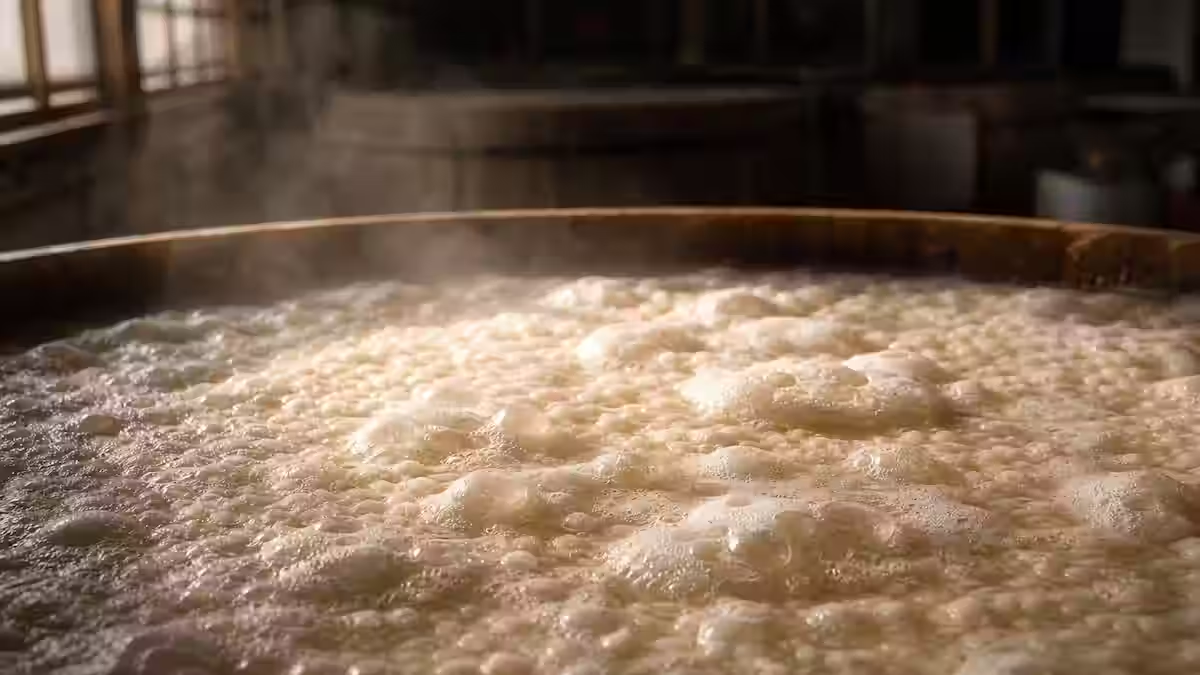
Great sake begins before the main fermentation ever starts. Hidden inside the brewery is a small but powerful starter called moto, also known as shubo, the “mother of sake.” So what is moto in sake brewing? In essence, moto is a concentrated mash that raises a healthy population of yeast. Moreover, it creates the acidic environment needed to protect that yeast. If the moto is weak, the entire brew can suffer.
One idea will guide this entire guide. Above all, moto is not the main fermentation mash. Instead, it is the preparation stage that comes before. Many beginners confuse moto with moromi, the main mash. Yet they are different steps with different jobs. For the wider picture, see our guide on how sake is made. This article explains how moto works, why it protects the yeast, and how the starter methods shape sake.
Quick Facts About Moto
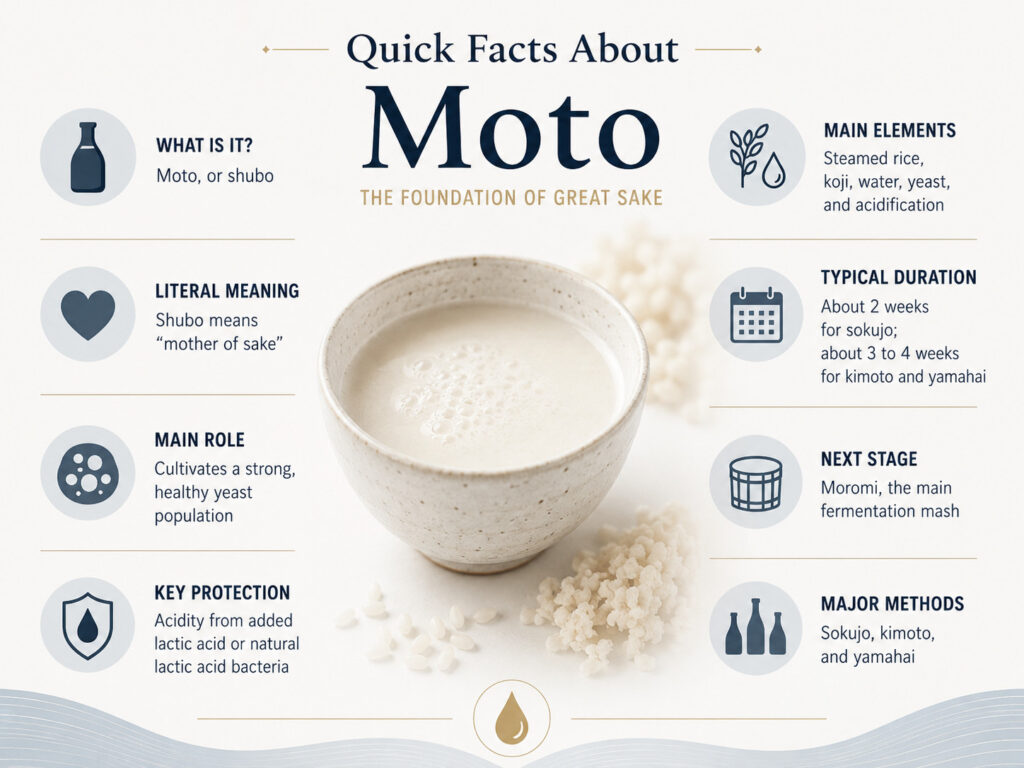
Here is a fast snapshot before the details begin.
| Japanese Name | 酛 / 酒母 (moto / shubo) |
| Reading | Moto, or shubo |
| Literal Meaning | Shubo means “mother of sake” |
| Main Role | Cultivates a strong, healthy yeast population |
| Key Protection | Acidity from added lactic acid or natural lactic acid bacteria |
| Main Elements | Steamed rice, koji, water, yeast, and acidification |
| Typical Duration | About 2 weeks for sokujo; about 3 to 4 weeks for kimoto and yamahai |
| Next Stage | Moromi, the main fermentation mash |
| Major Methods | Sokujo, kimoto, and yamahai |
What Is Moto?
Moto is the yeast starter of sake brewing. Essentially, it is a small, concentrated batch of fermenting mash. Inside it, brewers grow vast numbers of healthy yeast. To do so, they mix steamed rice, koji, water, and yeast together. Over several days, the yeast multiplies into a dense population.
Think of moto as the foundation of a house. Notably, you never see it in the finished sake. Yet everything above it depends on its strength. A strong moto leads to a clean, stable brew. By contrast, a weak one puts the whole batch in danger. For this reason, brewers treat this stage with great care.
Moto vs Moromi: What Is the Difference?
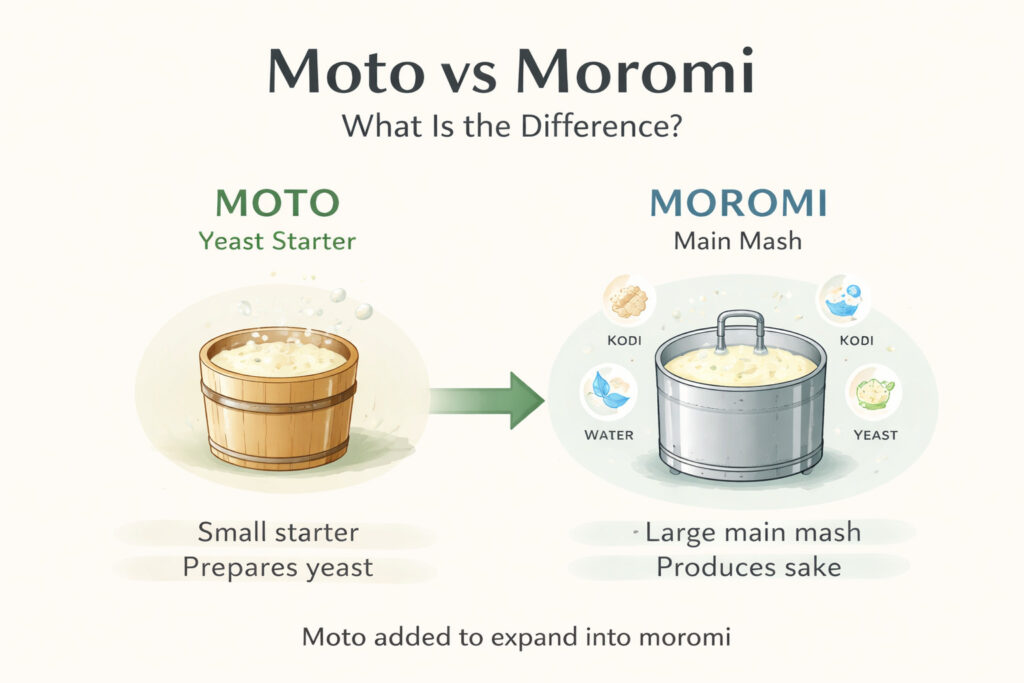
Moto and moromi are easy to confuse, yet they are not the same. Specifically, moto is the small yeast starter made before the main fermentation. Moromi, on the other hand, is the larger main mash where most alcohol production takes place. In simple terms, moto prepares the yeast. Afterward, the moromi turns rice, koji, water, and yeast into sake.
The timing makes the relationship clear. First, brewers build the moto over several weeks. Next, they add it to a much larger tank. Then they expand that tank into the moromi. To follow that next stage, read our sake fermentation guide. In short, the two stages are partners, not identical steps.
Why Sake Needs a Yeast Starter
Here is a fair question many readers ask. Why not just add yeast to the main mash? The answer lies in safety and strength. After all, a huge mash is a risky place for young yeast. Wild microbes could easily take over first.
The moto solves this problem in a clever way. First, it grows the yeast in a small, controlled space. There, the yeast becomes dense and dominant. Meanwhile, it builds protective acidity around itself. By the time it enters the main mash, therefore, it rules. Here is what a good starter achieves:
- A large, healthy population of active yeast
- Strong acidity that blocks unwanted bacteria
- A stable base for steady fermentation
- Yeast already adapted to the brewing conditions
In this way, the moto gives the yeast a head start. As a result, it enters the main mash strong and ready. That early advantage shapes the entire fermentation. In short, the starter sets the stage for success.
The Origins of Moto
The starter has a long and fascinating history. Early brewers did not understand microbes at all. Even so, they slowly learned to protect their yeast. Over many centuries, their methods grew wiser.
The Earliest Starters
The oldest known starter is the bodaimoto. Brewers used it as far back as the Muromachi period. In particular, temples in Nara helped develop this early method. It relied on natural acidity to guard the mash. Even centuries ago, then, brewers grasped the basic idea.
The Rise of Kimoto
Later, the kimoto method took center stage. Brewers refined it around the early 1700s, during the Edo period. This approach used wild lactic acid bacteria for protection. The work was hard, slow, and physical. Nevertheless, it produced strong, reliable starters. In time, kimoto became the classic traditional method.
A Century of Change
The early 1900s brought rapid progress. Around then, a national brewing institute studied the starter closely. Yamahai is generally traced to 1909, when brewers dropped one hard step. Soon after, the sokujo method followed around 1910. Thanks to this research, science began to reshape a craft built on tradition.
Main Components of Moto
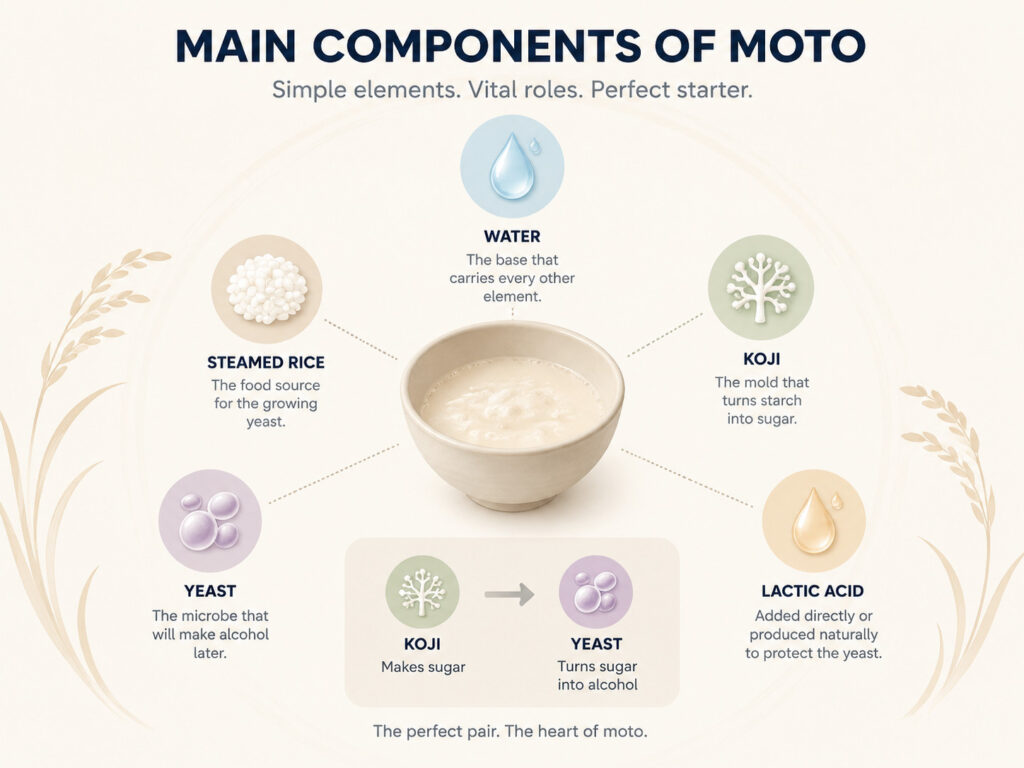
A moto uses only a few simple elements. However, each one plays a clear and vital role. Together, they create the perfect nursery for yeast.
- Water: the base that carries every other element
- Steamed rice: the food source for the growing yeast
- Koji: the mold that turns starch into sugar
- Yeast: the microbe that will make alcohol later
- Lactic acid: added directly or produced naturally to protect the yeast
The koji deserves a special mention here. Above all, it makes sugar for the yeast to eat. To learn more, see our guide to koji. The yeast then turns that sugar into alcohol. Likewise, our yeast in sake brewing guide explains that role. Even the starter, therefore, relies on this famous pair.
How Moto Is Made
Making moto takes patience and steady care. Typically, the process unfolds over two to four weeks. Each step builds toward a strong yeast population. Let us follow the journey in order.
- Prepare ingredients: brewers ready steamed rice, koji, and water
- Combine and add koji: the koji begins turning starch into sugar
- Introduce yeast: a chosen strain enters the small batch
- Build acidity: lactic acid develops naturally or gets added directly
- Grow the yeast: the population multiplies day by day
- Manage temperature: brewers guide the heat with great care
- Mature the starter: the moto becomes dense, sour, and ready
Temperature control matters at every stage. For instance, brewers warm or cool the batch to guide the yeast. A careful curve helps the right microbes win. For this reason, they check the starter often, day and night. A finished moto is typically acidic, active, and dense with yeast, ready to seed the main fermentation.
Why Lactic Acid Matters
Lactic acid is the secret guardian of moto. Without it, the starter would face real danger. Therefore, this single element deserves its own section. Let us explore why it matters so much.
A fresh batch of mash is a tempting target. Indeed, wild bacteria and stray microbes would love to invade. Lactic acid makes the environment sharply acidic. Consequently, most unwanted microbes cannot survive that acidity. Sake yeast, however, tolerates it quite well. The acid therefore clears the field for the right organism.
Brewers create this acidity in two main ways. In traditional methods, wild bacteria make the acid naturally. In modern methods, by contrast, brewers add lactic acid directly. Either way, both paths reach the same protective goal. Whichever method is used, the yeast stays safe. Ultimately, this protection is the true heart of the starter.
The Three Major Types of Moto
Brewers build moto in three main ways. Notably, each method handles lactic acid differently. That single choice shapes flavor, time, and labor. Here is a quick overview of the three.
- Kimoto: the old, traditional method using natural lactic acid bacteria
- Yamahai: a kimoto variation that drops one hard step
- Sokujo: the modern method with added lactic acid
We will explore each one in turn. For now, let us look at the essentials. Detailed articles will cover them more fully later.
Kimoto Moto
Kimoto is the oldest of the three major methods. According to brewing records, it was established around the early 1700s, during the Edo period. Brewers rely on wild lactic acid bacteria for protection. Those bacteria drift in from the air and tools. Over time, they create natural acidity in the batch.
The method includes a famous, grueling step. Specifically, brewers mash the rice with poles in cold air. This step is called yamaoroshi, and it takes hours. Teams often work deep into the freezing night. Kimoto therefore demands real labor and skill. In return, the reward is a rich, structured, earthy sake.
Yamahai Moto
Yamahai grew directly out of kimoto. Generally, it is traced to 1909, when brewers omitted one step. The name itself means “abolished yamaoroshi.” In other words, it drops the pole-mashing step. Brewers found the heavy grinding was not essential.
Instead, the rice dissolves naturally over time. Meanwhile, wild bacteria still create the protective acid. Yamahai therefore keeps the bold spirit of kimoto. It simply removes one exhausting task. As a result, the sake is often savory, deep, and sometimes wild. Many drinkers love its rustic character.
Sokujo Moto
Sokujo is the modern standard method. It was developed in the late Meiji period, often linked to Eda Kenjiro. The name means “quick fermentation.” Its key innovation was adding lactic acid at the start. Because of this, there is no wait for wild bacteria to grow.
This direct approach brings clear benefits. For one, the acid protects the yeast right away. In addition, the starter finishes in about two weeks. The flavor also tends to be clean and bright. For these reasons, sokujo now dominates modern sake brewing.
Kimoto vs Yamahai vs Sokujo
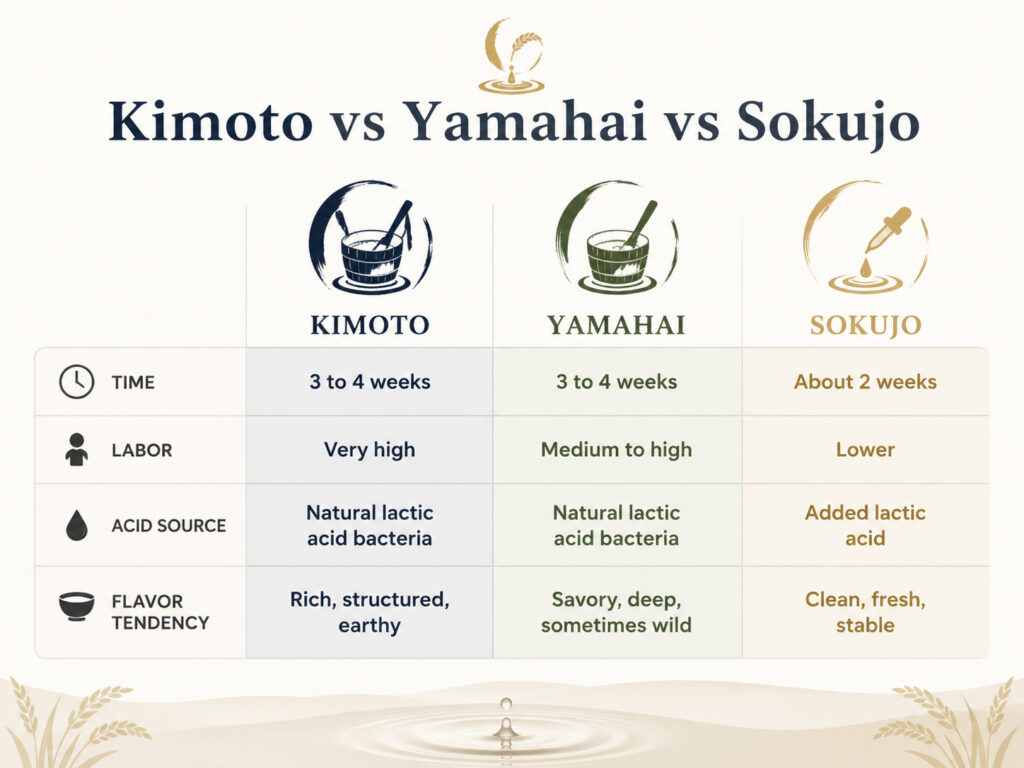
The three methods differ in clear ways. Therefore, a simple table makes the contrast easy to see.
| Method | Time | Labor | Acid source | Flavor tendency |
|---|---|---|---|---|
| Kimoto | About 3 to 4 weeks | Very high | Natural lactic acid bacteria | Rich, structured, earthy |
| Yamahai | About 3 to 4 weeks | Medium to high | Natural lactic acid bacteria | Savory, deep, sometimes wild |
| Sokujo | About 2 weeks | Lower | Added lactic acid | Clean, fresh, stable |
Each method offers a different trade-off. For example, kimoto and yamahai reward patience with depth. Sokujo, meanwhile, rewards efficiency with clean reliability. In fact, sokujo is widely cited as roughly 90 percent of modern production. Yamahai and kimoto together make up the small remainder. Even so, the old methods enjoy growing admiration.
Is Moto Used in Every Sake?
Yes, in essence. Every standard sake fermentation needs a starter stage. The method, however, can differ widely. Most modern breweries use sokujo for its speed and stability. By contrast, traditional breweries may choose kimoto or yamahai instead.
The choice usually reflects the brewer’s goal. For instance, a clean, fragrant style often favors sokujo. A deeper, richer style, meanwhile, may call for kimoto or yamahai. So the starter method is a real creative decision. It is never just a technical afterthought.
How Moto Affects Flavor
The starter shapes the sake in subtle ways. Although its effect is indirect, it is very real. The method leaves a mark on the final taste. Let us see how this happens.
Traditional starters build more acidity and depth. Moreover, wild bacteria create many flavor compounds, not just acid. Kimoto and yamahai sake therefore often taste richer. They can show savory, earthy, and umami notes. Sokujo sake, by contrast, tends to taste cleaner and lighter. In this sense, moto is one of the quiet authors of sake flavor.
Texture and body also shift with the method. For example, bolder starters can give a fuller mouthfeel. Lighter ones, on the other hand, keep the sake crisp and fresh. Brewers therefore choose the starter to match their vision. Ultimately, the result reaches all the way to your glass.
Moto and Sake Styles
The starter choice connects to the sake style. Naturally, different goals call for different starters. Brewers therefore match the method to the result. To explore the styles, see our types of Japanese sake guide.
The pattern appears across many styles. For instance, a delicate ginjo often uses a clean sokujo starter. A bold junmai, by contrast, may shine with kimoto or yamahai. Labels also proudly display the words kimoto or yamahai. The starter therefore even reaches the marketing of sake. In effect, it signals a certain taste to the drinker.
Regional Approaches to Moto
Region shapes the starter in quiet ways. Specifically, climate, water, and tradition all play a part. Local breweries therefore develop their own habits.
Cold regions suit the slow, traditional starters. For example, Akita and Yamagata keep strong brewing traditions. Niigata, meanwhile, favors clean, careful fermentation, as our Niigata sake guide shows. Kyoto’s soft water leads to gentle, mellow styles. Hyogo, with its famous rice, supports rich brewing. The starter therefore reflects its home region.
Moto in Modern Brewing
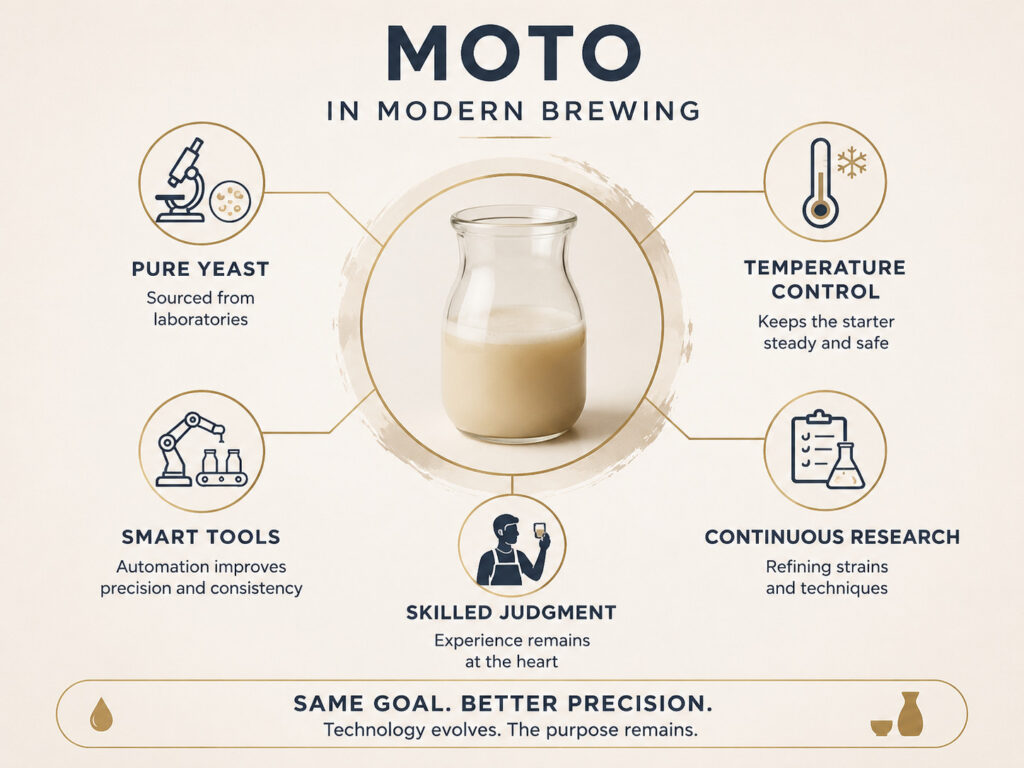
Modern tools have changed how brewers manage moto. Yet the core goal stays exactly the same. Simply put, technology makes the work more precise.
Breweries now source pure yeast from laboratories. In addition, temperature control keeps the starter steady and safe. Some larger producers even automate parts of the process. Meanwhile, research keeps refining strains and techniques. Science therefore supports the starter at every turn. Still, skilled judgment remains at the heart of it.
Common Misconceptions About Moto
Moto invites a few common mix-ups. Let us clear them up plainly.
- Is moto the same as moromi? No. Moto is the starter; moromi is the main mash.
- Is moto a type of sake? No. It is an unfinished starter, not a drink.
- Does moto make all the alcohol? No. Most alcohol forms later in the moromi.
- Is sokujo lower quality? No. It is simply faster and cleaner, not worse.
The first myth is the most important one. Therefore, hold on to the central idea once more. Moto is the preparation, while moromi is the main event. The starter builds the yeast; the mash makes the sake. Keep that clear, and everything falls into place.
Final Thoughts
Moto is the quiet foundation of every great sake. First, it builds the healthy yeast that drives fermentation. Second, it creates the acidity that keeps the brew safe. This single stage therefore shapes everything that follows. Though small, the starter carries enormous weight. Above all, remember the heart of the matter once again. Moto is the preparation, not the main fermentation. Ultimately, it is the biological base on which all sake depends. Understand the moto, and you understand sake’s beginning.
Moto FAQ
What is moto in sake brewing?
Moto is the yeast starter for sake. Brewers also call it shubo. It grows a strong, healthy yeast population. In turn, this prepares the way for the main fermentation.
What does shubo mean?
Shubo is another name for moto. Literally, the word means “mother of sake.” It captures the starter’s nurturing role. Essentially, the starter raises the yeast that makes sake.
Is moto the same as shubo?
Yes. Both moto and shubo refer to the sake yeast starter. Shubo literally means “mother of sake.” Meanwhile, moto can be understood as the foundation or starter.
Why is moto necessary?
It grows strong yeast in a safe space. Moreover, the acidity blocks unwanted bacteria. The yeast then enters the main mash dominant. As a result, this protects the whole batch from spoiling.
What is the difference between moto and moromi?
Moto is the small yeast starter. Moromi, by contrast, is the large main fermentation mash. The moto comes first and prepares the yeast. Afterward, the moromi makes most of the alcohol.
What is kimoto moto?
Kimoto is the old, traditional starter method. Notably, it uses natural lactic acid bacteria for protection. It also includes a hard pole-mashing step. As a result, the sake turns out rich and complex.
What is yamahai moto?
Yamahai is a variation of kimoto. Specifically, it drops the heavy pole-mashing step. Even so, wild bacteria still create the acidity. The sake often tastes savory and deep.
What is sokujo moto?
Sokujo is the modern, fast starter method. In this method, brewers add lactic acid at the start. It therefore protects the yeast right away. Today, it makes up most of all sake.
Is kimoto better than sokujo?
Not necessarily. Kimoto is more traditional and labor-intensive. Sokujo, meanwhile, is stable, clean, and widely used for fine sake. Ultimately, the better method depends on the style the brewer wants.
How long does moto take to make?
It depends on the method used. For example, sokujo takes about two weeks. Kimoto and yamahai, by contrast, take around three to four weeks. Naturally, the slower methods build more complex flavor.
References
- Japan Sake and Shochu Makers Association, Sake Brewing Processes and Flavor (moto, koji, and yeast). (Surveyed: June 2026)
- Daishichi Sake Brewery, Kimoto: the traditional yeast starter and natural lactic acid. (Surveyed: June 2026)
- Brewing Society of Japan, Brewing technology and the history of the sake starter. (Surveyed: June 2026)
- National Research Institute of Brewing, Science of sake fermentation and the yeast starter. (Surveyed: June 2026)
Related Articles
- Sake Fermentation (Surveyed: June 2026)
- Koji in Sake Brewing (Surveyed: June 2026)
- Yeast in Sake Brewing (Surveyed: June 2026)
- How Sake Is Made (Surveyed: June 2026)
- Types of Japanese Sake (Surveyed: June 2026)
- Junmai Sake (Pure Rice Sake) (Surveyed: June 2026)
- Ginjo Sake (Surveyed: June 2026)
- Niigata Sake (Surveyed: June 2026)




Comments