



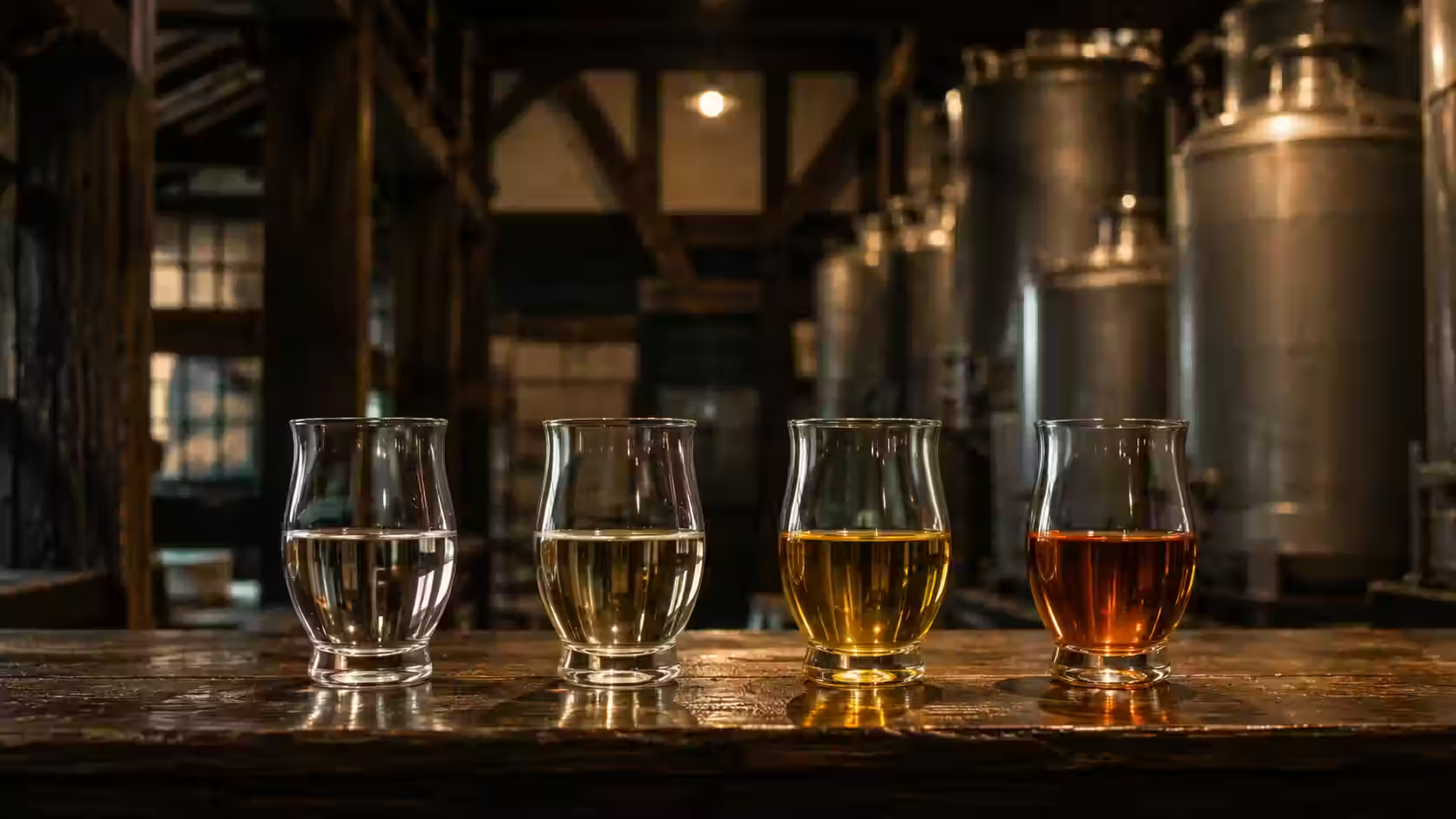
Jukusei (熟成) is the maturation of sake after brewing has finished. During this stage, time, temperature, and storage conditions gradually reshape its aroma, flavor, color, and texture. Most sake goes through some maturation before release. Extended maturation can produce the aged style known as koshu.
Consider two bottles from the same brewery, brewed in the same winter. One tastes sharp, bright, and a little restless, whereas the other feels rounder, softer, and considerably more settled in the glass. That gap usually opens up during Jukusei.
Here is the point that trips up most English-speaking readers. In practice, chozo (貯蔵) emphasizes the act of storing sake, while Jukusei emphasizes the maturation that happens during storage. The two ideas overlap, and breweries use the words differently depending on context.
This guide covers what changes chemically, how brewers control the process, and which sake actually benefits. It also explains how to store bottles properly at home. For the wider process, see our guide on how sake is made.
Jukusei at a Glance
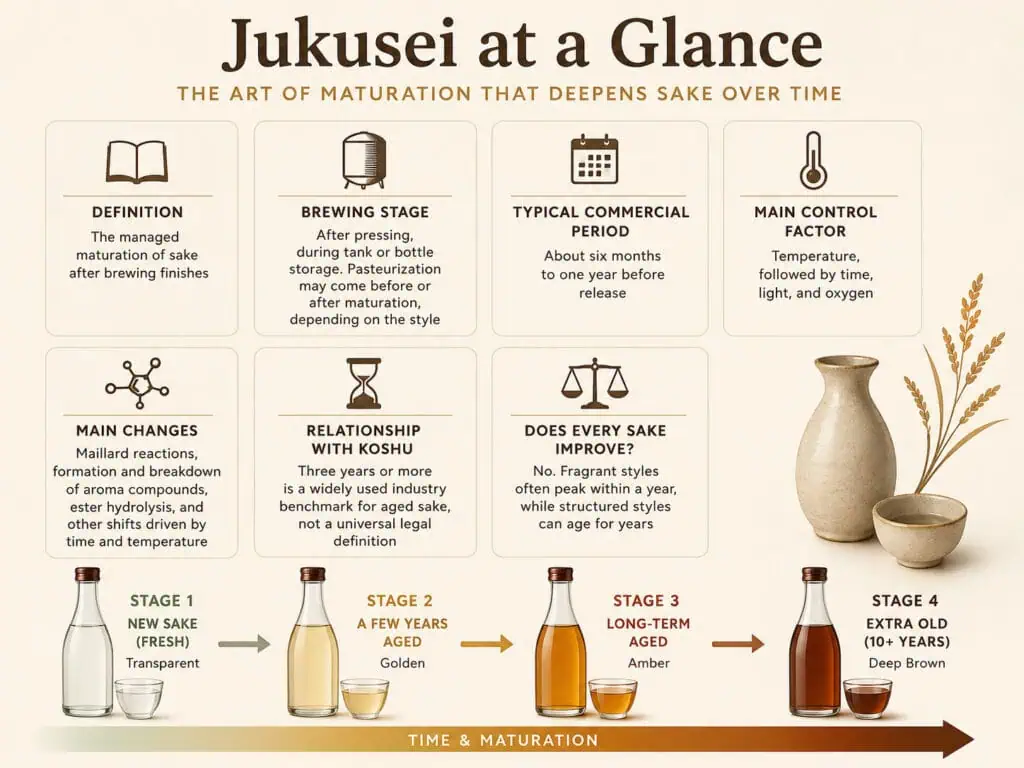
| Japanese term | 熟成 (jukusei), meaning ripening or maturing |
| Definition | The managed maturation of sake after brewing finishes |
| Brewing stage | After pressing, during tank or bottle storage. Pasteurization may come before or after maturation, depending on the style |
| Typical commercial period | About six months to one year before release |
| Main control factor | Temperature, followed by time, light, and oxygen |
| Main changes | Maillard reactions, formation and breakdown of aroma compounds, ester hydrolysis, and other shifts driven by time and temperature |
| Relationship with koshu | Three years or more is a widely used industry benchmark for aged sake, not a universal legal definition |
| Does every sake improve? | No. Fragrant styles often peak within a year, while structured styles can age for years |
What Is Jukusei?
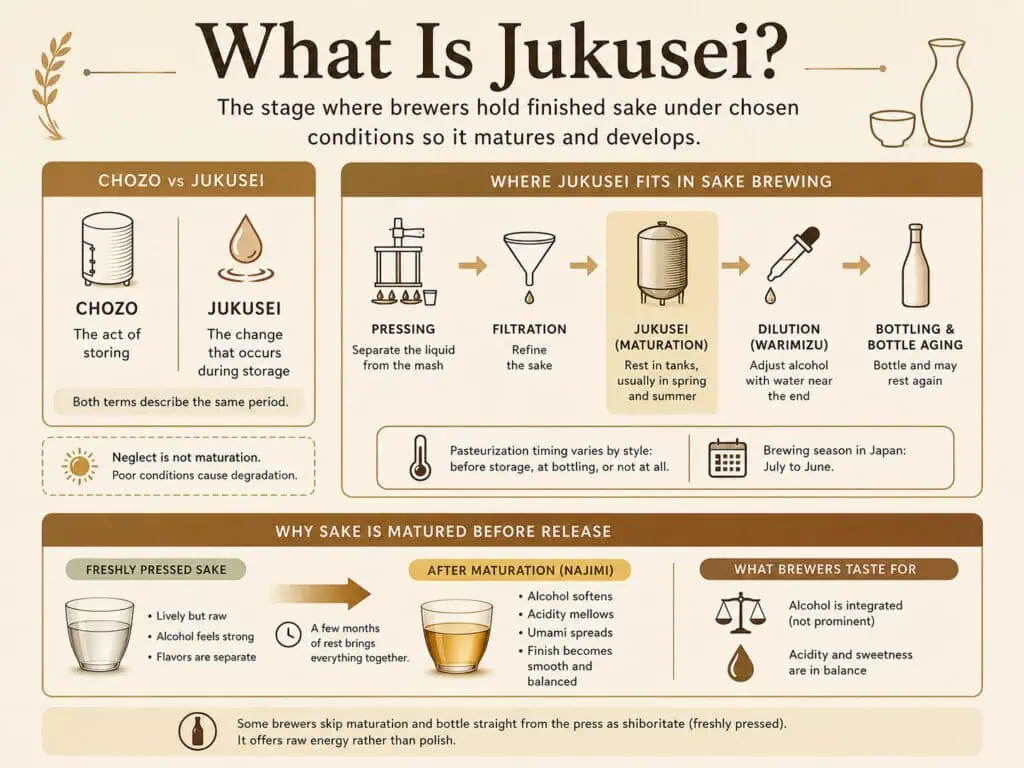
Jukusei is the stage where brewers hold finished sake under chosen conditions so that it matures. They select the temperature, the vessel, and the length of storage, then monitor how the sake develops. Although the chemical reactions proceed on their own, the surrounding conditions stay under close control.
The word itself carries a useful nuance, because jukusei in Japanese suggests ripening toward a kind of fullness rather than simply growing old. Fruit ripens, cheese matures, and sake follows a similar arc.
Chozo and Jukusei: Storage and Maturation
Two Japanese words cover this same block of time. Chozo points to the act of storing, while Jukusei points to the change that occurs during it. Breweries often use both terms for one tank, since the concepts overlap rather than compete.
English translations tend to flatten both words into storage, so readers assume that sake merely sits around waiting for a shipping date. In reality, staff taste it repeatedly and adjust their plans.
Neglect sits outside both ideas. A forgotten bottle in a sunny kitchen simply degrades, because nobody chose those conditions on purpose.
Where Jukusei Fits in Sake Brewing
Maturation begins once the active brewing work ends, after brewers separate the liquid from the mash during pressing and refine it through filtration. Most sake then rests in tanks through spring and summer.
The position of pasteurization varies by style, which matters more than it first appears. Some sake receives heat before storage, and some receives it only at bottling. A few styles skip heating altogether and mature cold.
The brewing calendar shapes all of this. Japan counts its brewing season from July through June. Most sake leaves the press between winter and early spring. Maturation therefore covers the warm half of the year, which is exactly when temperature control matters most.
Dilution usually comes near the end, when brewers adjust the alcohol with water, a step our warimizu guide explains in detail. Bottles may then rest again, which brewers describe as bottle aging.
Why Sake Is Matured Before Release
Freshly pressed sake tastes lively, yet slightly raw. The alcohol feels prominent, and the individual flavors sit apart from one another. Because a few months of rest lets those parts knit together, almost every brewery builds in a resting period.
Brewers call this settling-in effect najimi: sharp acidity softens, umami spreads more evenly across the palate, and the finish gradually tidies up. The sake begins to taste finished rather than assembled.
What are brewery staff actually tasting for? Mostly they watch for the alcohol to stop standing out, and they check that acidity and sweetness sit in reasonable proportion. A sake that still tastes like separate components needs more time.
Some producers skip the rest entirely, bottling straight from the press and selling the result as shiboritate, which means freshly pressed. That style trades polish for raw energy.
How Jukusei Changes Sake
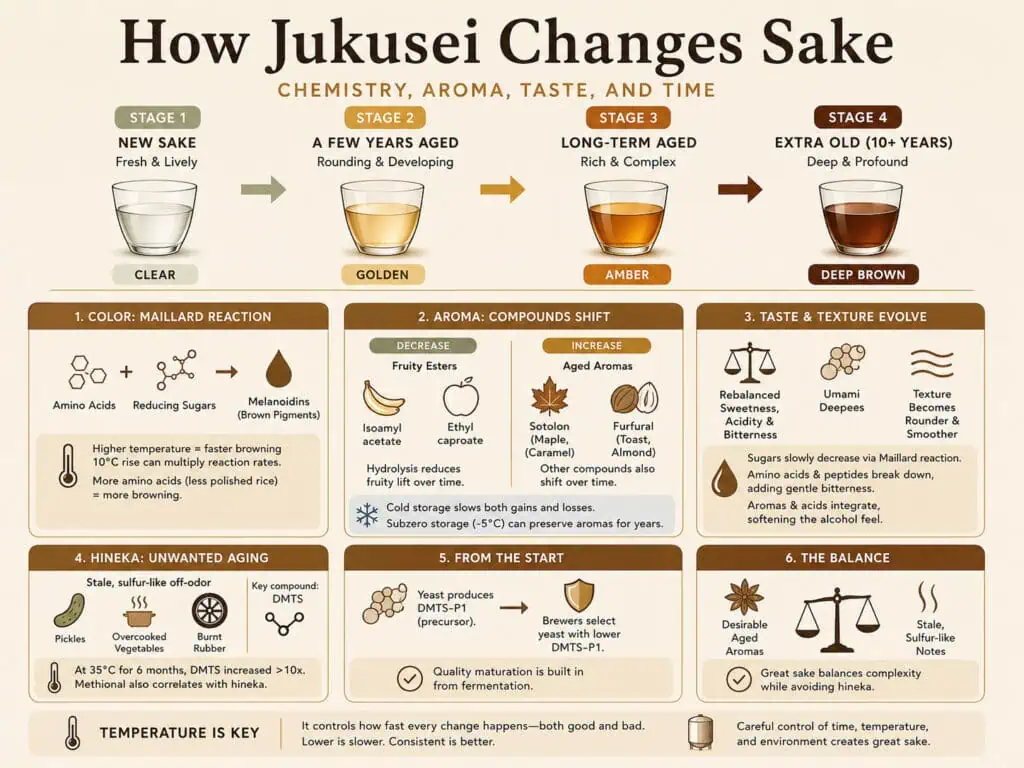
During Jukusei, sake darkens, loses fruity aromas, and gains caramel and nutty notes. Texture grows rounder, and bitterness rises slightly. Temperature governs how fast all of this happens. Warmth accelerates the changes drinkers want and the ones they do not.
Researchers at Japan’s National Research Institute of Brewing have documented much of this chemistry. Atsuko Isogai reviewed the key aroma compounds in the Journal of the Brewing Society of Japan in 2009. Her work traces which molecules rise and which fall during storage.
Color and the Maillard Reaction
Browning comes from the Maillard reaction, in which amino acids meet reducing sugars and produce the brown pigments known as melanoidins. You already know this reaction from the kitchen, since it browns onions in a pan and crusts a grilled steak.
Heat drives the reaction forward sharply, so a sake held near 20°C darkens far faster than an identical bottle kept at 5°C. Cold storage can therefore keep an old bottle almost colorless.
The relationship is not linear either. Chemists often note that a ten-degree rise can multiply reaction rates several times over. So a warm summer warehouse does far more work than the calendar suggests.
Amino acid content matters just as much as temperature, because a junmai with high amino acidity browns far more readily. A highly polished daiginjo carries fewer amino acids, so it resists color change. Rice polishing therefore shapes the curve before storage even starts.
How Aromas Change
Fresh sake leads with esters made by the yeast during fermentation. Isoamyl acetate suggests banana, and ethyl caproate suggests apple or melon. Slow hydrolysis breaks some of these apart over months. That is why a fragrant ginjo loses lift after a year or two.
Other compounds move in the opposite direction: sotolon brings maple and caramel notes, while furfural adds a distinctly toasted, almond-like quality. Aldehydes and organic acids shift as well, so no single reaction explains the whole aroma.
Cold storage slows both halves of that exchange. Isogai’s research shows that isoamyl acetate declines far less at low temperatures. Some breweries therefore hold premium sake in professionally controlled subzero rooms. Temperatures around minus five degrees can protect ginjo aroma for years.
That practice differs completely from using a household freezer, which cannot hold a precise subzero temperature and may damage the bottle if the contents freeze.
Taste and Texture
Aging quietly rebalances sweetness, acidity, and bitterness. Residual sugars gradually enter the Maillard reaction, while acidity itself stays fairly stable. Certain amino acids and peptides also break down into bitter fragments, adding grip in small amounts.
Perception can then run in either direction, and some drinkers read aged sake as drier because the sugar levels genuinely do fall. Others read it as sweeter, because caramel aromas suggest sweetness before the tongue reports anything.
Umami usually gains the most ground. Amino acids and peptides from the rice react and rearrange slowly over the months. That savory weight spreads across the palate and lengthens the finish. It also explains why aged sake handles warm serving so well.
Texture changes too, although the mechanism is not simple. Shifts in aroma compounds, acids, and esters can make the alcohol seem less sharp and the flavor more integrated. Drinkers usually describe that change as roundness or smoothness.
Hineka and Unwanted Aging
Not every aged aroma is welcome. Japanese tasters use the word hineka (老香) for a stale, sulfur-like smell that suggests pickles, overcooked vegetables, or burnt rubber. The same compounds that read as complexity in a long-aged bottle can read as a fault in a young one.
Isogai and colleagues identified dimethyl trisulfide, or DMTS, as a major contributor to hineka. A 2023 storage study from the same institute tracked how fast it forms. In commercial sake held at 35°C for six months, DMTS rose more than tenfold. Methional, another sulfur compound, also correlated strongly with hineka intensity.
Freshly pressed sake contains almost no DMTS at all. The institute has since identified a precursor, DMTS-P1, that yeast produce during fermentation. Researchers now breed yeast strains that generate less of it. So resistance to hineka can be built in long before storage begins.
Successful maturation balances two goals at the same time. Brewers encourage desirable aged aromas while limiting the stale, sulfur-like notes. Neither outcome depends on a single compound, and personal taste shifts with the sake and the concentration.
Short-Term and Long-Term Jukusei
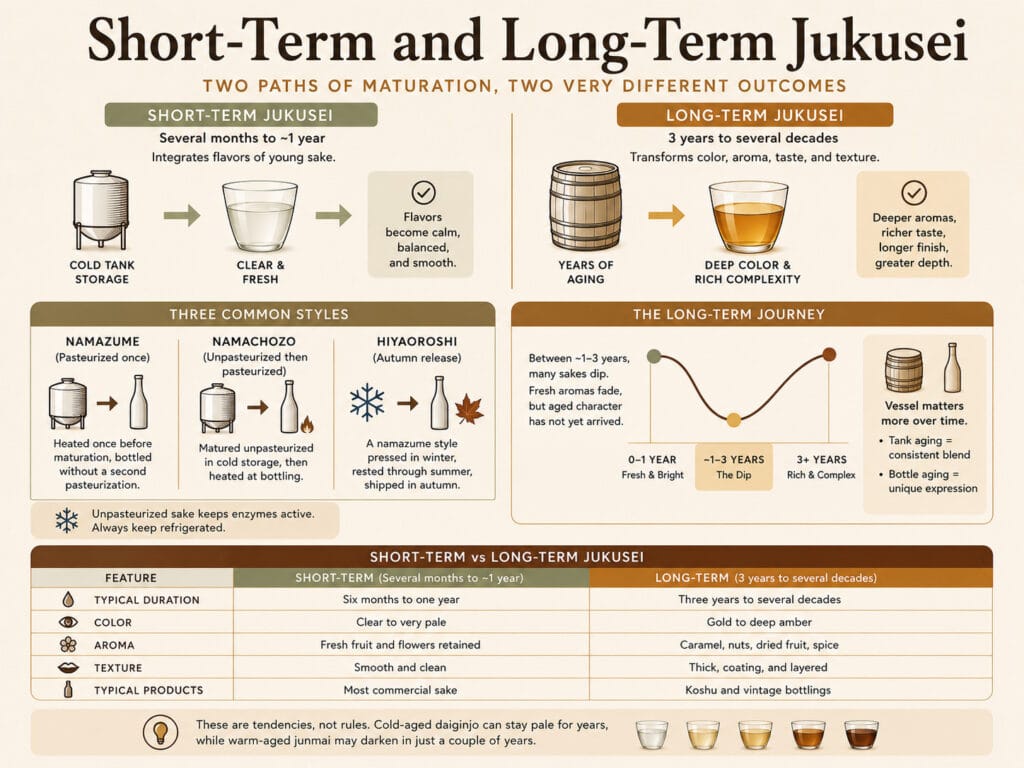
Short-term Jukusei usually lasts several months and aims to integrate the flavors of young sake. Long-term Jukusei runs for several years or more, and it can substantially change color, aroma, taste, and texture. Nearly every bottle experiences the first kind, while very few experience the second.
Short-Term Maturation
Most sake rests for roughly six months to a year, usually in cold tanks. Fresh aromas survive largely intact, and the color stays clear or very pale. Drinkers rarely notice the process, which is exactly the point.
The effect still shows up in a side-by-side tasting: a spring bottling tastes brighter and slightly angular, while the autumn release of the same sake tastes calmer and better joined together. Nothing dramatic happened, yet the balance clearly improved.
Namazume, Namachozo, and Hiyaoroshi
Three common labels show where pasteurization sat relative to storage, and although the terms look technical, the logic behind them is simple.
- Namazume (生詰): heated once before maturation, then bottled without a second pasteurization
- Namachozo (生貯蔵): matured unpasteurized in cold storage, then heated at bottling
- Hiyaoroshi (ひやおろし): a namazume style pressed in winter, rested through summer, and shipped in autumn
Unpasteurized sake behaves differently again, because leftover enzymes stay active, and our namazake guide explains why those bottles need constant refrigeration.
Long-Term Maturation
Long aging runs three years or more, and some breweries hold stock for decades. Color deepens toward gold, amber, or dark brown, while caramel, dried fruit, nuts, and soy sauce notes appear and the finish stretches out considerably.
Progress rarely follows a straight line, though. Between roughly one and three years, many sakes dip. The fresh aromas have faded, while aged character has not yet arrived. Brewers know this window well and generally ship either before it or after it.
Vessel choice matters more as the years add up. Tank aging blends a large volume into a single consistent result. Bottle aging splits the same sake into hundreds of separate small environments. Brewers who sell dated vintages usually prefer the second route.
| Feature | Short-term | Long-term |
| Typical duration | Six months to one year | Three years to several decades |
| Color | Clear to very pale | Gold to deep amber |
| Aroma | Fresh fruit and flowers retained | Caramel, nuts, dried fruit, spice |
| Texture | Smooth and clean | Thick, coating, and layered |
| Typical products | Most commercial sake | Koshu and vintage bottlings |
Treat that table as a set of tendencies rather than rules, since a cold-aged daiginjo can spend ten years and stay pale while a warm-aged junmai may darken within two.
Jukusei and Koshu
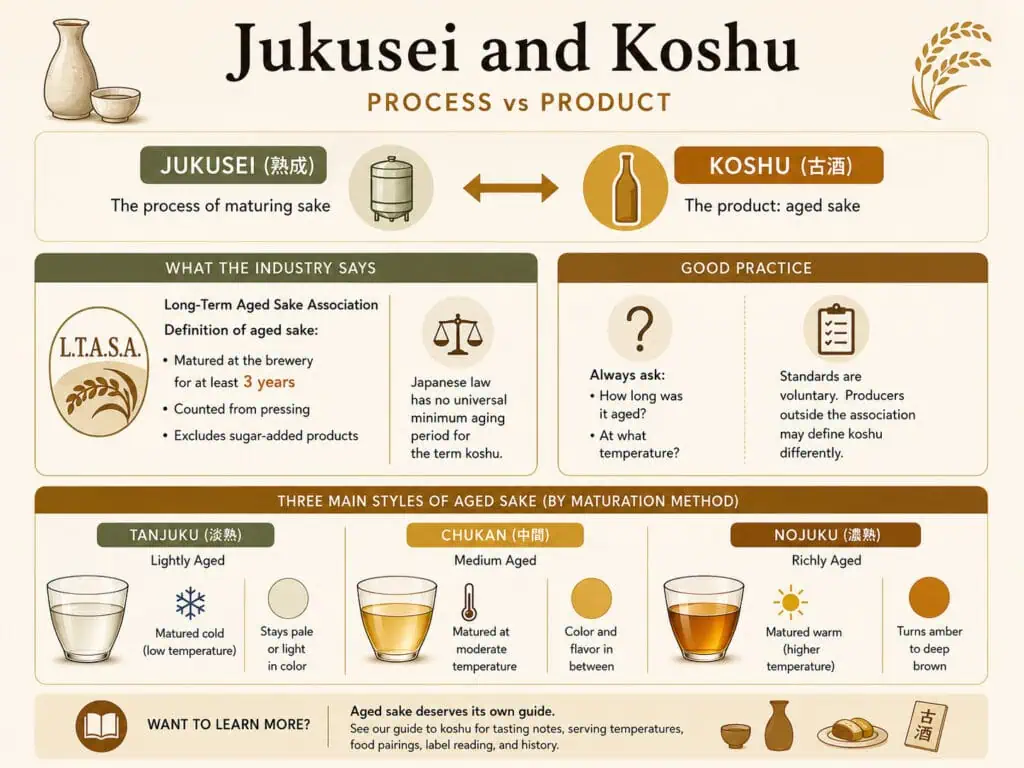
Jukusei names the process, while koshu names the product. The Long-Term Aged Sake Association defines aged sake as sake matured at the brewery for at least three years. Its definition counts from pressing and excludes sugar-added products. However, Japanese law sets no universal minimum aging period for the term koshu.
Japanese brewers know that body as the Choki Jukusei-shu Kenkyukai, founded in 1985. Its standard remains voluntary, so producers outside the association apply the word koshu on their own terms. A useful habit is simply to ask how long the sake aged, and at what temperature.
The association also sorts aged sake into three broad families. Tanjuku (淡熟) matures cold and stays pale, nojuku (濃熟) matures warmer and turns amber, and chukan (中間) sits between them.
Aged sake deserves a guide of its own, so for tasting notes, serving temperatures, food pairing, label reading, and history, see our guide to koshu.
How Breweries Control Jukusei
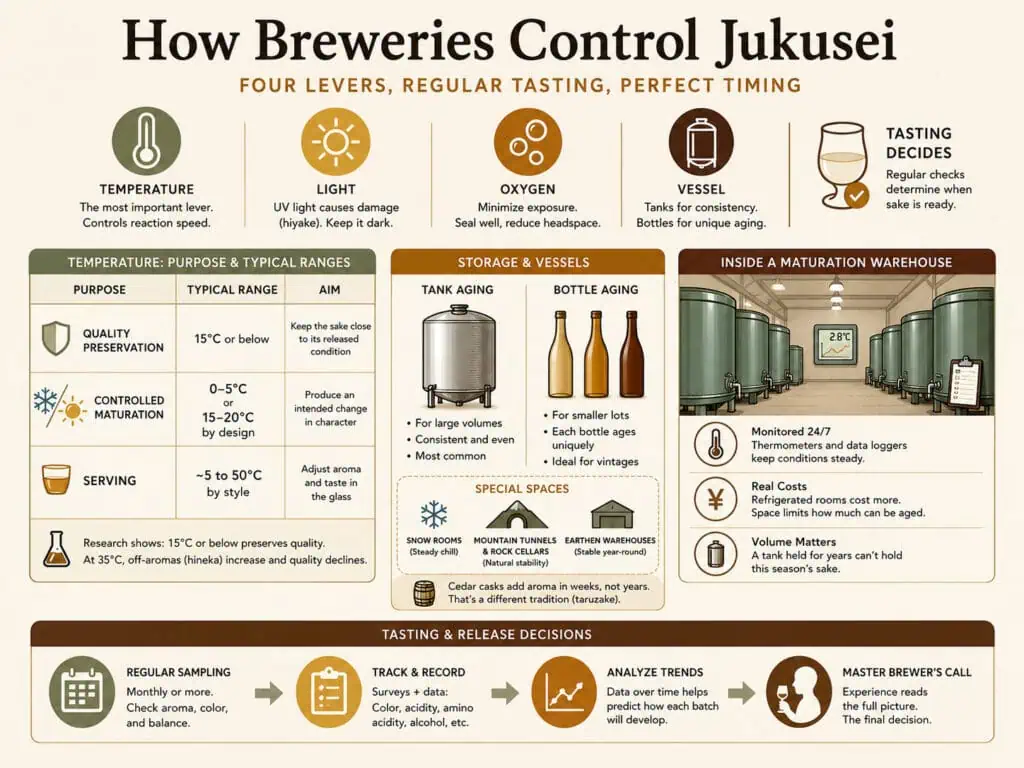
Breweries control Jukusei through four levers: temperature, light, oxygen, and the vessel, of which temperature carries by far the most weight. Regular tasting then decides when a tank is ready to ship.
Temperature
Cold slows the Maillard reaction and protects delicate aromas. Warmth speeds every reaction along and builds both color and body. Breweries therefore choose refrigerated rooms near 0 to 5°C for elegant styles. Ambient warehouses near 15 to 20°C suit richer results.
One distinction saves a lot of confusion here: a temperature suited to intentional maturation is not necessarily the best temperature for keeping a sake unchanged.
| Purpose | Typical range | Aim |
| Quality preservation | 15°C or below | Keep the sake close to its released condition |
| Controlled maturation | 0 to 5°C, or 15 to 20°C by design | Produce an intended change in character |
| Serving | Roughly 5 to 50°C by style | Adjust aroma and taste in the glass |
The 15°C figure comes from published research. In a 2023 study, scientists at the National Research Institute of Brewing stored commercial sake between 0 and 35°C. The trial ran for up to six months. Samples at 0°C and 15°C showed no significant sensory change. Samples at 35°C developed clear hineka and scored worse overall.
The component data told the same story, since concentrations at 0°C shifted by less than ten percent across the full six months. At 25°C, methional roughly doubled. The authors concluded that 15°C or below suits quality preservation.
Stability matters alongside the number itself, because repeated swings stress the liquid, so a steady 15°C usually beats a room bouncing between 5 and 25°C.
Light and Oxygen
Light damages sake quickly and permanently, since ultraviolet rays trigger reactions that create off aromas, a fault Japanese brewers call hiyake (日焼け), or sunstrike. Dark green and brown bottles, plus paper wraps, exist precisely for this reason.
Oxygen plays a smaller role than in wine, since a sealed bottle holds little headspace air. Light oxidation can round out harsh edges, while heavy exposure flattens aroma. Brewers therefore fill bottles carefully, cap them tightly, and sometimes blanket tanks with inert gas.
Tanks and Bottles
Enclosed steel tanks mature large volumes evenly and dominate commercial practice, while bottles suit smaller lots and let brewers track individual vintages precisely.
A few breweries use unusual spaces instead: snow rooms in Niigata hold a steady chill without machinery, while others rely on mountain tunnels or old rock cellars. Warehouses with thick earthen walls barely move a few degrees across a year, as our kura guide describes.
Cedar casks belong to a different tradition, because wood contributes aroma within weeks rather than years, so our taruzake guide sits beside this topic rather than inside it.
Inside a Maturation Warehouse
Maturation space looks far less romantic than most people imagine, with rows of steel tanks filling a plain and rather quiet hall. Thermometers and data loggers hang on the walls, and a clipboard usually hangs beside the sampling tap.
Space carries real cost, which shapes every decision, since refrigerated rooms draw electricity every day of the year while ambient warehouses cost far less yet age sake faster. Many breweries therefore run both and split their stock between them.
Volume adds another constraint of its own, because a tank held back for three years simply cannot take in this season’s sake. For a small brewery, that single choice can mean a noticeable drop in annual output.
Tasting and Release Decisions
No formula sets the ideal aging period, so staff draw samples on a schedule, sometimes monthly, and record aroma, color, and balance each time. Because those records accumulate over years, a brewery can predict how a new batch will behave.
Beyond tasting, staff track simple chemistry, so color readings, acidity, amino acidity, and alcohol all go into the same running log. Those numbers rarely decide anything alone, yet they flag a tank that is moving unusually fast.
The toji, or master brewer, usually holds the final say. Experience carries weight that instruments cannot replace, since a veteran reads a whole tank from one glass.
Which Sake Ages Well?
Structured sake with firm acidity and generous umami ages best, while fragrant, highly polished styles usually peak within a year of release. Thin, low-acid sake tends to collapse rather than develop, so time alone guarantees nothing.
- Aromatic ginjo and daiginjo: best fresh, or aged cold to protect the bouquet
- Junmai and honjozo: often reward several years, especially with kimoto or yamahai acidity
- Kijoshu: sweet and concentrated, and it matures gracefully
- Genshu: undiluted and higher in alcohol, which slows some reactions
- Namazake: changes fastest of all, and it needs cold storage throughout
Earlier brewing stages set these limits, because enzymes from koji release the amino acids that will later fuel the browning reactions. The yeast starter, meanwhile, builds the acidity that supports long aging. Our guides to moto and moromi cover those steps.
The starter method leaves a clear mark here. Kimoto and yamahai starters grow their own lactic acid through wild bacteria. That firm acidity gives aged sake a frame to hold. Modern sokujo starters use added lactic acid and give cleaner, softer results.
Brewers also look for warning signs before committing tank space. Low acidity, thin body, and a very high polishing ratio suggest a short window. Firm acidity, visible umami, and a slightly rustic character suggest patience will pay.
Regional habits follow broadly similar logic, although individual breweries vary widely. Niigata is often associated with clean, dry sake, and many producers there favor cool, short maturation. Hyogo, by contrast, is known for firm water and sturdy sake that tolerates longer aging.
How to Store Sake at Home
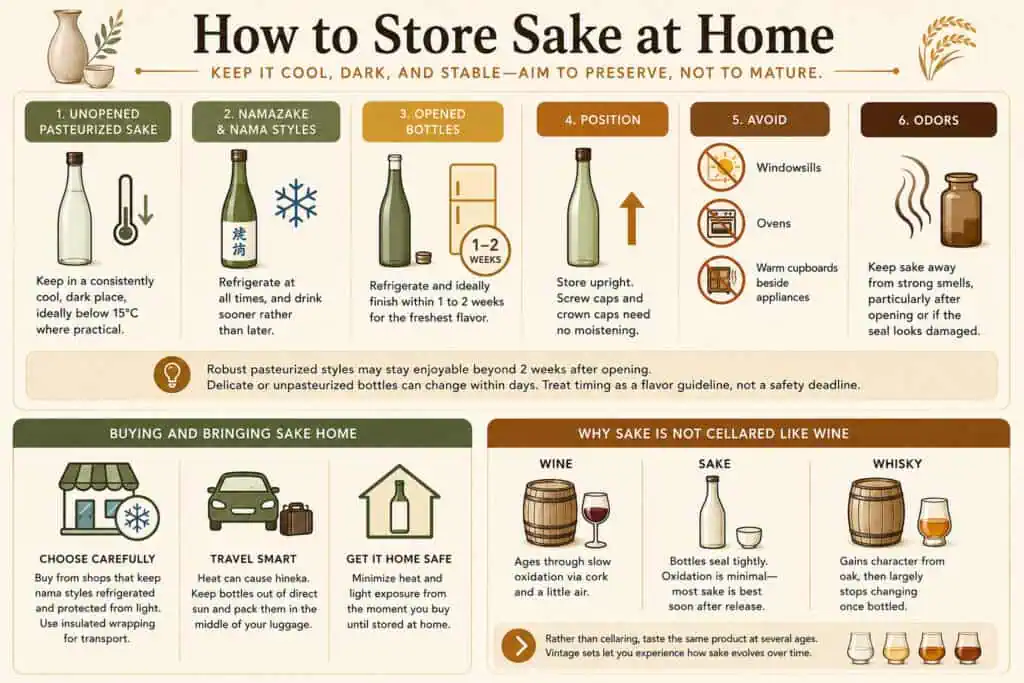
Store sake upright, in the dark, and as cool as you can manage. Refrigerate anything labelled nama, and follow any instructions printed by the brewery or retailer. Aim to preserve the sake rather than to mature it, since home conditions are hard to control.
- Unopened pasteurized sake: keep it in a consistently cool, dark place, ideally below 15°C where practical
- Namazake and nama styles: refrigerate at all times, and drink them sooner rather than later
- Opened bottles: refrigerate and ideally finish within one to two weeks for the freshest flavor
- Position: upright, because screw caps and crown caps need no moistening
- Avoid: windowsills, ovens, and warm cupboards beside appliances
- Odors: keep sake away from strong smells, particularly after opening or if the seal looks damaged
Robust pasteurized styles may stay enjoyable beyond two weeks after opening, while delicate or unpasteurized bottles can change within days. Treat the timing as a flavor guideline rather than a safety deadline.
Buying and Bringing Sake Home
Storage starts before the bottle reaches your shelf, since a shop that keeps nama styles on a warm, brightly lit display has already cost you something. Specialist retailers usually refrigerate those bottles and wrap them for transport.
Travel deserves a thought too. A bottle left in a hot car for an afternoon can pick up hineka. Carrying sake home from a trip? Keep it out of direct sun, packed in the middle of your luggage.
Why Sake Is Not Cellared Like Wine
Wine ages largely through slow oxidation, helped by a cork that exchanges a little air. Sake bottles seal tightly, so that mechanism barely applies, while whisky gains its character from oak and then stops changing once bottled.
One wine habit therefore transfers badly. Buying sake to cellar for a decade rarely pays off, because most bottles taste best soon after release. A better route is tasting the same product at several ages, which some breweries make easy through vintage sets.
Common Misconceptions About Jukusei
- Does all sake improve with age? No. Fragrant styles usually peak early, and many bottles decline after a year.
- Is old sake spoiled? Not necessarily. Well-stored aged sake is a deliberate product, not a failure.
- Is koshu the same as expired sake? No. Sake labels carry a bottling date rather than an expiry date, and koshu results from planned maturation.
- Should sake always be refrigerated? Not always. Pasteurized bottles keep well in a cool dark place, though nama styles need cold.
- Does darker color mean better quality? No. Color mostly reflects storage temperature and style.
- Is sediment a fault? Rarely. Melanoidins and proteins can bind and settle out during long maturation.
Price causes one further misunderstanding, because age genuinely does raise cost, with tank space and capital sitting idle for several years. Value, however, still depends on the sake inside the bottle.
Author’s tasting note
My first glass of koshu seemed strange, because I expected the bright fruit of young sake. Cold, it felt closed and faintly bitter. As the glass warmed over about fifteen minutes, caramel and dried-fruit aromas opened up and the bitterness made sense.
Final Thoughts
Jukusei is not simply the passage of time, but a controlled stage in which temperature, storage conditions, and the base sake together decide how aroma, flavor, color, and texture develop.
Most sake undergoes short maturation and becomes smoother and better integrated. Only selected styles suit years of aging, so Jukusei describes a process rather than a promise of improvement. Long maturation may eventually produce the distinct category of koshu.
Next, explore aged sake styles in our koshu guide, or browse more terms in our sake brewing guide.
Jukusei FAQ
What is Jukusei in sake brewing?
Jukusei is the managed maturation of sake after brewing finishes. Brewers hold the liquid at a chosen temperature for a set period. Chemical reactions then gradually reshape aroma, flavor, color, and texture.
How is Jukusei different from storage?
Chozo emphasizes the act of storing sake, while Jukusei emphasizes the maturation that happens during storage. The two overlap in practice, and breweries use the terms differently depending on context.
How long does sake mature before release?
Most sake rests for roughly six months to a year, usually in tanks before bottling. The aim is smoother balance rather than dramatic change, and autumn hiyaoroshi releases show the effect clearly.
What is the difference between Jukusei and koshu?
Jukusei names the process, while koshu names the product. The Long-Term Aged Sake Association defines aged sake as sake matured at the brewery for at least three years. Japanese law itself sets no universal minimum.
Does sake improve with age?
Some sake improves with time, but most does not, since fragrant ginjo and daiginjo often peak within a year of release. Structured junmai with firm acidity can gain depth over several years.
How should sake be stored?
Keep sake upright, in the dark, and consistently cool. Research from the National Research Institute of Brewing suggests 15°C or below for preserving quality. Anything labelled nama needs refrigeration throughout.
Is old sake safe to drink?
Properly sealed, unopened sake is generally microbiologically stable, but storage history still matters. Do not drink a bottle if the seal is damaged or the bottle leaks. Discard it if the contents look contaminated or the condition seems uncertain. Flavor deterioration and food safety are separate questions.
Can sake be aged at home?
You can try, though results are hard to predict, because household temperatures swing far more than carefully managed brewery cold rooms. Choose a structured junmai, then keep it dark, upright, and cool. Expect a gentle change rather than a transformation.
References
- Isogai, A. (2009). Aroma Compounds Responsible for the Aging of Sake and Their Formation Mechanism. Journal of the Brewing Society of Japan, 104(11), 847–857. https://www.jstage.jst.go.jp/article/jbrewsocjapan/104/11/104_847/_article (Surveyed: July 2026)
- Isogai, A. et al. (2023). Effect of Storage Temperature on Quality Changes of Sake [in Japanese]. Journal of the Brewing Society of Japan, 118(9), 649–657. https://www.jstage.jst.go.jp/article/jbrewsocjapan/118/9/118_649/_article/-char/ja/ (Surveyed: July 2026)
- National Research Institute of Brewing, Sake (Seishu) 2: The Integration of Science and Technology, https://www.nrib.go.jp/English/sake/pdf/SakeNo02_en.pdf (Surveyed: July 2026)
- Japan Sake and Shochu Makers Association, Japanese Sake: A Comprehensive Guide, https://www.nrib.go.jp/English/sake/pdf/guidesse01.pdf (Surveyed: July 2026)
- Nishibori, N., National Research Institute of Brewing, Brewing Methods for Sake Resistant to Hineka [in Japanese], https://www.nrib.go.jp/data/kouen/pdf/52kou02.pdf (Surveyed: July 2026)
- Long-Term Aged Sake Association (Choki Jukusei-shu Kenkyukai), Official Website, https://vintagesake.jp/ (Surveyed: July 2026)
Related Articles
- Koshu (古酒) (Surveyed: July 2026)
- Pasteurization (火入れ / Hiire) (Surveyed: July 2026)
- Warimizu (割水) (Surveyed: July 2026)
- Filtration (濾過 / Roka) (Surveyed: July 2026)
- Pressing (上槽 / Joso) (Surveyed: July 2026)
- Namazake (生酒) (Surveyed: July 2026)
- Kura (酒蔵) (Surveyed: July 2026)
- Types of Japanese Sake (Surveyed: July 2026)





Comments