



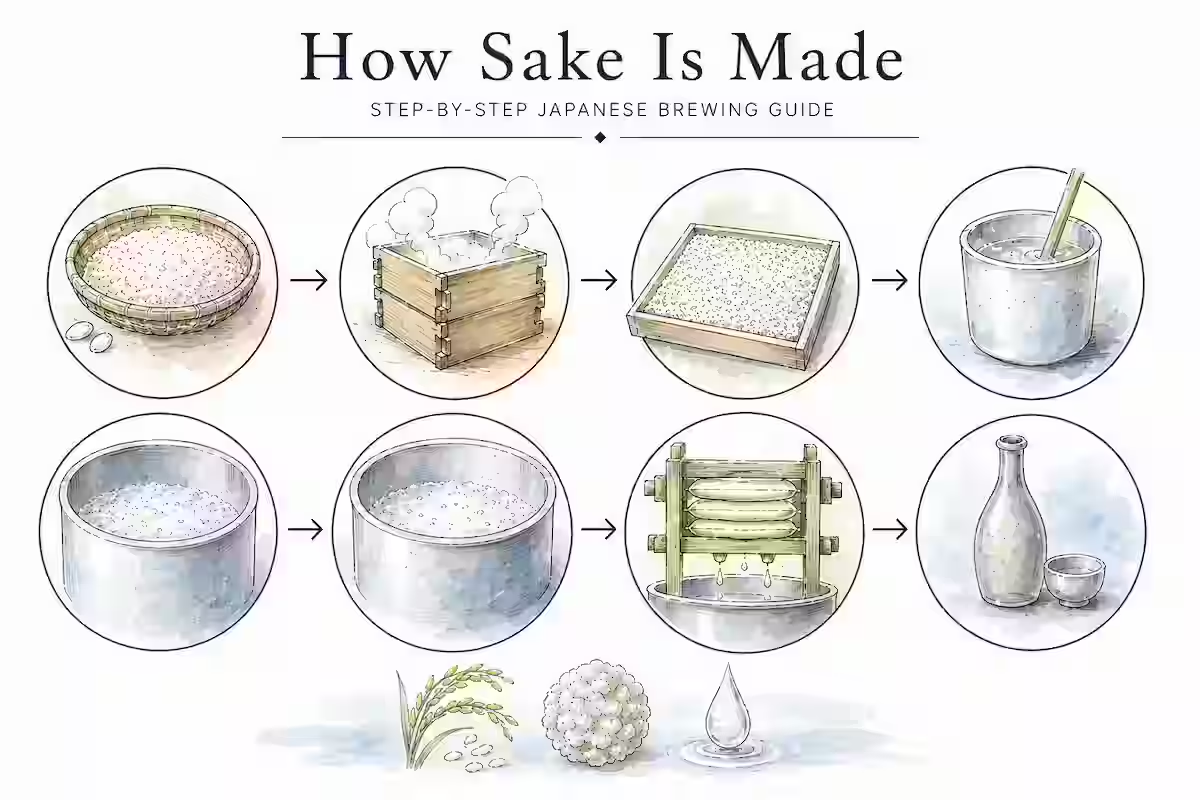
Sake is one of those drinks that rewards curiosity. The bottle looks simple. The contents taste complex. And the process behind it turns out to be genuinely fascinating, combining centuries of tradition with a brewing science that differs fundamentally from both wine and beer.
Understanding how sake is made changes how you taste it.
What Makes Sake Different from Wine and Beer
Before walking through the steps, it helps to understand what makes the Japanese sake brewing process unusual.
Wine ferments from fruit sugar that already exists in grapes. Beer converts grain starches to sugar first, then ferments that sugar separately. Sake does both at the same time, in the same tank. Sugar conversion and alcohol fermentation happen simultaneously, a process brewers call multiple parallel fermentation.
This parallel process gives sake its distinctive balance of richness, delicacy, and depth. No other major fermented beverage works quite this way. And a microscopic mold called koji makes the whole thing possible.
The Main Ingredients in Sake
Three core ingredients form the foundation of every sake:
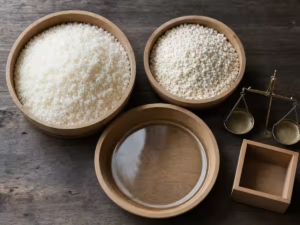
- Rice (sake-mai): Specialized brewing rice varieties like Yamada Nishiki or Gohyakumangoku, grown specifically for fermentation. They have larger grains, softer centers, and lower protein content than table rice.
- Koji (Aspergillus oryzae): A mold cultivated on steamed rice that produces enzymes capable of converting rice starch into fermentable sugar.
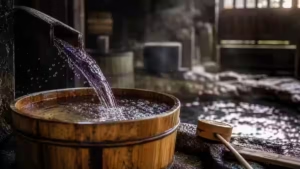
- Water (mizu): Breweries select water with extreme care. Mineral content directly influences fermentation speed and final flavor. The famous Nada-Gogo sake region built its reputation largely on the mineral-rich Miyamizu water available there.
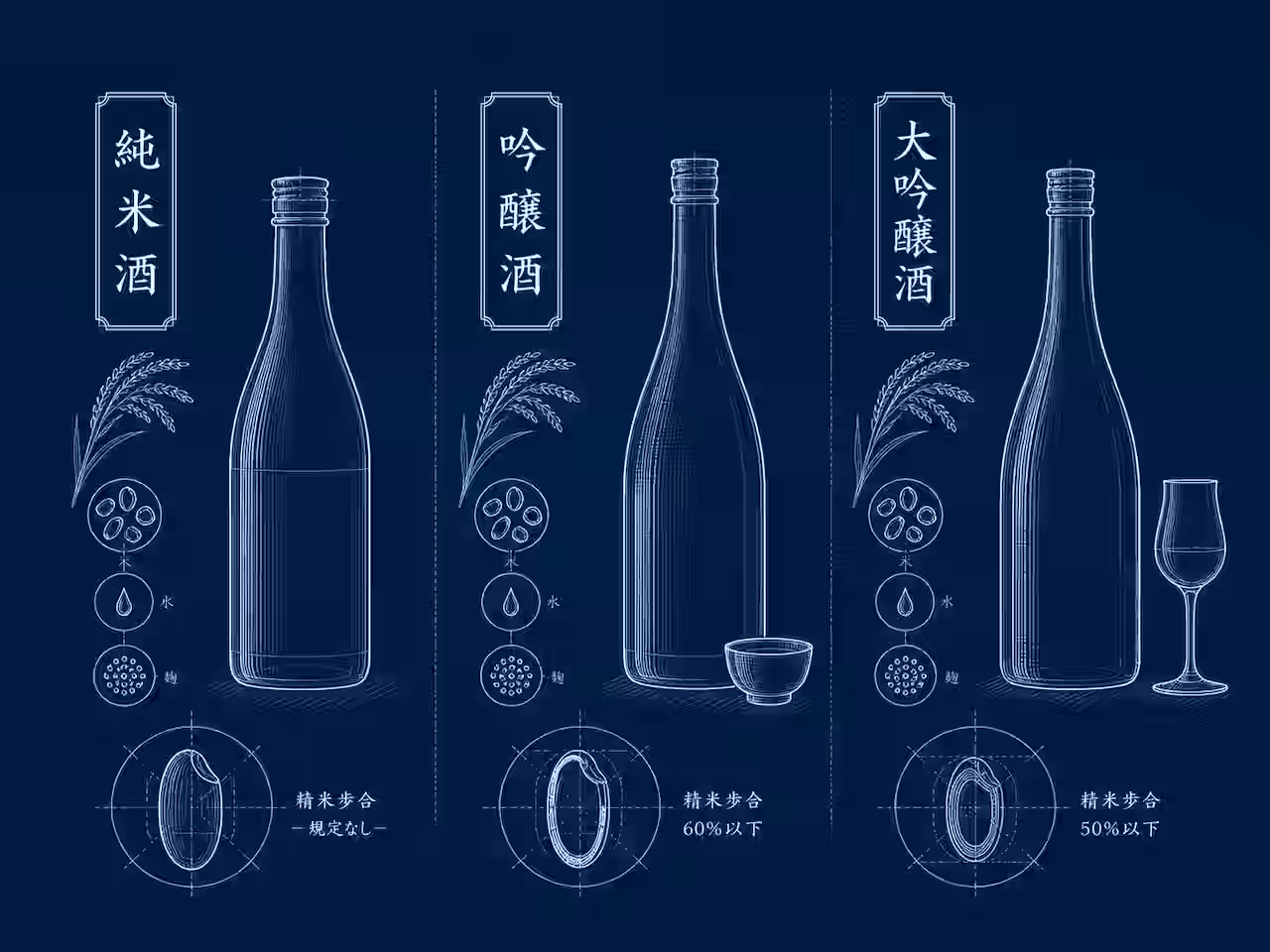
Premium styles like junmai, ginjo, and daiginjo use only these three. Honjozo adds a small, regulated amount of distilled alcohol to refine aroma and lighten the finish.
Step 1: Polishing the Rice
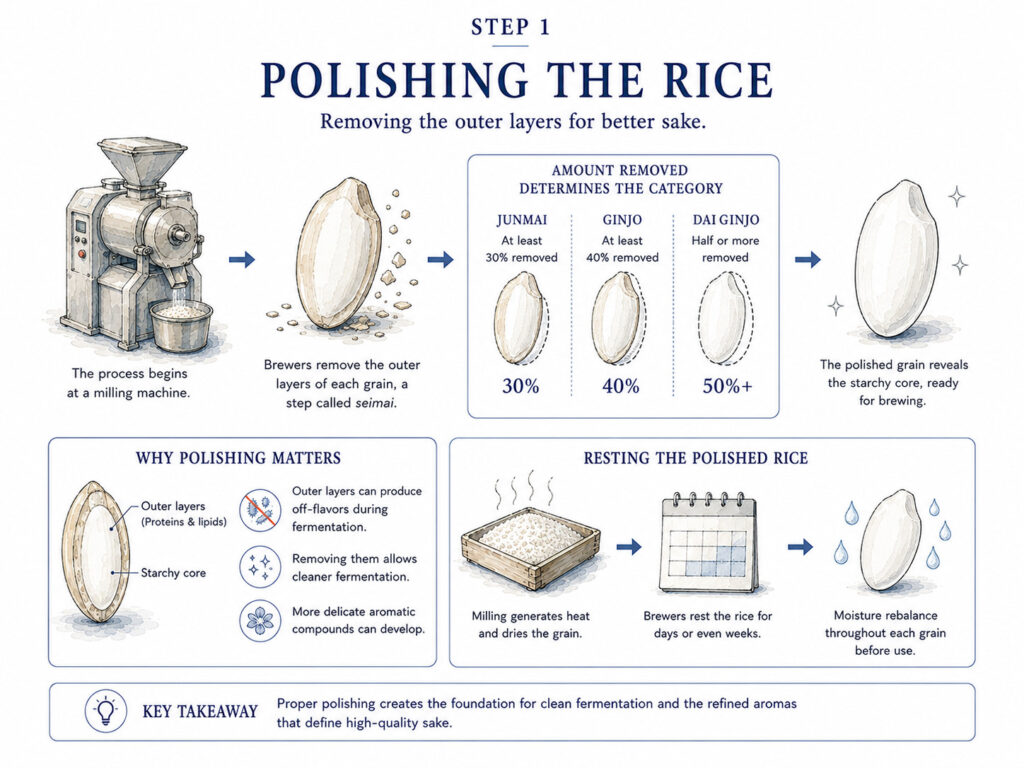
The process begins not in a tank but at a milling machine. Brewers remove the outer layers of each rice grain, a step called seimai.
The amount removed determines the sake category. For junmai sake, at least 30% of the grain disappears. ginjo, 40% minimum. For daiginjo, half or more of the original grain goes before brewing even begins.
Why does polishing matter? The outer layers contain proteins and lipids that can produce off-flavors during fermentation. Removing them exposes the starchy core, which ferments more cleanly and allows more delicate aromatic compounds to develop.
Milling generates heat and dries the grain. Consequently, brewers rest the polished rice for days or even weeks, allowing moisture to rebalance throughout each grain before use.
Step 2: Washing, Soaking, and Steaming
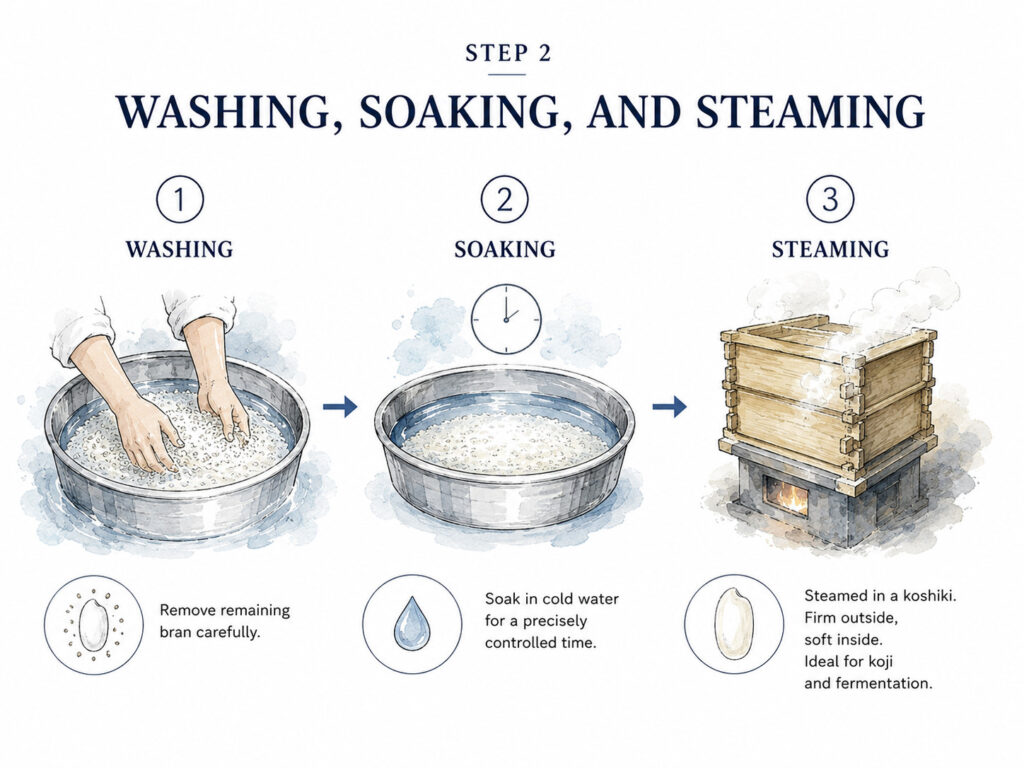
Workers wash the polished rice carefully to remove remaining bran. Then they soak it in cold water for a precisely controlled period, anywhere from minutes to hours depending on the sake style and seasonal conditions.
After soaking, the rice goes into a large steamer called a koshiki. Unlike boiled rice, steamed sake rice stays firm on the outside and soft inside. This specific texture matters for both koji cultivation and fermentation tank behavior.
Step 3: Making Koji
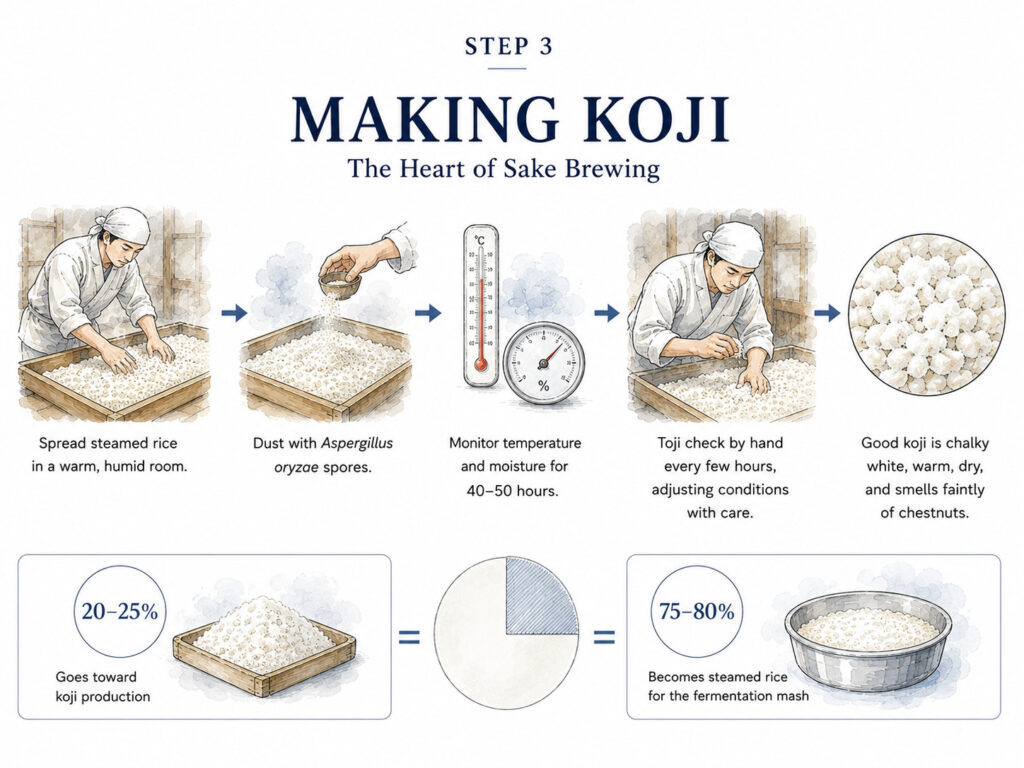
The Heart of Sake Brewing
Koji production is widely considered the most critical stage of the entire sake making process. Many experienced brewers describe it as the heart of everything.
Workers spread a portion of the steamed rice onto wooden trays in a warm, humid room called a koji-muro. They dust it with Aspergillus oryzae spores, then monitor temperature and moisture for 40 to 50 hours. The mold grows across and into each grain, producing amylase enzymes that later convert starch to sugar during fermentation.
Experienced toji (master brewers) check the koji by hand every few hours, adjusting airflow and temperature carefully. Too warm, and the mold grows too fast. Too cool, and enzyme development suffers. Good koji looks chalky white, feels warm and dry, and smells faintly of chestnuts.
Roughly 20 to 25% of the total rice batch goes toward koji production. The rest becomes steamed rice for the fermentation mash.
Step 4: Building the Yeast Starter (Shubo)
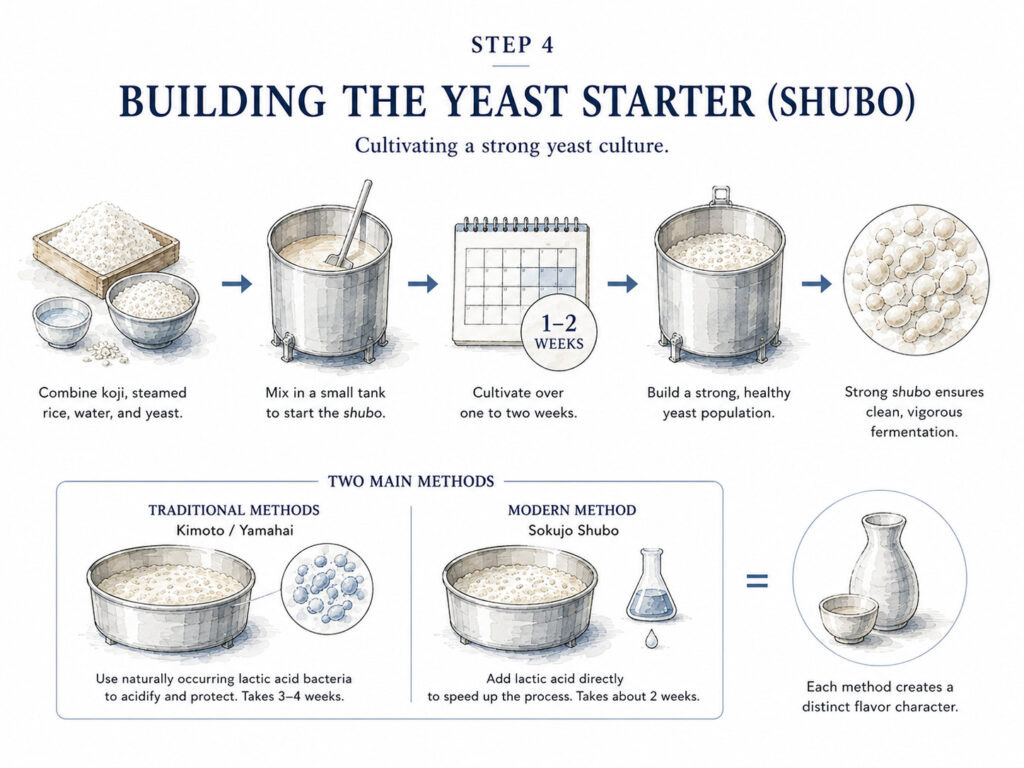
Before large-scale fermentation begins, brewers cultivate a concentrated yeast culture called shubo, or moto. This starter combines koji, steamed rice, water, and yeast in a small tank over one to two weeks.
The goal is to build up a massive, healthy yeast population capable of dominating the fermentation environment. A strong shubo protects against contamination and drives consistent, vigorous fermentation later.
Two main methods exist for making shubo. The traditional kimoto and yamahai methods use naturally occurring lactic acid bacteria to acidify and protect the starter. Modern sokujō shubo adds lactic acid directly, speeding the process from weeks to about two weeks. Each approach produces a different flavor character in the finished sake.
Step 5: Building the Fermentation Mash (Sandan Shikomi)
This step surprises most people who haven’t encountered it before.
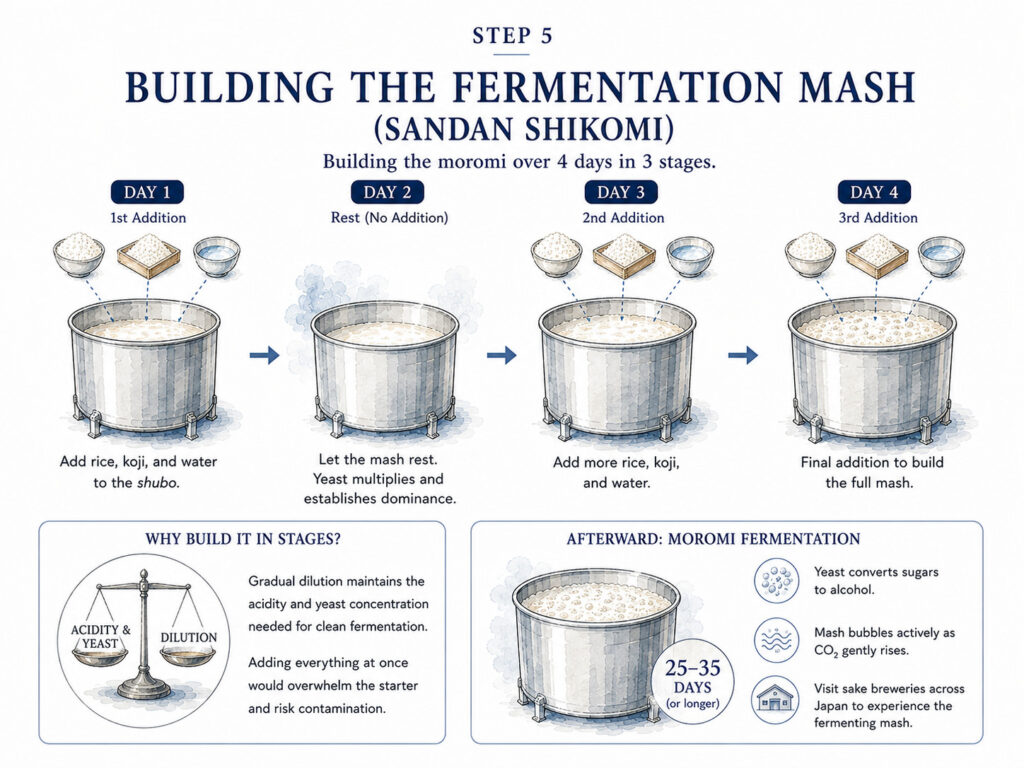
Brewers don’t add all the ingredients at once. Instead, they build the moromi (main fermentation mash) over three separate additions across four days, a technique called sandan shikomi, or three-stage brewing.
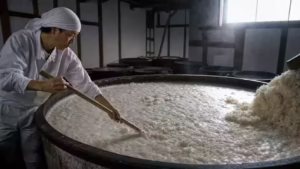
On day one, they add steamed rice, koji, and water to the shubo. Day two, the mixture rests without additions, allowing the yeast to multiply and establish dominance. On days three and four, two more larger additions of rice, koji, and water go in. By the end, the tank holds the full mash, diluted carefully to the right concentration for healthy yeast activity.
This incremental approach dilutes the mash slowly enough to maintain the acidity and yeast concentration needed for clean fermentation. Adding everything at once would overwhelm the starter and risk contamination.
Moromi fermentation then continues for 25 to 35 days, sometimes longer for premium styles. During this time, the mash bubbles actively as yeast converts sugars to alcohol. At traditional sake breweries across Japan, including those in Niigata and Aomori, visiting during this period means standing next to enormous tanks of fermenting mash, listening to the gentle hiss of CO₂ rising from the surface.
Step 6: Pressing, Filtering, and Clarifying
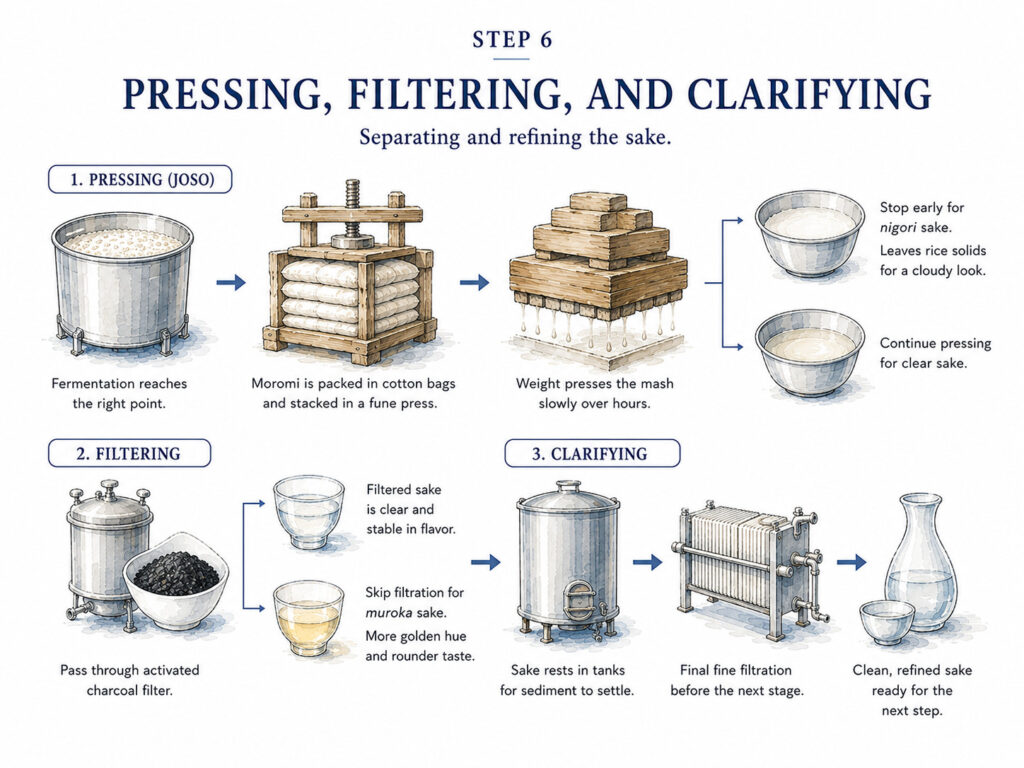
When fermentation reaches the right point, brewers press the moromi to separate the liquid sake from the solid rice lees. This step, called joso, uses several methods depending on the style and brewery.
The most traditional approach involves filling cotton bags with moromi and stacking them in a wooden press called a fune. Weight alone squeezes the liquid out slowly over hours. Breweries producing nigori sake stop filtration early, leaving some rice solids in suspension to create the characteristic cloudy appearance.
Most sake then passes through an activated charcoal filter to remove color compounds and stabilize the flavor. Some breweries skip this step, producing muroka (unfiltered) sake with a more golden hue and rounder taste.
After filtration, the sake rests in tanks to allow sediment to settle. A final fine filtration follows before the next stage.
Step 7: Pasteurization (Hi-ire)
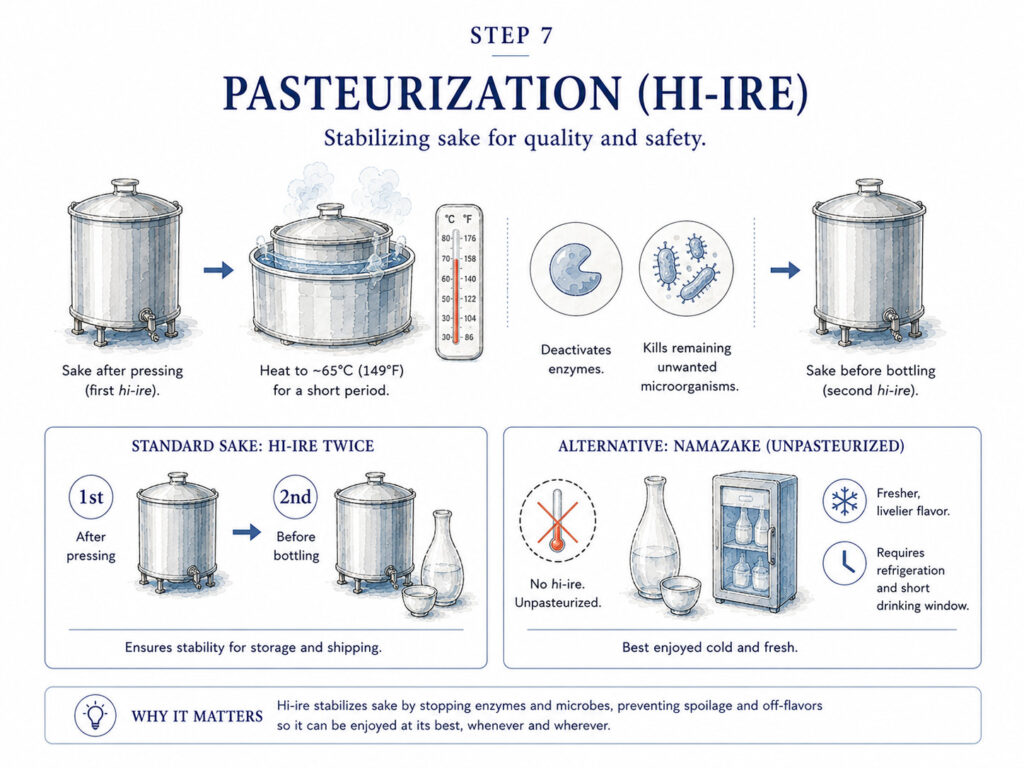
Most sake goes through pasteurization, called hi-ire, to stabilize the liquid for storage and shipping. Brewers heat the sake to around 65°C (149°F) for a short period, deactivating enzymes and killing any remaining unwanted microorganisms.
Standard sake undergoes hi-ire twice: once after pressing and once before bottling. Skipping both steps produces namazake, or unpasteurized sake, which tastes fresher and livelier but requires refrigeration and a much shorter window for drinking.
Step 8: Dilution, Aging, and Bottling
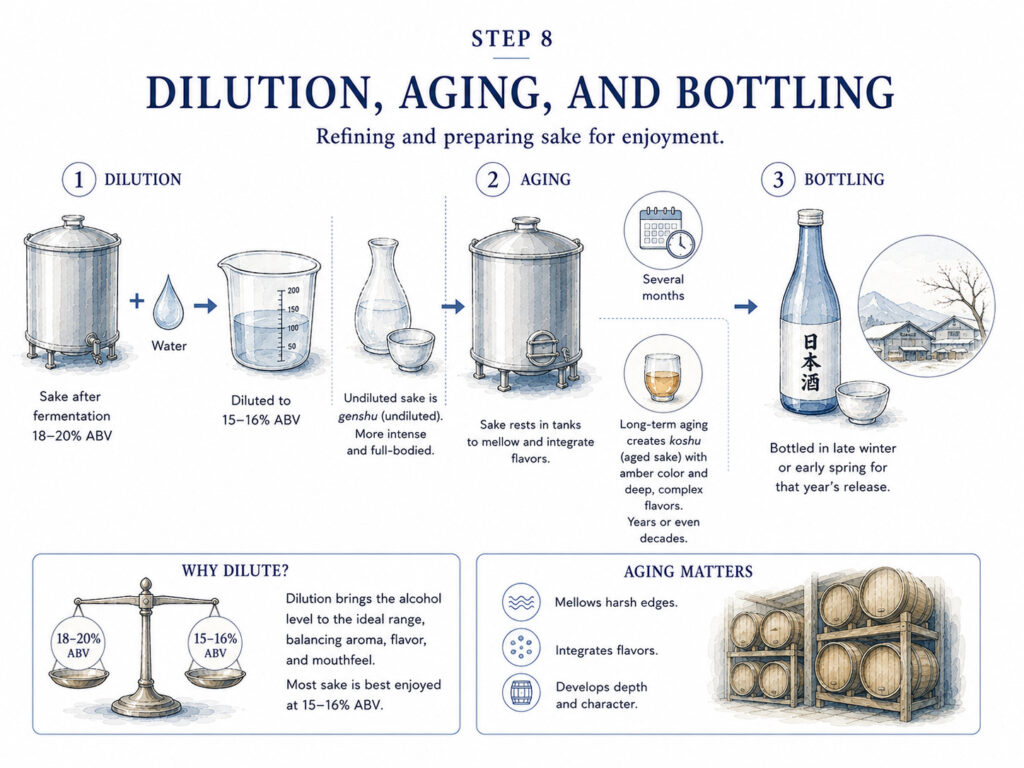
Most sake comes out of fermentation at around 18 to 20% alcohol. Brewers typically dilute it with water before bottling, bringing the final strength down to around 15 to 16%. Sake bottled without this dilution is called genshu, and it tends to carry more intensity and weight.
After pasteurization, the sake rests in tanks for several months before bottling. This aging period allows harsh edges to mellow and flavors to integrate. Some breweries age sake for years or even decades, producing koshu (aged sake) with amber color and deep, complex flavors closer to sherry or fortified wine.
Finally, the sake goes into bottles, often in late winter or early spring for that year’s vintage release.
How Sake Style Affects the Process
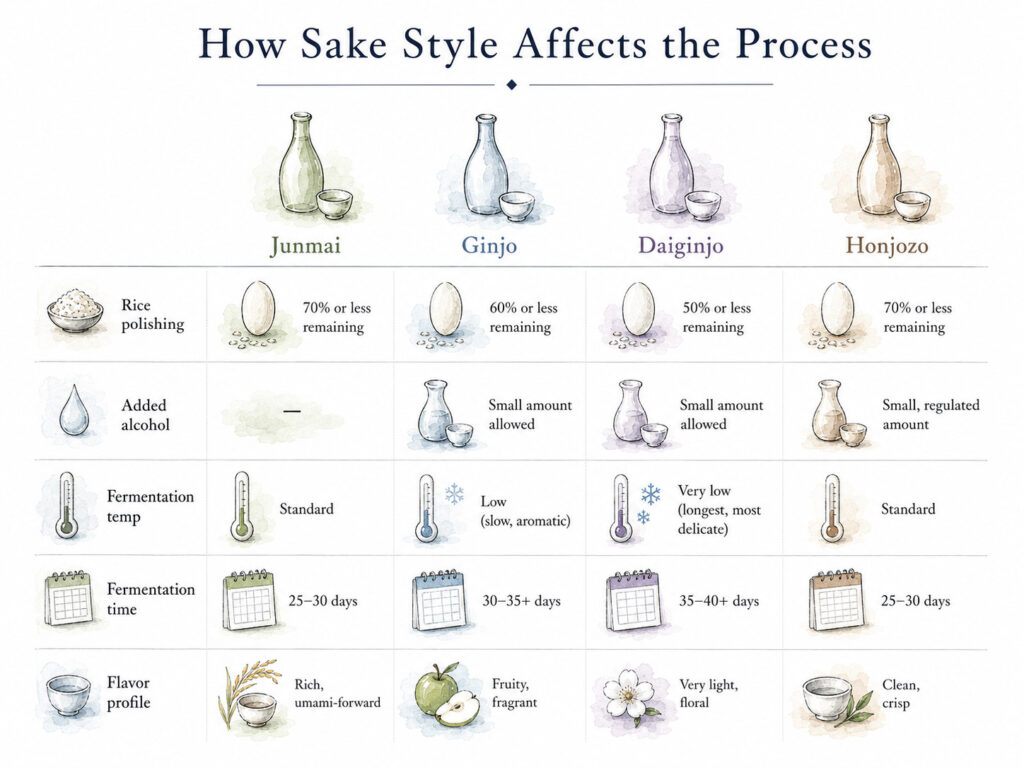
The category of sake being produced shapes decisions at every stage of brewing.
| Step | Junmai | Ginjo | Daiginjo | Honjozo |
|---|---|---|---|---|
| Rice polishing | 70% or less remaining | 60% or less | 50% or less | 70% or less |
| Added alcohol | None | Small amount allowed | Small amount allowed | Small, regulated amount |
| Fermentation temp | Standard | Low (slow, aromatic) | Very low (longest, most delicate) | Standard |
| Fermentation time | 25-30 days | 30-35+ days | 35-40+ days | 25-30 days |
| Flavor profile | Rich, umami-forward | Fruity, fragrant | Very light, floral | Clean, crisp |
Producing daiginjo demands the most from a brewery: half the rice is milled away before brewing, fermentation runs cold and slow for weeks, and the margin for error narrows at every step. The types of Japanese sake guide covers these distinctions in more detail for anyone curious about how categories translate to taste.
Visiting a Sake Brewery in Japan
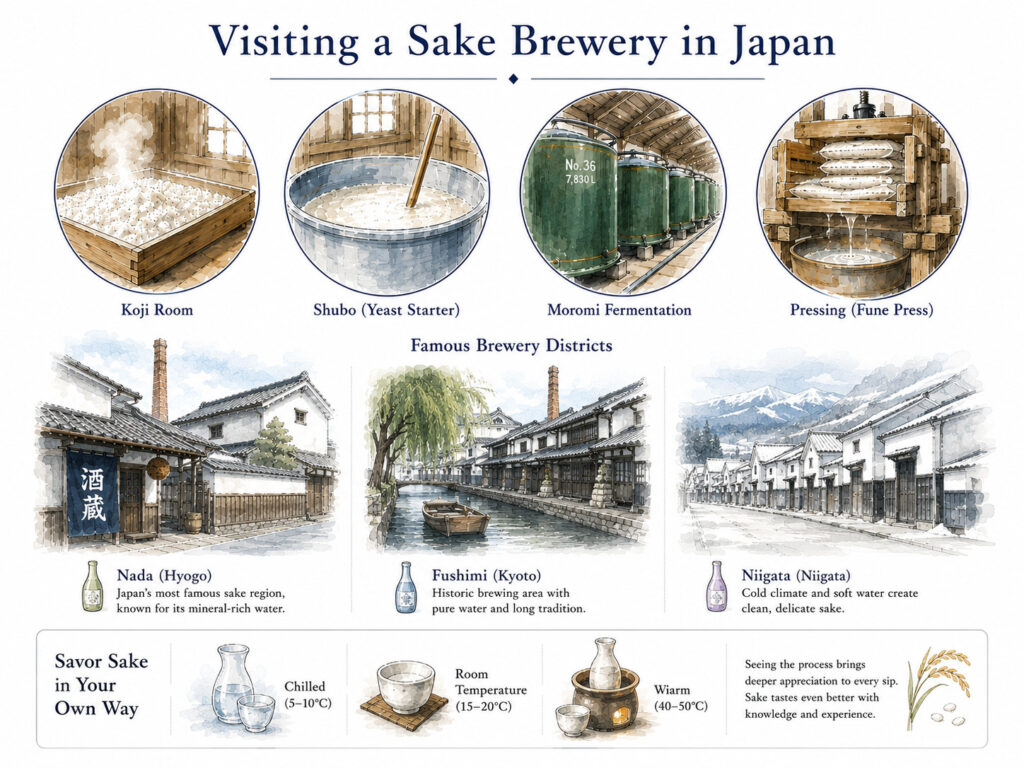
Understanding how sake is made creates a very different experience when visiting a working kura (brewery).
Many breweries across Japan open their doors to visitors, particularly during the winter brewing season from October through March. Walking through a brewery, you see the koji room steaming gently, smell the sharp yeast of the shubo, and watch enormous tanks of moromi bubbling in the cold air. Some breweries still press sake in traditional wooden fune presses, a sight worth traveling for.
Regions like Nada in Hyogo, Fushimi in Kyoto, and Niigata have brewery districts where multiple kura sit within walking distance of each other. For anyone serious about sake, a brewery visit brings the process from the page to something genuinely sensory.
And once you’ve watched moromi ferment and seen pressed sake run into a collection tank, even a simple glass of chilled sake tastes a little more interesting. Whether you prefer it cold, at room temperature, or as warmed sake on a winter evening, knowing the process behind the drink adds a dimension that no tasting note fully captures.
References
- Japan Sake and Shochu Makers Association, “How Sake Is Made” (2023): https://www.japansake.or.jp/sake/english/know/process.html
- Sake World (John Gauntner), “The Sake Brewing Process” (2021): https://sake-world.com/html/flash/process.html
- True Sake, “Sake 101: Understanding How Sake Is Brewed” (2023): https://www.truesake.com/blogs/news/sake-101
- The Japanese Bar, “How Is Sake Made? A Complete Guide to the Brewing Process” (2022): https://thejapanesebar.com/learn-sake/how-is-sake-made/




Comments