


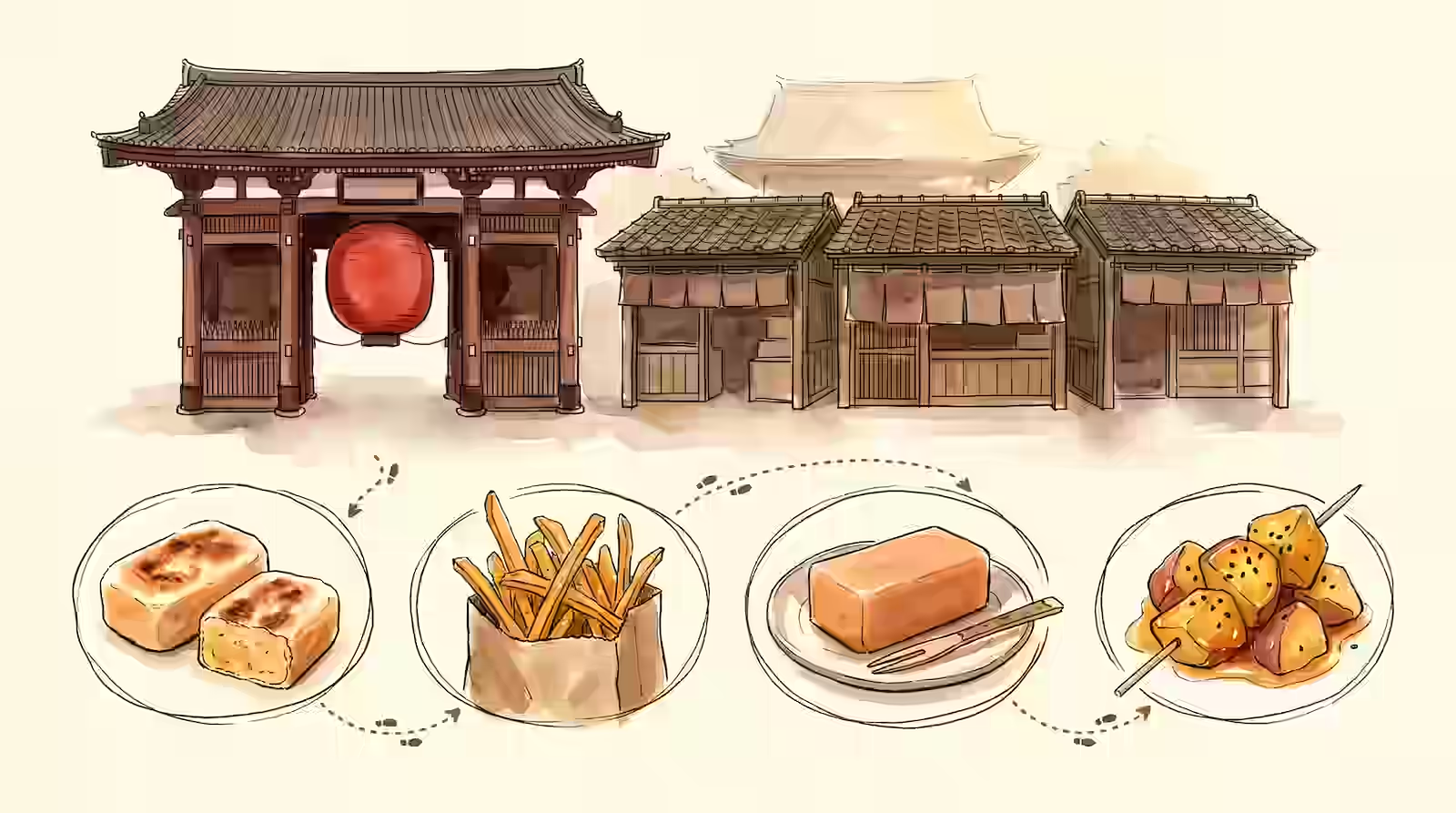


Walk a few blocks from Kaminarimon Gate in Asakusa, and you start to notice a pattern. One shop sells candied sweet potatoes, and the next sells sweet potato bars. A third, meanwhile, grills little sweet potato cakes. The Asakusa sweet potato tradition is real, and it makes a surprisingly good theme for an afternoon.
This guide turns that tradition into a self-guided food walk. First, it explains why Asakusa has so many sweet potato shops and how the main treats differ. It also suggests an order that makes tasting them easier, then covers budget, etiquette, souvenirs, and useful Japanese words.
Asakusa Sweet Potato Guide at a Glance
In short, you can taste four very different sweet potato foods within a short walk of Senso-ji Temple. They are grilled imo kin, candied daigaku imo, roasted yakiimo, and a dense, sliceable sweet potato confection called imo yokan. Each comes from a different shop, and each also has its own story.
Quick Facts
- Walk type
- Self-guided tasting route around Senso-ji, Asakusa, Tokyo
- Time needed
- About 2 to 3 hours, including a temple visit
- Stops
- Four sweet potato shops plus a break at Senso-ji
- Start and finish
- Kaminarimon Gate, then back toward Asakusa Station
- Best start time
- Around 11:00, after all main stops have opened
- Best season
- Autumn and winter, although most treats sell all year
- Budget
- Roughly 2,000 yen per person for small tastings, before souvenirs
- Information checked
- September 28, 2026; hours, prices, and menus change
Why Is Asakusa Famous for Sweet Potato Sweets?
A Trade Town, Not a Farm Town
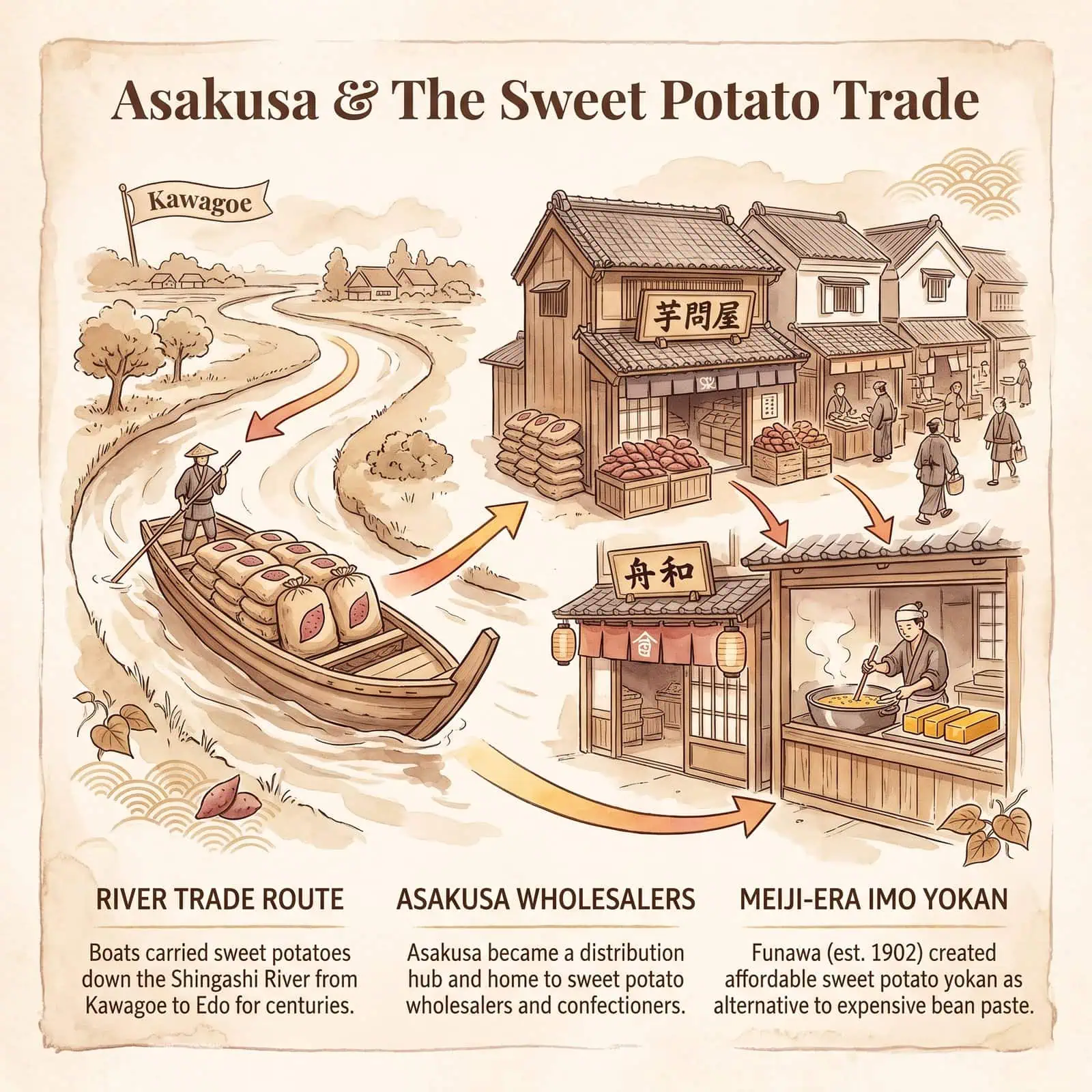
Here is the curious part: Asakusa is not a major sweet potato-growing area. Its connection with the ingredient grew through trade, processing, and confectionery instead. For centuries, river transport on the Shingashi River connected Kawagoe with Edo, the old name for Tokyo. It also helped move farm products toward the growing city. Kawagoe, in present-day Saitama, is still known for its sweet potatoes.
Asakusa later became home to sweet potato wholesalers and confectioners. In fact, two shops on this walk still trace their roots to that trade. Oimoyasan Koshin is run by Kawako Shoten, which began as a sweet potato wholesaler in 1876. The founder of Funawa, too, dealt in sweet potatoes before opening his sweets shop.
How Imo Yokan Was Born
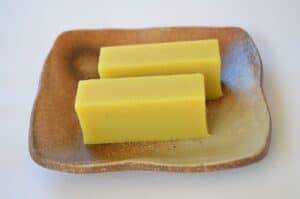
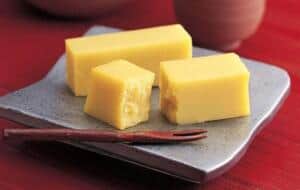
Asakusa gave rise to the best-known form of imo yokan during the Meiji era. Funawa opened in 1902, and it credits its founder, Wasuke Kobayashi, with creating the sweet. Japan’s agriculture ministry, meanwhile, describes imo yokan as the work of an Asakusa sweet potato wholesaler and a confectioner. Either way, it began as an affordable alternative to neri yokan. That kneaded bean-paste bar cost more than most ordinary people could pay.
Funawa’s own version is still simple: sweet potato, sugar, and a pinch of salt, pressed into a bar. For a closer look at its history and regional variations, read our complete guide to imo yokan.
What Makes Japanese Sweet Potatoes Different?
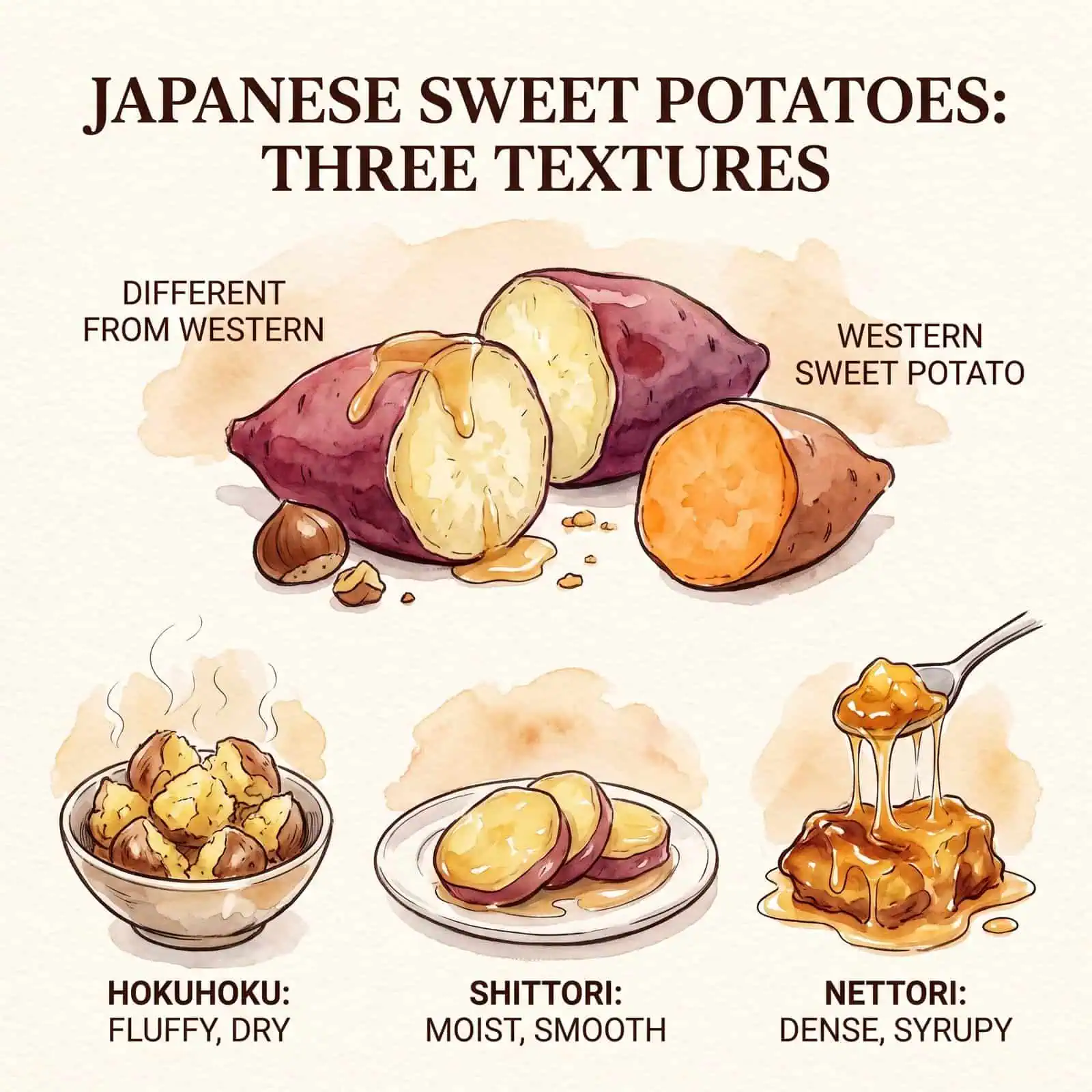
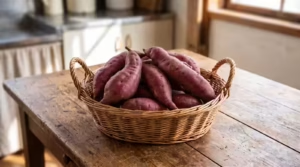
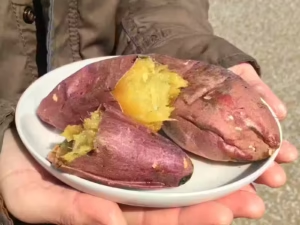
Japanese sweet potatoes, called satsumaimo, usually have reddish-purple skin and pale yellow flesh. Compared with the orange-fleshed sweet potatoes common in North America, they often taste denser and have a chestnut-like or honeyed sweetness. Texture also varies widely by variety and cooking method. As a result, people often eat them with nothing added at all.
Hokuhoku, Shittori, and Nettori
Japanese speakers describe sweet potato texture with three handy words. Hokuhoku means fluffy and dry, a little like roasted chestnut. Shittori means moist and smooth, while nettori means dense, sticky, and almost syrupy. The variety and the cooking method decide which one you get. Our guide to Japanese roasted sweet potato explains the varieties behind each texture.
Quick Comparison: Which Sweet Potato Treat Should You Choose?
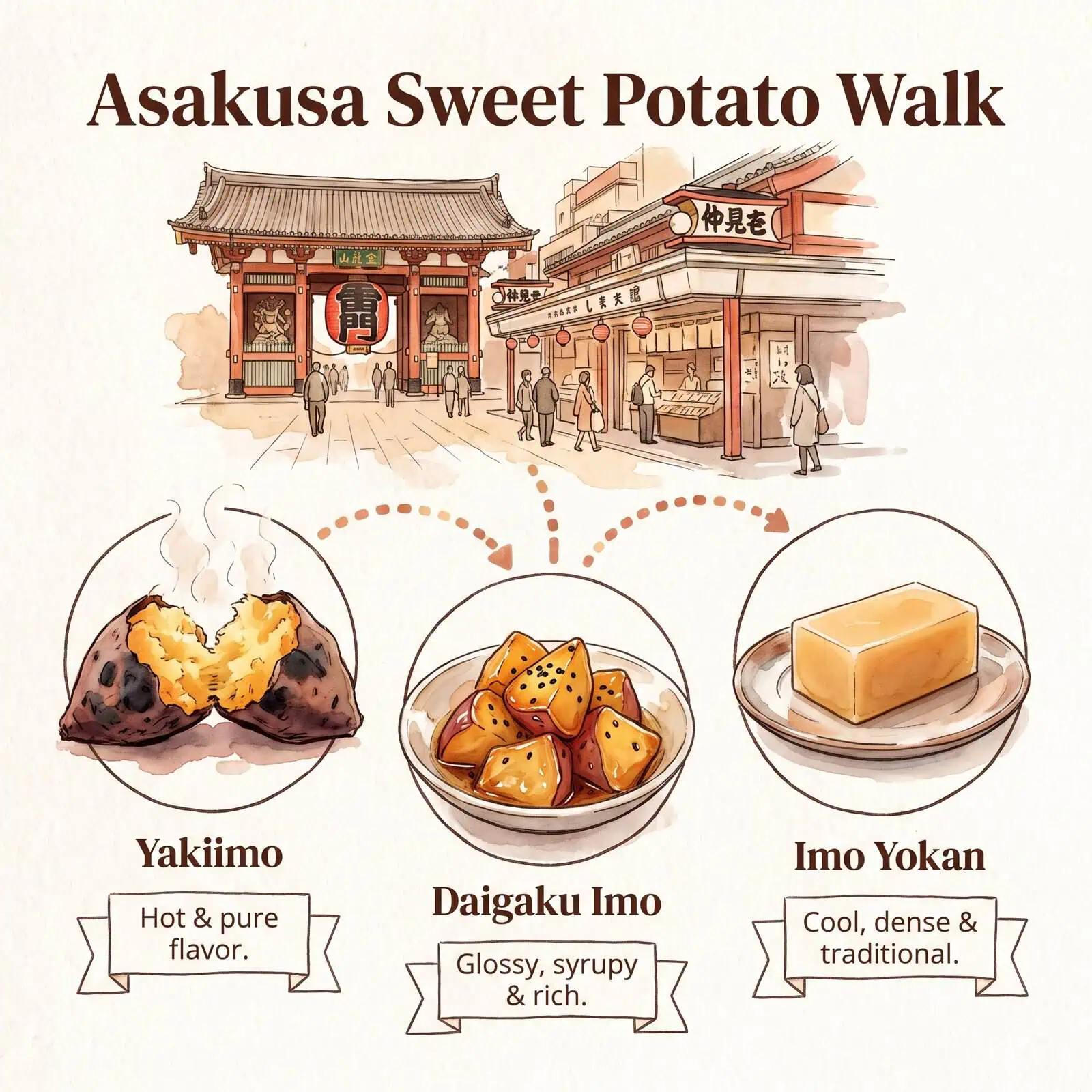
Each stop on the walk offers a different texture and temperature, so it helps to know what to expect. The table below sums up the main choices.
| Treat | Texture | Served | Eat it | Best for |
|---|---|---|---|---|
| Imo kin | Smooth filling, thin grilled crust | Warm, freshly made | Right away | A small first bite |
| Daigaku imo | Glossy and syrupy outside, soft inside | Warm or room temperature, by batch | Soon, at the shop | Sharing |
| Yakiimo | Fluffy to sticky, by variety | Usually hot | While warm | Pure sweet potato flavor |
| Sweet potato chips (when sold) | Thin and crunchy | Room temperature | Anytime that day | Groups and snacking |
| Imo yokan | Dense and silky | Cool or room temperature | Soon after buying or later that day | Tradition and souvenirs |
If you are torn between the two most famous options, here is the simple rule. Choose yakiimo for natural sweetness, and choose daigaku imo if you want something sweeter, richer, and syrup-coated.
A Self-Guided Asakusa Sweet Potato Walk
The route below keeps walking short and saves the take-home item for last. It also avoids eating on the move, which matters in crowded Asakusa. Treat it as a flexible plan rather than a strict order.
The route at a glance
- SStartKaminarimon Gate
- 1Imo kinMangando
- 2Daigaku imoOimoyasan Koshin
- ~PauseSenso-ji Temple
- 3YakiimoImoyasu
- 4Imo yokanFunawa
Eat each treat where the shop suggests, then walk on. Save imo yokan for last, since it is the one you take home.
Start at Kaminarimon Gate
Kaminarimon, the huge gate with its giant red lantern, makes an easy meeting point. Resist the urge to buy anything big here. Nakamise shopping street will tempt you right away. Still, the walk works better if you stay hungry for the first stop.
Shop Stop 1: Imo Kin at Asakusa Mangando
Mangando is an Asakusa confectioner known for its freshly grilled imo kin. The imo kin is a small block of sweet potato paste, wrapped in a thin batter and then grilled. As a result, the outside turns lightly toasty, while the inside stays soft.
You can buy a single piece, which makes it a perfect opener. The company lists one piece at 173 yen, and fresh imo kin has a 24-hour use-by period. It contains wheat, and the shop sells it only in person, not online.
Imo kin
Asakusa Mangando, Orange-dori Main Store 浅草満願堂
- Try
- One freshly made imo kin
- Where
- 1-21-5 Asakusa, Taito City
- Hours
- 10:00 to 18:00; closed 1st and 3rd Tuesdays, but open on public holidays
- Note
- 24-hour use-by; watch the official site for temporary closures
Oimoyasan Koshin shares the same address, so the next stop is right there.
Shop Stop 2: Daigaku Imo at Oimoyasan Koshin
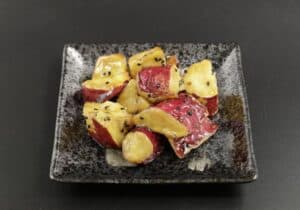
Kawako Shoten, which began as a sweet potato wholesaler in 1876, runs Oimoyasan Koshin. Today, the shop is best known for its daigaku imo, fried sweet potato coated in the house syrup. The name means “university potato.” One popular theory links it to students in Tokyo’s Hongo area in the early Showa era.
The varieties and styles on offer change with the season, so check the display before ordering. If two types are available, sharing both makes an easy comparison. Daigaku imo is generally sold by weight, so ask for the smallest available portion and check the current price. The syrup gets sticky, though, so grab a napkin. Our daigaku imo guide covers the dish’s history if you are curious.
Daigaku imo
Oimoyasan Koshin, Asakusa Orange-dori Store おいもやさん興伸
- Try
- The smallest available portion, ideally shared
- Where
- 1-21-5 Asakusa, Taito City
- Hours
- 10:00 to 18:00; open daily
- Note
- Varieties and portion sizes may change
Walk north to Senso-ji Temple for a sugar-free pause.
Temple Break: Senso-ji
Now pause the sugar. Walk up to Senso-ji Temple, and finish any open food before you approach the temple buildings. Drink some water, or try a salty rice cracker from one of the nearby shops if you want contrast. Your palate will thank you at the next stop.
Sugar pause
- Finish open food before the temple buildings
- Drink water or try a salty rice cracker
- Follow any posted signs on the grounds
Shop Stop 3: Yakiimo and Modern Treats at Imoyasu
Imoyasu opened in May 2021 opposite Asakusa Hanayashiki, Japan’s oldest amusement park. It opened as the second shop of a roasted sweet potato specialist from Tsuchiura. That city lies in Ibaraki Prefecture, one of Japan’s major sweet potato regions.
Alongside classic yakiimo, the shop has offered modern items such as roasted sweet potato sandwiches and dried sweet potato shakes. The selection may change, though, so check the display or the shop’s official site for the day’s menu.
If you are alone, choose one item here rather than two. A whole roasted sweet potato can be large, and you still have one stop left. Groups, by contrast, can share a roast potato and, if the shop has them that day, a bag of sweet potato chips.
Yakiimo
Yakiimo Senmonten Imoyasu, Asakusa 焼き芋専門店 芋やす
- Try
- A roasted sweet potato, or a snack to share if available
- Where
- Opposite Asakusa Hanayashiki
- Eat
- Seating may change; ask before ordering
- Note
- Ask which variety is roasting that day
Head back south toward Asakusa Station for the final stop.
Other Sweet Potato Stops Nearby
Optional detours
Daigakuimo Chiba-ya
Another well-known daigaku imo specialist, north of the temple in Asakusa 3-chome. It closes on some weekdays, so check its current schedule first.
Mangando soft serve
Mangando lists roasted sweet potato soft serve among its standard products. Availability can vary, so check the shop display.
Autumn specials
Many shops add limited-time desserts in autumn. Look for signs marked 期間限定 (kikan gentei).
Shop Stop 4: Imo Yokan at Funawa
Finish where the story of imo yokan began. Funawa’s main store sells imo yokan by the piece in its first-floor shop. Upstairs, the cafe stands where Funawa opened its Mitsumame Hall in 1903. Its elegant style of mitsumame, a jelly and fruit dessert, soon caught on. Today the cafe remains a calm place to sit after a busy walk.
Funawa’s imo yokan contains no coloring, preservatives, or flavorings, according to the company. It also has a relatively short use-by period, so buying it last reduces the time you need to carry it.
Imo yokan
Funawa Main Store (Asakusa Honten) 舟和 浅草本店
- Try
- A single piece from the first-floor shop, or a break in the upstairs cafe
- Where
- 1-22-10 Asakusa, Taito City
- Hours
- Shop 10:00 to 19:00; cafe 10:30 to 19:00 (last order 18:30); open daily
- Note
- Check the use-by date when buying to take home
How Much Time and Money Should You Allow?
Most people need two to three hours, including the temple. The budgets below are practical estimates rather than fixed package prices, so check current prices at each shop.
Light tasting
One imo kin, one piece of imo yokan, and a shared daigaku imo. Allow about 1,000 yen per person.
Standard walk
All four stops, sharing the larger items. Allow about 2,000 yen per person before souvenirs.
Tasting for two
Share daigaku imo and a roasted sweet potato, then take one small treat each. Add a box of imo yokan to go.
Some small shops may prefer cash, so carry some yen. Payment options also change, so check at the counter.
If You Only Have One Hour
Short on time? Then skip the temple break and pick two stops close together. Mangando and the Orange-dori branch of Oimoyasan Koshin sit near each other. So you can compare imo kin and daigaku imo in about half an hour. Afterward, finish at Funawa’s main store nearby and take imo yokan with you.
Best Time for an Asakusa Sweet Potato Walk
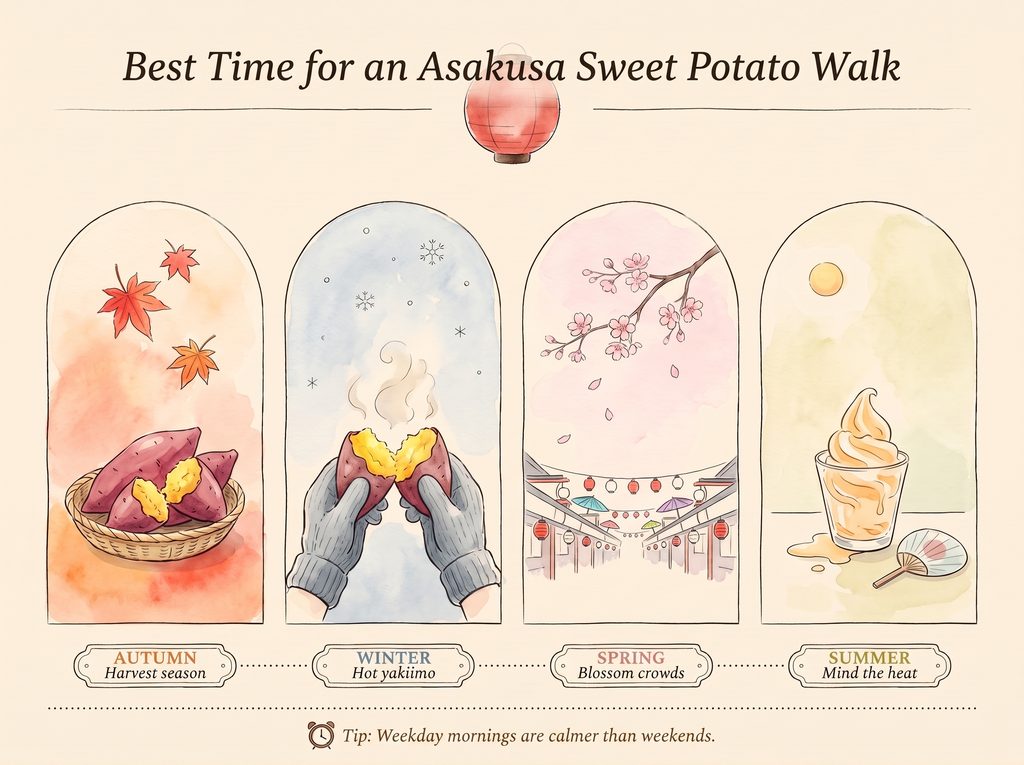
Autumn feels right for this walk, because farmers harvest sweet potatoes then and seasonal specials appear. Sweet potatoes are also part of a much wider seasonal food culture, explored in our Japanese autumn foods guide. Winter is even better for hot yakiimo, since a warm potato in cold hands is hard to beat. In spring, crowds swell during cherry blossom season. Summer is fine, too, but avoid carrying delicate sweets for long in the heat.
Weekday mornings are usually calmer than weekends and holidays. Still, Asakusa is busy almost every day, so a little patience helps.
Eating Etiquette in Asakusa
Crowded streets make eating on the move a problem in Asakusa. For that reason, many shops expect you to eat right by the counter. These habits keep things smooth:
- Stop to eat in the space the shop points to, and follow any posted signs.
- Avoid eating while walking through crowded Nakamise street.
- Do not block the entrance of the next shop while you eat.
- Return trash to the shop where you bought the food, since public bins are rare.
- Carry wet wipes, especially after daigaku imo.
- Avoid carrying open food near the temple buildings, and follow any posted instructions.
Useful Japanese Words for Your Walk
Words on labels and menus
- 焼き芋 (yakiimo) roasted sweet potato
- 大学芋 (daigaku imo) candied sweet potato
- 芋ようかん (imo yokan) sweet potato bar
- 焼きたて (yakitate) freshly baked or grilled
- 期間限定 (kikan gentei) limited time only
- 消費期限 (shōhi kigen) use-by date
- 要冷蔵 (yō reizō) keep refrigerated
Handy phrases
- Kore o hitotsu kudasai. One of these, please.
- Doko de tabereba ii desu ka? Where should I eat this?
- Shōhi kigen wa itsu desu ka? When is the use-by date?
What to Buy as a Souvenir
Imo yokan is the classic Asakusa souvenir, although its short shelf life limits long trips. Fresh imo kin also has a 24-hour use-by period. For a longer journey, Mangando’s separate usu-kawa imo kin has a 30-day best-before period, although it contains wheat, egg, dairy, and soy. The company sells its six-piece box at all shops and online.
Always read the label for the date and storage method. If you plan to take food out of Japan, check your home country’s rules on bringing in food, too.
Dietary and Allergy Notes
A plain roasted sweet potato is usually just sweet potato. Other treats vary more. Imo kin contains wheat, according to Mangando. Koshin’s frozen Miyabi daigaku imo lists sweet potato, sugar, starch syrup, salt, vegetable oil, and sesame. Still, check shop products separately. Modern desserts may also contain dairy or eggs.
Shops rarely publish full allergen charts in English, so ask staff before ordering. Do not assume anything is vegan or gluten-free without checking.
Is the Asakusa Sweet Potato Walk Worth It?
For food lovers, yes. In a single afternoon, you taste how one humble ingredient became four very different treats. Each one is also tied to a real shop with a real history. So start with warm imo kin and share some daigaku imo. Then pause at the temple, try a roasted potato, and end with imo yokan.
Before you go, check each shop’s current hours, since they change. If you fall for roasted sweet potatoes along the way, our yakiimo guide is a good next read. For a broader look at the capital’s food culture, see our complete Tokyo food guide.
Frequently Asked Questions
Choosing What to Eat
- What is the best sweet potato food for a first-time visitor?
-
Imo kin from Mangando makes an easy start, since you can buy a single piece. After that, try yakiimo for natural sweetness or daigaku imo for something richer. Finish with imo yokan, a sweet closely associated with Asakusa.
- What is the difference between yakiimo and daigaku imo?
-
Yakiimo is a whole sweet potato roasted slowly in its skin, with nothing added. Daigaku imo is cut, fried, and coated in a sweet syrup, often with sesame. Yakiimo tastes of the potato itself, while daigaku imo is richer and stickier.
- Is imo yokan the same as regular yokan?
-
No. Regular yokan is usually a firm bar of sweetened red bean paste. Imo yokan uses steamed sweet potato instead, and Funawa’s version contains only sweet potato, sugar, and a little salt.
Planning the Walk
- How long does the Asakusa sweet potato walk take?
-
Allow about two to three hours, including a visit to Senso-ji. The shops sit close together, so most of the time goes to eating, browsing, and the temple visit.
- Can I eat while walking in Asakusa?
-
It is better not to. Eat in the space each shop provides, and avoid eating while moving through crowded streets such as Nakamise. Follow any posted signs.
Budget and Diet
- How much should I budget?
-
Around 2,000 yen per person covers small tastings at each stop, before souvenirs. Sharing larger items keeps costs lower. Prices change, so check shop displays.
- Are Japanese sweet potato sweets vegan?
-
Some may be, but ingredients vary by shop and product. A plain roasted sweet potato is usually just sweet potato, while other treats can contain wheat, dairy, or eggs. Ask staff before ordering.
References
Official and public sources
- Funawa – Store Information: Asakusa Main Store (Accessed September 2026)
- Funawa – History (Accessed September 2026)
- Funawa – Imo Yokan and Funawa (Accessed September 2026)
- Ministry of Agriculture, Forestry and Fisheries – Imo-yokan (Sweet Potato Cake), Our Regional Cuisines (Accessed September 2026)
- Oimoyasan Koshin – Official Website and Store List (Accessed September 2026)
- Oimoyasan Koshin – Daigaku Imo Miyabi (Official Online Shop) (Accessed September 2026)
- Asakusa Mangando – Store Information (Accessed September 2026)
- Asakusa Mangando – Imo Kin (Accessed September 2026)
- Asakusa Mangando – Usu-kawa Imo Kin (Accessed September 2026)
- Asakusa Mangando – Standard Products (Accessed September 2026)
- Yakiimo Senmonten Imoyasu – Official Website (Accessed September 2026)
- Asakusa Hanayashiki – Official Website (Accessed September 2026)
- Ministry of Finance Japan – Kawagoe and Shingashi River Transport (Finance, August 2025) (Accessed September 2026)
- Ministry of Land, Infrastructure, Transport and Tourism – Kawagoe City and the Shingashi River Boat Trade (Accessed September 2026)
Press and travel sources
- Tokyo Shimbun – Funawa: Imo Yokan at the Asakusa Main Store (November 2024) (Accessed September 2026)
- Rurubu – Yakiimo Senmonten Imoyasu Opens in Asakusa (2021) (Accessed September 2026)
- TV Tokyo – Kawagoe Sweet Potatoes and the Shingashi River (January 2023) (Accessed September 2026)
- Hamoni – Sweet Potato Shops in Asakusa (Daigakuimo Chiba-ya) (Accessed September 2026)
- K’s House Tokyo Oasis – Asakusa and Sweet Potato (Accessed September 2026)
Related Articles
- Yakiimo: Japanese Roasted Sweet Potato (Surveyed: September 2026)
- Daigaku Imo (大学苋) (Surveyed: September 2026)
- Imo Yokan (苋ようかん) (Surveyed: September 2026)
- Tokyo Food Guide (Surveyed: September 2026)
- What to Eat in Tokyo (Surveyed: September 2026)
- Japanese Autumn Foods (Surveyed: September 2026)




Comments