



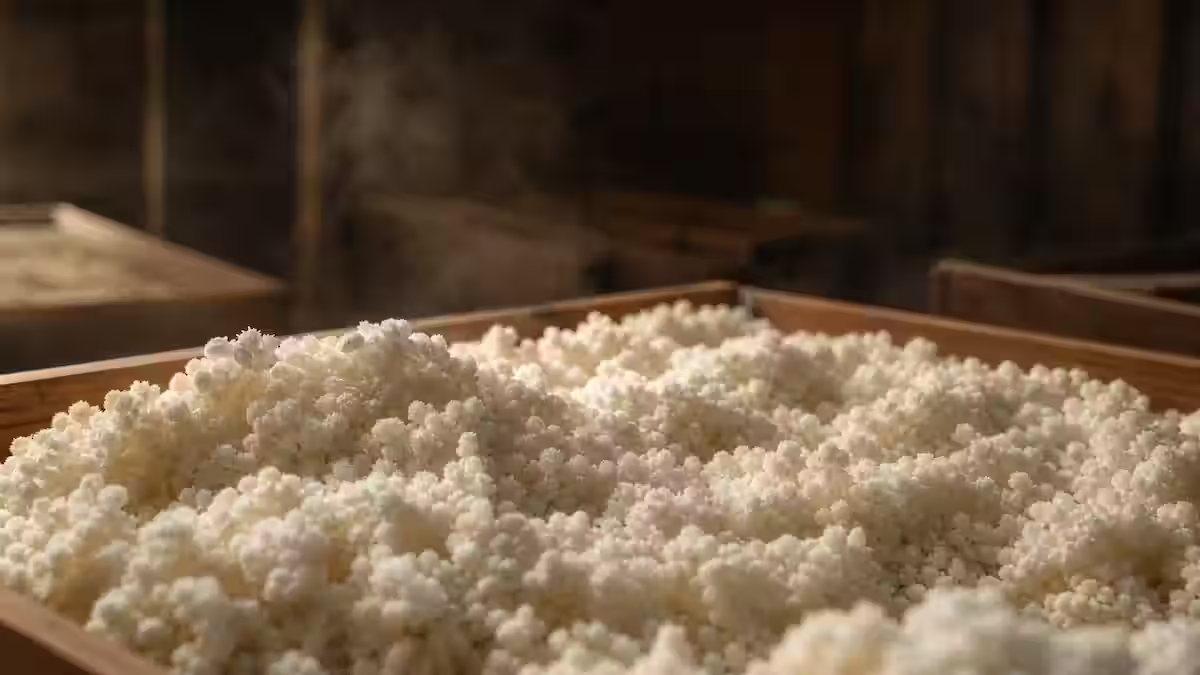
Sake begins with a quiet transformation inside a grain of rice. That transformation has a name: koji. So what is koji in sake brewing? Koji is steamed rice grown with a special mold, Aspergillus oryzae. The mold spreads through each grain and releases powerful enzymes. Those enzymes turn hard rice starch into simple sugar. Yeast then feeds on that sugar and makes alcohol. Without koji, that whole chain never starts. In short, sake cannot exist without it.
This guide explains koji in clear, complete terms. We cover what it is, how brewers make it, and why it matters. We also explore the science, the long history, and the flavor behind it. Brewers often call koji the heart of sake. By the end, you will understand why. For the full production picture, see our guide on how sake is made. Let me start at the very beginning.
Quick Facts About Koji
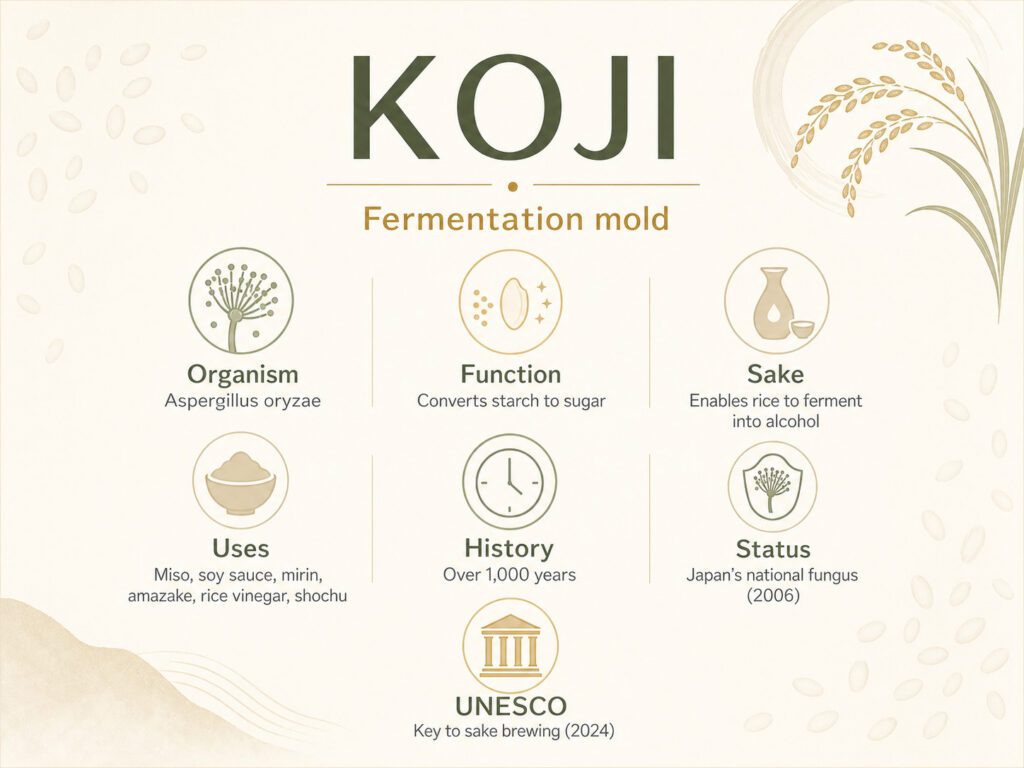
Here is a fast snapshot before the details begin.
| Japanese Name | 麹 / 糀 (kōji) |
| Scientific Organism | Aspergillus oryzae, a filamentous mold |
| Primary Function | Produces enzymes that convert starch into sugar |
| Role in Sake Brewing | Saccharifies rice so yeast can make alcohol |
| Other Uses | Miso, soy sauce, mirin, amazake, rice vinegar, shochu |
| Historical Importance | Central to Japanese fermentation for over 1,000 years |
| National Fungus Status | Designated Japan’s national fungus in 2006 |
| Heritage Status | Key to sake brewing, listed by UNESCO in 2024 |
What Is Koji?
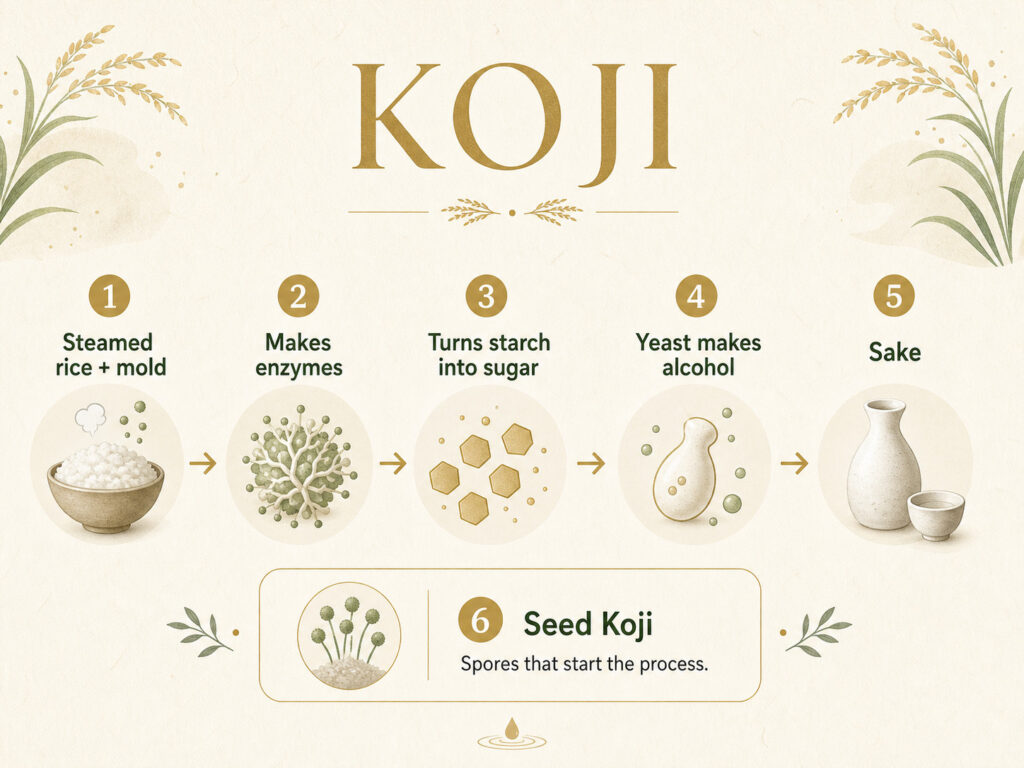
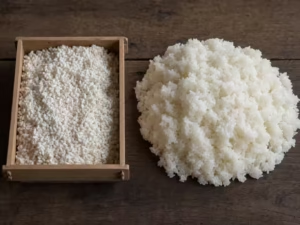
Let us begin with the simplest definition. Koji is steamed rice covered in a friendly mold. That mold is Aspergillus oryzae, known in Japanese as kōjikin. As the mold grows, it sends fine threads into each grain. Along the way, it releases enzymes that break down starch. So koji is really a living enzyme factory. Brewers grow it on purpose, with great care.
One Word, Two Meanings
The word koji can confuse newcomers. It names both the mold and the finished moldy rice. In this article, koji usually means the rice itself. Cooks also grow the same mold on barley or soybeans. For sake, however, rice koji remains the standard. This rice koji forms the base of every brew.
Why Sake Cannot Be Made Without Koji
Rice holds its energy as starch, not sugar. Yeast, though, cannot eat starch directly. So something must turn that starch into sugar first. Koji does exactly that job. Its enzymes slice long starch chains into small sugars. Only then can yeast begin its work. Without koji, the rice would simply sit there. In that sense, koji unlocks the entire process.
The Difference Between Koji and Yeast
People often mix up koji and yeast. Yet the two play very different roles. Koji is a mold that makes enzymes. Those enzymes create sugar from starch. Yeast is a single-celled microbe, not a mold. It eats sugar and produces alcohol and aroma. So koji prepares the food, and yeast eats it. Both work together, but they are not the same.
Seed Koji, the Starting Point
Every batch of koji starts from seed koji. Japanese brewers call this seed koji tane-koji, or simply moyashi. It is a concentrated powder of koji spores. Specialist makers cultivate and sell it to breweries. Remarkably, only about seven such makers remain in Japan. Their trade reaches back to the Muromachi period. So a tiny craft quietly supports the entire industry.
Why Koji Is Essential for Sake Brewing
So why is koji so important for sake? The answer lies in a simple chain of steps. Each step depends on the one before it. Let us walk through that chain slowly.
First, rice contains starch, a large and complex molecule. Second, yeast cannot consume that starch on its own. Third, koji produces enzymes during its growth. Fourth, those enzymes convert the starch into glucose. Finally, yeast converts that glucose into alcohol. So koji sits right in the middle of the story. It bridges the gap between rice and fermentation.
This bridge creates a remarkable situation. Both jobs happen at the same time, in one tank. Koji keeps making sugar as yeast keeps making alcohol. Brewers call this multiple parallel fermentation. It is one of the most special features of sake. We explore it in depth a little later.
How Koji Is Made
Koji making looks simple, yet it demands real skill. Brewers often call it the most important stage of all. The process unfolds over about two days. During that time, workers rarely leave it alone. Let us follow each step in order.
Step 1: Rice Polishing
Everything starts with milling the rice. Brewers polish away the outer layers of each grain. Those layers hold fats and proteins that can muddy the flavor. The polished heart, rich in starch, remains. A higher polish often yields a cleaner, more elegant sake. This step also shapes the later style of the brew.
Step 2: Washing and Soaking
Next, workers wash the rice to remove loose bran. Then they soak it in clean, cold water. Soaking sets the moisture inside each grain. Brewers time this step with great care. For premium sake, they may use a stopwatch. Too much water, and the koji struggles later.
Step 3: Steaming
After soaking, the rice goes into a large steamer. Steaming firms the outside while softening the core. This texture matters a great deal for koji. The mold needs grains that are firm yet tender inside. Boiled rice would turn mushy and unusable. So steaming, not boiling, remains the rule. Old records suggest steamed rice always suited the mold best.
Step 4: Inoculation With Koji Spores
Now comes the key moment. Workers cool the steamed rice to a safe warmth. Then they sprinkle fine seed koji spores over the surface. Gentle mixing spreads the spores across every grain. The goal is even, fair coverage. So each grain gets a chance to grow mold. This careful dusting decides much of what follows.
Step 5: The Koji Room (Koji Muro)
The inoculated rice moves into the koji muro. This room stays warm and very humid. Cedar walls help hold steady heat and moisture. Inside, the mold finally begins to grow. Workers wrap the rice in cloth to keep it cozy. The room feels almost like a nursery for koji.
Step 6: Temperature and Humidity Control
Control defines this whole stage. The mold gives off heat as it grows. So workers spread, gather, and mix the rice often. These moves keep the temperature in a narrow band. Brewers may check the koji through the night. A few degrees can change the final result. This is why many call koji making both exhausting and vital.
Step 7: Cultivation and Finished Koji
After roughly two days, the koji is ready. The grains now wear a soft white coat of mold. They smell faintly sweet, a little like chestnuts. Brewers call this finished stage dekoji. They then cool the koji to stop its growth. This rice koji will join the rest of the brew. Above all, good koji here shapes everything that follows.
A Test of Craftsmanship
No machine fully replaces a skilled koji maker. Experienced workers judge the rice by touch and smell. They feel the warmth and read the aroma. Small adjustments happen by instinct and training. So koji making blends science with deep craft. This human touch helped earn sake its heritage status.
The Science Behind Koji
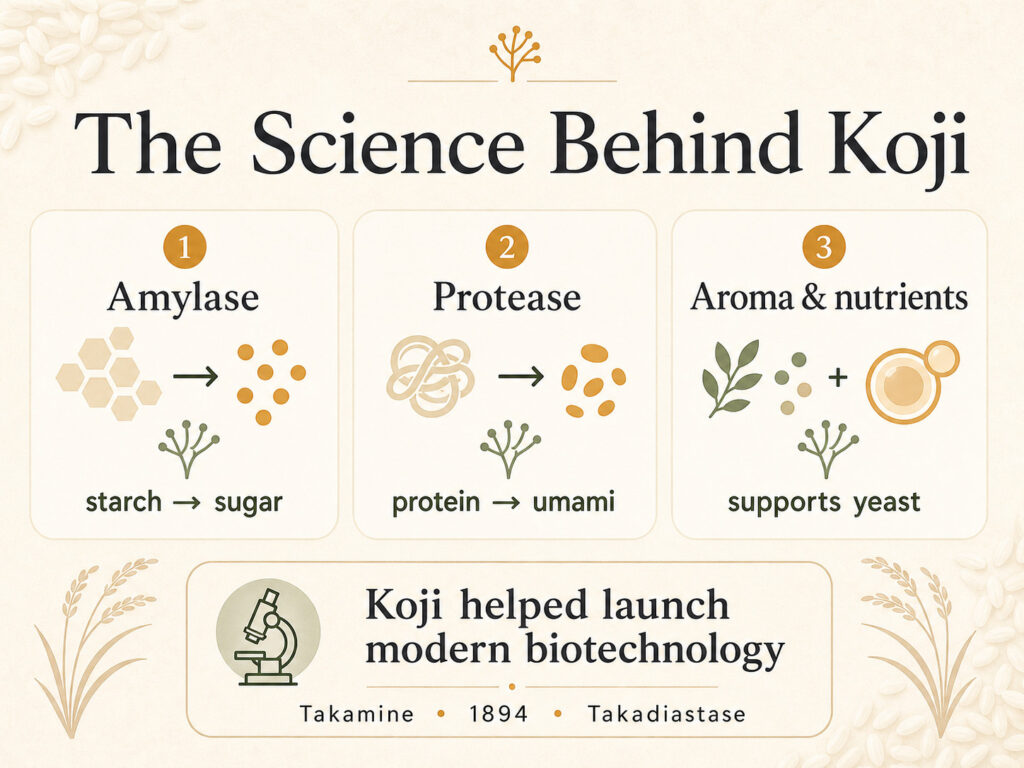
The beauty of koji lies in its enzymes. Enzymes are natural tools that speed up reactions. The mold makes many of them as it grows. A few families matter most for sake. Let us look at each in plain language.
Amylase: From Starch to Sugar
Amylase enzymes handle the starch. Rice starch is a long, tightly packed chain. Amylase cuts that chain into small sugar units. Glucose is the main sugar it releases. Yeast loves glucose, so this step feeds fermentation. Without amylase, the rice would stay locked and useless.
Protease: From Protein to Umami
Protease enzymes work on the rice proteins. They break proteins into amino acids and peptides. Those amino acids bring savory depth, or umami. So protease quietly shapes the body of the sake. Too much, though, can make a heavy, clumsy brew. Skilled brewers balance these enzymes with care.
Aroma and Other Enzymes
Koji does more than make sugar and umami. It also helps form aroma over time. Some enzymes free up compounds that smell fruity or floral. Others release minerals and nutrients for the yeast. So koji supports the yeast in many quiet ways. In a sense, the seeds of flavor are planted in the koji room.
From Koji to Modern Biotechnology
The story of koji enzymes reaches far beyond sake. In 1894, the chemist Jokichi Takamine made a famous discovery. He drew a digestive enzyme from Aspergillus oryzae. He called the product Takadiastase and patented it. That work launched the modern enzyme industry. So a humble brewing mold helped start global biotechnology. Few people connect their medicine cabinet to sake, yet the link is real.
Koji and Multiple Parallel Fermentation
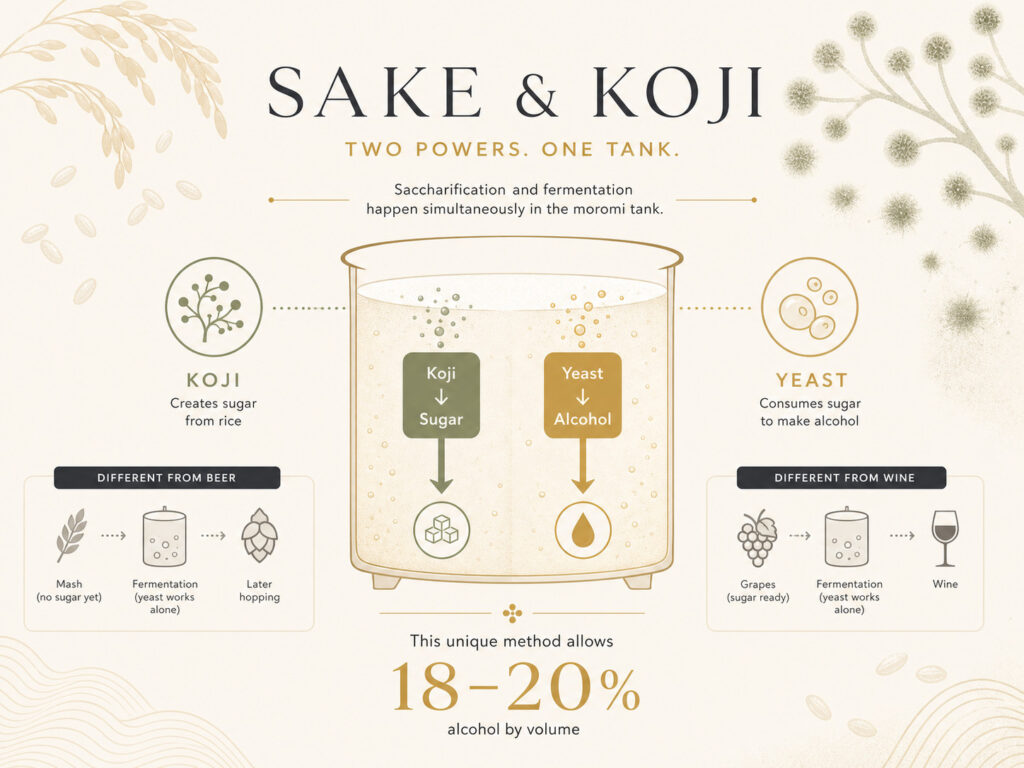
Here we reach one of sake’s true secrets. Most drinks ferment in clear, separate stages. Sake does not work that way at all. Instead, two reactions run side by side. This method is called multiple parallel fermentation.
Saccharification and Fermentation at Once
In the main mash, koji keeps making sugar. At the same time, yeast keeps eating that sugar. So saccharification and fermentation happen together. The two processes share one tank, called the moromi. This balance must stay steady for weeks. Brewers watch it daily, like tending a fire. To compare grades that come from this mash, see types of Japanese sake.
Why Sake Differs From Beer and Wine
Beer takes a step-by-step path instead. Brewers first turn grain starch into sugar. Only after that does yeast start fermenting. So beer separates the two jobs in time. Wine is simpler still, since grapes already hold sugar. Sake, by contrast, fuses the two jobs into one event. That difference may sound small, yet it matters greatly.
Why This Method Allows Higher Alcohol
This dual system keeps sugar levels gentle and steady. Sugar never floods the tank all at once. So the yeast avoids stress from a sugar overload. As a result, fermentation can push alcohol very high. Undiluted sake can reach around 18 to 20 percent. That figure ranks among the highest for any brewed drink. Few traditional methods can match it.
Is Koji Safe? The Science of a Domesticated Mold
Many readers feel uneasy about eating mold. That worry is fair, since some molds are harmful. Koji mold, however, has an excellent safety record. People have used it safely for many centuries. Modern science explains why it stays safe.
Aspergillus oryzae has a wild relative called Aspergillus flavus. That relative can produce aflatoxin, a dangerous toxin. Koji mold, though, does not produce aflatoxin at all. Researchers confirmed this through detailed genome studies. The toxin-making pathway in koji mold simply does not work. Even on toxin-friendly media, koji mold makes none. So scientists view koji mold as a safe, domesticated cousin. Centuries of careful selection shaped it into a trusted tool.
Koji as Japan’s National Fungus
Few countries honor a microbe so highly. Japan, however, treats koji mold with real pride. A scholar first proposed the idea in 2004. Then, in 2006, the Brewing Society of Japan acted. The society named koji mold the national fungus, or kokkin. This title covers several related molds. It includes the yellow koji used for sake. It also covers white and black koji, plus soy sauce koji.
Global recognition followed in time. In December 2024, UNESCO listed traditional Japanese sake brewing. The listing highlights the use of koji mold by hand. Its prototype took shape over 500 years ago. The honor also covers shochu, awamori, and mirin. So koji now carries both national and world recognition. That status reflects more than science, since it marks deep culture.
Historical Development of Koji
Koji carries a history as deep as Japan itself. Its story spans well over a thousand years. Over time, brewers refined the craft step by step. Let us trace that long journey in stages.
Ancient Origins
Rice farming reached Japan in ancient times. With rice came the first hints of koji. An eighth-century text, the Harima no Kuni Fudoki, records a telling scene. Rice offered to a deity grew damp and moldy. People then brewed sake from that moldy rice. Scholars call this the oldest written note of rice-based sake. So koji’s roots reach back to the Nara period.
A Heian-Period Breakthrough
The Heian period brought a quiet revolution. Brewers learned to make stable seed koji. They added wood ash to favor the koji mold. The ash held back unwanted microbes and helped koji thrive. So makers could now grow pure, reliable koji. Around this time, miso and soy sauce also spread. Koji slowly became a pillar of Japanese cooking.
The Medieval Koji Guild and the Bunan Riot
Medieval Kyoto turned koji into serious business. A guild tied to the Kitano shrine controlled koji making. Brewers had to buy their koji from this guild. At the time, Kyoto held over 300 sake breweries. Tension over the monopoly finally boiled over. In 1444, the famous Bunan Koji Riot erupted. The guild fell, and its monopoly collapsed. After that, brewers made koji inside their own breweries.
The Rise of the Moyashi Makers
That collapse reshaped the koji trade for good. Sellers could no longer control finished koji. So they shifted to selling seed koji instead. These seed koji sellers became the moyashi-ya. Their craft still survives, though only barely. Today just a handful of makers remain nationwide. They quietly supply spores to almost every brewery.
Edo-Period Spread
The Edo period brought koji into daily life. Households embraced amazake, a sweet koji drink. Shio koji also gained a place in home kitchens. Brewers, meanwhile, refined winter brewing into an art. So koji served both the brewery and the family table. Many habits from this age still survive today.
The Modern Era
Modern science finally explained the old magic. Researchers identified Aspergillus oryzae and its enzymes. Later, teams even sequenced its full genome. Industry and universities studied it together. So tradition and laboratory knowledge now work side by side. In this way, koji bridges ancient craft and modern research.
Koji Beyond Sake
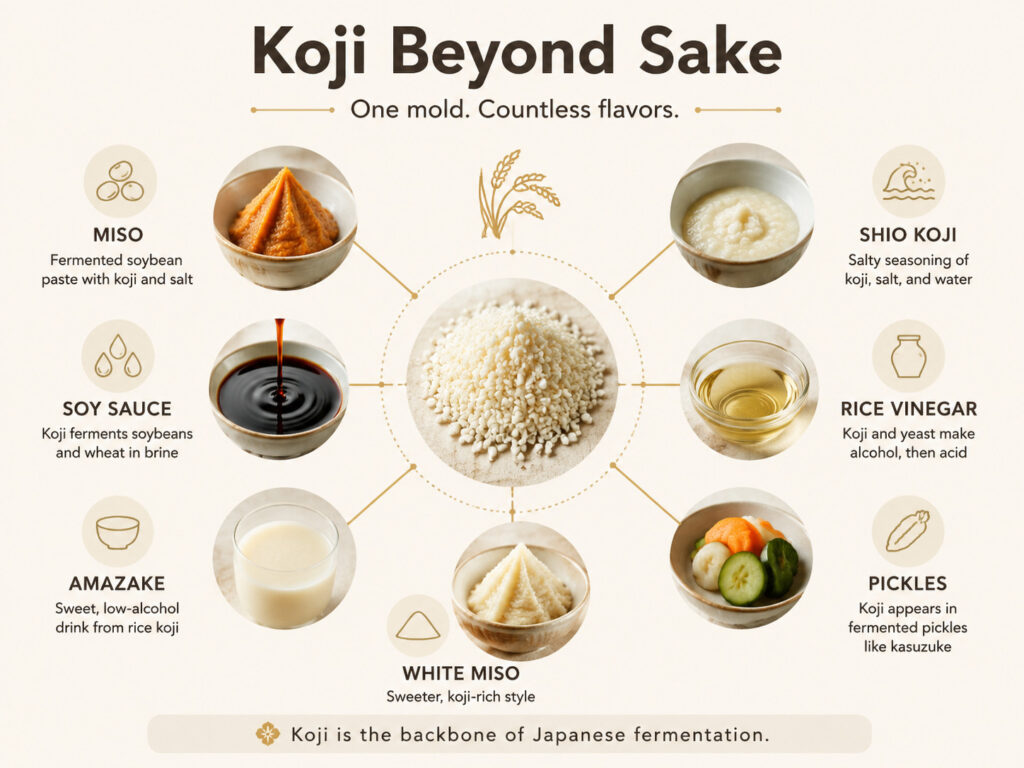
Koji does far more than brew sake. In fact, it underpins much of Japanese cooking. Many beloved foods rely on the same mold. So koji shapes flavors across the whole pantry. Here are the most famous examples:
- Miso: fermented soybean paste built on koji and salt
- Soy sauce: koji ferments soybeans and wheat in brine
- Amazake: a sweet, low-alcohol drink made from rice koji
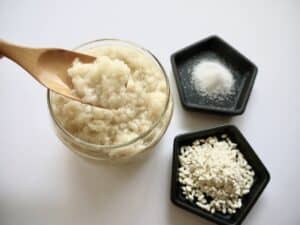
- Shio koji: a salty seasoning of koji, salt, and water
- Rice vinegar: koji and yeast first make alcohol, then acid
Each food uses koji for a slightly different goal. Miso and soy sauce lean on deep umami. Amazake highlights gentle, natural sweetness. Shio koji tenderizes meat and boosts flavor. The same mold even appears in pickles like kasuzuke. So koji truly forms the backbone of Japanese fermentation. You can also see a sweeter, koji-rich style in white miso.
How Koji Influences Sake Flavor
Koji does not just enable sake. It also paints much of its flavor. Small choices in the koji room echo into the bottle. So brewers treat koji as a flavor tool. Let us see how it shapes the final taste.
- Sweetness: more sugar from koji can lift the perceived sweetness
- Umami: amino acids from protease build a savory depth
- Aroma: koji helps form subtle fruity and floral notes
- Complexity: balanced enzymes add layers to the flavor
- Mouthfeel: body and texture shift with koji style
Brewers also manage how the mold spreads on the grain. Patchy growth, called tsuki-haze, suits clean, fragrant sake. Full coverage, called sou-haze, builds richer, fuller brews. So one technique can favor an elegant ginjo. Another can favor a hearty junmai. These quiet choices define a brewery’s signature. For the most polished grade, see our daiginjo guide.
Types of Koji Used in Brewing
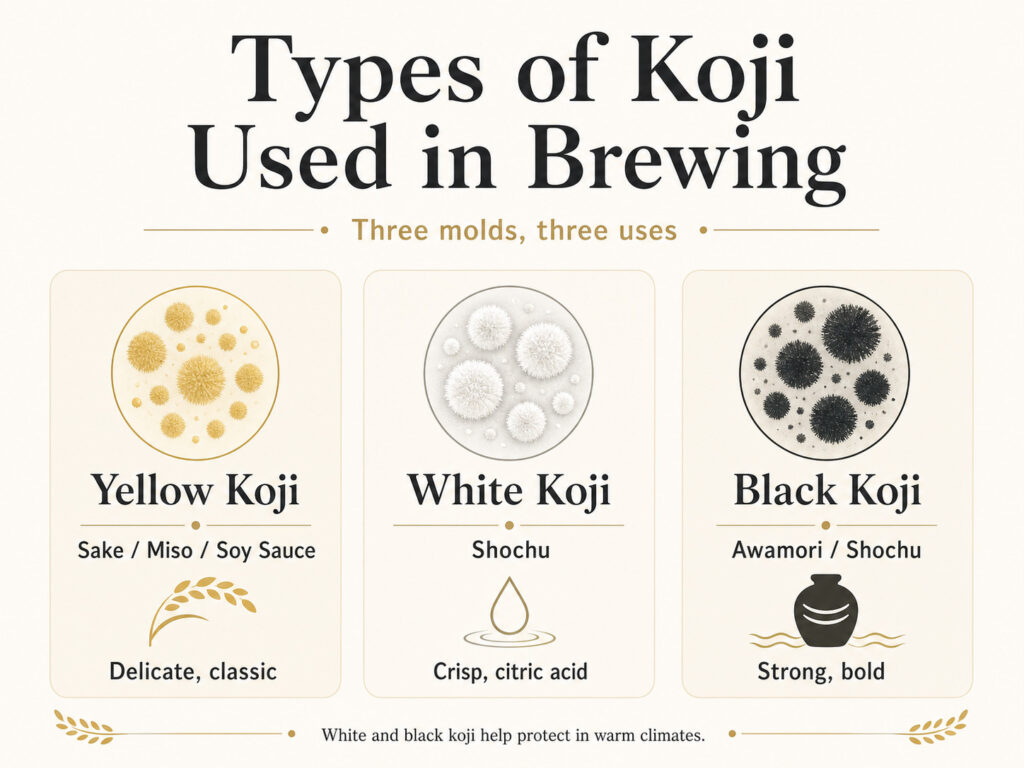
Not all koji molds behave the same way. Three main types serve different drinks. Each one suits its own climate and goal. The table below sums up the differences.
| Type | Japanese | Main use | Key trait |
|---|---|---|---|
| Yellow koji | Ki-koji | Sake, miso, soy sauce | Delicate, classic flavor |
| White koji | Shiro-koji | Shochu | Makes citric acid, crisp finish |
| Black koji | Kuro-koji | Awamori, shochu | Strong citric acid, bold body |
Yellow koji dominates the sake world. It gives the gentle, refined profile drinkers expect. White and black koji belong mostly to southern spirits. They produce citric acid, which guards against spoilage in heat. So shochu and awamori favor them in warm Kyushu and Okinawa. For sake, though, yellow koji remains the heart.
Traditional vs Modern Koji Production
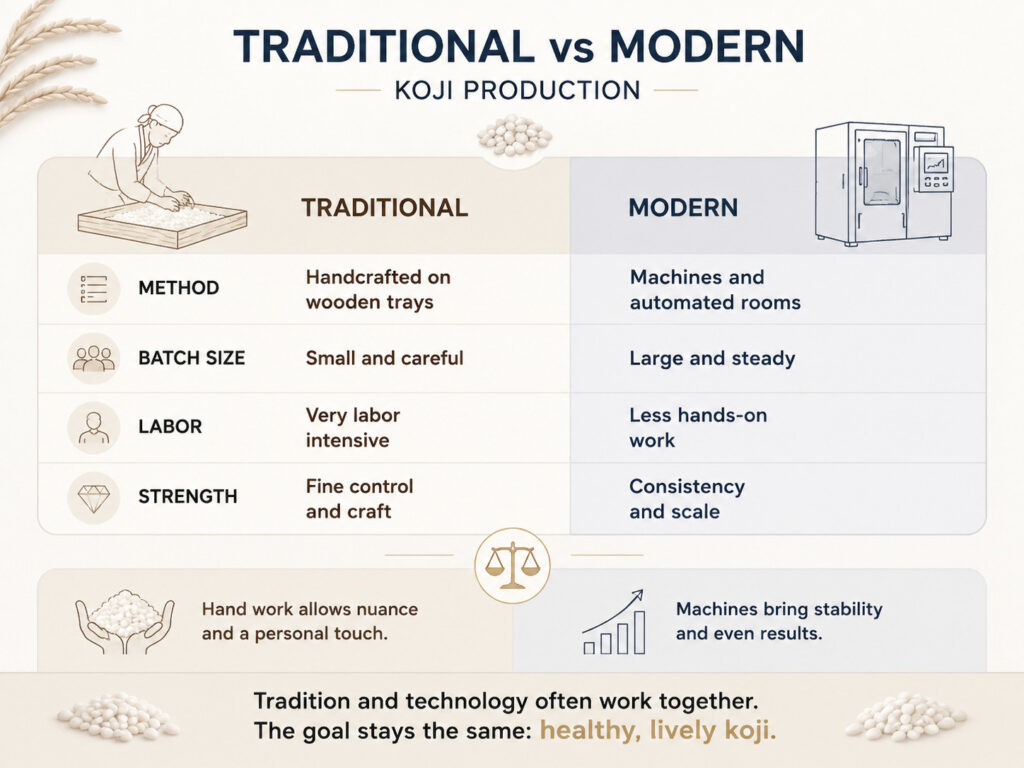
Koji making has changed with the times. Some breweries still work fully by hand. Others lean on machines and sensors. Both paths can produce excellent koji. The table below compares the two approaches.
| Aspect | Traditional | Modern |
|---|---|---|
| Method | Handcrafted on wooden trays | Machines and automated rooms |
| Batch size | Small and careful | Large and steady |
| Labor | Very labor intensive | Less hands-on work |
| Strength | Fine control and craft | Consistency and scale |
Neither method is simply better than the other. Hand work allows nuance and a personal touch. Machines bring stability and even results. Many breweries actually blend both styles. So tradition and technology often work together. The goal stays the same: healthy, lively koji.
Common Misconceptions About Koji
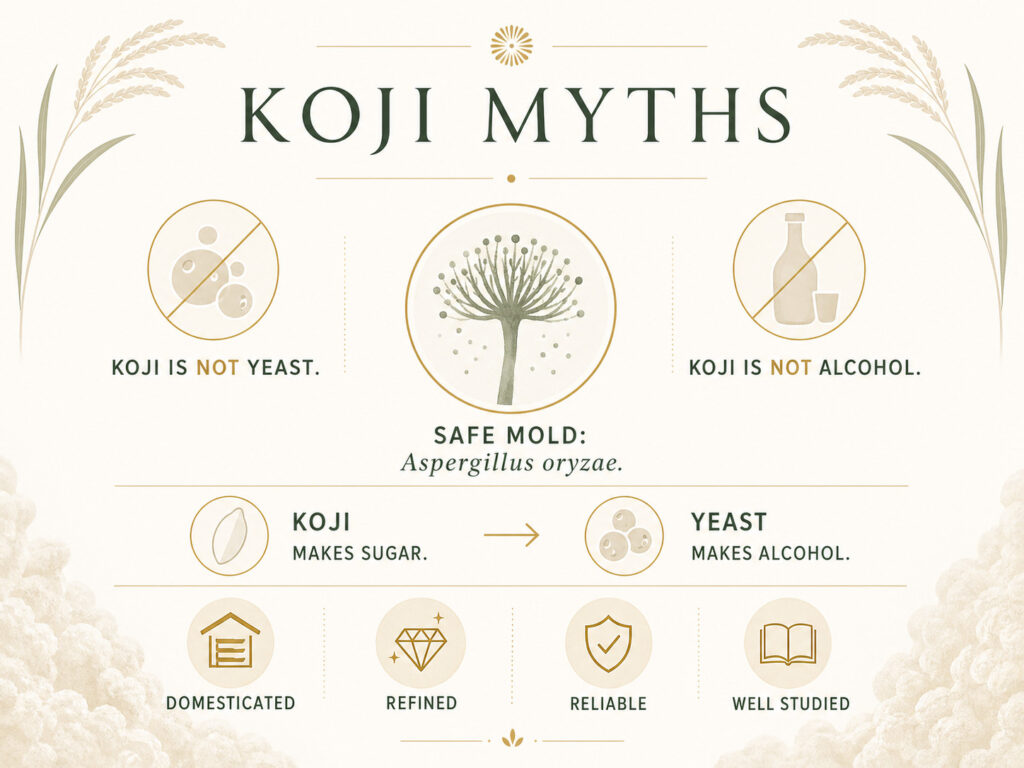
Koji invites plenty of confusion. A few myths come up again and again. Let us clear them up quickly.
- Is koji yeast? No. Koji is a mold, while yeast is a separate microbe.
- Is koji alcohol? No. Koji holds no alcohol; it only makes enzymes.
- Is koji mold dangerous? No. Aspergillus oryzae is safe and well studied.
- Does koji ferment sake alone? No. Koji makes sugar, but yeast makes the alcohol.
One point deserves a little more care. Koji mold differs from its toxic wild cousins. Brewers refined it over many centuries of use. So this domesticated mold is both gentle and reliable. In short, koji is safe, essential, and deeply studied.
Koji in Famous Sake Regions
Koji practice shifts from region to region. Local water, rice, and climate all play a part. So koji helps define each area’s house style. Here are a few notable examples.
Niigata aims for clean, dry, refined sake. Brewers there often favor a lighter koji touch. That choice suits the snowy region’s crisp style. You can read more in our Niigata sake guide. Hyogo, meanwhile, grows famous Yamada Nishiki rice. Its firmer water supports robust, full-bodied brews.
Kyoto leans on soft water near Fushimi. So its sake often feels gentle and mellow. Akita and Yamagata sit in the cold north. Their long, chilly winters reward slow, careful fermentation. As a result, both regions craft clean, elegant sake. To explore more local styles, browse our guide to jizake, or Japanese local sake.
Final Thoughts
Koji is the biological engine of sake brewing. It turns plain rice starch into living flavor. Its enzymes feed the yeast that makes alcohol. So nothing in the tank would happen without it. Koji also reaches far beyond sake itself. Miso, soy sauce, and many staples depend on it too. Its history runs from ancient shrines to modern labs. Japan honors it as a national fungus and a world heritage craft. To understand sake fully, you must understand koji first. It remains one of the great wonders of Japanese fermentation.
Koji FAQ
What is koji?
It is steamed rice grown with a special mold. Cooks use Aspergillus oryzae to create it. The mold releases enzymes as it grows. Those enzymes turn rice starch into sugar.
Is koji a fungus?
Yes, the mold itself is a fungus. Its name is Aspergillus oryzae. It grows as fine threads through the rice. So the finished koji is rice covered in this fungus.
Is koji safe to eat?
Yes, this mold is safe and well studied. It does not produce the toxin found in some wild molds. People have used it safely for over a thousand years. Japan even named it the national fungus.
What does koji do in sake?
It converts rice starch into fermentable sugar. Yeast then turns that sugar into alcohol. So koji starts the whole brewing chain. Without it, fermentation could not begin.
Can sake be made without koji?
No, true sake cannot exist without it. Yeast cannot eat rice starch on its own. Koji supplies the enzymes that make sugar. So this ingredient is truly essential.
What is Aspergillus oryzae?
It is the scientific name for the koji mold. Japanese speakers call it kōjikin. The mold produces powerful starch-cutting enzymes. Brewers grow it on steamed rice for sake.
How is koji different from yeast?
Koji is a mold that makes enzymes. Those enzymes create sugar from starch. Yeast is a microbe that eats sugar. It then produces the alcohol in sake.
Why is koji important?
It unlocks the energy stored in rice. It also shapes sweetness, umami, and aroma. So it drives both fermentation and flavor. Brewers rightly call it the heart of sake.
How long does koji cultivation take?
It usually takes about two days. Workers control heat and humidity throughout. They also mix the rice many times. Careful attention defines this demanding stage.
Why is koji called Japan’s national fungus?
A brewing society gave it that title in 2006. The mold supports sake, miso, and soy sauce. So it stands at the center of Japanese food culture. UNESCO also recognized koji-based brewing in 2024.
References
- Japan Sake and Shochu Makers Association, Sake brewing process and koji, https://www.japansake.or.jp/sake/en/ (Surveyed: June 2026)
- National Research Institute of Brewing, Safety of koji mold (Aspergillus oryzae is aflatoxin-free), https://www.nrib.go.jp/data/kouen/pdf/46kou02.pdf (Surveyed: June 2026)
- National Tax Agency of Japan, Report on traditional sake brewing using koji mold (history and process), https://www.nta.go.jp/taxes/sake/koujikin/ (Surveyed: June 2026)
- Agency for Cultural Affairs, Japan, Traditional knowledge and skills of sake-making with koji mold (UNESCO, December 2024), https://www.bunka.go.jp/seisaku/bunkazai/shokai/mukei/1923280.html (Surveyed: June 2026)
- Harima no Kuni Fudoki (Records of Harima Province), c. 715, Nara period; Shisawa district, “niwaki” (offered sake) passage describing mold on rice and the brewing of sake, regarded as Japan’s oldest written record of koji-based sake (classical text, no URL) (Year: c. 715)
- Engishiki, Book 40, “Zoshushi” (Bureau of Sake Brewing), 927, Heian period; court sake-brewing methods and equipment (classical text, no URL) (Year: 927)
- The Bunan Koji Riot (Bunan no koji sodo), 1444, Muromachi period; suppression of the Kitano Shrine koji guild (koji-za) in Kyoto, after which breweries made koji in-house and seed-koji (moyashi) sellers emerged (historical event, no URL) (Year: 1444)
Related Articles
- How Sake Is Made (Surveyed: June 2026)
- Sake: Types of Japanese Sake, Sake Making (Surveyed: June 2026)
- Junmai Sake (Pure Rice Sake) (Surveyed: June 2026)
- Ginjo Sake (Surveyed: June 2026)
- Daiginjo Sake (Surveyed: June 2026)
- Junmai Ginjo Sake (Surveyed: June 2026)
- Shio Koji (塩麹) (Surveyed: June 2026)
- Miso Fermentation: Secrets of Umami (Surveyed: June 2026)
- Niigata Sake (Surveyed: June 2026)




Comments