




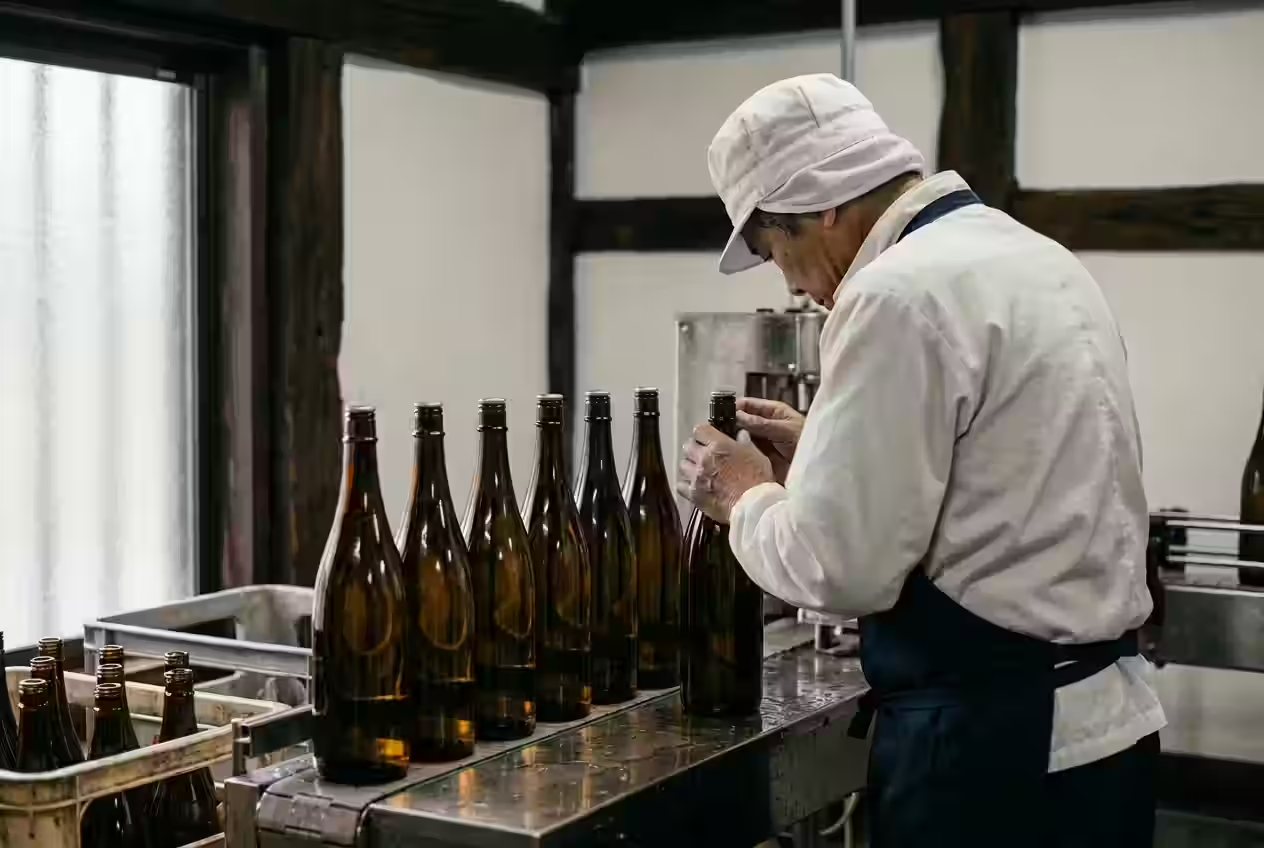
Bottling, or binzume (瓶詰め) in Japanese, is the stage where finished sake enters its retail container. Brewers fill, seal and then check the liquid they have spent months preparing, usually after clarification, dilution and heat treatment. Bottling is not intended to improve a flawed sake. Its primary task is to preserve the balance the brewery has already created.
This guide covers what happens immediately before filling, how the filling line itself works, why heat treatment timing defines several label terms, and finally how oxygen, light and temperature shape the bottle afterwards. Japanese labelling rules receive their own section, since they are more specific than most overseas readers expect.
Quick Facts
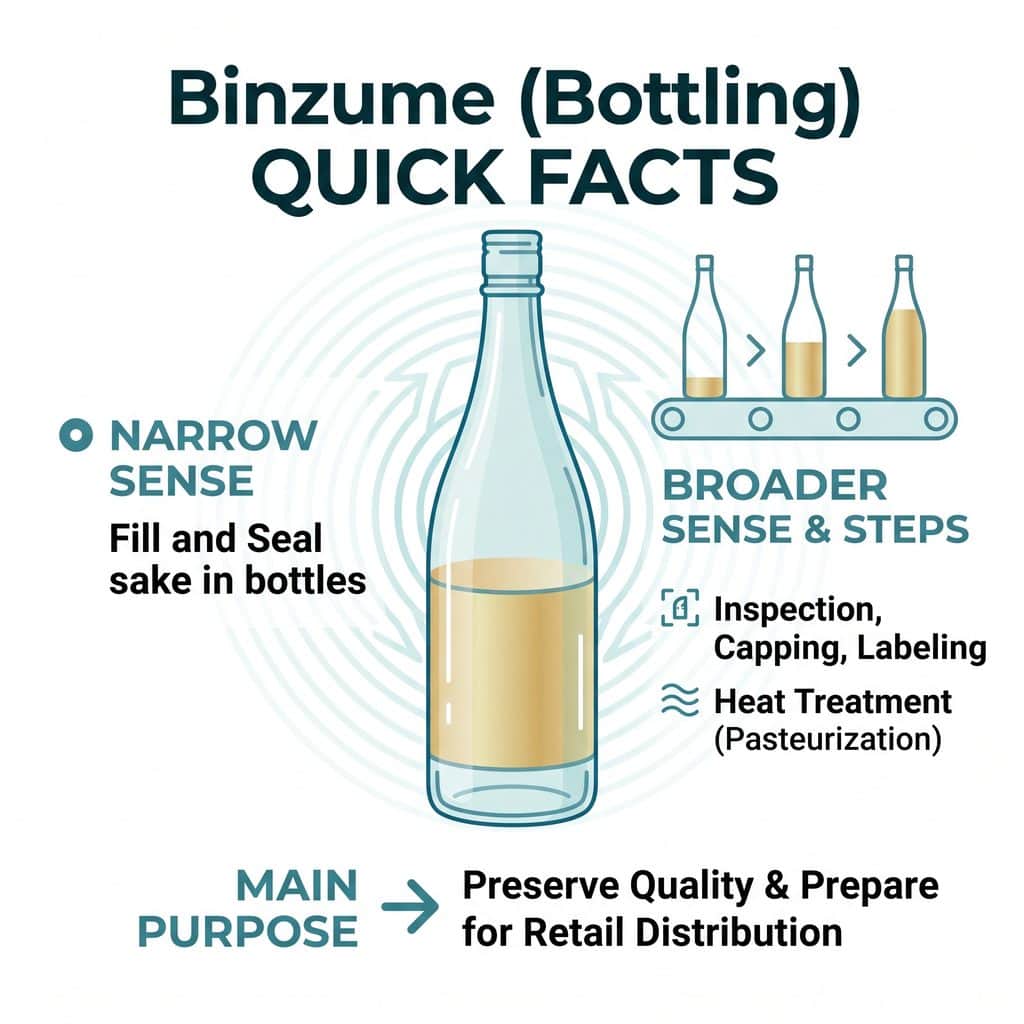
| Japanese | 瓶詰め |
| Romanization | Binzume |
| English | Bottling |
| Narrow sense | Filling sake into bottles and sealing them |
| Broader sense | The surrounding packaging operation, including inspection, capping and labelling |
| Main purpose | To fill and seal sake in a retail container while preserving its intended condition through storage and distribution |
| Related steps | Final adjustments and packaging: clarification, filtration, blending, dilution, heat treatment, labelling |
| Key variables | Temperature, oxygen, light, hygiene |
What Is Binzume?
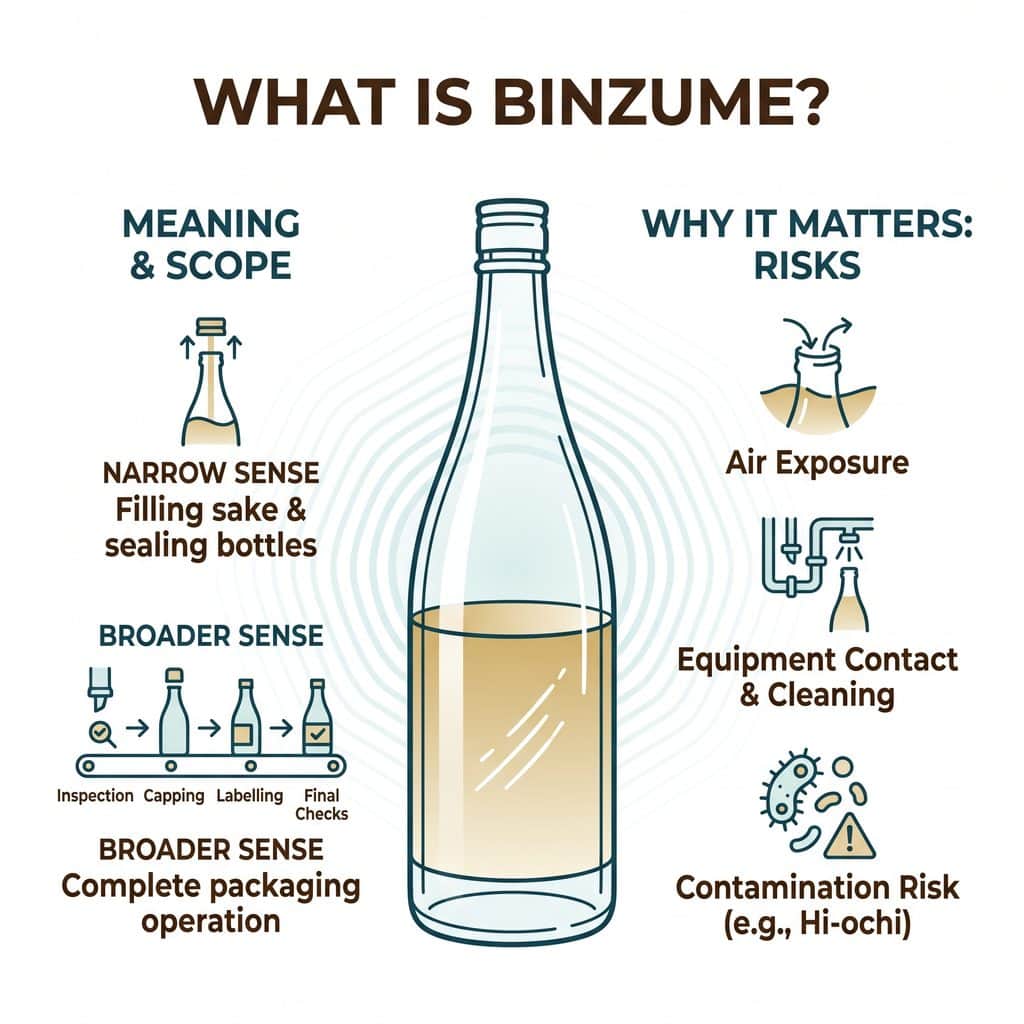
The word covers a narrow operation and a broader one, depending on who is speaking.
Meaning and scope
Bin (瓶) means bottle, while zume (詰め) means packing, so the compound reads almost literally as bottle-packing. In its narrowest sense, binzume means filling sake into bottles and sealing them. In brewery practice, the term may also refer more broadly to the surrounding packaging operation, including bottle inspection, capping, labelling and final checks.
Strictly speaking, bottling belongs to the finishing and packaging stage rather than to fermentation. In broader English-language accounts, it often appears inside the overall sake production or brewing process. Both usages are common, although neither misleads once the distinction is clear.
Why bottling matters
Filling exposes sake to conditions it has largely avoided until now. Air reaches the liquid surface, equipment touches every litre, while pipes and nozzles need scrupulous cleaning. Contamination introduced here can grow later, which is what our guide to hi-ochi describes. Hi-ochi is caused by specialised lactic acid bacteria able to grow in sake despite its alcohol content and acidity.
Does Bottling Change the Sake?
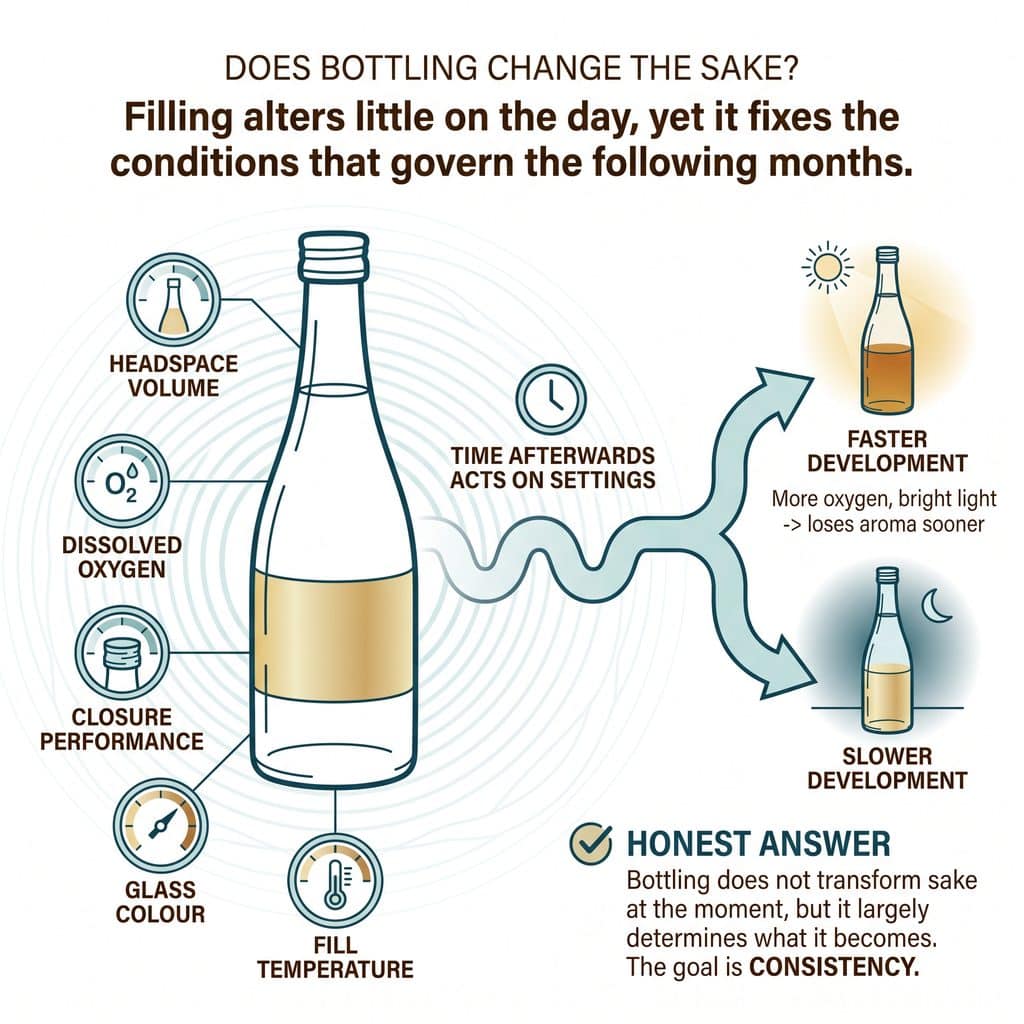
Filling alters little on the day, yet it fixes the conditions that govern the following months.
Several variables lock in at once as soon as the cap goes on. Headspace volume, dissolved oxygen, closure performance, glass colour and fill temperature all become fixed properties of that particular bottle.
Time afterwards acts on those settings. Bottles holding more oxygen develop faster. Clear glass under bright retail lighting loses aroma sooner. Two bottles from one tank can diverge noticeably within six months, yet nothing about the sake itself explains the gap.
So the honest answer runs both ways. Bottling does not transform sake at the moment of filling, while it largely determines what the sake becomes. The goal is not merely to contain the liquid but to preserve the character the brewery intended.
Where Bottling Fits in Sake Production
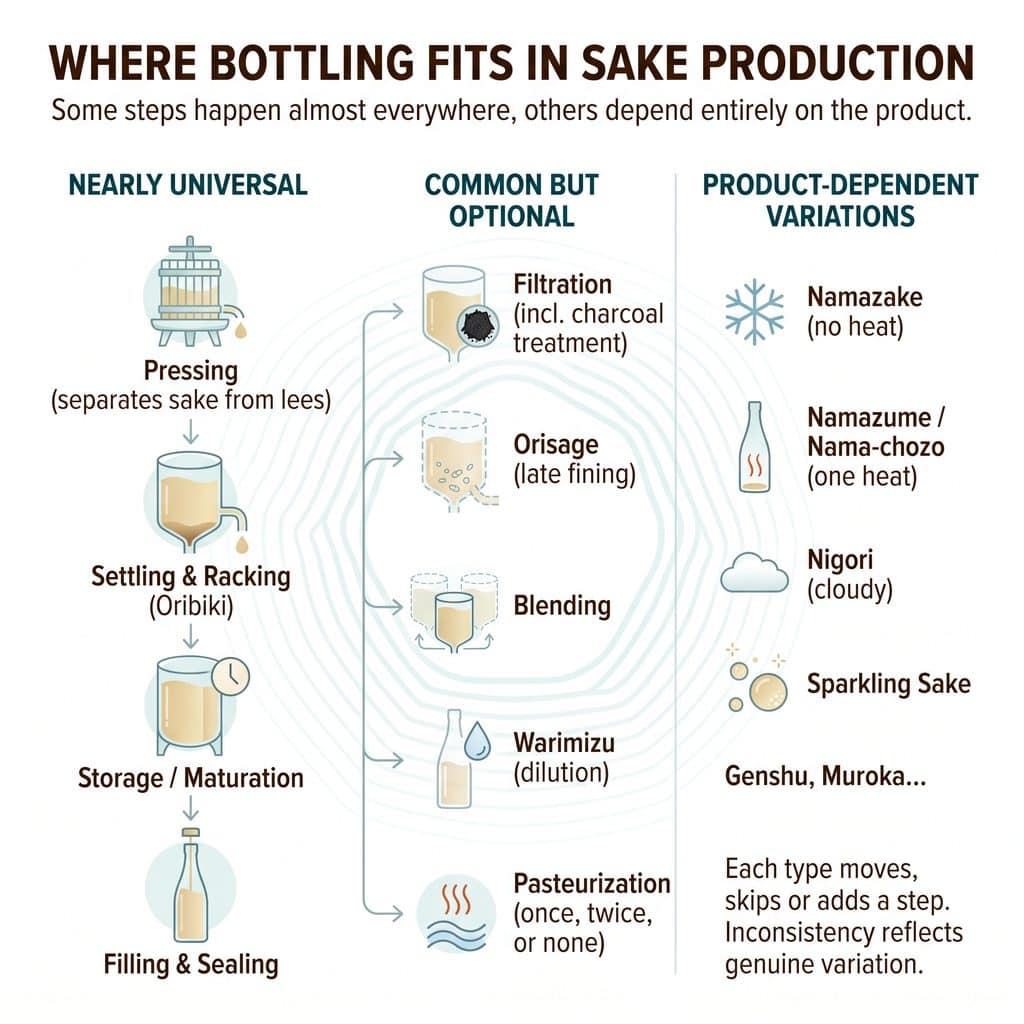
Some steps happen almost everywhere, others depend entirely on the product.
Listing the finishing steps in one fixed order usually misleads more than it helps. Sorting them by how universal they are works better.
Nearly universal
- Pressing, which first separates sake from the lees
- Settling and racking off the coarse sediment, called oribiki
- Storage, or else maturation in tank
- Filling, then sealing
Common but optional
- Filtration, including charcoal treatment
- Orisage, the late fining before bottling
- Blending across several tanks
- Warimizu, dilution to bottling strength
- Pasteurization, applied once, twice or not at all
Product-dependent variations
Namazake, namazume, nama-chozo, muroka, genshu, nigori and sparkling sake each move, skip or add a step. Anyone comparing several sake guides will find the stages listed in different orders, and that inconsistency reflects genuine variation rather than careless writing.
How Sake Is Prepared for Bottling
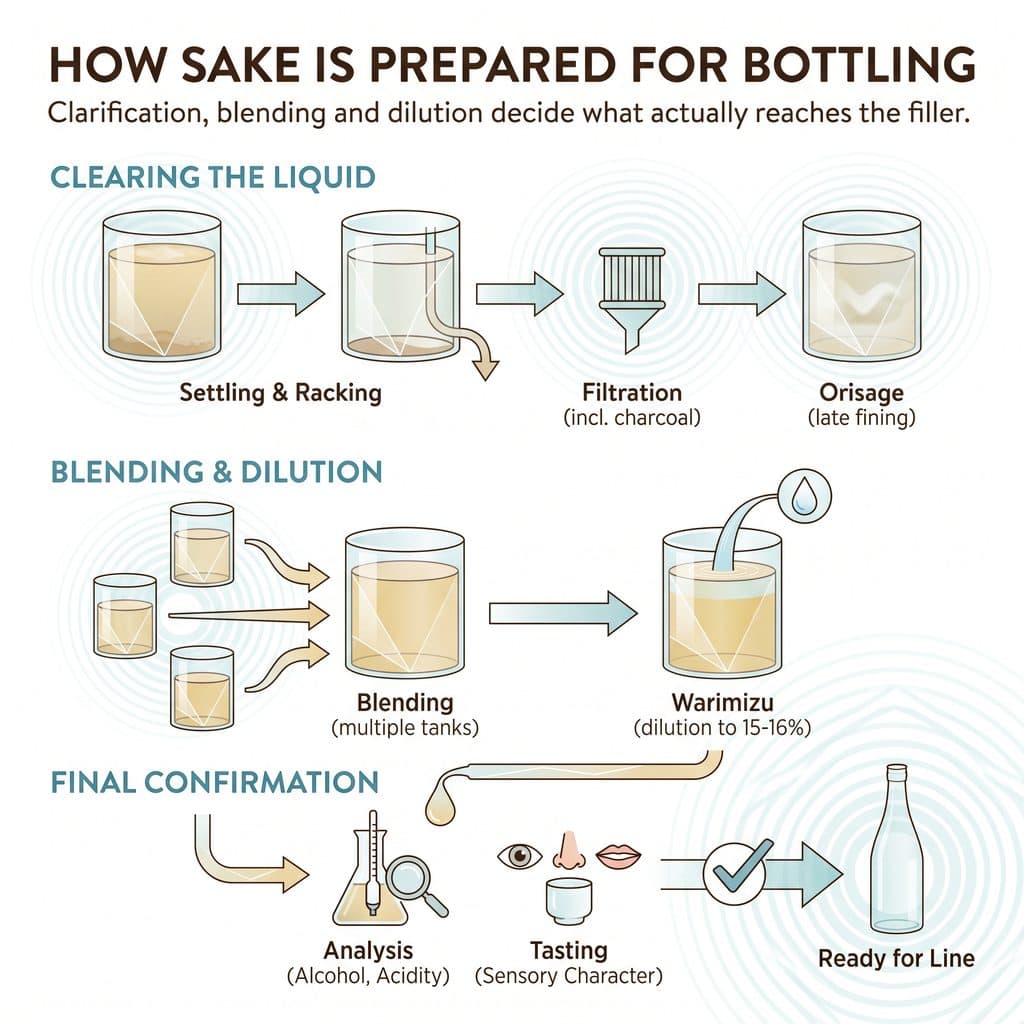
Clarification, blending and dilution decide what actually reaches the filler.
Clearing the liquid
Freshly pressed sake still carries fine solids. Brewers let those settle, before racking the clear liquid off the sediment. Filtration follows, while many products also pass through activated charcoal to adjust colour and aroma. Orisage arrives later still, once heating and storage have had time to raise a haze that did not exist earlier.
Blending and dilution
Breweries rarely bottle a single tank in isolation, though. Blending several tanks therefore narrows the variation between releases, so a brand stays recognisable year to year.
Newly pressed undiluted sake commonly contains roughly 18 to 20 percent alcohol, although the exact level varies by fermentation and product design. Most bottles reach the shelf nearer 15 or 16 percent, so brewers add water beforehand. That step is warimizu, and the water used receives the same scrutiny as brewing water, because it can account for a meaningful share of the final volume.
Final confirmation
Analysis and tasting then confirm the batch against its specification before the line starts. Brewers check alcohol content, acidity and sensory character, since the label figures must match what goes into the glass.
How Sake Is Bottled
The filling line itself follows a recognisable sequence, whatever its scale.
Equipment differs enormously between a large plant and a small kura, although the operations map onto each other. The outline below describes a general example rather than a universal standard.
- Bottle preparation Empty bottles arrive, pass an inspection for damage or foreign matter, then take a rinse
- Supply Sake moves from the finishing tank to the filler, occasionally through a final polish filter
- Filling Each bottle receives a measured volume, with foaming and drips controlled at the nozzle
- Headspace The line sets fill height, and some systems displace the remaining air before sealing
- Sealing A screw cap or, alternatively, a crown cap closes the bottle
- Heat treatment Whenever the product calls for bottle heating, it happens at this point
- Cooling Hot-filled or bottle-heated sake comes back down in temperature
- Inspection Operators or optical systems check fill level, seal integrity and foreign matter
- Labelling and coding Labels go on, and the line prints a lot code
- Packing Bottles go into boxes or crates, then move to temperature-controlled storage
Volume and temperature
Fill volume also interacts with temperature, since liquids expand when warm. A bottle filled hot and then cooled ends up with a slightly different fill height and headspace than one filled cold. Lines account for that difference, so operators record the filling temperature alongside the volume.
Bottling and Pasteurization
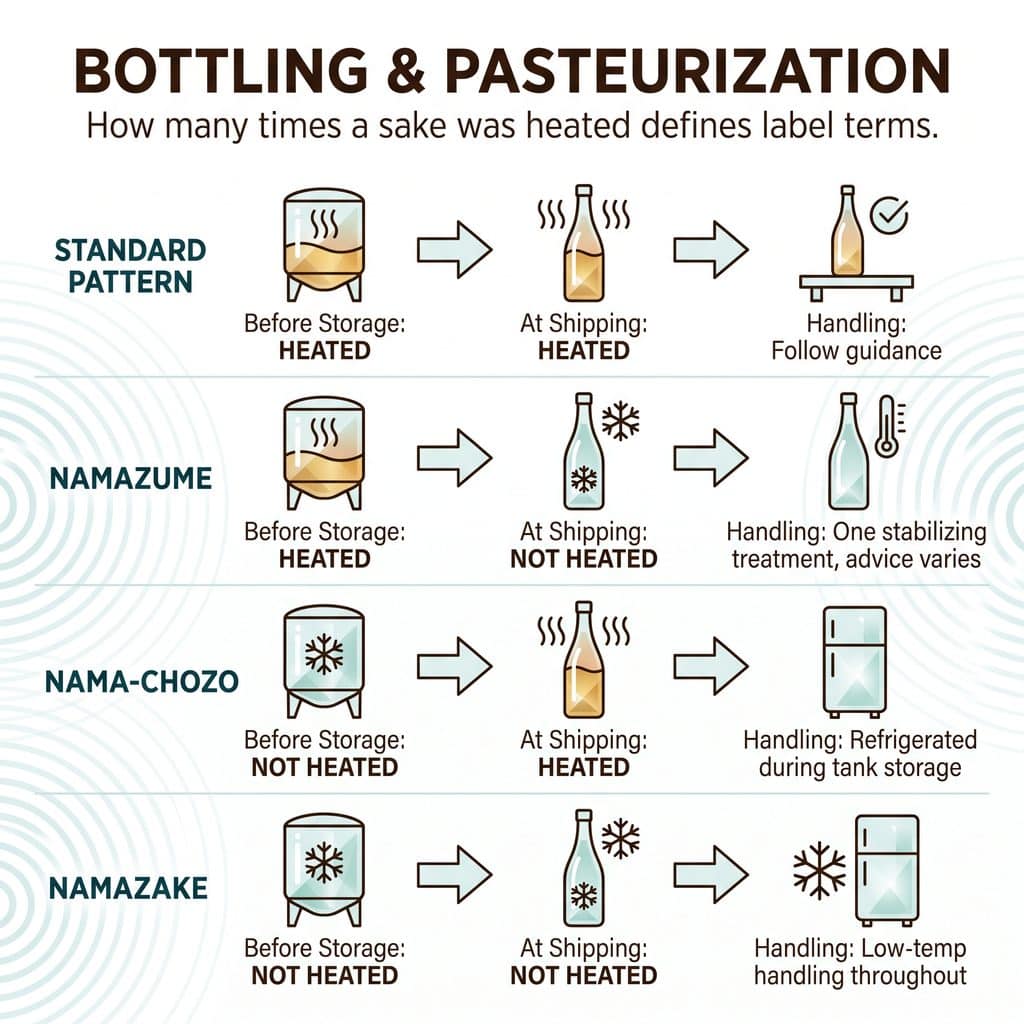
How many times a sake was heated, and when, defines several familiar label terms.
Japan’s National Tax Agency describes the usual pattern as two heat treatments, once before storage and once before shipping. Several recognised categories depart from it, and modern breweries may also use a single carefully controlled heating, depending on the product and the equipment available.
| Style | Before storage | At shipping | Handling note |
|---|---|---|---|
| Standard pattern | Heated | Heated | Follow the producer’s storage guidance |
| Namazume | Heated | Not heated | One stabilising treatment, storage advice varies |
| Nama-chozo | Not heated | Heated | Refrigerated during tank storage |
| Namazake | Not heated | Not heated | Low-temperature handling throughout |
Namazume and nama-chozo sit between the two extremes, since each keeps one heating and drops the other. Nama-chozo remains unpasteurized during tank storage and therefore depends more heavily on refrigeration and sanitary control.
What the second heating does
The final heat treatment improves stability after filling by controlling microbial risk and residual enzymatic activity. Its purpose is broader than correcting contamination introduced during bottling. Active enzymes from koji keep changing sweetness and aroma in storage, so stopping them stabilises the product independently of any bacterial question.
Two ways to apply it
A brewery can heat the sake in a heat exchanger and then fill, or else fill cold and heat the sealed bottle in warm water. The two approaches differ in oxygen contact, heating uniformity, cooling speed, throughput and suitability for small lots. Neither is universally better, so equipment often decides the choice.
How Bottling Differs by Sake Style
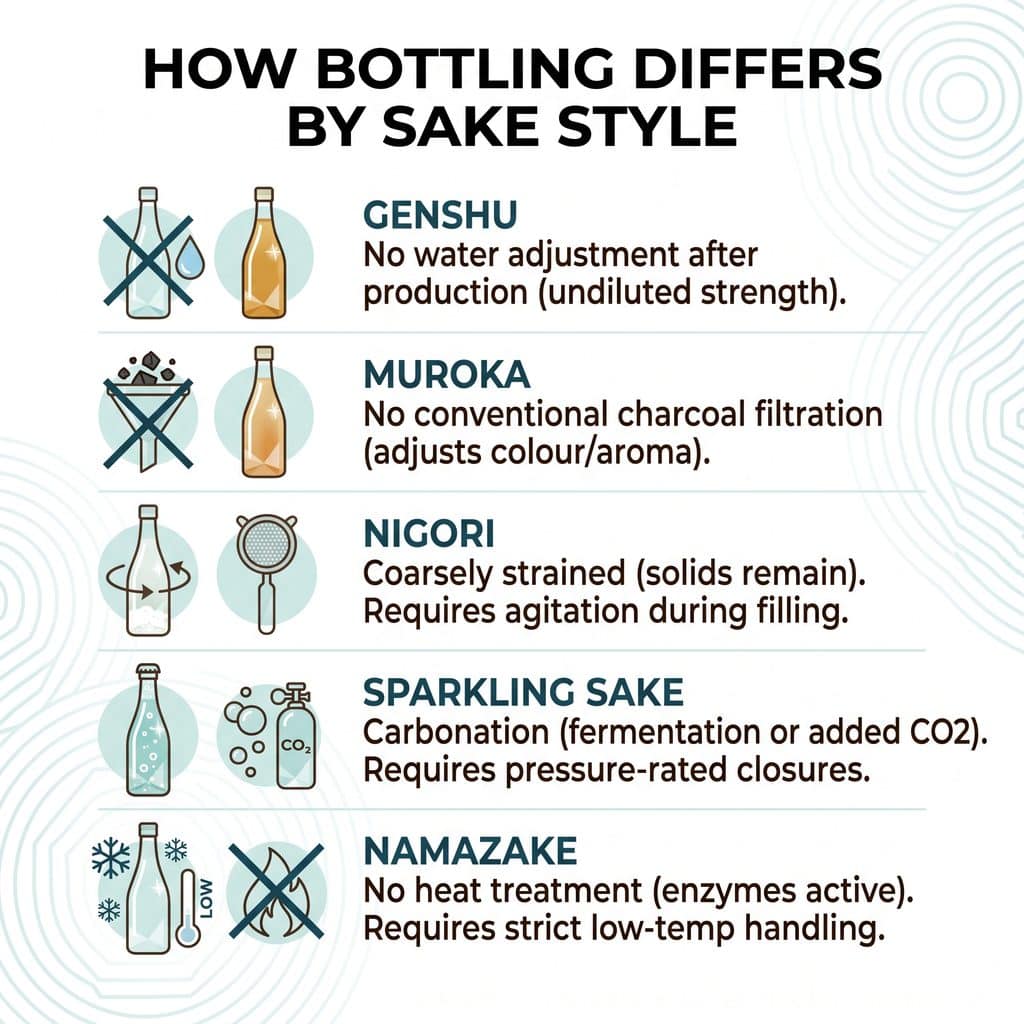
Several familiar label terms describe a step the brewery left out, or a filling requirement it added.
Genshu
Genshu may be shown on sake that has not undergone water adjustment after production. Japanese labelling rules allow one narrow exception, since adjusting alcohol within a range of less than one percent is permitted to even out batch variation. So genshu indicates undiluted strength in practice, without meaning that no water has ever touched the product.
Muroka
Muroka generally indicates that the sake has not undergone the conventional charcoal filtration used to adjust colour and aroma. The exact filtration method varies by brewery, while the term carries no legal definition in the way that specific designations do. It does not guarantee a particular colour or flavour intensity.
Nigori
Nigori is still legally strained, so it is not simply unfiltered moromi. A coarse method leaves rice solids suspended, and those solids settle in the tank, so gentle agitation keeps the mixture uniform during filling.
Some labels recommend gently mixing settled lees before serving. Follow the individual bottle instructions, especially for active or sparkling nigori, which may foam or overflow if shaken.
Sparkling sake
Sparkling sake may gain carbonation through secondary fermentation in the bottle or tank, or through the addition of carbon dioxide. Producers may subsequently use refrigeration, filtration or heat treatment to control further fermentation. Closures rated for pressure become essential too, while bottle-fermented products often leave sediment.
Namazake
Namazake receives no heat treatment at all, so enzymes stay active and aroma stays vivid. It requires closely controlled low-temperature handling after production, especially during storage and distribution. Japanese rules also require storage or drinking precautions on the label for sake shipped without any heat treatment.
Protecting Sake from Oxygen, Light and Heat
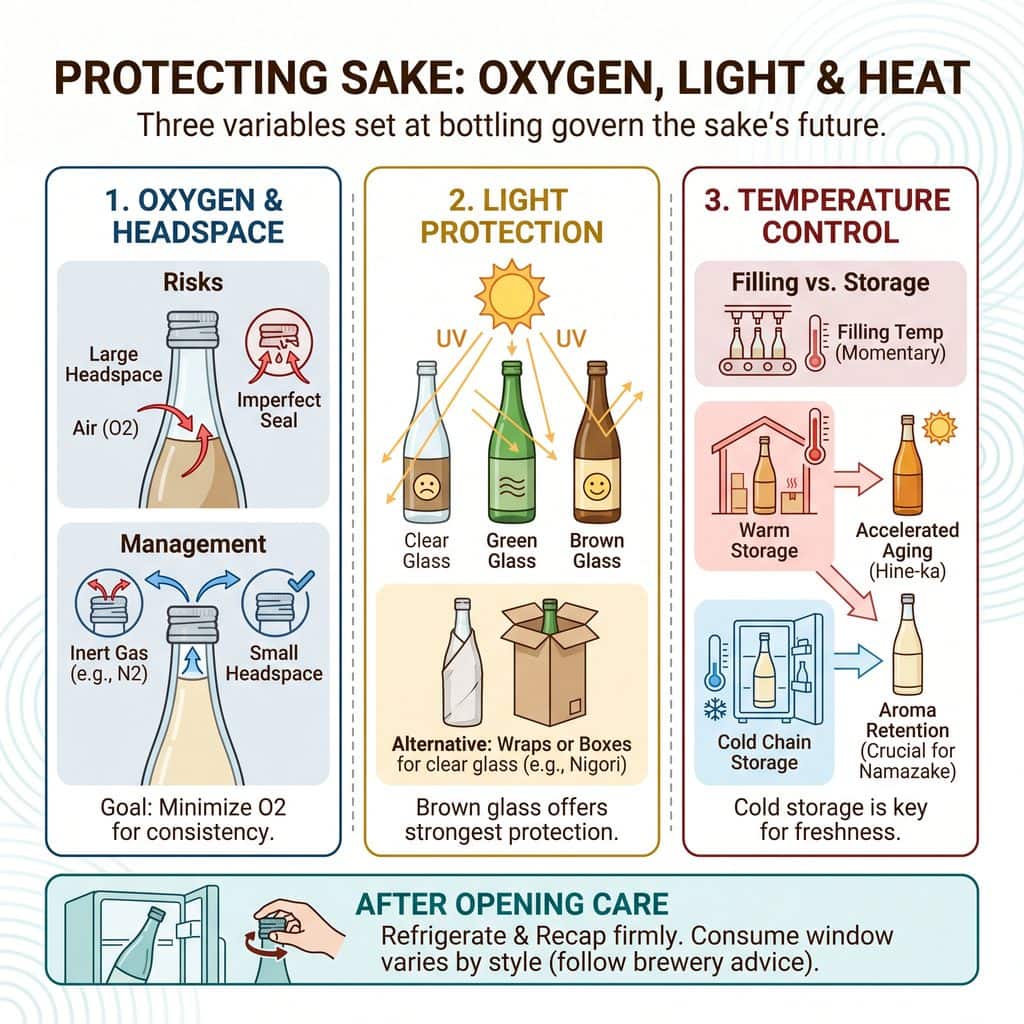
Three variables set at bottling govern most of what happens next.
Oxygen and headspace
Sake meets air whenever it moves, therefore pumping, filtering and filling all introduce dissolved oxygen. Headspace means the gap between the liquid surface and the cap. Smaller gaps hold less air, while consistent fill heights help two bottles from one run behave alike.
Some lines displace that air with an inert or protective gas before sealing. Nitrogen suits the job especially well, because it stays relatively inert in the product. Carbon dioxide can also displace air, although its solubility means it needs careful management in still sake.
Glass itself is effectively impermeable to oxygen, while oxygen can remain in the headspace or enter gradually through an imperfect closure. Oxygen is one factor in bottle development, and maturation also depends on temperature, time, light exposure and the sake’s chemical composition. Our guide to jukusei covers deliberate maturation in detail.
Light
Why coloured glass exists. Ultraviolet and short-wavelength visible light can accelerate reactions that alter sake aroma and colour. Brown glass generally offers stronger protection than green glass, while clear glass provides the least. Brewers therefore choose coloured glass for a practical reason rather than a decorative one.
Clear glass still has its uses, of course. Nigori shows better through it and seasonal releases gain visual appeal, so those bottles often ship wrapped in paper or boxed, which restores much of the protection the glass gives up. Bright retail lighting affects any bottle left standing in it for weeks.
Temperature
Two temperatures matter here, although confusing them causes problems. Filling temperature describes the sake as it enters the bottle, following either in-line heating or cold handling. Storage temperature describes the months afterwards, where most aroma retention is won or lost.
Warm storage can accelerate the development of hine-ka, a family of aged aromas that may be unwelcome in fresh styles yet overlap with characteristics sought in deliberately matured sake. For namazake, refrigeration replaces heat as the main control, so the cold chain runs from the brewery through to the buyer.
After opening. For most sake, refrigeration after opening slows deterioration, and a firmly closed cap helps. Follow the producer’s instructions, especially for namazake, sparkling sake and intentionally aged products. Fixed rules about days are unreliable, since the right window depends on the style.
Quality Control and Traceability
The last chance to catch a problem, and the first chance to make one traceable.
- Fill volume Checked against the declared net contents, with temperature recorded alongside
- Bottle condition Rinsing and inspection before filling, since one contaminated bottle spoils its own contents
- Seal integrity Torque and closure checks, because a weak cap admits air over months
- Alcohol content Verified against the label figure after dilution
- Microbial sampling Looking for contamination before distribution begins
- Sensory confirmation A final taste, because instruments miss what people notice
Lot coding turns those checks into something usable later. A code can link a bottle back to the tank it came from, the filling date, the line used, the analytical results and the shipment it joined. If a problem surfaces months afterwards, that chain decides whether a brewery can identify the affected bottles or must guess.
Cleaning underpins all of it. Hoses, valves, nozzles and filler heads hold residue in places nobody sees, so cleaning runs as a documented procedure. Unpasteurized products raise the stakes, since no heat step follows filling to correct a lapse.
Sake Bottles and Closures
Glass dominates, and two sizes shape almost everything around them.
Glass does not react with sake, and it cleans reliably, seals well and recycles readily. Two formats generally dominate Japanese retail. The 1.8 litre isshobin serves households and restaurants, while the 720 millilitre yongobin suits gifts and smaller purchases.
The larger format carries an ecosystem with it. Crates, delivery routes, restaurant storage and returnable bottle arrangements all grew around that single size over decades, so collectors can wash and refill a bottle rather than melt it down. Practice varies by region and by brewery.
Smaller bottles around 300 millilitres also appear in convenience stores, while cans serve chilled single servings and export markets. Bag-in-box and keg formats exist mainly in food service or export contexts, so treat any guide presenting them as standard Japanese retail with some caution.
Reading a Japanese Sake Label
Japanese rules separate required items, conditional items and voluntary claims.
Labelling follows the National Tax Agency’s standard for the manufacturing method and quality of sake, together with general liquor labelling obligations. The categories below reflect that framework, which the agency has amended more than once.
| Item | Japanese | Status |
|---|---|---|
| Category | 清酒 | Required |
| Ingredients | 原材料名 | Required |
| Alcohol content | アルコール分 | Required |
| Net volume | 内容量 | Required |
| Producer and address | 製造者、製造場所在地 | Required |
| Storage or drinking precautions | 保存又は飲用上の注意事項 | Required for sake shipped without heat treatment |
| Polishing ratio | 精米歩合 | Required when a special designation is shown |
| Rice variety | 原料米の品種名 | Voluntary, and only above a defined share of use |
| Region of production | 清酒の産地名 | Voluntary, and only if produced entirely there |
| Genshu, nama, nama-chozo | 原酒、生酒、生貯蔵酒 | Voluntary, each with a defined meaning |
| Production period | 製造時期 | Voluntary since a 2023 amendment |
The production period entry deserves attention. Japanese rules define it as the time the sake was filled and sealed for shipment, so it functions as a bottling date rather than an expiry date. A 2023 amendment moved it from required to voluntary, which means newer bottles may omit it entirely. Check current rules before relying on any single label detail.
Seishu and nihonshu
These two words are not freely interchangeable, notably. Seishu (清酒) is the legal product category under Japanese liquor law. Nihonshu (日本酒) may be displayed only on sake made with domestically produced rice and manufactured in Japan, and it also functions as a protected geographical indication.
Special designations
Eight special designations exist, namely junmai, ginjo, honjozo and their variants. Each carries defined requirements covering ingredients, polishing ratio and the share of koji rice, which must reach at least 15 percent of the rice used. A brewery showing one of these terms must also display the polishing ratio near the ingredient list, so the claim and its supporting figure travel together.
Voluntary claims also come with conditions of their own. Rice variety and region may be shown, subject to requirements about the share of use and whether all production took place in that region. Storage age and taru-zake, meaning sake matured in a wooden cask, appear in the same voluntary group. Japanese rules prohibit superlatives such as best or number one outright.
Storage and Distribution After Bottling
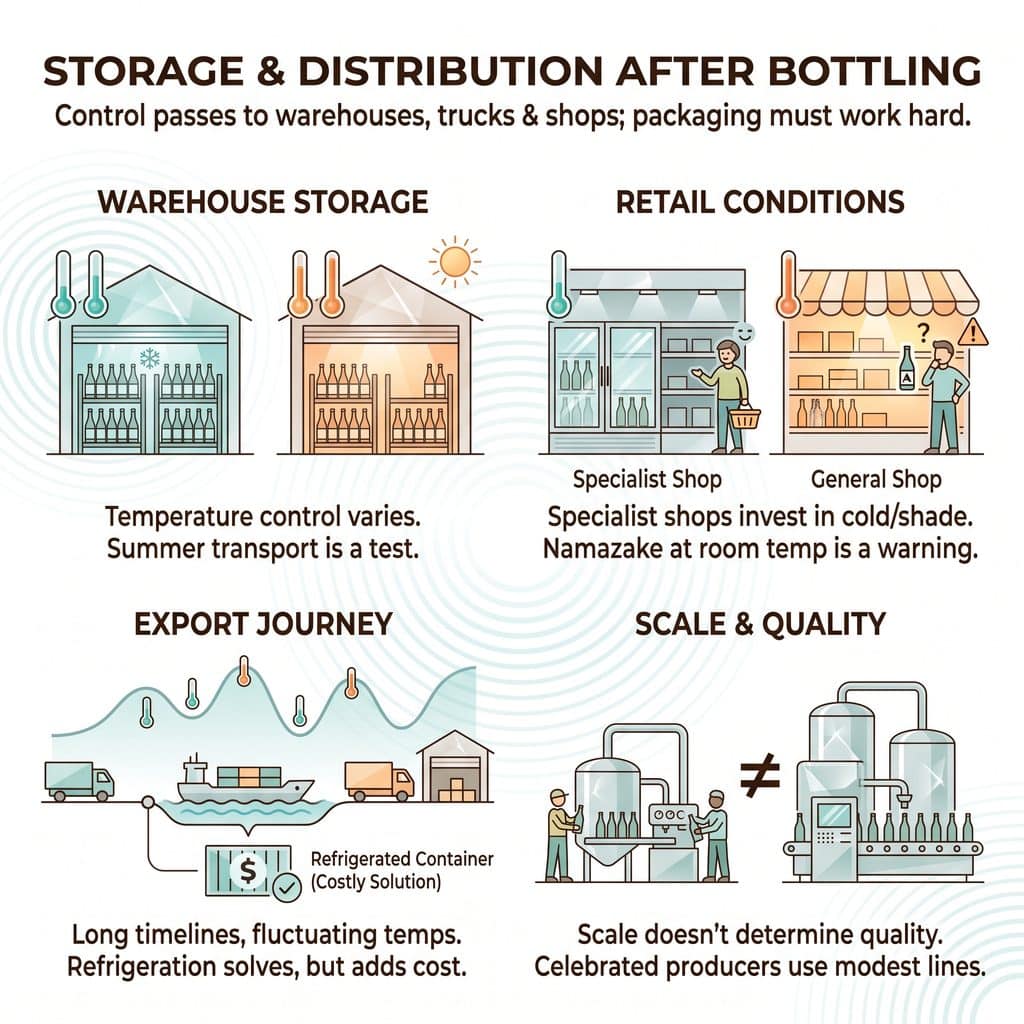
Control passes to warehouses, trucks and shops, which is why packaging has to work hard.
Sake often waits again after bottling, although this time in a warehouse. Temperature control there costs money, therefore practice varies between producers and distributors. Summer transport presents the sharpest test, particularly for anything unpasteurized.
Retail conditions decide a great deal as well. Specialist sake shops invest in refrigerated cabinets and shaded shelving, and buyers can read those signals before paying. A shop keeping namazake at room temperature is telling you something worth noticing.
Export stretches the timeline even further. Containers cross oceans, clear customs and then sit in warehouses, while temperatures fluctuate along the way. Refrigerated containers solve much of that, at a cost carried by every bottle.
Scale and bottling frequency
Smaller breweries may use compact or semi-manual equipment, outsource part of the process, or schedule bottling in limited runs. The effect on release frequency varies by brewery, and capability says nothing about the quality of the sake inside. Plenty of celebrated producers work with modest lines.
Common Misconceptions
- Bottling is only filling. The operation also covers inspection, sealing, heat treatment where applicable, labelling and lot coding.
- All sake is pasteurized the same way. Two heatings is the traditional pattern, while namazume, nama-chozo and namazake each differ, and some products use one controlled heating.
- Genshu is defined by high alcohol alone. The term describes the absence of water adjustment after production, within a narrow permitted range.
- Namazake means unfinished sake. It is a completed product that skips heat treatment by design and relies on low-temperature handling instead.
Final Thoughts
Bottling rarely attracts much attention, admittedly. Fermentation is dramatic, koji is mysterious, while a filling line looks like ordinary factory equipment.
The asymmetry is precisely what makes it interesting. A poor fermentation stays poor in a beautiful bottle, because filtration adjusts colour and dilution adjusts strength, and neither rescues a batch that went wrong months earlier. Yet bottling can undo something good, through oxygen picked up at the filler, a cap that seals badly, or a warm pallet in July.
Think of binzume as the bridge between brewing and the person drinking. Its job is to protect, package and deliver what already exists, and it succeeds by changing as little as possible.
For the whole sequence from rice to bottle, start with our guide to how sake is made.
Sake Bottling FAQ
What is Binzume?
Binzume basically refers to bottling. In its narrowest sense it means filling sake into bottles and sealing them. Brewery usage often extends the term to the surrounding packaging work, including bottle inspection, capping, labelling and final checks.
When is sake bottled?
Usually after pressing, clarification, blending and finally dilution, with heat treatment in most cases. Many products also rest in tank for months beforehand. Namazake and other unpasteurized styles follow different timing, since they skip some of those steps.
Is sake pasteurized before bottling?
Traditionally much pasteurized sake receives two heatings, once before storage and once before shipping. Some breweries now use a single carefully controlled heating instead. Others heat the sealed bottle rather than the liquid beforehand, and namazake receives none.
What is the difference between namazume and nama-chozo?
Namazume takes one heating before storage, with none at shipping. Nama-chozo runs the opposite way, since it stays unpasteurized in tank and takes one heating at shipping. Both carry a single stabilising treatment, so storage recommendations still depend on the individual product.
How does Warimizu relate to bottling?
Warimizu means the water added to bring alcohol down to bottling strength. Newly pressed undiluted sake commonly sits near 18 to 20 percent, while most bottles reach the shelf around 15 or 16. The dilution water affects flavour, so breweries select it carefully.
What does Genshu mean?
Genshu may be shown on sake that has not undergone water adjustment after production. Japanese rules permit adjustment within a range of less than one percent alcohol to even out batch variation. The term therefore signals undiluted strength in practice rather than an absolute guarantee.
Why are sake bottles coloured?
Ultraviolet and short-wavelength visible light can accelerate changes in aroma and colour. Brown glass generally protects better than green, whereas clear glass protects least. Producers often wrap or box clear bottles to compensate, and storage conditions matter regardless of the glass.
Does sake need refrigeration after bottling?
Namazake and other unpasteurized styles rely on low-temperature handling throughout. Heat-treated sake is more forgiving, though cool and dark storage remains sensible. After opening, refrigeration slows deterioration for most sake. Follow the producer’s instructions, which vary by style.
What information appears on a sake label?
Required items include the product category, ingredients, alcohol content, net volume and, finally, producer details. Polishing ratio becomes necessary when a special designation appears. Rice variety, region and terms such as genshu are voluntary. The production period moved from required to voluntary in a 2023 amendment.
Does bottling change the flavour?
Not at the moment of filling, though it fixes the conditions that govern the following months. Headspace, dissolved oxygen, closure performance and glass colour all become properties of that bottle. Storage temperature and light exposure then act on those settings over time.
References
- National Tax Agency of Japan, Outline of the Standard for the Manufacturing Method and Quality Labelling of Sake (Accessed August 2026)
- National Tax Agency of Japan, Notification Establishing the Standard for the Manufacturing Method and Quality Labelling of Sake (Accessed August 2026)
- Japan Sake and Shochu Makers Association, Glossary of Sake Terms (Accessed August 2026)
- National Tax Agency of Japan, Labelling Obligations for Alcoholic Beverages, Liquor Administration Handbook (Accessed August 2026)
- Japan Sake and Shochu Makers Association, Sake Brewing Processes and Flavor (Accessed August 2026)
- National Tax Agency of Japan, Standard for the Manufacturing Method and Quality Labelling of Sake, Handbook Section (Accessed August 2026)
- National Research Institute of Brewing, List of Standard English Expressions for Sake Terminology (Accessed August 2026)
- Suzuki, K., Sake and Beer Spoilage Lactic Acid Bacteria, A Review, Journal of the Institute of Brewing, 2008 (Accessed August 2026)
Related Articles
- Pasteurization (火入れ / Hiire): Stabilizing Sake with Gentle Heat (Surveyed: August 2026)
- Warimizu (割水): Why Water Is Added Before Bottling Sake (Surveyed: August 2026)
- Orisage (滓下げ): Clarifying Sake Before Bottling (Surveyed: August 2026)
- Jukusei (熟成): How Aging Transforms Sake (Surveyed: August 2026)
- Hi-ochi (火落ち): Bacterial Spoilage in Sake (Surveyed: August 2026)
- Moto (Shubo): The Sake Yeast Starter (Surveyed: August 2026)
- Kimoto (生酛): The Traditional Yeast Starter (Surveyed: August 2026)
- Water (水 / Mizu) in Sake Brewing (Surveyed: August 2026)
- Types of Japanese Sake: A Beginner’s Guide (Surveyed: August 2026)
- Japanese Sake Guide: Types, Regions, Brewing and Brands (Surveyed: August 2026)




Comments