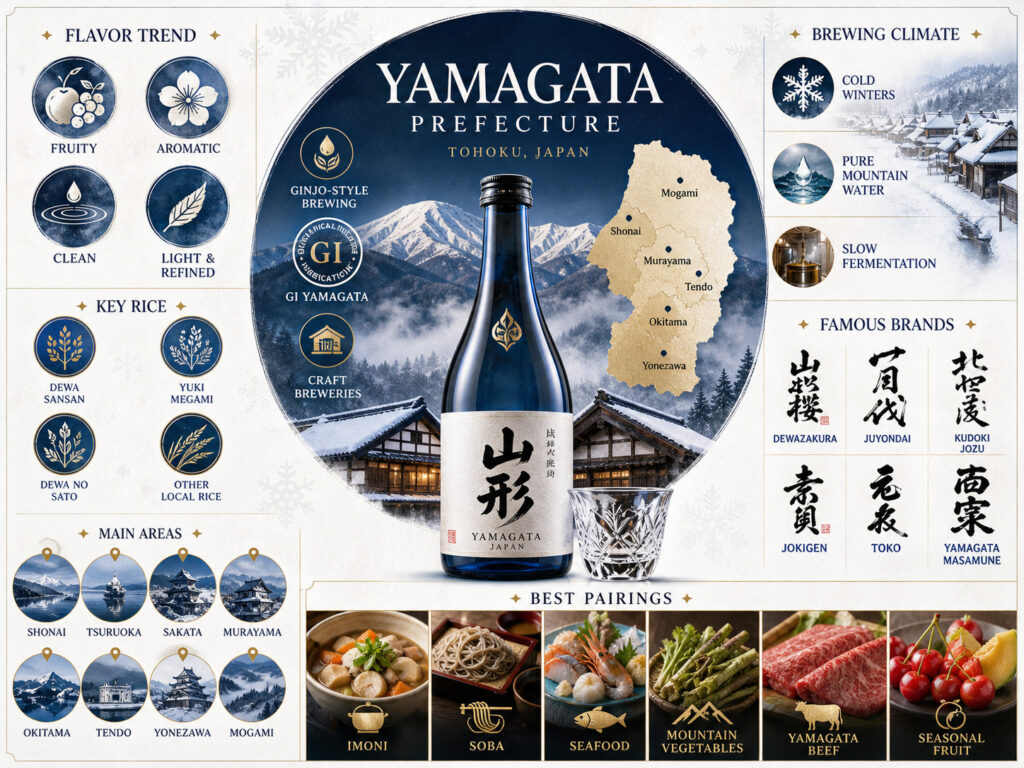
Yamagata sake is a Tohoku regional style known for fruity aroma, clean texture, and careful cold-climate brewing. The prefecture has built a strong reputation around Ginjo, Junmai Daiginjo, GI Yamagata, and local rice. In short, many drinkers see the region as one of Japan’s clearest examples of modern craft sake.
The phrase Ginjo kingdom Yamagata is not just a nickname. It reflects decades of technical work, shared research, and brewery effort. Still, the prefecture does not produce one single flavor. Local bottles range from light and smooth Ginjo to richer Junmai and rare premium labels.
Imoni, soba, seafood, mountain vegetables, Yamagata beef, seasonal fruit
This summary answers what defines Yamagata Prefecture sake. It is premium Tohoku regional sake shaped by snow, mountains, rice, and brewer cooperation. The region is especially strong in clean and elegant Ginjo brewing.
What Makes This Regional Sake Unique?
First, quality in the prefecture grew through cooperation. Breweries, research institutes, rice growers, and technicians worked together. That shared culture helped raise the overall level of local craft sake.
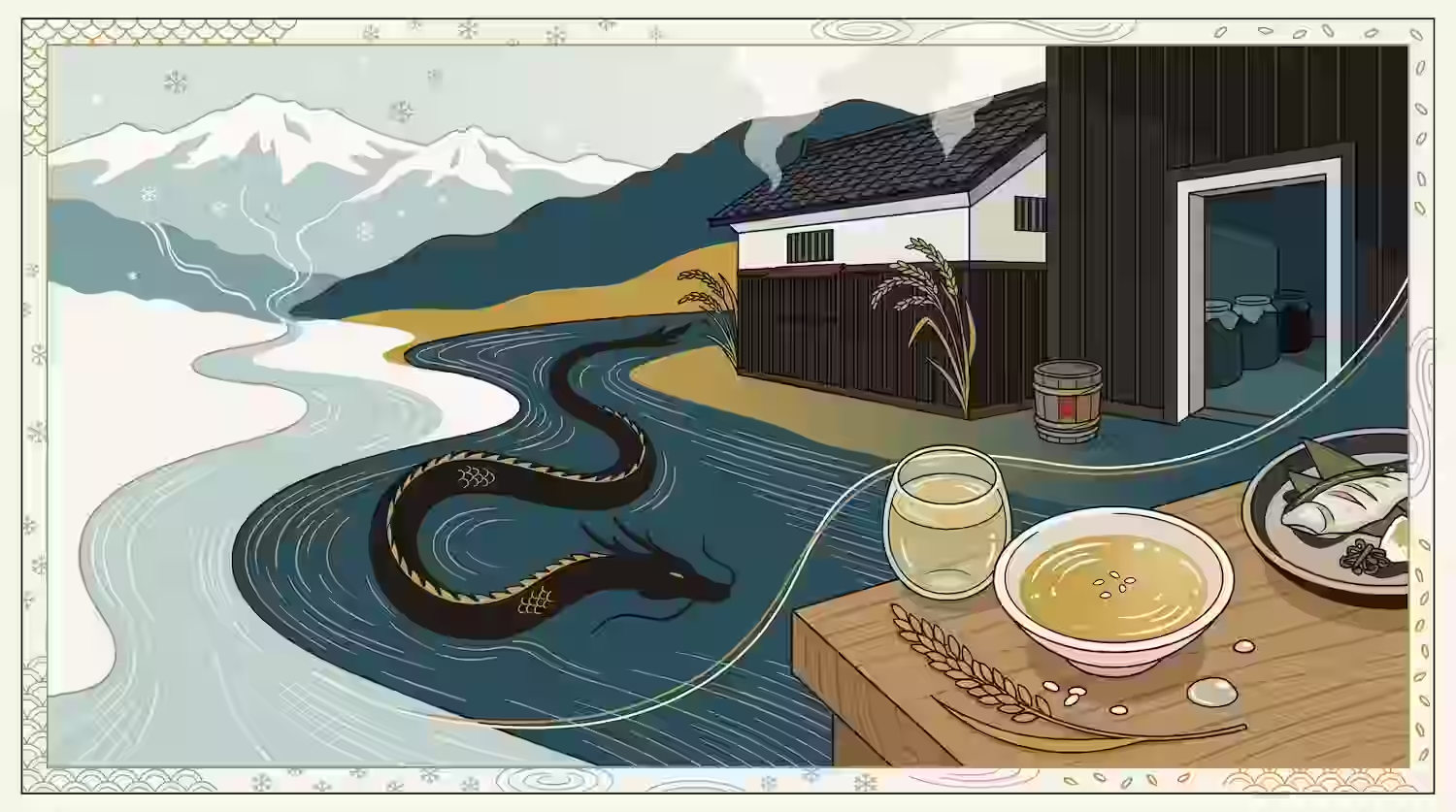
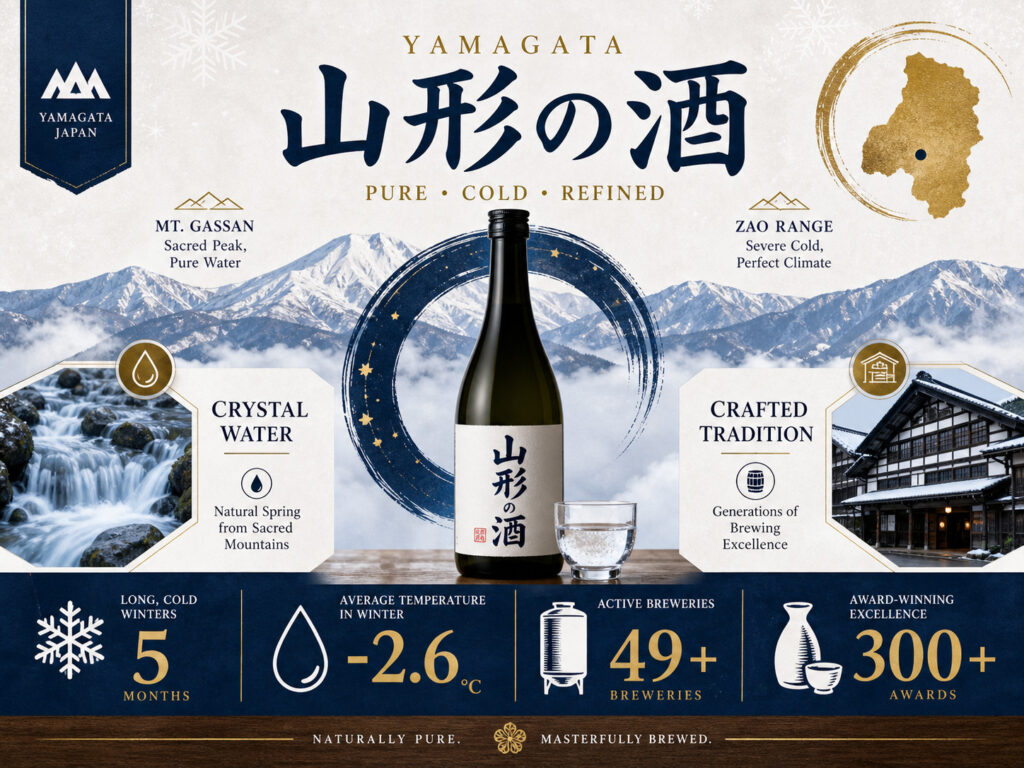
Water also matters. Yamagata has mountain systems such as Zao, Gassan, Chokai, and Asahi. These mountains support clean water sources that suit slow brewing.
Second, climate gives brewers an advantage. Cold winters support careful fermentation and aroma control. As a result, many bottles feel clear, polished, and calm.
Third, rice creates regional identity. Dewa sake rice from the prefecture supports local brewing. Dewa Sansan, Yuki Megami, and other varieties help shape Ginjo and Junmai Daiginjo styles.
Finally, people complete the story. Local breweries often share technical ideas while keeping distinct house styles. That balance explains why the region feels unified, but not uniform.
Yamagata is often called a Ginjo kingdom because Ginjo-style brewing plays a central role in its identity. The prefecture has long focused on aroma, clarity, polished rice, and temperature control. This helped move local sake from a regional market into national attention.
For example, Ginjo brewing requires careful rice polishing, koji work, yeast management, and low-temperature fermentation. It is not only about fragrance. Good Ginjo also needs balance and restraint.
As a result, many bottles from the prefecture feel fruity and aromatic without becoming heavy. Some show apple, melon, pear, white flowers, or soft rice sweetness. Others are quieter, with clean texture and gentle umami.
This is why clean and elegant Yamagata Ginjo attracts beginners and serious drinkers. It feels polished, but not empty. That may sound simple, though it takes serious brewer’s craft.
GI Yamagata strengthened the prefecture’s identity. In 2016, Yamagata received Japan’s first prefecture-wide geographical indication for sake. The designation protects the regional name and connects sake quality to origin.
In addition, the GI shows how seriously the prefecture treats local production. Sake using the name must follow rules linked to ingredients, brewing location, storage, and bottling. This system helps consumers understand that the regional name has meaning.
Therefore, GI Yamagata fits the idea of terroir-driven brewing. Water, rice, climate, and regional skill shape the final bottle. Of course, each brewery still has its own style. Yet the shared identity remains clear.
Dewa Sake Rice from Yamagata
Dewa Sansan is one of the most important sake rice varieties from the prefecture. Development began in the 1980s, and the rice later became a symbol of regional brewing. It supports the Ginjo image closely.
In practice, Dewa Sansan tends to suit aromatic sake. Brewers value its grain size, shinpaku formation, and brewing stability. It can create sake that feels mild, clear, and balanced.
Yuki Megami is another important local rice. Breweries often use it for delicate and refined Junmai Daiginjo from Yamagata. This rice helps create high-polish premium sake with clean aroma and graceful texture.
Moreover, Dewa no Sato and other local rice varieties also appear. Together, these grains show how the prefecture built sake identity through agriculture. Rice is not just an ingredient here. It is part of the region’s story.
Flavor Profile and Characteristics
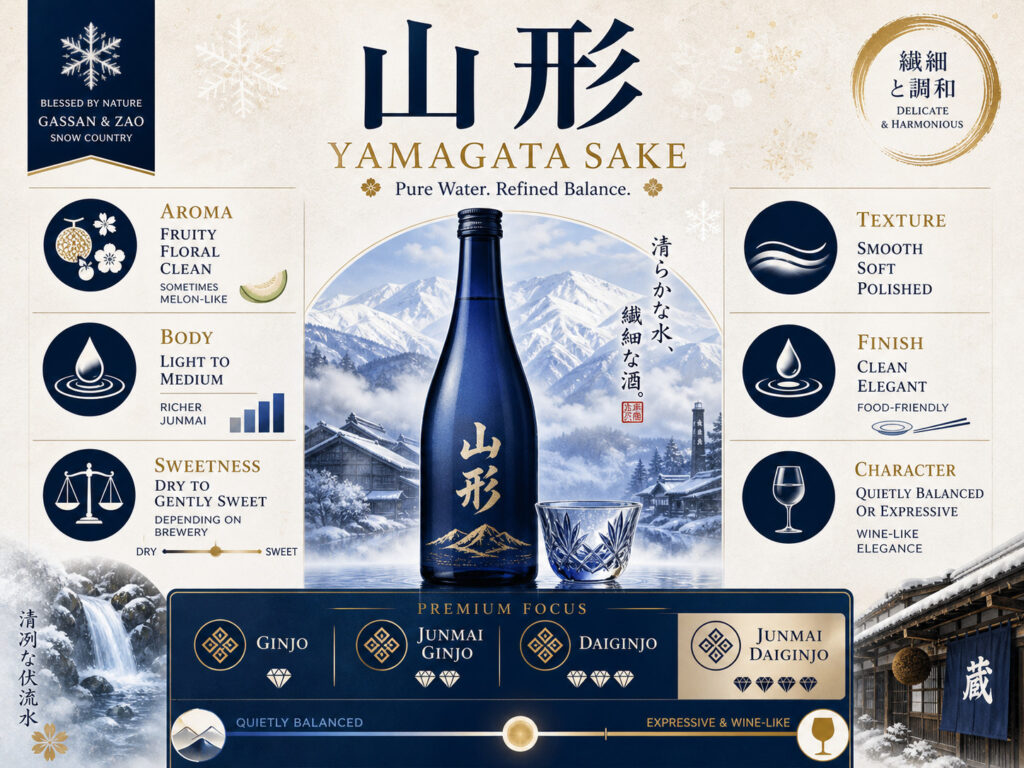
The flavor profile often centers on fruit, clarity, and smoothness. Many bottles feel light and smooth, with fine aroma and a clean finish. However, breweries also produce richer Junmai, dry styles, and expressive seasonal sake.
Character
Typical regional expression
Aroma
Fruity, floral, clean, and sometimes melon-like
Body
Light to medium, though richer Junmai exists
Sweetness
Dry to gently sweet, depending on brewery
Texture
Smooth, soft, and polished
Finish
Clean, elegant, and food-friendly
Premium focus
Ginjo, Junmai Ginjo, Daiginjo, and Junmai Daiginjo
In general, fruity and aromatic Yamagata sake is common, but not every bottle smells loud. Some breweries aim for quiet balance. Others make expressive styles that feel almost wine-like.
Meanwhile, premium Junmai Daiginjo can feel delicate and refined. It may show pear, white peach, apple, or soft flowers. Still, a good bottle keeps acidity and umami in balance.
Regional Areas and Brewing Identity
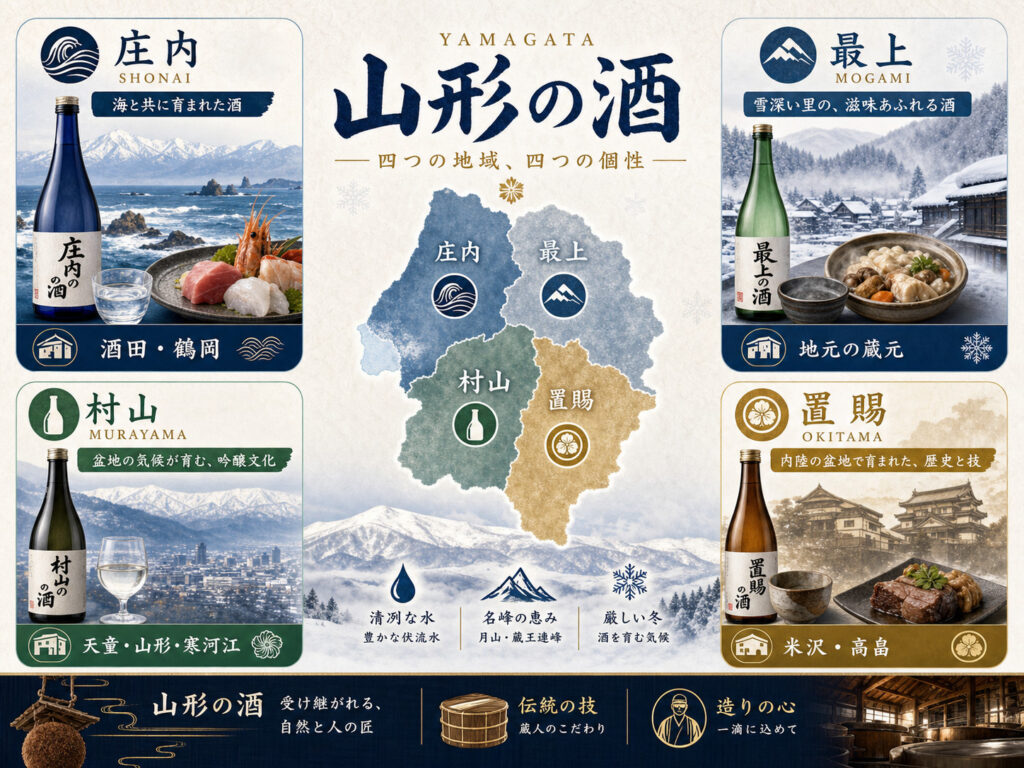
Geographically, the prefecture changes by area. Mountain basins, coastal towns, snowy valleys, and agricultural plains create different brewing contexts. These differences shape water, rice, food culture, and brewery identity.
Area
Sake identity
Typical context
Shonai region sake
Coastal Yamagata, seafood pairings, rice culture
Sakata and Tsuruoka breweries
Murayama region sake
Basin climate and aromatic Ginjo culture
Tendo, Yamagata City, Sagae
Okitama region sake
Inland basin, rice, history, and craft
Yonezawa and Takahata breweries
Mogami region sake
Snowy interior and rural food culture
Local breweries and winter dishes
For example, Shonai region sake connects well with seafood and winter dishes. Murayama often links to Ginjo culture and orchard landscapes. Okitama shows inland depth, while Mogami adds snow country character.
Therefore, Yamagata local sake is not only a list of brands. It is a map of regional brewing cultures.
History of Yamagata Sake
Historically, the region’s sake has older roots in rice farming and local brewing. Still, the modern reputation grew strongly in the late 20th century. That shift matters for understanding today’s premium image.
For many years, breweries mainly served local markets. Then sake demand changed, and ordinary sake became harder to sell. Some producers responded by moving toward premium styles.
In addition, public and private groups pushed quality improvement. Research into rice, yeast, brewing technique, and judging standards helped raise the prefecture’s reputation. Over time, the area became known for Ginjo and craft brewing.
Dewazakura helped spread the Ginjo image. Juyondai later became a symbol of modern premium sake. Meanwhile, many smaller producers built loyal followings through careful local brewing.
Today, Yamagata Prefecture sake has national and international recognition. It is no longer a quiet local category. It is one of the clearest examples of regional sake transformation in modern Japan.
Famous Breweries and Brands
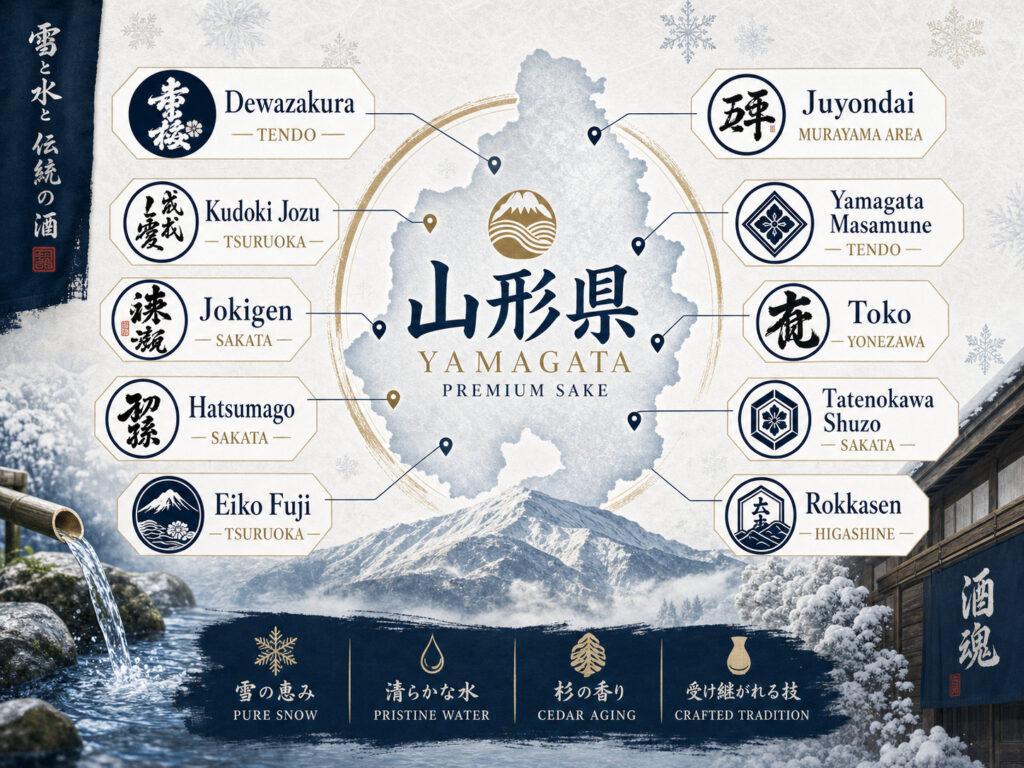
Yamagata sake breweries are diverse. This section is not a ranking. Instead, it gives a reference map for major names, regions, and brand identities.
Brewery or brand
Area
Notes
Dewazakura – Dewazakura Sake Brewery in Yamagata
Tendo
Known for Oka Ginjo, Yukimanman Daiginjo, and Ginjo culture
Juyondai – Takagi Shuzo brewery in Yamagata
Murayama area
Famous premium sake with strong national reputation
Kudoki Jozu – Kamenoi Shuzo brewery in Yamagata
Tsuruoka
Aromatic style, also known for Bakuren
Jokigen – Sakata Shuzo brewery in Yamagata
Sakata
Shonai coastal sake with food-friendly balance
Hatsumago – Tohoku Meijo brewery in Sakata, Yamagata
Sakata
Known for kimoto-style brewing and Higashimeijo heritage
Toko – Kojima Sohonten brewery in Yonezawa, Yamagata
Yonezawa
Historic brewery with a sake museum and castle town identity
Yamagata Masamune – Mitobe Shuzo in Yamagata
Tendo
Rice-focused craft brewery with clean structure
Eiko Fuji – Fuji Brewery in Yamagata
Tsuruoka
Expressive aromatic sake, including Hitoriyogari styles
Tatenokawa Shuzo – Tatenokawa from Sakata
Sakata
Known for Junmai Daiginjo focus and polished modern branding
Rokkasen – Rokkasen brewery in Yamagata
Higashine
Produces Rokkasen, Yamahoshi, and Hitotoki
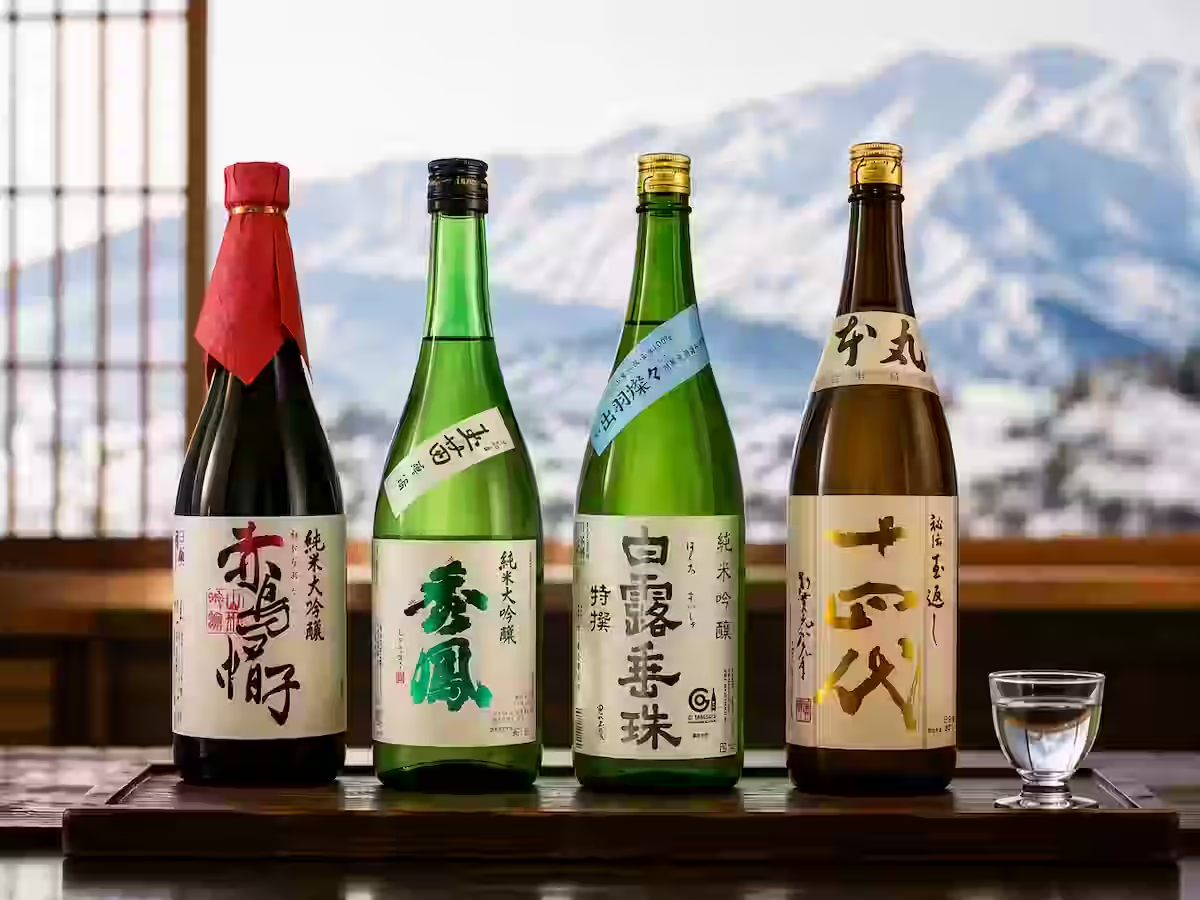
These names only show part of the picture. The prefecture also includes Asahikawa Shuzo 朝日川酒造 with 朝日川 and 山吹極, Otokoyama Shuzo 男山酒造 with 羽陽男山, and Gassan Shuzo 月山酒造 with 銀嶺月山.
Other important local names include Kikuizumi 菊勇株式会社 with 菊勇 and 三十六人衆, Koikawa Shuzo 鯉川酒造 with 鯉川 and 亀治好日, and Chiyokotobuki 千代寿虎屋 with 千代寿 from Sagae.
Meanwhile, Tsuruoka has Kato Kahachiro Shuzo 加藤嘉八郎酒造 with 大山, Watarai Honten 渡會本店 with 出羽の雪 and 和田来, and Ohu Jiman 奥羽自慢 with 奥羽自慢 and 吾有事. Yonezawa has Shinshu Shindo 新藤酒造店 with 雅山流 and Toko 小嶋総本店 with 東光.
Of course, the list could continue. Hideho Shuzo 秀鳳酒造場, Yonezuru 米鶴酒造, Wada Shuzo 和田酒造, Wakanoi 若乃井酒造, and Naganuma 長沼 all add regional depth. This density of producers explains why local craft sake feels unusually varied.
Famous Local Sake Types
In general, the region’s sake appears across many categories. Junmai can show rice flavor and food-friendly umami. Ginjo and Junmai Ginjo often highlight fruit, flowers, and smooth texture.
Daiginjo and Junmai Daiginjo are especially important. Delicate and refined Junmai Daiginjo from Yamagata reflects the prefecture’s high-polish brewing culture. Dewazakura Yukimanman Daiginjo from Yamagata and other premium bottles show this direction clearly.
Moreover, seasonal sake matters. Namazake brings freshness after winter brewing. Genshu gives stronger body when breweries skip dilution.
Finally, Dewasansan Ginjo from Yamagata is another useful phrase for understanding the region. Dewazakura Oka Ginjo from Yamagata also helped many drinkers recognize aromatic sake from the prefecture. Zao Ginjo from Yamagata belongs to this wider Ginjo image.
Food-Friendly Pairings
Food-friendly Yamagata sake pairings work because many bottles balance aroma with clean texture. The sake can support local dishes without covering them. This is important in a region with both mountain and coastal food.
Seasonal fruit desserts, including cherries and pears
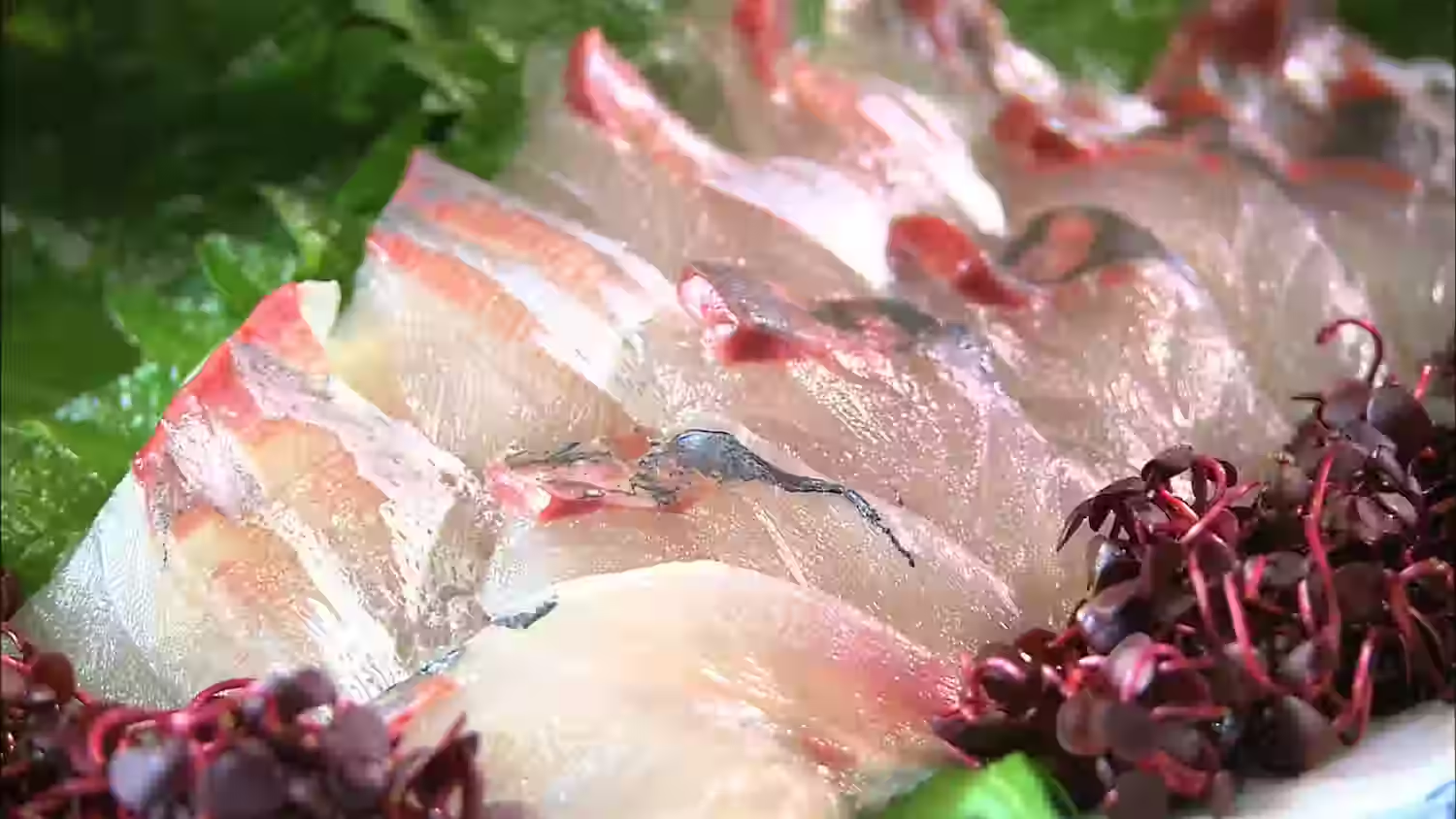
For example, aromatic Ginjo works well with lighter dishes. Richer Junmai can match imoni or grilled fish. Meanwhile, premium Junmai Daiginjo suits delicate seafood or mild seasonal vegetables.
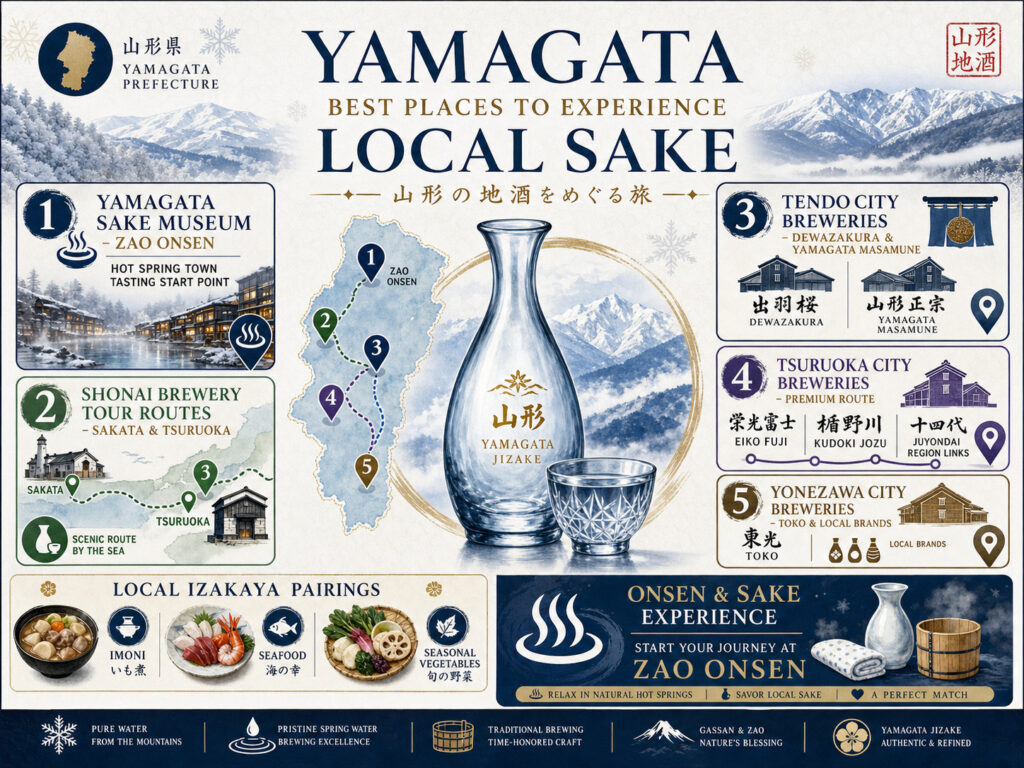
For visitors and readers, the prefecture’s sake is best understood by tasting across regions. Brewery towns, local sake bars, and onsen areas all show different sides of the area. However, the goal is not just tourism. The goal is to understand local sake culture.
Useful places include these.
Yamagata Sake Museum – Zao Onsen
Sake tasting in hot spring town settings
Shonai brewery tour routes in Sakata and Tsuruoka
Tendo city breweries, including Dewazakura and Yamagata Masamune
Tsuruoka city breweries, including Eiko Fuji, Kudoki Jozu, and nearby Juyondai region links
Yonezawa city breweries, including Toko and local brands
Local izakaya pairing sake with imoni, seafood, and seasonal vegetables
Meanwhile, Yamagata onsen and sake experience is a natural combination. Zao Onsen gives visitors a simple starting point through the Yamagata Sake Museum. Still, brewery visits require planning because access and tasting rules vary.
FAQ About Yamagata Sake
What is Yamagata sake?
Yamagata sake is Japanese sake brewed in Yamagata Prefecture in Tohoku. It is famous for Ginjo-style brewing, fruity aroma, smooth texture, and GI Yamagata identity. The region uses local rice such as Dewa Sansan and Yuki Megami. Many bottles feel clean, aromatic, and food-friendly.
Why is Yamagata called Ginjo kingdom?
Yamagata is called Ginjo kingdom because the prefecture has built a strong reputation for aromatic, polished sake. Breweries focus on rice polishing, cold fermentation, local yeast, and careful aroma control. Dewazakura and other producers helped make Yamagata Ginjo widely known. The nickname also reflects regional cooperation around premium brewing.
What does sake from Yamagata taste like?
Sake from Yamagata often tastes fruity, clean, and smooth. Common aromas include apple, melon, pear, white flowers, and soft rice notes. Some Junmai styles feel richer and more savory. Overall, the region is known for balance rather than rough power.
What is GI Yamagata sake?
GI Yamagata sake is sake protected under a geographical indication linked to Yamagata Prefecture. The designation connects the sake to regional origin, ingredients, brewing, storage, and bottling rules. It helps protect the name Yamagata. It also supports consumer trust in regional quality.
What is Dewa Sansan?
Dewa Sansan is a representative sake rice developed in Yamagata. It supports Ginjo-style brewing and helps express the region’s identity. Brewers value its brewing stability and clean flavor potential. It appears in many local sake labels.
Which local brands are famous?
Famous brands include Dewazakura, Juyondai, Kudoki Jozu, Bakuren, Jokigen, Hatsumago, Toko, Tatenokawa, Yamagata Masamune, and Eiko Fuji. Each brand has a different identity. Some emphasize aroma, while others focus on rice depth or food pairing.
What food pairs well with local sake?
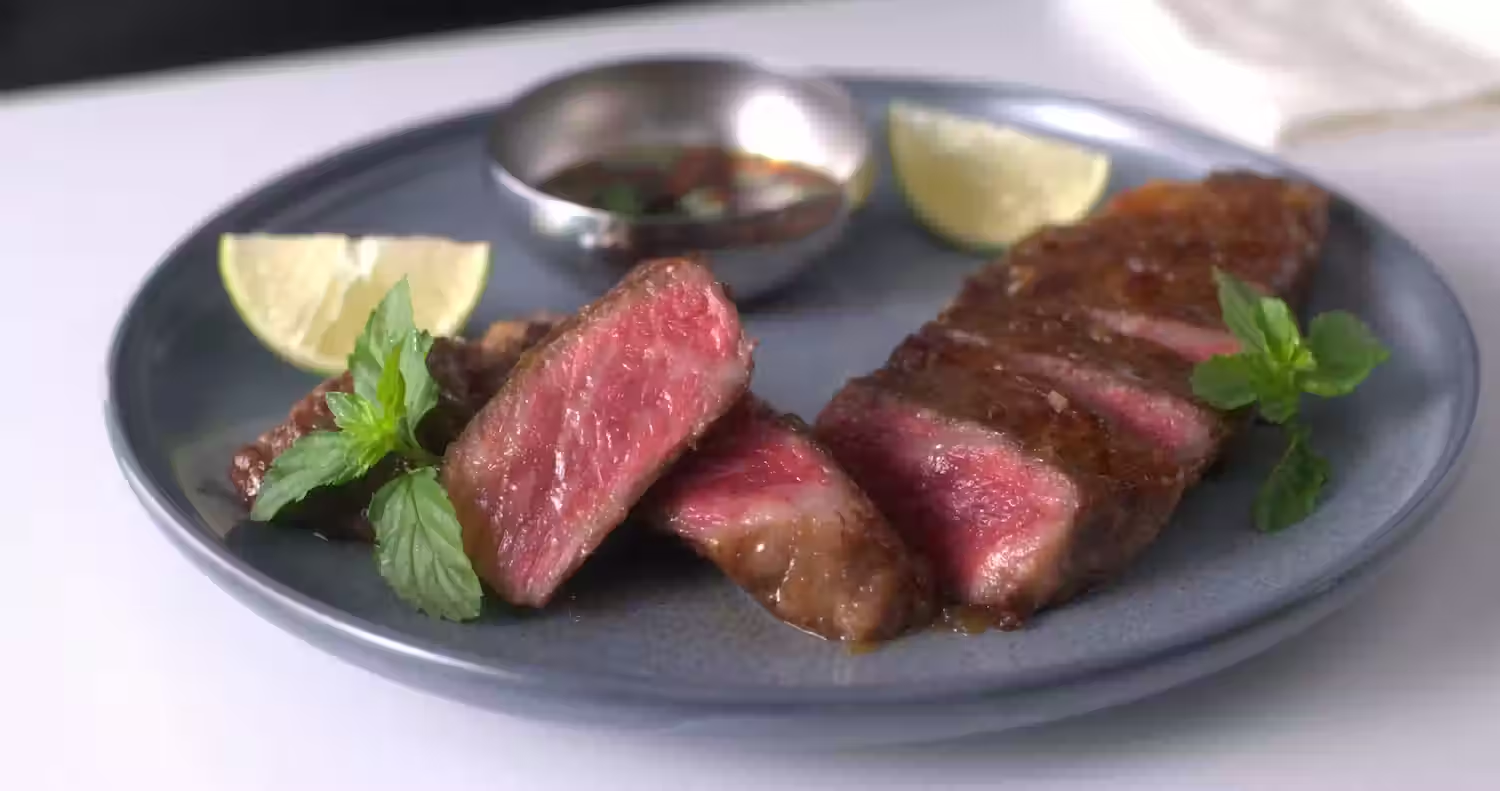
Local sake pairs well with imoni, soba, Shonai seafood, grilled fish, mountain vegetables, and Yamagata beef. Fruity Ginjo suits lighter dishes. Richer Junmai works well with stews and savory foods. Premium Junmai Daiginjo can pair with delicate seafood.
Final Thoughts
Yamagata sake is a refined expression of Tohoku regional sake culture. It combines cold-climate brewing, local rice, mountain water, and careful brewer cooperation. The result is often fruity, smooth, and elegant.
Finally, the region also shows how modern sake identity can be built. GI Yamagata, Dewa Sansan, Ginjo culture, and strong local breweries all matter. For readers studying Japanese regional sake, this prefecture is essential.
References
Yamagata Sake Brewers Association – checked in 2026; official information on Ginjo kingdom Yamagata, GI activity, water, breweries, and regional sake culture.
Yamagata Sake Museum – checked in 2026; GI Yamagata, 49 breweries, Zao Onsen tasting experience, and Ginjo kingdom explanation.
Ryo Iwa is the founder and editor of foodinjapan.org. Born and raised in Japan, he writes from regional travel, market visits, and Japanese-language primary sources that rarely reach English readers, including brewing institute publications and industry glossaries. Where a figure cannot be traced to a source, the article says so.
He has been a Google Maps Local Guide for over 10 years, with more than 1,800 reviews and over 41,000 photos viewed hundreds of millions of times. He previously spent two decades as an IT consultant in Japan, the US, and the UK.














Comments