



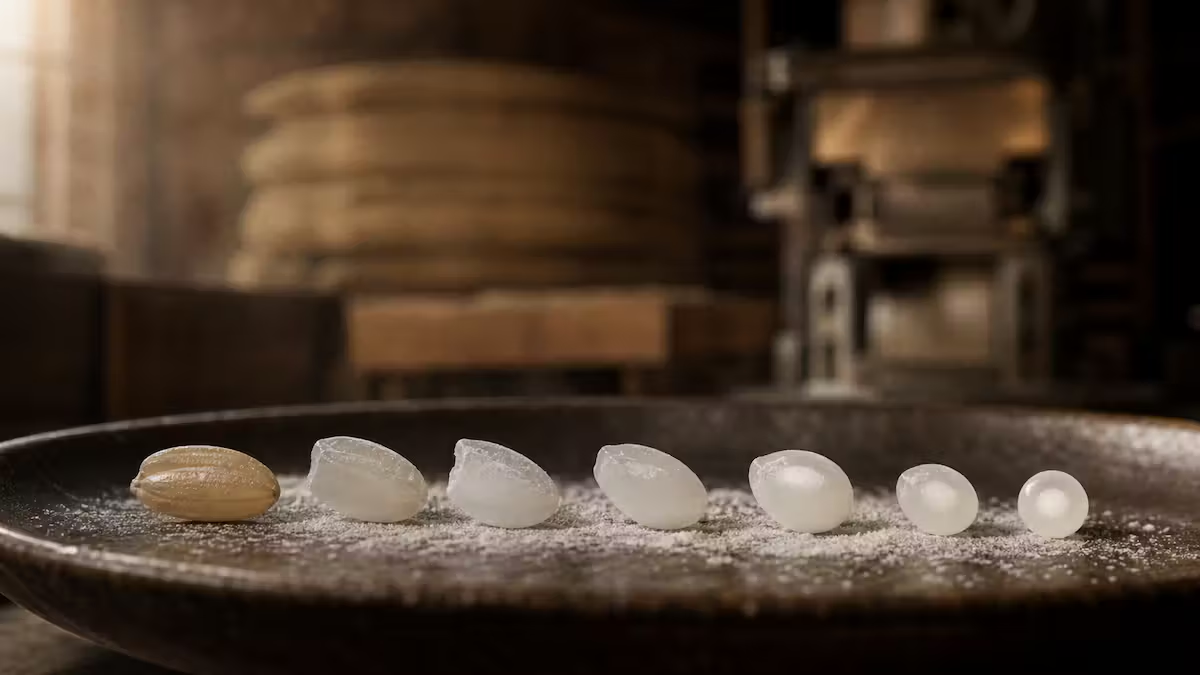
Open any bottle of premium sake, and you will see a number on the label. It often reads something like 60 percent or 50 percent. That figure points to rice polishing, one of sake’s defining steps. So what is rice polishing in sake brewing? Rice polishing is the milling away of a rice grain’s outer layers before brewing. Brewers do this to reach the clean, starchy heart of the grain. The amount they keep is called the polishing ratio, or seimai buai. This ratio helps define many famous sake styles.
This guide explains rice polishing in clear, complete terms. We cover what it is, how it works, and why it matters. We also explore the science, the history, and the flavor it shapes. One idea will return again and again here. A lower polishing ratio does not automatically mean better sake. Polishing is a powerful tool, yet only one of many. For the wider picture, see our guide on how sake is made.
Quick Facts About Rice Polishing
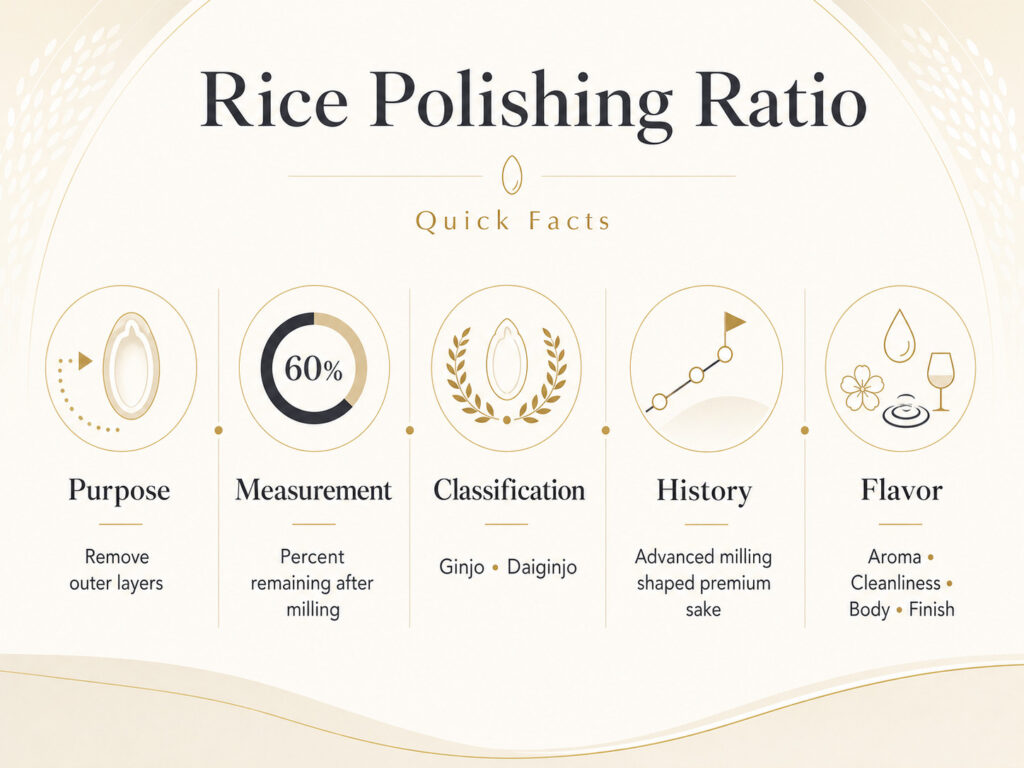
Here is a fast snapshot before the details begin.
| Japanese Term | 精米歩合 (seimai buai) |
| English Term | Rice polishing ratio |
| Purpose | Remove outer layers to reach the starchy core |
| Measurement Method | Percentage of the grain that remains after milling |
| Link to Classification | Helps define ginjo, daiginjo, and other styles |
| Historical Importance | Advanced milling enabled modern premium sake |
| Impact on Flavor | Influences aroma, cleanliness, body, and finish |
What Is Rice Polishing?
Rice polishing, at its core, is careful milling. Brewers grind away the outer surface of each brown rice grain. What remains is a smaller, whiter grain rich in starch. The Japanese term for this process is seimai. So polishing is really about subtraction, not addition. Yet that simple act shapes the entire brew that follows.
Why Sake Rice Differs From Table Rice
Not all rice suits sake brewing. Table rice and sake rice differ in clear ways. Sake rice grains tend to be larger and softer. They also carry less protein and fat than eating rice. Most importantly, they hold a white, starchy center. You can learn more in our guide to sake rice (sakamai). That special structure makes polishing both possible and worthwhile.
The Heart of the Grain: Shinpaku
At the center of good sake rice sits the shinpaku. This is an opaque, white core of pure starch. Brewers prize it above all other parts. The shinpaku absorbs water well and welcomes koji mold. So brewers polish toward this core, not away from it. The goal is to keep the clean starch and shed the rest.
Understanding the Structure of Sake Rice
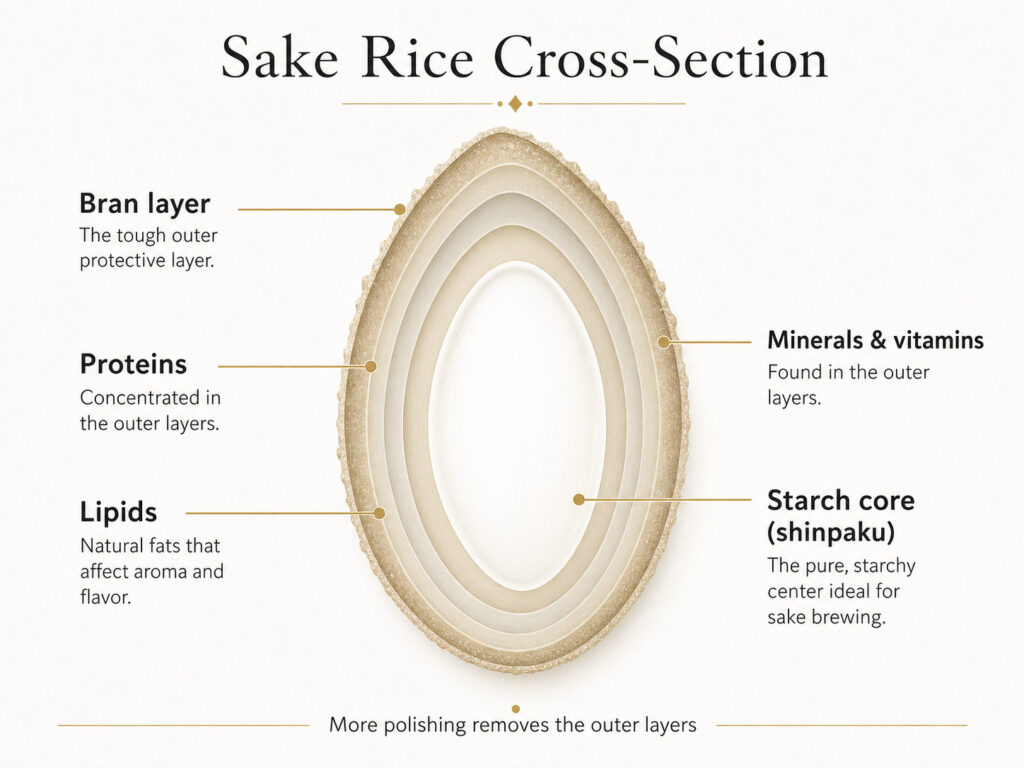
To grasp polishing, picture a single grain in cross-section. Each grain has layers, like a tiny onion. The outer layers and the core serve very different roles. Brewers treat each layer with care.
- Bran layer: the rough outer skin, removed early in milling
- Proteins: concentrated near the surface, useful but risky in excess
- Lipids (fats): sit in the outer region and can dull aroma
- Minerals and vitamins: gather in the outer layers and germ
- Starch core (shinpaku): the clean, central heart brewers want
Each part influences fermentation in its own way. Proteins can become amino acids, which add umami and body. Fats and minerals, though, can push aroma and taste off balance. The starchy core, by contrast, ferments cleanly. So brewers remove more of the outside to chase a lighter, purer style. They keep more of it when they want depth and richness.
Why Rice Is Polished for Sake
So why is sake rice polished at all? The reasons connect to flavor and control. Outer layers hold proteins, fats, minerals, and vitamins. These are useful in small amounts, yet harmful in excess. Too much protein can create heavy, rough, or off flavors. Too much fat can mute the delicate aromas brewers seek.
Polishing helps in several connected ways. First, it removes excess protein near the surface. Second, it reduces fats and lipids that blur aroma. Third, it supports cleaner, steadier fermentation. As a result, brewers gain finer control over the final taste. Cleaner rice also helps the koji mold grow evenly across each grain. For aromatic styles, that control proves essential. You can see this clearly in our ginjo sake guide.
Still, removal is never the whole story. Brewers do not simply strip away everything possible. They aim for balance, not extremes. A grain stripped too far can lose its soul. So polishing always involves judgment, not just machinery.
What Is Seimai Buai?
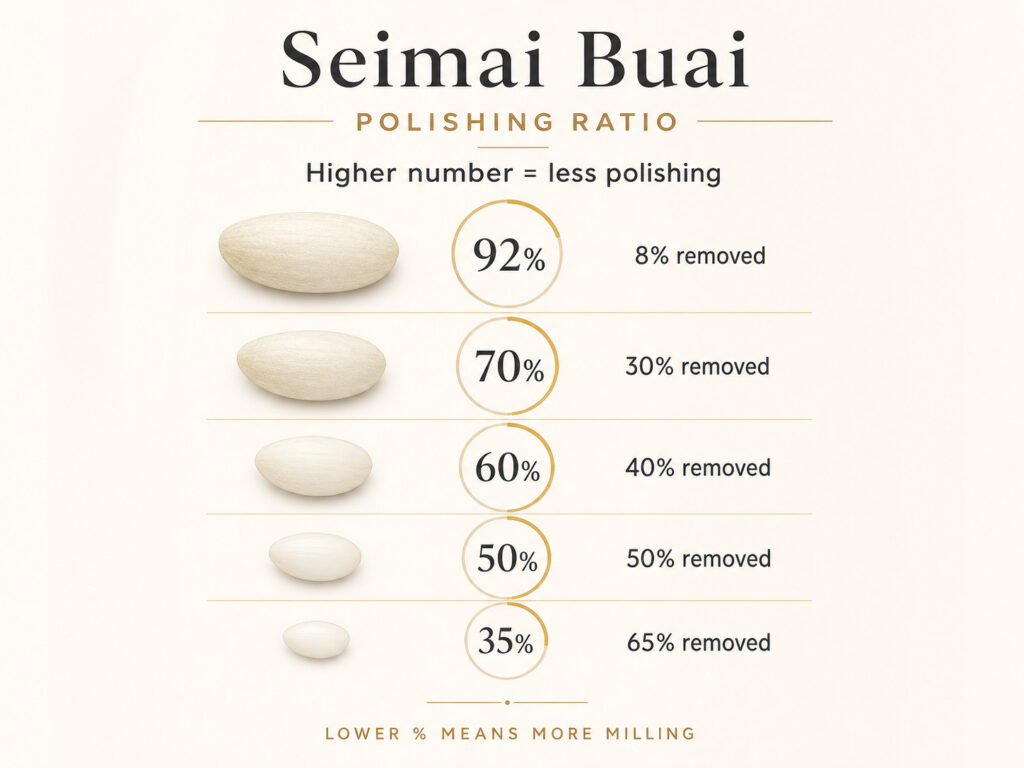
Seimai buai is the polishing ratio of the rice. It tells you how much of the grain remains. This single number appears on countless sake labels. Yet many people read it the wrong way.
How It Is Calculated
The math is refreshingly simple. Seimai buai is the weight of polished rice divided by the original brown rice. Brewers then express that share as a percentage. A ratio of 60 percent means 60 percent of the grain remains. So the brewer has milled away the other 40 percent.
A Very Common Misunderstanding
Here lies the classic mistake. A 70 percent seimai buai does not mean 70 percent was removed. It means 70 percent remains, and 30 percent is gone. The lower the number, the more rice has been polished away. Let us look at a few clear examples:
- 92 percent: ordinary table rice, with only about 8 percent removed
- 70 percent: 30 percent milled away, common for everyday sake
- 60 percent: 40 percent removed, a typical ginjo level
- 50 percent: half the grain gone, a typical daiginjo level
- 35 percent: 65 percent removed, a sign of extreme polishing
So a smaller number means more milling, more effort, and more cost. It does not, by itself, promise a better drink. We will return to that crucial point later.
How Rice Polishing Works
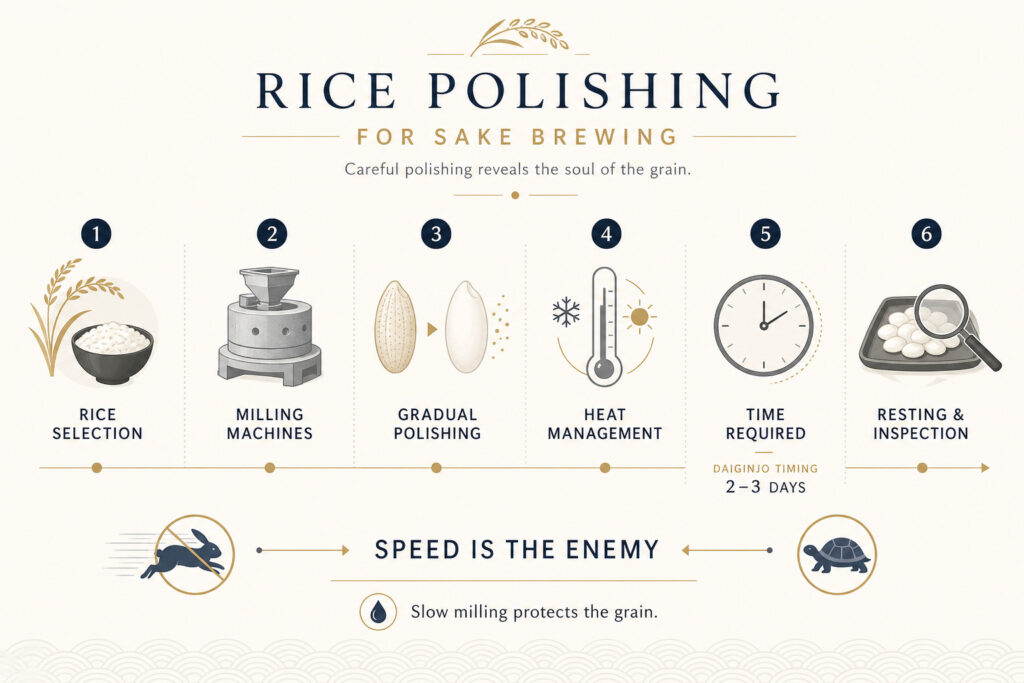
Polishing looks simple, yet it demands patience and precision. The process unfolds in clear stages. Let us follow them in order.
- Rice selection: brewers choose quality sake rice with a good core
- Milling machines: vertical mills grind the grain against rotating wheels
- Gradual polishing: the grain loses its outer layers slowly, not all at once
- Heat management: milling creates heat, so brewers work gently to protect the grain
- Time required: deep polishing can take many hours or even days
- Resting and inspection: polished rice rests to rebalance moisture before brewing
Speed is the enemy of good polishing. Fast milling builds heat and can crack the grain. Cracked rice absorbs water poorly and brews unevenly. So brewers slow down, especially for high polishing. For a daiginjo, milling may run for two or three days. That patience explains part of the cost. Afterward, the rice rests for days or weeks to settle.
The History of Rice Polishing in Japan
Rice polishing has a long, slow history. Its progress tracks the rise of sake itself. Each era added new tools and ideas. Let us trace that journey.
Early Sake and Primitive Milling
Early brewers had almost no way to polish rice. They pounded grain by hand with mortars and pestles. This removed only the roughest outer husk. So early sake used barely polished rice. The results were cloudy, heavy, and far from refined.
Water Wheels and the Edo Period
Progress came with simple machines. Foot-powered and water-powered mills slowly appeared. The Edo period brought water wheels into wider use. These wheels drove milling stones with steady force. So brewers could finally polish rice more deeply. Clearer, cleaner sake became possible for the first time.
Industrial and Modern Precision
The modern leap arrived with electric machines. In the twentieth century, vertical rice mills transformed the craft. These machines polished grains evenly and very deeply. So ratios of 50 percent and below became practical. This breakthrough made today’s ginjo and daiginjo styles possible. In short, technology unlocked a whole new tier of sake.
Rice Polishing in Modern Sake Brewing
Modern technology keeps reshaping this ancient step. Today’s mills are precise, fast, and smart. They give brewers control once thought impossible.
Computer-controlled machines now guide much of the work. Sensors track temperature, time, and grain condition. Some mills even shape grains along their natural form. This flat or “henpei” polishing trims less starch while removing impurities. So brewers can refine flavor while wasting less rice. Data and tradition increasingly work side by side.
Yet machines have not replaced the human eye. Skilled brewers still judge the rice with care. They blend old instincts with new tools. In that sense, modern polishing honors its long past. The craft evolves, but its purpose stays the same.
Rice Polishing and Sake Classifications
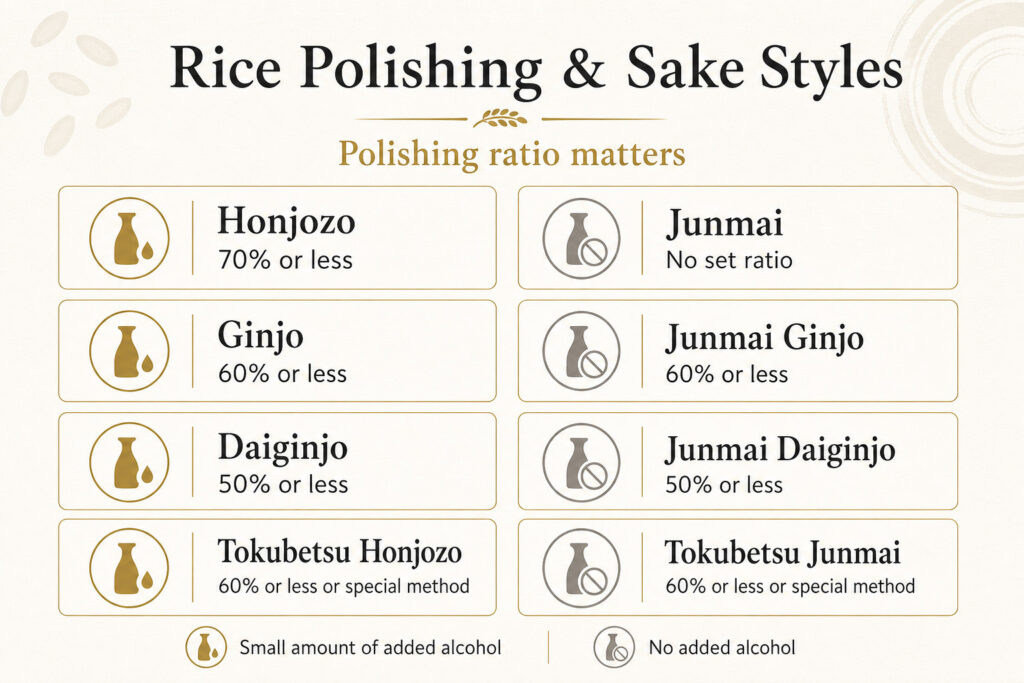
This is where polishing meets the sake label. Japan’s classification rules use the polishing ratio heavily. The system centers on the specially designated sake, or tokutei meisho-shu. To explore the full range, see our guide to types of Japanese sake.
The Main Categories and Their Ratios
The official rules tie several styles to polishing limits. The table below sums up the key requirements.
| Style | Polishing ratio | Added alcohol |
|---|---|---|
| Honjozo | 70% or less | Yes, small amount |
| Ginjo | 60% or less | Yes, small amount |
| Daiginjo | 50% or less | Yes, small amount |
| Junmai | No set ratio | None |
| Junmai Ginjo | 60% or less | None |
| Junmai Daiginjo | 50% or less | None |
| Tokubetsu Junmai | 60% or less, or special method | None |
| Tokubetsu Honjozo | 60% or less, or special method | Yes, small amount |
A few details deserve a closer look. Junmai sake once required a 70 percent ratio. That rule was dropped in 2004, so junmai now has no set limit. Daiginjo and junmai daiginjo demand at least 50 percent milling. Junmai ginjo sits at 60 percent or less, without added alcohol. All specially designated sake must also use a fair share of koji rice.
One detail applies across the board. Every specially designated sake must use a fair share of koji rice, set at 15 percent or more. The rice must also pass an official grade for quality. So these styles share a baseline, even when their polishing differs.
One point matters more than any ratio. The polishing number alone does not decide quality. It defines a category, not a verdict on taste. A skilled brewer can craft superb sake at 70 percent. A careless one can waste beautifully polished rice. So treat the label as information, not a score.
How Rice Polishing Influences Flavor
Polishing leaves a clear mark on flavor. The level of milling shifts the whole profile. Here is how it tends to play out:
- Aroma: heavy polishing often lifts fruity and floral notes
- Body: less polishing usually gives a fuller, rounder body
- Umami: the savory depth tends to fade with deeper milling
- Sweetness: clean starch can read as a soft, gentle sweetness
- Texture and finish: high polishing leans light, with a crisp close
So a highly polished sake often feels light and aromatic. A less polished sake can feel rich and grainy. Neither path is right or wrong. Each simply suits a different mood and meal. That variety is part of what makes sake fascinating.
Does More Polishing Always Mean Better Sake?
This question sits at the heart of the article. The short answer is simple: no, not always. More polishing brings real gains, but also real costs. Let us weigh both sides honestly.
Heavy polishing offers clear advantages. It can produce elegant, fruity, and floral aromas. It often yields a clean, light, refined finish. For delicate styles, that purity feels remarkable. So many prized daiginjo use very high polishing.
Yet the same process carries limitations. Removing more grain strips away rice character and umami. It also raises costs and lowers the usable yield. A 35 percent ratio discards nearly two-thirds of the rice. That waste affects both price and the environment. So heavier polishing is not automatically wiser or better.
Above all, polishing cannot replace brewing skill. Water quality, yeast, and koji shape the result deeply. Rice variety and regional tradition matter just as much. A modest junmai can outshine a flashy daiginjo. So think of polishing as one instrument in a large orchestra.
Ultra-Premium Polishing Ratios
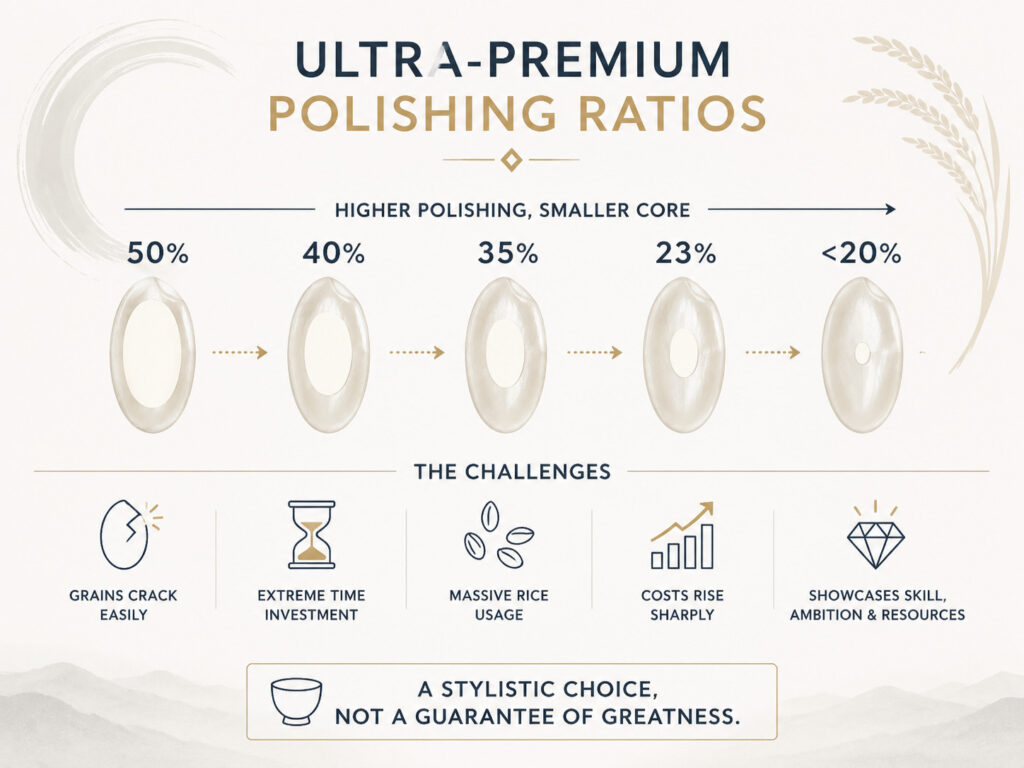
Some breweries push polishing to dramatic extremes. These ultra-premium ratios draw real attention. They also test the limits of the craft.
Common premium levels include 50, 40, and 35 percent. Beyond that, a few sake reach 23 percent or even below 20 percent. At those levels, brewers discard most of every grain. The remaining core is tiny, fragile, and pure. So milling must proceed with extraordinary care.
The technical challenges grow steep at these depths. Grains crack easily when milled so far. The process eats huge amounts of time and rice. Costs climb sharply with every extra percent removed. So extreme polishing showcases skill, ambition, and resources. Even so, it remains a stylistic choice, not a guarantee of greatness.
Rice Polishing and Sake Rice Varieties
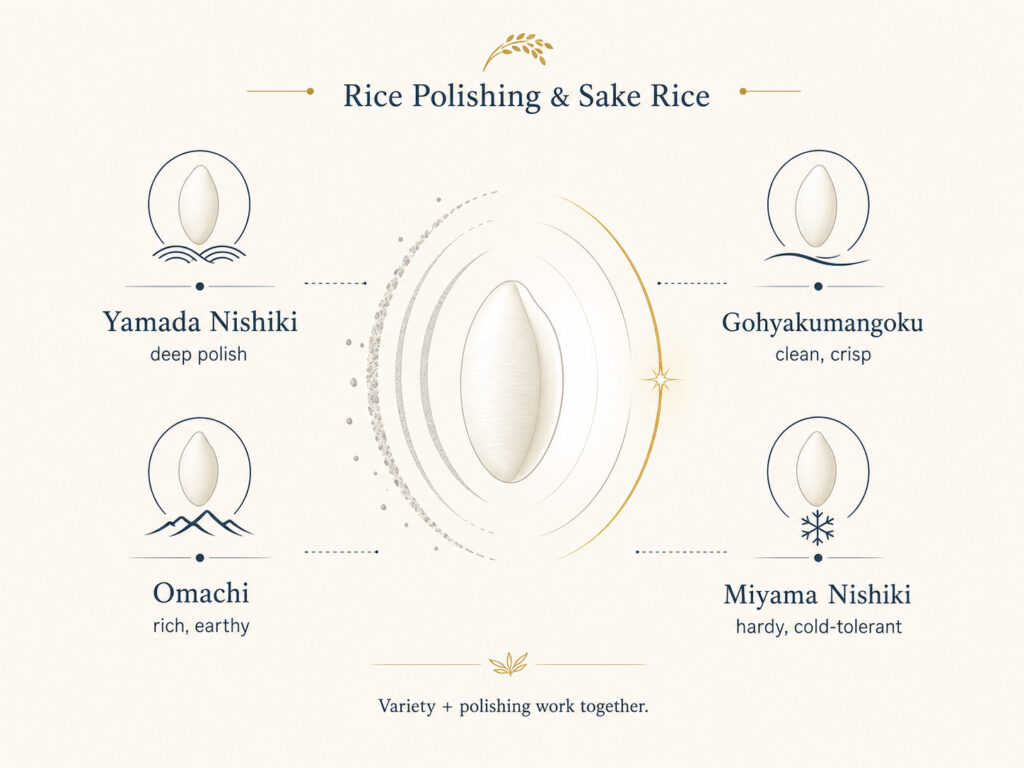
Polishing never works alone. The rice variety shapes how far brewers can mill. Some grains handle deep polishing far better than others. A large, clear shinpaku helps the grain survive milling.
- Yamada Nishiki: the famous “king of sake rice,” ideal for deep polishing
- Gohyakumangoku: clean and crisp, popular in northern regions
- Omachi: an old variety known for rich, earthy depth
- Miyama Nishiki: hardy and cold-tolerant, common in the north
Each variety reacts differently to milling. Yamada Nishiki keeps its shape under heavy polishing. Omachi often shines with gentler, lighter milling. So brewers match the variety to their goal. To dig deeper, explore our guide to sake rice. Variety and polishing always work as a pair.
Regional Approaches to Rice Polishing
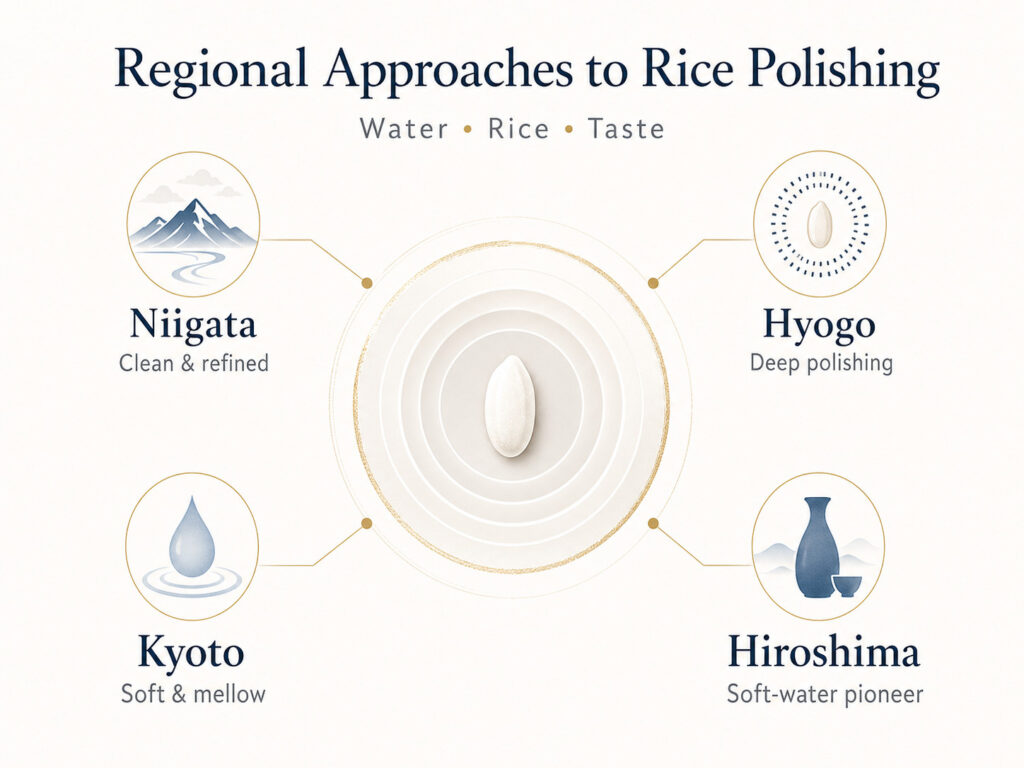
Regions bring their own philosophies to polishing. Local water, rice, and taste all shape the choice. So polishing habits vary across Japan.
Niigata favors clean, dry, refined sake. Brewers there often polish well for a crisp profile. You can read more in our Niigata sake guide. Hyogo, home of Yamada Nishiki, supports deep polishing and elegant styles. Our Nada Gogo guide shows that tradition in action.
Other regions take their own paths. Kyoto leans on soft water for gentle, mellow sake. Akita and Hiroshima built strong ginjo reputations over time. Hiroshima, in particular, helped pioneer soft-water brewing. So each region treats polishing as part of a larger identity.
Environmental and Economic Considerations
Polishing raises practical questions too. Every percent removed has a cost. That cost is both economic and environmental.
Consider the simple arithmetic of loss. A 50 percent ratio discards half of the rice. A 35 percent ratio throws away nearly two-thirds. That milled-away rice took land, water, and labor to grow. So heavy polishing carries a real footprint.
The industry has not ignored this issue. The removed rice becomes a fine powder, not pure waste. Makers turn this rice powder into flour, crackers, and other foods. Some use it for shochu or animal feed. So brewers increasingly try to honor every grain. That effort reflects a growing care for sustainability.
Common Misconceptions About Rice Polishing
Rice polishing breeds a few stubborn myths. Let us clear up the most common ones.
- Does a lower ratio always mean better sake? No. It changes the style, not the quality by itself.
- Is polishing only for premium sake? No. All sake rice gets polished to some degree.
- Can high polishing guarantee quality? No. Skill, water, yeast, and rice all matter too.
- Does polishing remove alcohol? No. Polishing happens long before any alcohol forms.
The first myth is the most important to drop. Many drinkers chase the lowest number on the shelf. Yet a thoughtful junmai can deliver more joy. So judge sake by taste, story, and balance. The ratio is a clue, never the conclusion.
Final Thoughts
Rice polishing stands among sake’s most influential steps. It shapes fermentation, flavor, and style all at once. The polishing ratio reveals a brewer’s intention clearly. So it rewards anyone who takes time to understand it. Still, the number tells only part of the story. Brewing skill, water, yeast, rice, and region all share the stage. A low ratio does not crown a sake as the best. Instead, it marks one choice among many thoughtful ones. Read the label with curiosity, then trust your own palate. That balance is the real art of sake.
Rice Polishing FAQ
What is rice polishing?
It is the milling away of a rice grain’s outer layers. Brewers do this before brewing sake. The goal is to reach the clean, starchy core. The process shapes the flavor that follows.
What is seimai buai?
It is the rice polishing ratio, shown as a percentage. The number tells you how much grain remains. A 60 percent ratio means 40 percent was milled away. It appears on most specially designated sake labels.
Why is sake rice polished?
Polishing removes excess protein, fat, and minerals. Those parts can cause heavy or off flavors. Removing them supports cleaner fermentation. So polishing helps brewers refine aroma and taste.
What does a 50 percent polishing ratio mean?
It means half of each grain remains. The brewer milled away the other 50 percent. This level is typical for daiginjo styles. It often yields a clean, aromatic sake.
Is daiginjo always better than junmai?
No, the two simply differ in style. Daiginjo uses more polished rice for a lighter profile. Junmai can offer richer, fuller rice flavor. Quality depends on the brewer, not the ratio alone.
How long does rice polishing take?
It depends on how deep the polishing goes. Light milling may take only a few hours. Deep daiginjo milling can run for days. Slow work helps protect each grain.
Does polishing affect flavor?
Yes, it shapes flavor in clear ways. More polishing tends to lift aroma and lighten body. Less polishing keeps more umami and richness. Both styles can be delicious.
Why is polishing expensive?
Deep polishing removes a large share of the rice. That lost grain still cost money to grow. Milling also takes time, energy, and skill. So heavy polishing raises the final price.
Does a lower ratio guarantee higher quality?
No, a lower number never guarantees better sake. It reflects style and effort, not final taste. Water, yeast, koji, and skill all matter. Judge each sake by the glass, not the label.
References
- National Tax Agency of Japan, Outline of the Labeling Standards for Sake (seimai buai and specially designated sake), https://www.nta.go.jp/taxes/sake/hyoji/seishu/gaiyo/02.htm (Surveyed: June 2026)
- National Tax Agency of Japan, Standards for the manufacture and quality labeling of sake, https://www.nta.go.jp/taxes/sake/hyoji/seishu/kokuji891122/03.htm (Surveyed: June 2026)
- Japan Sake and Shochu Makers Association, Classification of sake and polishing ratio, https://japansake.or.jp/sake/about-sake/classification-of-sake/ (Surveyed: June 2026)
- National Research Institute of Brewing, Sake rice, polishing, and brewing science, https://www.nrib.go.jp/ (Surveyed: June 2026)
Related Articles
- Koji in Sake Brewing (Surveyed: June 2026)
- How Sake Is Made (Surveyed: June 2026)
- Types of Japanese Sake (Surveyed: June 2026)
- Sakamai (Sake Rice) (Surveyed: June 2026)
- Junmai Sake (Pure Rice Sake) (Surveyed: June 2026)
- Ginjo Sake (Surveyed: June 2026)
- Daiginjo Sake (Surveyed: June 2026)
- Junmai Ginjo Sake (Surveyed: June 2026)
- Niigata Sake (Surveyed: June 2026)
- Nada Gogo Sake (Hyogo) (Surveyed: June 2026)





Comments