


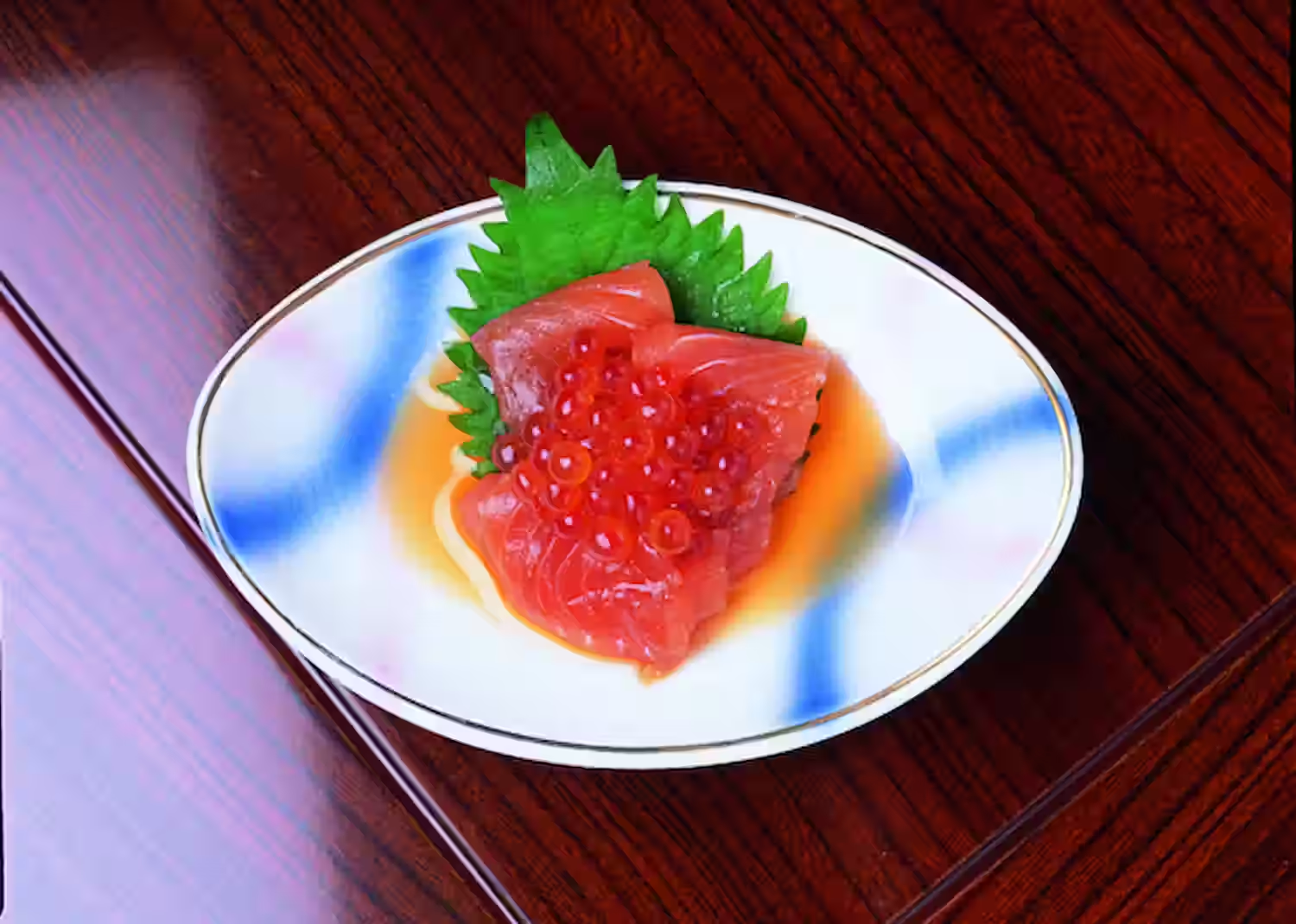

Kōyō-zuke (紅葉漬), also written koyo-zuke or koyozuke, is a ready-to-eat fermented salmon specialty from northern Fukushima Prefecture. Producers make it by curing and maturing salmon with rice koji and salt. The result is salty and savory, with the mild sweetness and aroma of koji. People usually eat it in small portions over hot rice or with sake.
The dish is closely associated with Yanagawa in Date City and the wider Abukuma River basin. However, it differs from an Iwate dish written with the same characters, which combines salmon and roe in a soy-based marinade. This guide covers its background, flavor, serving ideas, storage, and where to buy it.
What Is Kōyō-zuke?
Think of kōyō-zuke as a cured salmon relish rather than a main dish. Because it is strongly seasoned, it is normally served in small portions as a topping or side dish.
Quick Facts
- Japanese name
- 紅葉漬 (kōyō-zuke)
- Also written
- Koyo-zuke, koyozuke; sometimes searched as momiji-zuke
- Region
- Abukuma River basin, especially Yanagawa in Date City, northern Fukushima
- Type
- Ready-to-eat salmon cured and matured with rice koji and salt
- Core ingredients
- Salmon, rice koji, salt
- History
- Said by local tradition to date from the Bunsei era (1818 to 1830)
- How to eat
- On hot rice, with sake, or in ochazuke
- Storage
- Chilled or frozen, depending on the product; follow the label
The Name and Its Reading
In Fukushima, 紅葉漬 is normally read kōyō-zuke. You will also see momiji-zuke in English searches. That is because 紅葉 can be read momiji in other contexts, and the Iwate dish is sometimes romanized that way.
In Japanese food names, zuke generally refers to something that has been marinated, cured, or preserved. As for kōyō, meaning autumn foliage, the producer gives two explanations. First, cooks made the dish with salmon caught in the season of autumn leaves. Second, the finished product pairs reddish-orange salmon with white grains of koji, an autumnal contrast of colors.
Where Did Kōyō-zuke Originate?
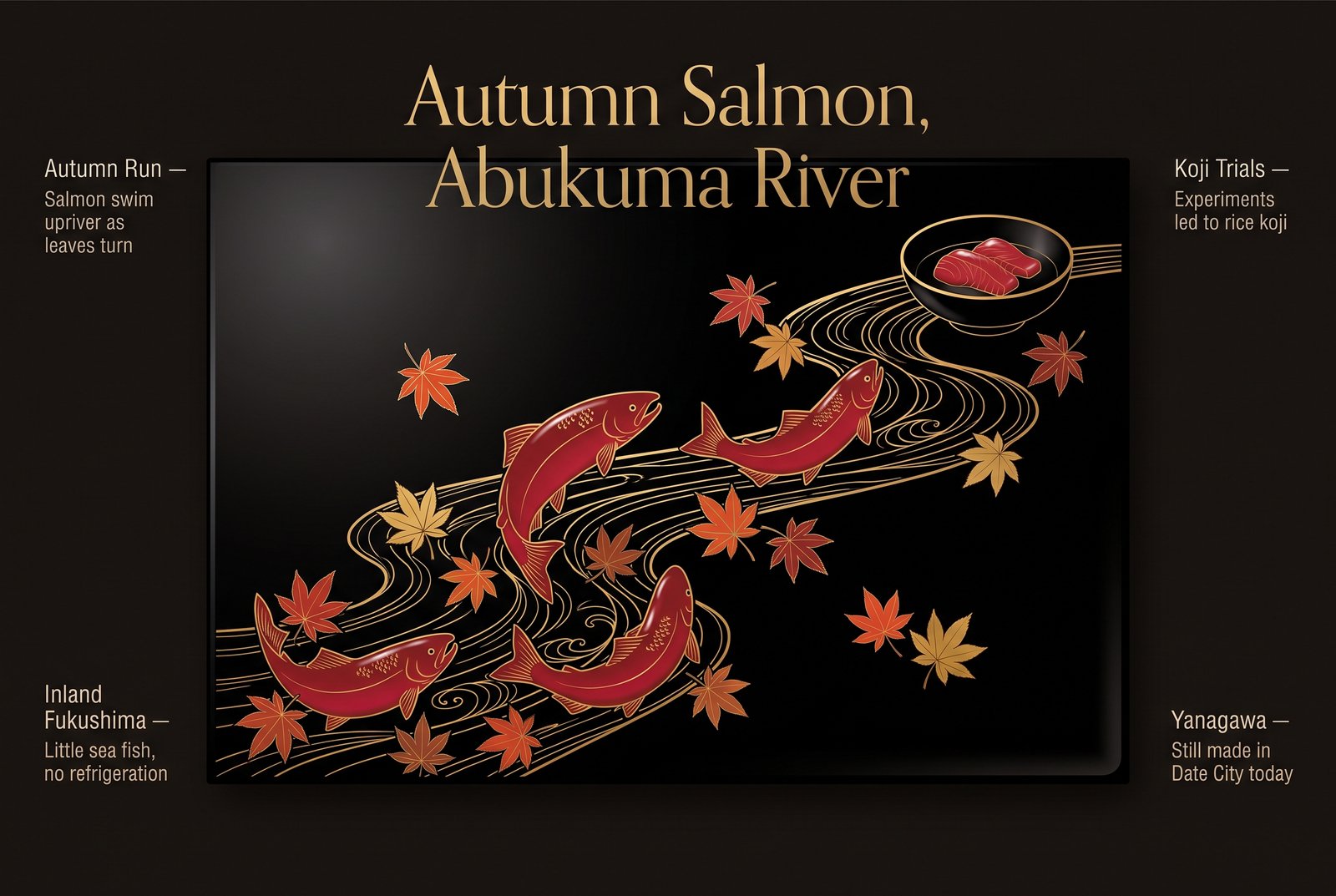
Salmon on the Abukuma River
The Abukuma River flows north through Fukushima and into Miyagi Prefecture before it reaches the Pacific. Local accounts describe the Abukuma River basin around Yanagawa as a productive salmon-fishing area during the Edo period (1603 to 1868). According to the same tradition, salmon moved upriver in autumn, around the time the leaves changed color.
This inland area had limited access to sea fish, and modern refrigeration did not yet exist. Preserving the autumn salmon catch was therefore an important practical concern. The producer’s account says that repeated experiments with salmon eventually led to rice koji, and kōyō-zuke was the result.
Yanagawa in Date City
Today, however, the dish is most closely associated with Yanagawa, a town within Date City. Fukushima Kōyō-zuke Co., a long-established local producer, still makes it there. A separate producer in Fukushima City also makes its own version. The tradition, then, is regional rather than tied to one company.
The History of Kōyō-zuke
Several producer and regional sources trace the recipe to the Bunsei era (1818 to 1830) of the Edo period. We could not find an original Edo-period document that confirms a specific year, though. So treat the date as local tradition.
The modern history is easier to follow. A producer history reproduced in Date City hometown-tax product listings adds more detail. It states that Tannoya had operated as a fish wholesaler since the Kyōhō era (1716 to 1736). It made kōyō-zuke to order for customers who wanted it for the New Year.
The same account says that the family established Fukushima Kōyō-zuke Co. in 1963 and subsequently registered a trademark for the product name. According to the company, this change allowed the family’s inherited method to be marketed beyond the local area. It also says it has kept the same ratio of salmon, koji, and salt.
Kōyō-zuke Ingredients
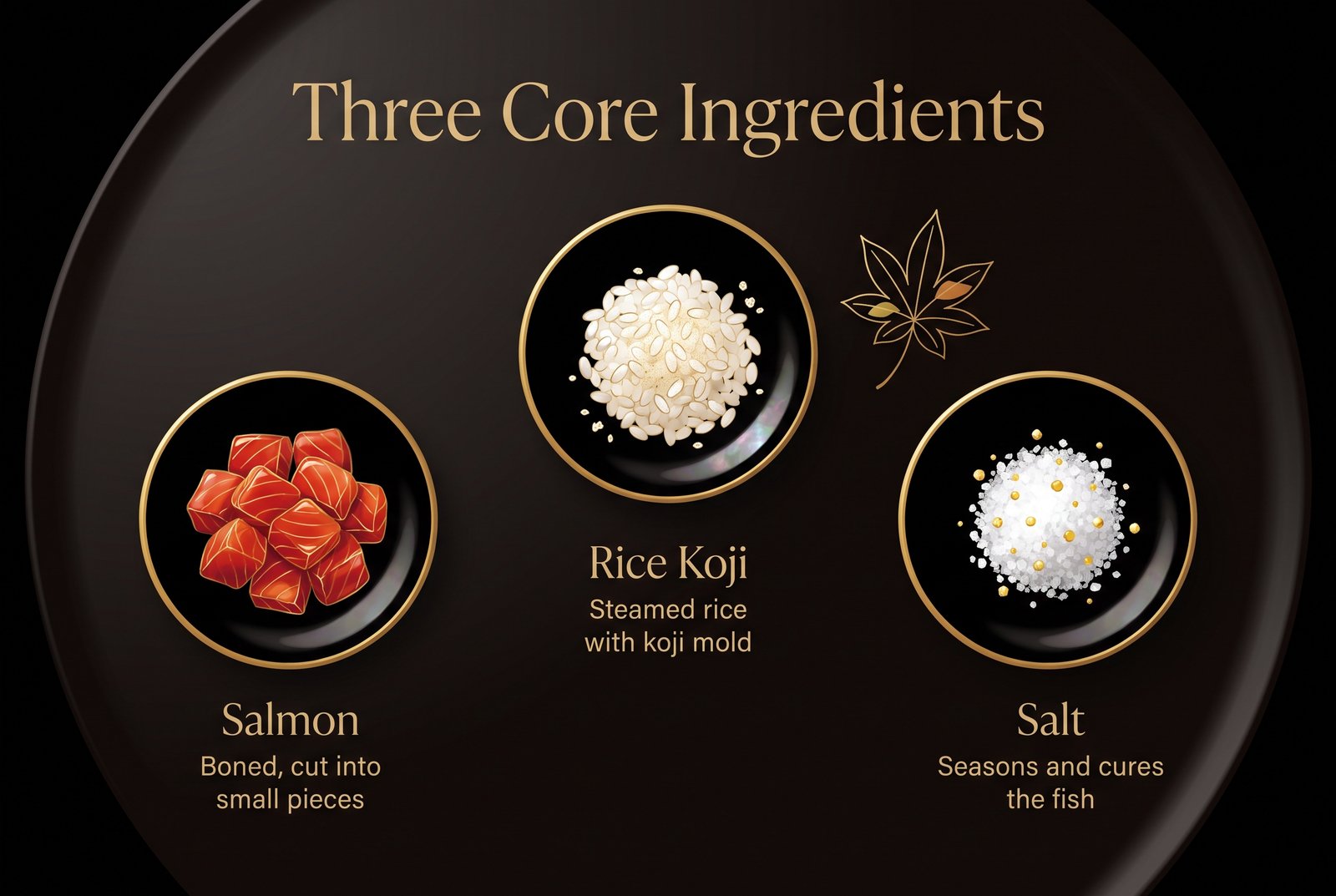
Traditional and regional descriptions identify three core ingredients:
- Salmon: boned salmon cut into small pieces, which forms the base of the dish.
- Rice koji: steamed rice cultured with koji mold, which adds sweetness and a mellow aroma.
- Salt: seasons and cures the salmon.
Current retail labels may also list mirin, seasonings, or an antioxidant, depending on the product. One currently listed product identifies its salmon as domestically sourced, and another version includes sockeye salmon.
Does It Contain Salmon Roe?
Salmon roe is not universal. Some Fukushima products contain only salmon and koji as their principal ingredients, while other versions include ikura. Check the individual label rather than assuming that every kōyō-zuke contains roe.
How Kōyō-zuke Is Made
Published descriptions do not disclose every production detail, but they show the following general process:
- Prepare the salmonMakers fillet and bone fresh salmon, then cut it into small pieces.
- Mix with koji and saltThey combine the salmon with rice koji and salt. One long-established producer says it keeps its inherited ratio.
- Cure and matureThe mixture rests while the salt cures the fish and the koji develops its flavor.
- Package for saleFinally, they package it for its set storage conditions, usually chilled and sometimes frozen for delivery.
Why This Guide Has No Home Recipe
The product contains uncooked fish and depends on controlled curing and maturation. For that reason, this article does not provide a home recipe. Choose a commercially prepared product instead, and follow its storage instructions.
What Does Kōyō-zuke Taste Like?
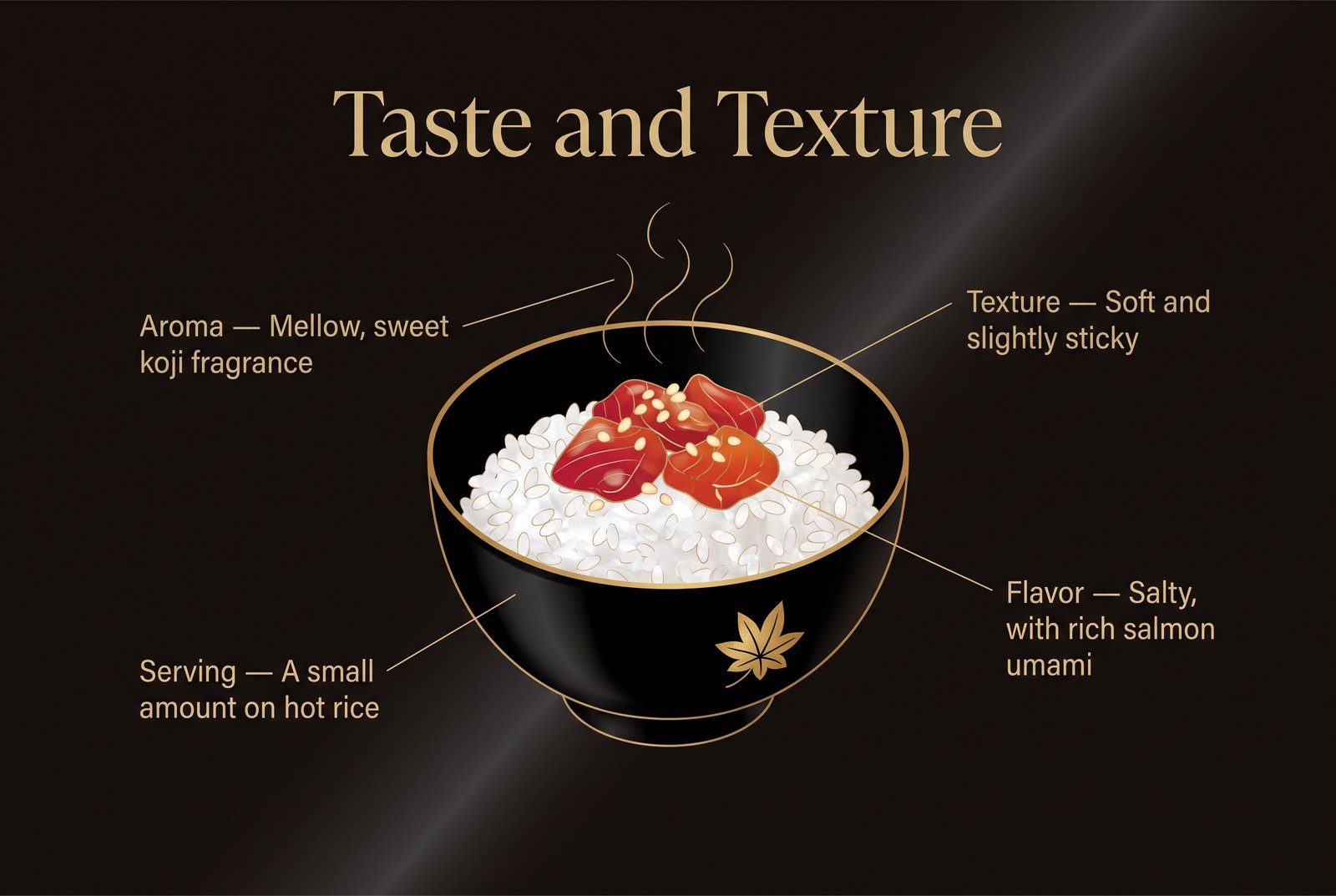
Producer and regional descriptions characterize the texture as soft and slightly sticky, reminiscent of fresh salmon. The flavor is noticeably salty, with concentrated salmon umami and a mellow koji aroma. Served on hot rice, the koji’s sweet fragrance comes forward, according to one regional listing.
A 2000 study of four commercially purchased samples found glutamic acid among the main free amino acids, which fits that savory taste. The same samples averaged 6.1 percent salt, so start with a small amount.
How to Eat Kōyō-zuke
The classic way is simple: spoon it onto hot Japanese rice. Producers and regional listings also suggest these uses:
- On rice: the everyday favorite, and the best first taste.
- With sake: a traditional snack with Japanese sake.
- In ochazuke: placed on rice with hot tea or broth poured over it.
- As a side: a small accent beside seasonal dishes.
Traditional kōyō-zuke does not require cooking and is sold ready to eat. Heating it would also change its characteristic texture and aroma. Some makers sell separate koji-marinated salmon fillets meant for grilling, so read the label to see which one you have.
Fukushima and Iwate: Two Dishes, One Name
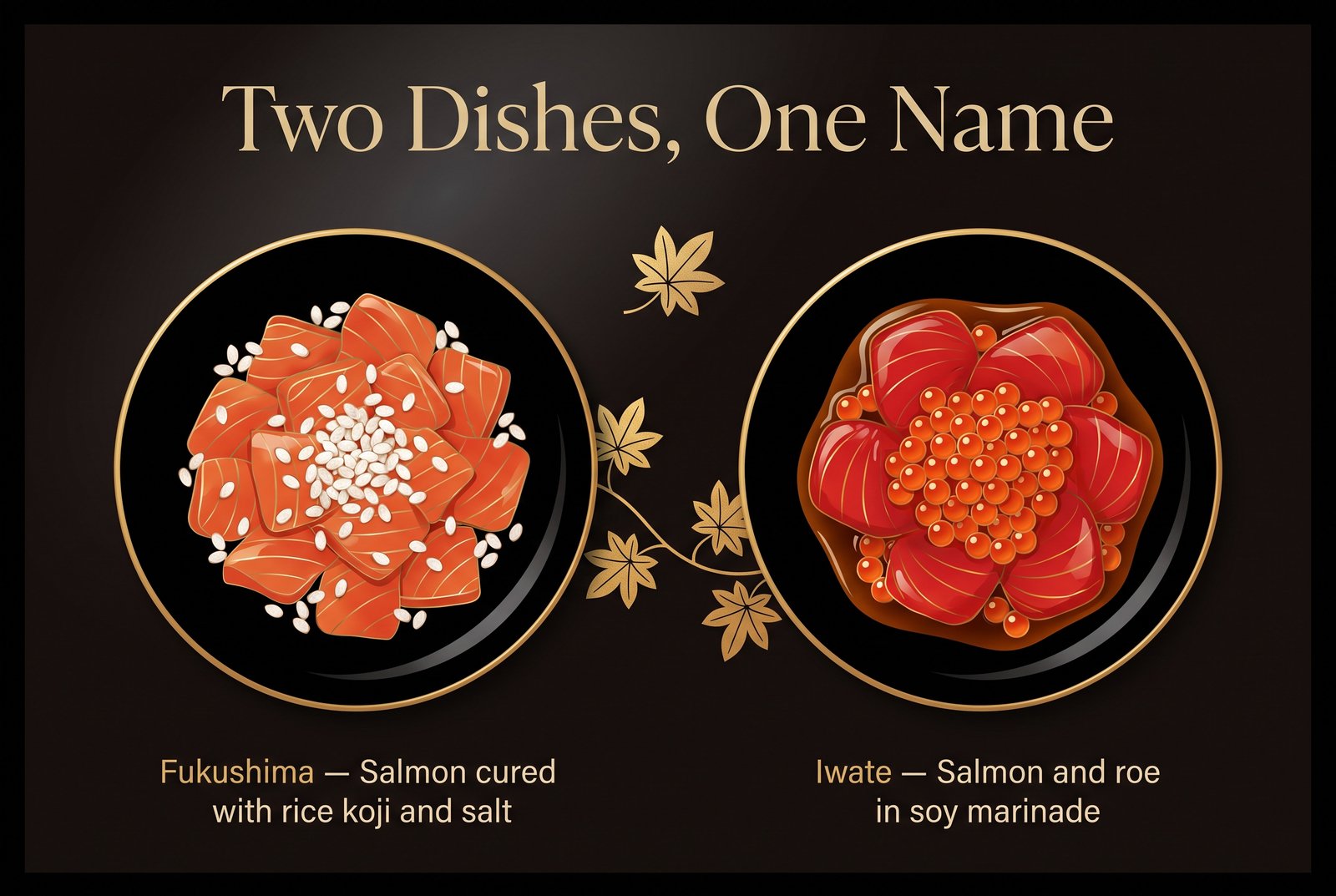
Regional recipe collections from Iwate’s Sanriku coast describe a New Year dish written with the same characters, 紅葉漬. In the documented Iwate version used here, cooks steep salmon and salmon roe in soy sauce, mirin, sake, and kombu.
| Fukushima (kōyō-zuke) | Iwate version | |
|---|---|---|
| Main ingredients | Salmon, rice koji, salt | Salmon and salmon roe |
| Method | Cured and matured with rice koji and salt | Steeped in a soy-based marinade |
| Fermented? | Yes, matured with koji | Not in the documented recipe cited here |
| Look | Orange salmon with white koji grains | Red salmon with glossy roe |
| Name origin | Autumn salmon and the salmon-and-koji colors | The red color of salmon and roe |
| Typical use | Rice, sake, ochazuke | Especially New Year meals |
The two traditions give related but distinct explanations for the name. Fukushima sources emphasize the autumn salmon season and the colors of salmon and koji, while the Iwate account emphasizes the red of salmon and roe.
Kōyō-zuke and Other Preserved Fish
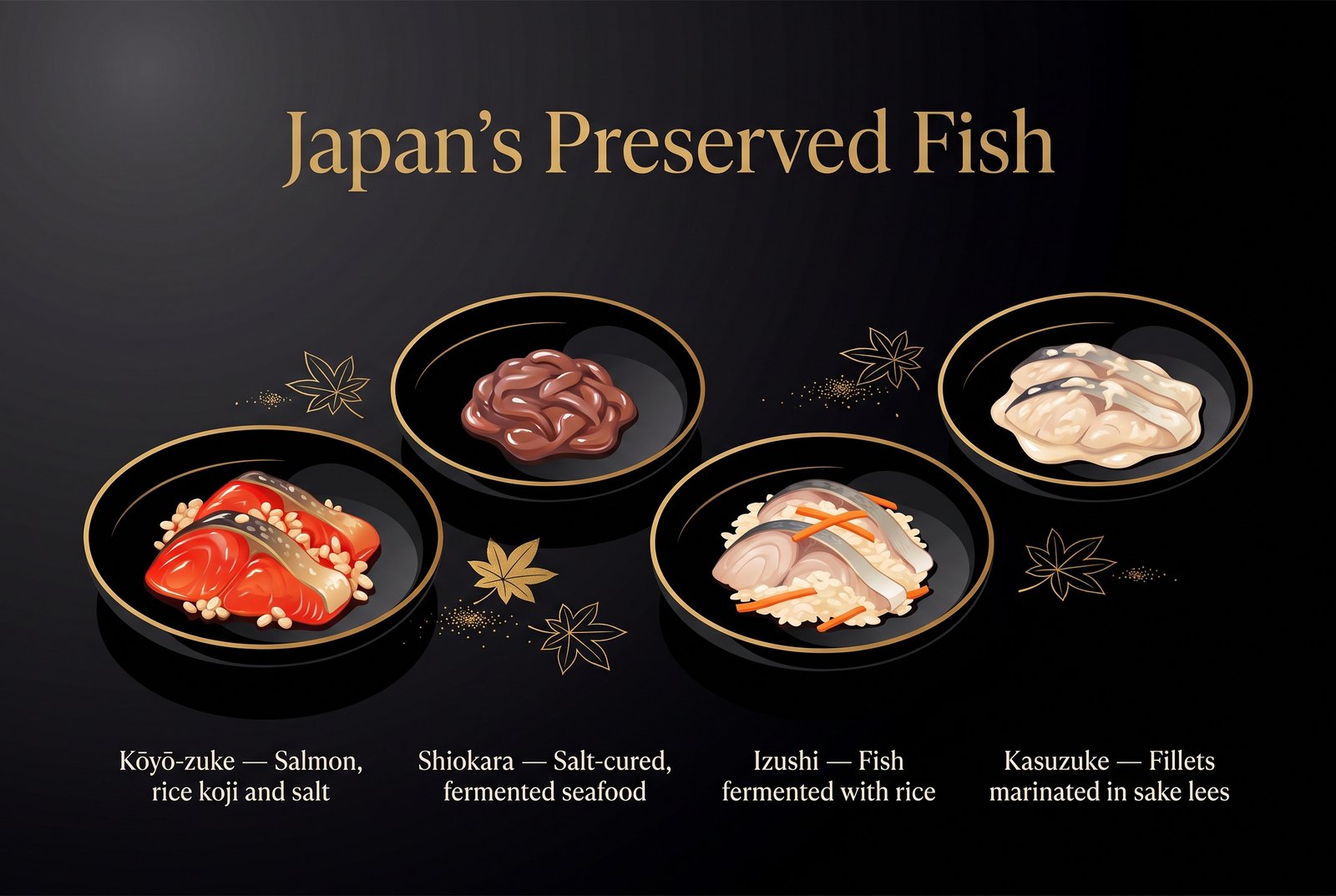
Japan has many ways of preserving fish with salt, rice, and fermentation. The table below places kōyō-zuke among a few familiar examples.
| Food | Main ingredients | How it is made | Eaten |
|---|---|---|---|
| Kōyō-zuke | Salmon, rice koji, salt | Cured and matured with rice koji and salt | Ready to eat after curing and maturation |
| Shiokara | Seafood, often with its innards, and salt | Salt-cured and fermented | Ready to eat after curing or fermentation |
| Izushi | Fish, cooked rice, koji, vegetables | Fermented with rice in a barrel | Ready to eat after fermentation |
| Kasuzuke | Fish fillets and sake lees | Marinated in lees | Usually cooked before serving |
Like izushi, kōyō-zuke belongs to northern Japan’s broader tradition of preserving fish with salt and rice-derived ingredients. However, it is not a type of izushi, which commonly adds cooked rice and vegetables.
Storage and Food Safety
Shelf life varies substantially by product, packaging, and whether it is sold chilled or frozen. Several currently listed products from the Yanagawa producer state a refrigerated shelf life of 30 days from manufacture. Other products may differ, so always follow the individual label.
Safety at a glance
- Store it as the label directs, usually in the refrigerator.
- Use a clean spoon each time.
- Eat it soon after opening, even before the printed date.
- Skip it if you avoid uncooked fish.
- It contains salmon, so people with a fish allergy should check the label carefully.
Nutritional values also vary by product. Because kōyō-zuke is strongly seasoned, people generally eat it in small amounts. So check the package for sodium, allergens, and serving information.
Where to Try or Buy Kōyō-zuke
In Fukushima
Travel listings report that you can find it in Date City supermarkets and tourist information centers. In addition, the Yanagawa producer takes phone orders.
Online in Japan
The producer links to online stores such as Rakuten and Yahoo Shopping. Date City and Fukushima City also offer kōyō-zuke as furusato nozei (hometown tax) gifts. That program, however, suits people who pay Japanese taxes. Deliveries come chilled or frozen, depending on the product.
Outside Japan
As of September 2026, we could not confirm a regular overseas retail channel. International shipping is likely to be limited by cold-chain requirements and import rules for fish products. Tasting it in Japan therefore remains the realistic option.
Why Kōyō-zuke Matters to Fukushima Food Culture
Kōyō-zuke captures a regional story in a single spoonful. It connects an inland river town, an autumn salmon run, and the region’s use of rice koji. Local fish merchants and producers also helped preserve the preparation across generations.
Kōyō-zuke is also one part of Fukushima’s broader food culture. Travelers exploring the prefecture can also discover local sake, regional ramen, and other specialties in our Fukushima food guide.
Frequently Asked Questions About Kōyō-zuke
About the Dish
- Is kōyō-zuke the same as momiji-zuke?
-
Not exactly. In Fukushima, 紅葉漬 is read kōyō-zuke, although English searches often use momiji-zuke. A different Iwate dish with the same characters combines salmon and roe in a soy-based marinade.
- What is kōyō-zuke made of?
-
The standard regional description lists salmon, rice koji, and salt. Current products may also contain mirin, seasonings, or an antioxidant. Some versions also include salmon roe, while others do not, so check the label.
- Is kōyō-zuke raw?
-
It is generally sold as a ready-to-eat product rather than a salmon dish intended for cooking. Producers cure and mature the salmon with rice koji and salt. People who avoid uncooked fish should skip it.
Eating and Storage
- How do you eat kōyō-zuke?
-
Spoon a small amount onto hot rice, serve it as a snack with sake, or add it to ochazuke. It needs no cooking.
- How long does kōyō-zuke last?
-
It depends on the product. Several currently listed refrigerated products state 30 days from manufacture, but the period varies by product and packaging. Follow the label, and eat it soon after opening.
- What drink pairs well with kōyō-zuke?
-
Japanese sake is the traditional partner, and producers recommend kōyō-zuke as a snack with sake.
Buying
- Can you buy kōyō-zuke outside Japan?
-
As of September 2026, we could not confirm a regular overseas retail channel. Cold-chain needs and import rules make shipping abroad difficult, so trying it in Japan is the realistic option.
References
Producer and regional sources
- Fukushima Kōyō-zuke Co. – Abukuma no Kōyō-zuke, Official Website (Accessed September 2026)
- Furusato Choice – Listing for a Date City Hometown-Tax Gift: Abukuma no Kōyō-zuke (Accessed September 2026)
- Furunavi – Listing for a Date City Hometown-Tax Gift: Producer History (Accessed September 2026)
- Furunavi – Listing for a Date City Hometown-Tax Gift: Kōyō-zuke with Sockeye Salmon (Accessed September 2026)
- Furusato Choice – Listing for a Fukushima City Hometown-Tax Gift: Kōyō-zuke and Min’yō-zuke (Accessed September 2026)
- Fukushima Bimi Brand Project – Regional Fermented Food: Abukuma no Kōyō-zuke (2015) (Accessed September 2026)
- Fukushima Bimi Brand Project – Abukuma no Kōyō-zuke (2018) (Accessed September 2026)
- Asoview – Abukuma no Kōyō-zuke, Visitor Information (Accessed September 2026)
Research on kōyō-zuke
- J-STAGE (Journal for the Integrated Study of Dietary Habits) – Endo, E., Kageyama, S., Kadono, T., and Yamada, K. (2000). Various Components and Bacteria of Koyozuke, 11(3), 296 to 301 (Accessed September 2026)
Background sources on related fish fermentation
- J-STAGE (Nippon Suisan Gakkaishi) – Shinano, H., Yoshimizu, M., Sasaki, M., and Kawai, Y. (2006). Effect of Starter Cultures on Salmon Izushi, 72(2), 231 (Accessed September 2026)
- Hokkaido University HUSCAP – Izushi Prepared from Raw and Salted Chum Salmon (Accessed September 2026)
Related Articles
- Fukushima Food Guide (Surveyed: September 2026)
- Kōriyama Black Ramen (Surveyed: September 2026)
- Japanese Rice (Surveyed: September 2026)
- Japanese Sake (Surveyed: September 2026)




Comments