



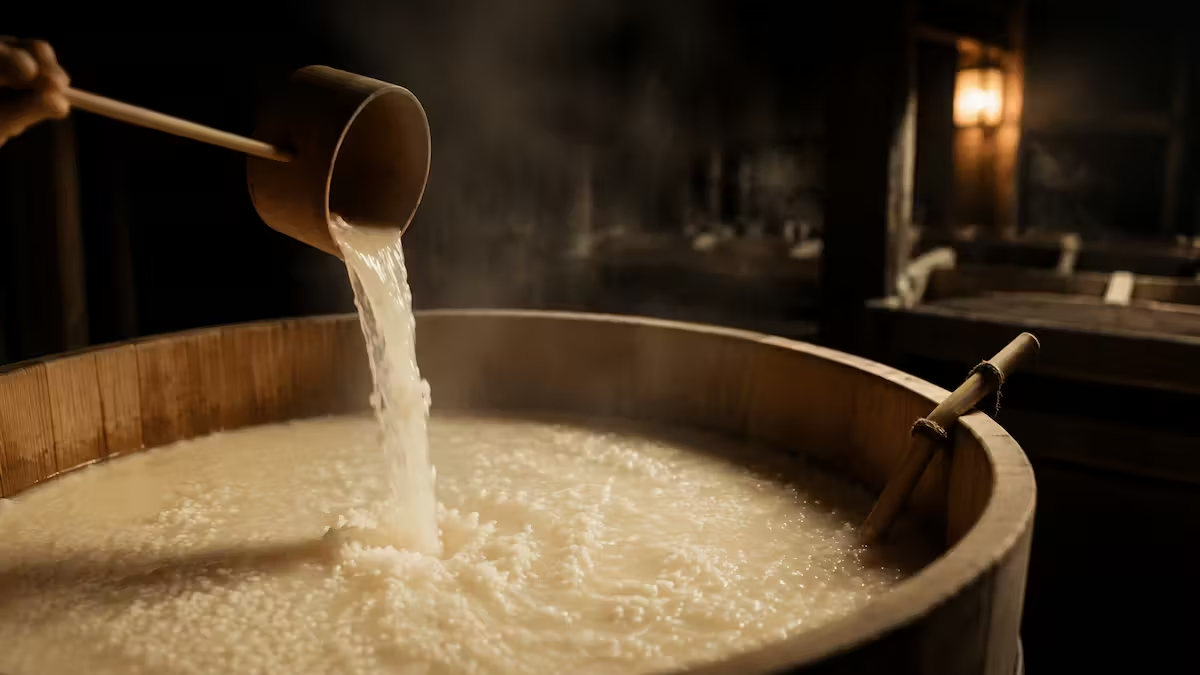
Some sake tastes bold, savory, and wonderfully complex. That depth often traces back to the yeast starter. So what is yamahai in sake brewing? Yamahai is a traditional yeast starter method born from kimoto. It drops the grueling yamaoroshi step, yet keeps the natural lactic acid. In short, yamahai sake brewing simplifies one hard task while preserving the old fermentation spirit.
This method sits between two famous neighbors. Kimoto came first, while sokujo came later. Yamahai bridges tradition and efficiency in a clever way. For the wider picture, see our guides to moto and kimoto. Let me walk you through this respected craft.
Quick Facts About Yamahai
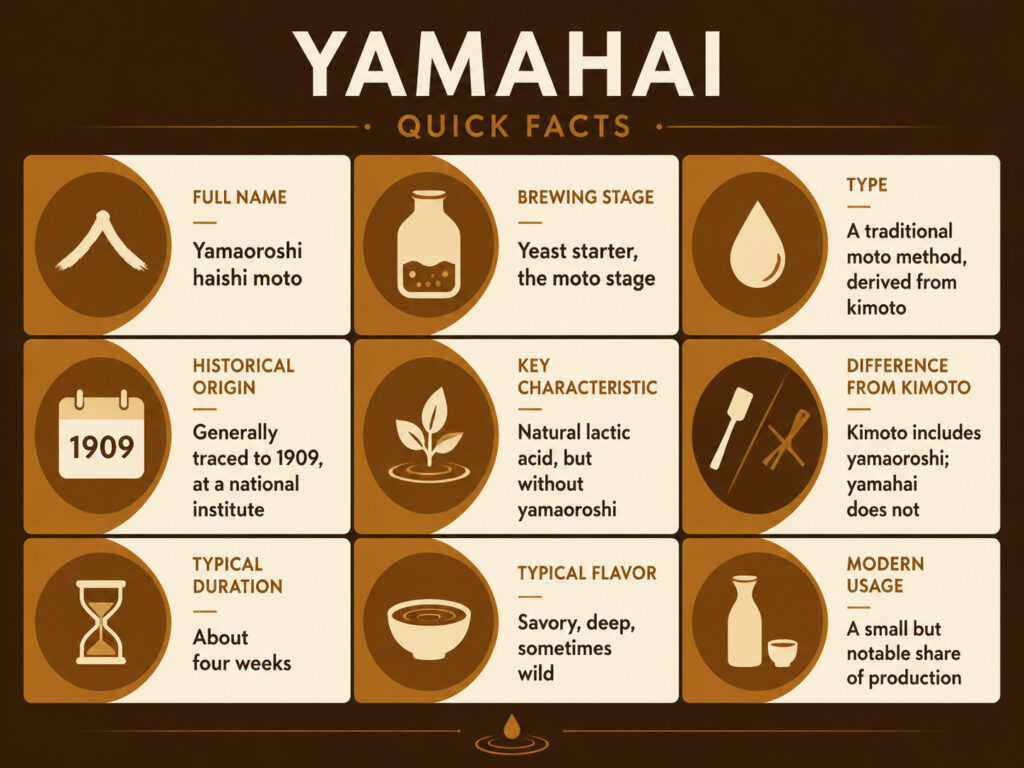
Here is a fast snapshot before the details begin.
| Japanese Name | 山廃 (yamahai) |
| Full Name | Yamaoroshi haishi moto |
| Brewing Stage | Yeast starter, the moto stage |
| Type | A traditional moto method, derived from kimoto |
| Historical Origin | Generally traced to 1909, at a national institute |
| Key Characteristic | Natural lactic acid, but without yamaoroshi |
| Difference from Kimoto | Kimoto includes yamaoroshi; yamahai does not |
| Typical Duration | About four weeks |
| Typical Flavor | Savory, deep, sometimes wild |
| Modern Usage | A small but notable share of production |
What Is Yamahai in Sake Brewing?
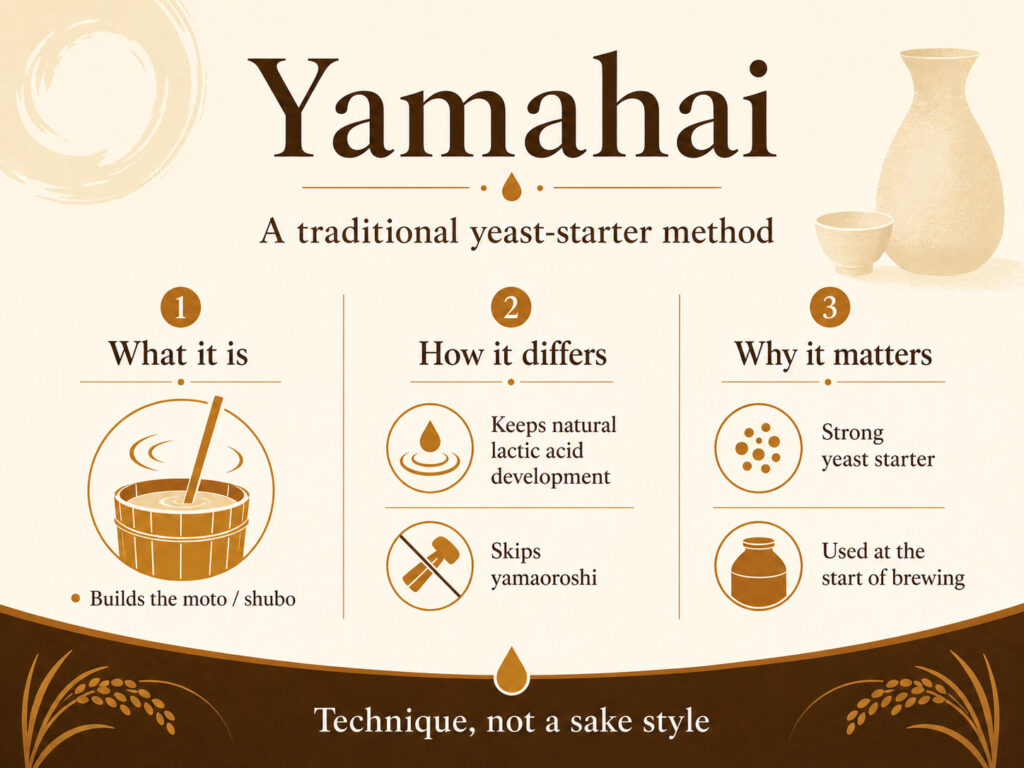
Yamahai is a method for building the yeast starter. That starter is called the moto, or shubo. Brewers grow a strong yeast population in it. They then use it to drive the main fermentation. Yamahai therefore sits at the very start of brewing.
One point deserves real emphasis here. Yamahai is not a type of sake at all. Rather, it is a brewing technique, not a flavor category. You may see “yamahai” on a bottle label. Yet it does not name a formal sake grade or style. Instead, it tells you how the yeast starter was made.
The method grew directly out of kimoto. It keeps the natural lactic acid development intact. However, it removes the hard yamaoroshi mashing step. So yamahai belongs to the traditional kimoto family. For the modern starter family, see our yeast in sake brewing guide. The rest of this article explores how and why.
There is also a useful saying in the brewing world. It runs “first koji, second moto, third the mash.” In other words, the starter ranks among the most vital steps. So mastering yamahai sake brewing has always carried real prestige. This respect helps explain its lasting place today.
The History of Yamahai
Yamahai was born in the early 20th century. It is generally traced to 1909. A national brewing institute developed it. The goal was to improve the kimoto method. So science and tradition met at this moment.
At the time, kimoto ruled sake brewing. Yet its yamaoroshi step was brutally hard. Researchers studied whether that labor was truly needed. Their findings would change brewing forever. As a result, a simpler method emerged.
A Scientific Discovery
The key insight was surprisingly simple. Brewers had long ground the rice by hand. They believed this helped the rice dissolve. Yet research showed the koji could do this alone. Its enzymes dissolved the rice naturally over time. So the heavy grinding was not essential after all.
Better milling technology also played a part. Polished rice absorbed the koji enzymes more easily. As a result, the rice softened without any pounding. The institute tested starters made both ways. Crucially, the two showed little difference in their components. So brewers could safely drop the grinding step.
This finding freed brewers from punishing work. The same institute later refined sokujo too. For the modern standard, see our sokujo guide. Yamahai therefore marks a turning point in brewing history. It blended old wisdom with new science.
Spreading Through the Industry
Breweries welcomed the new method gladly. It cut the worst labor from the starter. Meanwhile, it kept the familiar natural process. So many brewers adopted it quickly. Yamahai spread before sokujo became dominant. The famous brewer Kinichiro Kagi tested it at the Suehiro brewery in Fukushima.
What Does “Yamahai” Mean?
The name itself tells the whole story. Yamahai is a shortened term. The full name is yamaoroshi haishi moto. That phrase explains exactly what changed. Let us break it down.
- Yamaoroshi: the hard rice-mashing step in kimoto
- Haishi: abolition, or doing away with
- Moto: the yeast starter itself
Put together, the name means “starter without yamaoroshi.” Brewers soon shortened it to just yamahai. The short form is now used everywhere. So the very word records a piece of history. It marks the day brewers dropped the grinding poles.
A famous saying captures the same shift. It goes “do not crush with the pole; dissolve with the koji.” That phrase became the motto of the new method. In other words, the koji does the gentle work. So the name and the saying tell one story together.
Why Was Yamaoroshi Eliminated?
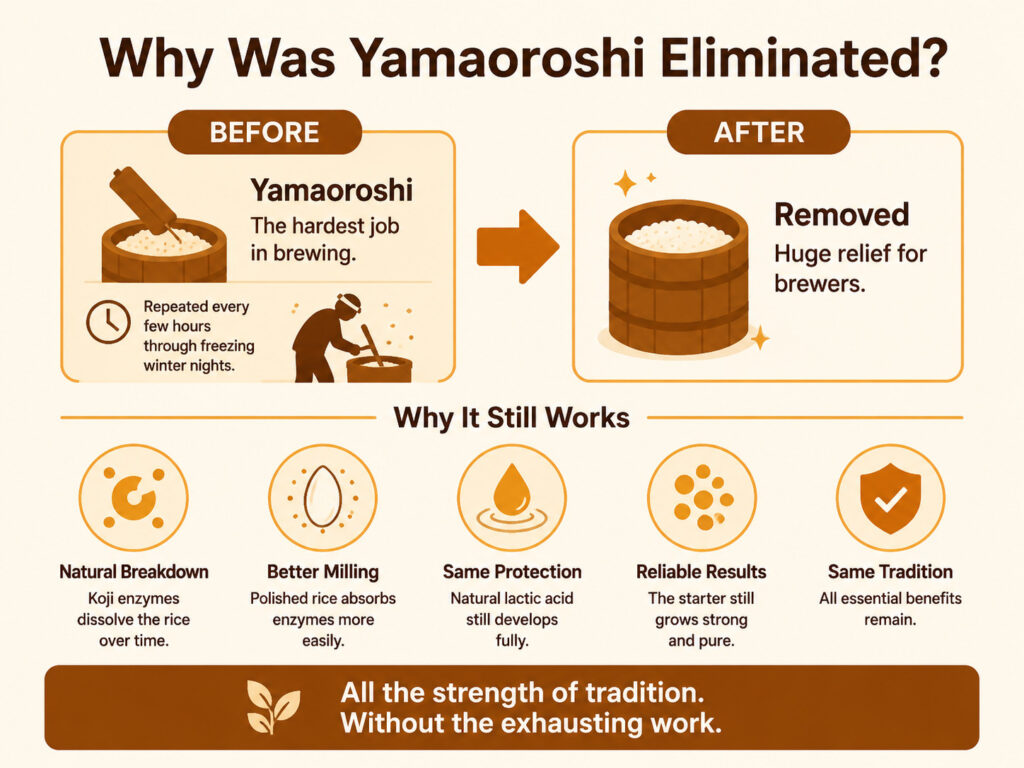
Yamaoroshi was the hardest job in brewing. Crews ground rice through freezing winter nights. They repeated the work every few hours. So removing it brought huge relief.
Yet relief alone was not the reason. The change had to be safe for the sake. Research proved the rice still dissolved well. Koji enzymes broke it down without grinding. As a result, fermentation still succeeded reliably. Here is why dropping the step worked:
- Natural breakdown: koji enzymes dissolve the rice over time
- Better milling: polished rice absorbs enzymes more easily
- Same protection: natural lactic acid still develops fully
- Reliable results: the starter still grows strong and pure
So the method kept all the essential benefits. It simply removed an exhausting, optional task. The koji quietly did the dissolving work instead. In this way, tradition lost none of its strength.
The Mizukoji Method
So how does yamahai dissolve rice without grinding? The answer is a clever step called mizukoji. This stage is special to yamahai sake brewing. It replaces the hard yamaoroshi work entirely.
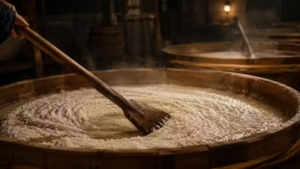
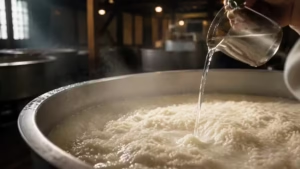
Mizukoji means “water koji” in Japanese. Brewers soak the koji in water first. Over a few hours, its enzymes seep into the water. This creates an enzyme-rich liquid. Then the steamed rice goes into that liquid. So the enzymes can reach the rice evenly, with no pounding.
Kumikake: The Pour-Over Step
Yamahai often adds another gentle technique. Brewers use a method called kumikake. They place a perforated pipe into the tank. Then they draw off the enzyme-rich liquid. Next, they pour it back over the rice surface. So the enzymes spread evenly across the mash. This helps the rice dissolve without any crushing.
How Yamahai Works Step by Step
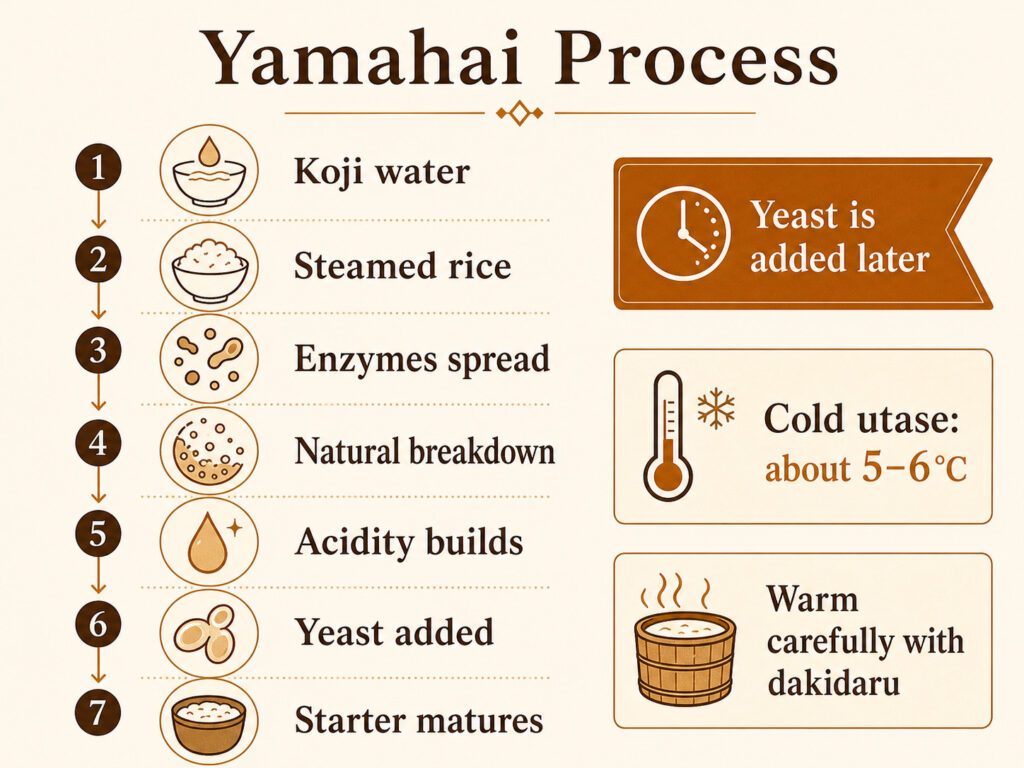
The yamahai process unfolds slowly and patiently. It takes about four weeks to finish. That is similar to kimoto, just without the grinding. Each step builds toward a strong, pure starter.
- Make the mizukoji: soak koji in water to release its enzymes
- Add steamed rice: cooled rice joins the enzyme-rich water
- Pour over the mash: kumikake spreads the enzymes evenly
- Let the rice dissolve: koji enzymes break it down naturally
- Build acidity: wild lactic acid bacteria multiply and make acid
- Add the yeast: sake yeast enters the safe, sour mash
- Grow and mature: the yeast multiplies into a dense starter
Notably, the yeast does not go in at the start. For the first two weeks, the mash builds acidity alone. Sugars and amino acids gather during this time. Only then do brewers add the yeast. So the timing protects the whole batch.
The Utase Cold Period
One stage demands special care and cold. After the first stirring, the mash enters utase. During utase, brewers hold the starter very cool. The temperature often sits near 5 or 6 degrees. This cold keeps unwanted microbes in check. Indeed, utase is impossible above about 5 degrees. So yamahai truly belongs to deep winter.
Warming the Starter
Later, brewers slowly raise the temperature. They use a warming tool called a dakidaru. It gently heats the mash from within. This warming encourages the right microbes in order. So the lactic acid bacteria and yeast thrive in turn. The whole schedule must be timed with care.
Natural Lactic Acid Development
Natural acid is the heart of yamahai. This single feature links it to kimoto. Modern sokujo simply adds lactic acid directly. Yamahai, by contrast, grows its own. The difference is therefore fundamental.
The Microbial Succession
The process works like a careful relay. At first, nitrate-reducing bacteria appear in the mash. They produce compounds that limit early invaders. Next, lactic acid bacteria grow and thrive. They flood the starter with protective lactic acid. The environment therefore turns sharply acidic.
Then the final handoff takes place. The acid clears out the earlier microbes. Only acid-tolerant organisms survive now. At this point, the brewer adds the yeast. That yeast thrives in the sour, protected mash. So nature itself selects the survivors.
This rich microbial life leaves a mark. The many microbes create varied flavor compounds. So the finished sake gains real depth. Sokujo, with its added acid, hosts fewer microbes. As a result, its flavor often tastes cleaner and simpler.
Compared with Sokujo
Sokujo reaches the same goal much faster. Brewers simply add lactic acid at the start. Protection is therefore instant, and the wait disappears. A sokujo starter finishes in about two weeks. Yamahai, by contrast, needs around a month. So yamahai trades speed for natural depth.
Yamahai and Fermentation Science
Yamahai connects to every other brewing stage. It does not stand alone in the process. Instead, it feeds directly into the main mash. Understanding it therefore clarifies the whole craft.
The starter relies on koji and yeast together. Koji makes sugar from the rice starch. Yeast then turns that sugar into alcohol. Once the yamahai starter matures, it joins the moromi. There, multiple parallel fermentation runs at full scale, as our moromi guide explains. Yamahai is therefore the strong first link in a chain.
The long process also toughens the yeast. Only the hardiest cells survive the harsh start. So the survivors ferment with real vigor. This strength helps in many brewing styles. For the broader stage, see our sake fermentation guide.
What Does Yamahai Sake Taste Like?
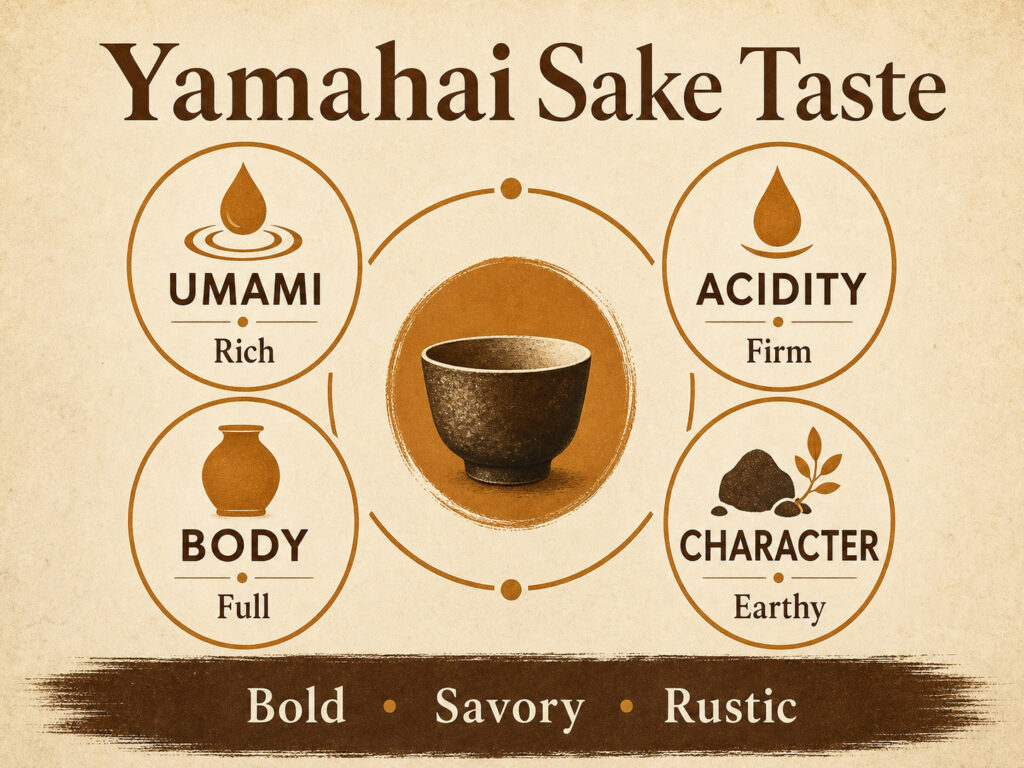
Yamahai leaves a clear mark on flavor. The long microbial process builds complexity. Many compounds form during those slow weeks. The resulting sake therefore often tastes distinctive.
- Umami: a rich, savory depth
- Acidity: a firm, pronounced backbone
- Body: a full, sturdy mouthfeel
- Character: earthy, gamey, sometimes wild notes
These traits are tendencies, not guarantees. After all, not every yamahai sake tastes the same. Rice, yeast, and brewer choices all matter. Still, many drinkers notice a bold, savory profile. As a result, yamahai often feels grounded and rustic. It can taste a touch wilder than kimoto.
Some tasters even find a milky, nutty quality. Caramel and roasted notes can appear too. The pronounced acidity then balances all this richness. So the sake stays lively rather than heavy. In this way, body and brightness work together.
The Organic Acids of Yamahai Sake
Acids do much of the flavor work in sake. Most of them form during fermentation. In yamahai, the slow process can build extra layers. So the acid profile deserves a closer look.
Several organic acids shape the taste. For example, lactic acid brings a smooth, rounded sourness. Succinic acid, meanwhile, adds umami and savory depth. Malic acid lends a fresh brightness. Together, these acids create a complex backbone. So yamahai sake often feels layered rather than flat. This is one reason it tastes so structured.
How to Drink Yamahai Sake
Yamahai sake performs well across a wide temperature range. For instance, a cool serving keeps the acidity crisp. At room temperature, the umami and body open up. Many examples, however, truly shine when warmed. So a little experimenting pays off.
Why Yamahai Shines When Warmed
Warming changes how yamahai tastes. Around 40 to 45 degrees, the firm acids soften. The savory umami then feels rounder and deeper. As a result, a warm cup can bloom beautifully. So a gentle warming, called nurukan, often suits it. Many fans love yamahai served this way.
If the acidity feels too strong, try one trick. Add a small splash of water before warming. This softens the edges and rounds the flavor. So even a bold yamahai becomes approachable. The right serving really does transform the experience.
Food Pairings for Yamahai Sake
Yamahai sake shines at the dinner table. Its firm acidity, umami, and body suit rich food. So it pairs naturally with hearty dishes.
For example, it stands up well to grilled meats and stews. Simmered fish in soy and sugar also works beautifully. In addition, mushrooms, aged cheese, and miso dishes match nicely. The acidity refreshes the palate between bites. Meanwhile, the umami connects with deep, savory flavors. Warmed yamahai and a winter hot pot make a classic pair.
How to Choose a Yamahai Sake
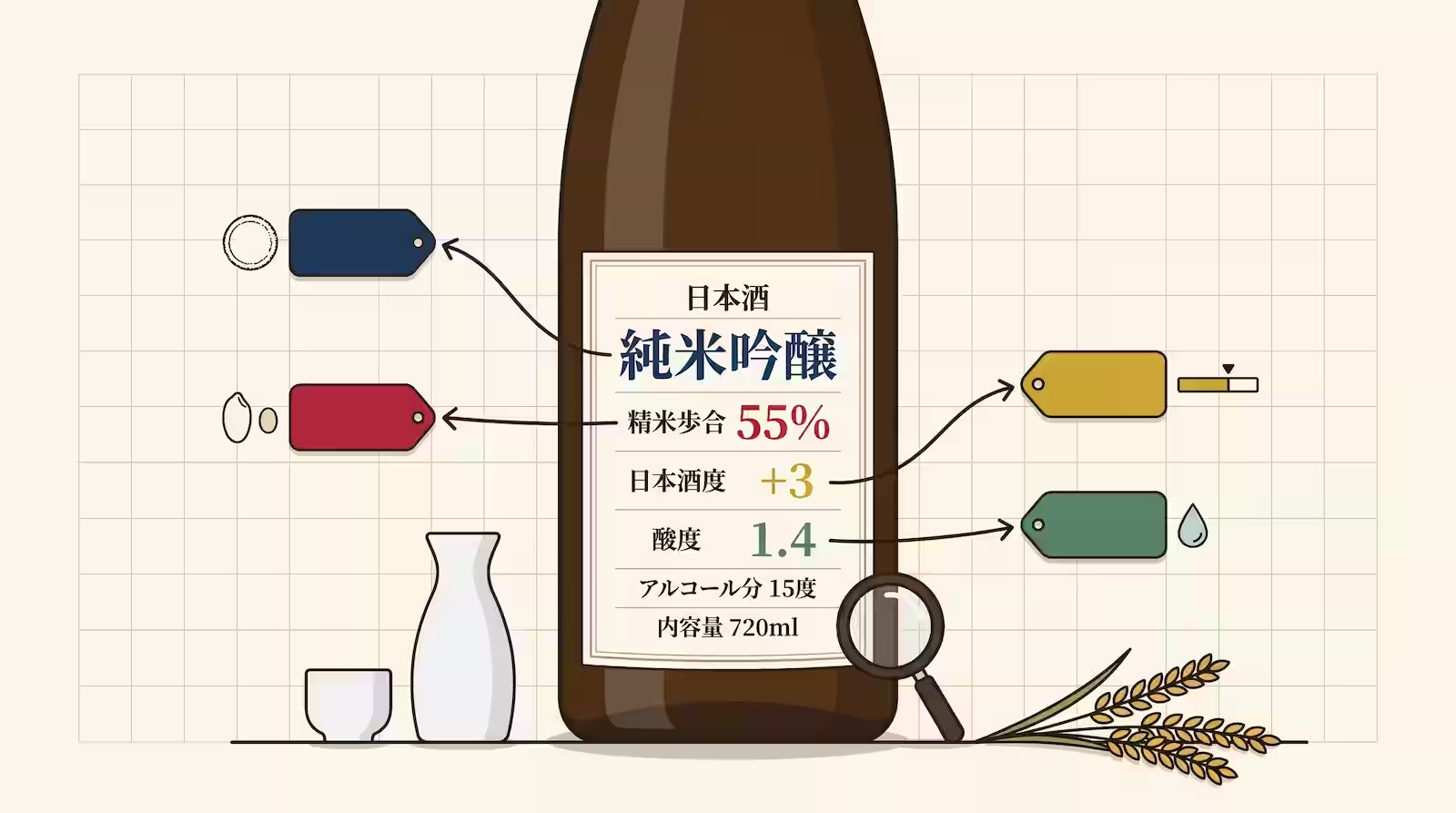
Choosing a yamahai sake is easier than it seems. Start by looking for “yamahai” or 山廃 on the label. Then check the grade and rice polishing ratio. These hints suggest the likely style.
A junmai yamahai often tastes rich and savory. It usually rewards gentle warming. For a first try, a junmai yamahai works well. Serve it cool at first, then warm a second cup. In this way, you can feel how the flavor shifts.
Yamahai vs Kimoto vs Sokujo
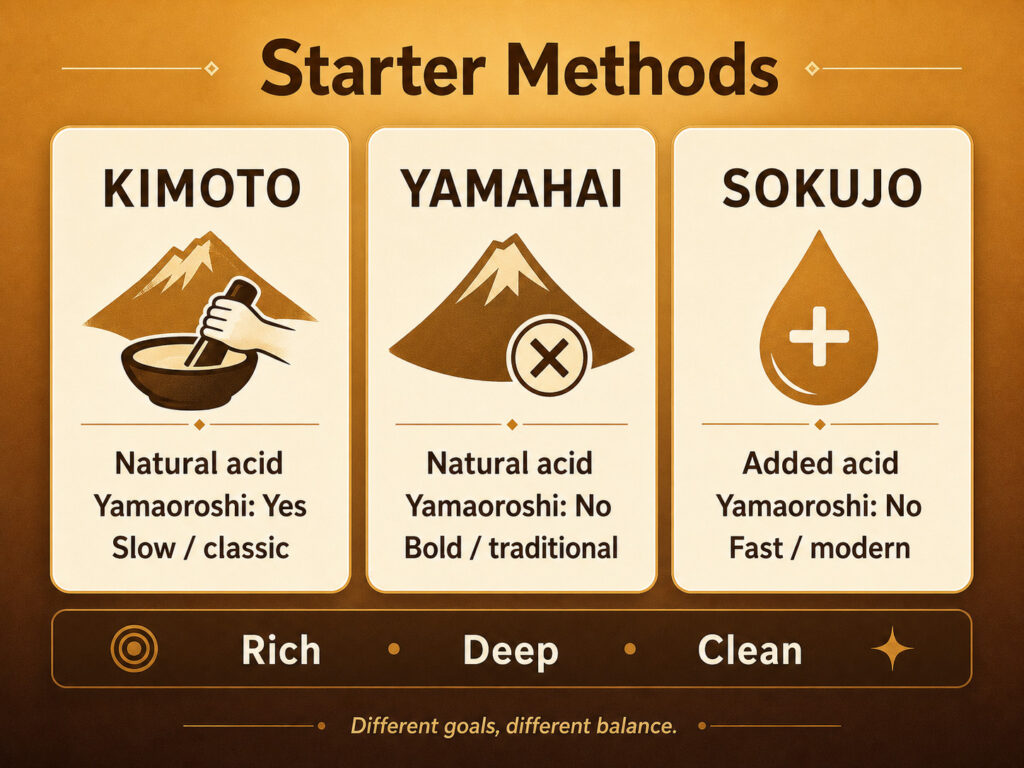
These three methods form one family. They all build the yeast starter. Yet they differ in clear, meaningful ways. A table makes the contrast easy to see.
| Point | Kimoto | Yamahai | Sokujo |
|---|---|---|---|
| Yamaoroshi | Yes | No | No |
| Lactic acid | Natural bacteria | Natural bacteria | Added directly |
| Time | About 4 weeks | About 4 weeks | About 2 weeks |
| Labor | Very high | Medium to high | Lower |
| Flavor tendency | Rich, sharp, structured | Bold, deep, sometimes wild | Clean, fresh, stable |
| Best understood as | The classic traditional starter | A simplified traditional starter | The modern standard starter |
| Modern usage | Small | Small to moderate | Most production |
The history flows in a clear line. Kimoto came first, as the original method. Yamahai then dropped the grueling yamaoroshi step. Sokujo followed soon after, with added acid. For the modern standard, see our moto guide. Each method therefore built on the one before.
One detail matters most of all. None of these methods is simply better. Each reflects a different balance of values. Kimoto prizes tradition and full labor. Yamahai blends tradition with practical relief. Sokujo offers speed and clean reliability. So the choice depends on the brewer’s vision.
Yamahai and kimoto stay especially close, though. Both rely on natural lactic acid development. The only real gap is the yamaoroshi step. For a full look at the original, see our kimoto guide. Some say kimoto tastes a touch sharper, while yamahai feels rounder.
Why Yamahai Became Popular
Yamahai spread for very practical reasons. It removed the worst labor from brewing. Yet it kept the familiar natural process. So brewers gained relief without losing tradition.
The timing also helped its rise. It appeared before sokujo took over. For a while, it was the modern choice. Many breweries embraced it eagerly. As a result, yamahai earned a lasting place in brewing. Today, it even outnumbers pure kimoto among traditional starters.
Yamahai in Modern Brewing
Yamahai thrives in modern craft brewing. Many premium breweries still choose it. They value its depth and bold character. So the method feels both old and current.
Modern tools make it safer than before. Temperature control has grown far more precise. Some brewers study the microbes directly. Others pair yamahai with fragrant modern yeasts. As a result, tradition and science now blend. Still, the slow, patient spirit remains.
Interestingly, some breweries use yamahai for nearly everything. They build most of their lineup on this starter. Meanwhile, others reserve it for special bottles. So yamahai ranges from everyday sake to prized labels. This flexibility keeps the method alive and evolving.
Regional Yamahai Traditions
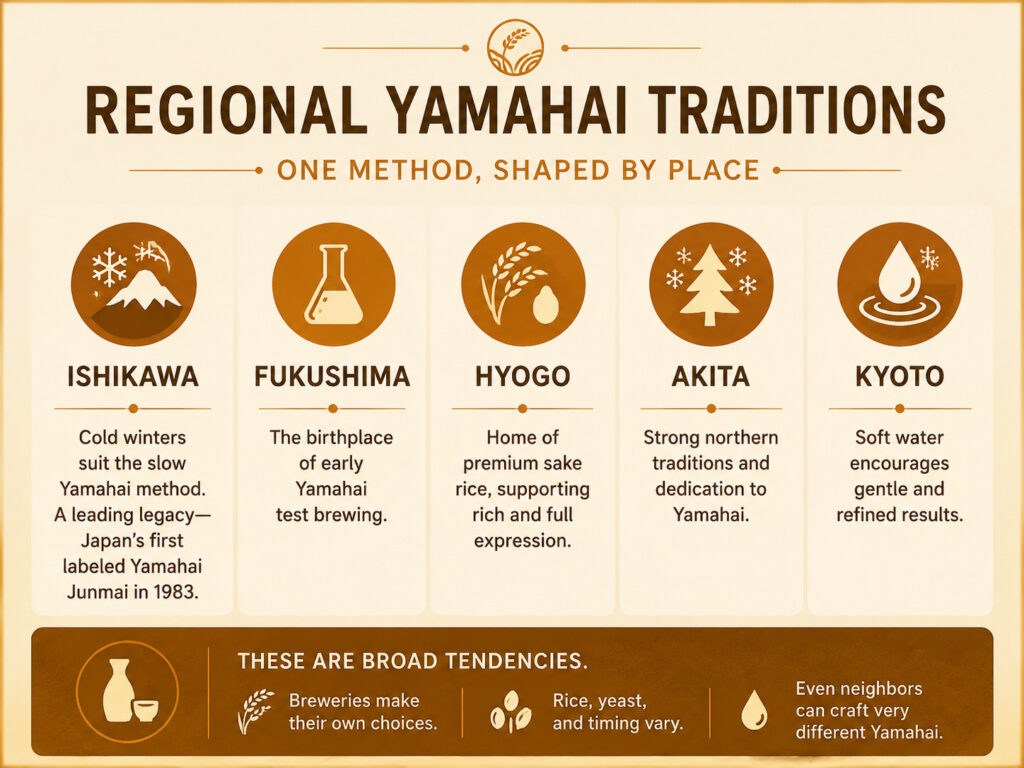
Yamahai carries strong regional roots. Climate, water, and history all shape it. Local traditions therefore vary in interesting ways.
Ishikawa holds an especially famous yamahai legacy. Its cold winters suit the slow method well. Several celebrated Ishikawa breweries built their fame on yamahai. One Ishikawa producer even released Japan’s first labeled yamahai junmai in 1983. So the region became closely tied to the style.
Other regions keep proud traditions too. Fukushima hosted the early test brewing of yamahai. Hyogo, home of great sake rice, supports rich brewing. Akita keeps strong northern traditions. Kyoto’s soft water leans toward gentler results. So each region adapts yamahai to its own conditions.
These regional notes are broad tendencies only. Individual breweries make their own choices. They vary rice, yeast, and timing freely. So even neighbors can craft very different yamahai sake.
Common Misconceptions About Yamahai
Yamahai invites several common myths. Let us clear them up plainly.
- Is yamahai the same as kimoto? No. Yamahai skips the yamaoroshi step.
- Is yamahai always sour? No. It has firm acidity, but it is not simply sour.
- Is yamahai more traditional than kimoto? No. Kimoto is the older method.
- Does yamahai mean unpasteurized? No. The term refers only to the starter.
- Is yamahai a lazy shortcut? No. It still demands skill and a full month.
The first myth causes the most confusion. So hold on to the central idea. Yamahai evolved from kimoto by dropping yamaoroshi. It still grows its lactic acid naturally. Keep that clear, and the rest makes sense.
Final Thoughts
Yamahai marks a key step in sake history. It grew directly from the kimoto method. It dropped one hard step, but kept the natural acid. So yamahai sake brewing bridges tradition and science. It is neither better nor worse than its neighbors. Instead, it reflects a different brewing philosophy. Above all, remember the heart of the matter. Yamahai keeps natural lactic acid, without the yamaoroshi labor. Understand yamahai, and you understand how tradition evolves.
Yamahai Sake Brewing FAQ
What is yamahai in sake brewing?
Yamahai is a traditional yeast starter method. It grew from kimoto by dropping the yamaoroshi step. It still grows lactic acid naturally. It is a method, not a sake style.
What does yamahai mean?
It is short for yamaoroshi haishi moto. That means “starter without yamaoroshi.” Yamaoroshi is the hard mashing step. Haishi means abolition or removal.
How is yamahai different from kimoto?
Both grow natural lactic acid the slow way. Kimoto includes the yamaoroshi mashing step. Yamahai skips that grueling step entirely. Instead, koji enzymes dissolve the rice.
Why is yamaoroshi omitted?
Research showed the grinding was not essential. Koji enzymes dissolve the rice on their own. Better milling also helped the rice soften. So brewers could safely skip the step.
What is mizukoji?
Mizukoji means “water koji” in Japanese. Brewers soak koji in water to release its enzymes. The steamed rice then dissolves in that liquid. This replaces the yamaoroshi grinding.
How long does yamahai take?
The starter takes about four weeks. That is similar to kimoto. Sokujo, by contrast, takes about two weeks. The slow process builds extra complexity.
What does yamahai sake taste like?
Yamahai sake often tastes savory and full-bodied. It usually has firm acidity and umami. Some examples feel earthy or wild. The final flavor depends on the brewery.
Should yamahai sake be served warm?
Many yamahai sake taste wonderful warmed. Around 40 to 45 degrees, the acids soften nicely. The savory umami also feels rounder. Still, some can be enjoyed cool too.
What foods pair well with yamahai sake?
It pairs well with rich, savory foods. Grilled meats, stews, and mushrooms work nicely. Simmered fish and aged cheese also match. Warmed yamahai suits winter hot pots.
Is yamahai still widely used?
It remains a small but notable method. Most sake now uses sokujo instead. Yet many premium brands feature yamahai. Its bold character keeps it popular.
Is yamahai better than sokujo?
Neither method is simply better. They reflect different brewing values. Yamahai offers natural depth and character. Sokujo offers speed and clean reliability.
Is yamahai a type of sake?
No, yamahai is a brewing method. It describes how the yeast starter is made. You may see it noted on a label. Yet it is a process, not a flavor category.
References
- Daishichi Sake Brewery, traditional kimoto and yamahai yeast starters. (Surveyed: June 2026)
- Japan Sake and Shochu Makers Association, glossary of sake terms (yamahai, yamaoroshi, mizukoji, shubo). (Surveyed: June 2026)
- Brewing Society of Japan, history of yeast starters and brewing microorganisms. (Surveyed: June 2026)
- National Research Institute of Brewing, science of the sake yeast starter and lactic acid bacteria. (Surveyed: June 2026)
-300x169.avif "Moto (酒母): The Yeast Starter of Sake")




Comments