Ask someone how sake reaches its final strength, and most people picture the fermentation tank. Yet one of the last and most quietly important steps happens after brewing is basically done. It is called Warimizu, and it is the practice of adding carefully selected water to sake before bottling. The goal is simple to state, though hard to master. Brewers adjust the alcohol content and fine-tune the balance of flavor, aroma, and texture.
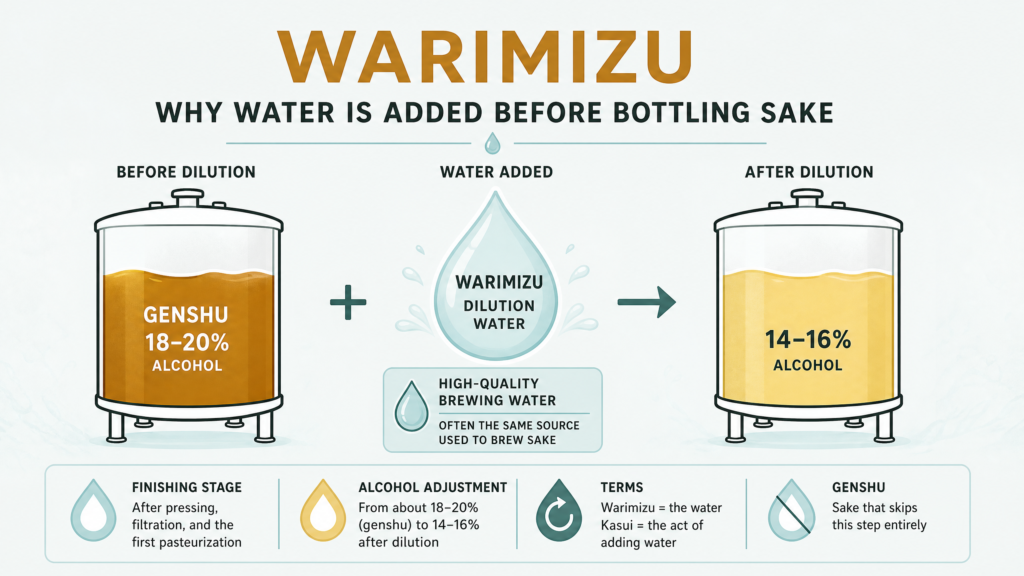
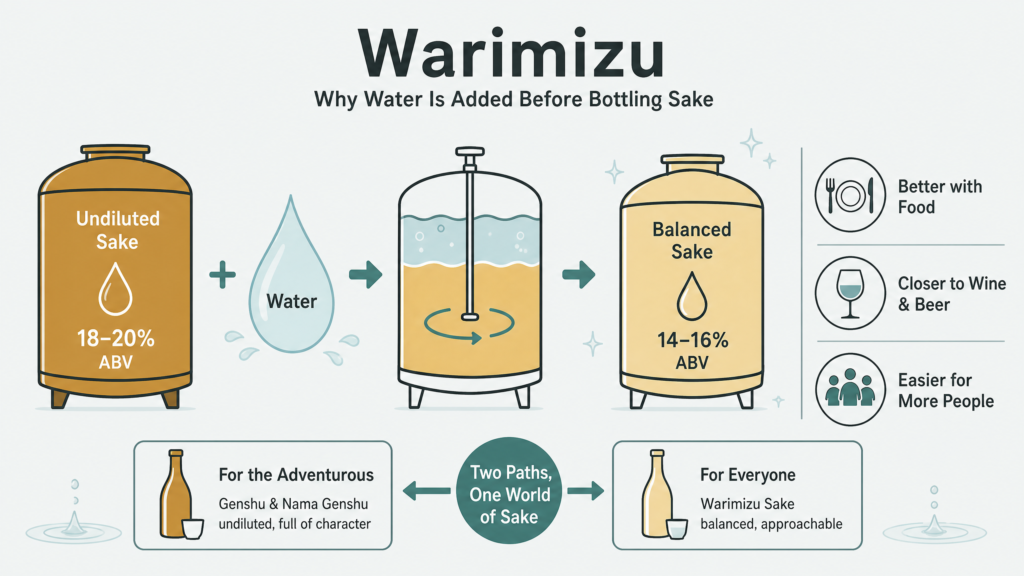
Sake usually finishes fermentation somewhere near 18 to 20 percent alcohol. That is strong, and for many drinkers it feels heavy beside a meal. Warimizu brings that number down to roughly 14 to 16 percent. The National Research Institute of Brewing, Japan’s official brewing authority, defines warimizu in exactly these terms. Undiluted sake reaches up to about 20 percent, and brewers usually dilute it to 14 to 16 percent before bottling.
Still, this is not just “watering down” a drink. A brewer chooses the water, tests the ratio, and often tastes the result many times. Get it wrong, and months of careful fermentation can taste thin or flat. Get it right, and the sake finally sits at its intended balance. This article explains what warimizu is, why it exists, and how it shapes the sake you eventually pour.
Quick Facts
Japanese Name: 割水 (also written 割り水)
Literal Meaning: “Dividing water” or “splitting water”
English Translation: Dilution water, diluting water, alcohol-adjusting water
Stage of Brewing: Finishing stage, usually after pressing, filtration, and the first pasteurization
Typical Alcohol Before Dilution: About 18 to 20 percent (genshu strength)
Typical Alcohol After Dilution: About 14 to 16 percent
Water Used: High-quality brewing water (shuzo yosui), often the same source used to brew the sake
Notice that the term names the water, not the act. In Japanese, warimizu literally refers to the dilution water itself. Brewers also call the wider adjustment kasui, meaning the addition of water. Both words point to the same finishing move. You will meet the related term genshu throughout this guide, since genshu is simply sake that skips this step entirely.
TOC
What Is Warimizu?
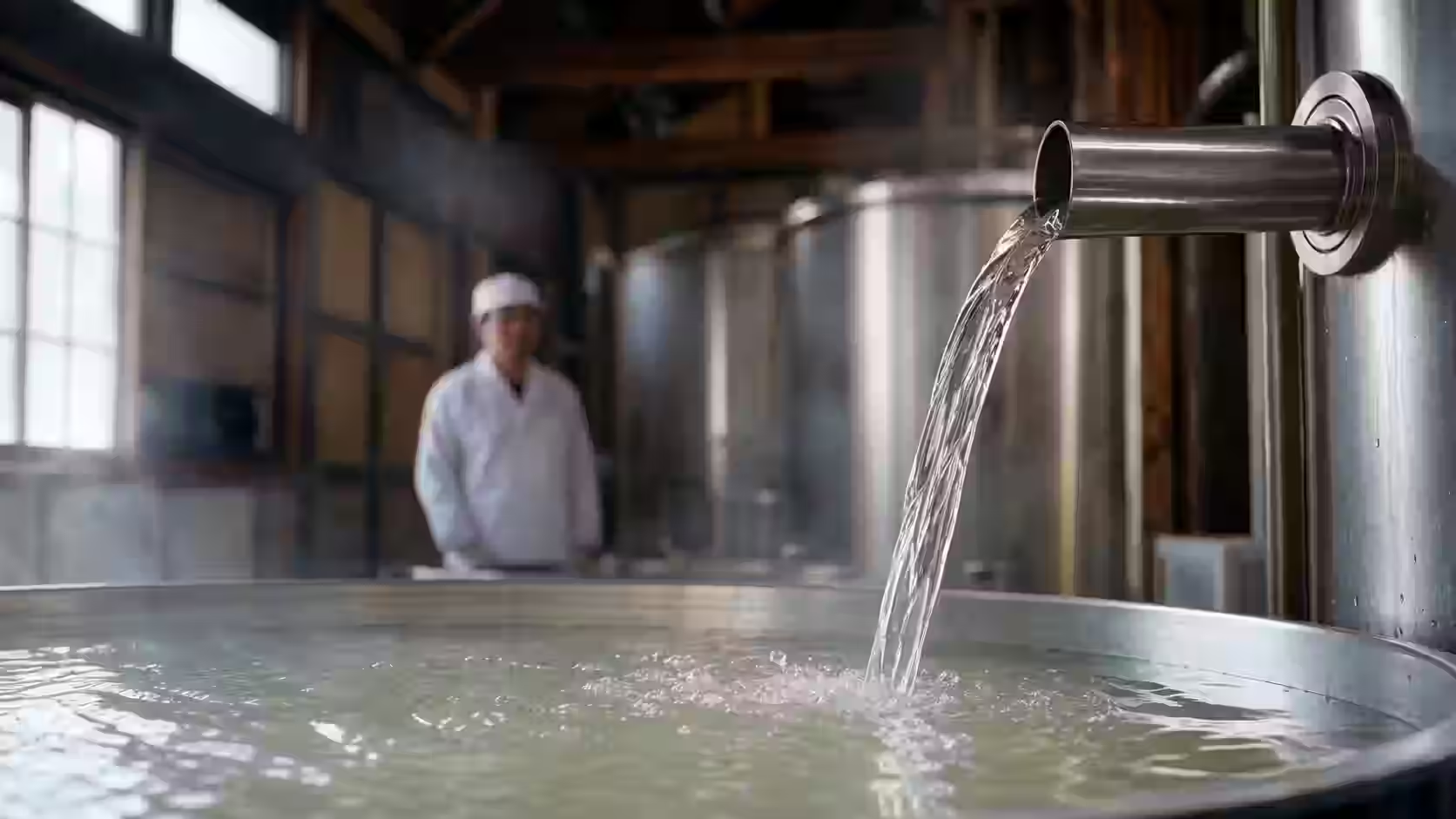
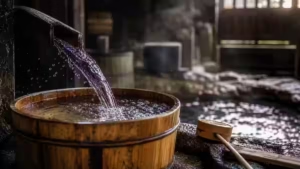
Warimizu is the controlled dilution of finished sake with water to reach a target alcohol level. The brewer takes sake from a storage tank, usually after it has matured, and blends in clean brewing water right before shipment. That single action lowers the strength and softens the overall impression. It sounds minor, yet it changes almost everything a drinker notices in the glass.
Brewing Water vs Dilution Water
Water enters sake at several points, and each role deserves its own name. First comes shikomi-mizu, the brewing water added when building the mash. Next comes oi-mizu, “following water,” which some brewers add during fermentation to adjust the mash. Finally comes wari-mizu, the dilution water added at the very end. All three may come from the same source, yet they do different jobs.
Brewing water works inside a living system. It feeds koji enzymes, supports yeast, and shapes fermentation across many days. Dilution water, by contrast, meets a finished product. There are no microbes left to protect, only flavor to balance. Because of that, the purity and mineral profile of dilution water matter in a very direct way. Any off-note in the water lands straight in the bottle.
Why Dilution Happens After Brewing
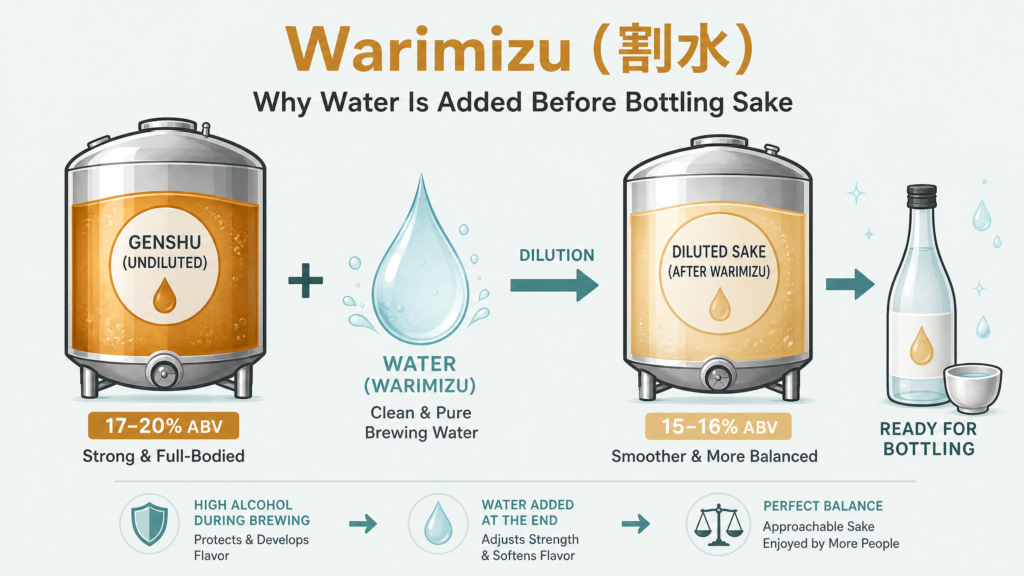
You might wonder why brewers do not simply aim for 15 percent from the start. The reason lies in how fermentation actually works. Sake uses a rare method called multiple parallel fermentation, where koji makes sugar and yeast makes alcohol at the same time, inside one tank during the fermentation stage. This process naturally pushes alcohol quite high, often near 20 percent.
High alcohol during fermentation serves a purpose. It helps the mash resist spoilage and lets flavors develop fully. So brewers welcome that strength while the sake is being made. Only later do they bring it down for drinking. In other words, the strong ferment builds character, and warimizu makes that character approachable. The timing is not an accident but a design.
The Relationship With Genshu
Genshu is the mirror image of warimizu. The word means undiluted sake, and it names sake bottled at its natural fermentation strength. Since no dilution water enters, genshu usually pours at 17 to 20 percent. It tastes fuller, denser, and often more intense. Most commercial bottles are not genshu, because most sake receives warimizu before shipment.
Understanding one term clarifies the other. Warimizu adjusts; genshu refuses adjustment. Neither choice is automatically better, which surprises some newcomers. A brewer may release the same base sake in two versions, one diluted and one as genshu. Comparing them side by side reveals exactly what the water does. We explore that comparison in detail further down.
Why Is Water Added?
The short answer is balance. The longer answer touches strength, flavor, aroma, texture, and even consistency between batches. Let us take these one at a time, because each reason reveals something about how sake is meant to be enjoyed.
Alcohol Adjustment
This is the headline reason. Sake near 20 percent alcohol feels hot and weighty, especially with delicate food. Bringing it to around 15 percent makes it far easier to drink across a meal. The number is not random either. Japanese sake law and long custom both settle near this range, and drinkers have come to expect it. Warimizu is how brewers hit that familiar target.
Flavor Balance
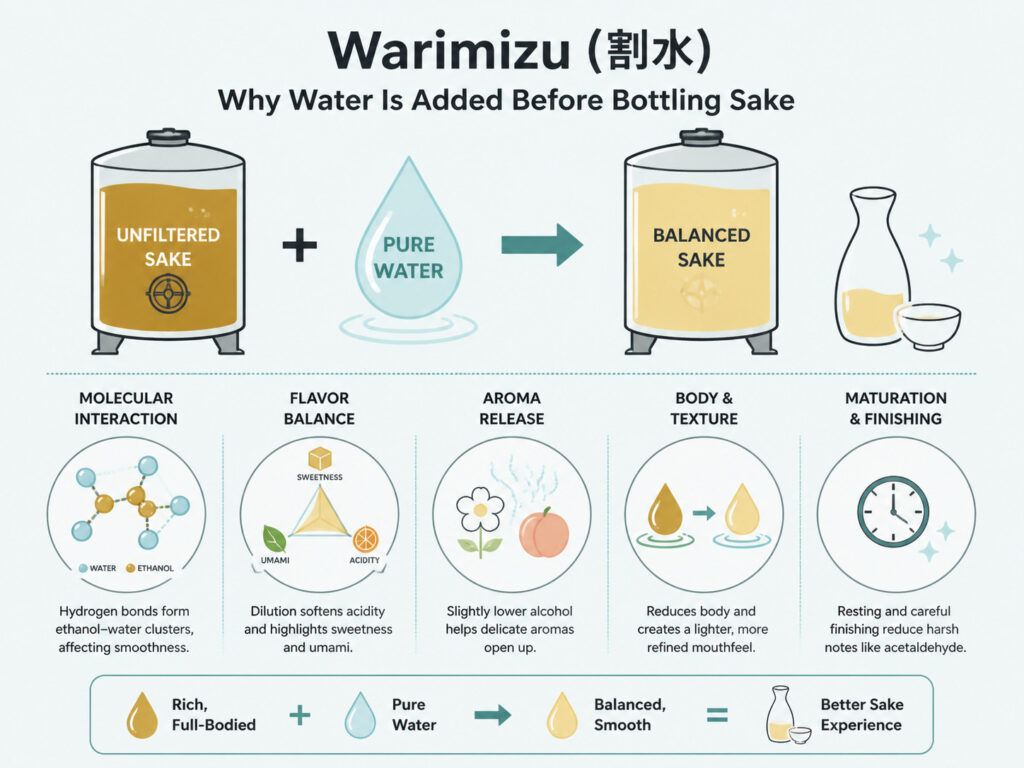
Alcohol carries flavor, but too much of it can dominate. At full strength, sweetness, acidity, and umami can feel compressed behind a wall of heat. Adding water opens that structure, letting each element breathe. Sweetness often reads more clearly. Acidity feels rounder. The bitter edge that sometimes appears in strong sake tends to soften. A skilled brewer uses dilution almost like seasoning.
Aroma Perception
Aroma behaves in a subtle way here. Many of sake’s fragrant compounds are volatile, meaning they lift into the air easily. High alcohol can trap or mask some of these notes, so a bottle can smell tighter than it should. Lowering the alcohol slightly can release fruit and floral aromas that were hiding. However, dilute too far, and those same aromas thin out. The brewer aims for the sweet spot.
Mouthfeel
Texture matters as much as taste. Genshu often coats the mouth with a thick, almost oily weight. Some drinkers love that richness; others find it tiring. Warimizu lightens the body and adds a cleaner finish. As a result, diluted sake usually feels more refreshing and drinkable in larger quantities. The change in mouthfeel is one of the first things a taster notices.
Consumer Preferences and Batch Consistency
Finally, water helps a brewery deliver a stable, expected product. Fermentation varies from tank to tank, since it is a living process. One batch might finish at 19 percent, another at 20. Through careful dilution, the toji, or head brewer, can bring different tanks to the same final strength. That consistency reassures customers who buy the same label year after year. It also lets a brewery tailor a release toward lighter or richer tastes, depending on the market.
The Science Behind Warimizu
Here we reach the most technical part of the story. Adding water to alcohol seems trivial, yet the chemistry is surprisingly rich. Ethanol and water do not simply sit side by side in a bottle. They interact at the molecular level, and that interaction shapes what your tongue and nose report.
Ethanol, Water, and Hydrogen Bonds
Both ethanol and water form hydrogen bonds. When you mix them, the molecules arrange into loose, shifting structures often called ethanol-water clusters. Researchers using Raman and infrared spectroscopy have studied these clusters closely. Their work shows that the strength of hydrogen bonding changes with concentration and with the other compounds present in the drink.
Why should a drinker care about clusters? Because these arrangements appear linked to taste and quality. A 2023 review in a spectroscopy journal examined ethanol-water clusters across whisky, shochu, sake, and Chinese rice wine. The authors argued that taste is not decided by ingredients alone. The supramolecular structure between ethanol and water also plays a role. In plain terms, how the molecules group together may influence how smooth a drink feels.
Studies on sake and other beverages have shown that certain compounds strengthen the hydrogen-bond network between water and ethanol. Nose and colleagues, in work published in the Journal of Agricultural and Food Chemistry, reported that components in sake, shochu, and whisky can tighten the association between the two molecules. This offers one scientific hint about why a rested, well-diluted sake can taste more integrated than a rough blend of alcohol and water.
Perceived Sweetness, Acidity, and Umami
Dilution shifts the concentration of every dissolved compound, not just ethanol. Sugars, organic acids, and amino acids all become slightly less concentrated. You might expect every flavor to simply fade, yet perception rarely works that cleanly. Lowering the alcohol can actually make sweetness and umami stand out more, because they no longer fight against a harsh alcoholic burn.
Acidity responds in its own way. A strong genshu can taste sharp, its acids amplified by the alcohol. After warimizu, that same acidity often reads as gentle and supportive. Umami, the savory depth from amino acids, tends to feel rounder in a diluted sake. The brewer is essentially rebalancing several tastes at once, using a single tool. That is why the ratio demands such care.
Volatile Aroma Compounds
The fragrant esters that give ginjo sake its fruit and flower notes are volatile and delicate. Alcohol concentration affects how readily these compounds escape into the air above the glass. Slightly lower alcohol can help some aromas release, which is one reason a diluted ginjo can smell so expressive. Push dilution too far, though, and the aromatic impression weakens. Balance, once again, decides the outcome.
Body and Temperature Effects
Body describes the weight and viscosity a sake feels like on the palate. Higher alcohol and more dissolved solids create a fuller body. Warimizu reduces both, producing a lighter, cleaner sensation. Temperature then interacts with all of this. Warming sake tends to lift sweetness and umami, while chilling sharpens crispness. A brewer often considers the likely serving temperature when deciding the final dilution. A sake meant for gentle warming may be balanced differently from one built for chilled drinking.
One more scientific wrinkle deserves mention. During fermentation, yeast produces acetaldehyde, a compound tied to certain rough or pungent notes. Resting and careful finishing help these harsher elements settle. So warimizu is not working in isolation. It cooperates with maturation, filtration, and pasteurization to deliver a smooth final drink.
The Importance of Water Quality
If water makes up a real share of the final bottle, its quality cannot be an afterthought. Brewers treat dilution water with the same respect they give brewing water. In fact, many use water from the same trusted source. The saying that those who control water control sake brewing applies right up to the last step.
Mineral Content and Purity
Minerals in water shape both fermentation and flavor. Potassium, magnesium, and phosphorus support yeast, while iron and manganese cause problems. Iron in particular can darken sake and dull its aroma, so brewers keep it extremely low. For dilution water, purity is just as vital. Any impurity now travels directly into finished sake, with no fermentation left to absorb or transform it. Clean, stable water protects everything the brewer worked to build.
Filtration and Treatment
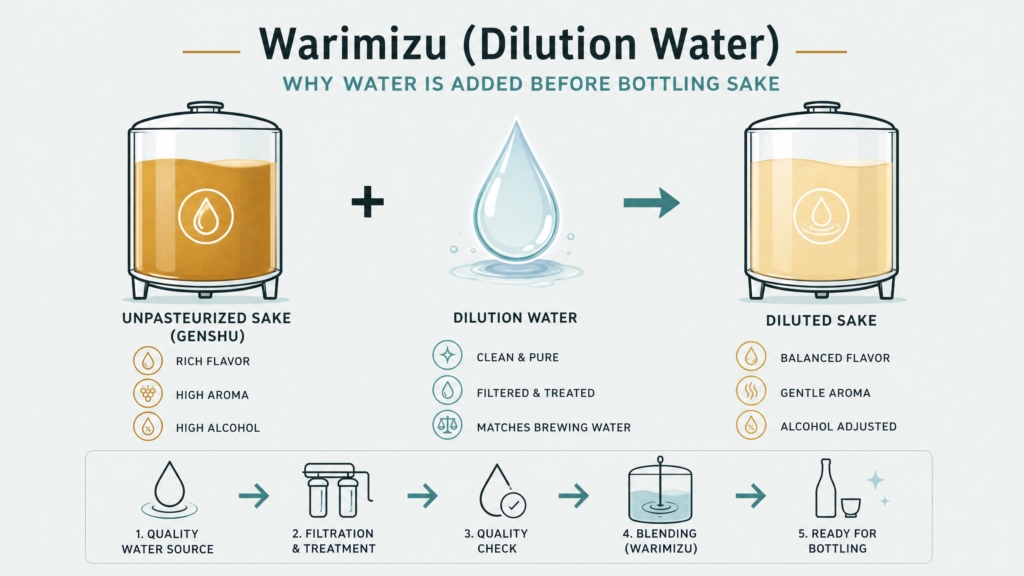
Breweries rarely pour raw spring water straight into sake. They filter and treat it to remove unwanted metals and particles. Some adjust the mineral balance to match their house style. In Japanese, the water handled around this stage, used for dilution, bottle cleaning, and equipment, is sometimes grouped under the term binzume-yosui. The point is control. The brewer wants dilution water that behaves predictably every single time.
Soft Water vs Hard Water
Japan’s brewing regions split roughly into soft-water and hard-water traditions. Soft water, low in minerals, tends to slow fermentation and yield gentle, delicate sake. Hard water, richer in minerals, can drive a firmer, more robust style. Nada in Hyogo is famous for its hard water and sturdy sake, while many soft-water regions produce softer, aromatic bottles.
This regional character carries into dilution too. Matching dilution water to brewing water helps keep a sake coherent. A soft-water sake diluted with harsh, mineral-heavy water could lose its identity. So thoughtful brewers align the two. For a deeper look at how water shapes sake from the beginning, see our full guide on water in sake brewing.
Matching the Brewing Water
Consistency is the guiding idea. When dilution water shares the profile of the original brewing water, the finished sake feels whole. The flavors integrate rather than clash. This is one more reason breweries value their local water so highly. From the first soaking of sake rice to the final drop of warimizu, one water source can thread through the entire process. That continuity is part of a region’s sake identity.
Genshu vs Warimizu Sake
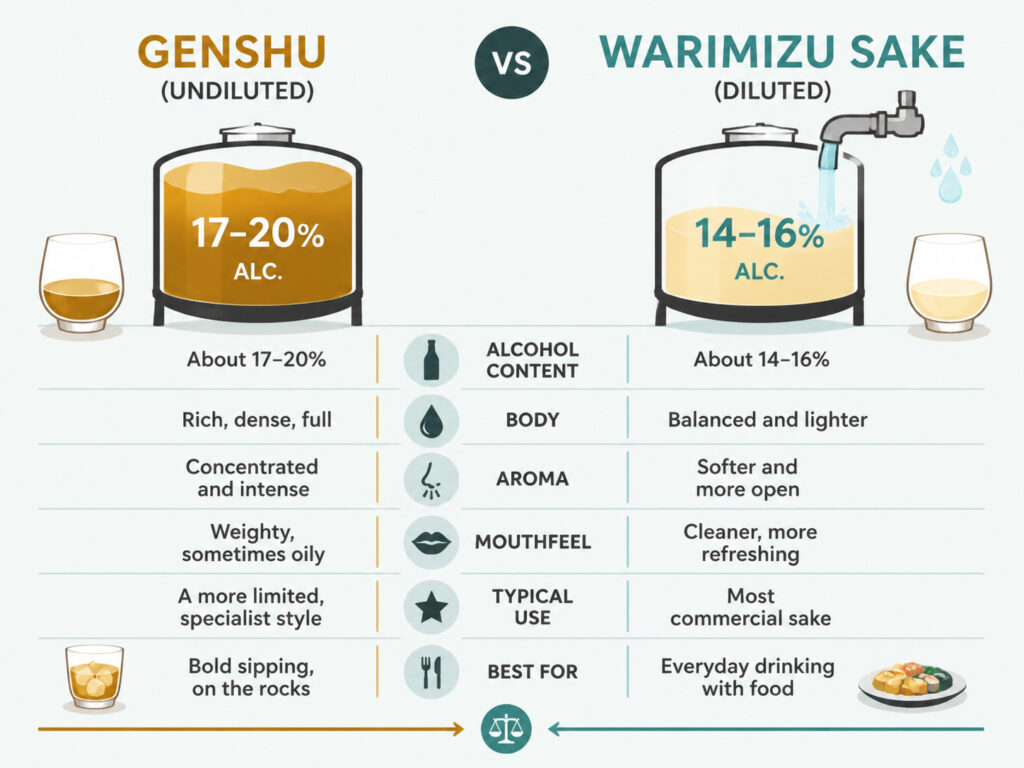
Now we can compare the two directly. Both styles come from the same brewing tradition, yet they present very different experiences. The table below sums up the core differences at a glance.
Genshu (Undiluted)
Warimizu Sake (Diluted)
Alcohol content
About 17 to 20 percent
About 14 to 16 percent
Body
Rich, dense, full
Balanced and lighter
Aroma
Concentrated and intense
Softer and more open
Mouthfeel
Weighty, sometimes oily
Cleaner, more refreshing
Typical use
A more limited, specialist style
Most commercial sake
Best for
Bold sipping, on the rocks
Everyday drinking with food
Both styles have real value, and neither is a compromise. Genshu offers power and concentration, a vivid snapshot of sake at full strength. It rewards slow sipping and pairs well with rich dishes. Some drinkers enjoy it over ice, which dilutes it gradually in the glass. That is home-style warimizu, in a sense.
Warimizu sake, meanwhile, is built for balance and ease. It suits long meals, varied food, and casual pouring. The overwhelming majority of bottles you meet in shops and izakaya fall into this group. So the two styles are not rivals but options. A curious drinker gains a lot by tasting the same base sake in both forms. The water becomes visible, so to speak, through its absence and its presence.
Traditional and Modern Techniques
Dilution has always demanded judgment, but the tools have changed a great deal. Older brewers relied heavily on the palate. Today, laboratory instruments support that palate with hard numbers. The best breweries blend both approaches.
Manual Dilution and the Brewer’s Palate
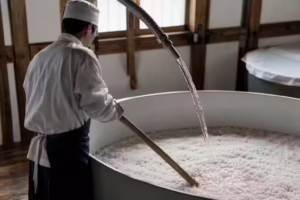
In the traditional method, the toji tastes the sake and decides. He knows the target strength and the character he wants. Then he adds water gradually, checking the flavor as he goes. This craft depends on years of experience inside the kura, the brewery. Small teams once handled every batch by feel, guided mostly by memory and skill. Many respected breweries still value this hands-on sensibility.
Laboratory Analysis and Precision Blending
Modern breweries measure alcohol content precisely before diluting. Instruments report the exact percentage, so the brewer knows how much water to add. This turns a rough estimate into a calculated blend. Precision blending also helps when combining several tanks into one release. The brewer can hit a chosen strength repeatedly, batch after batch. That reliability supports both quality and the trust of loyal customers.
Measurement Technology and Quality Control
Quality control now runs through the whole finishing sequence. Brewers track alcohol, acidity, and amino acid levels as reference points. They record dilution ratios so future batches can be reproduced. Some larger producers automate parts of the process for tight consistency. Even so, human tasting remains the final check. Numbers guide the decision, yet the palate confirms it. This partnership between science and craft defines modern warimizu.
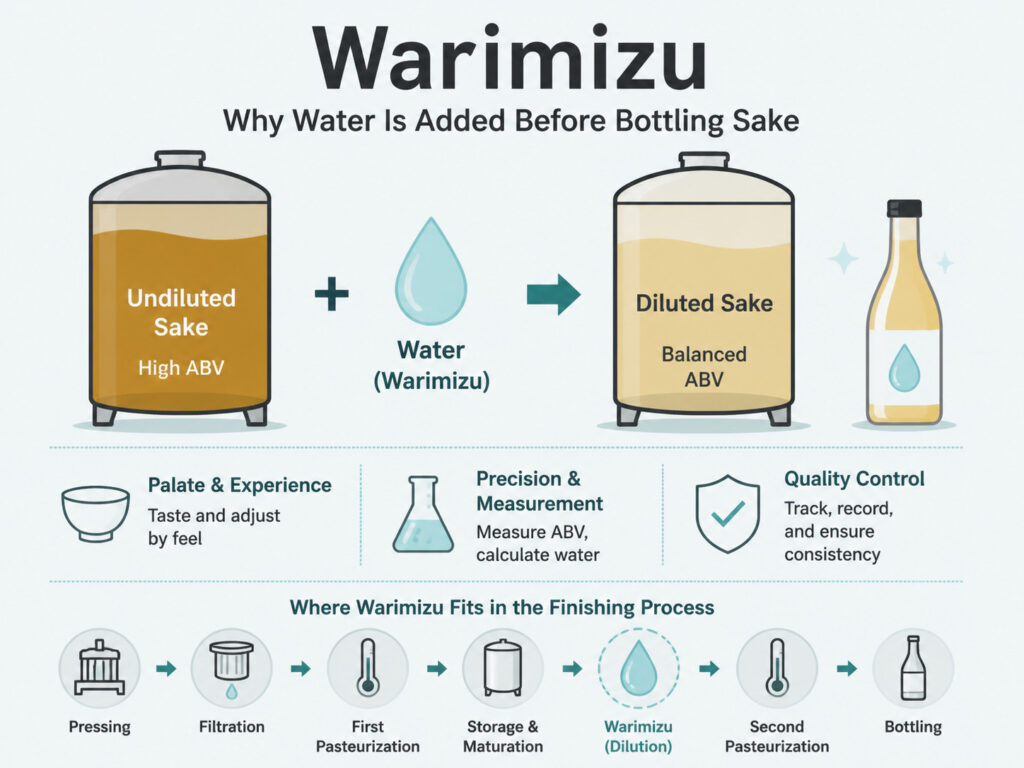
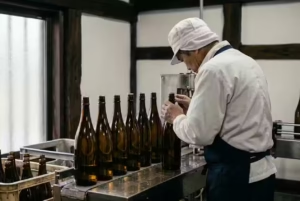
It helps to see where dilution sits in the finishing order. After pressing separates the sake from the lees, the liquid moves through filtration. Then comes the first pasteurization, followed by storage and maturation. Warimizu usually happens after this rest, just before a second pasteurization and bottling. Placing dilution near the end lets the sake settle first, so the brewer adjusts a stable, matured liquid.
Common Misconceptions
Warimizu attracts a fair amount of confusion, especially outside Japan. The word “diluted” carries a negative ring in English. Let us clear up the most frequent misunderstandings.
Does adding water lower quality? No. Warimizu is a deliberate finishing technique, not a shortcut. Brewers dilute to reach an intended balance, using premium water and careful measurement.
Is diluted sake “watered down”? Not in the cheapening sense. The alcohol drop is planned, and the sake is designed around its final strength. Calling it watered down misses the craft involved.
Is genshu always superior? No. Genshu is bolder, but bold is not the same as better. Many prize-winning sakes receive warimizu, and balance often wins over sheer power.
Does every sake undergo warimizu? No. Genshu skips it by definition, and some special releases stay undiluted on purpose. Most commercial sake is diluted, yet plenty is not.
The core idea is intention. A brewer chooses to dilute, or chooses not to, based on the sake they want to present. Water is a creative tool here, not a way to stretch the product. Once you see it that way, the whole process reads differently.
Why Some Sake Is Never Diluted
A meaningful share of sake is bottled at full strength on purpose. These undiluted styles let drinkers meet sake in its rawest, most concentrated form. Genshu leads this group, offering that dense body and vivid flavor we described earlier. For fans of intensity, nothing else quite compares.
Nama genshu takes the idea further. This style is both undiluted and unpasteurized, so it keeps a fresh, lively quality on top of its strength. It needs refrigeration and quick drinking, yet it delivers a bright, almost just-pressed character. Limited seasonal editions often use these undiluted formats to showcase a particular tank or harvest. In such cases, the brewer wants nothing standing between the drinker and the sake. Skipping warimizu becomes a statement about purity and boldness.
An International Perspective
Why does sake settle around 14 to 16 percent when it could go higher? Part of the answer is cultural, and part is practical. Sake is above all a food drink in Japan. It shares the table with rice, fish, and vegetables, so a moderate strength suits that role. A softer alcohol level lets the sake support a meal rather than overwhelm it.
The comparison with other drinks is telling. Most table wines sit near 12 to 14 percent, and many beers land well below that. Undiluted sake at 20 percent would tower over both. Warimizu brings sake into a range that feels familiar to wine drinkers worldwide. That familiarity helps sake travel. For newcomers in export markets, a balanced 15 percent bottle is simply easier to approach than a fiery genshu.
Interestingly, the growing global audience has also boosted interest in genshu and nama genshu abroad. Adventurous drinkers seek out the stronger, undiluted styles precisely because they feel distinctive. So both paths now serve the international market. Warimizu opens the door for beginners, while undiluted sake rewards the curious. Together they show sake’s range to the world.
Final Thoughts
Warimizu deserves more respect than its plain description suggests. It is not simply “adding water” to sake. It is a controlled finishing technique that lets a brewer present each sake at its intended balance. The choice of water, the exact ratio, and the timing all reflect real skill. Behind a single splash of dilution water sits generations of judgment.
Think back over the journey. Fermentation drives alcohol high for good reasons. Maturation smooths the rough edges. Then warimizu tunes the final strength, balancing flavor, aroma, and body for the drinker. Genshu shows what sake looks like before that tuning, and diluted sake shows the polished result. Neither would exist without the other as a reference.
Next time you pour a bottle labeled around 15 percent, remember the quiet step that got it there. A brewer chose that number and reached it on purpose. That is the real meaning of warimizu. Not dilution for convenience, but the last careful gesture in a long, deliberate craft.
Warimizu FAQ
What is warimizu?
Warimizu is the practice of adding water to sake before bottling. Brewers use it to lower the alcohol content and balance the flavor, aroma, and texture. The Japanese word literally names the dilution water itself. Most commercial sake goes through this finishing step.
Why is water added to sake?
Sake finishes fermentation at a high strength, often near 18 to 20 percent. That level feels heavy for most drinkers, especially with food. Water brings it down to a smoother 14 to 16 percent. The step also refines flavor balance and mouthfeel.
Does adding water reduce sake quality?
No, not when done properly. Warimizu is a deliberate technique, not a way to cheapen the product. Brewers use premium water and precise measurement to reach a planned balance. Many award-winning sakes are diluted this way.
What is the difference between genshu and regular sake?
Genshu is undiluted sake bottled at its natural fermentation strength, usually 17 to 20 percent. Regular sake receives warimizu, which lowers it to around 15 percent. Genshu tastes fuller and more intense. Diluted sake feels lighter and more balanced.
How is sake alcohol content adjusted?
Brewers measure the sake’s alcohol level, then add clean brewing water to reach a target. This dilution usually happens after maturation and before bottling. Modern breweries use precise instruments alongside the brewer’s palate. The result is a consistent, intended strength.
What kind of water is used for warimizu?
Brewers use high-quality brewing water, often from the same source used to make the sake. The water is filtered and low in harmful metals like iron. Purity matters greatly, since impurities now go straight into finished sake. Matching the original brewing water keeps the flavor coherent.
When does warimizu happen in the brewing process?
Dilution comes near the end of production. It follows pressing, filtration, the first pasteurization, and a period of storage. Warimizu then adjusts the matured sake just before the final pasteurization and bottling. This late timing lets the sake settle first.
Why not just brew sake to 15 percent from the start?
High alcohol during fermentation serves a purpose. It helps the mash resist spoilage and develops fuller flavors. Sake’s parallel fermentation also pushes alcohol naturally high. So brewers ferment strong, then dilute to a drinkable level afterward.
Does every sake undergo warimizu?
No. Genshu skips dilution by definition, keeping its full strength. Some limited and seasonal releases also stay undiluted on purpose. However, the majority of commercial sake is diluted for easier drinking. It depends on the style the brewer wants.
Is nama genshu the same as genshu?
They overlap but differ. Genshu means undiluted sake. Nama genshu is both undiluted and unpasteurized, so it stays fresher and livelier. Because it skips pasteurization, nama genshu needs refrigeration and quick drinking.
Can I dilute strong sake myself at home?
Yes, and some drinkers do exactly that. Adding a splash of water or ice to a strong genshu softens it gradually. Add the water slowly and taste as you go. This home method echoes what brewers do, just on a small scale.
Why is sake usually around 15 percent alcohol?
This range balances tradition, taste, and food pairing. Sake is mainly a food drink in Japan, so moderate strength suits the table. The level also feels familiar to wine drinkers worldwide. That familiarity helps sake appeal to new international audiences.
Nose, A., Hamasaki, T., Hojo, M. et al., Hydrogen Bonding in Alcoholic Beverages (Distilled Spirits) and Water-Ethanol Mixtures, Journal of Agricultural and Food Chemistry, 2005, Vol. 53, No. 18, pp. 7074-7081 (Surveyed: July 2026)
Japan Sake and Shochu Makers Association, How Sake Is Made (Brewing Process), https://japansake.or.jp/sake/en/ (Surveyed: July 2026)
Ryo Iwa is the founder and editor of foodinjapan.org. Born and raised in Japan, he writes from regional travel, market visits, and Japanese-language primary sources that rarely reach English readers, including brewing institute publications and industry glossaries. Where a figure cannot be traced to a source, the article says so.
He has been a Google Maps Local Guide for over 10 years, with more than 1,800 reviews and over 41,000 photos viewed hundreds of millions of times. He previously spent two decades as an IT consultant in Japan, the US, and the UK.











Comments