




Pasteurization in sake brewing is the quiet, decisive step near the very end.
It is a gentle heating called hiire. This step sits at the heart of pasteurization in sake brewing. The step barely gets a mention on most labels, yet it quietly guards everything the brewer built. Skip it, and a great many sake would sour or spoil long before they ever reached a glass.
So what is pasteurization in sake brewing? In short, it is a gentle heat treatment applied to most finished sake. Brewers warm the liquid just enough to settle it, deactivating stray enzymes and unwanted microbes in the process. The flavor then holds steady for months instead of drifting.
In Japanese, the step is called hiire. It means “adding fire.” That name sounds more violent than the reality.
That name sounds far more violent than the reality. The sake is never boiled, never scorched, and never truly cooked. it is simply warmed for a short while and cooled again. The drama lives entirely in the word, not in the pot.
Here is the detail that surprises almost everyone.
Japan was heat-treating sake by the late fifteenth century. That was roughly three hundred years before Louis Pasteur described the science in Europe. Brewers had no idea why it worked, yet they had already made it routine. That head start makes hiire one of the most quietly remarkable techniques in the whole craft.
This guide walks through all of it. It covers the history, the science, and the flavor. It also covers the famous unpasteurized style, namazake. For the stage that comes just before this one, see our filtration guide.
Quick Facts About Pasteurization
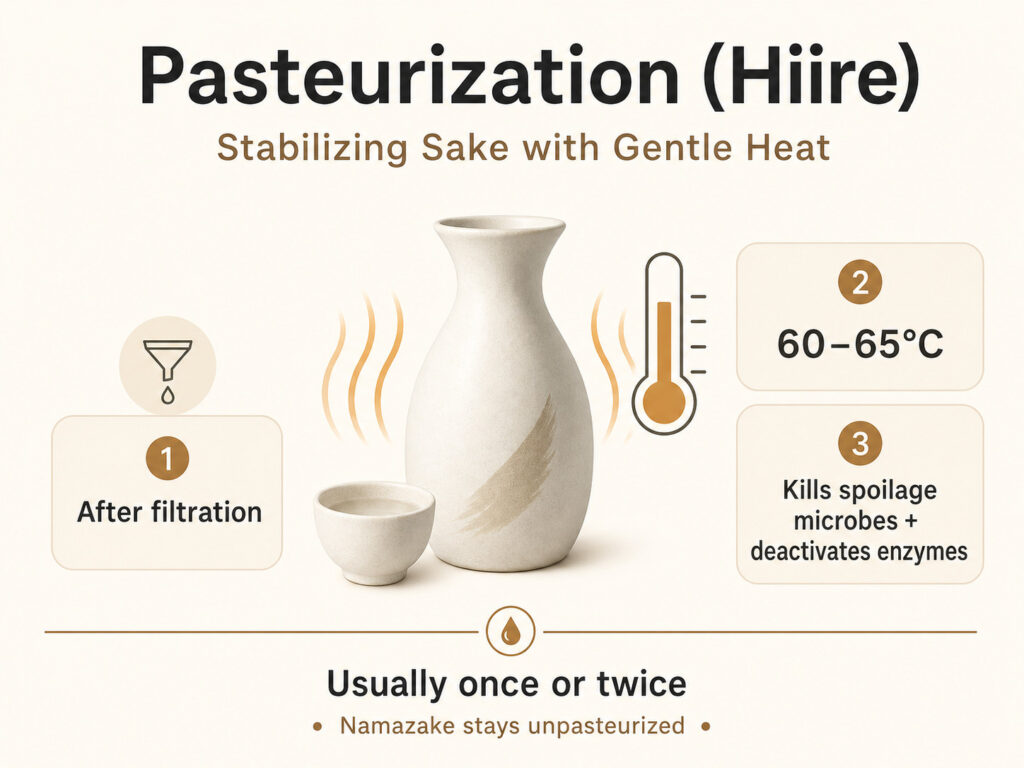
Here is a quick snapshot before the details begin.
| Japanese Name | 火入れ (hiire) |
| Brewing Stage | After filtration, around bottling |
| Main Purpose | Deactivate enzymes and kill spoilage microbes to stabilize sake |
| Typical Temperature Range | About 60 to 65 degrees Celsius |
| Number of Treatments | Usually once or twice (sometimes zero) |
| Related Sake Styles | Namazake, nama chozo, nama zume, hiyaoroshi |
| Storage Considerations | Pasteurized sake keeps longer; namazake needs refrigeration |
At its simplest, pasteurization is a gentle heat treatment for finished sake.
Brewers warm the sake carefully to stabilize it for storage, so it keeps the flavor they intended for far longer. The step lives near the very end of brewing, usually just after filtration and around the time of bottling.
The heat does two jobs at once: it deactivates the enzymes still active in the sake. it kills off the microbes that would otherwise spoil it. Most sake passes through this once or twice, though a rare few skip it completely. That unheated style is namazake, and we will come back to it in detail.
One idea deserves emphasis right away.
Hiire is a gentle stabilizing process, not a form of cooking. The sake is warmed, never boiled, so the flavor is preserved rather than transformed. Hold on to that distinction, because it shapes everything that follows.
What Is Pasteurization in Sake Brewing?
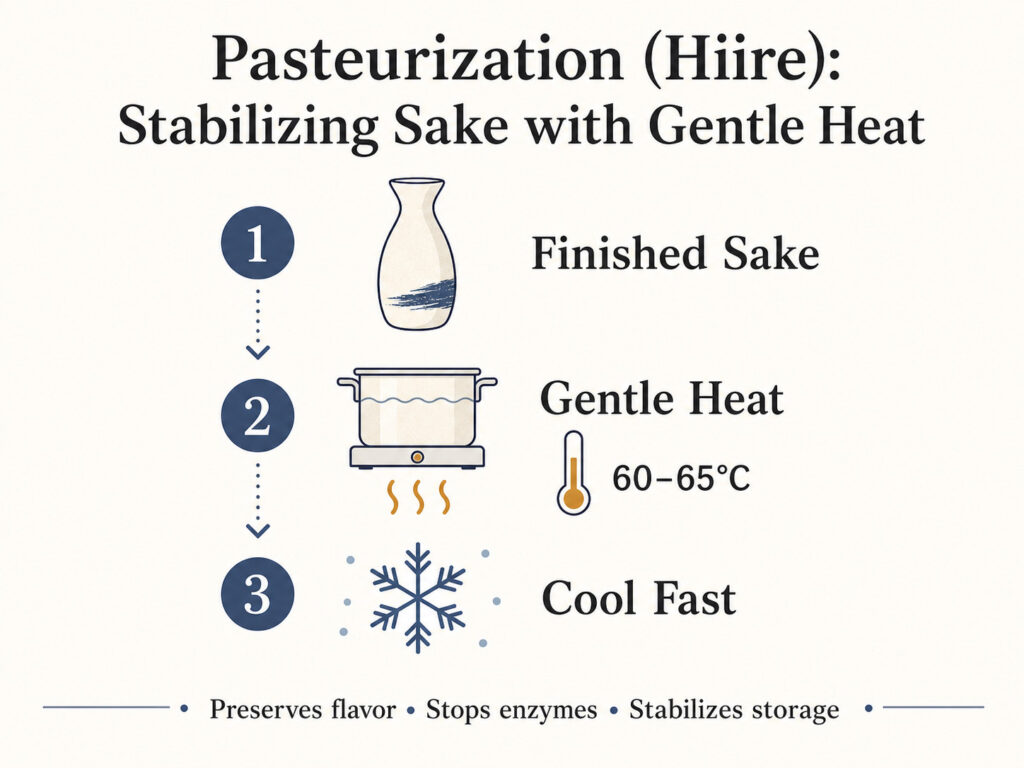
Hiire is the pasteurization step in sake brewing, and its job is refreshingly simple. Brewers warm the finished sake gently. that warmth settles and stabilizes the liquid so it holds its flavor in storage.
By the time this step arrives, the sake is nearly done. It has already been pressed, filtered, and refined into something clear and almost ready to drink. Yet it still carries active enzymes and living microbes. those quietly threaten everything achieved so far, which is exactly why one more step is needed.
The heating itself is surprisingly mild. Brewers bring the sake to around 60 to 65 degrees Celsius, hold it there briefly, then cool it quickly. The whole thing is over in minutes.
Pasteurization in Sake Brewing: Warmed, Not Cooked
Picture pasteurization, and you might imagine sake bubbling over a flame.
That image is completely wrong. The sake never comes near boiling, because temperature is everything here. Alcohol boils at about 78 degrees Celsius. So if the sake climbs too high, the alcohol simply escapes and the drink is ruined. Brewers therefore hold the heat well below that line. this careful balance protects both the strength and the delicate flavor.
The word hiire trips up newcomers for good reason. It literally means “adding fire,” yet no open flame ever touches the sake. The heat arrives indirectly and gently, so the name promises far more drama than the process delivers.
Think of warming a delicate cream sauce. Let it boil and it splits; hold it at a gentle heat and it stays silky and whole. Hiire follows the very same logic.
Above all, the goal is stabilization, never transformation. Brewers are not trying to change the flavor; they are trying to lock in the flavor they already built. So hiire preserves rather than alters, and that single aim guides every decision in the process.
The History of Pasteurization in Sake Brewing
The story of hiire is genuinely one of my favorites in all of sake.
It stretches back more than five hundred years, which makes it one of the oldest techniques still in daily use. What makes it remarkable is not only its age, though. Few brewing methods are this old. fewer still were being practiced long before anyone could explain the science behind them. That combination is what makes this history worth lingering on.
Early Records of Hiire
The written trail begins surprisingly early. One old brewing text lays out the practice plainly. scholars place it in the late fifteenth century, so brewers were already pasteurizing sake by around 1489.
Sit with that date for a moment. European winemakers were not heat-treating their wine, and they would not begin for centuries. Japan, working entirely by trial and observation, was simply ahead.
Louis Pasteur and Sake Pasteurization
The scientist we name the whole process after arrives much later. Louis Pasteur studied fermentation through the nineteenth century, and in 1866 he formally described gentle heat treatment for wine. His explanation was so influential that the world now calls the method pasteurization, after him.
The timing is almost hard to believe.
Pasteur was working in the 1860s. Japanese brewers had been using hiire since roughly the 1480s. That is a lead of about three hundred years. The only gap was explanation. They could not yet describe, in scientific terms, what their hands already knew.
Judging Heat by Hand
How did early brewers pull this off without any instruments?
They had no microscopes and no thermometers, and they could not see the enzymes or bacteria at work. Somehow they still noticed a clear pattern: heated sake kept better than untreated sake. Repeated over many seasons, that one observation slowly hardened into a dependable method handed from brewer to brewer.
Measuring the heat was the real trick.
With no gauge to read, brewers used the most available tool they owned, their own hands. A brewer would dip a hand straight into the warming sake and judge the temperature by feel alone. When the liquid grew too hot to bear after a few seconds. the hand pulled back on its own, the sake had reached the right point. They even named it the “hand-pulling” temperature, and that homespun test guided the craft for generations.
A very real fear sat underneath all of this.
Spoiled sake meant ruined batches and lost money, sometimes enough to sink a small brewery. A single stubborn bacteria could turn an entire tank sour, and no one could see it coming. Heat was the one defense that reliably worked, so heat treatment became a trusted, hard-won habit.
That spoilage bacteria still carries a name we use today: hiochi bacteria. It is a type of lactic acid bacteria, and it shrugs off the alcohol that kills most other microbes. Only heat truly stops it.
From a few temples and breweries, the method spread until nearly every kura relied on it. It settled into brewing as a standard, almost invisible step. So hiire quietly shaped the sake we drink now, and its long history lives on inside every bottle.
Why Pasteurization in Sake Brewing Matters
So why go to all this trouble? Why does pasteurization in sake brewing matter so much that nearly every brewery bothers? The reasons are part science, part hard commercial reality, and each one protects the finished sake in its own way.
Deactivating Enzymes and Microbes
Start with the enzymes. Finished sake still holds active enzymes left over from the koji. Left alone, they keep nudging the sake in new directions. Heat stops them cleanly in their tracks.
That matters because those enzymes slowly rewrite the flavor.
They break down compounds over time and pull the sake away from the taste the brewer aimed for. Shut them down, and the flavor is locked to the brewer’s intention rather than left to wander.
Then there is the microbe problem, which is more dangerous still. Sake can harbor unwanted microbes, and the most feared of them is the hiochi bacteria, which thrives even in alcohol. A single infection can cloud the liquid and sour the flavor. Once it takes hold, it can cost the brewer an entire batch.
Here is the frustrating part.
Alcohol alone will not save you. Hiochi bacteria tolerate ordinary sake strength without much trouble, and filtering does not reliably remove every last one. Gentle heat is the only defense that consistently deactivates them, which is precisely why hiire exists.
Stability, Shelf Life, and Transport
Beyond survival, there is stability. Pasteurized sake changes far more slowly, so its flavor stays close to the brewer’s intent. a bottle still tastes right months after it left the brewery. That consistency reassures the brewer and the drinker alike.
Shelf life follows naturally from that.
Unpasteurized sake spoils fairly quickly, while pasteurized sake can rest on a shelf for months. That simple durability is what makes wide distribution possible in the first place.
Transport is the last practical piece. Sake often travels long distances, meeting warmth and time along the way. pasteurization quietly guards against both so the bottle arrives in good condition.
There is a human side to all of this too. A drinker who opens a bottle expects it to taste the way it should. a spoiled sake breaks that unspoken promise. So brewers lean on heat to keep faith, and consistency becomes a small act of hospitality.
Put the reasons together and the case is overwhelming. Hiire protects flavor, quality, and shelf life, and it lets sake travel and wait without falling apart. Little wonder most brewers treat it as essential; the step quietly holds up the entire industry.
How Pasteurization in Sake Brewing Works
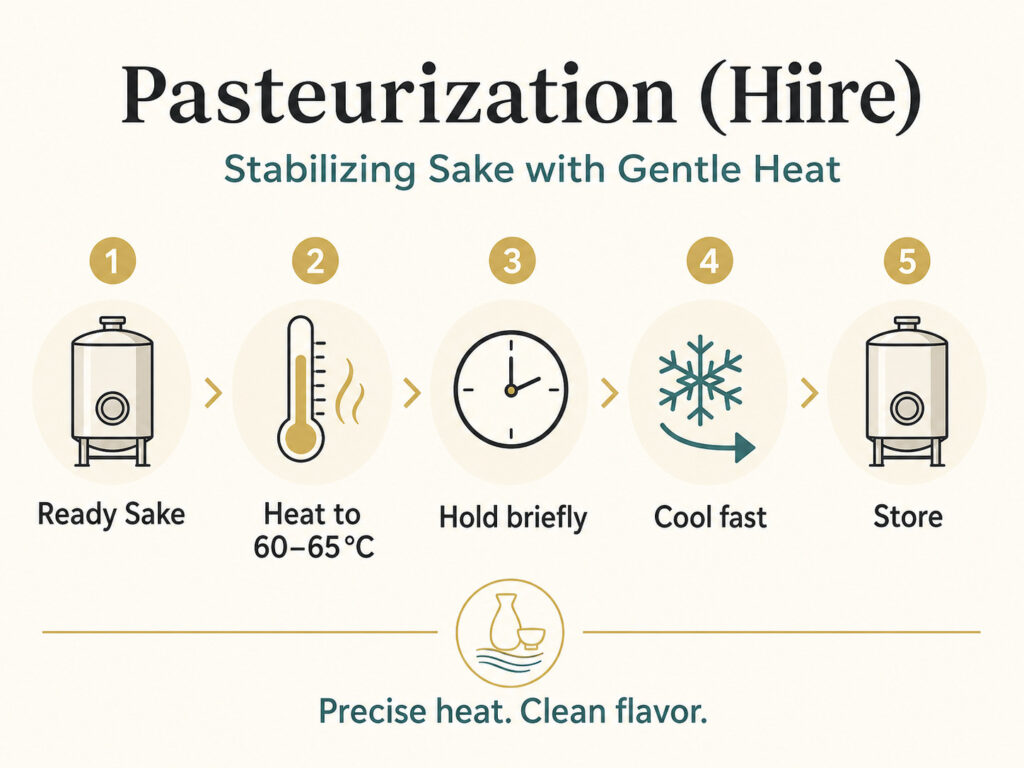
Let us walk through pasteurization in sake brewing from start to finish. The process is simple in outline but precise in practice, so every stage deserves a little care.
It begins with sake that is ready. The liquid has already been pressed and filtered, so it is clear and all but finished. prepared for this final layer of protection. That readiness sets up everything that follows.
Then comes the heating itself. Brewers warm the sake slowly and evenly toward 60 to 65 degrees Celsius, hold it there just long enough. let the enzymes and microbes deactivate.
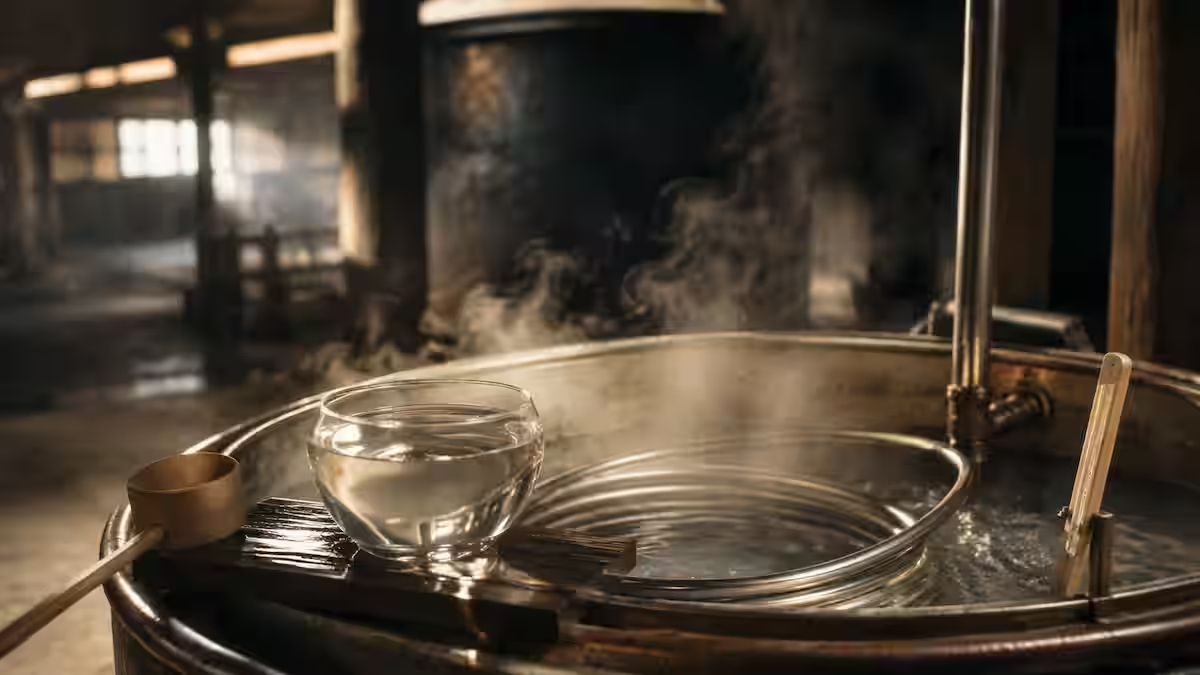
The exact tool varies from brewery to brewery. Some run the sake through a heated coil, while others warm sealed bottles in a hot-water bath. The equipment differs, yet every method chases the same gentle target.
Why Temperature Control Matters in Sake Pasteurization
Temperature is where this whole step lives or dies.
Too little heat, and the microbes survive to spoil the sake later. Too much, and the flavor flattens while the alcohol starts to slip away. Brewers therefore watch the thermometer closely, because the safe window is narrow and unforgiving, and hitting it takes real skill.
Timing matters just as much as temperature. The sake should stay warm only briefly, since a long hold quietly strips the aroma. So brewers heat it just enough and no more.
Cooling is the step people forget.
The moment the heating is done, brewers chill the sake as fast as they can. This is because slow cooling drags the flavor down. Speed here is not optional; a quick chill is what locks the fresh taste in place.
From there, the sake moves into storage, resting in tanks or waiting in bottles for aging or shipping. Pasteurization has done its job and handed off a calm, stable liquid.
Modern gear makes all of this cleaner and more repeatable, with machines controlling the heat precisely and cooling evenly. Some brewers still prefer the old bottle method for its gentle touch on fragile aromas, and both approaches happily coexist. Each brewery simply picks its own path.
One Pasteurization in Sake Brewing vs Two Pasteurizations
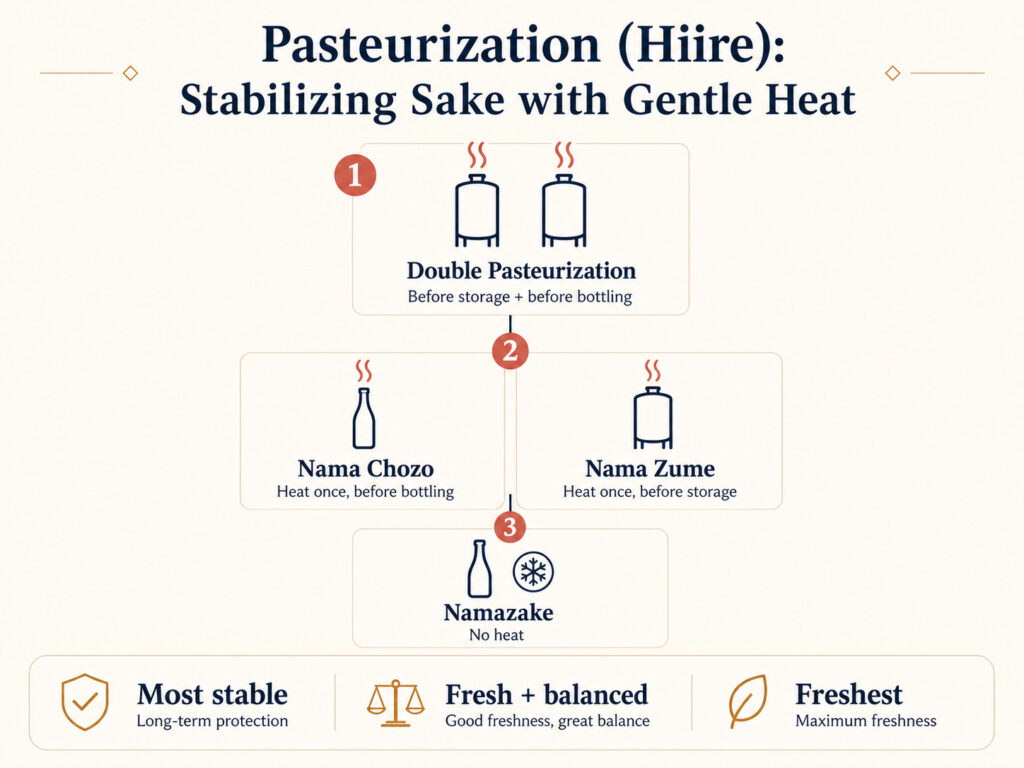
A question comes up constantly: how many times is sake actually pasteurized?
The honest answer is usually once or twice, and the exact count quietly defines the style in your glass.
Double Pasteurization
The classic approach is two heatings. Brewers pasteurize the sake once before storage and again before shipping. That guards it at both of its most vulnerable moments.
The first heating comes right after filtration. It settles the sake before the long rest of aging. So the liquid matures safely in the tank rather than drifting or spoiling.
The second heating waits until bottling is near. It shields the sake for the journey ahead, defending against spoilage through transport and time on the shelf. So the bottle reaches the drinker in the shape the brewer intended.
Two heatings buy the most stability of all. The sake shrugs off spoilage, holds a consistent flavor. travels and waits without complaint, which is exactly why everyday, widely sold sake tends to be double-pasteurized.
Single Pasteurization: Nama Chozo and Nama Zume
Some sake, though, is heated only once.
Brewers deliberately skip either the first or the second heating to keep a little more freshness. the two resulting styles even have their own names.
Skip the pre-storage heating, and you get the first style. The sake ages raw and unpasteurized, then receives a single stabilizing heat before bottling. This is nama chozo, or “raw stored” sake. it keeps a bright, lively character while still earning some shelf life.
Skip the pre-bottling heating instead, and you get the mirror image. The sake is stabilized once before storage, then bottled raw. This is nama zume, or “raw packed” sake.
Nama zume hides a seasonal treasure inside it.
Sake stabilized once and bottled raw in autumn is called hiyaoroshi. It has rested and mellowed through the warm summer months, so it pours smooth, round. gentle, and its yearly release is something fans genuinely look forward to.
A simple mental model ties it together. Two heatings give maximum stability. One heating balances freshness and keeping. zero heatings for the freshest style of all. The count is really just a dial between stability and freshness.
| Type | Heatings | When | Character |
|---|---|---|---|
| Double pasteurization | Twice | Before storage and before bottling | Very stable, long shelf life |
| Nama chozo | Once | Before bottling only | Fresher; aged raw, then stabilized |
| Nama zume | Once | Before storage only | Fresh; bottled raw (includes hiyaoroshi) |
| Namazake | Zero | No heat at all | Freshest, lively; needs refrigeration |
That dial never gives you something for nothing. More heat buys shelf life; less heat buys liveliness. Brewers simply choose the setting that fits their goal, and no single choice is automatically the best.
What Is Namazake?
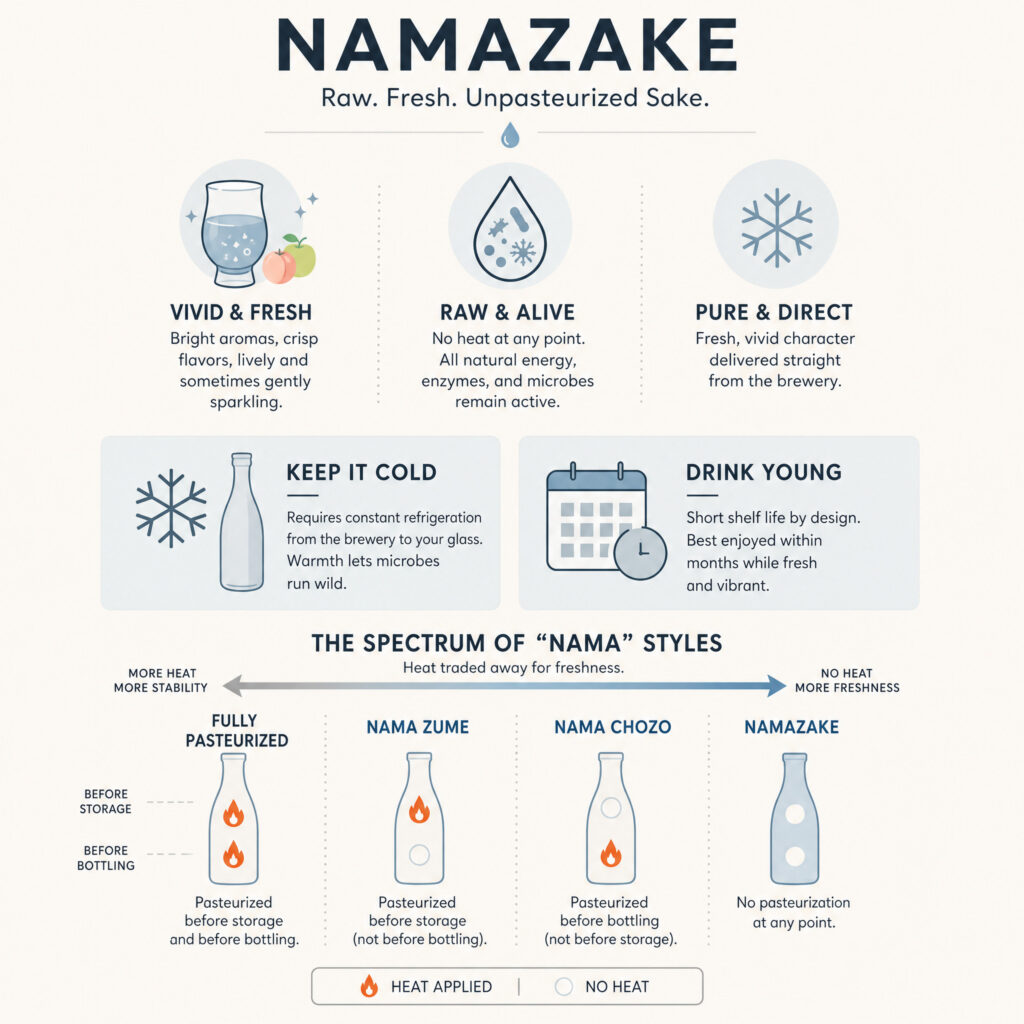
Namazake is the outlier in this whole story. It is sake that skips pasteurization entirely, taking no heat at any point. that alone makes it a special, slightly daring style.
The word nama means “raw” or “fresh,” and namazake earns it. With no heat to settle it, the sake keeps every bit of its natural energy, tasting vivid, fresh. gloriously direct. It is easy to see why so many drinkers fall for it.
That freshness shows up first in the glass. The aromas leap out bright and fruity, the flavor feels crisp and alive. some bottles even carry a faint natural prickle of sparkle.
Handling and Shelf Life
All that liveliness comes at a price, though.
Because the enzymes and microbes are still active, the sake never stops changing. it can spoil far more easily than any pasteurized bottle. That fragility dictates how it must be treated.
Namazake demands cold, and it demands it constantly. Leave it at room temperature and the microbes run wild. So the bottle has to stay chilled from the brewery all the way to your glass. Everyone in the chain, from brewer to shop to drinker, keeps it cold.
Its shelf life is short by design. Namazake is at its best young. its vivid character fades within months, so it is not a bottle to tuck away and forget. Drinking it soon is simply part of the pleasure.
Namazake, Nama Chozo, and Nama Zume Compared
It helps to picture a spectrum.
At one end sits fully pasteurized sake, stable and long-lived. At the other sits namazake, fresh and fragile. The single-pasteurized styles fill the space between. the whole family runs on one simple rule: heat traded away for freshness.
Laid side by side, the “nama” styles are easy to separate. True namazake takes no heat at all. Nama chozo takes one heating, before bottling. Nama zume takes one heating, before storage. Everything comes down to which of the two heating points is used.
If the labels still tangle, hold on to those two moments, pre-storage and pre-bottling. Each style simply keeps or skips them, and that little framework untangles the whole shelf. For more on cloudy and specialty bottles, see our nigori and specialty sake coverage.
Namazake is worth the care it asks for. The fresh, vivid taste is hard to find anywhere else. It only asks that you guard the cold chain and drink quickly. Treated well, it is a small adventure in a glass.
Pasteurization and Flavor
Pasteurization in sake brewing shapes the sake in ways that are quiet but real. It touches aroma, freshness, and texture together. Its fingerprints end up all over the finished glass, so it is worth taking each element in turn.
Aroma feels the change first. Fresh, unpasteurized sake smells vivid and fruity. gentle heat softens those bright top notes, so a pasteurized bottle tends to smell calmer and more settled by comparison.
Freshness is the difference you notice fastest. Namazake tastes lively and almost zippy, while pasteurized sake reads rounder and smoother. So the heat trades a little sparkle for calm. each style wins its own kind of fan.
Texture shifts in a subtler way. Some drinkers swear heated sake feels softer, with gentler edges on the tongue and a faintly silky finish. that small comfort is part of its appeal.
Stability is the gift you only notice later.
Because pasteurized sake changes so slowly, its flavor clings to the brewer’s intent. a bottle still tastes right long after it was made. That reliability is easy to take for granted.
Aging leans on the same stability. Because a heated sake rests safely, it can deepen and round out over time. This is why pasteurized sake suits patient aging while namazake is a drink-it-now pleasure.
Underneath every one of these effects sits a single truth. Pasteurization does not invent flavor; it preserves the flavor the brewer already built. It protects a style rather than reshaping it.
Think of it as pressing pause. The sake is held at its best moment, change slows to a crawl. what reaches the drinker is the brewer’s vision, kept intact by nothing more than gentle heat.
Traditional and Modern Pasteurization in Sake Brewing Methods
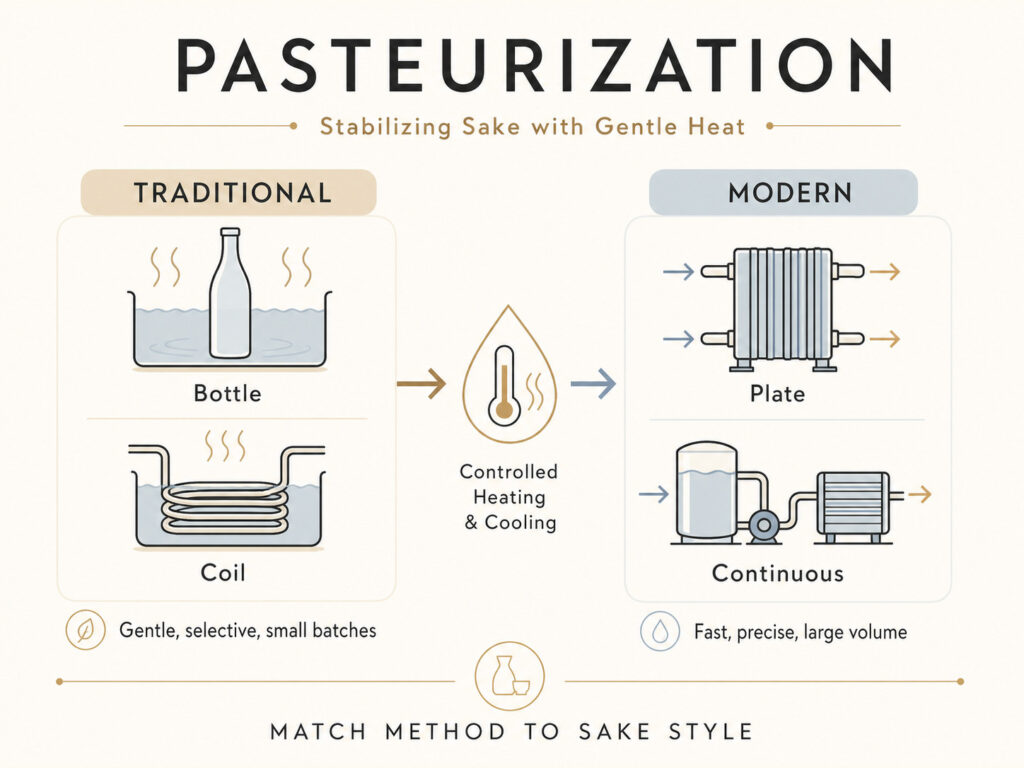
Brewers reach this same gentle result along quite different roads, some centuries old and some brand new. Tradition and technology sit comfortably side by side, so let us compare the main routes.
Traditional Bottle Pasteurization
The oldest approach is bottle pasteurization. Brewers fill and seal the bottles first, then warm them in a hot-water bath. So the sake heats gently inside its own glass in a way that feels careful and unhurried.
Its strengths are easy to appreciate. The heat spreads slowly and evenly, contact with air stays minimal. delicate aromas come through unharmed, which is why plenty of premium brewers still swear by it.
It is not without headaches, though. The method is slow and hands-on. warming bottles one batch at a time simply cannot scale. So it tends to stay the domain of small, quality-obsessed breweries.
A second old-school option is the heated coil. Brewers run the sake through a submerged pipe sitting in hot water, warming it as it flows. this snake-like coil remains a genuine classic of the brewhouse.
Modern Heat Exchangers
Newer breweries often reach for a plate heat exchanger instead. Thin metal plates pass warmth into the sake as it flows past. They bring it to temperature fast, then cool it just as quickly.
The upside is obvious. These systems move fast, handle large volumes. hold the temperature with real precision, which is exactly what big, consistent production demands.
Continuous systems take the idea even further, letting the sake flow through heating and cooling without ever stopping between batches. So production hums along and large breweries lean on the steady rhythm.
Speed does carry a quiet cost.
Rushed heating can bruise fragile aromas, so thoughtful brewers dial the settings back for their finest sake. The tool always has to suit the bottle.
In the end, each method has its rightful place. Bottle pasteurization flatters delicate, premium sake; plate exchangers carry the weight of everyday production. Brewers simply match the approach to the character of the sake in front of them.
Pasteurization in Sake Brewing and Different Sake Styles
Pasteurization choices ripple through nearly every style of sake, because each type strikes its own balance between stability and freshness. The heating you choose ends up reflecting the identity of the sake. So it helps to connect it to familiar names.
Take a clean junmai. It usually gets the standard two heatings. This hand it a stable, even profile, as our junmai guide explains. So it stays consistent and endlessly easy to drink.
Fragrant ginjo and daiginjo call for a lighter hand. Their aromas are precious and easily bruised. heavy heat would dull them, so brewers pasteurize gently and precisely, often favoring the bottle method. Our ginjo and daiginjo guides go deeper.
Namazake, naturally, opts out of heat altogether, keeping its full raw character and relying on cold storage to stay safe.
A couple of labels are easy to misread. Muroka describes a filtering choice rather than a heating one. it skips charcoal filtration for a fuller body, as our filtration guide shows. Yet it may still be pasteurized normally. Genshu, meanwhile, simply means no water was added after brewing. pasteurization choices still stack on top, so a genshu can be either heated or raw.
The lesson underneath is steady. Pasteurization is one tool among many, working shoulder to shoulder with filtering, dilution. pressing, so the finished style is always the sum of many choices, not the work of heat alone.
The Science Behind Hiochi Bacteria
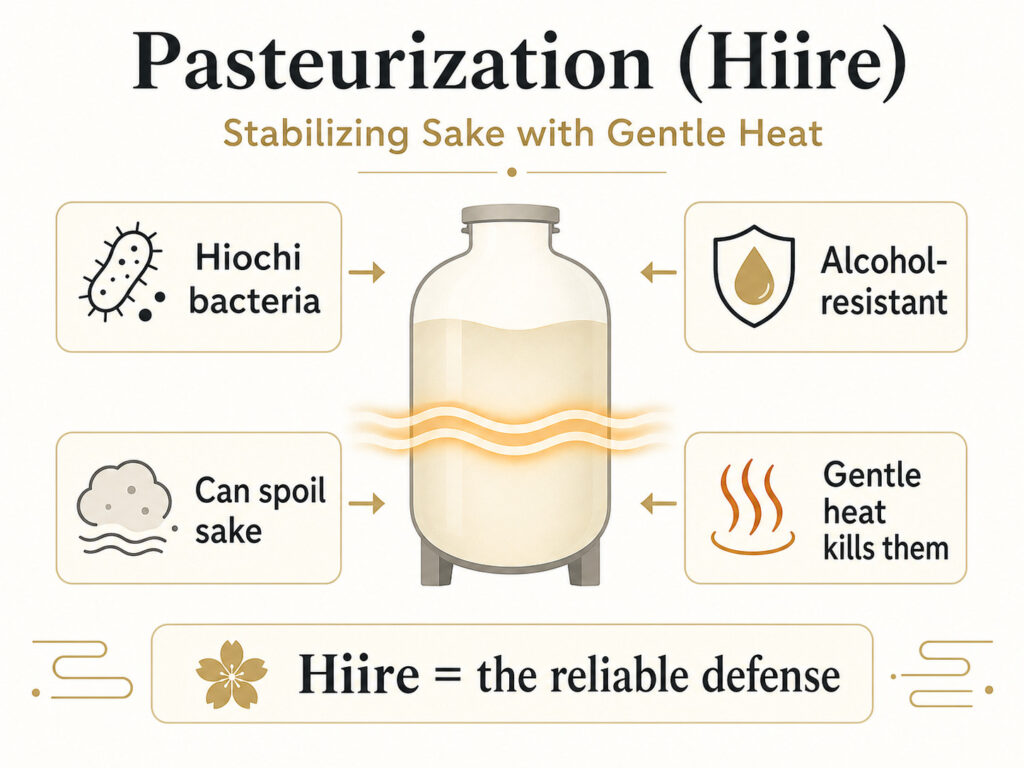
Hiochi bacteria earn a section of their own, because they are the whole reason hiire exists. Understand them, and the entire step suddenly makes sense; their story is quietly dramatic.
They belong to the lactic acid bacteria, but they are an unusually hardy branch of the family. Most bacteria simply die in alcohol. These do not.
For a brewer, that toughness is a nightmare. The bacteria can settle into finished sake, cloud the liquid. sour the taste, turning a sellable batch into a write-off. in the old days they could claim whole tanks at a time.
They flourish because sake happens to suit them beautifully, offering just the nutrients they crave. This is why brewers stay watchful season after season.
Against all that, heat is the one dependable weapon. Gentle warmth kills the hiochi bacteria where alcohol and filtering fall short. So hiire remains the true line of defense, a lesson generations of brewers learned the hard way.
A Closer Look at the Historical Record
The written record is worth pausing on a little longer. This is because it shows just how far ahead these early brewers really were.
The old brewing manuals do not hint at heat treatment. they spell it out, describing how brewers warmed sake to keep it. Those texts belong to the Muromachi period, so the practice was clearly well established, and clearly valued.
The striking part is what they did not know.
Microbes were an unknown world, bacteria an idea that did not exist, and enzymes a mystery. Brewers could not have told you why heat worked. They only knew, beyond doubt, that it did.
That blindness makes the achievement larger, not smaller. They solved a microbial problem they could not even see, guided by patience and stubborn observation. built a method that science would only vindicate centuries later.
When Louis Pasteur explained how gentle heat kills microbes, his insight reshaped food and drink worldwide. His name became attached to the whole idea. Japan, quietly, had been living that principle for generations already.
There is a gentle lesson in all of it. Careful watching can outrun formal theory, and tradition sometimes arrives first with the truth. Few crafts illustrate that as beautifully as sake.
Pasteurization and Aging
Pasteurization in sake brewing and aging are quietly bound together. Only a stable sake can rest and mature without risk. It is worth seeing how the two lean on each other.
After heating, sake often settles into a resting period. Given time, the sharp notes of youth soften and round, the flavors knit together. the sake gains a real sense of depth, all made possible by the stability that pasteurization provides.
Try that without heat, and you are gambling. Active microbes could spoil the sake. the flavor might wander far off course, so pasteurization is what keeps maturation gentle and under control.
Some sake rests for many months. a few age far longer. The heat treatment stands guard the whole way. It lets the sake mature exactly as the brewer imagined.
Namazake, true to form, wants none of this. It shines young and fresh, and long aging only dulls its charm, so drinkers rarely hold it for long. Its beauty is a beauty of youth.
How to Store Pasteurized and Nama Sake
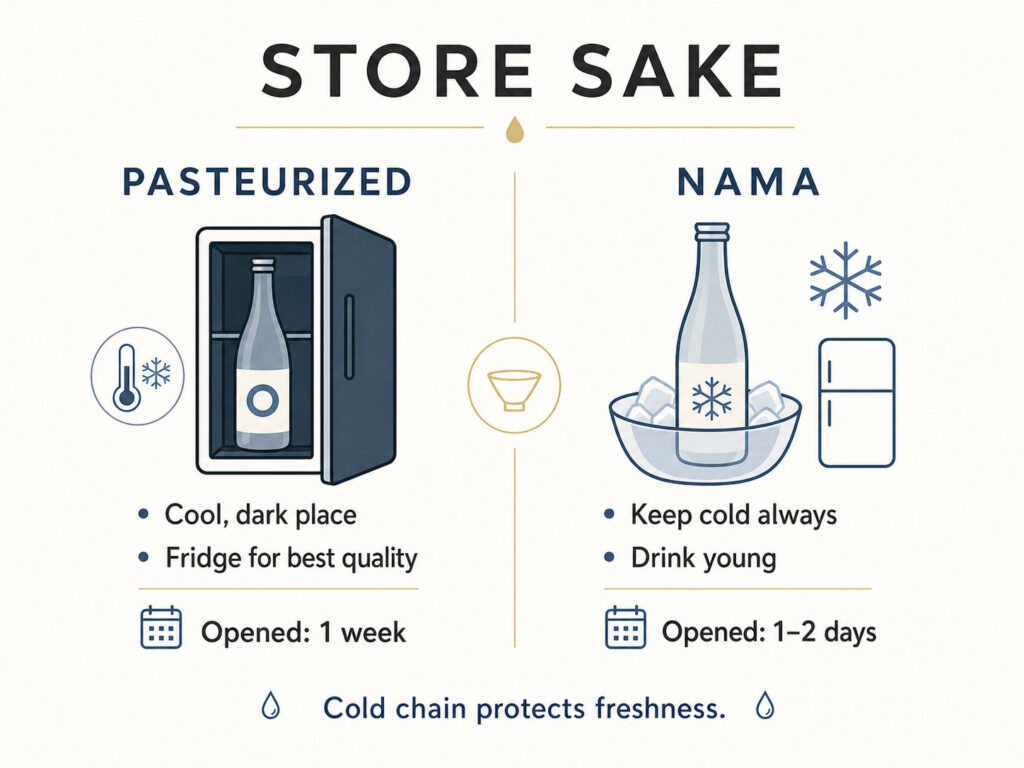
Storage is where all this pasteurization in sake brewing theory finally meets your kitchen. A few simple habits keep any bottle at its best, so it is worth knowing how to treat each type.
Pasteurized sake is forgiving. A cool, dark cupboard away from sunlight suits it well, though strong light and heat still do slow harm. a refrigerator is safer still for anything special.
Namazake asks for much more.
It has to stay cold every single moment, because room temperature lets it change fast. So it belongs in the fridge right up until you pour it. The cold chain is what protects its fresh soul.
Shelf life splits the two cleanly. An unopened pasteurized bottle keeps for months, while namazake is best inside roughly half a year. So nama styles are meant to be drunk young while their freshness is the whole point.
Opening a bottle resets the clock for both. Air dulls the flavor once the seal is broken. So a pasteurized bottle is best finished within a week or so. namazake rewards even quicker drinking, ideally within a day or two.
None of this is fussy; it is just respect for the work in the glass. Store each bottle to suit its type, and a little care pays you back in every sip.
How to Read Nama Labels
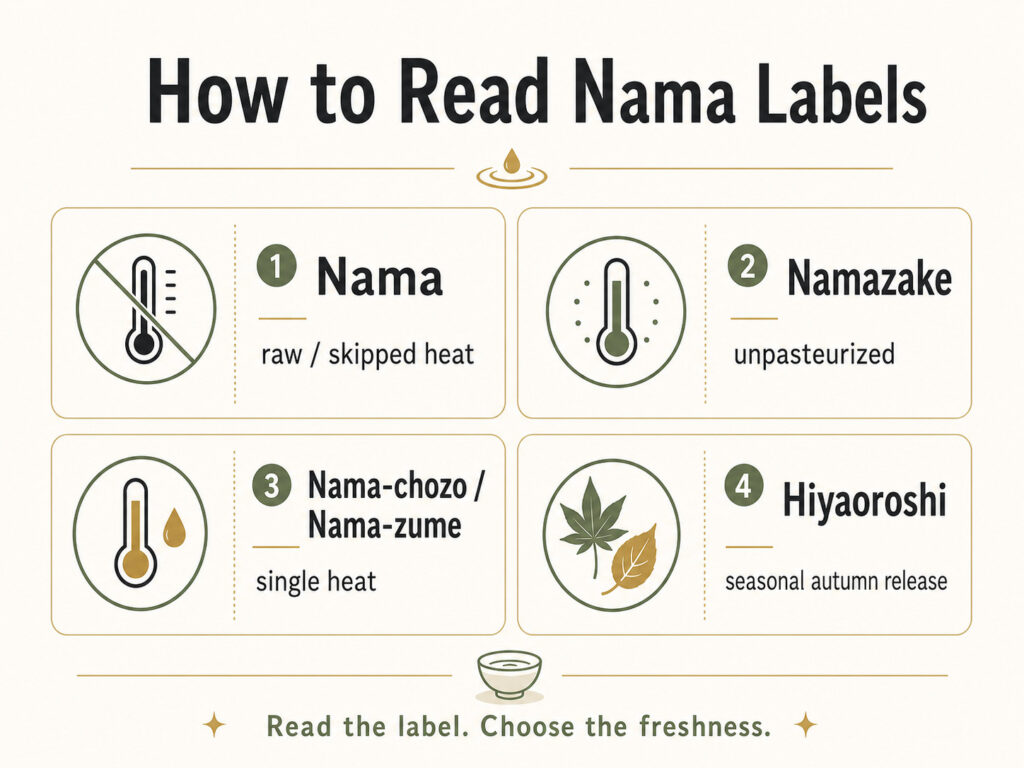
A sake label quietly tells you how the bottle was heated. You just need to know the handful of words to watch for. A short cheat sheet goes a long way.
The word nama flags that heat was skipped somewhere. On its own, it usually points to namazake. That means a fully unpasteurized bottle. It needs cold storage and a quick finish.
Nama chozo and nama zume both signal a single heating, each skipping one of the two heating points. So they hold on to some freshness while staying steadier than pure namazake.
Hiyaoroshi is the one to circle in autumn. Bottled raw after a summer of quiet aging, it drinks smooth, round. mellow, and its seasonal arrival is a small yearly event for fans.
A little of this vocabulary pays off fast. Read the label, predict the freshness, and choose your bottle on purpose; before long these terms feel like old friends.
Common Misconceptions About Pasteurization in Sake Brewing
A few stubborn myths cling to pasteurization. Let us clear them up plainly.
- Does pasteurization cook the sake? No. The sake is only gently warmed and never comes close to boiling.
- Is namazake always better? No. It is simply fresher and livelier, while pasteurized sake offers stability and depth.
- Is all sake pasteurized twice? No. The number varies, and some sake is heated once or not at all.
- Does pasteurization remove alcohol? No. Brewers keep the heat below the alcohol’s boiling point.
- Does pasteurization destroy flavor? No. It preserves the brewer’s intended flavor, trading a little freshness for stability.
Every one of these myths grows from the same seed: the assumption that heat must harm the sake. In truth, gentle heat protects far more than it changes. So it pays to judge each bottle on its own terms rather than on the label alone.
Final Thoughts
Pasteurization is one of the last quiet steps that protects everything the brewer built. It follows filtration and stands guard over the finished sake, deactivating enzymes and microbes so the intended flavor survives. That is the real work of pasteurization in sake brewing: safeguarding quality, aroma, and shelf life. It is a gentle stabilizing process, never a form of cooking. most sake passes through it once or twice for the sake of lasting consistency. Namazake is the daring exception, trading heat for pure freshness and asking for cold, careful handling in return. Most remarkable of all, Japan was practicing this centuries before Pasteur ever named the science. Both pasteurized and namazake sake can be wonderful, each simply chasing a different vision in the glass. Understand hiire, and you understand how sake reaches you exactly as its maker intended.
Pasteurization in Sake Brewing FAQ
What is hiire?
Hiire is the Japanese word for sake pasteurization. It is a gentle heat treatment near the end of brewing. Brewers warm the sake to stabilize it. So the flavor stays steady during storage.
Why is sake pasteurized?
Pasteurization deactivates enzymes and kills spoilage microbes. This stabilizes the flavor and extends shelf life. It also protects the sake during transport. So the bottle tastes as the brewer intended.
Is sake always pasteurized?
No, not every sake is pasteurized. Most sake is heated once or twice. Some styles skip heat completely. That unpasteurized style is called namazake.
What is namazake?
Namazake is raw, unpasteurized sake. It skips heat treatment entirely. So it tastes fresh, lively, and fruity. It needs refrigeration and quick drinking.
What is the difference between namazake and regular sake?
Regular sake is pasteurized once or twice. Namazake receives no heat at all. So namazake tastes fresher but spoils faster. Regular sake is more stable and keeps longer.
Why is sake pasteurized twice?
The first heating stabilizes the sake before storage. The second protects it before shipping. Together they give strong, lasting stability. So the sake travels and waits safely.
Does pasteurization affect taste?
Yes, it can soften bright aromas slightly. Pasteurized sake tastes rounder and calmer. Namazake tastes livelier and fresher. So the heat trades some sparkle for stability.
Does pasteurization remove alcohol?
No, the alcohol stays intact. Brewers keep the heat below its boiling point. The sake never gets hot enough to lose alcohol. So the strength stays essentially the same.
Does sake need refrigeration?
It depends on the type of sake. Pasteurized sake is fairly stable at cool room temperature. Namazake must stay refrigerated at all times. So always check the label for guidance.
Can pasteurized sake age?
Yes, pasteurized sake can age well. The heat keeps it stable during maturation. So the flavor deepens gently and safely. Namazake, by contrast, is best enjoyed young.
Is unpasteurized sake better?
No, it is simply different. Namazake offers fresh, vivid flavor. Pasteurized sake offers stability and depth. So the best choice depends on your taste.
Did Japan pasteurize sake before Louis Pasteur?
Yes, by roughly three hundred years. Records show heat treatment in the late fifteenth century. Pasteur described the science in 1866. So Japanese brewers were far ahead of the theory.
References
- National Research Institute of Brewing, “Standard English Terms for Sake” list, giving “pasteurization” and “heat sterilization” for hiire. (Surveyed: June 2026)
- Japan Sake and Shochu Makers Association, glossary of sake terms (hiire, namazake, nama chozo, nama zume). (Surveyed: June 2026)
- Brewing Society of Japan, materials on hiochi bacteria and heat treatment in sake. (Surveyed: June 2026)
- National Tax Agency of Japan, labeling standards for nama (unpasteurized) sake. (Surveyed: June 2026)
Related Articles
- Filtration (Roka): Refining Sake After Pressing (Surveyed: June 2026)
- Pressing (Joso): How Moromi Becomes Sake (Surveyed: June 2026)
- Sokujo: The Modern Yeast Starter (Surveyed: June 2026)
- How Sake Is Made (Surveyed: June 2026)
- Types of Japanese Sake (Surveyed: June 2026)
- Nigori Sake (Cloudy Sake) (Surveyed: June 2026)





Comments