Hi-ochi (火落ち) is the bacterial spoilage of sake. It strikes after brewing finishes, and a small group of ethanol-tolerant lactic acid bacteria causes it. Sake is a hostile place for microbes, so the fact that anything spoils it at all still comes as a surprise.
The term is not a polite way of saying that sake has gone off. Instead it names a specific microbiological event, and much of sake pasteurization makes sense only once hi-ochi is understood. This guide covers the bacteria involved, what they do to the liquid, how heating and storage keep them in check, and how the whole problem shaped Japanese brewing.
TOC
Quick Facts
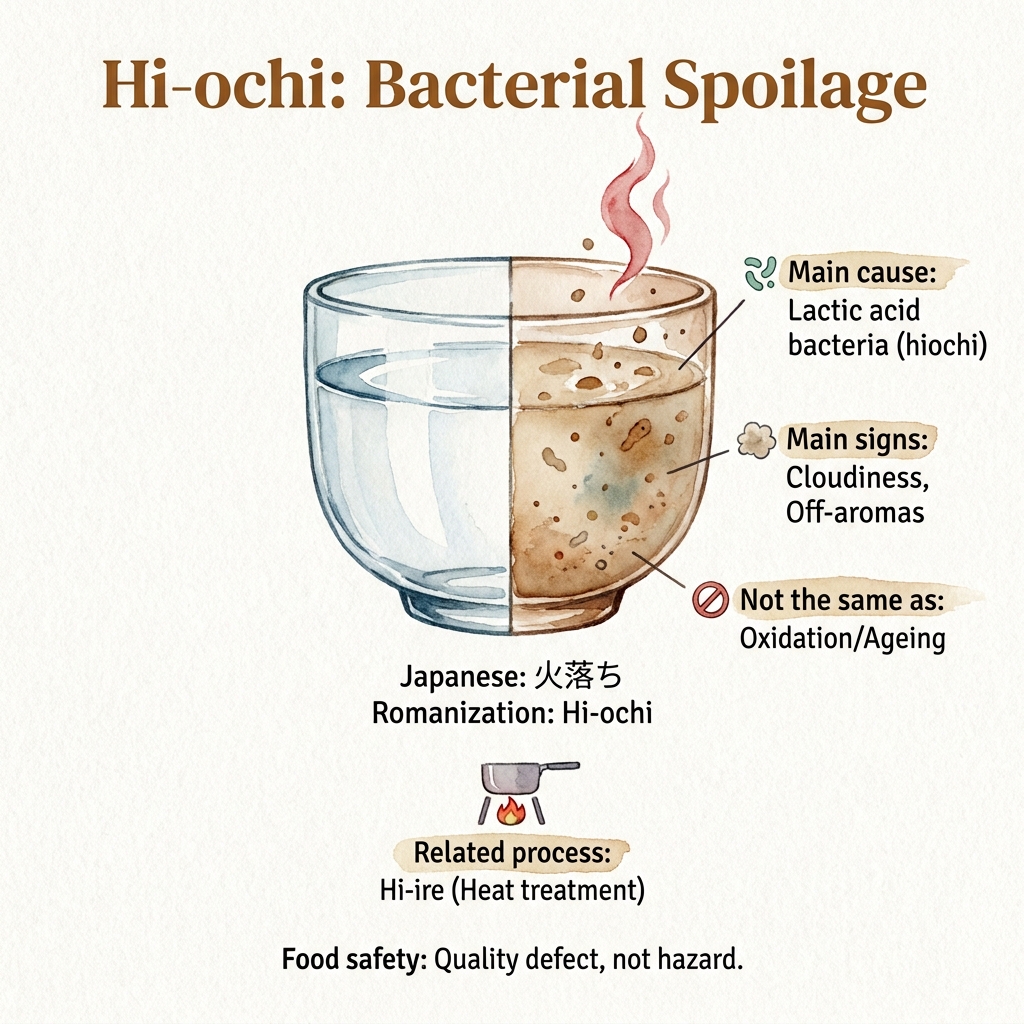
Illustration of Hi-ochi bacterial spoilage in sake highlighting causes and signs.
Japanese
火落ち
Romanization
Hi-ochi, also written hiochi
English
Bacterial spoilage, or bacterial contamination
Main cause
Ethanol-tolerant lactic acid bacteria, called hiochi bacteria
Main signs
Rising acidity, off-aromas, sometimes cloudiness
Related process
Hi-ire, the heat treatment used to stabilise sake
Not the same as
Hine-ka, oxidation, light damage or deliberate ageing
Food safety
Discussed as a quality defect rather than as a foodborne hazard
The Japan Sake and Shochu Makers Association defines hi-ochi as bacterial contamination by hiochi lactobacillus, while noting that the resulting spoilage damages both taste and aroma. Pasteurization, it adds, counts as one way to prevent the problem.
What Is Hi-ochi?
Illustration explaining Hi-ochi bacterial spoilage process in sake, highlighting signs and stages.
A microbial failure in finished sake, distinct from every other way a bottle can decline.
Reading the name
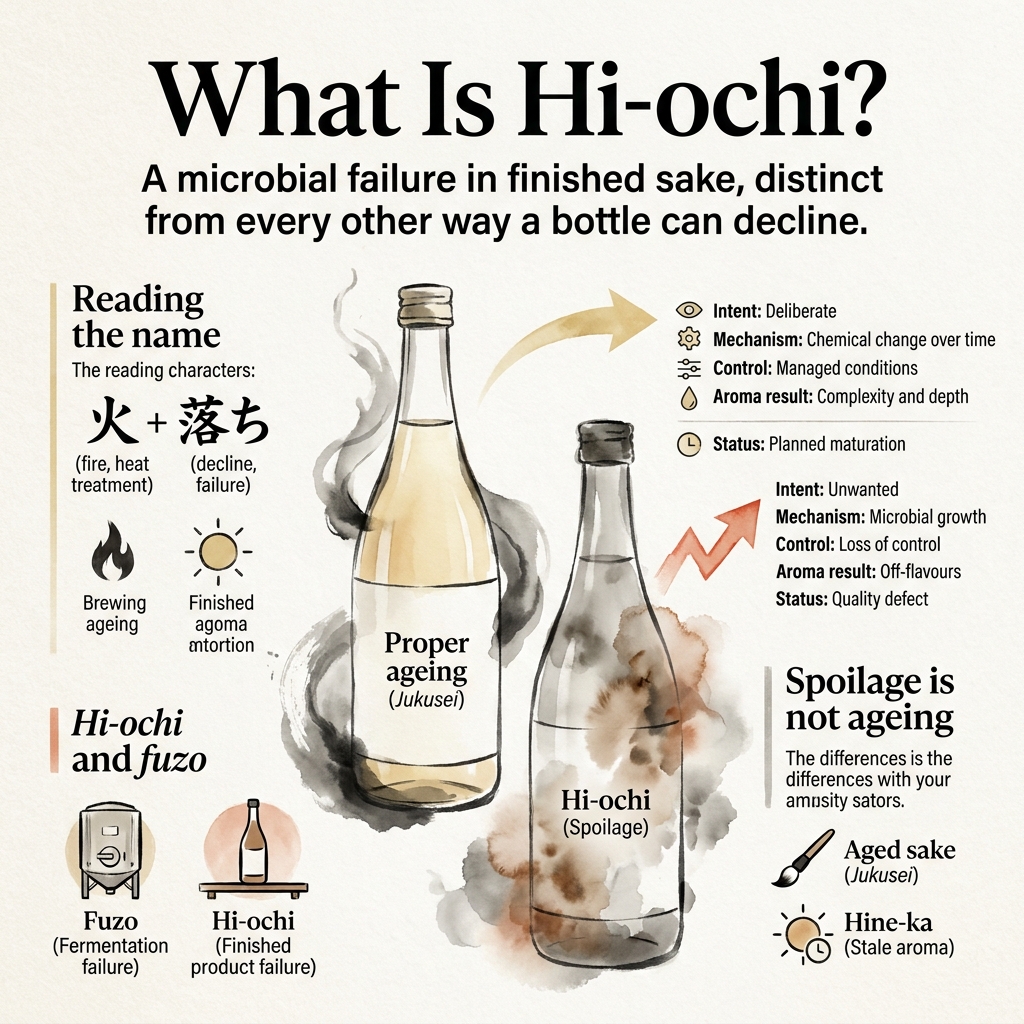
The first character, 火, means fire and evokes the heat treatment known as hi-ire. The second, 落ち, suggests decline or failure. Together they point to sake deterioration associated with inadequate microbial control.
Those characters literally suggest fire and falling, although the word functions as a technical brewing term rather than a phrase that translates character by character with confidence. Heat treatment itself is far older than the vocabulary used to discuss it, so the precise historical derivation should not be read too literally from the two characters alone.
Hi-ochi and fuzo
Fuzo (腐造) describes a batch that goes wrong while it is still fermenting, before pressing. The mash sours, fermentation stalls, or else the whole tank becomes unusable. Hi-ochi, by contrast, strikes finished product during storage or distribution.
The distinction shapes the response. A fuzo problem sends a brewer back to the starter, the mash and the incoming water. A hi-ochi problem sends them to heating records, equipment and the bottling line instead. Both failures could once wipe out a season’s work.
Spoilage is not ageing
Sake changes in the bottle whatever anyone does, of course. Some of that change is planned, so brewers call it jukusei. Aged sake develops depth, colour and savoury complexity that many drinkers value highly, and none of it involves bacterial growth.
Hine-ka forms a third category. The term describes a stale, flat aroma linked to storage conditions and chemical change rather than to bacteria. Heat, light and time generally drive it. A sake can show hine-ka without any microbiological problem whatsoever.
Point
Proper ageing
Hi-ochi
Intent
Deliberate
Unwanted
Mechanism
Chemical change over time
Microbial growth
Control
Managed conditions
Loss of control
Aroma result
Complexity and depth
Off-flavours
Status
Planned maturation
Quality defect
Collapsing matured aroma, hine-ka and hi-ochi into a single idea of old sake loses all the useful information. Each describes a different mechanism, and a brewery would investigate each one differently.
The Bacteria Behind Hi-ochi
Illustration explaining Hi-ochi bacterial spoilage in sake and its effects on quality.
A narrow group of lactic acid bacteria, adapted to conditions that exclude almost everything else.
Two groups, not one
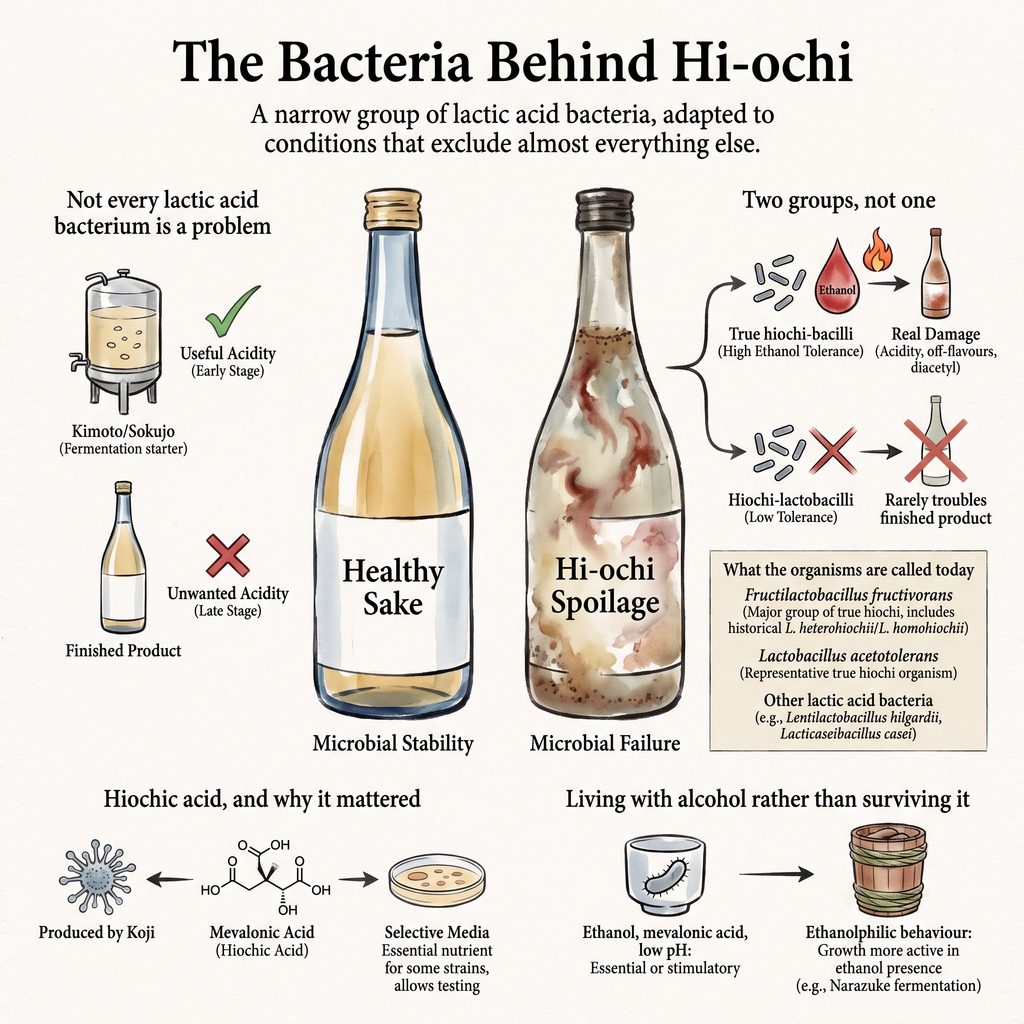
Research on sake spoilage divides hiochi bacteria into two groups. The first, usually called hiochi-lactobacilli, tolerates less ethanol and less heat, so it rarely troubles finished product. The second group, the true hiochi-bacilli, tolerates ethanol remarkably well and does the real damage.
A 2008 review in the Journal of the Institute of Brewing sets out that split clearly. True hiochi-bacilli, it notes, confer acidity and off-flavours including diacetyl in spoiled sake.
What the organisms are called today
Fructilactobacillus fructivorans The current name applied to a major group of true hiochi bacteria. Taxonomists now treat two historical names from 1957, Lactobacillus heterohiochii and Lactobacillus homohiochii, as later heterotypic synonyms of this species. The organism moved into a newly established genus during the 2020 reorganisation of Lactobacillus.
Lactobacillus acetotolerans Discussed in more recent work as a representative true hiochi organism. The 2020 taxonomic note also observes that the lost type strain of L. homohiochii probably represented something related to this species.
Other lactic acid bacteria Species including Lentilactobacillus hilgardii and members of the Lacticaseibacillus casei group appear in the broader hiochi group.
The exact roster depends on how the term is being used. Narrowly, hiochi bacteria means the true hiochi organisms. Broadly, it covers sake-spoilage lactic acid bacteria in general. Older sources also predate the 2020 renaming, so the same bacterium can appear under several names across the literature.
Not every lactic acid bacterium is a problem
This point confuses newcomers, and understandably so. Sake brewing actively relies on lactic acid bacteria at one stage, because the yeast starter needs acidity to keep rivals out. Kimoto encourages those bacteria to arrive naturally, while sokujo adds food-grade lactic acid at the start instead.
Hiochi bacteria are a different matter entirely. They belong to the same broad family, yet they appear in the wrong place at the wrong time, long after fermentation has finished. Useful acidity early in the process, then, and unwanted acidity months later.
Hiochic acid, and why it mattered
Some hiochi bacteria cannot grow without a specific nutrient, which Japanese researchers originally called hiochic acid. That compound turned out to be mevalonic acid, already known to biochemists elsewhere.
The 1957 classification work used exactly this dependency to sort strains, separating those for which the acid was essential from those that managed without it. Later research found the requirement is not absolute across all true hiochi bacteria, which complicated the neat original picture.
The discovery still paid off practically. A bacterium with an unusual nutrient requirement can be detected through that requirement, so selective media built on this principle let breweries test rather than hope. Mevalonic acid also enters sake through koji mould activity, which produces a neat irony. Our guide to koji covers that side of the process.
Living with alcohol rather than surviving it
The 2008 review describes the combination plainly. Ethanol, mevalonic acid and a low pH environment all count as essential or stimulatory for true hiochi-bacilli. These organisms are not merely surviving sake, then. They are suited to it.
Recent work on related bacteria uses the word ethanolphilic for this behaviour, meaning growth that becomes more active in the presence of ethanol rather than less. Strains identified as F. fructivorans have also been reported in narazuke fermentation, where sake lees provide the alcohol. Context, rather than biology, decides whether we call the result spoilage or preservation.
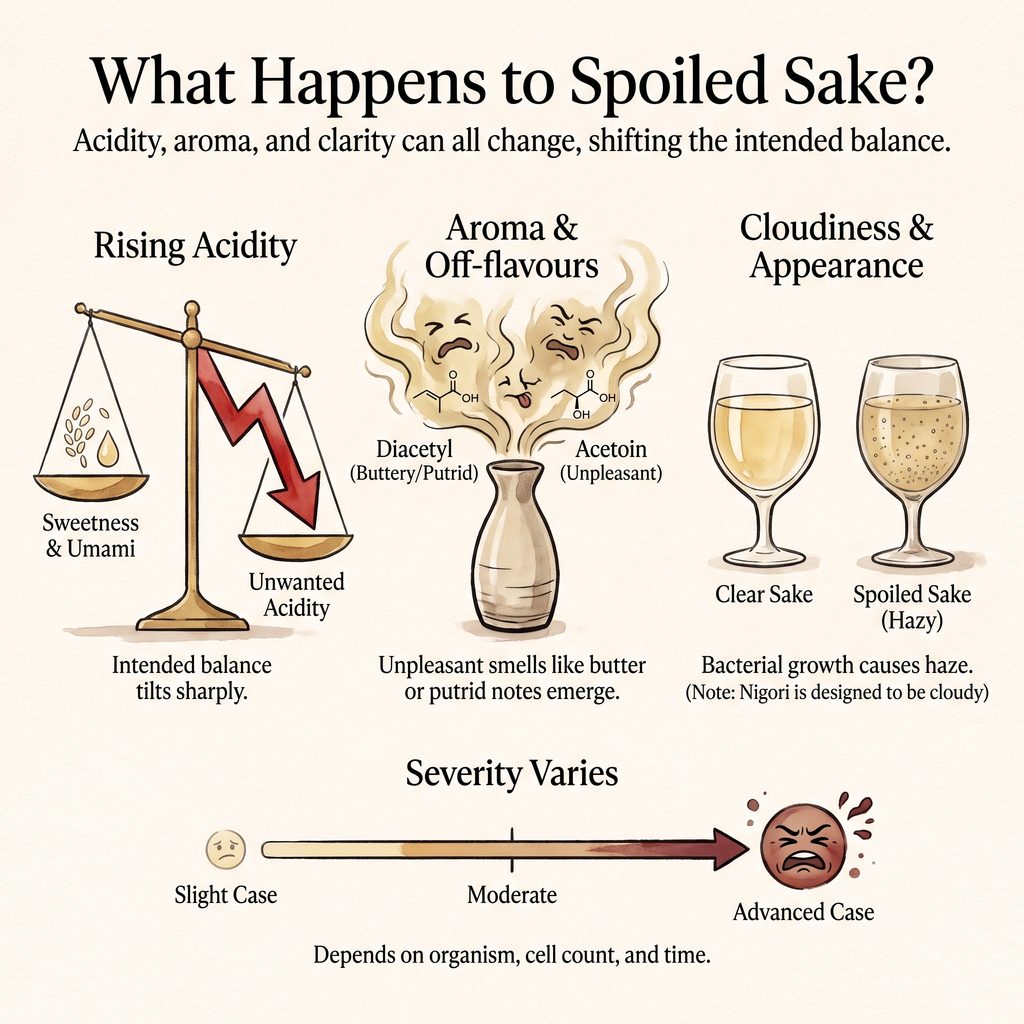
What Happens to Spoiled Sake?
Illustration of how bacterial spoilage affects sake’s aroma, appearance, and acidity.
Acidity, aroma and clarity can all change, although the pattern shifts with the organism.
Rising acidity
Increased acidity is one of the most common signs of hi-ochi, although the extent varies by strain. Some organisms produce a pronounced souring effect, while others alter aroma more dramatically than acidity. Either way, acidity that nobody designed pushes against sweetness and umami, so the intended balance tilts.
Drinkers often notice that tilt before they can name it. Something reads as unusually sharp or sour, even when no single element stands out.
Aroma and off-flavours
Diacetyl is the compound most often named in the research literature, above all. It carries a buttery or buttermilk character, familiar to beer brewers, although it sits awkwardly in sake. Acetoin also appears in related work on the same bacteria. Descriptions such as unpleasant or putrid recur across sources, which tells you something about severity in advanced cases.
Cloudiness and appearance
Bacterial growth can turn clear sake hazy, since a dense population of cells scatters light. Colour may shift as well, occasionally.
Cloudy sake is not automatically spoiled sake. Nigori is cloudy by design, protein haze arises through chemical routes, and chilling occasionally produces a temporary haze. Appearance alone settles nothing. Our guides to nigori sake and orisage cover those other routes to haze.
Severity depends on which organism took hold, how many cells there are, how long growth continued and what the sake was like beforehand. A slight case may register only as a faint sourness. So a single checklist of symptoms would mislead more than it helps.
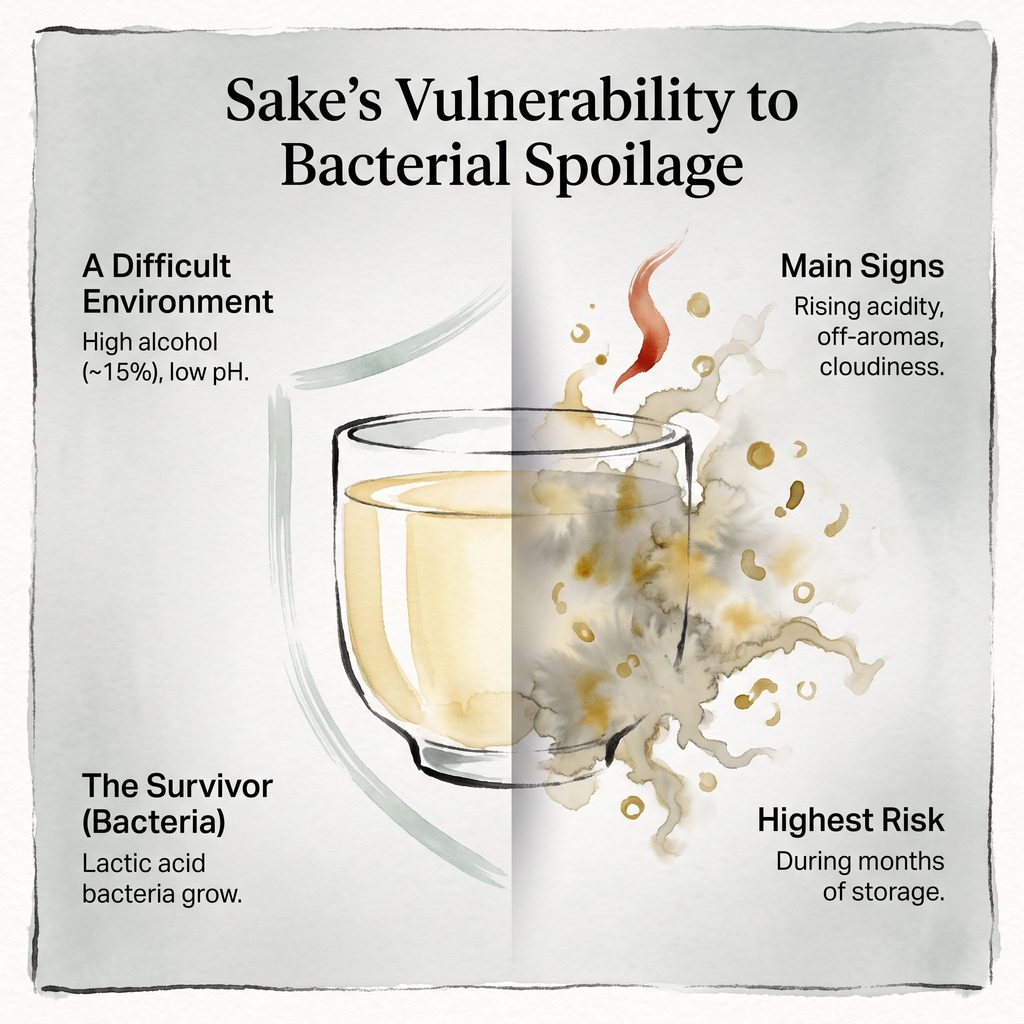
Why Sake Is Vulnerable Despite Its Alcohol
Diagram showing bacterial spoilage signs and risks in sake, including cloudiness and off-aromas.
The liquid blocks almost every microbe, which is precisely why the few survivors matter.
A difficult environment
Finished sake combines a relatively high alcohol concentration with low pH and a limited nutrient environment. Although sugars, amino acids and other compounds remain, the liquid is inhospitable to most microorganisms. Sealing protects it from new contamination, though sealing does not necessarily stop bacteria already present.
The idea that alcohol kills all bacteria is a misconception. Concentration decides the outcome, and the roughly 15 percent found in sake sits far below disinfection levels. Some lactic acid bacteria not only survive that concentration but also grow in it.
Where contamination comes from
Breweries are working environments rather than laboratories, after all. Bacteria accumulate in the places nobody looks, including hose interiors, valve seats, pump housings, filter assemblies and the joints of filling machines. Residue left after a rushed clean simply gives them somewhere to sit.
Sake breweries also host diverse resident microbial communities, sometimes discussed in connection with the Japanese idea of kuratsuki, or brewery-associated microorganisms. Most of these organisms are not hiochi bacteria, and many occur only during earlier stages of brewing.
When the risk is highest
After pressing, before heating The sake has left the protection of an actively fermenting mash, so nothing suppresses newcomers any longer.
During months of storage A small population has time to become a large one, and warmth accelerates whatever growth is possible.
At bottling Filling equipment touches every bottle, so a contaminated line can spread a problem across an entire run.
In distribution Control passes to wholesalers and retailers, where a warm shelf undoes careful work upstream.
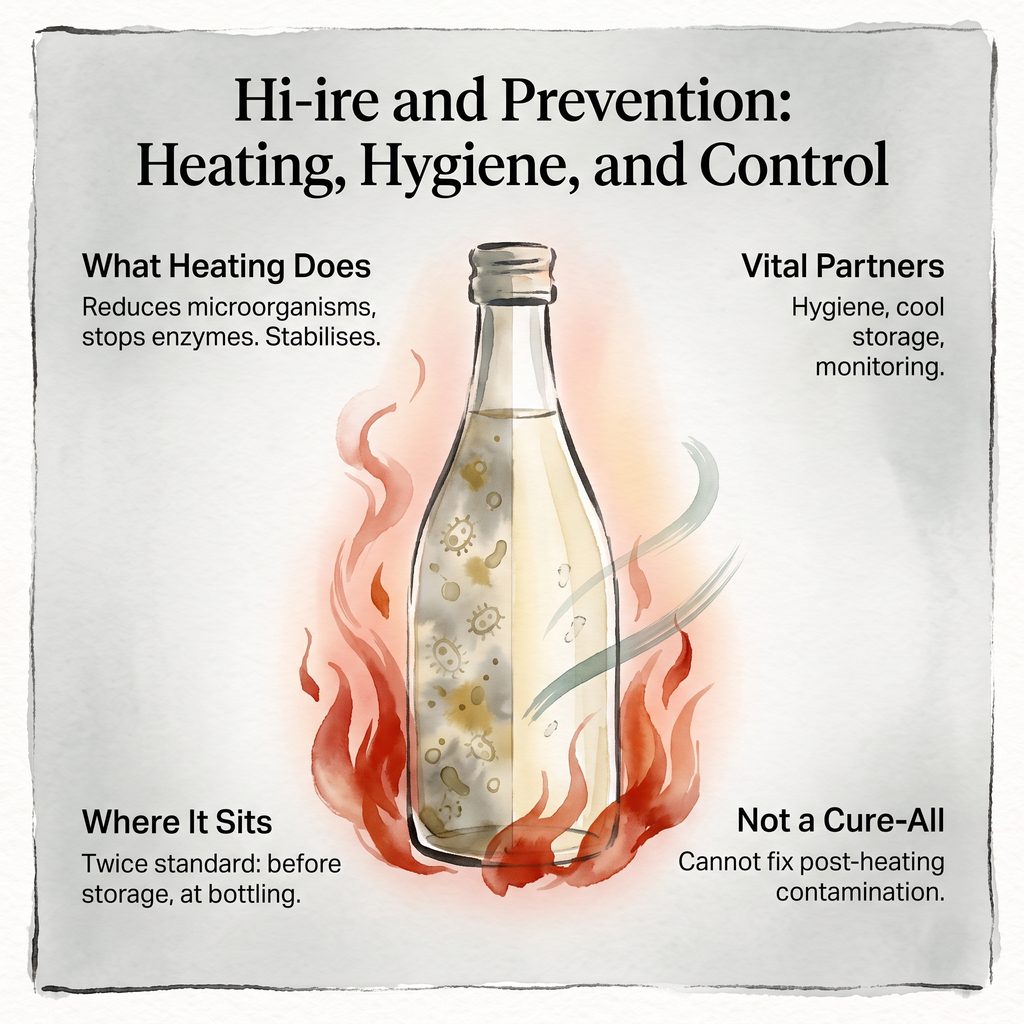
Hi-ire and Prevention
Illustration explaining heat, hygiene, and control in sake storage to prevent bacterial spoilage.
Heating is the principal defence, though it works only alongside hygiene and storage control.
What heating actually does
Hi-ire means heating finished sake, usually to somewhere around 60 to 65 degrees Celsius. Two things happen at once. Heat reduces microorganisms, while residual enzymes from koji lose their activity.
That second effect is easy to overlook, yet it explains why pasteurization is not simply sterilisation. Active enzymes keep changing sake in storage, altering sweetness and aroma over time. Stopping them stabilises the product independently of any bacterial question.
Where heating sits in the process
A common sequence looks like the following, although filtration, dilution, heating and bottling practices vary among breweries and products.
Pressing and clarification separate the sake and remove suspended material
First stabilisation before storage
Storage and adjustment, including water dilution to the target strength
Packaging and final stabilisation at or near bottling
Standard practice applies heat twice, once after filtration and again at bottling, and the Japan Sake and Shochu Makers Association describes that pattern. Two applications cover two different risk windows. Filtration removes suspended material and, depending on the method, may also reduce the microbial load.
Everything else that matters
Hygiene Cleaning and sanitising tanks, hoses, pumps, filters and filling equipment, treated as a documented procedure rather than a chore.
Temperature control Cooler storage slows microbial growth, and it becomes essential for unpasteurized products.
Packaging Sound closures and clean bottles limit contamination around filling.
Monitoring Laboratory testing detects contamination before it becomes visible in the glass.
Distribution Control extends beyond the brewery gate, particularly for namazake.
Pasteurization reduces microbial risk substantially. It does not make sake permanently stable, and it cannot protect against contamination that arrives afterwards. Bacteria introduced during filling, from the bottle or closure, or before the container is fully sealed may remain in the packaged sake and multiply later.
How breweries detect it
Trained tasters assess aroma, taste, texture and appearance together, while acidity measurement adds an objective signal. Breweries track those figures across a product’s life, then compare them against expected values.
Culturing samples on selective media remains standard, although hiochi bacteria grow slowly and can be awkward to detect. Researchers have also discussed viable but nonculturable states, in which cells remain alive yet refuse to grow on plates. A clean plate is therefore reassuring rather than conclusive, which is why breweries combine methods. Recent work has moved towards predicting spoilage risk during storage instead of confirming damage afterwards.
The practical summary. Heating addresses microbes and enzymes together. Cool, dark storage addresses chemical deterioration and slows any microbes that remain. Hygiene addresses the source. Removing any one of the three weakens the others.
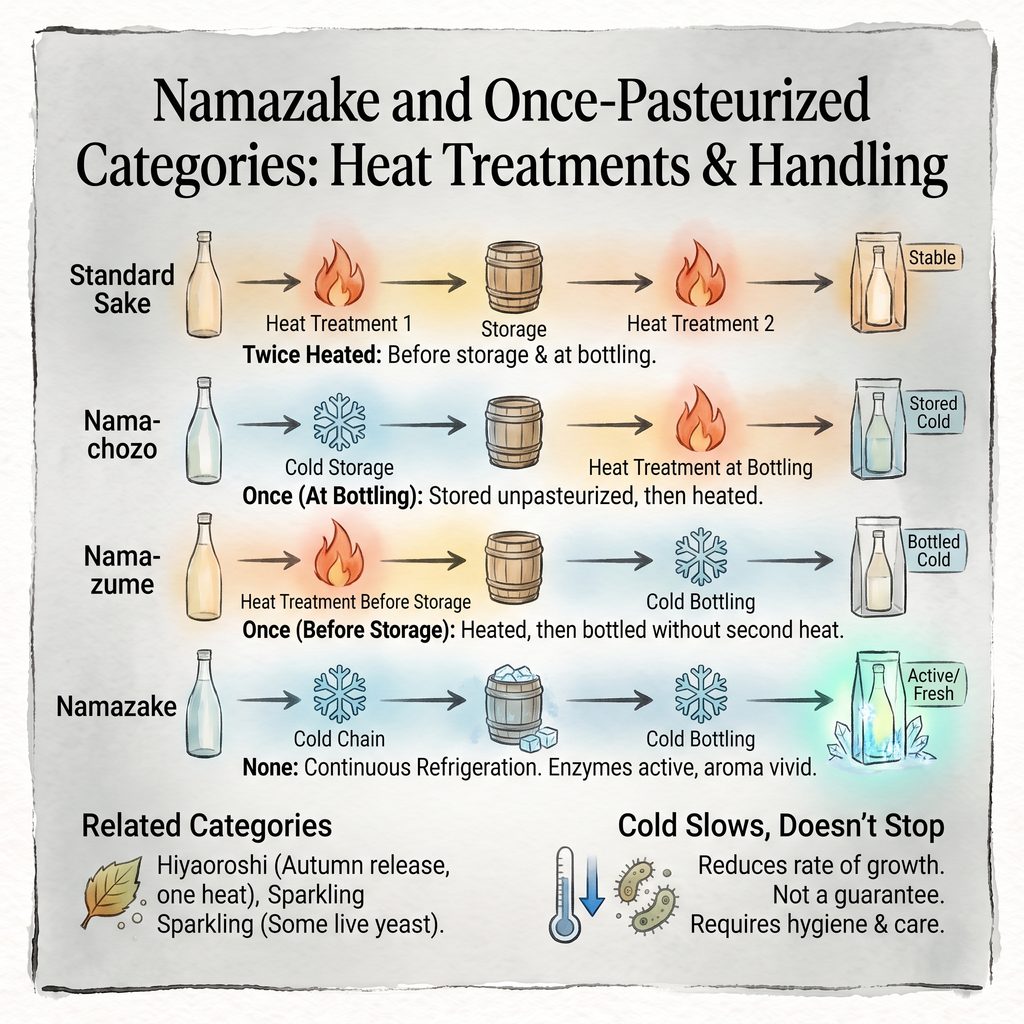
Namazake and the Once-Pasteurized Categories
Illustration of sake storage and handling methods, including heat treatments and cold chain processes.
Japanese labelling distinguishes products by how many heat treatments they received.
Category
Heat treatment
Handling implication
Standard sake
Twice, before storage and at bottling
Does not normally require a continuous cold chain, although cool, dark storage is recommended
Nama-chozo
Once, at bottling
Stored unpasteurized, then heated
Nama-zume
Once, before storage
Bottled without a second heating
Namazake
None
Refrigeration throughout
Namazake receives no heat treatment at all. Enzymes stay active, aroma stays vivid, and the sake keeps a freshness that many drinkers seek out. Those same qualities come from the absence of the step that otherwise stabilises everything.
Cold slows, it does not stop. Refrigeration reduces the rate of microbial growth and enzyme activity. It works as a control measure rather than a guarantee, and it performs best alongside hygiene, short storage times and careful handling.
Related categories and alternatives to heat
Hiyaoroshi belongs in the same conversation, since it is heated only once after filtration and released in autumn. Sparkling sake adds another layer, because some products retain live yeast for in-bottle fermentation while others are stabilised before sale. Research on unpasteurized sake has also explored alternatives to heat, including bacteriocins from lactic acid bacteria and high pressure processing.
None of this makes namazake a spoiled product. It makes it a product with different requirements. Our guide to the types of Japanese sake sets out the full family.
The Historical Importance of Hi-ochi
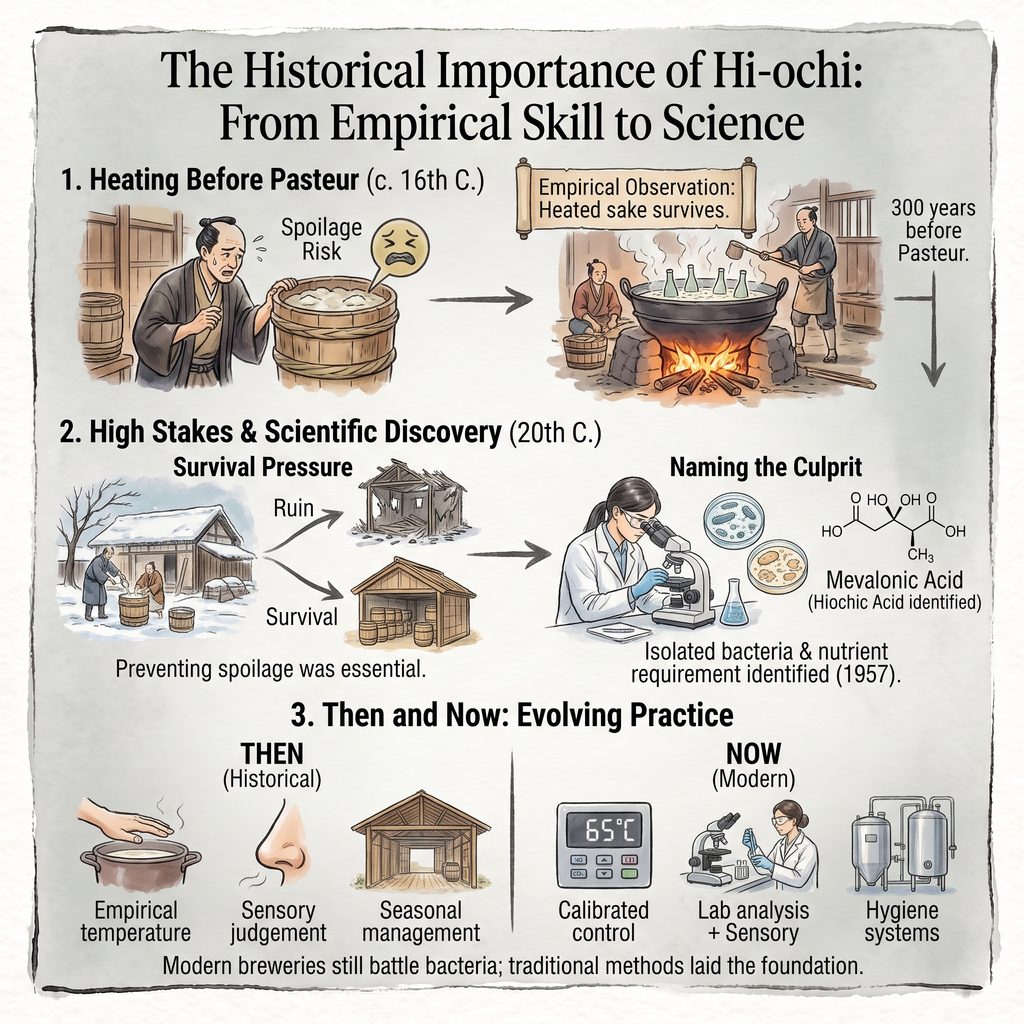
Illustration of Hi-ochi’s historical and scientific aspects, from pasteurization to modern practices.
Japanese brewers solved a microbiological problem centuries before microbiology provided an explanation.
Heating before Pasteur
Japanese records describe heat treatment of sake long before Louis Pasteur published on the subject. A 2021 paper in Frontiers in Microbiology notes that hi-ire was performed roughly 300 years earlier, and documentary evidence usually points to the sixteenth century.
Brewers did not yet understand bacteria, obviously enough. They did, however, observe that heated sake survived storage more reliably than unheated sake, and that observation was enough to establish the practice.
Why the stakes were so high
Sake was brewed in winter and sold across the following year, so every batch had to survive months in storage. A brewery that lost a season’s production faced ruin. Preventing spoilage was survival rather than refinement, and that pressure shaped habits which persist today. Our guide to kan-zukuri explains why cold seasons suited the craft.
Naming the culprit
Scientific understanding arrived much later. Japanese researchers isolated and studied the responsible bacteria across the first half of the twentieth century, until a 1957 study in the Journal of General and Applied Microbiology proposed two new species names. Its authors examined 64 strains, then sorted them by fermentation type and nutrient requirement.
Taxonomists have since folded both 1957 names into Fructilactobacillus fructivorans, which shows how classification keeps moving. Researchers pinned down the nutrient requirement around the same period, once hiochic acid turned out to be mevalonic acid.
Then and now
Aspect
Historical practice
Modern practice
Heating
Empirical temperature judgement
Calibrated control and documented procedures
Detection
Repeated observation and experience
Laboratory analysis alongside observation
Environment
Seasonal management
Managed temperature and hygiene systems
Sensory work
Central to daily judgement
Still central, alongside instruments
Two qualifications belong here. Modern breweries have not eliminated hi-ochi, because bacteria still exist and equipment still needs cleaning. Equally, traditional methods were far from crude, and the buildings themselves supported the work. Our guide to the kura shows how.
What Drinkers Need to Know
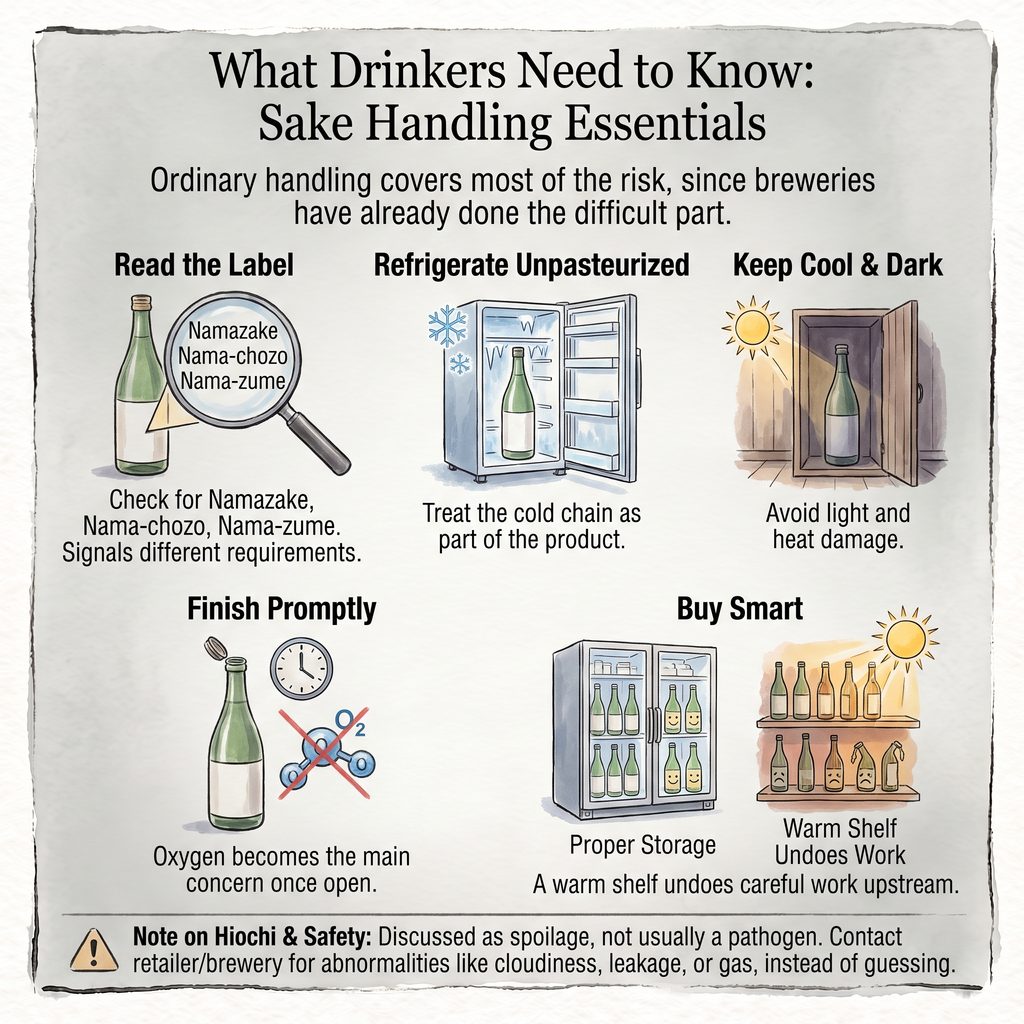
Infographic on sake handling essentials to prevent bacterial spoilage in Japanese breweries.
Ordinary handling covers most of the risk, since breweries have already done the difficult part.
Read the label for heating information. Namazake, nama-chozo and nama-zume all signal different storage requirements.
Refrigerate anything unpasteurized. Treat the cold chain as part of the product rather than an optional extra.
Keep bottles cool and dark. Light and heat cause their own damage, quite apart from any microbial question.
Finish opened bottles reasonably promptly. Oxygen becomes the main concern once a bottle is open.
Buy from retailers who store properly. A warm shelf undoes careful work upstream.
Hiochi bacteria are generally discussed as spoilage organisms rather than foodborne pathogens. However, visible cloudiness, leakage, unexpected gas pressure or an abnormal smell can have other causes, so this article cannot establish the safety of a particular bottle. Contact the retailer or brewery instead of guessing.
Final Thoughts
Hi-ochi is easy to file away as a merely technical fault, though. That reading undersells it badly.
The threat of bacterial spoilage pushed Japanese brewers towards heat treatment long before anyone could explain why heating worked. It reinforced winter brewing, encouraged obsessive cleanliness, and helped make sake one of the more microbiologically stable traditional beverages anywhere. Modern refrigeration then reopened a door that heat had closed, which is how namazake became widely available.
So the line runs from a spoilage problem to a preservation technique, then to storage practice, and finally to the reliable bottles on a shop shelf today. Hi-ochi did not simply damage sake. It shaped how brewers work.
Hi-ochi is the bacterial spoilage of sake, caused by ethanol-tolerant lactic acid bacteria. It damages taste and aroma, and it usually appears during storage or distribution. The Japanese industry body defines it as bacterial contamination by hiochi lactobacillus.
What causes Hi-ochi?
A small group of lactic acid bacteria causes it, since they tolerate alcohol and acidity far better than most microbes. Contamination usually reaches the sake through equipment, surfaces or handling rather than through ingredients. Yeast plays no part either, despite occasional confusion on that point.
What does Hi-ochi smell and taste like?
Reported characteristics include raised sourness and off-aromas, especially the buttery note of diacetyl. Descriptions of unpleasant or putrid aromas appear in the literature for advanced cases. Symptoms vary with the organism and the extent of growth, so no single description fits every case.
Is Hi-ochi the same as Hine-ka?
No, and mixing them up is a frequent error. Hi-ochi is microbial spoilage, meaning damage caused by bacteria. Hine-ka instead describes a stale aroma linked to storage conditions and chemical change. A sake can show one without the other.
Are Hi-ochi bacteria dangerous to people?
Hiochi bacteria are generally discussed as spoilage organisms rather than foodborne pathogens. However, cloudiness, leakage, unexpected gas pressure or an abnormal smell can have other causes. This article cannot establish the safety of a particular bottle, so contact the retailer or brewery if something seems wrong.
Can namazake develop Hi-ochi?
Namazake skips heat treatment, so it lacks the main microbiological defence. Refrigeration and short storage times become the working controls instead. Reputable producers and retailers manage this carefully, which is why the cold chain matters so much for these products.
Does refrigeration prevent Hi-ochi?
Refrigeration slows microbial growth considerably, although slowing is not the same as preventing. Cold works best alongside hygiene, sound packaging and reasonable storage times. Treat it as one control among several rather than a complete answer.
Can Hi-ochi be reversed?
No. Once bacterial growth has altered the acidity and aroma, those changes simply stay. Heating afterwards cannot restore the original character, and no home treatment repairs a spoiled bottle. Contact the retailer or brewery instead of attempting anything yourself.
Kitahara, K. and others, Taxonomic Studies on the Hiochi-Bacteria, Specific Saprophytes of Sake, Journal of General and Applied Microbiology, 1957 (Accessed August 2026)
Zheng, J. and others, A Taxonomic Note on the Genus Lactobacillus, International Journal of Systematic and Evolutionary Microbiology, 2020 (Accessed August 2026)
Zhao, W. and Gu, C. T., Lactobacillus homohiochii Is a Later Heterotypic Synonym of Lactobacillus fructivorans, International Journal of Systematic and Evolutionary Microbiology, 2019 (Accessed August 2026)
Nishida, H., Sake Brewing and Bacteria Inhabiting Sake Breweries, Frontiers in Microbiology, 2021 (Accessed August 2026)
Yamamoto, S. and others, Growth Inhibition of Hiochi Bacteria in Namazake by Bacteriocins from Lactic Acid Bacteria, Journal of Bioscience and Bioengineering, 2010 (Accessed August 2026)
Applied Food Research, Novel Method for Predicting the Risk of Spoilage by Lactic Acid Bacteria During the Storage of Japanese Sake, 2025 (Accessed August 2026)
Applied and Environmental Microbiology, Ethanolphilic Lactic Acid Bacterium Fructilactobacillus fructivorans as the Key Microorganism for Fermentation of Narazuke, 2025 (Accessed August 2026)
Frontiers in Microbiology, Genomic and Metabolomic Analyses of a Piezosensitive Mutant of Saccharomyces cerevisiae for Sake Pasteurization, 2021 (Accessed August 2026)
Ryo Iwa is the founder and editor of foodinjapan.org. Born and raised in Japan, he writes from regional travel, market visits, and Japanese-language primary sources that rarely reach English readers, including brewing institute publications and industry glossaries. Where a figure cannot be traced to a source, the article says so.
He has been a Google Maps Local Guide for over 10 years, with more than 1,800 reviews and over 41,000 photos viewed hundreds of millions of times. He previously spent two decades as an IT consultant in Japan, the US, and the UK.












Comments