




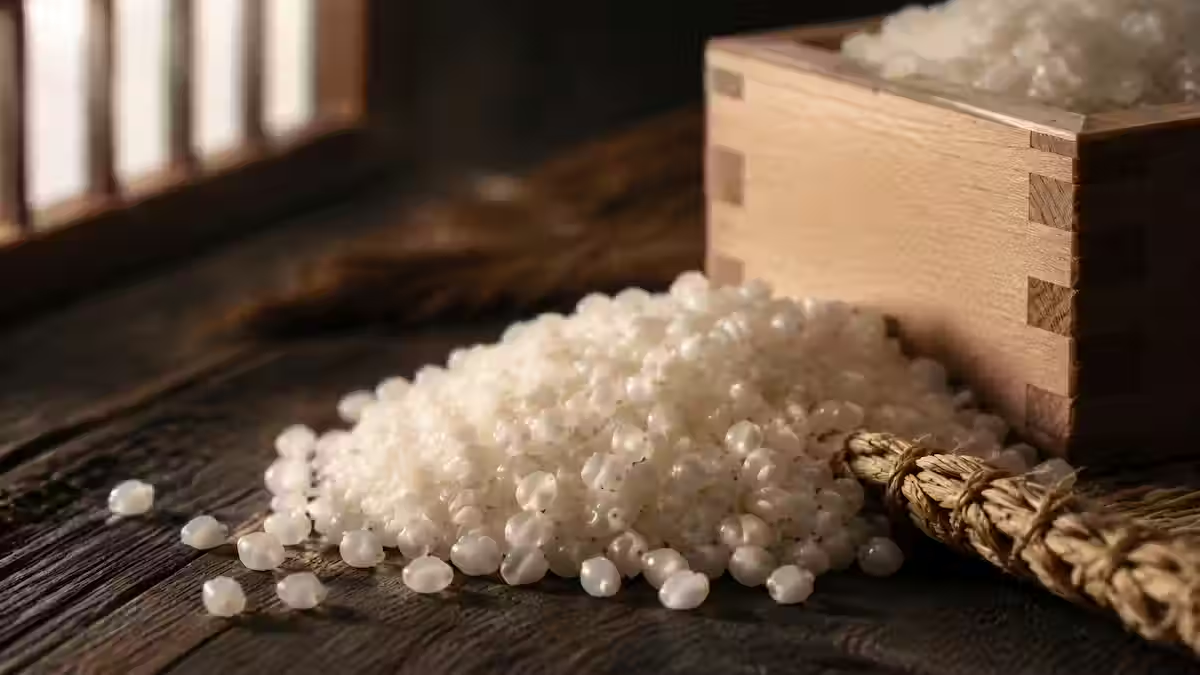
Sake rice is the quiet hero behind every great bottle of Japanese sake. Indeed, most people never see it, yet it shapes aroma, body, and finish. So what is sake rice, exactly? It is a group of rice varieties bred specially for brewing, not for eating. In Japanese, brewers call it sakamai, or shuzo koteki mai, meaning rice suited to sake making.
These grains look and behave very differently from the rice on your dinner plate. Typically, they are larger, softer in the center, and lower in protein and fat. Above all, many carry a white, opaque core called shinpaku. Above all, that core is where the magic of brewing begins. This article is the central guide to sake rice on our site. It explains what sake rice is, why brewers need it, and how it works.
We will look at grain structure, famous varieties, growing regions, and modern breeding. Along the way, it connects to every other part of the sake story. By the end, you will see why rice truly is the foundation of premium sake.
A quick note before we dive in. Sake rice can seem technical at first glance. Terms like shinpaku and seimai buai sound intimidating. Yet the core ideas are simple and even beautiful. Stay with it, and the whole picture soon clicks into place.
Quick Facts About Sake Rice
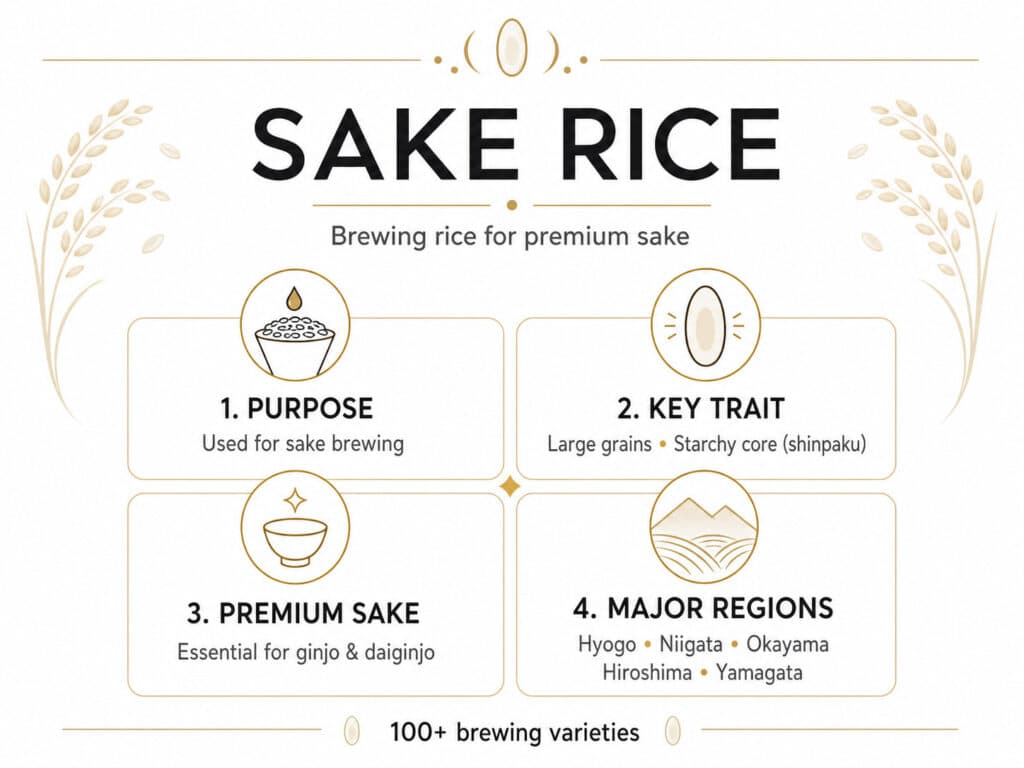
| Japanese Name | 酒米 (sakamai) / 酒造好適米 (shuzo koteki mai) |
| Common English Term | Sake rice / brewing rice |
| Primary Purpose | Brewing sake, not eating |
| Major Growing Regions | Hyogo, Niigata, Okayama, Hiroshima, Yamagata |
| Registered Varieties | Roughly 100 or more brewing varieties |
| Key Trait | Large grain with a starchy white core (shinpaku) |
| Link to Premium Sake | The base of nearly all ginjo and daiginjo sake |
Sake rice is a specialized crop, quite unlike everyday table rice. Farmers grow it mainly for breweries, not for the family table. Japan has registered many dozens of these brewing varieties over the years. The most famous by far is Yamada Nishiki, often called the king of sake rice. Hyogo, Niigata, and Okayama lead the country in growing it. Almost all premium sake starts with one of these prized grains.
What Is Sake Rice?
Sake rice, or sakamai, is rice developed specifically for brewing sake. The formal Japanese term is shuzo koteki mai, meaning rice well suited to brewing. Not every rice earns this label, though. Only certain varieties, grown to strict standards, qualify as true sake rice. Instead, they share a set of traits that make them ideal for fermentation.
The key features are simple to list. Good sake rice has large grains that resist cracking during milling. Moreover, it holds a well-formed shinpaku, the starchy white heart of the grain. Finally, it stays low in protein and fat, which keeps the sake clean. These three qualities set the whole foundation for brewing.
A Short History of Sake Rice
Rice arrived in Japan more than 3,000 years ago. Yet brewing with rice and rice koji began much later, around the Nara period. For centuries, in fact, brewers used whatever local rice they could find. By the late Edo period, the Settsu and Harima regions, now Hyogo, grew famous for brewing rice. Farmers there noticed that some strains made far better sake than others.
The modern era changed everything. Then, during the Meiji and Taisho periods, agricultural science took hold. Prefectural stations began breeding rice specifically for the brewing kettle. In 1936, that effort produced Yamada Nishiki, a true turning point. From then on, dedicated sake rice became a science of its own.
The change did not happen overnight, of course. Early brewers worked by instinct and long experience. Gradually, they learned which local strains gave sweeter, cleaner brews. Over generations, that knowledge built up quietly in each region. Modern breeding simply gave those old instincts a scientific backbone.
It helps to picture the scale of this shift. Before dedicated rice, sake quality swung wildly from year to year. A bad harvest could ruin a whole season of brewing. Purpose-bred rice made results far steadier and cleaner. In a real sense, sake rice made premium sake possible.
Why Brewers Needed a Special Rice
You might wonder why ordinary rice was not enough. The answer lies in how sake is actually made. Specifically, brewers polish rice hard, wash it, steam it, and grow koji on it. Each of those steps punishes a fragile or protein-heavy grain. Ordinary table rice simply struggles to keep up. So growers bred a rice built for the brewery, not the rice cooker.
Think of it like breeding a racehorse instead of a farm horse. Both are horses, yet each is shaped for a different job. Table rice is bred for sticky, sweet, satisfying meals. Sake rice is bred for the strange, demanding world of the mash. The goals pull the two rices in opposite directions.
Sake Rice vs Table Rice
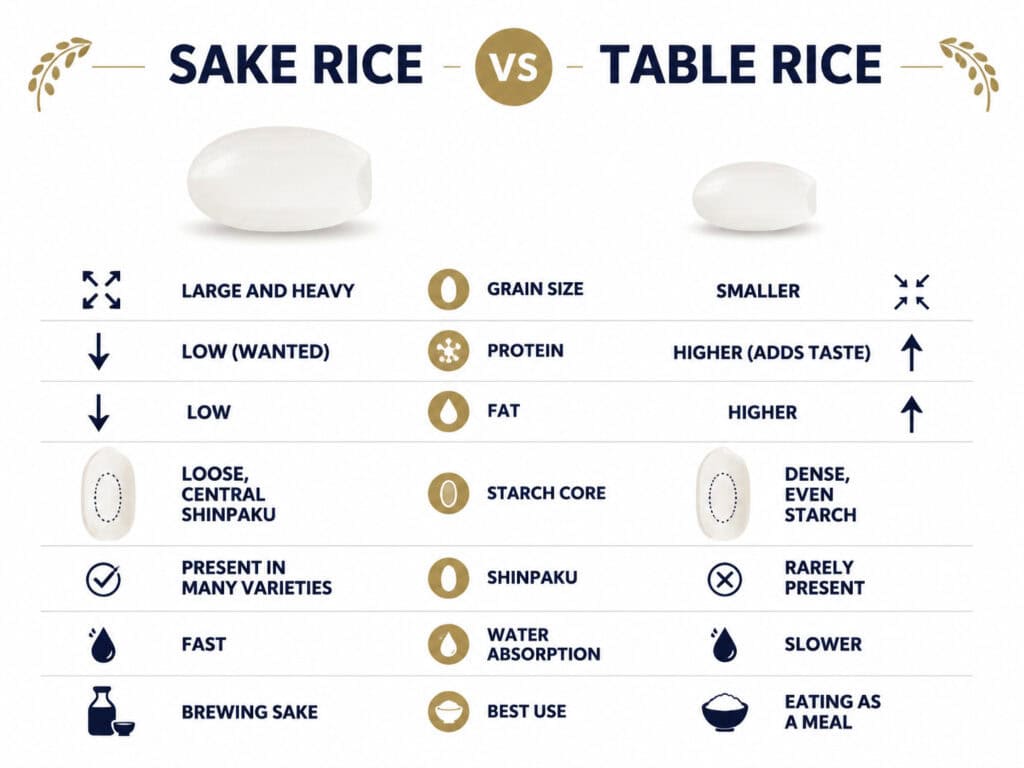
At a glance, sake rice and table rice look like cousins. After all, both are japonica rice, short and round in shape. Look closer, though, and the differences are striking. They differ in size, in structure, and in what they hold inside.
| Feature | Sake Rice | Table Rice |
|---|---|---|
| Grain size | Large and heavy | Smaller |
| Protein | Low (wanted) | Higher (adds taste) |
| Fat | Low | Higher |
| Starch core | Loose, central shinpaku | Dense, even starch |
| Shinpaku | Present in many varieties | Rarely present |
| Water absorption | Fast | Slower |
| Best use | Brewing sake | Eating as a meal |
Grain Size and Strength
Sake rice grains are noticeably larger and heavier. Naturally, that extra size gives brewers a bigger starchy core to work with. Furthermore, the grains must resist cracking under heavy polishing. Brewers sometimes remove half the grain, so strength really matters. A rice that shatters in the mill is useless for fine sake.
Protein, Fat, and Flavor
Here is where the two rices truly part ways. Table rice values protein and fat, since they add taste and shine. For sake, those same compounds cause trouble. For instance, excess protein turns into amino acids, which bring rough flavors. Fat can block the delicate aromas that ginjo sake prizes. So brewers want the leanest grain they can get.
This does not mean protein is simply the enemy. A little of it feeds the yeast and adds body. Too much, though, tips the balance toward coarseness. Brewers walk a fine line between richness and roughness. A well-chosen rice makes that line much easier to walk.
The Shinpaku Difference
One clear sign of sake rice sits right in the center. Many sake grains show a white, cloudy heart called shinpaku. By contrast, table rice rarely shows this feature at all. That opaque core is loose and full of tiny air gaps. Those gaps are exactly what koji mold loves to invade.
The Anatomy of a Sake Rice Grain
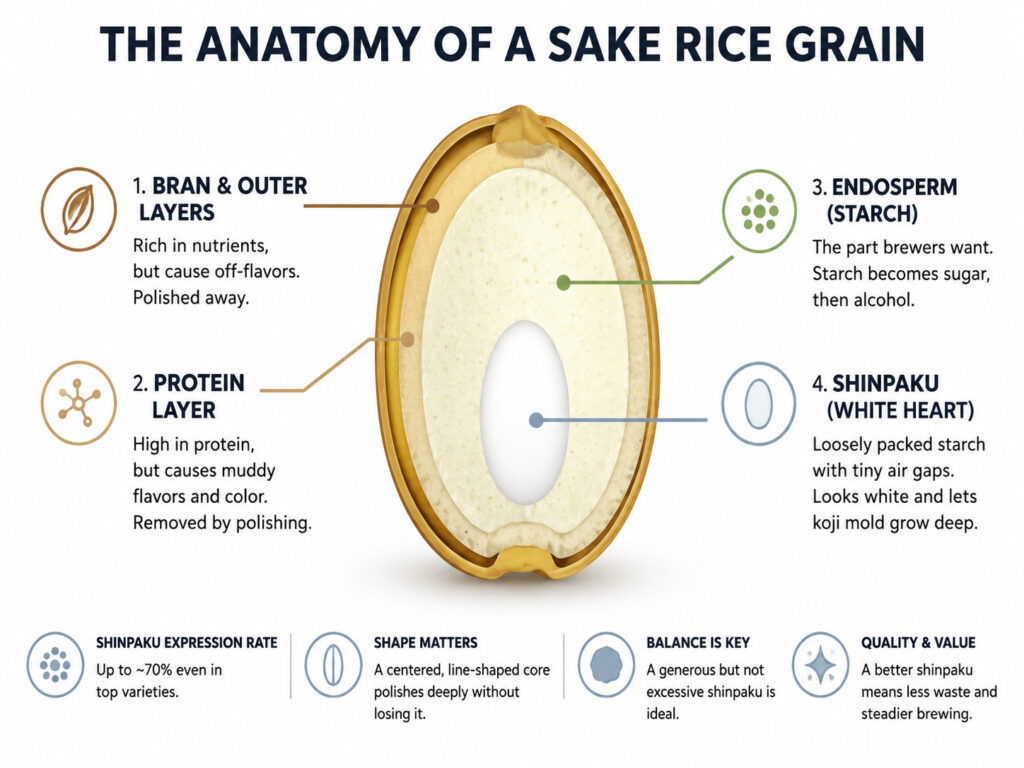
To understand sake, you have to look inside a single grain. In truth, a grain of brown rice is built in layers, like an onion. Notably, each layer plays a different role in brewing. Brewers treat some layers as treasure and others as trouble.
The Bran and Outer Layers
First, the outermost layer is the bran, or nuka. It is rich in fat, protein, vitamins, and minerals. For eating, that makes brown rice nutritious and hearty. For brewing, however, these layers cause off-flavors. So the first job in any brewery is to polish them away.
The Protein Layer
Next, just beneath the bran sits a layer heavy in protein. Similarly, this protein feeds people well, yet it muddies sake. Too much of it leads to excess amino acids in the brew. That, in turn, brings coarse tastes and darker color. Careful polishing removes much of this layer, too.
The Endosperm
Then, below the protein lies the vast starchy endosperm. This is the part brewers actually want. Essentially, starch here becomes the sugar that yeast turns into alcohol. The deeper you go, the purer and cleaner the starch becomes. So the heart of the grain is the real prize.
The Shinpaku Core
Finally, at the very center of many sake grains lies the shinpaku. The word means white heart, and the name fits perfectly. Interestingly, it looks opaque because its starch packs together loosely. Countless tiny air gaps scatter the light, so it appears white. Those same gaps let koji mold grow deep into the grain.
Not every grain forms a good shinpaku, though. Breeders track something called the shinpaku expression rate. Even in strong varieties, that rate tops out near 70 percent. A higher rate means less waste and steadier brewing. So this humble white core drives a lot of a variety’s value.
The shape of the shinpaku matters just as much as its size. Some cores sit as a neat line down the grain’s center. Others spread as a rounded blob or scatter unevenly. A centered, line-shaped core lets brewers polish deeply without losing it. That is one quiet reason Yamada Nishiki polishes so beautifully.
There is a trade-off hiding here, too. A big, bold shinpaku looks impressive and helps koji thrive. Yet a very large core can also make a grain fragile. Brewers therefore want a shinpaku that is generous but not excessive. Balance, once again, beats extremes.
How Brewers Evaluate Sake Rice
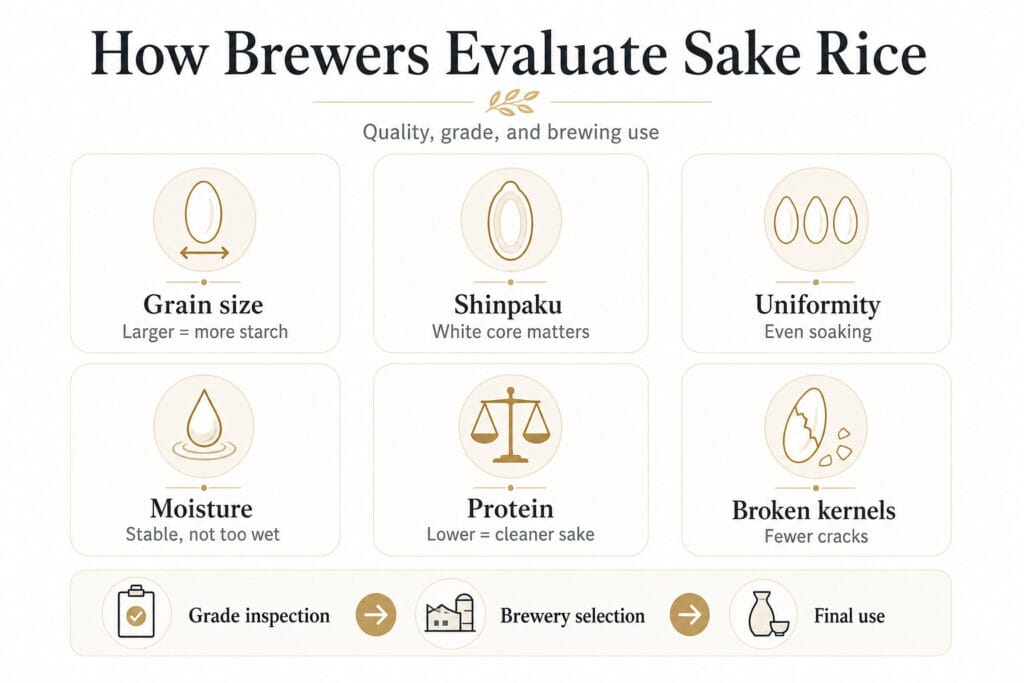
Not all sake rice is created equal, even within one variety. So brewers judge each batch against a set of clear standards. These measures decide the price, the grade, and the final use. Let us look at what a careful brewer actually checks.
The Traits That Matter Most
Grain size comes first, since bigger grains hold more clean starch. Next comes the shinpaku percentage, the share of grains with a good white core. A high figure means more of the crop is truly useful. Uniformity matters too, because even grains soak and steam evenly.
Moisture content is another quiet but vital check. Rice that is too wet spoils, while rice too dry can crack. Brewers look for a steady, moderate moisture level. That balance keeps the grain stable in storage and in the mill.
Protein sits high on every brewer’s watch list. Lower protein means fewer amino acids and a cleaner sake. Broken kernels count against a batch as well. Cracked grains soak unevenly and can muddy the whole brew.
- Grain size: larger grains hold more clean starch.
- Shinpaku rate: the share of grains with a good white core.
- Uniformity: even grains soak and steam alike.
- Moisture: steady levels keep grains stable and whole.
- Protein: lower protein gives cleaner sake.
- Broken kernels: fewer cracks mean more even brewing.
The Rice Grading System
Japan runs a formal grade inspection for brewing rice. Inspectors sort each lot into ranks by quality. The top tiers carry names like special, first, and second grade. They judge by the share of plump, whole grains and the level of damaged or colored ones.
For Yamada Nishiki, an extra layer sits on top of this system. The famous Toku-A, or Special A, districts earn their own mark. Rice from these blessed fields ranks above all others. Brewers chase it, and they pay dearly for the privilege.
Public bodies keep this whole system honest. Agricultural inspectors, once national and now often private, check each lot. Farm groups and the agriculture ministry set the standards. Because sake labels depend on grade, accuracy really matters.
How a Brewery Chooses Its Rice
So how does a brewery actually pick its rice? Much depends on the sake it hopes to make. A fragrant daiginjo calls for large, clean, high-grade grains. A hearty everyday sake can use a humbler, sturdier rice.
Budget and relationships play a real role too. Top Yamada Nishiki is costly and often spoken for years ahead. Many breweries build long bonds with specific farms and regions. That trust, built over seasons, can matter as much as any number on a chart.
Why Rice Matters in Brewing
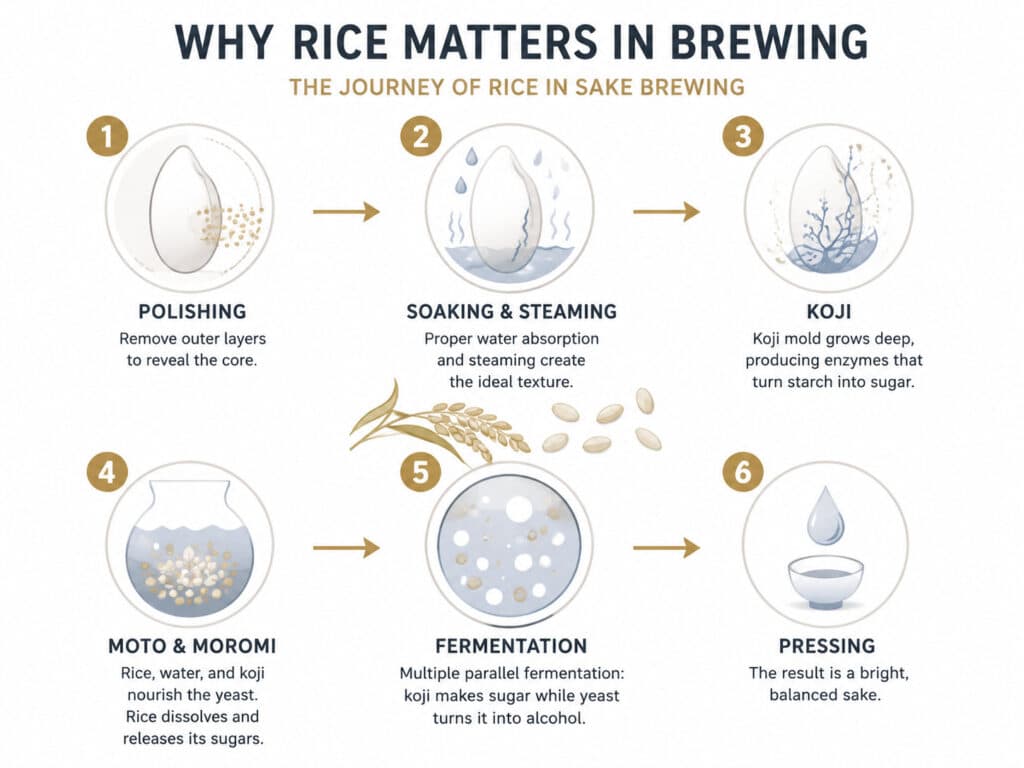
Rice touches every single stage of sake brewing. After all, choose the wrong grain, and no skill can fully save the sake. Choose well, and the rice quietly supports the brewer at every turn. Let us follow the grain through the whole process.
Rice and Polishing
Everything starts with rice polishing, known as seimai. First, brewers grind away the fatty, protein-rich outer layers. A sturdy, large grain survives this step without cracking. The bigger the shinpaku, the more the brewer can polish safely. So the grain’s structure sets the limit for how far polishing can go.
Rice, Water, and Steaming
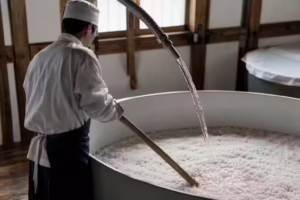
After polishing, the rice meets water for washing and soaking. Notably, sake rice absorbs water quickly, thanks to its loose core. Brewers time this soak by the second for the most polished grains. Then they steam the rice, firming the outside while keeping the inside soft. That texture is perfect for the next stage.
Rice and Koji
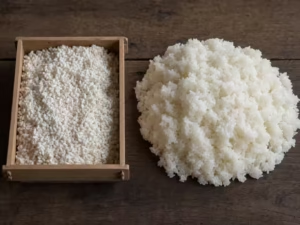
Steamed rice becomes the home for koji mold. Then the mold sends its threads into the soft shinpaku core. There it produces enzymes that break starch into sugar. A good shinpaku lets the koji reach deep inside each grain. This is why grain structure and koji quality are so tightly linked.
Picture the koji threads as tiny roots seeking food. In a dense grain, they crowd near the surface. In a loose shinpaku, they burrow toward the center. That deep growth gives what brewers call clean koji. Clean koji, in turn, gives clean, well-built sake.
Rice in the Moto and Moromi
Next, rice, water, and koji join the yeast starter, or moto. From there the brew grows into the main mash, called moromi. There, in the mash, the rice slowly dissolves and releases its sugars. How easily a rice melts shapes the final body of the sake. Soft, meltable grains often give a rich, full flavor.
Rice and Fermentation
Finally comes fermentation, the heart of the whole craft. Notably, sake uses a rare trick called multiple parallel fermentation. Remarkably, koji makes sugar while yeast turns it into alcohol at once. Steady, clean rice keeps this delicate balance on track. When it all works, the pressing stage reveals a bright, balanced sake.
Major Sake Rice Varieties
Japan grows a wide range of sake rice, each with its own personality. A handful of varieties, however, stand above the rest in fame and use. Here we introduce the most important ones in brief. Each deserves its own full article, which we will link over time.
Yamada Nishiki
Above all, Yamada Nishiki is the undisputed king of sake rice. Historically, Hyogo Prefecture bred it and named it in 1936. Its parents were the rice Yamadaho and the sturdy Tankan Wataribune. The grain is large, with a fine shinpaku that polishes beautifully. It dissolves well, giving rich yet elegant sake. Brewers reach for it above all when making daiginjo.
Brewers use it widely for many junmai daiginjo and daiginjo bottles. Famous labels like Dassai and Hakutsuru rely on it. In the contest world, brewers once spoke of YK35. That code meant Yamada Nishiki, Kumamoto yeast, and 35 percent polishing.
Gohyakumangoku
Meanwhile, Gohyakumangoku is the great rice of Niigata and the north. By contrast, its shinpaku is smaller and firmer, so it melts slowly. That restraint gives clean, dry, light sake. It powers much of the crisp Niigata sake style people love. For a sharp, refreshing drink, this grain shines.
Omachi
Omachi is a living piece of history. It is an old, pure variety, and an ancestor of both Yamada Nishiki and many others. Today, Okayama Prefecture grows most of it. The rice melts easily, giving deep, rich, earthy sake. It has a cult following, and fans even call themselves Omachi lovers.
Omachi almost disappeared in the twentieth century. It is tall, hard to grow, and prone to falling over. For a while, farmers nearly gave up on it. Devoted brewers and growers rescued the variety just in time. Today its comeback is one of sake’s happiest stories.
Miyama Nishiki
By contrast, Miyama Nishiki is a hardy northern grain. Notably, it handles cold mountain climates far better than most. The sake it makes tends to be clean, light, and crisp. Nagano and the Tohoku region rely on it heavily. Cold-country brewers treasure its toughness.
Dewasansan
Similarly, Dewasansan is Yamagata’s pride and joy. Specifically, the prefecture bred it in the 1980s and 1990s for its own sake. Its parents were Miyama Nishiki and Hanafubuki. The rice melts nicely and gives clean, gently aromatic sake. Yamagata even certifies special bottles made from it.
Hattan Nishiki
Hattan Nishiki is a signature grain of Hiroshima. In fact, the prefecture grows it almost exclusively. It has large grains and a good shinpaku. The sake it yields is fragrant and notably clean. It descends from the older Hattan family of rice.
Aiyama
Finally, Aiyama is a rare and treasured variety. Historically, Hyogo created it in 1941, blending Yamada Nishiki and Omachi lines. People call it the diamond of sake rice. It gives rich, fruity sake, though it is tricky to brew. Its scarcity makes bottles both pricey and prized.
Ginnohsei
Ginnohsei rounds out our list as a modern workhorse. Essentially, breeders designed newer rices like it to be easier to grow. Many stand shorter and resist falling over in wind. Some also aim for the quality of Yamada Nishiki with less risk. Such rices help spread good brewing to more regions.
The Evolution of Sake Rice Varieties
Sake rice did not arrive fully formed. It grew through a long chain of breeding and luck. Each new variety built on the ones before it. That story explains why today’s rice is so refined.
From Old Landraces to Yamada Nishiki
Old varieties like Omachi sit near the root of the family tree. Omachi is a pure, ancient rice, discovered in the 1800s. It passed its qualities into many later grains. In fact, it stands behind Yamada Nishiki itself.
Yamada Nishiki marked the great leap forward in 1936. Breeders crossed the tasty Yamadaho with the short, sturdy Tankan Wataribune. The goal was clear and practical. They wanted Omachi-like quality on a plant that would not fall over.
Spreading Out From the King
After Yamada Nishiki, breeding spread across the country. Niigata developed Gohyakumangoku for its clean, dry style. Nagano refined Miyama Nishiki for cold mountain fields. Each region chased a rice that fit its climate and its taste.
Many modern grains trace straight back to these pioneers. Dewasansan, for example, descends from Miyama Nishiki. Aiyama blends the lines of Yamada Nishiki and Omachi. The family tree keeps branching with every decade.
Why New Varieties Keep Appearing
You might ask why breeders never simply stop. The answer is that farming keeps posing new problems. Tall plants fall over, so breeders shorten them. Cold snaps ruin harvests, so they add frost resistance.
Regional pride pushes this work as well. Prefectures love to brew with their own home-grown rice. So they fund grains suited to local soil and weather. In this way, tradition and science keep the family tree growing.
Where Sake Rice Is Grown
Sake rice is fussy about where it grows. After all, it needs the right climate, soil, and skilled farmers. A few regions have become legends for their brewing rice. Each brings something different to the grain.
Hyogo
Above all, Hyogo is the heart of the sake rice world. Indeed, it grows more Yamada Nishiki than anywhere else. The best fields sit in a special zone called the Toku-A district. Warm days, cool nights, and clay-rich soil suit the rice perfectly. Rice from here earns the highest prices in Japan.
The Toku-A district is a small, almost sacred patch of land. It lies in the hills of north Hyogo, near towns like Kato and Taka. There, the temperature swings sharply between day and night. That daily swing helps the grain build a fine shinpaku. Brewers across Japan compete fiercely for this specific rice.
Niigata
Meanwhile, Niigata is famous for clean, dry sake. Naturally, its signature grain is Gohyakumangoku. Heavy winter snow feeds the region with pure meltwater. That water and the cold climate shape a crisp brewing style. Few places match its reputation for light, sharp sake.
Okayama
Similarly, Okayama is the guardian of Omachi. Remarkably, this historic rice nearly vanished, yet the region kept it alive. A mild climate and good water suit the tall, old variety. Today, Omachi from Okayama is highly sought after. Fans travel far to taste sake made from it.
Hiroshima
Hiroshima blends soft water with its own local rice. Here, Hattan Nishiki is the prefecture’s star grain. The region is also famous for gentle, aromatic sake. Its brewers helped pioneer soft-water brewing long ago. Rice and water here work hand in hand.
Yamagata
Yamagata calls itself a kingdom of ginjo sake. Specifically, its home-grown grain, Dewasansan, anchors that pride. Cold mountains and clean snowmelt define the land. The prefecture pushes hard for elegant, aromatic styles. Local breeding keeps its sake identity strong.
Climate, Soil, and the Idea of Terroir
Wine lovers talk endlessly about terroir, the taste of a place. Sake rice has its own quiet version of that idea. Where a grain grows changes how it turns out. Soil, water, sunlight, and temperature all leave their mark.
Temperature swings matter most of all. Warm days help the plant build plenty of starch. Cool nights then slow the plant down and firm the grain. That daily rhythm encourages a clean, well-formed shinpaku. Regions with big swings, like inland Hyogo, hold a real edge.
Soil and water play supporting roles, too. Clay-rich soil holds nutrients and moisture for the thirsty plant. Clean mountain water feeds the paddies through the season. Even the slope of a hillside terrace can help. Together, these details explain why famous rice clusters in certain valleys.
From Paddy to Brewery: The Life of Sake Rice
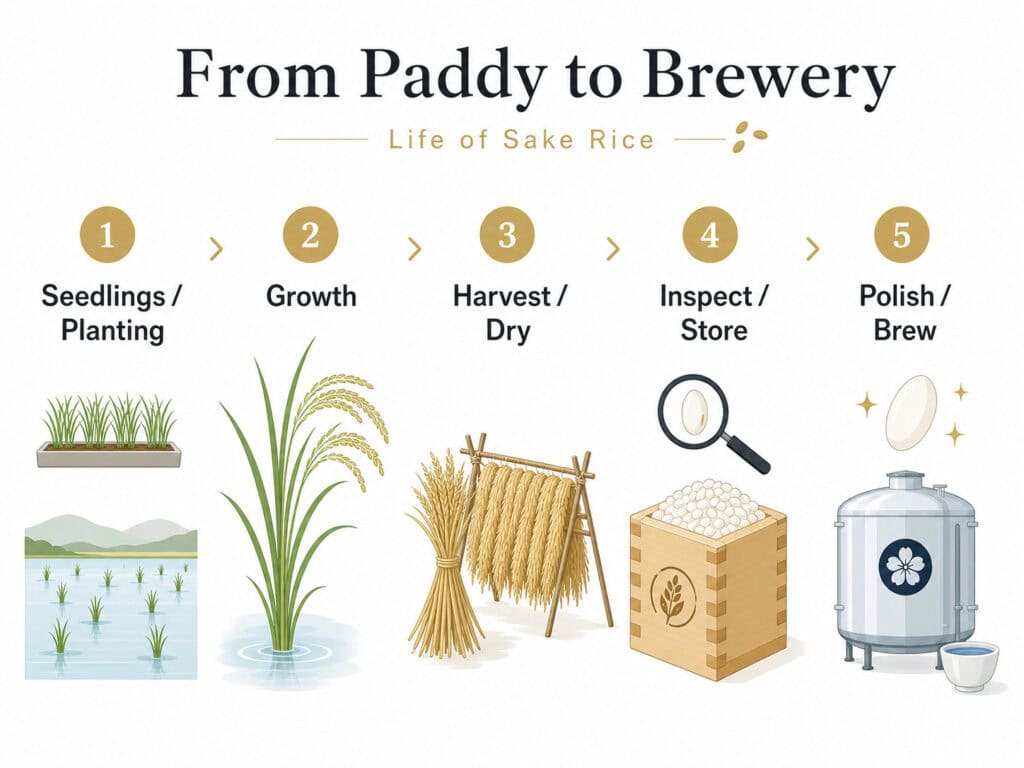
A grain of sake rice travels a long road before brewing. It passes through many careful hands along the way. Each step shapes the quality that finally reaches the tank. Here is that journey, from muddy paddy to steaming kettle.
Planting and Growing
The story starts in spring, in a greenhouse full of seedlings. Farmers raise young plants before moving them to the paddy. Then they flood the fields and transplant the seedlings by machine. Through summer, the plants drink sun, water, and warm air.
Sake rice demands extra care during this growing stage. Many varieties grow tall and top-heavy with grain. A strong wind or storm can flatten a whole field. So farmers watch the weather and the water with real attention.
Harvest and Drying
Autumn brings the harvest, usually a little later than table rice. Machines cut the ripe stalks and thresh out the grain. The fresh rice still holds too much moisture to store. So workers dry it gently and slowly to the right level.
Rushed or harsh drying can crack the delicate grains. Cracked rice soaks unevenly and hurts the final sake. Careful, patient drying protects the precious shinpaku inside. This quiet step guards months of hard field work.
Inspection and Storage
Next, the dried rice faces official inspection and grading. Inspectors weigh its size, wholeness, and shinpaku quality. A grade is assigned, and the price follows from it. Only then can the rice be sold as certified brewing rice.
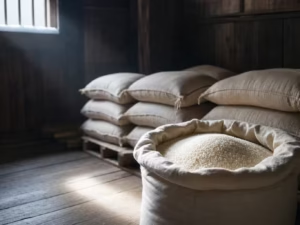
Good storage keeps the graded rice in top shape. Breweries hold it cool and steady until brewing season. Poor storage invites pests, mold, and lost quality. So this unglamorous step still protects the whole harvest.
Polishing and Brewing
At last the rice reaches the brewery’s own domain. First it is polished, then washed, soaked, and steamed. From there it flows into koji making and the fermenting mash. That long road from paddy finally ends in a glass of sake.
Rice Polishing and Sake Rice
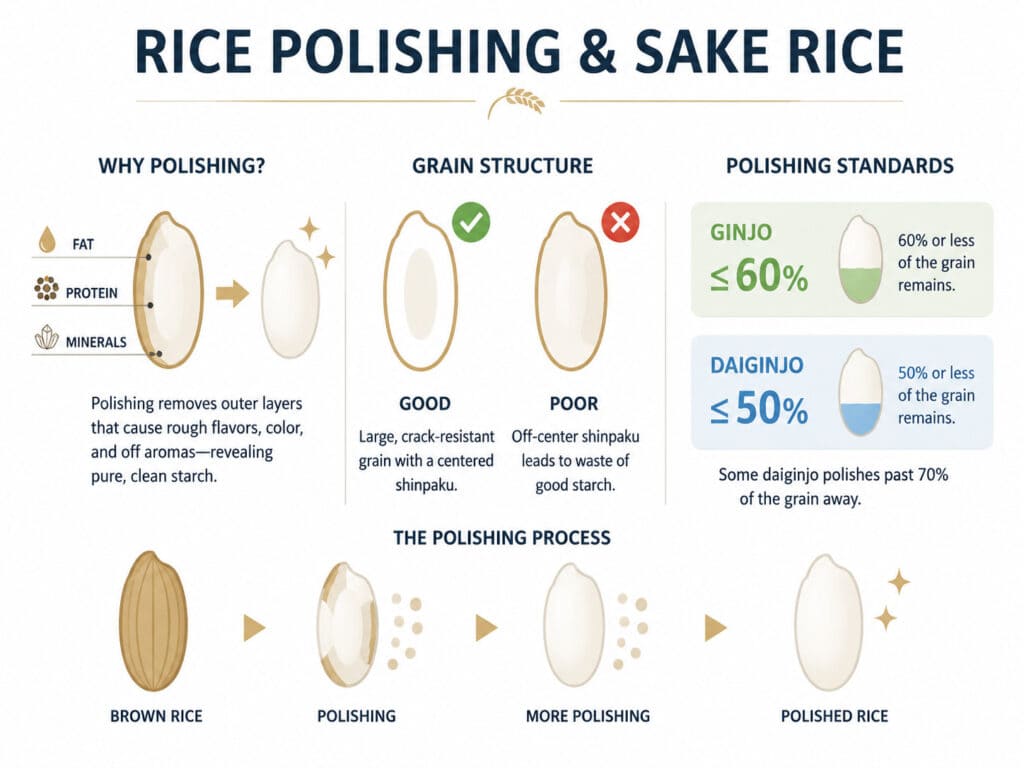
No topic ties to sake rice more closely than rice polishing. The two truly cannot be separated. Fundamentally, polishing removes the grain’s troublesome outer layers. What remains is the clean, starchy heart the brewer wants.
Why Polishing Is Necessary
The outer grain holds fat, protein, and minerals. Unfortunately, those parts feed people but harm sake. They bring rough flavors, heavy color, and muddy aromas. By polishing them away, brewers reach the pure starch inside. Cleaner starch means cleaner, more refined sake.
Polishing and Grain Structure
A grain’s structure decides how far polishing can go. For example, large, crack-resistant grains survive heavy milling. A central shinpaku guides the polish toward the core. If the white heart sits off-center, polishing wastes good starch. So breeders prize a compact, centered shinpaku.
Ginjo and Daiginjo Standards
Polishing levels define the premium sake grades. Specifically, the seimai buai is the share of the grain that remains. For ginjo, brewers polish rice to 60 percent or less. For daiginjo, they go further, to 50 percent or below. Some daiginjo polishes past 70 percent of the grain away. Such extremes suit fragrant junmai styles beautifully.
Sake Rice Around the World
For a long time, people believed sake rice grew only in Japan. That belief has quietly crumbled in recent years. Today, farmers raise brewing rice on several continents. It is one of the most exciting shifts in the sake world.
The United States
The United States leads this overseas movement by a wide margin. In Arkansas, Isbell Farms became the first outside Japan to grow sakamai. They now raise Yamada Nishiki, Omachi, and Gohyakumangoku. California’s Sun Valley Rice grows brewing rice as well.
American craft sake has grown fast on the back of this rice. The country went from about a dozen sake breweries in 2013 to nearly thirty by 2024. Even famous Japanese makers have joined in. Dassai now brews in New York using Arkansas-grown Yamada Nishiki.
Australia, Europe, and Beyond
The trend reaches well past North America, too. Growers and brewers in Australia have taken up the craft. Small sake ventures have appeared across Europe. Some American farms even export seed and rice abroad.
Local climate still shapes every overseas harvest, of course. Arkansas offers clay soil and clean, iron-free water. California enjoys warm days and cool mountain nights. Each place gives its sake rice a slightly different character.
This overseas growth carries a quiet significance. It frees brewers from leaning on Japan alone for rice. It also lets new regions build their own sake identity. In time, the world may speak of American or Australian sake rice with pride.
Modern Rice Breeding
Sake rice keeps evolving in the lab and the field. Research never really stops. Breeders chase better grains for a changing world. Their work quietly shapes the sake of tomorrow.
Today, public research stations lead much of this effort. Today, Japan’s national institute and prefectural centers breed new cultivars. They cross old favorites to capture the best of each. Ginnohsei and similar rices came from exactly this work.
Two goals drive most modern breeding. First, farmers want grains that resist disease and pests. Second, they need rice that stands up to a warming climate. Shorter, sturdier plants that resist falling over help a great deal. Higher yields also keep good sake rice affordable.
Climate change adds real urgency to this work. Hotter summers can harm the delicate shinpaku. Sudden storms flatten tall, top-heavy plants. Breeders now race to build rice that shrugs off heat. Their success will shape whether classic styles survive.
There is also a push to revive old varieties. Genetic testing helps rescue nearly lost strains. Some breweries fund this work to protect rare rice. In this way, the future and the past move together. Sake rice keeps one foot in tradition and one in science.
Rice Is Only One Part of the Equation
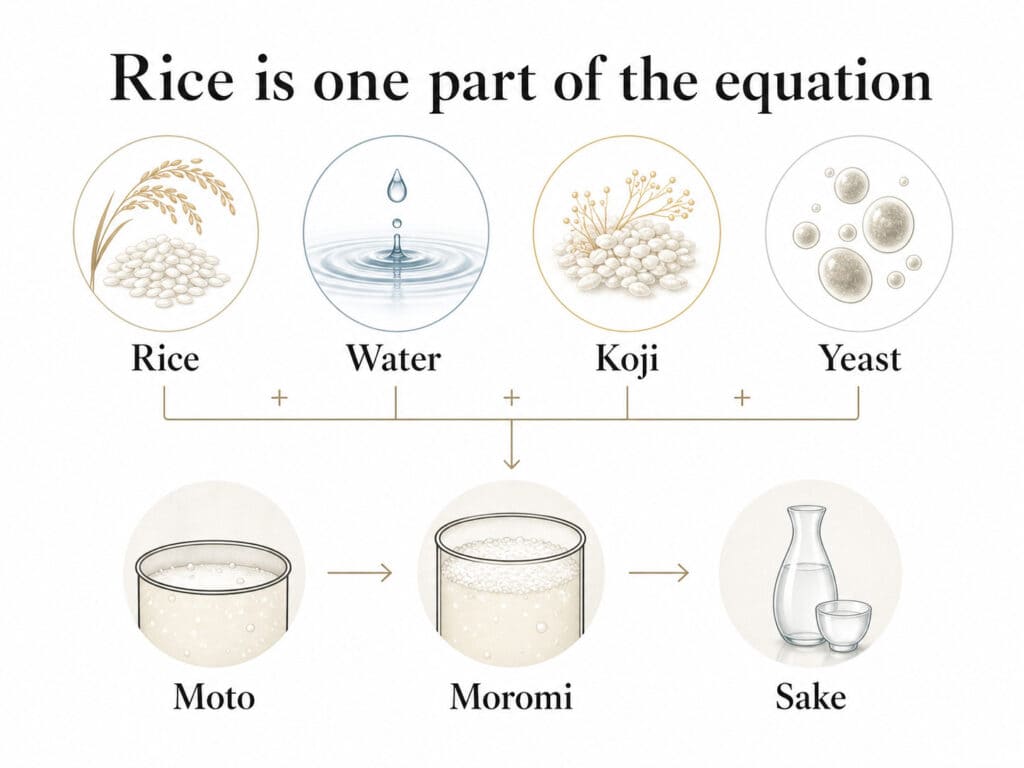
It would be easy to think rice alone decides a sake. The truth is more interesting than that. Rice is the foundation, yet it never works alone. Several partners join it to shape the final flavor.
Rice, Water, and Koji
Water is the silent partner in every batch of sake. It makes up most of the finished drink by volume. Its minerals feed the yeast and shape the pace of brewing. Our guide to water in sake brewing explores this in depth.
Koji then bridges the rice and the alcohol. The koji mold turns hard starch into simple sugar. Without it, the yeast would have nothing to eat. So rice and koji work as a tight, inseparable team.
Yeast, Moto, and Moromi
Yeast brings the aromas that many drinkers adore. Different strains give apple, banana, or floral notes. The rice sets the stage, yet the yeast writes much of the song. Brewers pick each strain with real care.
These players first gather in the moto, the yeast starter. There, a strong, healthy yeast population takes hold. That starter then grows into the main mash, or moromi. In the mash, rice, water, koji, and yeast finally act as one.
Bringing It All Together
So picture the whole process as a kind of orchestra. Rice, water, koji, and yeast each play a part. The brewer conducts them through fermentation and beyond. When the music ends, the pressing reveals the finished sake.
This is why two brewers can share one rice, yet differ. Change the water, the yeast, or the timing, and the sake shifts. Rice gives the sake its bones and its foundation. Everything else adds the flesh, the color, and the soul.
Common Misconceptions About Sake Rice
Sake rice attracts a fair amount of myth. Still, a few points come up again and again. Let us clear up the most common ones.
Is Sake Rice Edible?
Indeed, you can absolutely eat sake rice. Indeed, it is not poisonous or strange in any way. Cooked plain, though, it tastes light and a little dry. It lacks the sticky sweetness of good table rice. So people brew with it rather than serve it at dinner.
Is Yamada Nishiki the Only Brewing Rice?
Not at all, in fact, despite its huge fame. In fact, Japan grows dozens of respected brewing varieties. Omachi, Gohyakumangoku, and many others make superb sake. Each brings its own character to the glass. Variety is part of what makes sake so rich.
Does Premium Sake Always Use the Same Rice?
No, in truth, premium sake uses many different grains. For example, a great daiginjo might feature Yamada Nishiki or Omachi. Regional breweries often champion their local rice with pride. The rice is a choice, not a fixed rule. That freedom lets brewers express a place and a style.
Is Highly Polished Rice Always Better?
Certainly, this is a common and understandable belief. Indeed, heavy polishing gives clean, fragrant, elegant sake. Yet more polishing is not simply better in every case. Less-polished junmai can taste richer and more full of character. In the end, it comes down to the style you enjoy.
That last point is worth holding onto. Sake rewards curiosity far more than snobbery. A humble junmai can move you as much as any daiginjo. So trust your own palate above any rule. The best sake, in truth, is the one you love drinking.
Final Thoughts
Sake rice is far more than a simple ingredient. It is the foundation on which every stage of brewing rests. Fundamentally, its size, structure, and shinpaku shape all that follows. Polishing, koji, fermentation, and flavor all trace back to the grain. Understanding sake rice, then, unlocks the whole story of sake.
It also explains sake’s remarkable range. For instance, one grain can give a light, dry, crisp drink. Another can yield something rich, fruity, and deep. The humble rice grain holds that entire spectrum inside. So the next time you pour a glass, spare a thought for the rice. That quiet grain made the whole experience possible.
For me, that is the real charm of sake rice. It asks for nothing and takes no credit. It simply gives its starch, its structure, and its heart. Everything sake becomes, it owes partly to this grain. Understanding it deepens every single sip.
Sake Rice FAQ
What is sake rice?
Sake rice is rice bred specifically for brewing sake, not for eating. In Japanese, people call it sakamai. It has large grains, a starchy white core, and low protein. Nearly all premium sake starts with it.
What does sakamai mean?
Sakamai simply combines the words for sake and rice. The fuller term is shuzo koteki mai. That phrase means rice well suited to brewing. Both refer to the same specialized brewing rice.
Can table rice make sake?
Yes, you can brew sake from ordinary table rice. Many everyday and cheaper sakes use it. However, table rice cracks more easily and holds more protein. So it rarely reaches the heights of true sake rice.
What is shinpaku?
Shinpaku is the white, opaque core at the center of many sake grains. Its starch packs together loosely, leaving tiny air gaps. Those gaps scatter light, so the core looks white. They also let koji mold grow deep inside.
Why can’t ordinary rice be used for premium sake?
Ordinary rice holds more protein and fat in its outer layers. Those parts create rough flavors and muddy aromas. Its grains also crack under heavy polishing. Sake rice avoids these problems by design.
Which sake rice is the best?
There is no single best sake rice. Yamada Nishiki is the most famous and versatile. Yet Omachi, Gohyakumangoku, and others excel in their own styles. The right rice depends on the sake a brewer wants.
Why is Yamada Nishiki so famous?
Yamada Nishiki balances every ideal trait at once. It has large grains, a fine shinpaku, and low protein. It also polishes deeply without cracking. Those gifts make it perfect for elegant daiginjo.
Does rice determine the flavor of sake?
Rice is one of the biggest factors, though not the only one. It shapes body, cleanliness, and how the sake melts. Water, yeast, and the brewer’s skill matter too. Together they create the final taste.
What is seimai buai?
Seimai buai is the rice polishing ratio. It shows how much of the grain remains after milling. A ratio of 60 percent means 40 percent was polished away. Lower numbers usually mean more refined sake.
How is sake rice different from table rice?
Sake rice is larger and lower in protein and fat. It carries a shinpaku core that table rice usually lacks. It also absorbs water quickly and polishes well. Table rice, by contrast, is bred for flavor and stickiness.
Is sake rice more expensive than table rice?
Yes, sake rice usually costs much more. It is harder to grow and easier to damage. Tall plants can fall over in wind and storms. Top grades, like special Yamada Nishiki, fetch very high prices.
How many types of sake rice are there?
Japan has bred a large number of brewing varieties. Estimates often put the figure around 100 or more. New cultivars still appear regularly. Only a handful, though, are widely used.
References
- Ministry of Agriculture, Forestry and Fisheries (MAFF) – on the Yamada Nishiki production system of Hyogo, a Japan Agricultural Heritage site, and the variety’s 1936 origin. (Surveyed: July 2026)
- NARO (National Agriculture and Food Research Organization) – on the modern sake rice cultivar Ginnosato and its breeding for easier cultivation. (Surveyed: July 2026)
- National Research Institute of Brewing (NRIB) – on sake rice characteristics, shinpaku, and brewing suitability. (Surveyed: July 2026)
- JA Zen-Noh Hyogo – on Yamada Nishiki grain traits, shinpaku expression rate, and quality measurement. (Surveyed: July 2026)
- Sake Street – on the history and characteristics of Aiyama, the “diamond” sake rice. (Surveyed: July 2026)
- Ministry of Agriculture, Forestry and Fisheries (MAFF) – on the official inspection standards for brown rice, including brewing rice grading and shinpaku assessment. (Surveyed: July 2026)
- Sake Brewers Association of North America – on sake rice cultivation outside Japan, including Isbell Farms and Sun Valley Rice. (Surveyed: July 2026)
Related Articles
- How Sake Is Made (Surveyed: July 2026)
- Rice Polishing (Seimai) (Surveyed: July 2026)
- Koji (Surveyed: July 2026)
- Water in Sake Brewing (Surveyed: July 2026)
- Fermentation (Surveyed: July 2026)
- Moto (Yeast Starter) (Surveyed: July 2026)
- Moromi (Surveyed: July 2026)
- Ginjo (Surveyed: July 2026)
- Daiginjo (Surveyed: July 2026)
- Niigata Sake (Surveyed: July 2026)





Comments