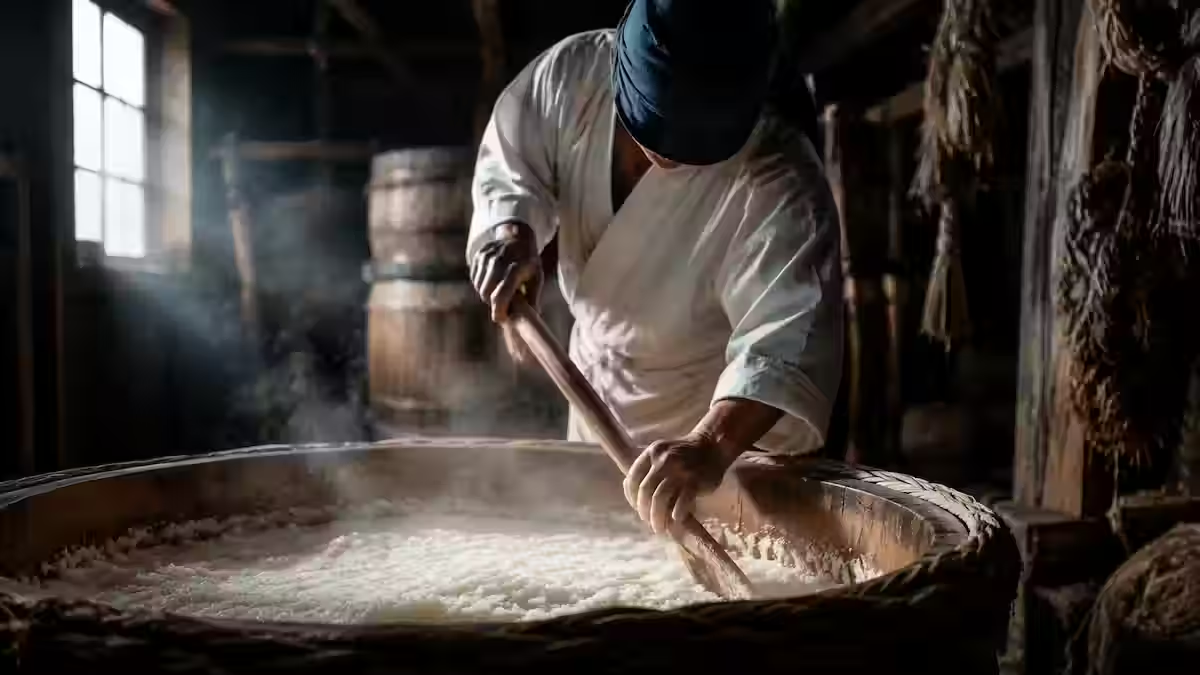
Behind every great bottle of sake stands one guiding figure: the toji. So what is a toji? A toji is the master brewer who leads all of sake production. Indeed, this person oversees everything, from choosing the rice to judging the taste. Think of the toji as the conductor of a large, careful orchestra.
In turn, rice, water, koji, and yeast each have their moment. Then the toji brings them together into one harmonious sake. For a long time, English writing reduced the role to two words, master brewer. Yet, in truth, the toji is far more than a job title.
This person carries centuries of tradition, science, and hard-won instinct. Moreover, the toji leads a whole team of brewery workers, the kurabito. In 2024, the wider craft even earned a place on a UNESCO list. This guide explores who the toji is and why the role matters so much.
A quick word before we begin. The toji is easy to romanticize as a lone genius. The reality is warmer and more human. This is a story of teamwork, seasons, and patience. Stay with it, and the whole world of the kura opens up.
In short, a toji is a sake brewery’s master brewer and head of production. This person selects the rice, manages fermentation, and judges the final quality. They also lead the kurabito, the skilled brewery workers. Traditionally a seasonal winter role, the toji is increasingly an in-house or owner-brewer today.
TOC
Quick Facts About the Toji
Japanese Name
杜氏 (toji)
English Translation
Master brewer / head brewer
Primary Role
Leading and managing all of sake production
Traditional Employment
Seasonal migrant brewer, working in winter
Modern Role
Often an in-house or owner-brewer (kuramoto-toji)
Brewing Season
Traditionally winter, roughly October to March
Leads
The kurabito, the brewery’s skilled workers
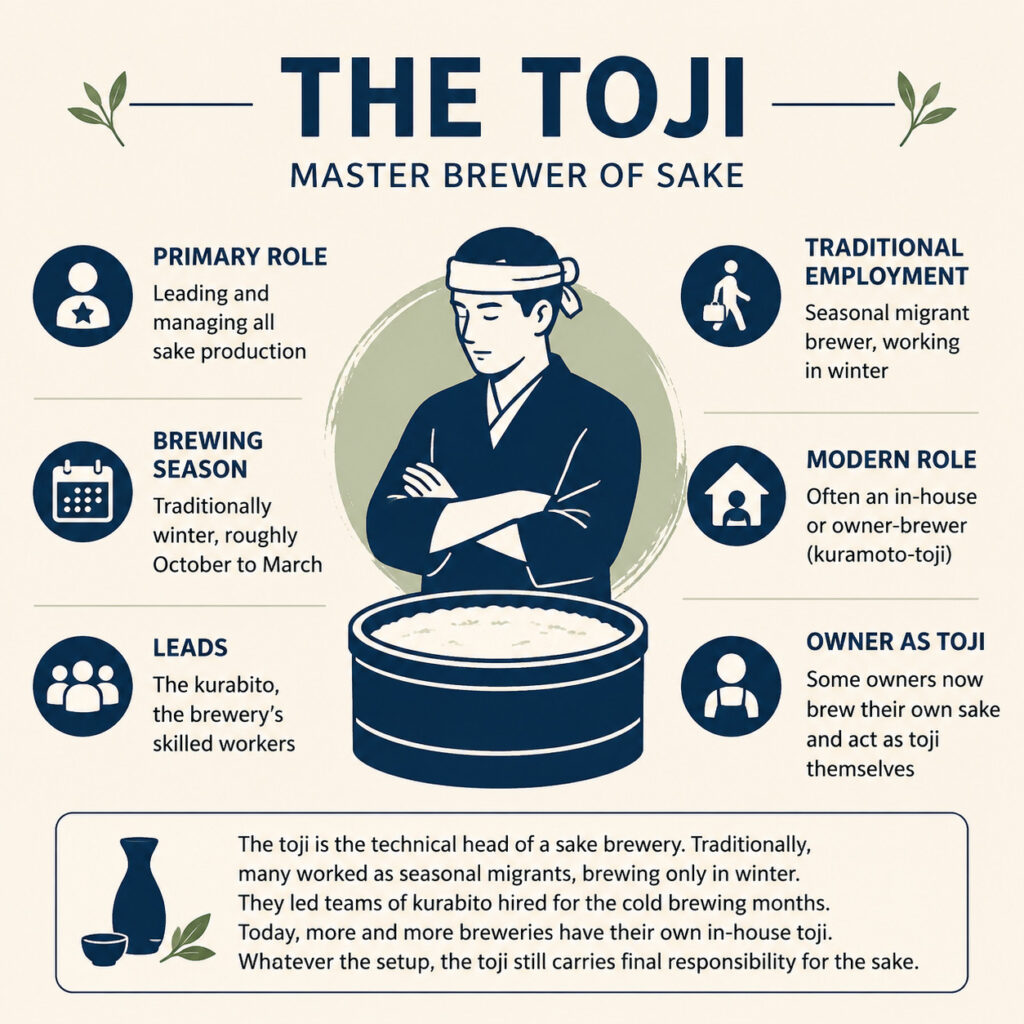
The toji is the technical head of a sake brewery. Traditionally, many worked as seasonal migrants, brewing only in winter. They led teams of kurabito hired for the cold brewing months. Today, more and more breweries have their own in-house toji. Some owners now brew their own sake and act as toji themselves. Whatever the setup, the toji still carries final responsibility for the sake.
What Is a Toji?
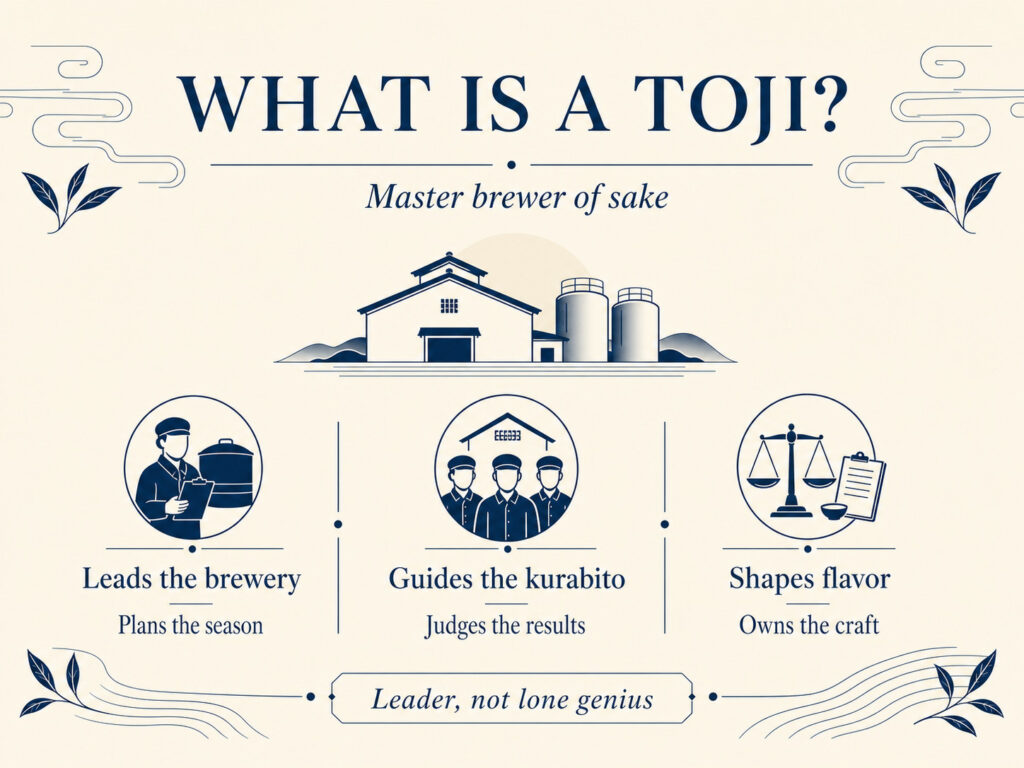
A toji is the master brewer who runs every stage of sake making. The word is usually written with two characters and read as toji. That person sits at the very top of the brewing team. Specifically, they plan the season, guide each step, and judge the results. In short, the toji decides how a brewery’s sake will taste.
The scope of that job is easy to underestimate. A toji shapes both the recipe and the schedule. Moreover, they carry the weight of every mistake. When a batch shines, the whole team shares the credit. Yet when it fails, the toji shoulders the blame.
The origins of the word itself are a little uncertain. For example, one theory links it to an old Chinese god of brewing. Another traces it to toji, a word for a senior woman of the house. Notably, that second idea fits a striking historical fact. Long ago, women brewed most of Japan’s sake.
That detail is more than a footnote. In ancient times, brewing was often sacred women’s work. Some shrines still recall this female origin. So the modern return of women to the kura is really a homecoming.
The Toji Within the Brewery
It helps to picture a brewery as a small company. The owner, or kuramoto, is like the president. Meanwhile, the toji acts as the head of the factory floor. Below them, the kurabito carry out the daily tasks. Each role is distinct, yet all depend on one another.
Kuramoto and Toji: Not the Same
People often confuse the kuramoto and the toji. The distinction is simple once you see it. A kuramoto owns the brewery as a business. By contrast, the toji owns the brewing as a craft. Sometimes, though, one person fills both roles.
A Leader, Not a Lone Genius
The toji is a leader first and foremost. After all, no single person can brew sake alone. First, the toji sets the plan and makes the key calls. In turn, the kurabito carry that vision out, hour by hour. So leadership matters as much as any technical skill.
The History of the Toji System
The toji system grew from Japan’s farming calendar. Indeed, its roots reach back many centuries. To understand it, you have to picture rural winter life. That season, quiet in the fields, became the season of sake.
From Temples and Farms
Historically, sake brewing has very old religious roots. Historically, temples and shrines brewed much of the country’s sake. In its earliest days, notably, women handled most of the work. Over time, however, commercial breweries slowly took over. That shift set the stage for a new kind of worker.
Seasonal Migration of Brewers
Here lies the heart of the traditional system. Traditionally, sake was brewed in the cold winter months. Back then, winter farm work slowed to almost nothing. So farmers traveled to breweries to earn extra income. These seasonal workers became the first true brewing teams.
Picture the rhythm of their year. In spring and summer, they farmed their own land. When the harvest ended, the cold set in. Then they packed up and left for the breweries. That yearly journey defined a whole way of life.
Naturally, the most skilled among them rose to lead. Naturally, that leader became the toji of the group. Each winter, the team left home for a distant brewery. They lived and worked there until spring arrived. Then they returned to their villages and their fields.
This rhythm shaped families and whole villages. Fathers passed the craft to sons. Skills stayed within certain communities for generations. So a village might become known for its brewers. That local pride still lingers in some places today.
Growth in the Edo Period
Then the Edo period pushed this system forward. Meanwhile, sake demand grew quickly in the big cities. Famous brewing regions, like Nada and Fushimi, expanded fast. So they needed skilled hands every single winter. So the seasonal toji system spread across the country.
Money and reputation followed skill. A gifted toji could command a good wage. Breweries competed to hire the best leaders. In this way, brewing slowly became a respected profession.
The Rise of Regional Guilds
Over generations, gradually, brewers organized into groups. Gradually, each region developed its own school, or guild. These guilds guarded their techniques and passed them down. They also placed their members in breweries each year. In this way, a region’s style stayed alive for centuries.
These guilds did more than teach technique. They arranged jobs for their members each winter. When one toji retired, another from the same school stepped in. So a brewery kept its flavor steady across the generations.
Into the Modern Brewery
Then the system changed again in modern times. Then, during the Meiji era, the government modernized brewing. Guilds reorganized and formed formal associations. Eventually, year-round breweries reduced the need for migration. Today, the old seasonal pattern is fading, though its legacy remains.
The Postwar Shift
Indeed, the biggest change came after the war. Sake sales soared, then peaked in the 1970s. After that, demand fell for many years. The pool of toji shrank and aged with it.
So breweries could no longer rely on outside toji. So many trained their own staff instead. The owner-brewer, or kuramoto-toji, became common. In this way, the craft moved inside the brewery walls.
Why Sake Is Traditionally Brewed in Winter
Here lies a question many newcomers ask. Why does the toji work mainly in the cold? The answer explains the whole seasonal system. It also reveals the quiet science behind the craft.
Notably, this winter method has a name, kan-zukuri. It took hold during the Edo period. Before then, in fact, brewers worked through much of the year. Cold-weather brewing slowly proved far superior.
The Science of Cold Brewing
Above all, low temperatures give the brewer real control. Fermentation runs slow and steady in the cold. That slow pace builds clean, refined, delicate flavors. A warm, fast ferment tends to turn rough instead.
Moreover, the cold guards the mash from danger. Fewer stray microbes thrive in winter air. So unwanted bacteria struggle to take hold. The koji and yeast can then work in peace.
Meanwhile, snowy regions gain an extra gift. Falling snow scrubs dust from the air. The kura’s air turns cleaner and calmer. For delicate brewing, that purity truly matters.
Winter and the Farming Calendar
Cold brewing also fit rural life perfectly. Back then, winter emptied the rice fields of work. Farmers suddenly had time and willing hands. So they carried their labor into the breweries.
Naturally, this overlap shaped the entire toji system. The brewing season matched the farming off-season. One rhythm fed neatly into the other. In that way, winter bound sake and farming together for centuries.
Interestingly, a gentle irony sits inside this tradition. Modern breweries can now cool their tanks by machine. So sake can be brewed in any season today. Yet many toji still choose winter, honoring the old wisdom.
A Toji’s Responsibilities Through the Season
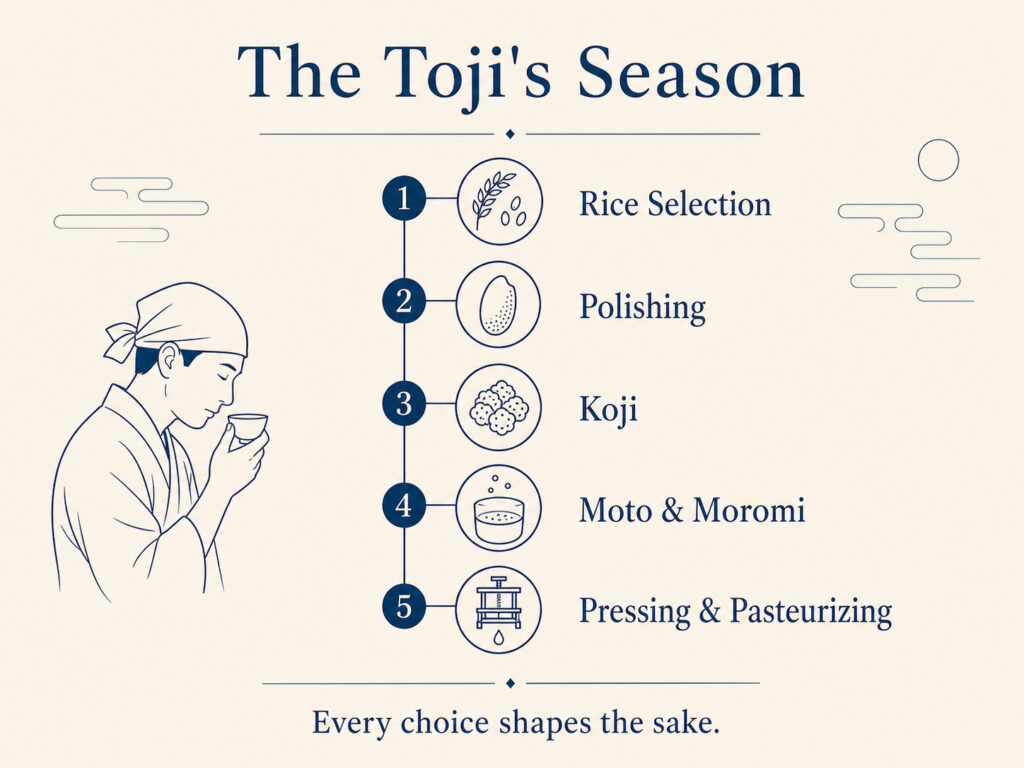
Indeed, the toji guides sake through every stage of its birth. Indeed, each step brings its own choices and risks. After all, a single misjudgment can change the whole batch. Let us follow the toji through a brewing season.
One idea guides the whole journey. The toji plans backward from the sake they imagine. Every choice serves that final picture. So the work is as much design as labor.
Choosing and Polishing the Rice
Everything begins with the sake rice. First, the toji selects the variety and the quality with care. Next comes rice polishing, which shapes the final style. The toji decides how far to polish each batch. Notably, that single choice already points toward the sake to come.
The toji weighs cost against quality here. Top rice is expensive and limited in supply. A wise toji matches the grain to the goal. A fragrant daiginjo earns the finest rice available.
Managing the Water and Koji
Then attention turns to the brewing water. Notably, its minerals quietly shape fermentation and flavor. Soon after, the crucial koji making begins. Many toji call koji the single most important stage. So they watch its temperature and growth almost hour by hour.
An old brewing saying captures this well. It ranks koji first, the starter second, and the mash third. The toji lives by that order of priorities. A great koji, they know, can lift the entire brew.
Indeed, this is why the koji room feels sacred. The toji often checks it through the night. A few missed hours can change everything. Such devotion defines the whole profession.
Building the Moto and Moromi
Next, the toji oversees the moto, the yeast starter. Some choose the old kimoto method for depth and richness. That starter then grows into the moromi, the main mash. There, fermentation runs its long, delicate course. The toji checks it daily, adjusting temperature with great care.
The mash can turn in a single day. A warm spell speeds the yeast too much. A cold snap can stall it instead. So the toji nudges the temperature gently. Small, timely moves keep the whole brew in balance.
Pressing, Filtering, and Pasteurizing
As fermentation ends, the toji calls for pressing. Here, timing shapes the balance of the finished sake. After that comes filtration to refine clarity and taste. Finally, gentle pasteurization stabilizes the sake. At each step, the toji guards the character of the brew.
Notice how many decisions pile up here. Each stage offers a fork in the road. The toji chooses again and again, day after day. Only at the end do all those choices become taste.
This is why two toji differ so much. Give them the same rice and water. Each will still make a different sake. Their choices, tastes, and instincts vary. So the toji is the true signature on the bottle.
The Skills and Knowledge of a Toji
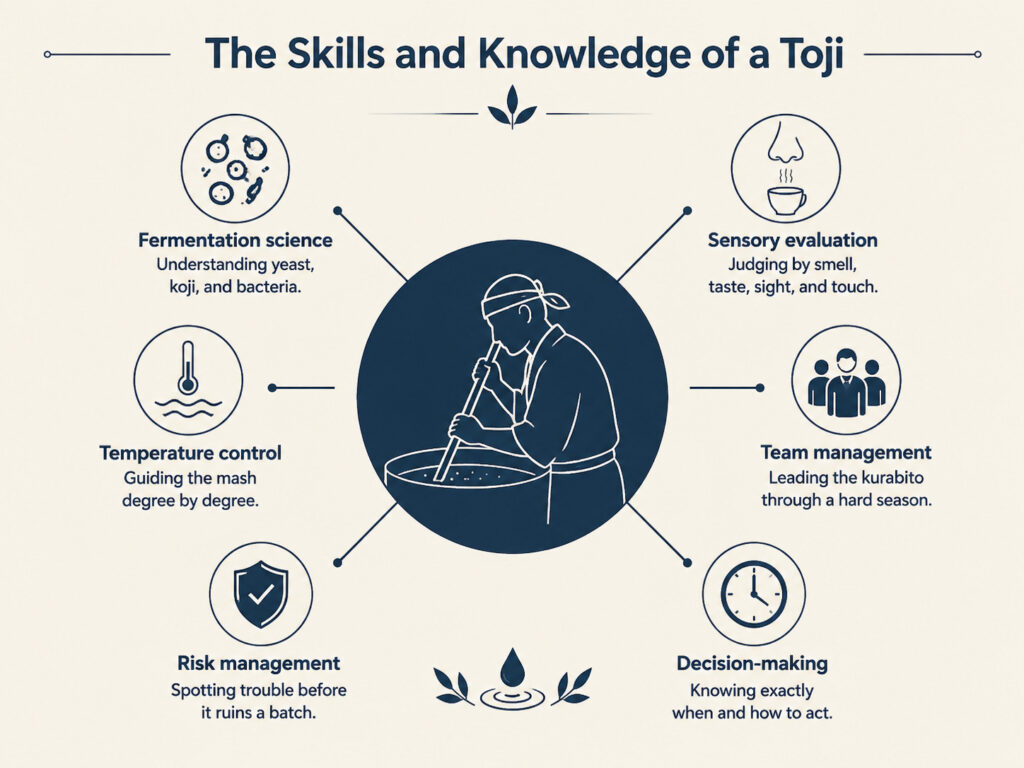
A great toji blends science, art, and leadership. Indeed, few other crafts demand such a wide range of skills. For one thing, some knowledge comes from books and study. Yet much more comes from years at the tank side.
Science and the Senses
First, a toji must understand fermentation deeply. Yeast, mold, and bacteria all follow their own rules. Yet science alone never finishes the job. The toji also judges by smell, taste, sight, and touch. A quick sniff of the mash can reveal its hidden health.
This sensory skill takes years to build. A young brewer learns to read tiny signals. The color of the foam tells a story. So does the sound of the bubbling mash. Over time, these clues become second nature.
Control and Timing
Above all, temperature control sits at the core of the craft. Remarkably, a few degrees can shift aroma, sweetness, and body. The toji reads the mash and adjusts with quiet precision. Timing matters just as much as temperature. Knowing exactly when to act is a skill built over decades.
Consider a single cold morning in the kura. The mash may be running slightly fast. A lesser hand might panic and overcorrect. The seasoned toji makes one small, calm adjustment. That restraint is itself a hard-won skill.
Leadership and Risk
Moreover, the toji leads people, not just microbes. After all, a brewing team works long, cold, demanding hours. Good leadership keeps that team sharp and united. Risk management rounds out the role. One wrong call can spoil weeks of shared labor.
So the toji carries a heavy mental load. They plan for problems before those problems appear. A backup exists for nearly every step. That quiet foresight protects the whole season.
Experience shapes this calm foresight. A veteran has seen batches go wrong before. Those hard lessons sharpen the instincts. So the seasoned toji stays cool under pressure. Panic, they know, ruins more sake than any microbe.
Fermentation science: understanding yeast, koji, and bacteria.
Sensory evaluation: judging by smell, taste, sight, and touch.
Temperature control: guiding the mash degree by degree.
Team management: leading the kurabito through a hard season.
Risk management: spotting trouble before it ruins a batch.
Decision-making: knowing exactly when and how to act.
A Day in the Life of a Toji
What does a toji actually do all day? The answer changes with the season. Yet a deep brewing day follows a clear shape. Let us step inside the winter kura for a moment.
Early Morning Checks
The day starts before dawn, in the cold. The toji visits the koji room first. They feel the rice with a bare hand. Temperature and moisture tell them how the mold grows. From that reading, they plan the hours ahead.
Next comes a slow walk past the tanks. The toji looks, listens, and smells at each one. A healthy mash sings with fine, steady bubbles. An off smell hints at trouble brewing. These quiet rounds shape every later decision.
Midday Work and Teaching
By midday, the team is deep in work. Rice is steaming, and koji needs turning. The toji moves between tasks, guiding as they go. They correct a grip here and a timing there. Teaching never really stops in the kura.
Evening and Records
As night falls, the pace finally eases. The toji records the day’s numbers with care. Temperatures, timings, and tastings all go down. These notes guide tomorrow and next year alike. Only then does the long day close.
Multiply that day by a whole season. Weeks of such care stack up slowly. Each batch demands the same devotion. So a toji’s winter is long and relentless. Yet the reward arrives in every finished bottle.
Famous Toji Guilds
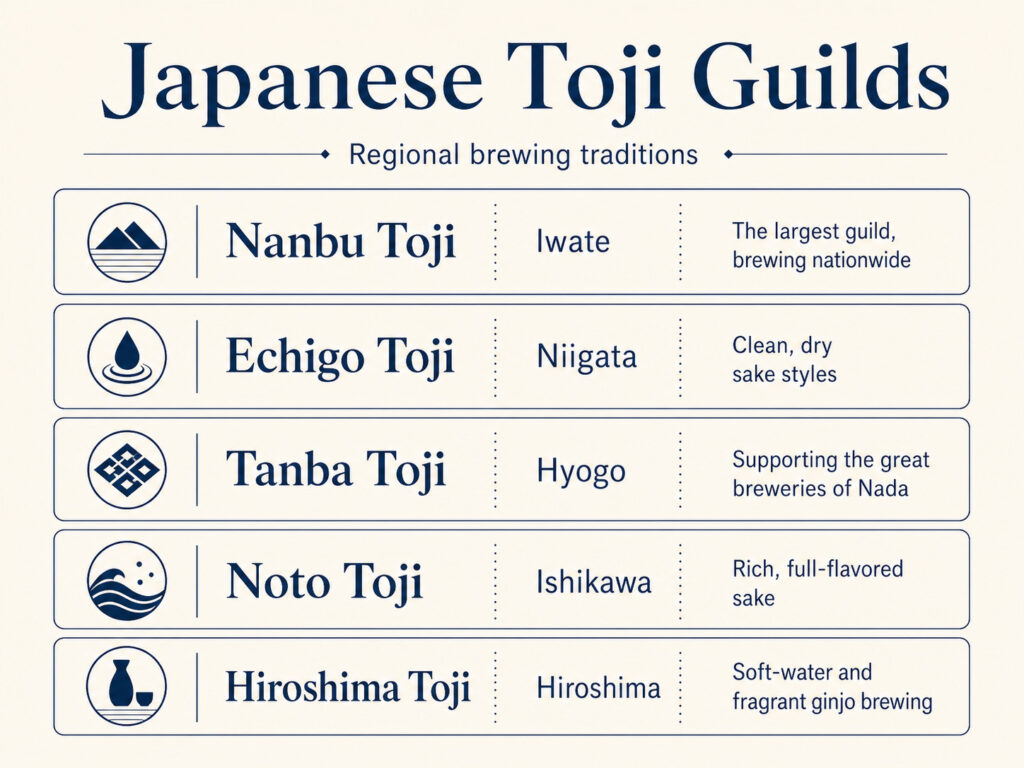
Historically, Japan’s brewing regions each raised their own toji guilds. Historically, these schools shaped the taste of whole areas. A few names stand out above the rest. Their traditions still echo in bottles today.
You can still spot a guild’s fingerprint. A brewery may name its toji’s school with pride. Some labels even mention the tradition directly. For fans, that name hints at the style inside.
Nanbu Toji
First, the Nanbu guild is the largest of them all. Specifically, it comes from the Iwate region in the north. Nanbu toji work in breweries across the whole country. Their name carries enormous respect in the sake world. Many famous brewers trained within this school.
The Nanbu guild built a strong training culture. It ran contests and study groups for its members. That focus on learning kept its standards high. As a result, Nanbu-trained toji spread across all of Japan.
Historically, the guild’s roots run deep in Iwate. Brewing groups formed there as early as the 17th century. The towns of Ishidoriya and Shiwa became its heart. A modern association followed in the late Meiji era.
In taste, Nanbu sake leans toward firm, well-defined flavor. The region’s harder water shapes that character. Today, the guild runs a formal certification system. It also shares once-secret methods through open training.
Echigo Toji
Meanwhile, the Echigo guild hails from Niigata. Notably, snow buries this region through the long winter. Its toji helped shape the clean, dry Niigata sake style. For a time, this was among the largest guilds of all. Today, Niigata brews much of its sake with local hands.
Meanwhile, the Echigo guild rose from snowy Niigata. Its brewers fanned out from the 18th century onward. They often worked in Kanto and around Nagoya. When the group formed in 1958, over 900 members joined.
By contrast, Echigo sake is famous for a soft, mild touch. Brewers there mastered long, cold fermentation. The guild also invests deeply in training. It even founded a dedicated sake school in 1984.
Notably, that school reflects a wider truth. Great guilds always invested in teaching. They turned scattered skill into shared knowledge. In doing so, they secured their own future.
Tanba Toji
By contrast, the Tanba guild comes from the hills near Hyogo. Historically, its brewers supported the mighty breweries of Nada. Nada produced a huge share of Japan’s sake. So Tanba toji influenced the national taste for centuries. Their techniques spread far beyond their home.
Historically, the Tanba guild grew up around Sasayama in Hyogo. From the late Edo period, it supplied nearby Nada. By the 1830s, Tanba toji ran most Nada breweries. In 1902, they even held Japan’s first brewing lecture course.
Trace many house styles back far enough, and a guild appears. A brewery in one region might follow a distant school. That mixing spread ideas across the whole country. In this way, the guilds knit the sake world together.
Tanba brewers also led on training and pride. In 1902, they held Japan’s first brewing lecture course. Their influence still lingers in the taste of Nada. A local museum now honors their long legacy.
Noto Toji
Similarly, the Noto guild comes from the Noto Peninsula in Ishikawa. Indeed, it is famous for rich, full-flavored sake. Several legendary toji rose from this school. A 2024 earthquake struck the region hard. Yet its brewers pressed on, even bottling a sake of recovery.
That story moved many people across Japan. The quake damaged the guild’s home region badly. Some breweries lost almost everything. Yet from surviving mash, a few crafted a hopeful sake. It became a quiet symbol of resilience.
Similarly, the Noto guild comes from the Suzu area of Ishikawa. It grew from the late Edo period onward. At its peak, Noto toji worked astonishingly far afield. Their sake reached Korea, Manchuria, and even Singapore.
In taste, Noto sake is prized for rich, full body. Master brewers like Naohiko Noguchi made it famous. The guild remains small but deeply respected. Its bond with the rugged peninsula runs very deep.
Sadly, recent years tested that bond severely. A major earthquake struck Noto in early 2024. Several breweries suffered heavy damage. Yet the guild’s spirit of recovery shone through the loss.
Hiroshima Toji
Finally, the Hiroshima guild has a special place in history. Notably, the region’s water is famously soft. Local brewers pioneered soft-water brewing methods. That breakthrough opened the door to fragrant ginjo sake. Hiroshima toji remain linked to elegant, aromatic styles.
Their soft-water method spread widely in time. Brewers elsewhere studied and adopted it. It helped make delicate ginjo sake possible nationwide. So one region’s fix reshaped the whole craft.
Finally, the Hiroshima guild centers on the town of Akitsu. There, a brewer named Senzaburo Miura changed history. In the 1890s, he cracked the puzzle of soft-water brewing. That breakthrough opened the door to fragrant ginjo.
Hiroshima brewers speak of tsukuri nakama, or crafting comrades. Rival breweries still help one another freely. The guild also produced Miho Imada, a celebrated woman toji. She earned a spot on a global list of influential women in 2020.
Guild
Home Region
Known For
Nanbu Toji
Iwate
The largest guild, brewing nationwide
Echigo Toji
Niigata
Clean, dry sake styles
Tanba Toji
Hyogo
Supporting the great breweries of Nada
Noto Toji
Ishikawa
Rich, full-flavored sake
Hiroshima Toji
Hiroshima
Soft-water and fragrant ginjo brewing
Toji and Japan’s Regional Sake Cultures
The toji tradition is deeply tied to place. Each region shaped its own brewing spirit. That local character still flavors the sake today. A short tour makes the point clear.
Hyogo, home of great rice, supported the Tanba toji. Their work fed the famous breweries of Nada. Kyoto’s Fushimi district favored softer, gentler sake. Its water and its toji shaped that smooth style.
Farther north, the story shifts again. Niigata’s snowy winters bred the Echigo school. Their clean, dry sake became a national favorite. Akita and Yamagata also raised skilled brewing hands.
Hiroshima adds its own bright chapter. Its soft water once made brewing hard. Local toji solved that puzzle with new methods. Their breakthrough helped launch fragrant ginjo sake.
Region and role are bound tightly together. A toji does not just make sake. They carry a place’s history in their hands. That is why local pride runs so deep. Each glass tells you where it came from.
Toji and Kurabito: The Brewing Team
Indeed, a toji never works alone. Here, the kurabito are the skilled workers of the brewery. Together, they form a tight, disciplined team. Understanding their bond reveals how sake truly gets made.
How the Roles Differ
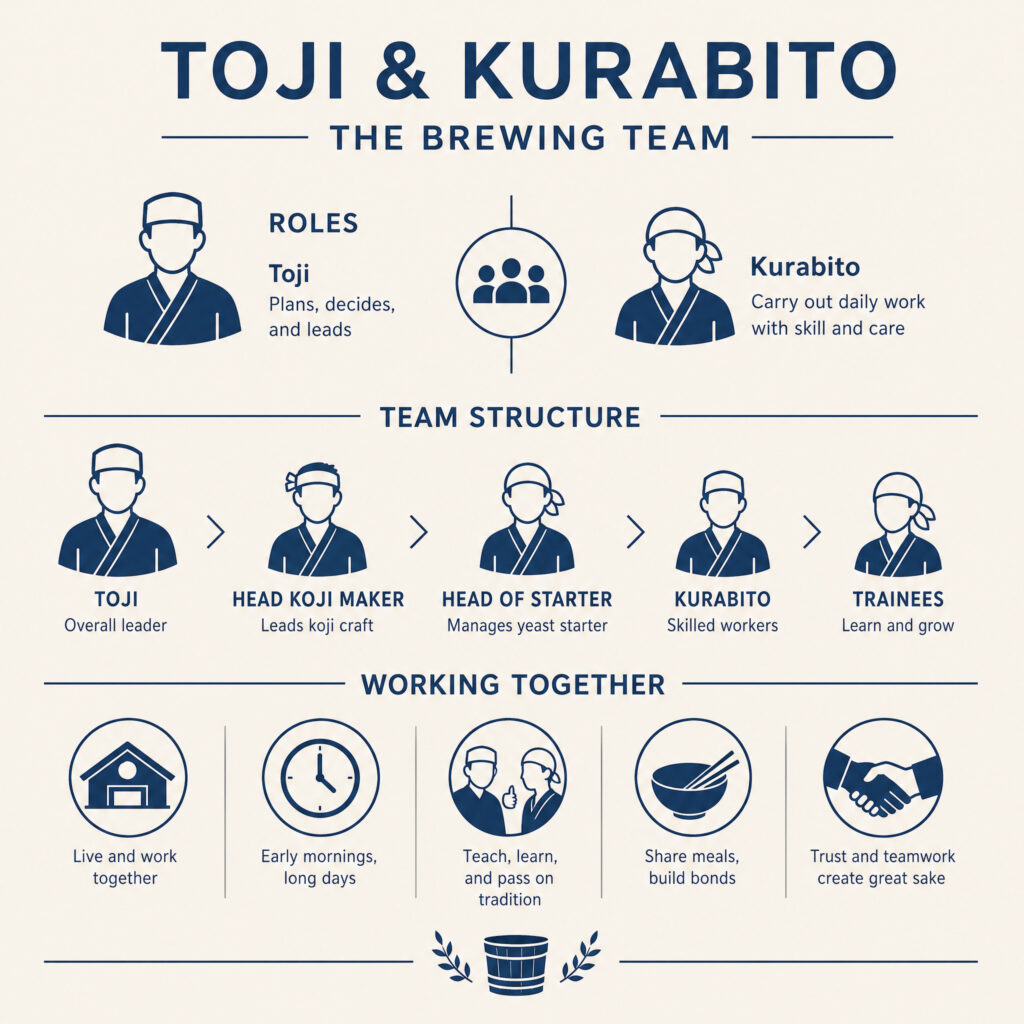
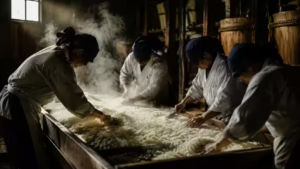
Fundamentally, the difference comes down to command. The toji plans, decides, and leads. In turn, the kurabito carry out the daily work with skill. Moreover, senior kurabito hold special titles and duties. Each knows a specific craft, from koji to pressing.
These specialists carry proud titles. One leads the all-important koji work. Another guards the yeast starter with care. Together, under the toji, they cover every task. No single step is ever left to chance.
A Team With Clear Ranks
Typically, a traditional brewery runs on clear ranks. Naturally, the toji sits at the top of the structure. Below come the head koji maker and the head of the starter. Then come the general kurabito and younger trainees. This order keeps a busy, cold brewery running smoothly.
Each rank has earned its place through time. A trainee starts with the simplest chores. Years of skill and trust bring promotion. In this way, the brewery grows its own future leaders.
Working Side by Side
Indeed, daily life in the brewery is intensely close. Typically, the team lives together during the season. They rise early and work through long, cold days. The toji teaches constantly, through word and example. In this way, knowledge passes from one generation to the next.
There is real warmth in this shared life. Long hours build deep, lasting bonds. Meals, work, and rest happen together. Many brewers speak of the team as a second family.
This closeness serves the sake, too. A united team communicates without words. A glance or a nod can pass a message. In the rush of brewing, that bond saves precious time. Trust, in the end, becomes part of the craft.
The Modern Toji
Today, the role of the toji is changing quickly. Indeed, old patterns are giving way to new ones. Some changes feel like a loss, others like fresh hope. The result is a richer, more varied profession.
This change did not arrive by accident. Fewer farmers now migrate for winter work. Breweries needed a steadier way to staff the kura. So new models grew to fill that gap. The profession simply adapted to a new age.
Owner-Brewers and In-House Toji
Notably, many breweries no longer hire a seasonal toji. Instead, the owner often brews the sake directly. This owner-brewer is called a kuramoto-toji. Other breweries train a permanent, in-house toji. Both models keep skills within the brewery all year.
This shift carries real trade-offs. An owner-brewer knows the business inside out. A traditional toji, though, brings deep specialized craft. Neither path is simply better than the other. Each brewery chooses what fits its own story.
Women Return to the Craft
Historically, women once brewed nearly all of Japan’s sake. For centuries, however, custom kept them out of the kura. That barrier is finally breaking down. A growing number of women now lead breweries as toji. In a real sense, they are reclaiming an ancient role.
Their progress is steady, if still modest. Some now run their family breweries outright. Others lead the brewing as respected toji. Each success quietly opens the door a little wider.
Their impact reaches beyond their own breweries. Young women now see a real path ahead. Role models make the dream feel possible. So each pioneering toji lifts the next generation.
A Younger, Scientific Generation
Today, younger brewers are entering the craft with fresh training. Today, many study fermentation science at university. They blend lab knowledge with traditional instinct. This new generation is reviving old methods too. Tradition and science now grow side by side.
This mix produces exciting sake. Young toji test bold new yeasts and methods. At the same time, they revive nearly lost techniques. The best of them honor the past while pushing forward.
Toji From Around the World
Remarkably, the role has even crossed national borders. Notably, Philip Harper, from England, became a certified toji. He trained for years inside Japanese breweries. His success showed the craft could be learned by anyone devoted. Today, sake brewing is slowly becoming a global pursuit.
Harper’s path was far from easy. He started by doing any job he was given. He milled rice, then learned to steam it. Only later did he master koji and the mash. His patience mirrored the traditional toji road exactly.
His achievement carried real weight. It proved the craft was open to outsiders. Language and culture were hurdles, not walls. Since then, more foreign brewers have followed. Sake now draws devoted makers worldwide.
The Future of the Toji Profession
The toji role faces real challenges today. Yet it also stands full of fresh promise. The old system is fading in places. In its place, new and hopeful models are rising.
An Aging, Shrinking Craft
Historically, sake shipments peaked in the 1970s. Demand then slid for many years. The number of toji fell alongside it. Many who remained grew older together.
Fewer farmers now travel to brew each winter. That shift broke the old supply of seasonal hands. Some small guilds simply faded away. A few even vanished when their last toji died.
New Models Take Hold
So breweries answered this squeeze with change. Many now employ a year-round, salaried toji. Others let the owner brew as a kuramoto-toji. Both keep vital skills inside the brewery.
Today, technology has entered the kura, too. Some breweries now brew by careful data. Sensors track what once lived only in memory. Yet human judgment still guides the final call.
A Hopeful Revival
Still, there is genuine reason for optimism here. The ginjo and junmai booms revived interest in craft. Young brewers now study fermentation at university. They blend that science with hard-won tradition.
Meanwhile, guilds have adapted to survive as well. The Nanbu school opened its once-secret methods. It built a modern certification system too. New regional guilds have even formed in recent decades.
Today, women and global brewers add fresh energy. Together, they widen who a toji can be. So the craft looks more open than ever. Its long story, it seems, is far from over.
Still, one truth anchors all this change. The core task never really shifts. A toji still reads living microbes by feel. That human skill remains the beating heart of sake.
UNESCO and Traditional Sake Brewing
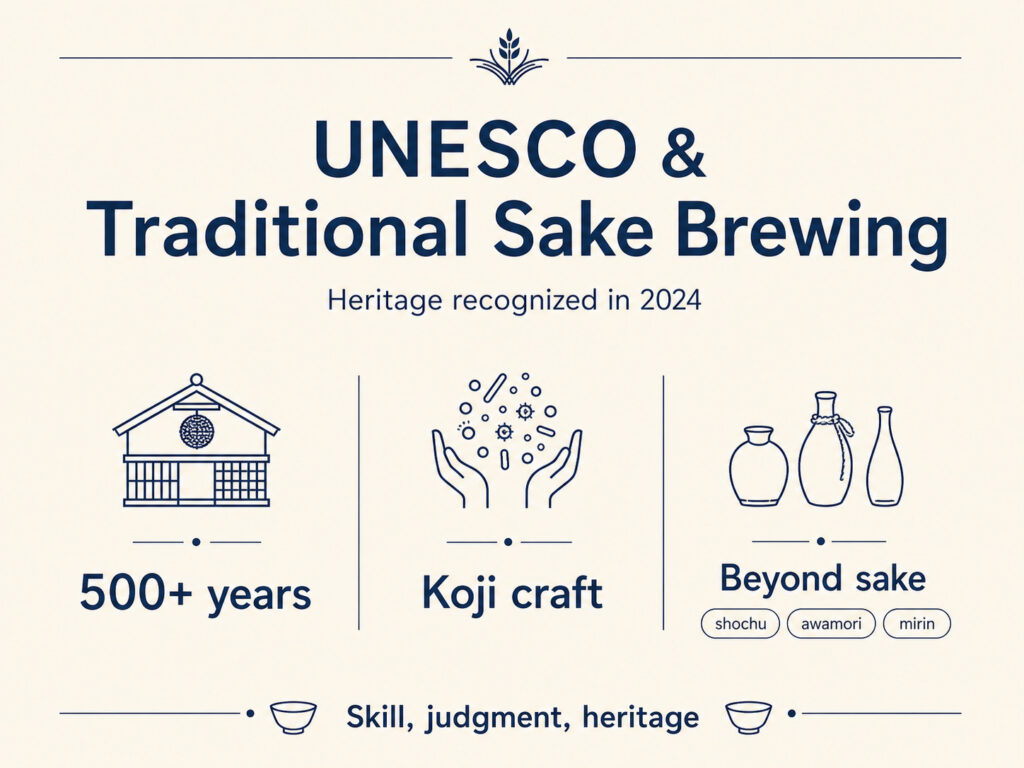
Then, in December 2024, the craft reached a global stage. Then UNESCO added traditional sake brewing to its heritage list. The listing honored a technique refined over 500 years. It celebrated the koji-based skills of toji and kurabito alike.
The listing covered more than sake alone. It also honored shochu, awamori, and mirin. All of these rely on koji and skilled hands. So the honor reached across many traditional drinks.
Why the Craft Matters
Above all, the listing spotlighted human skill. After all, machines can copy some steps, yet not the judgment. A toji reads living microbes and responds by feel. That blend of science and intuition is precious. UNESCO recognized it as heritage worth protecting.
Think about what a machine cannot do. It cannot smell doubt in a mash. It cannot decide to wait one more day. Only a person, rich in experience, can. That human judgment is the true heritage.
The timing felt especially meaningful. Interest in craft sake was already rising worldwide. The listing gave that interest a real boost. It also reminded younger Japanese of a proud tradition. Suddenly, the humble kura stood on a global stage.
Culture in Every Cup
Indeed, sake is woven into Japanese life. For example, it appears at festivals, weddings, and shrine rites. Behind each of those cups stands a toji. So honoring the craft also honors the people. The recognition arrived as a proud moment for the whole industry.
Common Misconceptions About the Toji
Naturally, the toji role attracts a fair share of myths. Still, a few deserve a clear answer. Let us clear up the most common ones.
Is the Toji Always the Owner?
No, in fact, the toji is not always the owner. Traditionally, the two roles stayed quite separate. The owner ran the business, and the toji ran the brewing. In some modern breweries, one person does both. Yet the two jobs remain different in nature.
The blending of roles has clear causes. Smaller breweries cannot always hire a separate toji. So the owner learns to brew out of necessity and love. This owner-brewer model keeps many small kura alive.
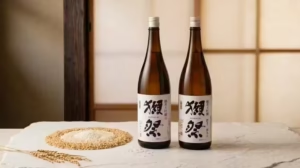
In fact, some breweries have gone even further. The maker of Dassai, in Yamaguchi, dropped the toji system entirely. Instead, trained staff brew by careful data and analysis. That bold move produced a world-famous sake.
Many celebrated sakes now come from such breweries. A hands-on owner can chase a personal vision. They answer to no outside toji at all. That freedom has fueled a wave of bold, exciting sake.
Can Women Become Toji?
Yes, indeed, women can absolutely become toji. Indeed, history shows women brewed sake first of all. A custom later barred them from the brewery. That custom is fading fast today. More women now lead breweries with pride and skill.
Does One Person Brew the Sake?
No, in truth, sake is never the work of one person. After all, the toji leads, but the kurabito do much of the labor. Brewing needs many hands and many skills. It is a team craft from start to finish. The toji simply guides that team toward one goal.
Do All Breweries Still Use the System?
Today, not every brewery uses the old seasonal system. Today, many have moved to in-house or owner-brewers. Year-round production changed the old rhythm. Still, the title and spirit of the toji live on. The role adapts, yet it never truly disappears.
So the toji system keeps reinventing itself. It began with migrant farmers in winter. It grew into proud regional schools. Now it lives on through salaried and owner-brewers alike.
Final Thoughts
Indeed, the toji stands at the very heart of sake. Indeed, this master brewer blends science, experience, and craftsmanship. They act as both a technical expert and a team leader. Rice, water, koji, and yeast all answer to their guidance. Without the toji, none of it would come together.
That word, foundation, feels exactly right. A house needs a strong base to stand. Sake needs a steady hand to guide it. The toji provides that hand, season after season.
Historically, the role has traveled a long and winding road. Historically, it began with farmers brewing through the winter. It grew into proud regional guilds and schools. Today it welcomes women, scientists, and even foreign brewers. Through every change, the core of the craft endures.
So the next time you sip sake, remember the hand behind it. A toji, somewhere, judged that very moment with care.
That thought adds something to every glass. You taste rice, water, and time. You also taste a person’s lifework. In the quiet of a good sake, the toji is still present.
Toji FAQ
What is a toji?
A toji is the master brewer of a sake brewery. This person leads every stage of production. They choose ingredients, manage fermentation, and judge the final sake. In short, the toji is the head of the whole brewing craft.
What does a toji do?
A toji plans and guides the entire brewing season. They select rice, oversee koji, and control fermentation temperatures. They also lead the team of brewery workers. Every important brewing decision passes through them.
What is the difference between a toji and a kurabito?
The toji is the leader, while the kurabito are the workers. This master brewer makes the key decisions and sets the plan. In turn, the kurabito carry out the daily hands-on tasks. Think of a factory chief guiding a skilled crew.
What is the difference between a toji and a kuramoto?
The kuramoto owns the brewery as a business. The toji leads the actual brewing as a craft. Sometimes one person does both jobs. Often, though, they are two separate roles.
Can women be toji?
Yes, women can and do become toji. In fact, women brewed most of Japan’s early sake. A later custom kept them out of breweries. That barrier is now fading, and more women lead breweries again.
Where does the word toji come from?
The origins are not fully certain. One theory links it to an old god of brewing. Another ties it to a word for a senior woman of the house. That second idea matches sake’s female history.
What are the famous toji guilds?
The best known include Nanbu, Echigo, and Tanba. Noto and Hiroshima are also highly respected. Each guild comes from a specific region. Each shaped its own distinct brewing style.
Is sake brewed by one person?
No, brewing is always a team effort. The toji leads, but the kurabito do much of the work. Many hands and skills are needed. Sake is a shared craft from beginning to end.
When do toji traditionally work?
They traditionally worked during the cold winter months. The season ran roughly from October to March. In summer, many returned to farming. Today, some breweries brew all year round.
Is the toji system still used today?
It survives, though in changing forms. Many breweries now use in-house or owner-brewers. Year-round production reshaped the old pattern. Yet the title and spirit of the toji continue.
Can a foreigner become a toji?
Yes, though it is rare and demanding. Philip Harper, from England, earned the title. He spent years training inside Japanese breweries. His story shows the craft can be learned by the truly devoted.
Why is traditional sake brewing on the UNESCO list?
UNESCO recognized it in December 2024. The craft rests on centuries of koji-based skill. It depends on human judgment, not just machines. That living heritage was seen as worth protecting.
Nanbu Toji Association (Iwate) – on the history, certification system, and training of the Nanbu guild. (Surveyed: July 2026)
Sato, Tadashi (1974). “Modernization of the Sake Brewing Industry and Structural Change in the Labor Market: An Analysis of Nanbu Toji,” academic study of the seasonal toji labor system. (Surveyed: July 2026)
Ryo Iwa is the founder and editor of foodinjapan.org. Born and raised in Japan, he writes from regional travel, market visits, and Japanese-language primary sources that rarely reach English readers, including brewing institute publications and industry glossaries. Where a figure cannot be traced to a source, the article says so.
He has been a Google Maps Local Guide for over 10 years, with more than 1,800 reviews and over 41,000 photos viewed hundreds of millions of times. He previously spent two decades as an IT consultant in Japan, the US, and the UK.













Comments