



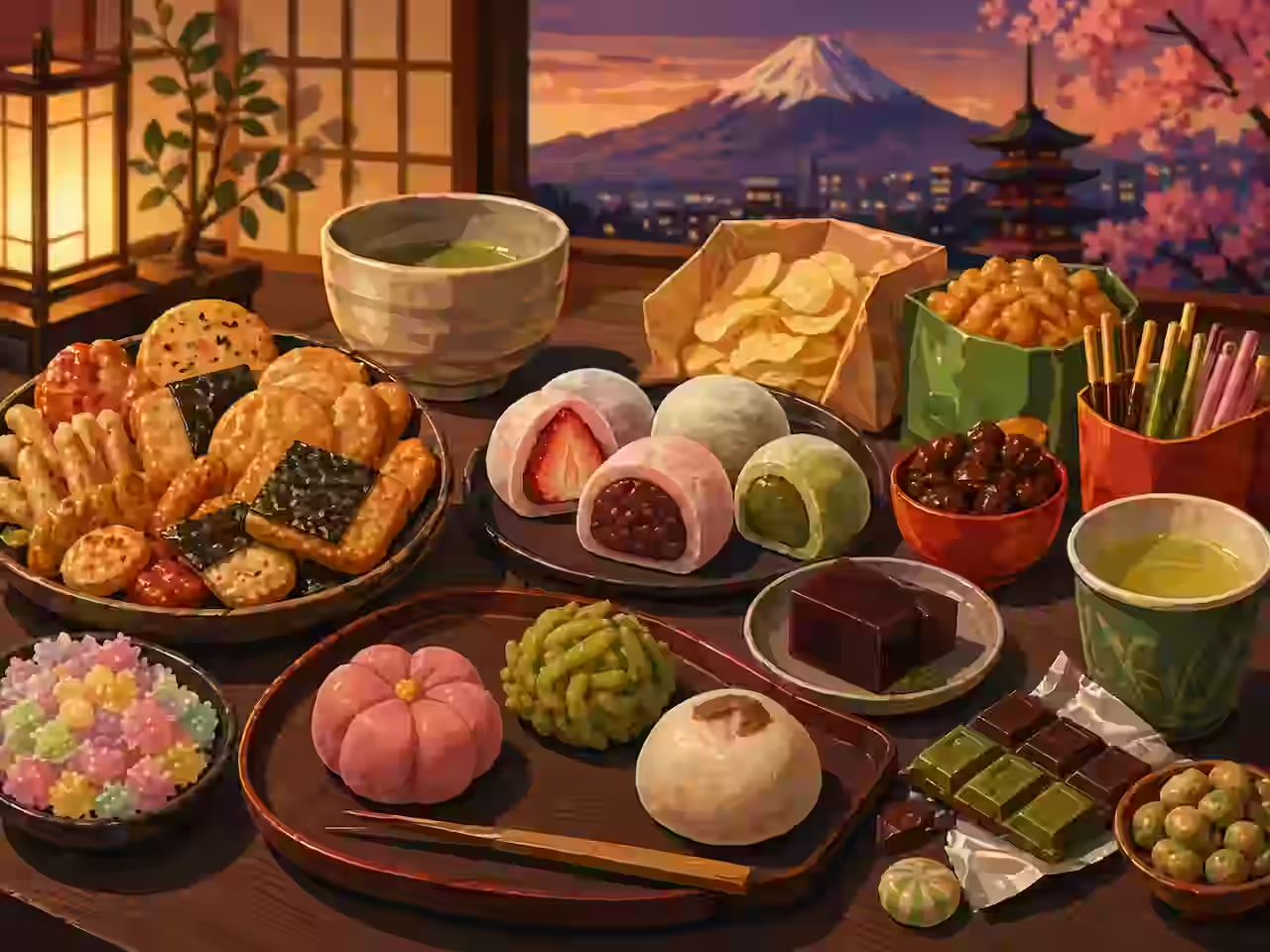
Japan’s snack culture is one of the most varied in the world. A single convenience store shelf can hold rice crackers dusted with seaweed, matcha-flavored chocolate, chewy mochi filled with strawberry, and sugar candies shaped like tiny stars. The range is genuinely staggering.
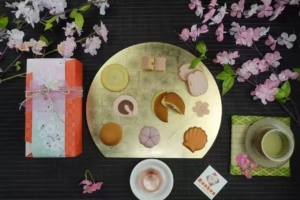
But beyond the modern convenience store snacks lies something older and more deliberate. Traditional wagashi confections have been part of Japanese culture for centuries. They’re tied to the seasons, to tea ceremony, and to the deep Japanese aesthetic of finding beauty in small, careful things.
This guide covers both worlds: the ancient and the contemporary, the sweet and the savory, the nostalgic and the surprising.
What Makes Japanese Snacks Unique
Most Japanese snacks share a few quiet principles. The ingredients are simple: rice, beans, sugar, sesame, seaweed. There’s rarely excessive fat or overwhelming sweetness. The flavors tend to be restrained, even elegant.
Seasonality matters enormously. Wagashi shops change their offerings with the months. Cherry blossom-shaped sweets appear in spring. Chestnut and sweet potato flavors arrive in autumn. Eating a seasonal wagashi is, in a small way, a participation in the Japanese relationship with the natural world.
There’s also a strong regional dimension to Japanese snacks. Every prefecture has its own specialty: a local rice cracker, a regional confection, a sweet that visitors carry home in carefully wrapped boxes. These omiyage (souvenir gifts) are taken seriously. Bringing back the wrong regional treat is a genuine social consideration.
The overall effect is a snack culture that feels both accessible and thoughtful. You can spend ¥50 on a piece of dagashi candy or ¥2,000 on a handmade wagashi from a century-old confectionery. Both have a place in the culture.
Traditional Wagashi: Sweets Made for Tea
Wagashi are Japan’s traditional confections. They developed alongside the tea ceremony, designed specifically to balance the bitterness of matcha. The best wagashi are small works of craft, carefully shaped, seasonally colored, and made with ingredients that have barely changed in hundreds of years.
Most wagashi rely on anko (sweet red bean paste) as a core ingredient. This paste, made from azuki beans and sugar, appears in dozens of forms across the wagashi world. It’s subtly sweet, deeply satisfying, and surprisingly versatile.
Mochi and Daifuku
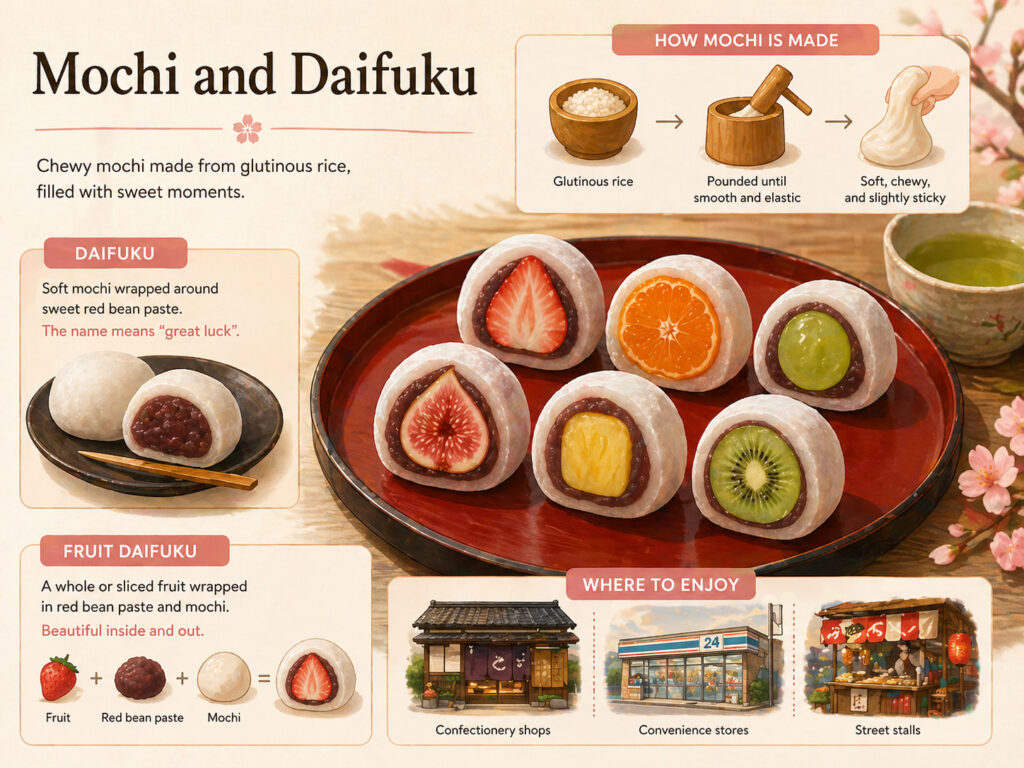
Mochi is perhaps the most internationally recognized Japanese sweet. It’s made from glutinous rice that has been pounded until smooth and elastic. The texture is dense, chewy, and slightly sticky, unlike anything in Western confectionery.
Plain mochi is eaten year-round, but daifuku is the more beloved snack form. Daifuku is a round of soft mochi wrapped around a filling, most commonly anko. The name literally means “great luck.” It’s sold at confectionery shops, convenience stores, and street stalls across Japan.
Fruit daifuku is a more recent and spectacularly beautiful variation. A whole strawberry, or sometimes a piece of mandarin, fig, or grape, is nestled inside the anko filling before being wrapped in mochi. When cut in half, the cross-section reveals a perfect geometric arrangement of white mochi, red bean, and vivid fruit. It’s as visually striking as it is delicious.
Yokan and Manju
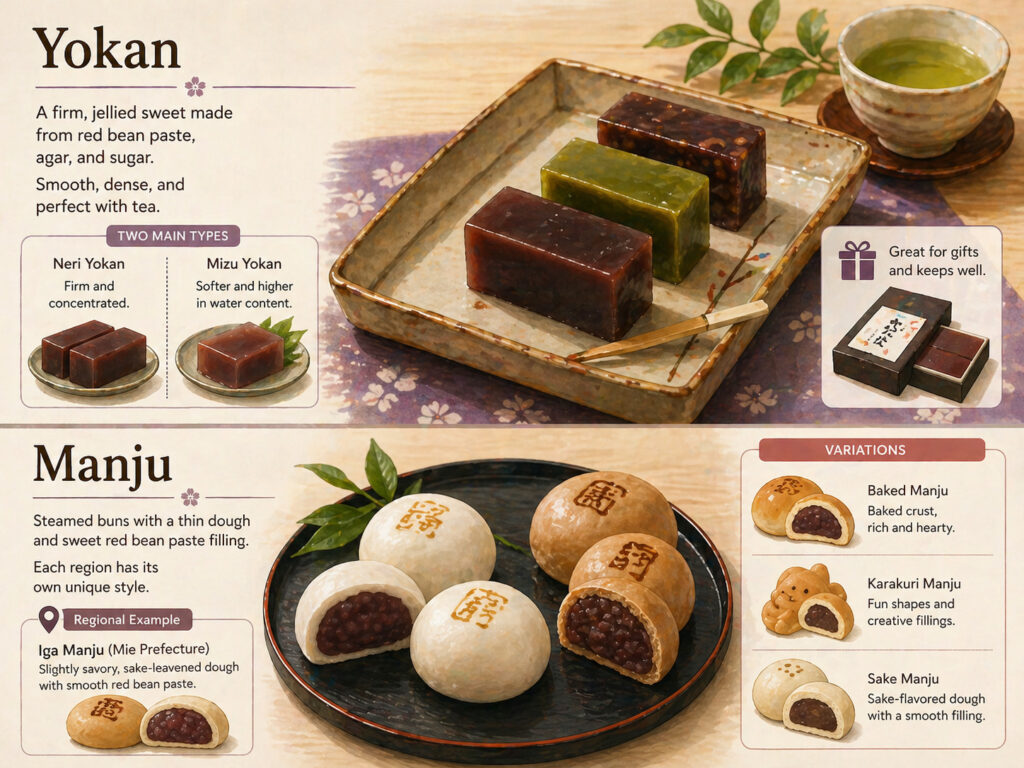
Yokan is a firm, jellied sweet made from anko, agar, and sugar. It’s sold in rectangular blocks and sliced before eating. The texture is dense and smooth. The flavor is clean and quietly sweet. Yokan keeps well, which makes it a popular gift and omiyage item.
There are two main types: neri yokan, which is firmer and more concentrated, and mizu yokan, which has a higher water content and a softer, cooler texture. Mizu yokan is particularly popular in summer and is often chilled before serving.
Manju are steamed buns with a thin dough exterior and a sweet filling, usually anko. They come in dozens of regional variations. Iga Manju from Mie Prefecture has a slightly savory, sake-leavened dough. Each region adds its own character to the basic form.
Dango
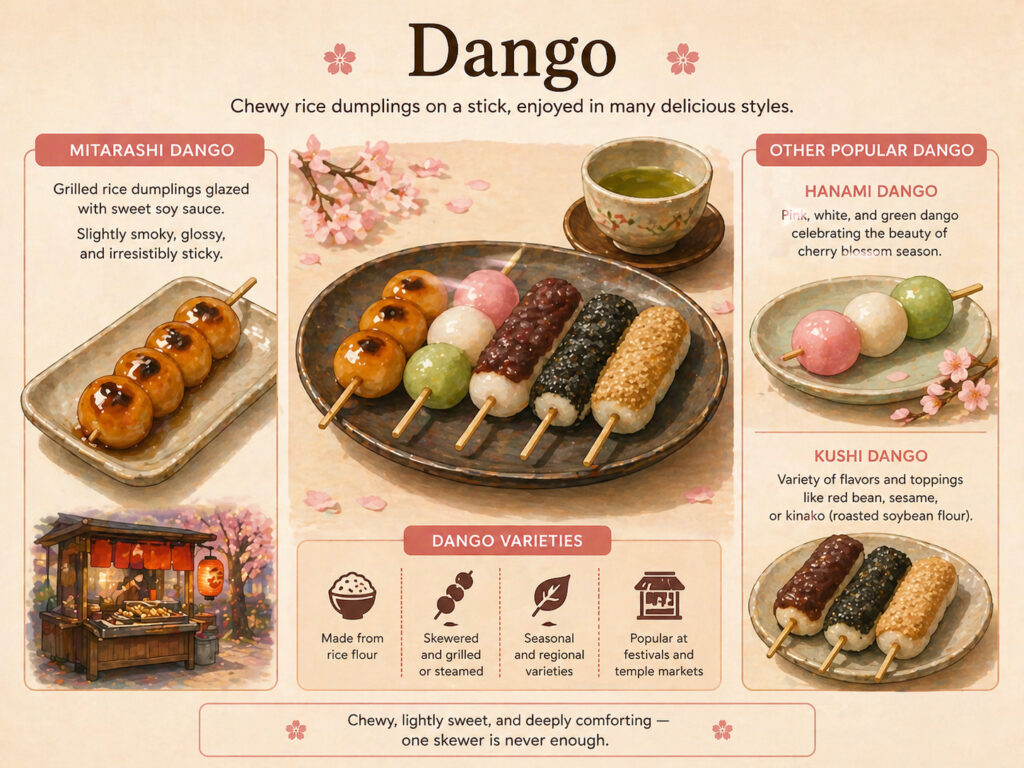
Mitarashi dango are skewered rice dumplings glazed with a sweet soy sauce syrup. The glaze caramelizes slightly over the grill, creating a glossy, slightly sticky coating with a gentle smokiness. It’s one of the most recognizable Japanese street sweets.
Dango come in many varieties beyond mitarashi. Hanami dango features three colored balls, pink, white, and green, on a single skewer, sold everywhere during cherry blossom season. Kushi dango, served in a range of flavors including sesame and red bean, appear at festivals and temple markets throughout the year.
The texture sits somewhere between mochi and a firm rice cake. It’s chewy without being difficult to eat. One skewer is rarely enough.
Konpeitō
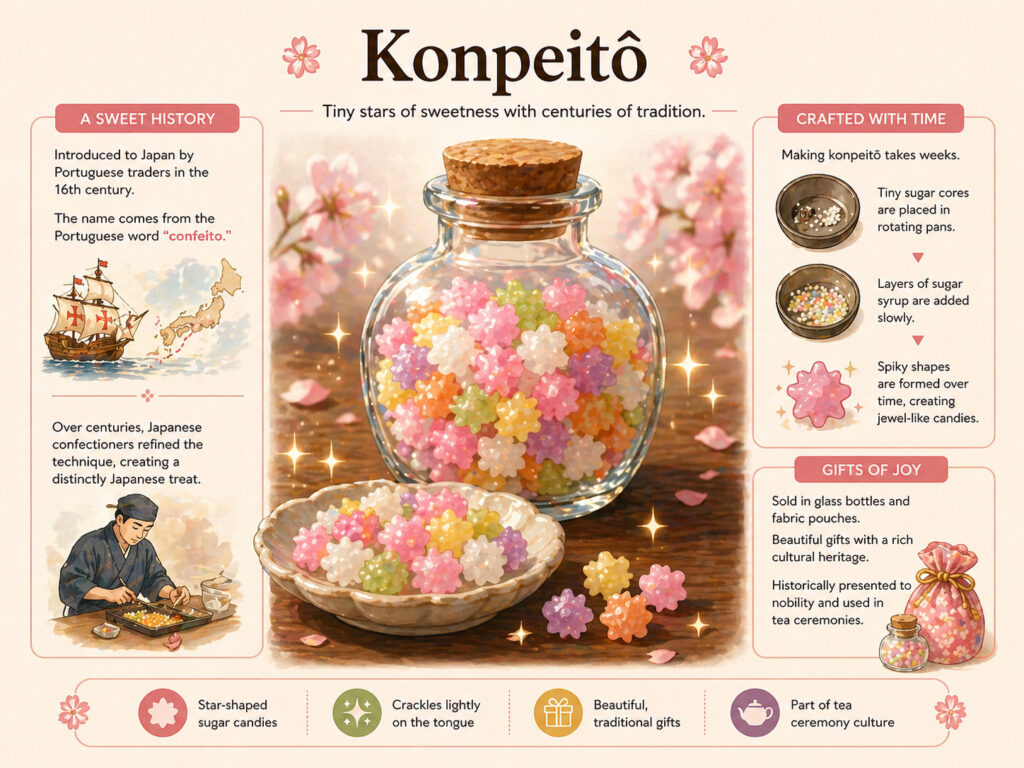
Konpeitō are tiny star-shaped sugar candies, introduced to Japan by Portuguese traders in the 16th century. The name comes from the Portuguese word “confeito.” Over centuries, Japanese confectioners refined the technique, and konpeitō became a distinctly Japanese treat.
Making konpeitō takes weeks. Tiny sugar cores are tumbled in rotating pans while layers of sugar syrup are added slowly, building the characteristic spiky shape over time. The result is a small, jewel-like candy that crackles lightly on the tongue.
Konpeitō are sold in small glass bottles and fabric pouches at traditional confectionery shops. They make beautiful gifts. Historically, they were presented to nobility and used in tea ceremonies.
Savory and Crispy Snacks
Not everything in Japan’s snack world is sweet. The savory side is just as rich, and in many ways more deeply embedded in everyday life.
Senbei: Rice Crackers
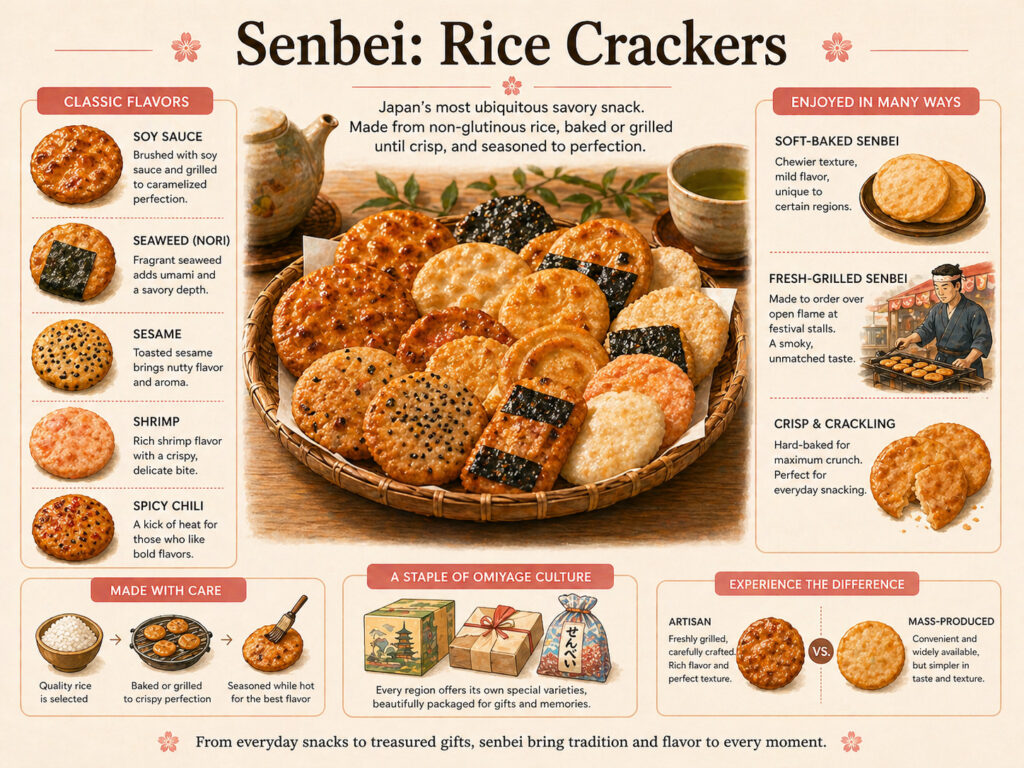
Senbei are Japan’s most ubiquitous savory snack. Made from non-glutinous rice, they’re baked or grilled until crisp and then seasoned. The classic flavor is soy sauce, sometimes brushed on while still hot so it caramelizes slightly. Other common varieties include seaweed (nori), sesame, shrimp, and spicy chili.
Regional senbei are a world of their own. Soft-baked senbei from certain areas have a completely different texture from the hard, crackling commercial varieties. Fresh-grilled senbei at festival stalls, made to order on wire racks over open flame, are a different experience again.
Senbei are a staple of omiyage culture. Every tourist area sells its own regional variety, usually packaged in elegant boxes. The quality gap between a freshly grilled artisan senbei and a mass-produced supermarket version is significant and worth experiencing.
Karintō: Fried Dough Snacks
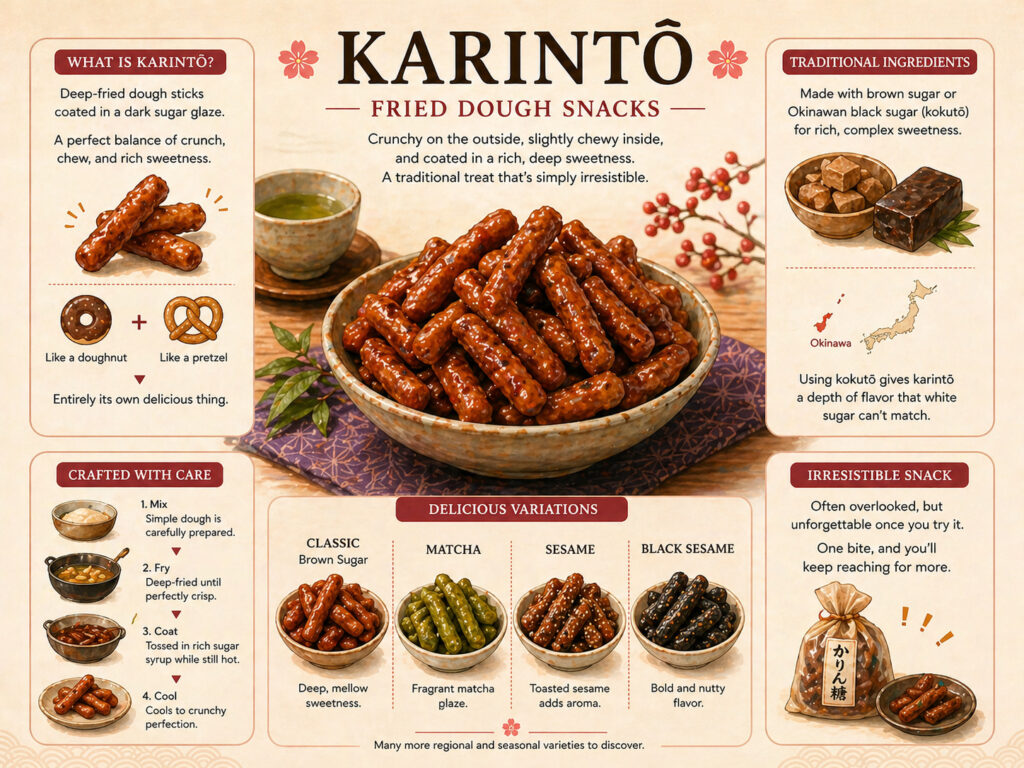
Karintō are deep-fried dough sticks coated in a dark sugar glaze. They’re crunchy, slightly chewy in the center, and deeply satisfying in a way that’s hard to explain until you’ve tried one. The flavor is subtly molasses-like, somewhere between a doughnut and a pretzel.
Traditional karintō use brown sugar or black sugar (kokuto) from Okinawa, which gives them a richer, more complex sweetness than white sugar would produce. Modern variations include matcha-glazed, sesame, and black sesame versions.
They’re often overlooked by first-time visitors in favor of more photogenic sweets. That’s a mistake. Karintō are genuinely addictive once you start.
Nori Seaweed Snacks
Seaweed appears across the Japanese snack landscape in multiple forms. Nori arare are small rice crackers wrapped in or flavored with dried seaweed. Tsukudani is a savory condiment made from seaweed simmered in soy sauce and sugar — often eaten on rice, but also sold as a snack in small portions.
Flavored nori sheets, seasoned with soy or sesame oil and lightly toasted, have also become popular internationally. In Japan, they’re a common lunchbox addition and an easy snack for all ages.
Regional Treats Worth Seeking Out
Yaki Manju from Gunma Prefecture are steamed buns skewered and grilled over charcoal, then coated with a sweet miso glaze. The exterior crisps slightly while the dough inside stays soft. The miso glaze caramelizes over the heat, creating a sticky, savory-sweet coating. They’re sold at festivals and roadside stalls throughout Gunma and are one of those regional snacks that’s difficult to replicate elsewhere.
Warabi mochi from the Kansai region, particularly Nara, is a cooling summer treat. Made from bracken starch rather than glutinous rice, it has a softer, more gelatinous texture than regular mochi. It’s typically dusted with kinako (roasted soybean flour) and drizzled with kuromitsu (black sugar syrup). Eaten cold on a hot day, it’s genuinely refreshing.
Dagashi: The Snacks of Childhood
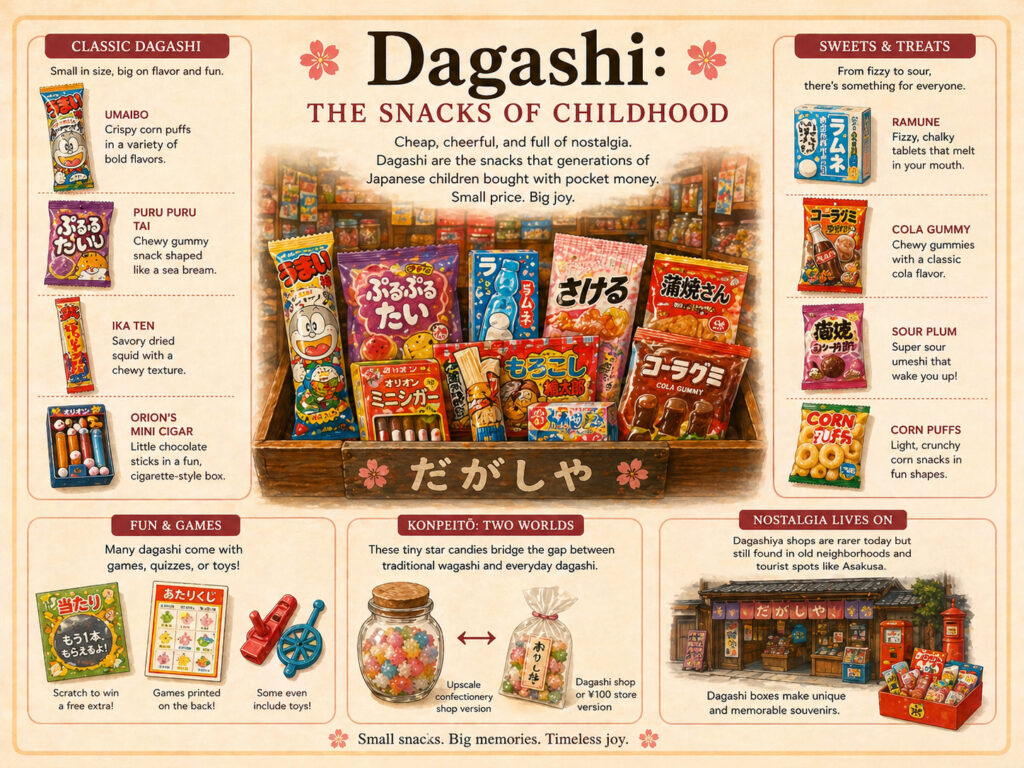
Dagashi occupies a special place in Japanese food memory. These are the cheap, cheerful, often garish snacks that generations of Japanese children bought at small neighborhood candy shops (dagashiya) with their pocket money. The snacks cost ¥10 or ¥20 each. The pleasure was enormous.
Classic dagashi include ramune tablets, chalk-white, fizzy, grape or strawberry flavored, and soft gummy candies shaped like cola bottles or watermelon slices. There are chewy ika (squid) snacks, corn puff rings, tiny chocolate wafers, and sour plum gummies that make your eyes water.
The packaging is important. Bright colors, cartoon characters, games printed on the back. Some dagashi come with a small toy or a “lucky” element. Scratch to see if you’ve won a free one. The experience is as much about ritual and discovery as taste.
Today, dagashiya shops are rarer but still exist in older neighborhoods and tourist areas. Asakusa in Tokyo has several. Theme restaurants built around dagashi nostalgia have also appeared in major cities. For visitors, a dagashi box, a curated assortment of classic snacks, is one of the more unusual and enjoyable souvenirs to bring home.
Konpeitō, mentioned earlier as a traditional wagashi, also has a dagashi dimension. Small bags of the star-shaped candies appear in both upscale confectionery shops and ¥100 stores, occupying a rare dual position in Japan’s snack hierarchy.
Modern and Fusion Snacks
Japan’s modern snack industry is endlessly creative. The country has turned global snack brands into something distinctly its own.
Japanese Kit Kat flavors are the most internationally famous example. While the original chocolate Kit Kat exists, the Japanese market has produced hundreds of regional and seasonal varieties. Matcha, sakura, sweet potato, sake, wasabi, roasted tea (hojicha), and strawberry cheesecake have all appeared in limited runs. Certain flavors are sold exclusively in specific prefectures, making them collector’s items.
Pocky, Japan’s own creation, follows a similar philosophy. The classic chocolate-dipped biscuit sticks remain popular, but seasonal releases like matcha Pocky, almond crush Pocky, and regional strawberry varieties keep the brand feeling current.
Convenience store snack sections are updated constantly. New flavors of chips, limited-edition mochi, seasonal taiyaki fillings, and experimental flavors of established snacks rotate through 7-Eleven, FamilyMart, and Lawson shelves throughout the year. Visiting Japan multiple times reveals a snack landscape that never quite looks the same twice.
Where to Find Japanese Snacks
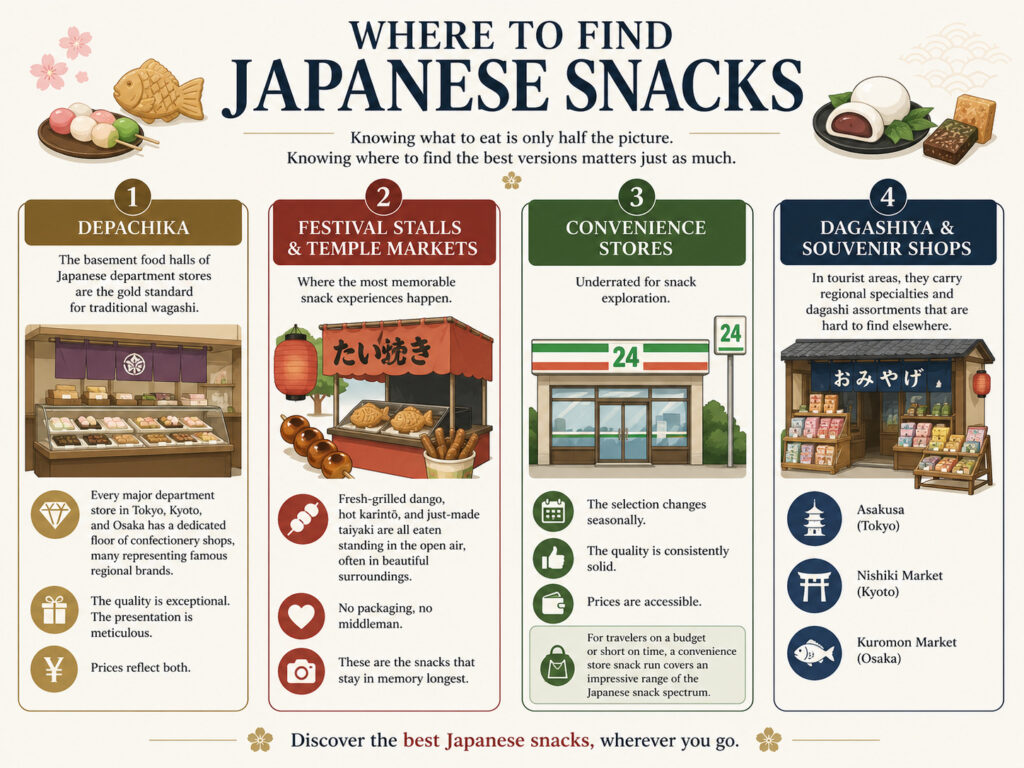
Knowing what to eat is only half the picture. Knowing where to find the best versions matters just as much.
Depachika, the basement food halls of Japanese department stores, are the gold standard for traditional wagashi. Every major department store in Tokyo, Kyoto, and Osaka has a dedicated floor of confectionery shops, many representing famous regional brands. The quality is exceptional. The presentation is meticulous. Prices reflect both.
Festival stalls and temple markets are where the most memorable snack experiences happen. Fresh-grilled dango, hot karintō, and just-made taiyaki are all eaten standing in the open air, often in beautiful surroundings. No packaging, no middleman. These are the snacks that stay in memory longest.
Convenience stores are underrated for snack exploration. The selection changes seasonally, the quality is consistently solid, and the prices are accessible. For travelers on a budget or short on time, a convenience store snack run covers an impressive range of the Japanese snack spectrum.
Dagashiya and souvenir shops in tourist areas like Asakusa, Nishiki Market in Kyoto, and Kuromon Market in Osaka carry regional specialties and dagashi assortments that are hard to find elsewhere.
A Snack Culture Worth Exploring Slowly
Japan’s snack and sweets culture rewards curiosity and patience. There’s always something new to try: a regional specialty you haven’t encountered, a seasonal wagashi you’ve just missed, a dagashi memory waiting to be made.
The best approach is simply to say yes. To the sample offered at the depachika counter, to the unfamiliar packaging at the convenience store, to the freshly made item at the festival stall whose name you can’t read.
Have you tried making wagashi at home? It’s more approachable than it looks. Start with simple daifuku: mochi, anko, and a strawberry, then work from there. Or share a picture of your favorite Japanese snack in the comments. We’d love to see what you’ve discovered.
Japan’s Snacks and Wagashi FAQ
What are wagashi and when do people eat them?
Wagashi represent traditional Japanese confections. Confectioners make them primarily from azuki beans, rice, and sugar. Tea masters serve them during tea ceremonies to balance the bitter matcha. Outside of tea settings, people eat them as everyday sweets, give them as gifts, and buy them as regional souvenirs. Seasonal varieties mark specific times of the year, like cherry blossom mochi in spring and chestnut wagashi in autumn.
What is the difference between dagashi and wagashi?
The distinction mainly involves tradition and price point. Wagashi represent refined, traditional Japanese confections with centuries of history. Artisans sell them at specialty shops, and hosts serve them at tea ceremonies. Dagashi represent inexpensive, mass-produced snacks. Manufacturers aim these cheap treats historically at children, and neighborhood candy shops sell them for pocket change.
Do Japanese snacks fit a vegetarian diet?
Many Japanese snacks fit a vegetarian diet naturally. Most traditional sweets — like mochi, daifuku, and dango — contain absolutely no meat or fish. However, cooks flavor some savory snacks with fish broth (dashi) or shrimp extract. We advise strict vegetarians to check ingredients carefully. You can safely eat most sweet wagashi without further investigation.
Where can I buy traditional snacks in Japan?
Department store basement food halls (depachika) offer the highest concentration of quality wagashi. Festival and temple markets provide the freshest street-snack experience. Convenience stores sell modern and seasonal snacks at accessible prices. If you want dagashi, you should visit dedicated retro candy shops in older neighborhoods or tourist areas like Asakusa in Tokyo.
What are the main ingredients in Wagashi?
The main ingredients include sweet red bean paste (anko), sticky rice flour (mochiko), and sugar. Artisans use these simple plant-based items to craft beautiful, nature-inspired shapes.
How much do Japanese snacks cost?
Cheap dagashi snacks typically cost between 10 and 50 yen. Meanwhile, premium wagashi from high-end artisan shops cost between 300 and 1,000 yen per piece.
What does Matcha pair best with?
Matcha pairs perfectly with sweet wagashi. The intense, sugary flavor of the traditional confection directly cuts through the strong, earthy bitterness of the green tea.
Can I make Wagashi at home?
Yes, you can easily make simple wagashi like dango or mochi at home. Japanese grocery stores stock the key ingredients, such as sweet rice flour and canned red bean paste.
What is Daifuku?
Daifuku is a highly popular traditional wagashi. Confectioners wrap a soft, chewy mochi shell around a sweet filling, usually red bean paste or whole fresh strawberries.
Are Japanese snacks popular outside Japan?
Japanese snacks enjoy massive popularity worldwide. Global fans eagerly buy Pocky, matcha-flavored chocolates, and mochi ice cream at Asian supermarkets and online stores everywhere.
References
- NHK World. Wagashi: The Art of Japanese Confectionery. https://www3.nhk.or.jp/nhkworld/en/food/
- Japan National Tourism Organization. Japanese Sweets and Snacks. https://www.japan.travel/en/guide/food-drink/





Comments