



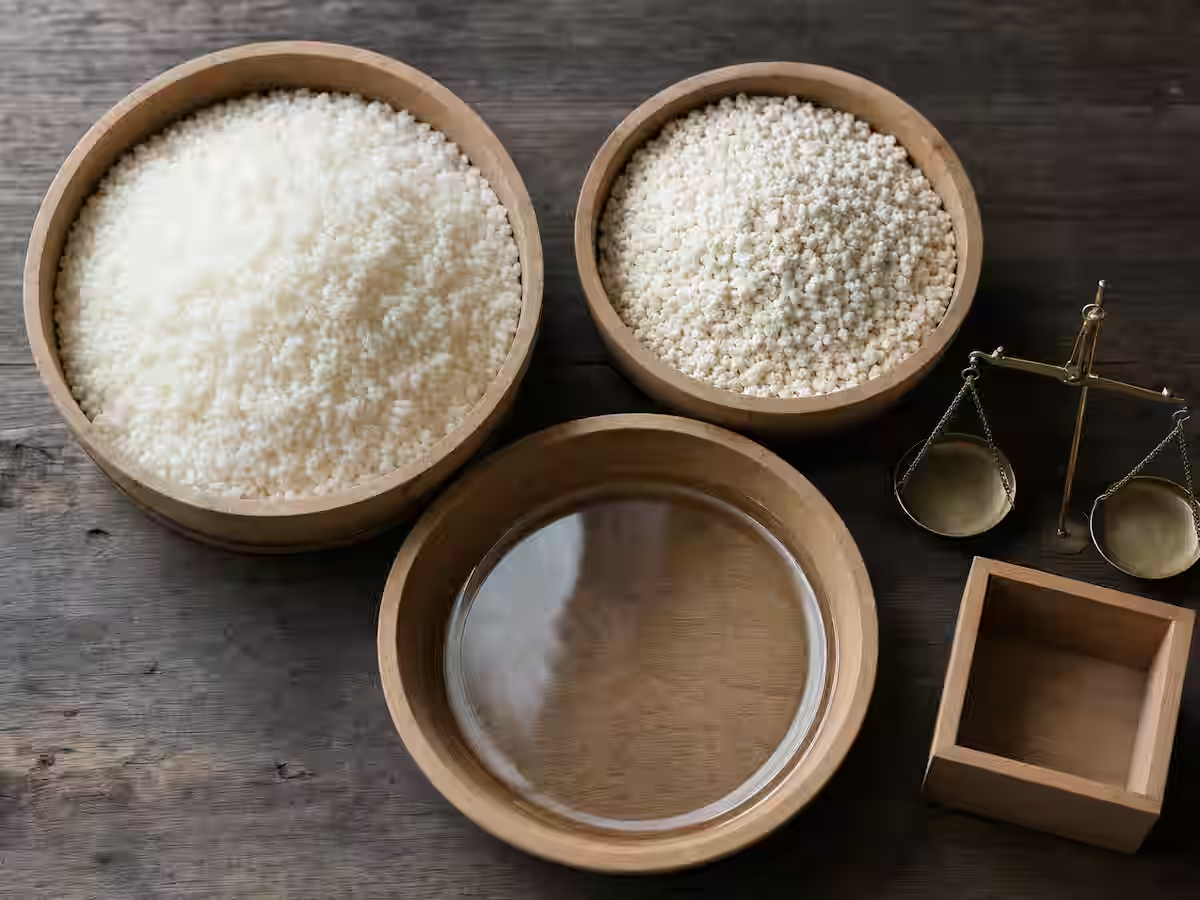
Two breweries can start with the same rice variety, the same well, and the same yeast. Yet the sake in the glass tastes nothing alike. The reason usually hides in a document that drinkers never see. Brewers call it the shikomi haigo.
So what is Shikomi Haigo? Shikomi Haigo (仕込配合) is the complete brewing recipe for a batch of sake. It fixes the weight of steamed rice, the weight of koji rice, the volume of brewing water, and the size of the yeast starter. It also decides how those amounts split across each stage of the mash.
The word itself is fairly plain. Shikomi means preparation, or charging a tank. Haigo means blending, or proportioning. Together they describe one act: deciding how much of each thing goes in, and when.
Most brewing guides stop at the process. They describe washing, steaming, koji making, and fermentation in order. That story is true, though it leaves out the numbers. And the numbers are where style actually lives. Those numbers also stay private, since every brewery guards its own.
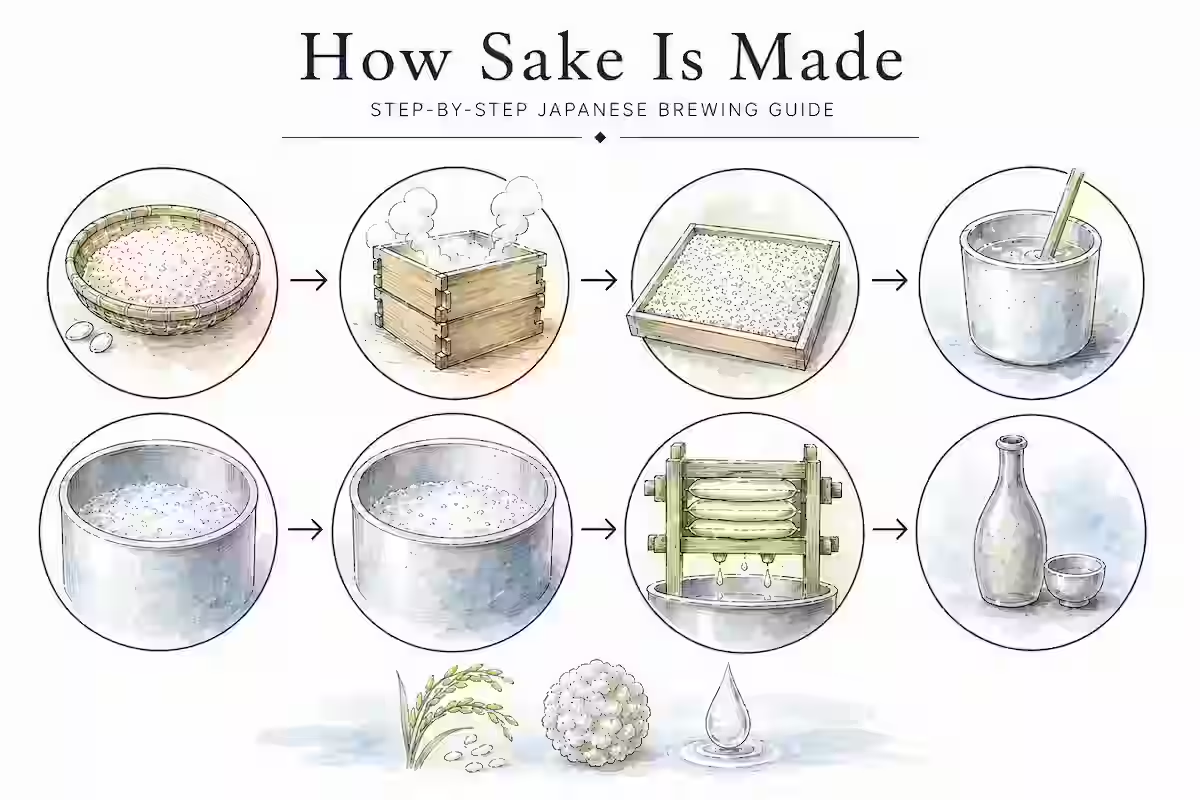
This guide walks through the whole idea. First we define the three ratios that matter most. Then we open a sample recipe sheet, follow each figure through the tank, and compare hypothetical formulas for ginjo, junmai, and genshu. Regional habits and common myths close things out. For the steps themselves, our guide to how sake is made covers the process in order.
Quick Facts About Shikomi Haigo
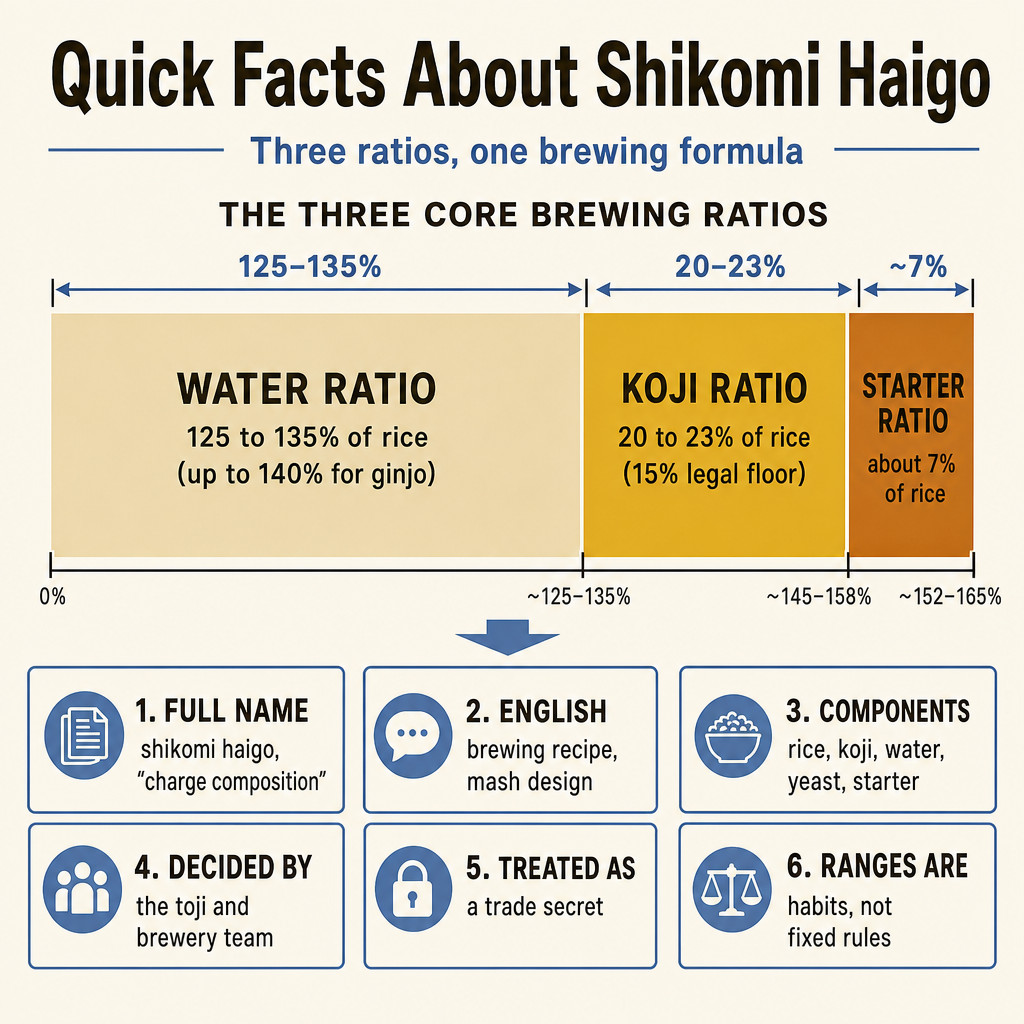
Here is a short snapshot before the detail begins.
| Japanese Name | 仕込配合 (shikomi haigo) |
| Literal Meaning | Preparation proportions, or charge composition |
| English Translation | Brewing recipe, ingredient formula, mash design |
| Used During | The yeast starter and all stages of the main mash |
| Main Components | Steamed rice, koji rice, brewing water, yeast starter, yeast, and sometimes distilled alcohol |
| Core Ratios | Kumimizu buai (汲水歩合), koji buai (麹歩合), moto buai (酒母歩合) |
| Standard Water Ratio | 125 to 135 percent of total rice weight, with ginjo able to exceed 140 percent |
| Standard Koji Ratio | 20 to 23 percent of all rice used, with 15 percent as the legal floor for premium grades |
| Standard Starter Ratio | About 7 percent of all rice used |
| Related Parameters | Polishing ratio, mash temperature, yeast strain, pressing timing |
| Who Decides It | The toji, usually with the brewery owner and the production team |
| Disclosure | Treated as a trade secret. Actual figures differ by brewery, by brand, and by sake type |
Treat those ranges as habits rather than rules. Breweries step outside them deliberately, and often.
What Is Shikomi Haigo?
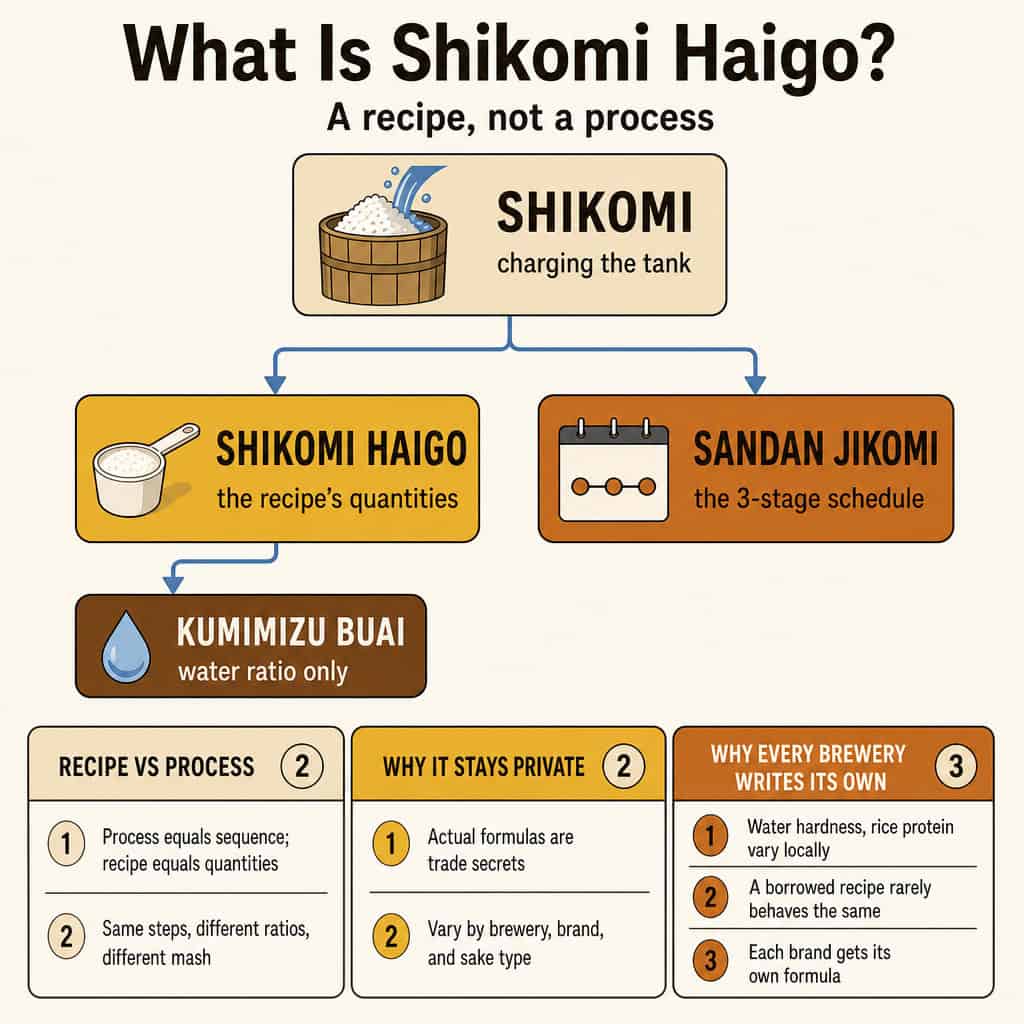
In one line: Shikomi Haigo is the numerical plan that tells a brewing team exactly how much rice, koji, water, and starter to put into each tank, and on which day.
A Recipe, Not a Process
People often mix these two things up. A process is a sequence of actions. Wash the rice, soak it, steam it, cool it, then build the koji. Any brewery in Japan follows roughly that order, because the biology demands it.
A recipe is different. It answers how much, not what next. Two tanks can run the identical process on the same morning and still hold very different mashes. One might carry 120 litres of water per 100 kilograms of rice. The other might carry 140. That single gap changes the sugar concentration, the yeast workload, and eventually the finish.
Think of bread for a moment. Everyone mixes, proves, shapes, and bakes. Still, hydration and salt decide whether you get a tight sandwich loaf or an open, chewy crumb.
The Three Ratios That Matter Most
Almost every conversation about brewing recipes comes down to three percentages. Each compares one ingredient against the total weight of polished rice in the batch.
| Ratio | Japanese | What it compares | Published standard |
|---|---|---|---|
| Water ratio | 汲水歩合 (kumimizu buai) | Brewing water in litres against total rice in kilograms | 125 to 135 percent |
| Koji ratio | 麹歩合 (koji buai) | Koji rice against all rice used | 20 to 23 percent |
| Starter ratio | 酒母歩合 (moto buai) | Starter rice against all rice used | About 7 percent |
These figures are published reference values, not guesses. The Society for Nada Sake Research lists them in its sake glossary, and the National Research Institute of Brewing gives a similar picture. Japan’s labelling standards for specially designated sake add a legal floor of 15 percent koji rice. Anything more specific than this belongs to individual breweries.
Why the Real Numbers Stay Private
One thing needs saying plainly. A brewery’s actual shikomi haigo is a trade secret, and almost no producer publishes it. Ask on a tour and you will usually get a friendly non-answer.
The variation is wider than newcomers expect. Figures differ from brewery to brewery, and they differ between brands inside a single brewery. They differ again by sake type, since a daiginjo and a futsushu need different designs. Even the same brand shifts a little from one year to the next.
So every figure in this guide comes from published industry references. They describe general practice across the field. No number here belongs to any particular producer, and this article does not attempt to estimate what an unpublished formula might contain.
How to read the figures below: every ratio in this guide is a published standard, not a formula. A real brewery may sit outside it deliberately, and most will not say where they sit.
Shikomi Haigo Is Not Sandan Jikomi
These two terms travel together, so English sources often blur them. They are not the same thing.
- Shikomi (仕込み) is the act of charging a tank with ingredients.
- Shikomi haigo (仕込配合) is the recipe that states the quantities.
- Sandan jikomi (三段仕込み) is the schedule, meaning three additions over four days.
- Kumimizu buai (汲水歩合) is one line inside the recipe, covering water only.
Put simply, the recipe says how much and the schedule says when. Our guide to sandan jikomi covers the timing side in detail.
Why Every Brewery Writes Its Own
No two breweries share the same conditions. Water hardness differs from one valley to the next. Rice arrives with a different protein level each harvest. Buildings hold heat differently, and cellar temperatures swing more in some places than others.
Because of that, a formula copied from elsewhere rarely behaves as promised. A recipe tuned for soft brewing water may stall in a hard-water brewery. The same recipe may run too warm in a milder prefecture. So each house develops its own numbers over years, then adjusts them season by season.
Intent matters too. A brewery aiming at competition ginjo needs a different design from one supplying local izakaya by the case. Both are legitimate, since they chase different targets. For the same reason, a single brewery keeps a separate formula for each brand it makes.
How Brewing Recipes Developed
Written formulas are older than most people expect. Edo-period brewing manuals already recorded proportions in some detail. The best-known example, Domo Shuzoki, is usually dated to the late seventeenth century, though its exact date and authorship remain debated. Those texts read like working notebooks rather than science papers.
Early recipes used far less water than modern ones. The mash sat thick, sugar built up quickly, and the resulting sake leaned toward sweetness and weight. Over the centuries the water ratio crept upward. Tastes shifted, milling improved, and temperature control got better.
Then the twentieth century brought laboratories. Japan’s national brewing institute opened in 1904, and prefectural bodies followed. Analytical data gave brewers a shared language for what they had long judged by hand.
The Components of a Brewing Recipe
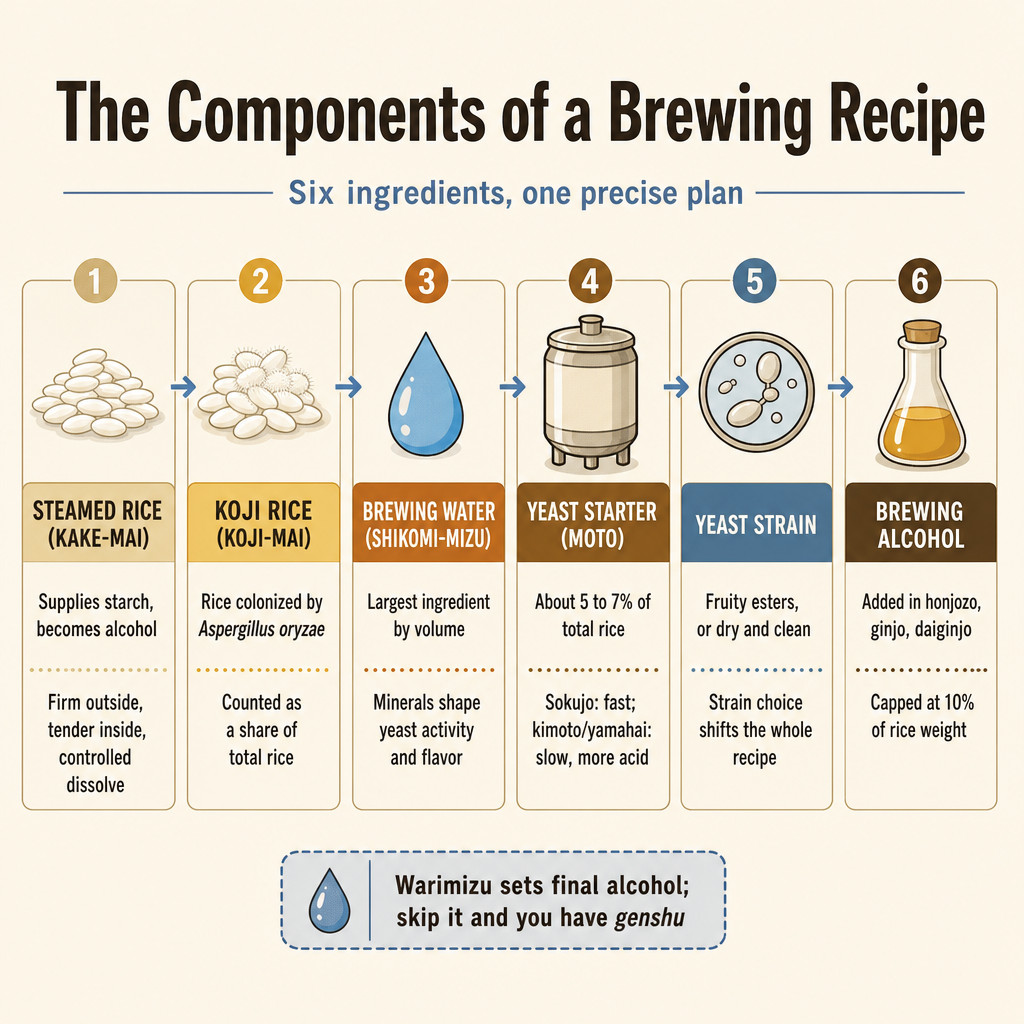
A shikomi haigo lists a handful of items. Each one carries a weight, a volume, or a strain name. Let us take them in turn.
Steamed Rice (Kake-mai)
Kake-mai is the plain steamed rice that goes straight into the mash. It supplies the bulk of the starch, and therefore most of the eventual alcohol. Brewers usually choose sake rice with a soft, starchy centre for this role.
Steaming matters as much as quantity. Good steamed rice feels firm outside and tender inside, which lets it dissolve at a controlled pace. Rice that dissolves too fast floods the tank with sugar. Rice that resists leaves starch behind and cuts the yield.
Koji Rice (Koji-mai)
Koji is steamed rice colonised by Aspergillus oryzae. It carries the enzymes that break starch into sugar, so it acts as the engine of the whole system. Without it, yeast has nothing to eat.
The recipe states koji as a share of total rice, not as a separate ingredient sitting outside the count. That distinction trips up newcomers constantly. If a batch uses 1,000 kilograms of white rice, and 200 kilograms of that becomes koji, the koji ratio is 20 percent. The remaining 800 kilograms is kake-mai.
Brewing Water (Shikomi-mizu)
Water is the largest ingredient by volume, and the recipe gives it a precise figure. Brewers count only the water charged into the starter and the mash. Washing and soaking water sits outside that number, even though it dwarfs it in total use.
Mineral content changes behaviour too. Potassium, phosphorus, and magnesium feed yeast activity, while iron and manganese cause colour and aroma problems. A brewery with mineral-rich water may deliberately choose a lower ratio, since fermentation already runs briskly.
The Yeast Starter (Moto)
The moto, also called shubo, is a small tank of concentrated, acid-protected yeast. Its rice counts inside the batch total, usually around 5 to 7 percent. So the starter is both an ingredient and a subsystem with its own miniature recipe.
Method matters here. A sokujo starter uses added lactic acid and finishes in about two weeks. Kimoto and yamahai grow their own acid over roughly a month. That choice ripples through the entire recipe, because slower starters usually bring more acidity and amino character.
The Yeast Strain
Strain choice appears on the sheet like any quantity. Some sake yeasts throw generous fruity esters. Others ferment hard and clean, leaving a drier finish. A few tolerate high alcohol better than the rest.
Because strains differ in appetite, the numbers around them shift as well. An ester-heavy strain often pairs with a cooler, longer mash and a slightly higher water ratio. A robust workhorse strain can handle a thicker charge.
Brewing Alcohol, Where It Applies
Some styles receive a measured addition of distilled alcohol shortly before pressing. Honjozo, ginjo, and daiginjo may all use it. Pure rice styles such as junmai skip it by definition.
Japan’s rules for specially designated sake cap the amount at 10 percent of the white rice weight. At that level the addition is not a shortcut for volume. Instead, brewers use it to lift aroma out of the lees and to sharpen the finish.
Worth knowing: the plan also names the dilution water added after pressing. That step, called warimizu, sets the final alcohol on the label. Skip it, and you have genshu.
How a Recipe Sheet Is Laid Out
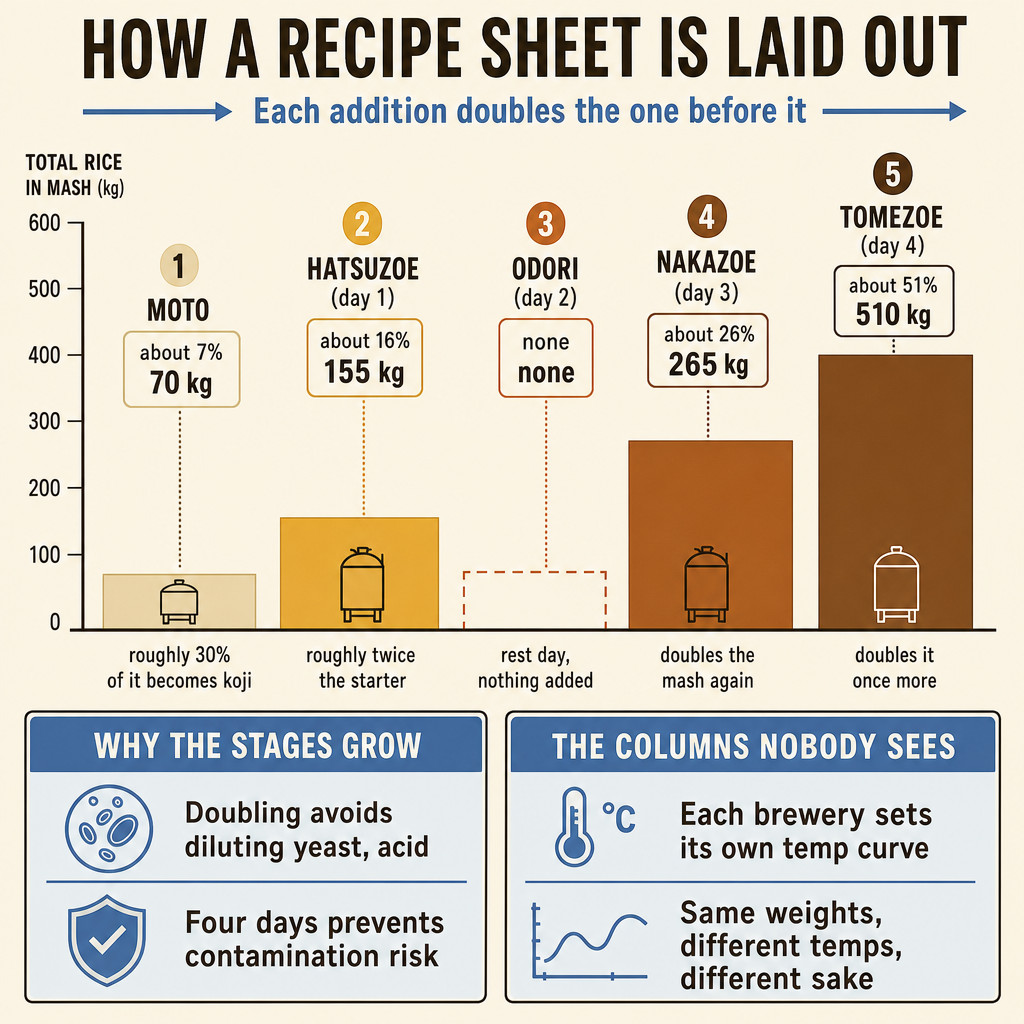
A shikomi haigo is not a single line of numbers. It is a grid, because the mash grows in stages rather than all at once.
Rows for Each Stage
The sheet lists the starter first, then the three additions. Each row carries its own koji weight, steamed rice weight, and water volume. Together the rows must add up to the batch totals, so the arithmetic has to close.
Below is a 1,000 kilogram batch mapped onto the published standard proportions. It is not any brewery’s sheet, and real ones stay in-house. Actual documents carry far more columns, including per-stage koji weights, target temperatures, and planned dates.
| Stage | Share of total rice | Rice (kg) | Published note |
|---|---|---|---|
| Moto (starter) | About 7 percent | 70 kg | Roughly 30 percent of it becomes koji |
| Hatsuzoe (day 1) | About 16 percent | 155 kg | Roughly twice the starter |
| Odori (day 2) | None | None | Rest day, nothing added |
| Nakazoe (day 3) | About 26 percent | 265 kg | Doubles the mash again |
| Tomezoe (day 4) | About 51 percent | 510 kg | Doubles it once more |
| Total | 100 percent | 1,000 kg | Koji 200 to 230 kg, water 1,250 to 1,350 L |
Read the bottom row and the three ratios reappear. Koji lands at 20 to 23 percent, water at 125 to 135 percent, and the starter at about 7 percent. So the summary figures everyone quotes are simply the totals of this grid.
Why the Stages Grow
Notice how each addition dwarfs the one before it. Industry references describe the pattern plainly: the first addition uses roughly twice the starter, then each following stage doubles the mash again. That growth is deliberate.
If brewers charged everything at once, the yeast, acid, and other components would be heavily diluted. Yeast growth could not keep pace, and contamination becomes a real risk. Building the mash across four days solves that problem, which is why the doubling pattern became standard.
The Columns Nobody Sees
Alongside the weights sit target temperatures for each addition, and these are not published as standards. Each brewery sets its own curve, then warms the mash toward a planned peak after the final addition.
Those figures belong to the recipe just as much as the kilograms. Change them and the same weights produce a different drink. This is exactly why comparing breweries by koji ratio alone rarely explains much.
How Ingredient Ratios Shape Sake
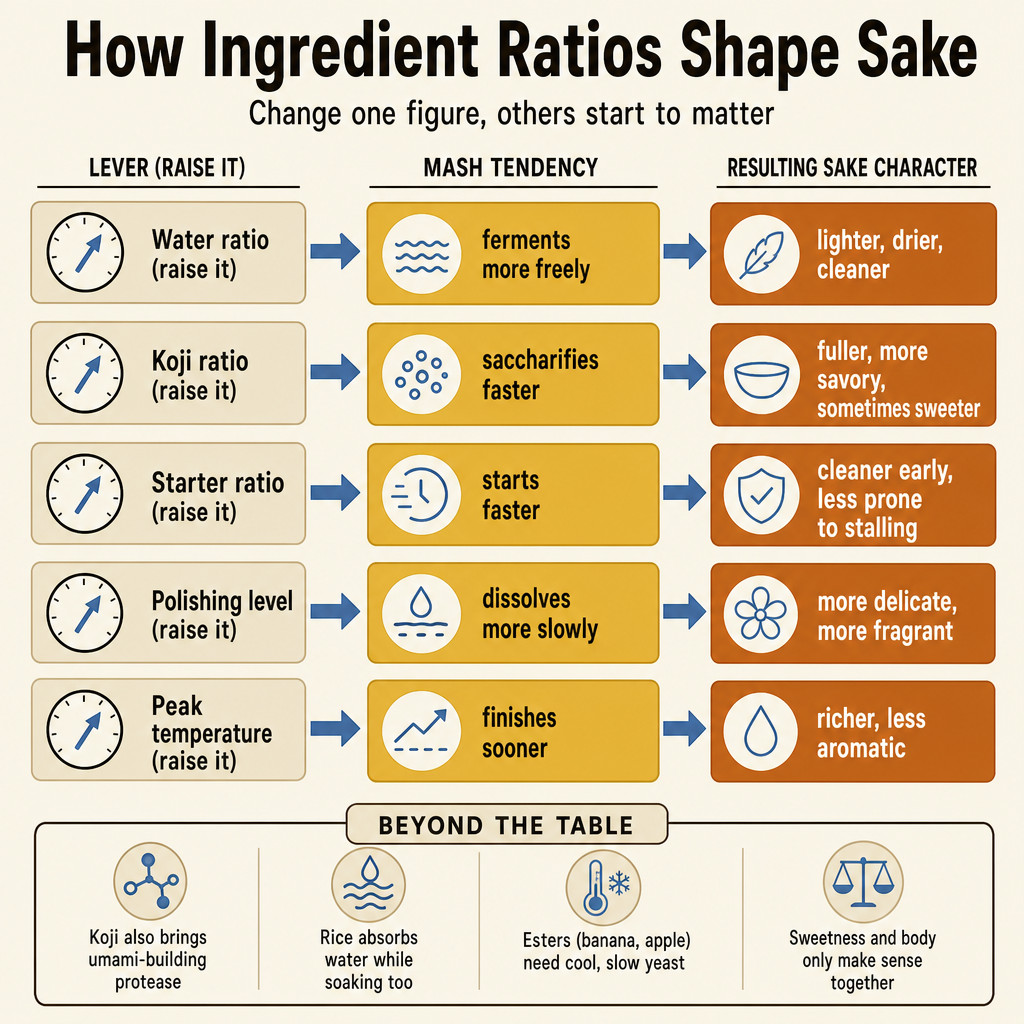
This is the technical core of the topic. Each ratio pushes the mash in a direction, and the directions interact. Change one figure and two others start to matter more.
The Rice-to-Water Balance
Brewers express this as kumimizu buai, the water ratio. It compares the litres of brewing water to the kilograms of total rice, so 130 percent means 130 litres per 100 kilograms. The published standard range is 125 to 135 percent.
A higher ratio thins the mash. Sugar concentration drops, osmotic pressure on the yeast eases, and fermentation runs more freely. Industry references describe raising the ratio when brewers want to advance fermentation. A lower ratio does the opposite. Brewers reduce it when aiming at a sweeter sake, or when they need to hold fermentation back.
There is a limit, though. Push the water too high and the mash loses its protective acidity, which invites contamination. Push it too low and the yeast stalls under sugar stress. So the number lives inside a fairly narrow safe band.
Koji Percentage and Enzyme Power
Koji buai controls how much enzyme enters the tank. More koji means faster saccharification, so sugar appears more quickly. That usually speeds fermentation and raises the final alcohol.
Koji brings protease as well as amylase, which is easy to forget. Protease releases amino acids from rice protein, and amino acids read as umami and body. Raise the koji ratio and you often raise amino acidity along with it. Some drinkers love that depth. Others find it heavy, or slightly bitter on the finish.
So the ratio is a balancing act rather than a dial marked better. Around 20 percent suits many house styles. Rich, savoury sake may climb higher, while some fragrant designs pull back a little.
Water Absorption and the Steaming Step
Here is a detail that surprises people. Rice arrives at the tank already carrying water, absorbed during soaking and steaming. That hidden moisture counts, because it dilutes the mash just as the measured water does.
Highly polished rice drinks water fast, sometimes within a minute or two. Teams therefore time soaking with a stopwatch and weigh the batch afterwards. If absorption runs high, the brewer may trim the charged water slightly. Otherwise the effective ratio drifts above target without anyone writing it down.
Alcohol Yield and Lees
Starch is the raw material for alcohol, so the rice figure sets the ceiling. Yet the mash never converts everything. Some starch stays locked in undissolved grain, and that residue leaves the press as sake lees.
Brewers track this as the lees ratio, comparing pressed solids to white rice. Everyday sake leaves a modest amount behind. A highly polished daiginjo can leave a great deal more, because cold fermentation and short mash times stop the grain from breaking down fully. That loss is deliberate, though it does make premium sake expensive.
Fermentation Efficiency
Efficiency in sake is not simply speed. A fast mash can finish clean, or it can finish coarse and hot. So brewers judge efficiency by whether the mash reaches its target profile without stress.
Ratios steer this directly. A thin mash with generous koji ferments briskly and dries out. A thick mash with restrained koji works slowly, and it may leave residual sugar. Meanwhile the starter ratio decides how many yeast cells begin the race, which shapes the early days above all.
Aroma Development
Fruity ginjo aroma comes largely from esters produced by stressed, cool-running yeast. Two names come up constantly. Isoamyl acetate reads as banana, while ethyl caproate leans toward apple and melon.
Recipe design supports that chemistry. A slightly higher water ratio keeps sugar moderate, and low temperatures slow everything down. Under those conditions the yeast produces more esters and fewer heavy flavours. Warm, dense mashes go the other way, favouring savoury depth over perfume.
Body and Sweetness
Sweetness reflects the sugar the yeast leaves behind. Body reflects sugar, amino acids, and glycerol together. Both trace back to the same handful of figures.
Brewers report the balance as the sake meter value, or nihonshudo, alongside acidity and amino acidity. A drier reading with firm acidity feels crisp. The same dryness with low acidity can feel thin, which is why the numbers only make sense as a set.
| If the brewer raises this | The mash tends to | The sake often becomes |
|---|---|---|
| Water ratio | Ferment more freely | Lighter, drier, cleaner |
| Koji ratio | Saccharify faster | Fuller, more savoury, sometimes sweeter |
| Starter ratio | Start faster | Cleaner early, less prone to stalling |
| Polishing level | Dissolve more slowly | More delicate, more fragrant |
| Peak temperature | Finish sooner | Richer, less aromatic |
Treat that table as a set of tendencies. Real tanks argue with it regularly.
Designing a Sake Style Before Brewing Begins
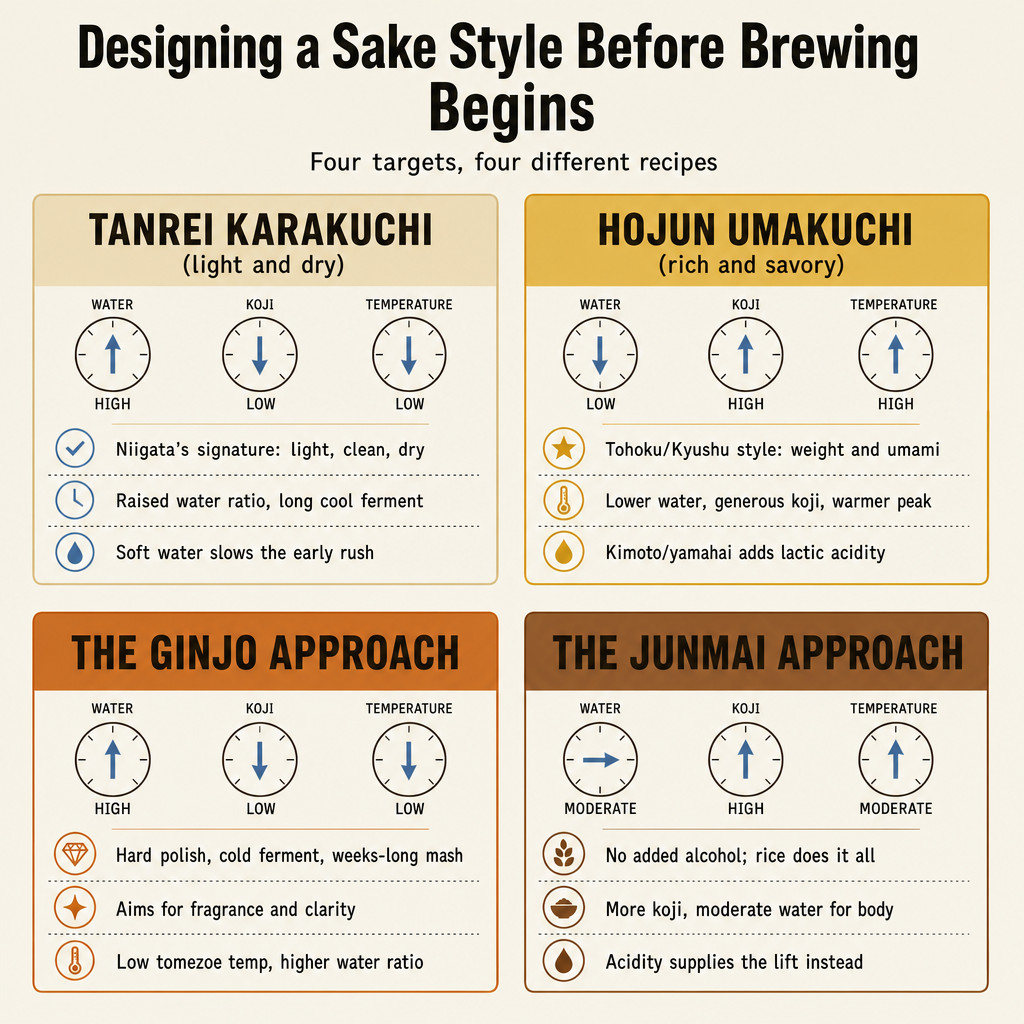
Recipes do not start from the ingredients. They start from a target in the brewer’s head. A toji decides what the sake should feel like, then works backwards toward the numbers that might get there.
Tanrei Karakuchi: Light and Dry
Tanrei karakuchi means light, clean, and dry. It became the signature of Niigata sake during the late twentieth century, and it still shapes expectations nationwide.
The direction is a raised water ratio and a long, cool fermentation, so the yeast consumes sugar thoroughly. Soft water helps, since it slows the early rush. Exactly how far any brewery pushes each element stays private. The result should finish quickly on the palate without feeling hollow, which is harder than it sounds.
Hojun Umakuchi: Rich and Savoury
Hojun umakuchi sits at the opposite pole. Here the brewer wants weight, umami, and a longer finish. Many Tohoku and Kyushu houses build their reputation on it.
The direction here reverses: a reduced water ratio, generous koji, and a warmer peak. A kimoto or yamahai starter adds lactic acidity, which stops the richness from turning flabby. Polishing may stay moderate on purpose, because some of the character lives in the outer grain.
The Ginjo Approach
Ginjo is less a category than a method. Brewers polish hard, ferment cold, and stretch the mash out for weeks. The aim is fragrance and clarity rather than depth.
Recipe-wise, that means a water ratio above the standard band, koji grown for enzyme balance rather than raw power, and a low tomezoe temperature. The mash may run past thirty-five days. Yields drop, labour climbs, and the margin for error narrows. Still, when it works, the aroma is unmistakable.
The Junmai Approach
Junmai removes one tool from the box. Without distilled alcohol, everything must come from rice, koji, water, and yeast. So the recipe carries more responsibility.
Brewers often compensate with slightly more koji and a moderate water ratio. That keeps the body intact and stops the sake from feeling thin after pressing. Acidity becomes important too, because it supplies the lift that added alcohol would otherwise provide.
The Standard Formula, and How It Shifts
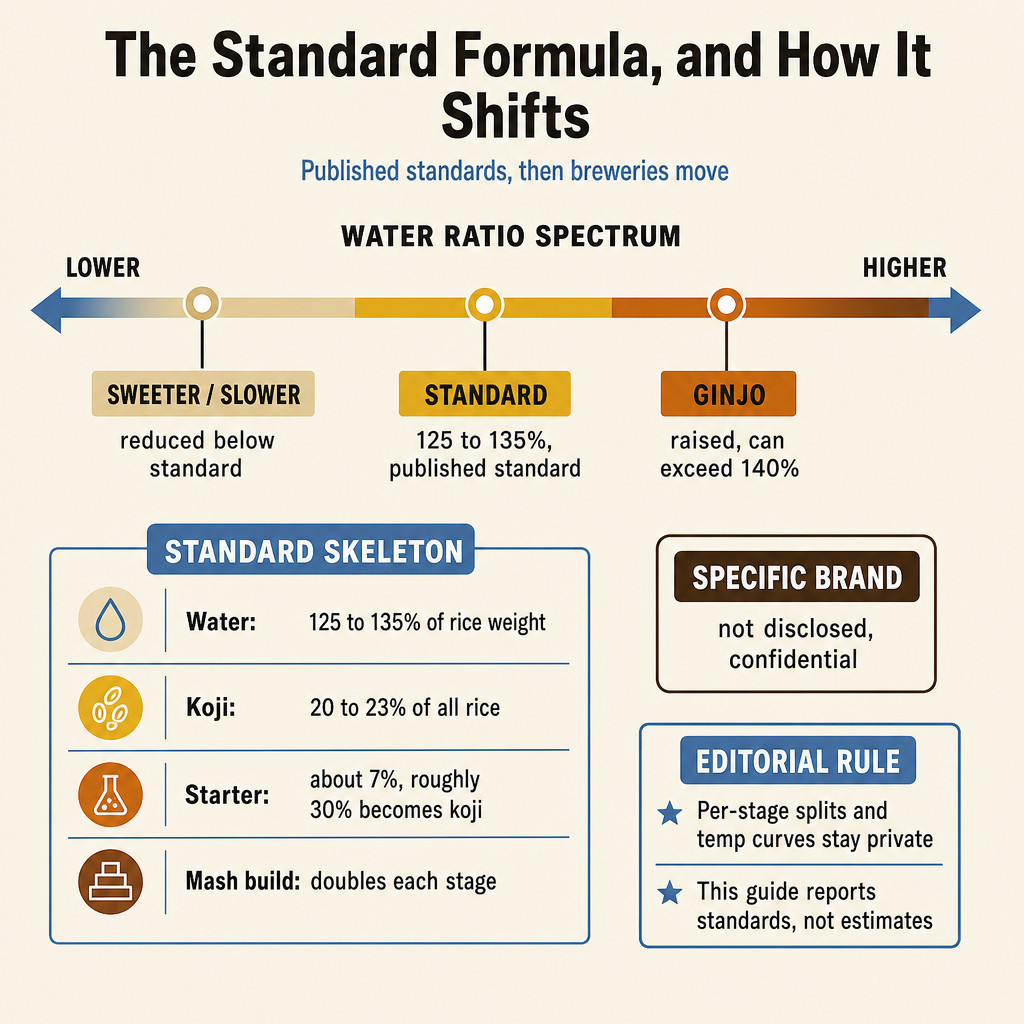
It would be easy to illustrate this with sample recipes for ginjo, junmai, and genshu. We avoid that, because invented formulas look authoritative and are not. Published standards do the job better, and they deserve to be quoted exactly.
What the Standard Says
The Society for Nada Sake Research maintains a sake glossary that lists reference values. Four figures come from it directly.
- Water ratio: 125 to 135 percent of total rice weight
- Koji rice: 20 to 23 percent of all rice used
- Starter rice: about 7 percent of all rice, roughly 30 percent of which becomes koji
- Mash build: the first addition uses about twice the starter, then each stage doubles the mash again
That is the shared skeleton. Every brewery starts somewhere near it, then moves.
Where Ginjo Departs
Ginjo brewing pushes the water ratio upward, and published references note that it can exceed 140 percent. The logic follows the biology. A thinner mash keeps sugar low, so the yeast works slowly and produces more aromatic compounds.
Cold fermentation compounds the effect. Together the two choices explain most of what people recognise as ginjo character.
Where Sweetness Departs
The reverse move is equally documented. When brewers aim at a sweeter sake, or need to slow fermentation down, they reduce the water ratio below the standard band.
A denser mash raises sugar concentration and puts the yeast under pressure. Fermentation then runs less completely, so more sugar survives into the finished sake. The same move also tends to lift the final alcohol, which matters for undiluted styles.
| Goal | Direction of the water ratio | Basis |
|---|---|---|
| General-purpose brewing | 125 to 135 percent | Published standard |
| Ginjo and similar styles | Raised, and able to exceed 140 percent | Published |
| Sweeter sake, or slower fermentation | Reduced below the standard band | Published |
| A specific brand at a specific brewery | Not disclosed | Confidential |
Where the Public Record Stops
The rows above are the honest limit. Beyond them, the record goes quiet.
Nobody publishes the per-stage koji split for a given brand. Nobody publishes the temperature curve that goes with it, or how far a house moved its numbers after a hot harvest. Those decisions are the craft itself, and breweries keep them in-house.
Our editorial rule: this guide reports published standards and stops there. Where a figure is not on the public record, we say so rather than estimating it.
What Does the Recipe Taste Like?
You cannot taste a ratio, obviously. Still, after enough side-by-side pours, certain patterns start to feel legible. The impressions below are personal ones, so treat them as orientation rather than fact.
Aroma
High-water, cold-mash designs tend to arrive with fruit at the front. Melon, green apple, sometimes banana. Denser, warmer designs smell more like the brewery itself: steamed grain, faint mushroom, a whisper of cream. Neither is better. They simply announce different intentions.
Taste
Koji-heavy recipes usually show umami early and hold it. There is a rounded, almost broth-like quality that sits mid-palate. Leaner formulas skip that and go straight to a clean, slightly mineral impression instead.
One assumption is worth abandoning early, and I held it far too long. A higher koji ratio does not simply mean richer sake. How the koji grew matters at least as much as how much went in. Patchy surface growth and full grain coverage produce different enzyme balances, so two tanks at the same percentage can taste unalike.
Texture
Texture may be the clearest signal of all. Genshu-style recipes coat the tongue and warm the throat. Ginjo designs feel almost weightless, sometimes to the point where drinkers call them watery on first sip. Give those a minute in the glass, though. They usually open up.
Shikomi Haigo and the Other Brewing Parameters
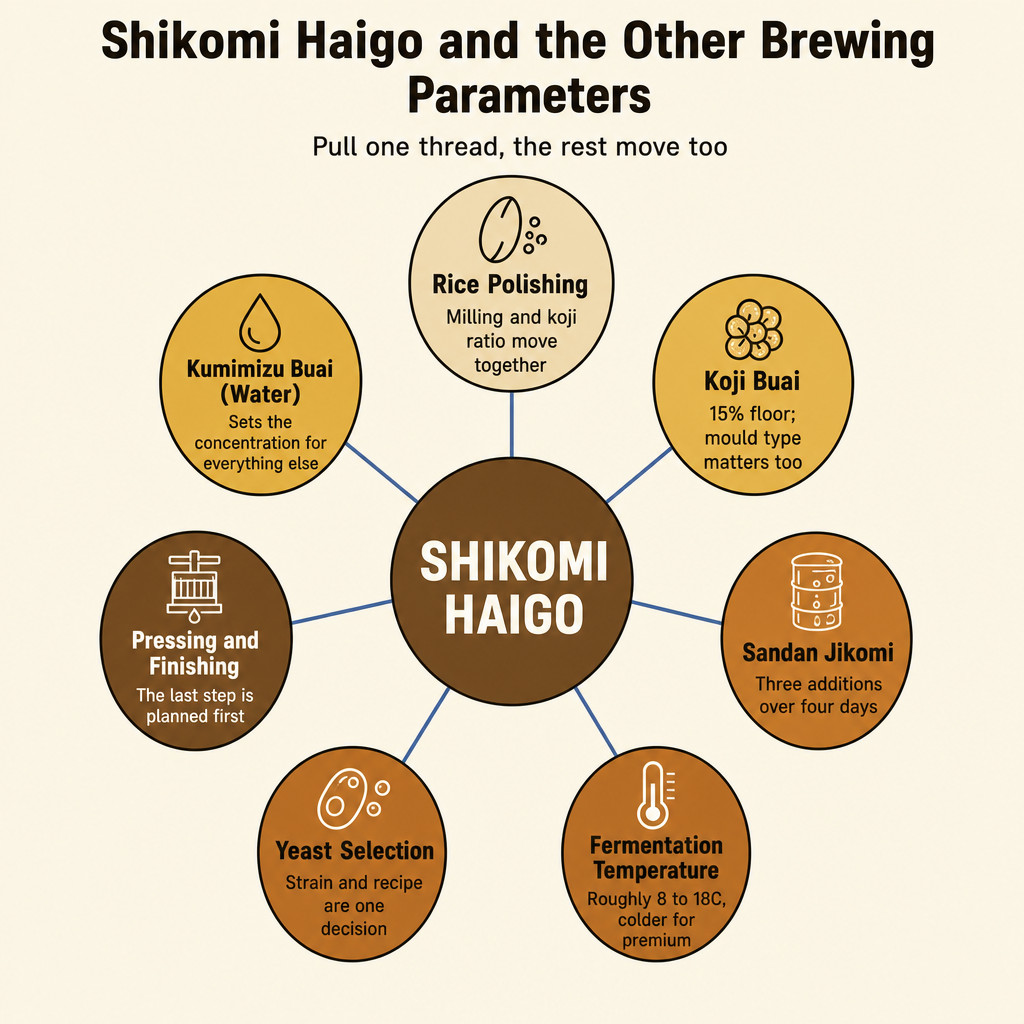
No ratio works alone. The recipe sits inside a web of decisions, and pulling one thread moves the rest.
Rice Polishing
Rice polishing decides what the recipe is actually working with. Heavily milled grain holds less protein and less fat, so it produces fewer amino acids and cleaner aromatics. It also absorbs water faster and dissolves more reluctantly in the tank.
Because of that, polishing and the koji ratio travel together. A brewer milling to 40 percent may keep koji generous, simply to guarantee enough enzyme reaches the sluggish grain. Assuming that high polish always means less of everything would be a mistake.
Kumimizu Buai
The water ratio is the single most quoted number in any shikomi haigo. It behaves like hydration in dough, setting the concentration everything else operates in. Higher water dilutes sugar and eases yeast stress. Lower water concentrates flavour and pushes alcohol.
Historically the figure has climbed a long way. Edo-period mashes ran far thicker than modern ones, which partly explains why old sake read as sweet by today’s standards. Following the water ratio across centuries is, in a sense, following Japanese taste itself.
Koji Buai
Koji buai is the enzyme dial. Japan’s labelling standards for specially designated sake set a floor of 15 percent, and most breweries sit comfortably above it. Twenty percent is a common working figure.
Yet the number alone tells you little. Koji grown with patchy surface mould, called tsuki-haze, favours clean fragrant styles. Fully covered sou-haze koji digs deeper into the grain and builds richness. So two tanks at 20 percent can behave nothing alike.
Sandan Jikomi
Sandan jikomi is where the recipe becomes a schedule. Brewers split the rice, koji, and water across three additions over four days, with a rest day called odori after the first.
Each stage enlarges the mash substantially, which protects acidity and keeps the yeast dominant. Shift the proportions between stages and the early fermentation changes character, even when the totals stay identical. Our moromi guide follows what happens next.
Fermentation Temperature
Temperature is the recipe’s constant partner. Fermentation speeds up as the mash warms, and it slows as the mash cools. Across all styles the working range runs roughly from 8 to 18 degrees Celsius, with premium styles clustered at the cold end.
This is why sake has traditionally been a winter craft. The practice of kan-zukuri gave brewers a cold, stable environment before refrigeration existed. Modern jacketed tanks widened the calendar, though many houses still prefer the old season.
Yeast Selection
Strain and recipe belong to the same decision, never separate ones. A high-ester strain paired with a dense, warm mash tends to waste its own strengths. The same strain in a thin, cold mash sings.
Prefectural laboratories now breed local strains for local styles, which adds another layer. Akita, Yamagata, Shizuoka, and others all maintain their own. So the yeast line on the sheet often carries regional identity as much as technical function.
Pressing and Finishing
The recipe does not end when fermentation does. Pressing timing decides how much sugar and acid survive into the bottle. After that come filtration, pasteurization, and dilution.
A brewer planning a genshu therefore writes a lower water ratio weeks in advance. A brewer planning a delicate 15 percent bottling builds in room for warimizu. In other words, the last step is already present in the first.
Traditional Versus Modern Recipe Design
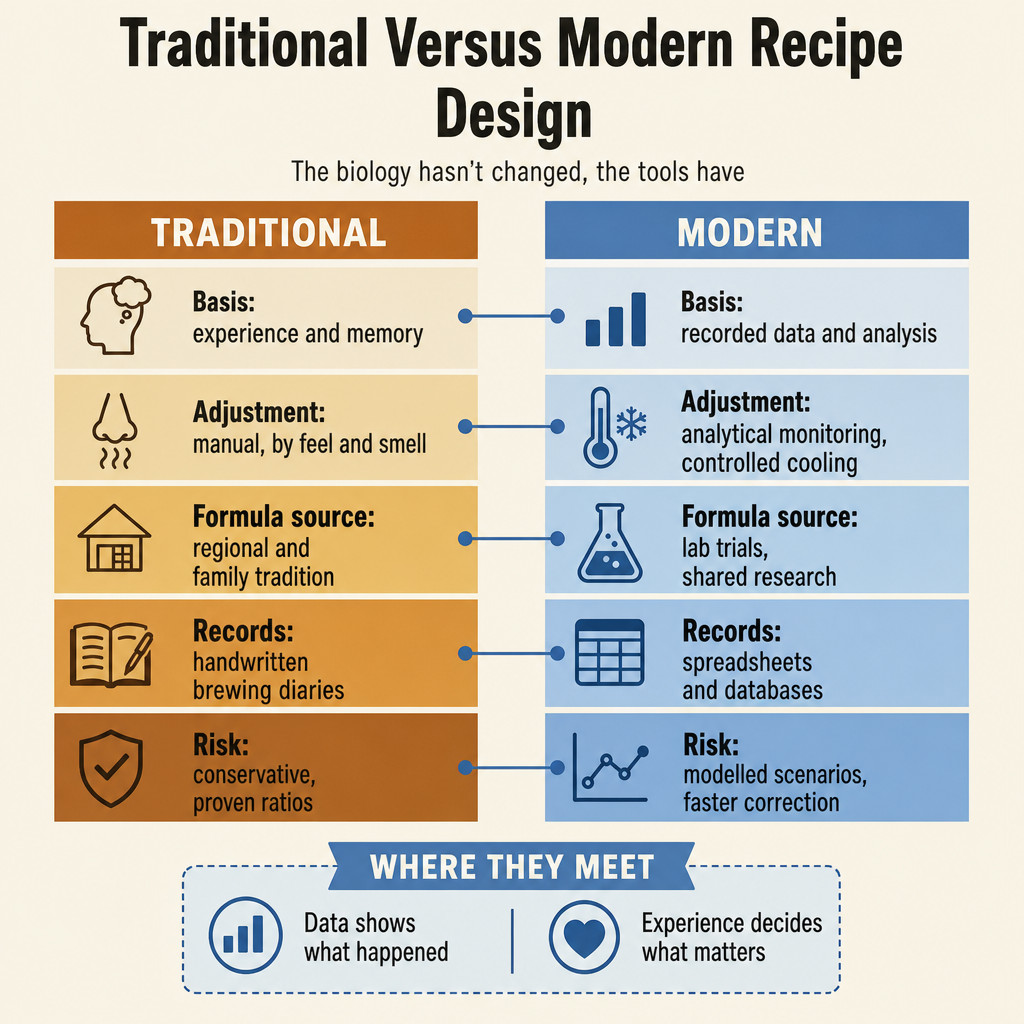
The craft has changed a great deal in a century. Not the biology, though. Only the way brewers observe it.
| Traditional | Modern | |
|---|---|---|
| Basis for decisions | Experience and memory | Recorded data and analysis |
| Adjustment method | Manual, by feel and smell | Analytical monitoring and controlled cooling |
| Source of the formula | Regional and family tradition | Laboratory trials and shared research |
| Record keeping | Handwritten brewing diaries | Spreadsheets and databases across seasons |
| Risk management | Conservative, proven ratios | Modelled scenarios and faster correction |
How Brewers Worked Before Instruments
Older recipes lived partly on paper and partly in someone’s head. A toji arrived each winter with a set of ratios that had worked before, then adapted them to the rice at hand.
Judgment came through the senses. Brewers read the foam, listened to the bubbling, and tasted the mash daily. Their kurabito teams learned by repetition rather than instruction. It worked, yet it travelled badly, since the knowledge rarely left the person who held it.
What Changed
Analysis changed everything. Once brewers could measure sugar, acidity, amino acidity, and alcohol daily, the mash stopped being mysterious. Patterns appeared across seasons, and those patterns went into writing.
Cooling technology mattered just as much. Jacketed tanks let a brewery hold nine degrees for a month without praying for weather. That control made ambitious ginjo recipes practical rather than heroic.
Where the Two Meet
In practice, no serious brewery is purely one or the other. Data tells you what happened. Experience tells you whether it matters, and which lever to pull next.
That division of labour is the honest summary. Numbers protect a brewery from disaster and preserve hard-won learning. Someone still has to decide what the sake ought to be.
From Tradition to Data Science
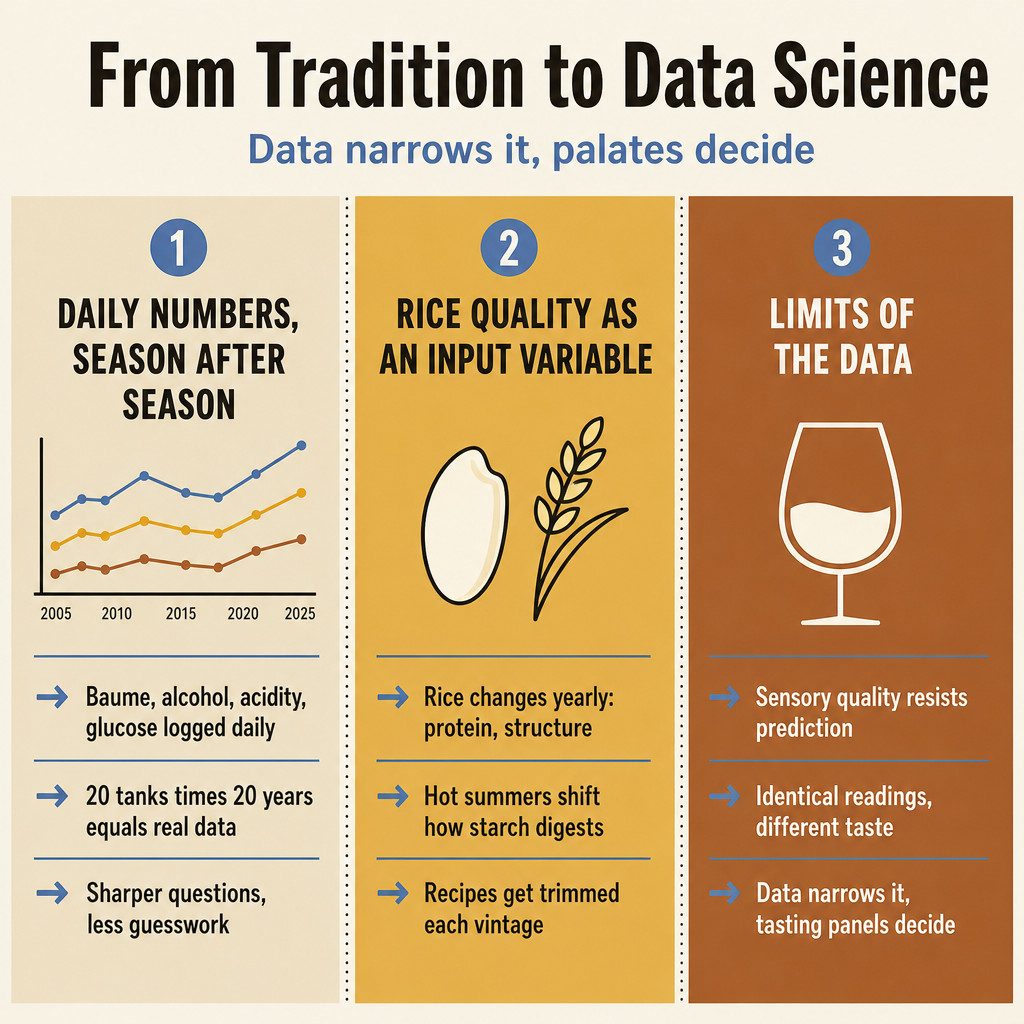
The newest layer is quantitative in a way earlier generations would not recognise. Breweries now hold years of tank records, and some are finally using them properly.
Daily Numbers, Season After Season
A working tank generates a lot of information. Baume, alcohol, acidity, amino acidity, glucose, and temperature go into the log, often every single day. Multiply that by twenty tanks and twenty years, and a real dataset appears.
With that history, a brewer can ask sharper questions. Which water ratio produced the cleanest finish with this rice? How did last year’s warm harvest change dissolution? Guesswork narrows considerably.
Rice Quality as an Input Variable
Rice is not stable from year to year. Hot summers change grain structure, protein content, and how readily the starch digests. Japan’s national brewing institute has published multi-year analyses of brewing rice, comparing varieties across many crop years.
So a recipe that worked beautifully in one vintage may need trimming in the next. Rather than repeat the formula blindly, brewers adjust soaking times and water ratios to compensate. It is closer to viticulture than most people assume.
Limits of the Data
Numbers do not settle everything, though. Sensory quality remains stubbornly hard to predict from analysis alone. Two tanks can post near-identical readings and still taste different in ways drinkers notice immediately.
Because of that gap, tasting panels have not gone anywhere. Data narrows the field, then human palates make the call. Personally, I find that reassuring rather than disappointing.
Famous Regional Brewing Philosophies
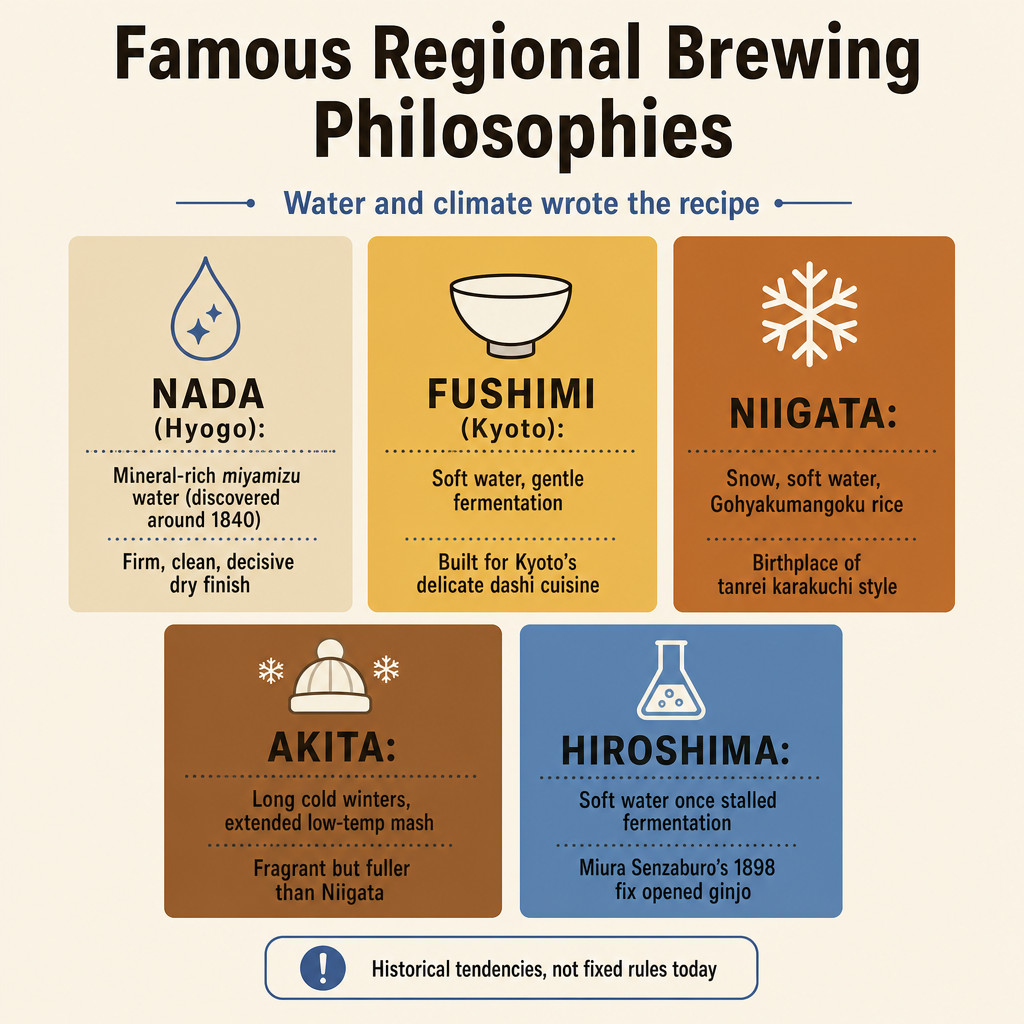
Regions did not choose their styles from a menu. Water, climate, rice, and market pressure pushed them there, and recipes followed.
Nada
Nada in Hyogo built its name on miyamizu, a mineral-rich groundwater identified around 1840. Potassium and phosphorus in that water drive vigorous fermentation, so mashes finish strong and dry.
Recipes there could afford to be assertive. Nada also sat beside excellent sake rice and a major shipping port, which encouraged large-scale, consistent production. The classic result was firm, clean sake with a decisive finish.
Fushimi
Fushimi in Kyoto works with much softer groundwater. Fermentation there proceeds gently, which suits recipes built for elegance rather than power.
Kyoto cuisine reinforced the direction. Delicate dashi-based cooking rewards sake that supports rather than dominates. So local formulas favour balance, restrained acidity, and a smooth mid-palate.
Niigata
Niigata combines heavy snow, soft water, and Gohyakumangoku rice. Those conditions push naturally toward long, cold fermentation, and the tanrei karakuchi style grew out of them.
Recipes tend to run generous on water and disciplined on temperature. The Echigo toji tradition codified much of this over generations. The style became so influential that it briefly defined what modern Japanese sake meant.
Akita
Akita holds long, deep winters, which makes extended low-temperature mashes straightforward. The regional signature blends fragrance with a fuller centre than Niigata usually shows.
Local rice varieties and prefectural yeast strains support that balance. Brewers there often accept slightly higher amino acidity than a purely tanrei design would allow. The trade-off buys warmth without losing clarity.
Hiroshima
Hiroshima faced a genuine problem in the nineteenth century. Its water was soft, low in minerals, and fermentation kept stalling. Miura Senzaburo is widely credited with solving it, and his soft-water brewing method appeared in print in 1898.
His approach reworked koji making and temperature handling to compensate for weak water. That work helped open the door to ginjo brewing as a whole. Saijo remains a centre of the tradition today.
A caution: these are historical tendencies, not present-day rules. Plenty of Niigata breweries now make rich, aromatic sake, and plenty of Nada houses make delicate ones. Regional character describes a starting point, not a limit.
Common Misconceptions
Recipe design attracts a few persistent myths. Let us clear them up.
- There is one standard recipe. There is not. Textbooks publish reference figures, and breweries treat them as starting points rather than instructions. Each brand within a brewery gets its own version.
- More koji always means better sake. More koji means more enzymes and more amino acids. Past a point, that reads as heaviness or bitterness instead of depth.
- Ratios alone determine quality. They set the conditions. Execution decides the outcome, and poor koji or careless steaming will spoil a perfect sheet.
- You can look up a brewery’s recipe. Almost never. Producers treat their figures as confidential, so published numbers describe the industry rather than any one house.
- Recipes never change. They change constantly. Rice quality shifts each harvest, so brewers adjust soaking, water, and timing to match.
- A higher water ratio just dilutes the sake. It changes the fermentation environment, not the finished strength. Dilution to bottling strength happens later, at the warimizu stage.
The last one causes the most confusion in English-language discussion. Brewing water and dilution water are separate figures with separate jobs, even though both are simply water.
Final Thoughts
Shikomi haigo is the least visible part of sake and, arguably, the most decisive. It never appears on a label. It rarely comes up on a brewery tour. Yet it explains why two bottles made from the same rice can feel like different drinks entirely.
The recipe is where philosophy turns into arithmetic. A brewer settles on lightness, or richness, or fragrance, then translates that wish into kilograms and litres. After that, biology takes over and the tank has its say.
What I like most is that the numbers stay humble. They guard against disaster and they encode generations of learning, but they cannot guarantee a great bottle. Weather, rice, and human attention still decide the last few percent.
If you want to go deeper from here, three routes work well. Read our moromi guide to see the recipe in action, our koji guide to understand the enzyme side, and our rice polishing guide for the raw material. Then, next time you open a bottle, try guessing the numbers behind it.
Shikomi Haigo FAQ
What is the difference between shikomi haigo and sandan jikomi?
Shikomi haigo is the recipe, while sandan jikomi is the schedule. The recipe states how much rice, koji, and water to use. The schedule states that those amounts enter the tank in three additions over four days. Brewers need both together.
What is the water ratio, or kumimizu buai?
It compares the litres of brewing water to the kilograms of total rice. A figure of 130 percent means 130 litres per 100 kilograms. The published standard range is 125 to 135 percent, and ginjo styles can exceed 140 percent. Higher figures generally produce lighter, drier sake.
How much koji does a typical recipe use?
Published references put it at 20 to 23 percent of all the rice used. Japan’s labelling standards for specially designated sake set a legal floor of 15 percent. Individual breweries do not disclose their own figure. How the koji is grown matters as much as the amount.
Can you tell the recipe from the label?
Only partly, unfortunately. Labels show the polishing ratio and grade, and sometimes the rice variety and yeast number. Water and koji ratios almost never appear, because breweries keep them confidential. Sake meter value and acidity give indirect hints at best.
Why does the same brand taste different from year to year?
Rice changes with the weather, so its structure and protein content vary each harvest. Brewers respond by adjusting soaking, water volume, and timing. The target stays the same, yet the route there shifts. Small differences reach the bottle.
Does more koji make sweeter sake?
Not automatically. More koji creates sugar faster, yet yeast may simply ferment that sugar away. The clearer effect appears in umami and body, since koji also releases amino acids. Final sweetness depends on when the brewer stops fermentation.
How does the recipe relate to the polishing ratio?
Polishing decides the raw material the recipe works with. Heavily milled rice carries less protein and dissolves more slowly. Brewers often adjust koji and water to compensate. So the two figures always get chosen as a pair.
Is the water in the recipe the same as the water added before bottling?
No, and mixing them up is common. Brewing water sets the fermentation environment inside the tank. Dilution water, called warimizu, comes after pressing and lowers the alcohol to bottling strength. The recipe records them separately.
If recipes are secret, where do the standard numbers come from?
From industry bodies rather than individual breweries. The Society for Nada Sake Research and the National Research Institute of Brewing both publish reference values. Those describe general practice across the industry. No brewery’s own formula appears in them.
Do breweries publish their shikomi haigo?
No, almost never. Producers treat the figures as confidential, and even brewery tours rarely reveal them. Any numbers you find in books or on this site come from research institutes and industry guides. They describe typical practice rather than a specific brewery.
References
- Society for Nada Sake Research, Sake Glossary, Kumi-mizu-buai (water ratio), https://www.nada-ken.com/main/en/index_k/461.html (Surveyed: August 2026)
- Society for Nada Sake Research, Sake Glossary, Kojimai, kake-mai and shubomai, https://www.nada-ken.com/main/en/index_k/64.html (Surveyed: August 2026)
- Society for Nada Sake Research, Sake Glossary, Sandan shikomi and shikomi, https://www.nada-ken.com/main/en/index_s/210.html (Surveyed: August 2026)
- National Research Institute of Brewing, A Comprehensive Guide to Japanese Sake (English), https://www.nrib.go.jp/English/sake/pdf/guidesse01.pdf (Surveyed: August 2026)
- National Research Institute of Brewing, About Sake etc., https://www.nrib.go.jp/English/sake/sakeinfo.html (Surveyed: August 2026)
- National Research Institute of Brewing, 2021 Research Results, https://www.nrib.go.jp/English/researches/seika/2021.html (Surveyed: August 2026)
- National Research Institute of Brewing, Research Topics, https://www.nrib.go.jp/English/researches/research_topi.html (Surveyed: August 2026)
- Japan Sake and Shochu Makers Association, How to Read Sake Bottle Labels, https://japansake.or.jp/sake/en/basic/how-to-read-sake-bottle-labels/ (Surveyed: August 2026)
- Japan Sake and Shochu Makers Association, Sake information in English, https://japansake.or.jp/sake/en/ (Surveyed: August 2026)
- Zhang, K., Wu, W., & Yan, Q. (2020). Research advances on sake rice, koji, and sake yeast: A review. Food Science & Nutrition, 8(7), 2995 to 3003, https://pmc.ncbi.nlm.nih.gov/articles/PMC7382144 (Surveyed: August 2026)
- Nishida, H. (2021). Sake brewing and bacteria inhabiting sake breweries. Frontiers in Microbiology, 12, 602380, https://www.ncbi.nlm.nih.gov/pmc/articles/PMC7970033/ (Surveyed: August 2026)
- Takahashi, H. et al. (2020). Effect of koji starter on metabolites in Japanese alcoholic beverage sake made from the sake rice Koshitanrei. Bioscience, Biotechnology, and Biochemistry, 84(8), 1714 to 1723, https://academic.oup.com/bbb/article/84/8/1714/5955602 (Surveyed: August 2026)
- Fujiwara, H., Watanabe, K., & Wakai, Y. (2023). Combination of four bacterial strains isolated from Yamahai-shubo in traditional Japanese sake brewing. Food Science & Nutrition, https://www.ncbi.nlm.nih.gov/pmc/articles/PMC10261790/ (Surveyed: August 2026)
Related Articles
- How Sake Is Made: Step-by-Step Japanese Brewing Guide (Surveyed: August 2026)
- Moromi (醪): The Main Fermentation Mash (Surveyed: August 2026)
- Moto (酒母): The Yeast Starter of Sake (Surveyed: August 2026)
- Sandan Jikomi: Sake’s Three-Step Mashing Method (Surveyed: August 2026)
- Koji (麹): The Heart of Japanese Brewing (Surveyed: August 2026)
- Rice Polishing (精米歩合) (Surveyed: August 2026)
- Water in Sake Brewing: Miyamizu and Minerals (Surveyed: August 2026)
- Yeast (酵母) in Sake Brewing (Surveyed: August 2026)
- Fermentation (発酵) in Sake Brewing (Surveyed: August 2026)
- Warimizu (割水): Why Water Is Added Before Bottling Sake (Surveyed: August 2026)
- Sake Kasu (酒粕): Sake Lees from Brewing to Table (Surveyed: August 2026)
- Toji (杜氏): The Master Brewer Behind Every Bottle of Sake (Surveyed: August 2026)
- Sake Rice (酒米): The Foundation of Premium Sake (Surveyed: August 2026)
- Types of Japanese Sake: Junmai, Ginjo and Daiginjo Guide (Surveyed: August 2026)





Comments