



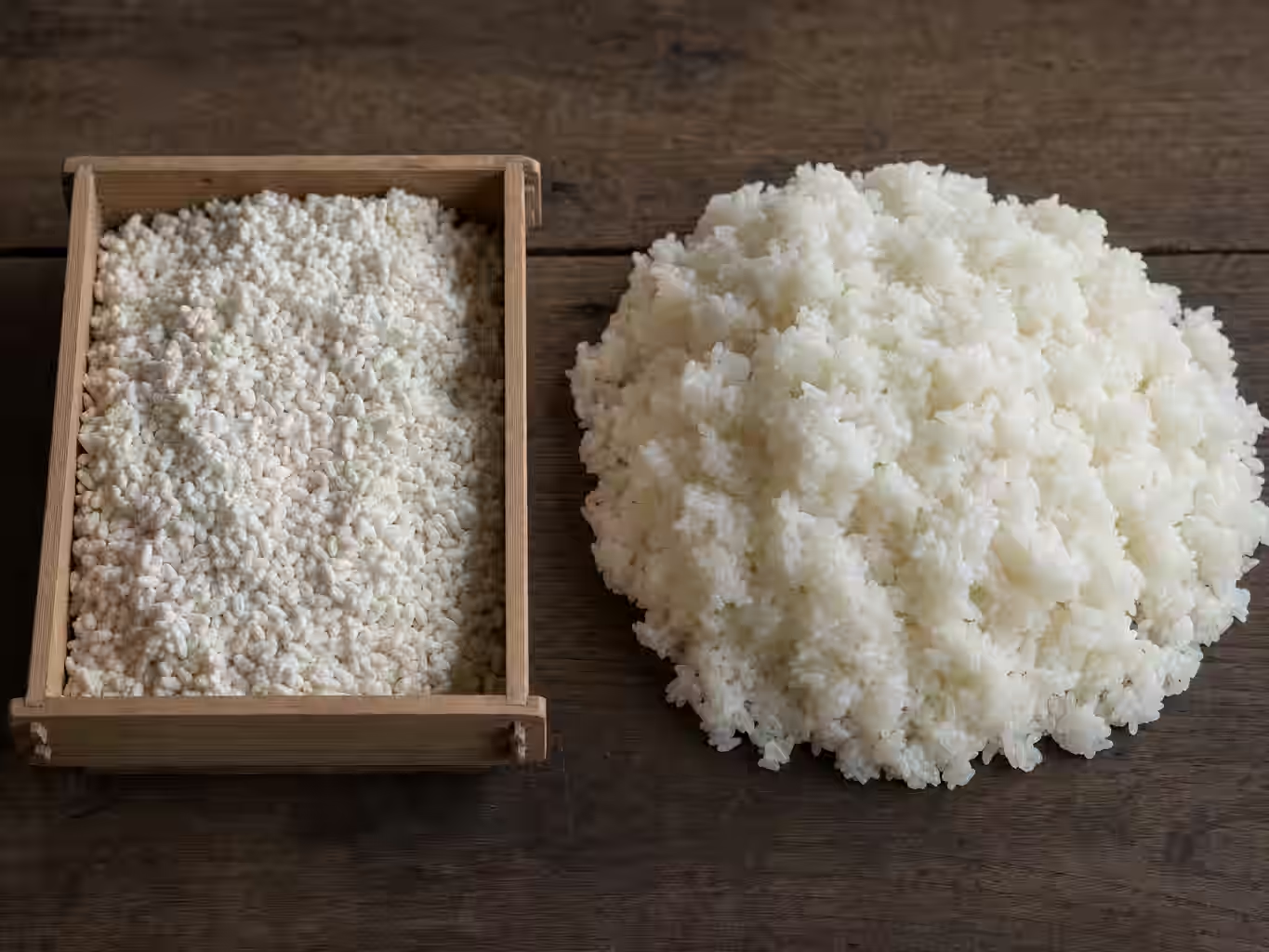
Ask a brewer what makes sake possible and the answer rarely starts with rice. It starts with koji. Yet koji is not added freely, and the amount is measured to the kilogram. That measurement has a name: koji buai.
Koji buai (麹歩合) is the percentage of a batch’s total rice that gets turned into koji. If a brewery uses 1,000 kilograms of polished rice and makes koji from 200 kilograms, the koji buai is 20 percent. The rest becomes plain steamed rice, added straight to the mash.
Simple arithmetic, then. The consequences are anything but. Koji supplies the enzymes that turn rice starch into sugar, so the ratio decides how much converting power enters the tank. Raise it and saccharification accelerates. Lower it and the mash works more slowly.
Here is where many English explanations go wrong. More koji does not mean better sake. It means more enzymes, and enzymes cut in several directions at once. Some release sugar, while others release amino acids. Push the ratio too far and richness turns into heaviness.
So this guide treats koji buai as one variable inside a system, not a quality score. We will walk from starch to enzyme to sugar to alcohol, then look at how the ratio interacts with polishing, water, yeast, and temperature. For the process itself, our guide to how sake is made covers the steps in order.
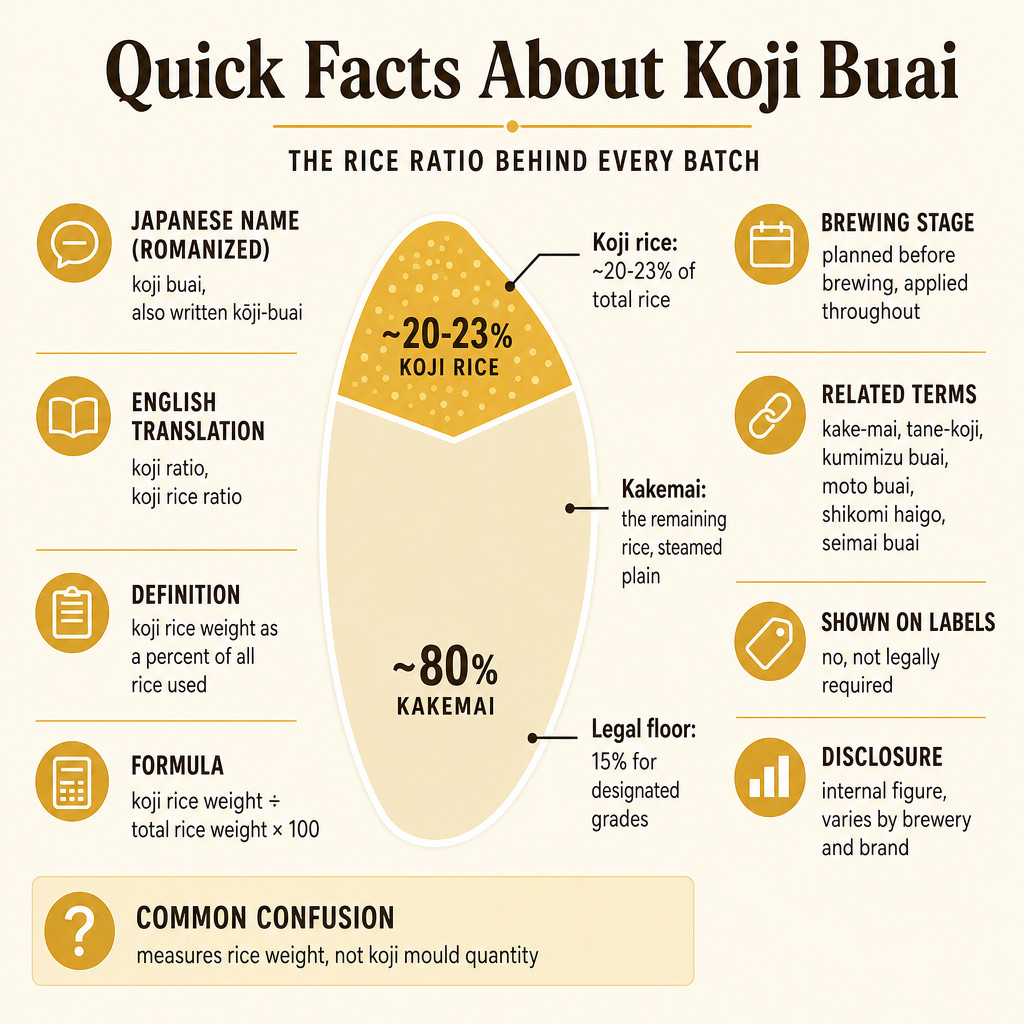
Quick Facts About Koji Buai
| Japanese Name | 麹歩合 |
| Romanization | koji buai (also written kōji-buai) |
| English Translation | Koji ratio, koji rice ratio |
| Definition | The weight of rice made into koji, as a percentage of all rice used in the batch |
| Formula | Koji rice weight ÷ total rice weight × 100 |
| Brewing Stage | Planned before brewing, applied to the starter and every mash addition |
| Published Standard | 20 to 23 percent of all rice used |
| Legal Floor | 15 percent for specially designated sake grades |
| Related Terms | Koji-mai, kake-mai, tane-koji, kumimizu buai, moto buai, shikomi haigo, seimai buai |
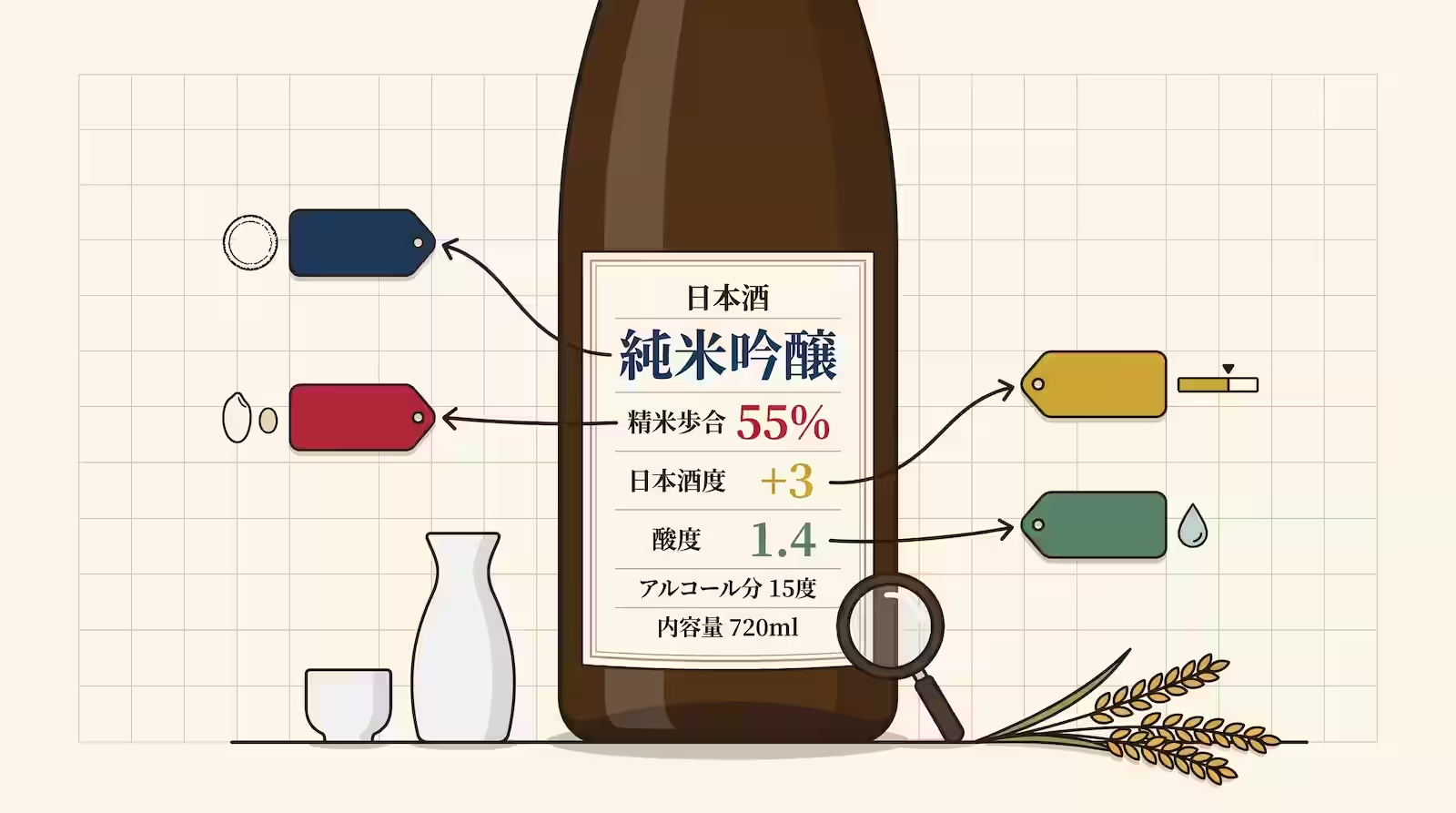
| Shown on Labels | No, and Japanese labelling rules do not require it |
| Disclosure | Treated as internal information. Figures differ by brewery, by brand, and by sake type |
| Common Confusion | It measures rice, not the quantity of koji mould |
The published standard above comes from industry references rather than any single brewery. Individual formulas stay confidential.
What Is Koji Buai?
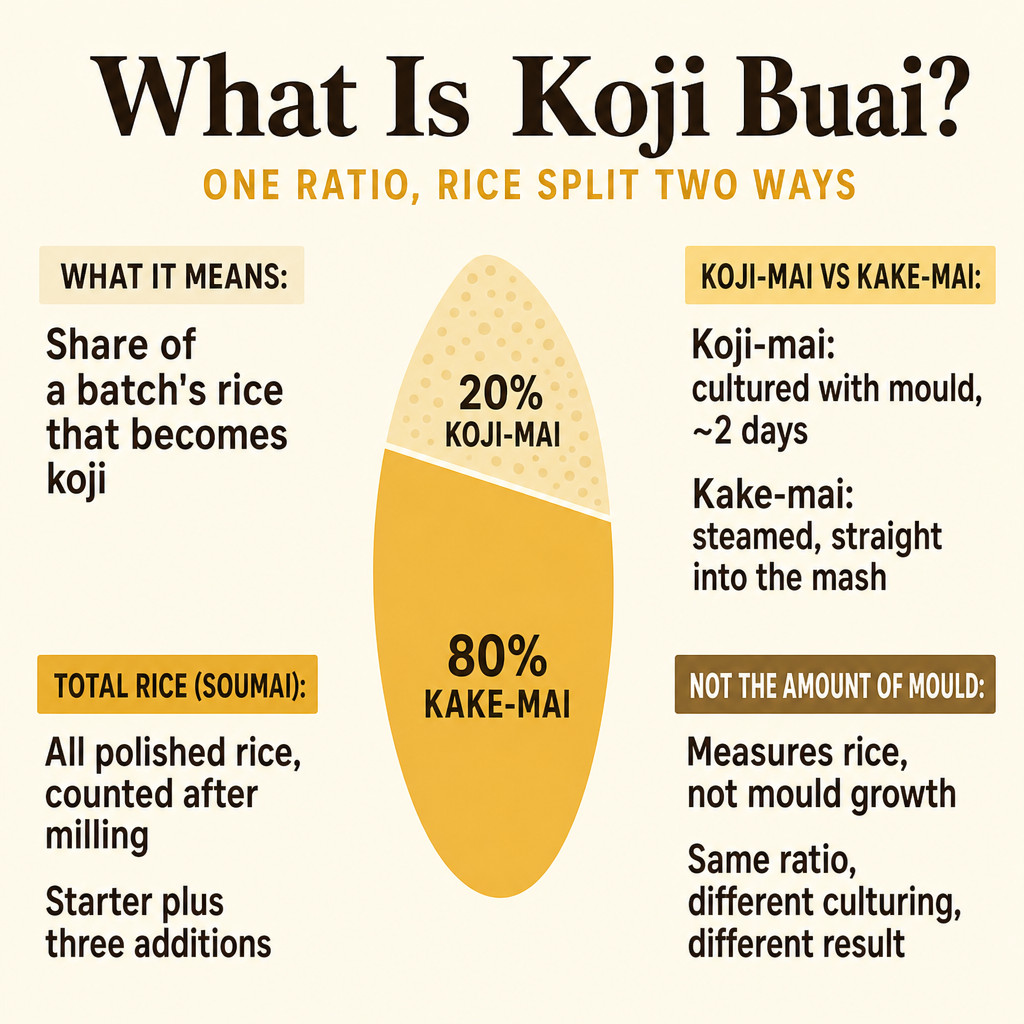
In one line: Koji buai is the share of a batch’s rice that becomes koji, expressed as a percentage of the total rice weight.
Koji-mai and Kake-mai
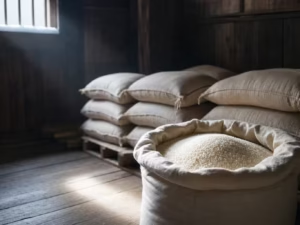
Every batch splits its polished rice into two jobs. Koji-mai (麹米) is steamed, cooled, inoculated with mould spores, and cultured for around two days. Kake-mai (掛米) is steamed, cooled, and added to the mash directly.
Both start as white rice, though not always the same variety. Industry references note that breweries often reserve premium sake rice for koji making, while everyday eating rice can fill much of the kake-mai role. So koji buai is really a question about allocation: how much rice should be spent on making enzymes rather than on supplying starch.
The starter has its own split, too. Industry references note that roughly 30 percent of the starter’s rice becomes koji, with the rest going in as steamed rice. That figure sits inside the batch total rather than beside it.
What Counts as Total Rice
Total rice, or soumai (総米), means all the polished rice in the batch. It covers the starter, the first addition, the middle addition, and the final addition. Brewers count it after milling, not before.
That last point matters more than it looks. A brewery milling to 40 percent buys far more brown rice than it brews with. The koji buai calculation ignores everything polished away, so it always refers to white rice weight.
Koji Buai Is Not the Amount of Mould
This confusion appears constantly, and it is worth killing off early. Koji buai says nothing about how much Aspergillus oryzae grows on the grain.
The mould itself is applied as spores, in tiny quantities measured in grams per hundred kilograms. What varies is how the culture develops over roughly 48 hours. Two breweries can run the same koji buai and end up with completely different enzyme profiles, because the culturing differed.
Put plainly: koji buai measures rice. Koji quality measures what happened to that rice. You need both figures to predict anything, and only one of them is a number.
How Is Koji Buai Calculated?
The formula is short enough to do in your head.
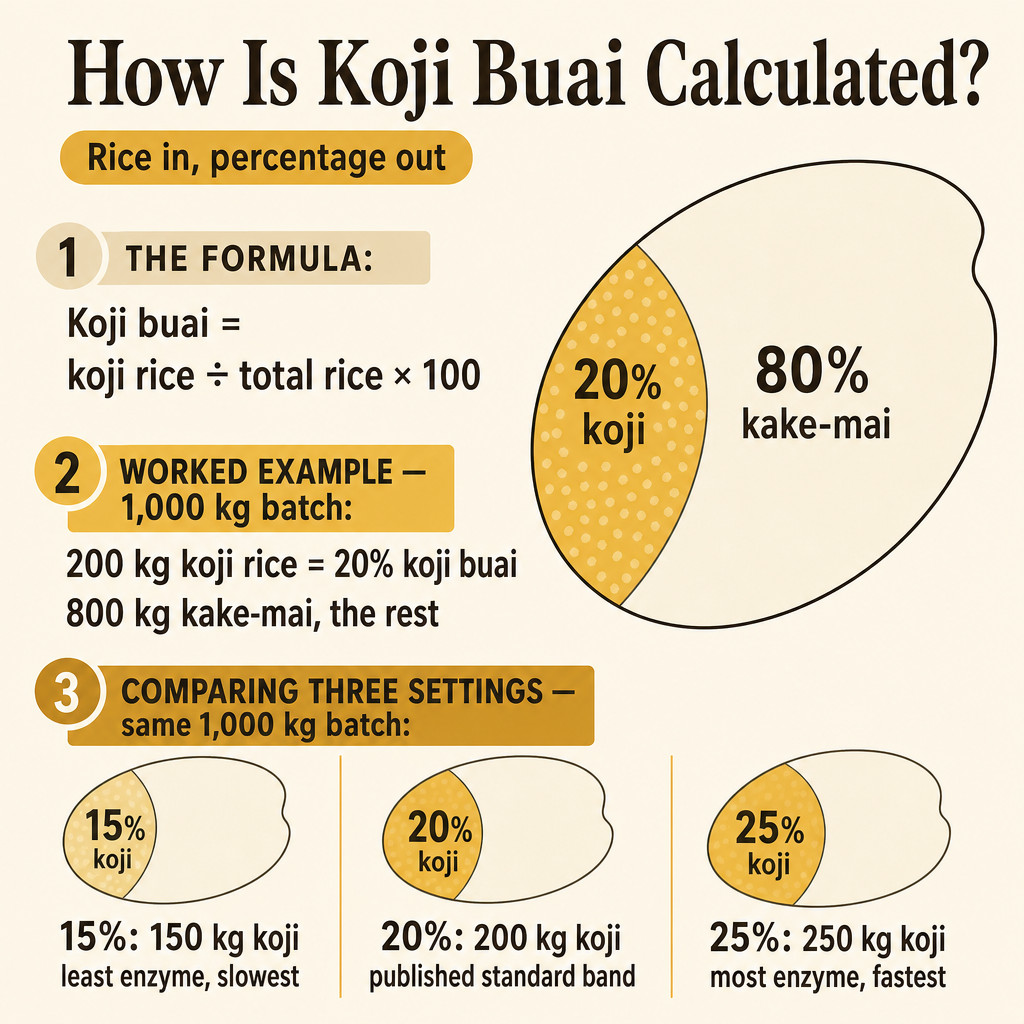
Koji buai (%) = koji rice weight ÷ total rice weight × 100
A Worked Example
Take a batch using 1,000 kilograms of polished rice in total. The brewery sets aside 200 kilograms for koji making. Dividing 200 by 1,000 gives 0.2, so the koji buai is 20 percent.
The remaining 800 kilograms becomes kake-mai. Notice that the two figures always add to 100 percent, since every grain does one job or the other. There is no third category.
Comparing Three Settings
The table below shows what different ratios look like on the same 1,000 kilogram batch. These are illustrative figures for arithmetic, not recommendations.
| Koji buai | Koji rice | Steamed rice | General tendency |
|---|---|---|---|
| 15 percent | 150 kg | 850 kg | Least enzyme input, slowest conversion |
| 20 percent | 200 kg | 800 kg | Within the published standard band |
| 25 percent | 250 kg | 750 kg | Most enzyme input, fastest conversion |
Read the right column carefully. It describes enzyme supply, not flavour. What happens to that enzyme supply depends on temperature, yeast, and water, so the finished sake could go several ways.
Which Buai Is Which
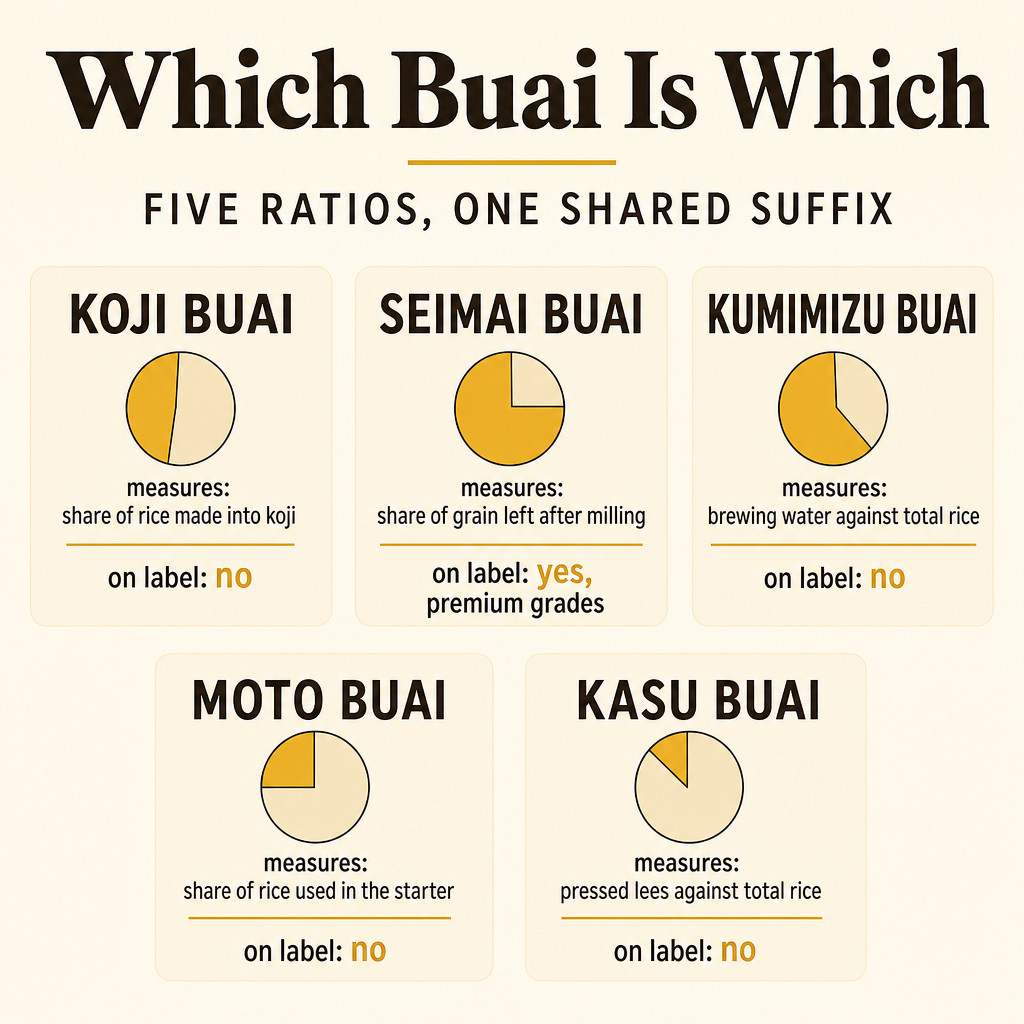
Japanese brewing uses several ratios ending in buai, and English writing muddles them constantly. Sorting them out takes one table.
| Term | What it measures | On the label? |
|---|---|---|
| Koji buai (麹歩合) | Share of total rice made into koji | No |
| Seimai buai (精米歩合) | Share of the grain remaining after milling | Yes, for premium grades |
| Kumimizu buai (汲水歩合) | Brewing water against total rice | No |
| Moto buai (酒母歩合) | Share of total rice used in the starter | No |
| Kasu buai (粕歩合) | Pressed lees against total rice | No |
Only one of them reaches the consumer. Seimai buai appears on bottles because labelling rules require it, which is partly why English writing overweights polishing and underweights everything else.
What the Number Leaves Out
Koji buai is a single figure covering the whole batch. It does not say how the koji gets distributed across the starter and the three mash additions. Brewers usually weight the early stages more heavily, since the yeast needs sugar before the mash gets big.
It also says nothing about enzyme strength. A weak koji at 25 percent may deliver less converting power than a vigorous koji at 18 percent. That is the awkward part of the whole topic, honestly.
Why Does Koji Matter?
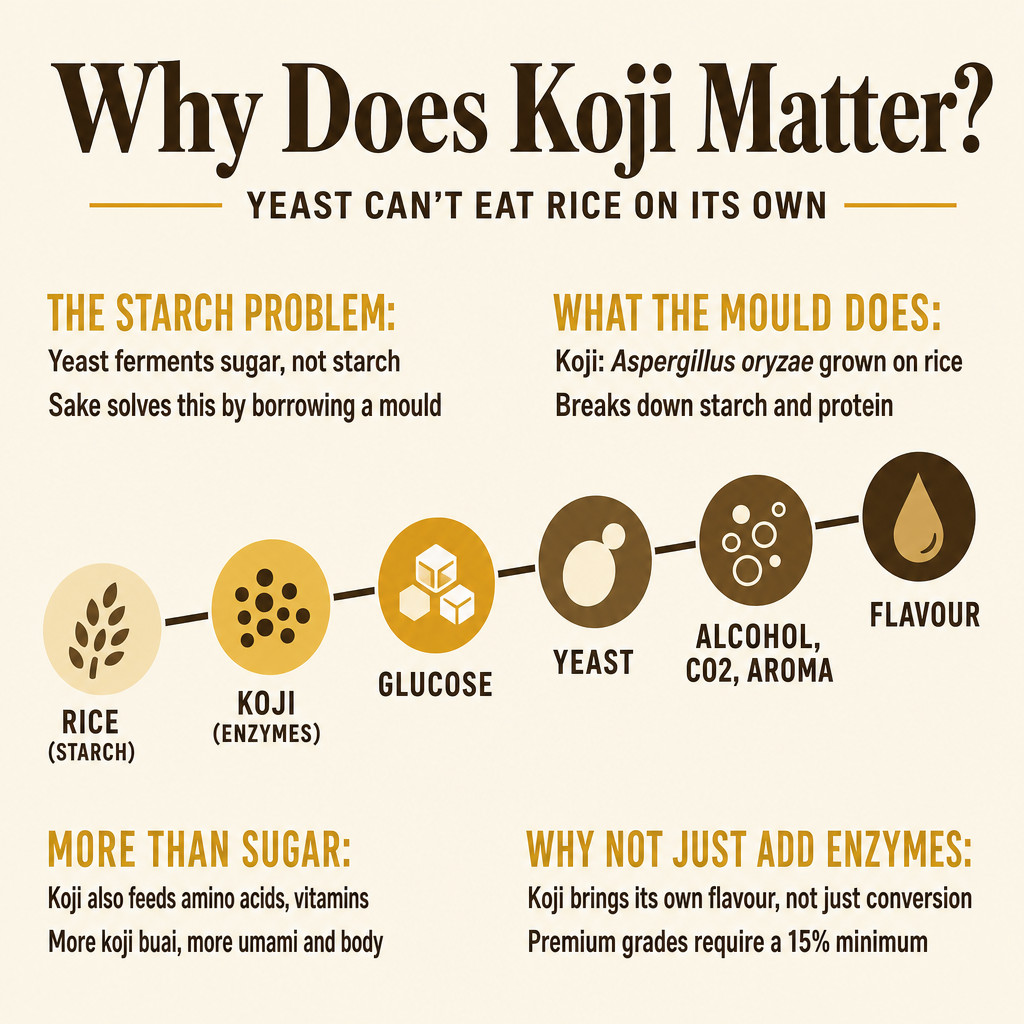
To see why the ratio carries weight, you have to start with a problem. Yeast cannot eat rice.
The Starch Problem
Rice stores its energy as starch, a long chain of glucose units. Yeast can ferment simple sugars, and it handles glucose easily. Starch, though, is far too large for the cell to absorb.
Beer solves this by malting barley, which activates the grain’s own enzymes. Wine skips the problem entirely, since grapes already contain sugar. Sake takes a third route and borrows a fungus.
What the Mould Actually Does
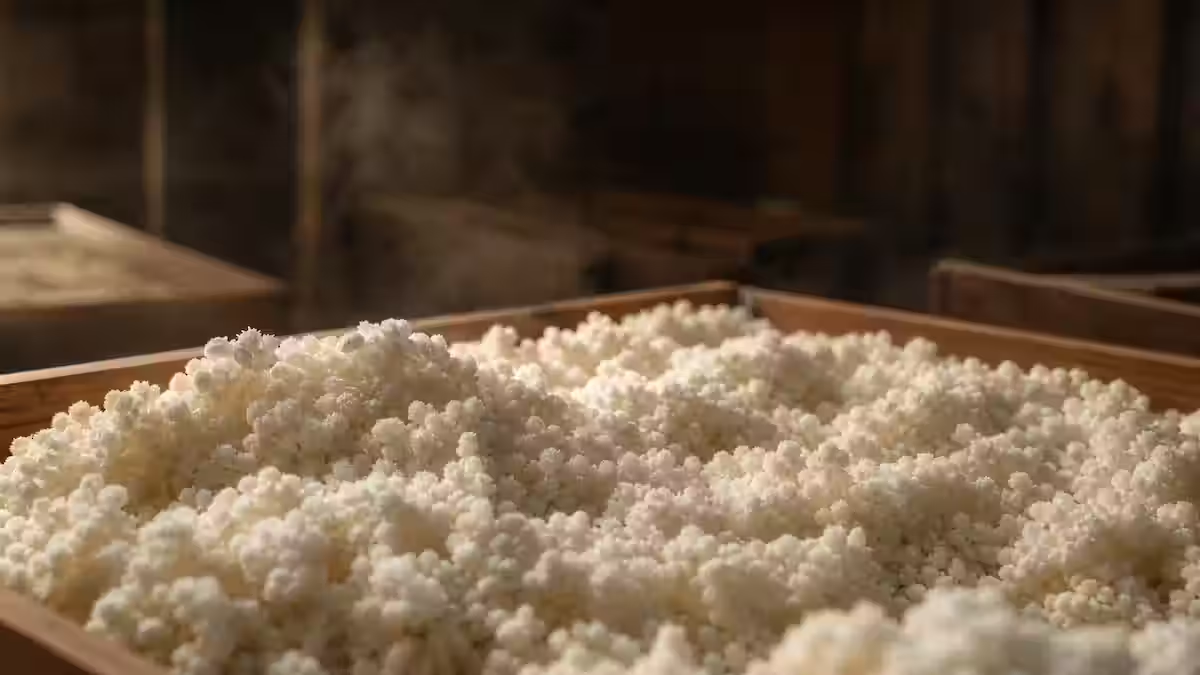
Koji is a solid culture of Aspergillus oryzae grown on steamed rice. Research on the fungus describes it as a strong producer of hydrolytic enzymes, both amylolytic and proteolytic. In plain terms, it breaks down starch and protein.
The hyphae grow into the grain rather than sitting on the surface. Studies on rice koji describe this penetration as haze-komi, and they report that it correlates strongly with how digestible the koji turns out. So the mould has to get inside to do its work.
From Starch to Glucose
Two enzyme families do the heavy lifting. Alpha-amylase chops long starch chains into shorter fragments, and glucoamylase then releases individual glucose units from those fragments.
Together they perform saccharification, the conversion of starch into fermentable sugar. Without it, nothing in the tank would ferment. Yeast simply waits for the enzymes to deliver.
- Rice supplies starch
- Koji supplies enzymes
- Enzymes convert starch into glucose
- Yeast consumes glucose
- Alcohol, carbon dioxide, and aroma compounds appear
- The balance of all of it becomes flavour
Koji Does More Than Sugar
Here is the part people underestimate. Industry explanations note that koji also supplies amino acids, vitamins, and lipids that the yeast needs to grow.
Proteases and peptidases break rice protein into amino acids and peptides. Those compounds feed the yeast early on, then survive into the finished sake as umami and body. Raise the koji buai and you raise this second stream as well, whether you wanted to or not.
So the ratio is never a sugar dial alone. It is a dial for the whole enzymatic environment, and that is exactly what makes it hard to predict.
Why Not Just Add Enzymes?
Reasonable question, and industrial enzyme preparations do exist. Some producers use them, particularly for ordinary sake, and Japanese brewing vocabulary even has a term for them.
The catch is that koji contributes more than conversion. It brings a mixed enzyme population rather than a single purified activity, and it leaves behind flavour compounds of its own. Sake made purely on added enzymes tends to read as flat by comparison.
There is a regulatory angle too. Premium grades set a minimum koji rice requirement, so a brewery cannot substitute its way below 15 percent and keep the designation.
Koji Buai and Multiple Parallel Fermentation
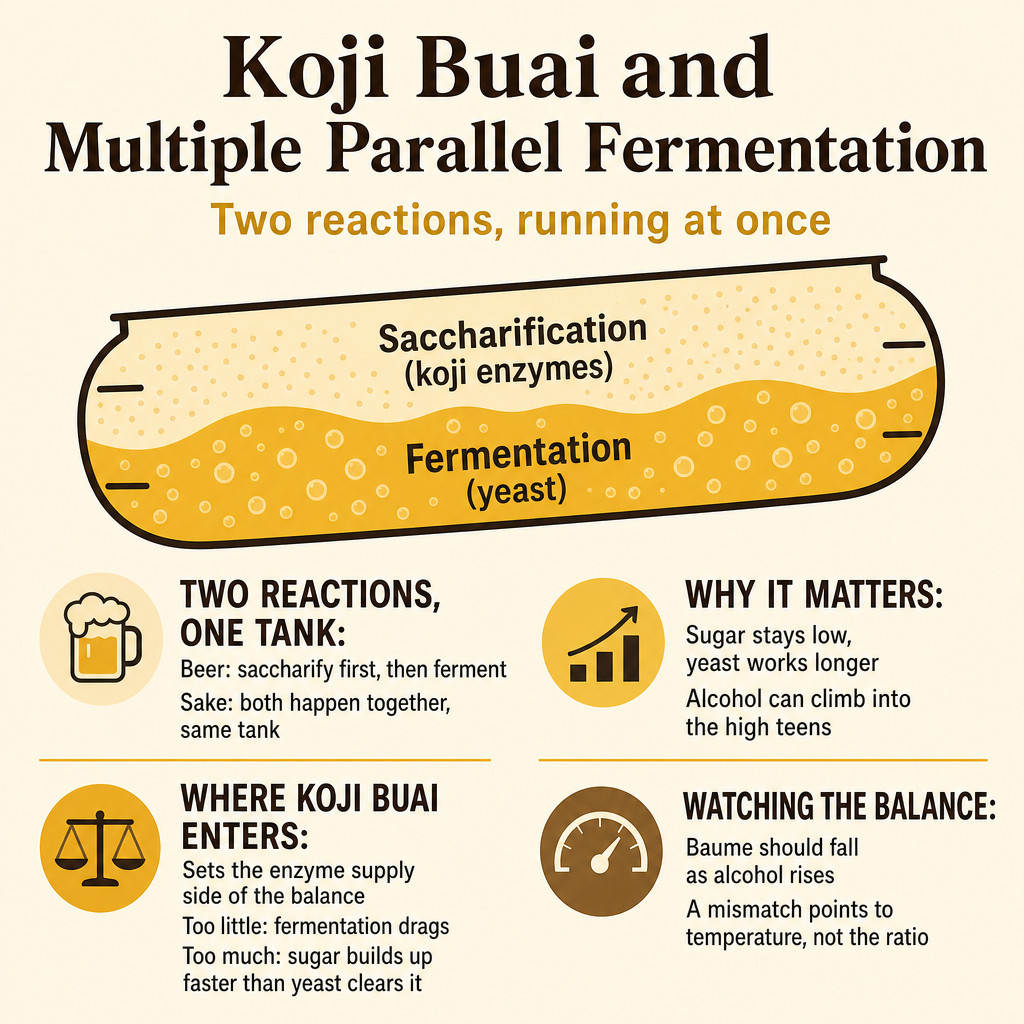
Sake does something unusual, and koji buai sits right at the centre of it.
Two Reactions, One Tank
In beer brewing, saccharification finishes before fermentation begins. Mashing happens in one vessel, then the wort moves to another for yeast to work on.
Sake runs both at once. Research describes it as multiple parallel fermentation: saccharification by the koji fungus and alcoholic fermentation by yeast proceed simultaneously in the same moromi. That overlap is why sake can reach unusually high alcohol for a brewed drink.
Why Simultaneity Changes Everything
Because both reactions run together, sugar never accumulates all at once. The enzymes release glucose gradually, and the yeast consumes it almost as fast. Sugar concentration therefore stays low.
Low sugar means low osmotic stress, so the yeast keeps working far longer than it otherwise could. Alcohol can climb into the high teens before pressing. A single-stage system would stall much earlier.
Where the Ratio Enters
Now the importance of koji buai becomes obvious. It sets the supply side of a two-sided balance.
Too little enzyme and sugar arrives slower than the yeast could use it, so fermentation drags and alcohol may fall short. Too much enzyme and sugar arrives faster than the yeast can clear it, so concentration rises and the mash behaves differently. Brewers spend a lot of effort keeping those two rates close.
The three-stage build helps here. Sandan jikomi adds rice, koji, and water across four days, so enzyme supply and yeast population grow together rather than in one shock. The moto starts that balance days earlier.
When the Balance Breaks
Brewers watch two readings to see whether the two rates have drifted apart. Baume tracks dissolved solids, mostly sugar, and it should fall steadily. Alcohol should rise in step with it.
If Baume stalls while alcohol creeps, conversion has fallen behind. If Baume stays stubbornly high, sugar is arriving faster than the yeast can clear it. Either pattern sends attention back to koji, temperature, and yeast health together.
Neither signal points to koji buai alone, which is worth stressing. The ratio was fixed weeks earlier, so by the time the mash misbehaves, the brewer adjusts temperature instead.
Does More Koji Mean Better Sake?
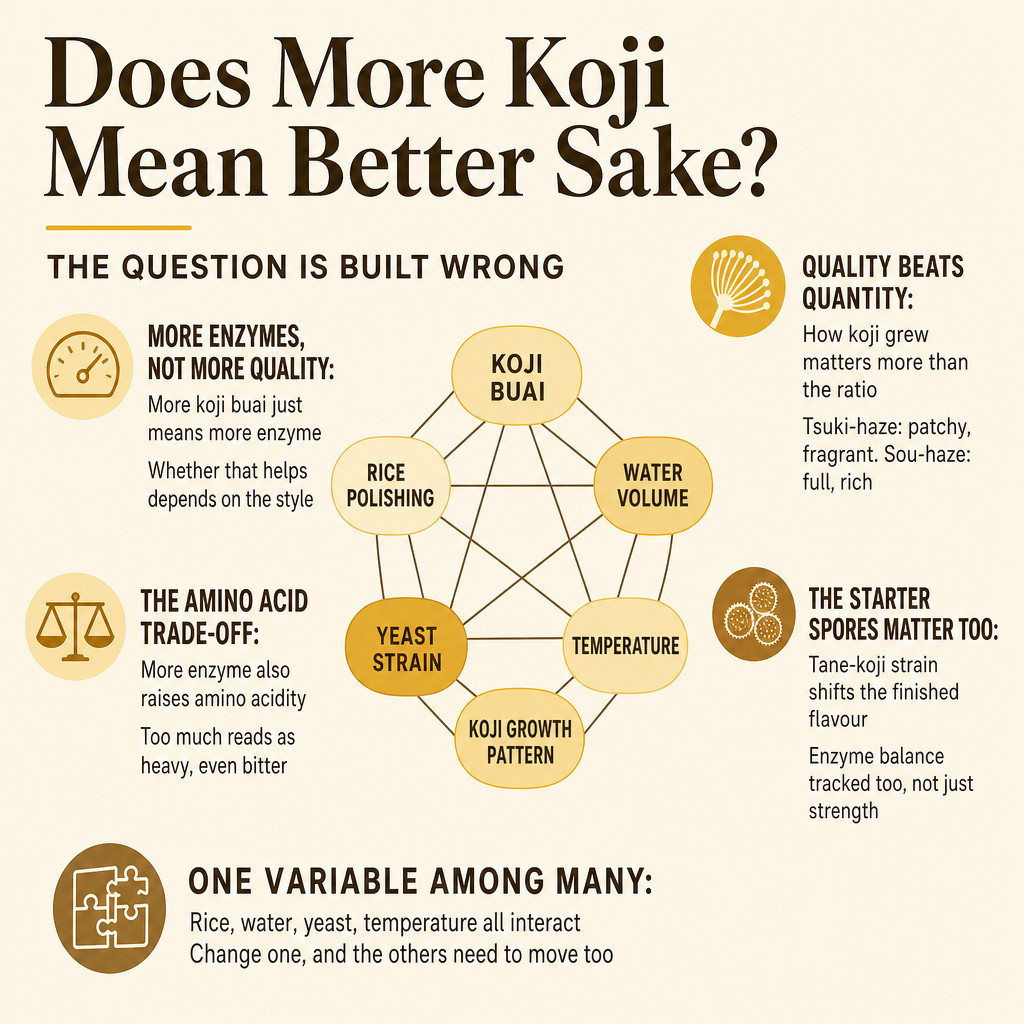
Short answer: no. Longer answer: the question itself is built wrong.
More Enzymes, Not More Quality
Raising the koji buai raises enzyme input. That is the only reliable statement anyone can make about it.
Whether more enzyme improves the sake depends on what the brewer wants. A rich, savoury style may benefit. A delicate aromatic style may suffer, because the extra amino acids blur the fruit. Neither outcome follows from the number alone.
The Amino Acid Trade-off
This is the practical limit that brewers hit first. Koji’s proteases work alongside its amylases, so a generous ratio tends to push amino acidity upward as well as sugar.
Amino acids read as depth and savouriness at moderate levels. Beyond a point they read as heaviness, and sometimes as a coarse or bitter edge on the finish. Where that point sits varies by style, by rice, and frankly by drinker.
Quality Beats Quantity
Ask brewers about this and the conversation usually turns away from the ratio within a minute. What they talk about instead is how the koji grew.
Two patterns get named repeatedly. Tsuki-haze describes patchy surface growth with deeper penetration at points, and it suits clean fragrant styles. Sou-haze describes fuller coverage, and it pushes richness. Research on rice koji supports the underlying idea, reporting that the extent of mycelial penetration correlates with digestibility.
Two tanks running the same koji buai can behave nothing alike. The number tells you how much rice went into the koji room. It cannot tell you what came out.
The Starter Spores Matter Too
Breweries do not gather wild mould. They buy tane-koji, a prepared spore starter, from specialist producers that have bred strains for centuries.
Strain choice measurably changes the result. A 2020 study brewed small test batches using three rice cultivars and three different koji starters, then compared the metabolites. The starter alone shifted the profile of the finished sake.
Brewers also watch the balance between enzymes rather than their total strength. The ratio of glucoamylase to alpha-amylase gets tracked as its own figure, alongside acid carboxypeptidase for protein breakdown. Two koji lots can carry similar overall activity with very different balances.
One Variable Among Many
Koji buai interacts with at least six other decisions. Rice polishing changes what the mould can reach. Water volume changes sugar concentration. Yeast strain changes appetite and aroma. Temperature changes every reaction rate in the tank.
Change one and the sensible setting for the others moves too. Treating the ratio as an independent quality score therefore misses how brewing actually works.
Koji Buai and Sake Style
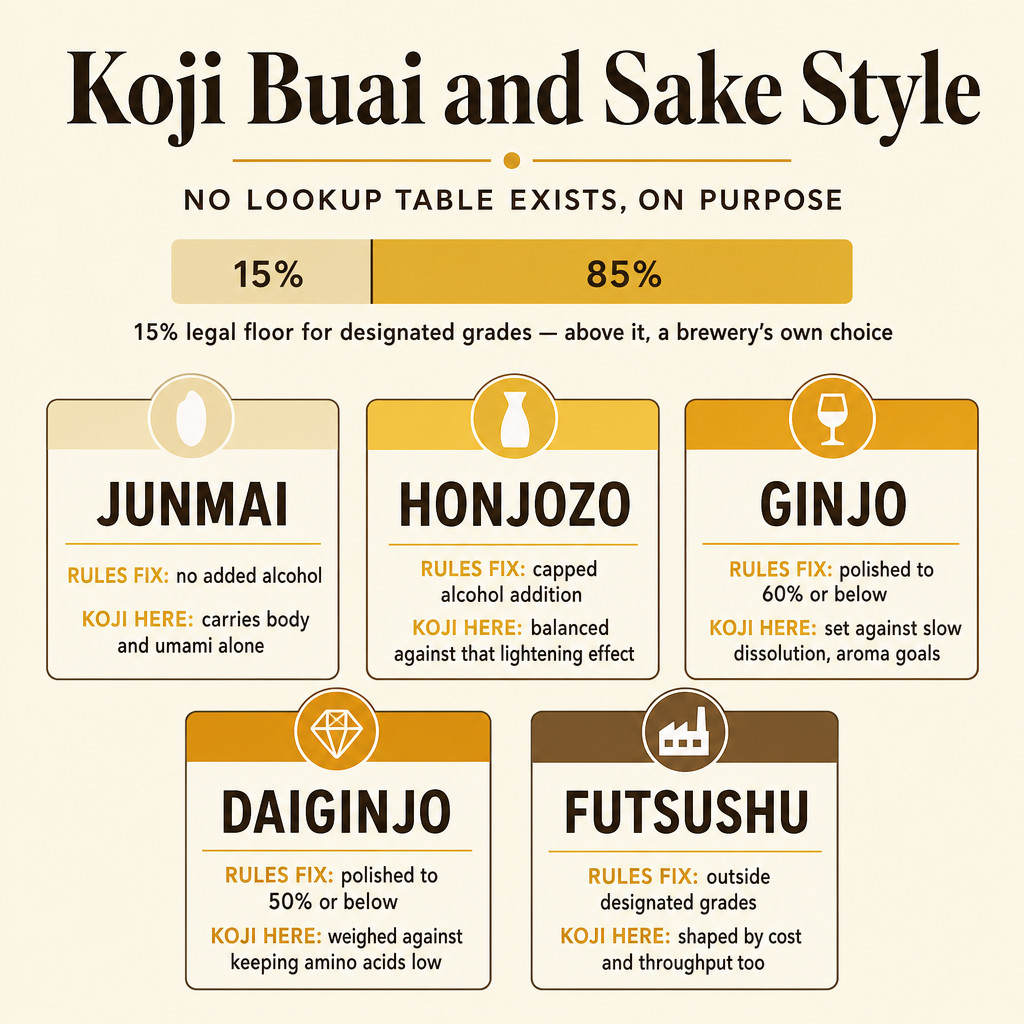
Readers usually arrive wanting a lookup table. Junmai uses this much, daiginjo uses that much. Unfortunately no such table exists, and publishing one would be misleading.
What the Categories Actually Regulate
Japan’s sake categories control specific things, and koji buai is one of them, though only as a floor. Specially designated grades require at least 15 percent koji rice.
Beyond that floor, the categories say nothing. They regulate polishing ratio and whether distilled alcohol may be added. Where a brewery sits above 15 percent is its own business, and it does not appear on the label.
Junmai and Honjozo
Junmai uses only rice, koji, water, and yeast. Without added alcohol, all the body has to come from the fermentation itself, so koji carries real weight in the design.
Honjozo adds a small measured amount of distilled alcohol before pressing, which lightens the texture and sharpens the finish. That changes the calculation, though not in a fixed direction. Some brewers keep koji generous to hold the middle together, while others pull back.
Ginjo and Daiginjo
A common assumption says ginjo uses more koji. It is not reliably true, and the reasoning behind it is worth unpacking.
Highly polished rice dissolves reluctantly in a cold mash, so some brewers do keep koji generous simply to guarantee conversion. Others prioritise a low amino acid load, since daiginjo aroma sits more clearly against a lean background. Both approaches exist, and both produce excellent sake.
Futsushu
Ordinary sake sits outside the specially designated grades, so the 15 percent floor does not apply to it. Production economics matter more here, since koji making is the most labour-intensive step in the brewery.
That does not make futsushu badly made by definition. Plenty of everyday sake is competent, honest drinking. It simply gets designed against a different set of constraints.
| Style | What the rules fix | What koji buai does here |
|---|---|---|
| Junmai | No added alcohol | Carries body and umami without other support |
| Honjozo | Capped alcohol addition | Balanced against the lightening effect of that addition |
| Ginjo | Polishing to 60 percent or below | Set against slow dissolution and aroma goals |
| Daiginjo | Polishing to 50 percent or below | Weighed against keeping amino acids low |
| Futsushu | Outside the designated grades | Shaped by cost and throughput as well as flavour |
Notice the middle column does the regulating. The right column is judgement, and it stays private.
Where the Effect Becomes Visible
Two styles make koji’s contribution unusually easy to notice. Genshu skips the dilution step, so everything the mash produced arrives undiluted, amino acids included.
Nigori keeps rice solids in suspension, which adds texture on top of the dissolved compounds. Neither style reveals the actual ratio, of course. They simply remove some of the things that usually mask it.
What Does Koji Buai Taste Like?
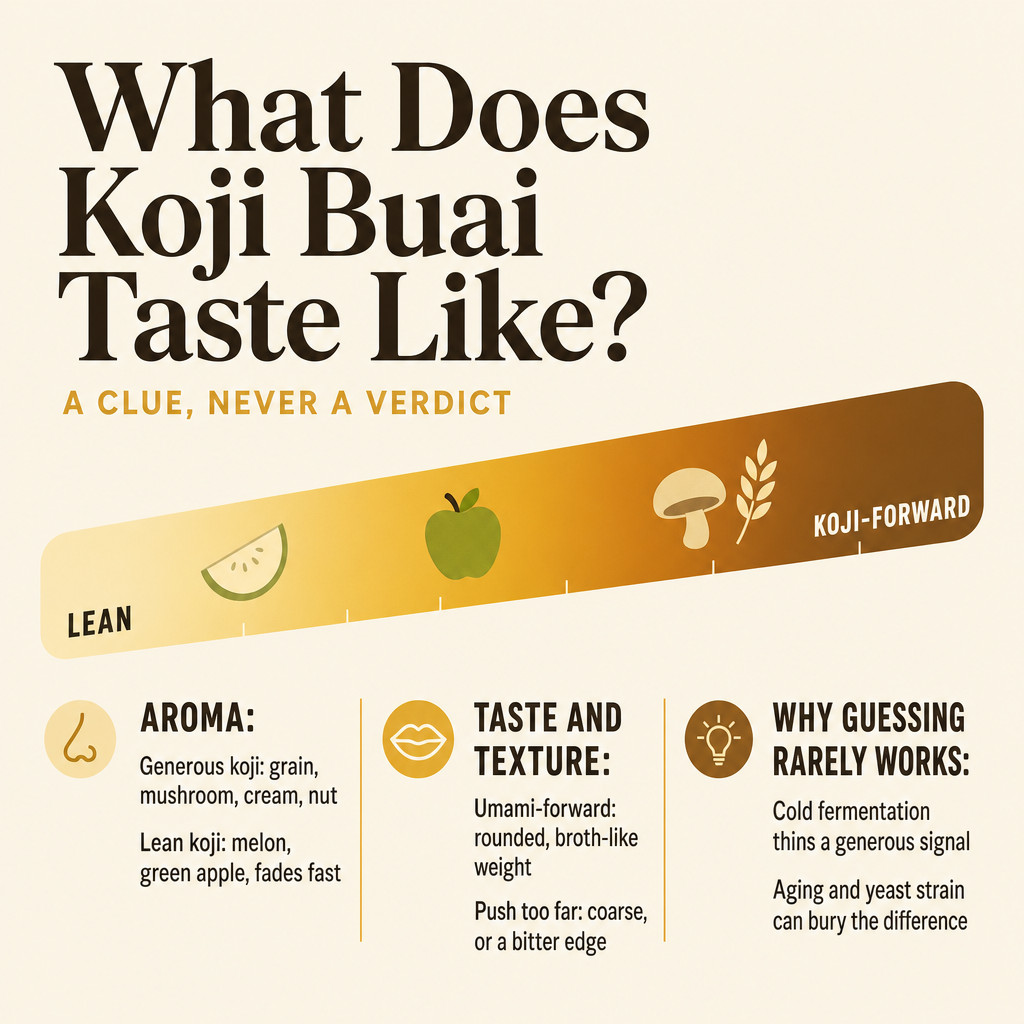
Nobody tastes a percentage, and claims to the contrary should be treated carefully. Still, certain impressions recur often enough to be worth describing. What follows is personal, so read it as orientation rather than fact.
Aroma
Sake built on generous koji often smells of the brewery rather than of fruit. Steamed grain, faint mushroom, a hint of cream or nut. The aroma tends to stay low in the glass and open slowly as the liquid warms.
Leaner designs behave the opposite way. Melon and green apple arrive quickly, then fade. That contrast has less to do with the ratio than with the amino acid background it creates.
Taste and Texture
Umami is where the effect shows most clearly. A koji-forward sake carries a rounded, almost broth-like weight through the middle of the palate, and it holds there. Warming the sake usually amplifies it.
Push further and something else appears. The finish can turn slightly coarse, or pick up a bitter edge that was not there at first sip. Where that threshold sits differs by drinker, which makes the whole subject harder to write about than it looks.
Why Guessing Rarely Works
I would not trust anyone to name a koji buai from a glass, including myself. Too many other things move the same signals.
A cold, slow fermentation thins the impression of a generous ratio. Aging thickens the impression of a lean one. Yeast strain shifts aroma so strongly that it can bury the difference entirely. So texture is a clue, never a verdict.
Koji Buai and Rice Polishing
These two ratios get chosen together, always. Polishing decides what the mould has to work with.
What Milling Removes
Rice polishing strips the outer layers of the grain, where protein and lipids concentrate. Imaging research at Tsukuba and the National Research Institute of Brewing compared koji grown on rice milled to 50 percent and to 90 percent. The hyphae reached deeper into the more heavily polished grain.
Less protein means fewer amino acids downstream. Less lipid means less interference with aroma. Deeper penetration also matters, since the hyphae carry the amylases that digest starch. That combination is the logic behind heavy milling for premium styles.
Shimpaku and Mould Growth
Good sake rice carries a shimpaku, an opaque starchy core at the centre of the grain. Its loose structure lets hyphae travel inward more readily than dense eating rice allows.
Because of that, brewers usually reserve their best sake rice for koji making even when everyday rice fills the kake-mai role. Industry references describe this preference plainly.
Why the Ratios Move Together
Heavily polished grain absorbs water quickly and dissolves slowly in the tank. Conversion therefore takes more coaxing, not less.
So a brewer milling to 40 percent may hold koji fairly generous, despite the style being delicate. Assuming that high polish always pairs with less of everything would be a mistake, and a fairly common one.
Koji Buai and Kumimizu Buai
Rice, koji, and water form a triangle. Move one corner and the shape changes.
What the Water Ratio Measures
Kumimizu buai (汲水歩合) compares brewing water in litres to total rice in kilograms. Published references put the standard range at 125 to 135 percent, with ginjo styles able to exceed 140 percent.
The ratio sets concentration inside the tank. More water thins the mash and eases pressure on the yeast, while less water concentrates everything.
How the Two Interact
Think of koji buai as the rate of sugar production and kumimizu buai as the volume it dissolves into. Generous koji in a thin mash and generous koji in a dense mash produce very different environments.
In the first case, sugar spreads out and the yeast keeps pace comfortably. In the second, concentration climbs and fermentation behaves differently. So neither ratio predicts much on its own, which is the point worth remembering.
A useful habit: whenever you see a koji figure quoted without a water figure beside it, treat the claim as incomplete. The same applies in reverse.
Koji Buai and Shikomi Haigo
Zoom out one level and koji buai stops being a standalone number. It becomes a line item.
The Recipe and the Line Item
Shikomi haigo (仕込配合) is the complete brewing recipe for a batch. It states the weight of steamed rice, the weight of koji rice, the volume of water, and the size of the starter, then splits all of it across the mash stages.
Koji buai is one row of that document. So is the water ratio, and so is the starter ratio. Reading any single row in isolation gives you a fragment of the design.
Distribution Across the Stages
The recipe does something the summary ratio cannot. It says where the koji goes.
Early additions usually carry proportionally more koji, because enzyme activity has to lead yeast growth rather than follow it. By the final addition the mash is large, so the same percentage represents a much bigger weight. Brewers plan that curve deliberately.
Where the Public Record Stops
Published standards cover the batch totals and little else. Per-stage koji weights for a named brand do not appear anywhere, since breweries treat their recipes as confidential.
This guide therefore reports what industry references publish and stops there. Estimating a brewery’s internal split would be guesswork dressed as fact.
Traditional Versus Modern Koji Production
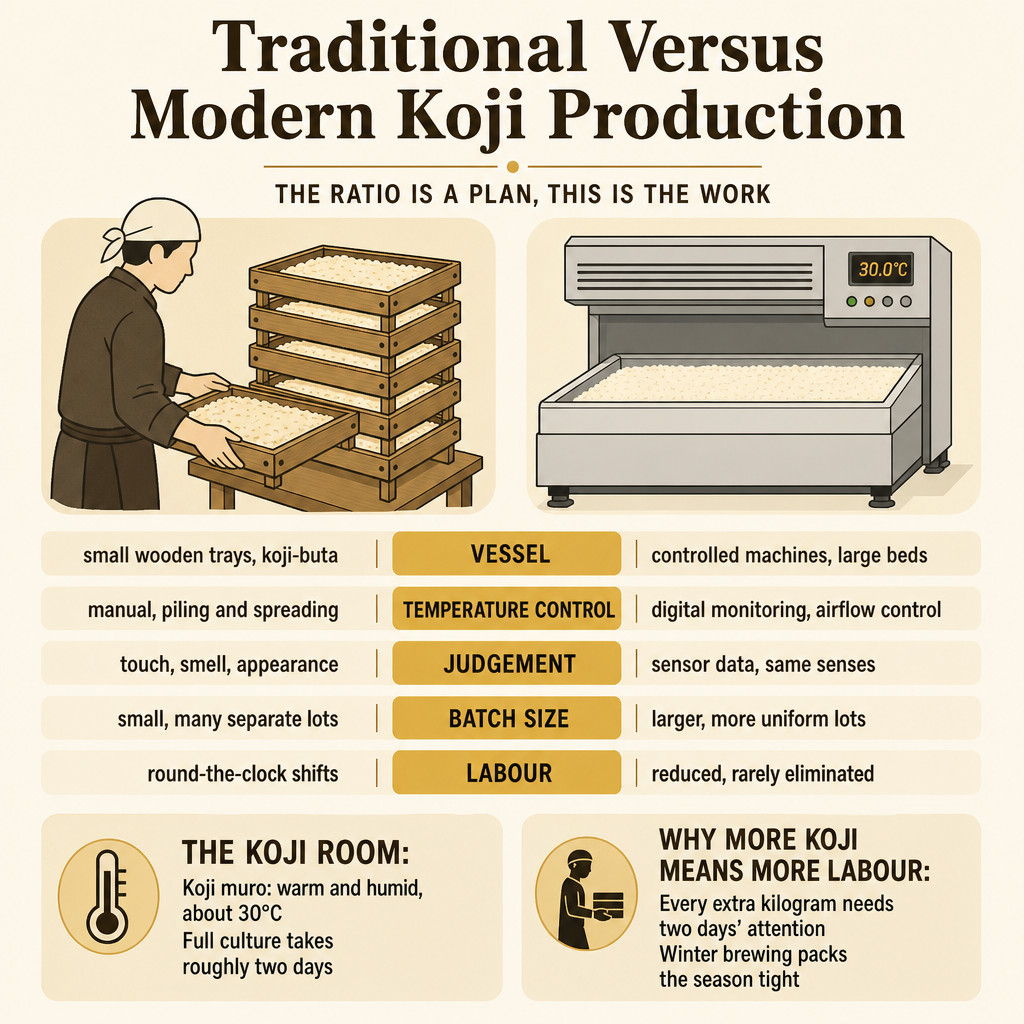
The ratio is a plan. Making the koji is the work, and that work has changed a great deal.
| Traditional | Modern | |
|---|---|---|
| Vessel | Small wooden trays, koji-buta | Controlled machines and large beds |
| Temperature control | Manual, by piling and spreading | Digital monitoring and airflow control |
| Judgement | Touch, smell, and appearance | Sensor data supporting the same senses |
| Batch size | Small, many separate lots | Larger, more uniform lots |
| Labour | Round-the-clock shifts | Reduced, though rarely eliminated |
The Koji Room
Koji making happens in a dedicated room called the koji muro (麹室). It stays warm and humid, typically somewhere around 30 degrees Celsius with very high moisture, and it is usually the most tightly controlled space in the brewery.
The whole culture takes roughly two days. During that window the team spreads, mixes, and piles the rice at set intervals to manage heat and moisture. Steps such as toko-momi, kiri-kaeshi, and mori all belong to this sequence.
Wooden Trays and Their Logic
Koji-buta are shallow wooden boxes, each holding a small amount of rice. Splitting a batch across many trays gives fine control, since each box can be moved, stacked, or opened independently.
The cost is obvious. Someone has to handle every tray, repeatedly, through the night. Many breweries reserve the method for their top lots and use machines for the rest, which strikes me as a reasonable compromise rather than a betrayal.
What Machines Changed
Automatic koji equipment regulates temperature and airflow continuously, which reduces variation between lots. It also makes a larger koji buai practical at scale, since the labour ceiling rises.
What machines do not replace is judgement about when to intervene. The toji still decides, and the kurabito still check by hand.
Why the Ratio Has a Labour Cost
Here is a practical point that rarely appears in tasting notes. Raising koji buai raises workload, not just enzyme supply.
Every extra kilogram of koji rice needs steaming, inoculating, and two days of attention in a warm room. In a small kura, that time comes out of a very short staff roster. So the ratio a brewery can sustain depends partly on how many hands it has.
Winter brewing concentrates the problem further. The season of kan-zukuri packs the whole year’s production into a few months, so koji making runs almost continuously.
Regional Approaches and Brewing Philosophy
Regions developed different habits, mostly because their water and climate gave them different problems. None of them can be reduced to a fixed percentage, and claims that they can should be treated with suspicion.
Hiroshima
Hiroshima had soft, mineral-poor water, and fermentation there kept stalling in the nineteenth century. Miura Senzaburo is widely credited with solving the problem, and his soft-water brewing method appeared in print in 1898.
Reworking koji making sat at the heart of that method. When the water cannot drive fermentation, the enzymes have to.
Nada and Fushimi
Nada in Hyogo brews with mineral-rich miyamizu, which drives vigorous fermentation on its own. Industry references note that brewers there favour shimpaku rice for koji making.
Fushimi in Kyoto works with much softer groundwater, so fermentation proceeds gently. Local cooking rewards sake that supports rather than dominates, and the brewing designs follow that expectation.
Niigata and Akita
Niigata pairs soft water and heavy snow with a long, cold fermentation tradition. Its light, dry house style became influential nationwide.
Akita has the winters for extended low-temperature mashes as well, though the regional signature tends to keep a fuller centre. Whether that comes from koji, rice, yeast, or all three is not something an outsider can settle.
A caution: these are historical tendencies, not present-day rules, and they say nothing about any specific brewery’s koji buai. Plenty of houses now brew against their regional stereotype on purpose.
Common Misconceptions
- More koji always means better sake. It means more enzymes. Whether that helps depends on the target style, and past a point it adds heaviness rather than depth.
- Koji buai measures the amount of koji mould. No. It measures the weight of rice made into koji. The mould itself goes in as a small quantity of spores.
- Koji buai alone determines sweetness. Sweetness reflects what sugar survives fermentation. Yeast, temperature, water, and pressing timing all shape that outcome.
- Ginjo always uses more koji. Some brewers raise it to handle slow-dissolving polished rice. Others hold it back to keep amino acids low. Both approaches exist.
- The ratio matters more than koji quality. Most brewers would say the reverse. How the culture grew decides what the enzymes can actually do.
- You can look up a brewery’s koji buai. Almost never. Published figures describe the industry, not individual houses, and labels do not carry the number.
Koji Buai and Brewing Data
A ratio only becomes useful once someone measures what it produced. That loop is how breweries learn.
What Gets Recorded
A working tank generates numbers daily. Rice and koji weights come first, then water volume, then temperature at every stage.
Once fermentation starts, the log fills with Baume readings, alcohol, acidity, amino acidity, and glucose. Nihonshu-do, the sake meter value, gets tracked toward the end. After pressing comes the lees ratio, comparing sake kasu to the rice used.
Reading the Chain Backwards
The useful move is to work in reverse. Amino acidity higher than intended points toward protein breakdown, which sends attention back to koji and to the rice. Slow early fermentation points toward enzyme supply or yeast health.
None of these signals proves a cause on its own. Still, across many batches, patterns emerge that a single season would never reveal.
The Limits of Numbers
Analysis narrows the field without settling it. Two tanks can post nearly identical readings and still taste different in ways drinkers notice at once.
So tasting panels have not gone anywhere, and I suspect they will not. The data says what happened. A person still has to say whether it was any good.
Final Thoughts
Koji buai looks like a trivia figure until you follow what it controls. Then it turns into one of the more consequential decisions in the brewery.
The ratio governs enzyme supply, and enzyme supply governs the balance between saccharification and fermentation. That balance is the engine of sake. Set it well and the mash runs steadily for weeks. Set it poorly and no amount of care downstream will fix things.
What the number cannot do is stand alone. It says nothing about how the koji grew, how much water dissolves the sugar, or how cold the tank runs. Quoting it without that context is a bit like quoting a recipe’s flour weight and calling it the loaf.
If you want to keep going, three routes help. Our koji guide covers how the culture is grown, our rice polishing guide explains what the mould has to work with, and our moromi guide shows the whole system running.
Koji Buai FAQ
What is koji buai?
Koji buai is the percentage of a batch’s total rice that gets made into koji, with the rest going into the mash as steamed rice. Brewers fix the figure before brewing starts. It governs how much enzyme power enters the tank, and therefore how quickly starch turns into fermentable sugar.
How is koji buai calculated?
Divide the koji rice weight by the total rice weight, then multiply by 100. A batch using 1,000 kilograms of rice with 200 kilograms made into koji gives 20 percent. The calculation uses polished white rice weight, not brown rice.
What percentage of sake rice becomes koji?
Published industry references put it at roughly 20 to 23 percent of all rice used. Japan’s labelling standards set a legal floor of 15 percent for specially designated grades. Individual breweries do not disclose their own figures.
Does more koji make sake sweeter?
Not reliably. More koji speeds sugar production, yet the yeast may simply ferment that sugar away. Final sweetness depends on yeast activity, temperature, and when brewers stop fermentation. The clearer effect of extra koji shows in umami and body.
Does koji buai affect alcohol production?
Indirectly, yes. Koji enzymes release the glucose that yeast converts into alcohol, so enzyme supply sets the pace. Too little slows fermentation, and too much can overwhelm the yeast. Water volume and temperature shape the outcome just as much.
Does koji buai affect aroma?
It contributes, though it does not control aroma. Generous koji raises amino acids, which can mask delicate fruity notes. Yeast strain and fermentation temperature drive ester production far more directly. Brewers balance all three together.
Is koji buai the same as the amount of koji mould?
No, and this is the most common misunderstanding. Koji buai measures rice weight, not fungal quantity. Breweries apply the mould as spores in very small amounts. How far it grows into the grain is a separate matter entirely.
How does koji buai relate to rice polishing?
Polishing decides what the mould can reach. Milling removes protein and lipids from the outer grain, and it exposes the starchy core. Heavily polished rice also dissolves slowly, so some brewers keep koji generous to compensate.
How does koji buai relate to kumimizu buai?
Koji buai sets how fast sugar appears, while the water ratio sets what it dissolves into. Generous koji in a thin mash behaves nothing like generous koji in a dense one. Neither figure predicts much on its own.
Does every brewery use the same koji buai, and does ginjo differ?
No, and there is no fixed rule for ginjo either. Figures differ between breweries, between brands inside one brewery, and by year. Some brewers raise the ratio because heavily polished rice dissolves reluctantly, while others hold it back to keep amino acids low. Grade rules specify nothing above the 15 percent floor.
Can I find a brewery’s koji buai anywhere?
Almost never. Japanese labelling rules require the polishing ratio but not the koji ratio, and breweries treat their formulas as internal information. Published figures such as 20 to 23 percent come from industry bodies and describe general practice. Asking directly on a brewery tour is the only reliable route.
References
- Society for Nada Sake Research, Sake Glossary, Kojimai, kake-mai and shubomai, https://www.nada-ken.com/main/en/index_k/64.html (Surveyed: August 2026)
- Society for Nada Sake Research, Sake Glossary, Kumi-mizu-buai (water ratio), https://www.nada-ken.com/main/en/index_k/461.html (Surveyed: August 2026)
- Society for Nada Sake Research, Sake Glossary, Sandan shikomi and shikomi, https://www.nada-ken.com/main/en/index_s/210.html (Surveyed: August 2026)
- National Research Institute of Brewing, A Comprehensive Guide to Japanese Sake (English), https://www.nrib.go.jp/English/sake/pdf/guidesse01.pdf (Surveyed: August 2026)
- National Research Institute of Brewing, About Sake etc., https://www.nrib.go.jp/English/sake/sakeinfo.html (Surveyed: August 2026)
- Japan Sake and Shochu Makers Association, Sake information in English, https://japansake.or.jp/sake/en/ (Surveyed: August 2026)
- Japan Sake and Shochu Makers Association, How to Read Sake Bottle Labels, https://japansake.or.jp/sake/en/basic/how-to-read-sake-bottle-labels/ (Surveyed: August 2026)
- Tanaka, M., & Gomi, K. (2021). Induction and repression of hydrolase genes in Aspergillus oryzae. Frontiers in Microbiology, 12, 677603, https://pmc.ncbi.nlm.nih.gov/articles/PMC8180590/ (Surveyed: August 2026)
- Yasui, M., Oda, K., Masuo, S., Hosoda, S., Katayama, T., Maruyama, J., Takaya, N., & Takeshita, N. (2020). Invasive growth of Aspergillus oryzae in rice koji and increase of nuclear number. Fungal Biology and Biotechnology, 7, 8, https://www.ncbi.nlm.nih.gov/pmc/articles/PMC7275602/ (Surveyed: August 2026)
- Zhang, K., Wu, W., & Yan, Q. (2020). Research advances on sake rice, koji, and sake yeast: A review. Food Science & Nutrition, 8(7), 2995 to 3003, https://pmc.ncbi.nlm.nih.gov/articles/PMC7382144 (Surveyed: August 2026)
- Ichikawa, E., Hirata, S., Hata, Y., Yazawa, H., Tamura, H., Kaneoke, M., Iwashita, K., & Hirata, D. (2020). Effect of koji starter on metabolites in Japanese alcoholic beverage sake made from the sake rice Koshitanrei. Bioscience, Biotechnology, and Biochemistry, 84(8), 1714 to 1723, https://academic.oup.com/bbb/article/84/8/1714/5955602 (Surveyed: August 2026)
- Higuchi, Y., & Kitamoto, K. (2021). Traditional and latest researches on Aspergillus oryzae and related koji molds. Journal of Fungi, 7(12), 1075, https://www.ncbi.nlm.nih.gov/pmc/articles/PMC8703801/ (Surveyed: August 2026)
- Nishida, H. (2021). Sake brewing and bacteria inhabiting sake breweries. Frontiers in Microbiology, 12, 602380, https://www.ncbi.nlm.nih.gov/pmc/articles/PMC7970033/ (Surveyed: August 2026)
Related Articles
- Koji (麹): The Heart of Japanese Brewing (Surveyed: August 2026)
- Sake Rice (酒米): The Foundation of Premium Sake (Surveyed: August 2026)
- Rice Polishing (精米歩合) (Surveyed: August 2026)
- Yeast (酵母) in Sake Brewing (Surveyed: August 2026)
- Fermentation (発酵) in Sake Brewing (Surveyed: August 2026)
- Moto (酒母): The Yeast Starter of Sake (Surveyed: August 2026)
- Moromi (醪): The Main Fermentation Mash (Surveyed: August 2026)
- Sandan Jikomi: Sake’s Three-Step Mashing Method (Surveyed: August 2026)
- Water in Sake Brewing: Miyamizu and Minerals (Surveyed: August 2026)
- Toji (杜氏): The Master Brewer Behind Every Bottle of Sake (Surveyed: August 2026)
- How Sake Is Made: Step-by-Step Japanese Brewing Guide (Surveyed: August 2026)
- Types of Japanese Sake: Junmai, Ginjo and Daiginjo Guide (Surveyed: August 2026)




Comments