



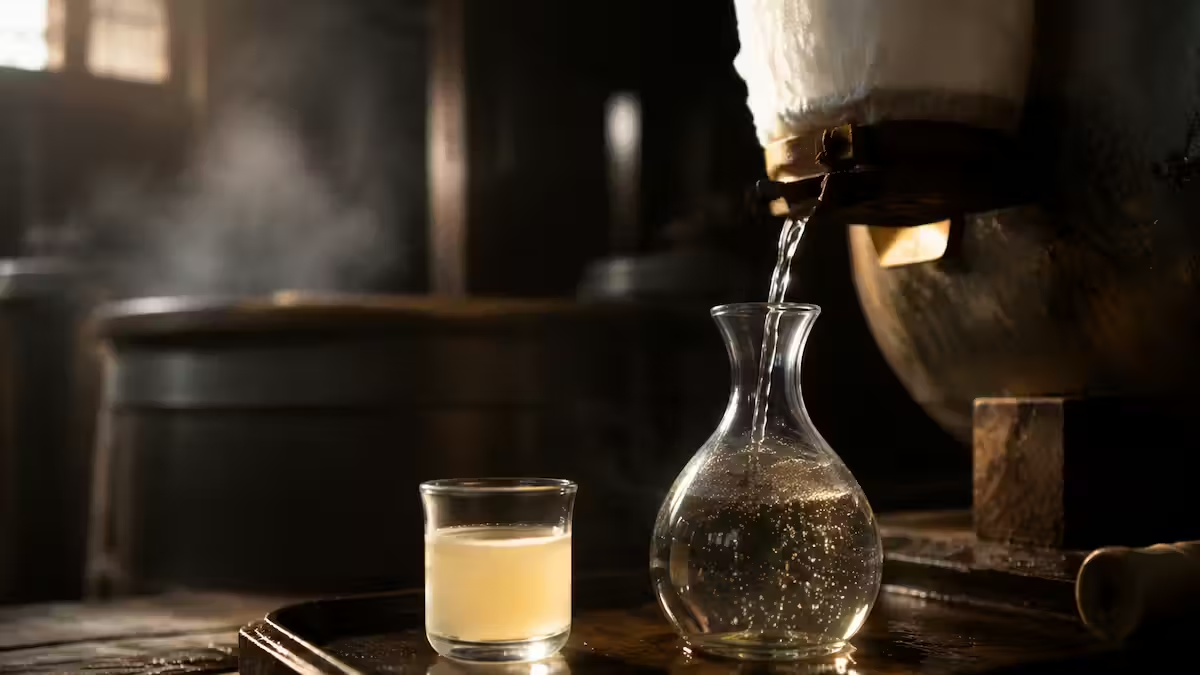
Freshly pressed sake is not quite finished. It looks a little cloudy and pale. A faint yellow or green tint often lingers. Filtration in sake brewing is the step that turns that hazy liquid into clear sake. So one more refining stage usually follows the press.
This stage is called filtration. In Japanese, it is known as roka. So what is filtration in sake brewing? It is the step that refines the pressed liquid. Brewers remove fine particles and adjust the sake.
Filtration comes right after pressing. Yet the two steps are quite different. Pressing separates the liquid from the solids. Filtration then refines that liquid further. So each step has its own clear job. For the step before this, see our pressing guide.
This stage does more than clean the sake. It can lighten the color noticeably. The step can also soften certain aromas and flavors. On top of that, it helps the sake stay stable. So filtration is both technical and stylistic.
Not every sake goes through the same treatment, though. Some brewers filter heavily for a clean profile. Others filter lightly to keep rich character. Meanwhile, a few skip charcoal filtering entirely. So the choice reflects the brewery’s vision.
Filtration is easy to misunderstand at first. Many assume it simply makes sake clear. In truth, it shapes aroma, color, and balance too. So this guide explores the whole picture. Let me walk you through this quiet, vital stage.
Quick Facts About Filtration
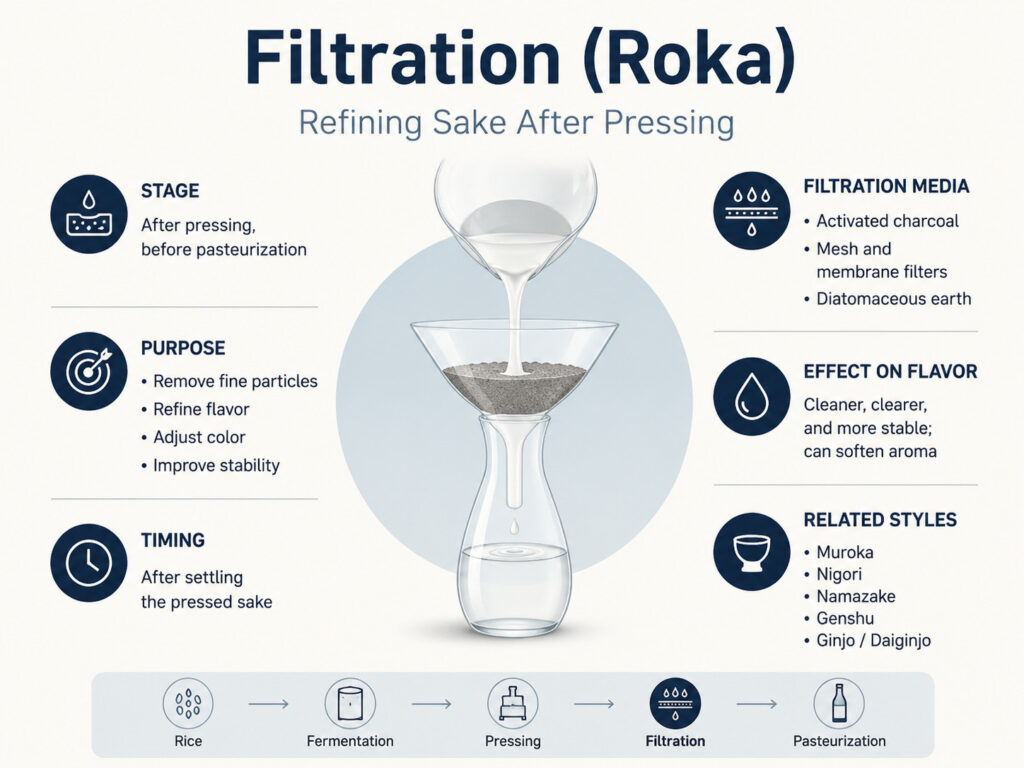
Here is a quick snapshot before the details begin.
| Japanese Name | 濾過 (roka) |
| Brewing Stage | After pressing, before pasteurization |
| Primary Purpose | Remove fine particles, refine flavor, adjust color, improve stability |
| Typical Timing | After settling the pressed sake |
| Common Filtration Media | Activated charcoal, mesh and membrane filters, diatomaceous earth |
| Effect on Flavor | Cleaner, clearer, and more stable; can soften aroma |
| Related Sake Styles | Muroka, nigori, namazake, genshu, ginjo, daiginjo |
What Is Filtration in Sake Brewing?
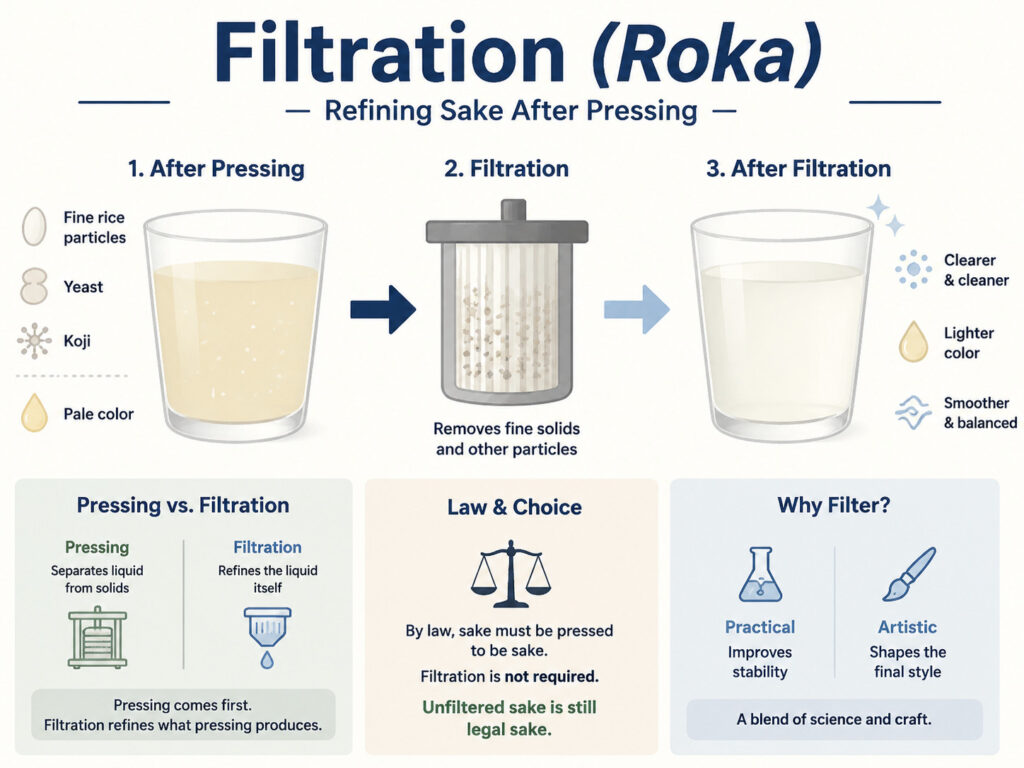
Filtration in sake brewing is the stage that refines pressed sake. Brewers pass the liquid through a filter. This removes fine solids and other particles. It can also adjust color, aroma, and taste. So the sake grows cleaner and more polished.
To understand it, picture the sake after pressing. The young liquid still looks slightly cloudy. Fine bits of rice, yeast, and koji remain. A pale yellow or greenish tint lingers too. So the sake is not yet fully refined.
Filtration addresses all of these traits at once. It clears the tiny suspended particles. The process can also lighten the natural color. Beyond that, it smooths out rough edges. So the result feels cleaner and more balanced.
Here lies the key difference from pressing. Pressing separates the sake from the solid mash. It answers the question of liquid versus solid. Filtration works only on the liquid itself. So it refines what pressing has already produced. For the fermentation background, see our moromi guide.
There is also a legal nuance worth knowing. By law, sake must be pressed to qualify as sake. That legal step is the pressing, not the filtering. So filtration is not a legal requirement. It is an optional refining choice instead.
This is why unfiltered sake can still be legal sake. It has been pressed, as the law requires. It simply skips the later filtering step. So the label may proudly say muroka. We will explore that term in depth later.
Brewers filter for both practical and artistic reasons. On the practical side, it improves stability. On the artistic side, it shapes the final style. So the step blends science and craft. Every choice reflects the sake the brewer wants.
Why Filtration in Sake Brewing Matters
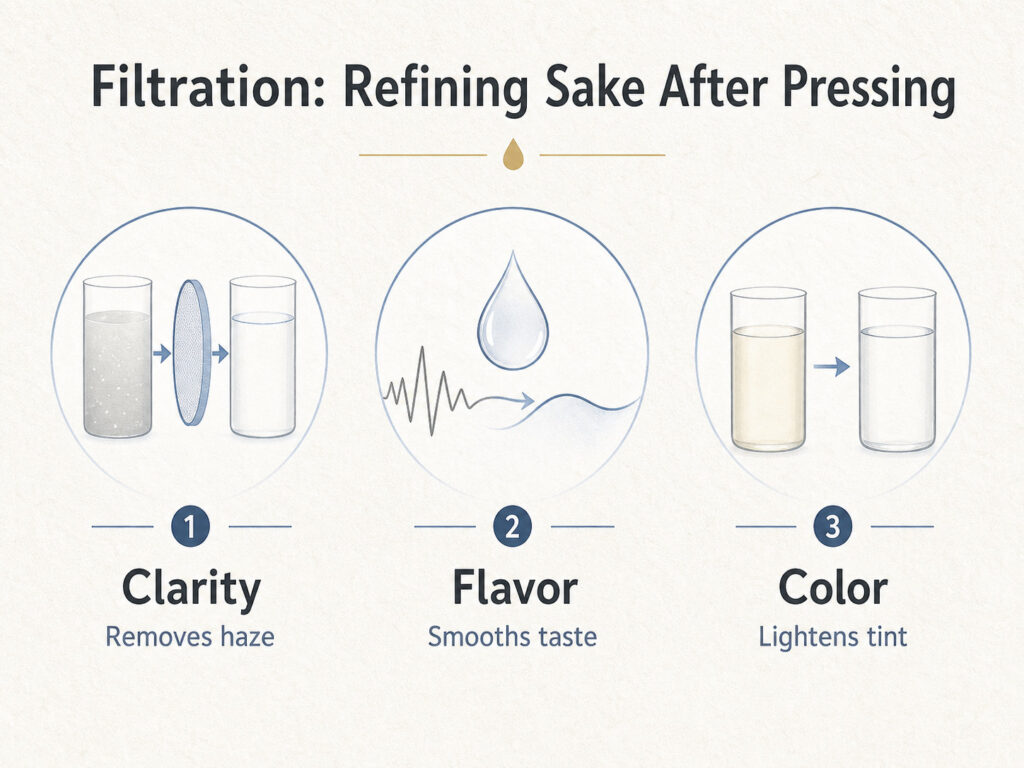
Why does filtration in sake brewing matter at all? The reasons range from clarity to stability. Each one serves the finished product. So let us look at them one by one.
The first reason is visual clarity. Freshly pressed sake often looks hazy. Fine particles cloud the young liquid. Filtration removes them for a clearer look. So the sake gains a bright, polished appearance.
Many drinkers have long preferred clear sake. A transparent glass looks clean and refined. Cloudiness once suggested a rougher product. So brewers filtered to meet this expectation. Clarity became a mark of careful work.
The second reason is flavor adjustment. Young sake can carry harsh or off notes. Some of these come from tiny impurities. Filtration can gently reduce them. So the flavor feels smoother and more even.
The third reason is color control. Fresh sake often shows a faint tint. That pale yellow or green can deepen over time. Charcoal filtering can lighten it toward clear. So brewers use it to fine-tune appearance.
Stability and Style
The fourth reason is stability. This one matters enormously for storage. Sake contains enzymes and stray microbes. These can slowly spoil the flavor. So filtration removes many of them, protecting quality.
Stability is often the deepest motive of all. Sake faces heat, light, and time on its journey. Any of these can degrade the flavor. Filtration guards against unwanted change. So it helps the sake reach drinkers in good shape.
The fifth reason is style itself. Filtration lets a brewer shape character. A clean, light sake needs careful filtering. A rich, full sake needs a gentler touch. So the method becomes a creative tool.
It helps to remember one balancing truth. Filtration removes both good and bad elements. It can strip harshness, yet also soften aromas. So brewers must weigh every choice. Too much filtering can thin the flavor.
This tension sits at the heart of the craft. Brewers chase clarity without losing soul. They protect stability without erasing character. So filtration demands real skill and judgment. It is never a simple on-off switch.
How Filtration in Sake Brewing Works
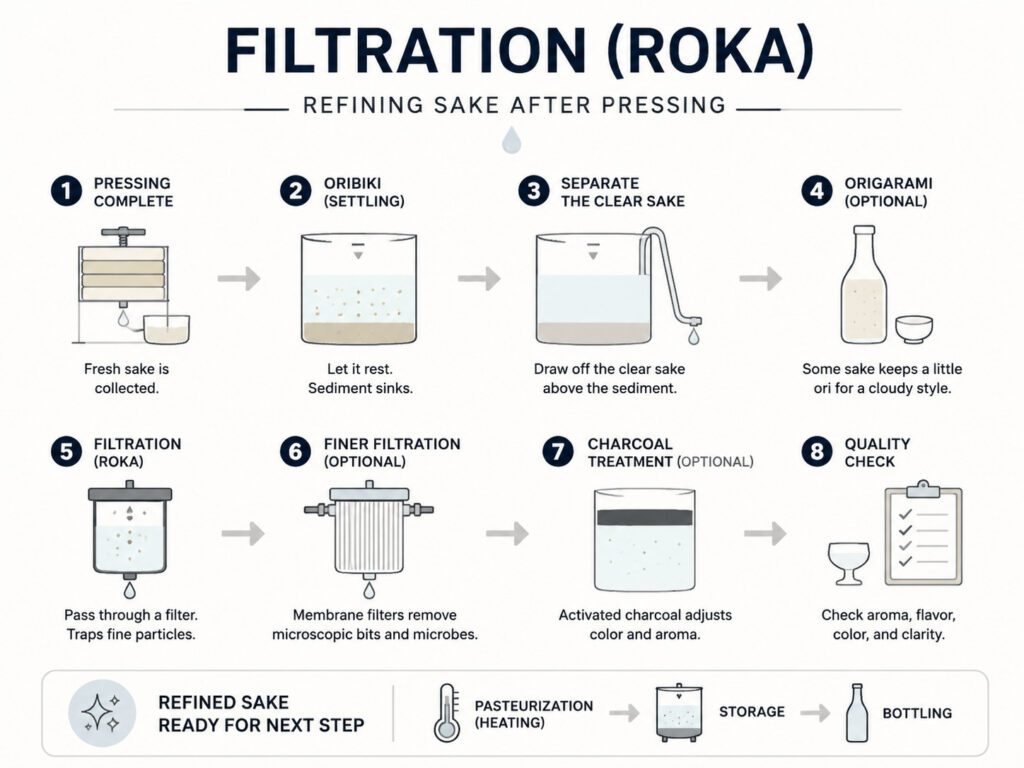
Let us follow filtration in sake brewing step by step. The process begins right after pressing. The young sake moves into a holding tank. So the real refining can start there.
First comes a resting period in many cases. The freshly pressed sake still holds fine solids. Left alone, these slowly sink to the bottom. This natural settling is called oribiki. So gravity does much of the early work.
The settled sediment is known as ori. It gathers as a soft layer below. Brewers carefully draw off the clear sake above. So they separate the bright liquid from the lees. This step alone clarifies the sake noticeably.
Some sake is bottled with a little ori left in. This cloudy style is called origarami. It looks faintly hazy and tastes fresh. So not every brewer removes all the sediment. The choice again depends on the desired style.
After settling, the true filtration begins. Brewers pass the sake through a filter. The filter traps the remaining fine particles. So the liquid emerges cleaner and brighter. This is the core of the roka step.
The physical idea is simple to picture. A filter acts like a very fine net. Small particles cannot pass through it. However, the clear liquid flows freely. So the filter sorts the sake by particle size.
Some filters go much further than this. They can trap microscopic bits and stray microbes. Fine membrane filters achieve great precision. So they clarify the sake to a high degree. We will look at these modern tools soon.
Charcoal adds another dimension to filtering. Brewers may add fine activated charcoal powder. The charcoal grabs color and aroma compounds. So it adjusts the sake beyond simple clarity. This method deserves its own detailed section.
After filtering, brewers check the sake closely. They taste it and judge the result. They confirm the color, aroma, and clarity. So quality control guides the whole process. Nothing moves forward without a careful check.
The refined sake is then ready for the next stage. Usually, that means pasteurization and storage. Sometimes, it heads toward bottling sooner. So filtration hands off a polished, stable liquid. The hardest brewing work now lies behind.
Understanding Ori and Sediment
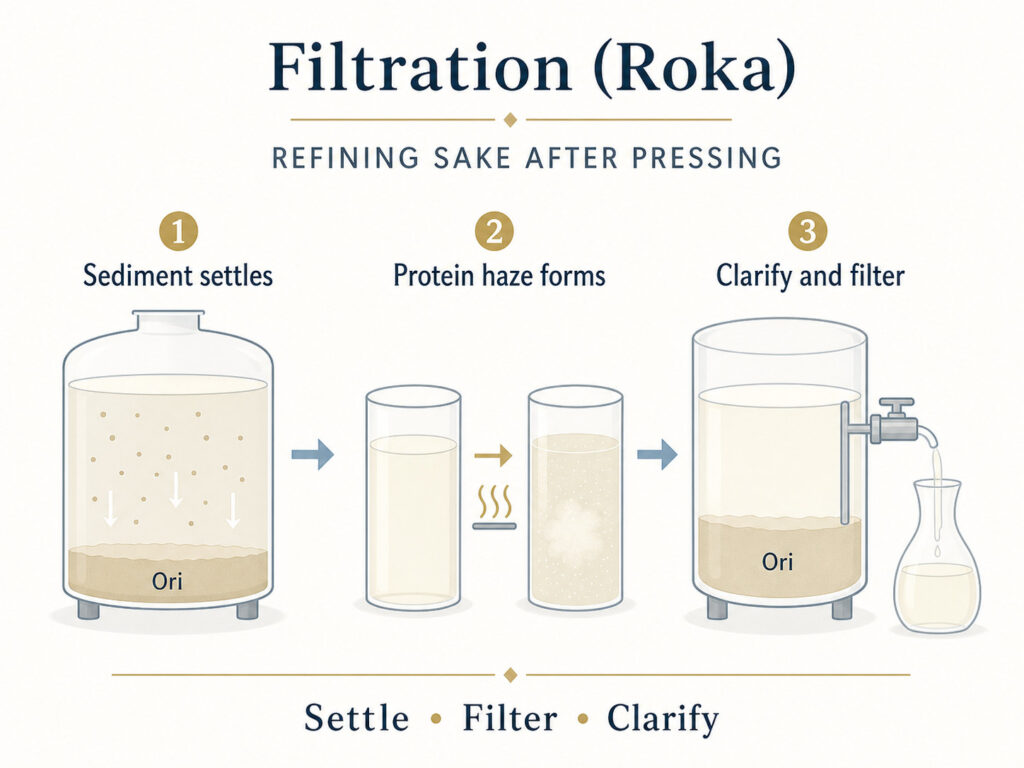
The word ori refers to the fine sediment in sake. It deserves a little extra attention. Handling it well is central to filtration. So let us look at ori more closely.
Ori forms from tiny bits left after pressing. Fragments of rice, yeast, and koji remain. These slowly drift downward over days. So they gather as a soft layer below. This settling makes the clear sake easier to draw off.
Sometimes a haze appears later in the process. Proteins can clump together after heating. This can cloud a sake that once looked clear. Brewers call this a protein haze. So a further clarifying step may be needed.
To handle it, brewers use a settling treatment. They encourage the proteins to gather and sink. Then they filter the clear liquid above. So the sake regains its bright appearance. This careful work protects the final look.
All of this shows how layered filtration can be. It is not a single, simple action. It blends settling, straining, and judgment. So brewers move through several gentle steps. Each one brings the sake closer to its goal.
Traditional Filtration in Sake Brewing
Long ago, brewers had no modern machines. Yet they still needed to clarify sake. So they relied on simple, clever methods. These early techniques shaped the craft.
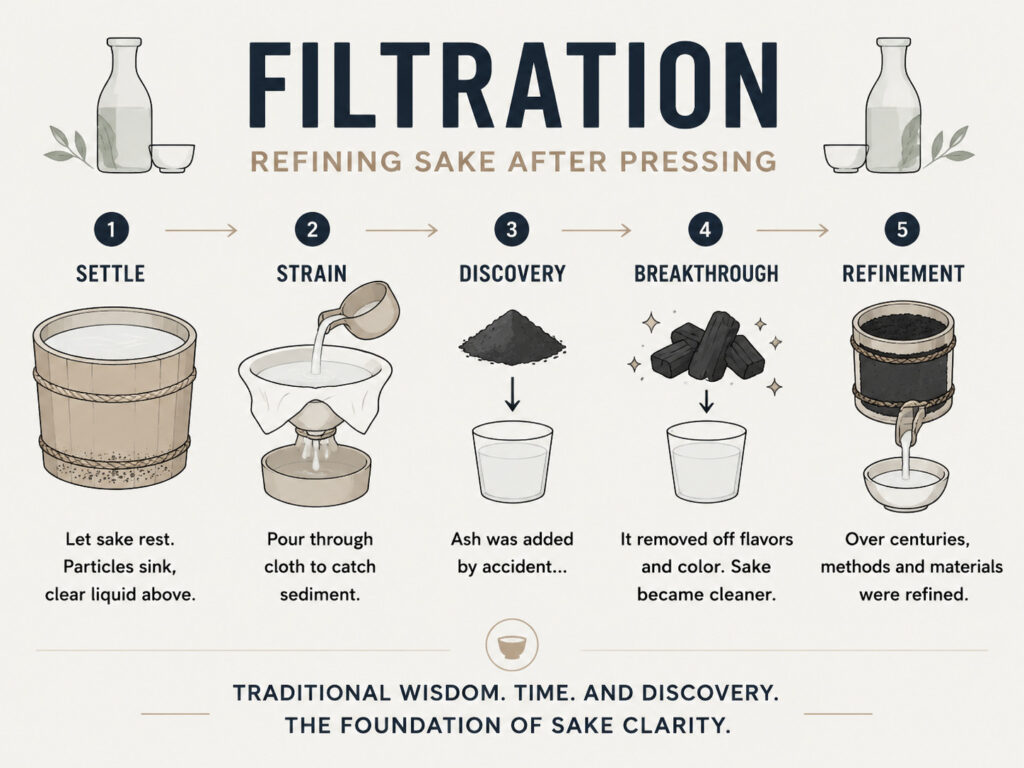
The most basic method used gravity and time. Brewers let the pressed sake rest in vats. The heavy particles slowly sank down. Then they drew off the clear liquid above. So patience did much of the clarifying.
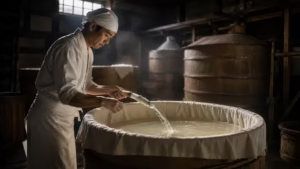
Cloth also played a central role. Brewers poured sake through woven cloth. The cloth caught larger bits of sediment. So the liquid grew clearer as it passed. This gentle straining was widely used.
These methods were humble but effective. They could not achieve perfect transparency. Yet they removed the worst of the haze. So the sake became far more presentable. Early drinkers valued this visible care.
Then came a famous discovery about charcoal. According to a well-known story, it began by accident. A disgruntled worker once dumped ash into sake. He meant to ruin the batch out of spite. So the brewers expected disaster.
Instead, the result surprised everyone. The ash had absorbed off flavors and color. The sake tasted cleaner than before. So a mishap became a breakthrough. Brewers began using charcoal on purpose.
This tale may be more legend than fact. Still, it captures a real turning point. Charcoal filtering transformed sake clarity. So the craft gained a powerful new tool. The discovery echoes through brewing today.
Over centuries, these methods steadily improved. Brewers refined their timing and materials. They learned how much charcoal to use. So traditional filtering grew more precise. This knowledge laid the base for modern methods.
Modern Filtration in Sake Brewing
Today, brewers have far more precise tools. Modern filtration blends tradition with technology. So sake can be refined with great control. Let us explore the main modern methods.
Activated Charcoal Filtration
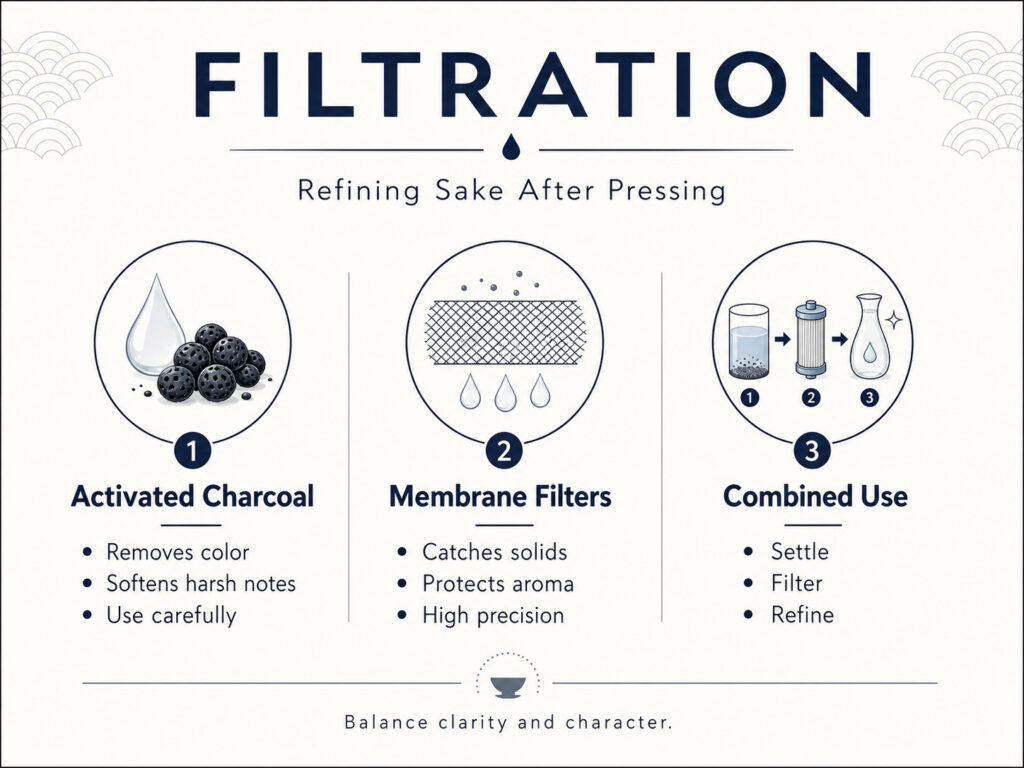
Activated charcoal is central to filtration in sake brewing. Brewers add fine charcoal powder to the sake. The charcoal has countless microscopic pores. These pores trap color and aroma compounds. So the charcoal reshapes the sake as it works.
The effect on color is striking. Fresh sake carries a pale yellow tint. Charcoal grabs those color molecules. So the sake shifts toward clear and bright. This is why many clear sakes use charcoal.
Charcoal also captures certain aromas and flavors. It can remove harsh or aged notes. It can strip away unwanted heaviness. So it smooths the overall profile. The sake often tastes cleaner and lighter.
The amount of charcoal matters enormously. Brewers use only a few grams per large batch. A common guide is a few grams per thousand liters. So the dose is small and carefully judged. Precision is everything at this stage.
Brewers test the dose before committing. They filter a small sample first. Then they taste it and adjust. So they avoid over-filtering the main batch. This tasting step protects the sake’s character.
Membrane and Mechanical Filtration
Beyond charcoal, brewers use fine mechanical filters. These trap particles purely by size. They add no charcoal and absorb little aroma. So they clarify without heavily changing flavor. Many breweries rely on them daily.
Some filters are astonishingly fine. Super-fine and ultra-fine membranes exist. They can catch microscopic solids and stray microbes. So they clarify sake to a very high degree. Yet they touch the aroma only lightly.
This gentleness makes them useful for fragrant sake. A delicate ginjo needs its aroma protected. Charcoal might strip too much away. So a fine membrane clarifies while sparing the scent. Brewers choose the tool to fit the sake.
Mechanical filters also give great consistency. They deliver the same result batch after batch. This reliability suits modern production. So large breweries value them highly. Consistency keeps a brand’s flavor steady.
Still, no filter is entirely without effect. Even a gentle membrane trims some nuance. Brewers weigh clarity against character every time. So they select carefully among the options. Each method has its place and price.
Modern brewers often combine several methods. They might settle, then membrane-filter, then lightly charcoal-filter. Each step handles a different task. So the sequence builds toward the target style. The craft lies in balancing them well.
Activated Charcoal: Benefits and Trade-offs
Activated charcoal deserves a closer, balanced look. It is powerful, useful, and sometimes controversial. So it helps to weigh both sides. Let us examine its benefits and trade-offs.
The benefits are real and important. Charcoal removes unwanted color effectively. It strips harsh or off aromas. It can rescue a sake with minor flaws. So it gives brewers strong corrective power.
Charcoal also helps with consistency. It can align a sake to a house style. It smooths year-to-year differences in the rice. So a brand can taste familiar each season. This reliability reassures loyal drinkers.
There is a stabilizing benefit too. By removing certain compounds, charcoal limits change. The sake ages more slowly and predictably. So it holds its intended flavor longer. This matters for wide distribution.
Yet charcoal carries clear trade-offs. Its power cuts in both directions. While it removes bad notes, it also removes good ones. So delicate aromas can vanish with the flaws. This is the core risk of charcoal.
Over-filtering is a genuine danger. Too much charcoal thins the flavor badly. The sake can turn flat and hollow. It may even pick up a faint charcoal note. So restraint is absolutely essential here.
This is why not every sake is charcoal-filtered. A fragrant, high-grade sake may skip it. Its delicate aromas are simply too precious. So the brewer protects them by avoiding charcoal. The style guides the decision.
The choice reflects a deeper philosophy. Some brewers prize clarity and cleanness. Others prize richness and raw character. So each leans toward or away from charcoal. Neither path is wrong, only different.
Modern practice has grown more careful. Better fine filters reduce the need for charcoal. Brewers can clarify without heavy absorption. So charcoal use is often lighter than before. The trend favors preserving character.
What Is Muroka?
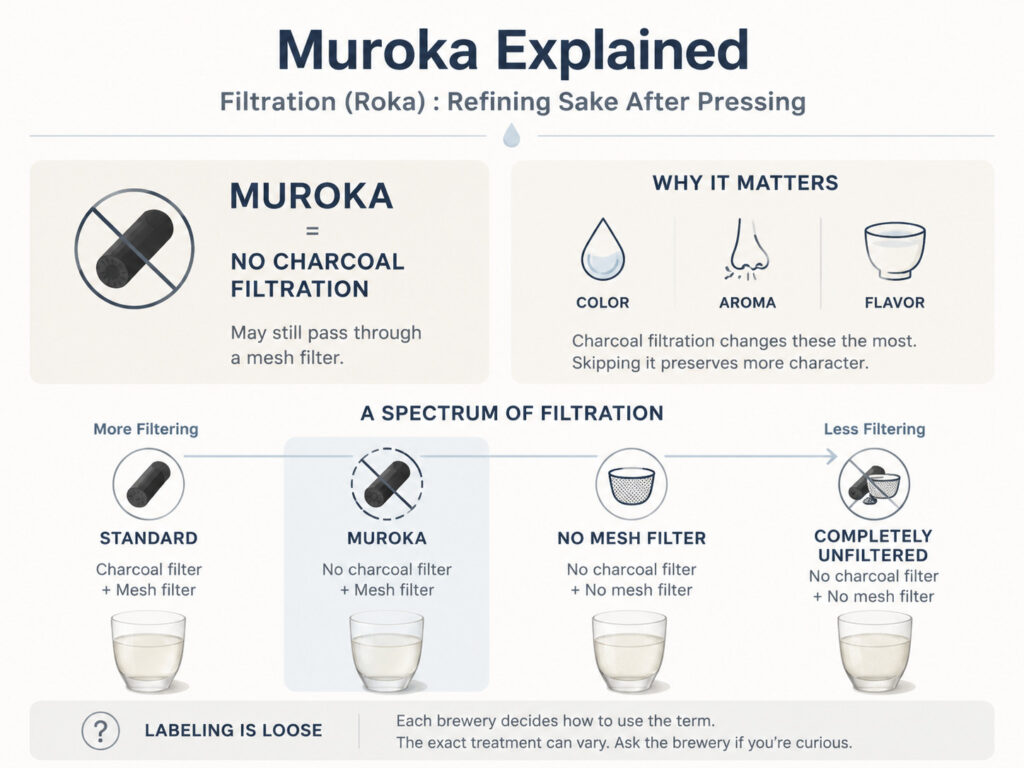
Muroka is one of the most talked-about sake terms. It appears proudly on many labels. Yet its meaning is often misunderstood. So let us define it carefully.
The word muroka means “no filtration.” At first, that sounds completely literal. It seems to promise a totally unfiltered sake. Yet the reality is more subtle. The term has a specific, narrower meaning.
In practice, muroka means no charcoal filtration. The sake has skipped the activated charcoal step. It may still pass through a mesh filter. So it is not always fully unfiltered. This distinction is genuinely important.
Why does this narrower meaning exist? Charcoal filtering has the biggest effect on character. It changes color, aroma, and flavor the most. So skipping it is the meaningful choice. That is what brewers highlight with muroka.
Many muroka sakes still receive light filtering. A simple filter removes coarse particles. This keeps the sake reasonably clean. So muroka does not mean cloudy or rough. It simply keeps more of the sake’s character.
A fully unfiltered sake is a stricter case. It skips both charcoal and mesh filtering. This is sometimes called completely unfiltered. So there is a spectrum of filtering choices. Muroka usually sits partway along it.
There is another layer of nuance here. Labeling rules for muroka are loose. Each brewery decides how to use the term. So the exact treatment can vary by producer. Curious drinkers may need to ask the brewery.
How Muroka Sake Looks and Tastes
Now consider how muroka sake tastes. It keeps more of its original flavor. The umami feels fuller and richer. The aromas stay bolder and more direct. So muroka often tastes deep and characterful.
Muroka sake also shows more natural color. It may keep a faint golden or pale tint. This hue signals its unpolished nature. So the look hints at the fuller flavor. Many fans find this appearance appealing.
The style suits certain drinkers perfectly. Fans of bold, rich sake often love it. It rewards those who want raw character. So muroka has a devoted following. It feels closer to the sake’s true source.
Muroka often pairs with other bold labels. You may see muroka nama genshu. That means unfiltered, unpasteurized, and undiluted. So the sake keeps the freshest possible profile. It is sake at its most direct. For the cloudy style, see our nigori sake guide.
Still, muroka is not automatically superior. Its richness can overwhelm some palates. Newcomers may prefer a cleaner, filtered style. So muroka is a choice, not a crown. The best sake depends on the drinker.
This point is worth stressing clearly. Muroka is not a mark of higher quality. It reflects a different brewing philosophy. So a filtered sake can be just as fine. Both paths can produce something excellent.
Filtration and Sake Styles
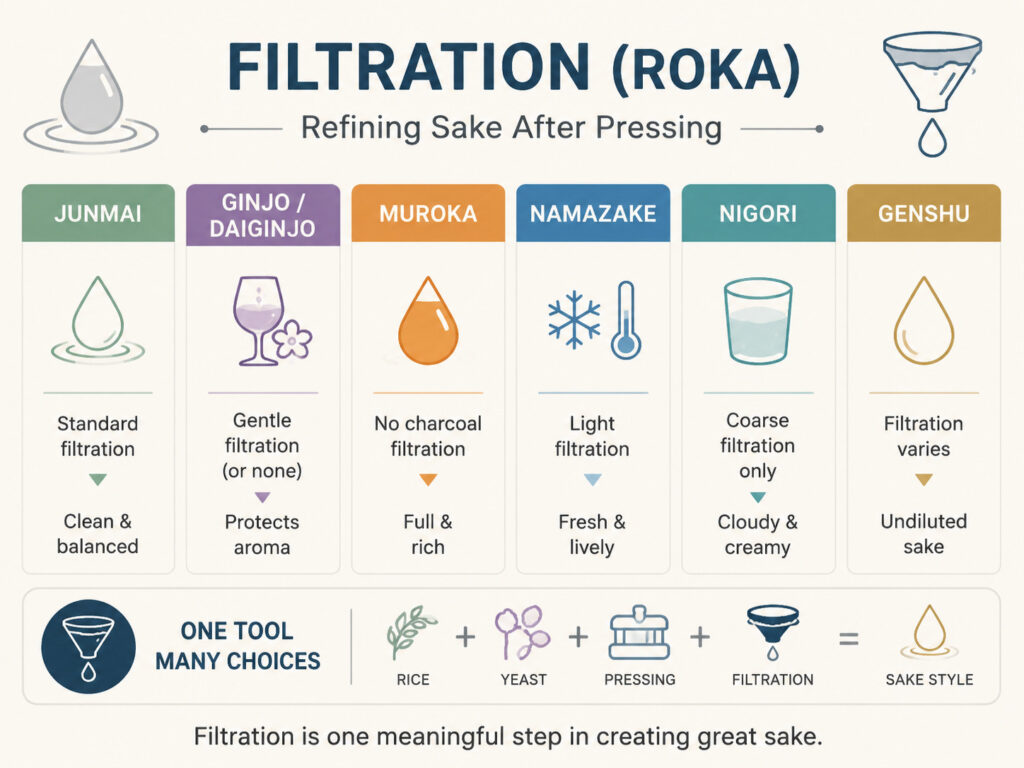
Filtration in sake brewing shapes many familiar styles. Each style balances clarity and character differently. So the filter reflects the sake’s identity. Let us connect filtration to familiar types.
A clean junmai often gets standard filtering. This gives a balanced, approachable profile, as our junmai guide explains. The sake tastes smooth and even. So filtering supports its easygoing charm.
Fragrant ginjo and daiginjo need special care. Their delicate aromas are precious and fragile. Heavy charcoal could strip those scents away. So brewers filter them gently, if at all. The goal is to protect the bouquet. See our ginjo and daiginjo guides for more.
Muroka sake, by definition, skips charcoal filtering. It keeps its full, rich character. So it stands apart from cleaner styles. The label signals a bolder experience.
Namazake follows its own logic too. This unpasteurized style prizes freshness above all. Brewers often filter it only lightly. So the lively, raw character survives. Cold storage then protects the delicate sake.
Nigori is the cloudy exception to clarity. It passes through only a coarse mesh, as our nigori guide shows. Plenty of rice solids remain behind. So nigori looks milky and tastes creamy. It embraces the opposite of clear.
Genshu describes undiluted sake. It has no water added after brewing. Filtration choices still apply on top of that. So a genshu may be filtered or muroka. The two labels describe different things.
These examples share one clear lesson. Filtration is one tool among many. It works alongside rice, yeast, and pressing. So the finished style emerges from many choices. The filter is just one meaningful step.
How Filtration in Sake Brewing Influences Flavor
Filtration in sake brewing shapes the sensory experience in subtle ways. It touches aroma, color, texture, and balance. So its influence reaches the whole glass. Let us explore each aspect in turn.
Consider aroma first of all. Charcoal filtering can soften strong scents. It removes both harsh and fragrant notes. So a heavily filtered sake smells cleaner. A muroka sake, by contrast, smells bolder.
Color is the most visible effect. Filtration can shift sake toward clear. It strips the pale yellow or green tint. So a filtered sake looks bright and transparent. A muroka sake keeps more natural color.
Mouthfeel changes with filtration too. Removing solids can make sake feel lighter. It smooths the texture on the tongue. So a filtered sake often feels crisp. A muroka sake feels rounder and fuller.
Balance is a more delicate matter. Skilled filtering can even out rough edges. It brings harmony to a young sake. So the flavors settle into place. Yet too much filtering flattens that balance.
Freshness also responds to filtering. Light filtering preserves a vivid, lively quality. Heavy filtering trades some freshness for stability. So brewers weigh energy against shelf life. Each sake finds its own balance.
One truth ties all of this together. Filtration refines flavor rather than creating it. It cannot add what the sake lacks. So the base sake must already be good. Filtering only polishes what is there.
This is a humbling point for brewers. No filter can rescue a poor sake fully. Great flavor starts with rice and fermentation. So filtration is the final polish, not the source. It reveals quality more than it makes it.
Regional and Brewery Approaches
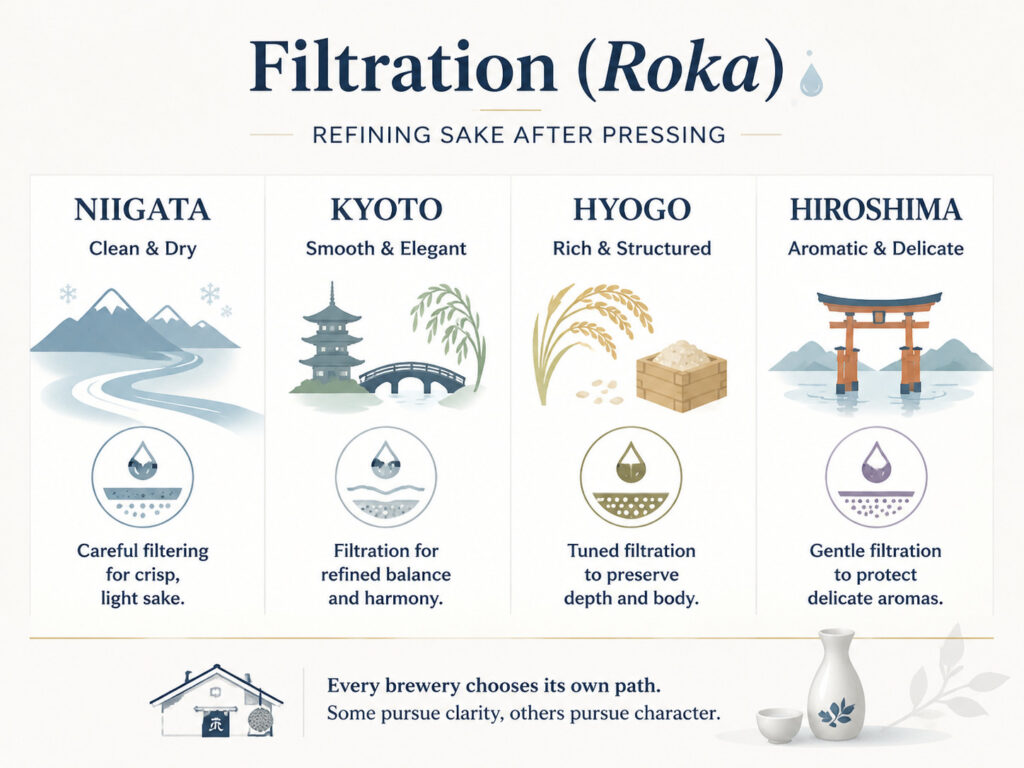
Filtration in sake brewing also varies by region and brewery. Local taste and philosophy shape the choices. So the same step looks different across Japan. Let us consider a few examples.
Niigata is famous for clean, dry sake. Its breweries often favor careful filtering. This supports the crisp, light profile prized there, as our Niigata sake guide shows. So the region leans toward polished clarity.
Kyoto brews with soft, gentle water. Its sake tends toward smooth elegance. Filtration here supports a refined balance. So the approach matches the local character. Grace and harmony guide the choices.
Hyogo grows superb sake rice. Its breweries craft rich, structured sake. Filtration is tuned to preserve that depth. So the method respects the strong base. The rice’s character stays front and center.
Hiroshima has a soft-water brewing legacy. Its ginjo tradition prizes delicate aromas. Brewers there filter with a gentle hand. So they protect the fragile, fragrant notes. The region’s history shapes its touch.
These regional patterns are broad tendencies only. Every brewery makes its own decisions. Some chase clarity, others chase character. So even neighbors can differ sharply. Philosophy matters more than location alone.
Filtered vs Muroka Sake at a Glance
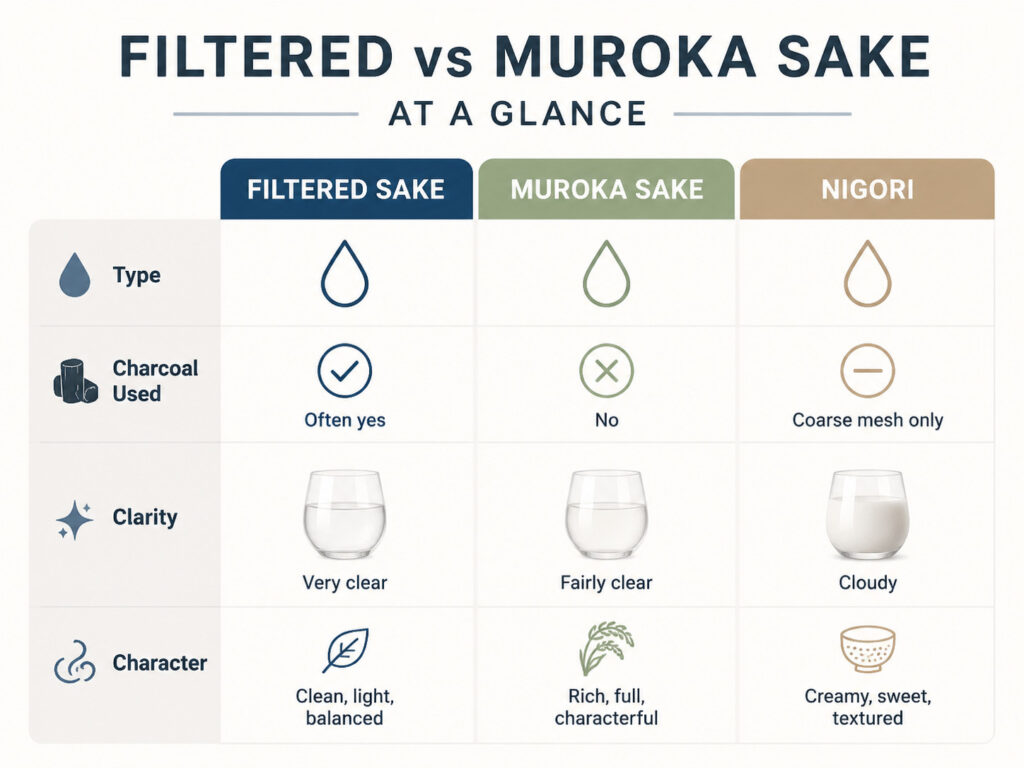
A simple comparison helps tie these ideas together.
| Type | Charcoal Used | Clarity | Character |
|---|---|---|---|
| Filtered sake | Often yes | Very clear | Clean, light, balanced |
| Muroka sake | No | Fairly clear | Rich, full, characterful |
| Nigori | Coarse mesh only | Cloudy | Creamy, sweet, textured |
What Happens After Filtration
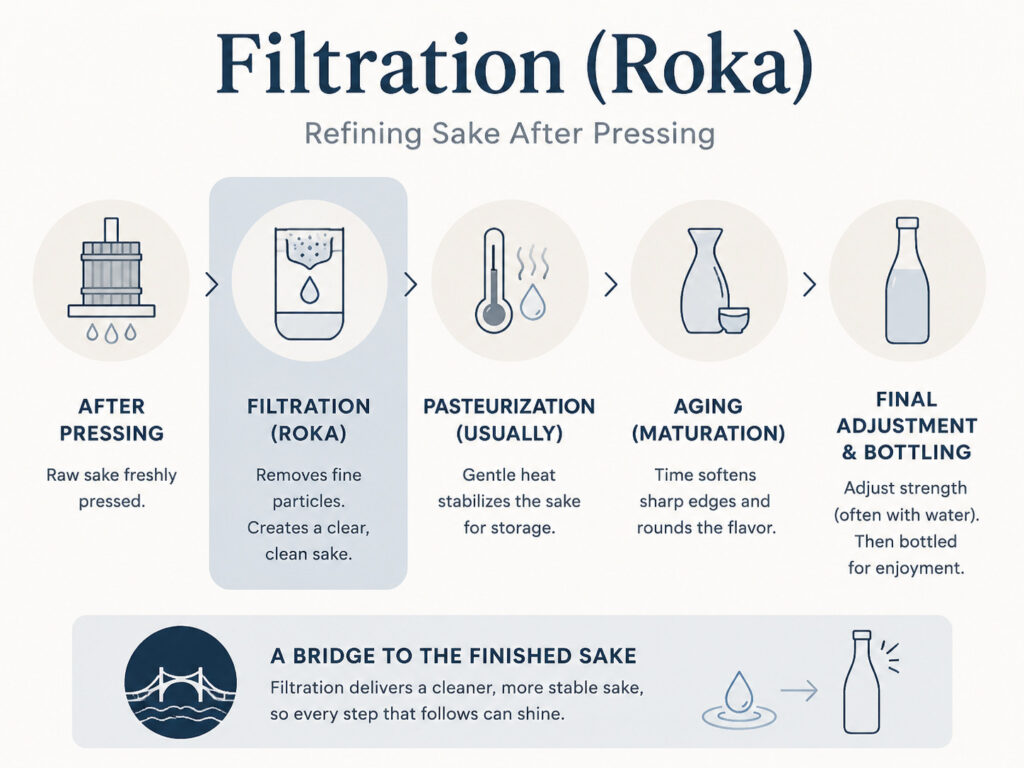
Filtration in sake brewing is not the very last step. Several stages still lie ahead. The refined sake continues its journey. So it helps to see what comes next.
Pasteurization usually follows filtration. Gentle heat stabilizes the sake for storage. It halts unwanted changes in the bottle. So the flavor stays steady over time. Some fresh styles skip this step, though.
After that, many sakes rest and age. A short maturation rounds out the flavor. The sharp edges of youth soften. So the sake grows more harmonious. Then it moves toward final adjustment.
Brewers often adjust the strength before bottling. They may add a little water to balance it. A genshu, by contrast, skips this dilution. So filtration feeds into these final choices. Each step builds on the one before.
Seen this way, filtration is a bridge. It links the raw pressed sake to the finished bottle. It hands off a cleaner, more stable liquid. So the later stages can do their work. The polish of filtration carries all the way through.
How to Read Filtration Terms on a Label
Sake labels often hint at filtration choices. Learning a few terms helps you choose well. Certain words appear again and again. So a short guide makes them easy to spot.
The word muroka signals no charcoal filtering. It promises a fuller, richer character. The term genshu means no water was added. So these words often mark bolder, stronger sake.
You may also see the word nama. It means the sake was not pasteurized. Such bottles taste especially fresh and lively. So they need cold storage and quick drinking.
These terms frequently appear together. A label might read muroka nama genshu. That signals unfiltered, unpasteurized, and undiluted sake. So it promises the most direct flavor possible.
A little label knowledge rewards the curious. It lets you predict a sake’s style. So you can pick a bottle with purpose. With practice, these words become familiar friends.
Common Misconceptions About Filtration
Filtration invites several stubborn myths. So let us clear them up plainly.
- Is filtered sake always better? No. Filtering is a stylistic choice, and both filtered and muroka sake can excel.
- Is muroka always cloudy? No. Muroka usually looks fairly clear, since it often passes through a mesh filter.
- Does filtration remove alcohol? No. It targets particles, color, and aroma, not the alcohol.
- Is charcoal filtration artificial? No. Charcoal is a natural material that simply absorbs compounds.
- Is filtration required by law? No. The law requires pressing, so sake can be sold unfiltered.
These myths share a common root. People assume clearer always means better. Yet clarity is a preference, not a verdict. So it helps to judge each sake openly. Taste matters far more than transparency.
Final Thoughts
Filtration is one of the final refining stages in sake brewing. It follows pressing and precedes pasteurization. Rather than simply making sake clear, it fine-tunes the whole character. So filtration in sake brewing shapes color, aroma, flavor, and stability. Pressing and filtration remain distinct steps, each with its own role. Muroka does not mean fully unfiltered, only free of charcoal filtering. Above all, filtration is a decision, not a ranking of quality. Both filtered and muroka sake can be truly outstanding. Each simply reflects a different vision in the glass. Understand filtration, and you understand how brewers shape their sake.
Filtration in Sake Brewing FAQ
What is roka?
Roka is the Japanese word for filtration. It is the step that refines pressed sake. Brewers pass the liquid through a filter. This removes fine particles and can adjust color and flavor.
Why is sake filtered?
Filtration clarifies the sake and adjusts its color. It also smooths the flavor and improves stability. This helps the sake keep well during storage. So it serves both looks and quality.
What is activated charcoal filtration?
It is a method using fine charcoal powder. The charcoal absorbs color and aroma compounds. Brewers add a small, careful amount. Then they filter the charcoal out again.
What is muroka sake?
Muroka means the sake skipped charcoal filtering. It usually still passes through a mesh filter. So it is not always fully unfiltered. It keeps a fuller, richer character.
Is muroka sake cloudy?
No, muroka is usually fairly clear. A mesh filter removes the coarse particles. It is quite different from nigori. Nigori is the milky, cloudy style.
Does filtration affect taste?
Yes, it can soften aroma and flavor. Charcoal filtering has the strongest effect. It removes both harsh and fragrant notes. So brewers filter with great care.
Does filtration remove alcohol?
No, filtration does not lower the alcohol. It targets particles, color, and aroma instead. The strength stays essentially the same. Dilution, a separate step, changes the alcohol.
Is filtered sake better than muroka?
Neither is automatically better. Filtered sake is clean and balanced. Muroka sake is rich and full. So the best choice depends on your taste.
Can premium sake be filtered?
Yes, many premium sakes are filtered. Brewers often use gentle mesh filters. These clarify without stripping delicate aromas. So filtering and quality go together well.
Is filtration required by law?
No, the law requires pressing, not filtering. So sake can legally be sold unfiltered. Muroka sake is a clear example. It has been pressed but not charcoal-filtered.
Why do some brewers skip filtration?
They want to keep the sake’s full character. Charcoal can strip aroma and umami. So skipping it preserves richness. This choice creates the muroka style.
What is the difference between filtered and muroka sake?
Filtered sake has been charcoal-filtered. Muroka sake has not. So filtered sake is cleaner and lighter. Muroka sake is fuller and more characterful.
References
- Japan Sake and Shochu Makers Association, glossary of sake terms (roka, muroka, oribiki, activated charcoal). (Surveyed: June 2026)
- National Research Institute of Brewing, sake refining, filtration, and clarification processes. (Surveyed: June 2026)
- National Tax Agency of Japan, definition of seishu and the legal “pressing/filtering” requirement. (Surveyed: June 2026)
- Brewing Society of Japan, “Sake Brewing Materials Q&A” (1999), on activated carbon use and haritsuke filtration. (Surveyed: June 2026)
Related Articles
- Pressing (Joso): How Moromi Becomes Sake
- Moromi: The Main Fermentation Mash
- Sake Fermentation
- Sokujo: The Modern Yeast Starter
- Types of Japanese Sake
- Nigori Sake (Cloudy Sake)
- Junmai Sake (Pure Rice Sake)
- Ginjo Sake





Comments