




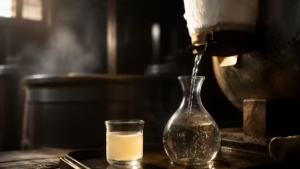
Oribiki (滓引き) is the sake racking step that separates clear sake from settled sediment after pressing. Brewers rest the freshly pressed sake until solids sink, then draw the clear liquid gently into another tank. It happens after pressing and before filtration, and it improves clarity, stability, and flavor cleanliness.
English speakers usually call this sediment removal or racking. The sediment itself has a Japanese name, ori. Nobody squeezes anything at this stage, and no filter media touch the sake. Gravity does almost all of the work.
Timing decides the result. Wait too long, and the ori begins to change the flavor above it. Move too early, and cloudy liquid follows the clear sake into the next tank. Most breweries act within a few days of pressing.
Many English guides fold this stage into a paragraph about filtration. That undersells it. Oribiki has its own logic, its own tools, and its own quiet risks.
This guide explains what ori is, how brewers remove it, and how the step differs from filtration and orisage. It suits anyone reading a sake label, planning a brewery visit, or simply wondering why one bottle looks cloudy and another looks like water. For the step just before, see our pressing guide.
Quick Facts About Oribiki
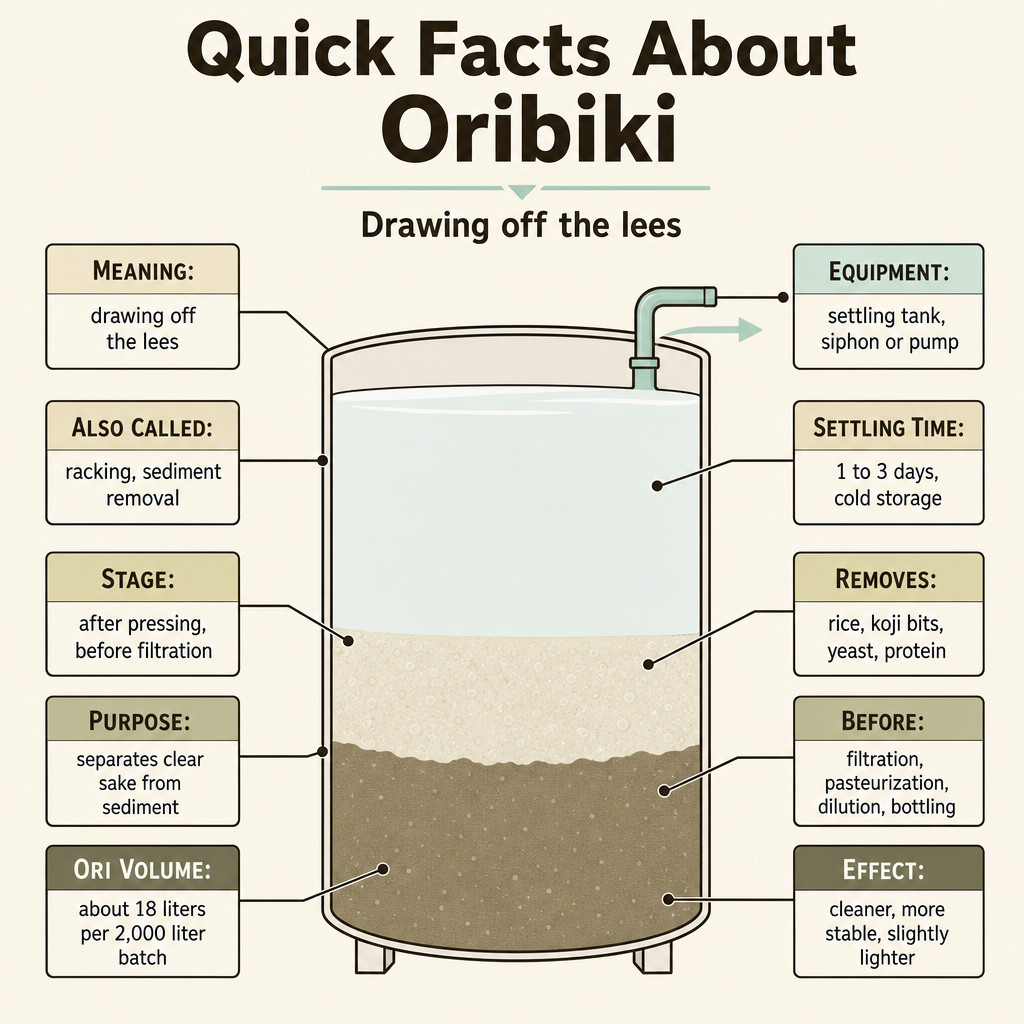
| Japanese Name | 滓引き (oribiki) |
| Literal Meaning | Drawing off the lees |
| English Terms | Sake racking, sediment removal, sake clarification |
| Brewing Stage | After pressing, before filtration |
| Main Purpose | Separate clear sake from settled sediment |
| Performed Before | Filtration, pasteurization, dilution, bottling |
| Removes | Rice fragments, koji pieces, yeast cells, insoluble protein |
| Typical Settling Time | Roughly one to three days in cold storage |
| Typical Ori Volume | Around 18 liters from 2,000 liters of sake |
| Core Equipment | Settling tank, upper outlet, siphon or gentle pump |
| Effect on Flavor | Cleaner and far more stable, with slightly less weight |
These figures are typical examples rather than fixed standards. Actual timing and sediment volume vary by brewery, rice variety, polishing ratio, temperature, and pressing method.
What Is Oribiki?
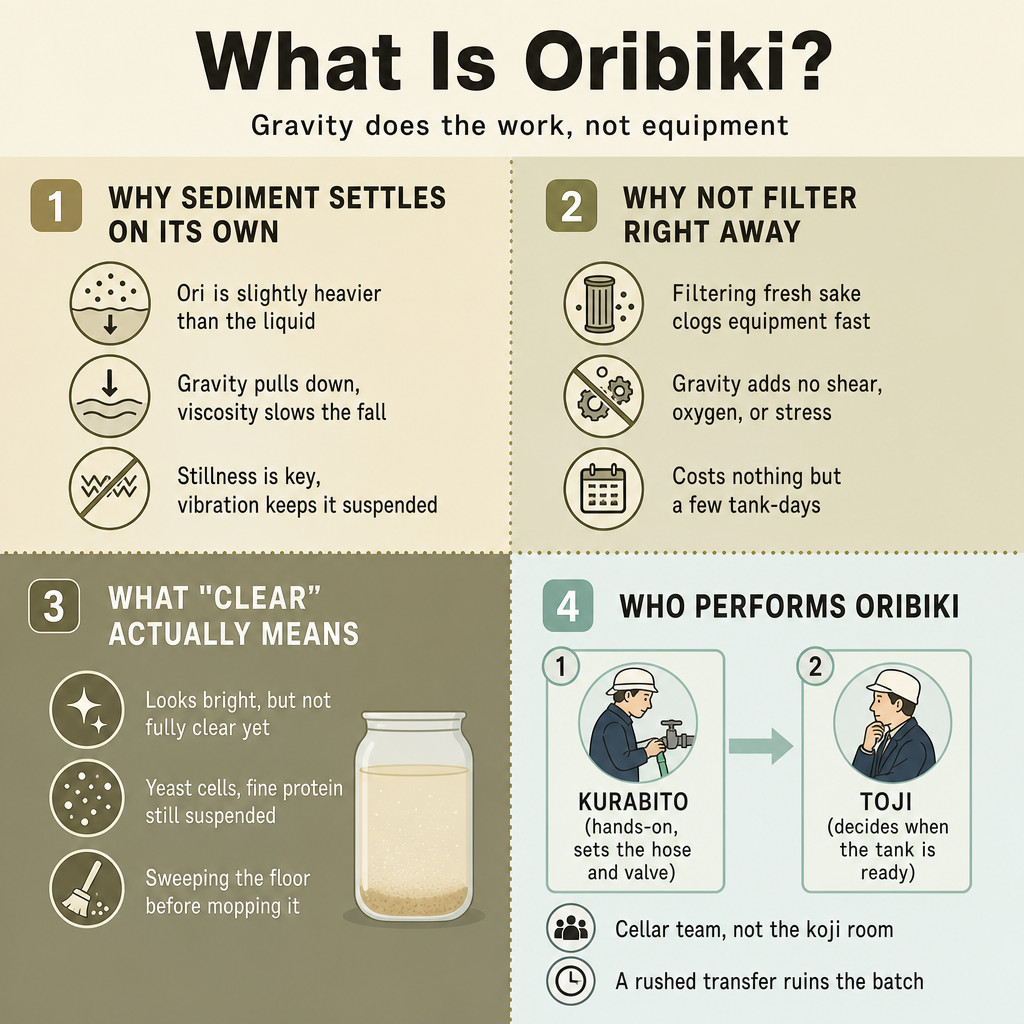
Oribiki is a separation step that uses gravity rather than equipment. Brewers rest freshly pressed sake in a tank, let the solids sink, and move the clear layer above into a fresh vessel.
Picture a bottle of unfiltered apple juice on a shelf. Leave it overnight, and a cloudy layer forms below. Pour gently, and you keep the bright part. Oribiki follows that same idea at brewery scale.
Why Sediment Settles on Its Own
Ori particles weigh slightly more than the liquid around them. Gravity pulls them down while viscosity slows their fall. Given time and stillness, they reach the bottom.
Stillness is the key condition. Vibration, pumping, and temperature swings all stir a tank. Sediment then hangs in suspension far longer than anyone wants.
Why Brewers Do Not Filter Straight Away
Filtering pressed sake immediately sounds efficient, yet it clogs equipment within minutes. Heavy sediment blinds a filter fast, and a brewery would burn through filter sheets, pump hours, and patience.
Gentleness matters too. Pumps and filters add shear, oxygen, and stress, while a quiet tank adds none of those. Cost points the same way, since gravity charges nothing beyond a few days of tank space.
What “Clear” Actually Means Here
Clear is a relative word at this stage. Sake after Oribiki looks bright to the eye, yet it still carries invisible material. Yeast cells and fine protein remain in suspension.
Full transparency arrives later, through filtration. Racking simply handles the heavy lifting first. Think of it as sweeping a floor before mopping it.
Who Performs Oribiki
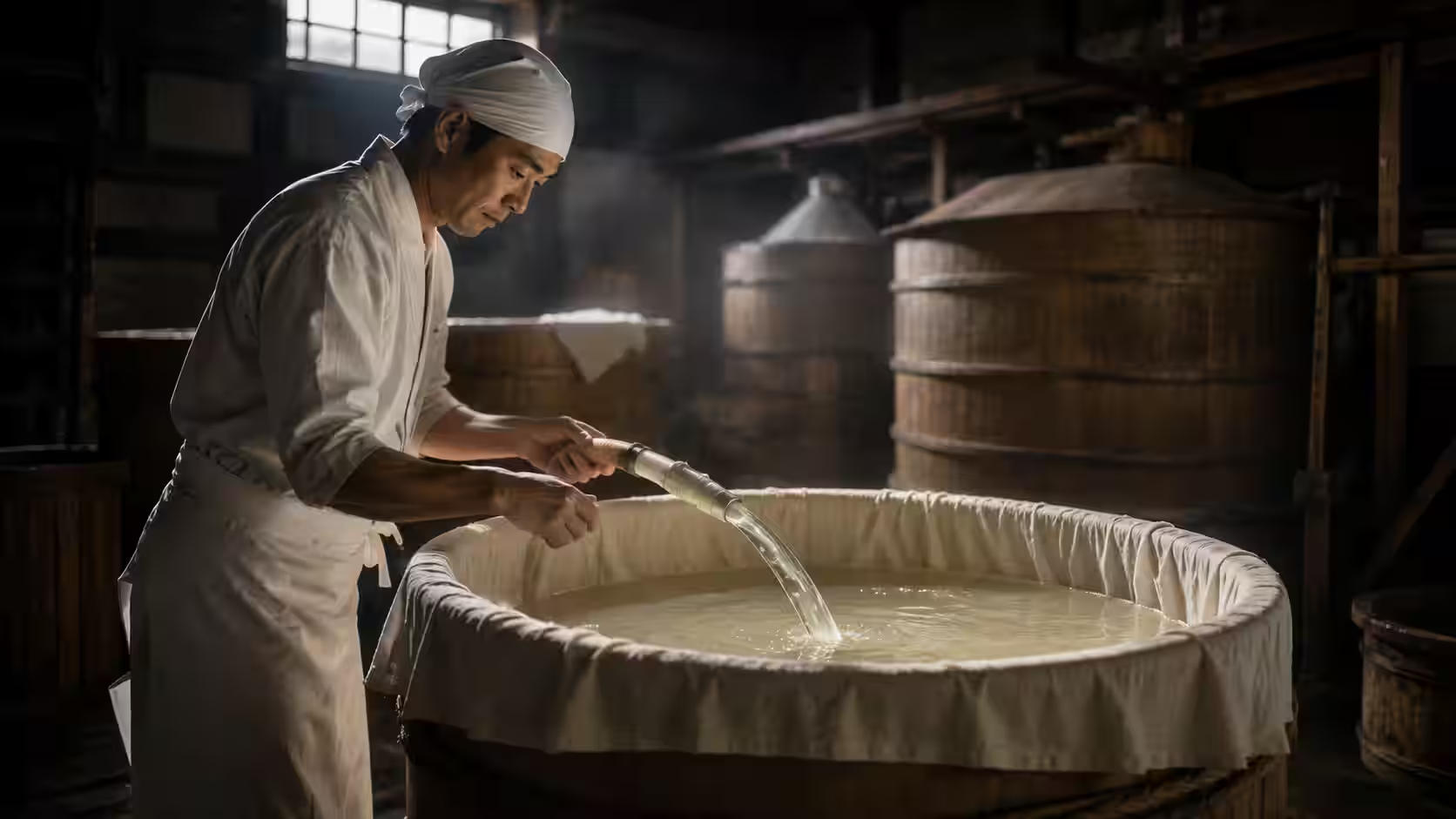
Racking sits with the cellar team rather than the koji room. A kurabito, meaning a brewery worker, usually sets the hose, opens the valve, and watches the flow. The toji, or master brewer, decides when the tank is ready.
Responsibility carries real weight here. A rushed transfer can pull sediment into a tank of finished sake. Undoing that mistake means starting the wait again, and the aroma never fully recovers.
What Is Ori?
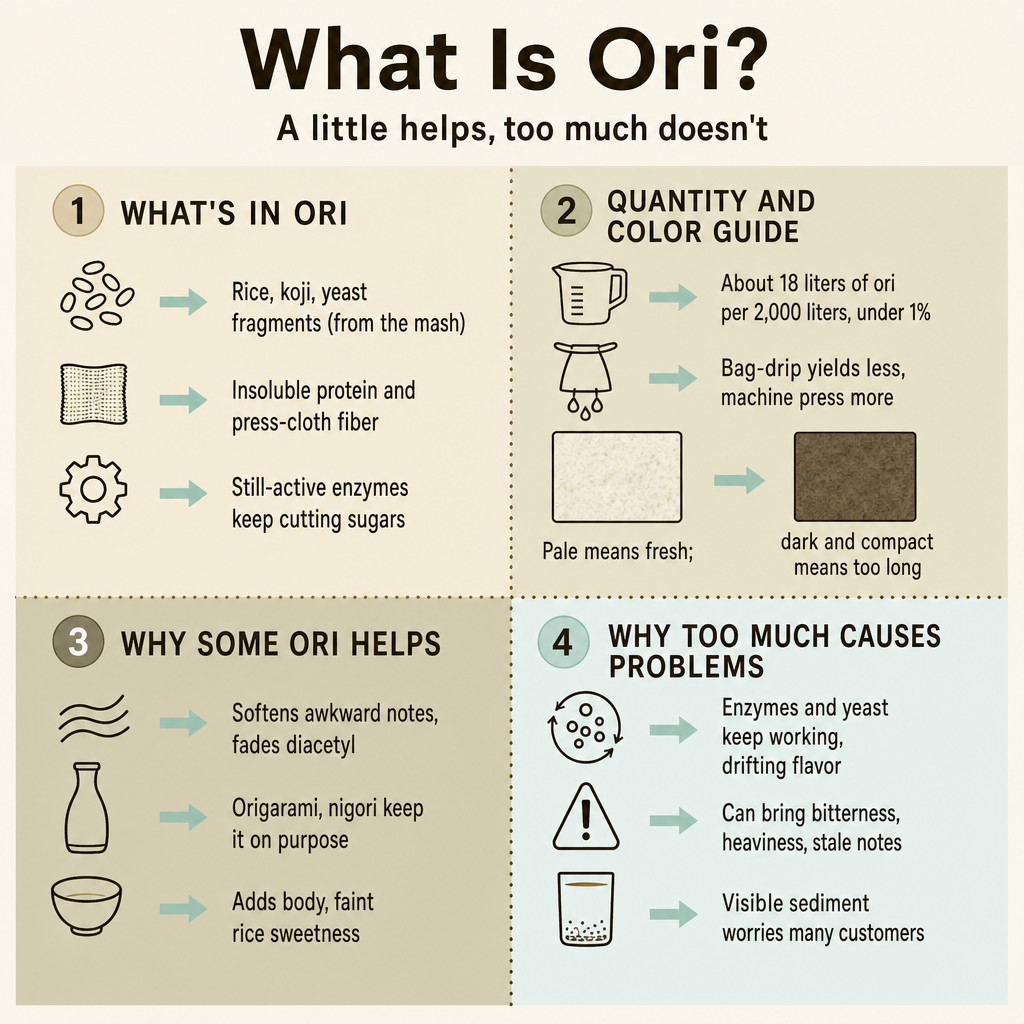
Ori is the fine sediment that drops out of young sake after pressing. It contains rice fragments, koji particles, spent yeast, insoluble protein, and still-active enzymes.
Suspended in the liquid, ori looks pale and soft. Collected in bulk at the tank base, it turns gray and dull. All of the material comes straight from the mash, because pressing cannot catch everything.
- Rice fragments: undigested starch and fine pieces of steamed rice
- Koji particles: small bits of the mold-grown rice that drives saccharification
- Yeast cells: dead and dying cells, roughly 2 to 10 microns wide
- Insoluble protein: material that never dissolved during the long fermentation
- Fiber: tiny strands from the rice and from the press cloth
- Enzymes: still active, still cutting sugars and proteins apart
Quantities stay modest. SAKE Street reports roughly 18 liters of ori from 2,000 liters of pressed sake, which comes to under one percent by volume. That small fraction still shapes clarity, stability, and taste.
Sediment load varies with the pressing method. A slow bag-drip run yields very little ori, while a hard machine press pushes more solids into the liquid. Rice polishing ratio shifts the balance as well, since lightly polished grain carries more protein.
Color offers a rough guide in the cellar. Pale, loose sediment usually means fresh material that settles cleanly. Darker, compacted ori suggests the tank has sat too long already.
Why Some Ori Helps
Ori is no enemy. Contact with it can soften certain awkward notes, and diacetyl, which smells of buttery or stale oil, may fade during that contact.
Several styles keep sediment deliberately. Origarami sake goes into the bottle with a little ori still swirling inside. Nigori keeps far more, as our nigori sake guide explains. A trace of ori also lends body and a faint rice sweetness.
Why Too Much Ori Causes Problems
Left alone, ori keeps working. Enzymes cut proteins into amino acids, and yeast cells break apart to release their contents into the liquid.
Flavor drifts while that happens. Some of the drift tastes pleasant, and some really does not. Bitterness, heaviness, and stale notes can creep in over weeks.
Appearance suffers too. Sediment in a clear bottle worries plenty of customers, and retailers usually read visible haze as a fault. Speed therefore becomes a quality issue: settle, transfer, then move on.
Ori vs Sake Kasu: What Is the Difference?
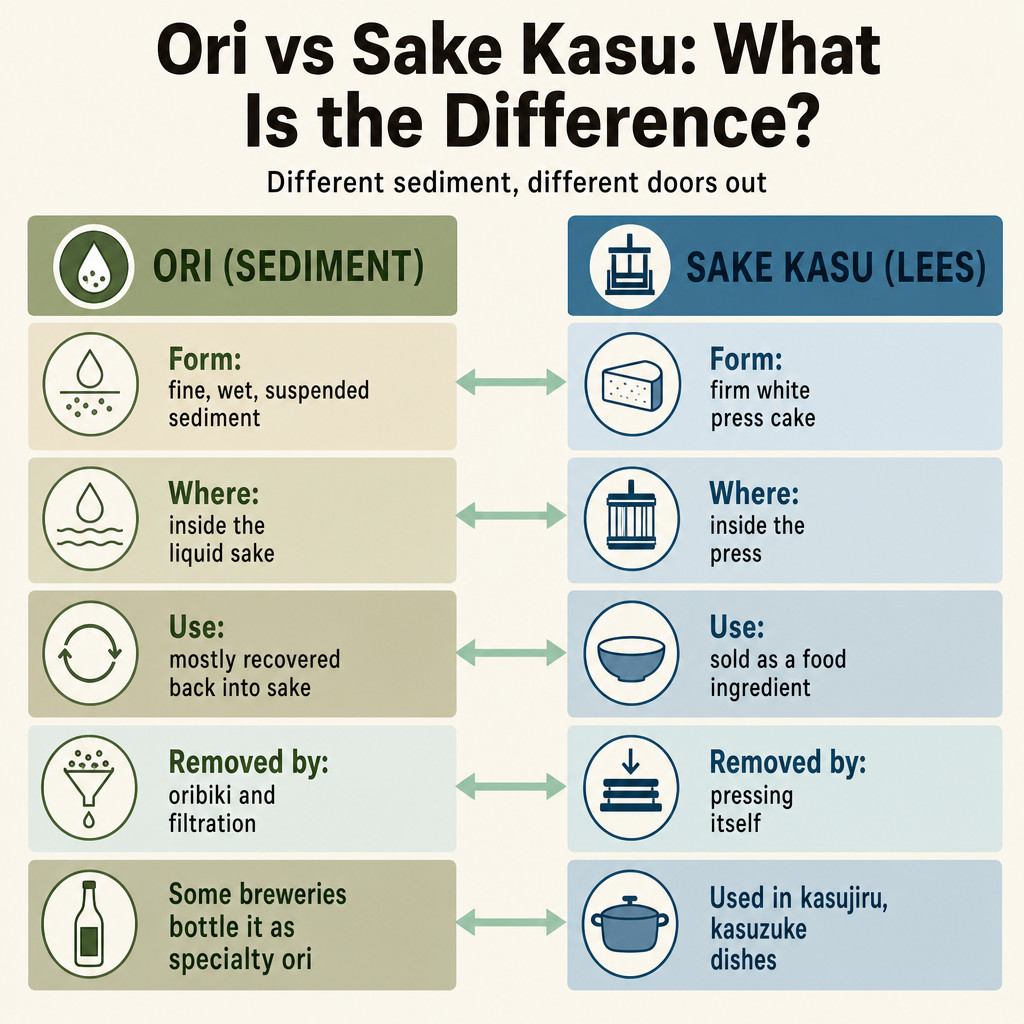
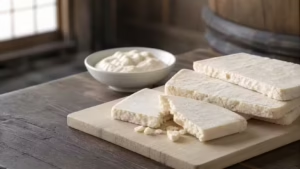
Ori is wet sediment that travels with the liquid after pressing. Sake kasu is the solid press cake left inside the press. Beginners mix the two up constantly, though they leave the brewery by completely different doors.
| Point | Ori (sediment) | Sake kasu (lees) |
|---|---|---|
| Form | Fine, wet, suspended sediment | Firm white cake |
| Where it appears | Inside the liquid sake | Inside the press |
| Typical use | Mostly recovered back into sake | Sold as a food ingredient |
| Removed by | Oribiki and filtration | Pressing itself |
Cooks buy sake kasu by the slab for soups, marinades, and pickles. Dishes such as kasujiru and kasuzuke depend on it entirely.
Ori takes a different path. Breweries pour the sludge into large bottles and chill it, and clear sake keeps separating out for days. Recovered liquid usually rejoins a standard tank, while a few kura bottle the ori portion as a specialty release.
Volume separates them sharply too. SAKE Street reports that 1,000 kg of raw ingredients yields roughly 300 kg of sake kasu, against only a few liters of ori. One is a product line, and the other is a handling task.
When Oribiki Happens in Sake Brewing
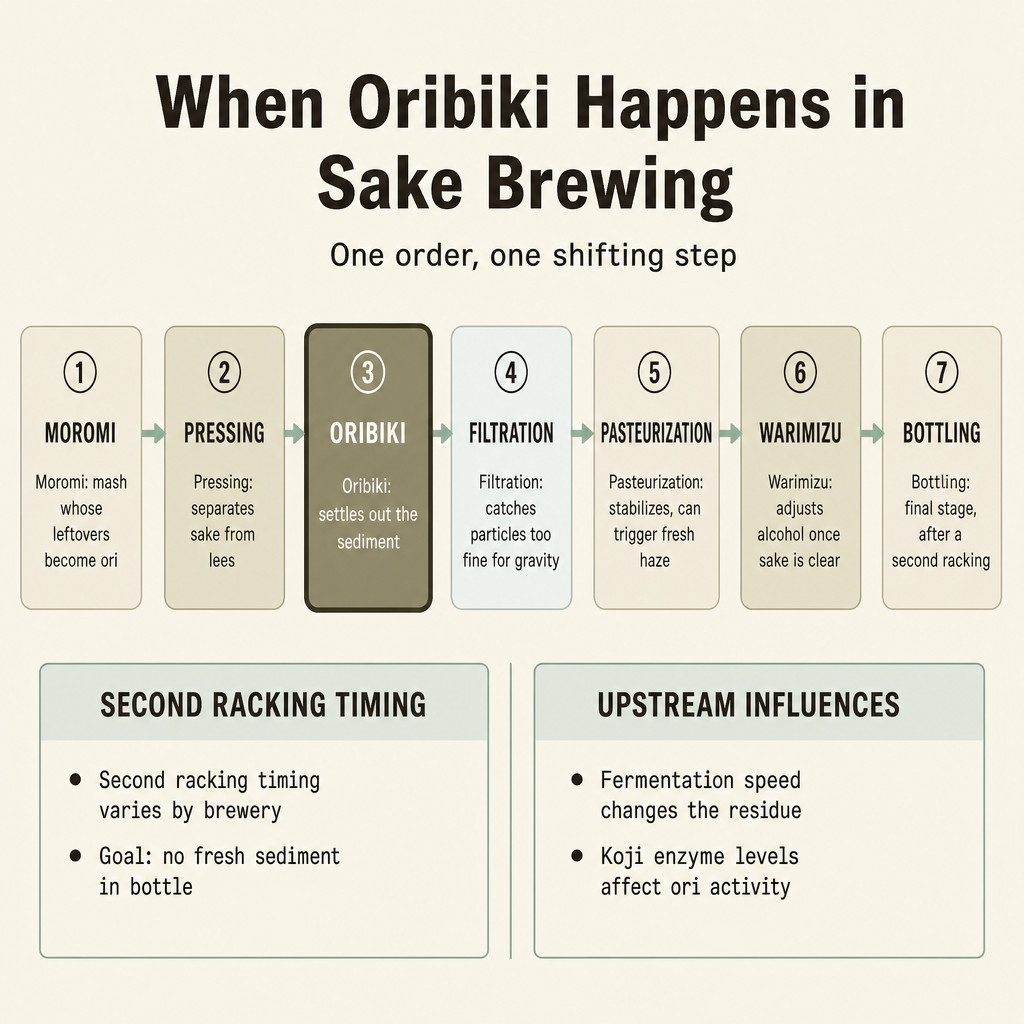
Oribiki sits after pressing and before filtration. It also shapes later pasteurization, storage, dilution, and bottling, because it decides how much sediment remains in the sake.
- Moromi: the mash whose leftovers eventually become ori
- Pressing: separates sake from lees and sets the sediment load
- Filtration: catches particles too fine for gravity alone
- Pasteurization: stabilizes the sake and can trigger fresh haze
- Warimizu: adjusts alcohol strength once the sake runs clear
- Bottling: the final stage, normally following a second racking
The order rarely shifts, though the second racking moves around. Some breweries rack again right after the first pasteurization, while others wait until just before bottling. Both approaches chase the same goal: no fresh sediment in a sealed bottle.
Upstream choices reach this step as well. A long, cool fermentation leaves different residues than a fast, warm one, and enzyme levels from the koji decide how busy the ori stays. For the full sequence, see our overview of how sake is made.
Style targets pull on the timing too. A delicate ginjo asks for the gentlest handling available, while a sturdy junmai tolerates firmer treatment without losing itself.
How Oribiki Works Step by Step
The basic oribiki process usually follows this order.
- Freshly pressed sake enters a settling tank.
- The tank rests quietly in cold storage.
- Ori settles toward the bottom over one to three days.
- Brewers draw the clear sake from the upper layer.
- The remaining ori goes into chilled bottles for recovery.
- A second racking follows later, usually before bottling.
Resting and Cold Storage
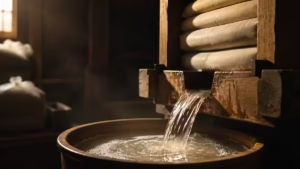
Pressed sake goes straight into a settling tank. Crews avoid splashing during the fill, since oxygen dulls fresh aroma. Chilled rooms then hold the tank near or below 5°C.
Brewers watch rather than guess. They draw small samples and hold them up to the light. A sharp boundary between clear and cloudy signals readiness.
The Transfer Itself
A siphon or a slow pump moves the clear layer into a fresh tank. Speed becomes the enemy here, because fast flow creates a small whirlpool that lifts settled material back up.
The operator stops before the cloudy boundary reaches the outlet. Judgment beats measurement at that exact moment. Many breweries taste the flow and check clarity as it runs.
Judging the Right Moment
No timer decides this step. Two tanks pressed on the same morning can behave differently by the second day.
Rice variety plays a part, and so does polishing ratio. Lightly polished rice leaves more protein behind, which changes how sediment packs. Yeast strain matters as well, since some strains clump readily and others drift.
Experience fills the gap between those variables. A senior brewer glances at a sample glass and knows. Newer staff learn by drawing samples morning and evening across a whole season.
Scale Changes the Feel of the Work
A small brewery might rack a single tank of around 1,800 liters by siphon in one quiet afternoon. Larger sites run several transfers a day through fixed piping, tracked on a printed schedule.
Either way, the operator watches the same thing. Everyone is looking for the moment when clear liquid starts to turn cloudy at the outlet.
Hygiene and the Second Pass
Clean lines matter enormously at this point. Sake has left the protective chaos of fermentation behind, and hiochi bacteria, the lactic acid organisms that spoil sake, can now take hold in a careless hose.
Crews sanitize hoses, valves, and pumps before every transfer. Some breweries flush lines with carbon dioxide to push out oxygen, and logs record tank number, date, temperature, and volume.
One racking rarely finishes the job. Storage brings more sediment, especially after heating, so most breweries repeat the step before bottling. That second pass tends to be quicker, though crews treat it with equal care.
The Science of Sedimentation

Sediment settles because gravity beats buoyancy and drag. Stokes’ law describes that balance for small particles, and three factors govern the outcome: particle size, density difference, and liquid viscosity.
Why Larger Particles Settle First
Settling speed scales with the square of particle diameter. Double the diameter, and a particle falls roughly four times faster.
That relationship explains the sequence in a tank. Coarse rice fragments drop within hours. Yeast cells, at 2 to 10 microns, take considerably longer, and fine protein needs days.
Why Thick, Cold Sake Settles More Slowly
Alcohol, residual sugar, and cold all raise viscosity, and thicker liquid resists a falling particle. Chilled sake therefore slows individual particles down.
Cold still wins overall. Low temperature calms the convection currents that stir a tank, slows enzymes, and protects delicate aroma. Brewers commonly chill toward 5°C or below, where particles clump into loose flocs and drop together. Research on brewing yeast makes the same point: flocculation drives practical settling, not lone cells.
How Tank Design Helps
Traditional Japanese tanks carry a raised mound in the base, called bozu. Sediment slides off that mound into the lower ring, known to brewers as yamashita.
Two outlets sit on the tank wall, both called nomikuchi. Crews draw clear sake from the upper one, while the lower outlet reaches the sediment layer. Modern conical tanks collect ori in the cone instead, and a tall narrow tank gives particles a longer, tidier fall.
Where Gravity Gives Up
Some material simply refuses to sink. Colloidal particles stay suspended almost indefinitely, held up by their own charge and by random molecular motion.
Waiting longer solves nothing there. A brewer could leave the tank for a month and still see a faint veil, so filtration or fining handles what physics alone cannot.
Knowing that boundary saves real time. Experienced crews stop settling once the rate of improvement flattens out. Extra waiting only exposes the sake to further enzyme activity.
Membrane filters answer the rest of the question. Pores near one micron catch starch granules, and finer SF filters at about 0.4 microns catch yeast and spoilage bacteria. Gravity never reaches that scale.
Oribiki vs Filtration vs Orisage
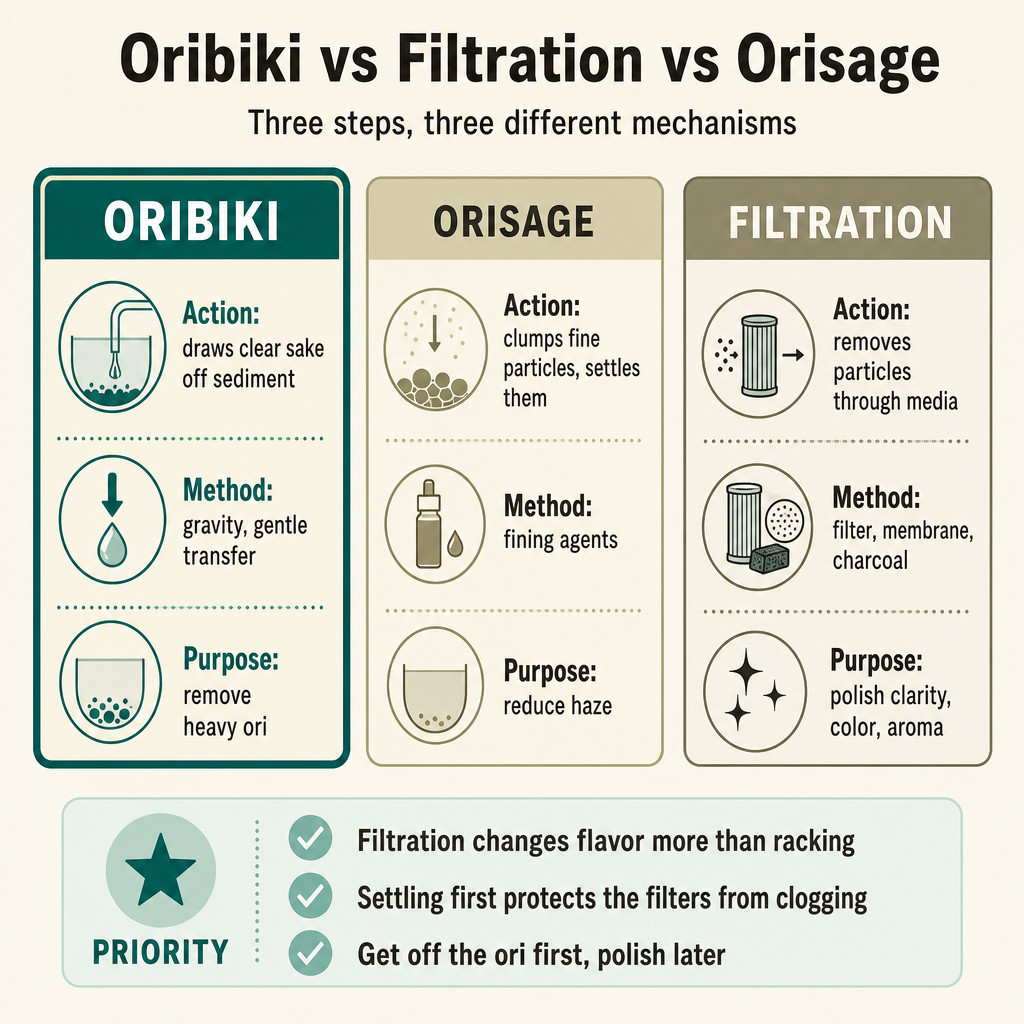
These three steps all clarify sake, yet the mechanism differs in each case. Gravity does the work in Oribiki, fining agents make fine particles clump during orisage, and filter media or charcoal remove the smallest particles, color, and some aroma during filtration.
| Step | Main action | Method | Purpose |
|---|---|---|---|
| Oribiki | Draws clear sake off settled sediment | Gravity and gentle transfer | Remove heavy ori |
| Orisage | Makes fine particles clump and settle | Fining agents | Reduce haze |
| Filtration | Removes particles through media | Filter, membrane, charcoal | Polish clarity, color, aroma |
Oribiki vs Filtration
Racking relies on gravity and patience, while filtration relies on a barrier and pressure. Everything else follows from that difference.
| Aspect | Oribiki | Filtration |
|---|---|---|
| Mechanism | Gravity settling | Physical barrier or adsorption |
| Targets | Larger, heavier sediment | Microscopic particles, color, aroma |
| Force involved | None beyond a gentle transfer | Pump pressure through media |
| Typical timing | Days after pressing | After settling, before storage |
| Effect on flavor | Mild and indirect | Direct, occasionally dramatic |
| Main cost | Time and tank space | Media, energy, and labor |
Filtration changes flavor far more dramatically. Activated charcoal strips color, harshness, and fragrance in one move. Racking takes out solid material instead, so character survives largely intact. Our filtration guide covers roka, muroka, and charcoal in depth.
This distinction explains a labeling puzzle. Muroka sake skips charcoal filtration, yet almost all of it went through racking. Nobody advertises that fact, because racking removes so little character.
Oribiki vs Orisage: What Is the Difference?
Orisage causes settling, and Oribiki completes it. Brewers add a fining agent that binds haze-forming material into heavier clusters, then rack the clear sake off the top.
- Persimmon tannin: links with protein and pulls it downward
- Gelatin: often pairs with tannin to complete the reaction
- Colloidal silica: an approved agent for removing haze-forming protein
- Alginic acid: coagulates under the acidic conditions of sake
- Activated carbon: adds color and aroma adjustment to the same operation
- Protease: breaks the bonds behind stubborn protein haze
Purpose separates them as clearly as method. Orisage usually answers a specific problem called shiroboke, the protein haze that appears after heating. Nada-ken describes the standard approaches in its sake glossary.
Why the Order Matters
Settling first protects the filters. Membrane filters with pores near one micron block up quickly against heavy sediment, and SF filters, finer still at about 0.4 microns, block up faster again.
Skipping either step carries a price. Skip the settling, and filtration turns slow and expensive. Skip the filtration, and a faint haze usually survives into the bottle.
Picture a February morning in a working brewery. One tank holds sake pressed on Tuesday, resting under a chilled ceiling, and nothing appears to happen. Across the room a filter unit hums while someone watches a sample glass beside the outlet.
Both operations chase clarity, and both cost something. Racking spends time, and filtration spends aroma. Balancing that pair defines much of the finishing work in sake.
Which Step Matters Most for Quality
Filtration attracts the label attention, yet racking often decides the outcome. Sediment left too long changes the sake permanently, and no later filter can restore what the enzymes altered.
Brewers describe the priority in simple terms. Get the sake off its ori quickly, then decide how much polishing it really needs. Skipping charcoal remains an option, while skipping the wait does not.
How Oribiki Shapes Flavor, Aroma, and Stability
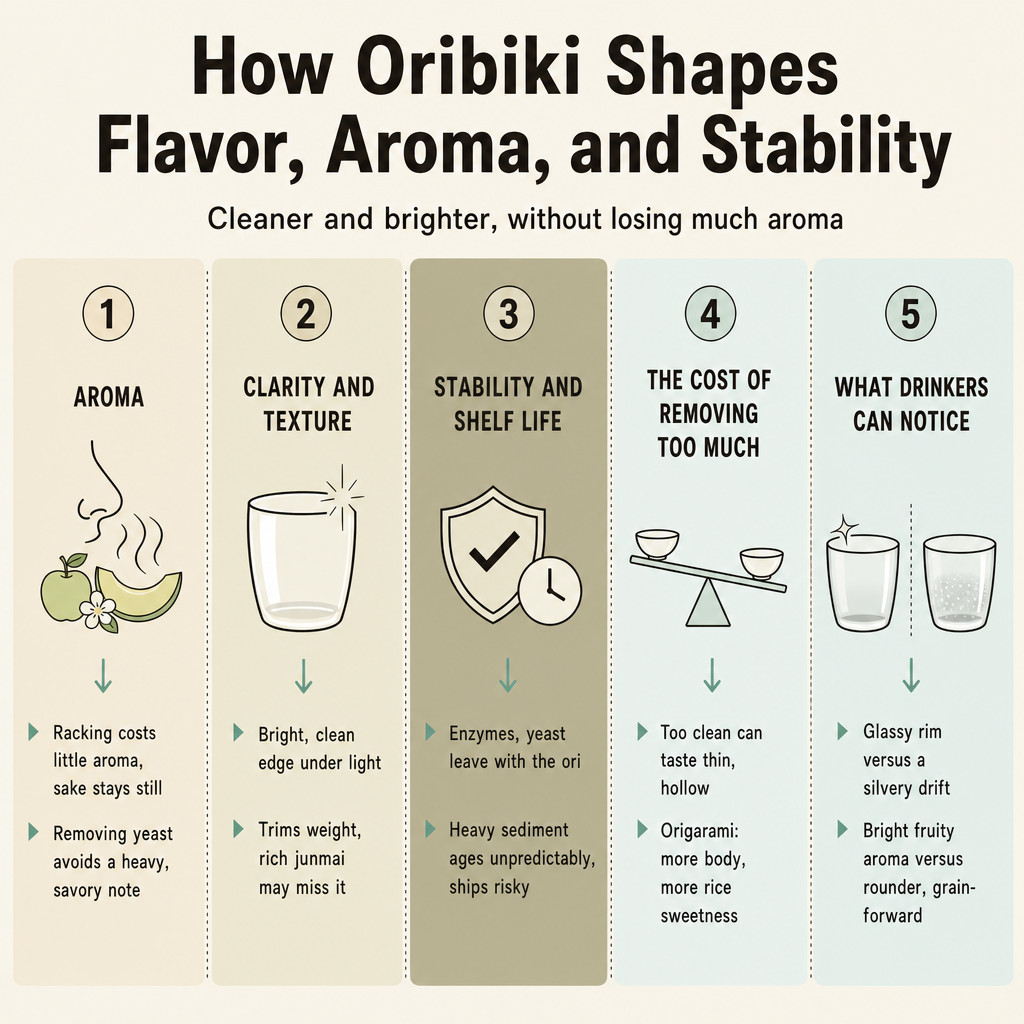
Oribiki gives a cleaner, brighter, and far more stable sake without stripping much aroma. That combination is exactly why brewers value the step.
Aroma
Ginjo aroma, the fruity fragrance of premium sake, is fragile stuff, and every pump, filter, and splash costs a little of it. Racking costs less than most handling steps, because the sake sits still and volatile compounds mostly stay put.
There is a second aroma benefit. Removing spent yeast prevents the slow release of amino acids from dying cells, so the sake avoids the heavy, faintly savory note that follows long ori contact.
Clarity and Texture
Clarity reads as quality to most drinkers, fairly or not. Well-racked sake pours bright under a light, with a clean edge in the glass.
Texture shifts in a quieter way. Removing solids trims a little weight from the palate, so the sake feels cleaner and its edges sharpen slightly. Whether that improves things depends on the style. A rich junmai may want the extra weight, while a crisp daiginjo probably does not.
Stability and Shelf Life
Stability is the practical prize. Enzymes and yeast leave the tank along with the ori, so flavor changes far more slowly during storage.
Sake carrying heavy sediment ages unpredictably. Shops cannot hold it long, and long-distance shipping grows risky. Careful racking buys months of calm.
Export markets raise the stakes further. A bottle may spend weeks in transit before it reaches a shelf overseas. Sediment left in the tank would keep reacting through every one of those weeks.
The Cost of Removing Too Much
Clean tastes good, and too clean tastes thin. Ori carries amino acids, peptides, and a certain roundness, so heavy removal can leave the sake hollow in the middle.
In side-by-side tastings, origarami versions often show more body and rice sweetness than fully racked ones. The clearer sake may smell brighter, while the hazier one can feel rounder and warmer on the palate.
Preference settles that argument, not chemistry. Brewers weigh the same trade every season, and reasonable people land in different places.
What Drinkers Can Notice
Hold a glass against white paper and look at the edge. A fully racked sake shows a clean, almost glassy rim. An origarami shows a faint silvery drift instead.
Aroma tells a similar story. Bright, fruity top notes usually mean careful handling and light treatment. A rounder, grain-forward smell often points to more contact with ori.
Oribiki in Nigori and Origarami Sake
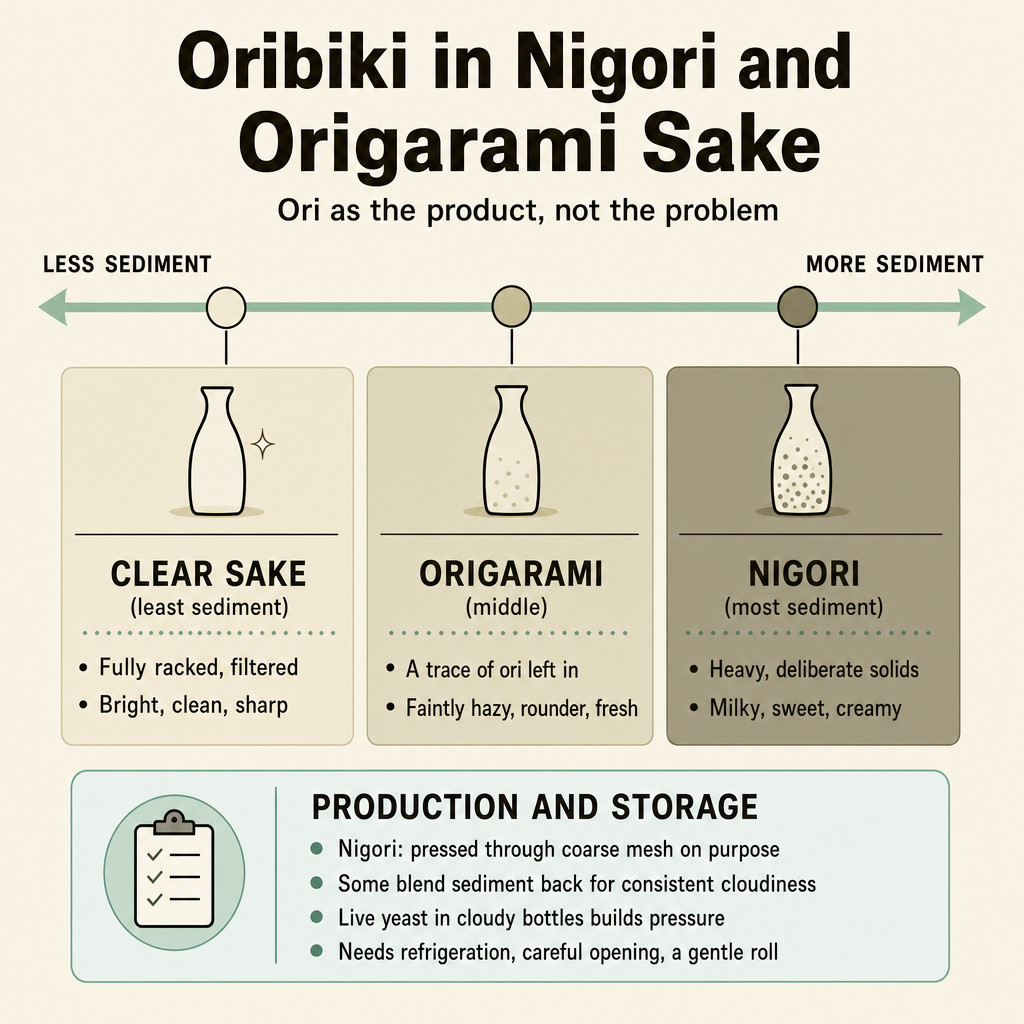
Cloudy styles treat ori as the product rather than the problem. Nigori keeps a heavy load of rice solids, origarami keeps only a trace, and clear sake keeps almost none.
| Style | Sediment level | Typical character |
|---|---|---|
| Clear sake | Fully racked and filtered | Bright, clean, sharp |
| Origarami | A trace of ori left in | Faintly hazy, rounder, fresh |
| Nigori | Heavy, deliberate solids | Milky, sweet, creamy |
Brewers press nigori through a coarse mesh, so plenty of solids ride through on purpose. Some producers still settle it partially, then blend a measured amount of sediment back for consistent cloudiness. Others bottle the cloudy liquid without any separation at all.
Storage rules change with the sediment. Live yeast in a cloudy bottle keeps nibbling at residual sugar, so pressure can build. Many nigori labels therefore ask for refrigeration, careful opening, and a gentle roll before pouring.
Serving habits differ between drinkers. Some roll the bottle gently to mix the layers evenly. Others pour the clear top portion first, then the cloudy base, and taste both. That comparison shows the role of ori more clearly than any description.
Traditional and Modern Oribiki Methods
The method itself never changed, though the equipment did. Brewers once waited in cedar vats and siphoned by hand, and today they wait in temperature-controlled steel tanks and transfer through sanitary pumps.
- Vessel: cedar vats then, enameled or stainless tanks now
- Cooling: winter air then, refrigerated rooms and cooling jackets now
- Transfer: ladles and hand siphons then, sanitary pumps and fixed lines now
- Judgment: eye and memory then, turbidity meters plus the same trained eye now
- Sediment load: heavy from hemp bags then, lighter from synthetic cloth now
Nada-ken notes that synthetic press bags and machine presses cut sediment volumes considerably. A modern kura, the Japanese word for a sake brewery, also runs closed piping, which limits oxygen from tank to tank.
Human judgment never disappeared, though. The master brewer still decides when to open the valve. Sensors report numbers, and people read the sake.
Some old habits survive by choice rather than by accident. A few breweries still rack by siphon, arguing that pumps bruise fragile aroma. Whether that difference reaches the glass remains a friendly argument among brewers.
A Short History of Clear Sake and Oribiki
Clear sake carried prestige long before anyone could explain the chemistry. Poems from the Manyo era, roughly the seventh and eighth centuries, already praise sumizake, meaning clear sake. Clarity signaled care rather than luck.
Early clarity came from waiting alone. Vats sat still through the cold months, and brewers drew off the bright layer above. Charcoal arrived later, wrapped in a famous story about a dismissed worker who threw brazier ash into a brewery’s sake out of spite.
Historians treat that tale carefully, since ash may have served against off-flavors far earlier. Either way, settling remained the foundation, and charcoal simply built on top of it.
Refrigeration later freed brewers from the calendar, and cold rooms made reliable settling possible in any season. Cloudy styles then came back into fashion, so sediment stopped meaning failure and started meaning choice.
Modern taste has nudged the practice again. Fragrant ginjo styles reward gentle handling, so racking now carries more weight than it once did. Several breweries lean on settling and skip heavy charcoal entirely.
Common Misconceptions About Oribiki
- Is cloudy sake unfinished? No. Nigori and origarami are finished products that keep sediment on purpose.
- Does clear sake always taste better? No. Clarity reflects a style choice, not a quality ranking.
- Does the law require Oribiki? No. Japanese law requires pressing, and racking stays optional.
- Does Oribiki strip flavor? Barely. It takes solids away rather than dissolved aroma compounds.
- Is sediment harmful? No. Ori is perfectly edible, and some breweries sell it deliberately.
Another assumption concerns effort. People often treat a hands-off step as a minor one. Ask a brewer about a botched transfer, though, and the mood in the room changes quickly.
One myth deserves a second look. Many drinkers read any haze as spoilage. Shiroboke haze usually disappears when the sake warms, while genuine spoilage does not.
Final Thoughts
In short, Oribiki is the quiet racking step that turns freshly pressed, hazy sake into a clearer and more stable liquid before filtration. It does not replace filtration, and it does not strip out character. Instead, it gives brewers a gentle way to separate sake from ori while preserving aroma, texture, and house style.
The step asks for patience more than technique. Nobody needs a machine to make sediment fall, and the brewer simply provides stillness, cold, and time.
A judgment call still hides inside it. Take too little, and the sake drifts in storage. Take too much, and it loses some warmth. Every brewery answers that question in its own voice.
Next time a glass of sake looks perfectly bright, remember the quiet tank behind it. Someone waited three days, watched a boundary form, and opened a valve at exactly the right moment.
Two things are worth trying next. Taste an origarami beside a clear sake from the same brewery, since the pair shows what ori actually contributes. Then read our filtration guide to see how brewers finish the job that racking begins.
Oribiki FAQ
What is Oribiki in sake brewing?
Oribiki is the sake racking step that separates clear sake from settled sediment after pressing. Brewers rest the young sake in a tank until solids sink. They then transfer the bright liquid into a fresh tank. The sediment, called ori, stays behind.
What does ori actually contain?
Ori holds fine rice fragments, koji particles, and spent yeast cells. It also carries insoluble protein, fiber from the press cloth, and active enzymes. None of it is harmful. Brewers simply want it out of the finished sake.
How long does Oribiki take?
Settling usually needs one to three days in cold storage. Colder tanks and finer particles push that window longer. Brewers judge readiness by drawing samples and watching the boundary form. The transfer itself takes only a few hours.
Is Oribiki the same as filtration?
No, the two steps work on completely different principles. Oribiki uses gravity, and filtration uses a physical barrier. Racking removes heavy sediment cheaply, while filters catch microscopic particles. Most breweries run both, in that order.
What is the difference between Oribiki and Orisage?
Orisage makes fine particles clump together so they can sink. Oribiki then draws the clear sake off that settled layer. Brewers use tannin, gelatin, silica, or enzymes for orisage. One step causes settling, and the other completes it.
Does Oribiki change the taste of sake?
It changes taste less than filtration does. Racking removes solid material instead of dissolved aroma compounds. Sake usually feels a little lighter and cleaner afterward. Heavy sediment removal can also cost some richness.
Is sediment in a sake bottle safe to drink?
Yes, ori poses no safety problem at all. Nigori and origarami keep sediment on purpose. Some breweries even bottle the ori-rich portion as a specialty product. Visible haze signals style far more often than spoilage.
How should I store a bottle of sake that has sediment?
Keep it upright in a refrigerator and drink it sooner rather than later. Sediment holds live yeast and enzymes, so flavor moves faster than in clear sake. Open nigori bottles slowly, because pressure can build inside. Roll the bottle gently instead of shaking it.
Can visitors see Oribiki on a brewery tour?
Rarely, because the tank simply sits still for days. Guides usually point out the settling tanks and the two outlets on the wall instead. Pressing and koji making make far better viewing. Winter visits between October and March give the best chance of seeing active work.
References
- National Research Institute of Brewing, Japanese Sake: A Comprehensive Guide, https://www.nrib.go.jp/English/sake/pdf/guidesse01.pdf (Surveyed: July 2026)
- Nada-ken Sake Glossary, Ori, https://www.nada-ken.com/main/en/index_o/236.html (Surveyed: July 2026)
- Nada-ken Sake Glossary, Ori-sage, https://www.nada-ken.com/main/en/index_o/238.html (Surveyed: July 2026)
- SAKE Street, Why Sake Looks Clear: Learning the Process from Pressing to Bottling, https://sakestreet.com/en/media/learn-sake-fining-1 (Surveyed: July 2026)
- SAKE Street, The Finishing Touch: Ways in Which Pressing Shapes the Sake, https://sakestreet.com/en/media/learn-sake-filterlation (Surveyed: July 2026)
- BrewSake.org, Sake Filtering and Racking, https://www.brewsake.org/filtering (Surveyed: July 2026)
- Stewart, G. G. (2018). Yeast Flocculation: Sedimentation and Flotation. Fermentation, 4(2), 28, https://www.mdpi.com/2311-5637/4/2/28 (Surveyed: July 2026)
- Journal of the Brewing Society of Japan on J-STAGE, https://www.jstage.jst.go.jp/browse/jbrewsocjapan (Surveyed: July 2026)
Related Articles
- Pressing (上槽 / Joso): How Moromi Becomes Sake (Surveyed: July 2026)
- Filtration (濾過 / Roka): Refining Sake After Pressing (Surveyed: July 2026)
- Pasteurization (火入れ / Hiire): Stabilizing Sake with Gentle Heat (Surveyed: July 2026)
- Warimizu (割水): Why Water Is Added Before Bottling Sake (Surveyed: July 2026)
- Moromi (醪): The Main Fermentation Mash (Surveyed: July 2026)
- Kura (酒蔵): Inside a Traditional Japanese Sake Brewery (Surveyed: July 2026)
- Toji (杜氏): The Master Brewer Behind Every Bottle of Sake (Surveyed: July 2026)
- Nigori Sake: History, Restaurants and Online Shopping (Surveyed: July 2026)
- How Sake Is Made: Step-by-Step Japanese Brewing Guide (Surveyed: July 2026)






Comments