


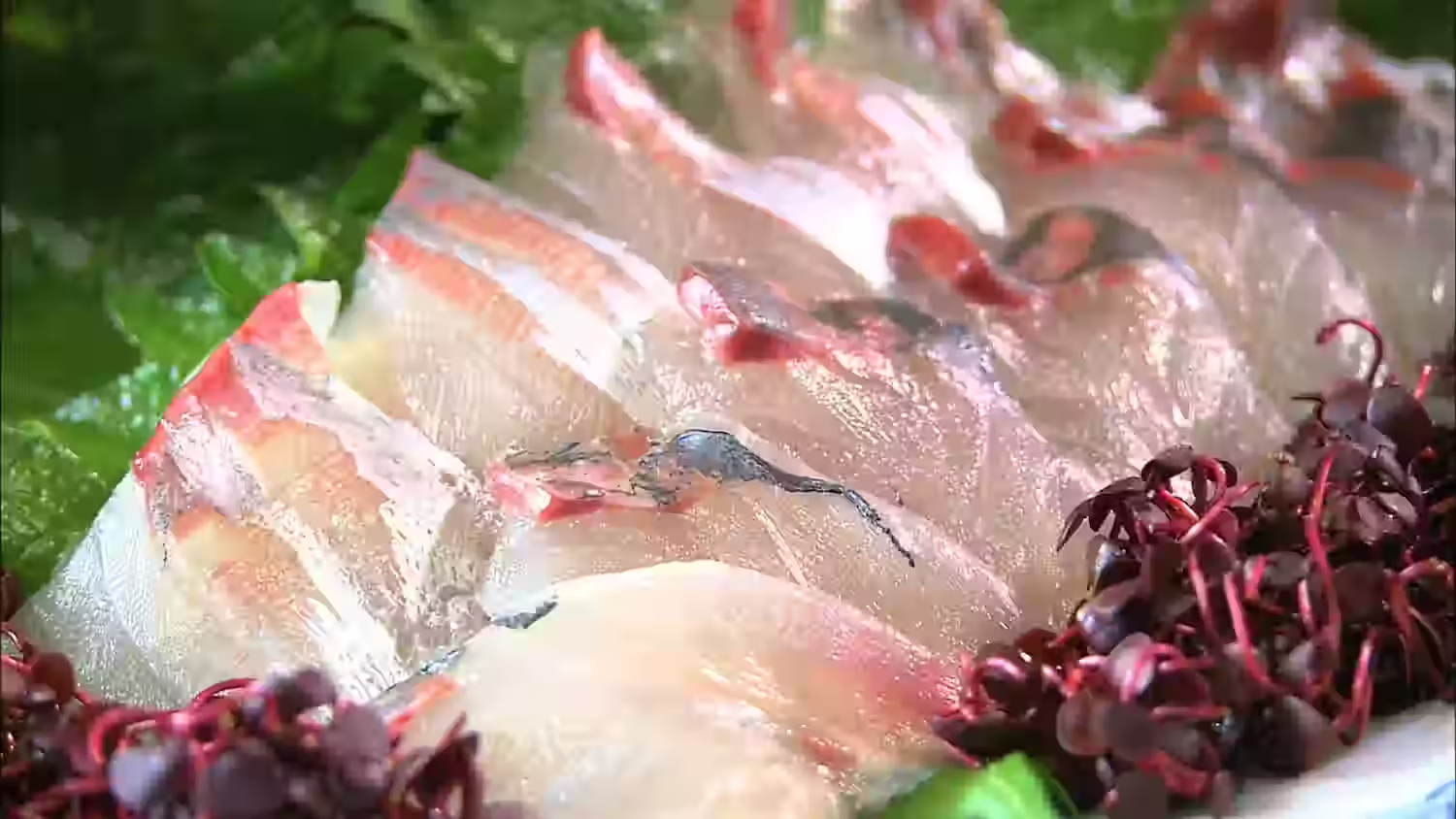



Sekiaji (Seki horse mackerel, 関あじ) is a branded Japanese jack mackerel from Saganoseki, in Oita Prefecture on the island of Kyushu. It is not a separate species. Only fish caught individually by hook and line, known as ippon-zuri (一本釣り), by members of the local cooperative branch can carry the name.
The fish became famous after its name spread in the 1980s. Today it is sold as a premium fish, priced well above everyday aji. So what helps explain its premium status? This guide explains the strait, the fishing, the careful handling, the brand tag, and how to enjoy Sekiaji as sashimi in Oita.
Quick Facts: Sekiaji
- Japanese name
- 関あじ (Seki aji), pronounced seh-kee ah-jee
- Fish
- Japanese jack mackerel, Trachurus japonicus (マアジ, ma-aji)
- Where
- Hayasui Strait off Saganoseki, Oita City, Oita Prefecture
- Who can use the name
- Fishers of the Saganoseki branch of the Oita Prefectural Fisheries Cooperative
- How it is caught
- Hook-and-line fishing (ippon-zuri) with lures or ragworms
- Handling
- Kept alive, priced by eye (tsuragai), rested a day, then bled (ikejime)
- Peak season
- July to September, according to Oita City and Oita Prefecture
- Best way to eat
- Sashimi
- Brand protection
- Regional collective trademark (2006) and a tag seal on genuine fish
What Is Sekiaji?
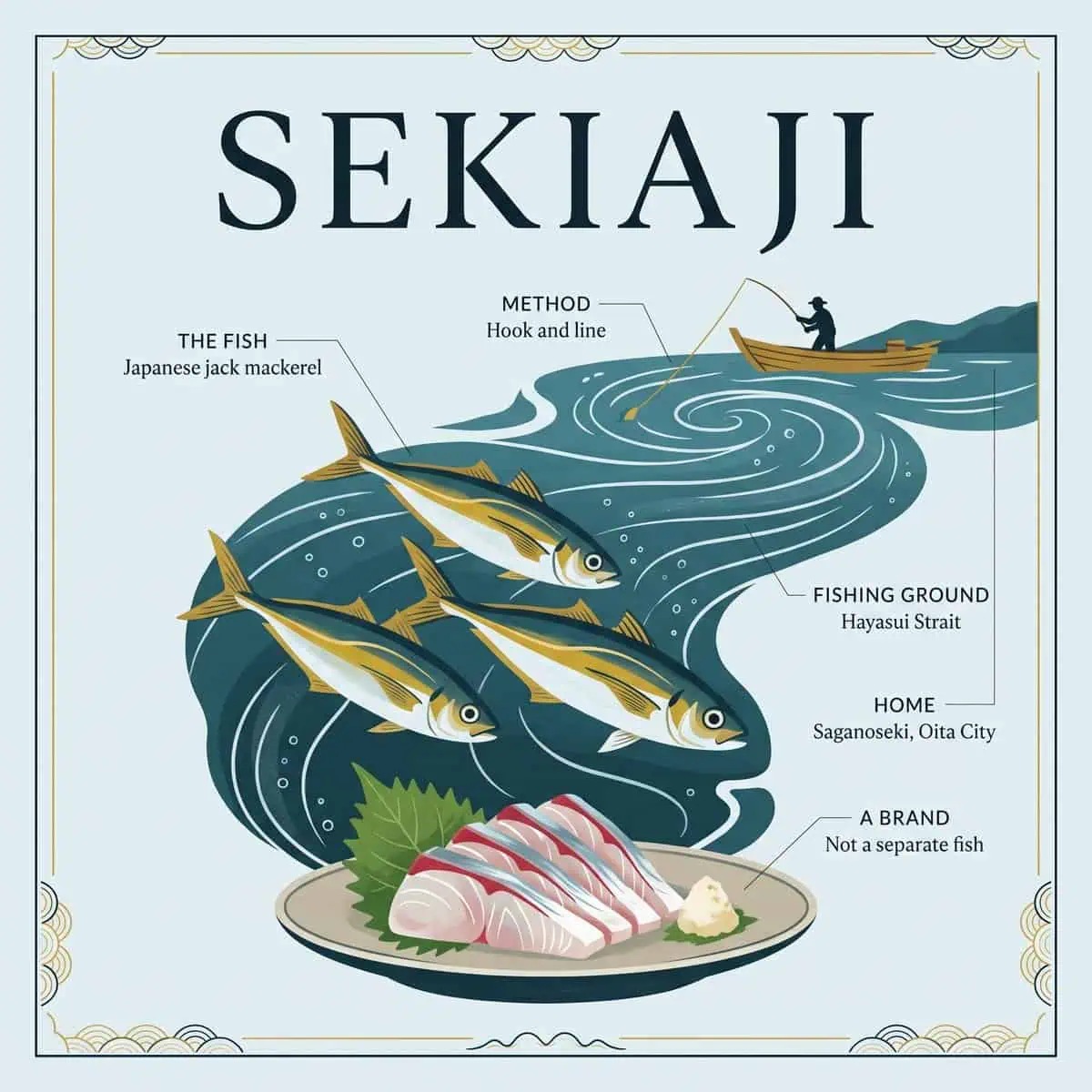
Sekiaji is a brand of Japanese jack mackerel, not a separate kind of fish. Japan’s Ministry of Agriculture, Forestry and Fisheries puts it simply. Only Japanese jack mackerel caught by hook and line in the Hoyo Strait, by members of the cooperative’s Saganoseki branch, may use the name.
Sekiaji in English
In English, the spelling varies. You will see Sekiaji, Seki aji, and Seki horse mackerel. The species itself is usually called Japanese jack mackerel, while menus often say Japanese horse mackerel or simply horse mackerel. On Japanese menus, aji usually means Japanese jack mackerel. Sekiaji is a protected regional brand for qualifying aji from Saganoseki.
Is Sekiaji a Different Species of Fish?
No. Sekiaji is Trachurus japonicus, the same species as ma-aji, the Japanese jack mackerel commonly sold as aji in Japan. The difference lies in where it is caught, how it is caught, and how it is handled afterward.
The Difference Between Aji and Sekiaji
For example, ordinary aji may come from many fishing grounds and methods, including nets. Sekiaji, by contrast, must come from one small area and one fishing method. It also goes through a strict handling routine before shipping. Other regions have branded aji too, such as Chiba’s Kogane aji, but each follows its own rules.
Where Does Sekiaji Come From?
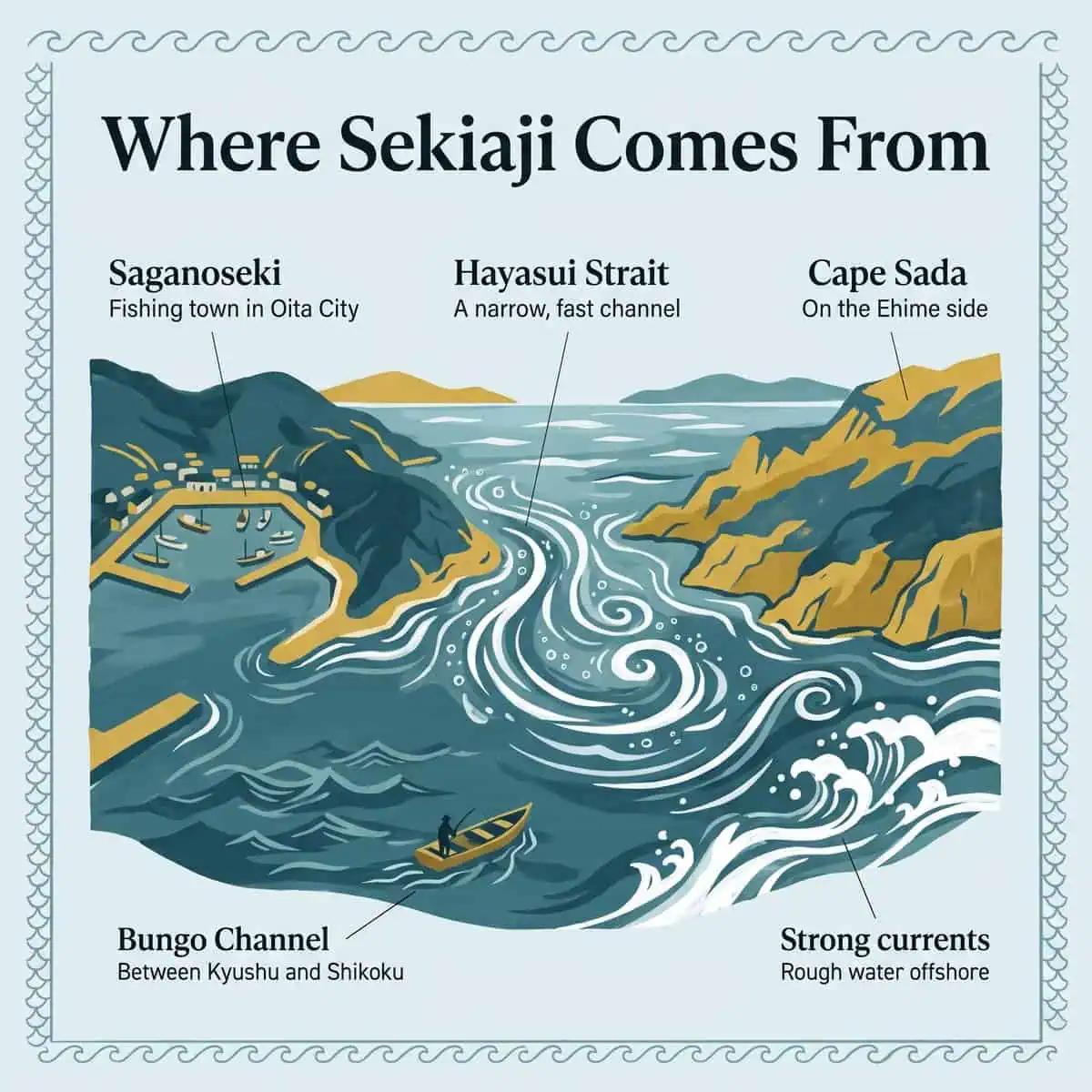
Sekiaji comes from the sea off Saganoseki, a fishing town at the tip of a peninsula in eastern Oita City. The boats work a narrow, fast-moving channel between Kyushu and Shikoku.
Saganoseki in Oita Prefecture
Although once a separate town, Saganoseki became part of Oita City in 2005. The town has a long tradition of hook-and-line fishing, shaped by the rough water just offshore. In a prefectural fisheries plan, line fishing made up 79% of the Saganoseki area’s total catch.
The Hayasui Strait and the Bungo Channel
The fishing ground is called Hayasui no Seto, or the Hayasui Strait. It lies between the Saganoseki Peninsula and Cape Sada in Ehime Prefecture, within the wider Hoyo Strait. Here, the Bungo Channel, which opens to the Pacific, meets the Seto Inland Sea. As a result, the tide runs fast.
Do Fast Currents Shape the Fish?
Local authorities and the cooperative associate the strong currents and rich feeding grounds with the fish’s firm texture. However, that link is hard to prove scientifically. The cooperative says the currents are fast and food is plentiful. It also says the seabed is very uneven, with many reefs. Summer water there is cooler than elsewhere, possibly because of upwelling, and winter water is warmer.
The cooperative also says these fish may stay near the reefs rather than migrate. It even suggests they could form a separate local group. Notably, its own wording is cautious, so this remains a local view, not a proven fact.
What Makes Sekiaji Special?
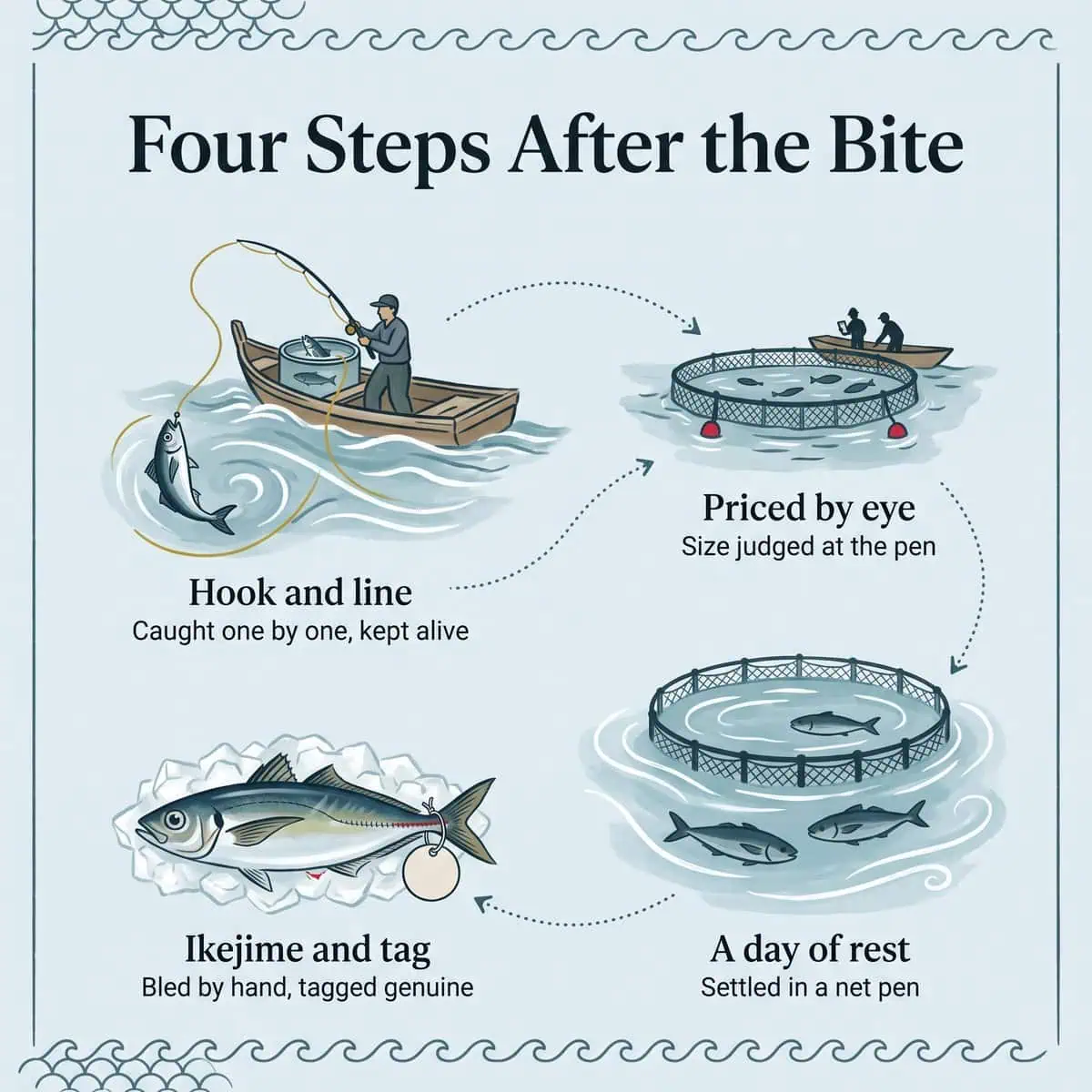
Sekiaji stands out mainly because of how it is caught and handled. Natural conditions matter, but the brand depends on four steps that happen after a fish bites.
- Hook-and-line catchFish are caught one by one and kept alive in the boat’s tank.
- Priced by eyeBuyers judge size from the surface of the pen instead of weighing each fish.
- A day of restLive fish settle in a net pen for at least a day before shipping.
- Ikejime and tagEach fish is bled by hand, chilled, and tagged as genuine.
Traditional Hook-and-Line Fishing
First, fishers work each line by hand, often with several hooks on it. According to Oita Prefecture, the bait is only lures or ragworms, and fishers do not scatter chum. A cooperative staff member has described feeling for bites through the fingertips rather than using a rod. Compared with nets, hook-and-line fishing also avoids crushing the fish together.
Tsuragai: Buying Fish by Sight
Back at port, the cooperative buys the catch through tsuragai (面買い), which means buying by looking. Instead of lifting each fish onto a scale, staff estimate size from the water’s surface. As a result, the fish avoid the thrashing that can bruise or split the flesh.
Resting and Ikejime
Next, live fish rest in a net pen for at least a day to calm down. Then, before shipping, workers dispatch and bleed each fish by hand using ikejime. They cut the spinal cord with a knife, drain the blood, and chill the fish on ice. Depending on the order, they may also perform shinkeijime, or nerve destruction, to delay post-mortem changes.
Worth Knowing
Researchers at Oita University have studied how handling affects fish quality, mainly with chub mackerel. A 1999 study found that storing fish at about 5°C after slaughter delayed rigor and kept the muscle firmer for longer. The study did not evaluate Sekiaji. Still, it offers useful background on why temperature control after the catch can matter.
Quality Standards and the Brand Tag
Finally, genuine fish leave the Saganoseki branch with a tag seal. The tag shows it is Sekiaji under the regional collective trademark. According to Oita Prefecture, the cooperative also watches for fakes sold elsewhere in Japan.
What Does Sekiaji Taste Like?
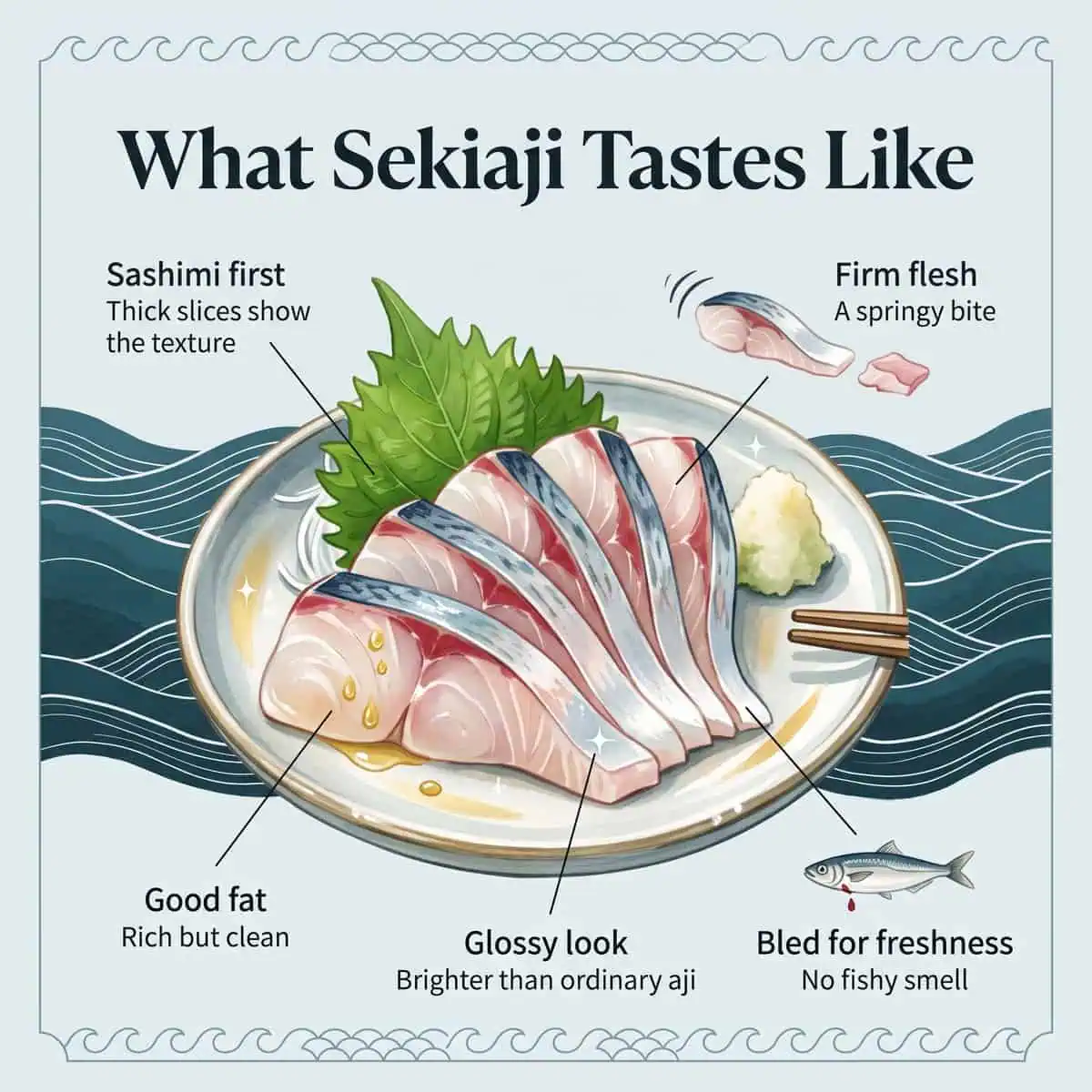
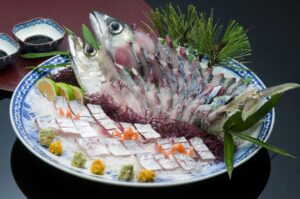
Sekiaji is prized for firm, springy flesh and a good amount of fat. Oita Prefecture describes the fish as large, fatty, and firm, which is why sashimi is the usual choice. A prefectural feature adds that it looks glossier than ordinary aji.
In addition, bleeding the fish matters. The cooperative’s shop says the blood removal keeps the fish fresh without a fishy smell. Of course, taste is personal, and it still varies by size, season, and how long the fish has rested. Even so, the firm bite is usually the first thing people notice.
Sekiaji vs Regular Horse Mackerel
Ordinary aji can be excellent too, especially very fresh fish from a good market. The key difference with Sekiaji is a defined, traceable process. The fishing area, method, handling, and distribution all run through the Saganoseki brand system. So you pay for that process, not only for the fish.
When Is Sekiaji in Season?
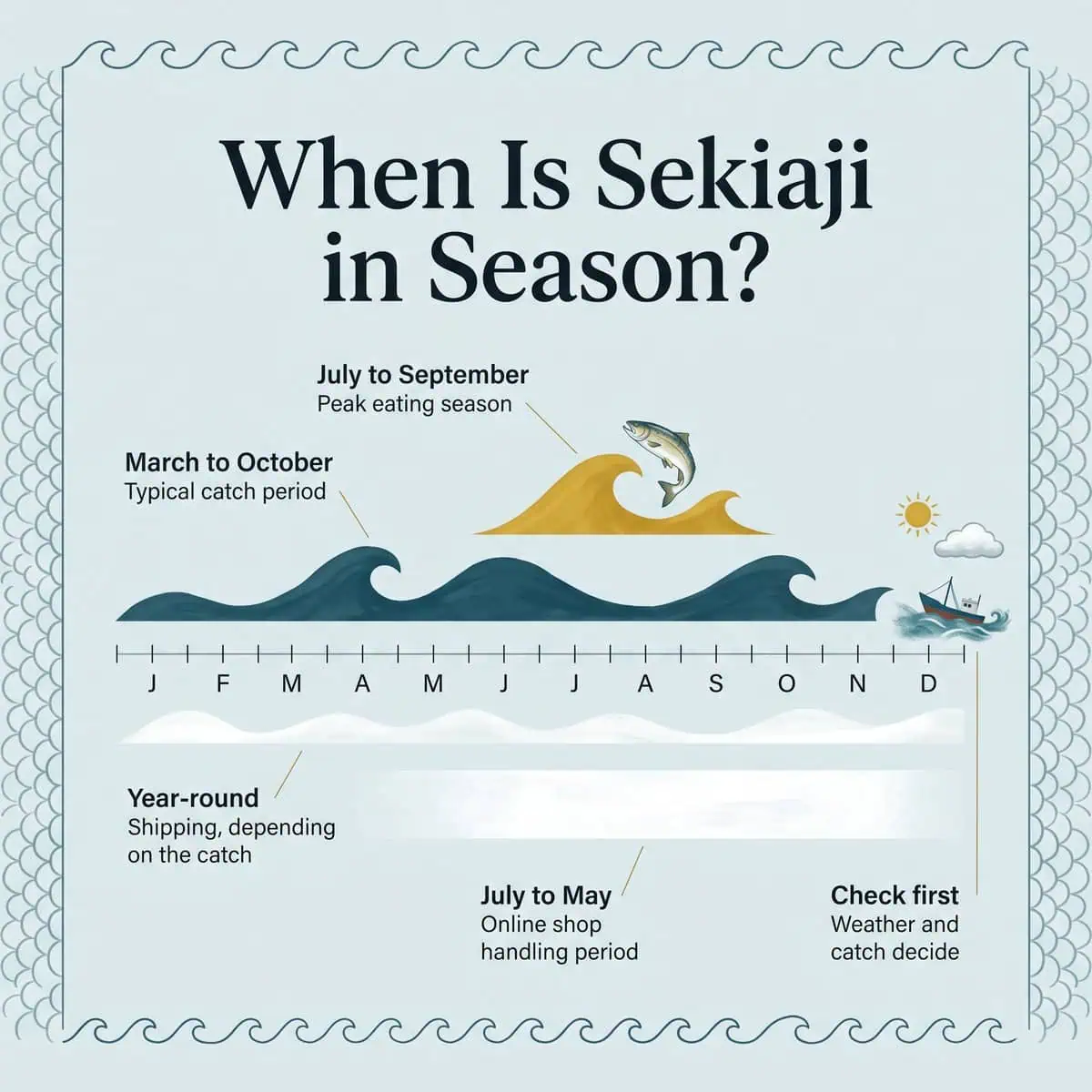
Oita City’s official guide, updated in June 2026, gives July to September as the season for Sekiaji. An Oita Prefecture feature names the same months. However, “season” means different things depending on the source, as the table shows.
| Term | Months | Source |
|---|---|---|
| Peak eating season | July to September | Oita City (2026) and Oita Prefecture’s edit Oita feature |
| Typical catch period | March to October | Oita Prefectural Fisheries Cooperative |
| Cooperative shipping period | Year-round, depending on the catch | Oita Prefectural Fisheries Cooperative |
| Online shop handling period | July to the following May | Saganoseki branch online shop |
Availability depends on weather and the catch, so check with the seller or restaurant before you go.
In practice, summer is the safest bet for peak Sekiaji. Large fish can be scarce at times, though. In October 2026, for example, the online shop had paused larger sizes until catches recovered.
How Is Sekiaji Eaten?
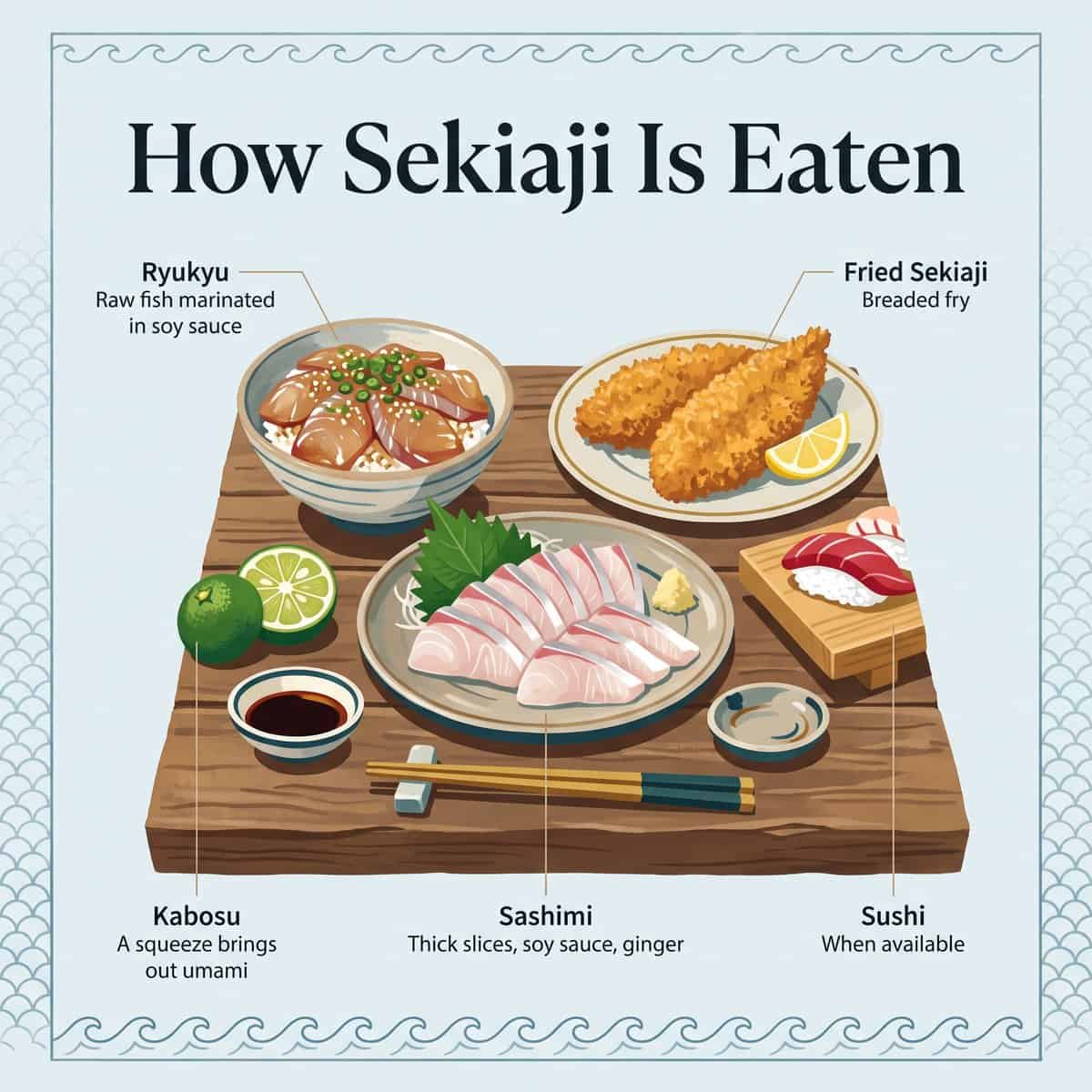
Sashimi comes first, by a wide margin. Still, Saganoseki also turns Sekiaji into a few other dishes worth trying.
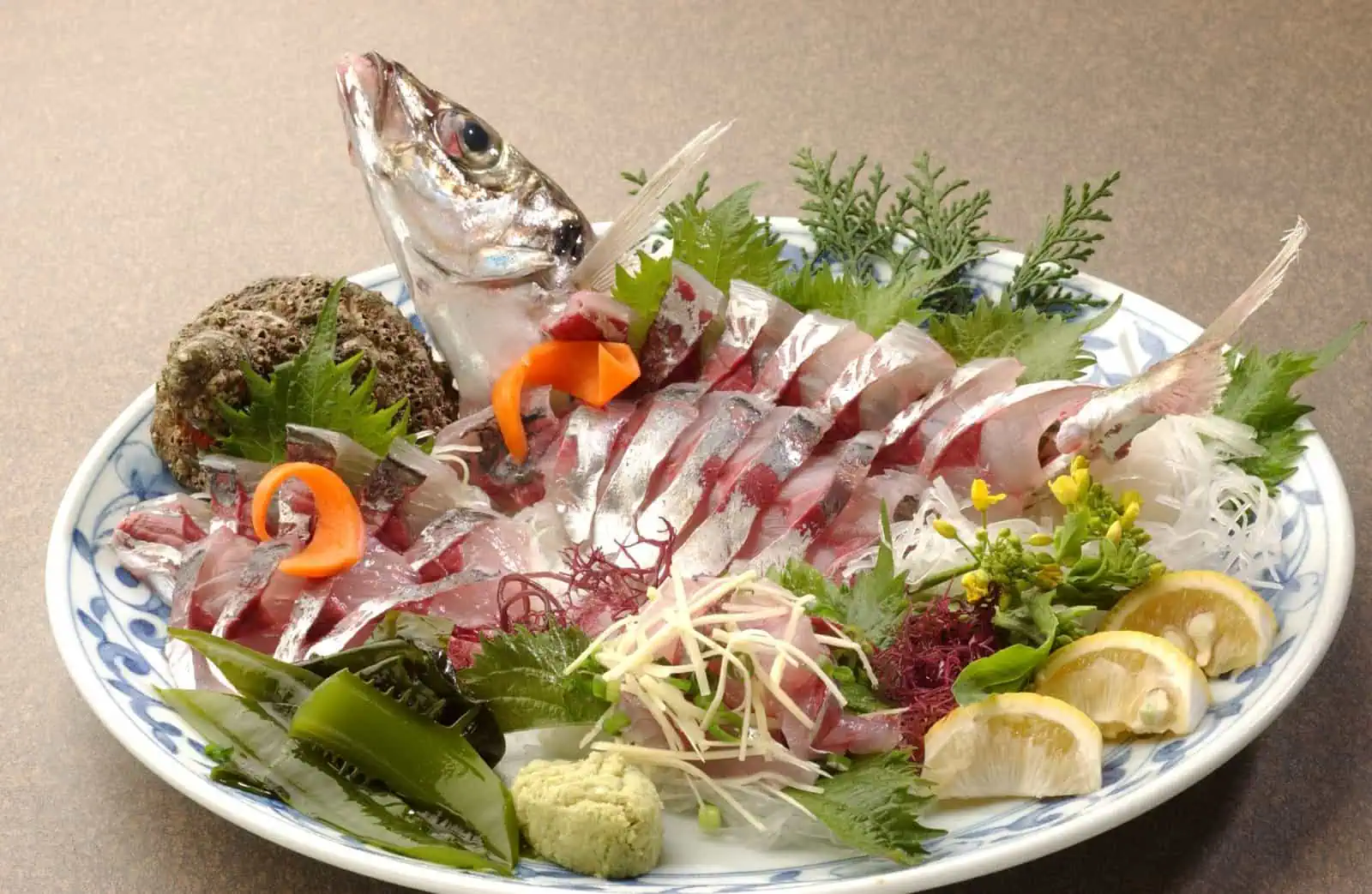
Sekiaji Sashimi
Above all, thick slices of sashimi show off the firm texture best. Restaurants often serve it with soy sauce, grated ginger, and green onion. Oita City and Oita Prefecture both suggest a squeeze of kabosu, the local citrus, to bring out more umami.
Ryukyu and Fried Sekiaji
The cooperative also sells Sekiaji ryukyu, an Oita dish of raw fish marinated in a soy-based sauce. It sells breaded Sekiaji fry, too. Both make good use of the fish beyond plain sashimi, and they travel better than live fish.
Sushi and Other Dishes
When it is available, some sushi bars may also serve Sekiaji as nigiri. Elsewhere in the prefecture, you can try a similar local bowl, Hyugadon, which uses marinated fish over rice.
Can You Eat Sekiaji Raw Safely?
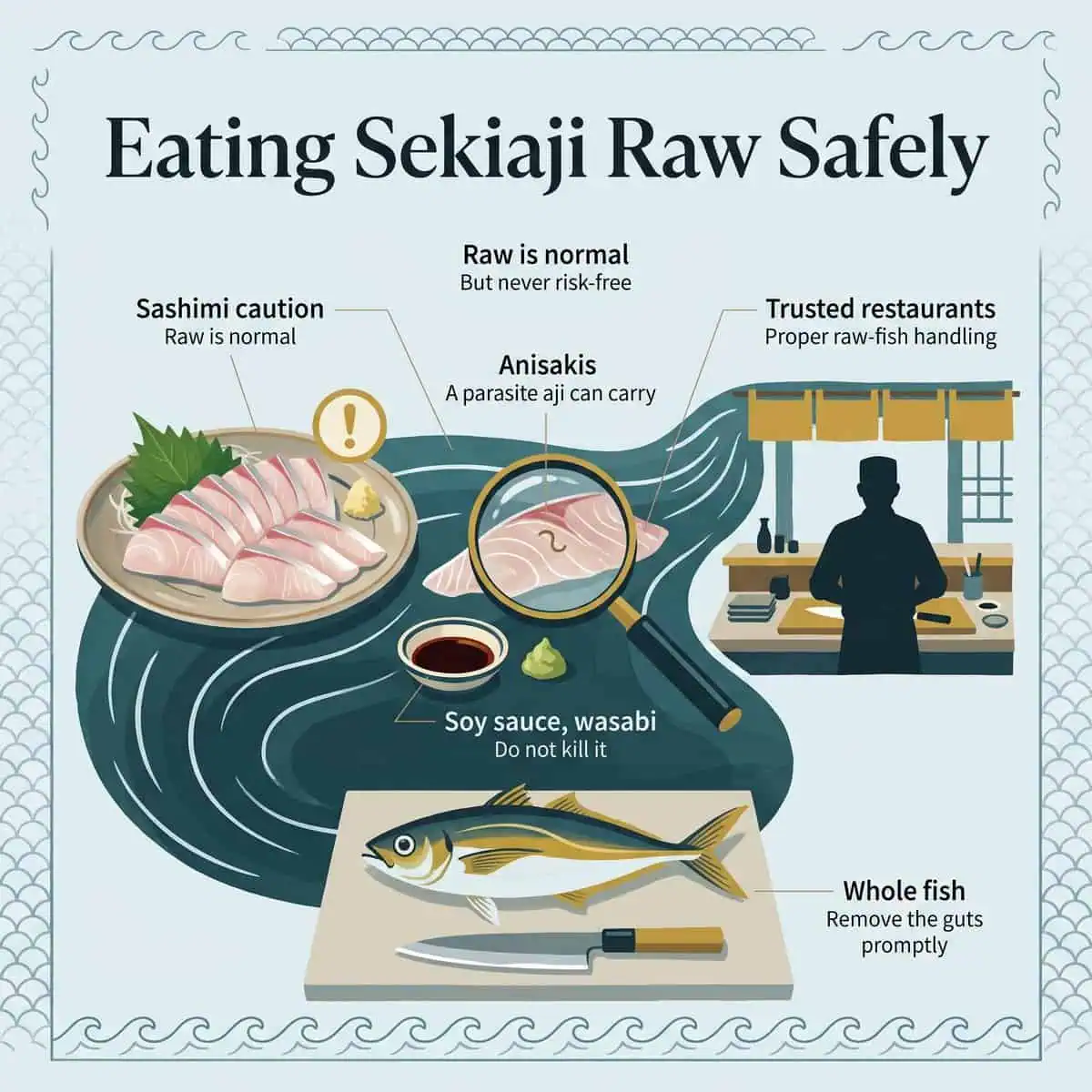
Yes, Sekiaji is normally eaten raw, but no raw fish is risk-free. Japan’s Ministry of Health, Labour and Welfare lists aji among the fish that can carry anisakis, a parasite. Vinegar, salt, soy sauce, and wasabi do not kill it.
For that reason, eat Sekiaji sashimi at restaurants that handle raw fish properly. If you buy a whole fish, remove the guts promptly and check the flesh carefully. For food businesses, the ministry advises freezing at -20°C for at least 24 hours, or applying enough heat, to kill the larvae.
Sekiaji vs Sekisaba
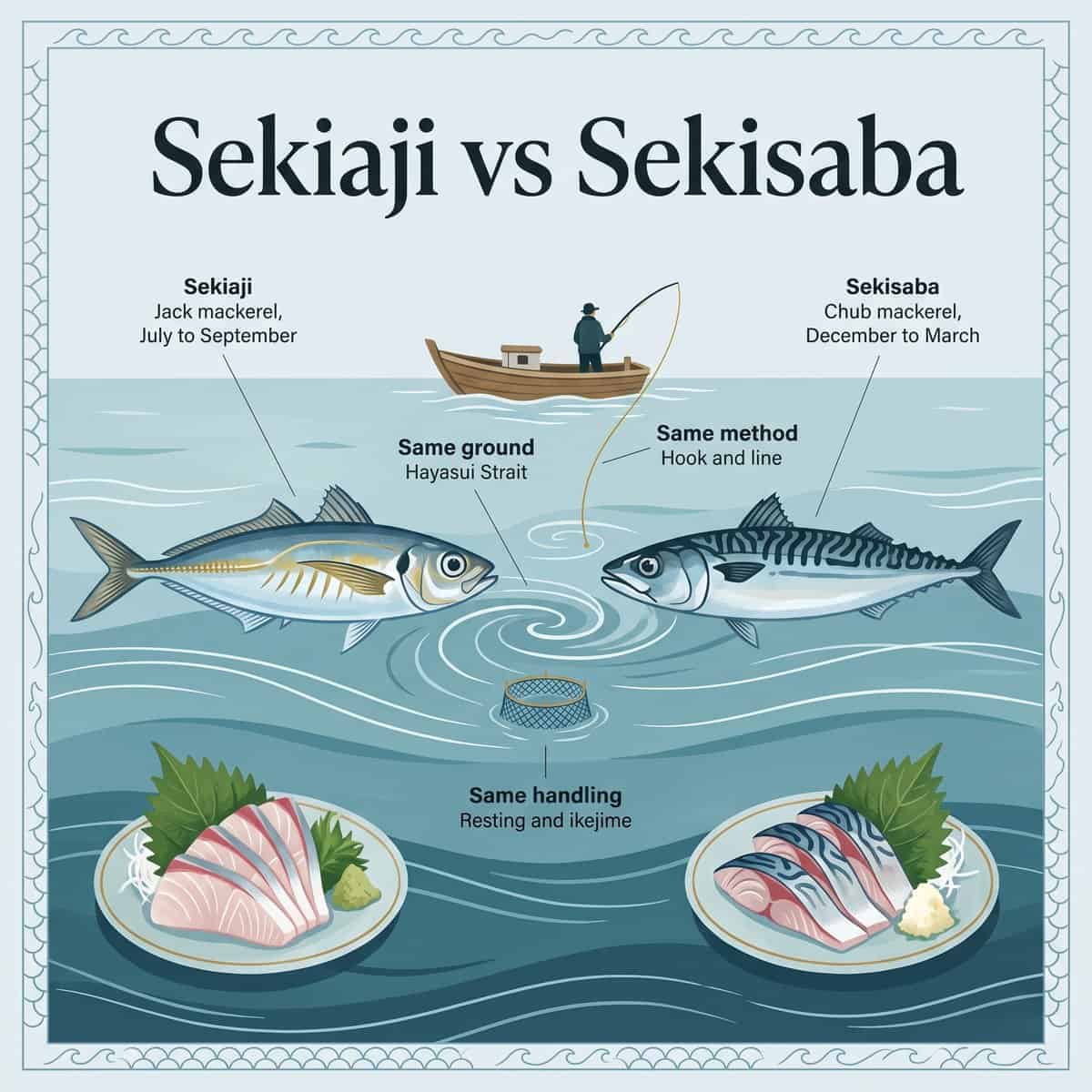
Sekiaji and Sekisaba are sister brands from the same Saganoseki fishing area, with broadly similar fishing and handling. The difference is the fish species. Our guide to Seki saba covers the mackerel in detail.
| Point | Sekiaji | Sekisaba |
|---|---|---|
| Species | Japanese jack mackerel (マアジ) | Chub mackerel (マサバ) |
| Fishing ground | Hayasui Strait off Saganoseki | Hayasui Strait off Saganoseki |
| Method | Hook-and-line fishing | Hook-and-line fishing |
| Handling | Tsuragai, resting, ikejime | Tsuragai, resting, ikejime |
| Peak season | July to September | December to March |
| Main dish | Sashimi | Sashimi |
| Trademark | Regional collective trademark | Regional collective trademark |
Based on Oita City, Oita Prefecture, the Ministry of Agriculture, Forestry and Fisheries, and the Saganoseki branch.
Which One Should You Try?
Because their peak seasons differ, summer favors Sekiaji and winter favors Sekisaba. Still, if you can, try both on the same plate. Some Oita restaurants serve both, which makes the comparison easy. Each fish has its own texture and flavor, and individual fish vary by size and season.
How to Recognize Authentic Sekiaji
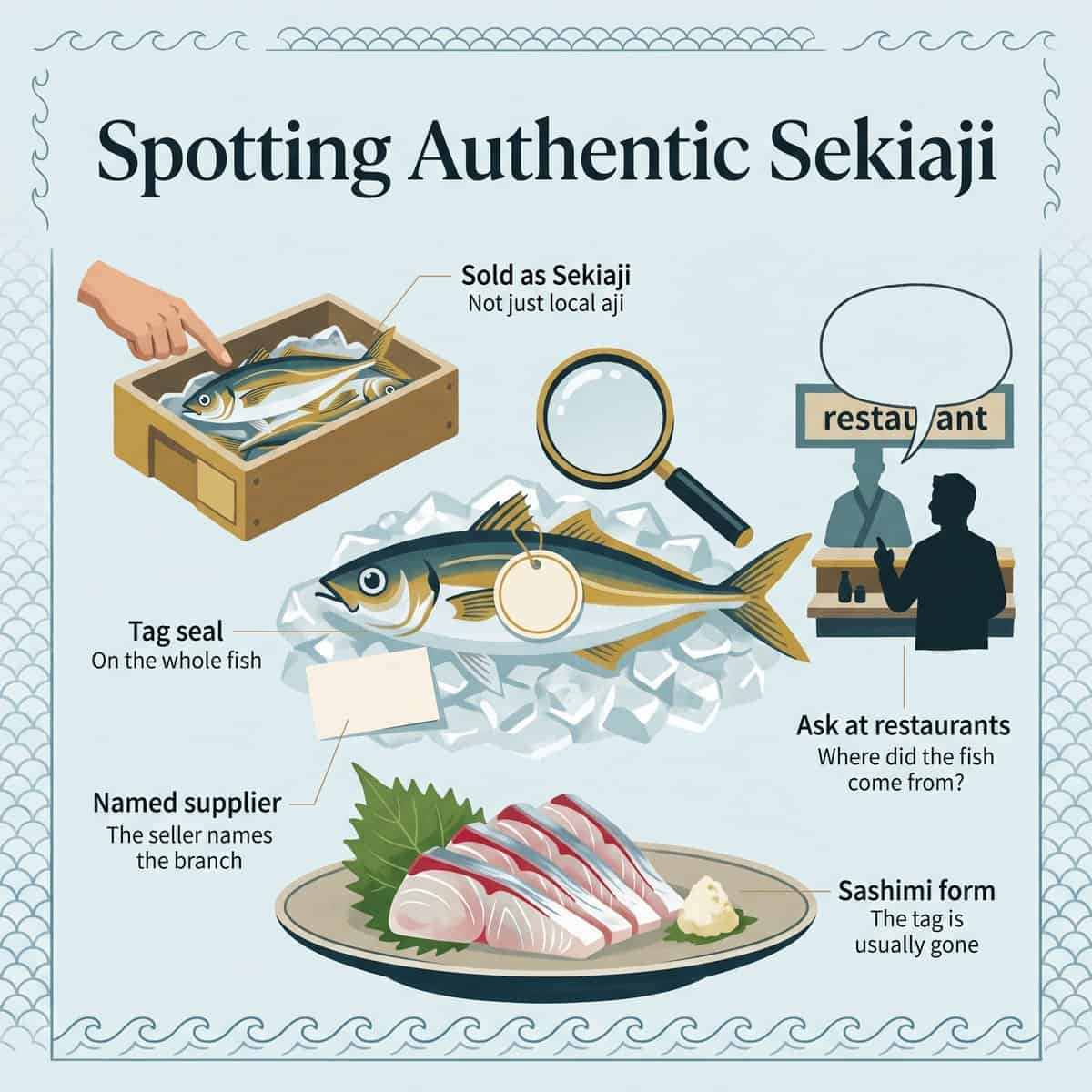
A famous name attracts imitators, so it helps to know the signs. Here is a short checklist.
- The whole fish carries the Saganoseki branch’s tag seal
- The seller can name the Saganoseki branch as the supplier
- It is sold as 関あじ (Sekiaji), not just 地あじ or local aji
In sashimi form, of course, the tag is usually gone. So at a restaurant, it is fine to ask where the fish came from. The cooperative’s list of shipping destinations, covered below, is a good place to start looking, but it is not a certification list.
Where to Eat Sekiaji in Oita
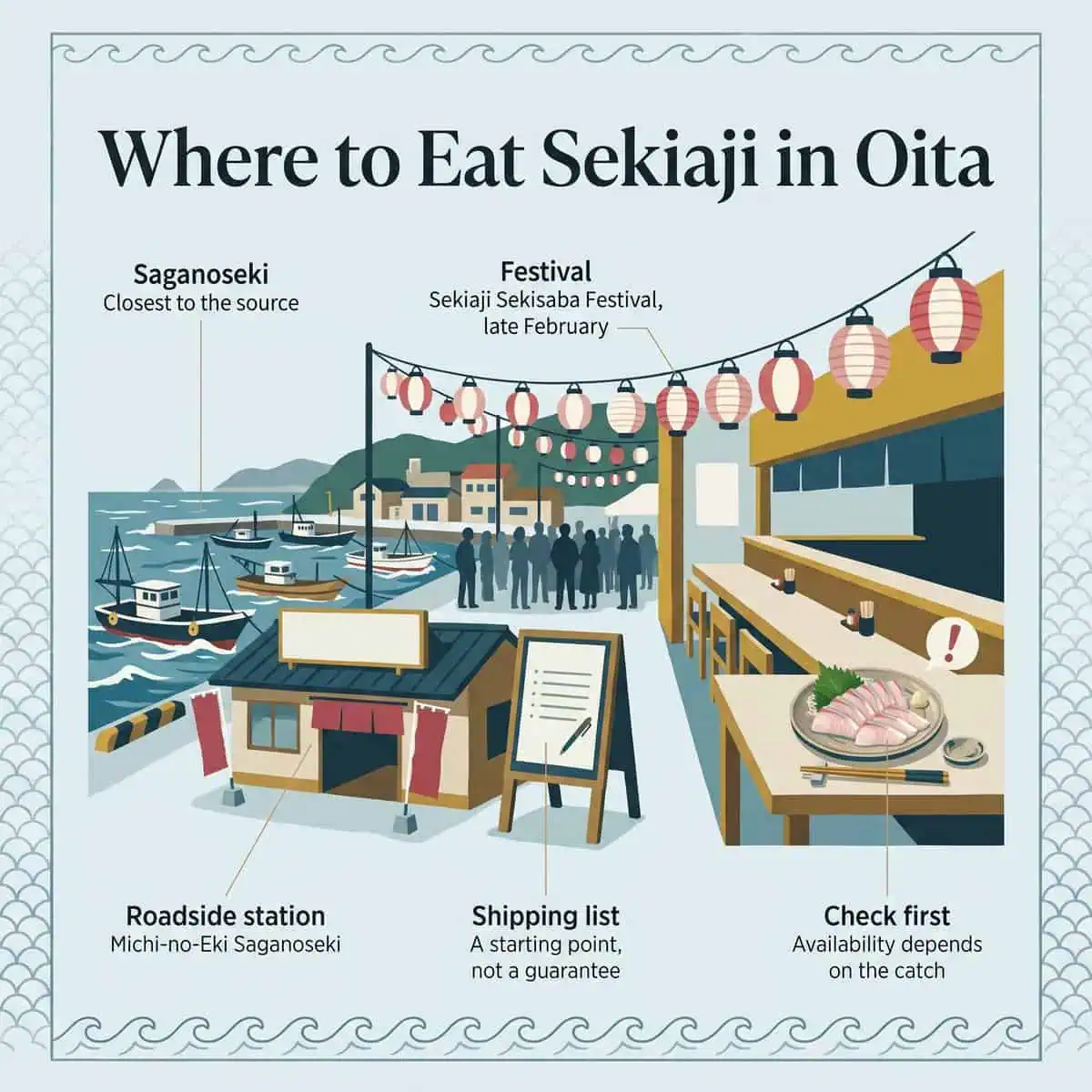
The Saganoseki branch publishes a list of its main shipping destinations. It is a useful starting point, but it does not guarantee that every place has Sekiaji every day. Restaurant information was last checked on October 13, 2026.
Saganoseki
Closest to the source, the list includes Seki Aji Seki Saba Kan (関あじ関さば館), a restaurant named after the two fish. Michi-no-Eki Saganoseki, a roadside station, also appears. Eating in Saganoseki puts you close to the cooperative and the port, although daily availability still depends on the catch. Oita Prefecture has also mentioned a Sekiaji Sekisaba Festival held around late February near the cooperative. If you plan a trip around it, check the current dates.
Oita City
In central Oita City, the list includes many izakaya (casual Japanese pubs) and sushi bars around Chuo-machi and Miyako-machi. Examples include Sushi Robata Hachijo and Kappo Dining Sajiki-za. Booking ahead and asking about Sekiaji when you reserve is a good idea.
Beppu and Tokyo
Beppu has several listed ryokan (traditional inns) and hotels, such as Suginoi Hotel, along with local restaurants like Toyotsune. Also, if you are only in Tokyo, the list includes Zarai Oita, an Oita-themed restaurant in Yurakucho.
Tips for Ordering Sekiaji
Ask whether it is Sekiaji or simply local aji, since both may appear on menus. Order it as sashimi first. Then, if the restaurant has Sekisaba too, order a small plate of each to compare.
How Much Does Sekiaji Cost?

On October 13, 2026, the Saganoseki branch’s online product page listed whole Sekiaji at ¥1,350 to ¥3,150, depending on size. Other official sales channels may show different prices, so confirm before ordering. All sizes were sold out at the time.
- 300 g: ¥1,350 (about two sashimi servings)
- 400 g: ¥1,800
- 500 g: ¥2,250
- 600 g: ¥2,700
- 700 g: ¥3,150 (about five to six servings)
Restaurant prices are higher, however, since preparation and service are included. Overall, the premium partly reflects the labor behind each fish: live handling, a day of rest, and hand bleeding.
Buying Sekiaji
Oita Prefecture’s edit Oita feature mentions a direct sales shop on the grounds of the cooperative’s Saganoseki branch. It sells fresh fish by advance reservation, plus dried fish, fry, and ryukyu, and it can ship. The online shop and the direct sales shop are both in Japanese, so check shipping areas before ordering.
History of the Sekiaji Brand
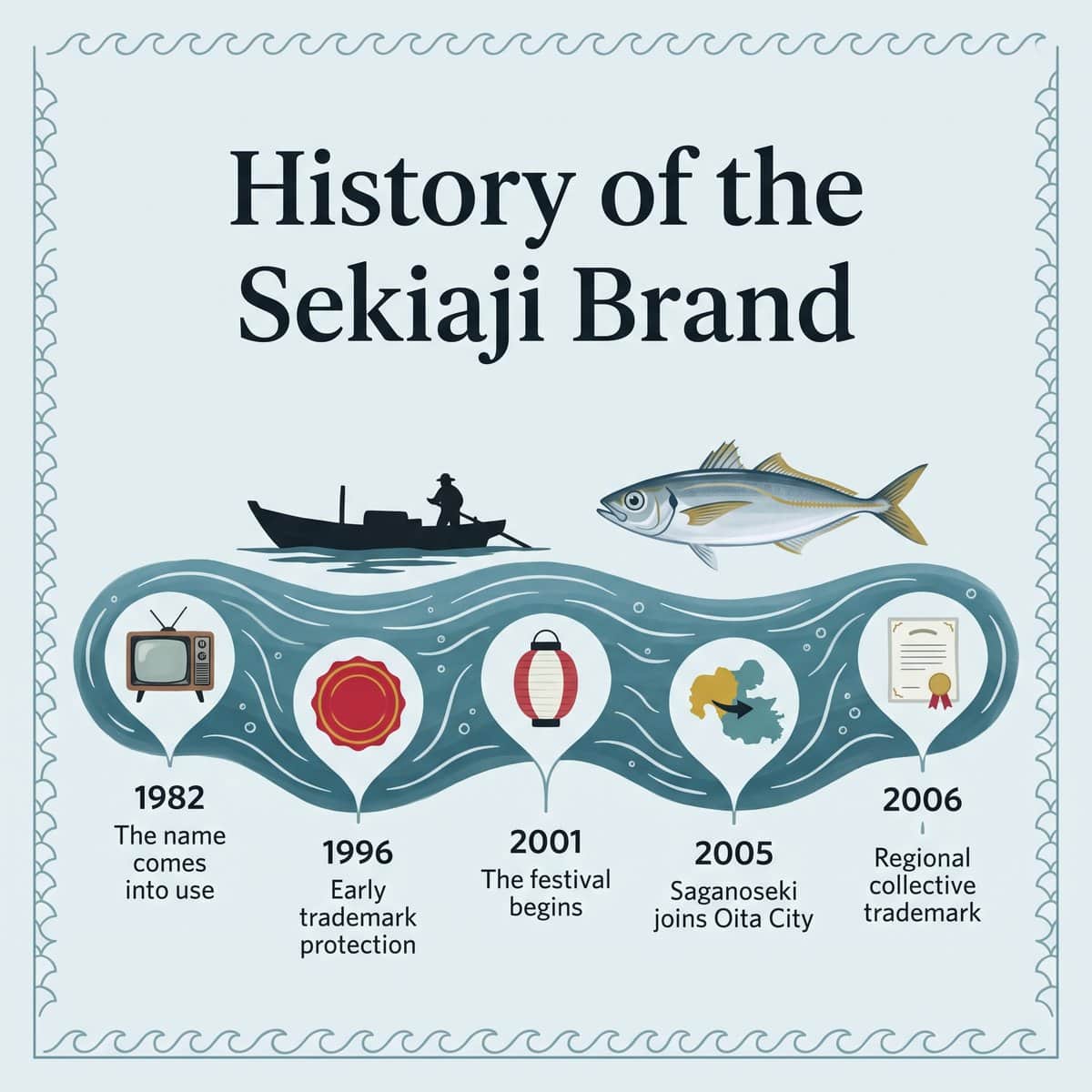
Hook-and-line fishing in Saganoseki is old, but the brand is recent. According to Oita Prefecture, the name Sekiaji was first used in 1982. The town’s mayor introduced the local fish to a visiting political commentator, and television then spread the name.
- 1982The name Sekiaji comes into use, according to Oita Prefecture.
- 2001The Sekiaji Sekisaba Festival begins in Saganoseki.
- 2005Saganoseki merges into Oita City.
- 2006Sekiaji is registered as a regional collective trademark, No. 5005587.
Trademark and Brand Protection
An Oita Prefecture feature says both names first gained trademark protection in 1996. Later, in 2006, both became regional collective trademarks. The Japan Patent Office lists Sekiaji as registration No. 5005587, held by the Oita Prefectural Fisheries Cooperative.
Sustainability and the Future of Sekiaji
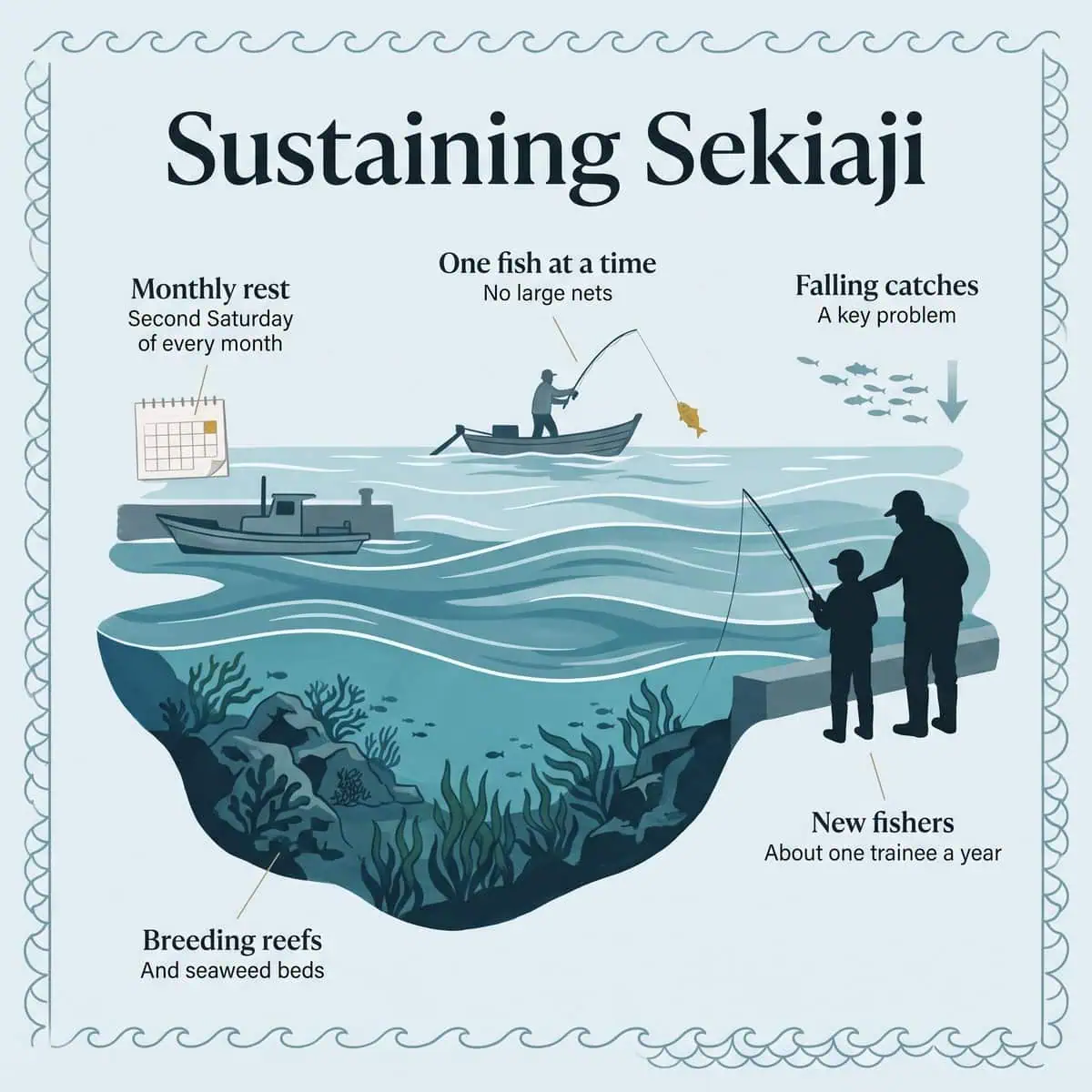
The future depends on both fish and fishers. The current fisheries revival plan for Saganoseki, covering fiscal 2024 to 2028, lists falling resources and lower catches as key problems. In response, fishers rest on the second Saturday of every month. The plan also includes breeding reefs and seaweed beds.
Meanwhile, keeping hook-and-line skills alive takes new people, as fishers age. According to the Ministry of Agriculture, the area accepts about one trainee each year, paired with a veteran fisher. Hook-and-line fishing catches fish one at a time rather than in a large net. However, we found no independent sustainability certification or full stock assessment for Sekiaji.
Why Sekiaji Is Worth Trying in Oita
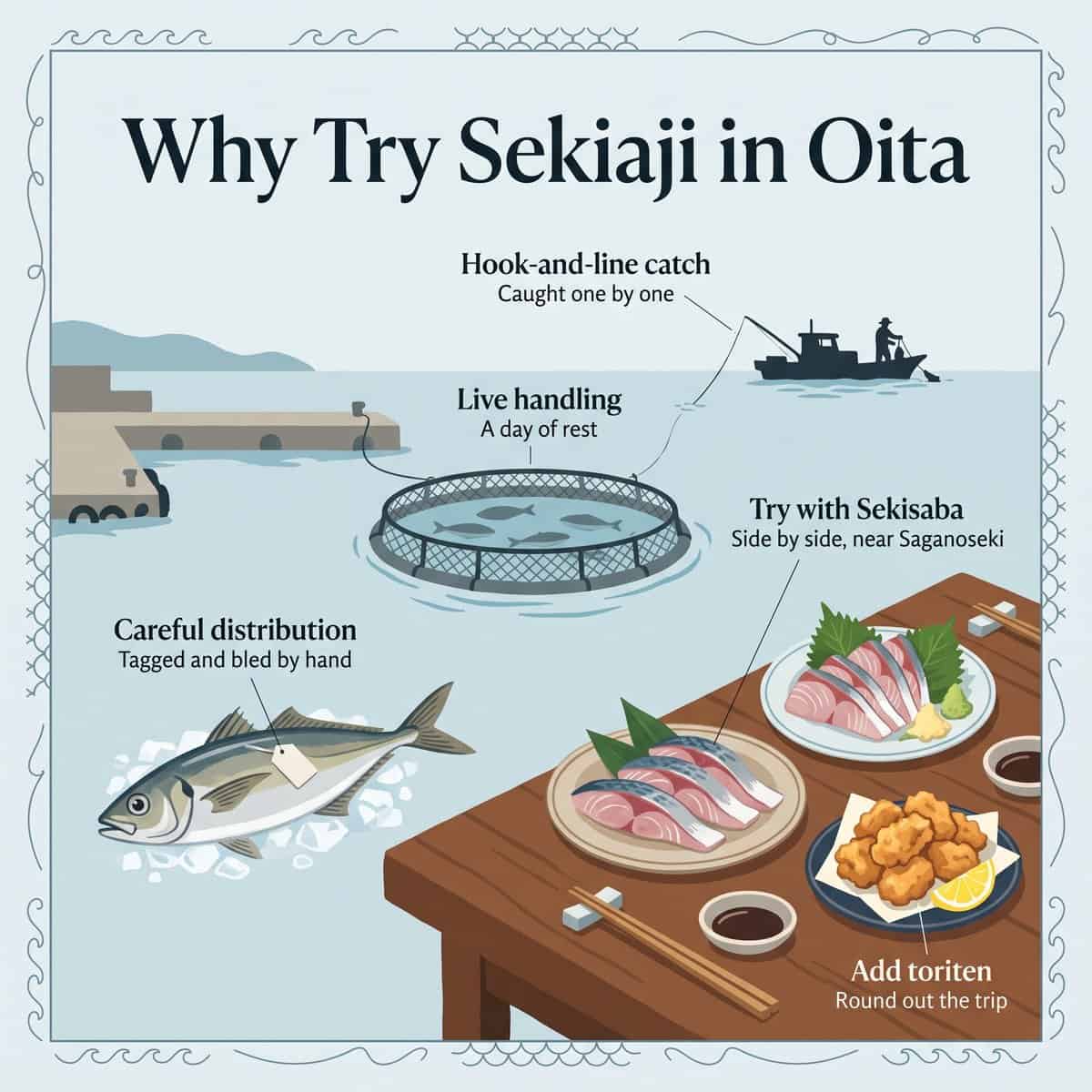
Sekiaji shows how a familiar fish can gain distinct regional value. Its fishing ground, hook-and-line catch, live handling, and careful distribution all come together in one plate of sashimi.
If you visit Oita, try Sekiaji and Sekisaba side by side, ideally near Saganoseki. Then add other local dishes like toriten to round out the trip. For more ideas, see the Kyushu food guide.
Frequently Asked Questions About Sekiaji
- What is Sekiaji?
-
Sekiaji is a branded Japanese jack mackerel from Saganoseki in Oita Prefecture. Only fish caught by hook-and-line fishing by the local cooperative branch’s members can use the name.
- Is Sekiaji the same as aji?
-
It is the same species as common aji. However, the brand requires a specific fishing ground, method, and handling process.
- When is Sekiaji in season?
-
Oita City and Oita Prefecture give July to September as the season. The cooperative fishes from March to October, and shipments can continue year-round.
- Can Sekiaji be eaten raw?
-
Yes, it is usually eaten as sashimi. Like other aji, it can carry anisakis, so eat it where raw fish is handled properly.
- Why is Sekiaji expensive?
-
Each fish is caught on a line, kept alive, priced by eye, rested for a day, and bled by hand. That labor, plus a limited catch, raises the price.
- Where can you eat Sekiaji in Oita?
-
Start with Saganoseki, close to the fishing ground, then try listed restaurants in Oita City or Beppu. The cooperative publishes its main shipping destinations online.
- How can you identify authentic Sekiaji?
-
A whole fish should carry the Saganoseki branch’s tag seal. At a restaurant, ask where the fish came from.
- What is the difference between Sekiaji and Sekisaba?
-
Sekiaji is horse mackerel, while Sekisaba is chub mackerel. Both come from the same strait and share broadly similar fishing and handling.
References
- Ministry of Agriculture, Forestry and Fisheries – aff (official magazine), July 2019 issue: Turning a Love of Fishing into a Career (Oita) (Accessed October 2026)
- Oita Prefecture – Oita Specialties: Sekiaji and Sekisaba (updated March 9, 2012) (Accessed October 2026)
- Oita City – Sekiaji and Sekisaba (updated June 12, 2026) (Accessed October 2026)
- edit Oita (Oita Prefecture’s official web magazine) – The Appeal of Oita’s Sekiaji and Sekisaba: Season, Features and Direct Sales (June 3, 2022) (Accessed October 2026)
- Oita Prefecture – Saganoseki Area Comprehensive Fisheries Infrastructure Development Plan (Accessed October 2026)
- Oita Prefecture – Feature on Sekiaji and Sekisaba with the Saganoseki Branch (Accessed October 2026)
- Fisheries Agency – Hama no Katsuryoku Saisei Plan, Saganoseki District, Third Term (FY2024 to FY2028) (Accessed October 2026)
- Oita City – Shiho Oita, April 1, 2020: Saganoseki Feature (Accessed October 2026)
- Japan Patent Office – Regional Collective Trademark No. 5005587: Sekiaji (Accessed October 2026)
- Oita Prefectural Fisheries Cooperative – Sekiaji (Accessed October 2026)
- Oita Prefectural Fisheries Cooperative, Saganoseki Branch – About the Saganoseki Brand (Accessed October 2026)
- Oita Prefectural Fisheries Cooperative, Saganoseki Branch – Main Shipping Destinations (checked October 13, 2026) (Accessed October 2026)
- Oita Prefectural Fisheries Cooperative, Saganoseki Branch – Online Shop: Sekiaji (checked October 13, 2026) (Accessed October 2026)
- Ministry of Health, Labour and Welfare – Preventing Food Poisoning from Anisakis (Accessed October 2026)
- FishBase – Froese, R., & Pauly, D. (Eds.). Trachurus japonicus, Japanese jack mackerel (Accessed October 2026)
- Oita University Repository – Mochizuki, S., Ueno, Y., Sato, K., & Hida, N. (1999). Effects of Storage Temperature on Post-mortem Changes in the Muscle of Chub Mackerel. Nippon Suisan Gakkaishi, 65(3), 495–500 (Accessed October 2026)
Related Articles
- Seki saba (関サバ) (Surveyed: October 2026)
- Aji (鯵) (Surveyed: October 2026)
- Kogane aji (黄金アジ) (Surveyed: October 2026)
- Sashimi (刺身) (Surveyed: October 2026)
- Hyugadon (ひゅうが丼) (Surveyed: October 2026)
- Toriten (とり天) (Surveyed: October 2026)
- Shio Tomato (潮トマト) (Surveyed: October 2026)
- The Ultimate Kyushu Food Guide: 10 Local Dishes You Must Eat (Surveyed: October 2026)
Photo credit: Sekiaji photos courtesy of the Oita Prefecture tourism photo library (おおいた風景写真集), Tourism Oita.





Comments