



A plate of salt-grilled fish arrives, its skin still crackling. You take a sip of sake, then a bite of fish, then another sip. Somehow the fish tastes richer and the sake feels cleaner. Why does that happen, and can you make it happen on purpose?
This sake food pairing guide focuses on that question. Rather than giving you a fixed chart, it explains why pairings work. It covers sweetness, acidity, umami, aroma, texture and temperature. With those tools, you can match sake with Japanese and international dishes on your own.
What Makes a Good Sake and Food Pairing?
Sake pairs well with seafood, sushi, grilled fish, simmered dishes, pickles, cheese, meat, salads and desserts. The best match depends less on the cuisine than on flavor intensity, aroma, acidity, texture and serving temperature. Sake’s relatively low acidity, abundant amino acids and lack of significant tannin make it unusually versatile.
Sake and Food Pairing: Quick Facts
- Start with
- Intensity: delicate sake with delicate food, and rich sake with rich food
- Choose the role
- Reveal, complement, refresh or transform
- Adjust with
- Temperature, which changes sweetness, acidity, umami and aroma
- Treat style names as
- Clues, not rules
What “Pairs Well” Actually Means
The phrase sounds vague, so it helps to define it. The National Research Institute of Brewing (NRIB) offers a definition in its 2020 newsletter. A good pairing is one where umami or sweetness increases, or the aftertaste becomes cleaner. A poor pairing, by contrast, can create bitterness, astringency or fishy notes that linger.
That definition is useful because you can test it yourself. Take a sip, take a bite, and ask two questions. Did the food taste fuller or sweeter? Did the finish feel clean or muddy? Those answers tell you more than any label.
It also explains why pairing is personal. A review in Bioscience, Biotechnology, and Biochemistry describes palatability as shaped by rewarding, cultural and informational factors, not taste alone. For example, in one survey it covers, the same sake was rated more palatable with flounder sashimi than with grilled mackerel. So treat every rule below as a starting point, then trust what happens in your own mouth.
Four Things Sake Can Do for Food
The Japan Sake and Shochu Makers Association (JSS) lists four benefits of pairing sake with food in its advanced pairing guide. They make a handy framework, because most good matches lean on one or two of them.
Brings out flavors
Sake can make hidden tastes in a dish easier to notice, especially umami.
Complements the dish
Sake can fill in what a dish lacks, such as a little sweetness beside sour food.
Refreshes the palate
A clean sip can reset your mouth before the next bite.
Creates new flavors
Together, sake and food can produce a taste neither has alone.
The NRIB’s own English guide makes a similar point in simpler words. It says the delicate tastes and aromas of sake can bring out latent tastes from the food. It also suggests pairing strongly sweet or umami-rich dishes with equally sweet sake, and light sake with refreshing dishes.
Notice that “refreshing the palate” and “bringing out umami” can pull in opposite directions. That is fine. Sometimes you want a sip that wipes the slate clean, and sometimes you want one that makes the last bite linger.
For example, a crisp sake after fried food mainly refreshes. A savory junmai beside grilled mushrooms, on the other hand, mainly brings out flavor. Knowing which job you want the sake to do makes choosing much easier.
Six Practical Pairing Principles
For everyday decisions, JSS offers six basic rules in its beginner guide. They work best as a checklist rather than a law, and you will rarely need all six at once.
- Match the intensityRich sake with rich food, delicate sake with delicate food.
- Echo the aromaFor example, sake with a roasted aroma beside grilled or stewed dishes.
- Line up the ageFresh sake with fresh food; aged sake with pickles, dried fruit and aged cheese.
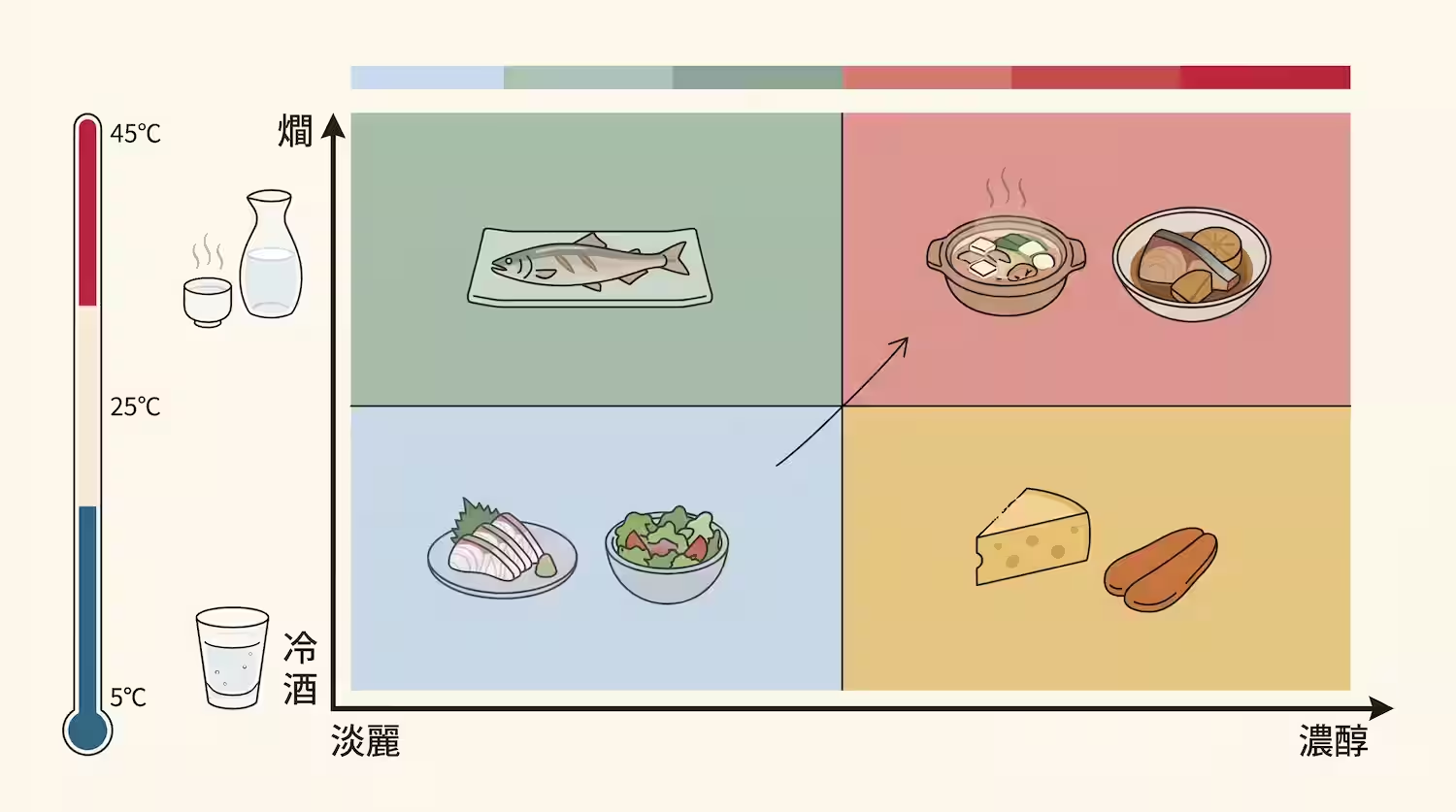
- Align the temperatureWarm sake with warm dishes, chilled sake with chilled dishes.
- Contrast tastesFor instance, a slightly sweet sake beside sour or bitter food.
- Consider the regionCoastal sake with seafood, inland sake with earthy ingredients.
Start With Intensity
If you remember only one rule, make it this one. A delicate sake beside a rich stew tends to disappear, while a heavy sake can flatten a light white fish. Match the weight first, and the other rules become fine-tuning.
Aroma, Age and Temperature
The next three rules are about echoes. A toasty, savory sake mirrors the browned edges of grilled food. Similarly, fresh sake suits fresh ingredients, and aged sake meets aged ones. Temperature works the same way, since a warm dish and warm sake feel like they belong together.
Contrast and the Regional Rule
Contrast is the exception that keeps things interesting. A touch of sweetness can soften a sharp vinaigrette, for example. The regional rule is more of a tradition than a tested principle, though. We could not find independent research showing that coastal sake suits seafood better. So treat it as a fun starting point rather than a fact.
Why Sake Works With Food: Umami, Acidity and Seafood
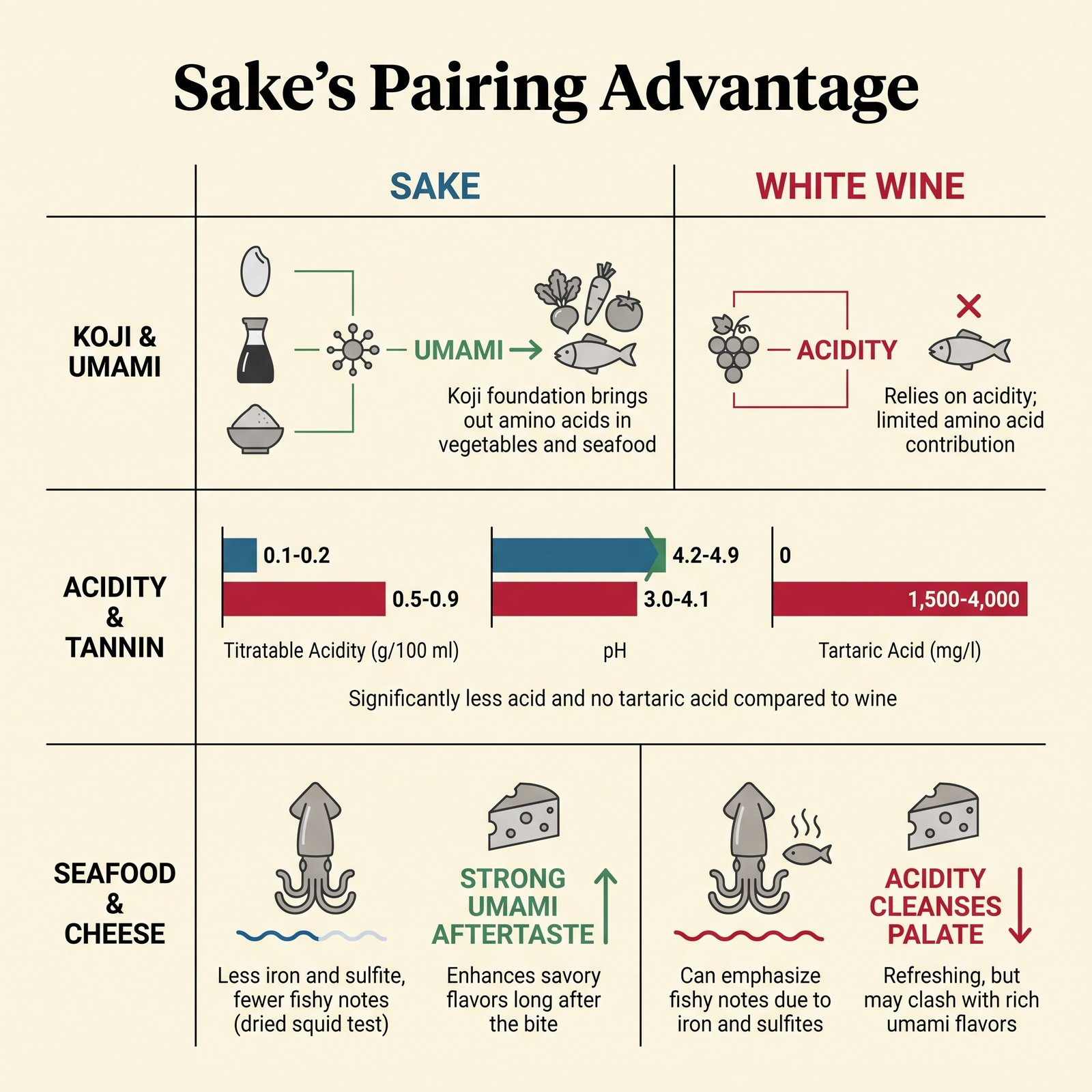
The chemistry offers part of the answer. Several features of sake’s composition help explain why it pairs so widely, and Japanese researchers have tested some of them directly.
Koji and Umami
Sake, soy sauce and miso share a common thread: all three rely on koji. In sake brewing, koji mainly converts rice starch into fermentable sugars. Its enzymes also influence amino acid formation and flavor. JSS links part of sake’s savory character to koji and the amino acids formed during brewing. It suggests this helps sake bring out flavors in vegetables and seafood, not only in meat.
JSS also mentions that experts link umami sensitivity to combinations. Examples include glutamate with the inosinate in bonito flakes, or with the guanylate in dried mushrooms. This synergy helps explain the depth of many dashi-based dishes. Sake may support that savory profile without adding pronounced acidity or significant tannin.
Less Acid and Little Tannin
Sake generally has much lower titratable acidity than white wine. JSS lists sake’s range well below that of white wine, and its comparison table shows no tartaric acid in sake.
| Component | Sake | White wine |
|---|---|---|
| Titratable acidity (g/100 ml, as tartaric acid) | 0.1 to 0.2 | 0.5 to 0.9 |
| pH | 4.2 to 4.9 | 3.0 to 4.1 |
| Succinic acid (mg/l) | 200 to 500 | 500 to 1,500 |
| Malic acid (mg/l) | 100 to 400 | 250 to 5,000 |
| Tartaric acid (mg/l) | 0 | 1,500 to 4,000 |
Sources: JSS, “Why Salad Pairs Well with Sake,” and the NRIB comprehensive guide, which gives the same acidity ranges in g/100 ml. These are typical ranges, so individual bottles vary, and some sakes are notably acidic. Still, the gap helps explain some pairing differences. Because sake generally contributes less acidity than white wine, it may avoid making an acidic dish feel even sharper. Pickles and dressings are the obvious examples.
Bitterness tells a similar story. JSS explains that tannins tend to clash with the bitterness and astringency of raw greens like arugula. Because sake contains little to no significant tannin, bitter vegetables may come across more gently, and its umami and sweetness help balance any sour notes.
Seafood and Fishy Odors
Many people have noticed an odd fishy taste when pairing wine with seafood. NRIB links some of these unpleasant pairings to reactions involving wine components and polyunsaturated fatty acids in seafood. A 2010 study by Fujita and colleagues found that sulfite promoted the breakdown of DHA, a fatty acid in fish. Earlier, a 2009 study by Tamura and colleagues had linked ferrous iron in wine to a fishy aftertaste with dried scallops. According to JSS, sake contains much less iron and sulfite than wine, so it may be less likely to intensify certain fishy aromas.
The 2010 study tested this with dried squid, or surume, and the NRIB newsletter describes it in plain terms. Panelists chewed the squid while sipping either sake or white wine, and they rated fishy and harsh notes as stronger with the wine.
Of course, this does not mean wine fails with all seafood. It means sake is often the easier match. This may matter most with fatty seafood, although the experiments covered only limited examples. Toyama’s firefly squid and white shrimp are local seafood worth trying this way.
Cheese and the Umami Aftertaste
The cheese research is even more interesting. Using a taste sensor, NRIB researchers measured the umami aftertaste left after eating cheese with either sake or wine. The sensor recorded a stronger umami aftertaste after sake than after white wine. That fits how people describe the two: wine refreshes the rich taste of cheese, while sake supports its umami.
Why cheese in the first place? The NRIB comprehensive guide notes that cheese is rich in amino acids and peptides from the microbial breakdown of milk protein. Fermentation may also create aromatic links between sake and cheese. However, NRIB’s clearest evidence concerns organic acids and umami aftertaste.
The researchers then looked at organic acids, which wine contains in far larger amounts. A separate sensory test found less lingering umami when tartaric acid was added to sake. So the difference seems to come partly from organic acids. Neither result is “better” in itself. Rather, sake and wine simply shape the finish in different ways.
How Temperature Changes a Pairing
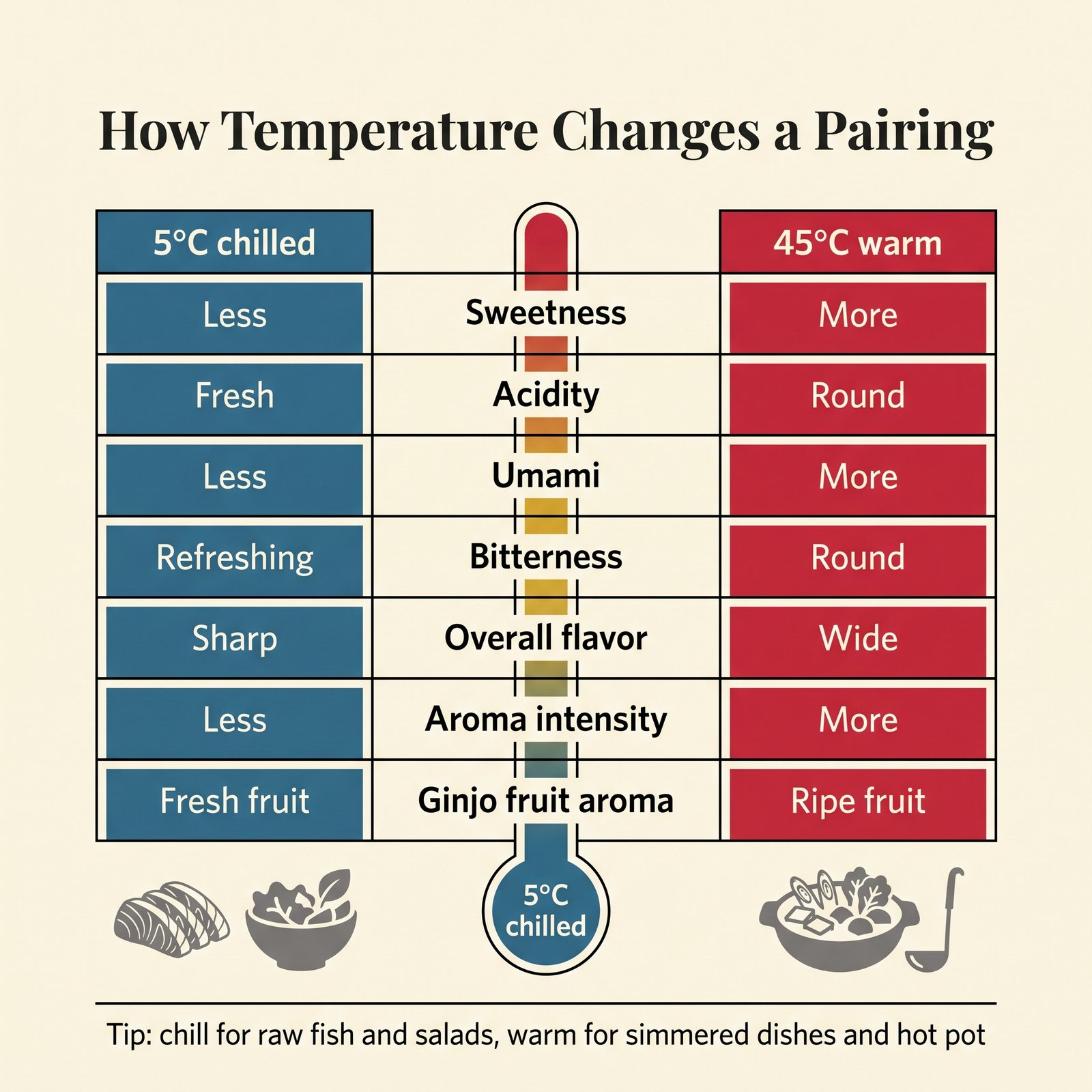
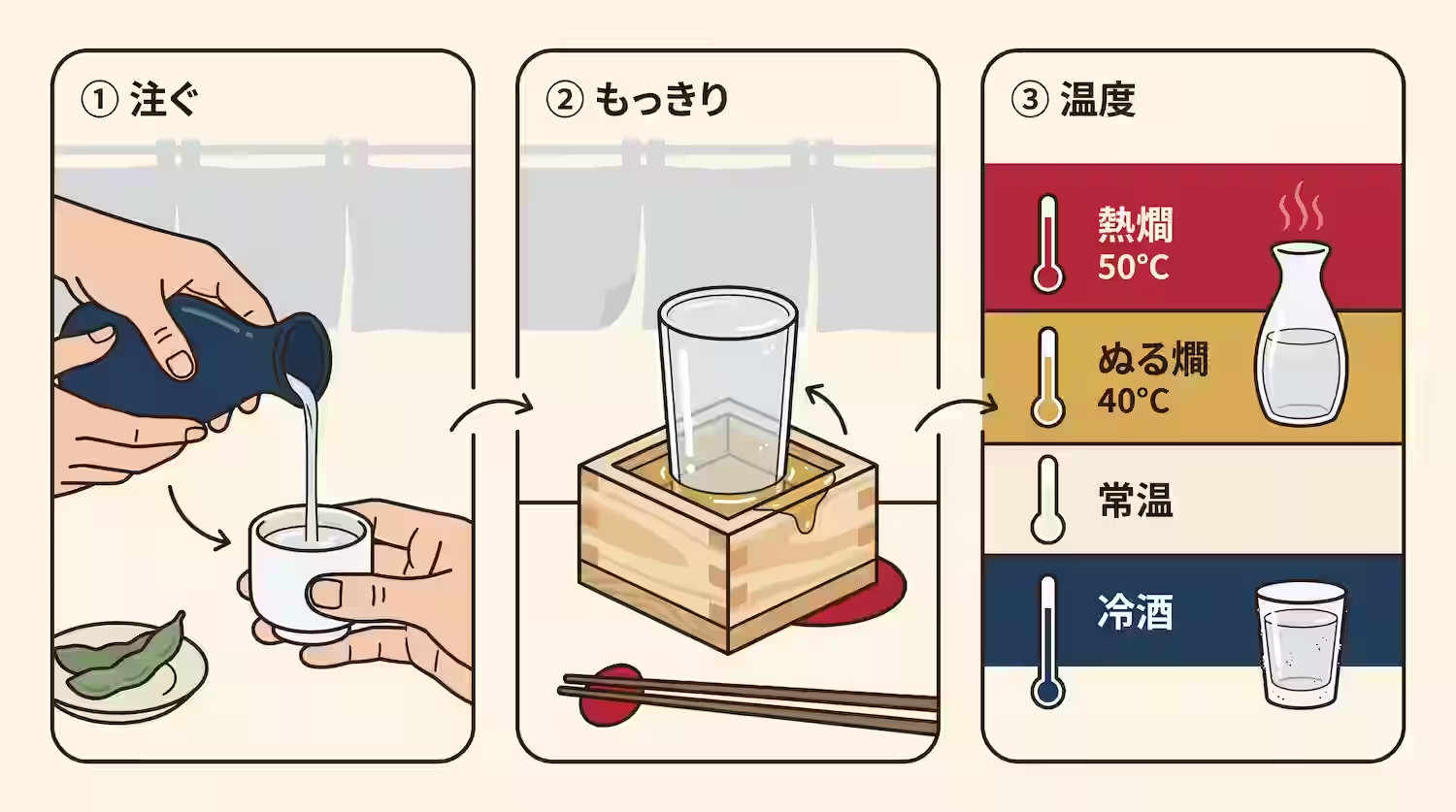
Temperature gives sake an unusually wide pairing range. JSS recommends trying a new sake at several temperatures when pairing. Warmth changes both the drink and how the food tastes beside it. For serving basics, see our guide to how to drink sake in Japan.
| Characteristic | At 5°C | At 45°C |
|---|---|---|
| Sweetness | Less | More |
| Acidity | Fresh | Round |
| Umami | Less | More |
| Bitterness | Refreshing | Round |
| Overall flavor | Sharp | Wide |
| Aroma intensity | Less | More |
| Ginjo fruit aroma | Fresh fruit | Ripe fruit |
Source: JSS, which presents these as general tendencies compared with sake at 25°C. JSS also notes that above about 55°C, the alcohol begins to sting the tongue. Meanwhile, the NRIB comprehensive guide explains that people generally perceive sweetness more strongly near body temperature.
Using Temperature in Practice
These shifts suggest a simple approach. Try a cooler serving temperature when you want a sharper, fresher impression, such as with raw fish or salads. Try warming it when you want roundness and umami, such as with simmered dishes or a winter hot pot. Our hot sake guide explains the warm temperature names in detail.
Pour the same sake chilled and warm, then taste each with the same dish. The difference can be surprisingly noticeable.
Pairing by Sake Style
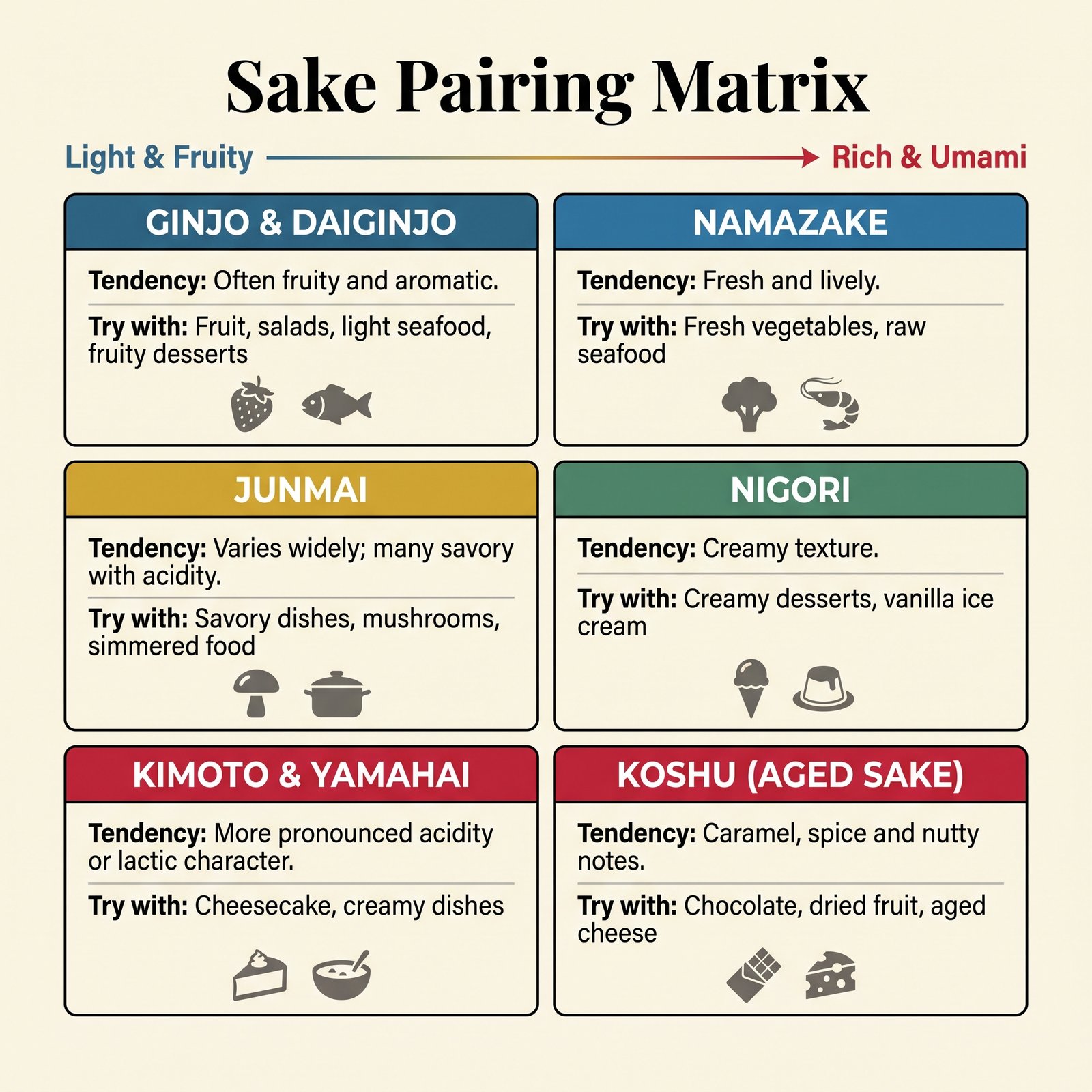
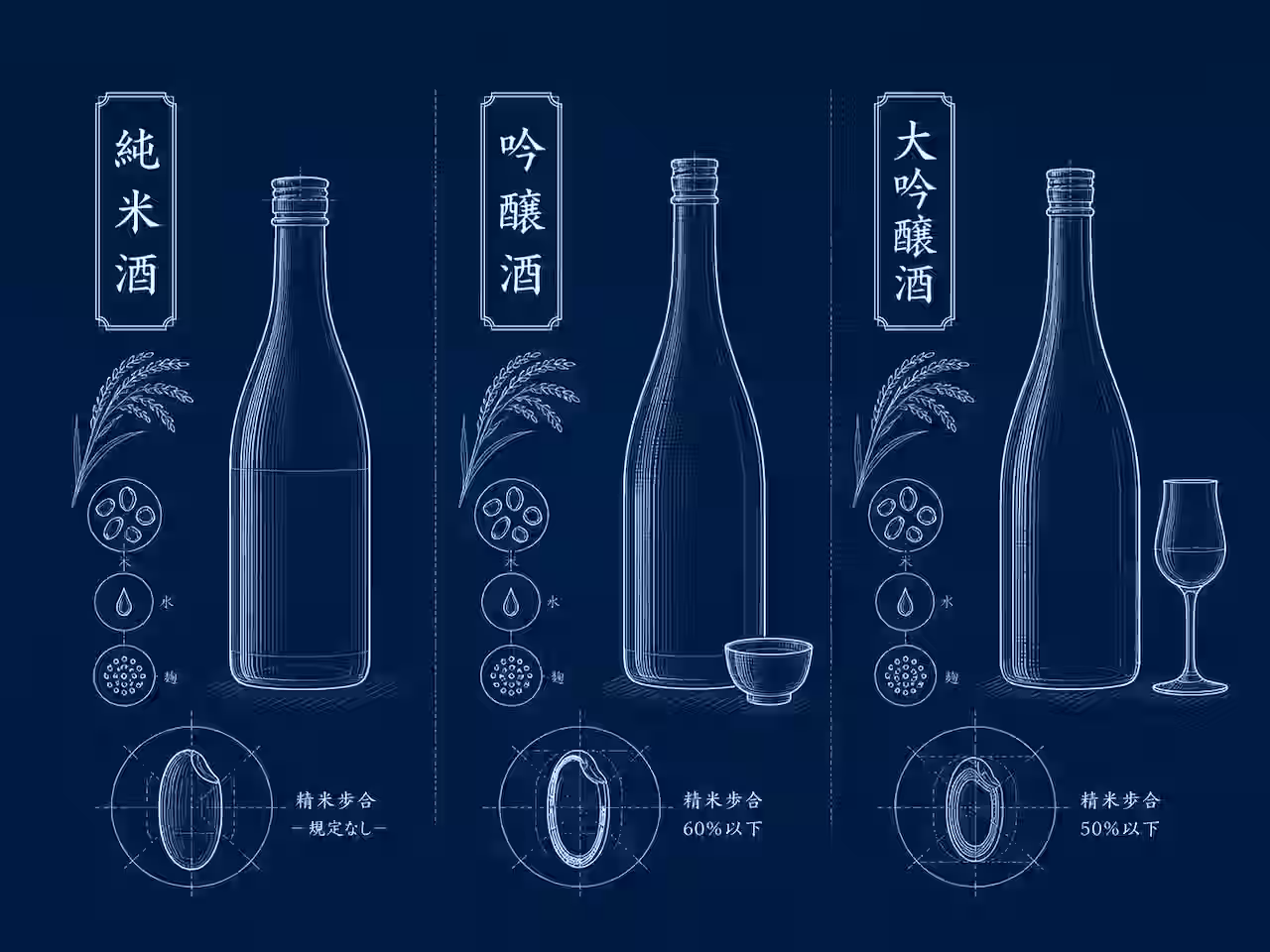
Grade names such as junmai, ginjo and daiginjo describe production and labeling rules set by Japan’s National Tax Agency (NTA). They do not prescribe a single flavor, and the law says nothing about food. Our sake label guide explains those rules. Still, each style has tendencies that can guide a first choice.
Ginjo and daiginjo
Often fruity and aromatic
Try with: fruit, salads, light seafood, fruity desserts
Junmai
Varies widely; many are savory with noticeable acidity
Try with: savory dishes, mushrooms, simmered food; taste the bottle first
Kimoto and yamahai
Often shows more pronounced acidity or lactic character
Try with: cheesecake, creamy dishes
Namazake
Fresh and lively
Try with: fresh vegetables, raw seafood
Nigori
Creamy texture
Try with: creamy desserts, vanilla ice cream
Koshu (aged sake)
Caramel, spice and nutty notes
Try with: chocolate, dried fruit, aged cheese
Aromatic and Everyday Styles
JSS links the fruity aroma of ginjo and daiginjo to fruits such as pear, peach, melon and berries. It also mentions vegetables such as tomato and cucumber. Junmai is harder to summarize. Many bottles are savory, yet the category also includes light and fragrant sake, so taste before you assume.
Lactic, Fresh and Aged Styles
JSS notes that sake contains lactic acid from brewing. It suggests that the lactic character found in some kimoto sake can complement the creaminess of cheesecake. Yamahai shares the same traditional starter family. Meanwhile, namazake fits the “fresh with fresh” rule, nigori brings texture, and koshu adds caramel and nutty depth to desserts.
Pairing Sake With Japanese Food
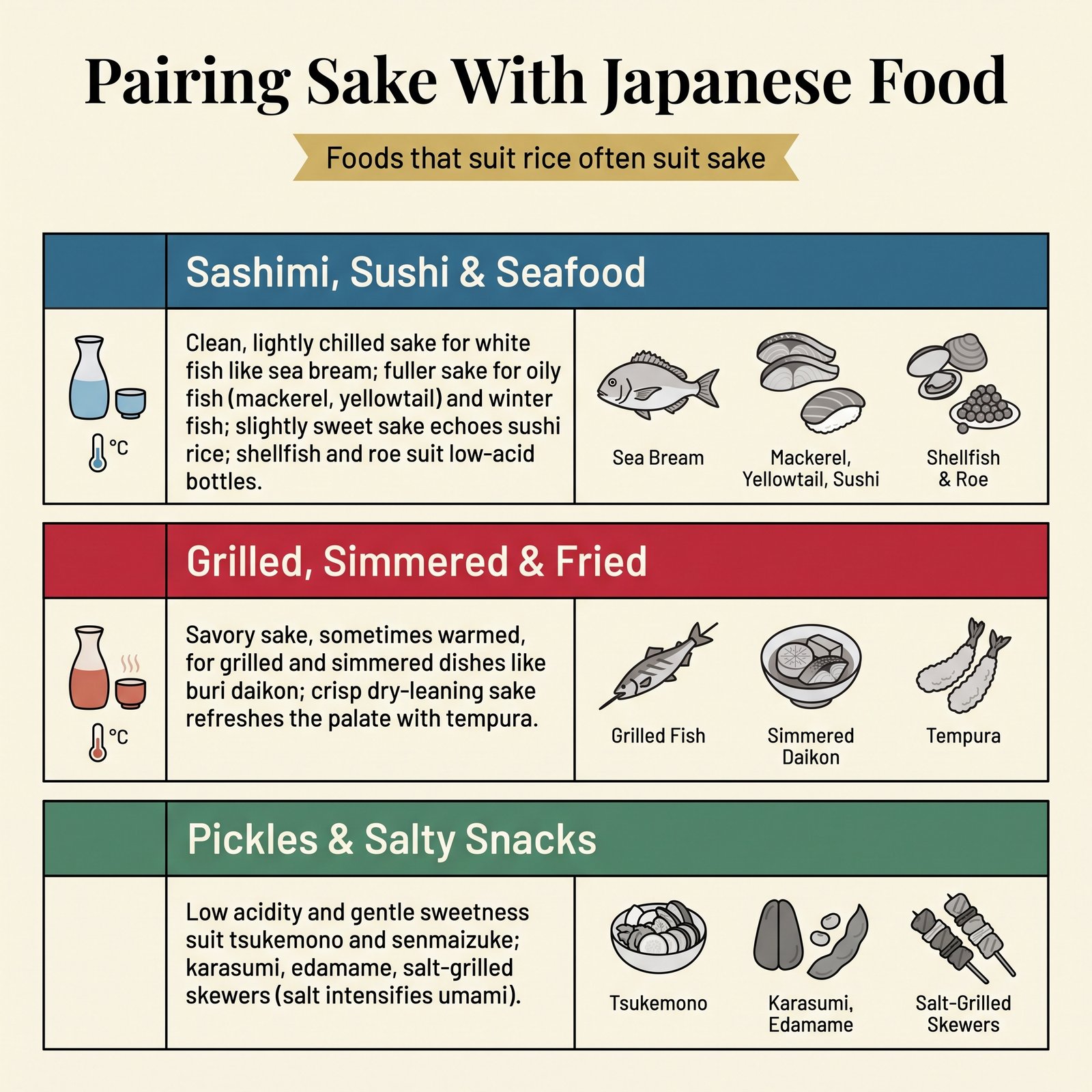
JSS offers a useful shortcut: foods that suit rice often work with sake as well. After all, JSS notes, many Japanese dishes traditionally accompany rice. That idea covers grilled fish, simmered vegetables and pickles alike.
Sashimi, Sushi and Seafood
With raw fish, a clean, lightly chilled sake usually lets the fish lead. As a starting point, try delicate styles with white fish such as sea bream. Oily fish such as mackerel or yellowtail, however, may handle more body. Try a fuller sake with rich winter fish like Himi kanburi, and notice how the finish changes.
Sushi adds more variables. Vinegared rice brings mild acidity and sweetness, soy sauce adds salt and umami, and wasabi adds heat. A sake with a little sweetness can echo the seasoning of the rice, while seared toppings or sweet glazes may welcome a fuller style. None of this has been tested in research, so treat it as a set of suggestions to try.
Shellfish and roe deserve a mention too. Their briny, savory character can work with sake’s amino-acid-rich profile. In addition, a lower-acid bottle may avoid adding excessive sharpness. If a match tastes metallic or fishy, try a different sake style or serving temperature before giving up on the dish.
Grilled, Simmered and Fried Dishes
Grilled and simmered dishes often welcome savory sake, sometimes warmed. Toyama’s buri daikon, yellowtail simmered with radish, is a classic winter example. For fried food like tempura, a crisp, dry-leaning sake can act as a palate refresher between bites.
Pickles and Salty Snacks
Pickles are a traditional partner, and JSS ties this to sake’s low acidity and gentle sweetness. Try tsukemono or Kyoto’s senmaizuke with a glass. Salty delicacies work too, such as Nagasaki’s karasumi, dried mullet roe often eaten in thin slices with sake.
Salt has a role here as well. The NRIB comprehensive guide notes that salt can intensify the umami of amino acids, which sake contains in good amounts. That may explain why simple salty snacks, from edamame to salt-grilled skewers, feel so satisfying with a cup of sake.
Pairing Sake With International Food
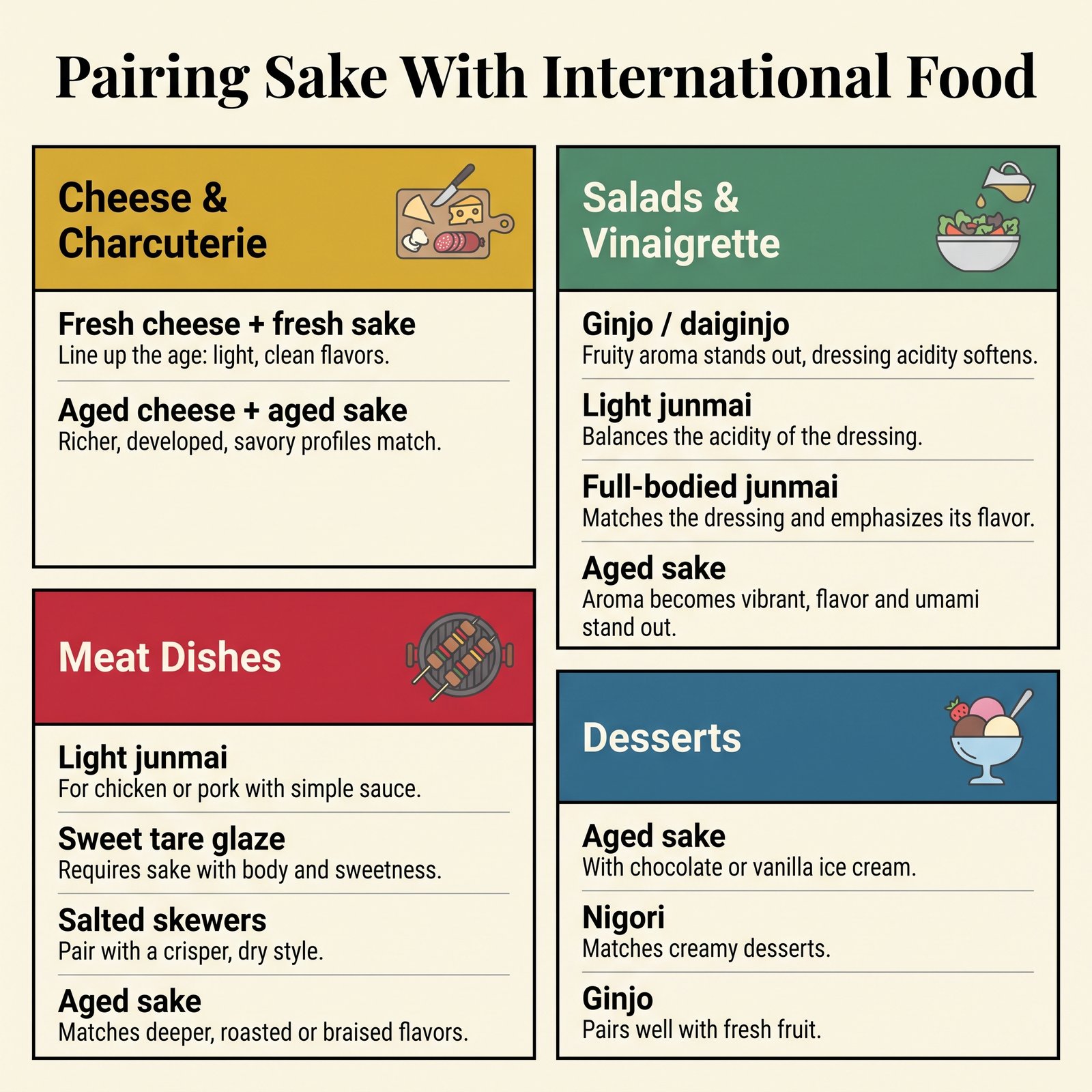
Sake does not need Japanese food to shine. JSS describes sake as a partner for sour, bitter and seafood dishes that may not suit wine easily. In turn, cheese, salads, meat and desserts each highlight a different side of sake.
Cheese and Charcuterie
NRIB’s findings make cheese a useful place to start. Fresh cheese suits fresh sake, while aged cheese meets aged sake, following the JSS “line up the age” rule.
Salads and Vinaigrette
Salads are hard for many wines, yet sake handles them well. JSS presents a case study describing how several sake styles interact with vinaigrette.
| Sake style | What JSS describes in its vinaigrette case study |
|---|---|
| Ginjo / daiginjo | Fruity aroma stands out; the dressing’s acidity softens |
| Light junmai | Balances the acidity of the dressing |
| Full-bodied junmai | Matches the dressing and emphasizes its flavor |
| Aged sake | Aroma becomes vibrant; flavor and umami stand out |
Meat Dishes
Meat follows the intensity rule. A light junmai can suit chicken or pork with a simple sauce, while richer or aged sake can stand up to deeper flavors. We found no direct research on warm sake and meat fat, so treat claims that warm sake “melts” fat with caution.
Sauce often matters more than the meat itself. A sweet soy glaze, like yakitori tare, invites a sake with some body and sweetness. Salt-seasoned skewers, by contrast, may suit a crisper style. Compare which pairing leaves the cleaner, more balanced finish.
Desserts
Yes, sake can go with dessert. JSS suggests aged sake with chocolate or vanilla ice cream, where its caramel and nut notes act almost like a sauce. It also pairs nigori with creamy desserts and fruity ginjo with fruit. Match sweetness first, then look for an aroma or texture bridge.
The Order of a Bite Matters
Here is a detail most pairing charts ignore. A 2019 article in the Journal of the Brewing Society of Japan addressed it. Its authors, Terumi Kobata and two JSS colleagues, evaluated pairings at three separate moments.
1. Sake, then food
How the sake changes your first impression of the dish.
2. Together in the mouth
Called kuchinaka-chōmi (口中調味), seasoning in the mouth.
3. Food, then sake
How the sake cleans up or extends the finish.
The same pair can score differently depending on which moment you judge. A sake might refresh nicely after a bite, yet feel thin when both are in the mouth together. So if a pairing seems “off,” try changing the order before you change the bottle.
A Simple Pairing Method to Try
Combined, these ideas become a short routine. It works at home, at a restaurant or at an izakaya counter.
- Judge the dishIs it delicate or rich, fresh or aged, hot or cold?
- Match the weightPick a sake of similar intensity.
- Choose a temperatureCooler for a fresher impression, warmer for roundness and umami.
- Taste in three ordersSake first, together, then food first.
- AdjustToo sour? Try a slightly sweeter sake. Too heavy? Go lighter or cooler.
At a restaurant, you can hand most of this to the staff. Tell them what you are eating and whether you prefer something light or rich, and they will usually do the rest.
Pairing Across a Whole Meal
Over a full meal, order matters as well. The NRIB comprehensive guide suggests starting with a light sake and moving toward fuller ones with more acidity or umami as dishes grow richer. It describes fragrant ginjo as an aperitif, or pre-meal drink. Slightly sweet aged sake, meanwhile, can follow the meal. That progression often follows the increasing richness of a course meal.
Similarly, JSS notes that sake can follow an entire course, from brothy soups and seafood mains to salads and dessert. You do not need a new bottle for every plate, though. For many meals, two or three contrasting sakes, such as one fragrant, one savory and one aged, may be enough.
Common Sake Pairing Myths
MythSake only goes with Japanese food.
RealityJSS describes good matches with salads, cheese, charcuterie and desserts.
MythSake never creates fishy flavors.
RealityIt is less likely to intensify certain fishy aromas, but it is not a guarantee.
MythJunmai always goes with grilled fish.
RealityJunmai covers a wide range of styles, so the bottle matters more than the name.
MythDaiginjo has only one correct serving temperature.
RealityIt is commonly chilled to highlight delicate aromas, but modest temperature changes can alter how those aromas are perceived.
MythSake increases the umami in food.
RealitySome pairings preserve or heighten how strongly you perceive umami, which is different.
Final Thoughts
Sake pairing is less about memorizing matches and more about knowing what to look for. Start with intensity, then let aroma, temperature and contrast fine-tune the result. The research helps explain why sake often works with seafood and cheese. Still, your own palate has the final say.
So pour a little, take a bite, and change one thing at a time. When you want to go further, our guide to sake types and regional sake guides are good next steps.
Sake Pairing FAQ
Getting Started
- What food goes best with sake?
-
Seafood, savory Japanese dishes, pickles and cheese are among the easiest matches. Sake’s relatively low acidity, abundant amino acids and lack of significant tannin help it work with foods that can be tricky for wine. Still, the best match depends on the specific sake and dish.
- What sake goes with sushi?
-
Start with a clean, lightly chilled sake, especially with white fish. Fattier toppings, seared fish or sweet glazes may welcome a fuller style. These are suggestions rather than tested rules, so try two styles side by side.
- Does sake go with non-Japanese food?
-
Yes. JSS describes good matches with salads, cheese, charcuterie and desserts. It also describes sake as a partner for sour and bitter flavors that can be difficult with wine.
Specific Pairings
- Why does sake pair well with seafood?
-
Studies published in 2009 and 2010, summarized by NRIB, link some unpleasant fishy notes to iron and sulfite in wine reacting with fatty acids in seafood. Sake contains much less of both, according to JSS, so it may be less likely to cause the problem. It is not a guarantee, but it helps explain why sake is often an easy partner for fish.
- Is sake good with cheese?
-
Often, yes. In NRIB taste-sensor tests, sake left a stronger umami aftertaste after cheese than white wine did. Wine tends to refresh the palate instead, so the choice depends on the effect you want.
- Can you pair sake with dessert?
-
Yes. JSS suggests aged sake with chocolate or vanilla ice cream, nigori with creamy desserts and fruity ginjo with fruit. Match the sweetness level first, then look for an aroma or texture link.
Temperature
- Should sake be warm or cold with food?
-
It depends on the dish and the sake. Cooler sake generally comes across as sharper and fresher, which many people enjoy with raw fish and salads. Warmer sake tends to feel rounder, with more sweetness and umami, which can suit simmered and savory dishes.
- Does warming sake change the pairing?
-
Yes. JSS presents 45°C sake as generally sweeter, rounder and richer in umami than sake at 25°C, while 5°C sake comes across as sharper. Trying the same sake at two temperatures with one dish is an easy way to see this.
References
Government and Public Research Sources
- NRIB (National Research Institute of Brewing) – Pairings, Japanese Sake Essentials (Accessed October 2026)
- National Tax Agency (NTA) – Overview of Labeling Standards for the Manufacturing Process and Quality of Sake (清酒の製法品質表示基準の概要) (Accessed October 2026)
- NRIB (National Research Institute of Brewing) – NRIB No. 37 (March 2020, Japanese): O-sake no Oishisa II [The Deliciousness of Alcoholic Beverages II] (お酒のおいしさ II) (Accessed October 2026)
- National Research Institute of Brewing – Research Topics 2018: Difference in the Palatability of Sake and Wine When Paired with Food (Accessed October 2026)
- NRIB (National Research Institute of Brewing) – A Comprehensive Guide to Japanese Sake (Japan Sake and Shochu Makers Association and NRIB, 2011) (Accessed October 2026)
Academic Sources
- A Thought on the Affinity of Foods and Sake (料理と日本酒の相性に関する一考察) – T. Kobata, S. Imada and Y. Hamada, Journal of the Brewing Society of Japan, 114(4), 166–173 (2019), via J-STAGE (Accessed October 2026)
- Effects of Sulfur Dioxide on Formation of Fishy Off-Odor and Undesirable Taste in Wine Consumed with Seafood – A. Fujita et al., Journal of Agricultural and Food Chemistry, 58(7), 4414–4420 (2010) (Accessed October 2026)
- Iron Is an Essential Cause of Fishy Aftertaste Formation in Wine and Seafood Pairing – T. Tamura et al., Journal of Agricultural and Food Chemistry, 57(18), 8550–8556 (2009) (Accessed October 2026)
- Evaluating the Palatability of Fermented Foods – Bioscience, Biotechnology, and Biochemistry, review article (Accessed October 2026)
Industry Sources
- Japan Sake and Shochu Makers Association (JSS) – Sake Food Pairings: Basic (Accessed October 2026)
- Japan Sake and Shochu Makers Association (JSS) – Sake Food Pairings: Advanced (Accessed October 2026)
- JSS (Japan Sake and Shochu Makers Association) – Why Salad Pairs Well with Sake (Accessed October 2026)
- Japan Sake and Shochu Makers Association (JSS) – Why Dessert Pairs Well with Sake (Accessed October 2026)
Related Articles
- How to Drink Sake in Japan: A Beginner’s Guide (Surveyed: October 2026)
- How to Read a Japanese Sake Label: A Beginner’s Guide (Surveyed: October 2026)
- Hot Sake (熱燗) (Surveyed: October 2026)
- Types of Japanese Sake (Surveyed: October 2026)
- Junmai Sake (純米酒) (Surveyed: October 2026)
- Ginjo (吟醸酒) (Surveyed: October 2026)
- Koshu (古酒) (Surveyed: October 2026)
- Kimoto Sake Brewing (生酛) (Surveyed: October 2026)
- Japanese Pickles (Tsukemono) (Surveyed: October 2026)
- Karasumi (からすみ) (Surveyed: October 2026)







Comments