




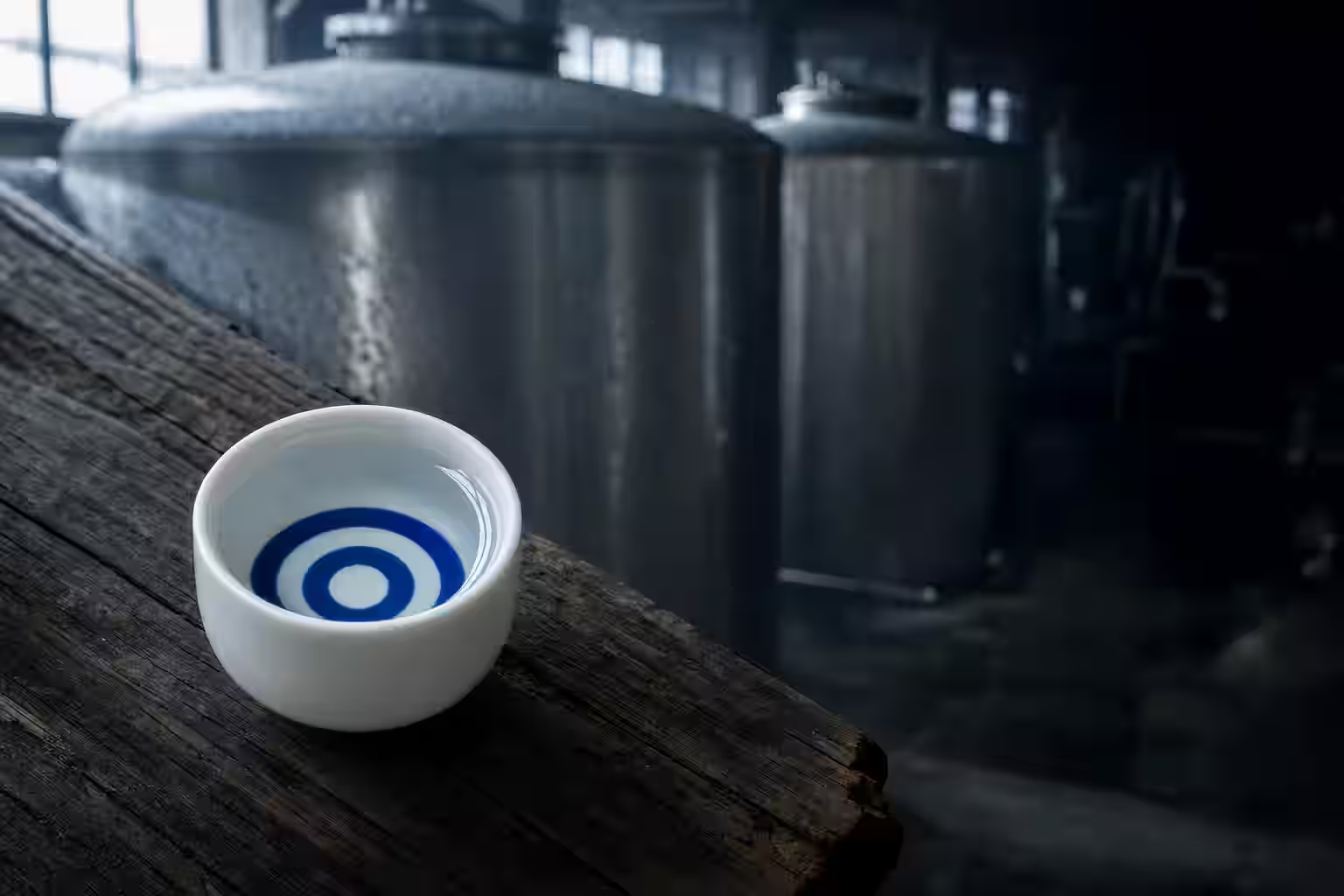
Pour a glass of good sake and hold it up to the light. That transparency looks effortless, yet it takes weeks of quiet work.
So what is Orisage? Orisage (滓下げ) is the clarification step brewers carry out before bottling. It settles the fine proteins and colloids that would otherwise cloud the sake during storage. Brewers then move the bright liquid above into another tank. The name means, roughly, “lowering the lees.”
Many English guides blur this step with Oribiki (滓引き), the earlier racking stage. The two genuinely differ. Oribiki handles the coarse sediment that drops soon after pressing. Orisage targets the microscopic material that clouds sake much later, often after heating and months in a tank.
Why bother at all? A faint cloud is usually harmless to the drinker. It does worry the person holding the bottle in a shop, and that reaction drives the entire practice. Clarity has signalled quality in Japan since the Manyo era, when writers praised sumizake, or “clear sake.”
A note on wording first. English sources render Orisage as clarification, fining, or sedimentation. This guide uses clarification for the process itself, and fining for the narrower practice of adding agents to speed it up. For the wider brewing sequence, see our guide on how sake is made.
Quick Facts About Orisage
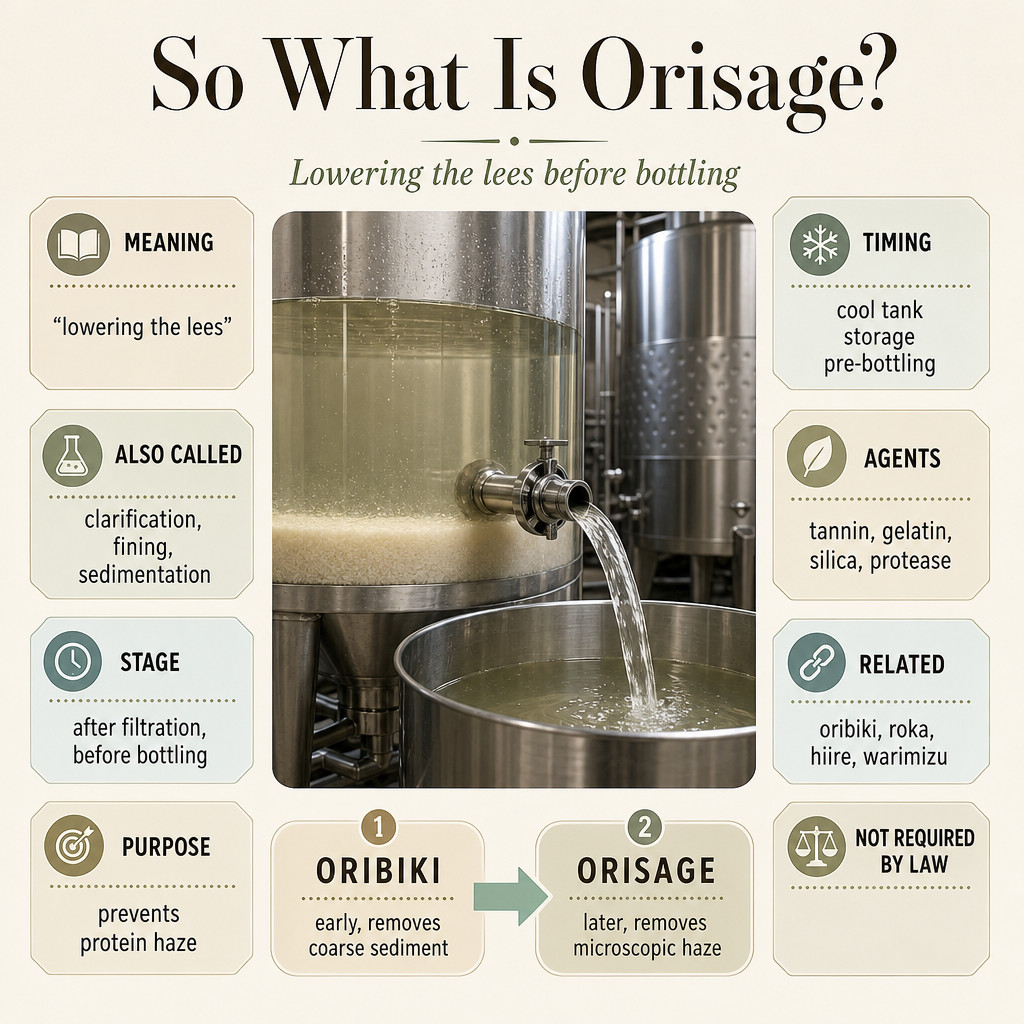
- Japanese Name: 滓下げ (orisage)
- Literal Meaning: “Lowering the lees,” or settling the sediment
- English Terms: Clarification, fining, sedimentation
- Brewing Stage: After the first filtration, before bottling
- Primary Purpose: Prevent protein haze and keep the sake visually stable
- Typical Timing: During cool tank storage in the weeks before bottling
- Common Agents: Persimmon tannin, gelatin, colloidal silica, diatomaceous earth, protease
- Japanese Term for Agents: 滓下げ剤 (orisage-zai)
- Related Steps: Oribiki, filtration (roka), pasteurization (hiire), warimizu
- Required by law? No, and plenty of breweries skip it
One detail deserves an early flag. Orisage is not a rescue operation for spoiled sake. It is routine housekeeping, aimed at a specific and fairly harmless kind of cloudiness.
What Is Orisage?

Orisage is the operation that drops haze-forming substances out of sake before bottling. Brewers hold the liquid still at a low temperature. Over days or weeks, the troublesome components clump together and sink. What remains above is bright, stable sake.
The Japan Sake and Shochu Makers Association defines the step in exactly these terms. Its Japanese glossary describes Orisage as the operation that settles the components which would otherwise become ori, performed before bottling to protect the product’s value. The substances brewers add to help that process carry their own name: orisage-zai.
Where It Sits in the Brewing Process
Sake reaches this stage well down the line. Fermentation comes first, in the main mash. Brewers then separate liquid from solids at pressing, which also yields the lees known as sake kasu. Coarse sediment settles a few days later, and racking removes it.
After that, filtration catches most of what remains. Pasteurization follows for most products, then months of quiet storage. Orisage arrives near the end of that sequence, alongside warimizu and the final checks.
Position matters more here than it first appears. A brewer cannot remove a haze that has not formed yet. And the haze in question mostly appears after heating and storage, not before.
Why the Order Varies Between Breweries
Anyone reading several sake guides will notice the steps arriving in different orders. That inconsistency is real, not sloppy writing. Filtration, clarification, heating, and dilution form a flexible toolkit rather than a fixed line.
One brewery pasteurises before storage and again at bottling. Another skips heating entirely. A third clarifies the sake after bottling, then pours it back into a tank. Treat any published sequence as a common pattern, then, rather than a rule.
Why Particles Survive Everything Before It
Freshly pressed sake carries a load of fine solids. Undigested starch, rice fibre, insoluble protein, yeast cells, and active enzymes all drift through it. Brewers call this suspended material ori.
Racking removes the bulk of it, and filters catch a great deal more. Yet some material slips through every net, because it never behaves like a particle in the first place. A dissolved protein passes through a filter as easily as water does.
Those proteins only turn visible later. Heat during pasteurization changes their shape, and cool storage then gives the altered molecules time to gather into clusters large enough to scatter light. Japanese brewers named the resulting cloud shiroboke (白ボケ), meaning roughly “white blur.” Elsewhere it goes by protein haze.
Why Clarification Is Necessary
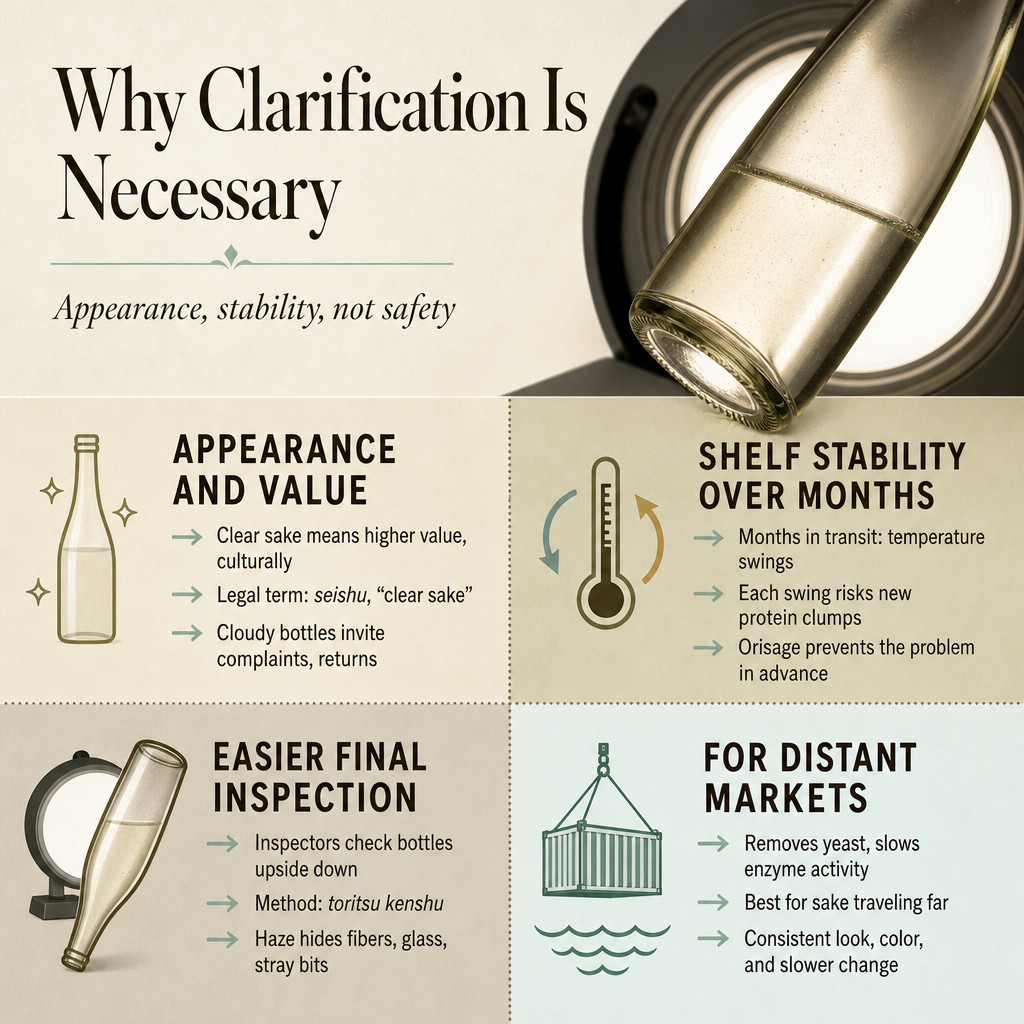
The case for Orisage rests on appearance, stability, and the long journey from brewery to glass rather than on safety.
Appearance and Commercial Value
Clear sake carries centuries of cultural weight in Japan. Early poetry already separated sumizake from cloudier drinks and placed it higher. Japanese liquor law even labels the refined category seishu (清酒), written with the character meaning “clear.”
Put two identical bottles side by side, one bright and one clouded. Most people reach for the bright one. Retailers know this, and so do exporters. A cloudy bottle invites questions, complaints, and sometimes returns.
Shelf Stability Over Months
A bottle rarely goes straight from brewery to table. It may sit in a warehouse, then a truck, then a shop shelf for months, while temperatures rise and fall the whole time.
Every swing gives dissolved proteins another chance to clump together. Orisage removes that potential in advance. Think of the step as pre-empting a problem rather than fixing one.
Easier Final Inspection
Clarity helps one more group: the people checking bottles before shipment. Inspectors look for stray fibres, glass fragments, or browned koji grains against a light source. Japanese breweries use an inverted check called toritsu kenshu, turning the bottle upside down so that anything moving oddly stands out. A hazy background hides small objects almost perfectly, so bright sake makes that search practical.
Fine Yeast, Enzymes, and Distance
Clarification does one more useful job. Removing residual yeast cells and enzyme activity slows unwanted change inside the bottle. Sake bound for a distant market benefits most from that quiet insurance.
- Visual consistency: every bottle in a case looks the same on the shelf.
- Reduced sediment: nothing settles into a grey layer during a long voyage.
- Slower change: fewer active enzymes mean fewer surprises after six months.
- Predictable colour: the liquid holds its intended tone under shop lighting.
Is Cloudy Sake Safe to Drink?
In most cases, yes. Protein haze itself does no harm, and several sake styles are cloudy by design. Cloudiness can occasionally have other causes, though, including microbial spoilage. Appearance alone therefore does not settle the question.
Two very different things can cloud a bottle. Protein haze comes from the brewing chemistry described above. Microbial spoilage, called hiochi, comes from lactic acid bacteria that survive into the bottle, and that genuinely damages the sake.
Brewers use a simple test to tell the two apart. Technical guidance from Hiroshima Prefecture suggests warming the cloudy sake to around 60°C. Protein haze generally clears at that temperature, while bacterial turbidity stays put.
Trust your nose alongside your eyes. A sour, sharp, or musty aroma suggests spoilage rather than protein, whatever the liquid looks like. When the smell seems wrong as well as the appearance, ask the retailer rather than guessing.
The Science of Haze Formation
Proteins From Rice and Koji
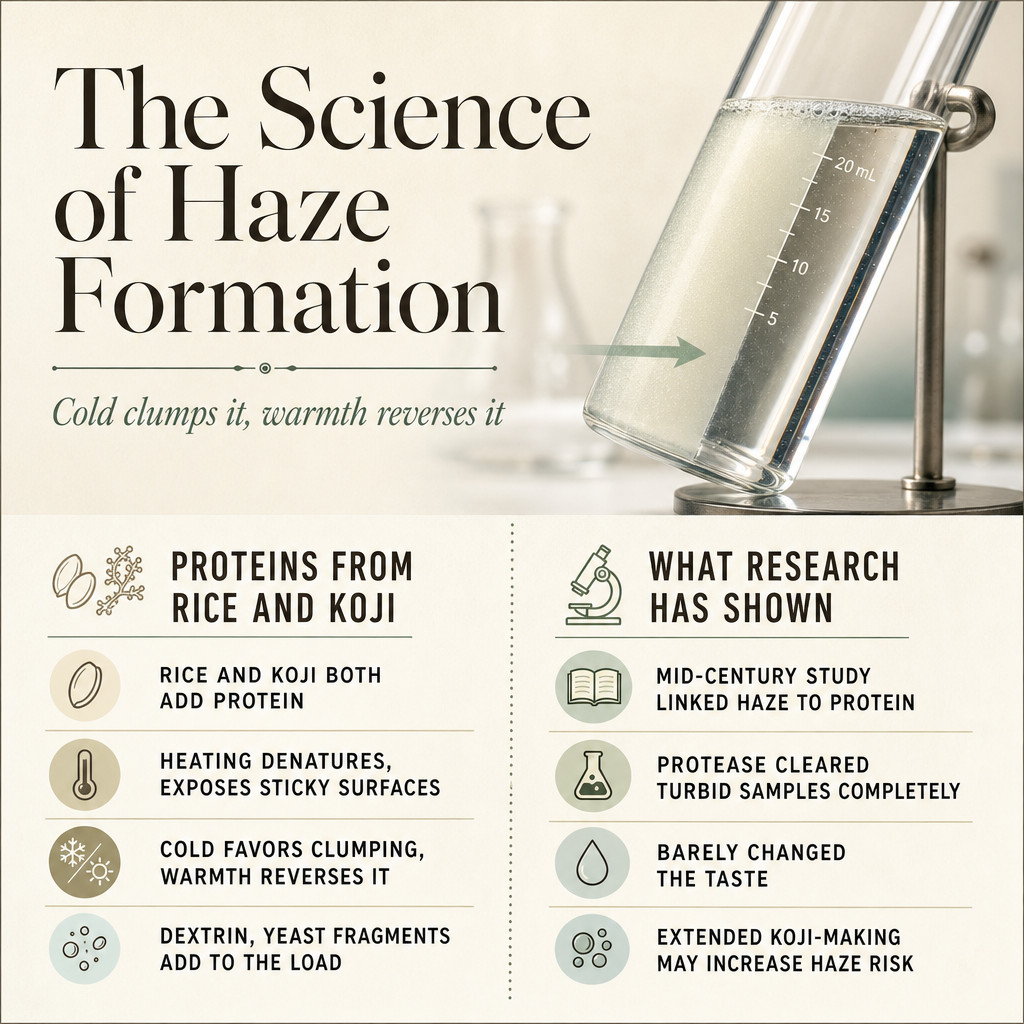
Haze in sake comes down to proteins that will not stay dissolved. Rice contains protein, and polishing removes only part of it. More protein arrives with koji, since enzymes are proteins too.
Heating changes them permanently. A denatured protein loses its neat folded shape and exposes sticky surfaces. Molecules that once floated separately now find each other and hold on.
Temperature then decides what a drinker actually sees. Cool conditions favour clumping, so haze often shows up in a chilled warehouse, and gentle warming reverses it. Dextrin and fine yeast fragments add to the colloidal load alongside protein.
What Research Has Shown
Brewing scientists studied this decades ago, and their findings still hold. Mid-century work published in the Journal of the Brewing Society of Japan tied the white haze directly to sake protein. Researchers cleared dozens of turbid samples with a protease preparation, leaving a small gel-like deposit and almost no change in taste.
That result explains why enzyme treatment remains a standard clarification route today. Break the proteins into small enough fragments and they lose the ability to cloud anything. The white haze also tends to appear in sake made with extended koji-making, the same approach that builds umami, though nobody has fully mapped the mechanism.
Traditional Clarification Methods
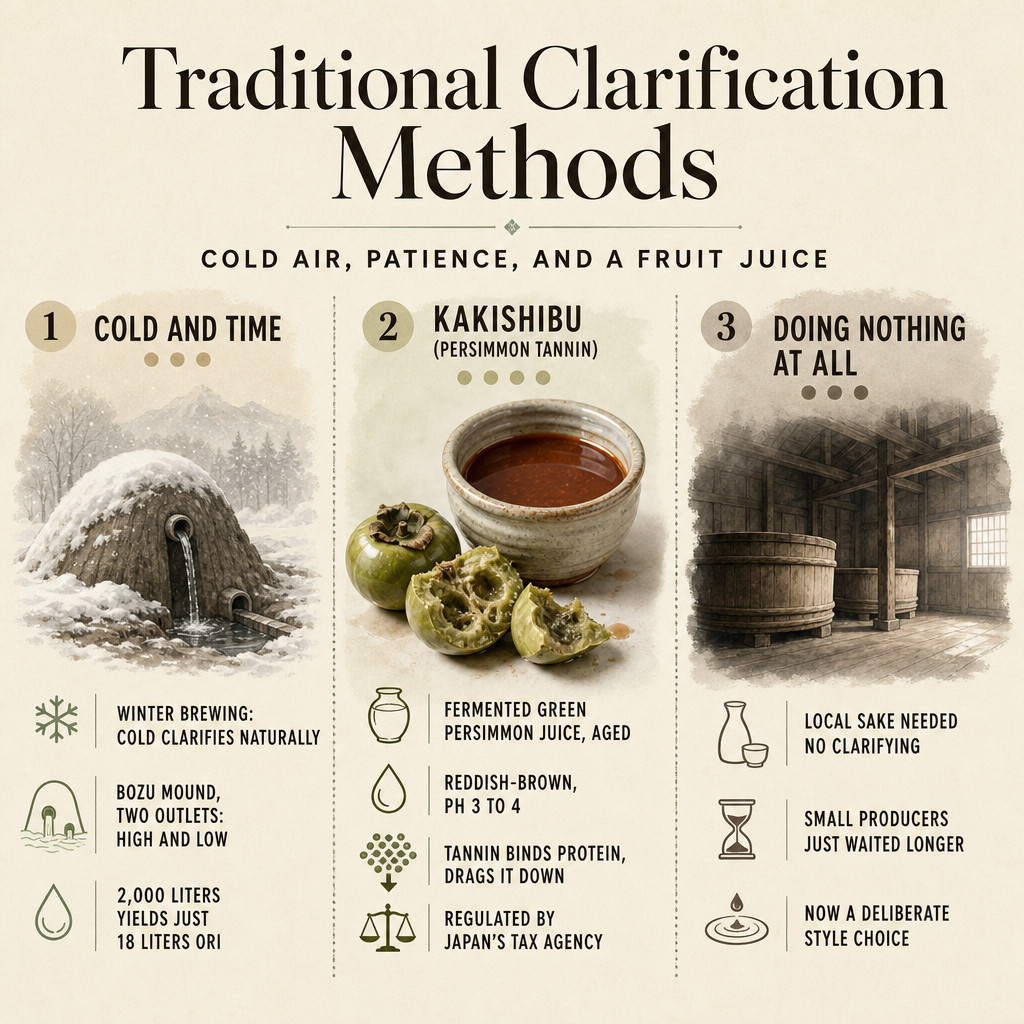
Long before anyone measured protein, brewers had already solved this practically. Their tools were cold air, patience, and a fruit juice.
Cold and Time
Sake brewing became a winter craft for good reasons, as our guide to kan-zukuri explains. Cold cellars also happened to clarify sake beautifully. Low temperatures push haze together, and stillness lets it fall.
Tank design helped too. Many traditional tanks rise slightly in the centre, a mound brewers nickname the bozu, and sediment collects in the lower ring around it. Two outlets, one high and one low, let a brewer draw clear liquid without disturbing the layer below.
The volumes involved are small. Sake Street reports that 2,000 litres of sake yields only about 18 litres of ori. Tiny quantities, yet enough to spoil the look of a whole tank.
Kakishibu: Fermented Persimmon Tannin
The classic Japanese fining agent comes from astringent persimmons. Producers harvest the fruit while still green, crush it, and press out the juice. That juice ferments for about a month, then goes through heating and long ageing.
The finished kakishibu is a reddish-brown liquid with a pH of 3 to 4. Records from the Nada brewing research institute put its solids at 7 to 10 percent and its organic acids at 2 to 3 percent. Only about 5 to 6 percent of its tannin content actually does the clarifying work.
The chemistry is elegantly simple. Tannin binds to protein and forms a complex too heavy to stay suspended. Down it goes, taking the future haze with it.
Japan’s National Tax Agency took this seriously enough to regulate it. The agency set a titre standard called rikika for kakishibu sold as a fining agent, along with limits for lead, arsenic, and hiochi bacteria. Few traditional materials receive that level of official attention.
Doing Nothing at All
Minimal intervention counts as a traditional method too. Long-distance shipping was what pushed breweries toward careful clarification in the first place, and regional sake sold near the kura faced no such journey. Many small producers simply waited longer and shipped what they had.
That approach never fully disappeared. It came back, in fact, as a deliberate style choice.
Modern Clarification Techniques
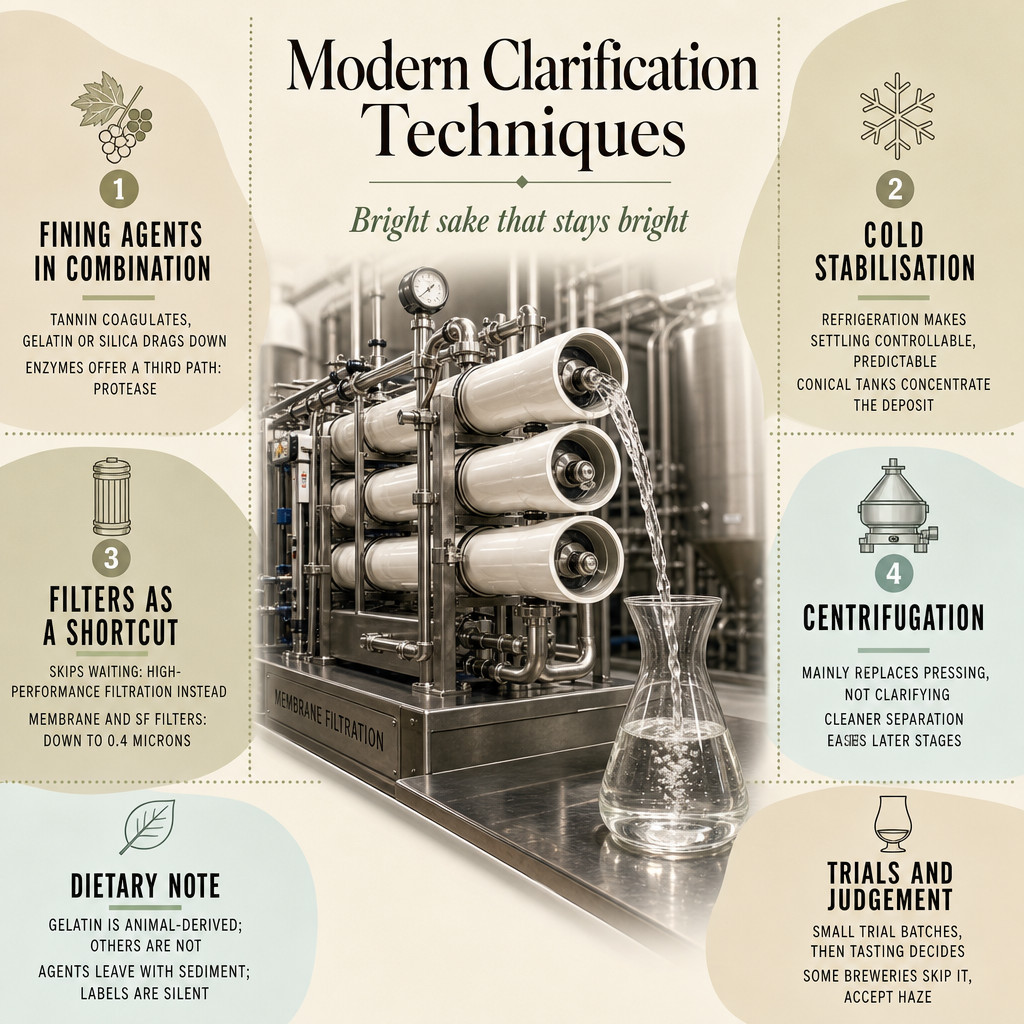
A brewer today has options, and most choose a combination. The goal has not changed at all: bright sake that stays bright.
Fining Agents in Combination
A common modern recipe pairs two agents. Persimmon tannin coagulates the protein first. Gelatin or diatomaceous earth then drags the coagulated material down through the tank.
Colloidal silica offers another route, and Japanese brewing guidance treats it as approved for this purpose alongside persimmon tannin. Silica adsorbs haze-active protein directly. Wine and beer producers rely on closely related chemistry for the same reason.
Enzymes provide a third path. Japanese sources divide the field neatly: physical clarification with agents like kakishibu, and enzymatic clarification with protease.
Cold Stabilisation and Settling Tanks
Refrigeration turned an old advantage into a controlled variable. Brewers now hold sake at chosen low temperatures rather than waiting on the weather, and stable cold produces predictable settling.
Tanks with conical or raised bottoms concentrate the deposit, and careful transfer then separates the two layers. The operation looks almost identical to racking, which is precisely why the terms get confused.
Filters as a Shortcut
Sometimes a brewery skips the waiting entirely. High-performance filters can remove the same material, and the Japan Sake and Shochu Makers Association names this as a direct alternative to letting it settle.
The equipment gets impressively fine. Membrane filters reach pore sizes around one micron, small enough to stop yeast cells measuring two to ten microns. Hollow-fibre SF filters go finer still, near 0.4 microns, catching protein particles and spoilage bacteria alike.
Fine filters do demand preparation. Clog one with coarse sediment and the whole run stalls. Earlier racking and rough filtration therefore protect the expensive equipment downstream.
Where Centrifugation Fits
Centrifugal separators have entered a number of Japanese breweries. Their main role sits earlier in the process, as an alternative to conventional pressing, since the method separates mash from liquid gently and without heavy pressure.
The knock-on benefit still reaches clarification. Cleaner separation upstream means less sediment arriving downstream, so a brewer using a centrifuge starts the finishing stages with an easier tank.
Fining Agents and Dietary Preferences
One practical point rarely reaches English-language sake writing. Gelatin appears among the traditional fining materials, and gelatin comes from animals. Persimmon tannin, colloidal silica, and diatomaceous earth all come from plant or mineral sources, so practice varies widely between breweries.
The agents leave with the sediment rather than staying in the bottle. Labels will not answer the question either way, since processing aids need no declaration. Anyone who needs certainty should contact the brewery or importer directly.
Trials, Tasting, and Judgement
No brewer applies a fixed dose blindly. Small trial batches come first, with different amounts and different agents, and tasting decides the final choice. Overtreatment carries a real cost, since too much of anything strips character along with the haze.
Some breweries decline the whole procedure. Treating sake after bottling means pouring it back into tanks and often reheating it. That handling stresses delicate liquid, so a few producers accept a little haze instead.
Orisage vs Oribiki vs Filtration
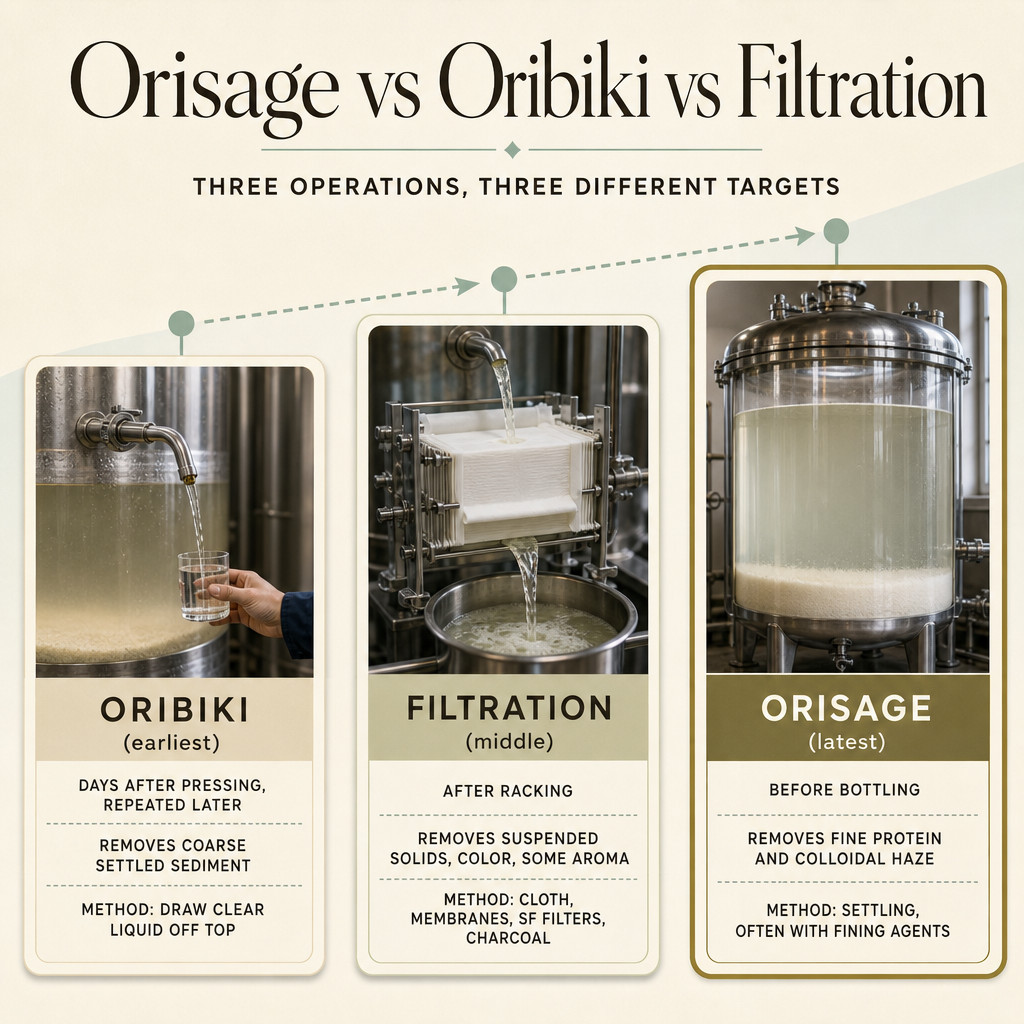
This comparison sits at the heart of the confusion, so let us be exact. Three separate operations clarify sake, and each targets something different.
| Process | Japanese | Stage | Removes | Method |
|---|---|---|---|---|
| Oribiki | 滓引き | Days after pressing, repeated later | Coarse settled sediment | Drawing clear liquid off the top |
| Orisage | 滓下げ | Before bottling | Fine protein and colloidal haze | Settling, often with fining agents |
| Filtration | 濾過 | After racking | Suspended solids, colour, some aroma | Cloth, membranes, SF filters, charcoal |
Oribiki: The Racking Step
Oribiki happens early and works by gravity. Pressed sake rests for a few days, visible sediment gathers at the bottom, and a brewer then siphons or pumps the clear portion into a fresh tank.
Speed matters at this stage. The sediment holds live yeast and active enzymes, which keep altering the sake around them. Leaving it too long risks off-aromas and autolysis notes.
Skip this step deliberately, or draw from the lower outlet, and you get something different. That hazy result reaches shops as origarami, and plenty of drinkers seek it out.
Filtration: A Different Kind of Work
Filtration removes what a filter can physically catch. Cloth handles debris, membranes handle particles, and hollow fibres handle microbes. So far, so mechanical.
Activated charcoal belongs to a separate category, though people lump it in. Charcoal adsorbs colour compounds and unwanted aromas rather than solids. Skipping it gives muroka sake, with its faint golden or greenish cast.
Orisage: The Step That Waits
Orisage differs from both in one crucial way. It addresses material that has not yet become a particle at all. You cannot filter out a dissolved protein, so a brewer has to make it visible first.
Fining agents perform that conversion. Tannin, silica, or gelatin turn an invisible risk into a settleable solid. Only then does removal become possible.
Why the Two Terms Get Swapped
English-language writing mixes Orisage and Oribiki constantly. Some sources translate one as the other, and a few describe racking after pressing while labelling it orisage.
Japanese technical usage keeps them apart. The National Research Institute of Brewing lists 滓引き as racking in its standard English terminology for sake. The Japan Sake and Shochu Makers Association glossary places 滓下げ under the heading sedimentation, describing a tank rest that settles remaining solids and prevents turbidity in storage.
There is one honest source of the muddle. Both steps end the same way, with a brewer transferring bright sake off a settled layer. The Association’s own process description makes that explicit: the settling goes by orisage, and the transfer that follows goes by oribiki. Same final gesture, different problem solved.
Orisage vs Nigori: Two Different Kinds of Cloudy
Search for cloudy sake and two words come back: Orisage and nigori. They sit on opposite sides of the same question.
Orisage is a process that removes cloudiness, while nigori is a style that keeps it. One works to make sake bright. The other leaves rice solids suspended on purpose.
The material differs too. Nigori sake owes its milky look to relatively coarse rice particles left in after gentle pressing. The haze Orisage targets is far finer, invisible at first, and appears only after heating and storage.
Nobody fines nigori sake, then. Doing so would erase the very thing people buy it for. Origarami sits between the two extremes, with a light snowy haze from fine lees that a brewer chose not to rack away.
What Does Clarified Sake Taste Like?
Now the question drinkers actually care about. Does pulling haze out of sake pull flavour out with it?
Aroma
Clarification itself barely touches aroma. Tannin and silica bind protein, not the volatile esters that give ginjo sake its melon and pear character. Japanese brewing sources describe the flavour impact as slight.
The handling around it does more damage. Moving sake between vessels exposes it to oxygen and movement, and a second round of heating tires delicate top notes further. Aroma loss, when it happens, usually traces back to the logistics rather than the chemistry.
Texture and Mouthfeel
Colloids contribute a little body. Strip them away and the liquid can feel marginally leaner across the palate. The shift is subtle, and most drinkers would miss it in a blind glass.
Compare a hazy origarami with its clear sibling, though, and the contrast shows. The cloudy version feels rounder, slightly grainy, faintly creamy.
It is tempting to assume that clarity costs flavour, since filtration debates run hot in the wine world. The evidence does not really support that here. The trade-off is not quite zero either, so the honest summary is a small loss of texture in exchange for a stable bottle.
Comparing Clarity Across Sake Styles
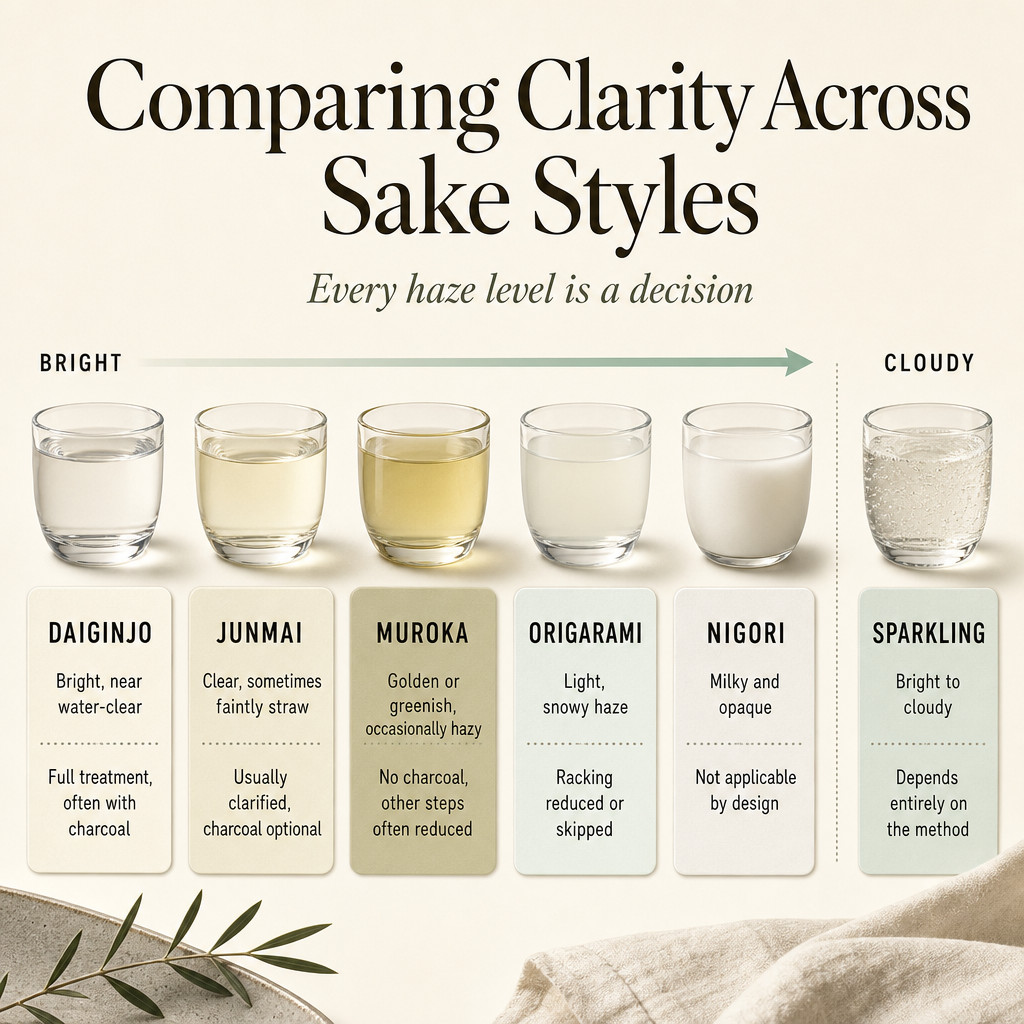
Clarity varies enormously by style, and none of it happens by accident. Every level of haze reflects a decision someone made on purpose.
| Style | Typical Appearance | Clarification Approach |
|---|---|---|
| Daiginjo | Bright, close to water-clear | Full treatment, often with charcoal |
| Junmai | Clear, sometimes faintly straw | Usually clarified, charcoal optional |
| Muroka | Golden or greenish, occasionally hazy | No charcoal; other clarification often reduced |
| Origarami | Light, snowy haze | Racking reduced or skipped |
| Nigori | Milky and opaque | Not applicable by design |
| Sparkling | Anywhere from bright to cloudy | Depends entirely on the method |
Daiginjo sits at the polished end. Half the rice grain disappears before brewing begins, so the resulting sake carries less protein to start with. Brewers then finish the job with careful clarification.
Junmai styles vary more widely. Richer, umami-driven examples often come from longer koji work, which raises the haze risk. Producers weigh that against the character they want to keep.
How to Read Clarity on a Sake Label
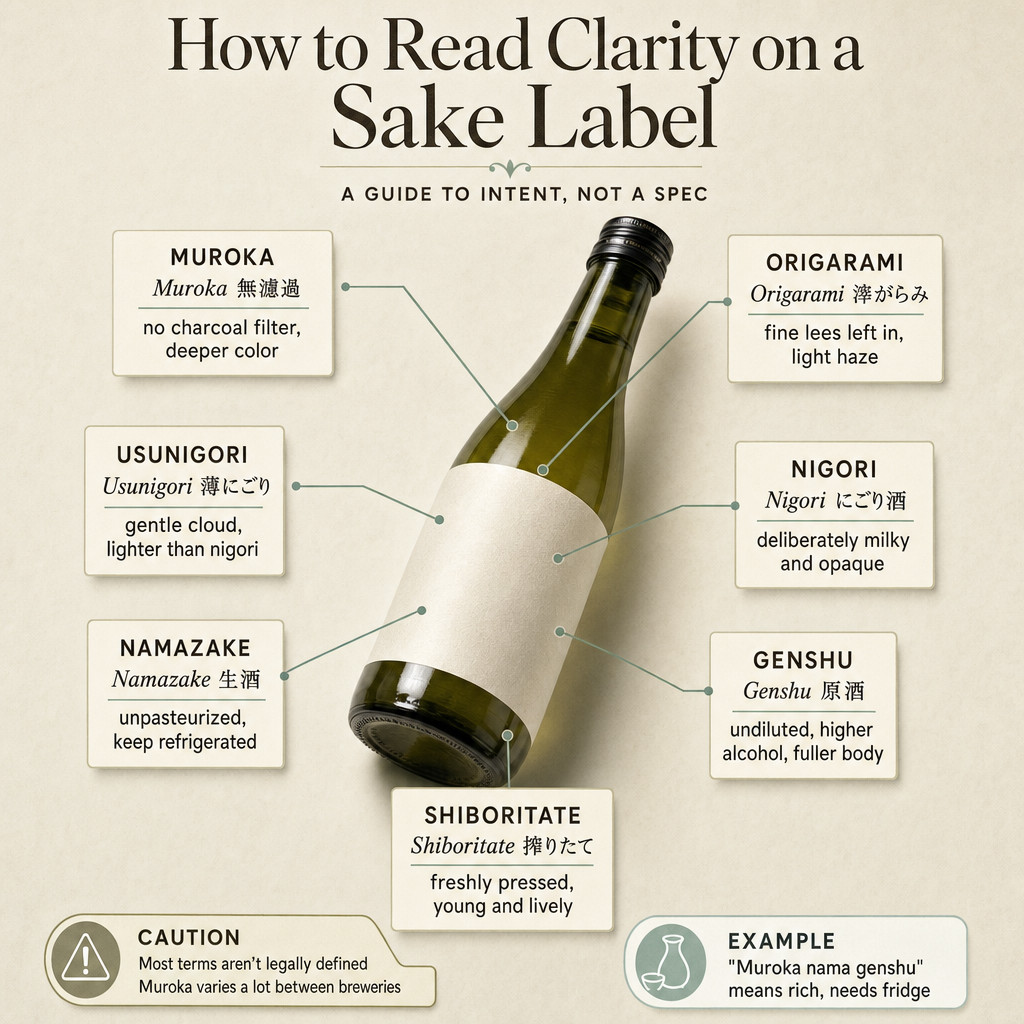
All of this becomes useful the moment you stand in front of a shelf. A handful of label terms tell you roughly what to expect in the glass.
| Term | Japanese | What It Signals |
|---|---|---|
| Muroka | 無濾過 | No charcoal filtration; deeper colour, haze possible |
| Origarami | 滓がらみ | Fine lees left in on purpose; light snowy haze |
| Usunigori | 薄にごり | A gentle cloud, lighter than full nigori |
| Nigori | にごり酒 | Deliberately milky and opaque |
| Namazake | 生酒 | Unpasteurised; keep refrigerated |
| Genshu | 原酒 | Undiluted; higher alcohol and fuller body |
| Shiboritate | 搾りたて | Freshly pressed; young and lively |
One caution belongs with that list. Most of these words carry no legal definition, unlike grade terms such as junmai or daiginjo. Muroka in particular varies between breweries, since some skip charcoal only and others skip filtration almost entirely.
Treat the terms as a guide to intent, then, rather than a specification. A bottle marked muroka nama genshu promises richness and asks for refrigeration. A bottle carrying none of these words probably went through the full clarification sequence.
Muroka, Nama, Genshu: The Minimal-Intervention Style
Three label terms often travel together, and a quiet counter-movement has grown around them. Muroka means no charcoal filtration. Namazake means no pasteurisation, and genshu means no dilution.
Combine all three and you get sake close to its tank state. Colour runs deeper, texture feels fuller, and flavour hits harder. Haze becomes a real possibility rather than a fault, and some retailers now describe it as a marker of maturation.
Ironically, this style depends on very modern capability. Cold chains, fast logistics, and refrigerated retail make unstabilised sake shippable at all. Minimal intervention leans on maximum infrastructure.
Why Export Markets Prefer Clear Sake

Exports raised the stakes around clarity. A bottle heading overseas faces conditions no brewery can supervise.
Long Transport and Temperature Swings
Long journeys punish unstable liquid. A container may bake in one port and chill in another, and each cycle of warming and cooling nudges proteins toward each other. Light adds another pressure, since sun exposure ranks among the recognised causes of colour change in sake.
Retail Expectation
An importer facing a hazy pallet has a difficult conversation ahead. Explaining that the cloud is harmless takes time nobody has at a busy retail counter. Prevention costs far less than persuasion, which is why export-bound sake usually goes through the full clarification sequence.
No Law, Only Expectation
Worth stating clearly: no regulation demands clear sake. Japanese liquor law requires the mash to be strained or pressed for a product to qualify as sake, and it sets no clarity standard beyond that. The pressure comes entirely from the market.
Common Misconceptions About Orisage
- Is cloudy sake defective? Usually not. Protein haze is harmless, and some styles are cloudy on purpose.
- Does clarification strip flavour? Very little. The extra handling does more harm than the agents themselves.
- Is Orisage mandatory? No. Many breweries skip it and say so on the label.
- Is Orisage the same as filtration? No. Filtration catches particles; Orisage creates them first, then settles them.
- Is Orisage the same as Oribiki? No. Different stage, different target, similar final action.
- Do fining agents remain in the sake? No. They bind to protein, sink, and leave with the sediment.
That Oribiki pairing causes the most trouble in English writing. Hold on to the timing and you will not slip. Oribiki comes soon after pressing, while Orisage waits until bottling approaches.
Final Thoughts
Orisage is a late-stage clarification process designed to remove haze-forming proteins before bottling. It improves visual stability and shelf appearance, yet no law requires it, and it does not define quality on its own. Clear sake and cloudy sake simply reflect different brewing choices.
Three things are worth carrying away. Check labels for muroka, origarami, and nama when the fuller, less processed styles appeal, store any bottle cool and dark, and warm a small cup before judging a faint haze. Our guides to filtration and pasteurization cover the stages either side of clarification.
Orisage FAQ
What is Orisage in sake brewing?
Orisage is the clarification step brewers carry out before bottling. It settles fine proteins and colloids that would otherwise cloud the sake during storage. Brewers then transfer the bright liquid away from the sediment. The Japanese name means “lowering the lees.”
What is the difference between Oribiki and Orisage?
Timing and target separate them. Oribiki removes coarse sediment a few days after pressing, using gravity alone. Orisage waits until bottling nears and deals with microscopic haze-forming protein. Both finish with a transfer, which is why English sources often confuse the two.
Why does sake turn cloudy after brewing finishes?
Dissolved proteins cause most of it. Heating during pasteurisation changes their structure, and cool storage then lets them gather into visible clusters. Japanese brewers call the result shiroboke, or protein haze. Rice protein and koji enzymes both contribute to the problem.
My sake looks hazy. Is it still good to drink?
Generally yes, and a simple test helps. Warm a small cup to roughly 60°C and watch the liquid, since protein haze usually clears at that temperature. A cloud that persists, especially alongside a sour or musty aroma, may point to spoilage instead. In that case, ask the retailer rather than guessing.
What agents do brewers use for Orisage?
Persimmon tannin, known as kakishibu, remains the classic option. Brewers often follow it with gelatin or diatomaceous earth to help the material sink. Colloidal silica offers a modern alternative, and protease enzymes provide a third route. Japanese brewing terminology calls all of these orisage-zai.
Is fined sake suitable for vegetarians and vegans?
It depends on the brewery, and labels will not say. Gelatin is animal-derived and appears among traditional fining materials, though persimmon tannin, silica, and diatomaceous earth do not. Fining agents leave with the sediment rather than remaining in the bottle. Anyone who needs certainty should ask the brewery or importer, or choose unfined styles.
Does Orisage change the flavour of sake?
The impact stays small. Japanese brewing sources describe clarification as broadly flavour-neutral. Extra handling does carry some risk, since transferring and reheating can tire delicate aromas. Careful dosing and gentle work keep those losses minimal.
Is Orisage required by law?
Not at all. Japanese liquor law requires straining or pressing for a product to qualify as sake, but sets no clarity standard. Market expectation drives the practice instead. Plenty of breweries skip it and advertise the fact proudly.
Does muroka sake skip Orisage as well?
Often, though the term technically refers to charcoal filtration. Muroka means no activated carbon treatment, which explains the golden or greenish tint. No strict definition exists, so some producers reduce other clarification steps too. Faint haze may therefore appear over time.
How should I store sake to avoid haze forming?
Aim for cool, dark, and steady. Repeated temperature swings encourage proteins to clump, and light drives colour change. Refrigerate namazake and other unpasteurised bottles without exception. Even well-stored sake can develop a faint protein haze, which warming will usually clear.
References
- Japan Sake and Shochu Makers Association, Sake Brewing Processes and Flavor (orisage settling and oribiki transfer described as separate operations; persimmon tannin and colloidal silica listed for removing excess protein), https://japansake.or.jp/sake/en/professional/sake-brewing-processes-flavor/ (Surveyed: July 2026)
- Japan Sake and Shochu Makers Association, Glossary of Sake Terms (滓下げ / orisage listed under the heading sedimentation), https://japansake.or.jp/sake/en/basic/glossary/ (Surveyed: July 2026)
- Japan Sake and Shochu Makers Association, 日本酒用語集 (orisage defined as settling haze components before bottling to prevent shiroboke; physical and enzymatic clarification distinguished; 滓下げ剤 defined), https://japansake.or.jp/sake/about-sake/glossary-of-sake/ (Surveyed: July 2026)
- National Research Institute of Brewing, List of Standard English Expressions for Sake Terminology (滓引き / oribiki listed as racking, removal of sediment), https://www.nrib.go.jp/English/sake/pdf/nrib_st_en_ver1.pdf (Surveyed: July 2026)
- National Research Institute of Brewing, Japanese Sake: A Comprehensive Guide (use of persimmon tannin or colloidal silica approved for protein removal), https://www.nrib.go.jp/English/sake/pdf/guidesse01.pdf (Surveyed: July 2026)
- Nada Brewing Research Institute, Sake Glossary: Shibu (kakishibu at pH 3 to 4, 7 to 10 percent solids, 2 to 3 percent organic acids, 5 to 6 percent of tannin effective in orisage), http://www.nada-ken.com/main/en/index_s/240.html (Surveyed: July 2026)
- Nada Brewing Research Institute, Sake Glossary: Ori (sediment composed of starch, fibre, insoluble protein, yeast and enzymes), https://www.nada-ken.com/main/en/index_o/236.html (Surveyed: July 2026)
- Hiroshima Prefecture, Food FAQ: Causes and Countermeasures for Turbidity in Sake (haze judged by warming to approximately 60°C; protein-derived haze disappears), https://www.pref.hiroshima.lg.jp/soshiki/26/foodfaq10-3.html (Surveyed: July 2026)
- SAKE Street, Why Sake Looks Clear: Learning the Process from Pressing to Bottling (sumizake prized from the Manyo era; 2,000 litres of sake yields roughly 18 litres of ori; membrane filters near 1 micron, SF filters near 0.4 microns, yeast cells 2 to 10 microns; five recognised causes of coloration; toritsu kenshu inverted inspection), https://sakestreet.com/en/media/learn-sake-fining-1 (Surveyed: July 2026)
- Journal of the Brewing Society of Japan (J-Stage), Studies on So-Called Protein-Turbid Sake (Shiroboke Sake), Vol. 48, No. 11, p. 431 (57 turbid samples clarified with a protease preparation, with negligible sensory change), https://www.jstage.jst.go.jp/article/jbrewsocjapan1915/48/11/48_11_431/_article/-char/ja/ (Surveyed: July 2026)
- Journal of the Brewing Society of Japan (J-Stage), Studies on Protein-Turbid Sake, Report 5, Vol. 51, No. 11, p. 794 (turbidity linked to protein and reversible with pH adjustment), https://www.jstage.jst.go.jp/article/jbrewsocjapan1915/51/11/51_11_794/_article/-char/ja/ (Surveyed: July 2026)
- Springer Nature, History of Kakishibu: Before and After the Plastic Era (National Tax Agency rikika titre standards for fining agents, 1961 and 1997, with limits for lead, arsenic and hiochi bacteria), https://link.springer.com/chapter/10.1007/978-981-95-7805-4_3 (Surveyed: July 2026)
Related Articles
- Pressing (上槽 / Joso): How Moromi Becomes Sake (Surveyed: July 2026)
- Filtration (濾過 / Roka): Refining Sake After Pressing (Surveyed: July 2026)
- Pasteurization (火入れ / Hiire): Stabilizing Sake with Gentle Heat (Surveyed: July 2026)
- Warimizu (割水): Why Water Is Added Before Bottling Sake (Surveyed: July 2026)
- Moromi (醪): The Main Fermentation Mash (Surveyed: July 2026)
- Sake Kasu (酒粕): Sake Lees from Brewing to Table (Surveyed: July 2026)
- Kan-zukuri (寒造り): Why Sake Is Traditionally Brewed in Winter (Surveyed: July 2026)
- Nigori Sake: History, Restaurants and Online Shopping (Surveyed: July 2026)
- Namazake: What Is Japanese Unpasteurized Sake (Surveyed: July 2026)
- How Sake Is Made: Step-by-Step Japanese Brewing Guide (Surveyed: July 2026)
- Types of Japanese Sake: A Beginner’s Guide (Surveyed: July 2026)






Comments