Isojiman (磯自慢) is a sake brand from Isojiman Shuzo, a brewery founded in 1830. It is based in Yaizu, a fishing port in Shizuoka Prefecture. The brewery describes itself as an early pioneer of ginjo brewing in Shizuoka. Its sake is known for gentle fruit aromas and a clean finish designed to complement food.
What makes it interesting is not one secret ingredient. Instead, it is a chain of choices. About 65% of its rice is Yamada Nishiki from the Tojo district of Hyogo. The water comes from the Oi River system, and the brewery keeps its own yeast. Then there is the cold. In fact, the brewery says it borrowed ideas from Yaizu’s seafood-freezing industry to keep its brewing rooms chilled.
This guide follows that chain from the port to the glass. Along the way, it also shows something about the restrained, food-friendly character often linked with Shizuoka sake. It covers the product range and the Blue Bottle single-field series. It also explains the summit toasts and how to choose and serve a bottle.
Iwashigashima, Yaizu, Shizuoka Prefecture, on Suruga Bay
Founded
1830 (the first year of the Tenpo era)
Head brewer
Nobuo Tada (多田信男), a Nanbu toji, as listed on the company page
Main rice
Contract-grown Tojo Yamada Nishiki from Hyogo, about 65% of all rice used
Water
Soft water from the Oi River system
Yeast
House-preserved strains, including Shizuoka yeast; the brewery says it avoids ethyl-caproate-focused strains
Style
Gentle fruit aroma, clean finish, made with food in mind
Known for
Toast sake at the 2008 G8 summit dinner and the 2016 G7 Sherpa dinner
TOC
What Is Isojiman Sake?
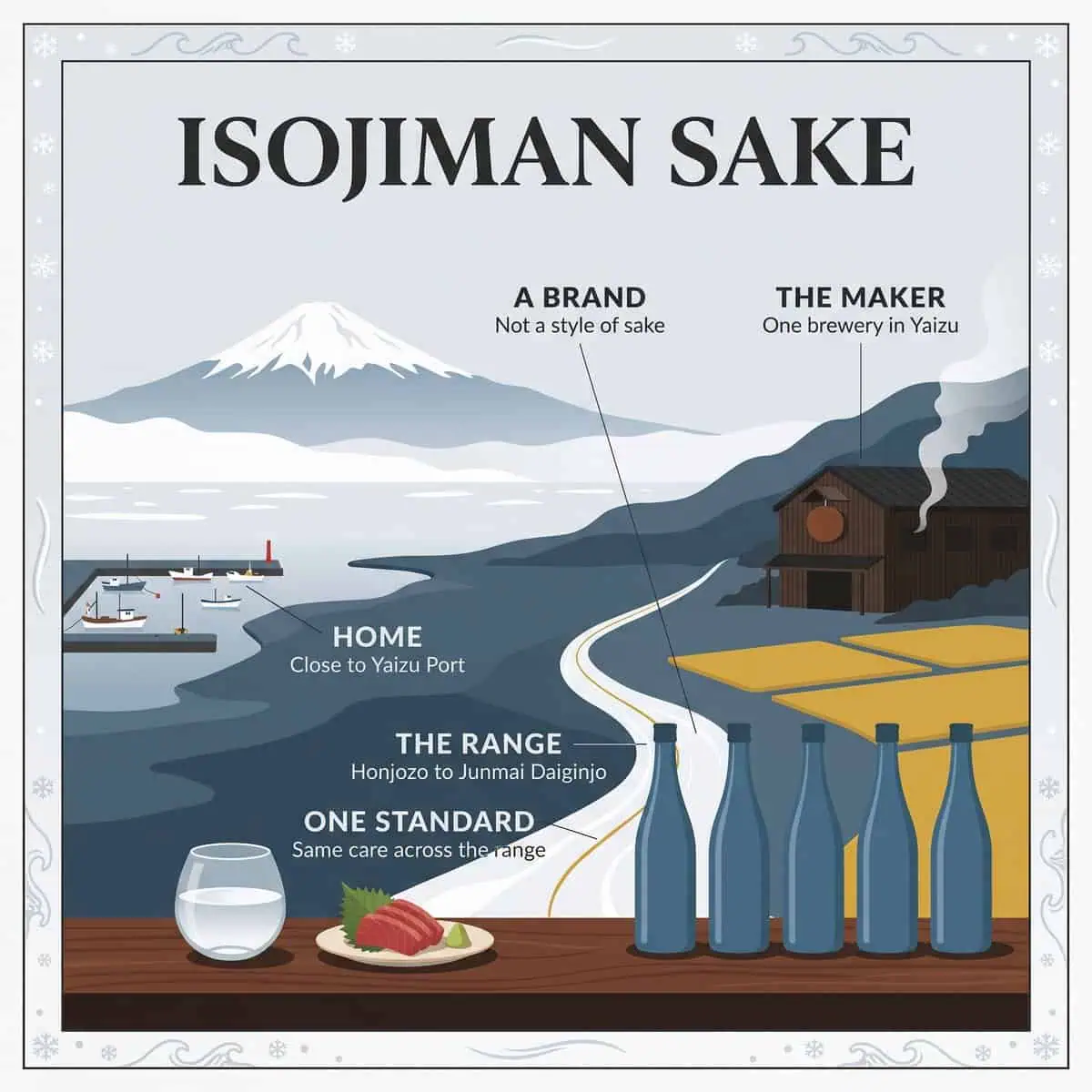
Diagram explaining the process of ISOJIMAN sake production in Japan.
Isojiman is a brand name, not a style of sake. It belongs to one company, Isojiman Shuzo, and the Isojiman sake brewery stands at 307 Iwashigashima, close to Yaizu Port. So when you see “Isojiman” on a menu, it tells you the maker. The label then tells you the production category, from everyday Honjozo up to Junmai Daiginjo.
The range is wide. Across it, though, the brewery emphasizes one consistent standard of process control. Its product page says that even its Honjozo goes through the same steps as its ginjo brewing. That is unusual enough to be worth noting, because many drinkers assume care is reserved for the top bottles.
Isojiman is also the only sake brewery listed for Yaizu on the 2026 Shizuoka brewery map from the National Tax Agency’s Nagoya bureau. Similarly, a feature on the brewery’s own site calls it Yaizu’s only sake brewery.
The Meaning of the Isojiman Name
Literally, iso means a rocky seashore, and jiman means pride. So a simple reading would be “pride of the shore.” However, we could not find an official account of how the name was chosen. So it is safest to treat that reading as a translation of the words, not as the brewery’s story.
Still, the name fits the place. The brewery stands near Yaizu Port, facing Suruga Bay. In its owner’s message, the brewery describes a view of the Izu Peninsula and Mount Fuji to the east. To the north-northwest, it says, lies the southern end of the Southern Alps.
A Brewery Founded in 1830
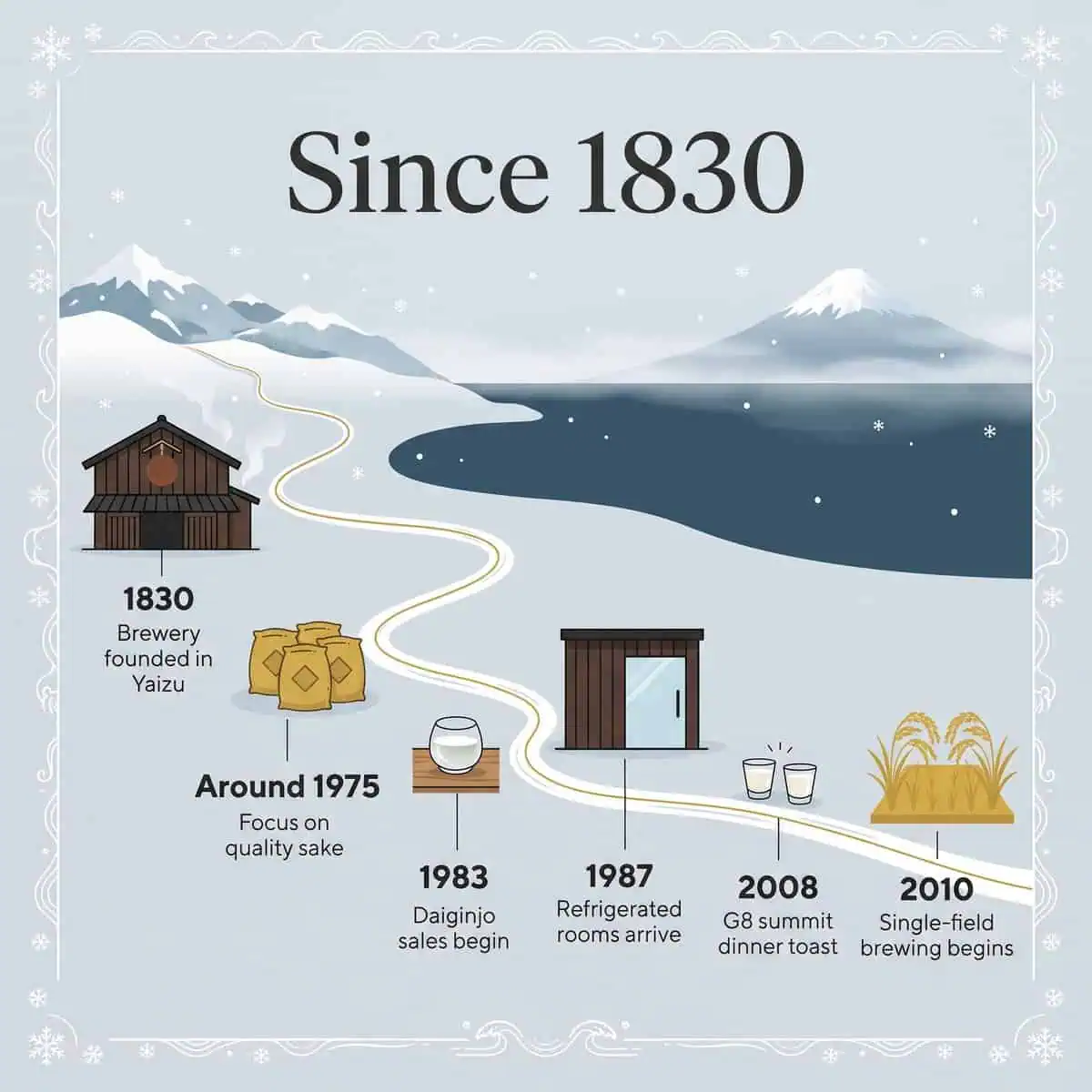
Timeline of Japanese brewing history from 1830 to 2010, highlighting key milestones in sake and beer production.
Isojiman Shuzo was founded in 1830. For most of its history, though, it was a very different business. The brewery’s own feature article, “Getting to Know Isojiman,” tells the story of how it changed.
1830The brewery is founded in Yaizu.
Around 1975The owners decide to focus on high-quality sake, according to the president’s recollection.
1983Isojiman begins selling daiginjo, a term few drinkers knew then.
1987Brewing and tank storage move into large refrigerated rooms.
2008Nakadori Junmai Daiginjo 35 is the toast at the G8 summit dinner.
2010Single-field brewing from three Akitsu rice fields begins, according to the brewery. In the same year, the brewery reports two IWC gold medals.
2016Daiginjo 28 Nobilmente is the toast at the G7 Sherpa dinner.
2025An Isojiman Omachi Tokubetsu Junmai places first in its SAKE COMPETITION category.
From Landowner to Full-Time Brewer
The brewery’s retrospective feature suggests that the founding family may have been substantial local landowners, possibly village heads. If so, they likely made sake from surplus rice in winter, as many Edo-period landowners did. The article itself says “probably,” and we do the same.
After World War II, land reform ended that way of life. As a result, brewing became the family’s main business.
The Oke-Gai Era
Meanwhile, Japan’s postwar boom created a distinctive supply structure. Demand for sake rose so fast that big brewers could not keep up. So they bought sake from small country breweries by the tank. This system was called oke-gai, or “buying by the vat,” and the big brands sold the blended sake under their own labels.
For some small breweries, bulk sales provided dependable income without the need to build a brand of their own. According to the feature, many local breweries came to depend on it for years.
The Turn Toward Quality
From the mid-1970s, however, sake drinking in Japan began to decline, and the drop deepened in the late Showa years as tastes diversified. Isojiman saw the danger early. In the feature, president Yoji Teraoka recalls a talk with his father around 1975. Together, they decided to redirect the brewery toward quality-focused sake.
He adds, with a laugh, that without that decision the brewery might not exist today. The head brewer at the time was Yokoyama (横山福司), a toji from Shizuoka’s Shida guild. Teraoka also credits him with building the foundation of Isojiman’s quality. Yokoyama worked there until he retired at 75. Today, the brewery’s company page lists Nobuo Tada (多田信男) of the Nanbu guild as its toji. Our guide to toji explains what these brewing guilds are.
Then, in 1983, Isojiman began selling daiginjo, which the brewery calls a major turning point. Later, in 1987, it moved its brewing and tank storage into large refrigerated rooms. The brewery describes this as an early example of large-scale refrigerated brewing and storage in Japan. For more context on this period, see our page on modern sake history.
Yaizu: A Port City and Its Cooling Technology
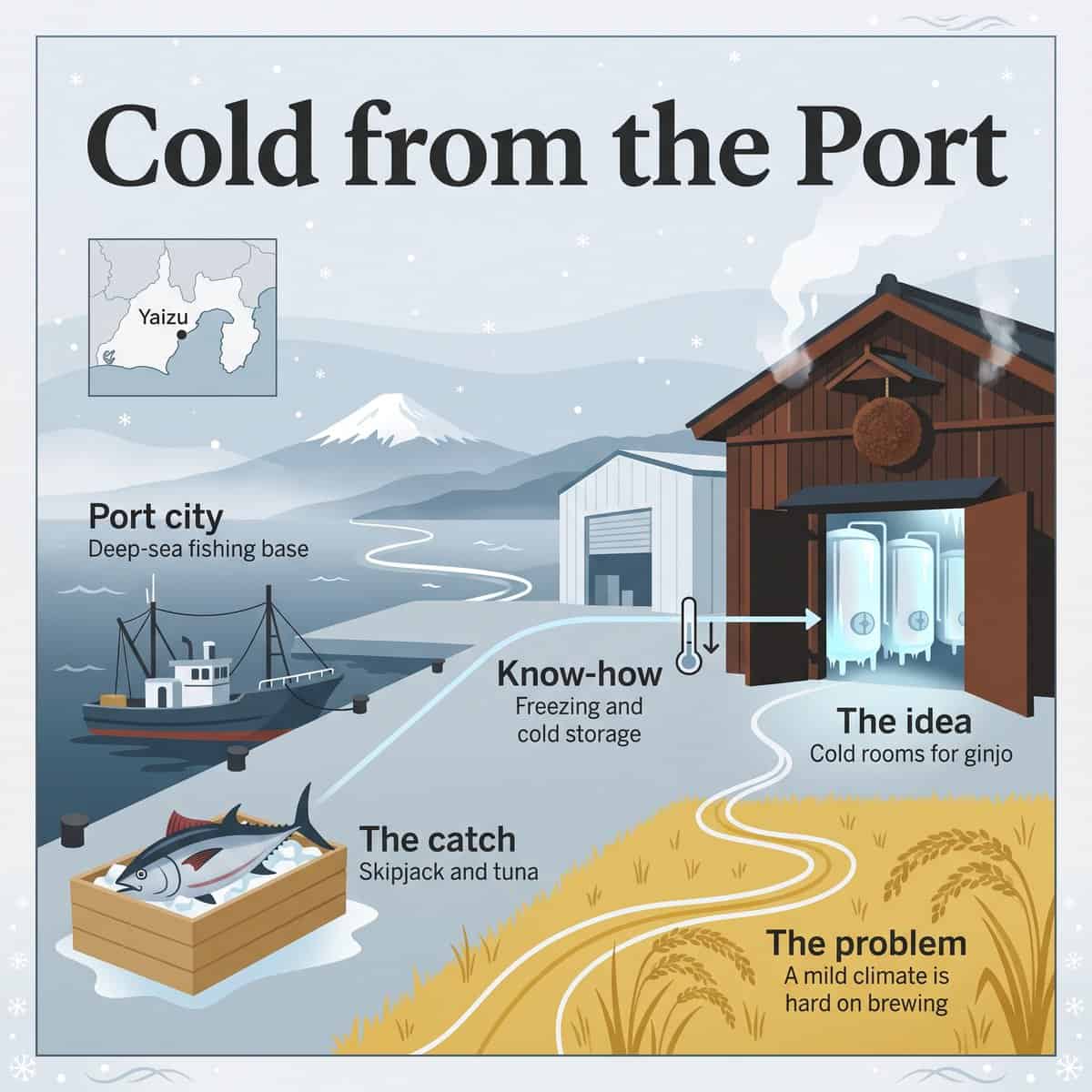
Illustration of Japan’s cold storage process for ginjo, highlighting port, catch, and freezing techniques.
Yaizu is one of Japan’s leading bases for deep-sea and offshore fishing. According to the city’s fisheries revival plan, its deep-sea fleet mainly lands skipjack tuna and tuna. That catch has shaped local food, from fresh sashimi to katsuobushi, dried bonito flakes.
Why Cold Matters in a Warm Place
However, Shizuoka has a mild climate, which is pleasant for people but hard on brewers. Low-temperature fermentation is central to the aromatic, controlled style of ginjo brewing. So Isojiman looked to its neighbors, since Yaizu’s fishing industry already had extensive expertise in refrigeration and cold storage.
The brewery says it applied Yaizu’s freezing technology, rated to around minus 60°C, to its sake brewing. Today, its brewing room is a stainless-steel space kept under continuous refrigeration. Its pressing room is refrigerated too. The brewery notes that the mash is only about 5°C just before pressing, so a cold room makes sense.
According to the feature, the president designed much of this equipment himself. It also says some of the machines are found nowhere else in Shizuoka. Of course, cold rooms do not make good sake on their own. Still, they let the brewers control temperature regardless of the weather outside.
Yamada Nishiki and the Tojo Connection
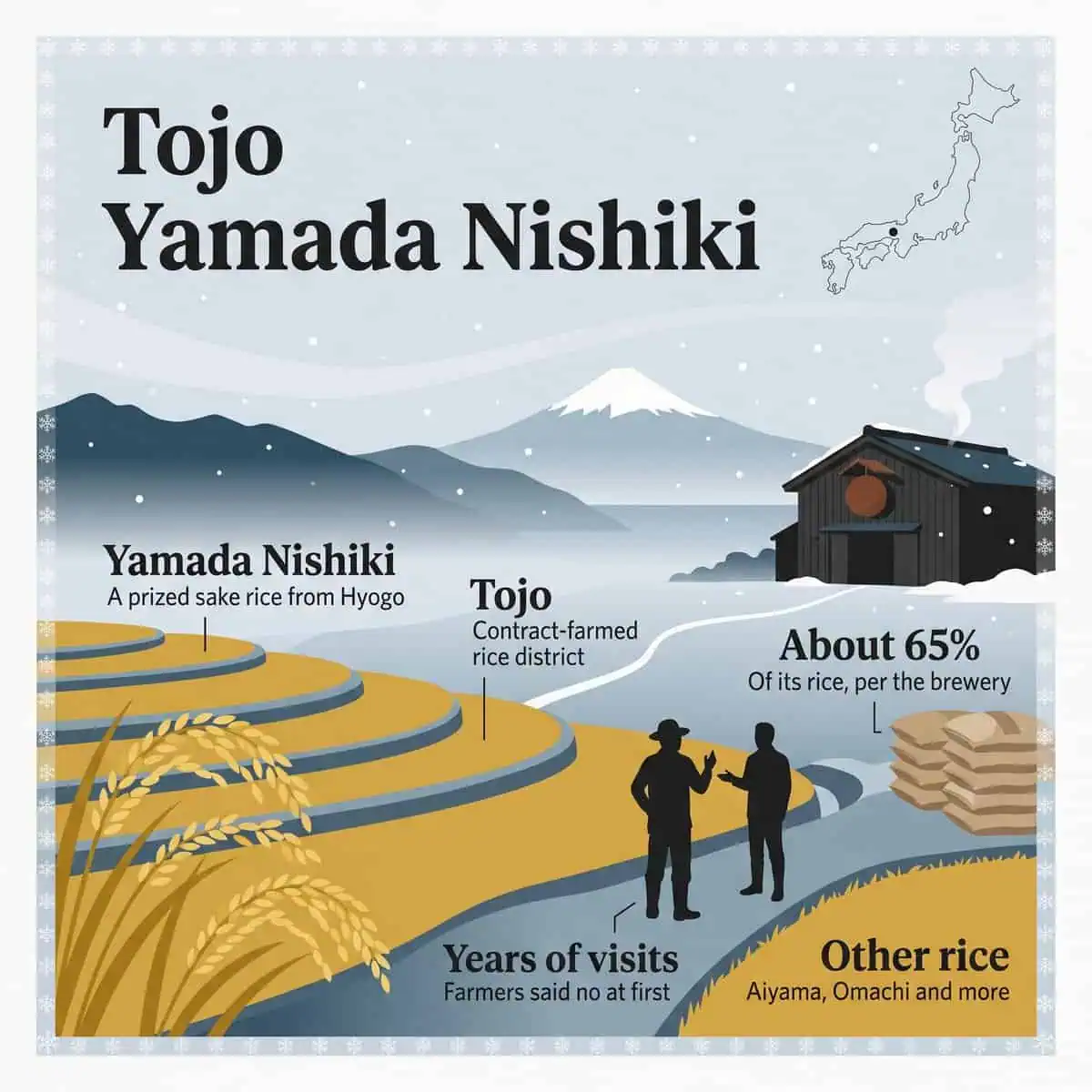
Infographic about Yamada Nishiki rice from Hyogo, Japan, highlighting its cultivation and significance.
Yamada Nishiki is a sake rice first bred in Hyogo Prefecture, and it is widely prized for premium sake. In fact, most of the rice Isojiman uses is Yamada Nishiki. Our guide to sake rice explains why brewers value large-grained rice like this.
Contract Farming in Tojo
Isojiman’s main rice is Tojo Yamada Nishiki, a registered trademark name, grown by contract farmers in the Tojo district. According to the brewery, it makes up about 65% of all the rice it uses. Since a 2006 merger, Tojo has been part of Kato City in Hyogo.
Still, getting that rice was not easy. In the feature, Teraoka says he visited farmers one by one and was turned away at first. He kept returning every year. According to his account, six years passed before a farmer agreed to work with the brewery.
As a result, Isojiman now belongs to Frontier Tojo 21, a group of 11 breweries. The group works to support Tojo farmers and protect the rice fields. It also holds food and sake events about twice a year.
What Does “Special A” Mean?
You will see “Special A” (特A) on many Isojiman labels. It refers to the top production-area class for Yamada Nishiki in Hyogo, not to the finished sake. A Japanese agricultural heritage document describes the Special A area as divided into three zones: Yashiro, Tojo, and Yokawa.
Interestingly, the brewery itself compares Special A to a grand cru in French wine. That is a helpful image, but it is a comparison, not a legal sake grade. Also, good rice does not guarantee good sake. The brewing still has to bring out what the rice offers.
Isojiman’s spec list adds more detail. It uses grade terms such as 特上 (tokujo, extra) and 特等 (tokuto, special), which are top inspection grades for brewing rice. Its finest bottles name Akitsu, a specific area within Tojo.
Not All Isojiman Uses the Same Rice
This point is easy to miss. The local Honjozo, sold mainly in Shizuoka, uses Kiyonishiki and Miyamanishiki, with Hyogo Yamada Nishiki for the final addition. Similarly, the Aiyama bottles use Aiyama rice from Yokawa. Meanwhile, an export Tokubetsu Junmai uses Omachi rice from Akaiwa in Okayama.
Water from the Oi River System
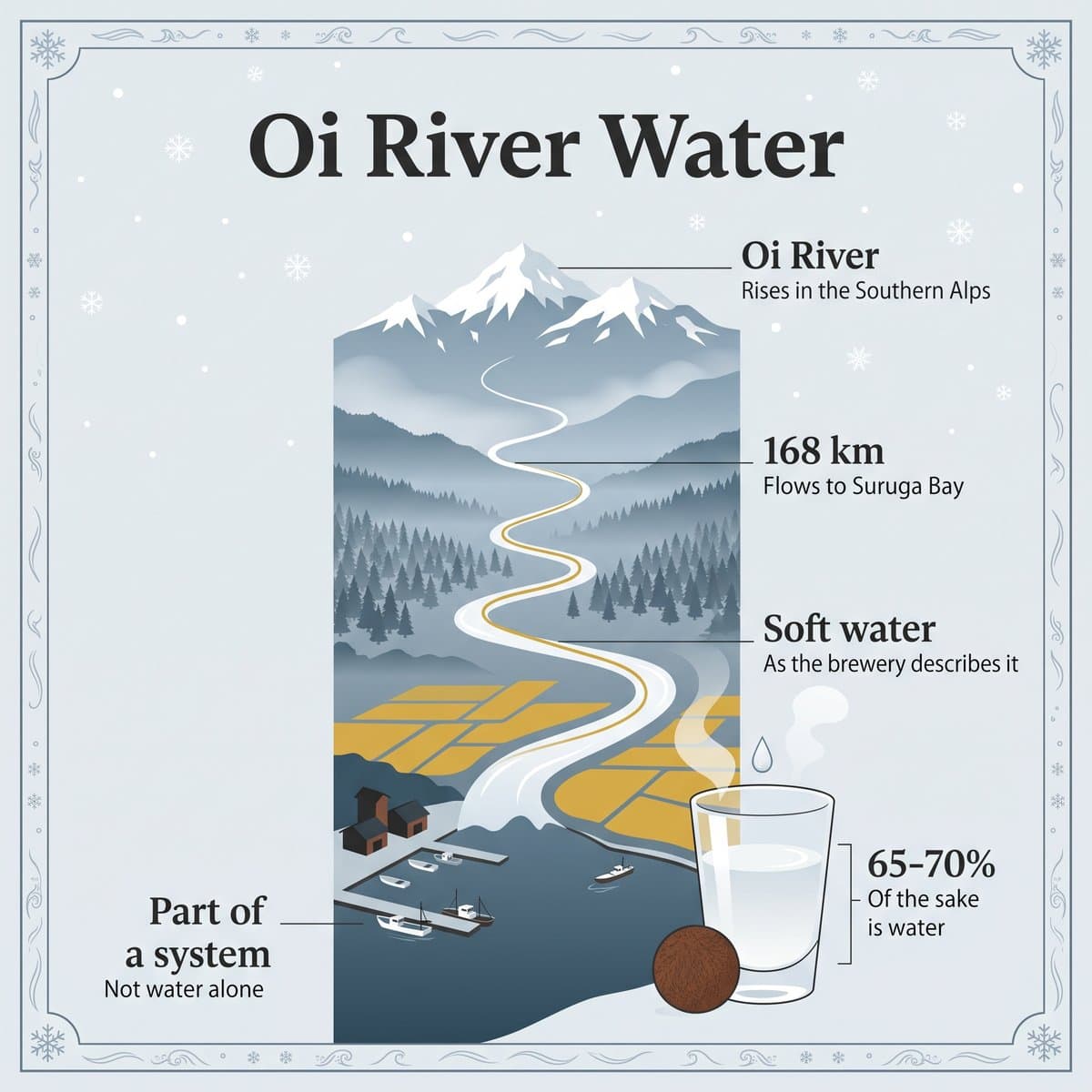
Illustration of the Oi River water cycle, from mountains to brewery, highlighting water sources for sake production.
The Oi River rises on Mount Aino-dake, a 3,189-meter peak in Japan’s Southern Alps. It then runs 168 kilometers to Suruga Bay, according to Japan’s Ministry of Land, Infrastructure, Transport and Tourism. The brewery describes the river as flowing about 170 kilometers and nourishing the Shida Plain, where Yaizu sits.
Water matters, because it makes up most of the brew. The brewery notes that water accounts for roughly 65% to 70% of its sake. It describes its water as soft and calls this gift of nature something to be truly grateful for.
Does soft water alone create Isojiman’s style? Probably not, and the brewery does not claim that either. Instead, it presents water as one part of a system that includes rice, yeast, and temperature control. Our page on sake water covers the general science.
Using Water Generously
Also, the brewery uses water in unusually generous quantities. For washing, it uses more than 350 liters of water for every 10 kilograms of rice. According to the brewery, that large volume fully rinses away residue from the rice surface before soaking.
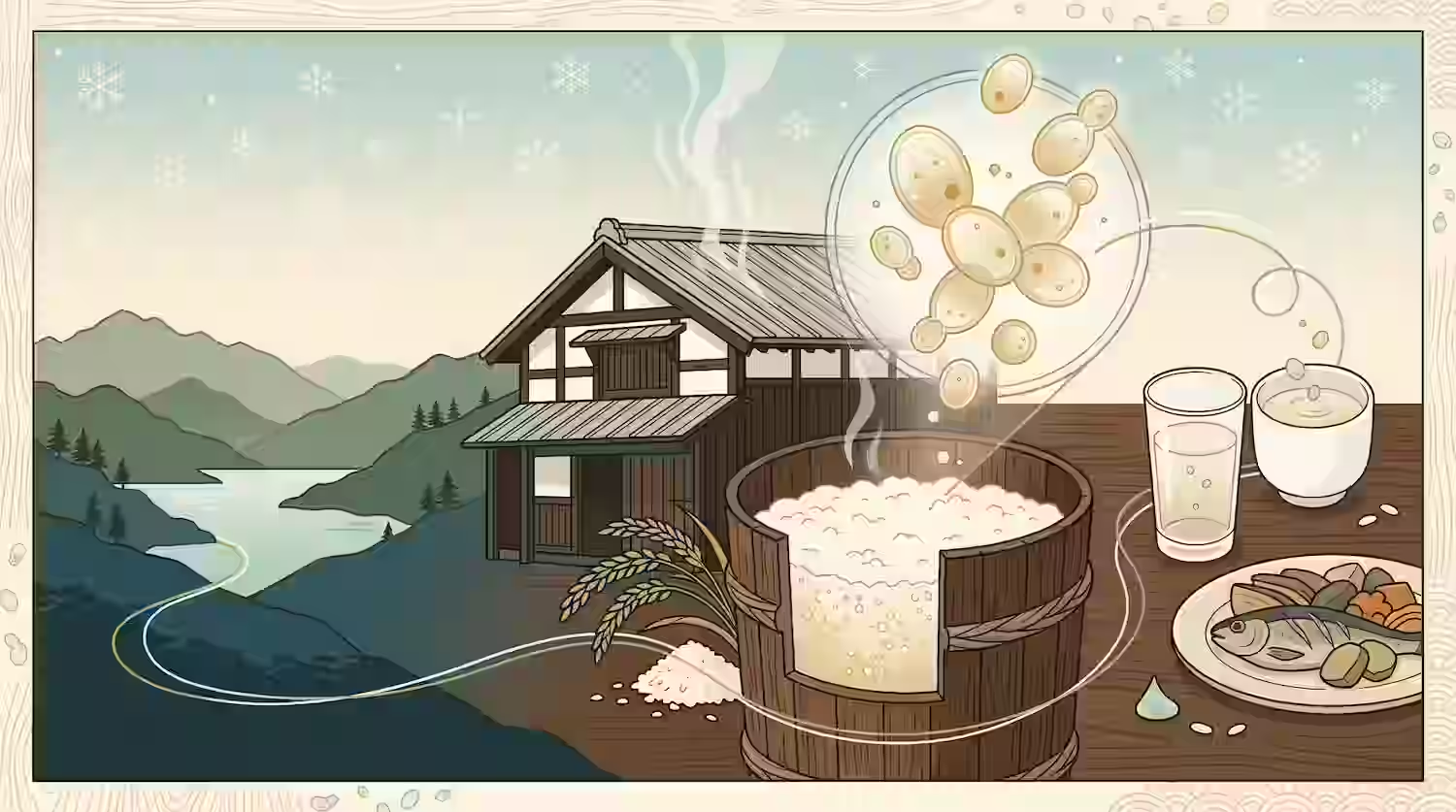
Yeast: Isojiman’s Aroma Philosophy
Illustration of yeast and aroma in Japanese fermentation, highlighting local use and flavor notes.
Yeast turns sugar into alcohol, and it also creates much of sake’s aroma. As a result, the choice of yeast shapes how a sake smells. Our page on sake yeast explains the basics.
Shizuoka Yeast
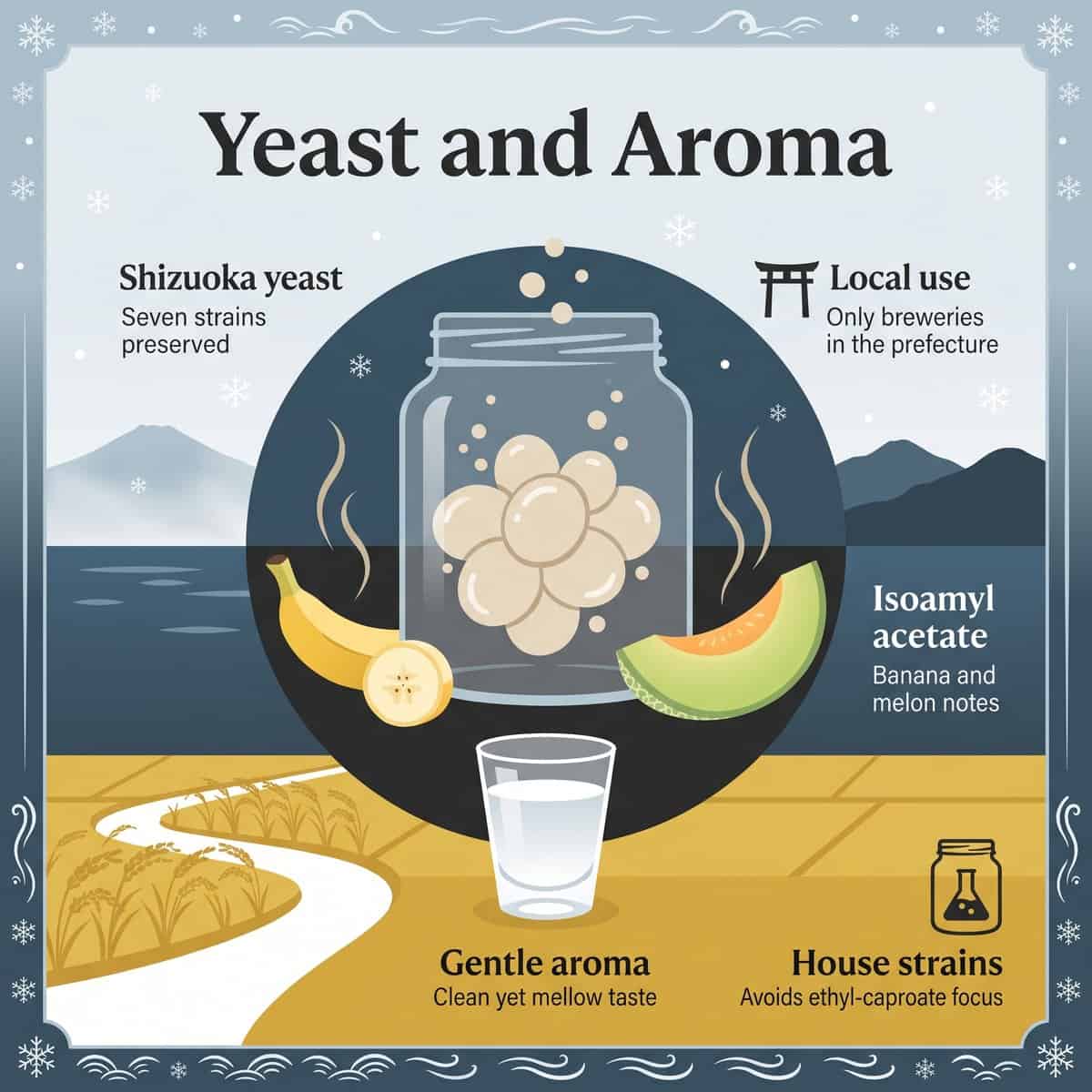
Shizuoka has its own yeast family. It was developed from around the late 1970s, with the Shizuoka Sake Brewers Association as a partner. That account comes from the Shizuoka Prefectural Research Institute of Industrial Technology. Seven strains are now preserved, and only breweries in the prefecture may use them.
These yeasts mainly produce isoamyl acetate, an aroma compound linked with banana and melon notes. They were designed for a refined, gentle aroma and a clean yet mellow taste. A Shizuoka Prefecture newsletter adds that this approach earned the region the nickname “Ginjo Kingdom Shizuoka.”
Isojiman’s House Yeast
Isojiman uses its own preserved yeast strains, which include Shizuoka yeast. Notably, the brewery says it does not use yeast strains selected for high ethyl caproate (also called ethyl hexanoate). Those strains are often linked with conspicuous apple-like or candied fruit aromas. Isojiman’s choice points toward softer fruit instead.
The brewery describes the aroma it aims for as muskmelon, La France pear, Fuji apple, ripe banana, and passion fruit. Of course, these are official tasting descriptions, not lab results. Still, they match the gentle, isoamyl-acetate style that Shizuoka yeast was designed for.
Worth Knowing
Isojiman’s yeast choice is part of a wider Shizuoka tradition. What sets the brewery apart, however, is the combination. It pairs that yeast with Tojo rice, generous water use, long koji making, and fully refrigerated rooms.
Brewing Control: From Stopwatch to Cold Room
Step-by-step process of making traditional Japanese miso, from soaking rice to fermentation.
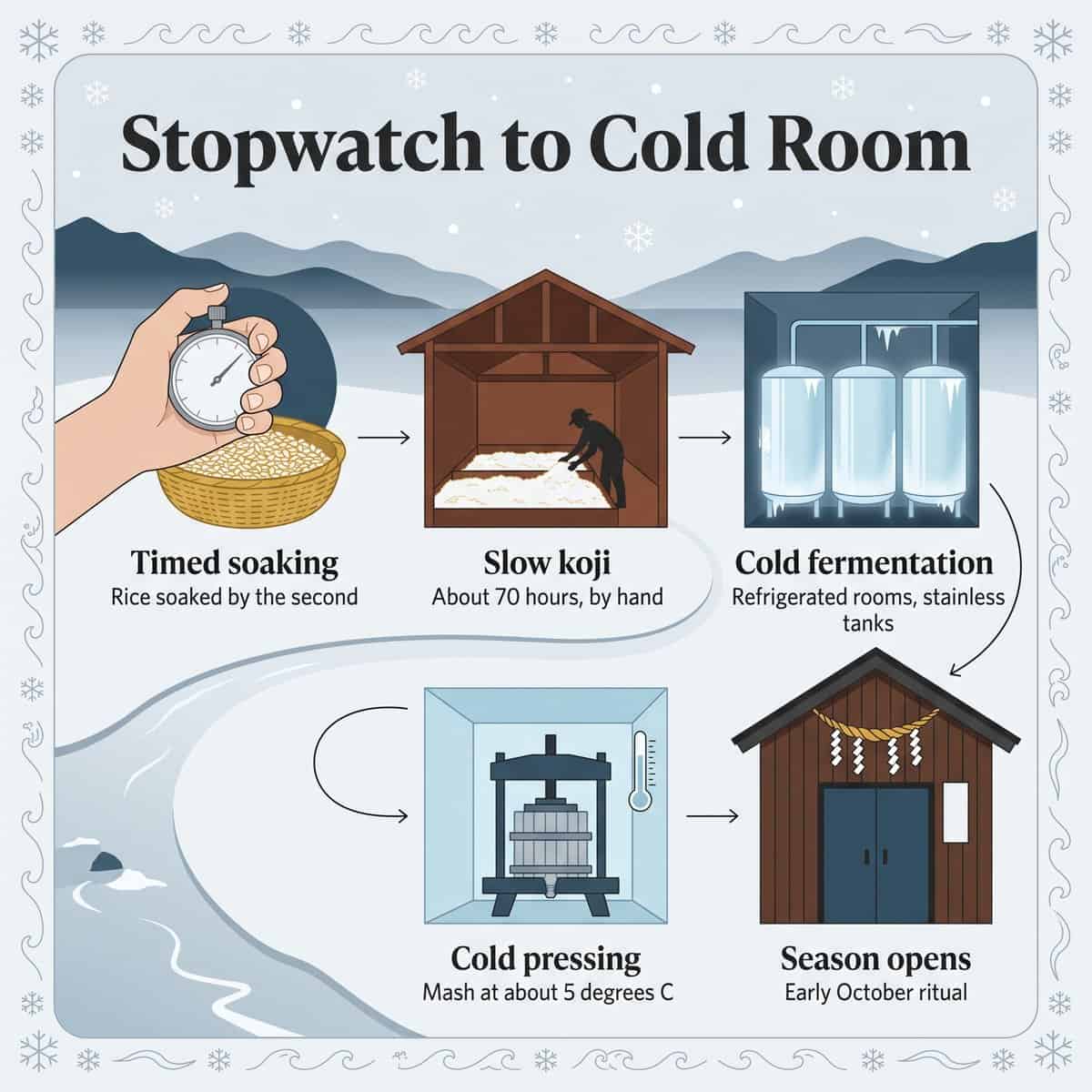
Every season begins in early October with a Shinto ritual for the god of brewing. The team starts with Honjozo, then moves on to ginjo and daiginjo. Once brewing starts, it continues daily until pressing in spring.
Timed soakingRice is washed and soaked with a stopwatch, timed to the second.
Slow kojiDaiginjo koji is made by hand over about 70 hours in a cedar room.
Cold fermentationMash ferments in stainless refrigerated rooms in glass-lined tanks.
Cold pressingSake is pressed inside a refrigerated room while the mash is about 5°C.
Limited Water Absorption
First, brewers hold a stopwatch while the washed rice soaks, timing it to the second. This is called limited water absorption. That way, the rice takes in exactly the right amount of water. The brewery describes careful washing as a “second polishing” and treats it with great care. It even says that rice washed and soaked this way shows clean, octagonal crystals under an electron microscope. See rice polishing for the first polishing.
Steaming and Koji Making
Next, the rice is steamed in a koshiki made of sawara cypress. The brewery says this wood is gentle on rice. Then comes koji, the mold-grown rice that turns starch into sugar. Isojiman makes it entirely by hand in a large room built of cedar.
For daiginjo, in particular, koji making takes about 70 hours. The brewery says it works through the night to grow koji suited to its yeast. It calls this the starting point of Isojiman’s flavor.
Yeast Starter and Main Mash
After that comes the starter. Every Isojiman starter is the faster sokujo type, made over about half a month. It grows in a refrigerated room finished in colored aluminum. On days three to five, the brewers adjust the temperature to put the yeast under mild stress. According to the brewery, this briefly creates a sulfur-like smell, similar to a hot spring. As the starter develops, it says, that smell subsides and fruit-like aromas such as muskmelon and La France pear become more apparent. By the end, one milliliter holds more than 150 million yeast cells.
The main moromi, or mash, ferments in glass-lined tanks inside the refrigerated brewing room. The refrigerated room helps the brewers maintain the low, stable temperatures that controlled fermentation requires. In short, that is the heart of ginjo brewing.
Pressing and Storage
Finally, Isojiman uses two presses: a traditional fune and an automatic press. Both sit inside a stainless refrigerated room. Our page on pressing explains how these presses differ. After pressing, the brewery keeps its sake in low-temperature storage, and says it manages temperature through distribution as well.
Understanding the Isojiman Product Range
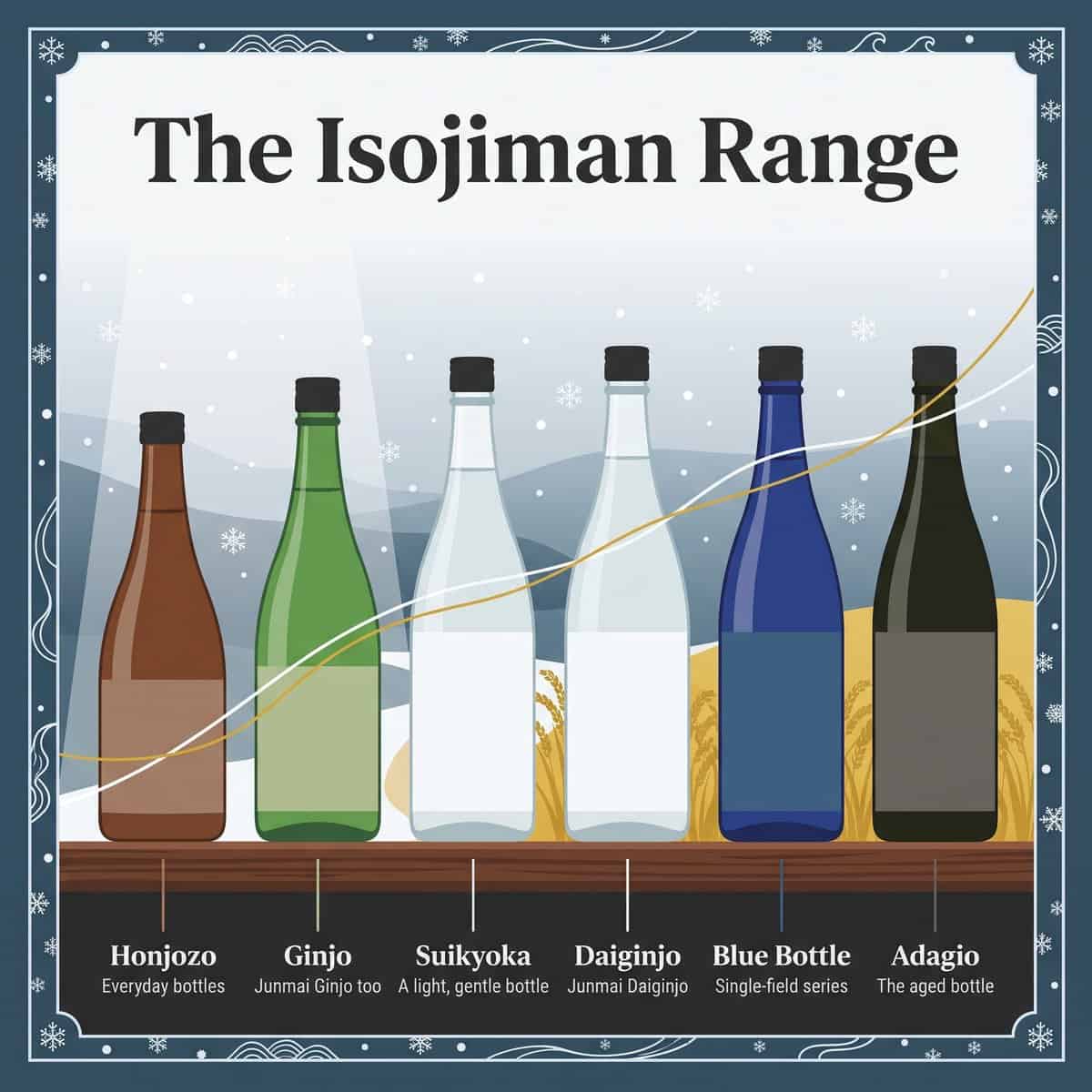
The Isojiman Range of sake bottles showcases various types from Honjozo to Adagio, highlighting Japan’s rich sake tradition.
Isojiman’s lineup runs from everyday Honjozo to rare vintage bottles. For clarity, the table below summarizes the official spec list. Products and release times can change, so check with a dealer.
Bottle
Grade
Rice
Polishing
Honjozo
Honjozo
Yamagata Kiyonishiki and Miyamanishiki; Hyogo Yamada Nishiki for the final addition
65%
Shuyu / Bessen Honjozo
Honjozo
Tojo Yamada Nishiki
60%
Tokubetsu Honjozo Tokusen
Tokubetsu Honjozo
Special A Yamada Nishiki
55% koji, 60% other
Ginjo / Junmai Ginjo
Ginjo / Junmai Ginjo
Tojo Yamada Nishiki
50% koji, 55% other
Suikyoka
Daiginjo
Tojo Yamada Nishiki
50%
Emerald Bottle
Junmai Daiginjo
Tojo Yamada Nishiki
50%
Itteki Nyukon
Daiginjo
Tojo Akitsu Yamada Nishiki
45%
Blue Bottle (three fields)
Junmai Daiginjo
Tojo Akitsu Yamada Nishiki
40%
Aiyama Grappa Bottles
Daiginjo / Junmai Daiginjo
Yokawa Aiyama
50% / 40%
Nakadori Junmai Daiginjo 35
Junmai Daiginjo
Tojo Akitsu Yamada Nishiki
35%
Nakadori Junmai Daiginjo 35 Adagio
Junmai Daiginjo, cold-aged
Tojo Akitsu Yamada Nishiki (product page names the Saito field)
35%
Daiginjo 28 Nobilmente
Daiginjo
Tojo Akitsu Yamada Nishiki
28%
Based on Isojiman Shuzo’s official Japanese spec list and product page (checked October 2026).
Everyday Bottles
To start with, the plain Honjozo is the local favorite, shipped mainly within Shizuoka. Bessen Honjozo, by contrast, uses 100% Tojo Yamada Nishiki polished to 60%, and it is a popular new-sake-season release. Meanwhile, the Tokubetsu Honjozo uses Special A Yamada Nishiki. Our guides to Honjozo and Tokubetsu Honjozo explain these grades.
Ginjo and Daiginjo Core Bottles
The Ginjo and Junmai Ginjo are the brewery’s classic food sakes. For example, the brewery describes the Ginjo as having a refined fruity aroma, clear sweetness, and gentle acidity. It calls this typical of Shizuoka-style ginjo.
Itteki Nyukon, meaning “a drop of heart and soul,” is the core Daiginjo. According to the brewery, it is the bottle most customers support. It also says this bottle best shows the Isojiman style with seafood. Suikyoka is lighter, with restrained aroma and acidity.
One name can confuse readers. The Emerald Bottle is labeled “Daiginjo Junmai,” which is Isojiman’s way of naming a Junmai Daiginjo. In other words, it contains no added alcohol.
Pinnacle Bottles
Nakadori Junmai Daiginjo 35 is the brewery’s top sake, made without regard to yield. Nakadori means the middle portion of the pressing, explained in our nakadori guide. Adagio is a small portion of that sake, aged slowly in a dedicated refrigerator. In years when the owner judges the aging not good enough, Adagio is not released at all. Notably, the product page names Saito, one of the Blue Bottle fields, as the source of Adagio’s rice.
Daiginjo 28 Nobilmente uses Akitsu Yamada Nishiki polished to 28%. Its mash ferments for about 50 days. Then, one hour before pressing, the brewery adds 65 liters of pure alcohol per tonne of rice. It explains that this draws out aroma compounds from the koji and increases clarity.
Why Some Top Bottles Add Alcohol
This surprises many drinkers, who assume “junmai” always means better. At Isojiman, however, adding a measured amount of alcohol is a deliberate technique, not a shortcut. Nobilmente, a Daiginjo with added alcohol, sits at the very top of the range.
Export Bottles
For overseas markets, the brewery lists three bottles. These are a Junmai Daiginjo 50, a Junmai Ginjo, and a Tokubetsu Junmai made with Omachi rice. So the bottle you find abroad may not match the domestic lineup.
The Blue Bottle: A Story of Specific Rice Fields
Overview of the Blue Bottle sake production process in Japan, highlighting key stages and ingredients.
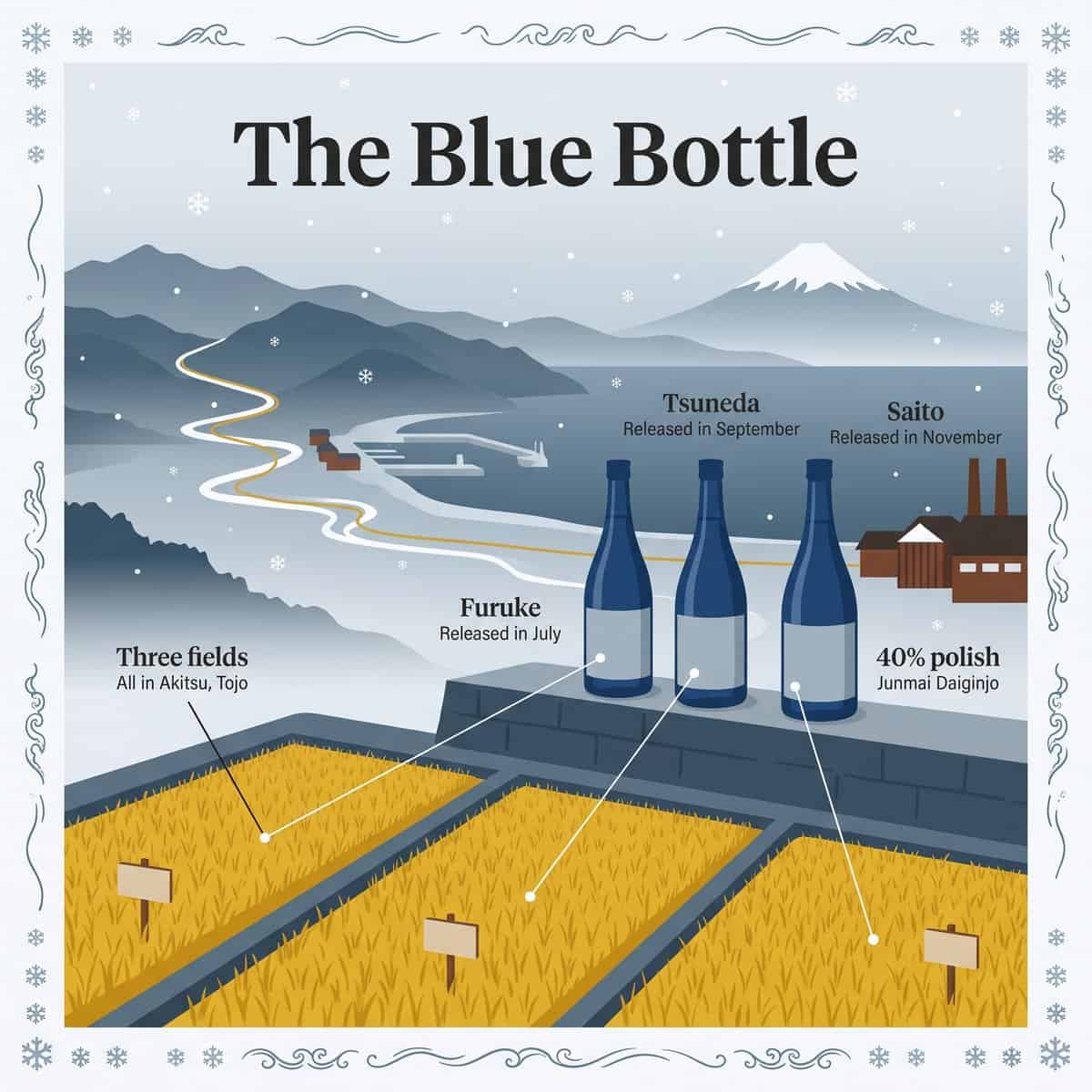
The Blue Bottle series is Isojiman’s experiment in terroir. Each bottle is a Junmai Daiginjo made from Yamada Nishiki grown in one named field in Akitsu, Tojo. All three use rice polished to 40%.
Furuke (古家)Released in July
Tsuneda (常田)Released in September
Saito (西戸)Released in November
According to the brewery’s feature, brewing from these three fields began in 2010. The feature compares the idea to Romanée-Conti, a single vineyard in Burgundy. It also links it to France’s AOC system of protected place names.
Here, a careful distinction helps. Sake has no legal field classification like Burgundy’s. The comparison is the brewery’s own concept, not an official grade. Still, the idea is clear: same brewery, same rice variety, same polishing, but different fields.
There is a human side, too. The feature says the project also helps protect the farmers who grow rice on these three plots. Quantities are limited, so the bottles can be hard to find.
What Does Isojiman Sake Taste Like?
Exploring the taste profiles of various fruits with notes on flavor and acidity.
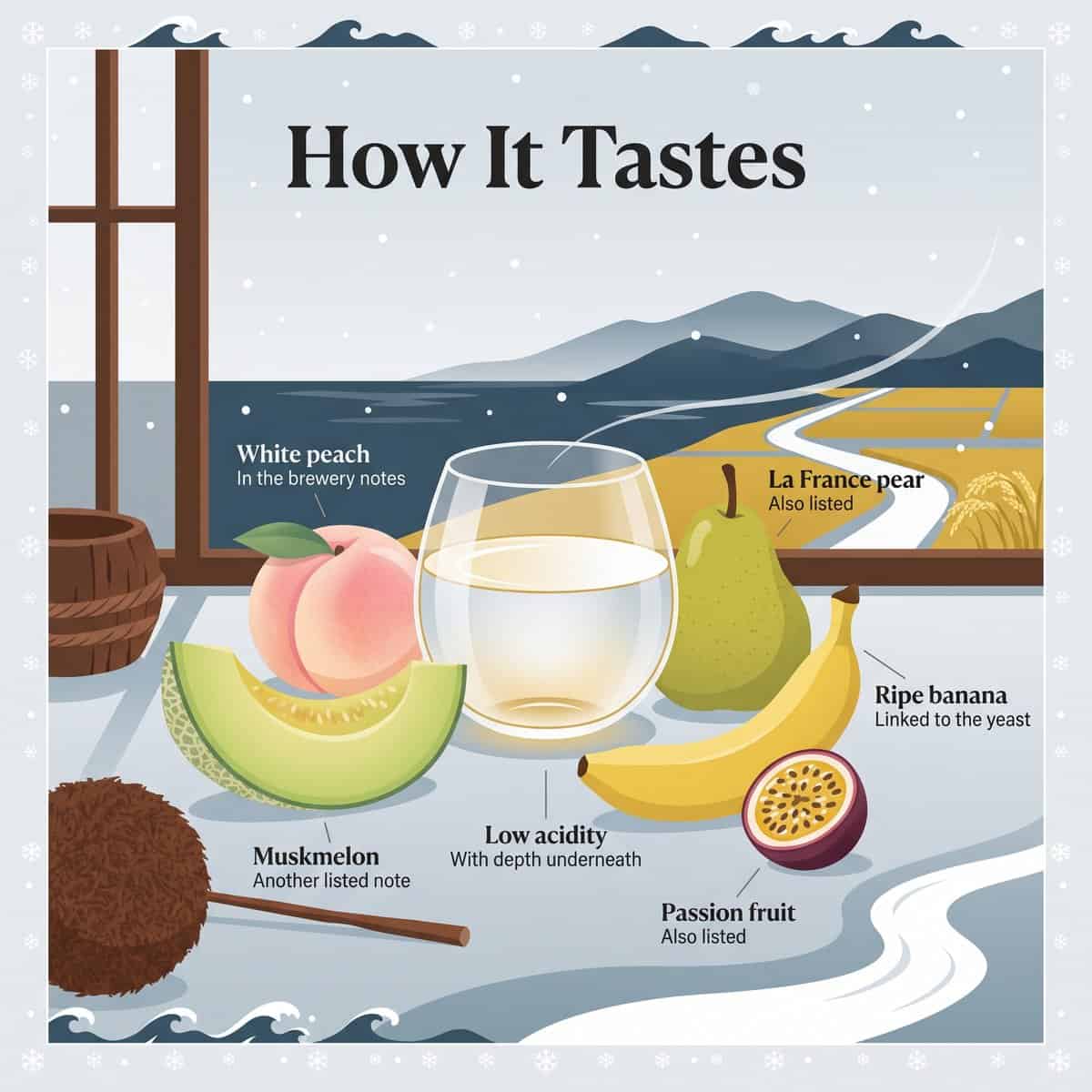
Overall, the brewery describes a natural, gentle aroma. Its official tasting descriptions include white peach, muskmelon, La France pear, ripe banana, and passion fruit. It describes the acidity as low, with depth underneath. Then, it says, the flavor wraps around food, rinses it away, and fades like light snow.
Those are the brewery’s words, so take them as a guide rather than a promise. In general, the house style leans toward quiet fruit rather than a big perfume. That fits the yeast choices described above.
How the Bottles Differ
Of course, each bottle has its own character. Suikyoka is described as light, with aroma and acidity held back. The Aiyama bottles, by contrast, are described as fuller and heavier, with a clean finish. Meanwhile, Spring Breeze 42, a spring-only Junmai Daiginjo, uses Yamada Nishiki from Shobudani, next to Akitsu, and a newer house yeast. The brewery says it opens up after a short rest in the glass.
Changes After Opening
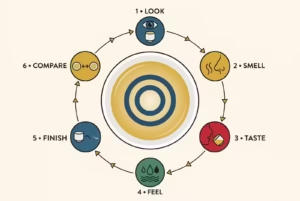
Isojiman suggests enjoying how its daiginjo changes after opening. For daiginjo-type sake, it says aroma and flavor shift over two days to one week. For the Emerald Bottle, it suggests noticing how aroma and roundness change as the sake sits in the glass. Our guide on how to taste sake can help you notice these shifts.
Isojiman and Seafood Pairing
Traditional seafood dishes from Isojiman with fresh sashimi, grilled white fish, and local specialties.
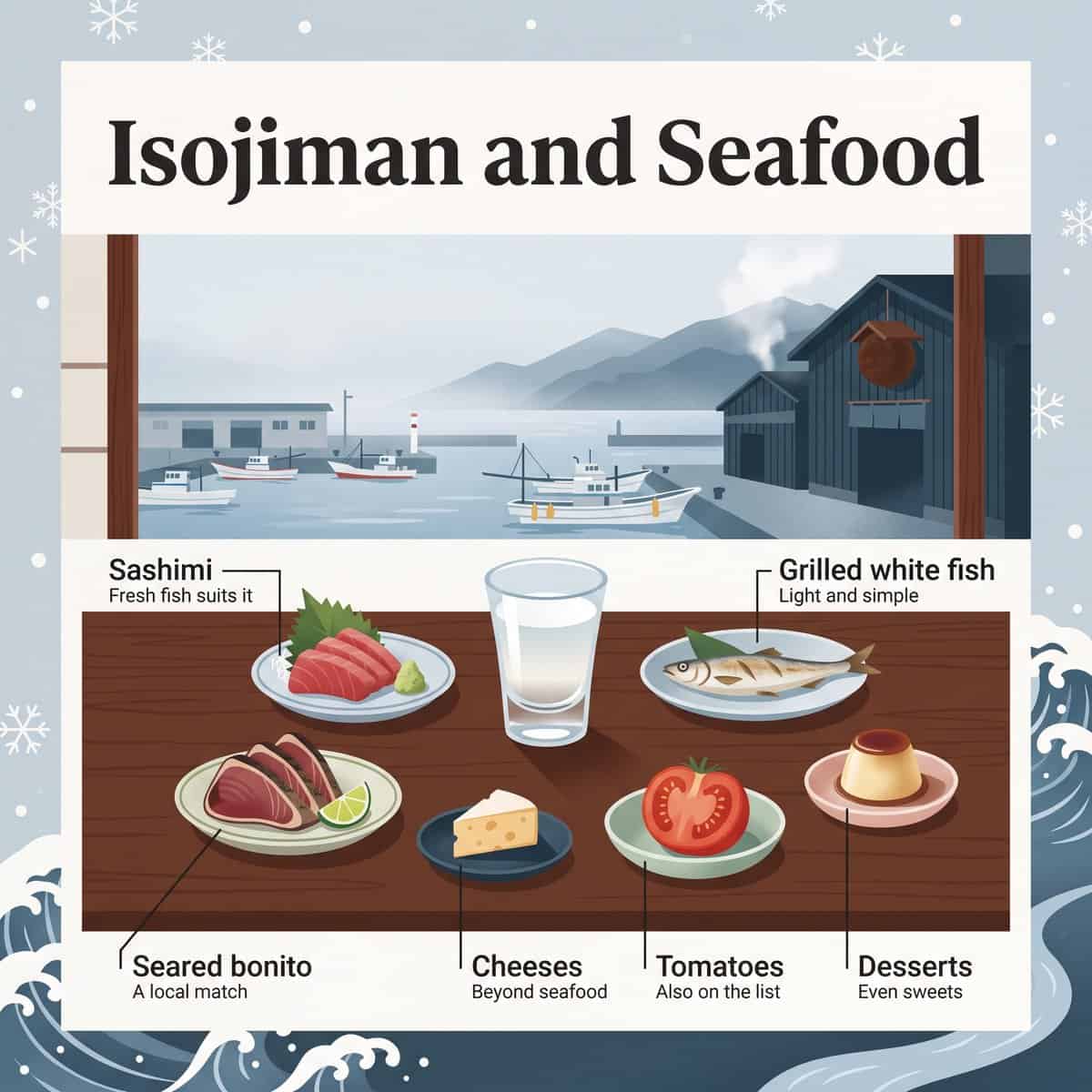
Given its location, the brewery says fresh fish is probably the best match. That fits a town built on skipjack and tuna. Try it with sashimi, seared bonito, or lightly grilled white fish.
However, Isojiman does not stop at seafood. It also suggests French and Italian dishes, various cheeses, tomatoes, and desserts. So seafood is a natural starting point, not a strict rule.
Why the Style Suits Fish
Why might this style work with fish? Part of the answer may be what it leaves out. Yeast strains associated with prominent ethyl caproate can produce conspicuous apple-like aromas. By contrast, Isojiman emphasizes a gentler isoamyl-acetate profile. In pairing terms, this may make the aroma less likely to dominate delicate sashimi, although the result depends on the bottle, the dish, and the drinker.
The brewery also describes its flavor as wrapping around food and then rinsing it away. That restrained profile can be an appealing match for fatty tuna or seared bonito. Still, it is a matter of taste, not a rule. Our suggestion is simple: try a bite of fish, then a small sip, and notice what happens to the finish.
Matching Bottle and Dish
The brewery notes that each sake suits slightly different foods. As a starting point, Itteki Nyukon or the Junmai Ginjo work across a whole meal. Meanwhile, quieter dishes leave room for the subtle aroma of the top bottles. Shizuoka Prefecture also describes Shizuoka-yeast sake as a food sake that brings out the flavor of local seafood. For more ideas, see sake and food pairing.
Isojiman on the International Stage
Celebration of Japanese achievements with toast and traditional foods, highlighting key moments from 2008 to 2016.
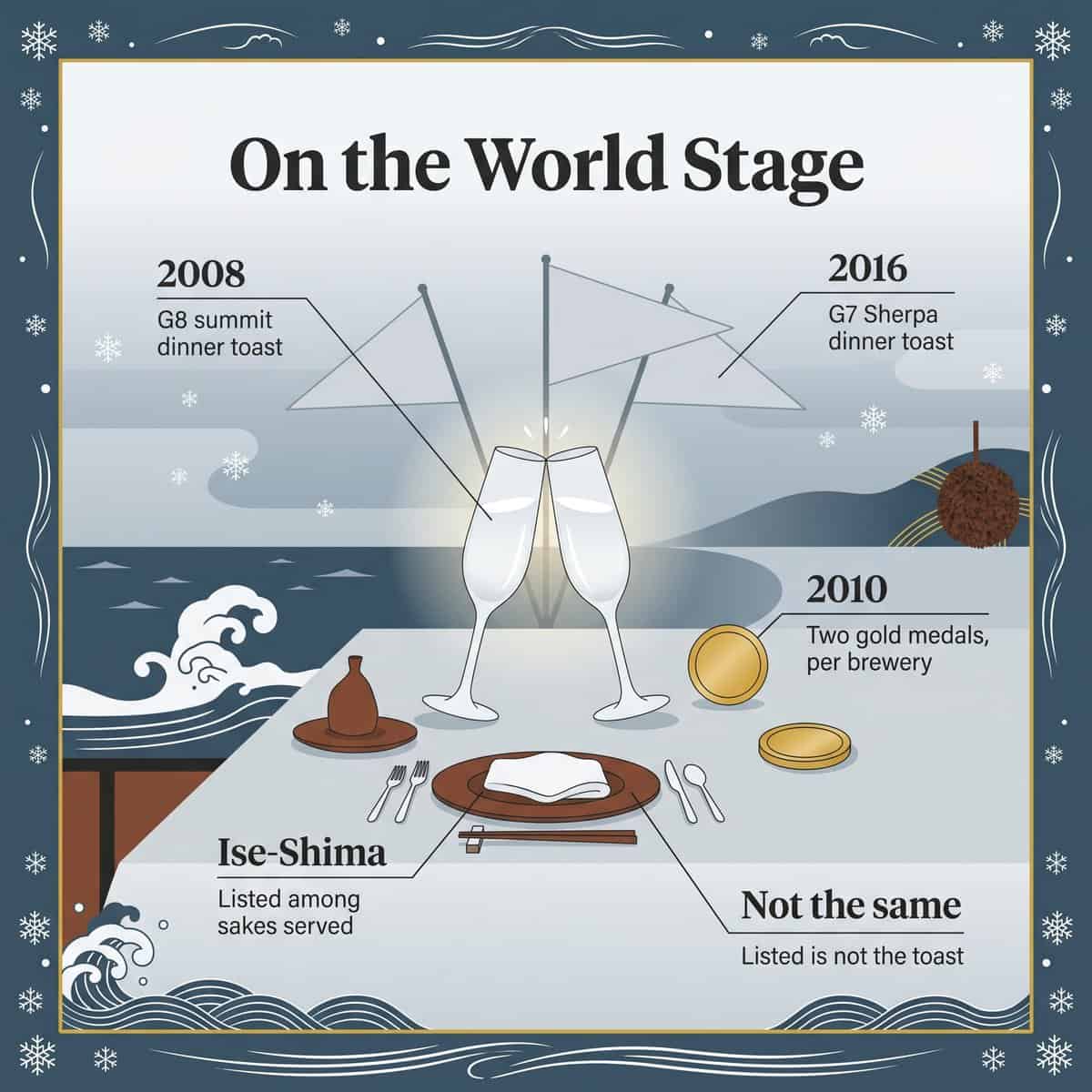
Isojiman has appeared at two major diplomatic meals. According to the brewery, Nakadori Junmai Daiginjo 35 was the toast at the 2008 G8 Hokkaido Toyako Summit dinner. Then, in May 2016, Daiginjo 28 Nobilmente was the toast at the G7 Sherpa dinner. That dinner took place ahead of the Ise-Shima Summit.
Separately, Japan’s Ministry of Foreign Affairs listed Isojiman Daiginjo Junmai among the sakes served at the 2016 Ise-Shima Summit. That government list confirms the brand’s presence there. However, being on the list is not the same as being the leaders’ toast.
Competition Results
The brewery reports two gold medals at the 2010 International Wine Challenge in London, on its first entry. One went to an export Omachi Tokubetsu Junmai, and the other to the Emerald Bottle Daiginjo Junmai. It lists another IWC gold in 2014 for its Omachi Tokubetsu Junmai.
More recently, at SAKE COMPETITION 2025, Isojiman Omachi Tokubetsu Junmai 53 placed first in the Junmai category, judged blind. The brewery says that category had 286 entries. Its Junmai Ginjo placed seventh in its category, and the brewery received the special TAKANAWA GATEWAY CITY Opening Commemorative Best Brewery Award.
Admittedly, awards and summit toasts are worth knowing. Still, they do not mean every bottle will suit every drinker. Interestingly, the 2025 winner used Omachi rice, not Yamada Nishiki, which shows the range is broader than one rice. The competition only judges sake sold on the market. Note that the winning Omachi 53 differs from the export Omachi 55 listed on the brewery’s site, so check the exact name when you buy.
What Makes Isojiman Different from Other Shizuoka Sake?
Exploring Shizuoka’s sake: shared traits, cold brewery, rice fields, and unique local brewing traditions.
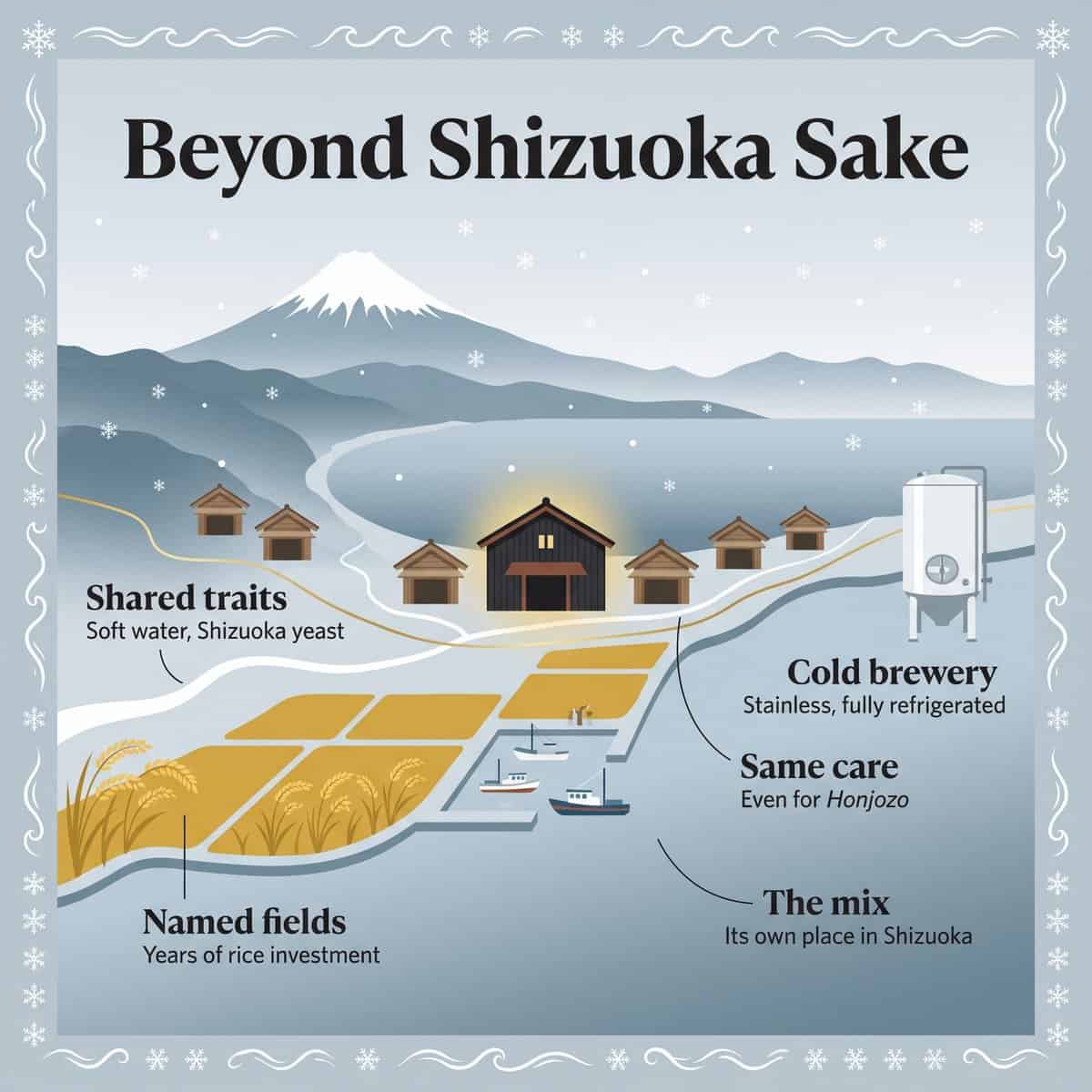
To begin with, Shizuoka sake shares some traits. Many breweries use soft mountain water and Shizuoka yeast, aiming for gentle aroma and a clean taste. So it would be wrong to credit Isojiman alone for that style.
What sets Isojiman apart is the combination. First, there is the long investment in Tojo Yamada Nishiki and named fields. Second, there is a fully refrigerated, stainless-steel brewery inspired by Yaizu’s cold-storage industry. Finally, the brewery applies ginjo-level care even to Honjozo. Together, these choices give the brand its own place within Shizuoka’s ginjo tradition.
How to Choose, Store, and Serve an Isojiman Sake
Japanese sake bottles displayed in a store, highlighting different types and brands for consumers.
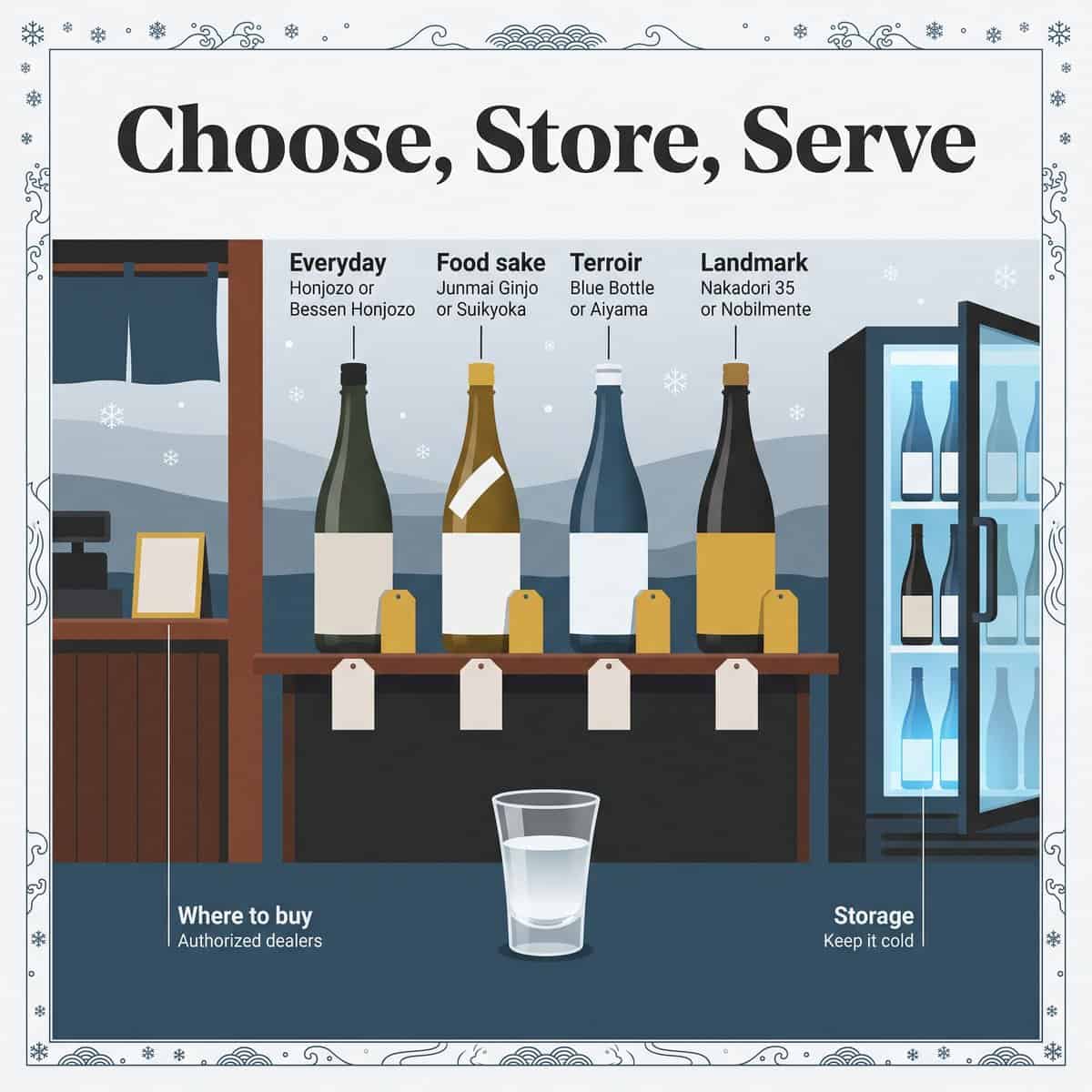
Isojiman is sold mainly through authorized dealers, so it helps to know what you want before you shop.
Everyday meals: Honjozo, Bessen Honjozo, or Tokubetsu Honjozo
A classic food sake: Junmai Ginjo, Itteki Nyukon, or Suikyoka
Rice and terroir: the Blue Bottle series, the Aiyama bottles, or the export Omachi Tokubetsu Junmai
A landmark occasion: Nakadori Junmai Daiginjo 35, Adagio, or Daiginjo 28 Nobilmente
Where to Buy
The brewery asks customers to buy from its authorized dealers to protect quality. It publishes a list of these shops by prefecture. Because the list changes, check the official site rather than relying on old shop names.
Storage and Serving
First, keep the bottle in the refrigerator until you open it. When serving cold, the brewery advises not to over-chill it. When warming, it advises not to make it too hot. Its Emerald Bottle mentions the traditional serving names yuki (snow), hana (flower), and ryo (cool), which describe different chilled temperatures.
After opening, there is no need to finish a daiginjo in one night. As noted above, the brewery suggests enjoying how it changes over two days to a week. Our guide to reading a sake label will help you decode the bottle.
Can You Visit the Brewery?
The brewery’s website does not advertise public tours or tastings. The Shizuoka brewery map also advises contacting each brewery directly about visits. So if you hope to visit, ask the brewery first rather than turning up.
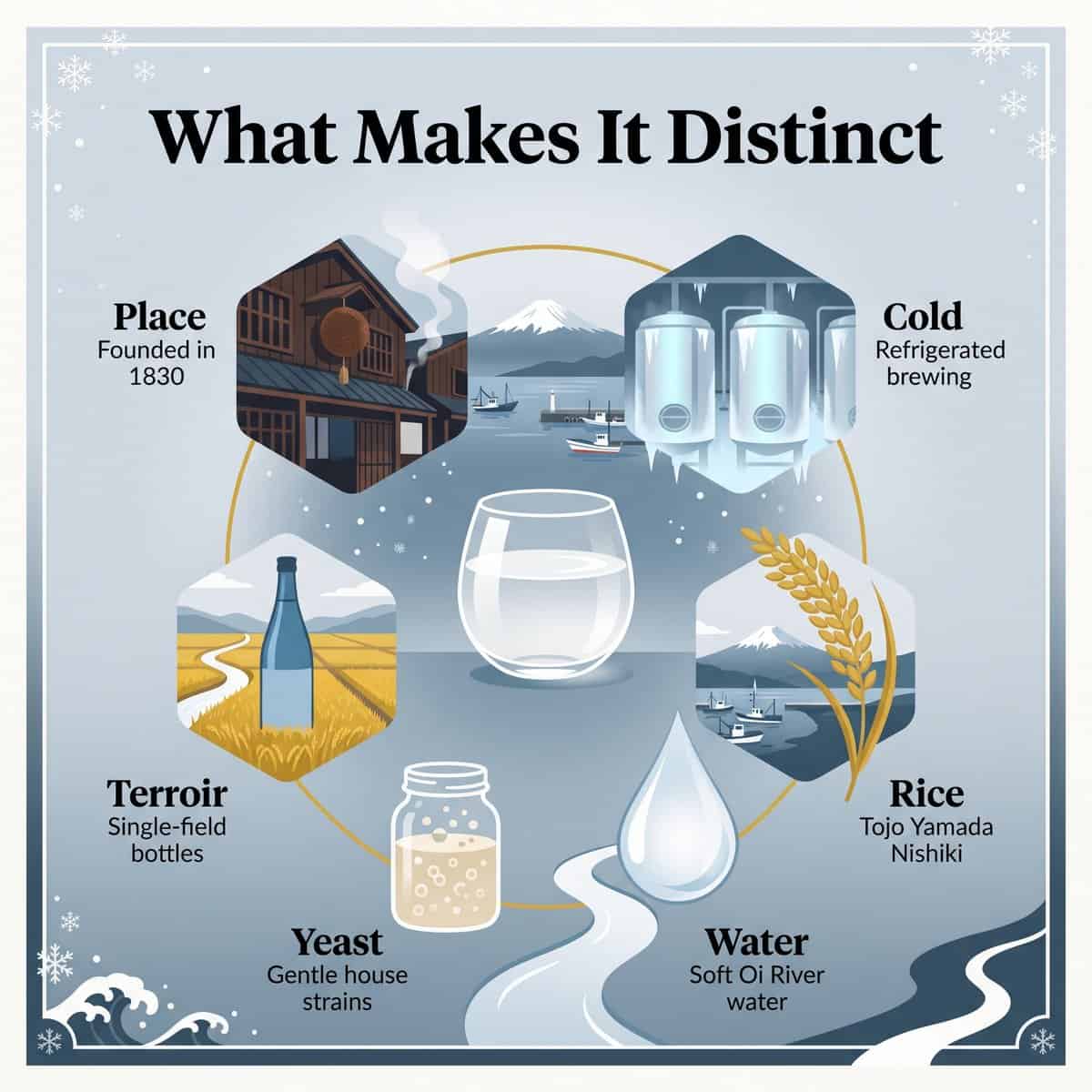
What Makes Isojiman Distinctive?
Traditional Japanese sake bottle and rice, highlighting Japan’s unique food and beverage culture.
Here is a short summary of the points above, followed by a few common misunderstandings.
Place: founded in 1830, and the only sake brewery listed for Yaizu on the regional tax bureau’s map
Cold: refrigerated brewing and pressing inspired by local freezing know-how
Rice: about 65% contract-grown Tojo Yamada Nishiki, plus Aiyama, Omachi, and others
Water: soft water from the Oi River system
Yeast: house strains including Shizuoka yeast, avoiding ethyl-caproate-focused strains
Terroir: single-field Blue Bottle bottles and the aged Adagio
Common Misconceptions
“Isojiman is a style of sake.” It is a brand from one brewery.
“Every bottle uses the same rice.” Rice and polishing vary by product.
“Special A is a grade on the bottle.” It is a rice-growing area class.
“Added alcohol means lower quality.” Nobilmente uses it deliberately.
“Serve it ice-cold.” The brewery advises against over-chilling.
“Finish it the night you open it.” Daiginjo can change over days.
Final Thoughts
Illustration of the food supply chain in Japan, from rice fields to table, emphasizing care and quality.
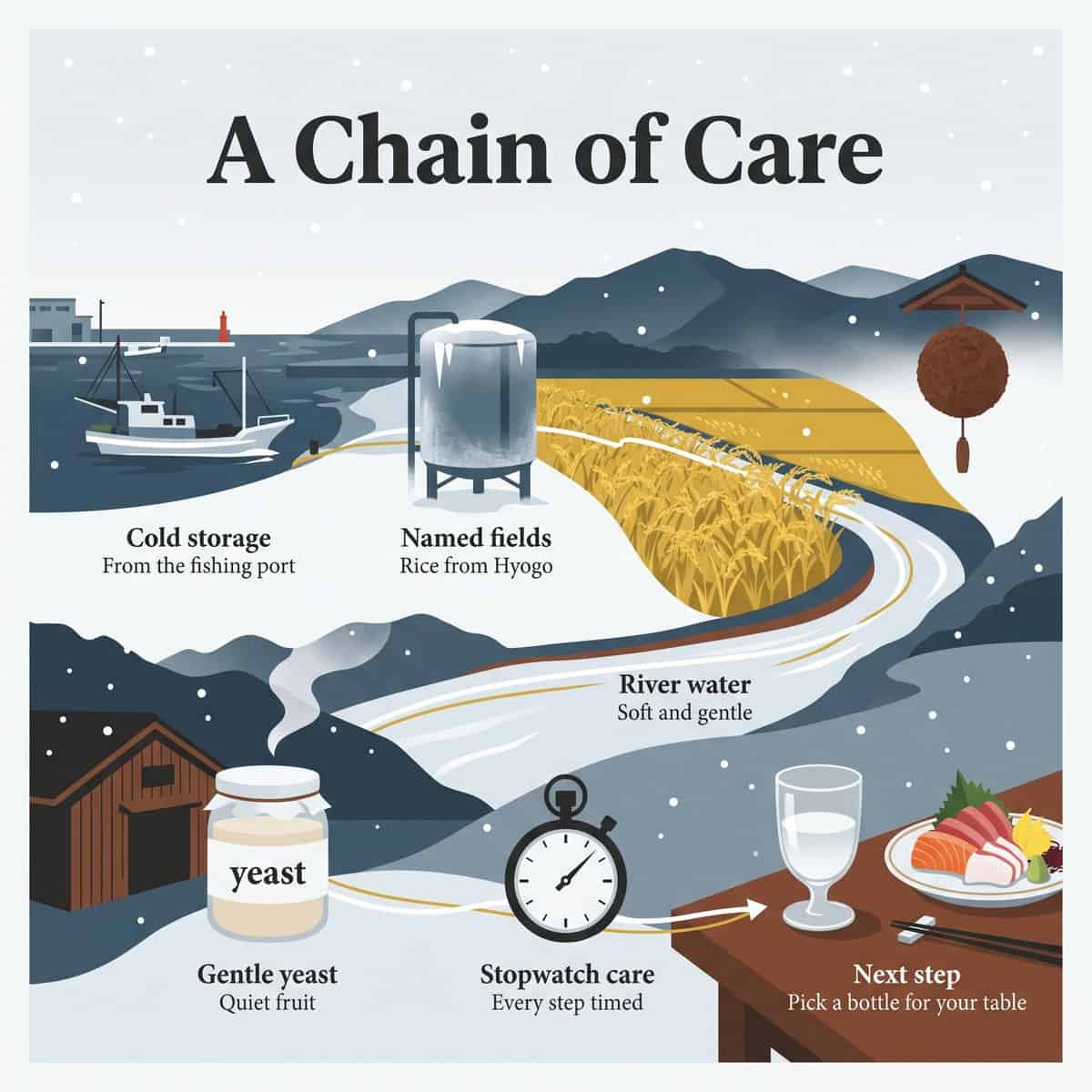
Isojiman is easy to describe as a rare, expensive sake. That misses the point, though. Instead, its story is a chain. It links a fishing port’s cold-storage know-how with rice from named fields in Hyogo. Soft river water, gentle yeast, and stopwatch-level care complete it.
The summit selections and competition results later brought wider attention to that work. So if you find a bottle, start with one that suits your table. Then compare it with other Japanese sake brands, such as Masumi or Dassai, to see how differently breweries chase quality.
Frequently Asked Questions About Isojiman
What is Isojiman sake?
Isojiman is a sake brand from Isojiman Shuzo, a brewery founded in 1830 in Yaizu, Shizuoka Prefecture. It ranges from Honjozo to Junmai Daiginjo.
What rice does Isojiman use?
About 65% of its rice is contract-grown Tojo Yamada Nishiki from Hyogo. Some bottles use Aiyama, Omachi, Kiyonishiki, or Miyamanishiki instead.
What water and yeast does Isojiman use?
It uses soft water from the Oi River system. Its yeast is house-preserved, includes Shizuoka yeast, and avoids strains selected for high ethyl caproate.
What is the Isojiman Blue Bottle series?
It is a set of three Junmai Daiginjo bottles, each from one named rice field in Akitsu, Tojo. They are released in July, September, and November.
Which Isojiman was served at the G8 and G7 events?
Nakadori Junmai Daiginjo 35 was the 2008 G8 summit dinner toast. Daiginjo 28 Nobilmente was the 2016 G7 Sherpa dinner toast, according to the brewery.
Why does Isojiman make alcohol-added Daiginjo?
The brewery adds a measured amount of alcohol to some bottles to draw out aroma and clarity. It is a deliberate technique, not a cost-saving step.
How should Isojiman be stored and served?
Keep it refrigerated, avoid over-chilling, and avoid making warm sake too hot. Daiginjo can be enjoyed over two days to a week after opening.
Can you visit the Isojiman brewery?
The brewery does not advertise public tours online. Contact it directly before planning a visit.
References
Isojiman Shuzo – Kuramoto yori Minasama e (蔵元より皆様へ): Message from the Brewery Owner and Brewing Process (Accessed October 2026)
Isojiman Shuzo – Isojiman Tanbo (磯自慢探訪): Getting to Know Isojiman (Accessed October 2026)
Ryo Iwa is the founder and editor of foodinjapan.org. Born and raised in Japan, he writes from regional travel, market visits, and Japanese-language primary sources that rarely reach English readers, including brewing institute publications and industry glossaries. Where a figure cannot be traced to a source, the article says so.
He has been a Google Maps Local Guide for over 10 years, with more than 1,800 reviews and over 41,000 photos viewed hundreds of millions of times. He previously spent two decades as an IT consultant in Japan, the US, and the UK.

















Comments