






Water in sake brewing is the ingredient almost everyone forgets. Ask what sake is made from, and most people say rice. They are not wrong, yet they are missing the ingredient that fills most of the bottle. So what role does water play in sake brewing? It is the single largest ingredient by volume, making up roughly 80 percent of the finished drink.
It also acts as the medium in which koji, yeast, and rice all do their work. Change the water, and you change the sake. This is easy to overlook, because water looks like nothing at all. It is clear, quiet, and seemingly plain. Yet brewers have chased good water for centuries, building whole regions around a single spring.
The famous brewing town of Nada rose on the strength of one remarkable water. This guide follows water through the entire process, covering the science, the minerals, and the soft-versus-hard debate. It also tells the story of miyamizu, the legendary brewing water of Nada. For the wider picture, see our guide on how sake is made.
Quick Facts About Water in Sake Brewing
Here is a quick snapshot before the details begin.
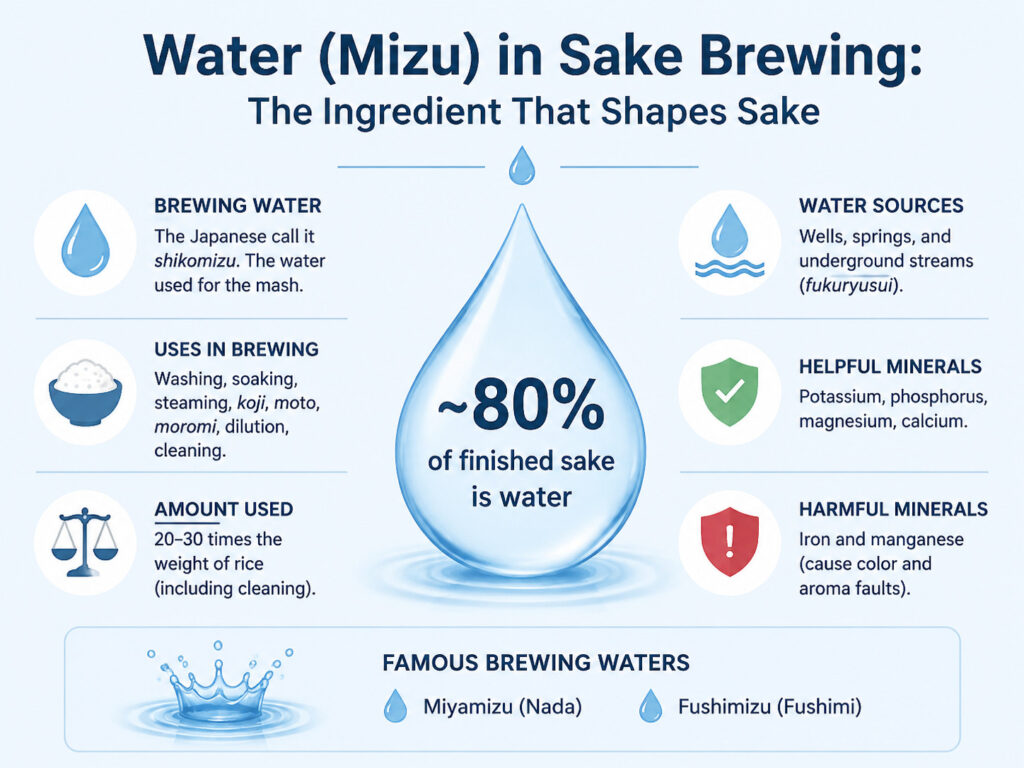
| Japanese Name | 仕込み水 (shikomizu), brewing water |
| Share of Finished Sake | Roughly 80 percent by volume |
| Uses During Brewing | Washing, soaking, steaming, koji, moto, moromi, dilution, cleaning |
| Water Sources | Wells, springs, and underground streams (fukuryusui) |
| Helpful Minerals | Potassium, phosphorus, magnesium, calcium |
| Harmful Minerals | Iron and manganese (cause color and aroma faults) |
| Famous Brewing Waters | Miyamizu (Nada), Fushimizu (Fushimi) |
In brewing terms, water is far more than a filler. It is the medium that carries every reaction in the tank. The Japanese call brewing water shikomizu, meaning the water used for the mash. Brewers use it to wash and soak rice, to build the koji and starter, and to run the main fermentation. They even use it to dilute the finished sake before bottling. One number surprises many people.
A brewery uses far more water than rice. It is often twenty to thirty times the weight of the rice, once cleaning is counted. So water is not a minor detail. It is the quiet foundation of the whole craft.
Why Water Matters in Sake Brewing
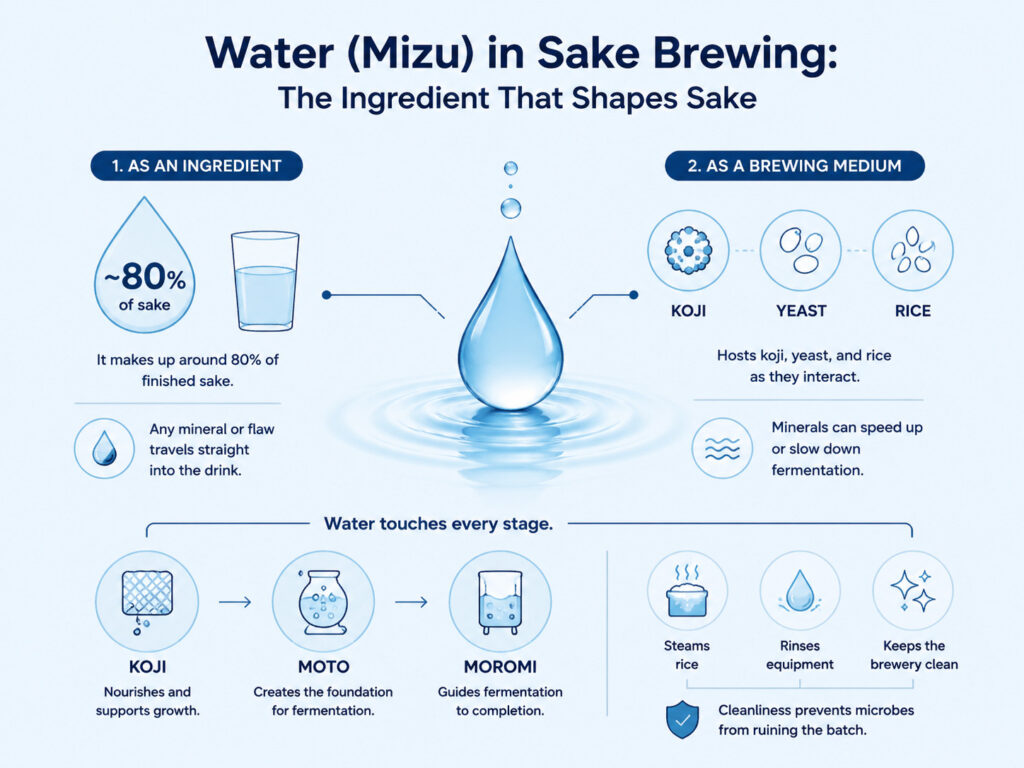
Water in sake brewing earns its importance in two very different ways. It is both an ingredient and a working environment, and both roles shape the final sake. As an ingredient, water is simply everywhere in the bottle. It makes up around 80 percent of finished sake, so its character sits in every sip.
Any mineral it carries, and any flaw it hides, will travel straight into the drink. As a brewing medium, water does something subtler. It hosts the koji, the yeast, and the rice as they interact. So the minerals it carries can speed up or slow down fermentation.
In this sense, water quietly directs the whole performance. It also does the plain, unglamorous jobs. Brewers use it to steam rice, to rinse equipment, and to keep the brewery clean. Cleanliness matters enormously here, since stray microbes can ruin a whole batch.
So water touches koji, moto, and moromi alike. Our guides to koji, moto, and moromi each show it at work. In every one of those stages, the water is quietly doing something.
Water Throughout the Brewing Process
Water in sake brewing appears at nearly every step, often in ways you might not expect. Following it through the process shows just how central it is.
Washing, Soaking, and Steaming
It starts the moment the rice arrives. Brewers wash the polished rice to remove loose bran, then soak it so each grain takes on water. This soaking is timed to the second for premium rice. Next, steaming comes. The soaked rice is steamed rather than boiled, which gives firm grains with a soft center.
That texture is exactly what koji and yeast need later. Our guide to rice polishing covers how the grain is prepared beforehand.
How Much Water Sake Brewing Uses
The sheer volume of water can surprise people. Brewing uses far more water than rice by weight. Count only the brewing steps, and the ratio is already high. Add in all the washing and cleaning, and it climbs further.
Some estimates put total use at twenty to thirty times the weight of the rice. This has a practical side. A brewery needs not just good water, but a lot of it. A steady, reliable source is essential. So access to abundant clean water shaped where breweries could grow. It was never a small concern.
Koji, Moto, and Moromi
In addition, water carries through the biological heart of brewing too. In the koji room, humidity and the water in the rice help the koji mold grow evenly across each grain. Water builds the yeast starter too. Brewers make the moto by combining water, koji, steamed rice, and yeast.
The minerals in that water feed the growing yeast. So a good starter leans on good water from the start. Then comes the main mash. The moromi is built in stages with more water, koji, and rice, and it ferments for weeks. Here the water makes up the bulk of the liquid, so its character shapes the whole fermentation.
Dilution and Cleaning
Near the end, water plays one more flavoring role. Freshly pressed sake is often strong, so brewers add pure water to bring the alcohol to bottling strength. This step is called warimizu, or dilution water. Warimizu is not an afterthought.
It can be a large share of the final volume. So its quality matters as much as the brewing water. A clean, soft dilution water keeps the sake smooth rather than harsh. Meanwhile, cleaning water runs quietly through it all. Brewers rinse tanks, tools, and floors constantly, since hygiene protects every batch. It is humble work, yet it guards everything else.
Why Japan’s Water Suits Sake
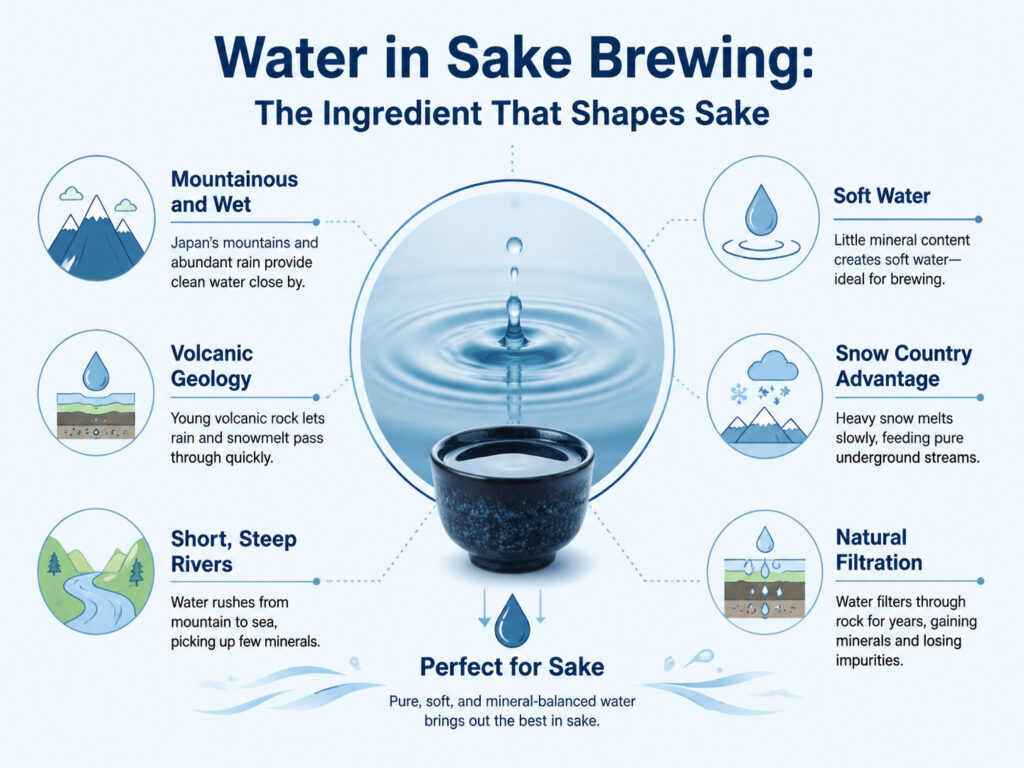
Japan is unusually blessed when it comes to brewing water. The country is mountainous, wet, and green, so clean water is rarely far away. Geology explains a lot of this. Japan sits on young, volcanic rock.
Its rivers are short and steep, and they rush from mountain to sea. Rain and snowmelt pass through the ground quickly. So the water picks up relatively few minerals along the way. This is why most Japanese water is soft. In much of Europe, by contrast, water travels slowly through limestone and turns hard. Japan’s landscape simply produces a gentler water.
In addition, snow country adds another gift.
Regions like Niigata and Akita receive heavy winter snow.
That snow melts slowly and feeds clean underground streams. Brewers there draw on a steady supply of soft, pure water. It is one reason these areas became sake strongholds. Moreover, abundant rainfall helps everywhere.
Water filters down through layers of rock over many years. Along the way, it gathers helpful minerals and drops harmful ones. The result, in the best spots, is water almost tailor-made for brewing.
Water Chemistry: The Minerals That Matter
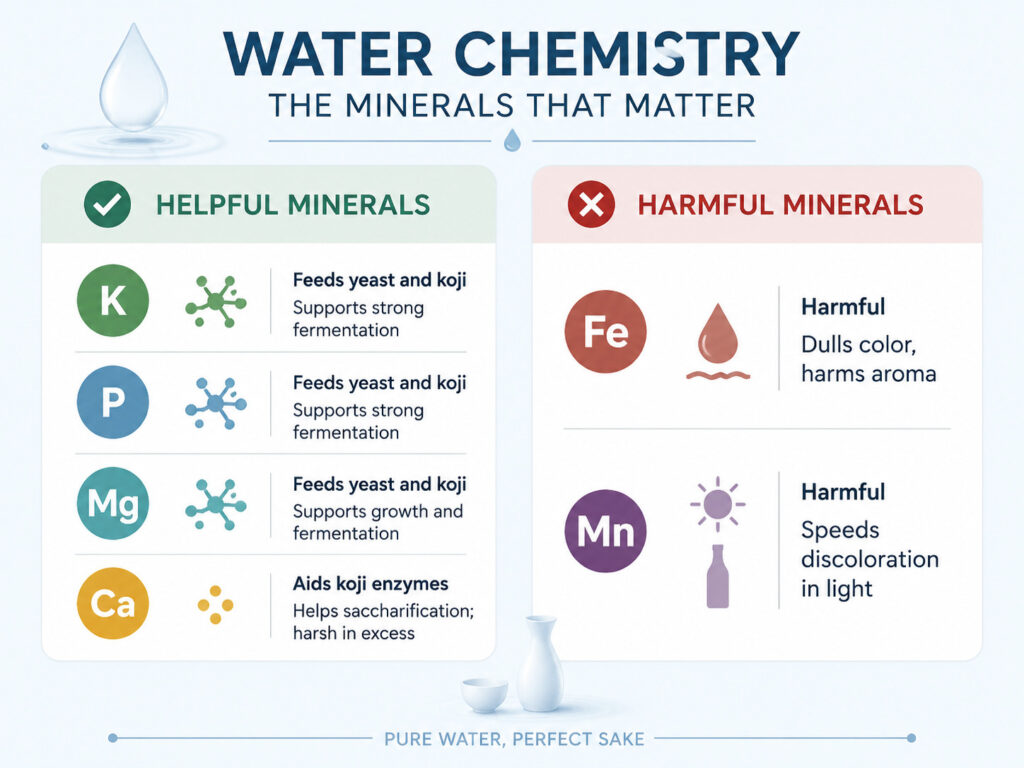
Now we reach the science of water in sake brewing, which is where it gets genuinely interesting. The minerals dissolved in water fall into two camps, the helpful and the harmful. The helpful minerals feed the microbes. Potassium, phosphorus, and magnesium all support the koji mold and the yeast.
They help the cells grow and ferment, so water rich in them tends to drive a strong, lively fermentation. Brewers prize these three above all. Meanwhile, calcium plays a quieter supporting role. It helps the koji release its enzymes, which keeps saccharification running smoothly. Too much calcium, though, can leave the sake tasting bitter or rough.
The harmful minerals are a different story. Unfortunately, iron is the great enemy of good sake. It reacts with compounds from the koji and dulls the color, turning the sake brownish and stripping away fresh aroma. Even tiny amounts cause trouble.
Similarly, manganese is nearly as unwelcome. It speeds up discoloration when the sake meets light, so brewers keep it as low as they can. Both metals are held to standards stricter than ordinary tap water.
| Mineral | Role in Brewing | Effect |
|---|---|---|
| Potassium | Feeds yeast and koji | Supports strong fermentation |
| Phosphorus | Feeds yeast and koji | Supports strong fermentation |
| Magnesium | Feeds yeast and koji | Supports growth and fermentation |
| Calcium | Aids koji enzymes | Helps saccharification; harsh in excess |
| Iron | Harmful | Dulls color, harms aroma |
| Manganese | Harmful | Speeds discoloration in light |
One thing surprises newcomers here. Brewers do not simply want the purest possible water. They want water with the right helpful minerals and almost none of the harmful ones. That balance is what makes a water truly suited to sake.
The Helpful Minerals
Potassium sits near the top of the list. It supports the yeast as it grows and ferments. A water with enough potassium helps the mash push forward steadily. So brewers welcome it in their source. Likewise, phosphorus works closely alongside it. It is a key nutrient for both koji and yeast.
Without enough phosphorus, fermentation can turn sluggish.
With it, the microbes stay active and strong. Then magnesium rounds out the trio. It feeds the growth of koji and yeast as well. Rice already carries some magnesium, so water is not the only source. Yet the minerals in rice are bound to protein and must be freed by enzymes first. The minerals in water are ready to use at once, which is why they matter so much.
Calcium and the Enzyme Question
Calcium plays a more delicate role. It helps the koji release and use its enzymes. Those enzymes break rice starch into sugar. So calcium quietly supports saccharification. Balance is everything with calcium, though.
A little supports the process nicely. Too much, however, can leave the sake tasting bitter or coarse. So brewers watch calcium levels with care. The goal is support, not excess.
The Minerals to Avoid
Iron is the mineral brewers fear most. It bonds with an amino acid the koji produces, forming a reddish-brown complex. The result is a dull, yellow-brown color and a tired aroma. Even a trace can spoil an otherwise fine sake.
Manganese brings its own problem. It speeds the reactions that occur when sake meets ultraviolet light. A bottle left in sunlight can turn “light-struck,” fading and taking on an off aroma. So brewers hold manganese to very low levels. The best brewing waters carry almost none of either metal.
Soft Water vs Hard Water in Sake Brewing
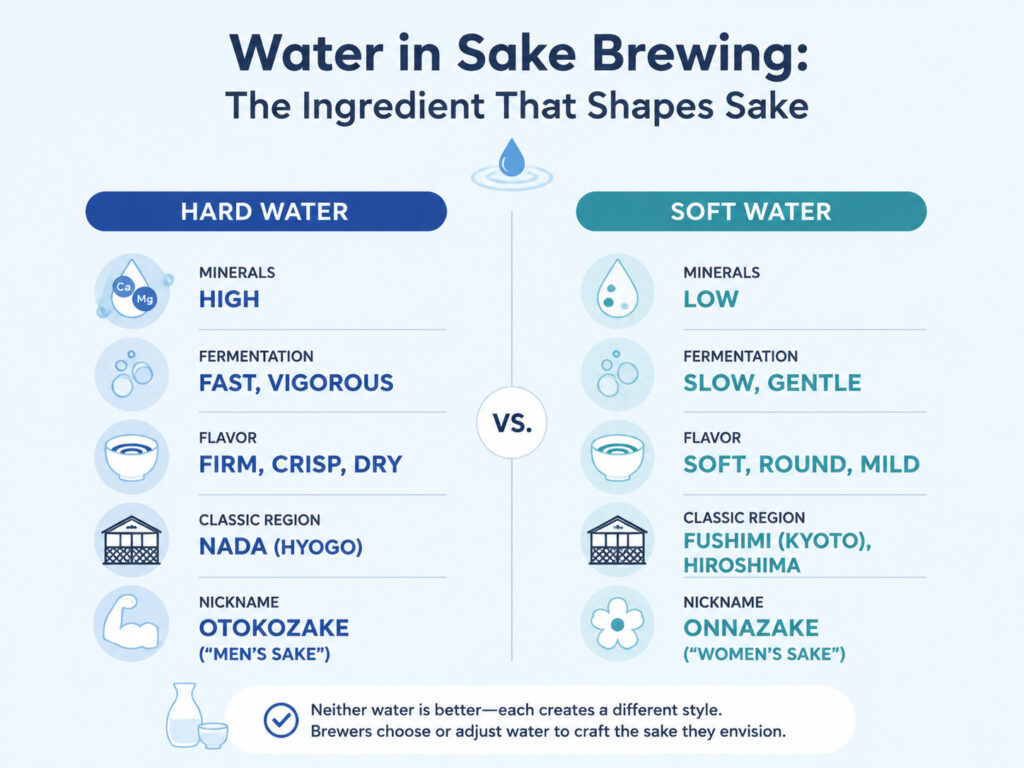
Hardness is the first thing brewers ask about water in sake brewing. It measures the calcium and magnesium a water carries, and it shapes the sake in clear ways. A quick definition helps. Water with few of these minerals is soft, while water rich in them is hard. Most Japanese water leans soft, since the country’s short, steep rivers give minerals little time to dissolve.
How Hard Water Behaves
In general, hard water tends to drive a fast, vigorous fermentation. Its extra minerals energize the yeast, so the mash ferments strongly and often finishes dry. The classic example is Nada. Brewers there use mineral-rich water, and the result is a firm, crisp, dry sake. This bold style earned the nickname otokozake, or “men’s sake,” for its sharp, muscular character.
How Soft Water Behaves
By contrast, soft water works in the opposite direction. With fewer minerals to spur the yeast, fermentation runs slow and gentle, which tends to give a softer, rounder sake. Kyoto’s Fushimi district is the famous case. Its gentler water yields a smooth, delicate style long called onnazake, or “women’s sake.” The contrast with Nada is striking. it comes largely down to the water.
| Hard Water | Soft Water | |
|---|---|---|
| Minerals | High | Low |
| Fermentation | Fast, vigorous | Slow, gentle |
| Typical Flavor | Firm, crisp, dry | Soft, round, mild |
| Classic Region | Nada (Hyogo) | Fushimi (Kyoto), Hiroshima |
| Nickname | Otokozake (“men’s sake”) | Onnazake (“women’s sake”) |
Neither water is better, to be clear. They simply pull toward different styles. A brewer chooses the water, or adjusts it, to suit the sake they hope to make. That choice sits near the root of regional character.
Famous Waters for Sake Brewing
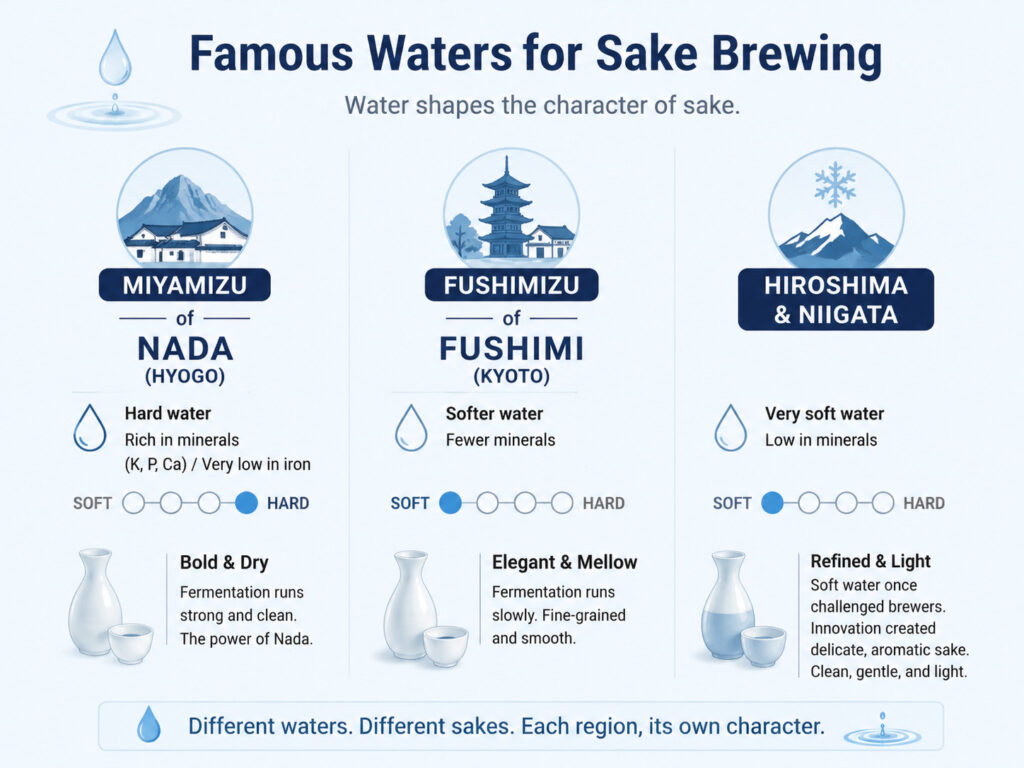
A few waters have become legendary among brewers. Each helped shape a region’s identity, and each tells you something about what sake needs.
Miyamizu of Nada
Indeed, miyamizu is perhaps the most famous brewing water in Japan. It rises in Nishinomiya, in Hyogo, fed by the granite slopes of the Rokko mountains. It is unusually hard for Japan. The water is rich in potassium, phosphorus, and calcium, yet very low in iron. That combination pushes fermentation hard while keeping the sake clean.
It is close to ideal for brewing. Nada’s bold, dry sake owes much to this water. Our Hyogo sake coverage explores the region built around it.
Fushimizu of Fushimi
Kyoto’s Fushimi district relies on a softer water, sometimes called fushimizu. It carries fewer minerals than miyamizu, so it sits closer to the soft end of the scale. The gentler water shapes a gentler sake. Fermentation runs slowly, and the sake turns out fine-grained and mellow. This is the source of Fushimi’s elegant, smooth reputation, a quiet counterpoint to Nada’s power.
Hiroshima and Niigata Waters
Hiroshima took a harder road, because its water is very soft. For a long time, such soft water was thought unfit for good sake, since the yeast struggled to get going. One brewer changed that in 1898. His name was Senzaburo Miura, and he developed a soft-water brewing method that tamed the problem. His techniques let Hiroshima craft refined, aromatic sake.
So the region joined Nada and Fushimi among the great brewing centers. Likewise, Niigata leans on soft water too. Its snowmelt feeds a clean, gentle water that suits the region’s light, dry style, as our Niigata sake guide explains.
The Discovery of Miyamizu
The story of miyamizu is one of my favorite tales in sake history. It turns on a puzzle, a hunch, and a careful test. In the late Edo period, a Nada brewer named Tazaemon Yamamura ran two breweries. One stood in Nishinomiya, the other in Uozaki, some distance away. The same brewer, the same rice, the same method, yet the results differed. The sake from Nishinomiya was consistently better.
For a while, no one could say why, and the gap nagged at him. Something set the two sites apart. So he ran a simple experiment. He carried water from the Nishinomiya well all the way to Uozaki and brewed with it there. The Uozaki sake promptly improved, which pointed straight at the water.
The secret was not the site or the skill, but the spring. That water became known as miyamizu, a shortening of “Nishinomiya water.” The discovery is usually dated to around 1840. It reshaped Nada brewing almost overnight. The effect was enormous.
Soon, word spread, and Nada breweries flocked to the water, hauling it to their kura. Sake quality rose sharply, and Nada came to dominate the market. By the late Edo period, its sake filled a huge share of the demand in old Edo. It is worth pausing on how bold that test really was. Hauling water between two towns took real effort.
Roads were poor, and the loads were heavy. Yet the brewer trusted his hunch enough to try. That willingness to test an idea changed sake forever. The name itself tells the story. “Miyamizu” is a shortening of “Nishinomiya no mizu,” the water of Nishinomiya.
Over time the longer name wore down to the word we use now. It has stuck for well over a century. Brewers soon learned why the water worked. Later analysis showed miyamizu was rich in phosphorus and potassium.
It carried around 20 mg per liter of potassium, yet very little iron. So it drove a strong fermentation while keeping the sake clean and bright. The old brewer had stumbled onto a near-perfect brewing water.
The Historical Importance of Water
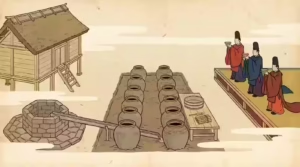
Water has shaped sake for as long as sake has existed. Long before anyone understood minerals, brewers knew that some water simply made better sake. Historically, early breweries clustered near good water. A reliable spring or well was a treasure worth protecting. Whole brewing towns grew up around such sources.
The location of the water often decided where sake was made at all. The discovery of miyamizu marked a turning point. It showed, in a very concrete way, that water alone could transform sake quality. After that, brewers paid far closer attention to their water. Eventually, science caught up with tradition.
Modern researchers identified the minerals that help and harm fermentation.
They confirmed what old brewers had learned by feel. Iron was pinpointed as a real enemy, and potassium and phosphorus as friends. So centuries of intuition found a chemical explanation. Today, water still carries deep cultural weight.
Breweries take real pride in their source, and many protect it fiercely. Some spring waters are even guarded by conservation efforts. The link between water and sake remains as strong as ever.
Water and Regional Sake Styles
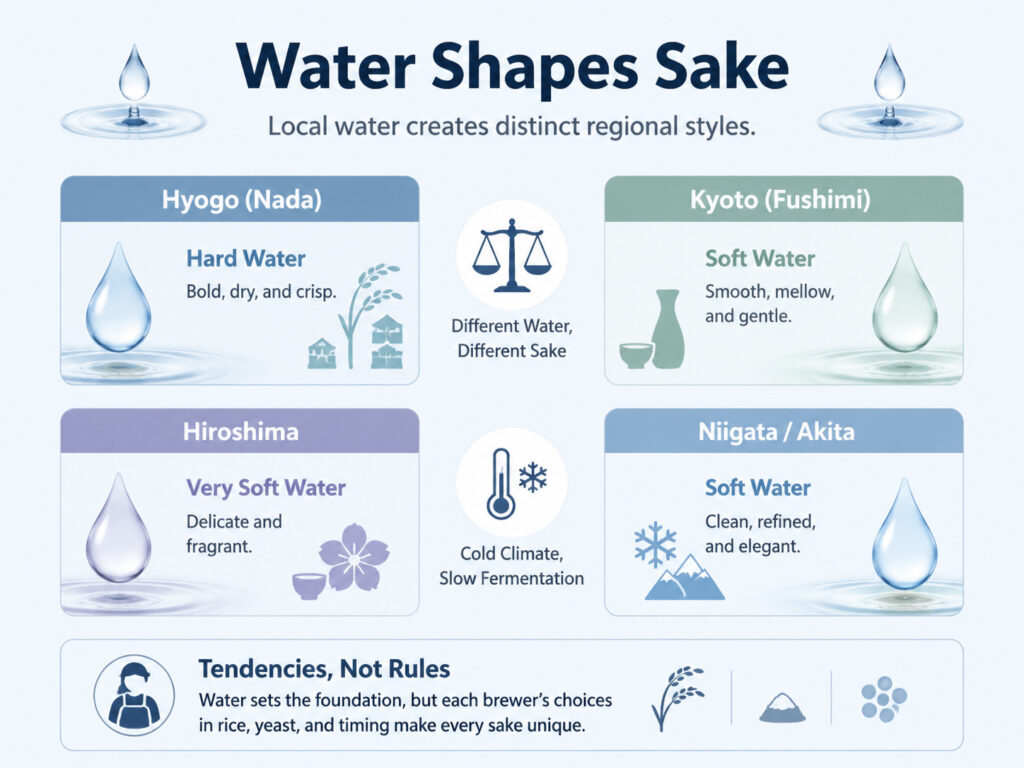
Trace the water, and you can almost predict a region’s sake. The link between local water and local style runs deep across Japan. Hyogo, home to Nada, built its name on hard miyamizu and bold, dry sake. Kyoto’s Fushimi leaned on softer water for a smooth, mellow style. The two regions sit close together, yet their sake diverges sharply.
Hiroshima tells the soft-water success story.
Its very soft water once seemed a drawback, until the soft-water method turned it into an asset. Today the region is known for delicate, fragrant sake. Northern regions add their own twist. Niigata and Akita pair soft water with long, cold winters, so fermentation runs slow and clean. The result is often a light, refined, dry style, as our regional sake guides describe. Akita deserves a closer look here.
This northern region enjoys soft water and deep snow. Its cold winters let fermentation run long and slow. So Akita sake often turns out clean, refined, and elegant. The water sets the stage for that gentle style. By contrast, Hyogo sits at the other pole. Its hard miyamizu drives a strong, dry fermentation.
The famous sake rice of the region suits this bold approach. Together, water and rice give Nada its firm, crisp character. These regional links are tendencies, not laws. Every brewery makes its own choices within a region. They pick their rice, their yeast, and their timing. So two neighbors can craft very different sake from similar water.
The water shapes a starting point, and the brewer does the rest.
Choosing and Protecting a Water Source
For a brewery, the water source is a treasure. Choosing it well, and guarding it, is part of the craft of water in sake brewing. Most breweries draw on wells or springs. Underground water is prized for its consistency. It stays cleaner and more stable than surface water.
Many kura have used the same well for generations.
That reliability lets brewers refine their style over time. Naturally, testing the water comes first. A brewer checks its hardness and its minerals before trusting it. They look for helpful potassium and phosphorus, and for unwelcome iron. Only then can they judge whether the water suits their sake.
Protecting the source matters just as much.
Groundwater can be harmed by nearby development or pollution.
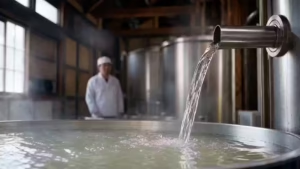
A famous water like miyamizu has long been shielded by careful conservation. Local efforts help keep the underground flow clean. Without such care, a great brewing water could quietly disappear. Some breweries even offer their water to visitors. You may find a small spout in the entrance, free to sample. It is a quiet point of pride, and a reminder of where the sake begins.
Modern Water Treatment
Not every brewery sits on a perfect spring. So water treatment in sake brewing has become a quiet necessity. Modern brewers can shape their water with real precision. First, filtration handles the harmful metals. Activated carbon filters strip out iron and manganese, the two metals that spoil color and aroma. Brewers match the filter to their water and their goal, since every source is different.
Some breweries go further still. Ion-exchange systems can lower hardness, while aeration methods help remove iron. So a brewery can tune its water toward the profile it wants. Adjusting minerals is allowed within limits. Brewers may add small amounts of approved mineral salts, such as potassium phosphate, to support fermentation. The aim is never to overload the water, only to correct a shortfall.
Finally, quality monitoring ties it together.
Breweries test their water regularly, watching for stray metals or contamination. This is because clean water underpins every other decision in the kura. Treatment always has a limit, though. Brewers can remove iron and adjust hardness within reason.
Yet they cannot rebuild a poor water into a great one entirely. So a naturally good source still carries real value. No filter fully replaces the gift of fine water. Consistency is the quiet goal of all this work. A brewery wants the same water quality every single season. Careful treatment and monitoring make that possible.
In turn, steady water helps produce steady, reliable sake.
Water in Sake Brewing and Flavor
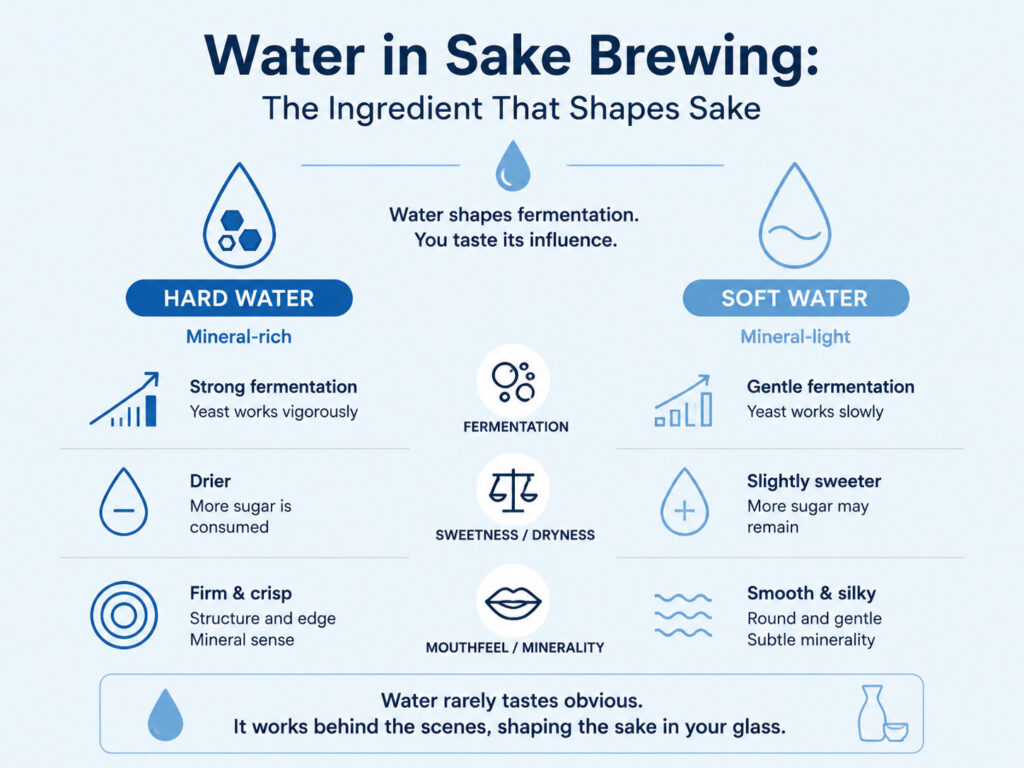
Here is a question worth pausing on. Can you actually taste the water in a glass of sake? The honest answer is yes, though rarely in an obvious way. Water shapes flavor mostly through fermentation, not through its own taste. Hard water drives a strong, dry fermentation, so the sake often finishes crisp and firm.
Soft water works gently, so the sake tends to feel round and mild. Moreover, mouthfeel shifts with the water too. A mineral-rich water can lend a sense of structure and sharpness. Meanwhile, a soft water leaves a smoother, silkier impression. Sweetness and dryness follow the same logic.
The mechanism is simple.
A vigorous, hard-water fermentation tends to consume more sugar.
So it pushes the sake drier. A gentle, soft-water fermentation works the other way. It can leave a touch more sweetness behind. So the water rarely announces itself directly. Instead, it works behind the scenes, steering the fermentation that shapes the flavor. You taste its influence far more than its actual mineral character.
Sweetness and Dryness
Sweetness in sake often traces back to the water. A hard water drives the yeast hard, so it eats through more sugar. The finished sake then tastes drier and crisper. Soft water tells a gentler story.
Its slower fermentation can leave a little more sugar behind. So the sake may feel rounder and slightly sweeter. This is only a tendency, of course. The brewer still guides the final balance.
Mouthfeel and Minerality
Water also shapes how the sake feels in the mouth. Mineral-rich water can lend a sense of firmness and edge. So hard-water sake often feels tight and clean. Soft water leaves a different impression.
It tends to give a smoother, silkier texture. The sake can feel gentle and easy on the palate. Some tasters even sense a faint minerality in certain sake. Yet this is subtle, and it hides behind the fermentation flavors.
Water in Sake Brewing and Different Styles
Water choice also connects to the grade of sake being made. A brewer thinks about water differently for a rich junmai than for a delicate daiginjo. Full-bodied styles can lean on firmer water. A robust junmai often suits a mineral-rich water. The strong fermentation builds body and a dry finish.
Our junmai guide explores this hearty style in more depth.
By contrast, delicate styles often prefer softer water.
A fragrant ginjo or daiginjo relies on a slow, cool fermentation.
Soft water encourages exactly that gentle pace, so it helps protect the fine aromas. See our ginjo and daiginjo guides for the finer points. None of this is a strict rule, though. Skilled brewers bend water to their will. They filter it, adjust it, and manage the fermentation with care. So a talented brewer can craft a delicate sake even from harder water.
The water sets a tendency, not a destiny.
How Brewers Think About Water in Sake Brewing
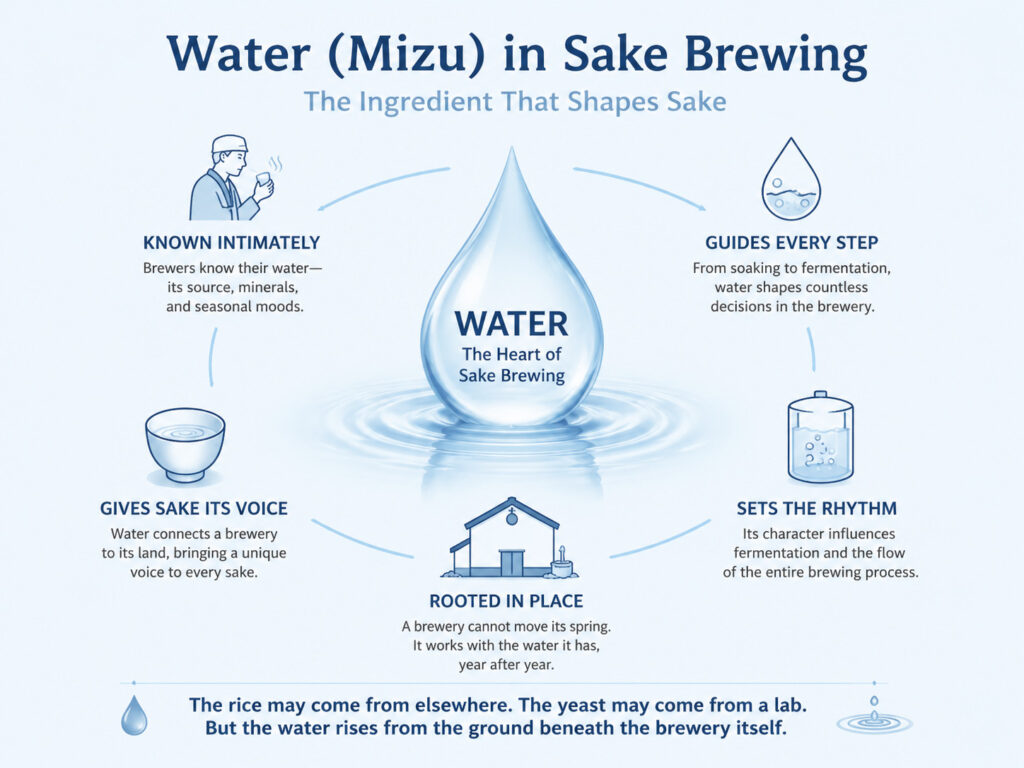
Talk to a brewer, and water comes up quickly. To them, it is never just a background detail. They speak about their water with real affection. A brewer often knows the source intimately.
They know its hardness, its minerals, and its moods across the seasons. Some can taste a faint difference between one well and another. That closeness comes from years of daily use. Furthermore, water also guides countless small decisions.
A brewer adjusts the soaking time to the water. They tune the fermentation to its mineral strength. So the water quietly steers the whole rhythm of the kura. I find this relationship rather moving, honestly. A brewery cannot move its spring. It must work with the water it has, year after year.
So each kura learns to draw the best from its own source. In a way, the water gives every brewery part of its voice. This is why water in sake brewing feels almost personal. It ties a brewery to its land in a direct, unbroken way. The rice may come from elsewhere, and the yeast from a lab. Yet the water rises from the ground beneath the brewery itself.
Common Myths About Water in Sake Brewing
Water attracts a few persistent myths. Let us clear them up plainly.
- Does mountain spring water always make better sake? No. Scenic water can still carry iron or lack the right minerals for brewing.
- Can any spring water make sake? No. Water high in iron or manganese causes color and aroma faults, so brewers test carefully.
- Is bottled mineral water better for brewing? Not necessarily. What matters is the right balance of helpful minerals, not simply more of them.
- Is hard water better than soft water? No. Each suits a different style, and skilled brewers work beautifully with both.
- Is purer always better? No. Perfectly pure water lacks the minerals that feed a healthy fermentation.
The thread running through these myths is the same. People assume purer or more scenic water must be better, yet brewing water is about balance, not romance. The right minerals matter far more than the prettiest source.
Final Thoughts
Water in sake brewing is easy to overlook, precisely because it is clear and quiet. Yet it is one of the defining elements of the whole craft. It makes up most of the bottle, and it steers nearly every stage of brewing. From the koji room to the final dilution, every drop leaves a mark.
The minerals it carries can drive a bold, dry sake or coax out a soft, gentle one. Whole regions grew up around a single remarkable spring, as the story of miyamizu shows. Neither hard nor soft water is better; each simply shapes a different style. Understand the water, and you understand why sake tastes the way it does. The next time you raise a glass, remember that most of what you taste began as water.
Water in Sake Brewing FAQ
What role does water play in sake brewing?
Water is the largest ingredient in sake by volume. It makes up around 80 percent of the finished drink. It also hosts the koji, yeast, and rice during fermentation. So it shapes almost every stage of brewing.
How much of sake is water?
Roughly 80 percent of finished sake is water. The rest comes from rice, plus the compounds made during fermentation. So the water’s character reaches every sip. Its quality truly matters.
What is miyamizu?
Miyamizu is a famous brewing water from Nada, in Hyogo. It rises from the Rokko mountains and is unusually hard for Japan. It is rich in potassium and phosphorus but low in iron. This makes it ideal for brewing.
What is the difference between soft and hard water in sake?
Hard water carries more minerals than soft water. Hard water drives a fast, dry fermentation, giving crisp sake. Soft water ferments slowly, giving a rounder, milder sake. Neither is better, only different.
Why is iron bad for sake?
Iron reacts with compounds from the koji. This dulls the sake’s color and harms its aroma. Even small amounts cause problems. So brewers keep iron very low, often by filtering the water.
Which minerals help sake fermentation?
Potassium, phosphorus, and magnesium feed the yeast and koji. Calcium helps the koji release its enzymes. Together these support a healthy fermentation. Good brewing water carries them in balance.
Why did famous sake regions grow where they did?
Great sake regions often grew around excellent water. Nada had hard miyamizu, and Fushimi had softer water. Good water made reliable, high-quality brewing possible. So brewing clustered near these springs.
What is warimizu?
Warimizu is the pure water added to finished sake. Brewers use it to lower the alcohol to bottling strength. Its quality affects the final flavor. So brewers choose it as carefully as brewing water.
Can breweries treat their water?
Yes, brewers often treat their water. Carbon filters remove iron and manganese. Other methods adjust hardness or add helpful minerals. This lets a brewery fine-tune its water.
Does soft water make sweeter sake?
It often leans that way. Soft water ferments gently, so a little more sweetness can remain. Hard water ferments strongly and finishes drier. Still, the brewer’s choices matter too.
Is spring water always best for sake?
No, not always. Scenic spring water can still carry iron or lack key minerals. Brewers judge water by its chemistry, not its source. Balance matters more than beauty.
Can you taste the water in sake?
Yes, but usually indirectly. Water mostly shapes flavor through fermentation, not its own taste. Hard water leans crisp and dry, while soft water leans smooth. So you taste its influence more than the water itself.
References
- National Research Institute of Brewing, on sake brewing water standards, including limits on iron and manganese. (Surveyed: June 2026)
- Japan Sake and Shochu Makers Association, glossary covering shikomizu, miyamizu, and warimizu. (Surveyed: June 2026)
- Brewing Society of Japan, materials on the role of minerals in sake fermentation. (Surveyed: June 2026)
- Nishinomiya City, on miyamizu and its conservation in the Nada brewing region. (Surveyed: June 2026)
- Nishida, H. (2021). “Sake Brewing and Bacteria Inhabiting Sake Breweries.” Frontiers in Microbiology, 12, 602380. (Surveyed: June 2026)
- Yoshida, K. “The Story of Japanese Sake: Its History, Technology, and Art.” Kobe University symposium paper, on brewing water minerals, iron and manganese effects, and the discovery of miyamizu. (Surveyed: June 2026)
- Standard Tables of Food Composition in Japan (MEXT), mineral composition data relevant to brewing water and sake ingredients. (Surveyed: June 2026)
Related Articles
- Koji (麹): The Heart of Sake Brewing (Surveyed: June 2026)
- Fermentation in Sake Brewing (Surveyed: June 2026)
- Moromi: The Main Sake Mash (Surveyed: June 2026)
- Pressing (Joso): How Moromi Becomes Sake (Surveyed: June 2026)
- How Sake Is Made (Surveyed: June 2026)
- Niigata Sake (Surveyed: June 2026)





Comments