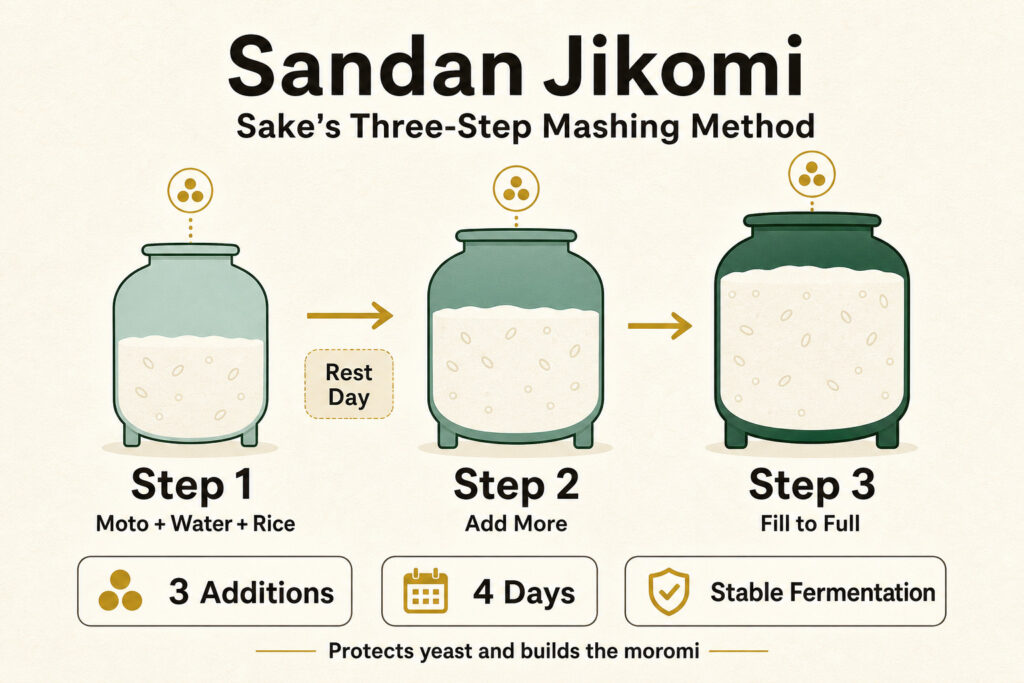
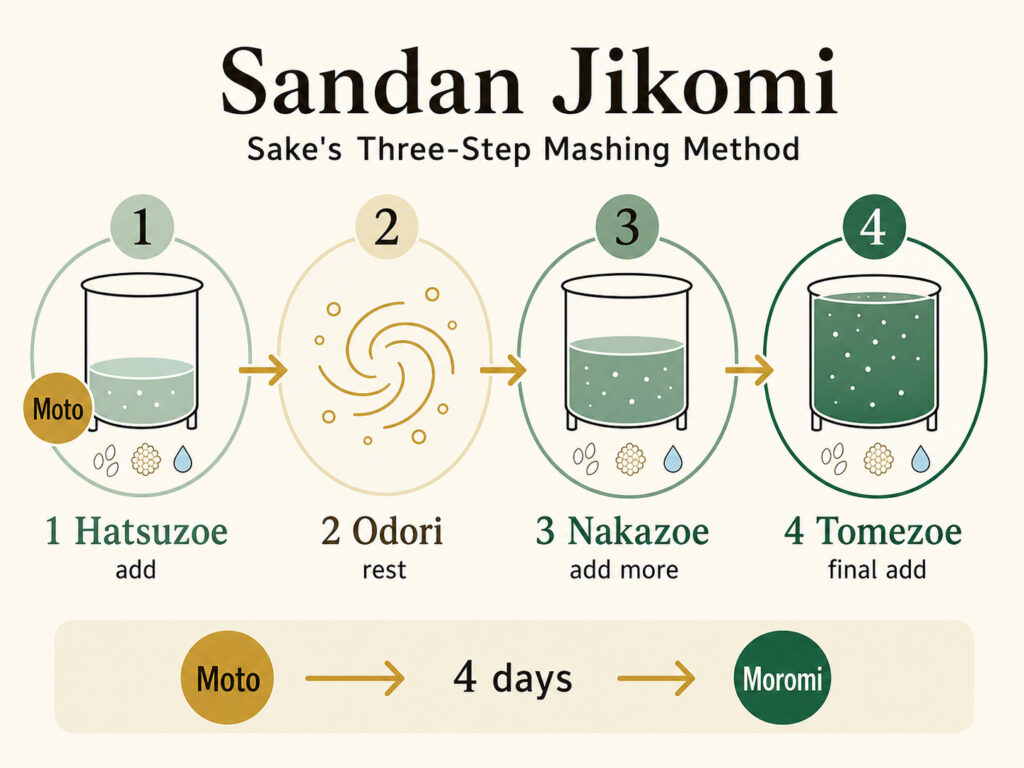
Sandan jikomi is the traditional three-step method of building the main fermentation mash in sake brewing. Brewers add steamed rice, koji, and water in three stages, spread across four days. They do not mix everything at once, and that patience is the whole point. The gradual approach protects the delicate yeast starter and keeps fermentation stable.
The name says exactly what it is. San means three, dan means step, and jikomi means preparation or mashing. So sandan jikomi is simply three-step mashing. Each stage roughly doubles the size of the batch. The yeast then has time to adjust before the next load of rice and water arrives.
This guide explains why brewers take this careful path. We cover the science that makes it work, the four-day schedule, and the roles of hatsuzoe, nakazoe, and tomezoe. We also look at how it powers sake’s signature fermentation. Along the way, one question keeps coming up. Why not just add it all at once? The answer reveals a quiet genius at the heart of sake brewing.
TOC
Quick Facts About Sandan Jikomi
Here is a short snapshot before the details begin. Keep it handy as a quick reference.
Japanese Name
三段仕込み (sandan jikomi)
Also Written
Sandan shikomi
Literal Meaning
Three-step preparation
English Translation
Three-step mashing
Number of Additions
Three (over four days, with one rest day)
Typical Duration
Four days to build the mash, then weeks to ferment
Main Purpose
Protect the yeast and keep fermentation stable
Used For
Building the moromi, the main fermentation mash
What Is Sandan Jikomi?
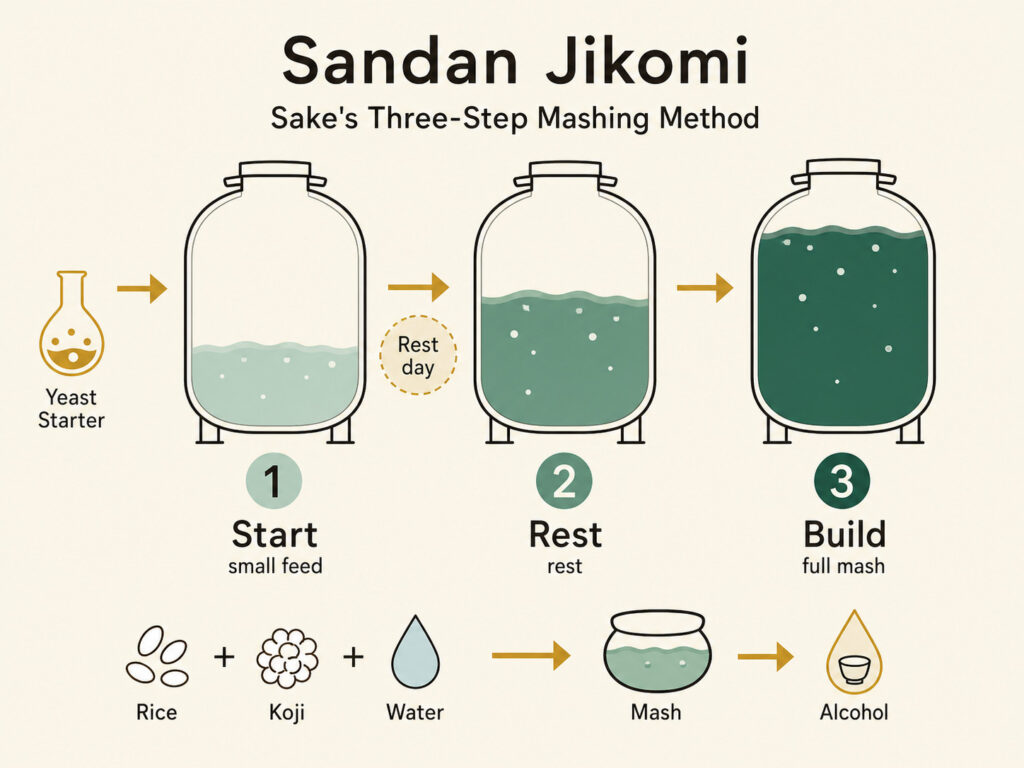
Sandan jikomi is a method for building the main sake mash in three careful stages. Brewers start with a small, strong yeast starter. They then add steamed rice, koji, and water three times over four days. Each addition feeds the growing culture without shocking it. By the end, the full mash is ready to ferment.
Why It Is Called “Three-Step”
The name counts the additions, not the days. There are three feeding stages in total. They carry their own names: hatsuzoe, nakazoe, and tomezoe. A rest day sits between the first and second additions, so the process spans four days rather than three. That extra day matters, as we will see.
Each stage grows the batch by roughly double. The first addition is small. The second is about twice as large. The third is larger still. This steady doubling gives the method its rhythm. Brewers sometimes call the whole family of techniques dan-kake, or staged mashing.
Why Not Just Mix Everything at Once?
This is the obvious question, and it has a clear answer. Dumping all the rice and water in together would dilute the starter. The yeast would suddenly find itself in a weak, unprotected soup. Harmful bacteria could then move in and spoil the batch. The slow build avoids that danger entirely.
Think of it like feeding a fire. You do not smother young flames with a huge log. You add small pieces and let them catch first. Sandan jikomi treats the yeast the same way. Small feedings keep the culture strong and in control.
The Link to Moromi
Sandan jikomi is how brewers create the moromi, the main fermenting mash. The moromi is where sake truly forms. Koji breaks rice starch into sugar there, while yeast turns that sugar into alcohol. Sandan jikomi builds this mash safely. After the final addition, the moromi ferments for weeks before pressing.
Why Is Three-Step Mashing Necessary?
The three-step method solves several problems at once. Each one threatens a young mash, and together they could ruin a batch. This section is the scientific heart of the article. Understanding these risks explains why brewers never rush.
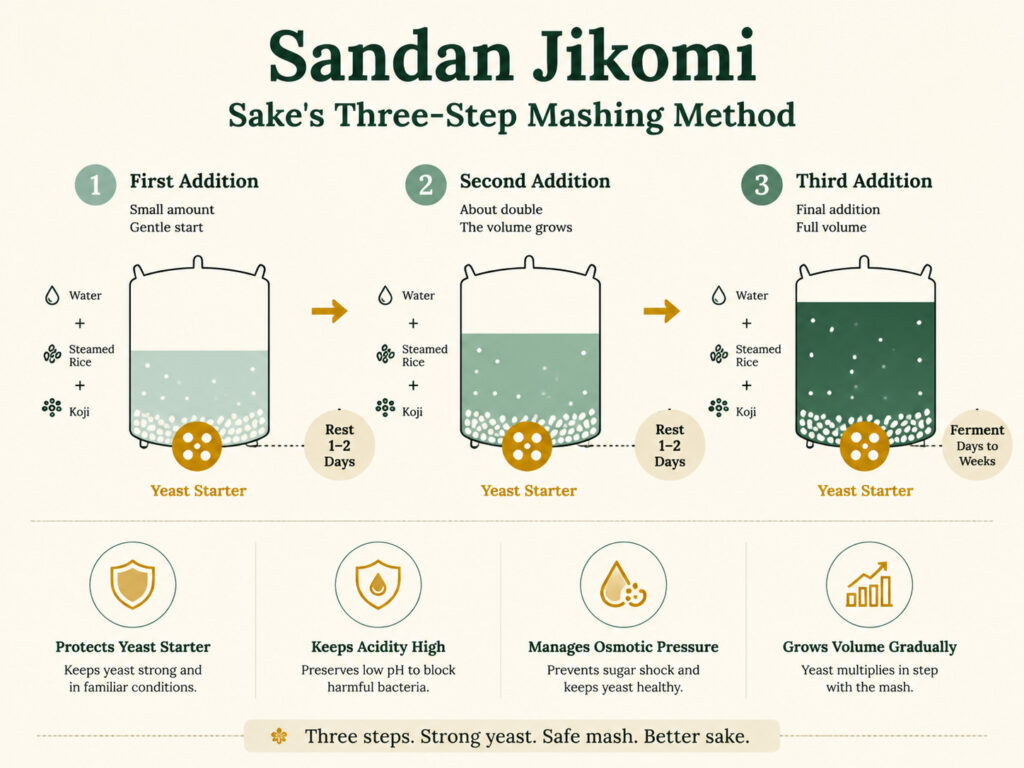
Protecting the Yeast Starter
Everything begins with the yeast starter, called moto or shubo. Brewers spend weeks building this concentrated, healthy culture. It is precious, and it needs defending. The first small addition surrounds the starter with familiar conditions. The yeast stays dense and dominant, rather than thin and vulnerable.
Keeping Acidity High Against Bacteria
The starter is deliberately acidic, and that acidity is a shield. Lactic acid lowers the pH and keeps unwanted microbes out. Add too much water too fast, and you dilute that protection. The three-step method preserves the acidic environment through each stage. So the mash stays safe while the yeast takes firm control.
This defense matters most in the early days. A single addition would drop the acidity like a stone. Wild yeast and spoilage bacteria would seize the chance. Staged additions keep the pH low just long enough. By the time acidity finally eases, the yeast already rules the tank.
Managing Osmotic Pressure
Here is a subtler danger, and it involves sugar. Koji quickly turns rice starch into glucose. Too much glucose at once creates high osmotic pressure. That pressure pulls water out of the yeast cells and stresses them. A stressed culture ferments poorly and can stall.
Staged additions keep the sugar level in check. Each new batch of rice arrives only as the yeast is ready. Glucose never floods the tank all at once. The yeast stays comfortable and keeps working steadily. This balance is one reason a slow build produces cleaner sake.
Growing the Volume Gradually
Yeast multiplies fast, but not instantly. It needs time to match a growing food supply. Each doubling gives the culture a day or two to catch up. The population expands in step with the mash. Nothing outruns the yeast, and nothing starves it.
Brewers learned this balance through long experience. Two stages leave too little room for the yeast to grow. Four or more stages add needless complexity. Three turned out to be the sweet spot. It matches the natural growth rate of the yeast almost perfectly.
The Four-Day Schedule
The whole process follows a strict four-day rhythm. Three days involve adding ingredients, and one is a rest. The table below gives the overview, and the sections that follow explain each day.
Day
Stage
What Happens
Rough Share of Total
Day 1
Hatsuzoe (first addition)
Add rice, koji, and water to the starter
About one sixth
Day 2
Odori (rest)
Nothing added; yeast multiplies
No addition
Day 3
Nakazoe (second addition)
Add roughly double the first amount
About two sixths
Day 4
Tomezoe (final addition)
Add the largest, final amount
About three sixths
Day 1: Hatsuzoe (First Addition)
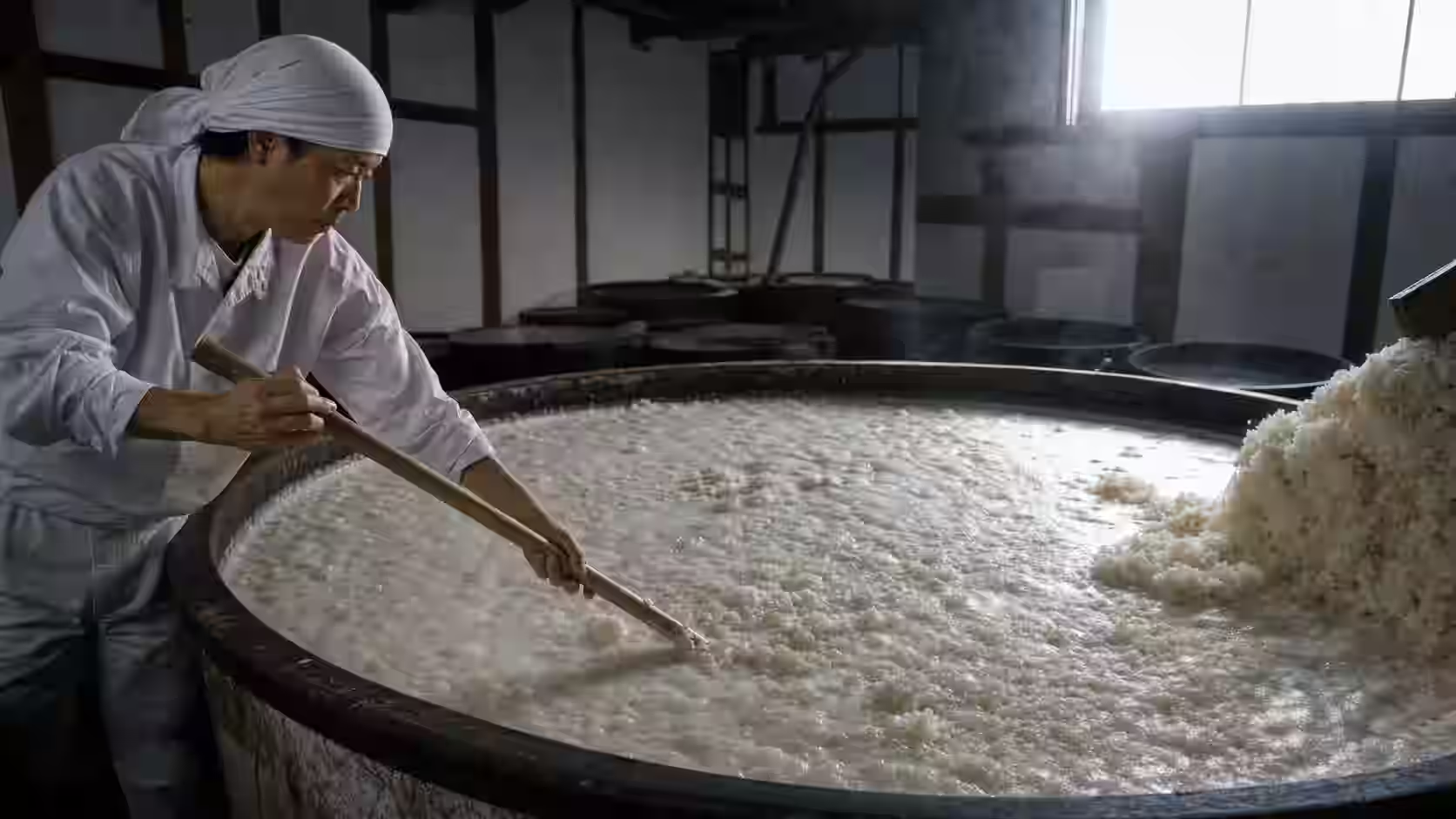
On the first day, brewers move the starter into the mashing tank. They add steamed rice, koji, and water for the first time. The amount is small, around twice the volume of the starter. That works out to roughly a sixth of the final mash. Brewers stir it well with a long pole called a kai.
The goal here is gentle introduction, not speed. The yeast meets fresh food in a safe, acidic setting. It begins to feed and prepares to multiply. Nothing is rushed on day one. This small start sets up everything that follows.
Day 2: Odori (The Rest Day)
The second day looks strange at first. Brewers add nothing at all. This pause is called odori, which means dancing. The name fits, since the mash bubbles and churns as the yeast wakes up. It is resting from additions, yet full of hidden activity.
The reason is simple but vital. The yeast needs a day to multiply before more food arrives. Skip this pause, and the next addition would overwhelm the culture. Odori lets the population roughly catch up. Only then is the mash ready to grow again. Brewers still stir during this day to keep everything even.
Day 3: Nakazoe (Second Addition)
By the third day, the yeast is strong and numerous. Now brewers add the second, larger load. Nakazoe roughly doubles the amount added at hatsuzoe. More rice, koji, and water go into the tank. After this stage, about half the total mash is in place.
The yeast handles this bigger feeding with ease. Its numbers have grown enough to cope. Fermentation deepens, and the tank grows livelier. The mash is now well on its way. Still, one more addition remains.
Day 4: Tomezoe (Final Addition)
The fourth day completes the build. Tomezoe is the largest addition of all. It roughly doubles the volume once more. Brewers add the final rice, koji, and water. With this, the full moromi is finished.
From here, the waiting begins. The completed mash ferments for about three to five weeks. Brewers watch the temperature closely and adjust as needed. Slowly, the sake takes shape inside the tank. Every later step depends on this careful four-day start.
The Full Timeline at a Glance
It helps to see where sandan jikomi sits in the wider process. The steps below run from the yeast starter to pressing. The four-day mashing is just one stretch of a longer chain.
Moto (yeast starter): built over two weeks to a month before mashing begins.
Hatsuzoe (day 1): the small first addition to the starter.
Odori (day 2): a rest day while the yeast multiplies.
Nakazoe (day 3): the larger second addition.
Tomezoe (day 4): the largest final addition, completing the mash.
Moromi fermentation: about three to five weeks of parallel fermentation.
Pressing: clear sake is separated from the solids, ending the mash stage.
Ingredients Added at Each Stage
The same three ingredients go in at every stage. Only the amounts change. Understanding each one shows why the recipe is so precise. Brewers call the overall formula the shikomi-hai, or mashing composition.
The Three Core Ingredients
Each addition brings steamed rice, koji, and water together. All three play a distinct role.
Steamed rice: the main source of starch, which koji later turns into fermentable sugar.
Koji: rice grown with koji mold, supplying the enzymes that convert starch to sugar.
Water: the medium for fermentation, making up most of the finished sake by volume.
Ratios and Proportions
The proportions are not left to chance. Brewers track several key ratios in the shikomi-hai. The water-to-rice ratio, or kumimizu-buai, shapes how fast and dry the sake becomes. The koji ratio affects how much sugar the mash produces. The starter ratio sets how much yeast leads the batch.
These numbers are surprisingly precise. The koji ratio, for instance, often sits near 20 to 25 percent of the total rice. The water-to-rice ratio commonly lands between about 120 and 140 percent. More water than rice, in other words, is normal. Small shifts in these figures change the whole character of the sake.
Flavor follows these ratios closely. More water tends to give a cleaner, drier sake. It also eases sugar pressure, so the yeast works harder. Less water can leave more richness and sweetness. A brewer adjusts these values with real care. In a sense, the shikomi-hai is the recipe behind the recipe.
Temperature Management
Temperature guides every stage of the build. Each addition is made at a carefully chosen temperature. Brewers usually start cool and let the mash warm gently. Cold conditions keep the early yeast calm and clean. This is one reason sake is often made in winter, during kan-zukuri.
The chill also slows things at the right moments. A cooler mash ferments more slowly and evenly. That control protects the aroma and balance. Brewers nudge the temperature up or down as the mash matures. Nothing about the process is left to guesswork.
Sandan Jikomi and Multiple Parallel Fermentation
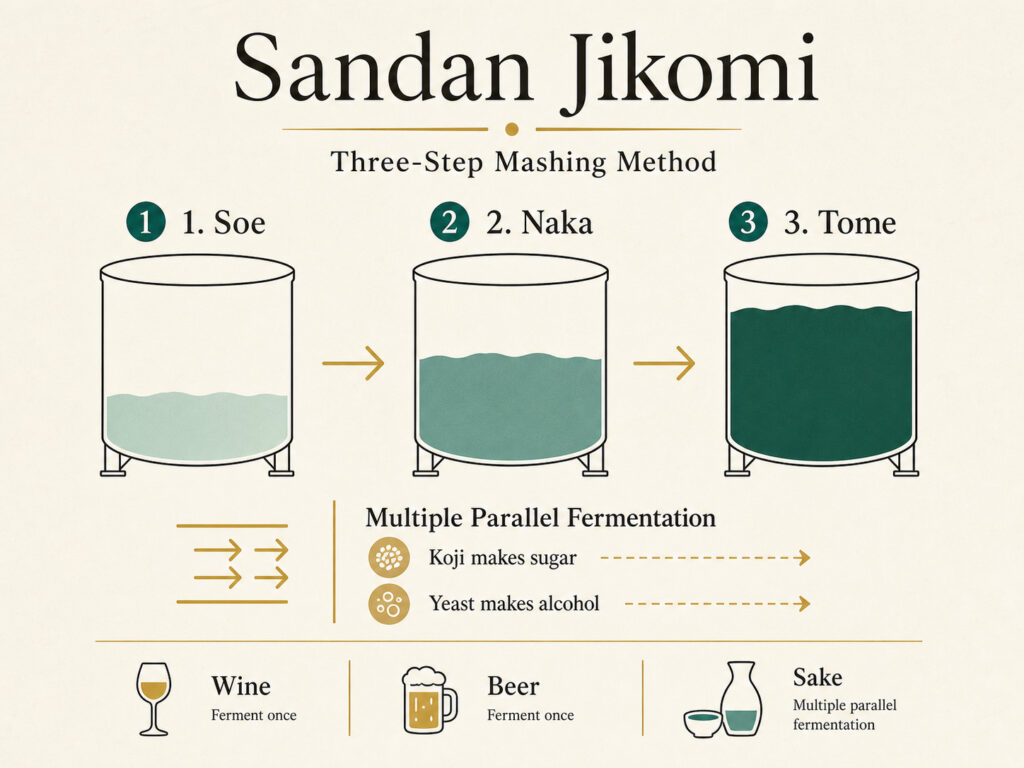
To fully grasp sandan jikomi, you need one more idea. Sake ferments in a way found almost nowhere else. Experts call it multiple parallel fermentation. Sandan jikomi exists to make this rare process work smoothly.
Two Processes in One Tank
Most alcoholic drinks ferment in two separate steps. Winemakers start with grapes that already contain sugar. Brewers of beer first convert grain starch to sugar, then ferment it. Sake does both jobs at the same time, in the same tank.
Two things happen together in the moromi. Koji enzymes break rice starch into sugar. Yeast then eats that sugar and makes alcohol. Both run side by side, hour after hour. This simultaneous teamwork defines sake among the world’s drinks.
The table below shows how sake differs from beer and wine. The key is where the sugar comes from, and when.
Drink
Sugar Source
How Sugar and Alcohol Form
Typical Natural Alcohol
Wine
Grapes (already sweet)
One step: yeast ferments existing sugar
About 11 to 15 percent
Beer
Grain starch
Two steps: mash for sugar, then ferment
About 5 to 8 percent
Sake
Rice starch
Parallel: koji makes sugar as yeast ferments it
Around 18 to 20 percent
The Role of Koji Enzymes
Rice will not ferment on its own. Its starch is a long chain of glucose, locked tight and insoluble. Yeast cannot use it in that form. This is where koji does its quiet magic. The koji mold, Aspergillus oryzae, produces powerful enzymes.
Two enzymes matter most, and they work as a team. First, alpha-amylase cuts the long starch chains into shorter pieces called dextrins. Then glucoamylase snips those dextrins into single glucose molecules. Only now can the yeast feed. Koji also makes proteases, which release amino acids that add umami and depth.
Why the Balance Is Delicate
Running both processes at once is a tightrope walk. Sugar must appear at the right pace. Too much sugar too fast raises osmotic pressure and stresses the yeast. Too little, and fermentation slows to a crawl. The mash needs a steady, gentle supply of sugar.
This is exactly what sandan jikomi delivers. Staged additions feed starch into the tank gradually. Koji then releases sugar at a manageable rate. Yeast consumes it before it can pile up. The two processes stay in balance from start to finish.
How Sake Reaches Such High Alcohol
This balance unlocks a remarkable feat. Finished moromi can reach around 18 to 20 percent alcohol. That is the highest of any brewed drink made without distillation. The reason lies in the steady sugar supply. Yeast never faces a heavy sugar load all at once.
Picture the glucose as a slow, constant drip. The koji releases it just as fast as the yeast can use it. So sugar stays low while alcohol keeps climbing. The yeast avoids the osmotic shock that would stall it early. Even the koji feels the strain of rising alcohol, yet it keeps making sugar until the very end.
A Uniquely Japanese Solution
Sake solved a puzzle that stumped other traditions. Turning starch into strong alcohol usually needs two separate stages. Sake fused them into one elegant process. The gradual staging of sandan jikomi made it reliable. Method and biology grew together over centuries.
The result feels almost too neat to be an accident. Fermentation and mashing evolved hand in hand. Brewers found the rhythm long before science explained it. Together they turned a tricky biological problem into a dependable craft. That, in essence, is the genius of sake brewing.
The Historical Development of Sandan Jikomi
Sandan jikomi did not appear fully formed. It grew slowly, shaped by monks, merchants, and long experience. Its roots reach back many centuries.
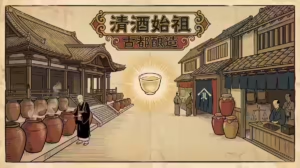
The Temple Brewers of Nara
Some of the best early records come from temples. Monks were skilled brewers in medieval Japan. One temple stands above the rest: Shoryakuji, near Nara. Many call it the birthplace of clear sake. There, brewers refined several key techniques together.
By the Muromachi period, Shoryakuji had combined four innovations. These were three-step mashing, morohaku brewing, an early yeast starter called bodaimoto, and pasteurization. Each one improved safety, stability, or flavor. Together they formed the basis of modern sake. It is striking how much came from one place.
Nanto Morohaku and the Written Record
The sake from these Nara temples earned a proud name. People called it Nanto Morohaku, the finest sake of its day. It was prized much as premium junmai daiginjo is now. Its fame spread far beyond the temple walls. Temple sake set the standard others chased.
Two old texts preserve this knowledge for us. The Goshu no Nikki records early starter methods. The Tamon-in Diary, kept at Kofukuji temple, describes staged mashing and heating. Both span the Muromachi era in rich detail. Modern researchers still treat them as milestones. Their notes reveal careful, almost scientific thinking.
Refinement in the Edo Period
The Edo period pushed brewing toward large-scale craft. Great brewing towns like Itami and Nada grew rapidly. Bigger tanks and steady demand rewarded reliable methods. Staged mashing fit that need perfectly. It gave consistent results at scale, batch after batch.
Over time, the three-step form settled as standard. Brewers tested other patterns and kept what worked. Three additions balanced safety, effort, and quality best. The method spread across the country. By the modern era, sandan jikomi defined ordinary sake brewing.
Why It Replaced Simpler Methods
Simpler, all-at-once mashing never matched it for safety. Single-batch mashes spoiled more often and tasted rougher. Staged mashing lost fewer batches and gave cleaner sake. For brewers, that reliability was everything. A lost tank meant lost income and lost face.
So the choice was really no contest. The extra days of work paid for themselves. Better sake sold better and traveled better. Practical wisdom, not mere tradition, made sandan jikomi win. It endures today for the very same reasons.
Traditional vs Modern Sandan Jikomi
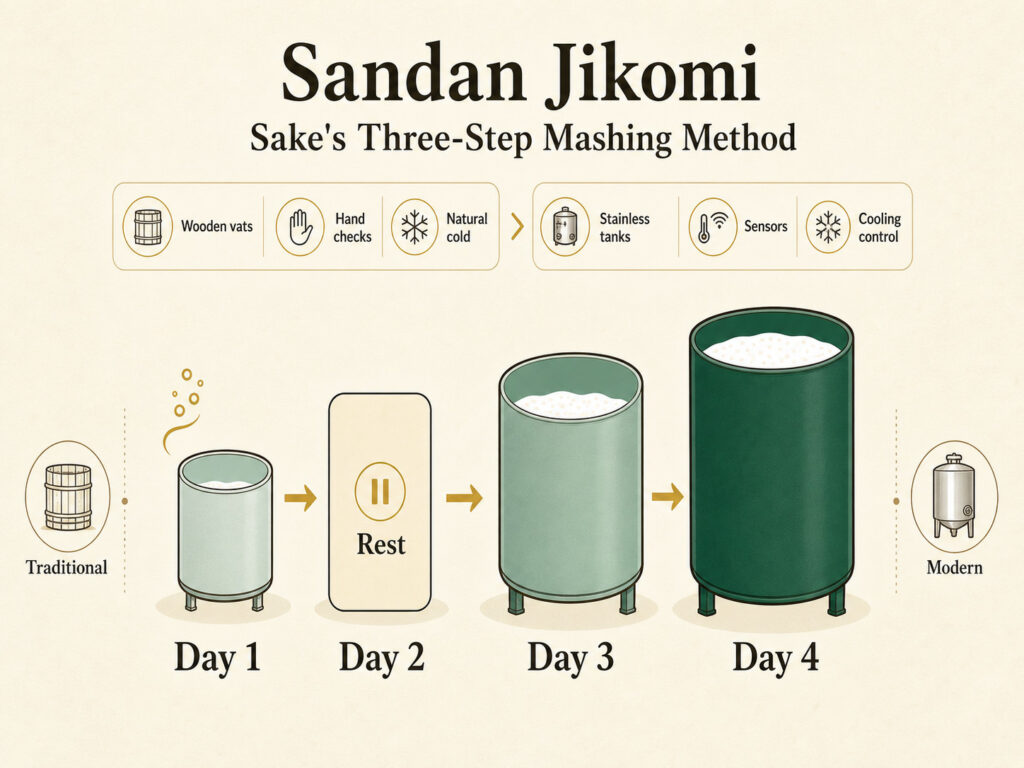
The core method has barely changed in centuries. The tools around it, however, look very different now. Modern breweries blend old logic with new technology. The table below shows how the two eras compare.
Aspect
Traditional
Modern
Vessels
Large wooden vats
Stainless steel tanks
Measurement
Experience and manual checks
Digital sensors and data
Mixing
Hand stirring with a kai pole
Mechanical assistance in larger kura
Temperature
Natural winter cold
Precise cooling systems
Records
Handwritten brewing logs
Computer monitoring and analysis
Yet the four-day rhythm survives almost untouched. Hatsuzoe, odori, nakazoe, and tomezoe still guide the work. Sensors may now track what brewers once judged by hand. The underlying biology has not changed at all. In that sense, the tradition and the technology simply serve the same yeast.
Variations of Sandan Jikomi
Three-step mashing is the standard, but not the only path. Brewers sometimes add stages for specific goals. These variations show how flexible the method can be. Most build directly on the three-step base.
Yondan Jikomi (Four-Step Mashing)
The most common variation adds a fourth stage. This is called yondan jikomi, or four-step mashing. Brewers add it after the usual three additions. The goal is usually to sweeten the sake. The extra stage tips the balance toward richness.
What goes into that fourth stage varies. Some brewers add plain steamed rice, known as uruchi yondan. Others add sweet rice, sweet amazake, or even sake lees. Each choice nudges the final flavor a different way. A brewer might also use it to fix an overly dry batch.
Other Staged Methods
The family of staged mashing runs wider still. Historical and specialty methods add even more stages. These are rare and demanding, yet they exist.
Yondan jikomi: a fourth addition, most often to raise sweetness.
Amazake yondan: sweet amazake added at the end for a softer, sweeter profile.
Mochi yondan: steamed glutinous rice added to boost body and sweetness.
Extra-stage methods: rare historical mashes with five or more additions.
More stages are not simply better, though. Each addition adds labor and changes the fermentation. Too many can unbalance the mash entirely. That is why three remains the trusted default. The variations serve special aims, not everyday brewing.
Common Misconceptions About Sandan Jikomi
A few misunderstandings surround this method. Let us clear up the most common ones.
Is Sandan Jikomi the Same as Fermentation?
No, the two are different things. Sandan jikomi is how brewers build the mash. Fermentation is the biological process that follows. The staged additions set the stage, then fermentation runs for weeks. One prepares the ground, the other grows the crop.
Why Not Simply Add Everything at Once?
Adding everything at once would endanger the whole batch. It dilutes the protective acidity and stresses the yeast. Bacteria could then take hold and spoil the mash. Staging keeps the yeast safe and dominant. The extra effort prevents costly failure.
Does Every Sake Use It?
Almost all standard sake uses three-step mashing. It is the industry norm for good reason. Some brewers add extra stages, though, for specific styles. A fourth addition can boost sweetness, for example. The three-step base still underlies most of these variations.
Final Thoughts
Sandan jikomi is one of the quiet triumphs of sake brewing. It looks simple, yet it solves several deep problems at once. Staged additions protect the yeast, hold off bacteria, and control sugar. Centuries of practice refined it into a dependable art.
What impresses me most is the blend of instinct and science. Temple monks sensed the logic long before microscopes existed. Modern research later confirmed why their method worked. The four-day rhythm still hums along in breweries today. Little has needed to change.
So the next time you sip sake, spare a thought for those four days. A small starter grew into a full mash, step by careful step. That patient build gave the drink its strength and grace. In a single cup lies centuries of quiet, practical genius.
Sandan Jikomi FAQ
What is sandan jikomi?
Sandan jikomi is the three-step method of building the main sake mash. Brewers add steamed rice, koji, and water in three stages over four days. Each stage roughly doubles the batch. This gradual build protects the yeast and keeps fermentation stable.
Why is sake made in three stages?
Three stages protect the yeast starter and keep the mash safe. Adding everything at once would dilute the protective acidity and stress the yeast. Staged additions preserve that acidity and let the yeast multiply steadily. The result is a stable, clean fermentation.
What do hatsuzoe, nakazoe, and tomezoe mean?
They are the three additions of sandan jikomi. Hatsuzoe is the small first addition on day one. Nakazoe is the larger second addition on day three. Tomezoe is the largest final addition on day four. Each roughly doubles the mash.
What is odori, the rest day?
Odori is the second day, when no ingredients are added. The word means dancing, since the mash bubbles as the yeast wakes up. This pause lets the yeast multiply before the next feeding. It prepares the culture for the larger additions ahead.
How long does sandan jikomi take?
The staged mashing itself takes four days. That covers hatsuzoe, odori, nakazoe, and tomezoe. After the final addition, the moromi ferments for about three to five weeks. So the full mash, from first addition to pressing, spans several weeks.
Why is there a rest day in the middle?
The rest day gives the yeast time to catch up. After the first addition, the culture needs to multiply. Adding more food too soon would overwhelm it. The odori pause lets the population grow before the second, larger addition arrives.
Is sandan jikomi the same as multiple parallel fermentation?
No, but they work closely together. Sandan jikomi is the staged method of building the mash. Multiple parallel fermentation is the process where koji makes sugar and yeast makes alcohol at once. The staged mashing creates the ideal setting for that process.
Does every sake use three-step mashing?
Almost all standard sake uses it, as it is the industry norm. Some styles add a fourth stage to increase sweetness. Others use more additions for specific effects. Even so, the three-step method forms the base of most sake brewing.
What ingredients are added at each stage?
Each stage adds the same three ingredients: steamed rice, koji, and water. Only the amounts change, roughly doubling each time. The rice supplies starch, the koji supplies enzymes, and the water carries the fermentation. The starter provides the yeast at the beginning.
Does sandan jikomi make sake sweeter?
Not by itself, since it mainly controls safety and balance. Sweetness depends more on the ratios and fermentation choices. Adding a fourth stage, however, can raise sweetness on purpose. The basic three-step method aims for stability, not a fixed flavor.
How old is the sandan jikomi method?
Staged mashing dates back centuries in Japan. Temple records from the Muromachi period already describe the technique. The Tamon-in Diary from Nara is a famous example. Brewers refined the three-step form through the Edo period into today’s standard.
Ryo Iwa is the founder and editor of foodinjapan.org. Born and raised in Japan, he writes from regional travel, market visits, and Japanese-language primary sources that rarely reach English readers, including brewing institute publications and industry glossaries. Where a figure cannot be traced to a source, the article says so.
He has been a Google Maps Local Guide for over 10 years, with more than 1,800 reviews and over 41,000 photos viewed hundreds of millions of times. He previously spent two decades as an IT consultant in Japan, the US, and the UK.












Comments