A great sake begins long before the rice is even washed. Instead, it begins with the building itself, the kura. So what is a kura? A kura, or sakagura, is a traditional Japanese sake brewery. It is the place where every stage of brewing unfolds.
Here, workers store, wash, steam, and turn rice into sake. Yet a kura is far more than a simple workshop. Indeed, its thick walls, high roofs, and quiet rooms all serve a purpose. Above all, they shelter fermentation from heat and noise. In a real sense, the building is a brewing tool itself.
This guide takes you inside the traditional sake brewery. We will explore its rooms, its design, and its history. We will also meet the people who bring it to life. By the end, you will see the kura as a living space, not just a structure.
A quick note before we step inside. The kura can feel almost like a temple. It is quiet, cool, and full of purpose. Every corner has a job to do. That sense of order is part of its charm.
Above all, a kura rewards a slow, curious eye. Each room tells part of a longer story. The tools hint at centuries of practice. Even the air seems to carry history. To walk through one is to walk through time.
TOC
Quick Facts About the Kura
In short, a kura is a building designed for brewing sake. Its very architecture supports fermentation and careful craft. Many stand near clean water and famous brewing regions. Builders made traditional breweries from wood, earth, and plaster. Modern ones often add steel, concrete, and refrigeration. Above all, the kura shapes the sake made within its walls.
Japanese Name
酒蔵 (kura) / 酒蔵 (sakagura)
Literal Meaning
Sake storehouse
English Translation
Sake brewery
Primary Function
Brewing and storing sake
Typical Location
Near clean water and rice-growing regions
Traditional Materials
Wood, earthen walls, plaster (dozo-zukuri)
Modern Alternatives
Stainless steel, concrete, refrigeration
What Is a Kura?
A kura is a sake brewery, the home of the whole brewing craft. Notably, the word kura simply means storehouse or warehouse. So when it refers to sake, people often say sakagura. That word joins sake and kura into one clear idea. So a sakagura is, quite literally, a sake storehouse.
Kura, Sakagura, and Kuramoto
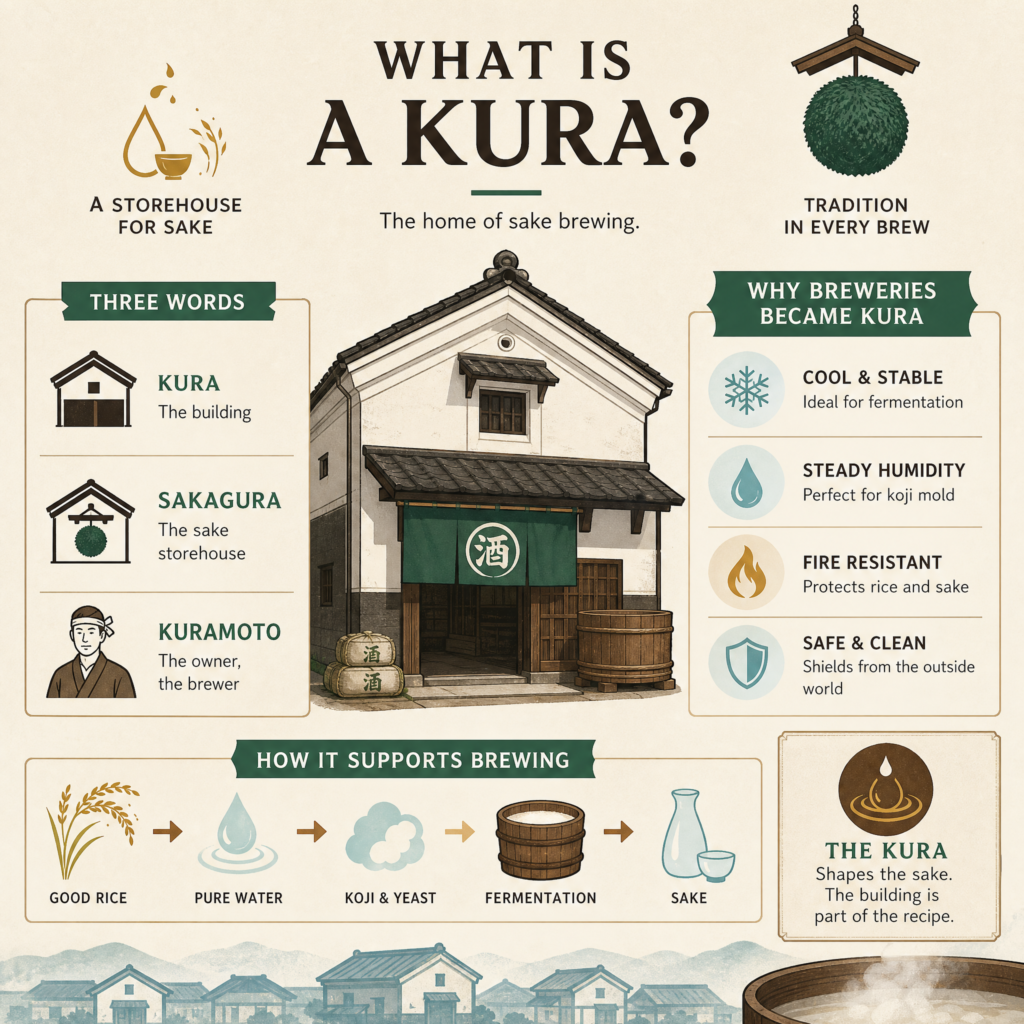
These three words look alike but mean different things. The kura is the building itself. A sakagura means the same thing, named for sake. The kuramoto, by contrast, is the owner who runs the brewery. So one word names a place, and the other names a person.
Why Breweries Became Kura
Sake makers had good reasons to build sturdy kura. After all, brewing needs a cool, stable, and clean space. Thick earthen walls hold steady temperature and humidity. Moreover, they guard the precious stored rice and sake. Fire was a constant danger, and a kura resists flames well.
There is a quiet beauty in this logic. The same features that protect rice also help fermentation. For example, cool air suits the slow work of yeast and koji. Stable humidity keeps the koji mold happy. So the storehouse and the brewery became one.
This overlap was no small thing. A brewery is really a controlled environment. It shields living microbes from a harsh outside world. The sturdy kura provided exactly that shelter. In effect, the building became a giant brewing vessel.
For this reason, brewers treat the kura with respect. They know the building shapes the sake. A poor space can undo good rice and water. A fine kura, though, quietly lifts the whole craft. Those very walls become part of the recipe.
The History of the Sake Brewery
Indeed, the story of the kura spans many centuries. Indeed, it follows the long history of sake itself. Breweries grew from simple beginnings into grand estates. Each era left its mark on how brewers built them.
Ancient Brewing Sites
Sake brewing in Japan is very old indeed. Historically, rice-based drinks appeared over a thousand years ago. At first, brewing happened in homes and villages. There were no dedicated brewery buildings yet. The kura, as we know it, came much later.
Picture those earliest brewing days. Families made small amounts for local use. Rituals and festivals called for sake. There was no need for a large building yet. The craft was humble and close to home.
Still, these humble roots matter greatly. They show that sake began as everyday life. It was food and ritual, not luxury. The grand kura grew from this simple soil. Every brewery traces back to those first pots.
Temple and Shrine Brewing
For centuries, temples and shrines led the craft. Specifically, they brewed sake for rituals and for income. These religious sites had space, skill, and resources. So they built some of the earliest true breweries. Their careful methods shaped the craft for generations.
For example, shrine brewing carried deep meaning. Sake was an offering to the gods. Purity and care were sacred duties. That reverence raised the whole craft. Some of that spirit survives in today’s kura.
Temple brewing left a lasting legacy. Monks kept written records of their methods. They refined techniques with patience and care. Much early brewing knowledge survived through them. In a sense, they were the craft’s first scholars.
For example, some temple records survive to this day. They describe brewing steps in careful detail. Modern historians still study these texts. They reveal how advanced the old methods were. So temple brewing seeded centuries of skill.
Edo-Period Commercial Breweries
The Edo period changed everything for sake. Meanwhile, demand soared in the growing cities. Merchant families built large commercial breweries. Notably, regions like Nada and Fushimi rose to fame. Many kura from this era used strong earthen construction.
Fire safety drove much of that building style. After all, cities burned often, and brewers feared the flames. The government even pushed fire-resistant construction. So thick-walled kura spread across the land. Some of those very buildings still stand today.
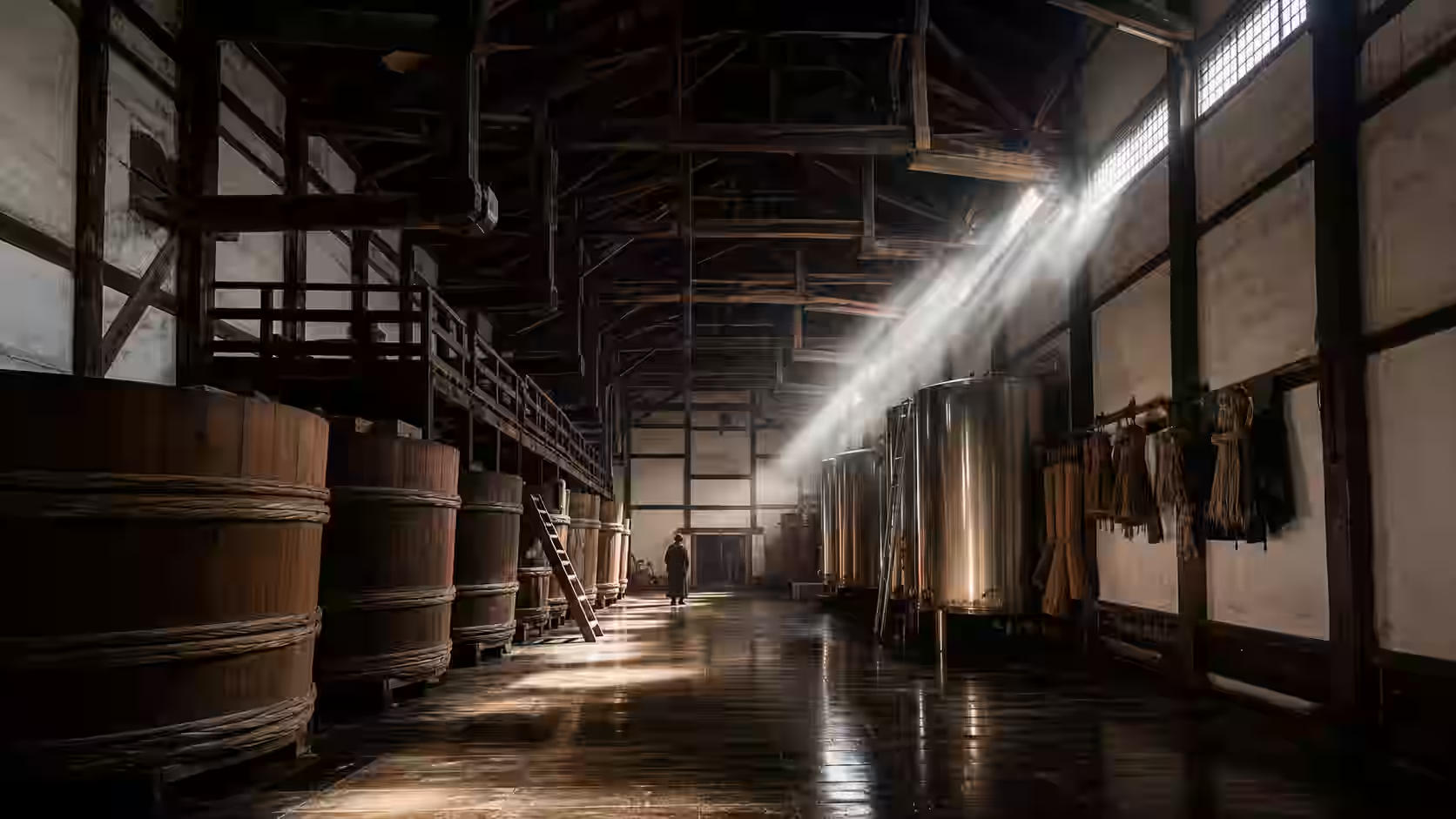
These grand kura were often huge. A single brewery might fill many linked halls. Rows of tall tanks stood in cool, dim rooms. Workers moved between spaces like a small factory. The scale of it can still amaze visitors.
Above all, these merchant brewers took real pride in their kura. A grand brewery signaled wealth and skill. Fine timber and thick walls showed lasting ambition. So the building became a statement, not just a workshop. Some of that pride still lingers in old sake towns.
Meiji Modernization
The Meiji era brought new tools and ideas. Gradually, brewing adopted science and machinery. Larger tanks and better milling appeared. Yet the basic shape of the kura endured. Tradition and progress learned to share one roof.
The Meiji shift was gradual, not sudden. Old hand skills stayed vital throughout. New tools simply eased the hardest tasks. Brewers tested science against their instincts. The best kept whatever truly improved the sake.
Modern Breweries
Today’s breweries blend the old and the new. For example, some brew inside century-old wooden halls. Others work in clean, modern, climate-controlled plants. Many combine both under a single company. The kura keeps evolving, yet its spirit remains.
Still, something essential never changes. The goal is always clean, careful fermentation. The tools may shift from wood to steel. Yet the brewer’s attention stays the same. That constant care defines every true kura.
Inside a Traditional Kura
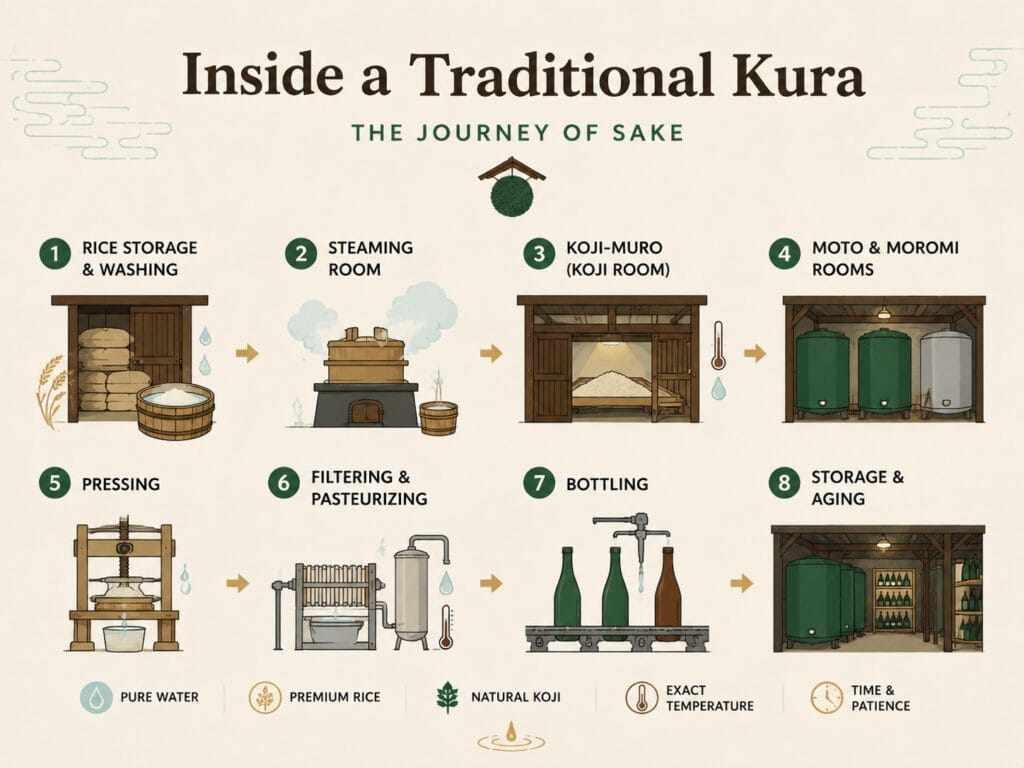
A traditional kura is a maze of specialized rooms. Notably, each space serves one stage of brewing. Together, they form a careful production line. Let us walk through the brewery, room by room.
Rice Storage and Washing
The journey starts with the sake rice store. First, sacks of rice wait in a cool, dry room. Nearby sits the washing area, where polished rice is rinsed. Workers wash and soak the grain with great care. Clean water and precise timing matter enormously here.
Rice storage is more delicate than it sounds. The grain must stay dry and cool. Damp rice can spoil or attract pests. So workers keep the store clean and well aired. Good sake truly begins in this quiet room.
Moreover, brewers inspect the incoming rice with real care. They check each batch for damage and moisture. Good grain earns a place in the tank. Poor grain steps aside without regret. Quality control starts in this very first room.
The Steaming Room
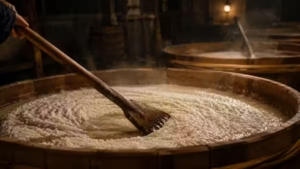
Next comes the steaming room, often called the kamaba. There, a large vessel steams the rice with rising vapor. Thick clouds of steam fill the air each morning. The warm, sweet smell drifts through the whole kura. Steamed rice then moves on to several other rooms.
The steaming step is oddly beautiful to watch. Great clouds billow up toward the high roof. Workers gather around the hot, fragrant rice. Then they cool it and carry it away. It is one of the busiest moments in the sake brewery.
Notably, steaming is more than simple cooking. It firms the outside of each grain. Yet it keeps the center soft and open. That texture suits the koji perfectly. So the steaming room shapes all that follows.
The Koji-Muro
The koji-muro is the sacred heart of the brewery. In this warm, humid room, koji mold grows on rice. Typically, fragrant cedar lines the walls. Temperature and moisture stay high and steady. Brewers guard this room with special care.
Few visitors ever see the koji-muro. Its air is warm, moist, and still. Cedar walls help hold that steady climate. Here, the mold quietly transforms the rice. Many brewers speak of this room with real reverence.
For example, the koji maker may sleep near this room. They rise in the night to check the mold. Such devotion sounds extreme to outsiders. Yet the koji cannot simply be left alone. This room truly never rests.
Notably, the koji-muro rules the rhythm of the kura. Brewers check it through the day and night. Its needs often set the whole day’s schedule. A koji batch waits for no one. So this small room quietly commands the brewery.
Indeed, brewers sometimes call koji the soul of sake. A saying puts koji first among all tasks. The room that grows it earns deep respect. Everything downstream depends on its success. So the kura is built around this precious space.
The Moto and Moromi Rooms
The moto room is where the yeast starter is born. Some brewers still use the slow kimoto method here. Then the brew moves to the moromi tanks. There, the main fermentation slowly unfolds. There, tall tanks line the cool, quiet fermentation rooms.
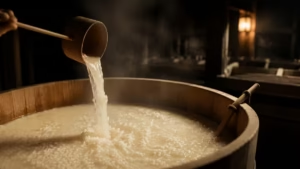
These fermentation rooms feel almost hushed. The mash bubbles softly in the tanks. A faint, sweet-sour aroma fills the air. Workers move gently so as not to disturb it. Here, patience slowly turns into sake.
Indeed, fermentation is the soul of the kura. It can run for weeks in the cool tanks. The toji watches its temperature daily. A small nudge can shift the final taste. So these quiet rooms hold the real magic.
Pressing, Filtering, and Pasteurizing
After fermentation, the mash reaches the pressing room. There, clear sake separates from the leftover solids. The sake may then pass through filtration. Gentle pasteurization follows to stabilize it. Each of these steps has its own dedicated space.
Bottling and Storage
Finally, the sake reaches the bottling room. Here, clean and careful handling protects the finished drink. Then it rests in a cool storage cellar. Some sake ages quietly here for months. At last, it is ready to leave the kura.
Notably, the cellar has its own gentle mood. It stays dark, quiet, and steadily cool. Rows of tanks or bottles wait in the calm. Time works slowly on the resting sake. This patience is the final act of brewing.
Storage is a quiet but vital stage. There, the cool cellar keeps the sake stable and calm. Some styles mellow and deepen with a little age. Brewers ship others fresh to capture their bright youth. The sake brewery chooses the moment with care.
Why the Sake Brewery Environment Matters
A sake brewery is really a giant instrument for fermentation. Its whole environment shapes the final drink. Temperature, humidity, and cleanliness all play a part. Change any of these, and the sake changes too.
Consider temperature first of all. Yeast and koji work best within narrow ranges. A stable, cool brewery keeps them content. Wild swings in heat could ruin a delicate batch. So the sake brewery guards its climate closely.
Humidity matters just as much as heat. The koji room needs warm, moist air to thrive. Other rooms stay cooler and drier by design. Each space holds its own careful balance. The building manages all of this at once.
Cleanliness completes the picture. A single stray microbe can spoil a whole tank. So brewers scrub every surface with great care. Brewers keep the sake brewery almost surgically clean. This discipline protects months of patient work.
Sake Brewery Architecture and Design
Every feature of a kura serves the sake. Indeed, the design is practical, not merely pretty. Thick walls and high roofs are not accidents. They solve real problems of temperature and air.
Thick Walls and Natural Insulation
Traditional kura use a style called dozo-zukuri. Specifically, workers build thick earthen walls over a wooden frame. A smooth plaster called shikkui coats the outside. These walls can reach thirty centimeters thick. They keep the interior cool in summer and warm in winter.
That thickness is not for show. Thirty centimeters of earth is a fine insulator. It slows heat from passing in or out. The interior stays remarkably steady all year. Old builders understood this without any physics book.
Indeed, this is passive design at its finest. The building works with nature, not against it. It borrows the earth’s own steady coolness. Modern architects now study these old ideas. The humble kura was green long before the word existed.
This natural climate control is remarkable. No machine holds the temperature at all. The earth itself does the work. On a hot day, the kura stays cool and calm inside. That stability is a gift to the fermenting sake.
For instance, imagine a heatwave outside the kura. The world may swelter under a summer sun. Inside, though, the air stays cool and calm. The thick walls hold the heat at bay. That steadiness protects the resting sake.
High Ceilings and Ventilation
For one thing, high ceilings give hot steam room to rise. They also help fresh air move through the space. Many kura use a clever raised-roof design. A gap between roof and ceiling lets air flow freely. This natural venting keeps the brewery from overheating.
This raised-roof trick is quietly clever. Hot air rises and escapes near the top. Cooler air flows in from below. The whole building breathes on its own. The design needed no fans or vents at all.
Indeed, this passive airflow saved energy for centuries. Brewers needed no electric fans at all. The roof and walls managed the air together. Warm, damp air left before it caused harm. Simple design solved a hard problem.
Wood, Earth, and Fire Safety
Wood and earth were the classic building materials. For example, cedar and cypress appear throughout the old kura. The earthen walls also resisted fire remarkably well. In a blaze, workers could seal the openings with clay. So a good kura protected both people and sake.
For example, cedar does more than build the frame. Its wood resists moisture and smells clean. The koji room often uses it for good reason. Over years, the timber soaks up the brewery’s character. Some say the old wood itself flavors the air.
The Modern Sake Brewery
Modern breweries add new materials and tools. Today, stainless steel tanks stand beside wooden ones. Concrete and insulation improve climate control. Refrigeration lets brewers work in any season. Still, many keep the old kura for its perfect atmosphere.
For instance, cooling changed the brewing calendar. Once, only winter offered safe, cool air. Now a modern kura can brew in summer too. This freedom reshaped the whole industry. Yet many still treasure the winter season most.
This mix of old and new can surprise visitors. A modern sake brewery may hide behind old walls. Gleaming tanks sit inside a century-old hall. The past and present work quietly together. For many brewers, that blend feels just right.
For example, a visitor might feel this blend at once. Old beams rise above shining steel tanks. A wooden tool leans beside a digital gauge. The two eras share the same cool air. Somehow, the mix feels natural, not strange.
Water and Location
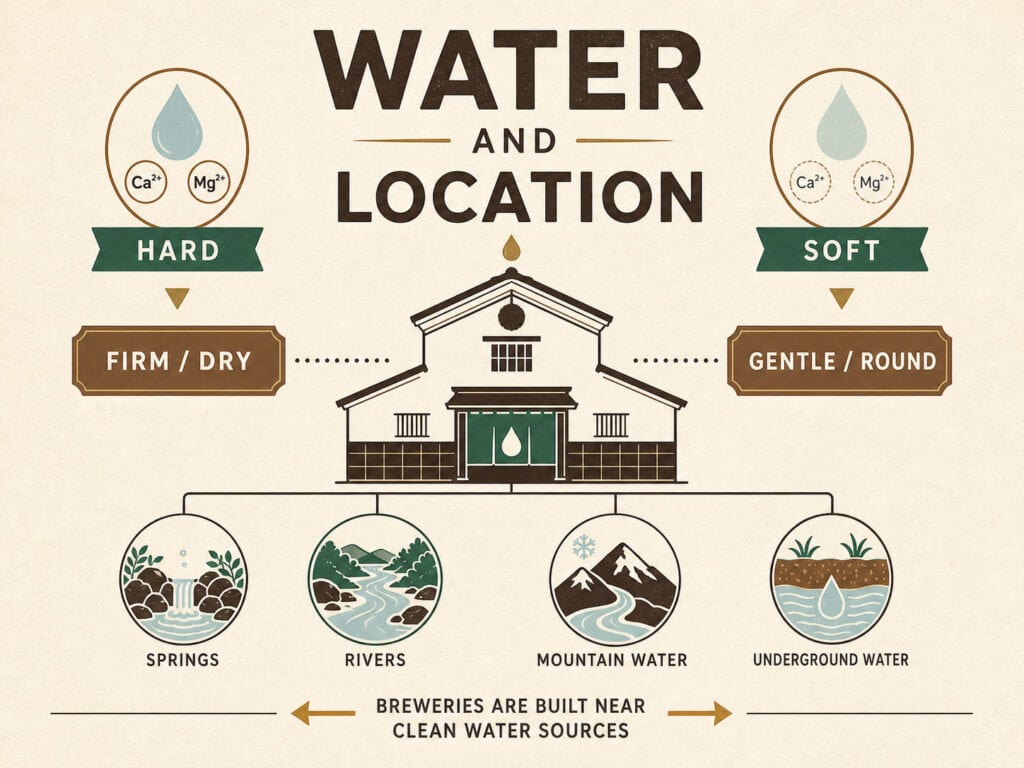
No single factor shapes a brewery’s site like water. After all, sake is mostly water, so its quality is vital. Brewers chase the cleanest, best-suited water they can find. That search often decides where a kura stands.
Springs, Rivers, and Mountains
Many kura rise near springs and clean rivers. Notably, mountain snowmelt feeds some of the finest breweries. Brewers prize underground water, filtered slowly by rock. A reliable source of pure water is essential. Without good water, even great rice cannot save the sake.
Brewers speak of water almost lovingly. Its minerals feed the yeast and shape the taste. Hard water tends to give firmer sake. Soft water leads to gentler, rounder styles. So the source quietly steers the final flavor.
Famous Brewing Regions
Some regions became legends for their water. For instance, Nada, near Kobe, boasts the mineral-rich miyamizu. That hard water gives firm, dry, robust sake. Fushimi, in Kyoto, offers softer, gentler water. Its very name hints at the hidden water below.
Notably, these water styles shaped local reputations. Nada became famous for strong, dry sake. Fushimi grew known for soft, gentle brews. Drinkers still associate each town with its taste. The water wrote those reputations long ago.
Water even guided famous brewery moves. Historically, one Kyoto brewer relocated south for better water. They settled in Fushimi for its fine underground springs. Such choices show how deeply water matters. The land and the sake belong tightly together.
This bond explains the map of sake. Great brewing towns cluster near great water. Rice can travel, but water cannot easily move. So the brewery goes to the water, not the reverse. Geography quietly shapes the whole craft.
Indeed, you can almost map sake by its water. Soft-water towns tend toward delicate styles. Hard-water towns lean toward bold, dry sake. Each region wears its water like a signature. So place and taste stay forever linked.
The People Who Work in a Sake Brewery
A kura is nothing without its people. Indeed, brewing is a craft of many skilled hands. Each worker holds a clear place and purpose. Together, they turn a quiet building into a living brewery.
Role
Japanese
Job in the Kura
Owner
Kuramoto
Runs the business
Master brewer
Toji
Leads all production
Brewery workers
Kurabito
Do the daily brewing
The Kuramoto
The kuramoto is the owner of the brewery. Typically, this person runs the business and sets its course. They manage money, sales, and long-term plans. Sometimes the owner also brews the sake. That combined role is called a kuramoto-toji.
Interestingly, the owner’s vision shapes the whole kura. They decide the styles the brewery will chase. They also carry the weight of tradition. Many kura have stayed in one family for generations. So the kuramoto guards both business and heritage.
The Toji
The toji is the master brewer. Above all, this person leads all of production. They plan the season and judge each step. Every key brewing decision rests with them. In the kura, the toji is the guiding mind.
The Kurabito
The kurabito are the skilled brewery workers. In turn, they carry out the daily hands-on tasks. Washing, steaming, and koji work all fall to them. Under the toji, they form one coordinated team. Without them, the kura would fall silent.
For example, picture the team on a cold morning. One worker tends the koji upstairs. Another washes rice in icy water below. A third checks the bubbling tanks nearby. Together, they keep the whole kura alive.
The bond within this team runs deep. Skills pass from senior to junior workers. Trust builds over many shared seasons. A good team almost reads its own mind. That harmony shows up in the finished sake.
For instance, a new worker starts with small jobs. They watch, listen, and slowly learn. Senior hands guide them with patience. Over years, raw effort becomes real skill. This is how a kura grows its own future.
Seasonal Workers
Traditionally, many kurabito were seasonal workers. Traditionally, they came for the cold winter brewing months. In summer, they returned to farms and home. This seasonal rhythm shaped brewery life for centuries. Today, more breweries keep staff all year round.
This change reshaped life in the sake brewery. Year-round work offers steadier careers. It also lets a brewery brew in more seasons. Yet the winter remains the classic brewing time. Old rhythms fade slowly, even in a modern age.
Traditional vs Modern Sake Breweries
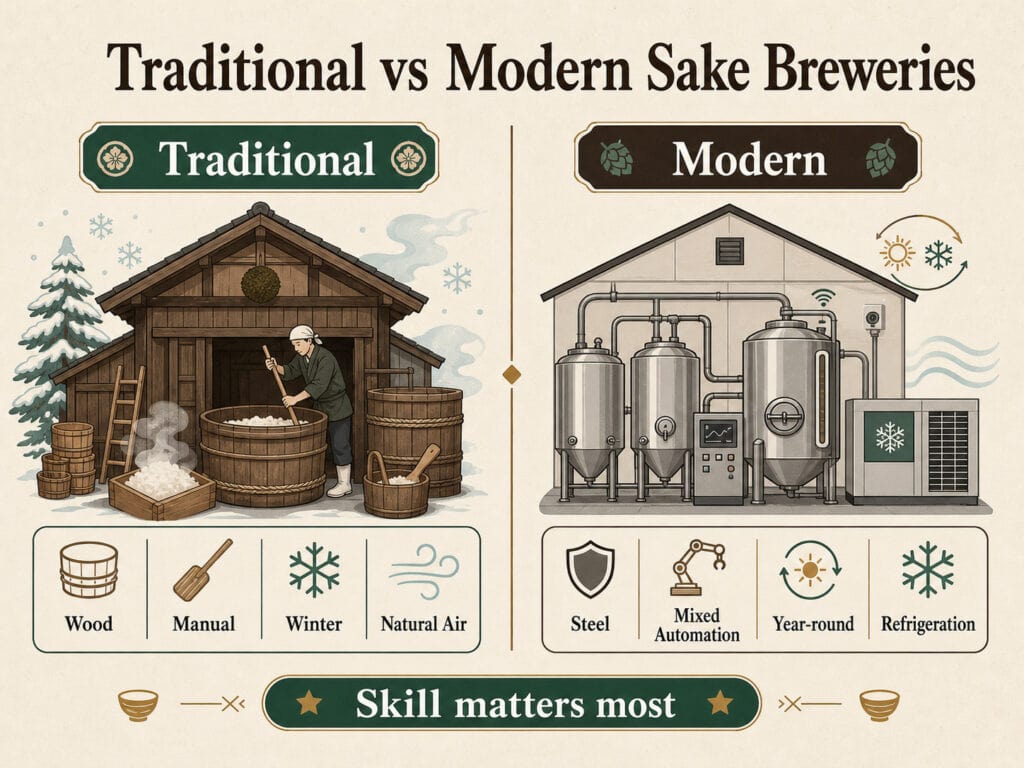
The world of the kura holds both old and new. Indeed, some breweries cling to time-honored ways. Meanwhile, others embrace the latest technology fully. Most sit somewhere in between the two.
Feature
Traditional Kura
Modern Brewery
Tools
Wooden tools
Stainless steel
Labor
Mostly manual
Some automation
Season
Winter only
Often year-round
Cooling
Natural air
Refrigeration
Building
Wood and earth
Steel and concrete
The Traditional Way
Traditional breweries rely on wood and hand skill. For example, workers steam rice in wooden vessels and stir by hand. They brew only in the cold winter season. Natural air, not machines, keeps the kura cool. This path demands patience and deep experience.
Still, tradition carries real romance. The wooden tools connect the brewer to the past. Each gesture echoes generations of skill. Fans of these sakes taste that heritage. For them, the old way is worth the effort.
The Modern Way
Modern breweries lean on steel and control. Notably, stainless tanks replace many wooden tubs. Refrigeration lets them brew all year. Machines handle some heavy or repetitive work. This path brings steadiness and greater output.
Notably, modern methods also protect quality. Sensors catch problems early and clearly. Cooling holds the mash at a perfect point. Fewer batches fail along the way. So science quietly serves the drinker too.
Neither approach is simply better than the other. On one hand, tradition offers soul, depth, and a sense of place. Modern methods offer safety and consistency. Many breweries blend the best of both worlds. The finest sake can come from either path.
Interestingly, some breweries prove this daily. They brew a modern line and a traditional one. Both can win awards and loyal fans. The method matters less than the care behind it. In the end, skill decides the quality.
Sustainability in Modern Breweries
Today’s breweries think hard about the planet. After all, brewing uses water, rice, and energy in large amounts. So many kura now work to reduce their footprint. This green shift is reshaping the craft.
Saving Water and Energy
First, water conservation sits high on the list. Breweries recycle and treat their washing water. Many switch their lighting to efficient LEDs. Some even reach for renewable energy sources. In 2022, one brewery released a carbon-zero sake.
Reusing Sake Kasu and Waste
Brewing leaves behind sake kasu, the pressed lees. Yet far from waste, brewers treasure this by-product. For example, cooks use it in pickles, soups, and sweets. Breweries also compost rice waste for local farms. Little of the harvest is ever truly wasted.
Notably, this care extends beyond the lees. Rice-washing water can nourish nearby fields. Heat from brewing may warm other tasks. Even old wooden tools find second lives. A thrifty kura wastes almost nothing at all.
Sake kasu deserves special mention here. It is rich in flavor and nutrients. For example, chefs prize it for marinades and winter stews. Some breweries sell it as a product in its own right. So yesterday’s by-product becomes today’s delicacy.
Moreover, this thrift reflects a deeper value. Nothing from the harvest should go to waste. Rice, water, and effort all deserve respect. A good kura honors that old principle. Sustainability, in truth, is nothing new here.
Greener Practices
Today, many kura reuse and recycle their bottles. Some collect glass from other companies too. Lighter packaging cuts shipping emissions. A few breweries even pursue environmental certification. Care for the land has become part of the craft.
For instance, one famous brewery reached carbon-zero sake. It switched to renewable power and cleaner gas. Small changes across the kura added up. Such efforts show where the craft is heading. Tradition and green thinking can walk together.
Brewery Tours and Cultural Tourism
A kura can be a wonderful place to visit. Indeed, sake tourism has grown quickly in recent years. Travelers come to see the craft up close. Moreover, they taste sake right where it is made.
Open Breweries and Museums
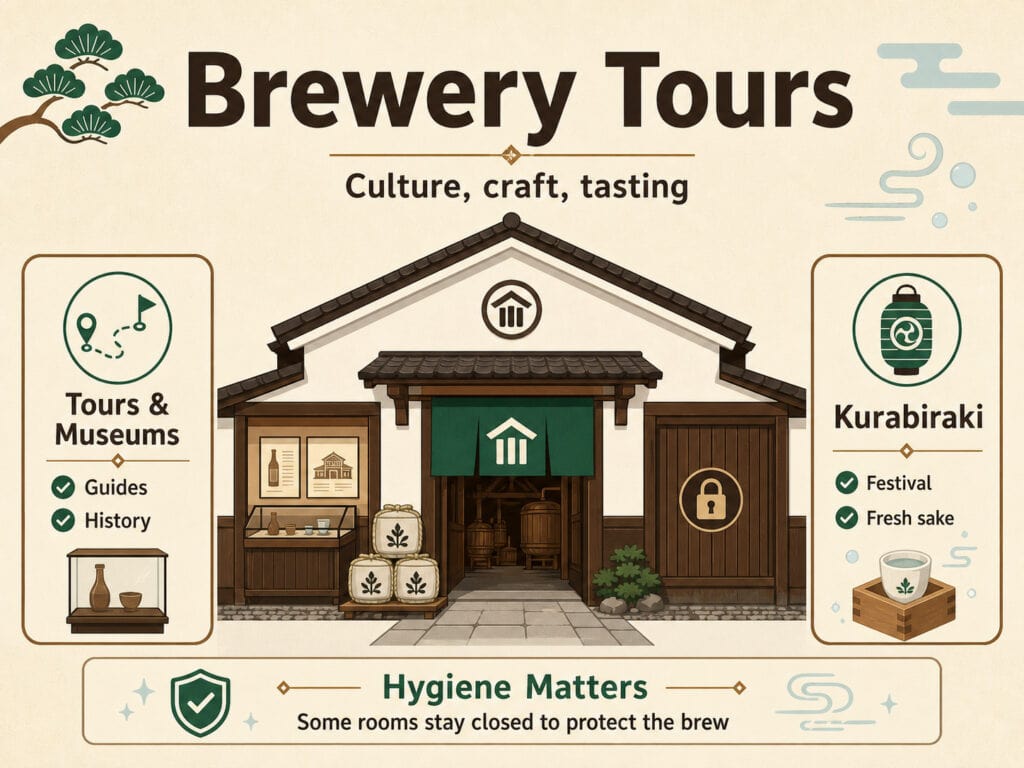
Today, many breweries welcome curious guests. Typically, guided tours reveal the rooms and the tools. Notably, some kura run their own small museums. Visitors learn the history and the craft firsthand. A good tour often ends with a tasting.
These visits do more than sell sake. They teach people how the drink is made. A guest leaves with new respect for the craft. Many also feel closer to the local region. In this way, tourism keeps the tradition alive.
Still, a careful balance is needed here. Too many visitors could disturb the brewing. So breweries plan their tours with real thought. They open some rooms and protect others. In this way, they share the craft without risking it.
Kurabiraki Festivals
Each year, many breweries hold a kurabiraki. Literally, the word means brewery opening. Naturally, these festivals celebrate the fresh new sake. They often fall in late winter, around February. Locals and travelers gather to taste and rejoice.
Notably, a kurabiraki is a warm community event. Families stroll the brewery grounds together. Fresh sake flows, and food stalls appear. The mood is festive, proud, and welcoming. For a day, the quiet kura fills with life.
A Note on Hygiene
Not every kura opens its doors, though. After all, brewing areas demand strict cleanliness. A stray microbe could spoil a whole batch. So some rooms stay closed to all outsiders. This caution protects the quality of the sake.
Still, closed doors are not unfriendly. Brewers simply protect their living craft. A tour may skip the most delicate rooms. Yet it still reveals plenty to enjoy. Visitors leave with a deeper respect for sake.
Common Misconceptions About the Kura
The kura attracts a few common myths. A short list deserves a clear answer. Let us clear up the usual confusion.
Is Every Kura Centuries Old?
No, not every brewery is ancient. Certainly, some kura date back hundreds of years. Yet many were built far more recently. In fact, new breweries open even today. Age alone does not decide sake quality.
Are All Breweries Made of Wood?
No, brewery materials vary widely. Historically, traditional kura used wood, earth, and plaster. Meanwhile, modern ones often use steel and concrete. Many breweries mix these materials freely. The building suits the brewer’s needs and era.
Notably, materials often mix within one kura. An old wooden hall may hide steel tanks. A new plant might add cedar for its koji. Brewers choose each material with purpose. Function, not fashion, guides the design.
Can Anyone Enter a Brewery?
Not always, since hygiene comes first. For example, some breweries welcome visitors warmly. Meanwhile, others keep their brewing rooms strictly closed. A single contaminant could ruin a batch. So access depends on each brewery’s rules.
For example, brewers may ask guests to cover their hair. Some rooms stay off-limits entirely. Visitors might view them through a window instead. These rules protect the living microbes inside. A little caution saves a whole season’s work.
Is a Kura the Same as a Distillery?
No, the two are quite different. Instead, a kura brews sake through fermentation. By contrast, a distillery makes spirits by distilling them. Notably, sake is brewed, not distilled, like beer or wine. So a sake kura is a brewery, not a distillery.
Final Thoughts
A kura is far more than a simple building. Indeed, it is an environment built for careful craft. Above all, its walls, rooms, and air serve the sake. Indeed, generations of skill live within its timbers. So to understand sake, you must understand the kura.
Above all, the building supports craftsmanship and teamwork. Above all, it shelters fermentation from a harsh outside world. It holds the memory of every past brewing season. Old or new, wooden or steel, its purpose stays the same. So the next time you enjoy sake, picture its birthplace. A quiet kura, somewhere, made that pleasure possible.
In the end, the kura deserves our attention. It is easy to praise the rice or the brewer. Yet the building quietly holds it all together. It shelters, steadies, and shapes the sake. To know the kura is to know sake itself.
Sake Brewery (Kura) FAQ
What is a kura?
A kura is a traditional Japanese sake brewery. The word means storehouse, and sakagura means sake storehouse. Inside, brewers wash rice, make koji, and ferment sake. Brewers design the building itself to support brewing.
What does sakagura mean?
Sakagura combines the words for sake and storehouse. So it literally means a sake storehouse. In practice, it refers to a sake brewery. People use kura and sakagura to mean the same place.
What is the difference between a kura and a kuramoto?
A kura is the brewery building itself. A kuramoto is the person who owns the brewery. One word names a place, the other a person. The kuramoto runs the business inside the kura.
Why are sake breweries built with thick walls?
Thick earthen walls keep temperature and humidity steady. That stability helps fermentation and protects stored sake. The walls also resist fire, a historic danger. So the design serves both safety and quality.
What rooms are inside a sake brewery?
A kura holds many specialized rooms. These include rice storage, a washing area, and a steaming room. There is also a koji room, fermentation tanks, and a pressing room. Bottling and storage areas complete the space.
What is a koji-muro?
The koji-muro is the room where koji mold grows on rice. It stays warm and humid, often lined with cedar. Brewers guard it with great care. Many call it the heart of the brewery.
Why are breweries built near water?
Sake is mostly water, so its quality is vital. Breweries seek clean springs, rivers, or mountain water. Famous regions like Nada and Fushimi are known for their water. Good water is essential to good sake.
Are all sake breweries old?
No, breweries range widely in age. Some kura are centuries old and still working. Others were built quite recently. New breweries continue to open today. Age does not determine sake quality.
Can you visit a sake brewery?
Often, yes, though it depends on the brewery. Many kura offer tours and tastings. Some run festivals called kurabiraki. Yet certain brewing rooms stay closed for hygiene reasons.
Is a kura the same as a distillery?
No, a kura is a brewery, not a distillery. It makes sake through fermentation, like beer or wine. Instead, a distillery makes spirits by distilling them. Sake is brewed, so its home is a kura.
What is dozo-zukuri?
Dozo-zukuri is a traditional earthen-wall building style. Workers build thick walls over a wooden frame. A smooth plaster then coats the surface. This style keeps the kura cool, stable, and fire-resistant.
What is a kurabiraki?
A kurabiraki is a brewery-opening festival. It celebrates the season’s fresh new sake. Many breweries hold one in late winter. Locals and visitors gather to taste and enjoy.
Ryo Iwa is the founder and editor of foodinjapan.org. Born and raised in Japan, he writes from regional travel, market visits, and Japanese-language primary sources that rarely reach English readers, including brewing institute publications and industry glossaries. Where a figure cannot be traced to a source, the article says so.
He has been a Google Maps Local Guide for over 10 years, with more than 1,800 reviews and over 41,000 photos viewed hundreds of millions of times. He previously spent two decades as an IT consultant in Japan, the US, and the UK.














Comments