



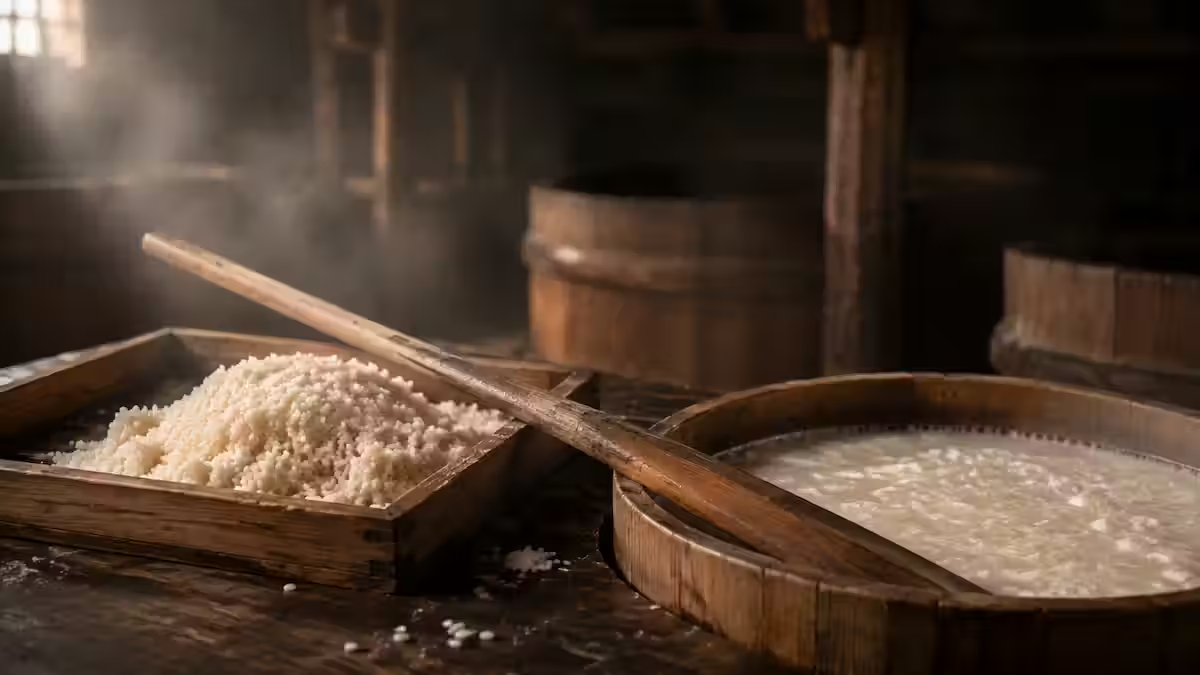
Every bottle of sake hides a quiet miracle inside. That miracle is fermentation. So what is fermentation in sake brewing? Fermentation is the process where yeast turns sugar into alcohol. It also gives off carbon dioxide and rich aroma. Yet sake does this in a way no other drink does. It relies on multiple parallel fermentation, a rare and complex method. Many experts call it the most intricate fermentation in the world.
One idea sits at the heart of this guide. Koji makes sugar, and yeast makes alcohol, at the same time. That single fact explains almost everything about sake. So keep it in mind as we go deeper. For the full overview, see our guide on how sake is made. Let me walk you through this remarkable process.
Quick Facts About Sake Fermentation
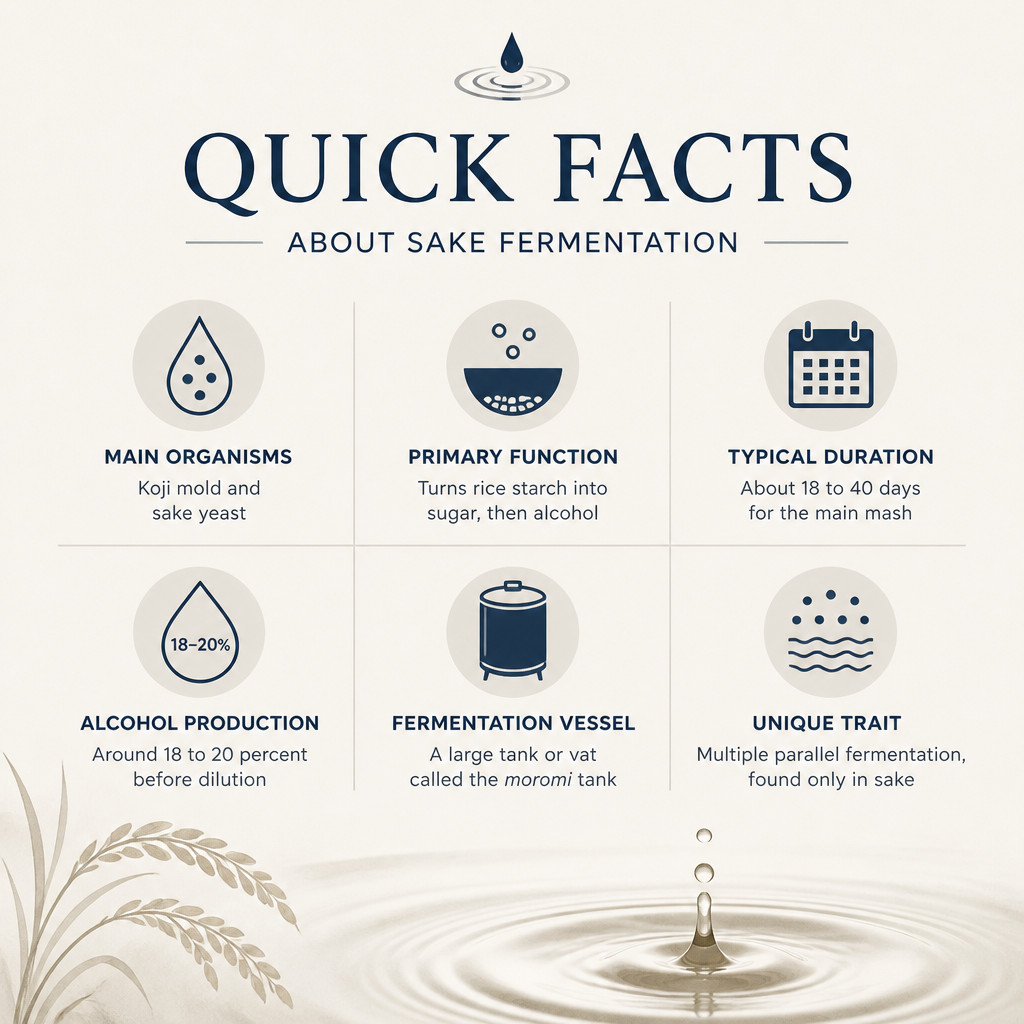
Here is a fast snapshot before the details begin.
| Japanese Term | 発酵 (hakkō) |
| Main Organisms | Koji mold and sake yeast |
| Primary Function | Turns rice starch into sugar, then alcohol |
| Typical Duration | About 18 to 40 days for the main mash |
| Alcohol Production | Around 18 to 20 percent before dilution |
| Fermentation Vessel | A large tank or vat called the moromi tank |
| Unique Trait | Multiple parallel fermentation, found only in sake |
What Is Fermentation?
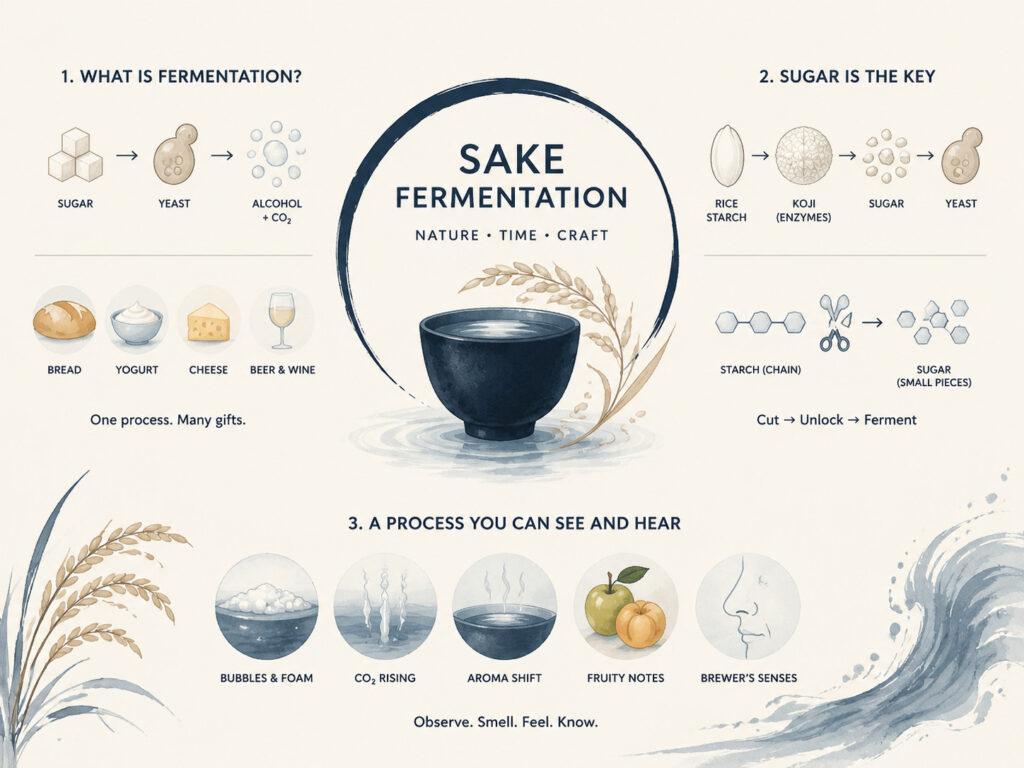
Let us start with the basics. Fermentation is a natural biological process. Tiny living organisms drive it from within. In brewing, yeast does most of the work. The yeast eats sugar and releases alcohol. It also gives off carbon dioxide as bubbles.
You meet fermentation more often than you think. It raises bread, sours yogurt, and ripens cheese. The same basic idea powers beer and wine. So fermentation is one of humanity’s oldest tools. Sake simply takes it to a new level of artistry.
Sugar Is the Hidden Key
Yeast cannot work without sugar to eat. That single fact explains a lot. Grapes hand yeast their sugar freely. Grain and rice, though, lock it away as starch. So someone must unlock that starch first. In sake, koji holds the only key. This is why sake brewing feels so layered. The sugar must appear before the alcohol can.
Starch is really a chain of sugar units. Enzymes act like scissors on that chain. They snip it into small, sweet pieces. Yeast can then absorb those pieces with ease. So the whole drama hinges on this cut. Keep this picture in mind as we continue.
A Process You Can See and Hear
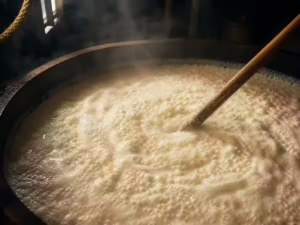
Fermentation is not silent or still. Lean over an active mash, and it speaks. The surface bubbles, foams, and softly hisses. Carbon dioxide rises in steady streams. The aroma shifts from sweet rice to ripe fruit. So a brewer can read the tank by sight and smell.
Why Fermentation Is Essential in Sake Brewing
Fermentation is not just one step among many. It is the very heart of sake brewing. Without it, the rice would go nowhere. So the whole craft depends on this stage.
The process does several jobs at once. First, it creates the alcohol that defines sake. Second, it builds layers of flavor and depth. Third, it produces the fruity and floral aromas. Fourth, it shapes the body and texture. So without fermentation, sake would stay sweet rice liquid. With it, that liquid becomes a living, fragrant drink.
How Sake Fermentation Differs From Beer and Wine
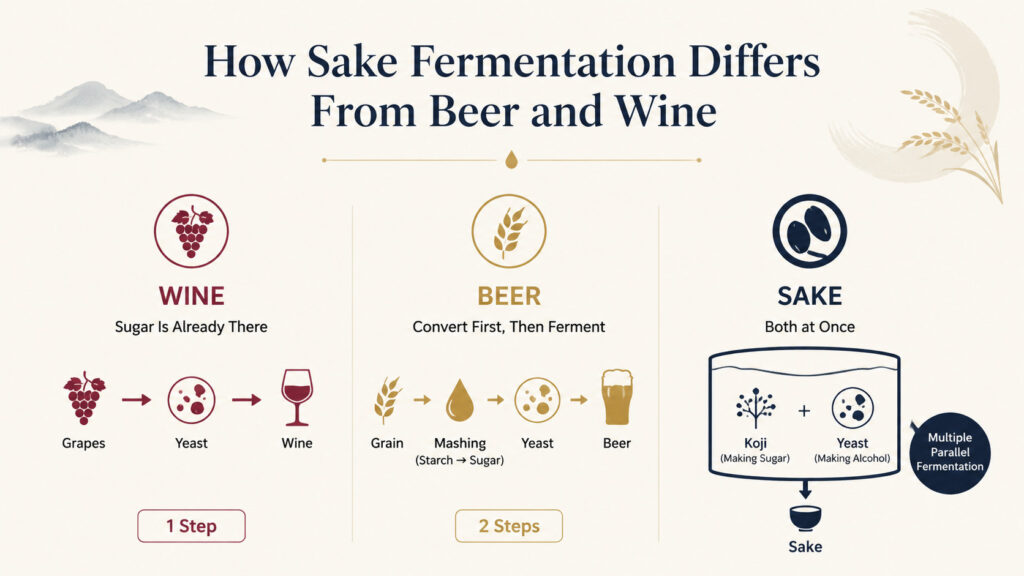
Here we reach a truly defining difference. Wine, beer, and sake all rely on yeast. Yet they reach the sugar in very different ways. That single difference changes everything.
Wine: Sugar Is Already There
Wine has the simplest path of the three. Grapes already contain plenty of sugar. So yeast can start fermenting right away. The juice turns to wine with little fuss. In short, wine needs only one main step.
Beer: Convert First, Then Ferment
Beer takes a two-step approach instead. Grain holds starch, not ready sugar. So brewers first convert that starch into sugar. They call this mashing, and it happens before fermentation. Only after mashing does the yeast begin its work. So beer separates the two jobs in time.
Sake: Both at Once
Sake follows a path all its own. Rice also holds starch, much like barley. Yet sake does not convert it in a separate step. Instead, koji makes sugar while yeast makes alcohol together. Both reactions run side by side in one tank. Brewers call this multiple parallel fermentation. So sake fuses two jobs that beer keeps apart.
Understanding Multiple Parallel Fermentation
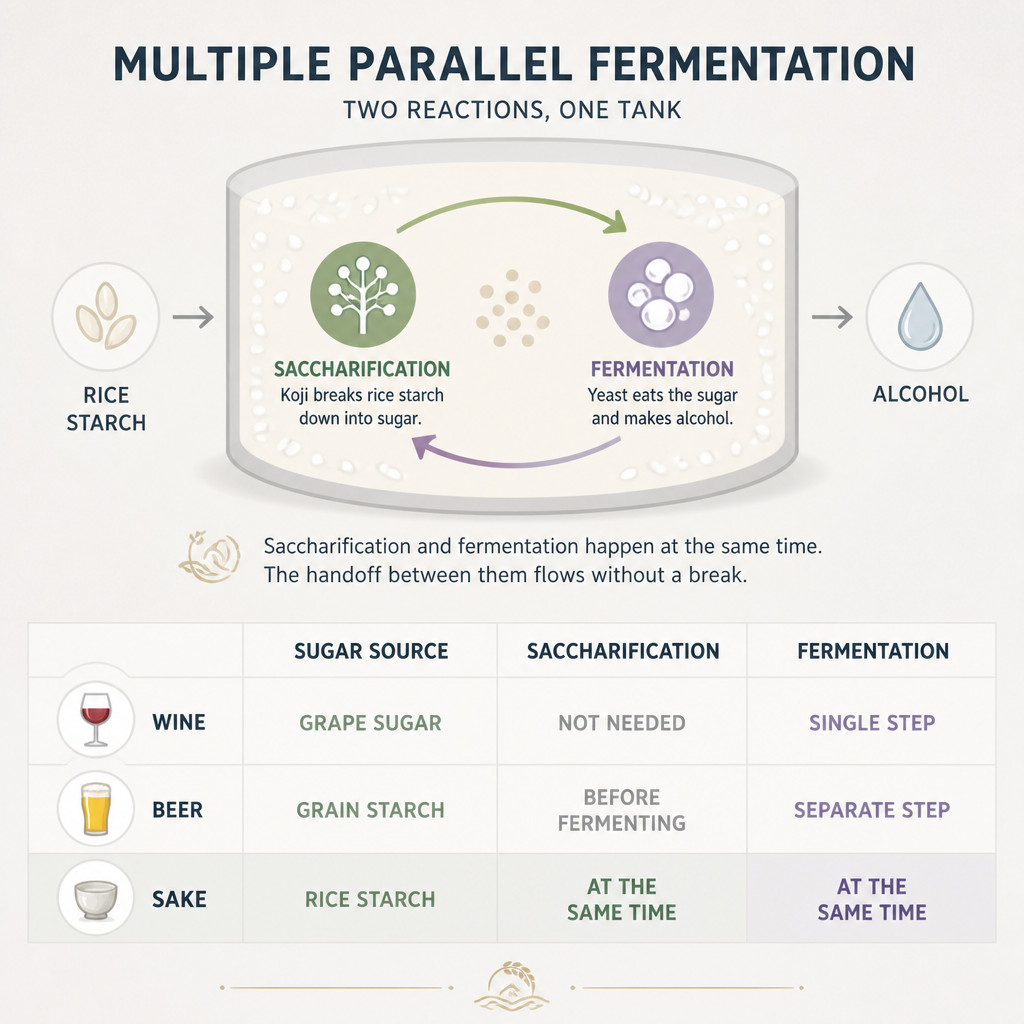
This is the most important section of all. Multiple parallel fermentation defines true sake. The idea sounds technical, yet it is simple at heart. Let us break it down slowly.
Two Reactions, One Tank
Picture a single tank full of mash. Inside, two jobs happen at the same moment. Koji breaks rice starch down into sugar. At once, yeast eats that sugar and makes alcohol. So saccharification and fermentation never pause. The handoff between them flows without a break.
| Drink | Sugar source | Saccharification | Fermentation |
|---|---|---|---|
| Wine | Grape sugar | Not needed | Single step |
| Beer | Grain starch | Before fermenting | Separate step |
| Sake | Rice starch | At the same time | At the same time |
Why This Method Reaches High Alcohol
This dual system brings a clever advantage. Sugar never floods the tank all at once. Instead, koji feeds the yeast a little at a time. So the yeast avoids stress from a sugar overload. As a result, it keeps working far longer. Undiluted sake can reach 18 to 20 percent alcohol. That level ranks among the highest for any brewed drink.
Think of it like a steady drip feed. A sudden flood would overwhelm the yeast. A gentle stream keeps it healthy and active. So balance, not force, drives this process. That quiet balance is the genius of sake.
A Method Centuries in the Making
Brewers did not plan this system on paper. They discovered it slowly, over many centuries. No one knew about enzymes or microbes back then. Yet generations refined the method by feel and result. Modern science later explained why it works so well. So tradition arrived at the answer long before the lab.
Reading the Mash by Numbers
Brewers do not simply watch and hope. They measure the mash every single day. One key figure is the sake meter value. It tracks how much sugar remains unfermented. A sweet mash holds plenty of sugar still. A dry mash has had most of it consumed.
Brewers also check temperature, acidity, and alcohol. Together, these numbers tell a clear story. They reveal whether the yeast feels happy or stressed. So a brewer can steer the mash with care. Small daily choices shape the final sake. That patient attention is part of the craft.
The Role of Koji During Fermentation
Koji is the first hero of this story. It is steamed rice grown with a special mold. That mold is Aspergillus oryzae, Japan’s national fungus. As it grows, it releases powerful enzymes. Those enzymes do the crucial work of saccharification.
Two enzymes matter most during fermentation. Amylase cuts rice starch into simple sugar. Protease breaks proteins into savory amino acids. So koji feeds the yeast while shaping the flavor. It keeps making sugar throughout the entire mash. For the full story, see our guide to koji. Without koji, fermentation could never begin.
Koji also works steadily, not in a burst. It releases sugar bit by bit over weeks. That slow pace keeps the yeast well fed. So the two organisms stay in balance. This quiet teamwork defines the whole process.
The Role of Yeast During Fermentation
Yeast is the second hero of the tank. It is a microscopic, single-celled fungus. While koji makes sugar, yeast consumes it. In return, it produces alcohol and carbon dioxide. So yeast turns the sweet mash into sake.
Yeast also paints much of the aroma. It releases fragrant compounds called esters. These esters smell of apple, banana, and melon. Different strains create different scent profiles. So brewers choose their yeast with great care. To learn more, visit our guide to yeast in sake brewing. Koji and yeast truly work as partners.
Sake yeast has one rare and vital talent. It tolerates very high alcohol levels. Many yeasts fail well before 15 percent. Sake yeast, though, keeps working past 18 percent. So it pushes fermentation further than most. That toughness gives sake its natural strength.
Fermentation Stages in Sake Brewing
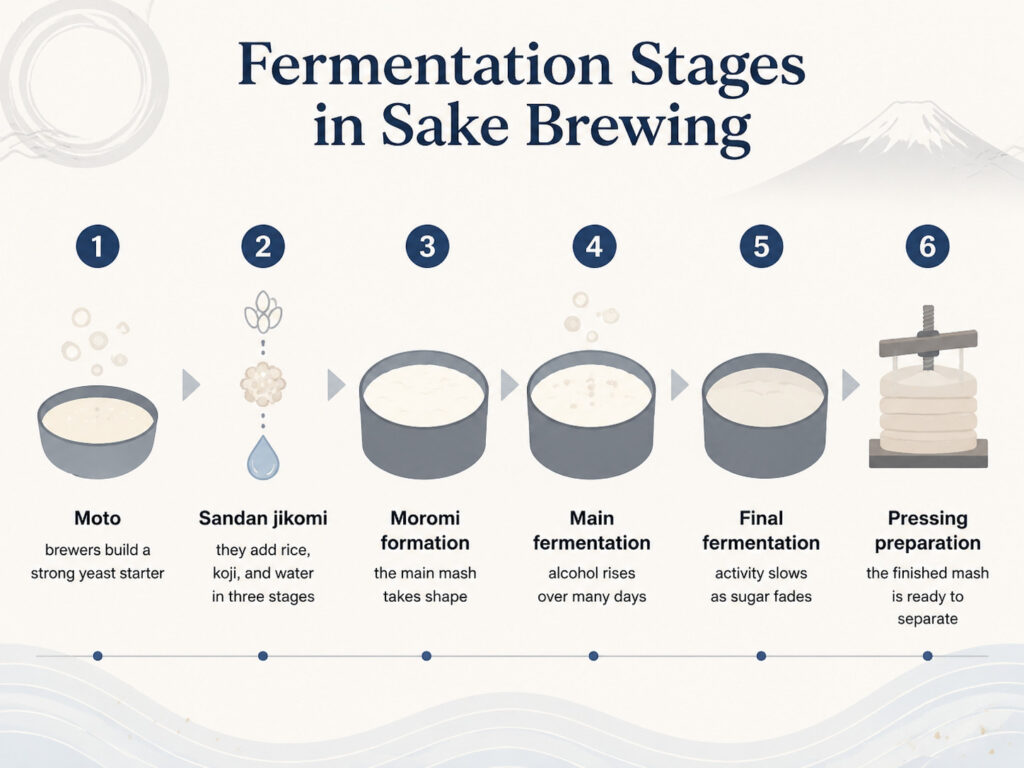
Sake fermentation unfolds in clear stages. Each one builds on the last. The journey takes several weeks from start to finish. Let us follow it step by step.
- Moto: brewers build a strong yeast starter
- Sandan jikomi: they add rice, koji, and water in three stages
- Moromi formation: the main mash takes shape
- Main fermentation: alcohol rises over many days
- Final fermentation: activity slows as sugar fades
- Pressing preparation: the finished mash is ready to separate
Sandan Jikomi: The Three-Stage Addition
The three-stage addition deserves a closer look. Brewers do not build the mash all at once. Instead, they add rice, koji, and water in steps. This careful method takes four days to finish.
Day one is the first addition, called hatsuzoe. Brewers add koji, steamed rice, and water to the starter. Day two is a rest day, known as odori. They add nothing and let the yeast multiply. Day three brings the second addition, the nakazoe. Day four brings the final, largest addition, the tomezoe. Each stage roughly doubles the batch in size.
Why split the work across four days? The answer is protection. A slow build keeps acidity and yeast concentrated. So harmful microbes never get a foothold. The mash stays safe while the yeast grows strong. After the final addition, the long fermentation begins.
Moto: Building the Yeast Starter
Everything begins with the moto, or yeast starter. Brewers also call this the shubo. The word shubo means “mother of sake.” Its purpose is simple yet vital. It grows a dense, healthy population of yeast.
The starter also builds protective acidity. Lactic acid guards the mash from unwanted microbes. So the yeast can grow safely and freely. This small batch shapes the entire brew. A future article will explore the moto in depth.
Moromi: The Main Fermentation Mash
The moromi is where the magic peaks. It is the main fermentation mash. Brewers build it from the starter, rice, koji, and water. Over weeks, it bubbles and transforms into sake.
Inside the moromi, the parallel process runs fully. Koji keeps releasing sugar from the rice. Yeast keeps turning that sugar into alcohol. The mash froths, foams, and slowly grows stronger. So the moromi shows multiple parallel fermentation in action.
The mash changes its mood day by day. Early on, small bubbles creep across the surface. Soon, thick foam rises and roars with life. Later, the foam falls back and the mash quiets. So brewers track these stages like a story. The whole drama runs for about three to five weeks.
Inside the Moromi: A Closer Look
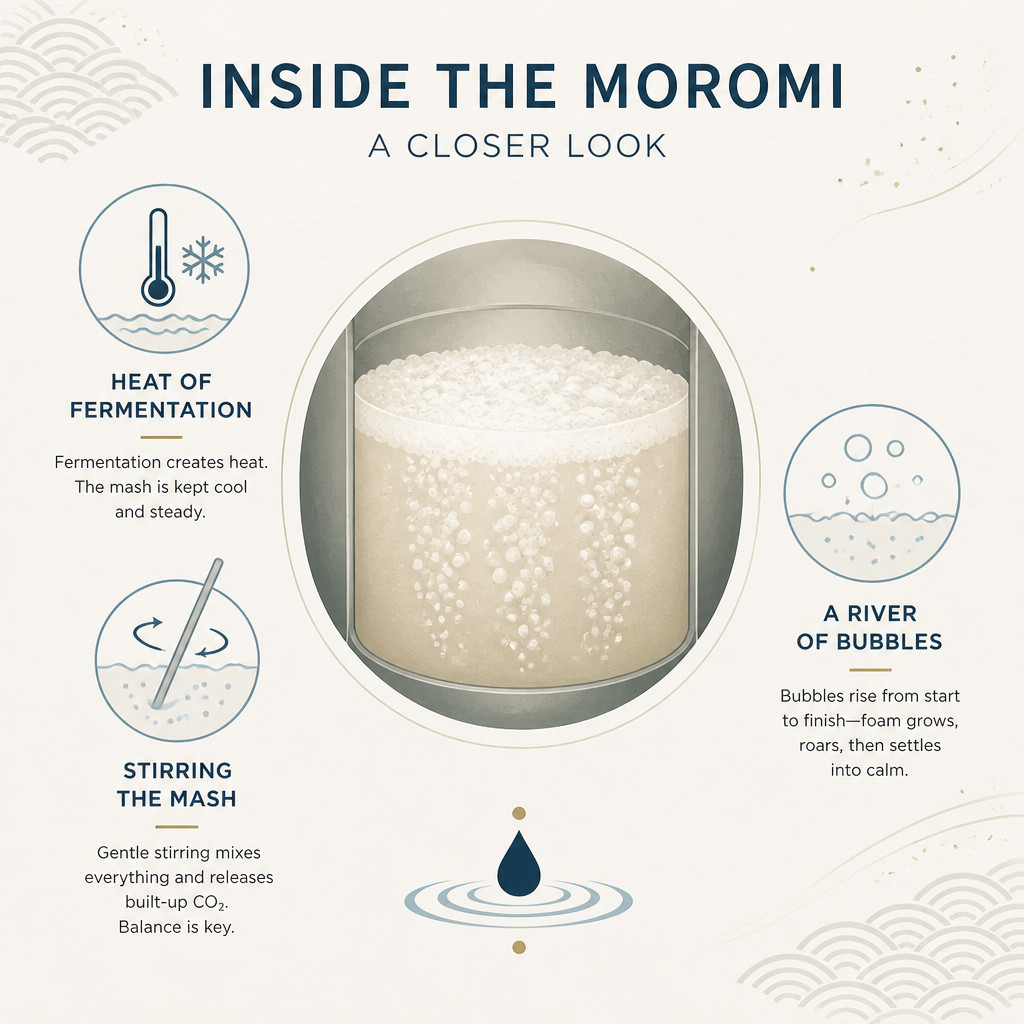
The moromi rewards a closer, slower look. So much happens inside that bubbling tank. Let us peek at the daily life of the mash.
The Heat of Fermentation
Fermentation gives off real heat as it works. Left alone, the mash would grow too warm. So brewers cool the tank to hold it steady. They may circulate cold water around the vessel. In older days, they tied ice to the sides. So temperature control is constant, careful work.
Stirring the Mash
Brewers gently stir the mash with a pole. This act mixes the rice, koji, and yeast evenly. It also helps release built-up carbon dioxide. So the mash stays balanced and healthy. Stirring sounds simple, yet timing matters greatly. Too much or too little can shift the result.
A River of Bubbles
Carbon dioxide rises endlessly through the mash. Early on, fine bubbles speckle the surface. Then a thick, foamy cap builds and roars. The foam can almost climb the tank walls. Later, it falls back into a calm sheen. So the bubbles chart the mash from start to finish.
Temperature Control During Fermentation
Temperature may be the brewer’s most powerful tool. It quietly shapes the speed and the flavor. A few degrees can change the whole result. So brewers watch the mash like hawks.
Cool fermentation brings out delicate, fruity aromas. Premium styles ferment slowly at low temperatures. A ginjo may ferment near six or seven degrees. A daiginjo pushes this care even further. Warm fermentation, by contrast, works faster and fuller. So most sake mash sits around fifteen degrees or below.
The Tradition of Winter Brewing
Cold weather long shaped the brewing calendar. Before machines, winter offered the only stable cold. So brewers worked through the coldest months. This season earned the name kanzukuri, or cold brewing. Many breweries still follow that rhythm today. The crisp winter air remains part of the craft.
How Fermentation Creates Aroma and Flavor
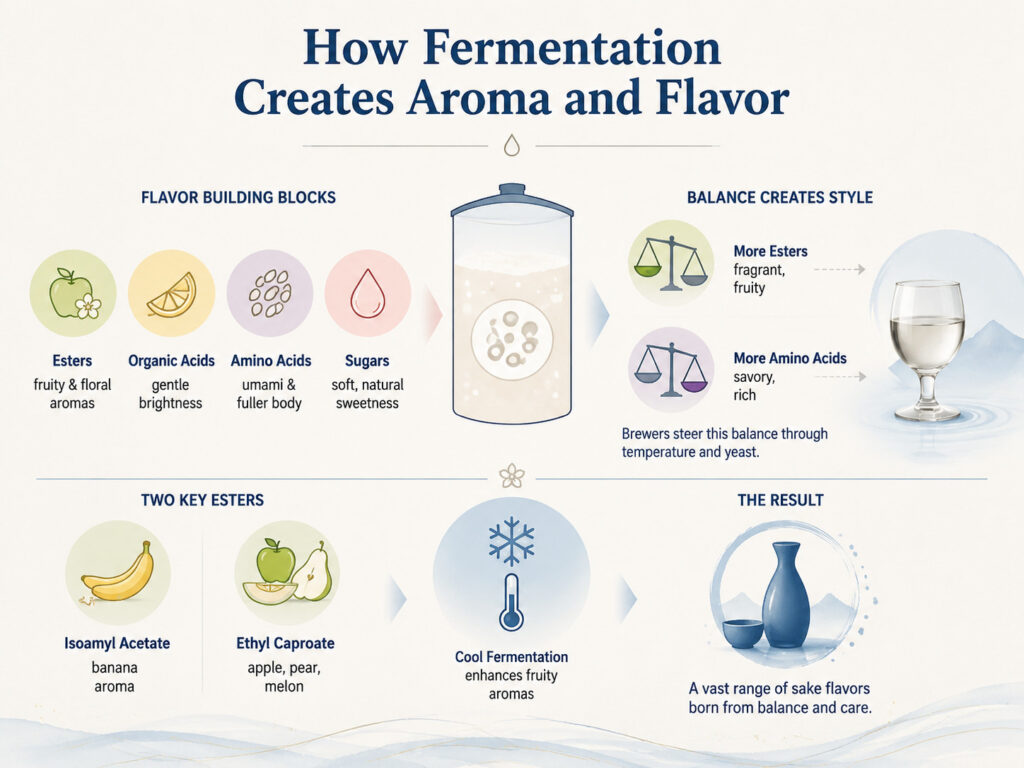
Fermentation does far more than make alcohol. It builds the entire flavor of the sake. Many tiny compounds form during these weeks. Together, they create depth and character.
- Esters: fruity and floral aromas, like apple and banana
- Organic acids: a gentle brightness that balances sweetness
- Amino acids: savory umami and a fuller body
- Sugars: a soft, natural sweetness left in balance
The balance among these defines the style. More esters bring a fragrant, fruity glass. More amino acids bring savory richness. So brewers steer this balance through temperature and yeast. The result is the vast range of sake flavors.
Two esters lead the famous aromas. Isoamyl acetate gives a soft banana note. Ethyl caproate suggests apple, pear, and melon. Cool fermentation tends to raise these scents. So a fragrant ginjo owes much to careful cooling. The yeast and the temperature work together here.
Fermentation and Sake Styles
Fermentation choices shape every sake style. The same rice can become many different drinks. So the brewer’s decisions matter enormously. To see the range, visit our types of Japanese sake guide.
The pattern shows up clearly across styles. A junmai often ferments for a rounder, fuller taste. Ginjo and junmai ginjo use cool, slow fermentation for aroma. Nigori keeps some unpressed mash for a cloudy body. Namazake skips pasteurization to stay fresh and lively. So each style reflects a different fermentation choice.
Even alcohol strength reflects these choices. Most sake is diluted with water before bottling. A few skip that step and stay full-strength. Brewers sell that bold result as genshu, or undiluted sake. So one mash can yield many faces.
Traditional Fermentation Methods
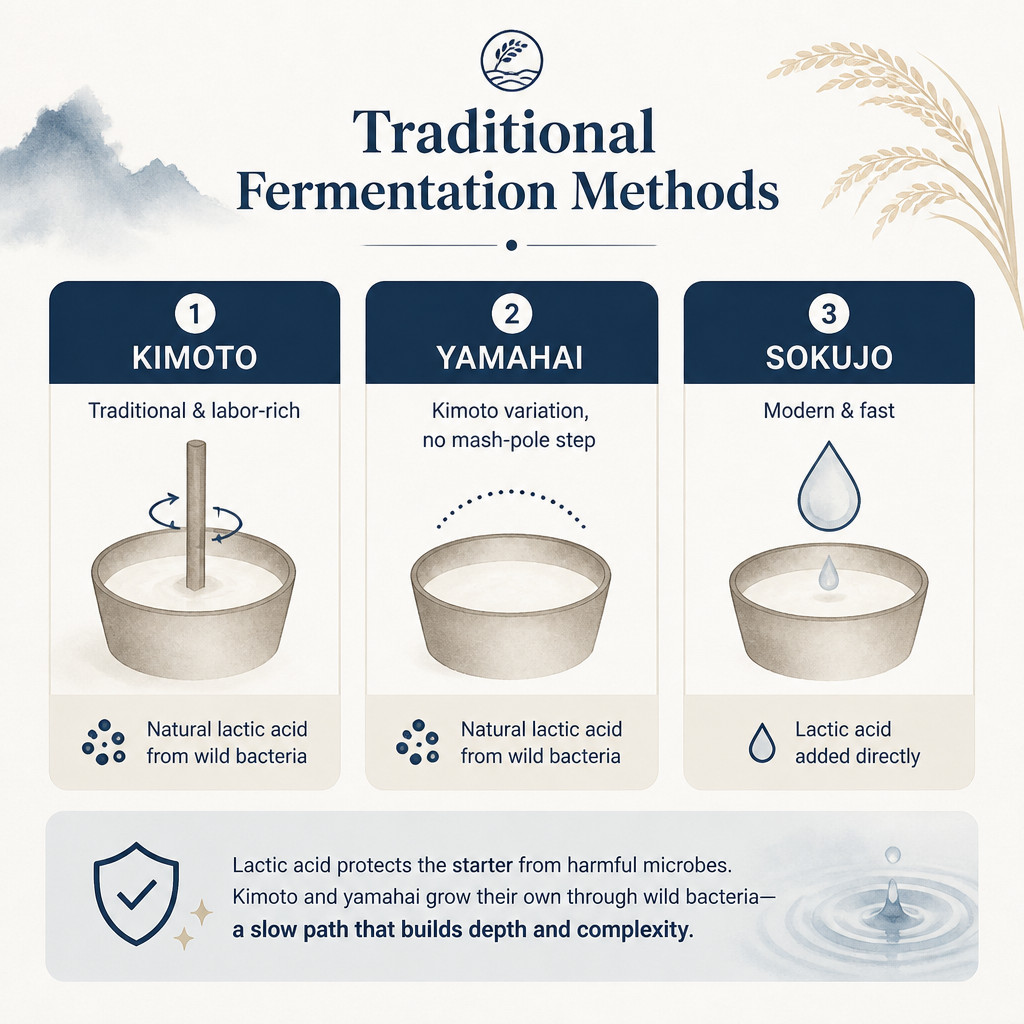
Brewers build the starter in different ways. Each method shapes acidity and flavor. Three approaches stand out in particular.
- Kimoto: an old, labor-rich method using natural lactic acid
- Yamahai: a kimoto variation that skips the mash-pole step
- Sokujo: a modern, faster method adding lactic acid directly
The difference comes down to the lactic acid. Lactic acid protects the starter from harmful microbes. Kimoto and yamahai grow their own, through wild bacteria. That slow path builds bold, complex, savory sake. Sokujo simply adds lactic acid at the start. So it works faster and avoids many risks.
A Short History of the Starter
The starter has a long, fascinating past. The oldest known form is the bodaimoto. Brewers used it as early as the Muromachi period. Centuries later, the kimoto method reached its peak. It was perfected in the Nada region during the Edo era. So the traditional starter carries deep history.
Modern science then transformed the craft. In 1909, a brewer named Kinichiro Kagi developed yamahai. He did this at the Suehiro brewery in Aizu. The method dropped the grueling mash-pole grinding step. The very next year brought an even bigger leap. In 1910, Kamajiro Eda created the sokujo method.
Eda made his breakthrough at a brewery in Aichi. The national brewing institute backed both advances. His method added lactic acid right at the start. So it cut the starter time dramatically. Today, sokujo accounts for about 90 percent of sake. Yamahai and kimoto together make up the rest.
Neither newer method is simply better, though. Many brewers still prize kimoto and yamahai. Those starters give richer, more layered flavor. So tradition and efficiency live side by side. Future articles will explore each one in detail.
Regional Approaches to Fermentation
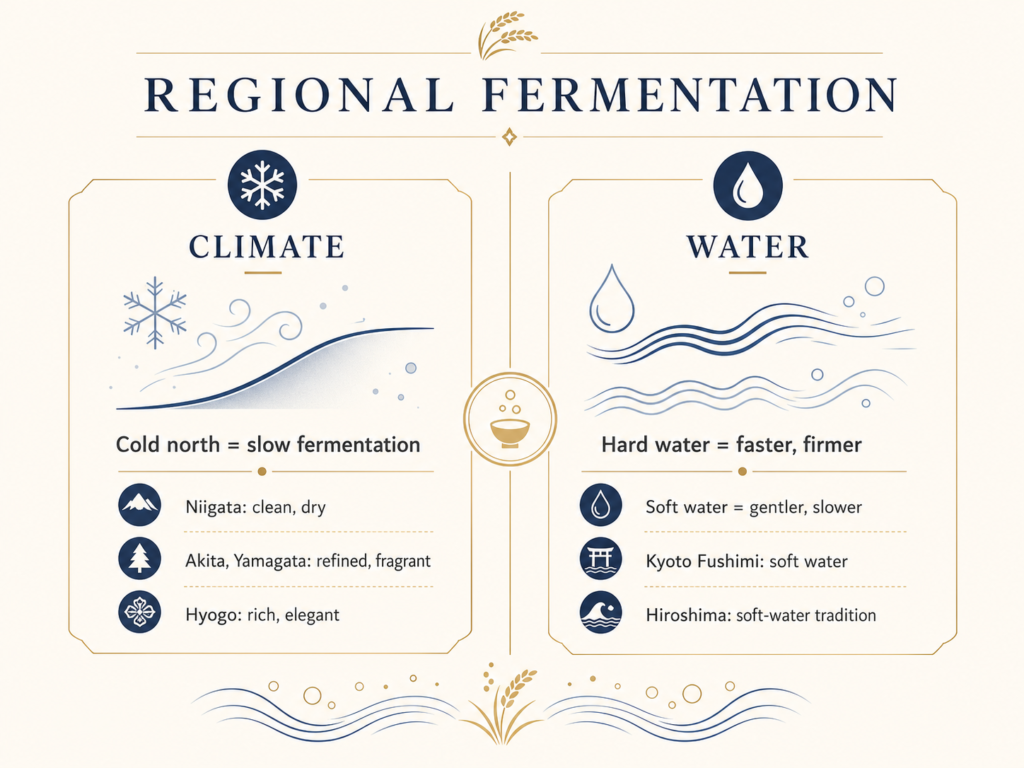
Region shapes fermentation in quiet ways. Climate, water, and tradition all play a part. So local sake carries a sense of place.
Cold northern regions favor long, slow fermentation. Niigata uses this to craft clean, dry sake. You can read more in our Niigata sake guide. Akita and Yamagata also brew refined, fragrant styles. Hyogo, with its famous rice, supports rich and elegant sake.
Water hardness also steers each region’s choices. Hard water speeds fermentation and builds firmer sake. Soft water slows it down for a gentler style. Kyoto’s Fushimi district is famous for soft water. Hiroshima even pioneered soft-water brewing long ago. So geology quietly guides the brewer’s hand.
The Science Behind High Alcohol Production
Sake reaches a strength few brewed drinks match. The reason lies in parallel fermentation. Let us look closer at why this works.
Most yeasts struggle as sugar and alcohol rise. Many give up well before 15 percent. Sake yeast, though, tolerates very high alcohol. It keeps working past 18 percent with ease. Because koji feeds sugar slowly, the yeast never gets overwhelmed. So fermentation continues far longer than in beer or wine. The result is a naturally strong undiluted sake.
Most brewers then add water before bottling. This brings the alcohol to around 15 or 16 percent. A few skip that step entirely, though. They sell the full-strength result as genshu, or undiluted sake.
The End of Fermentation
Fermentation does not last forever. Eventually, the yeast slows and grows quiet. Sugar runs low, and alcohol runs high. So the brewer must judge the right moment to stop. That decision shapes the sake’s balance and style.
A Final Choice About Alcohol
Some brewers add a touch of distilled alcohol here. They do this near the end of fermentation. This step is common for honjozo and many ginjo. A small, careful addition can lift aroma and crispness. Pure rice styles skip it entirely, by definition. So this single choice separates two whole families of sake.
From Mash to Sake
At last, the finished mash is ready. It now holds liquid sake and spent rice solids. Brewers must separate these two parts next. That pressing step turns mash into clear sake. So fermentation hands its work to the press. The living stage of brewing draws to a close.
Common Challenges During Fermentation
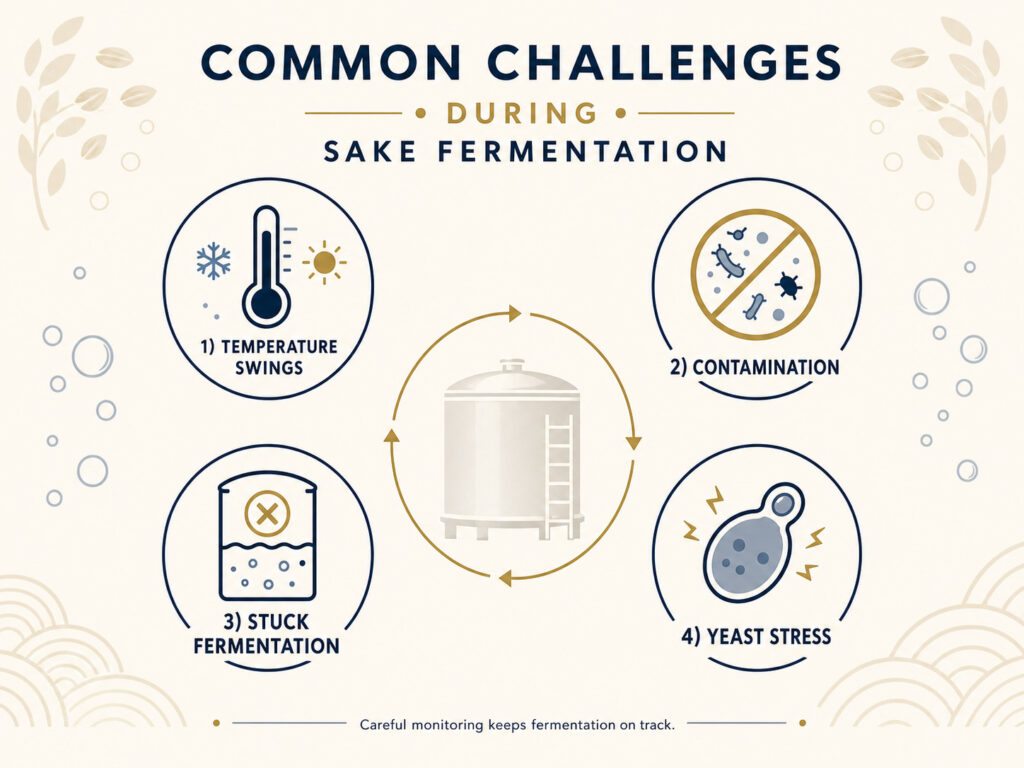
Fermentation looks calm, yet it carries real risk. Many things can go wrong inside the tank. So brewers stay alert through the whole process.
- Temperature swings: sudden changes can stall or rush the mash
- Contamination: wild microbes can sour or spoil a batch
- Stuck fermentation: the yeast may slow down too early
- Yeast stress: harsh conditions can weaken the cells
Brewers manage these risks with skill and care. They check the mash daily, often many times. Clean tools and cool rooms prevent most trouble. They also stir and taste to judge progress. So experience and vigilance keep the sake safe.
Modern Technology and Fermentation
Modern tools have transformed fermentation control. Yet the core biology stays exactly the same. Technology simply helps brewers guide the process.
Temperature-controlled tanks now keep the mash steady. Sensors track heat, gravity, and progress daily. Yeast research keeps producing useful new strains. Some breweries even log data across many seasons. So tradition and technology now work hand in hand. Still, the brewer’s judgment remains at the center.
Common Misconceptions About Sake Fermentation
Sake fermentation invites plenty of confusion. Let us clear up the most common myths.
- Is fermentation the same as aging? No. Fermentation makes the sake; aging mellows it later.
- Does koji make alcohol? No. Koji makes sugar; yeast makes the alcohol.
- Is sake distilled? No. Sake is brewed, not distilled like shochu.
- Is fermentation done once alcohol appears? No. It continues for weeks afterward.
- Can fermentation happen without yeast? No. Yeast is the organism that makes alcohol.
The second myth causes the most trouble. So remember the simple rule once again. Koji makes sugar, and yeast makes alcohol. The two never swap their roles. Keep that pairing clear, and sake makes sense.
Final Thoughts
Fermentation is the true heart of sake brewing. It is where rice, koji, yeast, water, and skill unite. From that union, plain rice becomes a fragrant drink. So this stage carries the whole soul of sake. Above all, remember the one defining idea. Koji makes sugar while yeast makes alcohol, at the same time. That parallel process gives sake its strength and its grace. It also explains the remarkable diversity of sake. Understand fermentation, and you understand sake itself.
Sake Fermentation FAQ
What is sake fermentation?
It is the process that turns rice into sake. Koji makes sugar from rice starch. Yeast then turns that sugar into alcohol. Both happen at the same time.
Why is sake fermentation unique?
It uses multiple parallel fermentation. Sugar creation and alcohol creation happen together. No other major drink works this way. So sake fermentation is unusually complex.
What is multiple parallel fermentation?
It is the heart of sake brewing. Koji turns starch into sugar continuously. At the same time, yeast turns sugar into alcohol. The two reactions share one tank.
How long does fermentation take?
The main mash ferments for about three to five weeks. Cooler, premium styles take longer. Warmer fermentation finishes faster. The starter also adds time before that.
Does koji make alcohol?
No, koji does not make alcohol. It makes sugar from rice starch. Yeast is what makes the alcohol. The two work as partners.
What does yeast do?
Yeast eats the sugar made by koji. In return, it produces alcohol and carbon dioxide. It also creates fruity aroma compounds. So it shapes both strength and scent.
Why is sake stronger than beer?
Koji feeds sugar to the yeast slowly and steadily. So the yeast keeps working much longer. Undiluted sake can reach 18 to 20 percent. That is higher than most beer.
What is moromi?
Moromi is the main fermentation mash. It contains rice, koji, water, and yeast. Over weeks, it ferments into sake. This is where parallel fermentation peaks.
What is moto?
Moto is the yeast starter, also called shubo. It grows a strong, healthy yeast population. It also builds protective acidity. This starter feeds the main mash.
How does temperature affect fermentation?
Temperature controls both speed and flavor. Cool mashes ferment slowly and build aroma. Warm mashes ferment fast and full. So brewers guard it closely.
References
- Japan Sake and Shochu Makers Association, Sake brewing and multiple parallel fermentation, https://www.japansake.or.jp/sake/en/ (Surveyed: June 2026)
- National Research Institute of Brewing, Science of sake fermentation, https://www.nrib.go.jp/ (Surveyed: June 2026)
- Brewing Society of Japan, Koji, yeast, and the history of sake starters, https://www.jozo.or.jp/ (Surveyed: June 2026)
- Yamahai developed by Kinichiro Kagi (1909) and sokujo by Kamajiro Eda (1910) at the national brewing institute, as recorded in Japanese brewing history (no single URL; historical record) (Year: 1909)
- National Tax Agency of Japan, Sake manufacturing and labeling standards, https://www.nta.go.jp/taxes/sake/ (Surveyed: June 2026)
Related Articles
- Koji in Sake Brewing (Surveyed: June 2026)
- Yeast in Sake Brewing (Surveyed: June 2026)
- How Sake Is Made (Surveyed: June 2026)
- Types of Japanese Sake (Surveyed: June 2026)
- Junmai Sake (Pure Rice Sake) (Surveyed: June 2026)
- Ginjo Sake (Surveyed: June 2026)
- Daiginjo Sake (Surveyed: June 2026)
- Niigata Sake (Surveyed: June 2026)




Comments