In 1975, a brewery in Fukui Prefecture released a daiginjo at a time when such highly refined sake was still closely tied to technical competitions rather than ordinary retail. Daiginjo is a highly polished, slow-fermented style. The bottle was Kokuryu Daiginjo Ryu, and the brewery describes it as a nationwide pioneer in selling such sake commercially.
That decision sits at the center of Kokuryu’s (黒龍) story. The brewery, founded in 1804, did not invent ginjo brewing. Rather, it helped turn a competition-oriented style into a commercial premium product, and then kept refining it. This guide covers the brewery’s history, the 1975 launch, its approach to water, rice, and aging, the main bottles, and what to expect in the glass.
Kuzuryu (九頭龍), a separate brand from the same brewery
Water
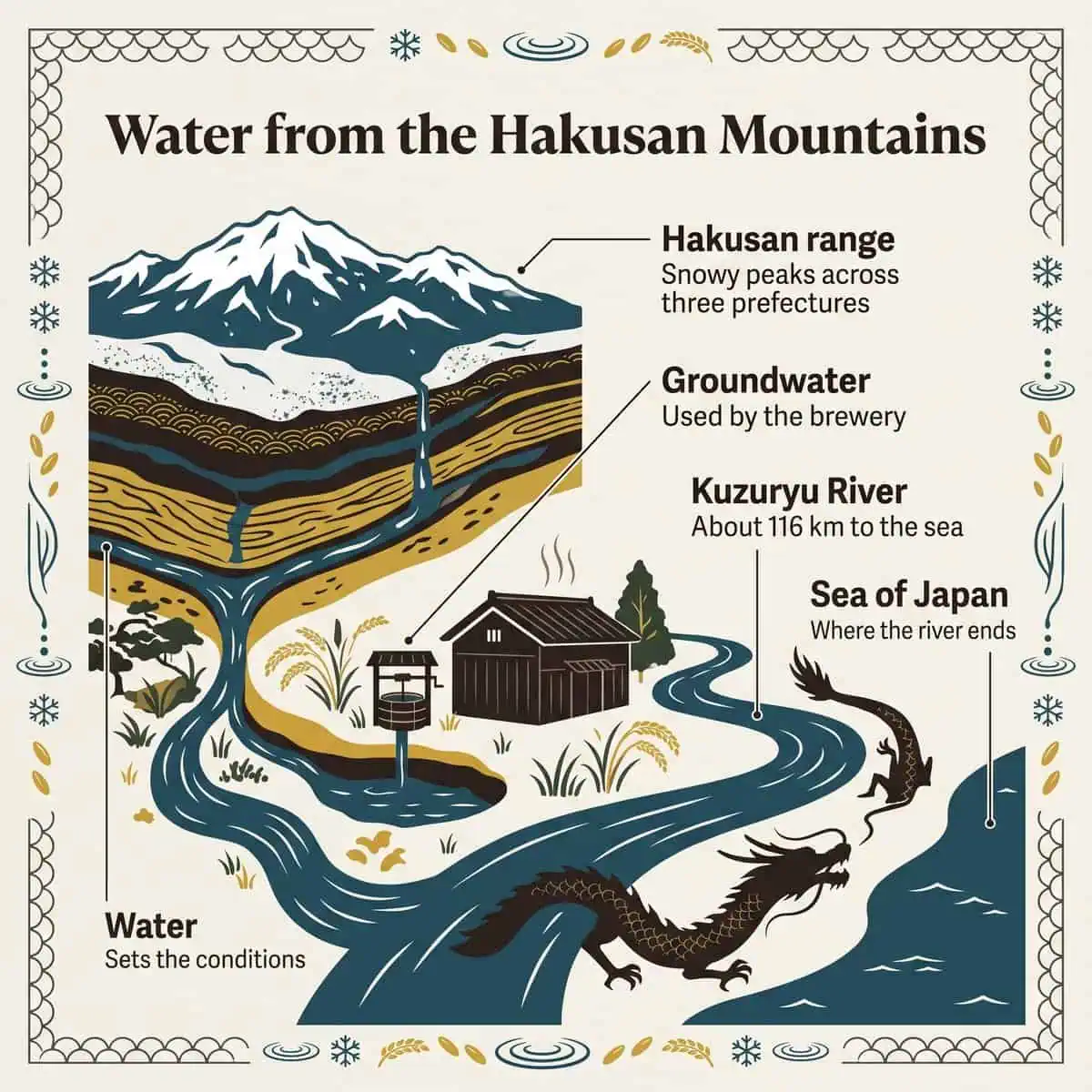
Groundwater that the brewery traces to the Hakusan mountain range
Good first bottles
Daiginjo Ryu for the historic style; a Kuzuryu bottle if you want to try warm service
TOC
What Is Kokuryu Sake?
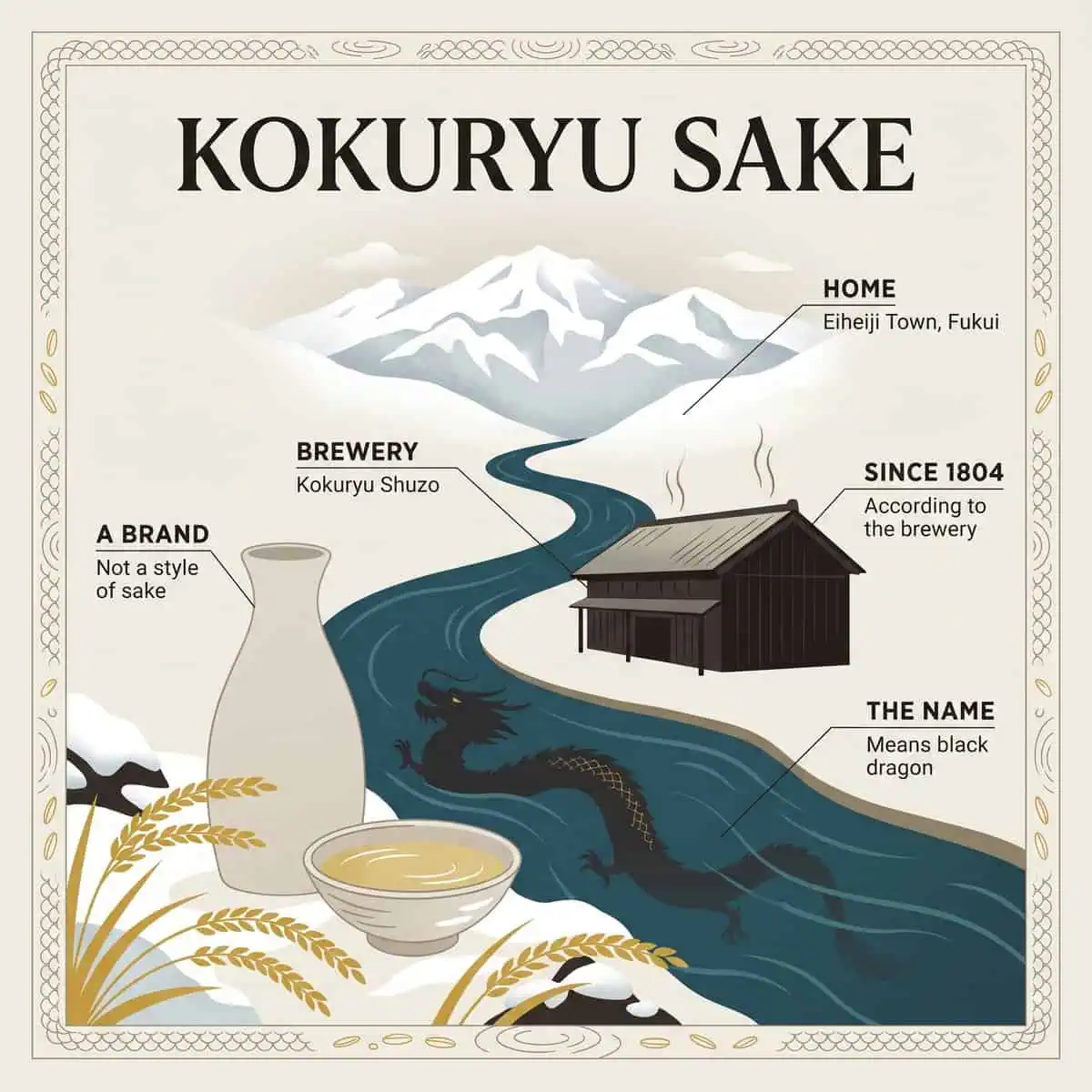
Kokuryu is a sake brand, not a category of sake. Kokuryu Shuzo, often called Kokuryu Sake Brewery in English, makes it in Eiheiji Town, Fukui Prefecture, a region on the Sea of Japan known for snow, rice, and crab. Within the brewery’s range, the Kokuryu name covers most of its premium bottles, including daiginjo and junmai daiginjo bottles.
Meanwhile, the same brewery also makes Kuzuryu (九頭龍), a separately named brand. The two share a maker, but they are not interchangeable names for the same bottles. A third brand, ESHIKOTO, appeared in 2022. More on those later.
What Does the Name Mean?
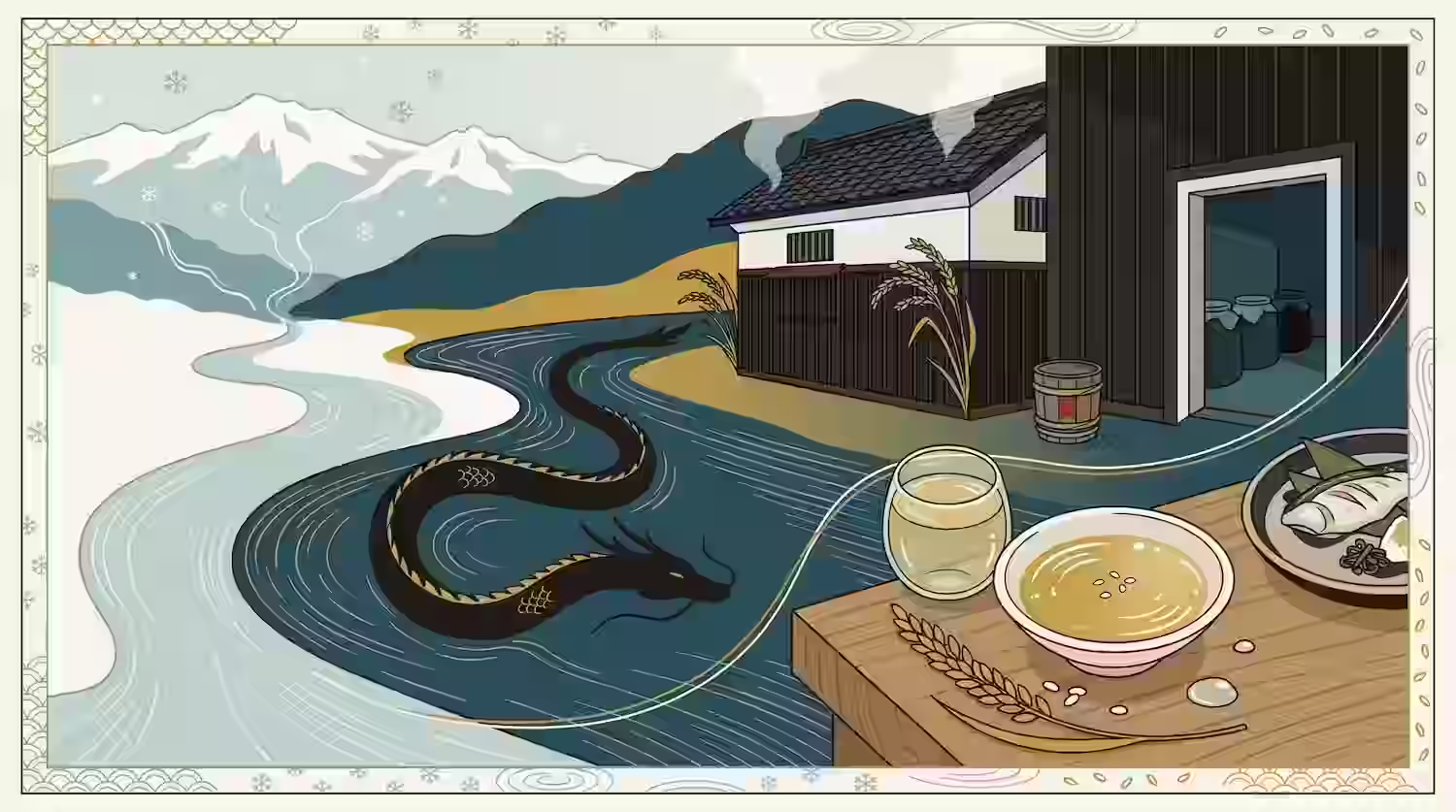
Kokuryu means “black dragon.” The name connects to the Kuzuryu River, which flows through Eiheiji Town and much of northern Fukui. Official river-history materials from Japan’s land ministry present several explanations for the river’s name. In one tradition, a shrine to a black dragon deity stood on its banks, so people called the river Kokuryu-gawa, or Black Dragon River.
Other accounts, however, tell of a nine-headed dragon, which is what the kanji for Kuzuryu literally say. An older name, Kuzure-kawa, also appears in a 15th-century map. So the brand name draws on these river traditions rather than on one settled fact. When the brewery first adopted the name is not stated in the sources reviewed here.
A Brewery Founded in 1804
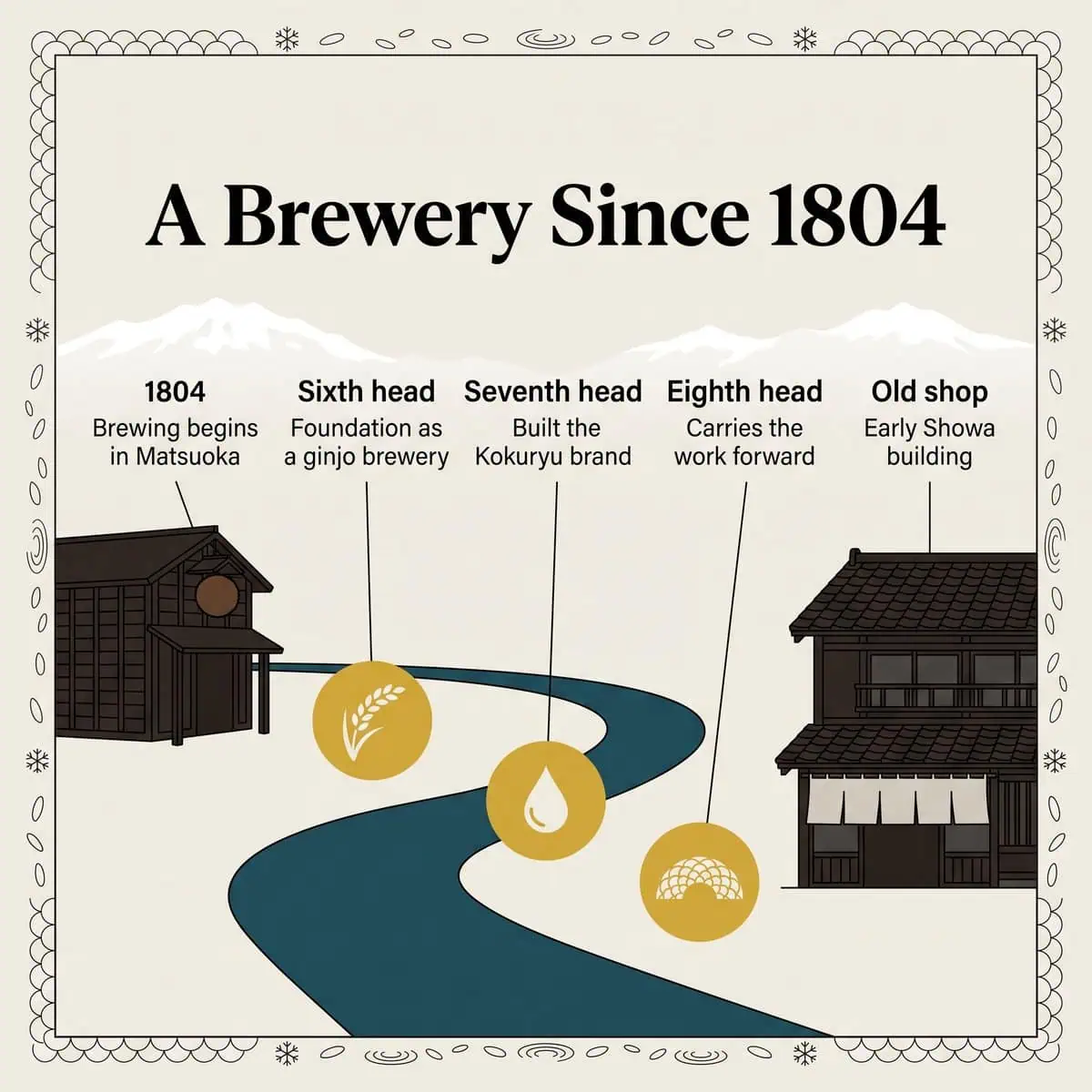
According to the brewery, its story begins in 1804, when the first Ishidaya Nizaemon started brewing in Matsuoka. Today, Matsuoka is part of Eiheiji Town, best known for the Zen temple of the same name. Ishidaya was the family’s shop name, and it still survives today as the name of the brewery’s retail company.
That makes 2024 the brewery’s 220th anniversary year, which it marked with a special three-bottle release. Across those two centuries, the brewery says, successive heads have passed down one principle: “making good sake.” It is a plain phrase, and that is probably the point.
Three Generations and a Brewery of Ginjo
In its own history, the brewery gives three recent heads a role each. Gitaro Mizuno, the sixth, laid the foundation for the brewery as a specialist in ginjo. His successor Masato Mizuno then established the Kokuryu brand. Today, the eighth head, Naoto Mizuno, carries the work forward with what the brewery calls further value creation in sake.
These are the company’s own summaries of its leaders, so they are best read that way. Even so, they explain the shape of the story well. First came a focus on ginjo, then a brand built around it, then new ways to present it.
The Old Shop in Matsuoka
One detail, though, is easy to get wrong. The brewery’s shop and main house in Matsuoka is a registered tangible cultural property, but it dates from the early Showa period, in the first half of the 20th century. It is the oldest building the brewery owns, not a structure from 1804.
Ginjo Before It Was a Shop Shelf Item
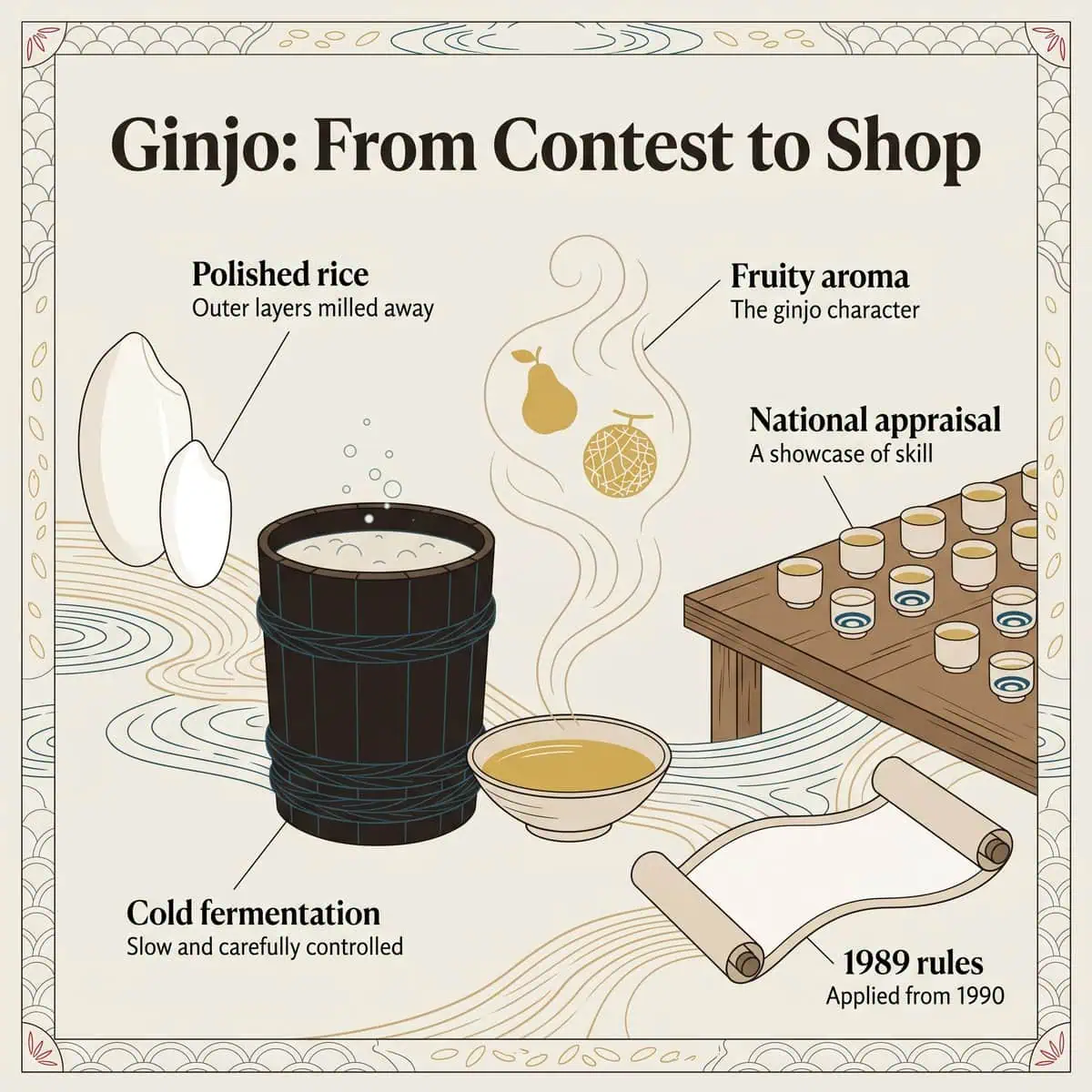
To see why 1975 mattered, it helps to know what ginjo was then. Ginjo brewing uses highly polished rice and slow, cold fermentation to draw out a distinctive aroma, often described as fruity. It also leaves a higher proportion of sake lees and needs careful temperature control. As a result, it costs more to make than ordinary sake.
For decades, this style was closely linked to Japan’s national sake appraisal. According to Kuniyasu Goto of the National Research Institute of Brewing, the appraisal targets ginjo made with the highest brewing techniques. In other words, breweries prepared highly refined sake to demonstrate and evaluate their skill, rather than mainly to supply shops.
Worth Knowing
Japan’s current labeling rules for ginjo and daiginjo were set in 1989 and applied from 1990. So a 1975 bottle called “daiginjo” used the word as a product name and a brewing style, not as the legal grade it later became.
Ginjo therefore developed over decades through competitions, public research, and shared technical improvement. Kokuryu did not create it. Its significance lies in helping turn that competition style into a sustained commercial product.
1975: Kokuryu Daiginjo Ryu
Here, then, is the center of the story. According to the brewery, the seventh-generation head Masato Mizuno traveled to France at the age of 25. The brewery describes him as deeply knowledgeable about wine. After returning, he experimented with whether techniques associated with wine maturation could be adapted to sake.
The result, the brewery says, was Kokuryu Daiginjo Ryu, released in 1975. Its own words are that the bottle became “a nationwide pioneer” in putting competition-grade daiginjo on the commercial market. At launch, the label used cloth from the bags that press sake. Later it switched to Echizen-ori, a textile from Fukui.
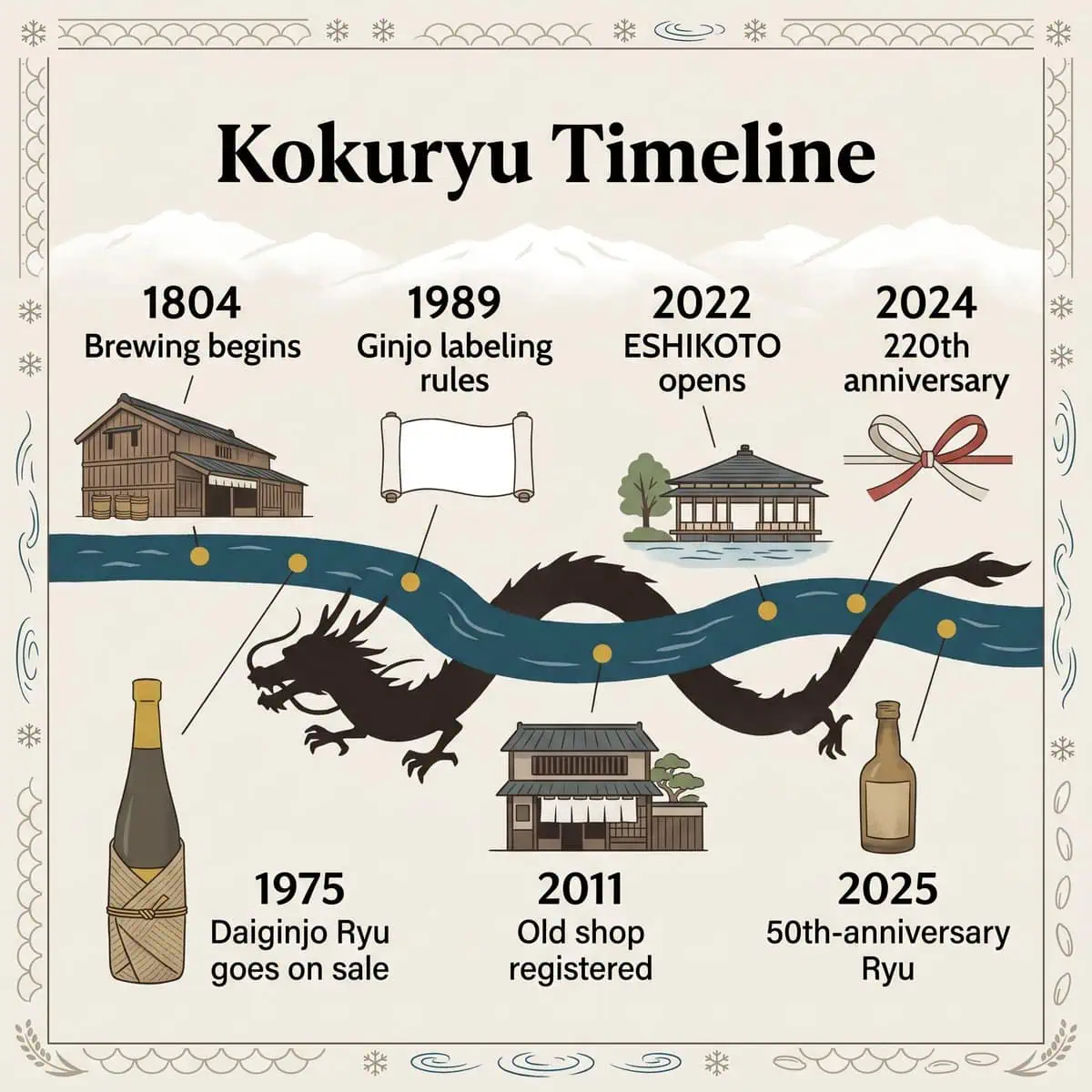
1804The first Ishidaya Nizaemon begins brewing in Matsuoka, according to the brewery.
1975Daiginjo Ryu goes on sale; the brewery calls it a nationwide pioneer in commercial daiginjo.
1989Japan sets national labeling rules for ginjo and daiginjo, applied from 1990.
2011The Matsuoka shop and main house becomes a registered tangible cultural property.
2022ESHIKOTO opens beside the Kuzuryu River in June.
2024The brewery marks its 220th anniversary.
2025The brewery releases a 50th-anniversary Ryu, aged five years.
How Big a First Was It?
This deserves honest handling, because the wording matters. The brewery’s claim is “a nationwide pioneer,” not “Japan’s first.” We found no independent record ranking 1970s daiginjo releases, so this guide does not call Ryu the first commercial daiginjo. What the sources do support is simpler: in 1975, Kokuryu began selling a named daiginjo as a commercial product, and the brewery itself sees that as pioneering.
Two other things also followed from that launch. First, the know-how from those aging experiments, the brewery says, became the start of the low-temperature aging it still practices. Second, Ryu is still part of the range today. Then, fifty years after its launch, in September 2025, the brewery released an anniversary Ryu made from 2020 sake and aged five years at low temperature.
What Makes Daiginjo Different?
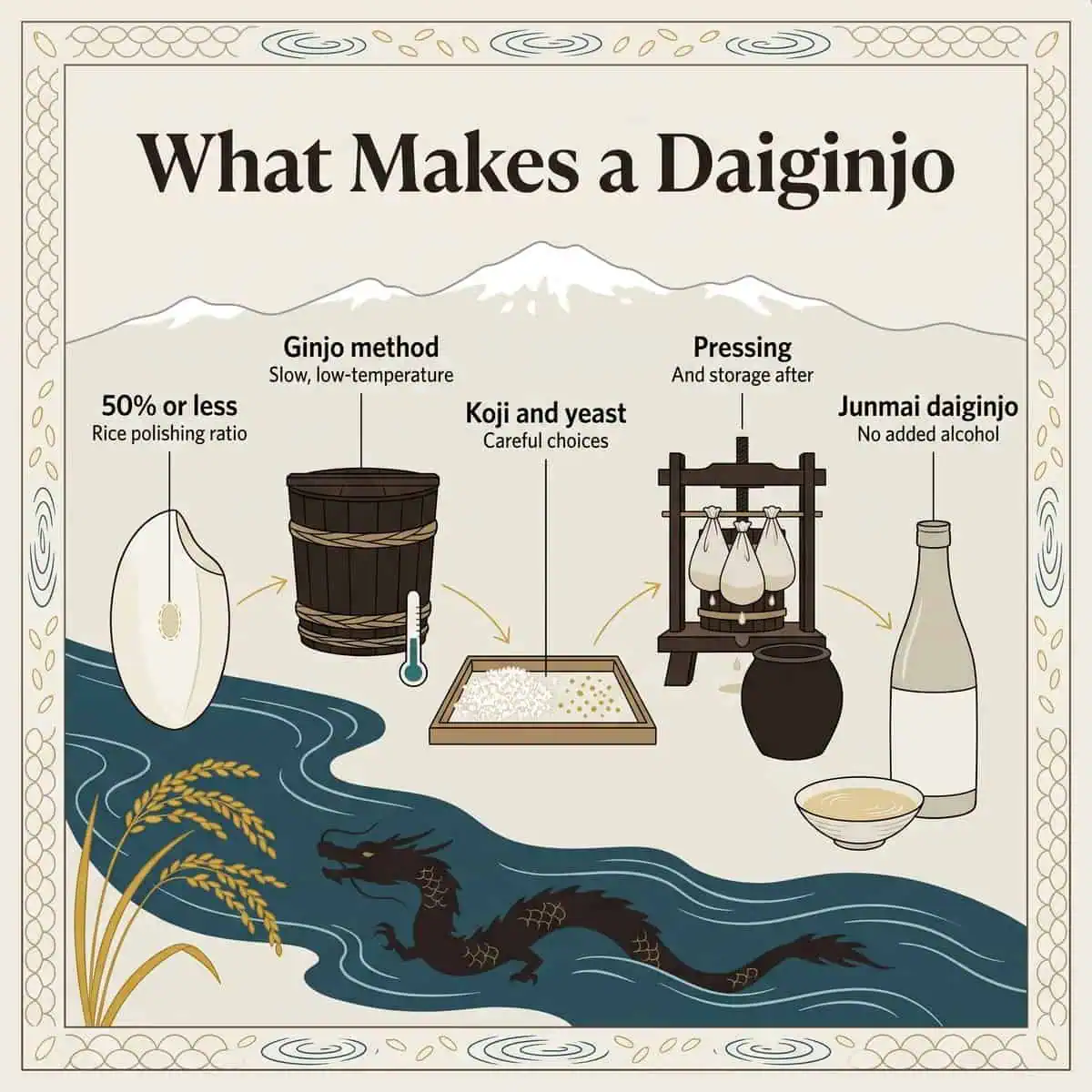
Under Japan’s labeling standards, daiginjo must use rice polished to 50% or less of its original weight. It must also follow ginjo brewing and show particularly good aroma, flavor, and appearance. Junmai daiginjo meets the same bar without added brewer’s alcohol. Our rice polishing guide explains the percentages.
Polishing alone, though, does not make a daiginjo. The tax agency’s definition of ginjo brewing describes fermenting well-polished rice slowly at low temperature, so the sake develops its characteristic aroma. Koji making, yeast choice, and fermentation control all matter. So do pressing and storage afterward.
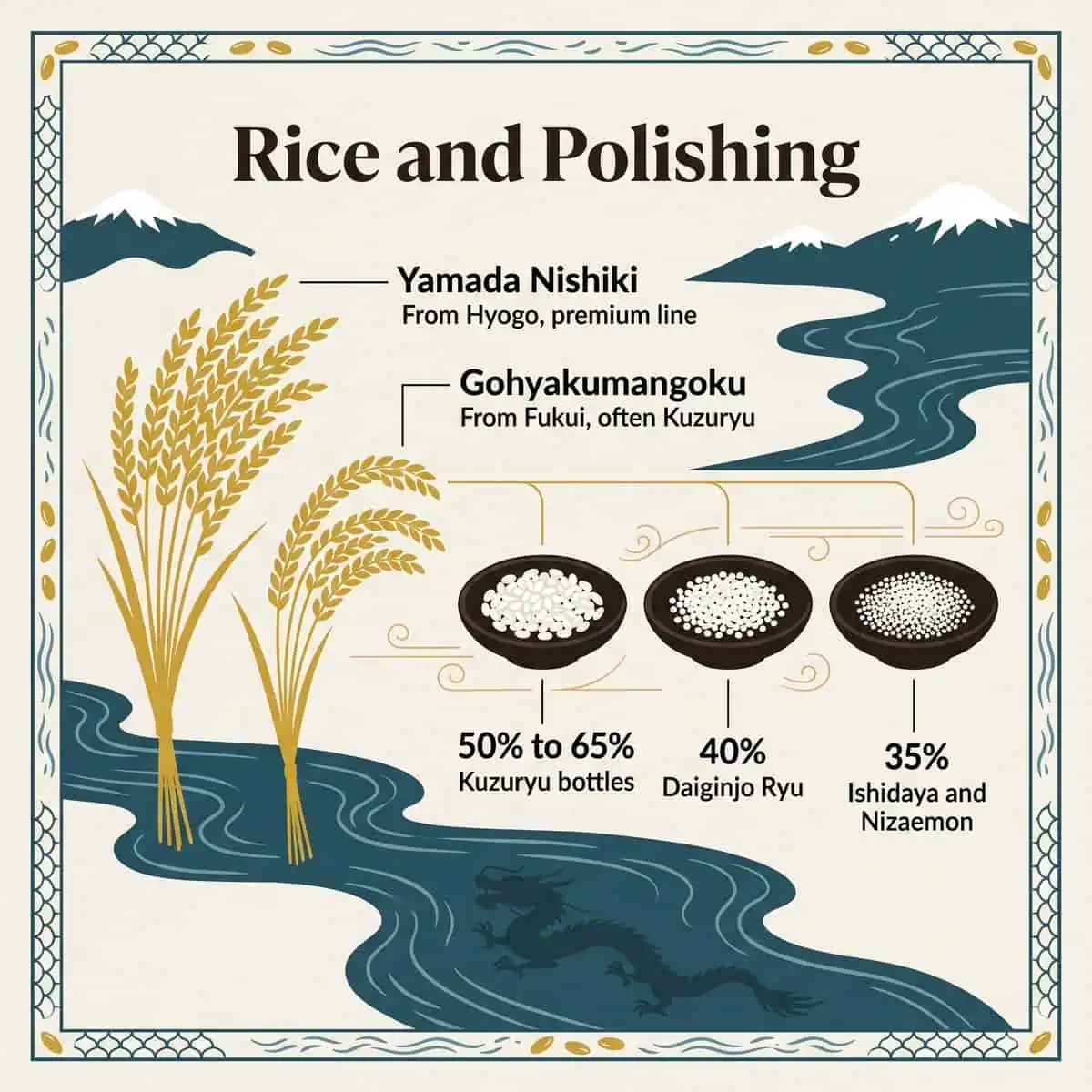
So why does this matter for Kokuryu? Because the brand’s identity rests on that whole chain, not on a polishing number. Current retailer listings describe the standard Ryu as Yamada Nishiki polished to 40%, while the limited Ishidaya and Nizaemon go to 35%. The numbers differ, but the method is the point.
Water from the Hakusan Mountains
The ESHIKOTO site calls the Kuzuryu River the source of Fukui’s sake brewing. The brewery, for its part, states that it uses groundwater originating in the Hakusan mountain range, the snowy peaks spanning Ishikawa, Gifu, and Fukui. Meanwhile, the Kuzuryu River runs about 116 kilometers through northern Fukui to the Sea of Japan.
Of course, it is tempting to say the river flows straight into the tank. The brewery’s own wording, however, is more careful: groundwater from the Hakusan mountain system. We found no published hardness or mineral figures, so this guide does not give any. For how minerals shape fermentation in general, see our guide to water in sake brewing.
In any case, water sets conditions rather than flavor. Rice, koji, yeast, temperature, and time do the rest. Kokuryu’s choices in those areas are what give the water something to work with.
Rice, Polishing, and the Pursuit of Quality
Kokuryu’s premium bottles lean heavily on Yamada Nishiki from Hyogo Prefecture, often called the king of sake rice. Ryu, Ishidaya, Nizaemon, and the 220th-anniversary bottles all use it, according to the brewery and its retailers. Kuzuryu, by contrast, often uses Gohyakumangoku grown in Fukui.
The current range shows a broad contrast, although it should not be treated as a fixed rule for every bottle. In any case, not every bottle from the brewery uses the same rice or the same polishing. The table later in this guide gives the details bottle by bottle.
The brewery describes its sake rice as grown with care by dedicated farmers. Beyond that, however, it publishes few details about contracts or polishing in-house. So this guide stays with what official pages and retailer listings say.
Low-Temperature Aging
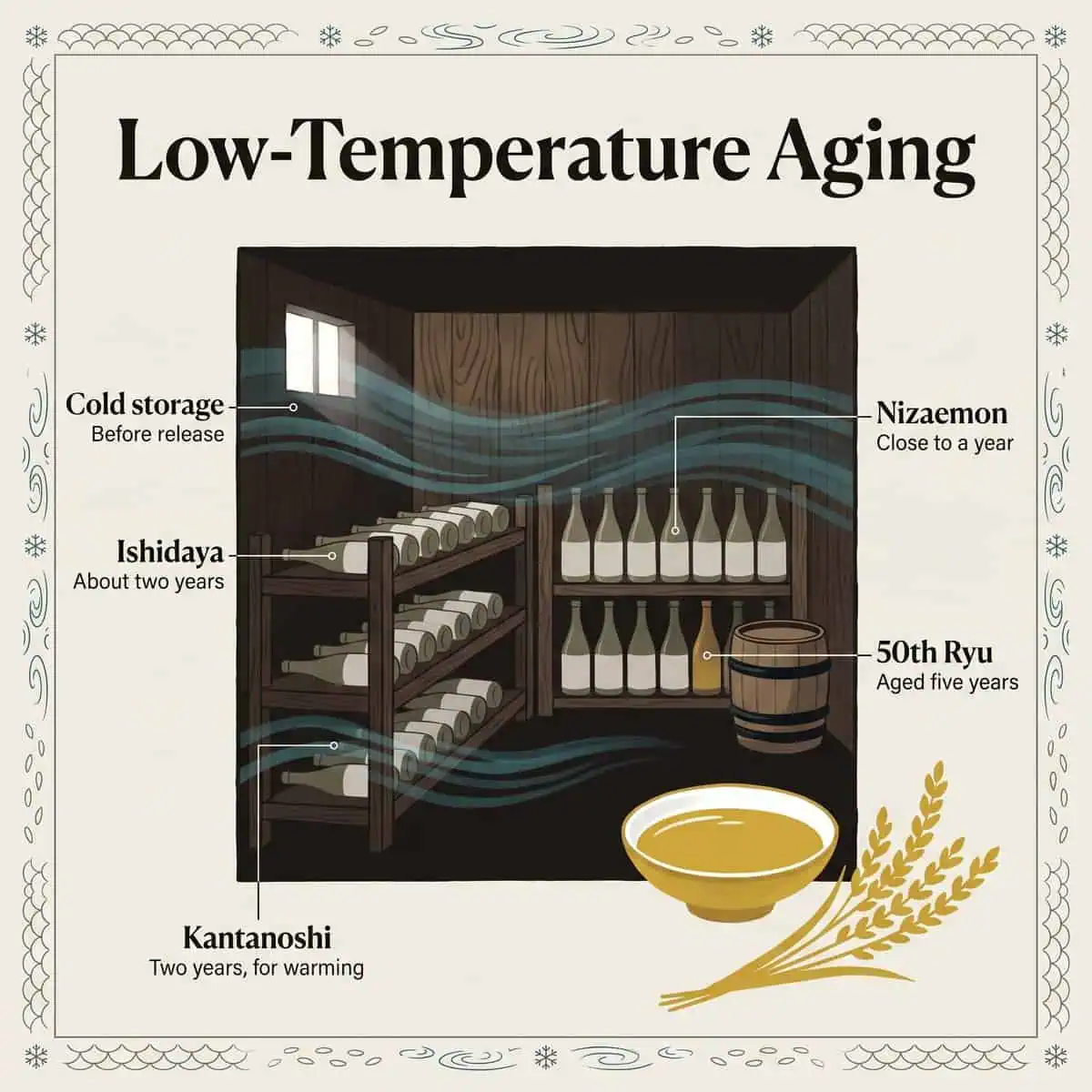
Aging is where Kokuryu’s wine connection shows most clearly. Much modern sake is released relatively young, while selected styles are deliberately matured before sale. Kokuryu, for its part, holds some of its premium sake in cold storage before release. Our guide to jukusei, or sake maturation, explains the general science.
The brewery traces this practice to the trials behind Ryu in the 1970s. In the current range, Ishidaya is aged about two years and Nizaemon for close to a year, according to a retailer’s product listings. Kuzuryu Kantanoshi, a seasonal bottle made for warming, is aged two years as well.
So what does aging do? At low temperature, change is slow. Depending on the sake and storage conditions, aromas may become more integrated and the texture may feel rounder. For the 50th-anniversary Ryu, aged five years, descriptions mention a sweet, nectar-like ginjo aroma that gained complexity with time. That said, older is not automatically better, either. Aging is a style choice that depends on storage conditions and the sake itself.
Understanding the Kokuryu and Kuzuryu Range
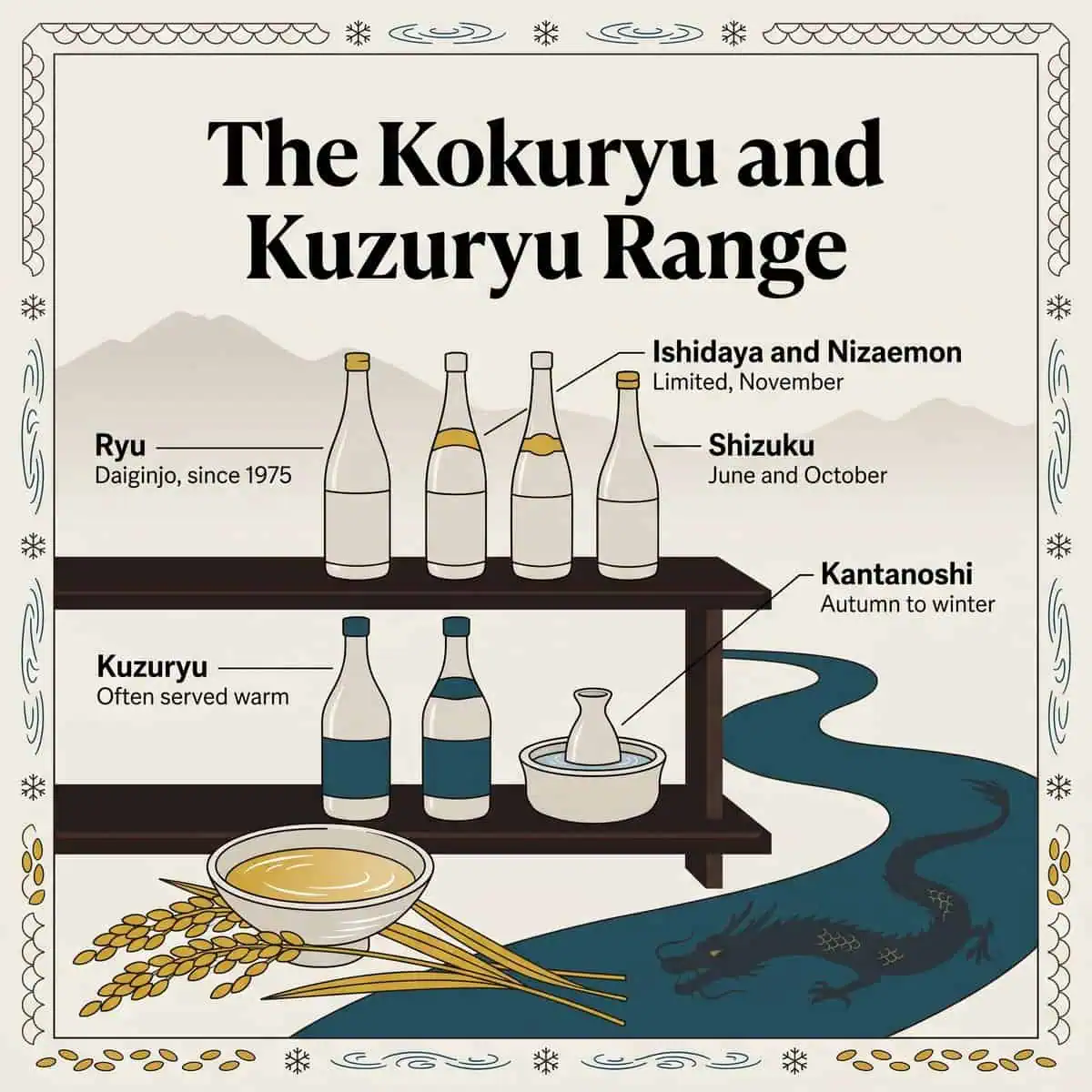
The brewery’s bottles fall into two brands. The table below covers the main ones. Specifications can change, and several bottles are limited releases. So check the label; our guide to reading a sake label can help.
Sake
Brand
Type
Rice
Polishing
Notes
Daiginjo Ryu (龍)
Kokuryu
Daiginjo
Yamada Nishiki (Hyogo)
40%
Launched 1975; year-round
Ishidaya (石田屋)
Kokuryu
Junmai daiginjo
Yamada Nishiki (Hyogo)
35%
Aged about two years; limited, released in November
Nizaemon (二左衛門)
Kokuryu
Junmai daiginjo
Yamada Nishiki (Hyogo)
35%
Aged close to a year; limited, released in November
Shizuku (しずく)
Kokuryu
Daiginjo
Yamada Nishiki (Hyogo)
35%
Limited, released in June and October
Junmai Daiginjo
Kokuryu
Junmai daiginjo
Yamada Nishiki (Hyogo)
35%
Released several times a year
Kuzuryu Daiginjo
Kuzuryu
Daiginjo
Gohyakumangoku (Fukui)
50%
Suggested gently warmed; year-round
Kuzuryu Junmai
Kuzuryu
Junmai
Domestic rice
65%
Warming recommended; year-round
Kuzuryu Kantanoshi (燗たのし)
Kuzuryu
Junmai, aged
Gohyakumangoku (Fukui)
65%
Aged two years; suggested at 45–50°C; autumn to winter
Product specifications and release timing are based partly on a specialist retailer’s listings, checked October 2026, and may vary by brewing year. Check the current label or the brewery’s authorized sellers before buying. Limited bottles sell out quickly, and some go on sale by lottery.
The Kokuryu Premium Line
Ryu is the historic bottle, and therefore the one to try if you want the style that started things. Ishidaya and Nizaemon share their names with the family’s historic shop name and the founder. Both are junmai daiginjo from Yamada Nishiki polished to 35%, released in limited quantities each November. The brewery’s retail company notes that these, along with Shizuku, cannot be offered year-round.
Shizuku means “drop,” a word often used for sake collected by dripping rather than by pressing. However, we could not find the brewery’s own description of the method, so this guide does not describe how Shizuku is made.
Kuzuryu and Warm Sake
A specialist retailer’s brewery profile dates the first Kuzuryu release to 1959, although the brewery materials cited here do not confirm that date. Several current Kuzuryu bottles are promoted for warm service. The retailer’s listings suggest the Kuzuryu Daiginjo gently warmed, recommend the Junmai warm, and give 45 to 50°C for Kantanoshi. If warm sake is new to you, our guide to warmed sake explains why temperature matters.
The brewery’s own tagline captures the split. Kokuryu is “a cup that connects to eternity,” while Kuzuryu is “a cup that opens the door to freedom.” The contrast suggests different emotional identities. Still, it should not be read as a strict division by price, occasion, or serving temperature, so judge each bottle on its own.
What Does Kokuryu Sake Taste Like?
There is no single Kokuryu taste, and the two brands make that obvious. Even within the premium line, for instance, a fresh Shizuku and a two-year-aged Ishidaya are different experiences.
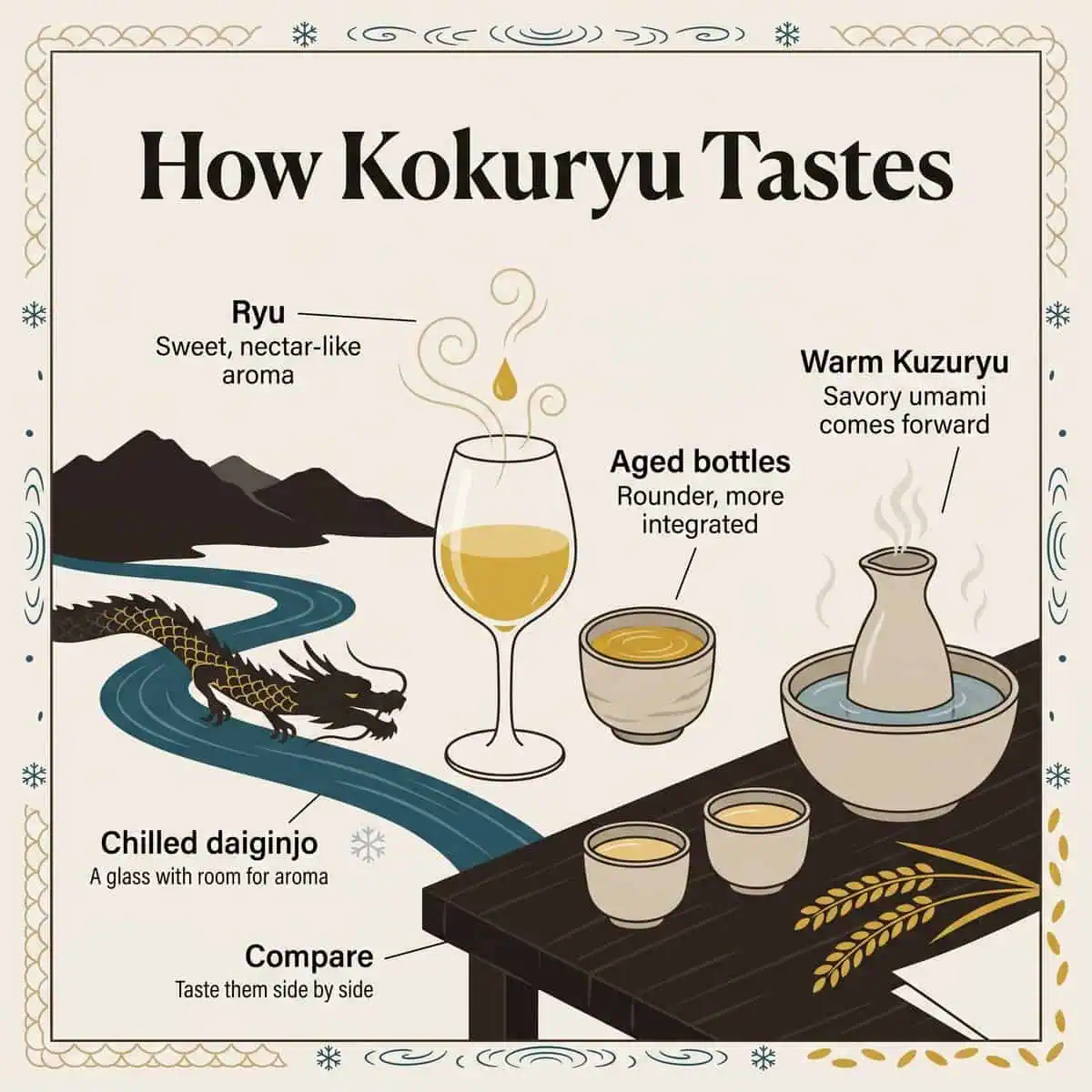
Still, a few threads run through the brand’s own descriptions. For example, Ryu centers on ginjo aroma, described for the anniversary bottle as sweet and nectar-like. Some aged bottles, by contrast, may show more integrated aromas and a rounder texture. Meanwhile, when suitable Kuzuryu bottles are warmed, their rice-derived savoriness and umami may become more noticeable, while the aroma changes with temperature.
How should you taste it? Begin with the serving guidance for each bottle. For an aromatic daiginjo, lightly chilled service in a glass with room for the aroma is a useful starting point. Then try a Kuzuryu bottle warm beside it, if you can. The contrast teaches more than any description can. Our guide on how to taste sake walks through the steps.
Kokuryu and Food
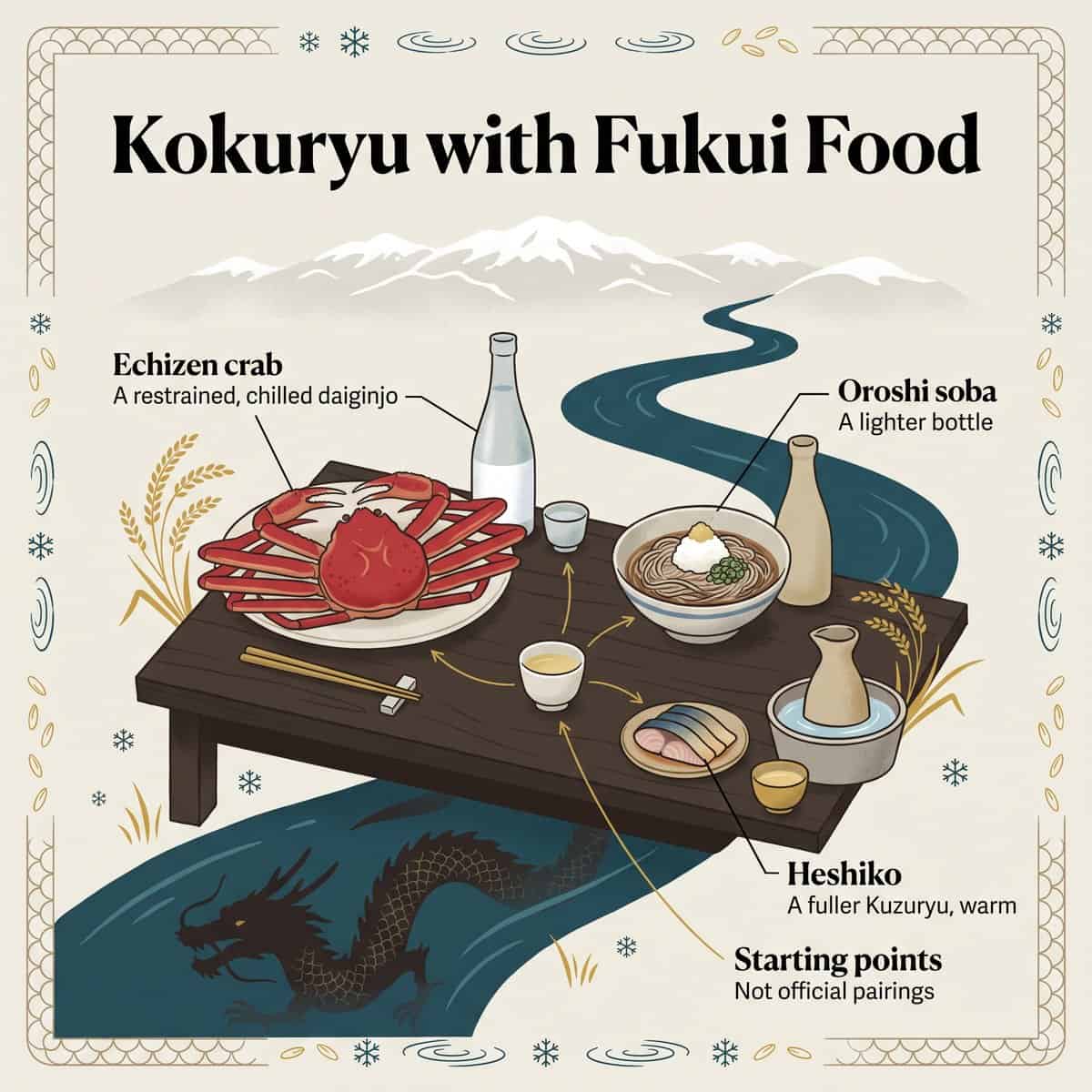
Fukui’s own table is a natural place to start. The prefecture is famous for Echizen crab in winter. A restrained, lightly chilled daiginjo can complement its sweetness, as long as the sake is not so aromatic that it overwhelms the meat. Oroshi soba, buckwheat noodles with grated daikon, can work with a lighter bottle. Richer local dishes, such as heshiko, fermented mackerel, can work with a fuller Kuzuryu served warm.
These are starting points rather than official pairings, since the brewery publishes few of its own. For the logic behind good matches, see our sake and food pairing guide.
Kokuryu Beyond the Bottle: ESHIKOTO
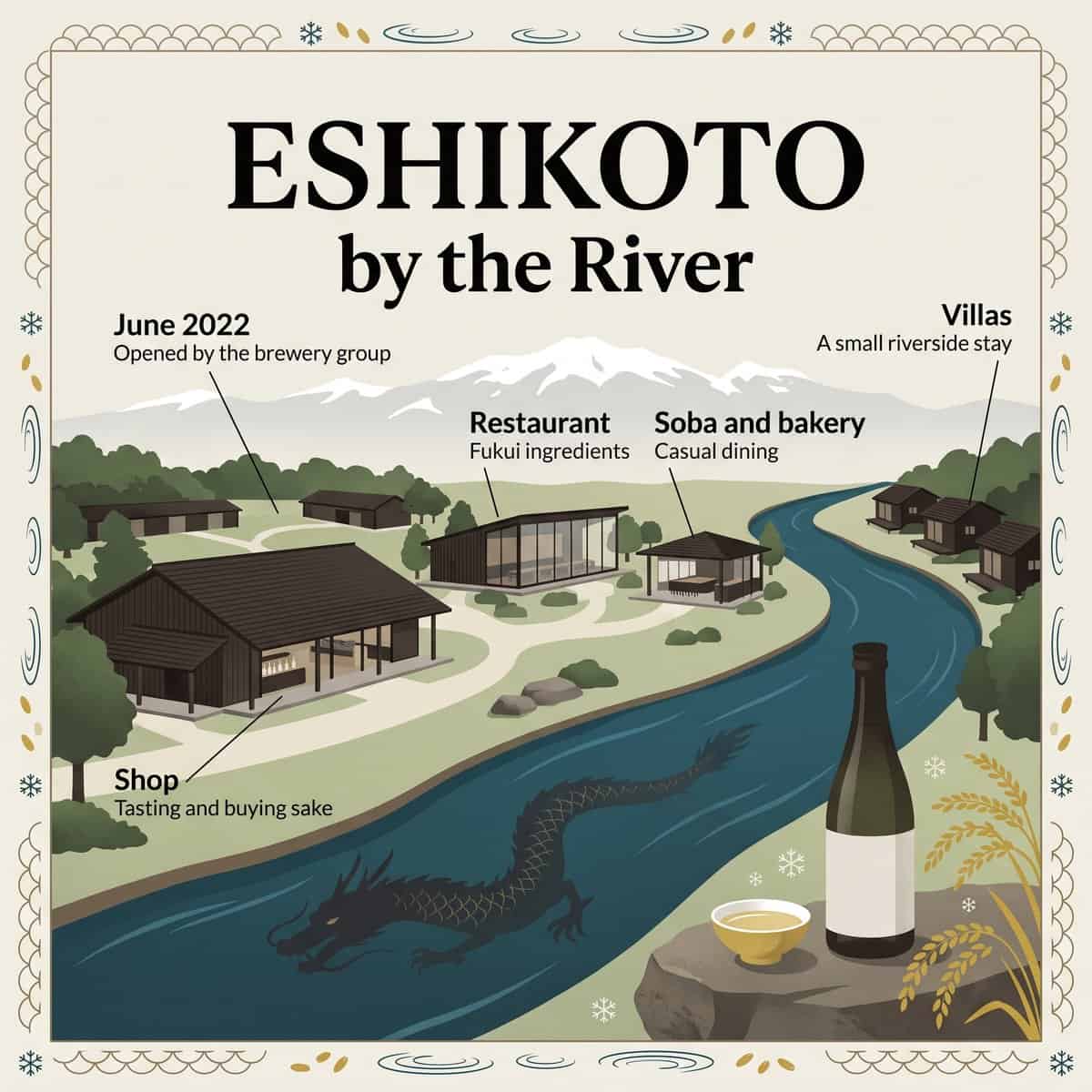
In June 2022, the wider Ishidaya and Kokuryu group opened ESHIKOTO on a riverside site in Eiheiji Town. The name, in fact, belongs to both a sake brand and a place. According to its own site, ESHIKOTO is “a place that conveys the culture of Fukui and Hokuriku with sake at its core.” Fukui City’s tourism site describes it the same way.
First, the site includes the Ishidaya ESHIKOTO shop, where visitors can taste and buy sake, including bottles sold only there. In addition, there is a restaurant and patisserie using Fukui ingredients, a soba restaurant, a bakery, and a small lodging with riverside villas. According to a 2022 report by Mynavi News, British architect Simon Conder designed one of the main buildings, and its cellar reuses pillars and doors from old houses.
Why does a brewery do this? The simplest answer is that it extends the work beyond brewing and bottling, into hospitality. Sake becomes the center of a day out, with food, landscape, and design around it. Whether that changes Fukui tourism is not something the sources measure, so this guide does not claim it.
Visiting Eiheiji and the Brewery
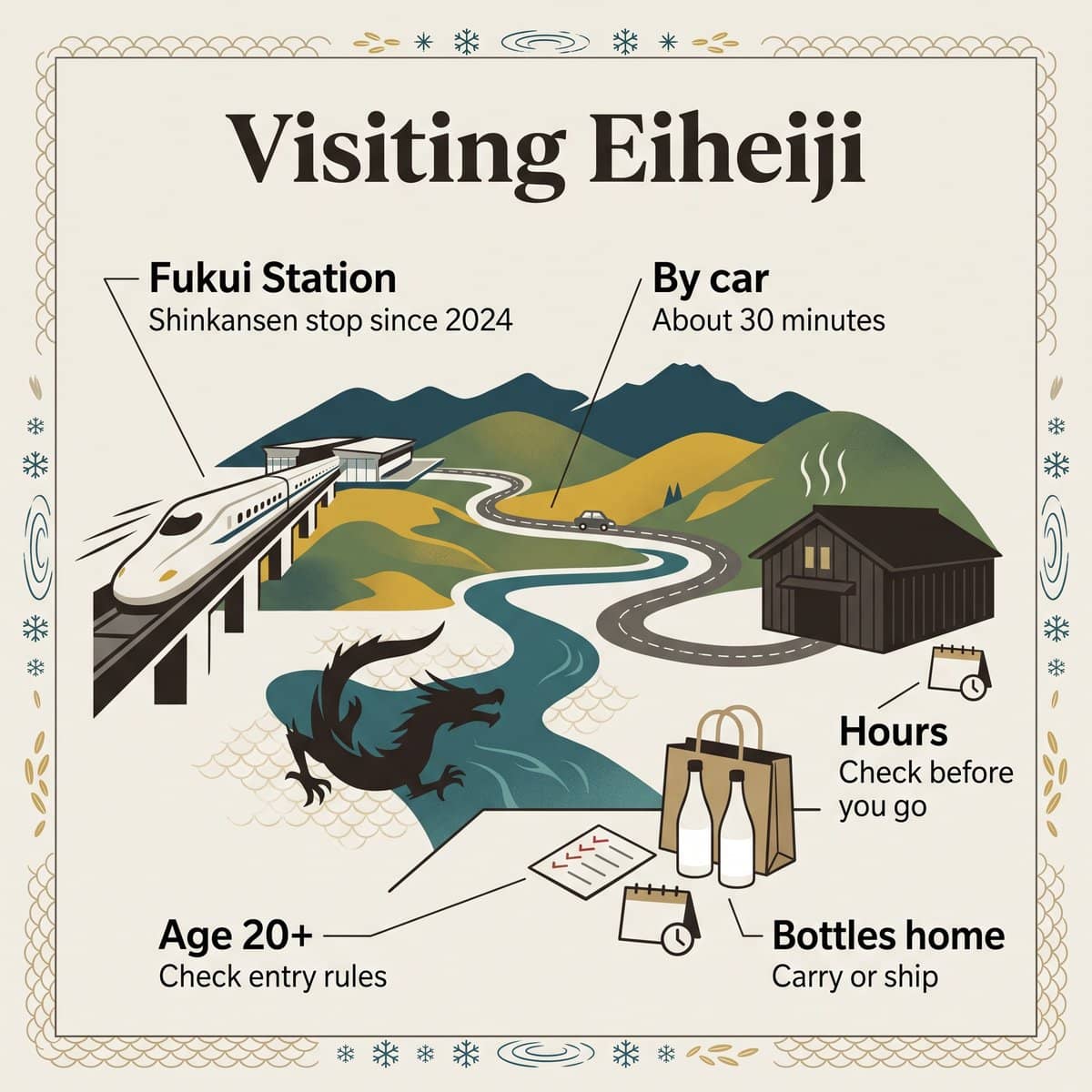
According to Mynavi News, ESHIKOTO is about 30 minutes by car from Fukui Station. Since March 2024, Fukui Station has also been a stop on the Hokuriku Shinkansen. The old Matsuoka district, meanwhile, holds the brewery’s historic shop building. Japan’s legal drinking age is 20, and Fukui City’s tourism site lists ESHIKOTO entry as limited to ages 20 and over. Before you go, check:
Current opening days, hours, and age rules on the official site
Whether the shop offers tastings on your date, and the fee
Which limited bottles are in stock, since many sell out
How you will carry bottles home, or whether shipping is available
What Makes Kokuryu Different?
Other major brands, such as Dassai, Masumi, and Kubota, are often discussed through different turning points in modern sake history. Kokuryu’s story, by comparison, centers on selling daiginjo as a commercial product in 1975, then building low-temperature aging into the house style.
Common Misconceptions About Kokuryu
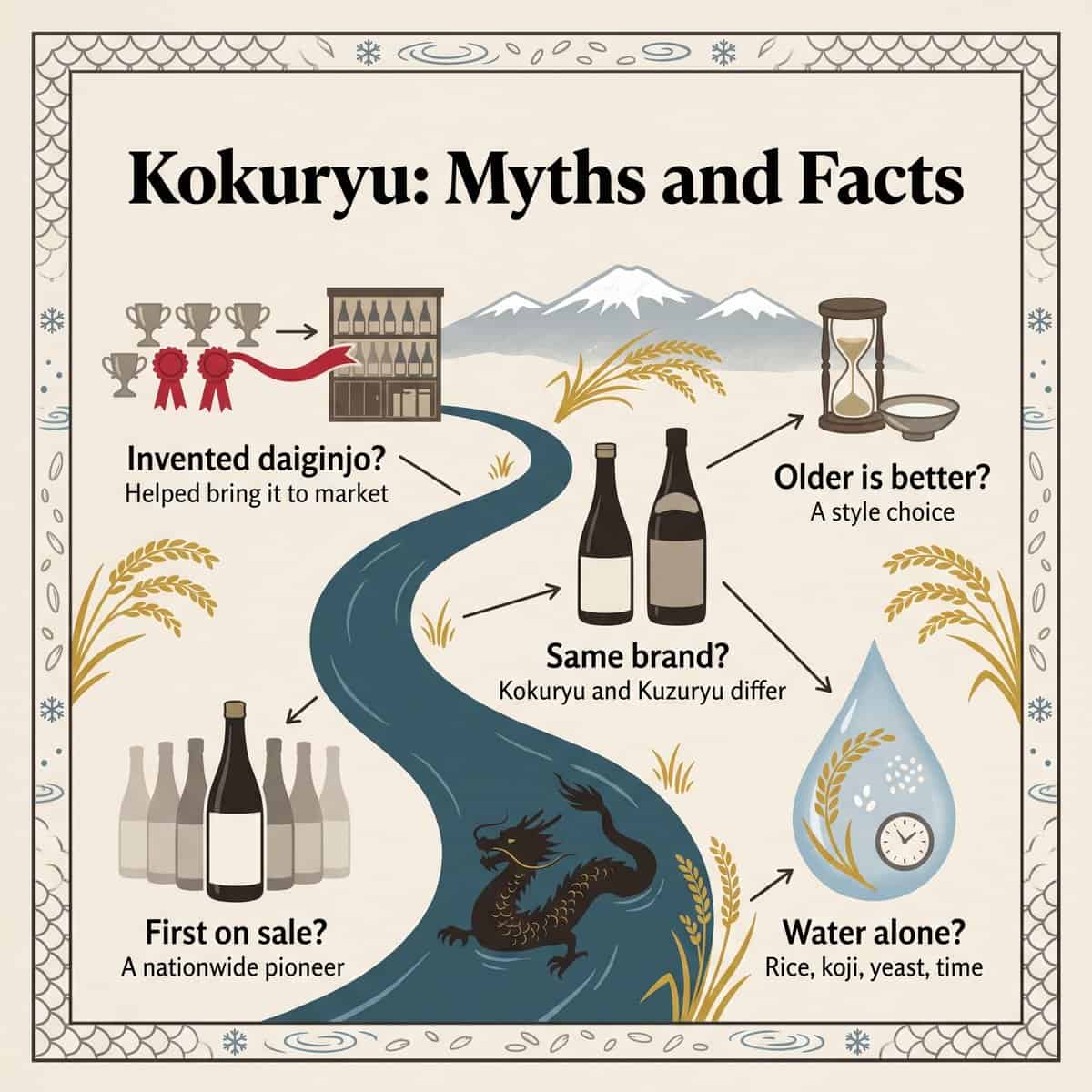
“Kokuryu invented daiginjo.” Ginjo developed through decades of competitions and research. Kokuryu helped bring it to market.
“Ryu was Japan’s first daiginjo on sale.” The brewery calls it a nationwide pioneer. No independent ranking confirms “first.”
“Kokuryu and Kuzuryu are the same brand.” They are separately named brands from one brewery group.
“Every Kokuryu bottle tastes the same.” Fresh, aged, chilled, and warmed bottles differ widely.
“Older sake is always better.” Aging is a style choice that depends on storage and the sake itself.
“Water alone explains the flavor.” Rice, koji, yeast, temperature, and time matter as much.
Final Thoughts
Kokuryu’s importance does not rest on being first at anything. It rests on a choice made in 1975 to sell a demanding, competition-style sake as a commercial product. Fifty years on, that bottle is still in the range. Meanwhile, low-temperature aging and, more recently, ESHIKOTO have grown from the same habit of looking for the next thing.
If you want to taste the story, start with Daiginjo Ryu lightly chilled, then try a Kuzuryu bottle warm. After that, our Japanese sake guide can take you further into Fukui and beyond.
Facts and product details in this article were last checked in October 2026.
Frequently Asked Questions About Kokuryu Sake
What is Kokuryu sake?
Kokuryu is the main sake brand of Kokuryu Sake Brewery in Eiheiji Town, Fukui Prefecture. The brewery traces its founding to 1804, and its best-known bottle is Daiginjo Ryu, launched in 1975.
What does the name Kokuryu mean?
It means “black dragon.” The name connects to traditions around the Kuzuryu River, which one account says was once called Kokuryu-gawa, or Black Dragon River.
What is Kokuryu Daiginjo Ryu?
It is the brewery’s historic daiginjo, first sold in 1975. Current product information lists it as made with Yamada Nishiki polished to 40%, and the brewery describes it as a nationwide pioneer in commercial daiginjo.
Was Ryu the first daiginjo sold in Japan?
The brewery does not claim that. It says Ryu was a nationwide pioneer in selling competition-grade daiginjo, and no independent source reviewed here confirms a “first.”
What is the difference between Kokuryu and Kuzuryu?
They are separately named brands from the same brewery group. Kokuryu includes many of the brewery’s premium ginjo and daiginjo bottles, while several Kuzuryu bottles are promoted for a wider range of serving temperatures, including warm service. The difference is best judged bottle by bottle.
Does Kokuryu age its sake?
Yes. The brewery links its low-temperature aging to the experiments behind Ryu. Its 50th-anniversary Ryu, for example, was made from sake brewed in 2020 and matured for five years before release in 2025.
Where can I buy or taste Kokuryu in Fukui?
The brewery group runs the Ishidaya shops, including the ESHIKOTO store that opened in June 2022 and offers tastings. Check current hours and any age restrictions on the official site before visiting.
J-STAGE – Goto, K. (2012). 「全国新酒鑑評会」について [On the National New Sake Appraisal]. Journal of the Brewing Society of Japan, 107(3), 149–159 (Accessed October 2026)
Ryo Iwa is the founder and editor of foodinjapan.org. Born and raised in Japan, he writes from regional travel, market visits, and Japanese-language primary sources that rarely reach English readers, including brewing institute publications and industry glossaries. Where a figure cannot be traced to a source, the article says so.
He has been a Google Maps Local Guide for over 10 years, with more than 1,800 reviews and over 41,000 photos viewed hundreds of millions of times. He previously spent two decades as an IT consultant in Japan, the US, and the UK.













Comments