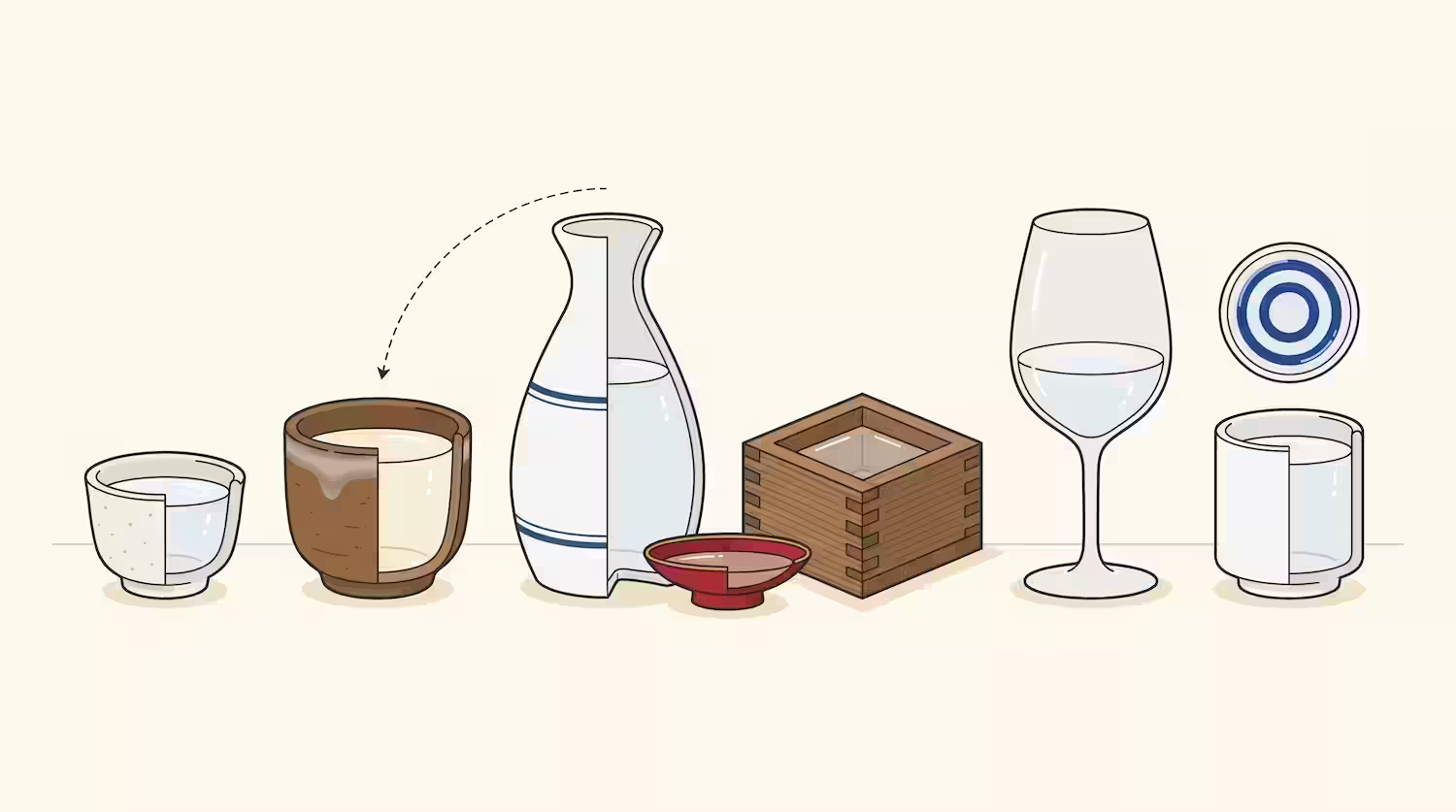
Pour the same sake into three vessels: a small ceramic cup, a straight-sided glass and a wine glass. Then smell each one. The sake has not changed, yet the three pours may not seem the same. One might seem quieter, another brighter.
This guide explains sake glasses and cups, from the ochoko and guinomi to the tokkuri, masu and kiki-choko tasting cup. It also covers what each vessel does and how shape and material can shift your impression. Finally, it shows how to choose without worrying about rules.
TOC
Is There a Correct Sake Cup?
No single sake cup is correct. In fact, the Japan Sake and Shochu Makers Association (JSS) says no strict rules link a vessel to a sake. Some pairings work better than others, though, and that is what this guide is about.
The cup does not change the sake itself. It can, however, change how much aroma reaches your nose and how the sake meets your lips. It also changes how fast the sake warms and how big each sip is. Together, those small shifts add up to a different impression.
Traditional Does Not Mean Mandatory
At first, many visitors assume sake must come in a tiny ceramic cup. In practice, Japanese bars and restaurants use a wide mix of vessels. A fragrant sake may arrive in a stemmed glass, while warm sake often comes in a flask with small cups. Both choices are normal.
So treat tradition as a starting point. After all, your mood, the food and the setting all count.
What a Vessel Can Change
Sake researchers separate the experience into parts: aroma before sipping, aroma in the mouth, taste, mouthfeel and finish. As a result, a vessel can nudge several of those at once. Here is what tends to shift:
Aroma: how much scent gathers above the sake before you sip.
Temperature: how the vessel’s material, thickness and serving size affect heat transfer.
Lip feel: how the rim feels against your lips and controls the flow of sake.
Sip size: how much sake reaches your mouth at once.
Pace: how often you refill, and therefore how fast you drink.
Look: color, clarity, light and the mood of the table.
The Basic Sake Drinking Set
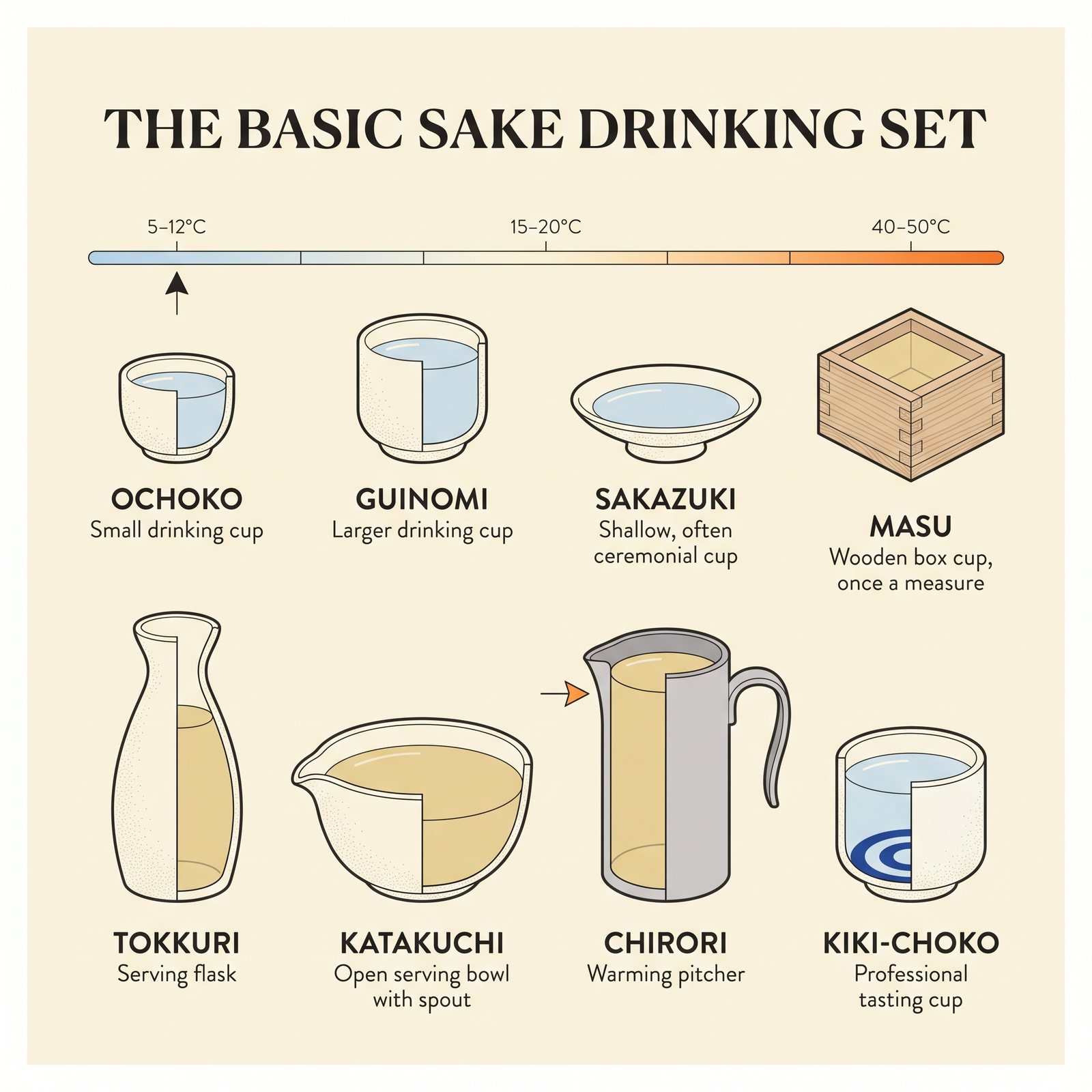
Before going deeper, it helps to sort vessels by job. Some are for drinking and some for serving, while one is mainly for warming. Mixing them up is a common point of confusion, and honestly, an easy one.
Vessel
Japanese
Main job
Typical material
Ochoko
お猪口
Small drinking cup
Ceramic or porcelain
Guinomi
ぐい呑み
Larger drinking cup
Ceramic, glass, metal
Sakazuki
盃
Shallow cup, often ceremonial
Lacquer, porcelain
Masu
枡
Wooden box cup, once a measure
Wood
Tokkuri
徳利
Serving flask
Porcelain, ceramic, glass
Katakuchi
片口
Open serving bowl with spout
Ceramic, glass, lacquer
Chirori
ちろり
Warming pitcher
Tin, pewter or copper
Kiki-choko
利き猪口
Professional tasting cup
White porcelain
If you are new to sake, you only need four names at first: ochoko, guinomi, tokkuri and masu. Then, for ordering and table manners, see our guide on how to drink sake in Japan.
Ochoko: The Classic Small Sake Cup
The ochoko is the small cup most people picture when they think of sake. In fact, the government magazine Highlighting Japan describes it as small enough to drink in one sip. Most are ceramic or porcelain, and many come in matching sets with a tokkuri.
Why Is It So Small?
Historical reasons are hard to pin down, but one practical advantage is clear. Warm sake cools, and chilled sake warms, once it leaves the flask. A small pour can be finished before its temperature changes very far.
Their small size also fits easily with the custom of pouring for one another, which the Highlighting Japan feature describes. Friends keep an eye on each other’s cups and refill them. Frequent refills can hide how much you have had, though, so keep a glass of water nearby.
Shapes Vary More Than You Think
Not every ochoko has a narrow mouth. Instead, some flare out, some stand straight like a thimble, and some are nearly flat. So any general claim about “the ochoko effect” needs care. Still, JSS offers one useful rule of thumb about shape, which we return to later.
A quick tip: if a restaurant brings a basket of cups, pick the one you like the look of. After all, nobody expects a technical choice, and the small ritual makes the table feel personal.
Guinomi: A Larger Cup for Aroma and Texture
Simply put, a guinomi is a larger drinking cup. According to the Highlighting Japan feature, it is a size up from the ochoko and suits drinking over several sips. JSS also adds that its bigger mouth lets you enjoy more aroma.
How It Differs From an Ochoko
The main difference is size, not status. In other words, a guinomi is not “the premium cup,” and an ochoko is not the cheap one. Instead, a bigger cup changes the experience in two ways. First, more surface area is open to the air. Second, each pour lasts longer, so the sake has more time to change temperature as you drink.
Is that good or bad? It depends. For instance, with a gently warmed sake, watching it cool can be part of the fun. With a delicate chilled sake, however, a large pour may warm past its best before you finish.
Guinomi as Pottery and Craft
Guinomi are also a natural canvas for pottery. Because a guinomi sits in the hand for longer, its weight, glaze and texture become part of the drink.
Sakazuki: Sake for Ritual and Special Occasions
The sakazuki is a shallow, wide cup. In casual Japanese, the word can also mean a sake cup in general. Yet the classic sakazuki, often in red lacquer, carries ceremonial associations that everyday cups do not.
Weddings, New Year and Ceremony
A guide by JSS and the National Research Institute of Brewing (NRIB) covers this history. It notes that nobles used lacquered sakazuki at banquets and ceremonies since ancient times. Even today, at traditional weddings, the couple sip from a vermilion lacquered cup about 20 cm across. Gold lacquer often decorates the surface.
Sake also marks the turn of the year. Likewise, the same guide says families gather on New Year’s morning to share sake and wish each other long life. Shrines, meanwhile, still receive sake as an offering. For the deeper roots of these customs, see our article on ancient sake in Japan.
Why a Shallow Cup?
Because it is shallow and wide, the cup holds very little and shows off the surface of the sake. That suits ritual, where the gesture matters more than the amount. It also tends to make sake feel light, which fits the JSS observation about shallow, thin-lipped vessels.
Tokkuri: The Sake Serving Flask
One point often confuses visitors: a tokkuri is not a cup. Instead, it is a serving flask with a narrow neck and a rounded body. You then pour from it into an ochoko, guinomi or sakazuki.
Size, Shape and Material
The 2011 JSS and NRIB guide describes porcelain tokkuri for heated sake in the 150 to 300 ml range, although modern vessels vary. Shapes range from gourds to tall candle-like forms, with decoration from simple indigo lines to multicolor overglaze. Glass tokkuri are also sometimes used for chilled sake.
You may also hear the word o-choshi. Some restaurants use it loosely for a serving flask. Formally, though, a choshi can mean a different vessel with a handle, and JSS describes the two separately. So do not worry if two shops use the words differently.
Warm or Chilled?
Because tokkuri are traditionally warmed in hot water, many people link them with warm sake. That link is real, but it is not a rule, as glass tokkuri for chilled sake show. For warming methods, see our guides to warmed sake and hot sake.
Can You Drink Straight From a Tokkuri?
You can, physically. However, it looks out of place at a Japanese table, a bit like drinking wine from the decanter. The flask is designed for pouring rather than drinking from directly, so use a cup instead.
Katakuchi: The Open-Top Serving Vessel
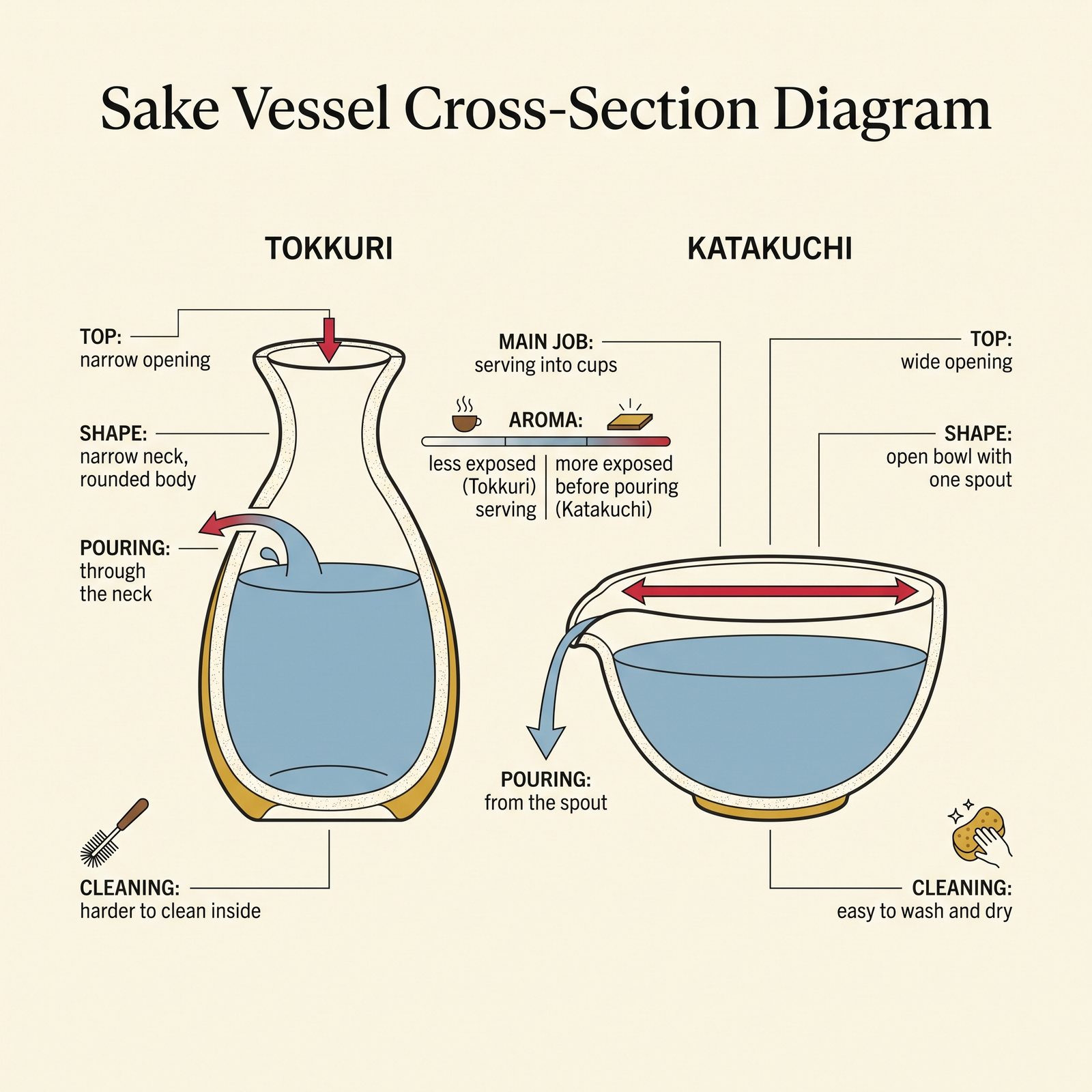
A katakuchi is an open bowl with a spout on one side. Similarly, the Highlighting Japan feature compares it to a small pitcher. Like the tokkuri, it is for serving, not drinking.
Tokkuri vs Katakuchi
Point
Tokkuri
Katakuchi
Main job
Serving into cups
Serving into cups
Shape
Narrow neck, rounded body
Open bowl with one spout
Top
Narrow opening
Wide opening
Pouring
Pours through the neck
Pours from the spout
Aroma
Less exposed while serving
More exposed before pouring (JSS)
Cleaning
Harder to clean inside
Easy to wash and dry
JSS notes that the katakuchi has a larger opening than a tokkuri. That can make the aroma easier to notice while the sake is presented and poured. The open top also lets you see the sake. Even so, katakuchi are not limited to chilled sake. Ceramic and lacquer versions, for example, also appear with room-temperature and warm sake.
Chirori: A Traditional Vessel for Warm Sake
The chirori is a small metal pitcher with a handle and spout. According to the NRIB guide, makers use pewter or copper, and it holds about 150 to 300 ml. The Highlighting Japan feature describes tin or copper versions. Its job is mainly to heat sake.
Why Metal?
Metal passes heat quickly. Set a chirori in hot water, and the sake warms faster than it would in thick ceramic. Staff then pour it into a tokkuri or straight into cups. That quick response also makes it handy when precise temperature control matters.
Will tin make sake taste smoother? You will often read that claim. We could not find solid evidence for a chemical effect, so treat it as tradition rather than science. Still, rapid temperature adjustment is the clearest practical benefit.
Masu: From Measuring Rice to Drinking Sake
Why does sake sometimes arrive in a wooden box? The answer starts with measuring, not drinking. A masu was a standard measure for grain and liquid long before it became a sake cup.
A Measuring Tool First
Japan long measured grain and liquids by volume. You filled a masu to the brim and leveled it, so you got a fixed amount. Today, one gō, the common sake serving unit, equals about 180 ml, and one shō equals ten gō.
Museums still hold old liquid measures. For example, the Takaoka City Museum keeps a wooden one-gō masu for liquids. Its side carries a burned brand reading “Ogaki,” a city in Gifu Prefecture.
From Measure to Cup
Over time, the box that measured sake also became a way to serve it. Today, you may drink straight from the corner of a masu, or receive a glass set inside one. In the second style, staff often pour until sake spills into the box, usually presented as a generous pour.
Exactly when masu became common as drinking vessels is less clear. However, sources disagree, and we have not found a firm primary record. So be wary of claims that people have always drunk sake from masu.
Wood and Aroma
Wooden cups add their own scent. JSS notes that wooden cups such as the masu add a woody aroma. The kind of wood varies by maker. If you enjoy that note, try taruzake, sake stored briefly in cedar casks.
A practical caveat is that wood can compete with delicate aromas. For a fragrant daiginjo, therefore, the scent of the box may compete. With a simple, dry sake at a festival, though, the wood can feel just right.
Why Is Sake Sometimes Served in a Wine Glass?
At first glance, sake in a wine glass can look like a modern fashion. Yet wine glasses are not merely decorative. The 2011 JSS and NRIB guide lists a Bordeaux-style glass as a tasting option. It also says that glass suits nearly all types of sake.
What the Bowl Does
A wine glass has a wide bowl and a narrower rim, so that shape gives aroma room to collect above the liquid. Similarly, JSS notes that a wine glass, like a guinomi, has a large mouth that shows off complex aromas.
Interestingly, research on wine offers a clue about why shape matters. In a 2015 study in Analyst, Japanese researchers imaged ethanol vapor above glasses of wine. At 13°C, for example, a wine glass showed a ring of higher ethanol near the rim, with less in the center. By contrast, a straight glass and a cocktail glass did not show that ring.
That study measured wine, not sake, so take it as a hint rather than proof. Still, it supports a simple idea. The shape of a glass changes where vapors gather, and that may change what your nose meets.
Which Glass for Which Sake?
For most sake, a medium-sized wine glass, such as a Bordeaux-style glass, is a good starting point. The NRIB guide suggests a larger balloon or Burgundy glass for aged sake, to show its nutty, dried-fruit notes. Fragrant ginjo and daiginjo also tend to suit a wine glass, because their fruity aroma comes from yeast esters.
Kiki-Choko: The Professional Tasting Cup
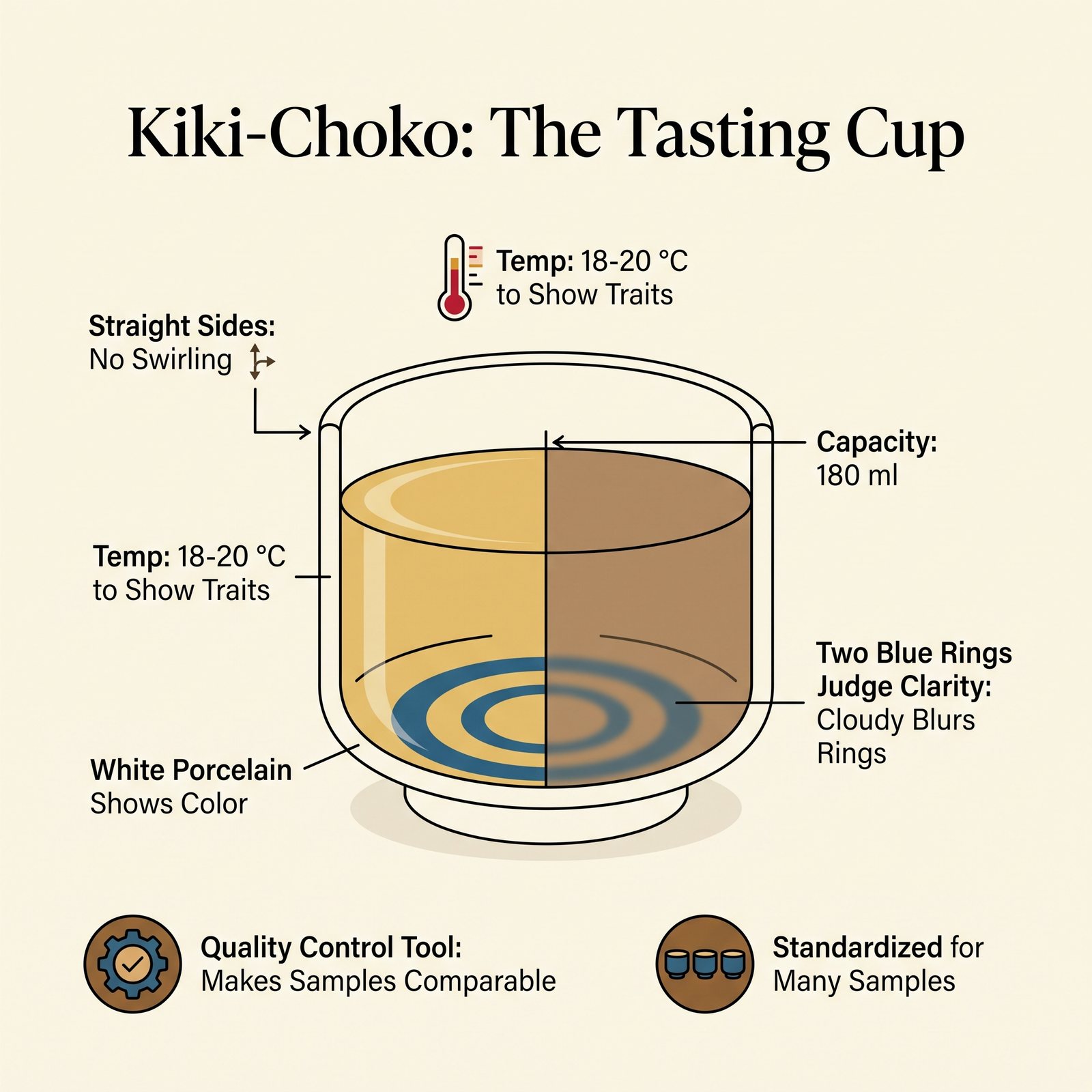
Breweries and analysis labs have traditionally used a cup called the kiki-choko. Perhaps you have seen it: a white porcelain cup with two blue rings inside the bottom. It looks plain, almost clinical. That is the point.
Why Blue Rings?
The 2011 JSS and NRIB guide describes the kiki-choko used by breweries and analysis labs. It holds 180 ml and has two concentric cobalt blue circles. First, the white porcelain shows the color of the sake. Second, the blue rings help tasters judge clarity. If the sake is slightly cloudy, the edges of the rings blur.
During storage, unexpected cloudiness can indicate inadequate filtration or microbial contamination, according to the guide. So the cup is really a quality-control tool. Its look comes from function, not decoration.
Straight Sides and No Swirling
The NRIB guide also points out that the kiki-choko has straight sides. After all, sake tasting usually skips the swirl used in wine tasting. The guide suggests this may be because aroma in the mouth matters more for sake than aroma from the cup.
Professional tasting also controls the conditions. Furthermore, the guide recommends tasting at 18 to 20°C, a temperature that shows subtle traits and limits fatigue. In other words, the standard cup exists to make many samples comparable, not to make one sake taste its best.
Kiriko and Decorative Glassware
Kiriko is Japanese cut glass. The Agency for Cultural Affairs database describes it as patterns carved into clear or color-coated glass. One designated Edogawa craftsperson carves patterns without a drawn design, while other workshops first mark layout lines on the glass. Either way, the glass catches light in sharp, sparkling lines.
Edo Kiriko and Satsuma Kiriko
The best-known style, Edo kiriko, began in Edo, now Tokyo, in the 19th century. Later, in 2002, it became a nationally designated traditional craft. According to Tokyo’s craft guide, Edo kiriko uses a colored layer under 1 mm thick. Satsuma kiriko from Kagoshima, by contrast, carves a thicker layer for soft color gradients.
Kiriko cups work well with chilled sake, where light passes through the sake and the cut pattern together. Still, a kiriko cup makes a simple glass of sake feel like a small celebration. This decorative character also makes kiriko a natural gift choice.
Ceramic Sake Cups and Japanese Pottery
JSS says small ceramic cups are the most common sake cups in Japan. Moreover, famous pottery regions each make cups with their own clay, glazes and designs. So when you choose a cup, you are also choosing a piece of regional craft.
Six Pottery Traditions to Know
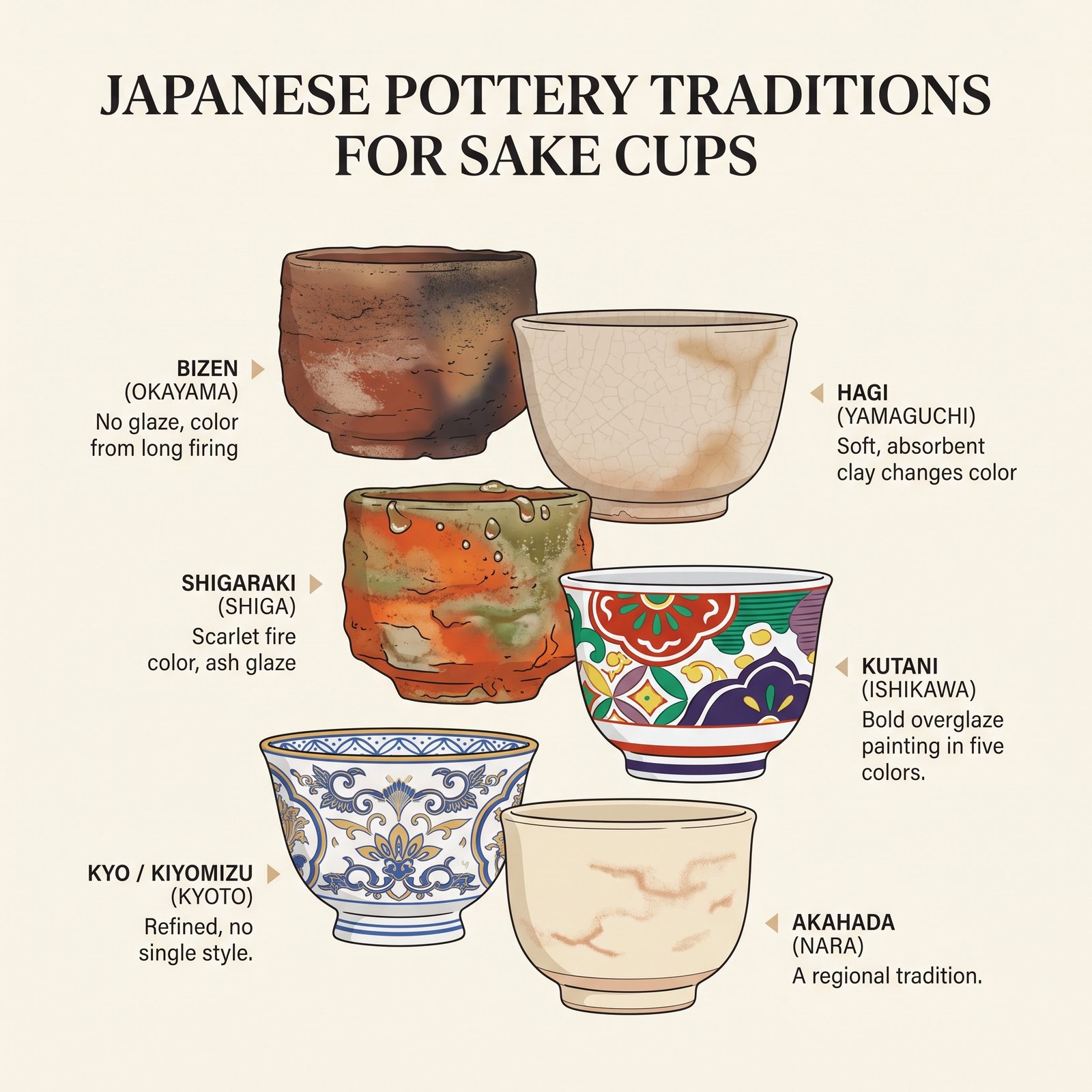
JSS highlights several pottery styles for sake cups, and the table draws on Japan’s official craft showroom for details. Five of the six below are nationally designated traditional crafts, a status that requires handwork, traditional techniques and an established production area. Akahada ware appears here as a regional tradition instead.
Pottery
Region
What to look for
Bizen
Okayama
No glaze or painting; color and texture come from long kiln firing
Hagi
Yamaguchi
Soft, absorbent clay; tea and sake slowly change its color
Shigaraki
Shiga
Scarlet fire color, natural ash glaze, dark scorch marks
Kutani
Ishikawa
Bold overglaze painting in five traditional colors
Kyo / Kiyomizu
Kyoto
No single style; refined traditional and modern work
Akahada
Nara
Featured by JSS; not on the national designated list
Other names come up too. The NRIB guide also lists Karatsu, Imari, Mino and Seto as sources of everyday sake cups. In short, nearly every pottery region in Japan makes vessels for sake.
Regional Sake With Regional Pottery
JSS notes that many people consider it sophisticated to match a cup’s origin with the sake’s region. A Bizen cup with an Okayama sake, for instance, tells a small local story. There is no science claiming a perfect match, though. Instead, it is a cultural pleasure, and a lovely one.
Sake Culture as Craft Culture
Sake vessels sit where several Japanese crafts meet: pottery, glass, woodwork, lacquer and metalwork. Buying one handmade cup can change how you drink. You start to notice its weight, its glaze and the way the rim meets your lip. For the bigger story of how the drink itself developed, read our history of sake.
Does the Shape of a Cup Change the Taste?
Shape is the technical heart of this topic, and also the area with the most myths. The safest answer is that shape can change perception. It does not change the sake itself.
Opening: Narrow or Wide
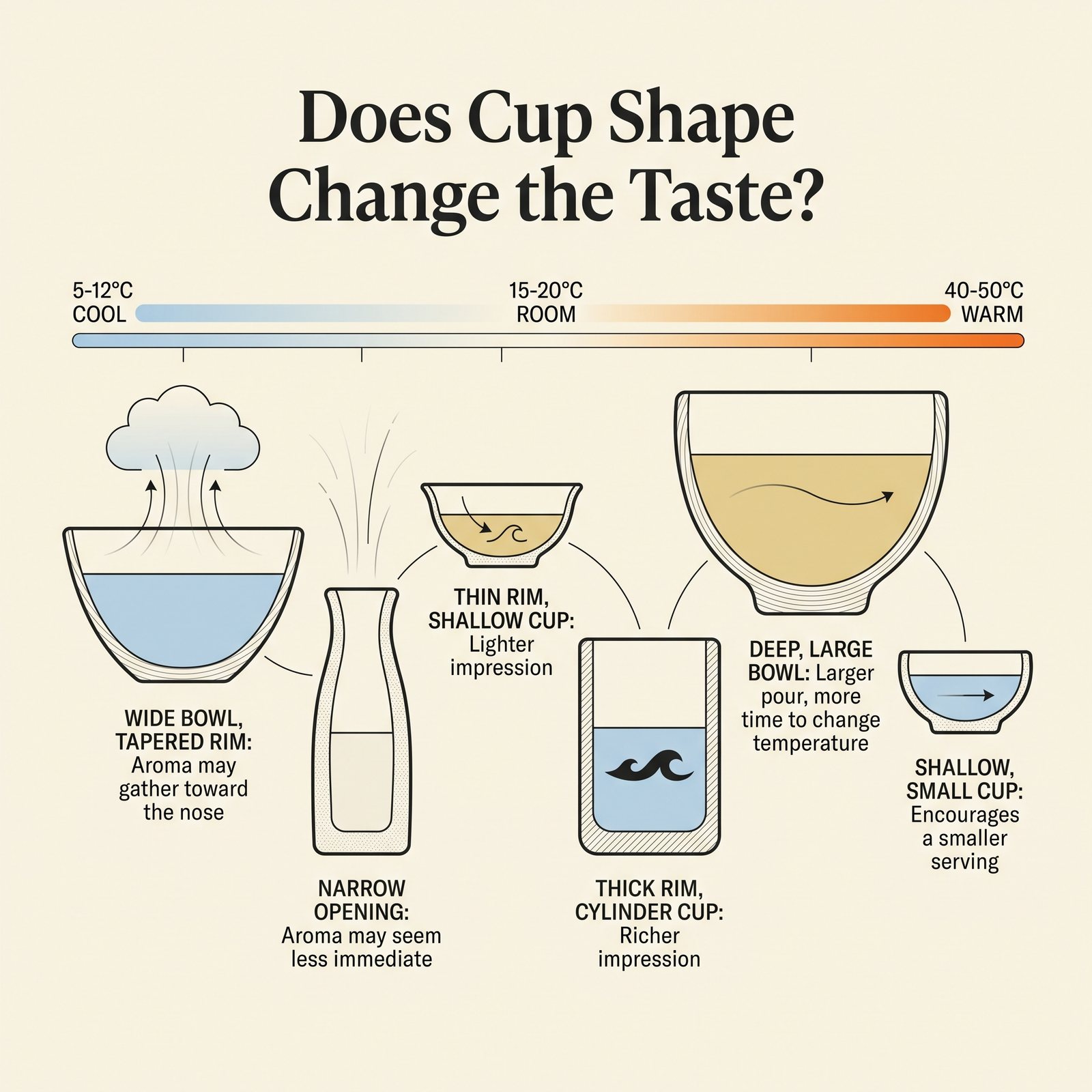
Several features interact here. A broad liquid surface may release aroma differently from a narrow one. A large bowl also creates more headspace, while the rim controls where that space opens toward your nose. So “wide is aromatic” and “narrow concentrates aroma” can both be true for different designs.
Rim: Thin or Thick
JSS gives the clearest guidance here. A cylinder-shaped cup with a thick lip tends to make sake taste richer. In contrast, a shallow cup with a thin lip makes it taste lighter. Similarly, the NRIB guide repeats the same idea about sakazuki.
Why might that happen? A thin rim lets sake flow smoothly onto the tongue. On the other hand, a thick rim slows the flow and adds weight against the lips. That explanation is reasonable, but formal studies on sake cups are scarce, so treat it as experience rather than proven fact.
Depth and Bowl Size
Depth and size work together. A deep cup holds a larger pour, so each serving lasts longer and changes temperature more. By contrast, a shallow cup holds less and empties sooner, so it encourages smaller servings.
Shape feature
Possible effect
Worth trying with
Wide bowl, tapered rim
Aroma may gather toward the nose
Fragrant ginjo, chilled sake
Narrow opening
Aroma may seem less immediate
Clean, dry sake
Thin rim, shallow cup
Lighter impression (JSS)
Delicate, light sake
Thick rim, cylinder cup
Richer impression (JSS)
Fuller junmai, warm sake
Deep, large bowl
Larger pour, more time for temperature change
Slow sipping
Shallow, small cup
Encourages a smaller serving
Sharing at the table
Keep in mind that these effects depend on many things at once. The sake, its temperature, the pour size and your own senses all play a role. So use the table as a guide for experiments, not a law.
Does Material Change the Sake?
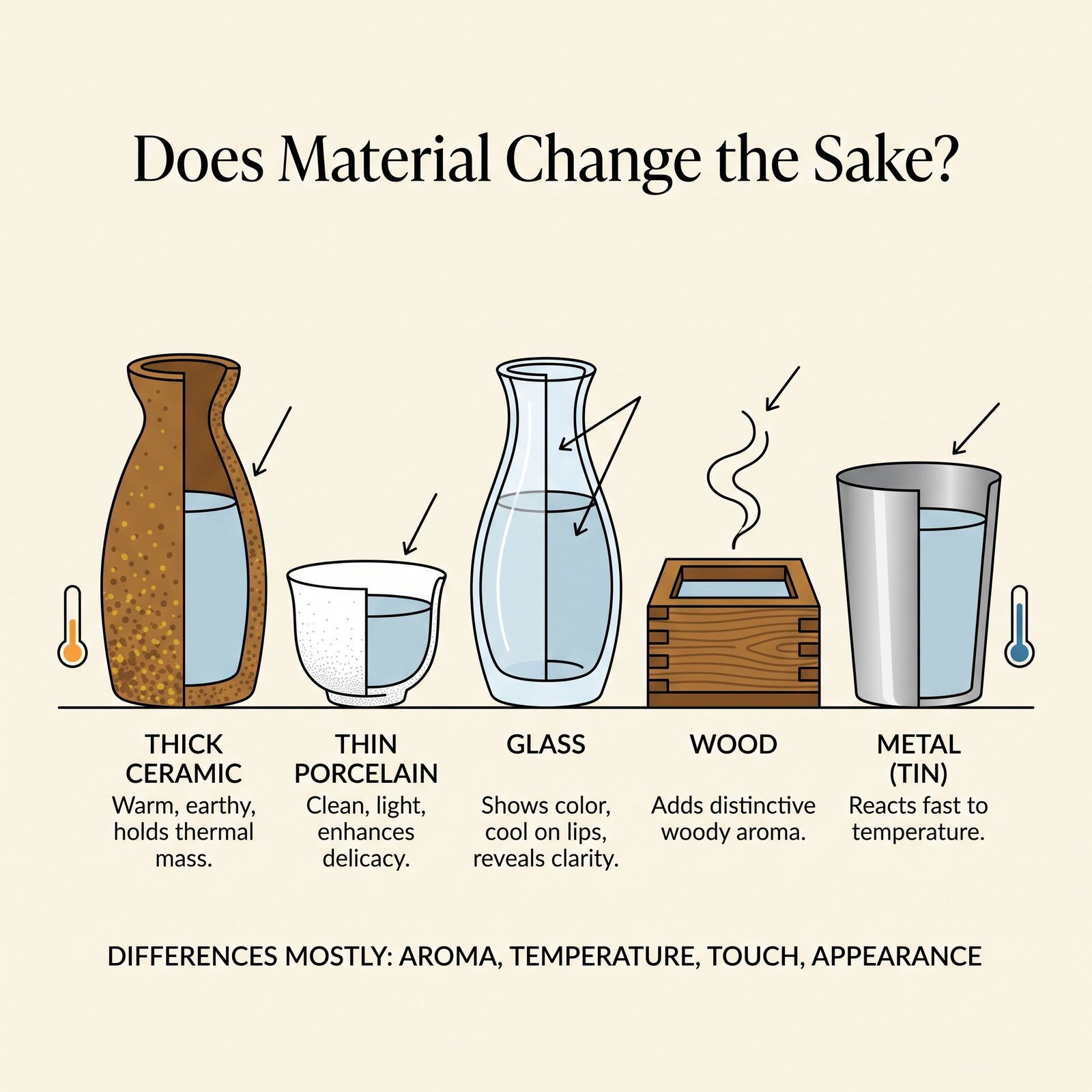
Material shapes the experience mainly through heat, touch, sight and, with wood, scent. So here is a practical way to think about each one.
Ceramic and Porcelain
Ceramic is the classic choice. Thick stoneware feels warm and earthy in the hand. It also has more thermal mass. A pre-warmed cup can slow cooling, while a cold one may first draw heat from the sake. Thin porcelain feels cleaner and lighter. Some drinkers describe sake in rough stoneware as rounder, although that is a personal impression.
Glass
Clear glass makes color and clarity easy to observe. It also feels cool against the lips, which fits chilled sake. JSS notes that small glasses of up to 110 ml are the most common choice for chilled sake. The NRIB guide also mentions 60 ml and drum-shaped glasses.
Wood, Lacquer and Metal
Wood adds aroma, as with the masu. Meanwhile, lacquer feels soft and smooth, and lacquered cups carry a ceremonial mood. Finally, metal cups and chirori respond quickly to temperature. A tin cup filled with chilled sake will feel cold fast, but it will also warm fast in your hand.
So does material change the sake? In practice, most differences here concern aroma, temperature, touch and appearance rather than a major change in composition. Wood is the main exception, since it can add scent. Even so, those sensory effects still shape how you enjoy a cup.
Which Vessel Should You Choose?
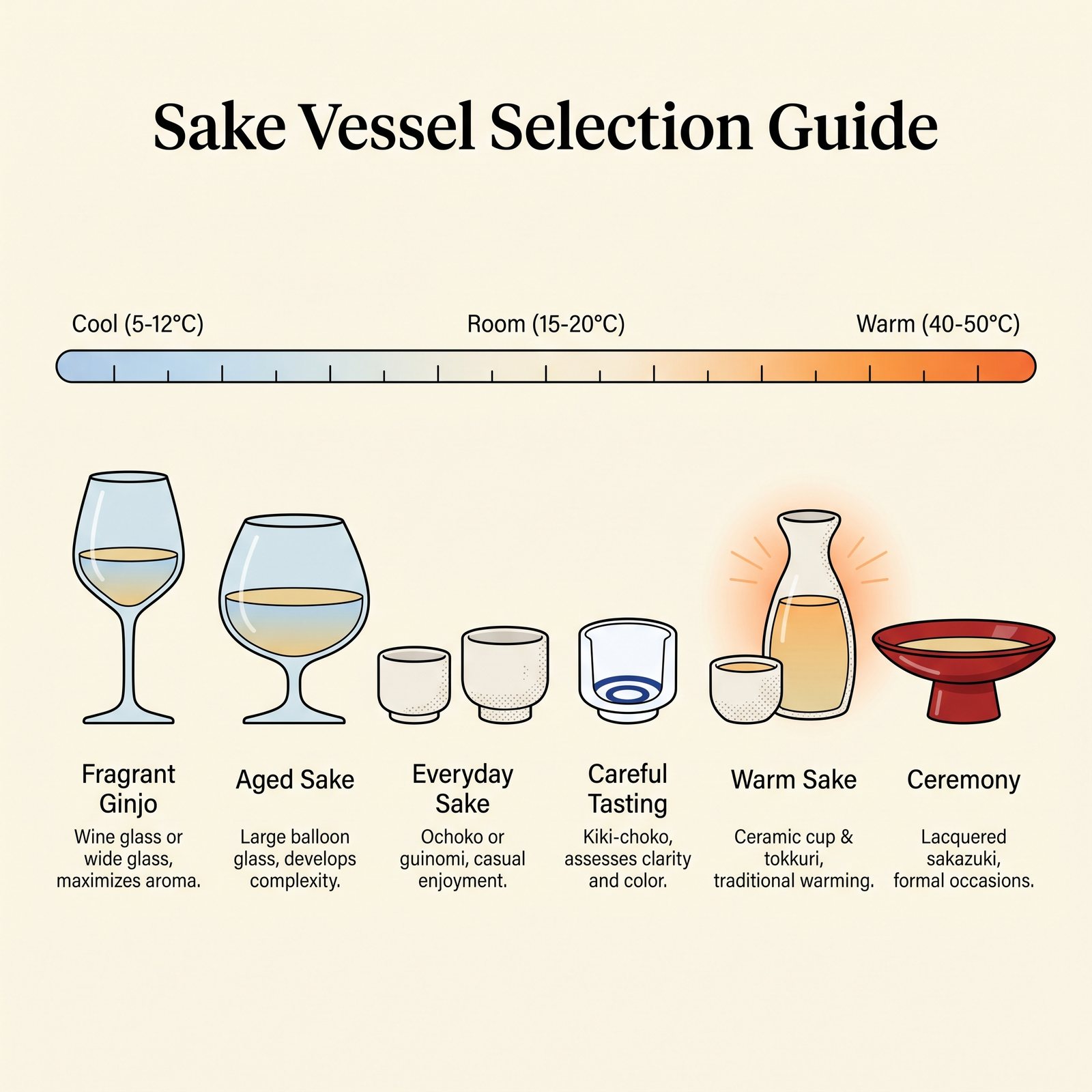
The cards below pair common situations with a vessel worth trying first. Then trust what you enjoy.
Fragrant ginjo
Wine glass or wide glass
Gives the fruity aroma room to gather.
Everyday sake
Ochoko or guinomi
Easy, relaxed and good for sharing with food.
Warm sake
Ceramic cup with tokkuri
Pre-warm the cup and keep the pours small.
Aged sake
Large balloon glass
Shows nutty, dried-fruit notes (NRIB guide).
Careful tasting
Kiki-choko
Shows color and clarity; keeps samples comparable.
Ceremony
Lacquered sakazuki
For weddings, New Year and formal toasts.
Temperature matters as much as the cup. As a general guide, the 2011 JSS and NRIB guide suggests about 8 to 10°C for ginjo and namazake. It describes warm sake as commonly served around 42 to 45°C. Individual styles may work well outside those ranges. For food matches, see our guide to sake and food pairing.
Try It Yourself: One Sake, Three Vessels
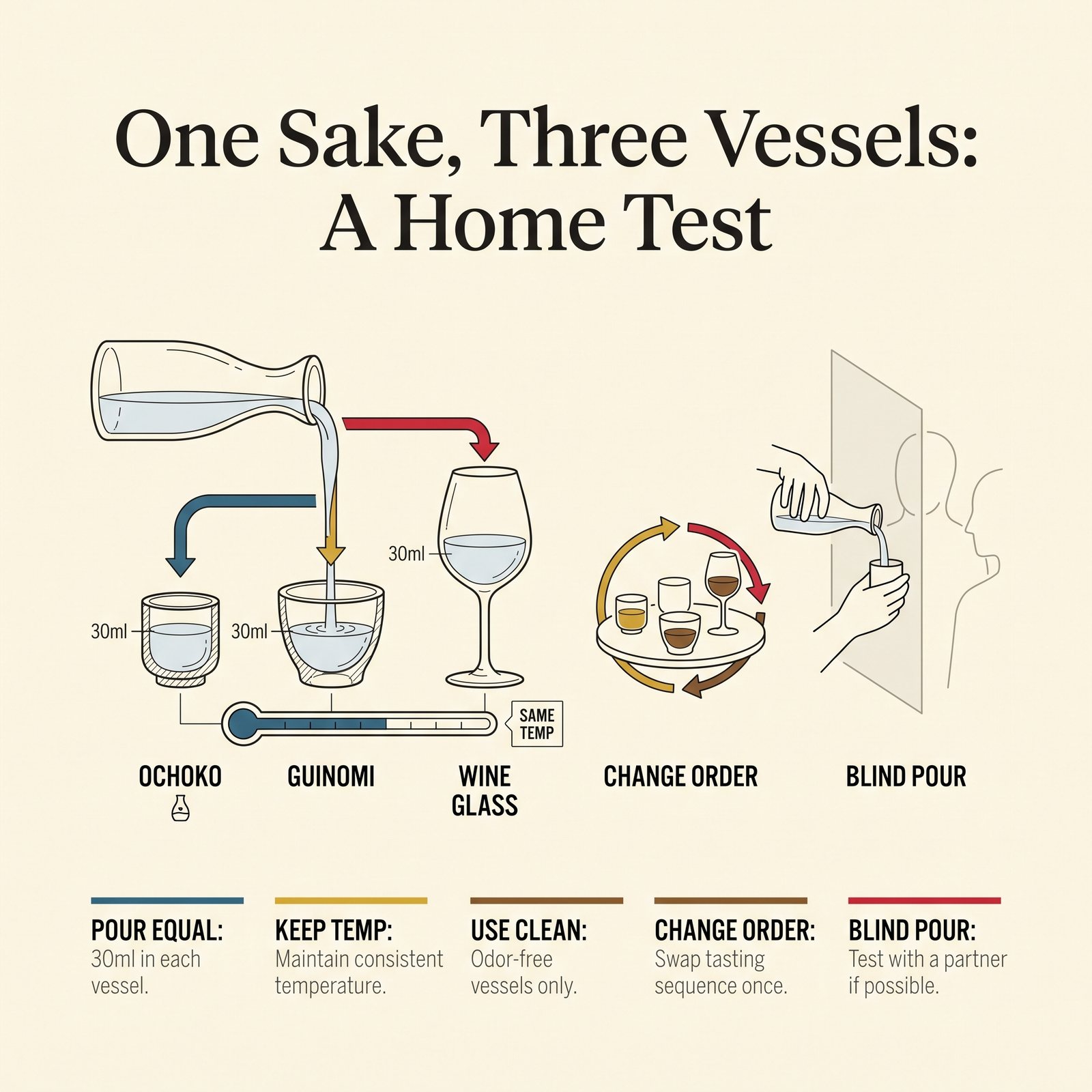
Perhaps the best way to understand all this is a small test at home. Choose one sake, ideally a clean, medium-bodied bottle served cool. Our guide to sake types can help you pick. Then pour the same amount into an ochoko, a guinomi and a wine glass.
How to Set It Up
Pour the same amount, about 30 ml, into each vessel.
Keep all three at the same temperature, and taste within a few minutes.
Use thoroughly cleaned, odor-free vessels, and rinse away any detergent.
Change the tasting order once, because the first sip often stands out.
If possible, ask a friend to pour so you do not know which is which.
Using the same volume controls the amount of sake, but not the fill level or headspace. That is part of the real-world vessel experience. It also means this is an informal comparison, not a laboratory test.
What to Notice
Check
Question to ask yourself
Aroma
How strong is the scent before you sip?
First sip
Does the sake feel sharp, soft or round?
Texture
Does it feel light or heavy on the tongue?
Finish
Does the taste fade quickly or linger?
Temperature
Which pour warms fastest in your hand?
Pace
Which vessel makes you drink faster?
Next, write down a word or two for each. Notice a difference first, and only then decide what you prefer. Those are separate questions. After all, sensory scientists keep them apart for good reason, and the habit makes your notes more useful.
How Restaurants Choose Sake Vessels
When a restaurant picks a vessel, it rarely thinks about the sake alone. Temperature, food, occasion and presentation all play a part.
From Izakaya to Kaiseki
At some izakaya, sake comes in a glass set inside a masu, or in a tokkuri with small cups. Sake bars, by contrast, may switch to stemmed glasses to show off aroma. At kaiseki dinners, the cup may change with the season and the dish, much as the plates do.
Similarly, the Agency for Cultural Affairs describes Japanese tableware, from lacquer to porcelain, as a way to express the seasons. It also ties presentation to hospitality. The same thinking can apply to sake vessels. A cool glass in summer and a thick ceramic cup in winter tell guests something before they even taste.
At a Brewery Tasting
Cups at brewery tastings vary from place to place. If you want to judge color, look for a white cup or hold a glass against something white.
Common Misconceptions About Sake Cups
There is one traditional sake cup.
Japan uses many vessels, from ochoko and guinomi to sakazuki, masu and glass.
Ginjo must be served in a wine glass.
A wine glass is a useful starting point, not a requirement.
A tokkuri is a drinking cup.
It is a serving flask. Pour from it into a cup.
The masu is just a restaurant gimmick.
It began as a standard measure for grain and liquid.
An expensive cup makes sake taste better.
Price and craft add pleasure, but they do not improve the sake itself.
Professional tasters use handmade pottery.
The 2011 JSS and NRIB guide describes a standardized white kiki-choko used in breweries and labs.
Final Thoughts
A sake vessel does four jobs at once. It holds and serves the drink, and it shapes what your senses notice. It also shows off a craft and carries a piece of culture. That is why one drink has so many cups.
Still, the best vessel is not always the most traditional one. Rather, it is the one that helps you enjoy the sake and the moment. So try a glass, a ceramic cup and maybe a masu, then keep what makes you happy. Your favorite might surprise you.
Sake Glasses and Cups FAQ
Names and Basics
What is a sake cup called?
The everyday small sake cup is called an ochoko. Meanwhile, a larger one is a guinomi, and a shallow, often ceremonial cup is a sakazuki. The general word for sake vessels is shuki.
What is the difference between an ochoko and a guinomi?
The main difference is size. A guinomi is larger and suits drinking over several sips. An ochoko, by contrast, is small enough to finish in one or two sips.
Why are sake cups so small?
A small pour can be finished before its temperature changes much. The size also fits the custom of pouring for one another. Frequent refills can hide the total amount, though, so keep track.
Choosing a Vessel
What glass is best for ginjo sake?
A medium-sized wine glass, such as a Bordeaux-style glass, is a good starting point for ginjo. Its bowl lets the fruity aroma gather. A small ceramic cup still works if you prefer it.
What cup is best for warm sake?
A small ceramic or porcelain cup is a classic choice. A pre-warmed cup slows cooling, and a small pour is finished before it cools much. Then serve it from a tokkuri for easy refills.
Does the shape of a sake glass affect the taste?
It can affect your impression, though not the sake itself. JSS says a thick-lipped cylinder cup tends to taste richer and a shallow, thin-lipped cup lighter. Bowl size and headspace also shape how aroma reaches you.
What Japanese pottery is used for sake cups?
Almost every pottery region makes sake cups. Well-known styles include Bizen, Hagi, Shigaraki, Kutani, Kyo-Kiyomizu and Akahada ware. Many people also enjoy matching a cup’s region with the sake’s.
National Research Institute of Brewing – A Comprehensive Guide to Japanese Sake (with JSS, 2011): sections 4.1, 4.4, 5.3 and 5.5 (Accessed October 2026)
Royal Society of Chemistry – Arakawa, T., Iitani, K., Wang, X., Kajiro, T., Toma, K., Yano, K., & Mitsubayashi, K. (2015). A sniffer-camera for imaging of ethanol vaporization from wine: the effect of wine glass shape. Analyst, 140(8), 2881–2886 (Accessed October 2026)
J-STAGE – Utsunomiya, H. (2007). Odor and aroma in the sensory evaluation of sake. Journal of Japan Association on Odor Environment, 38(5), 352–360 (Accessed October 2026)
J-STAGE – Takao, Y., Takahashi, T., & Sueno, K. (2019). Search for indicator compounds of taru aroma intensity in taruzake. Journal of the Brewing Society of Japan, 114(3), 159–163 (Accessed October 2026)
Ryo Iwa is the founder and editor of foodinjapan.org. Born and raised in Japan, he writes from regional travel, market visits, and Japanese-language primary sources that rarely reach English readers, including brewing institute publications and industry glossaries. Where a figure cannot be traced to a source, the article says so.
He has been a Google Maps Local Guide for over 10 years, with more than 1,800 reviews and over 41,000 photos viewed hundreds of millions of times. He previously spent two decades as an IT consultant in Japan, the US, and the UK.












Comments