


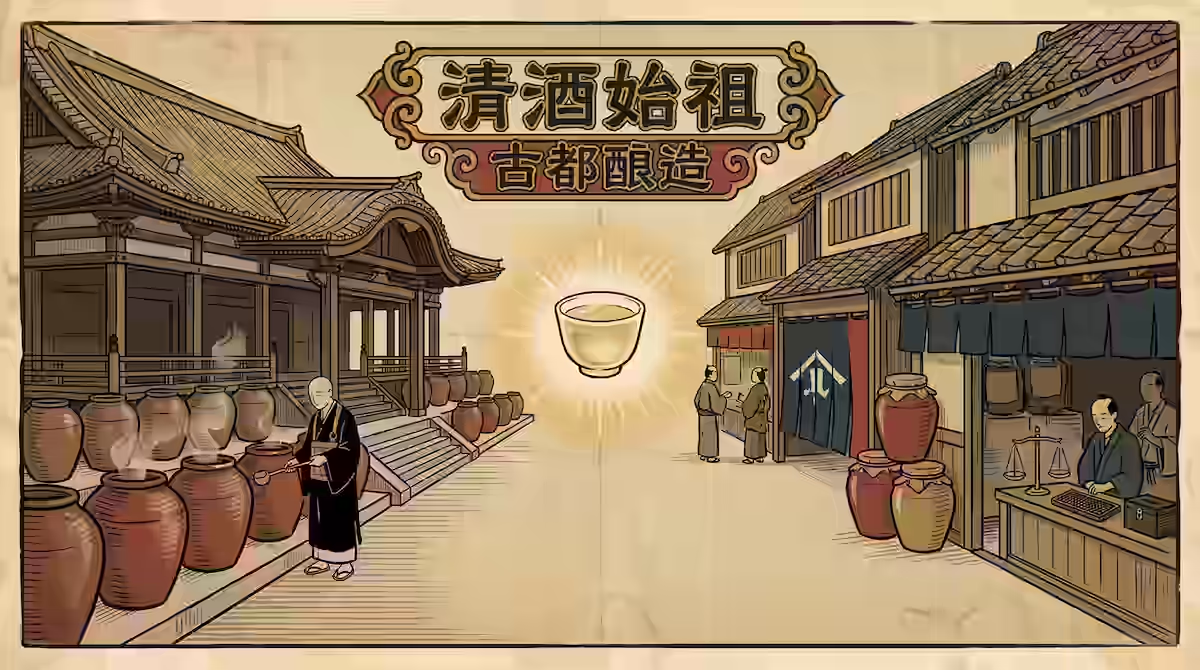


In 1425, a document kept at Kitano Shrine in Kyoto recorded 342 sake businesses inside and around the capital. By then, that number marks how far sake had travelled. It was no longer mainly a courtly ritual drink, but rather a commodity, a taxed trade, and a craft under active development.
Medieval sake is the story of three things happening together: commercialization, institutional control, and technical accumulation. Temples and city merchants all brewed, competed, and, importantly, left records. This guide follows that thread from the court’s fading monopoly to the brewing methods that early modern producers inherited.
What Medieval Sake Means
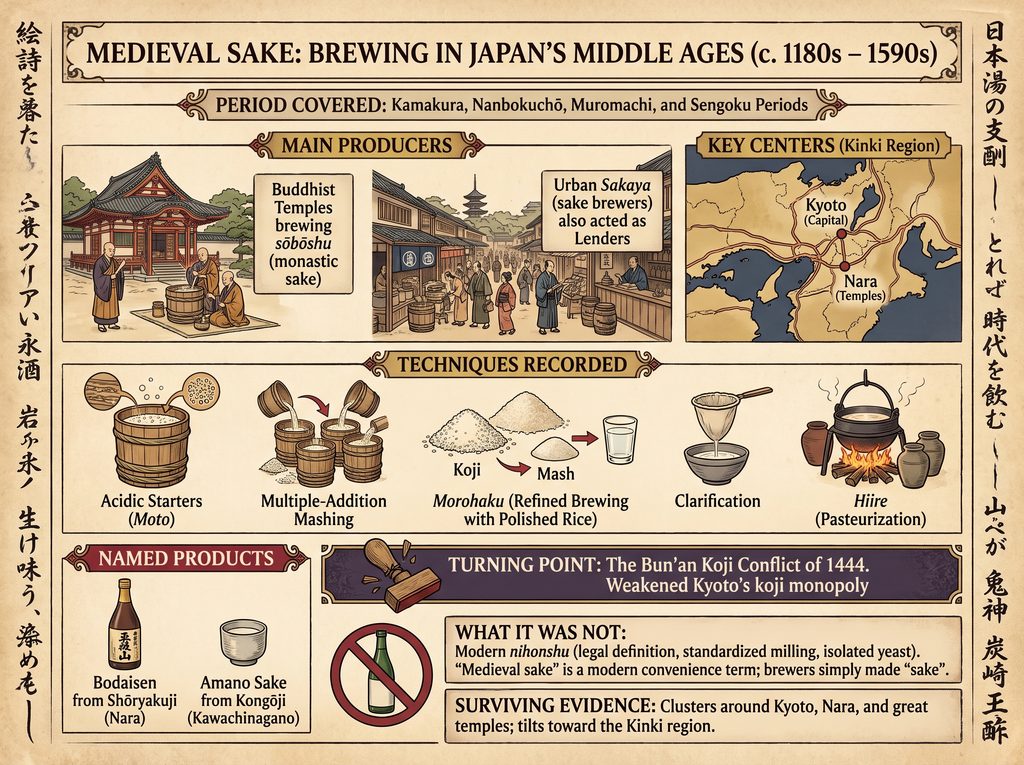
Medieval sake refers to the sake brewed in Japan between roughly the late twelfth and late sixteenth centuries, covering the Kamakura, Nanbokuchō, Muromachi, and Sengoku periods. Historians draw the boundaries slightly differently, although for brewing history the pattern matters more than the exact year.
- Period Covered
- Roughly the 1180s to the 1590s.
- Main Producers
- Buddhist temples brewing sōbōshu, and urban sakaya that also worked as lenders.
- Key Centers
- Kyoto and Nara, with the wider Kinki region behind them.
- Techniques Recorded
- Acidic starters, multiple-addition mashing, morohaku, clarification, and hiire.
- Named Products
- Bodaisen from Shōryakuji and Amano sake from Kongōji.
- Turning Point
- The Bun’an Koji Conflict of 1444, which weakened Kyoto’s koji monopoly.
- What It Was Not
- Modern nihonshu, which has a legal definition, standardized milling, and isolated yeast strains.
“Medieval sake” is also a modern convenience. Brewers at the time simply made sake, since none of the legal categories that define nihonshu today yet existed. One more limitation is worth stating early: the surviving evidence clusters around Kyoto, Nara, and a handful of great temples, so the picture tilts heavily toward the Kinki region.
How We Know: Manuals, Diaries, Tax Records, and Archaeology
Four kinds of evidence carry this history, and each one has its own strengths. Knowing what they are makes the rest of the article easier to weigh.
The four evidence types
Goshu no Nikki (御酒之日記) is a brewing manual recording production methods, including Bodaisen and Amano sake. Its date is disputed, with proposals ranging from the mid-fourteenth to the late fifteenth century.
Tamon’in Nikki (多聞院日記) is a daily administrative diary kept at a sub-temple of Kōfukuji in Nara from 1478 to 1618. Brewing appears alongside weather, deliveries, and disputes.
Kanmon Gyoki (看聞御記) is the court diary of Prince Fushimi-no-miya Sadafusa, which notes Amano sake in 1432.
Tax and guild records, plus excavated brewery sites, show scale and institutions rather than method.
Each type answers a different question. A manual shows what someone believed the correct method to be, but not how widely anyone followed it. A diary shows routine practice at one institution. Tax records count businesses, while archaeology reveals equipment. None of them alone gives a national picture.
Survival bias also shapes what we have. Documents endure where institutions endure, so temple archives and tax offices dominate the record. An ordinary Kyoto brewer probably kept notes as well, although those notes are almost certainly gone.
From Court Brewing to a Commercial Sake Economy
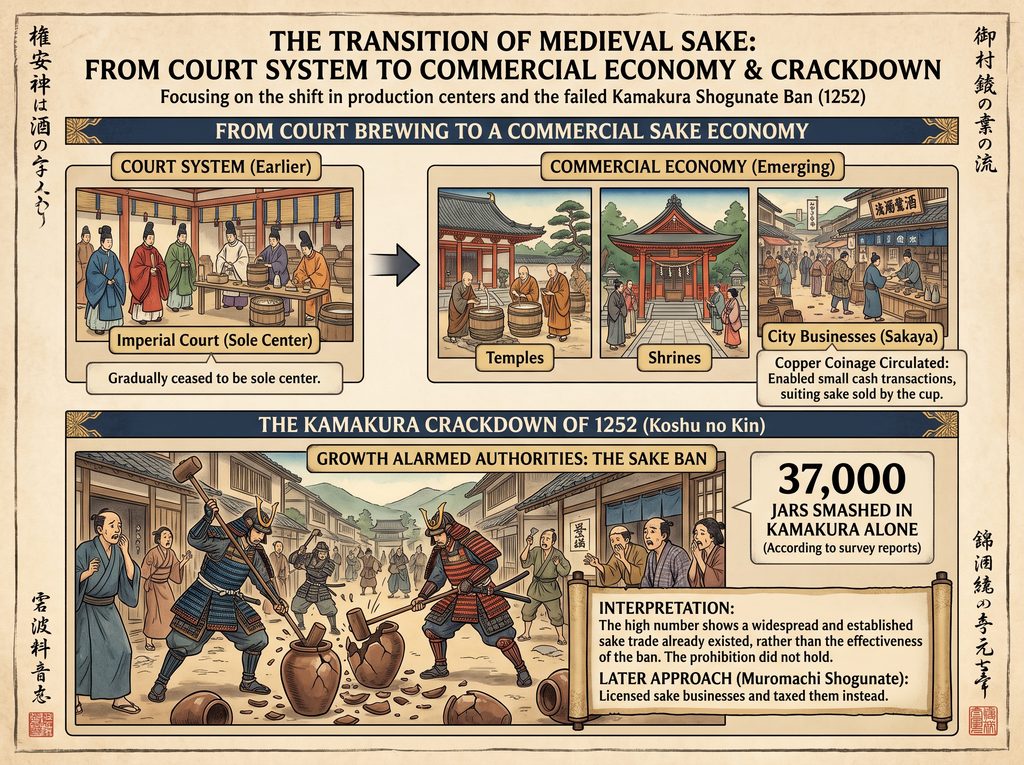
The court brewing system did not disappear immediately, but it gradually ceased to be the sole center of sake production. Temples, shrines, and city businesses all began brewing and selling. As copper coinage circulated more widely, small cash transactions became easier, which suited a drink sold by the cup.
The Kamakura Crackdown of 1252
Growth soon alarmed the authorities. In 1252, the Kamakura shogunate issued the koshu no kin, a ban on selling sake. According to a National Tax Agency survey report, households were allowed to keep one jar each, while the rest were destroyed. The number smashed in Kamakura alone is given as around 37,000.
So that figure says more about the trade than about the ban. You cannot destroy 37,000 brewing and storage vessels in one city unless an awful lot of people are making and keeping sake. The prohibition did not hold. Later, the Muromachi shogunate took the opposite approach, licensing sake businesses and taxing them instead.
Temple Breweries and the Rise of Sōbōshu
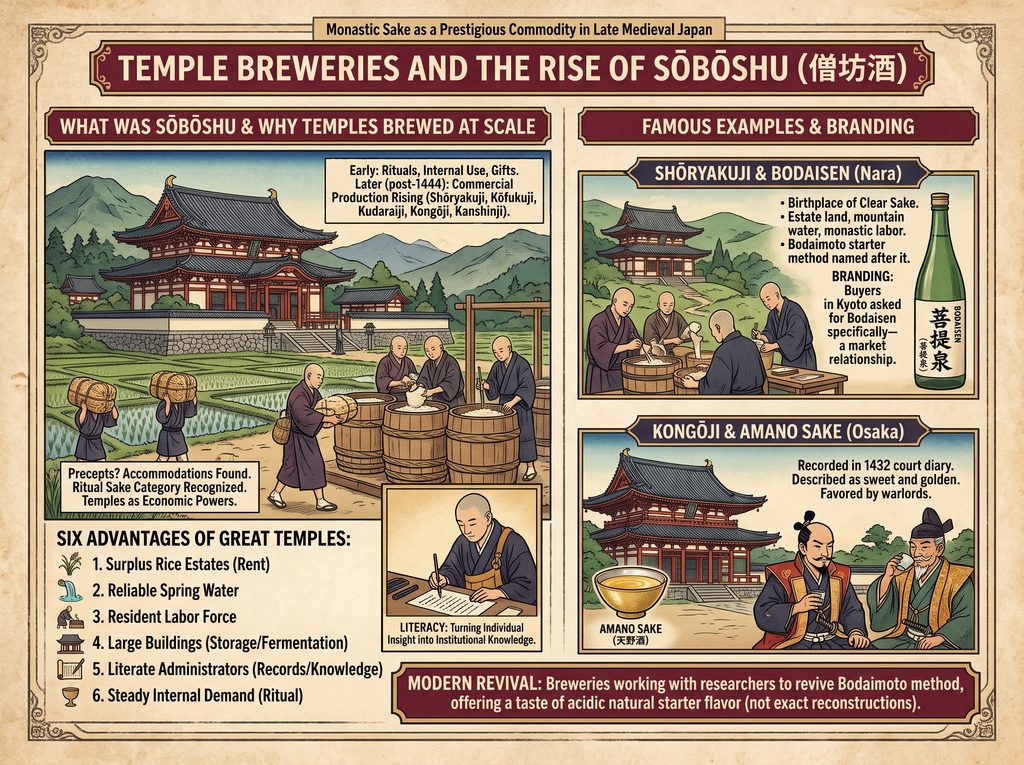
Sōbōshu (僧坊酒) means sake brewed in the lodgings of Buddhist monks. Some of it became prestigious named product in late medieval Japan, sought out by name rather than bought as a generic drink.
What Was Sōbōshu?
At first, temple brewing stayed modest, covering ritual offerings, internal consumption, and gifts. From the mid-fifteenth century it moved closer to commercial production, and the National Tax Agency report describes sōbōshu from Shōryakuji, Kōfukuji, Kudaraiji, Kongōji, and Kanshinji rising after 1444.
Did brewing alcohol not conflict with monastic precepts? In practice, temples found workable accommodations, and sake for ritual offerings occupied a recognized category. Great medieval temples also functioned as landholders and economic powers, rather than only as religious communities.
Why Temples Could Brew at Scale
Because brewing consumes rice that people could otherwise eat, only a producer with a real surplus can risk it. Peasant households, by contrast, rarely had that margin. Major temples, by contrast, collected rice as rent from many villages at once.
What a great temple actually controlled
Estates producing surplus rice. Reliable spring water. A resident labor force able to work at awkward hours. Large covered buildings for storage and fermentation. Literate administrators who kept records year after year. And a steady internal demand for ritual sake. Few other medieval institutions combined all six.
Literacy may be the underrated advantage. A village brewer could discover something useful, yet without a written record the discovery usually died with the person who made it. Temple diaries and account books turned individual insight into institutional knowledge.
Shōryakuji and Bodaisen
Shōryakuji sits in the hills southeast of Nara, and it is widely called the birthplace of clear sake. Nara Prefecture’s own material points to the combination of estate land, mountain water, and monastic labor behind that reputation. Its sake, Bodaisen, then gave its name to the bodaimoto starter method.
Branding is the striking part here. A buyer in Kyoto could ask for Bodaisen specifically and expect a known character. That is a market relationship rather than a devotional one.
A handful of breweries work with Nara researchers today to produce sake using a revived bodaimoto method. The results are not reconstructions of Bodaisen itself, since neither the rice nor the equipment matches. But they do let people taste what an acidic natural starter does to flavor.
Kongōji and Amano Sake
Kongōji, in the hills of Kawachinagano in what is now Osaka, produced Amano sake. A 1432 entry in the court diary Kanmon Gyoki records the regard it enjoyed in aristocratic circles. Later accounts describe it as sweet and golden, and warlords including Oda Nobunaga and Toyotomi Hideyoshi are said to have favored it.
Kyoto’s Sake Businesses, Finance, and Taxation
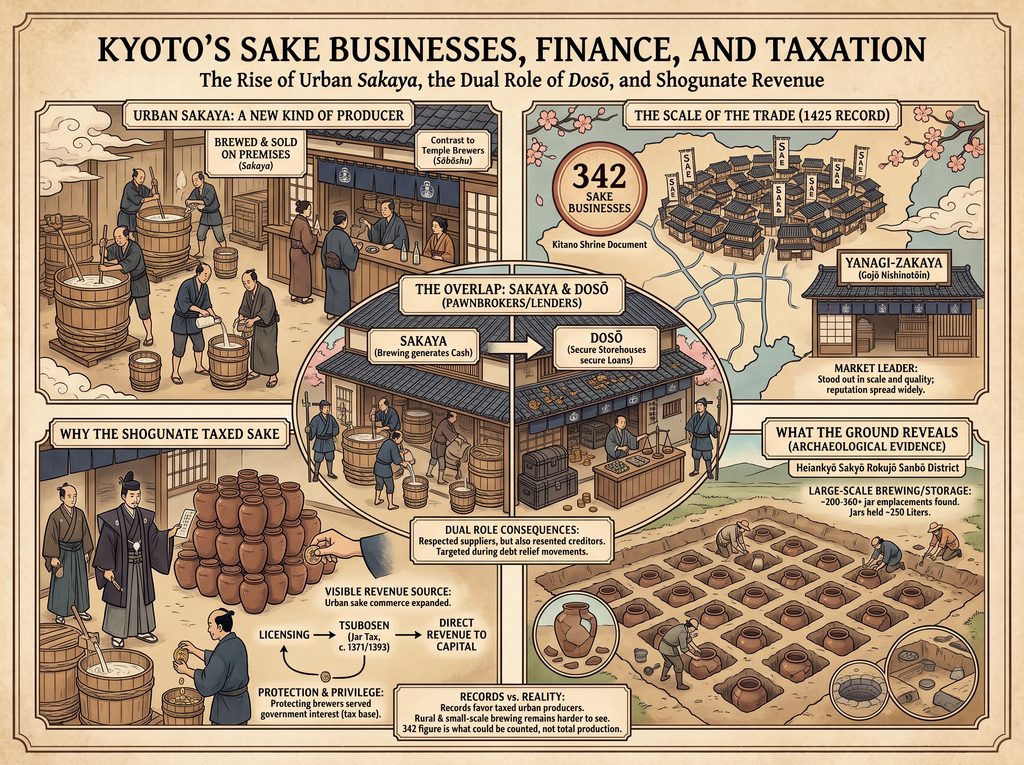
Temples, though, were only half the story. In the cities, a different kind of producer appeared: the sakaya, which brewed and sold on the same premises.
The 342 Sake Businesses of 1425
A National Tax Agency survey report cites a document preserved at Kyoto’s Kitano Shrine recording 342 sakaya inside and outside the old capital area in 1425. The figure counts businesses in one urban region, so it measures neither output nor the country as a whole. Even so, it shows a dense and established trade.
Individual names survive as well, for example. The report singles out Yanagi-zakaya at Gojō Nishinotōin, which stood out from its competitors in both scale and quality, and whose reputation spread widely. So this was already a market with recognized leaders.
The Overlap Between Sakaya and Dosō
Many sake businesses also operated as pawnbrokers and lenders, the dosō. The overlap makes economic sense, because brewing generated cash and required secure storehouses, and storehouses in turn secured loans. Such businesses even employed guards to protect property and collect debts.
That dual role naturally had consequences. When debt relief movements swept the capital, crowds sometimes targeted the same establishments. Brewers were therefore both respected suppliers and resented creditors, which is an awkward position for any industry.
Why the Shogunate Taxed Sake
As urban sake commerce expanded, it became an increasingly visible source of shogunal revenue. The National Tax Agency report describes the Muromachi shogunate licensing sake businesses and collecting tsubosen, a levy assessed on brewing jars. Research in the agency’s academic journal further records a jar tax in 1371 and the permanent sakaya-yaku from 1393.
Jars made a practical tax base, since they were fixed, visible, and hard to conceal. Unlike land taxes, which regional warriors could intercept, this revenue came straight from the capital. Protecting brewers therefore served the government’s own interest, and taxation arrived together with privilege.
What the Ground Reveals
Excavation in the former Heiankyō Sakyō Rokujō Sanbō district, north of Kyoto Station, revealed large and regularly arranged groups of jar emplacements. An interim public report in 2005 described about 200 pits in the main group, while later research counted more than 360 emplacement features across the site. Reconstructed Tokoname stoneware jars, for reference, held roughly 250 liters.
The jars’ original contents were not preserved. However, the concentration of large vessels, wells, and work areas, together with documentary evidence for sake and koji businesses in the surrounding district, strongly supports an interpretation involving large-scale brewing or storage. Not every pit was necessarily in use at once, and replacements have been identified, so the site resists a simple capacity calculation.
What Tax Records Can and Cannot Tell Us
Records survive because the state wanted money, so our view leans toward taxed urban producers. Rural and small-scale brewing is much harder to see. The 342 figure therefore measures what officials could count, which is not the same as what the country produced.
The Koji Trade and the 1444 Conflict
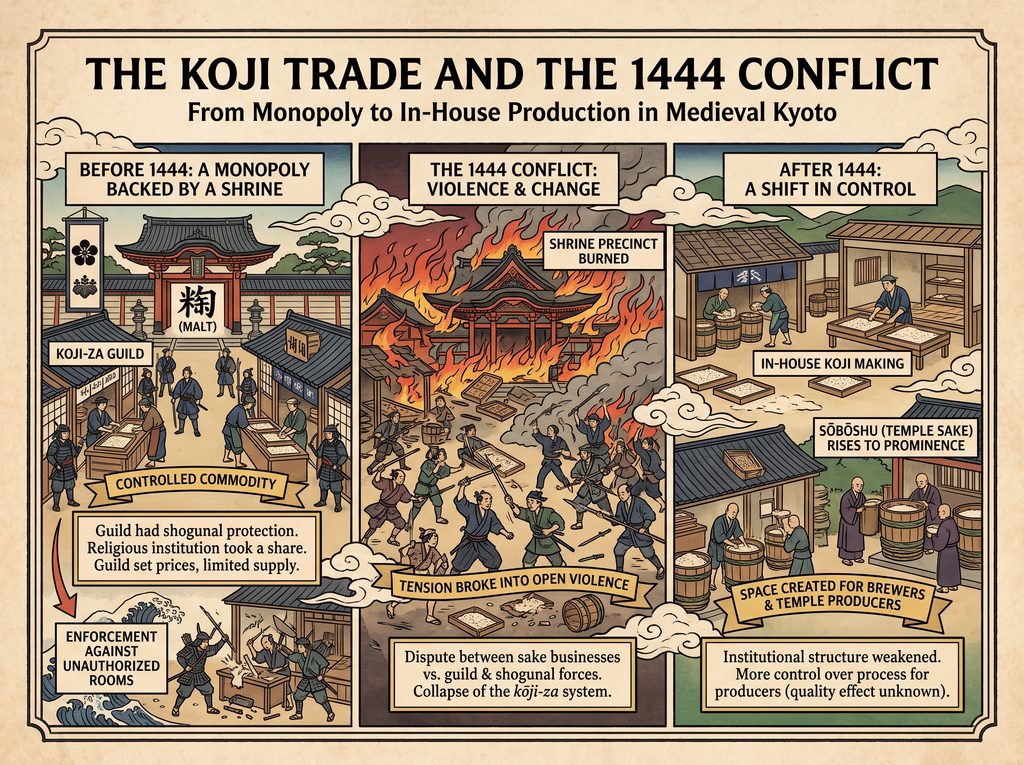
Because koji converts rice starch into fermentable sugar, brewing depends on it completely. In medieval Kyoto, koji was not simply something every brewer made in-house. Instead, it was a controlled commodity.
A Monopoly Backed by a Shrine
Specialist producers formed a guild, the kōji-za, and Kitano Shrine held privileged rights over koji production and sale under shogunal protection. Guild monopolies of this kind were common, covering goods from oil to salt, with a religious institution taking a share of the trade. Koji simply sat at the choke point of an unusually profitable industry.
Brewers who built their own koji rooms challenged that privilege directly. Enforcement could also turn physical, because guilds had shogunal backing to break up unauthorized koji rooms.
This is worth pausing on, since it explains why the conflict mattered so much. Whoever controlled koji controlled the pace of every brewery in the city. A guild could set prices, limit supply, and decide who was allowed to compete at all.
What Changed After 1444
Eventually, tension broke into open violence in 1444. The dispute between the sake businesses on one side, and the guild and shogunal forces on the other, ended with the shrine precinct burned. Research in the National Tax Agency’s journal treats this as the collapse of the kōji-za system, after which sōbōshu rose to prominence.
The conflict seriously weakened the institutional structure supporting Kyoto’s koji monopoly. Over time, it helped create space for brewers and temple producers to bring koji making into their own operations. From a brewing perspective, in-house koji may also have given producers more control over their process, although the surviving records do not let us measure its effect on quality directly.
How Medieval Brewing Techniques Developed
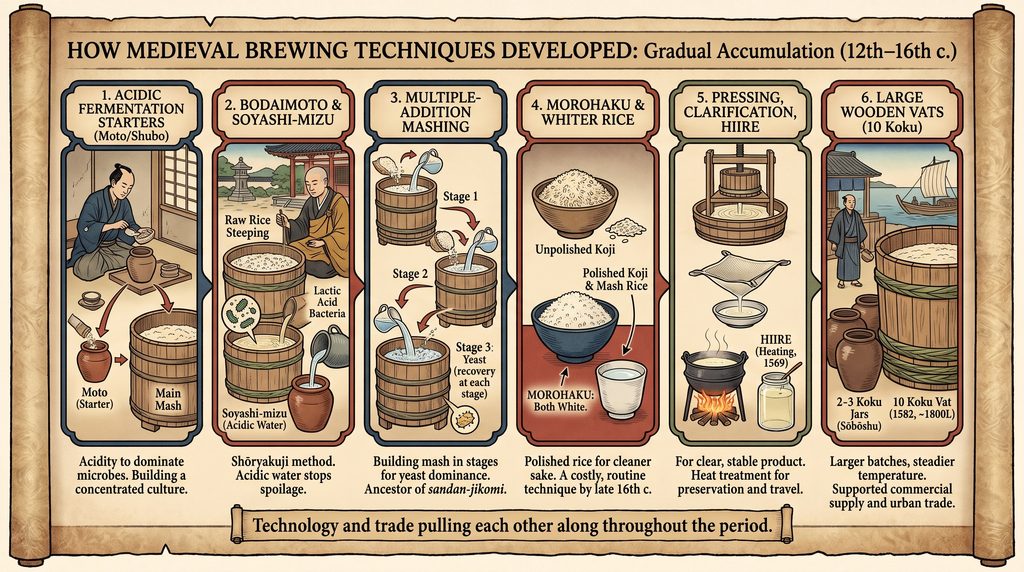
The National Research Institute of Brewing describes the twelfth to fifteenth centuries as the era when techniques underlying modern sake developed substantially. Several of them become clearly visible in documents only toward the end of the medieval period, so this is a story of gradual accumulation rather than sudden invention.
1. Acidic Fermentation Starters
First, consider the basic problem: an open tank of sweet, wet rice attracts every microbe nearby. Brewers needed the yeast they wanted to arrive first and dominate, and acidity was the tool that made that possible. Building a small, concentrated culture before the main mash solved the problem, and that culture is the shubo, also called the moto.
Nobody involved knew what a bacterium was, yet the logic worked. Our moto guide covers how the starter functions today.
None of these methods appeared overnight, either. Each represents many small adjustments, tested across seasons and passed between brewers. Because the records are patchy, we usually meet a technique only once it has already become routine, so the experimental years stay hidden.
2. Bodaimoto and Soyashi-mizu
Bodaimoto is the best-documented acidic starter, and it is associated with Shōryakuji. The method begins with raw rice steeped in water, where lactic acid bacteria multiply and turn the liquid sharply acidic. That liquid, soyashi-mizu, then becomes the brewing water for the starter itself.
Acidity this strong suppresses spoilage organisms from the first day, so a starter could be built even in warm weather. The Goshu no Nikki advises cooling the rice thoroughly in summer. Later brewers would abandon warm-season production entirely, which makes bodaimoto a different answer to the same problem, reached centuries earlier.
3. Multiple-Addition Mashing
Medieval brewers also stopped adding all their rice and water at once, building the mash up in stages instead. Each addition let the yeast population recover and stay dominant. Some researchers read the mash instructions in the Goshu no Nikki as an early form of this approach.
Still, that is not the same as saying modern three-stage brewing already existed. The standardized sandan-jikomi of later centuries is a refined descendant, not a medieval fixture, as our moromi guide explains.
4. Morohaku and Whiter Rice
Morohaku (諸白) means “both white,” referring to polished white rice used for both the koji rice and the mash rice. Earlier brewers often polished only the koji portion. Because the outer layers carry proteins and fats that generate rough, heavy flavors, removing them from both portions produced noticeably cleaner sake.
Polishing also carried a real cost, since every layer removed is rice nobody eats or sells. Only producers who could absorb that loss and charge for the result had any reason to do it. Morohaku then appears repeatedly in the Tamon’in Nikki from the later sixteenth century, which captures the technique becoming routine.
5. Pressing, Clarification, and Hiire
Three steps worked toward the same goal, namely a clearer and more stable product. Separating the mash into clear sake and lees, filtering it, and then applying gentle heat all appear in records from the later sixteenth century. Hiire (火入れ) is that heat treatment, and the Tamon’in Nikki records heating sake before casking in 1569.
Of course, medieval brewers did not understand bacteria or enzymes. They observed that heated sake kept better, so they heated it. Calling hiire “pasteurization” is convenient shorthand, but it imports a scientific framework that did not yet exist. Commercially, the practice mattered because stabilized sake could travel further and sit longer in a merchant’s storehouse.
6. Large Wooden Vats and Production Scale
Technique alone cannot build an industry, since vessels set the ceiling. Sōbōshu was typically brewed in jars of two to three koku. Then, in 1582, a record describes a vat holding ten koku, about 1,800 liters, which made far larger batches possible.
Wood also behaves differently from ceramic. It insulates better, so a large vat holds a steadier temperature through a cold night. Improved coopering and tools made these vessels practical, and larger batches in turn supported commercial supply.
The timing is telling. Larger vessels arrive at almost exactly the point where regional producers were competing hardest for urban markets. Technology and trade were pulling each other along, which is a pattern that runs through the whole period.
What Medieval Sake May Have Tasted Like
Honestly, nobody can answer this with confidence. No bottles survive, and taste descriptions from the period are sparse and subjective. The documents still allow some reasonable inference.
Why Some Medieval Sake May Have Been Sweet and Dense
Research in the National Tax Agency’s journal discusses the mash ratios recorded in the Goshu no Nikki, and notes the view that the resulting sake was rich and sweet. Amano sake is similarly remembered as sweet and golden in color. Even so, these are readings of recipes and reputation rather than measurements.
How Clear Could It Have Been?
Morohaku, pressing, and filtration all pushed toward clarity, and by the later sixteenth century the records show all three in use. A medieval sake would still not match the brightness of a modern bottle, though. Quality also varied widely between producers, which is partly why named products emerged at all.
Why Modern Reconstructions Remain Approximate
Breweries that revive bodaimoto today also work with modern rice, water treatment, and equipment. They are informed experiments rather than time machines. Alcohol content is another open question, and records mention diluting sake with water before serving, so strength in the vat and strength in the cup may have differed.
Medieval Sake and Modern Nihonshu
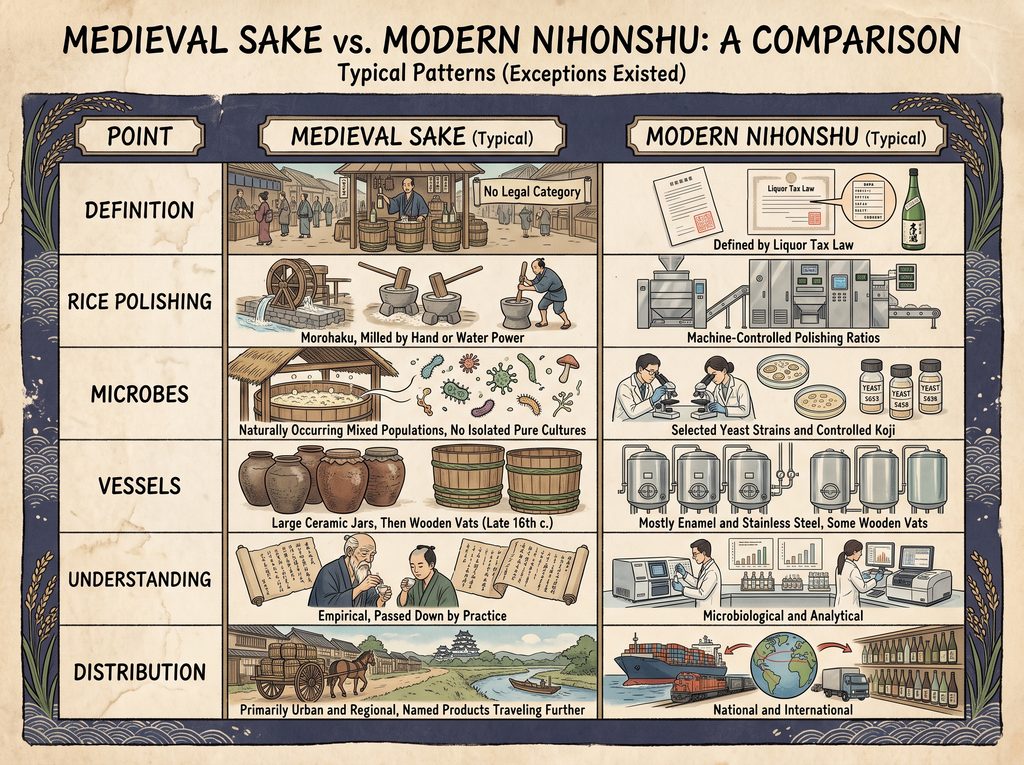
It is easy to read this period backward and see modern sake arriving too early. The table below sets out typical patterns rather than absolute rules, since exceptions existed on both sides.
| Point | Medieval sake (typical) | Modern nihonshu (typical) |
|---|---|---|
| Definition | No legal category | Defined by liquor tax law |
| Rice polishing | Morohaku, milled by hand or water power | Machine-controlled polishing ratios |
| Microbes | Naturally occurring mixed populations, no isolated pure cultures | Selected yeast strains and controlled koji |
| Vessels | Large ceramic jars, then wooden vats from the late 16th century | Mostly enamel and stainless steel, with some wooden vats |
| Understanding | Empirical, passed down by practice | Microbiological and analytical |
| Distribution | Primarily urban and regional, with named products travelling further | National and international |
Continuity and change sit side by side here. A medieval brewer would recognize the logic of a modern starter immediately, while the tank, the thermometer, and the laboratory yeast would all baffle them.
The Transition to Early Modern Brewing
Temple brewing did not simply fade on its own, either. Warfare, land reforms, and the political consolidation of the late sixteenth century all weakened the great religious institutions, and as their estates shrank, so did their brewing. Secular producers backed by merchant capital then moved into the gap.
Meanwhile, the Ōnin War of 1467 to 1477 reshaped the map. Kyoto suffered enormous damage, and regional sake that the capital had once dismissed as provincial began to compete directly. The National Tax Agency report lists examples such as Nishinomiya, Kaga, and Izu among the products that gained reputations.
Early modern producers subsequently combined and expanded many of these practices within larger, more specialized brewing businesses. Licensing, winter brewing, and long-distance shipping to Edo followed, and the professional toji system took shape around them. Our sake brewing section covers each of those stages in detail.
Medieval Sake Timeline
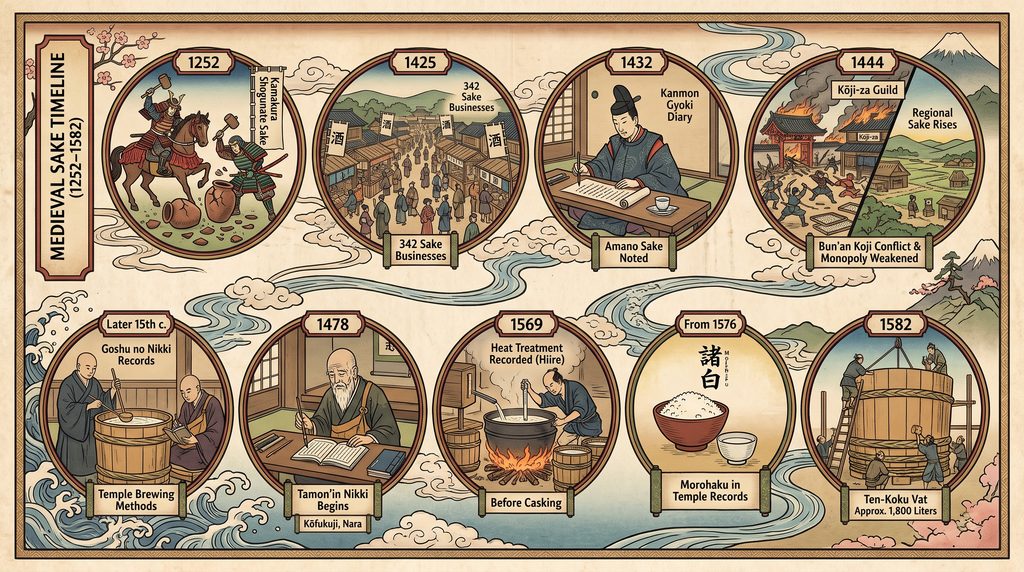
The dates below correspond to events discussed above, so each one rests on an institutional report or a surviving document.
| Year | Development |
|---|---|
| 1252 | The Kamakura shogunate bans sake sales and destroys brewing jars |
| 1425 | 342 sake businesses recorded in and around Kyoto |
| 1432 | Amano sake noted in the court diary Kanmon Gyoki |
| 1444 | The Bun’an Koji Conflict weakens the kōji-za monopoly |
| 1467–1477 | The Ōnin War devastates Kyoto and regional sake rises |
| Later 15th century | The Goshu no Nikki records temple brewing methods |
| 1478 | The Tamon’in Nikki begins at Kōfukuji in Nara |
| 1569 | Heat treatment of sake recorded before casking |
| From 1576 | Morohaku appears regularly in temple records |
| 1582 | First record of a ten-koku brewing vat, about 1,800 liters |
Common Misconceptions About Medieval Sake
Five claims circulate widely, so each one is worth correcting.
- “Temples invented sake.” They did not. Brewing predates temple production by centuries, and temples refined and scaled it.
- “All medieval sake was brewed by monks.” Sōbōshu was the prestige tier, while urban sakaya supplied the everyday market.
- “Medieval sake was already modern nihonshu.” Several key techniques did appear, but the legal category, the equipment, and the science did not.
- “Hiire was modern pasteurization.” The practical effect overlaps, yet medieval brewers acted on observation rather than microbiology.
- “The 342 shops represented all of Japan.” That count covers Kyoto and its immediate surroundings in 1425, and nothing more.
Frequently Asked Questions About Medieval Sake
The Drink and the Trade
What was medieval sake like?
Recipes and reputation together suggest a sweeter, denser drink than modern sake. Better rice polishing, pressing, and filtration made it clearer than earlier versions. Quality varied enormously between famous temple brands and ordinary town production. No bottles survive, so all of this remains careful inference.
When did commercial sake brewing develop?
Brewing for sale spread through the medieval centuries, largely alongside urban growth. The Kamakura shogunate already thought it big enough to ban in 1252. By 1425, records list 342 sake businesses in and around Kyoto. The Muromachi shogunate then licensed and taxed the trade rather than suppressing it.
Why did Buddhist temples brew sake?
Great temples controlled the resources brewing needs. Their estates produced surplus rice, and mountain sites supplied clean water. Resident communities provided organized labor, and large compounds offered space for fermentation and storage. Monks also kept written records, so improvements accumulated across generations.
What was sōbōshu?
Sōbōshu means sake brewed in the monks’ quarters of Buddhist temples. It began with ritual and internal use, then moved toward commercial production from the mid-fifteenth century. Kinki temples led the field, while Bodaisen and Amano sake became recognized names. Some of it commanded genuine prestige.
Techniques and Institutions
What was bodaimoto?
Bodaimoto is the starter method linked to Shōryakuji in Nara. Brewers steep raw rice in water until lactic acid bacteria acidify it, producing soyashi-mizu. That acidic water then protects the starter from spoilage organisms. The method even allowed brewing in warm weather.
Was hiire the same as modern pasteurization?
The practical effect overlaps, but the reasoning does not. The Tamon’in Nikki records heating sake before casking in 1569, roughly three centuries before Pasteur’s work. Brewers acted on repeated observation rather than on any theory of microbes. Modern pasteurization rests on science that did not yet exist.
Why did the 1444 koji conflict matter?
Koji production in Kyoto was controlled by a guild under Kitano Shrine. Brewers who made their own risked having their koji rooms destroyed. The violent dispute of 1444 ended with the shrine precinct burned and the guild system broken. Over time, producers gained space to bring koji making in-house.
How Certain Is This History?
Recorded in documents
The 1252 ban, the 342 sake businesses of 1425, shogunal sake taxation, the 1444 koji conflict, temple brewing at named institutions, and the dated entries for hiire, morohaku, and the ten-koku vat.
Supported by interpretation
That commercialization encouraged technical change, that institutional resources let temples innovate, and that medieval methods fed into early modern brewing.
Cannot be established
The flavor of any specific historical sake, conditions at individual breweries, how widely each technique spread, and the precise line from one medieval method to its modern descendant.
Final Thoughts
In short, three things define medieval sake. It became a commercial product with named brands and real markets. It also became an institution, licensed and taxed by the government. And it accumulated the technical knowledge that early modern brewers would later organize into an industry.
What stands out is the ordinariness of the records. Hiire appears in a temple diary between notes about deliveries and weather. Nobody was announcing a breakthrough. Yet they were writing down what they did that day, and that habit is why we can trace any of it at all.
References
- Survey Report on Traditional Sake Brewing Using Koji Mold in Japan, National Tax Agency. Accessed September 2026.
- The History of Japanese Sake, in the Survey Report on Traditional Sake Brewing Using Koji Mold, National Tax Agency. Accessed September 2026.
- Chronology of Traditional Japanese Alcoholic Beverages Made with Koji Mold, National Tax Agency. Accessed September 2026.
- On the Formation of Discourse Concerning the Culture and Tradition of Japanese Sake, Journal of the National Tax College, National Tax Agency. Accessed September 2026.
- Sake Information, National Research Institute of Brewing. Accessed September 2026.
- Sakabayashi: The Story of Sake, No. 1, National Research Institute of Brewing. Accessed September 2026.
- The History of Japanese Sake, Japan Sake and Shochu Makers Association. Accessed September 2026.
- Nara Prefecture official website, materials on Shōryakuji and the origins of clear sake. Accessed September 2026.
- Zhang, K., Wu, W., & Yan, Q. (2020). Research advances on sake rice, koji, and sake yeast: A review. Food Science & Nutrition, 8(7), 3773–3782. Accessed September 2026.
- Interim public report on the excavation of the Heiankyō Sakyō Rokujō Sanbō site, Kyoto City Archaeological Research Institute, April 2005. Accessed September 2026.
- Goshu no Nikki (御酒之日記), medieval brewing manual recording the production of Bodaisen and Amano sake. Accessed September 2026.
- Tamon’in Nikki (多聞院日記), diary kept at Tamon’in, Kōfukuji, Nara, 1478–1618. Accessed September 2026.
- Kanmon Gyoki (看聞御記), court diary of Prince Fushimi-no-miya Sadafusa, entry of 1432 concerning Amano sake. Accessed September 2026.
Related Articles
- How Sake Is Made: Step-by-Step Japanese Brewing Guide (Surveyed: September 2026)
- Koji: The Mold Behind Japanese Brewing (Surveyed: September 2026)
- Moto: The Sake Yeast Starter (Surveyed: September 2026)
- Kimoto Sake Brewing: The Traditional Yeast Starter (Surveyed: September 2026)
- What Is Moromi? The Main Sake Fermentation Mash (Surveyed: September 2026)
- Kura: Inside a Traditional Sake Brewery (Surveyed: September 2026)





Comments