A kurabito is a sake brewery worker, one of the skilled hands who brews sake under the toji, or master brewer. Sake is never the work of one person alone, and behind every bottle stands a whole team of kurabito who wash the rice, tend the koji, and watch over the fermenting mash. If the toji is the conductor who plans the season and makes the key calls, the kurabito are the orchestra that turns that plan into finished sake.
This guide explains who the kurabito are and what they actually do, from their ranks and daily routine to the long road that leads to master brewer. It also explains why sake, at its heart, is a team craft rather than a solo one. The kurabito rarely get the spotlight, since the toji earns the fame and the label credit, yet they do much of the hands-on work that decides how a sake turns out. This is their story.
TOC
Quick Facts About Kurabito
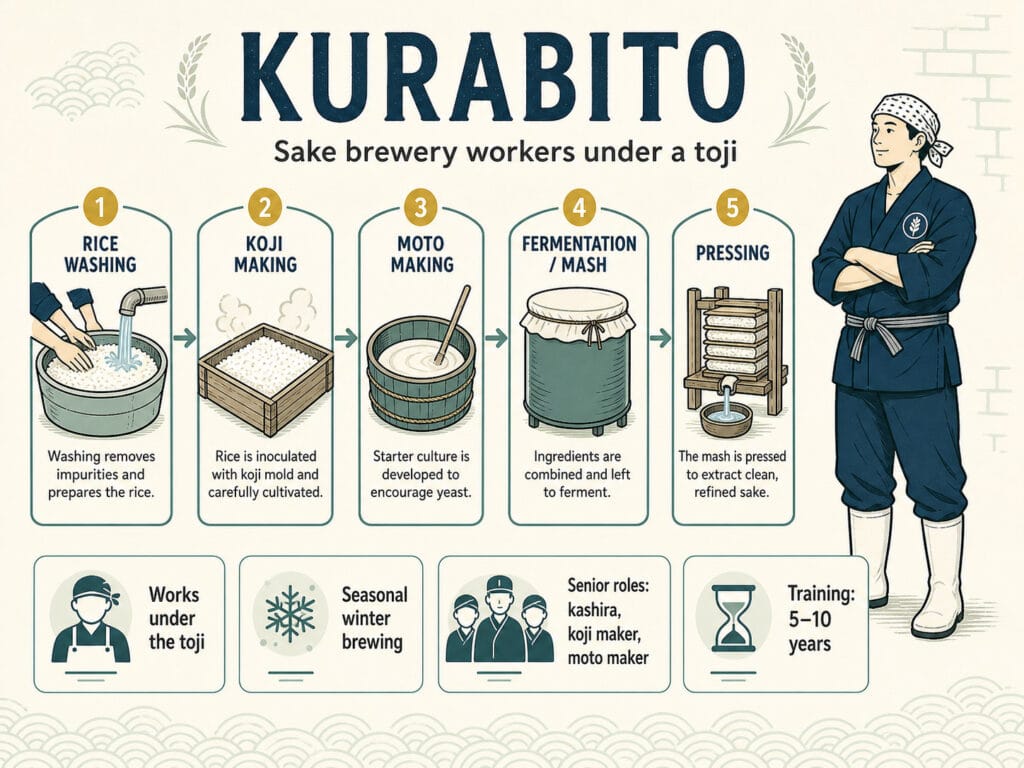
In short, kurabito are the skilled workers who brew sake under a toji, handling every hands-on step from washing rice to pressing the finished mash. Traditionally many were seasonal workers who lived in the brewery through the winter, organised into a clear order of ranks that ran from newcomer to senior specialist. Becoming a fully skilled brewer can take five to ten years of patient training, and in the end it is the kurabito who turn the toji’s plan into real, finished sake.
Japanese Name
蔵人 (kurabito)
English Meaning
Sake brewery worker / brewer
Role
Carrying out the hands-on work of sake brewing
Leader
Works under the toji, the master brewer
Senior Roles
The sanyaku: kashira, koji maker, moto maker
Traditional Work
Seasonal winter brewing, living in the brewery
Training Time
Often five to ten years to become skilled
What Is a Kurabito?
A kurabito is a sake brewery worker who brews under the guidance of the toji. The word itself joins two ideas, kura (brewery) and hito (person), so a kurabito is quite literally a person of the brewery. In practice, they are the craftspeople who carry out the daily work of making sake, from soaking the rice to scrubbing the tanks.
Their work spans the entire brewing process. They wash and steam the rice, cultivate the koji mold, build the yeast starter, and watch over the moromi mash as it ferments. When the sake is ready they press, filter, and bottle it, and between batches they clean the brewery and care for every tool.
Not everyone who works at a brewery is a kurabito, though. The word refers specifically to the people who make the sake, so office staff and sales workers fall outside it. The title belongs to the hands-on brewing team, and it carries a quiet pride: to be a kurabito is to belong to the kura and to share in a craft older than living memory. Many workers wear the name with real honor, because it marks them as makers rather than mere staff.
Kurabito, Toji, and Kuramoto: Who Is Who?
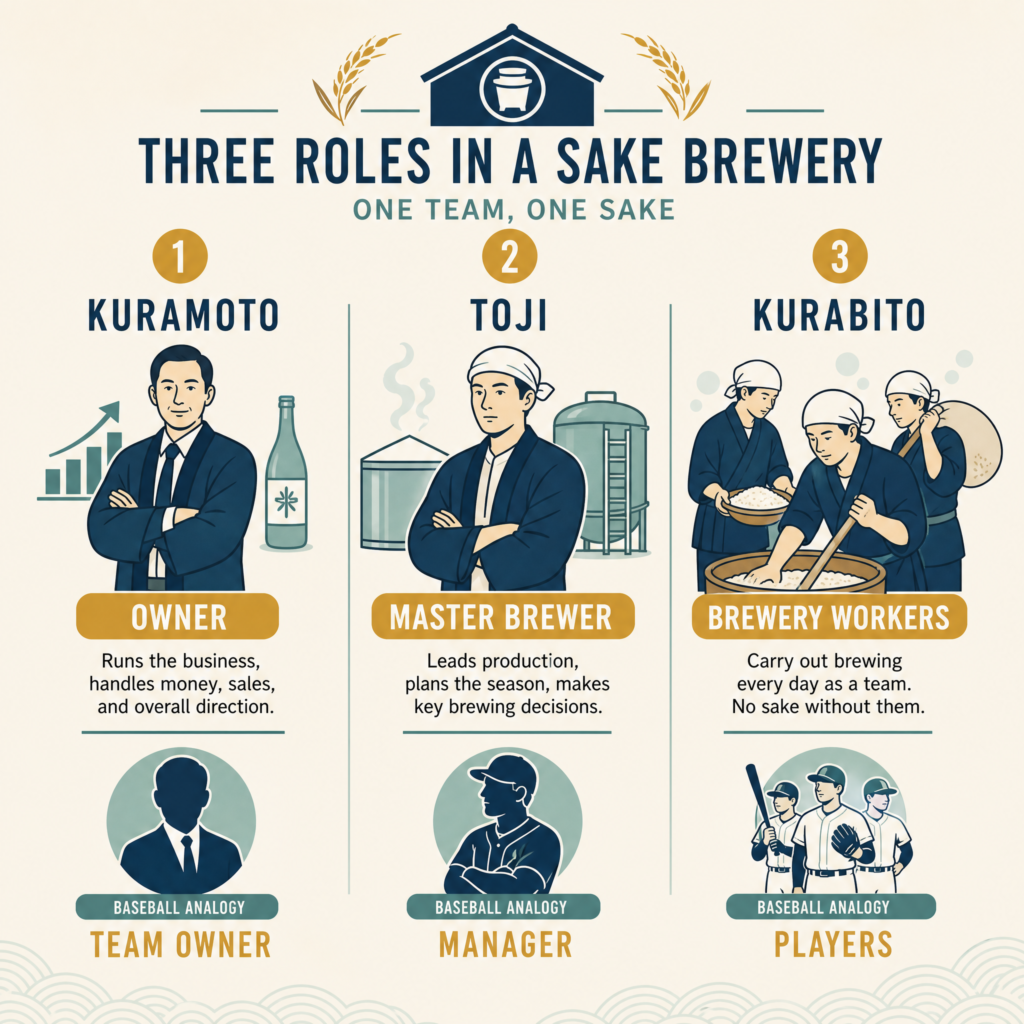
Sake breweries use three words that newcomers often mix up: kurabito, toji, and kuramoto. Each names a very different role, and sorting them out makes the whole brewery suddenly make sense. A useful shortcut is to picture a baseball team.
Role
Japanese
Position
Baseball Image
Owner
Kuramoto
Runs the business
Team owner
Master brewer
Toji
Leads production
Manager
Brewery workers
Kurabito
Do the brewing
Players
The Kuramoto
The kuramoto is the owner of the brewery and runs the business side, handling the money, the sales, and the brewery’s overall direction. In baseball terms, the kuramoto owns the team. In smaller breweries the owner sometimes brews as well, taking on both jobs as a kuramoto-toji.
The Toji
The toji is the master brewer and the head of production. This is the person who plans the season, judges each stage, and makes the key decisions that set the direction of the sake. In our baseball image the toji is the manager, and a brewery traditionally has only one.
The Kurabito
The kurabito are the players on the field, the ones who carry out the actual brewing day after day. A single toji typically leads a team of around ten kurabito, each holding a role suited to their skill and experience. Together they form one coordinated crew, and without them no sake would ever be made.
The Ranks and Roles of Kurabito
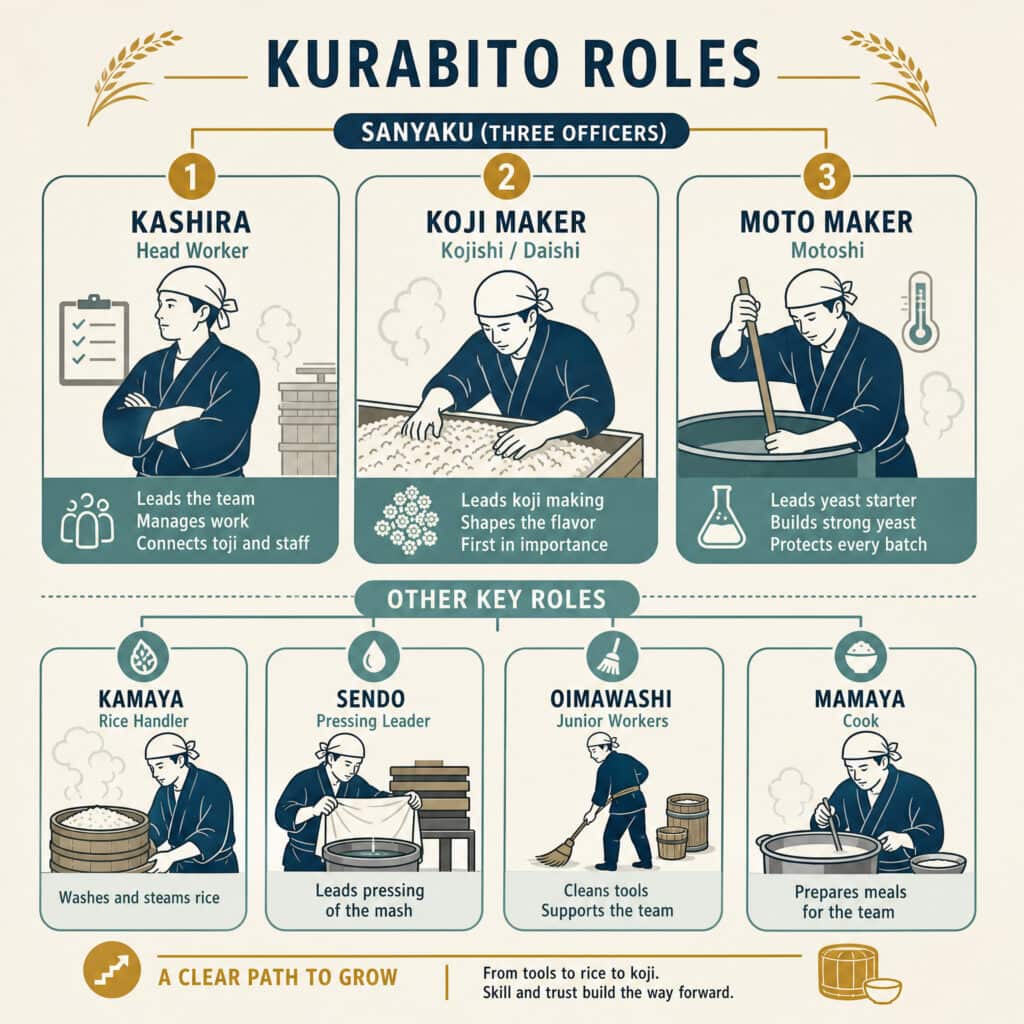
A traditional brewery runs on a clear order of ranks, with each kurabito holding a title that matches their skill. The most senior roles are known together as the sanyaku, or three officers, and below them come the other specialists and the newcomers. This structure keeps a busy winter brewery moving smoothly, since everyone knows exactly what they are responsible for.
The Kashira (Head Worker)
The kashira is the most senior kurabito, acting as the toji’s right hand. This person directs the daily work, assigns each task, manages the team, and keeps the schedule on track, much like a foreman on the brewery floor. The kashira also bridges the toji and the workers, passing the toji’s decisions down and reporting the day’s progress back up. In the busiest stretches of the season, a steady kashira is often what keeps the whole operation calm.
The Koji Maker (Kojishi or Daishi)
The kojishi, sometimes called the daishi, leads all koji making. An old brewing saying ranks the work in order of importance: first the koji, second the starter, third the mash. Because koji shapes the flavor of the finished sake more than almost anything else, the koji maker holds a place of real honor and watches the warm, humid koji room almost around the clock.
The role is often a stepping stone toward becoming a toji, since mastering koji proves a worker’s patience, care, and fine touch. Many future master brewers first make their name in this very job.
The Moto Maker (Motoshi)
The motoshi is the master of the moto, or yeast starter, which grows the strong, healthy yeast the whole brewery depends on. Some motoshi still build it the slow, traditional kimoto way, a method that rewards patience and a careful hand. The moto room is kept cooler than the koji room, and there the yeast slowly multiplies into a robust culture while the motoshi checks its smell and temperature again and again. A rushed or weakened starter can spoil an entire batch, so this quiet, watchful work protects every stage that follows.
Other Key Roles
Below the sanyaku sit several more specialists. The kamaya handles the washing and steaming of the rice, while the sendo leads the pressing of the finished mash. Junior workers, once called oimawashi, look after the tools and the cleaning, and the cook, or mamaya, keeps the whole hungry team fed. These roles once followed a strict ladder, with a worker climbing from tools to rice to koji as they earned new skill and trust, and that ladder gave every kurabito a clear path upward.
The Path of a Kurabito
No one starts as a master brewer. Every kurabito begins at the very bottom and climbs slowly through the ranks over many years, and that long road is a defining part of the craft.
Starting at the Bottom
New kurabito begin with the humblest jobs: cooking meals, cleaning tools, washing equipment, and hauling water and rice. There is real wisdom in this slow start. The simple tasks teach discipline and the rhythm of the brewery, let a newcomer watch the experts up close, and slowly earn the trust of the senior workers. Only once that trust is in place do bigger responsibilities come their way.
Learning Through the Ranks
From there a kurabito gradually earns new roles, perhaps moving from cleaning to steaming rice, and later joining the koji or starter teams. Each step brings more skill and more trust, and traditionally workers rarely moved back down the ladder once they had climbed it.
How Long It Takes
Becoming a genuinely skilled brewer takes time. Many in the trade say it needs five to ten years of steady work, and reaching the level of toji can take far longer still. The early years can test a person’s resolve, since progress feels slow, but each season adds new confidence, and those who stay are shaped by the work itself. In the end, patience matters as much as any technical skill, because the craft simply cannot be rushed.
Skills and Qualifications
Most of a brewer’s skill is learned by hand, on the job. Japan does also offer a national qualification, the sake brewing technician (shuzo ginoshi) certification overseen by the Ministry of Health, Labour and Welfare, which tests brewing knowledge through written and practical exams. Its two grades are demanding: the second grade generally requires about two years of experience and the first grade around seven. Even so, a certificate alone does not make a brewer. The real test comes at the tank side, where instinct and experience read what no exam can measure, so study and daily practice have to go together.
A Day in the Life of a Kurabito
Life in a brewery during the winter is intense. The days are long, cold, and closely shared, yet many kurabito speak of a deep satisfaction they have never found in other work. It helps to walk through a typical brewing day.
Early Mornings
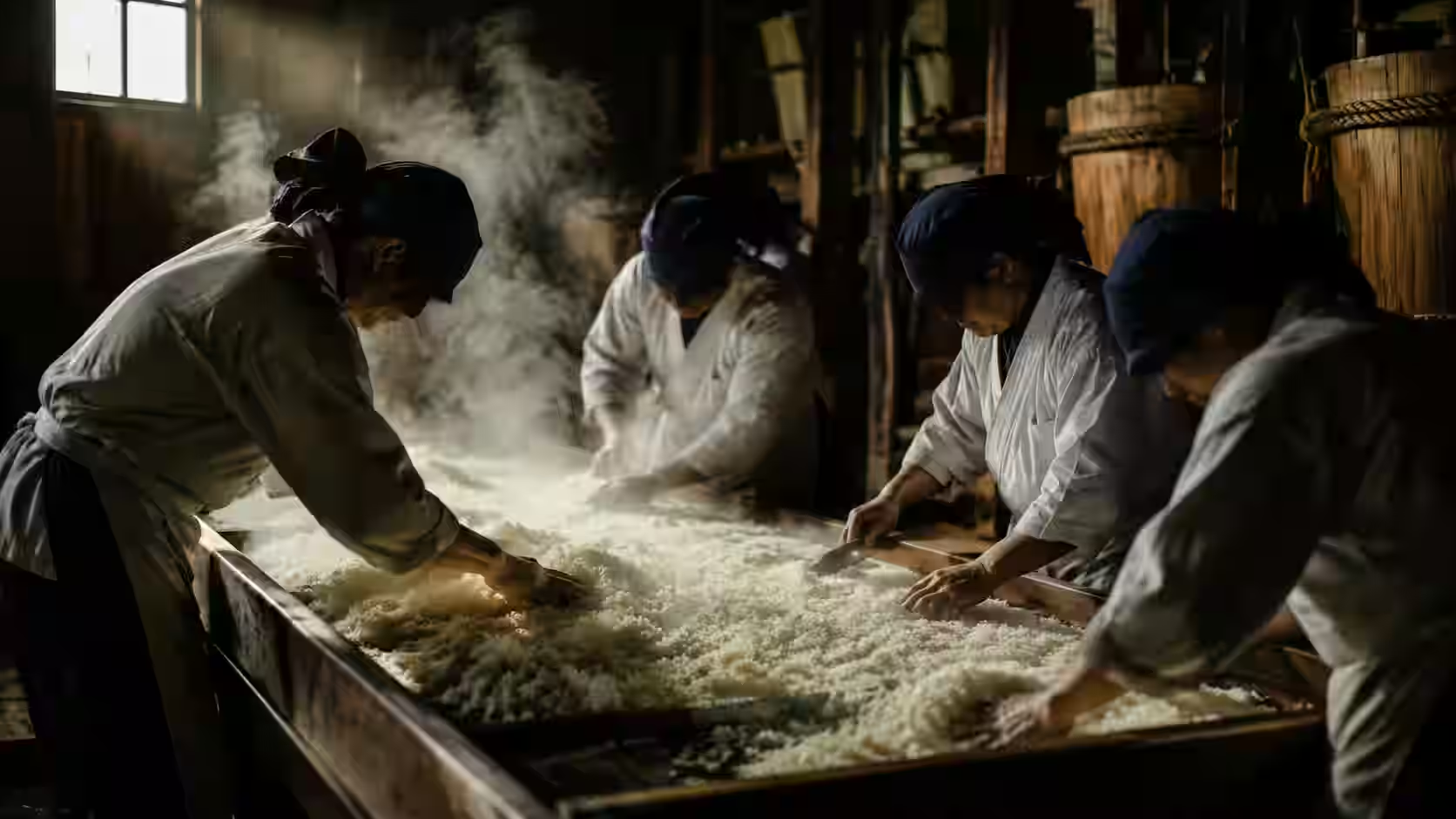
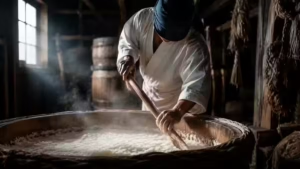
The day often begins before dawn, when workers rise in the dark to steam the day’s rice. Step into a working kura at that hour and the first thing you notice is the steam, rolling up warm and sweet into the cold air as the whole team gathers around it. Many brewers call this their favorite moment of the day. It is hard work and strangely peaceful at the same time, and it sets the tone for everything that follows.
Living Together
Historically, kurabito lived at the brewery for the whole season, eating, sleeping, and working side by side. That shared life built deep and lasting bonds, and many describe their team as a second family. Even where the living arrangements have changed, that closeness still shapes brewery culture today.
Round-the-Clock Care
Brewing does not stop for the clock. Koji and mash need attention at all hours, so a kurabito might check the fermenting tank late at night, knowing that a few missed hours can change how a sake turns out. This is why brewing feels less like a job and more like a calling. A kurabito cannot simply clock out and forget, because the living mash keeps its own schedule, and the worker has to bend around the sake rather than the other way round.
Before dawn: rise early and begin steaming the day’s rice.
Morning: tend the koji, wash rice, and prepare the mash.
Midday: check fermentation and record temperatures.
Afternoon: clean tanks and tools with great care.
Night: make late checks on the koji and mash.
Why Sake Is a Team Craft
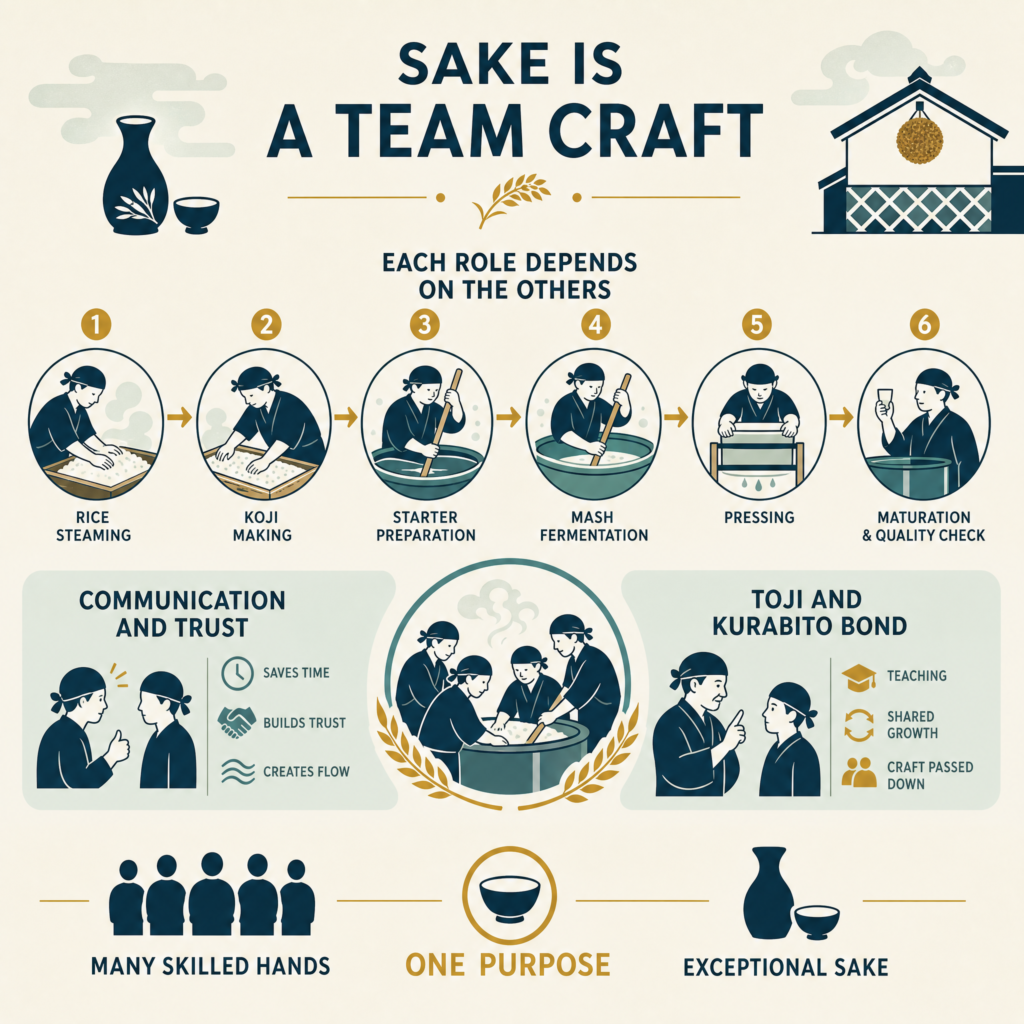
Sake brewing is, above all, a group effort. No single person could handle every task, because the work is too complex and too constant, so it depends on many skilled hands moving as one.
Each Role Depends on the Others
Every stage of brewing feeds the next. Good rice steaming helps the koji maker, strong koji helps the starter and the mash, and one weak link anywhere can affect the whole batch. The team therefore has to move in careful harmony, with each person trusting that the stage before theirs was done well.
Communication and Trust
A seasoned team almost seems to read its own mind. A glance or a nod can pass a message that would take a newcomer a paragraph to explain, and that silent understanding, built up over years of working together, saves precious time. You can see it in any working brewery: tasks flow from hand to hand without fuss, each worker already knowing what comes next. That smoothness is not luck but practice, teamwork honed over many seasons.
The Toji and Kurabito Bond
The toji leads but never works alone. The kurabito turn that vision into actual sake, and in return the toji teaches them constantly, so knowledge flows from master to worker season after season. This bond is how the craft has carried itself from one generation to the next.
The History of the Kurabito
The story of the kurabito is an old one, tied closely to the rhythm of rural life. For centuries, farming and brewing shared the same year, and that link shaped who the kurabito were.
Seasonal Workers From the Farms
Long ago, sake was brewed mostly in winter, when the cold months slowed farm work almost to a halt. Farmers travelled to the breweries for the season and became the first true kurabito, then returned to their fields when spring came. This yearly journey shaped whole communities, and certain villages grew famous for their brewers. Fathers taught the craft to their sons, so brewing skill ran in families and regions, and that heritage still colors the sake world today.
The Winter Brewing Life
This winter craft is known as kanzukuri, and it took firm hold during the Edo period. The cold helped in two ways at once: it kept unwanted microbes in check and it matched the farmers’ free season, so brewing and farming fit neatly together around the calendar.
Guilds and Shared Knowledge
Over time, brewers formed regional groups, or guilds, each led by a toji, and within them skills passed carefully from senior kurabito to younger ones. Whole regions kept their own brewing style alive this way. Four of these toji groups grew especially well known: the Nanbu toji of Iwate, the Echigo toji of Niigata, the Tajima toji of Hyogo, and the Noto toji of Ishikawa. In a real sense, the kurabito were the living memory of the craft, carrying its knowledge in their hands rather than in any book.
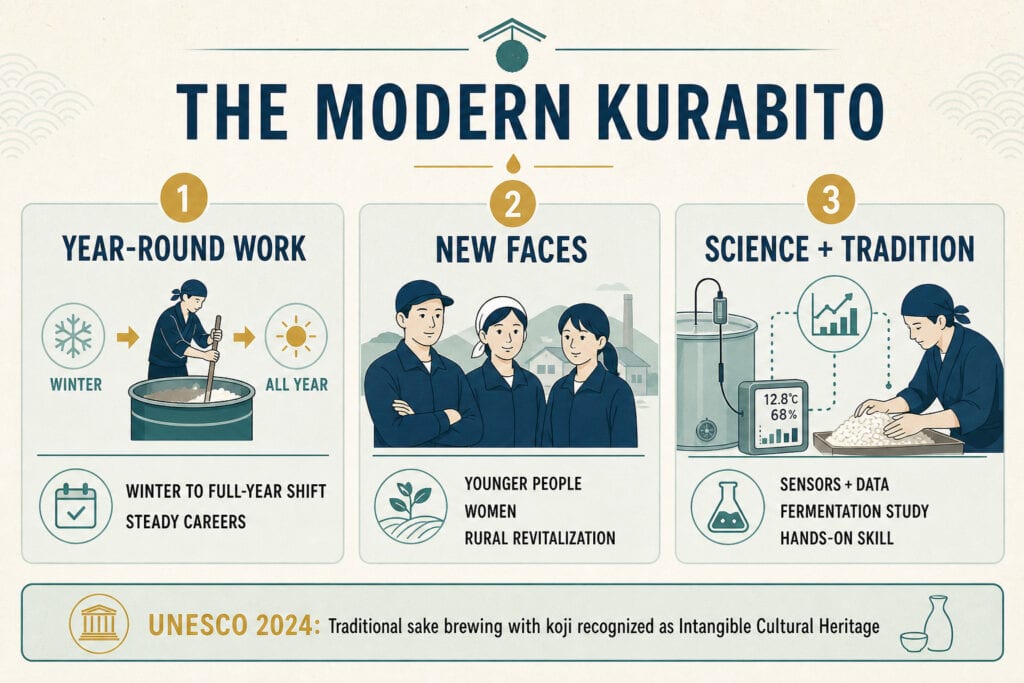
The Modern Kurabito
The world of the kurabito is changing quickly. Old patterns are giving way to new ones, yet the heart of the work stays the same, and today’s brewery is very much a blend of the old and the new.
From Seasonal to Year-Round
Where kurabito once worked only through the winter, more breweries now employ them all year, with staff caring for the brewery through the summer too. This shift gives workers steadier, fuller careers and keeps hard-won skills inside the brewery rather than scattering them each spring.
New People Join the Craft
The craft is also drawing fresh faces. Younger people are entering breweries with new energy, some of them through rural revitalization programs, and women are joining the brewing floor in growing numbers. These newcomers bring fresh questions and ideas: some gently challenge old habits, while others treasure the traditions they have joined. Together they keep the craft both rooted and alive.
Science Meets Tradition
Modern kurabito increasingly blend study and instinct. Some learn fermentation science at university and then pair that knowledge with hands-on tradition, using sensors and data to support skills that were once purely intuitive. The tools have changed, but human care still guides the final call. In December 2024, UNESCO added traditional Japanese sake brewing with koji mold to its list of Intangible Cultural Heritage, an honor that explicitly recognizes the accumulated skill of the toji and kurabito, and one that has drawn new attention to the people behind the craft.
Common Misconceptions About Kurabito
A few myths cling to the kurabito role, and they are worth clearing up.
Are Kurabito the Same as the Toji?
No, the two roles are quite different. The toji leads and makes the key decisions, while the kurabito carry out the hands-on work, and a single brewery has one toji but many kurabito. What links them is the career ladder: the toji rises from the ranks of the kurabito, so today’s master brewer was yesterday’s brewery worker.
Do Kurabito Only Do Simple Labor?
No, the work is highly skilled. Kurabito make delicate judgments every day, reading the rice, the koji, and the mash by feel in a way that takes years to learn. Even the cleaning matters, since hygiene directly protects the sake. This is craftsmanship, not simple labor.
Can Anyone Become a Kurabito?
In principle, yes, the door is open, and no special degree is strictly required. Many people enter with little more than passion and a willingness to learn. What the job really demands is commitment, because the long hours and cold early mornings test every newcomer sooner or later.
Is the Job Disappearing?
No, the role is changing rather than vanishing. Seasonal work has faded in many places, but year-round positions and younger kurabito are rising in its place, and fresh interest keeps bringing new people in. The craft continues, simply in a new form.
Final Thoughts
The kurabito are the quiet heart of every sake brewery, the many hands that turn rice into sake. The toji leads, but it is the kurabito who bring the plan to life, and their skill, care, and teamwork shape every bottle. Without them, sake as we know it could not exist.
Their story is really a story of teamwork. It began with farmers brewing through the winter, grew through proud regional guilds and shared knowledge, and today welcomes new faces, women, and young scientists alike. Through every change, the spirit of the team endures. So the next time you pour a cup of sake, picture the whole crew behind it: many careful hands, working as one, that made the moment possible.
Kurabito FAQ
What is a kurabito?
A kurabito is a worker who brews sake inside a brewery, under the direction of the toji, or master brewer. Their tasks range from washing and steaming rice to tending the koji and pressing the finished mash. In short, the kurabito are the hands that actually make the sake.
What is the difference between a kurabito and a toji?
The toji is the leader, and the kurabito are the workers. The toji plans the season and makes the key decisions, while the kurabito carry out the daily brewing. A brewery has just one toji but many kurabito, and the toji is usually someone who rose through the kurabito ranks.
How do you become a kurabito?
Most kurabito learn on the job by joining a brewery and starting with basic tasks. No special degree is strictly required, so passion and a willingness to work hard matter most at the start. Some brewers also earn the national sake brewing technician certification as they gain experience.
How long does it take to become skilled?
Becoming a genuinely skilled brewer usually takes years of practice, with many in the trade citing five to ten years. Reaching the level of toji can take even longer. Patience is as important as any technical skill, because each season teaches things no shortcut can.
Do kurabito live at the brewery?
Traditionally, many kurabito lived at the brewery throughout the winter season. They ate, slept, and worked side by side, which built strong, family-like bonds. Some modern breweries still follow this pattern, though many kurabito now commute like other workers.
Is being a kurabito hard work?
Yes, the work is genuinely demanding, especially in winter. Days often begin before dawn in the cold, and some tasks continue late into the night because the fermentation cannot wait. Even so, many kurabito describe a deep pride and satisfaction in the craft.
Are kurabito only seasonal workers?
Not anymore. Traditionally many worked only through the winter, but today a growing number of breweries employ kurabito all year round. Year-round staff also care for the brewery through the summer, and both patterns still exist across Japan.
Can women become kurabito?
Yes, and women work as kurabito in growing numbers today. Some accounts even trace brewing in early Japan to women, though a later custom kept them out of many breweries for a long time. That barrier has been steadily fading, and women now brew at every level, including as toji.
What is the sanyaku?
The sanyaku means the three senior officers who work directly under the toji. It usually refers to the head worker (kashira), the koji maker, and the moto maker. These are the most trusted roles in the brewery, and they oversee the stages that matter most to the final sake.
Ryo Iwa is the founder and editor of foodinjapan.org. Born and raised in Japan, he writes from regional travel, market visits, and Japanese-language primary sources that rarely reach English readers, including brewing institute publications and industry glossaries. Where a figure cannot be traced to a source, the article says so.
He has been a Google Maps Local Guide for over 10 years, with more than 1,800 reviews and over 41,000 photos viewed hundreds of millions of times. He previously spent two decades as an IT consultant in Japan, the US, and the UK.














Comments