You carry a bottle home from a liquor shop, and a small worry starts. Should it go in the fridge, or is the cupboard fine? Knowing how to store sake answers that question, and it takes only a few habits.
In short, sake keeps best when it stays cool, dark, and sealed. This guide covers unopened bottles, opened bottles, and the styles that need extra care.
TOC
Why Proper Sake Storage Matters
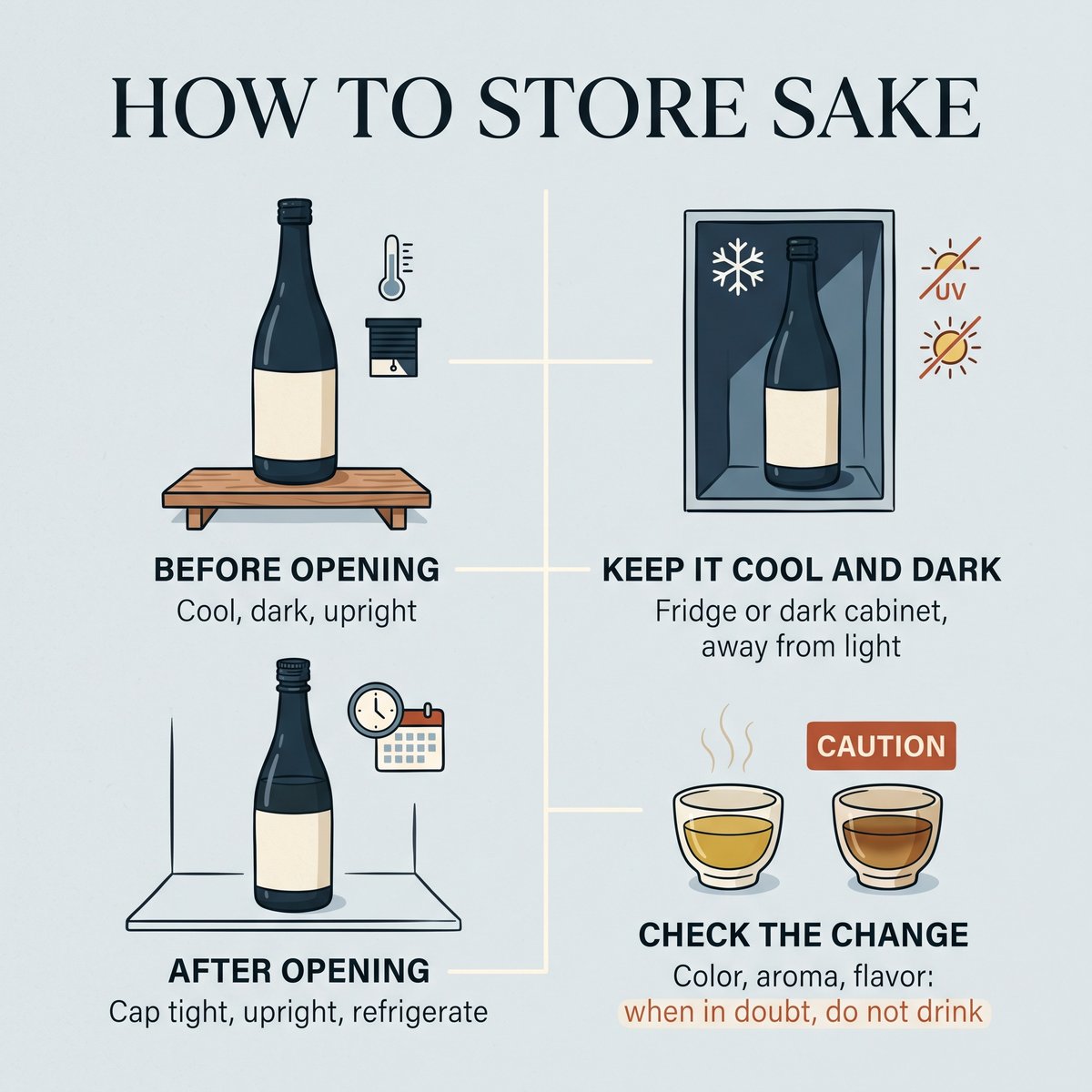
Proper sake storage means protecting the aroma and flavor the brewer intended. Heat, light, and air all change sake over time, so a few steady habits keep a bottle tasting fresh.
Best default
Cool, dark, upright, and sealed
Unopened bottle
A cool, dark place, or the fridge if the label asks for it
Opened bottle
Close tightly, stand upright, and refrigerate
Always check
The label and the brewery’s own guidance
Temperature guide
About 5–15°C (40–60°F) for most sake; 4°C (40°F) or lower for namazake, sparkling sake, and ginjo (a general guide)
Not a deadline
A production date is not an expiration date
Sake does not stop changing once you buy it. After that, the bottle meets your kitchen, your fridge, and your schedule. Those conditions shape how it smells and tastes. For example, a warm shelf can dull a fruity aroma.
The goal is usually simple. You want to preserve the character the brewer intended, not improve the sake through uncontrolled aging. Deliberate aging does exist, and our guide to Jukusei explains it. Still, most bottles are meant for drinking fairly young.
Advice also varies by style. A pasteurized everyday sake can handle a cool cupboard. Unpasteurized namazake and delicate ginjo usually want the fridge. So the label matters more than any single rule, and our guide to reading a sake label shows where to look.
Quick Guide: How to Store Sake
You probably want the short answer on how to store sake first, so here it is.
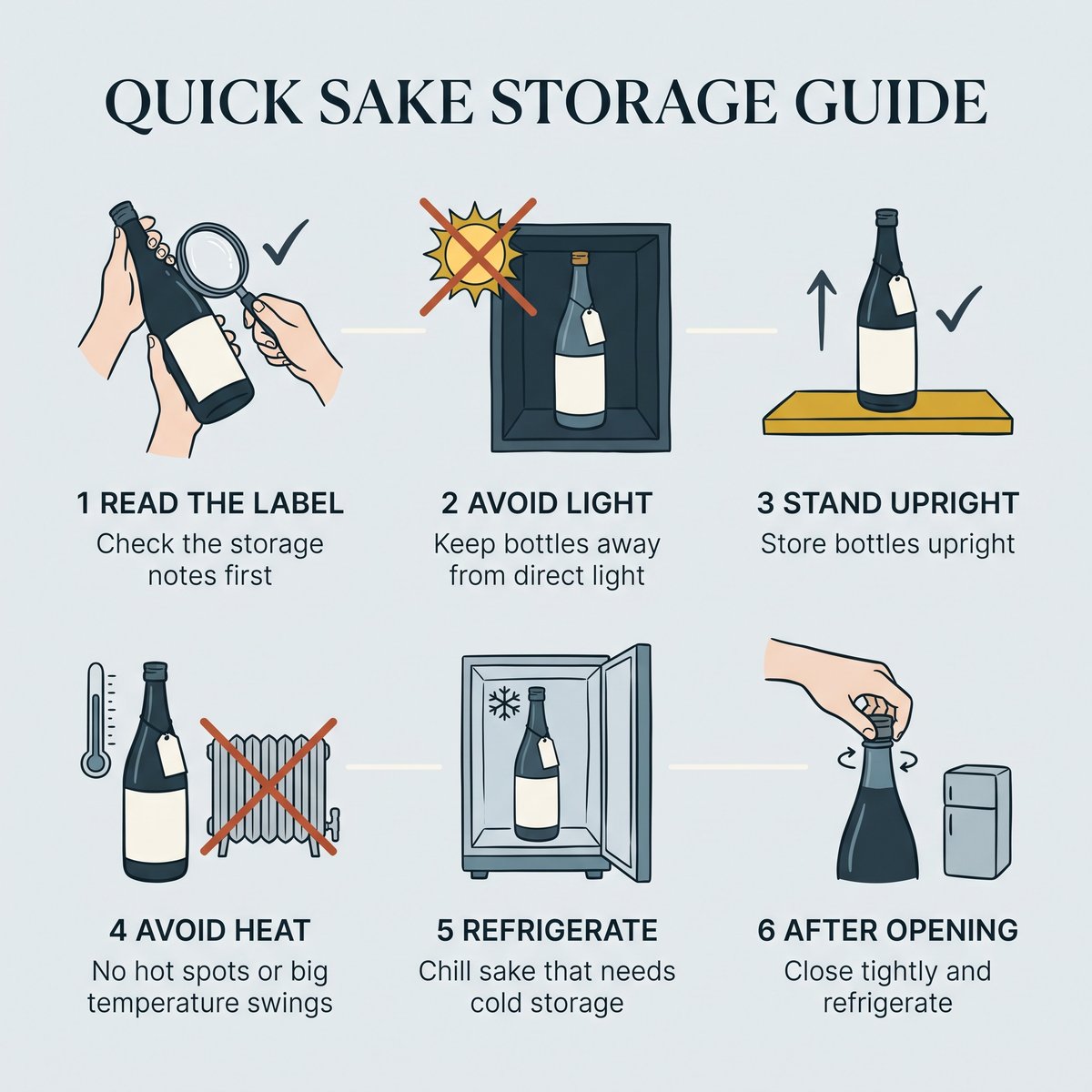
Quick Sake Storage Guide
Check the storage notes on the label first.
Keep bottles away from direct light.
Store bottles upright.
Avoid hot spots and big temperature swings.
Refrigerate sake that needs cold storage.
Close opened bottles tightly and refrigerate them.
Each habit has a reason, and the sections below explain them. For now, treat the list as a safe starting point. Then adjust for the style you bought. If the label gives its own instructions, follow those first.
Why these six? Heat and light are the main concerns before opening, while oxygen becomes especially important after opening. A tight seal limits air, and an upright bottle keeps less liquid in contact with air. Together, the habits cover most of what can go wrong. None of it needs special equipment, only a little attention when you put a bottle away.
Does Sake Need to Be Refrigerated?
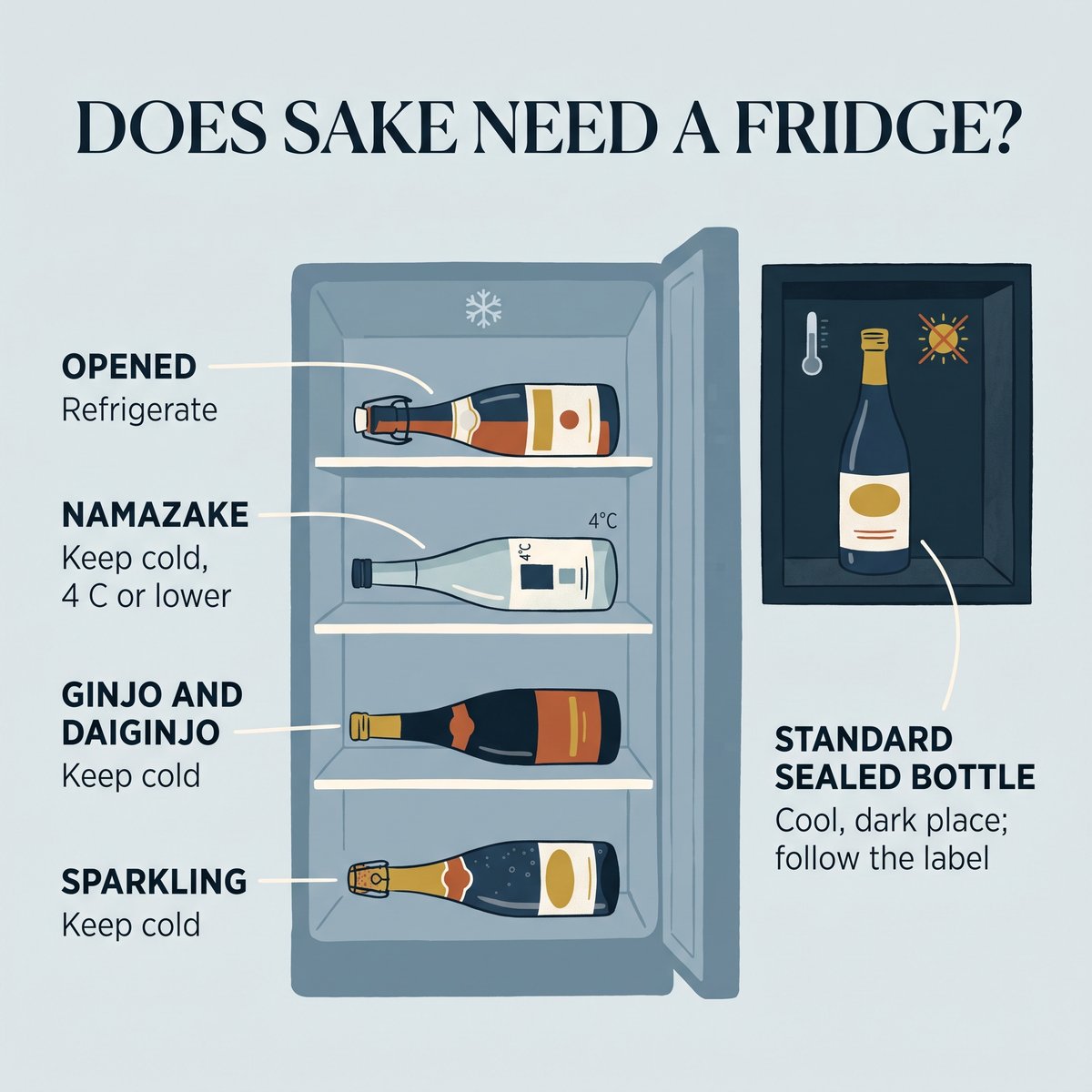
Sometimes it does, and sometimes it does not. The honest answer depends on how the sake was made. Neither extreme works well. Not every bottle requires refrigeration, but warm storage can accelerate unwanted aroma and flavor changes.
When Refrigeration Matters
Some styles clearly benefit from cold storage. Japan’s National Tax Agency, for instance, asks liquor shops whether they keep daiginjo and nama sake in refrigerated cases. That question shows how seriously the industry treats those styles.
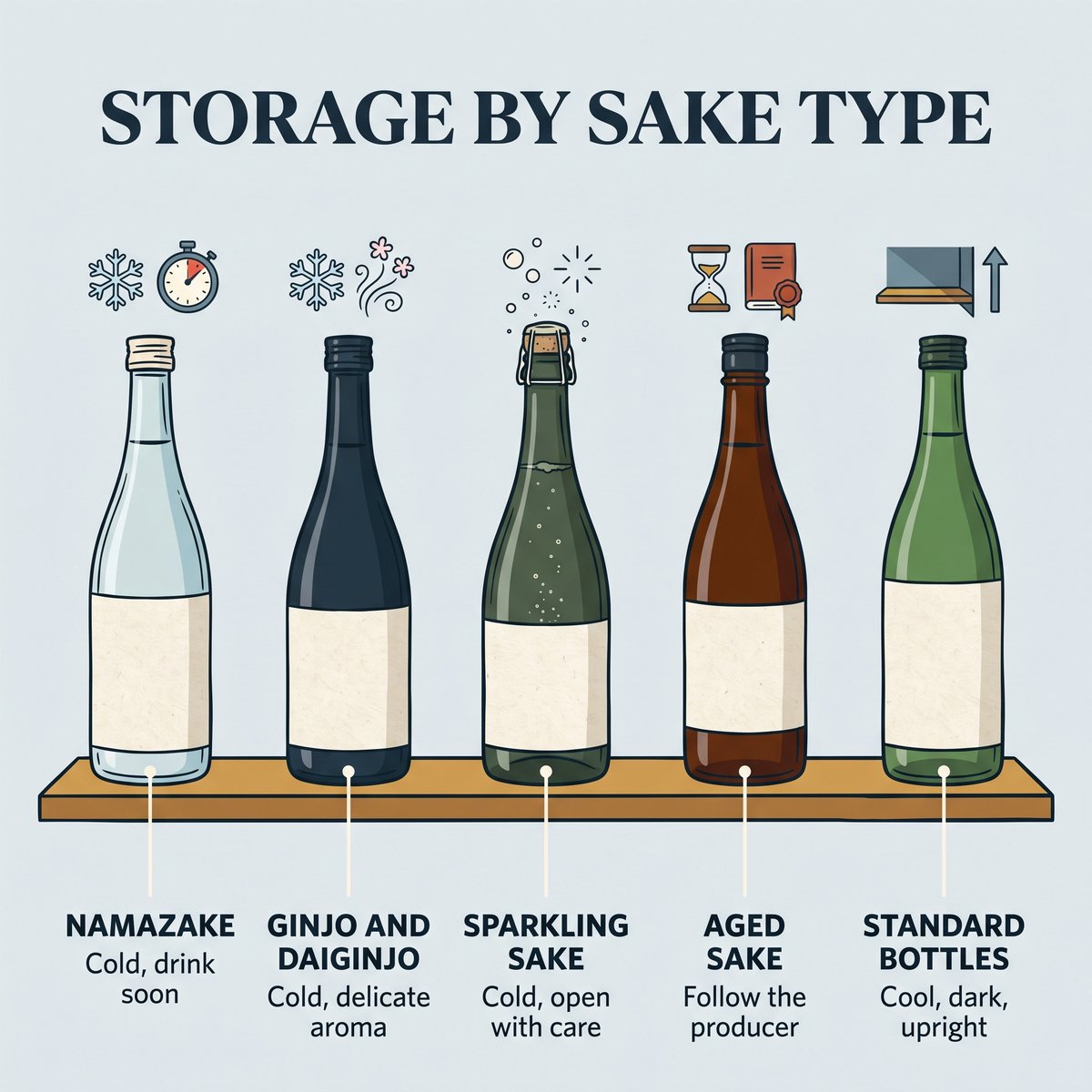
Namazake (生酒), which skips heat treatment
Fragrant ginjo (吟醸) and daiginjo (大吟醸)
Sparkling sake, when the label asks for it
Any bottle marked for refrigeration (要冷蔵)
Why do these styles differ? Namazake stays more reactive, while ginjo and daiginjo carry delicate aromas. Sparkling sake adds pressure to the mix. So each style needs the fridge for its own reason.
When a Cool, Dark Place Can Work
Many heat-treated styles tolerate a cool cupboard well. Pasteurized futsushu (普通酒) and other everyday styles often fall here. Some junmai (純米) does too, though style and aroma vary. Certain deliberately matured products also follow the producer’s own guidance.
That said, the fridge is often the simpler choice. Summer rooms warm up fast, and a fridge holds a steady temperature. If you do not trust your cupboard in July, move the bottle. A stable spot beats a lucky guess.
How Cold Is Cold Enough?
Two Japanese bodies give numbers. The National Research Institute of Brewing describes a cool place such as a wine cellar, about 5–15°C (40–60°F), as acceptable for sake in general. It says namazake, sparkling sake, and ginjo are more sensitive and need 4°C (40°F) or lower. The Japan Sake and Shochu Makers Association describes an ideal of 1–8°C (34–46°F), with as little light as possible. Treat both as general guidance. When the label says otherwise, the label wins.
A Simple Way to Decide
Ask three questions. Does the label ask for refrigeration? Is the sake unpasteurized, sparkling, or very aromatic? Will you keep it for several weeks or through a hot summer? If any answer is yes, use the fridge. If all three answers are no, a cool, dark cupboard is reasonable. When you are unsure, the fridge is the safer default.
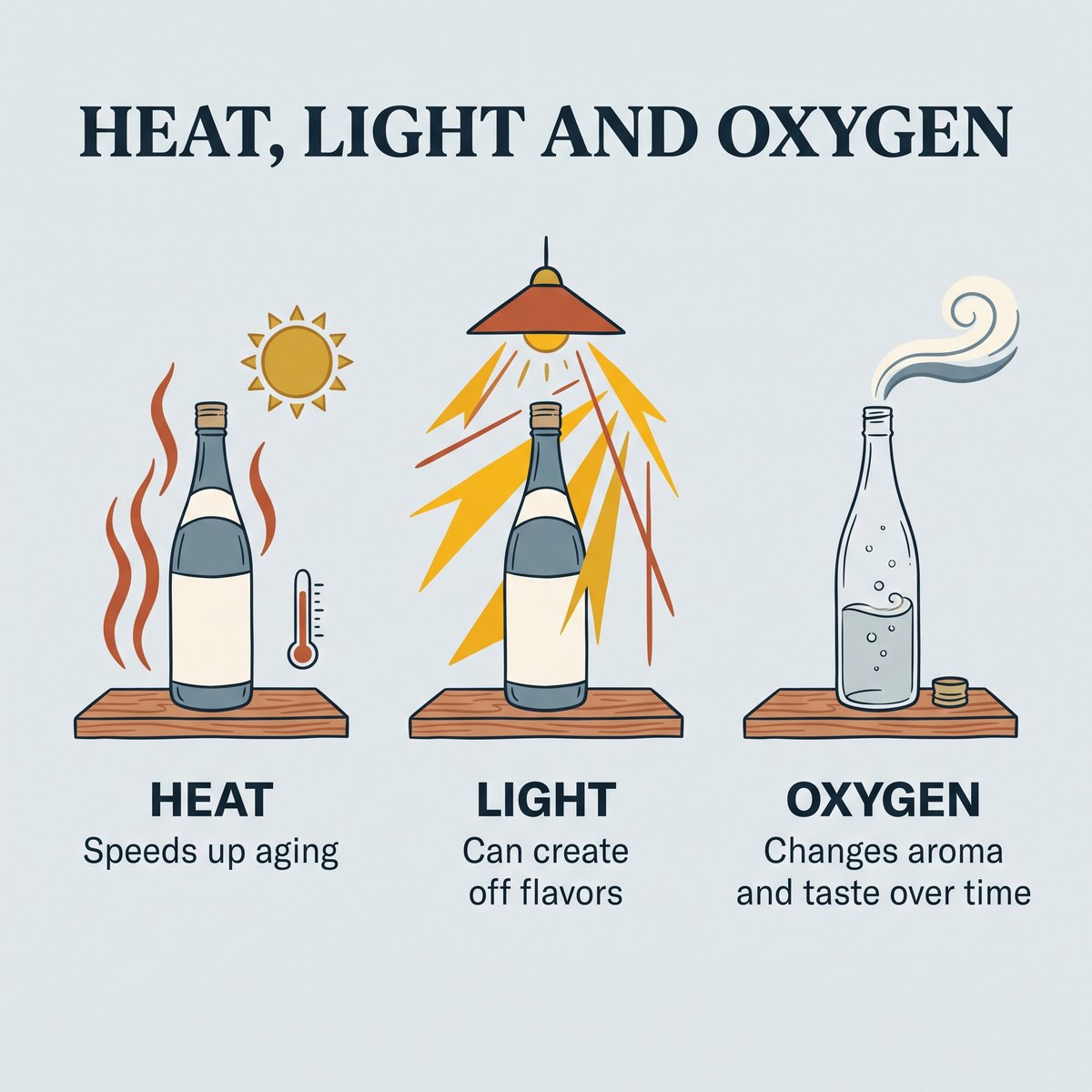
Heat, Light, and Oxygen: The Three Main Enemies
Three forces drive most changes in a stored bottle. We keep the science short here. For the full story on brewing and bottling, see our guide to bottling.
These forces also work together. Warmth speeds up the effects of oxygen, and light adds to both. That is why one shelf can differ from another, even in the same house.
Heat
Heat speeds up the chemical changes that dull sake. A 2023 study in the Journal of the Brewing Society of Japan tested seven commercial heat-treated sakes. Four were ginjo-group samples and three were junmai-group samples. The team stored them at 0, 15, 25, and 35°C (32, 59, 77, and 95°F) for up to six months. At 35°C, every sample developed a stronger aged off-aroma, which brewers call hine-ka (ひね香), and scored worse overall. By contrast, tasters found no significant difference between 0°C and 15°C.
Even at 25°C, one aging-related compound roughly doubled over six months. Some samples also showed reduced ginjo aroma or increased aged aroma after four months or longer, although the pattern was not uniform. The authors concluded that storage at 15°C (59°F) or below is desirable for preserving quality. A separate Iwate Prefecture report saw a similar pattern in a maturity marker called 3-DG. Still, the study covered a small group of heat-treated sakes and did not include namazake or opened bottles. Read it as a trend, not a rule for every bottle.
Light
Light also changes sake. In a 2011 review, a researcher at the National Research Institute of Brewing noted that certain indole compounds linked to aged aromas rise especially fast under light. Many brewers likewise warn that sunlight and fluorescent lamps can add off-notes and deepen the color. Clear bottles offer less protection than dark glass, so they deserve extra care.
Oxygen
Air matters most after opening. Once the cap comes off, oxygen starts a slow shift in aroma and color. The Nada Sake Research Association notes that heat and oxygen both influence aging, so the storage environment strongly affects quality. A tight cap and a cold shelf slow this shift, though they do not stop it.
How to Store Unopened Sake
When you bring a bottle home, resist the urge to leave it on the counter. Unopened sake is easy to store well, because a few choices do most of the work.
Pick a Cool, Dark Spot
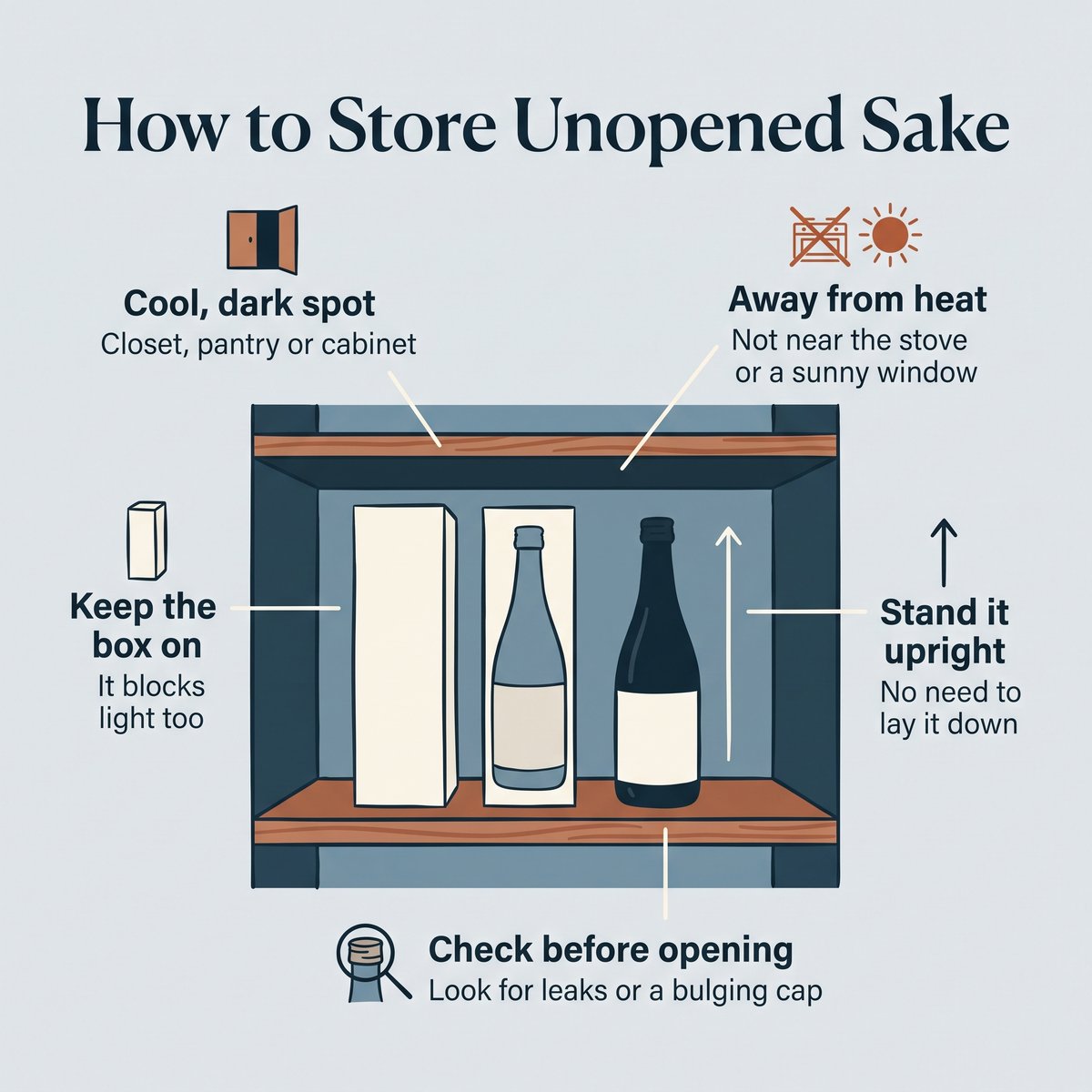
Look for a closet, pantry, or cabinet that stays cool through the year. Avoid the area near the stove, the dishwasher, or a sunny window. Kitchens run warmer than they feel. If the bottle came in a box, keep the box on, because it blocks light too. A paper wrap works as a cheap backup.
If the label asks for refrigeration, follow it. Otherwise, a heat-treated bottle can wait in a cool cupboard. Keep the original label and packaging, since you may need the storage notes later.
Keep the Bottle Upright
Wine lovers often lay bottles on their side to keep the cork moist. Sake does not work that way. The Japan Sake and Shochu Makers Association says sake does not need horizontal storage, and many bottles use caps instead of corks. So stand the bottle up. The National Research Institute of Brewing also advises storing sake upright. After opening, this reduces the liquid’s surface area exposed to air. It also lowers the risk of leakage and makes the bottle easier to secure in a refrigerator.
Check the Bottle Before Opening
Take a quick look before you open it. Check for leaks, a bulging cap, or anything that does not match the style. A damaged closure is a reason to pause. Then contact the seller instead of opening the bottle at the table.
How to Store Sake in the Refrigerator
A home fridge works well for most bottles. The trick is to treat the bottle gently, because steady cold beats frequent changes.
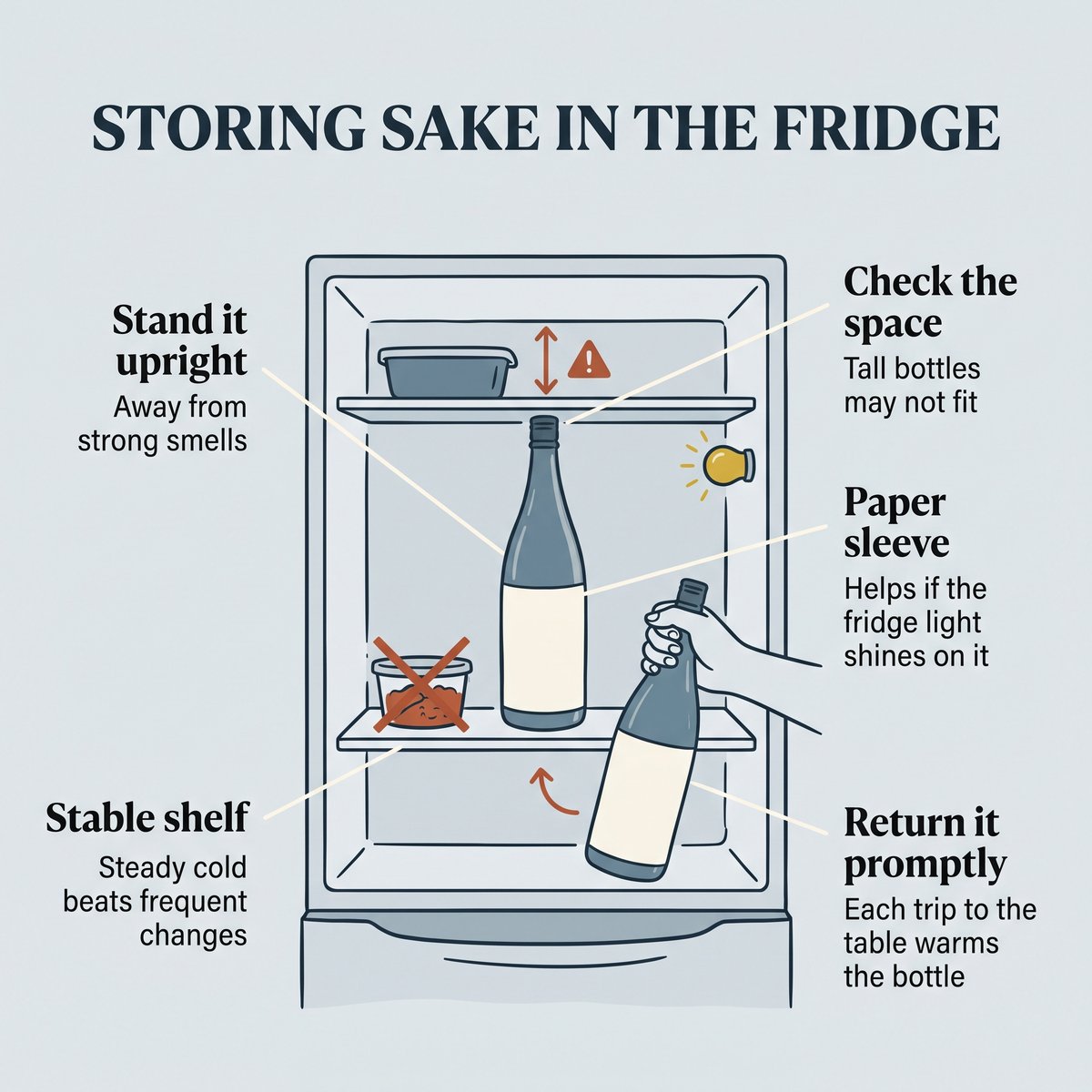
Start with a stable shelf. In many fridges, a back shelf sees fewer temperature swings than the door, though we found no official rule on this. Stand the bottle upright, and keep it away from strong smells.
Next, limit the back-and-forth. Each trip to the table warms the bottle a little. So pour what you need, then return it promptly. A paper sleeve helps if the fridge light shines on the bottle often.
Space can be the real obstacle. Tall bottles may not fit under a low shelf, and a crowded fridge raises the odds of knocks. A dedicated spot near the back helps. A wine cooler may also work if you can confirm that it stays cold enough for the bottle’s storage instructions.
Finally, read the brewery’s own instructions. Unpasteurized and sparkling sake need extra care, and we cover both below. If a tall bottle will not fit, a smaller size next time may solve the problem.
How to Store Namazake
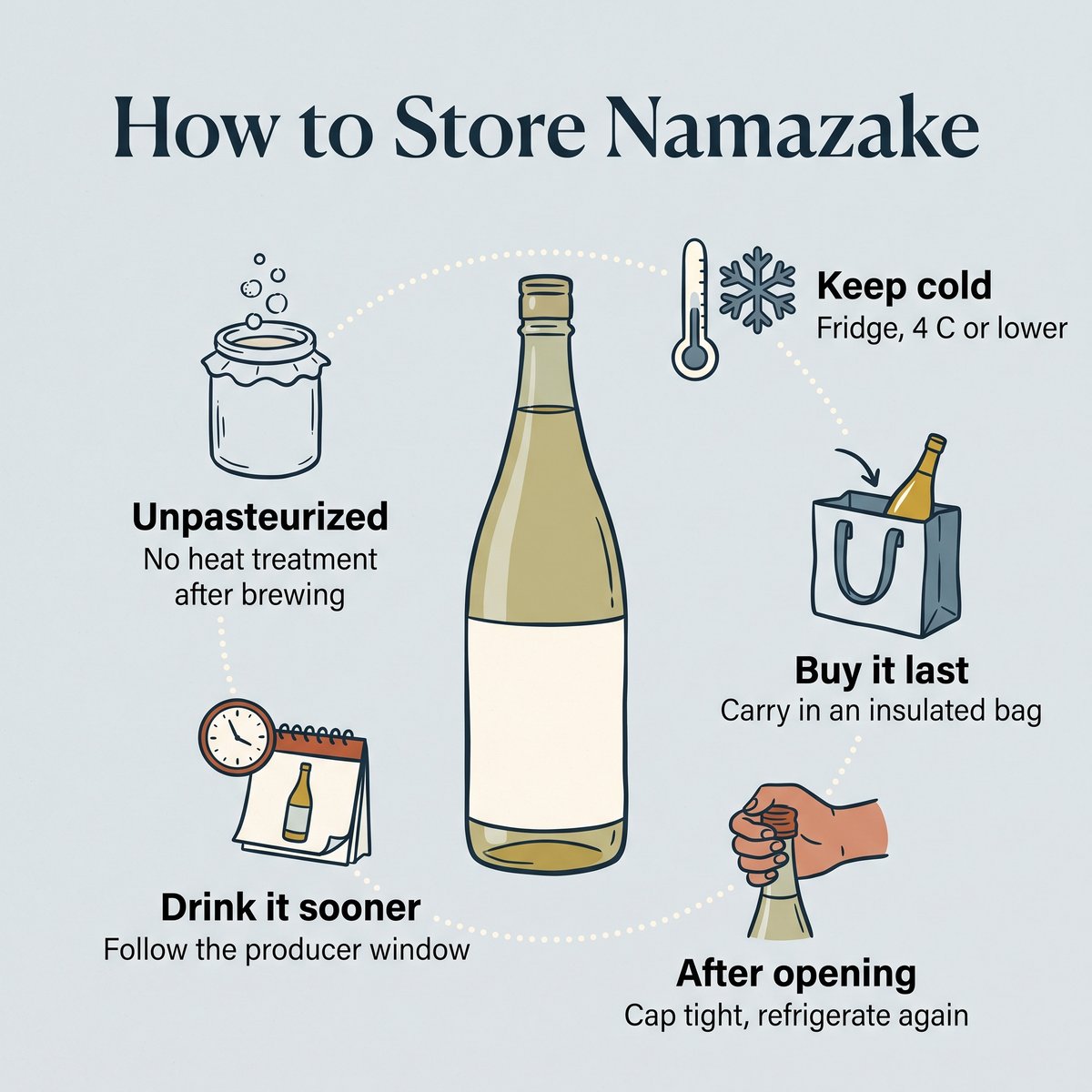
Namazake is sake with no heat treatment after brewing, and it needs the most careful handling. Our namazake guide covers how it gets made. This section focuses on keeping it fresh.
Why Namazake Needs Careful Cooling
Japan’s National Tax Agency defines namazake as sake that gets no heat treatment after production. Its labeling standards also require storage or drinking notes on such bottles. Brewers heat most sake twice, once before storage and once before shipping, as our pasteurization article explains. Namazake skips that step, so it stays more reactive.
So most namazake needs the fridge. A few producers do design products for room-temperature distribution, though. Follow the label and the producer’s instructions.
Bringing It Home and Opening It
Buy namazake last on your shopping trip. Carry it in an insulated bag if the trip is long. Then put it straight into the fridge. Never leave it in a warm car, even for a short errand.
After opening, close the cap tightly and refrigerate it again. Drink it sooner than a heat-treated sake. Its fresh character is the main point, so there is little reason to wait. If the brewery gives a drinking window, follow it.
How to Store Ginjo and Daiginjo
Ginjo and daiginjo are prized for aroma, so storage matters more. Our guides to ginjo and daiginjo cover how brewers make them. Here we stay with aroma and temperature.
Why Warmth Dulls the Aroma
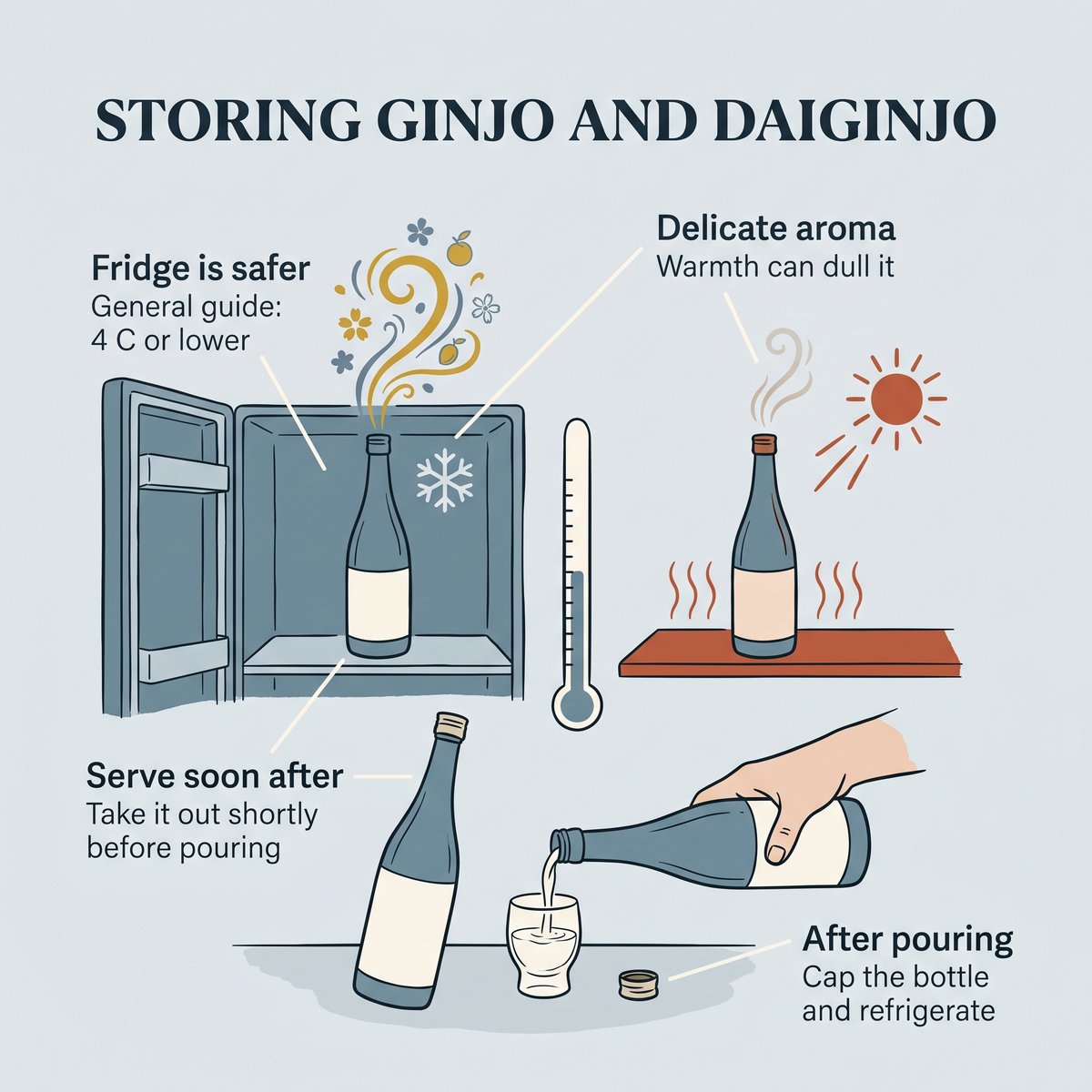
Brewers go to great lengths to protect these aromas. A Hiroshima Prefecture technical FAQ notes that a growing number of makers heat highly aromatic ginjo only once, to limit quality changes. It makes little sense to lose that effort on a warm shelf. In the same study, the four ginjo-group samples showed a marked decrease in ginjo aroma at 35°C (95°F), together with increased hine-ka and poorer overall scores.
So refrigeration is generally preferable, especially for preserving a delicate aroma. The National Research Institute of Brewing groups ginjo with namazake and sparkling sake as styles that need 4°C (40°F) or lower. That is general guidance, not a legal rule. If the label has no cold note and the bottle has sat in a cool cupboard, there is no need to panic. Still, the fridge is the safer bet.
Serving and Opened Bottles
Take the bottle out shortly before serving, not hours early. A short rest softens the chill without letting the aroma drift. Our glasses guide shows how vessels shape the aroma too. After pouring, cap the bottle and return it to the fridge. Drink opened ginjo earlier than a sturdy junmai.
How to Store Sparkling Sake
Sparkling sake follows its own rules, because bubbles mean pressure. Methods and closures differ by product, and our sparkling sake guide explains the styles.
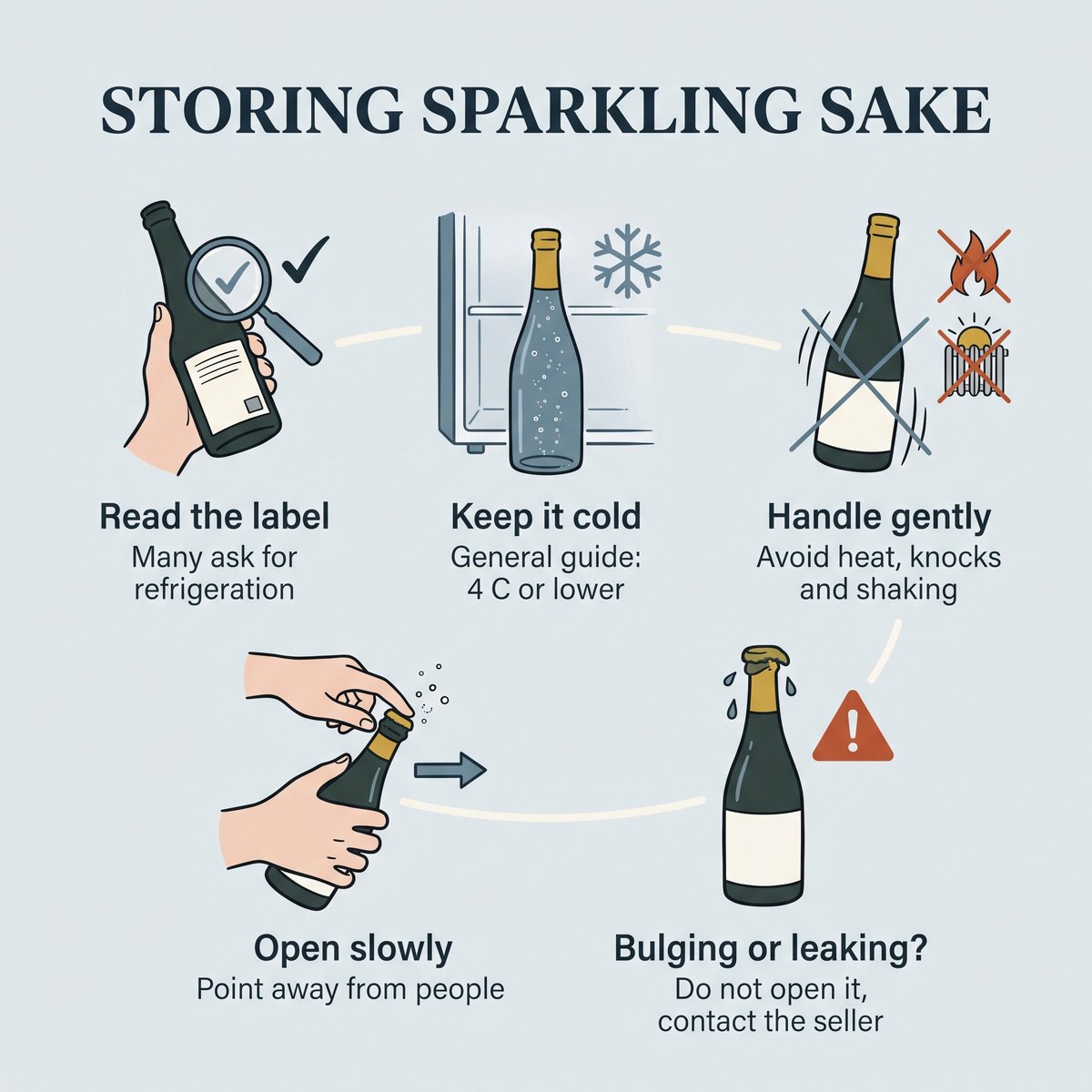
First, read the label. Many sparkling sakes ask for refrigeration, and heat can raise the pressure inside the bottle. The National Research Institute of Brewing also lists sparkling sake among the styles that need 4°C (40°F) or lower. Some brewers carbonate by secondary fermentation in the bottle, while others add gas. Pressure therefore differs from product to product.
Next, handle the bottle gently. Avoid heat, knocks, and shaking. Chill it well before opening when the label recommends it. Then open it slowly, pointing the bottle away from people.
Resealing deserves caution. Reseal only when the closure suits reuse. Otherwise, plan to finish the bottle in one sitting or share it. If the bottle bulges or leaks, do not open it, and contact the seller.
How Long Does Unopened Sake Last?
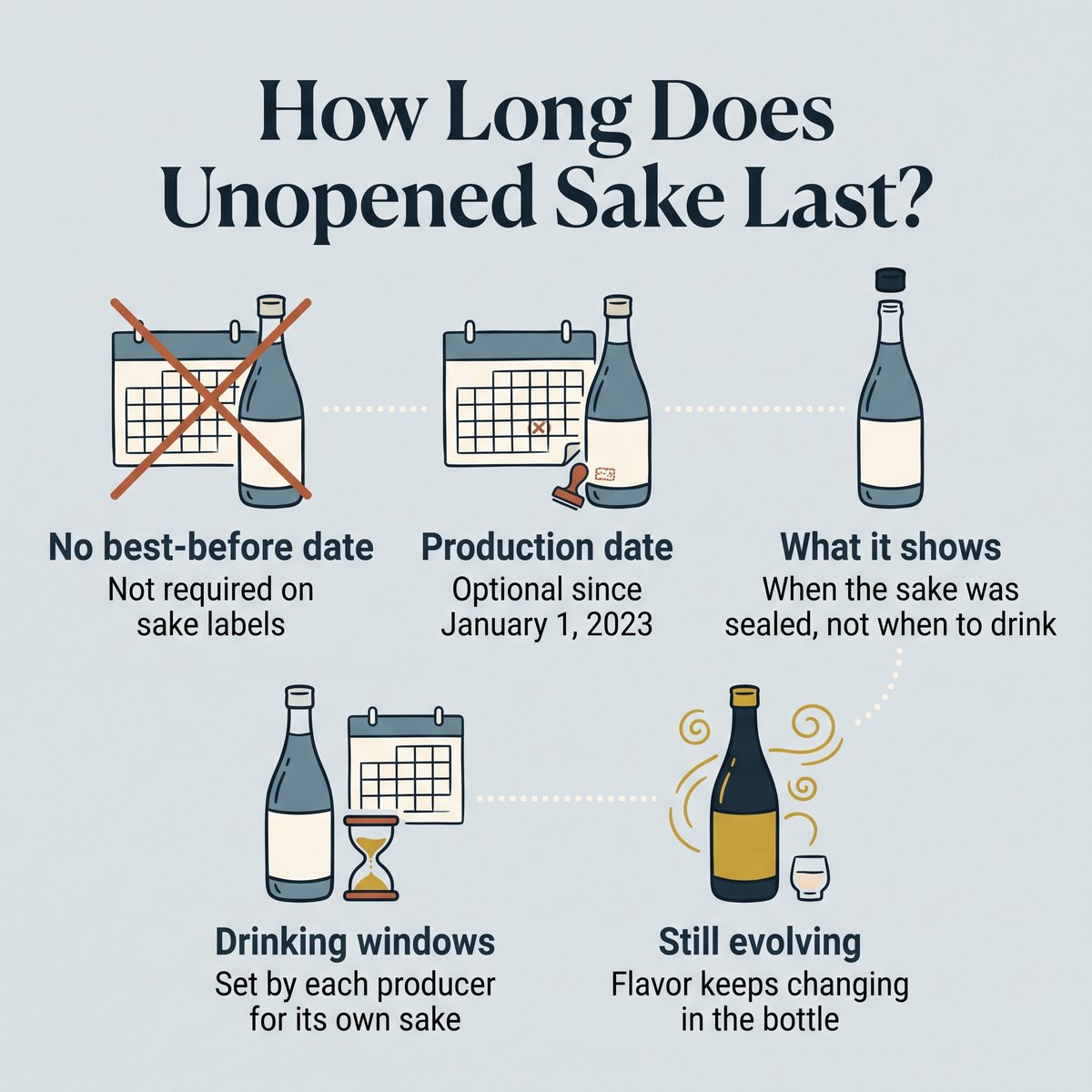
Unopened sake can remain drinkable for a long time, but its aroma and flavor continue to evolve. No single number fits every bottle. Label rules, storage, and style all play a part.
Is There an Expiration Date?
Japan’s labeling rules do not require a best-before date on sake. Before 2023, producers had to print a production date, though that has changed. Since January 1, 2023, showing the production date has been optional under the National Tax Agency’s standards. When a brewery does show it, the date marks when the sake went into its sale container and the brewery sealed it.
Important: A production date is not the same as a best-before date. It tells you when the sake was sealed in its container, not when to drink it.
Because of this, you may find bottles with no date at all. Do not read that as a warning sign. It simply reflects the current rules.
Drinking Windows Are Product-Specific
Many breweries publish product-specific drinking windows on their websites or labels. Those windows apply to their own products, not to all sake. A window for a table sake will not match the window for a fragrant ginjo. So use brewer guidance as a guide, and avoid turning it into a rule.
Time still matters for sealed bottles. According to a National Research Institute of Brewing researcher, sake usually ships about six months to a year after brewing. Flavors keep evolving afterward. An intact unopened bottle is generally more stable, but its condition and storage history still matter.
Aged Sake Is a Different Category
Old does not automatically mean spoiled, and it does not mean better either. Brewers make koshu on purpose and store it for the purpose. A bottle that sat on a warm shelf by accident tells a different story. For the difference, see our jukusei guide.
How to Store Sake After Opening
Opening a bottle changes the rules. Air is now inside, and every day counts a little more. A simple routine keeps most of the freshness.
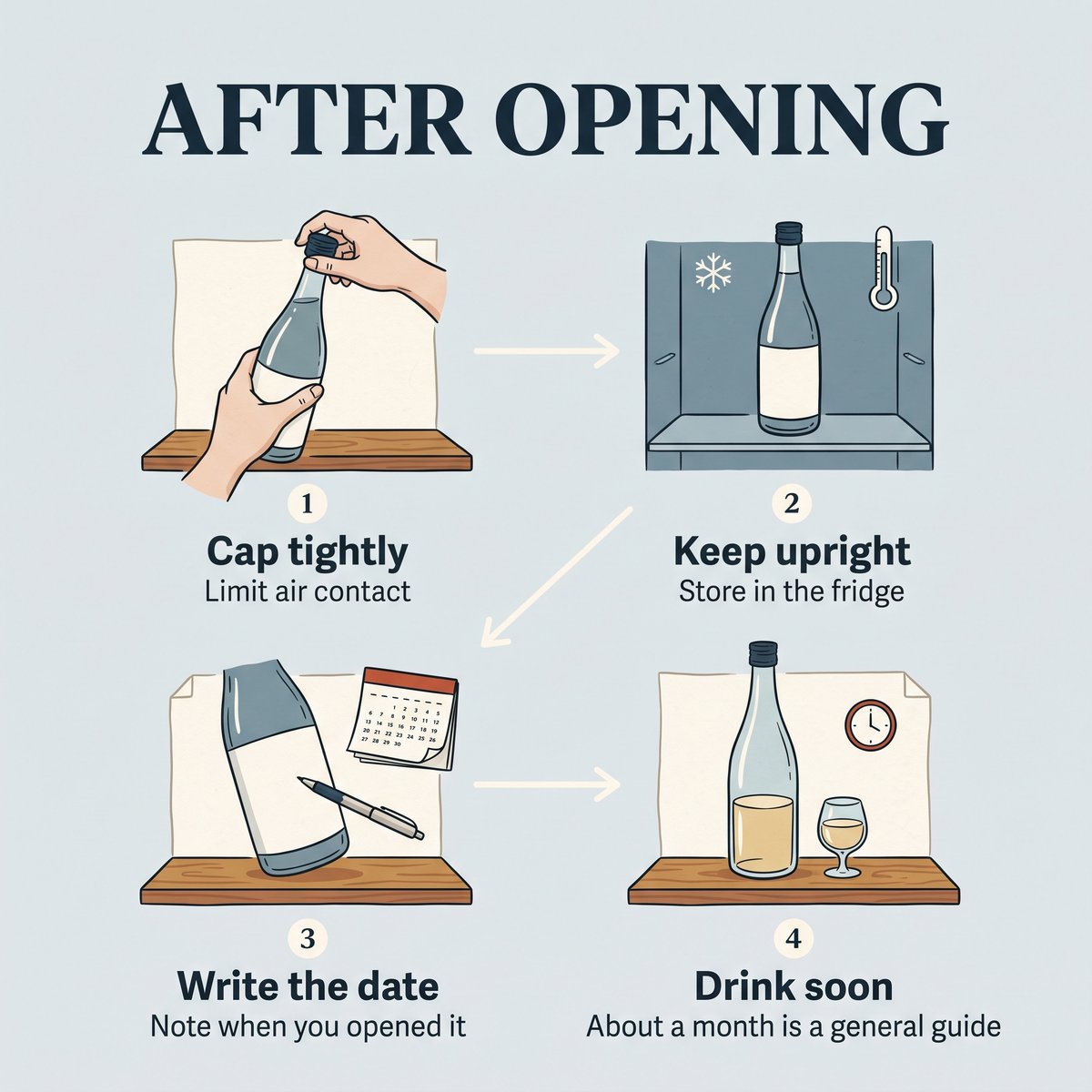
A Simple After-Opening Routine
Pour what you want, then cap the bottle promptly.
Wipe the neck so no sake dries on the rim.
Close the cap tightly.
Stand the bottle upright in the fridge.
Check the label for any special notes.
For most opened sake, refrigeration is the simplest way to slow further change. Do not leave the bottle uncapped longer than necessary, especially in a warm room. Pour what you need, close the cap, and return the bottle to the refrigerator.
You may wonder about pouring leftovers into a smaller bottle. That cuts air space, yet it adds a hygiene risk. Avoid transferring sake unless you can use a clean, suitable container.
How Soon Should You Drink It?
Opened sake usually tastes freshest when you enjoy it sooner. Sturdier styles often hold their character longer. Still, the speed depends on the style and on how you store the bottle.
There is no universal safety deadline for every bottle. However, the National Research Institute of Brewing gives one month as a general guide after opening, and it adds that this may not fit every type of sake. Delicate aromas may fade much sooner, so fragrant sake is usually best enjoyed earlier. Some breweries publish their own windows, but these apply to their products rather than all sake. A bottle past its flavor peak is not automatically unsafe, but see the caution notes below for what to watch for.
One practical tip helps here. Write the opening date on a small sticker or on the box. Memory fades fast, and a date makes the decision easy later. You can then learn how quickly your favorite styles change in your own kitchen.
How Long Does Opened Sake Last?
This section looks at time and taste rather than storage steps. There is no fixed number, but the pattern is fairly predictable.
What Changes in the First Few Days
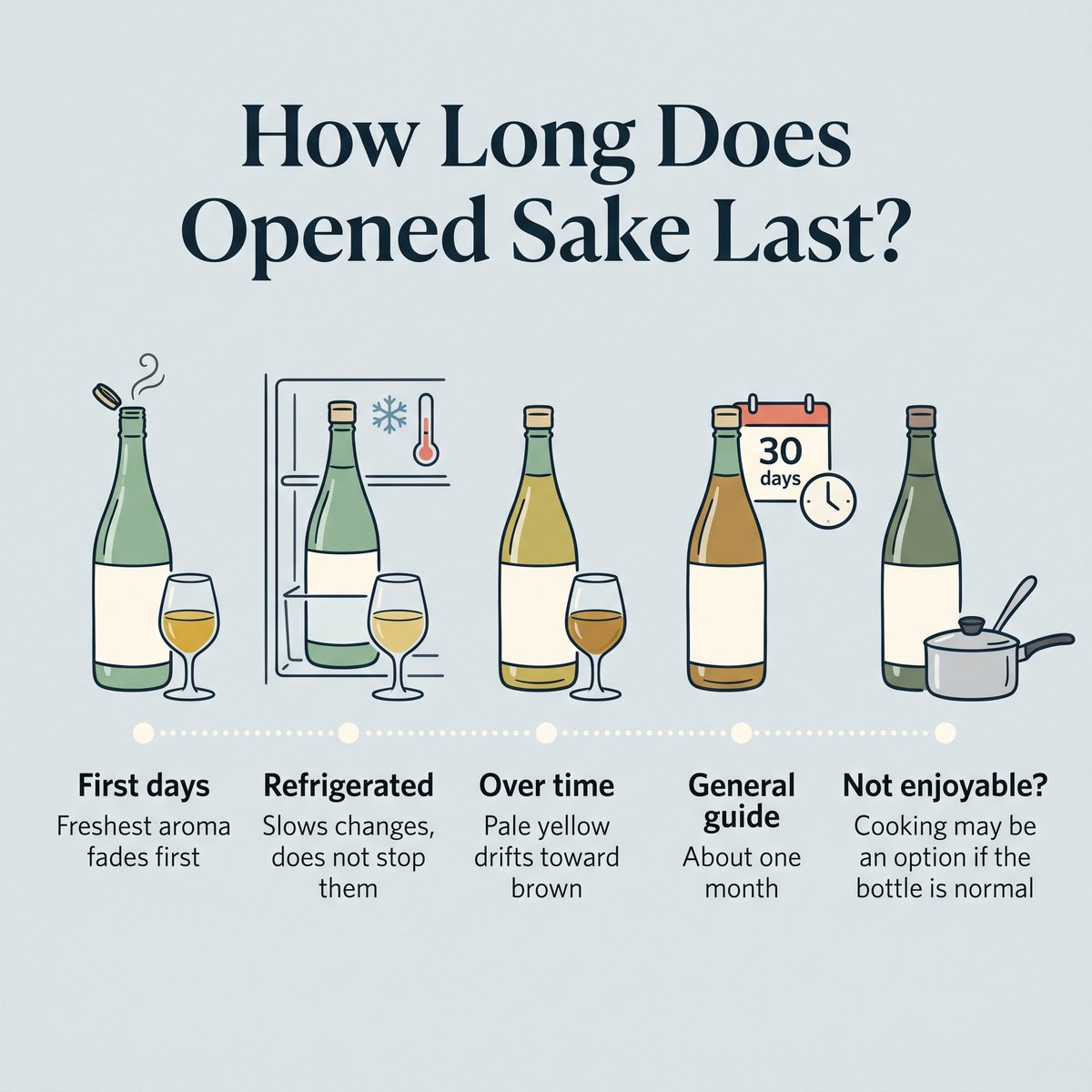
The first thing to fade is usually the freshest part of the aroma. It fades gradually, and the flavors begin to shift. Oxidation then adds new notes over time. Aromatic styles show this sooner because they have more aroma to lose. Changes may be less immediately noticeable in fuller, more robust styles.
Refrigeration slows these changes, but it does not stop them. So if you want the best flavor, prioritize the bottle you already opened. Save the next one for later. Rushing can feel wasteful, yet it often tastes better than nursing a bottle for a long time.
How Sake’s Aroma and Flavor Change Over Time
An NRIB researcher describes stored sake shifting from pale yellow toward brown. The fruity aroma fades, and notes like caramel, toast, soy sauce, and nuts appear. The mouthfeel turns smoother, and bitterness can rise. Brewers use the word hine-ka for the unwelcome version.
Some people enjoy these deeper notes, and others find them flat. Both reactions are fair. If the sake looks and smells normal but no longer tastes enjoyable on its own, using it in cooking may be an option. Do not use it for cooking if the bottle is leaking, damaged, unexpectedly pressurized, or otherwise abnormal.
Can You Store Sake at Room Temperature?
Sometimes you can, but “room temperature” is a loose phrase. A number tells you more than the word does, and the real environment tells you even more.
What Room Temperature Means in Practice
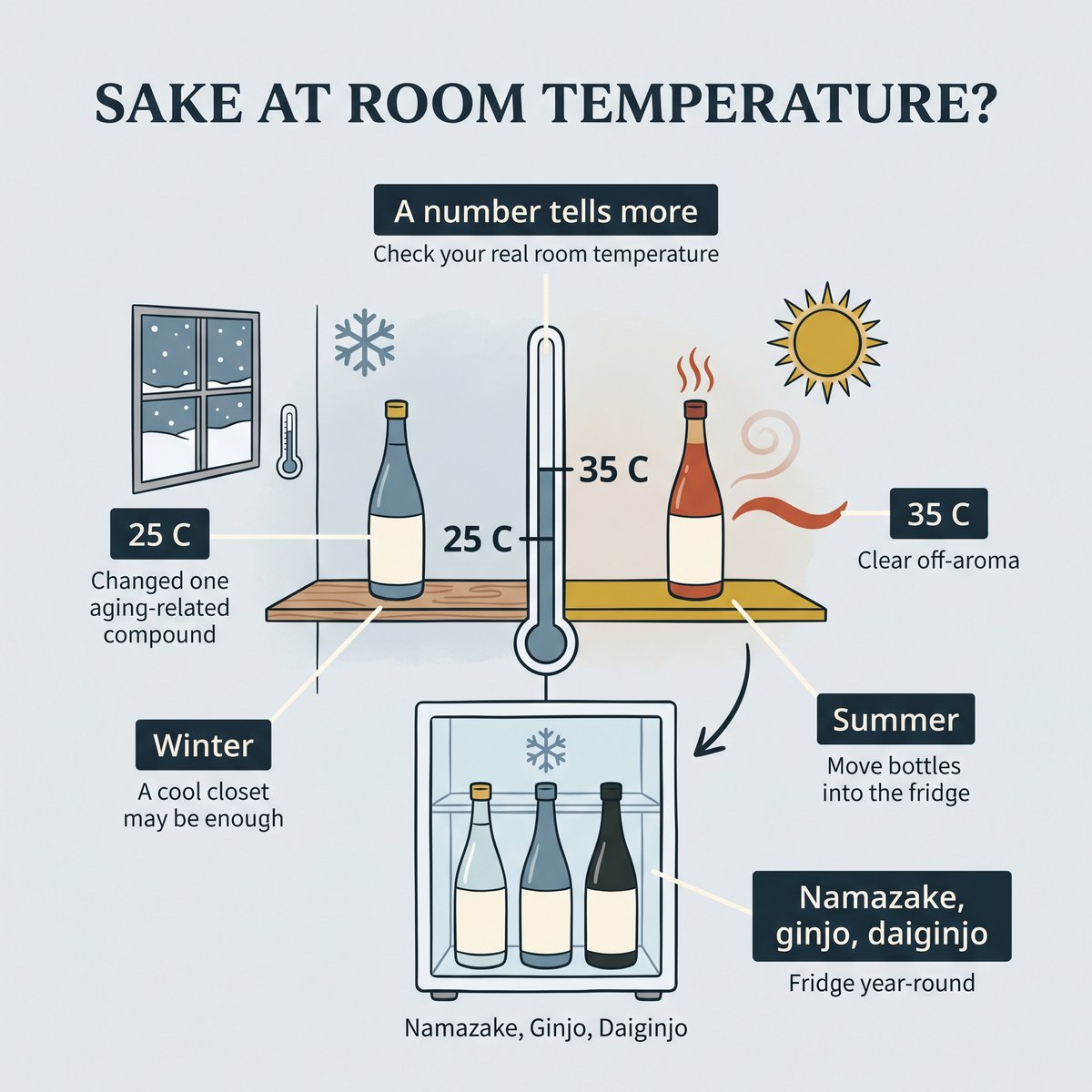
A cool cupboard in a shaded pantry is not the same as a kitchen shelf in August. Rooms also warm and cool with the seasons. In the 2023 study, 25°C (77°F) already changed one aging-related compound, while 35°C (95°F) produced clear off-aroma. Summer rooms without air conditioning can approach those levels, so check your own spaces.
Sunlight matters indoors too. A bottle near a window gets light and heat together. So choose a dark cupboard instead.
Seasonal Habits
Seasons change the answer. In winter, an unheated closet may stay cool enough on its own. In summer, the same closet can turn into a warm trap. Many people therefore move bottles into the fridge from late spring through early autumn. It is a small habit, and it removes the guesswork. For namazake, ginjo, and daiginjo, choose the fridge year-round.
Can You Freeze Sake?
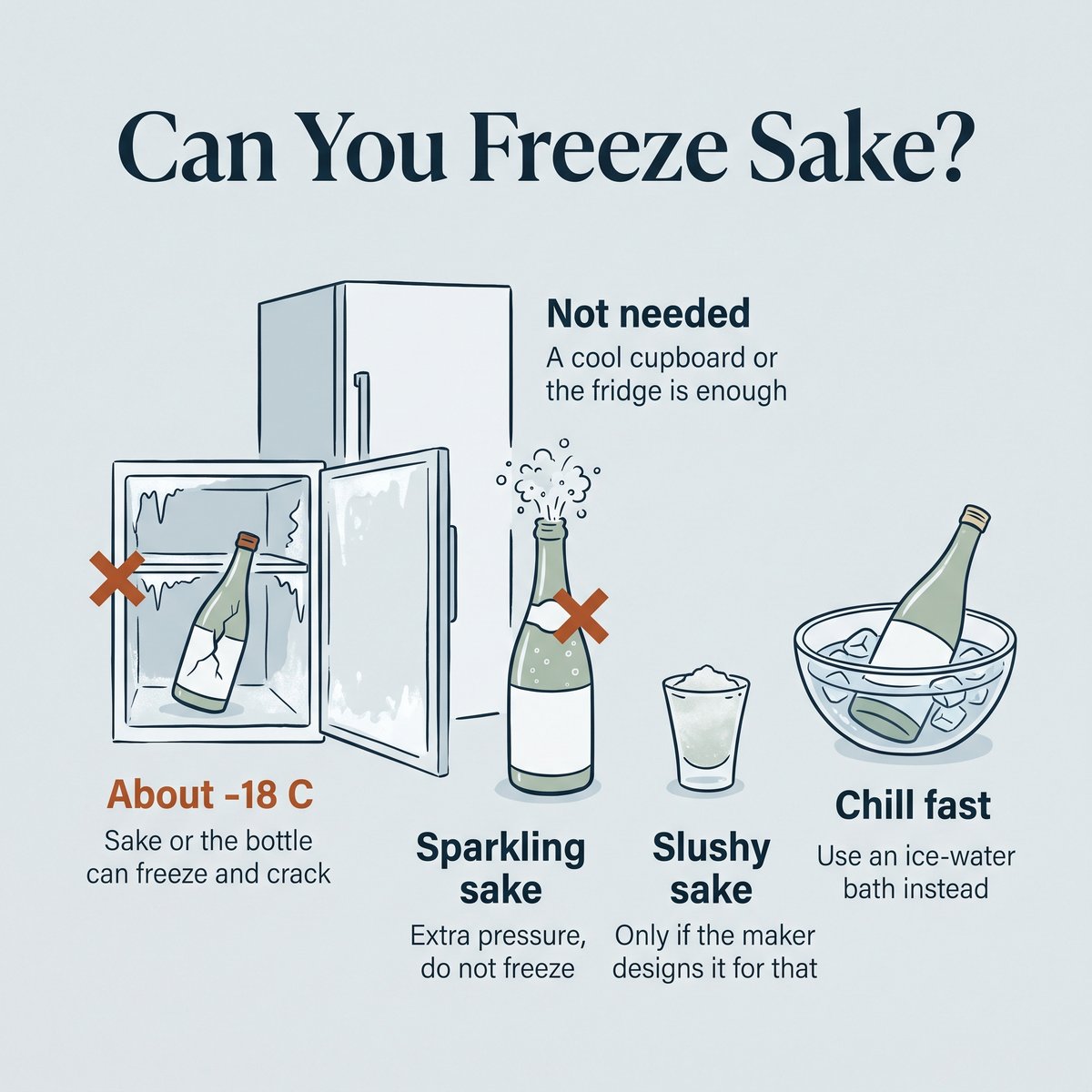
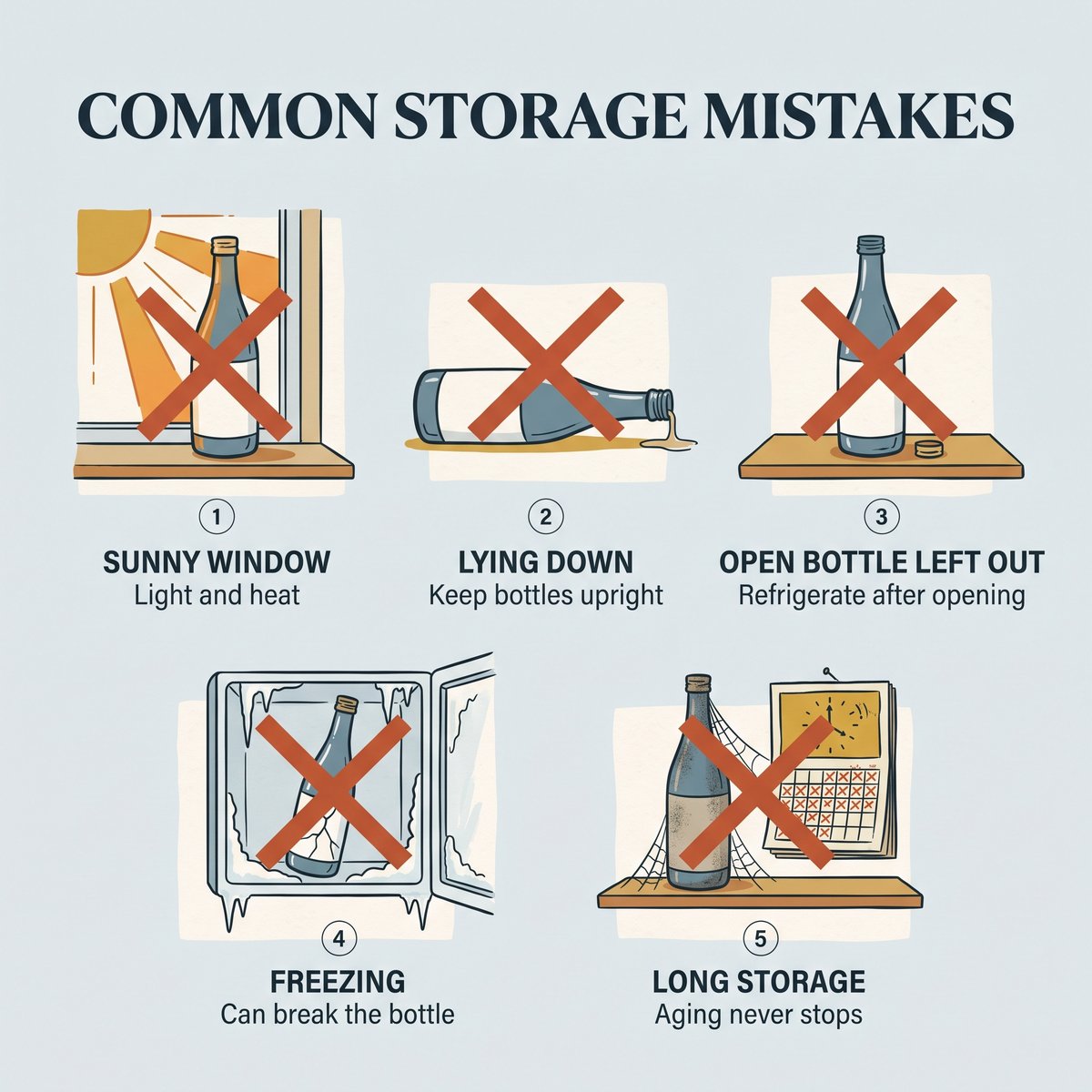
You do not need to freeze sake for storage. Ordinary sake keeps well in a cool cupboard or the fridge, so freezing adds risk without a clear benefit.
The National Research Institute of Brewing warns that sake may freeze, or the bottle may shatter, at around -18°C (0°F) or lower. A typical household freezer runs at about that temperature. Expanding liquid can crack glass, and a cracked bottle makes a mess. Sparkling sake adds pressure, so do not freeze it unless the producer explicitly says the product is designed for freezing.
Freezing for storage differs from making a frozen drink on purpose. Some makers sell sake meant to be served slushy or frozen, and their instructions come first. Otherwise, chill sake in the fridge instead.
If you want a cold drink in a hurry, an ice bath works better than the freezer. Set the bottle in a bowl of ice water for a few minutes. The sake cools evenly, and the glass stays safe.
How to Store Sake When Traveling
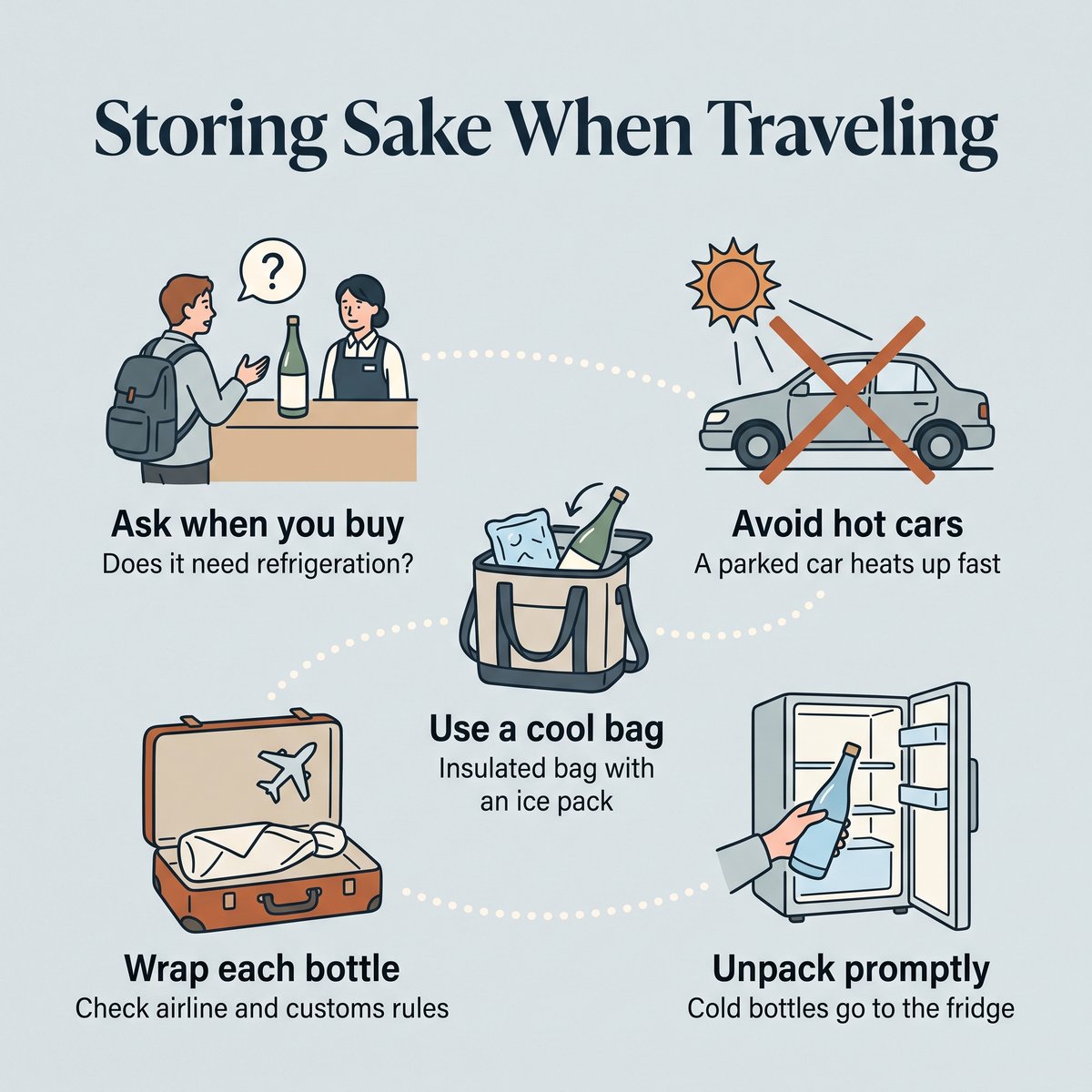
Travel makes it hard to store sake ideally. You can still protect a bottle with a few habits. Start by asking about storage when you buy.
At a brewery or shop, ask whether the bottle needs refrigeration. Also ask how long it can sit at room temperature. Staff can usually tell you quickly. If the bottle sits in a cold case, treat it as a cold product until you hear otherwise.
Next, protect the bottle on the way. Avoid hot cars, since a parked car heats up fast. Keep refrigerated bottles in an insulated bag with an ice pack. At the hotel, check that the refrigerator is running and cold enough for the product’s storage instructions.
Bringing sake home from Japan takes some planning. Wrap each bottle well, and check airline and customs rules before you pack. Rules differ by country and change over time. After you arrive, unpack promptly and put the bottles in their proper spot. Namazake and other cold bottles go straight to the fridge.
Souvenir bottles deserve a plan too. If you receive sake as a gift, check the label before you stash it in a cupboard. Gift boxes sometimes include a storage note. Treat a bottle from a brewery shop as you would a bottle from any shop. Read the notes, then choose the cupboard or the fridge.
How to Tell If Sake Has Changed
A change is not always a problem. Quality changes and safety concerns are different things, and mixing them up leads to wasted sake or bad decisions.
Possible Quality Changes
Less fresh aroma
A darker color
New mature or oxidized aromas
Shifts in sweetness, acidity, or finish
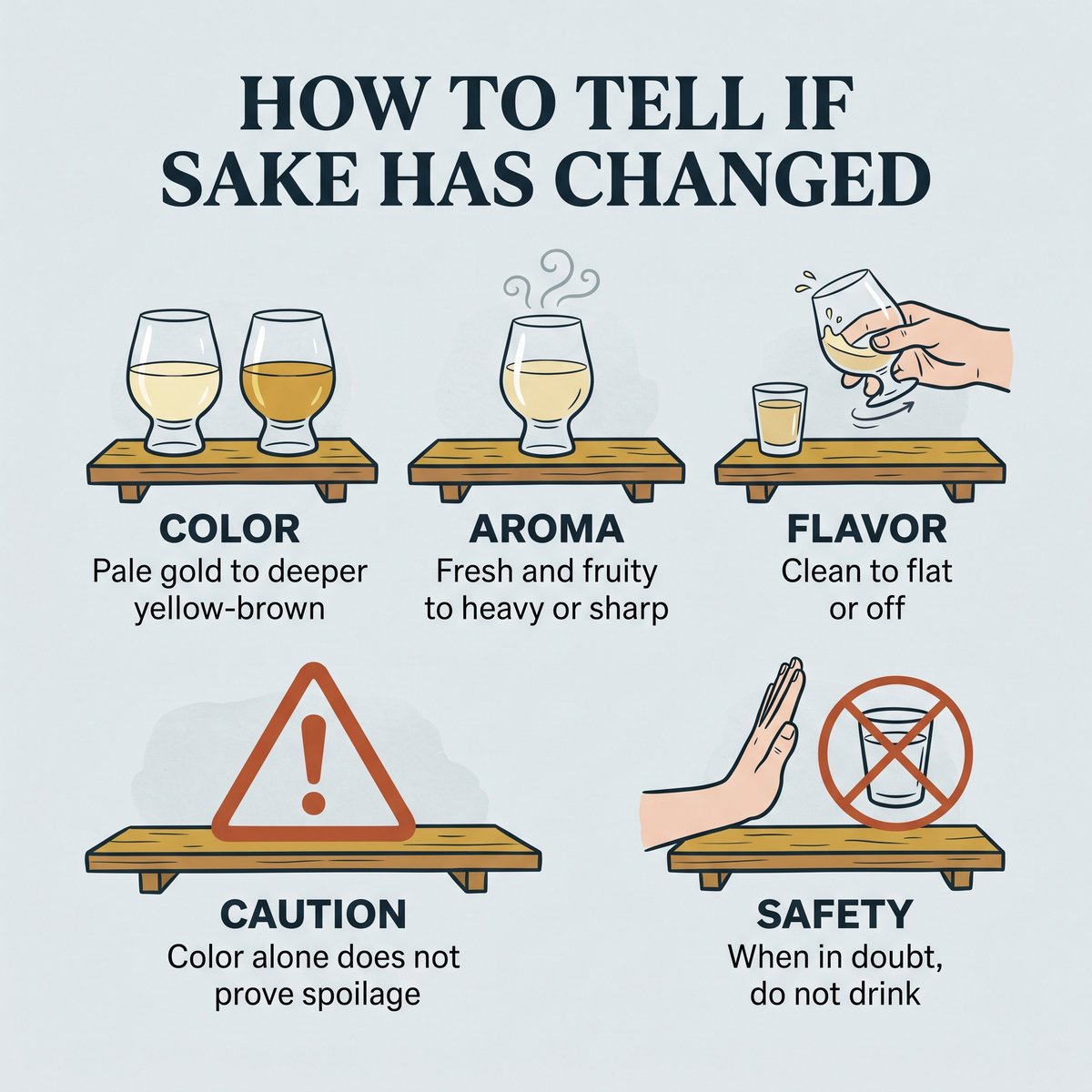
Color change may reflect maturation, light exposure, or heat. It does not prove spoilage by itself. Researchers in Gifu Prefecture, for example, use color as a marker of how far maturation has gone. Aged sake often changes color on purpose, so a deep amber koshu is no cause for alarm.
When to Be Cautious
Be cautious:
Do not drink from a leaking or damaged bottle.
Contact the seller if the product shows unexpected pressure, foaming, or contamination.
Skip bottles with unusual cloudiness or smells that do not match the style.
Sight and smell cannot guarantee safety. So if something seems abnormal, do not drink the bottle, and contact the seller instead. Bacterial spoilage called hi-ochi is a separate issue, and our hi-ochi article explains it. When in doubt, do not drink.
If the aroma is clean and the color looks normal, that is a good start. If the bottle shows no warning signs, taste a small amount only to check whether its flavor is still suitable for serving. Do not taste sake from a leaking, damaged, unexpectedly pressurized, or otherwise abnormal bottle.
Storage Guide by Sake Type
Use this table as a starting point. Always let the label override it.
Sake Type
General Storage Approach
Main Consideration
Standard heat-treated sake
Cool, dark place (about 5–15°C / 40–60°F); fridge also works
Avoid heat and light
Junmai
Follow the producer’s instructions
Style and aroma vary
Ginjo / Daiginjo
Fridge is generally preferable (4°C / 40°F or lower)
Protect the delicate aroma
Namazake
Fridge, usually essential (4°C / 40°F or lower)
No heat treatment
Sparkling sake
Follow the product notes; 4°C / 40°F or lower is a general guide
Temperature and pressure
Koshu / aged sake
Follow the producer’s storage guidance
Intended maturation versus decline
Opened sake
Close tightly and refrigerate
Minimize oxidation
The table gives general approaches, not guarantees. A producer’s own notes always win.
Common Sake Storage Mistakes
Most mistakes come from treating all sake alike. Here are the common ones, along with the fix.
Leaving sake in direct sunlight. Move it to a dark spot.
Storing bottles near a stove. Kitchen heat adds up, so choose a cooler cupboard.
Treating all sake types the same. Check the label for each bottle.
Assuming unopened means unaffected by time. Sealed sake still changes slowly.
Leaving opened bottles uncapped. Close them tightly right away.
Storing sake on its side like cork-sealed wine. Stand it upright.
Treating every aroma change as spoilage. Aged notes are not always a flaw.
Assuming refrigeration stops all change. It only slows the change.
Using one expiration rule for every sake. Follow the brewer’s guidance for each product.
Do not worry if you have made some of these. Most bottles survive a few slips, and the fix is easy. A different shelf or a new capping habit goes a long way.
Final Thoughts
Knowing how to store sake comes down to a few steady habits. Follow the brewery’s instructions first. Keep sake away from heat and light. Refrigerate the styles that need it, and close opened bottles tightly.
Enjoy delicate sake while its aroma is fresh. Also remember that sake does not age the same way in every bottle. A fragrant ginjo, a sturdy junmai, and a koshu each follow their own path.
If you remember only one thing about how to store sake, make it this: cool, dark, and sealed. Everything else is detail. Start with the label and use the fridge when in doubt. If the bottle leaks, develops unexpected pressure, or otherwise seems abnormal, do not drink it. Over time, you will learn how your favorite bottles behave.
Good storage does not make every sake better. It helps preserve the style the brewer intended you to enjoy. Once the bottle is ready, our guides to tasting sake and drinking sake in Japan take you from there.
Frequently Asked Questions
Refrigeration and Temperature
Does sake need to be refrigerated?
It depends on the style. Namazake, ginjo, daiginjo, and bottles marked for refrigeration usually need the fridge. Many heat-treated sakes can sit in a cool, dark place. Follow the label first, and refrigerate opened bottles.
Do namazake and ginjo need refrigeration?
Yes, in most cases. Namazake has no heat treatment after brewing, so cold storage protects its freshness. The National Research Institute of Brewing groups namazake, sparkling sake, and ginjo as styles that need 4°C (40°F) or lower. A few producers design namazake for room-temperature distribution, so follow the label and the producer’s notes.
Handling and Travel
Should sake bottles be stored upright?
Yes, in most cases. Unlike cork-sealed wine, most sake does not need horizontal storage. The Japan Sake and Shochu Makers Association says an upright bottle is fine in the fridge. Special bottles may follow their own product notes.
Can I freeze sake?
You do not need to. Ordinary sake keeps well in a cool cupboard or the fridge. The National Research Institute of Brewing warns that sake may freeze, or the bottle may shatter, at around -18°C (0°F) or lower. Skip the freezer for sparkling sake, and follow the maker’s notes if a product is meant for freezing.
Can I bring sake home in a suitcase?
Many travelers do, with care. Wrap each bottle well and pack it away from heat. Check airline and customs rules first, since they vary. After you arrive, refrigerate bottles that need cold storage.
Time and Change
Does sake have an expiration date?
Not in the usual sense. Japanese labeling rules do not require a best-before date on sake. Showing a production date has been optional since January 2023, and it marks when the sake was sealed in its container. Some breweries add their own drinking windows.
How long does sake last after opening?
The National Research Institute of Brewing gives one month as a general guide after opening. That is not a universal safety deadline, and delicate aromas may fade much sooner. Keep the bottle tightly closed and refrigerated, and follow any shorter window the producer provides.
Does refrigeration stop sake from aging?
No. Refrigeration slows change, but it does not stop it. Time and oxygen still work on the sake. So cold storage helps, yet drinking sooner helps even more.
Can I drink sake that has changed color?
Often yes, but judge the whole bottle. Color change may reflect maturation, light exposure, or heat. It does not prove spoilage by itself. If you notice leaks, pressure, or odd smells, do not drink it and contact the seller.
References
National Tax Agency – Outline of the Standards for Sake Production Methods and Quality Labeling (「清酒の製法品質表示基準」の概要) (Accessed October 2026)
National Tax Agency – Quality Control Checklist for Liquor Retailers (酒類の品質管理等に関するチェック表) (Accessed October 2026)
J-STAGE (Journal of the Brewing Society of Japan) – Isogai A. et al. (2023), 清酒の貯蔵温度が品質変化に及ぼす影響 [Influence of storage temperature on changes in sake quality], vol. 118, no. 9, pp. 649-657 (Accessed October 2026)
Society for Biotechnology, Japan – Isogai A. (2011), 清酒の熟成に関与する香気成分 [Aroma compounds involved in the maturation of sake], Seibutsu-kogaku, vol. 89, no. 12, pp. 720-723 (Accessed October 2026)
Iwate Prefecture – Yamaguchi Y., Nakayama S. and Kikuchi K. (2009), The Use of 3-Deoxyglucosone in the Measurement of Sake Staling (II) (Accessed October 2026)
Hiroshima Prefecture – Changes in Sake Quality Caused by Pasteurization (火入れによる清酒の品質変化) (Accessed October 2026)
Gifu Prefecture Food Science Institute – Press Release: Temperature Monitoring System for Sake Storage Rooms (February 13, 2025) (Accessed October 2026)
Ryo Iwa is the founder and editor of foodinjapan.org. Born and raised in Japan, he writes from regional travel, market visits, and Japanese-language primary sources that rarely reach English readers, including brewing institute publications and industry glossaries. Where a figure cannot be traced to a source, the article says so.
He has been a Google Maps Local Guide for over 10 years, with more than 1,800 reviews and over 41,000 photos viewed hundreds of millions of times. He previously spent two decades as an IT consultant in Japan, the US, and the UK.










Comments