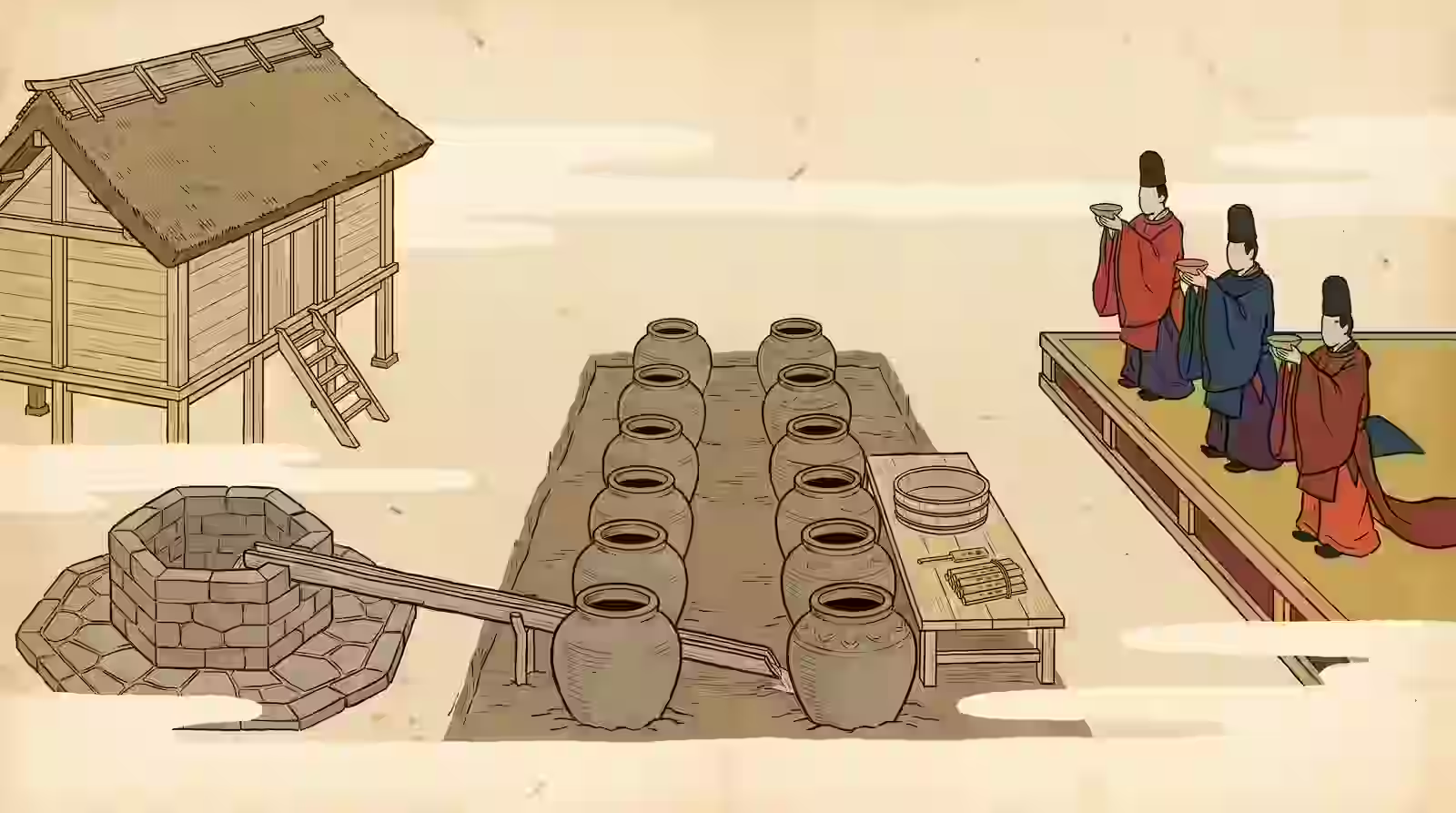
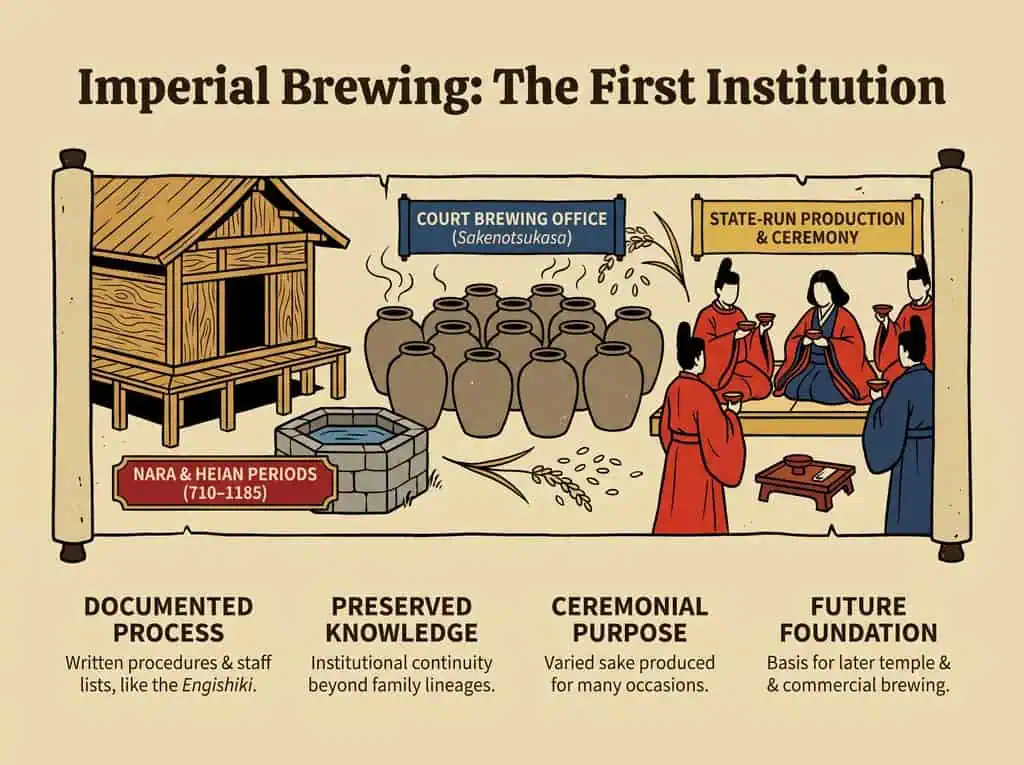
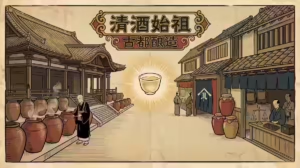
Beneath the grass of the Heijo Palace site in Nara, archaeologists uncovered a well surrounded by hexagonal stone paving. Nearby lay wooden pipes, the sockets of large ceramic jars, and wooden tablets carrying notes about brewing. These were not the remains of an ordinary household workshop. They belonged to a government office, and its job was making sake for the emperor.
Brewing did not stop being a household, community, or religious activity during these centuries. What changed is that the imperial court also turned it into a documented administrative operation, with an office, assigned workers, official rice supplies, and a ceremonial production schedule. This article follows that development: the brewing office, the people who did the work, the rituals the sake served, and the tenth-century law text that recorded it in unusual detail.
TOC
When Sake Became an Organized Institution
Earlier rice drinks belonged to farming villages, to shrines, and to local elites. Such drinks certainly existed, although the surviving evidence is limited. Our guide to ancient sake handles that stage in detail, so this article does not repeat it.
What changes in the Nara period (710 to 794) is paperwork. A centralized state appears, and that state writes things down. Brewing gains an office, a staff list, a rice budget, and a ceremonial calendar. By the Heian period (794 to 1185), the court is producing many different sake for many different occasions. Then, late in the era, the court weakens and the knowledge starts moving elsewhere. That whole arc matters, because almost everything later in Japanese brewing history builds on it.
Why does this matter to anyone who drinks sake now? Because institutions preserve knowledge in a way that households cannot. A family recipe dies with a family. A written procedure, staffed by assigned workers and funded by tax rice, survives changes of personnel. That durability is the main legacy of these centuries.
Period covered
Nara period (710 to 794) and Heian period (794 to 1185)
Key institution
Miki no Tsukasa (造酒司), the court brewing office under the Ministry of the Sovereign’s Household
Key document
The Engishiki (延喜式), compiled by 927, which records court brewing procedures
Physical evidence
Excavated wells, jar settings, and wooden tablets at the Heijo Palace brewing office site
What it led to
Temple and shrine brewing, and eventually commercial production
How Court Brewing Developed from Nara to Heian
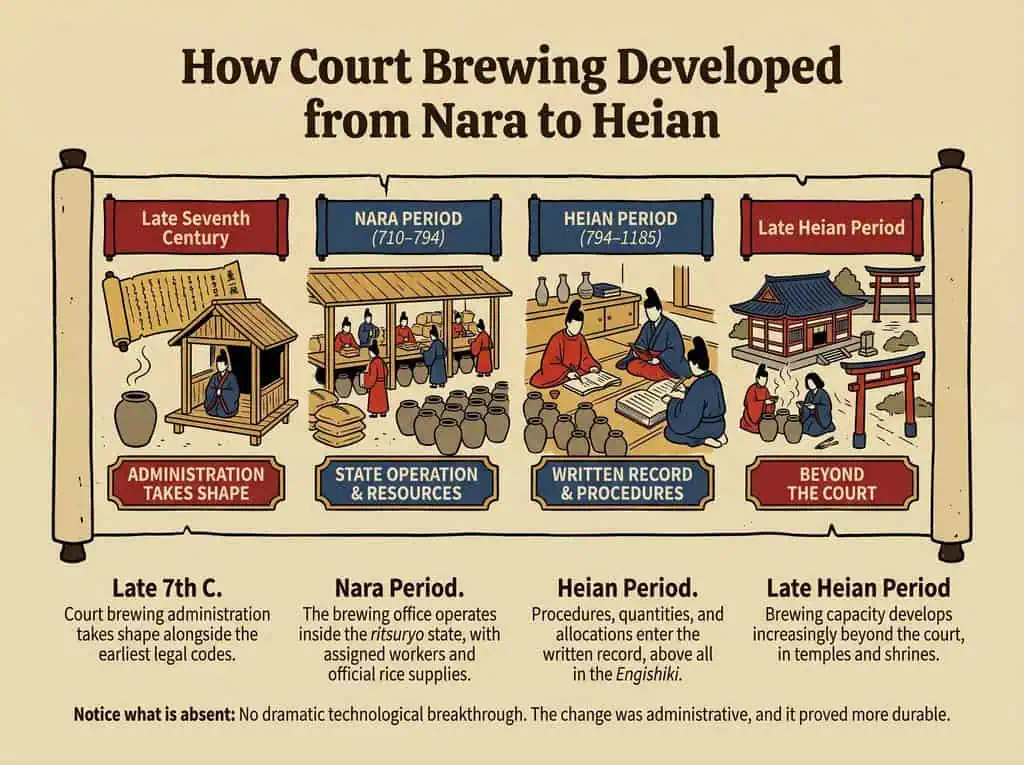
Before the detail, here is the shape of the change, stage by stage. The arc begins before the Nara period and continues past the height of the Heian court.
Late seventh century. Court brewing administration takes shape alongside the earliest legal codes.
Nara period. The brewing office operates inside the ritsuryo state, with assigned workers and official rice supplies.
Heian period. Procedures, quantities, and allocations enter the written record, above all in the Engishiki.
Late Heian period. Brewing capacity develops increasingly beyond the court, in temples and shrines.
Notice what is absent from that list. No dramatic technological breakthrough defines these centuries. The change was administrative, and it proved more durable than most inventions would have been.
Japan in the Nara and Heian Periods
To understand court sake, you need a little context about the government that made it. Japan in this era was busy copying and adapting Chinese administrative models. That project shaped everything, including the drinks.
A Capital, a Code, and a Bureaucracy
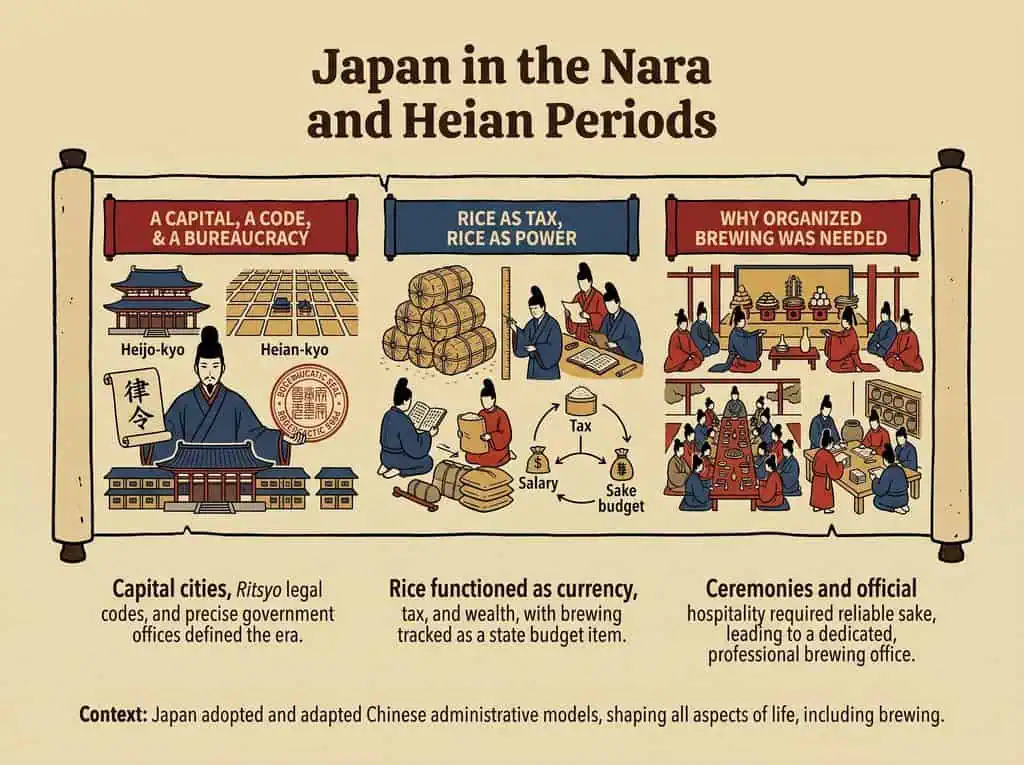
In 710 the court settled at Heijo-kyo, today’s Nara. Then, in 794, it moved again to Heian-kyo, which we now call Kyoto. Both capitals ran on a legal system known as the ritsuryo codes. Those codes defined ministries, ranks, duties, and staffing numbers with considerable precision. Under that system, almost any regular activity of the palace got its own office.
Where to Picture All of This
Two places anchor the story, and both survive in modern Japan. Heijo-kyo lies inside today’s Nara, where a broad archaeological park now covers the old palace grounds. Heian-kyo became Kyoto, so its palace zone disappeared under a working city. Both sit in western Japan, within easy reach of each other by train. Visitors walk across this history constantly without noticing it.
Rice as Tax, Rice as Power
Rice was not only food in this period. It functioned as tax, as salary, and as a measure of wealth. Provinces sent rice to the capital, and officials tracked it carefully. Because sake consumes a great deal of rice, brewing was never a private matter for the state. It appeared in the accounts as a budget item.
Why a Central Government Needed Organized Brewing
Court life ran on ceremony, and ceremony ran on sake. Offerings needed it. Seasonal banquets needed it. Official hospitality for envoys needed it. So supply could not depend on luck or on whoever happened to be good at brewing. Instead, the court set up a dedicated office, gave it labor, and told it what to make. That decision sounds bureaucratic, yet it quietly created Japan’s first documented professional brewing operation.
The Miki no Tsukasa: The Imperial Court Brewing Office
The Miki no Tsukasa sits at the center of this story. It was a small office with an outsized legacy, and it lasted for centuries.
One Office, Several Names
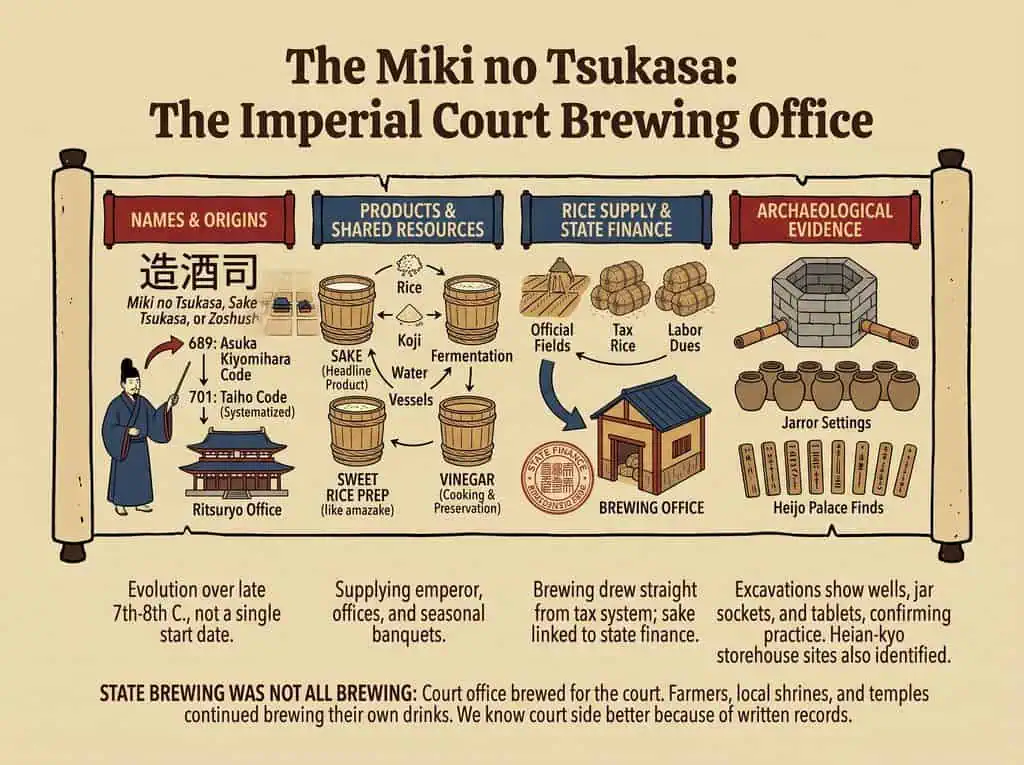
The characters 造酒司 can be read Miki no Tsukasa, Sake no Tsukasa, or Zoshushi. English sources use all three, which confuses newcomers. The office belonged to the Kunaisho, the ministry that handled the imperial household. Its brewing hall carried its own name, the sakadono.
Origins in the Late Seventh Century
A traditional chronology links court brewing administration to 689 and the Asuka Kiyomihara Code. Then, in 701, the Taiho Code systematized the arrangement into the ritsuryo office we can actually describe. Industry bodies and museums often quote the 689 date directly.
Treat that year gently, though. It marks a step in a long administrative process, not the opening day of a brewery. The detailed picture we can reconstruct comes from later sources, especially the eighth century onward. Historians are comfortable saying that organized court brewing took shape across the late seventh and eighth centuries. Pinning it to a single morning in 689 goes further than the evidence does.
What the Office Actually Produced
Sake was the headline product, but not the only one. The office also produced sweet fermented rice preparations, often compared with amazake, along with vinegar. Supplying the emperor came first, while other government offices received allocations too. Seasonal banquets known as sechie drew especially heavily on its output.
Sweet Preparations and Vinegar
The two side products deserve a moment. Writers often connect the court’s sweet preparation with amazake, the sweet rice drink still sold in Japan today. Do not assume the two were identical, though, because ingredients and methods have changed since. Vinegar, meanwhile, mattered for cooking and preservation.
The three products shared raw materials, vessels, and part of the fermentation process. That overlap made it practical for one office to oversee them together.
Where the Rice Came From
Brewing at this scale needed a dependable supply, and the regulations name its sources. Rice from official fields in the home provinces went to the office, together with rice collected as tax. Grain held by another palace bureau and rice submitted as labor dues appear as well.
That list carries a quiet implication. Court brewing drew straight from the tax system, so every cup at a banquet began as somebody’s obligation in a distant province. Sake and state finance were joined at the root.
Evidence in the Ground at Heijo Palace
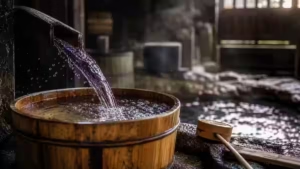
Here the story stops being only textual. Excavations at the Heijo Palace site have identified remains attributed to the brewing office. The Nara National Research Institute for Cultural Properties reports a well enclosed by hexagonal stonework, wooden water pipes, and buildings with rows of settings for large sueki jars. Wooden tablets, or mokkan, relating to brewing turned up as well.
Those finds change the tone of the whole subject. Text can be idealized, since regulations describe what should happen. Jar sockets and wells describe what did. In Heian-kyo, meanwhile, storehouse foundations linked to the brewing office have been marked at a site in central Kyoto.
State Brewing Was Not All Brewing
One warning belongs here, and it shapes the rest of this article. The court office brewed for the court. Farmers, local shrines, provincial officials, and temples kept brewing their own drinks throughout the period. The great brewing scientist Kinichiro Sakaguchi drew this distinction neatly, separating the sake of the people from the sake of the court. We know the court side far better simply because the court wrote reports.
Who Made Court Sake?
Brewing needed hands, and the codes counted them. This is the point where sake history overlaps with the history of labor.
Sakabe and Shuko
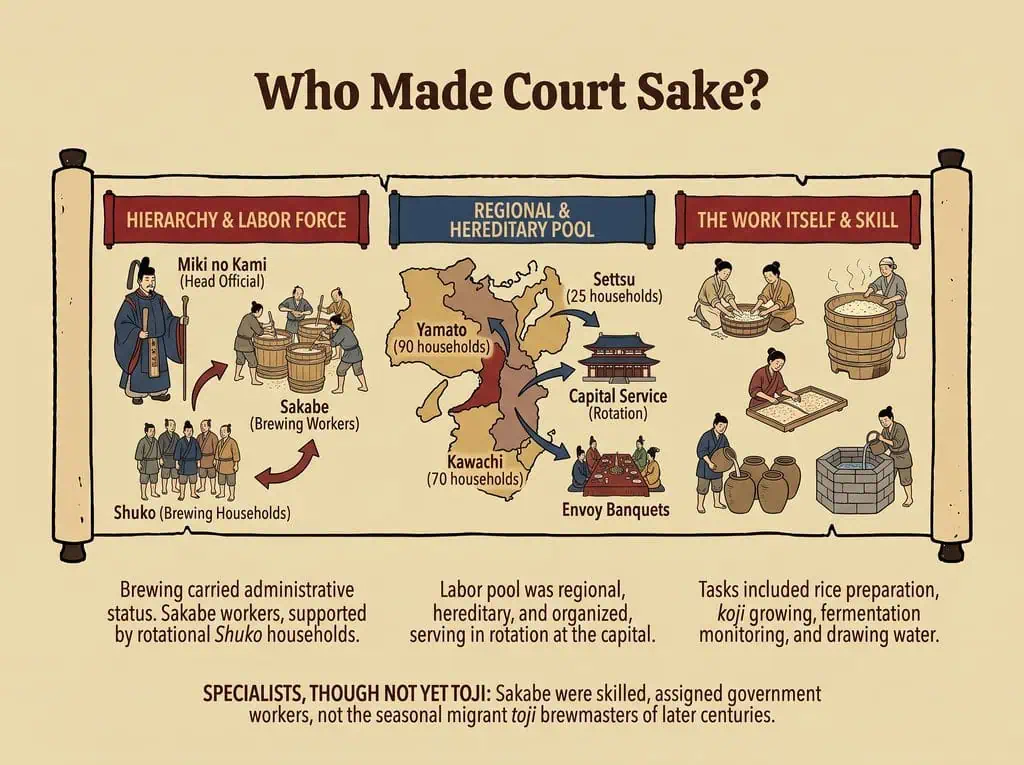
Workers called sakabe carried out the brewing. Japan’s National Tax Agency, in its own account of sake history, puts their establishment strength at sixty. Behind them stood the shuko, households assigned to brewing service and drawn mainly from the Yamato and Kawachi areas. Those households rotated members into duty at the capital.
The office had a proper hierarchy above them. A head official, the miki no kami, ran it at a court rank that no casual appointee could hold. So brewing carried administrative status, not just craft status.
Standard Japanese reference works on the ritsuryo system describe the arrangement in more detail. Roughly ninety brewing households sat in Yamato and seventy in Kawachi, serving in rotation at the capital. A further group of about twenty five in Settsu handled banquets for envoys from abroad. So the labor pool was regional, hereditary, and organized well before anyone thought of brewing as a trade.
The Work Itself
Nobody has left us a diary of a sakabe’s day. Still, the tasks are easy enough to infer from the procedures recorded later. Rice had to be washed, steamed, and cooled. Koji had to be grown and judged. Jars had to be filled, watched, and eventually emptied and cleaned. Water had to be drawn, which explains the wells.
Specialists, Though Not Yet Toji
Some writers describe the sakabe as ancestors of the toji, the brewmasters of later centuries. There is something to that comparison, because both represent skilled, named brewing labor. Yet the sakabe were assigned workers inside a government office. The toji tradition of seasonal migrant brewing teams belongs to a much later economy.
Sake and Social Rank at the Imperial Court
Court society ran on visible hierarchy. Clothing showed rank, seating showed rank, and so did what landed in your cup.
Rank Decided the Cup
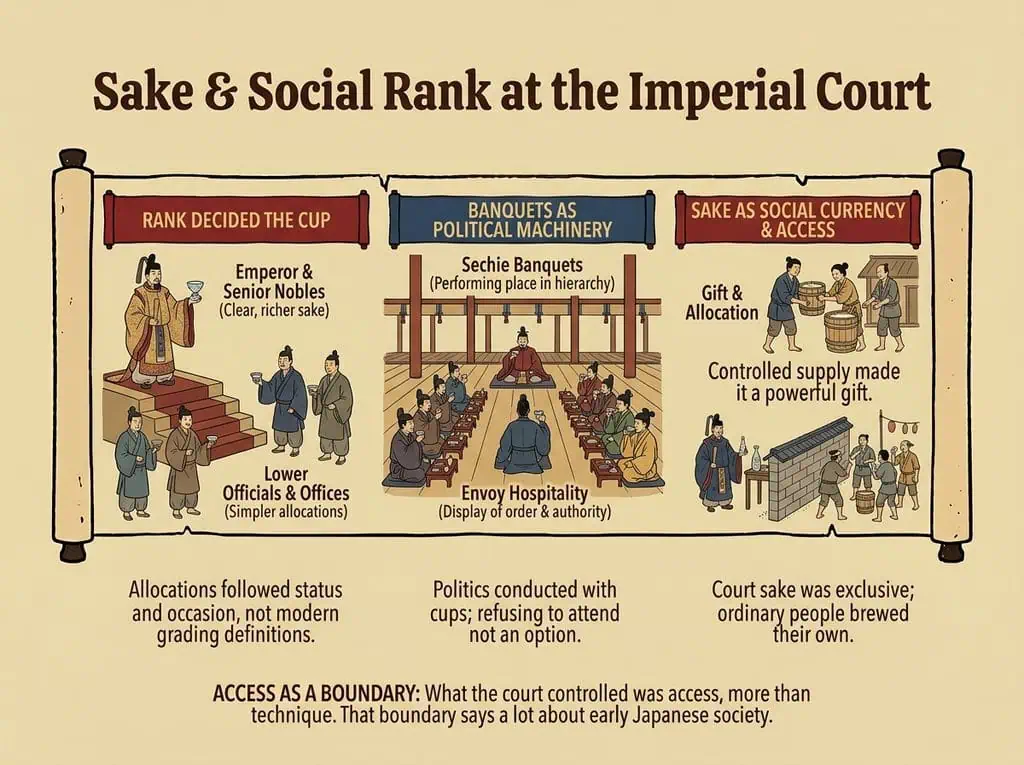
The court produced several qualities of sake at once. Clearer, richer preparations went to the emperor and senior nobles. Simpler allocations went to lower officials and to offices that needed a working supply. Because regulations set out these distributions, the pattern is reasonably clear.
Resist the urge to call this a grading system, though. Modern sake labels follow legal definitions about polishing and additives. Heian allocation followed status and occasion. The two things look similar from a distance, yet they answer different questions.
Banquets as Political Machinery
Sechie banquets punctuated the court calendar. Officials gathered, drank, received gifts, and performed their place in the hierarchy. Refusing to attend was not really an option. So the banquet worked as politics conducted with cups, and sake supplied the medium.
Hospitality for foreign envoys followed similar logic. Certain brewing households in the Settsu area served banquets for visitors from abroad. Serving carefully prepared sake formed part of the court’s display of order, hospitality, and political authority.
Sake as a Social Currency
Distribution reached beyond the banquet hall. Government offices received working allocations, and sake also moved between households as a gift. Because supply stayed controlled, handing someone sake carried weight that a simple purchase never could. Later Japanese gift culture still runs on that instinct, though the mechanics have changed completely.
Access as a Boundary
What the court controlled was access, more than technique. Ordinary people were not drinking palace sake at a village festival. They were drinking their own. That boundary says a lot about early Japanese society, and it explains why the surviving records feel so lopsided.
Sake in Court Ritual and Ceremony
Religion and government were not separate departments in this world. Rituals were state business, and sake was ritual equipment.
Offerings and the Harvest
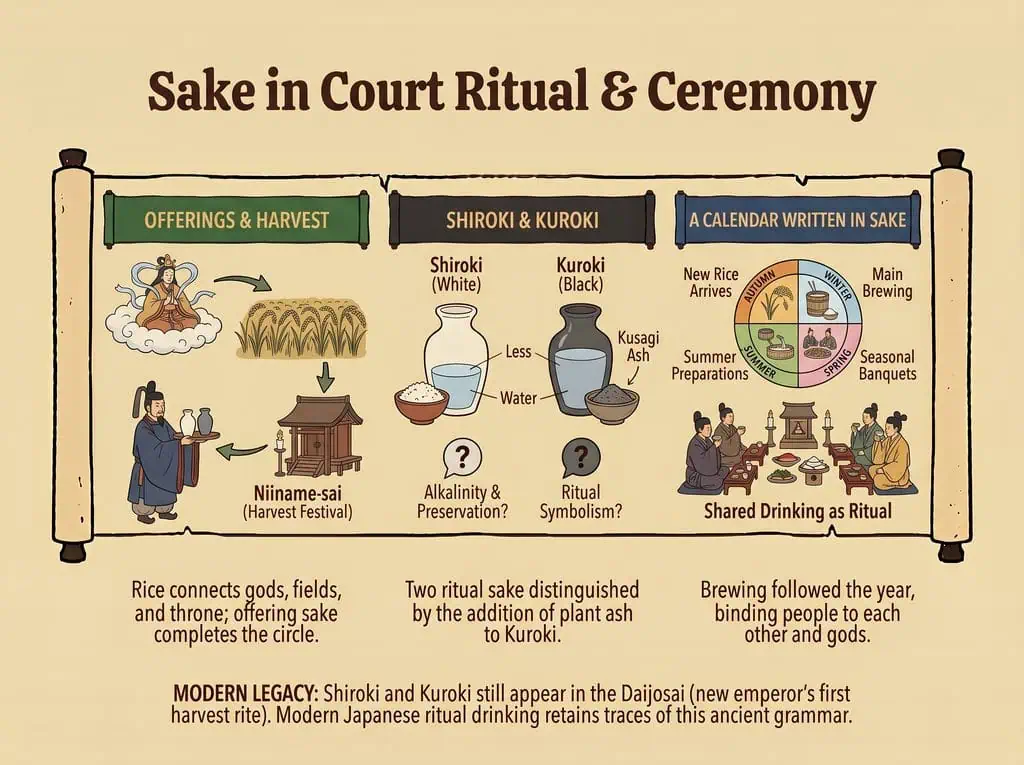
Rice connected the gods, the fields, and the throne. Offering sake back to the deities completed that circle. The Niiname-sai, the great harvest festival, stands out among these observances. New rice went to the gods, and the emperor shared in the offering. Brewing for such events was therefore an obligation rather than a choice.
Shiroki and Kuroki
Two ritual sake deserve special mention. Shiroki, the white one, was a thick and sweet preparation made with less water. Kuroki, the black one, took the same base and received an addition of plant ash from the kusagi tree. That addition distinguished kuroki from shiroki, and it would have altered both the appearance and the chemistry of the drink.
Why bother with ash at all? Nobody can answer that with certainty. Ash does raise alkalinity, which can affect fermentation and preservation. Ritual symbolism may matter just as much. Both explanations circulate, and honest sources admit the uncertainty.
Shiroki and Kuroki in the Modern Daijosai
One ceremony deserves a note of its own. When a new emperor performs the harvest ritual for the first time, the rite takes the name Daijosai instead of Niiname-sai. Shiroki and kuroki belong to that occasion as well, and both retain a place in the modern form of the ceremony. So a pair of drinks named in ancient regulations still appears in a living imperial rite.
A Calendar Written in Sake
Court brewing followed the year closely. Production centered on the months after the new rice arrived, yet certain preparations belonged to summer or early autumn. Different festivals called for different drinks. As a result, the brewing office worked almost year round, switching products with the season.
Drinking Together as Ritual
Shared drinking bound people to each other and to the gods. That idea did not begin at court, since villages had long done something similar. What the court added was scale, schedule, and documentation. Modern Japanese ritual drinking, from shrine offerings to the cups at a wedding, still carries traces of this older grammar.
The Engishiki: A Window Into Heian Court Brewing
If one document defines this article, it is the Engishiki. No other early text tells us so much about how sake was actually made in Japan.
What the Engishiki Is
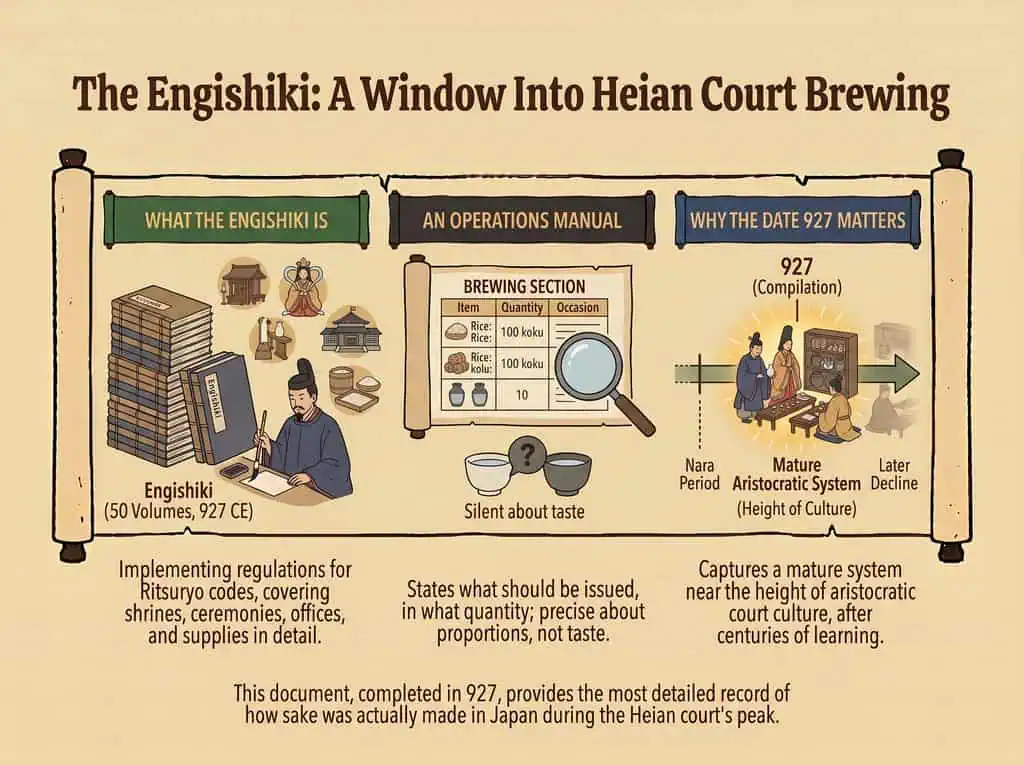
The Engishiki is a vast collection of implementing regulations for the ritsuryo codes. Compilation finished in 927, and the text runs to fifty volumes. It covers shrines, ceremonies, offices, supplies, and procedures in obsessive detail. One section deals with the brewing office, and that section is the treasure.
Think of it as an operations manual rather than a history book. It states what should be issued, in what quantity, for which occasion. That register makes it precise about proportions while staying silent about taste.
Why the Date 927 Matters
The compilation reached completion in 927, although it took effect only later in the century. That timing places it at a particular moment, near the height of aristocratic court culture and before the long decline. So the Engishiki captures a mature system rather than an experimental one. Whatever the court had learned about brewing since the Nara period, this is where it landed on paper.
Named Sake and Their Purposes
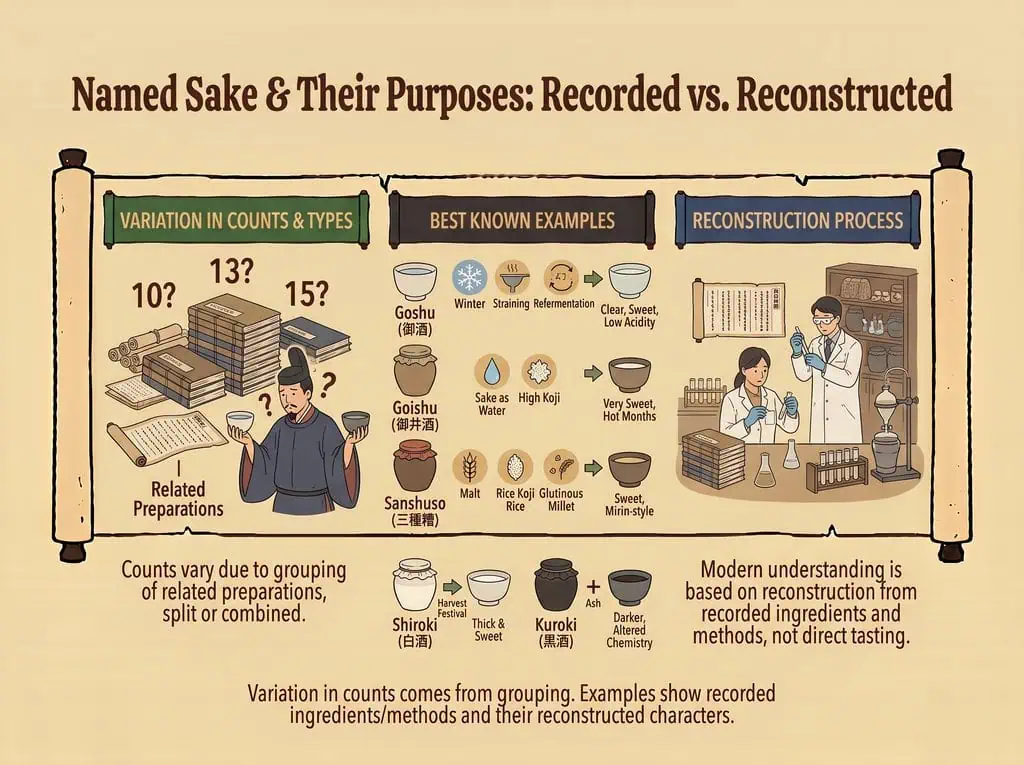
Counts of the sake types described in the text vary. Some writers list about ten, others thirteen, and others closer to fifteen. The variation comes from grouping, since related preparations can be split or combined. The table below shows several of the best known examples, and it separates what the text records from what modern researchers reconstruct.
Name
Reading
Recorded ingredients or method
Reconstructed or likely character
御酒
Goshu
Winter brewing, with repeated straining and refermentation
Reconstructed as clear and sweet, relatively low in acidity
御井酒
Goishu
Early autumn brewing, then clarified
Reconstructed as rich and sweet
醴酒
Reishu
Sake used in place of water, high koji proportion
Reconstructed as very sweet, made for the hottest months
三種糟
Sanshuso
Malt alongside rice koji, with glutinous rice and millet
Reconstructed as sweet, in the direction of later mirin-style drinks
白酒
Shiroki
Harvest festival sake, brewed with reduced water
Thick and sweet
黒酒
Kuroki
Shiroki with kusagi plant ash added
Darker, with altered chemistry
Look at that range for a moment. A single office was running sweet summer preparations, malt-based drinks, ritual specialties, and clarified banquet sake. Sakaguchi once remarked that the technical variety would embarrass modern brewing. He was overstating it for effect, yet the point stands.
Shiori: Brewing Into Brewing
The most striking technique in the text is called shiori. Brewers took a finished, strained sake and used it in place of water for a new batch. Steamed rice and koji went into that liquid, fermentation started again, and the result was strained once more. Repeating the cycle built sweetness, body, and presumably strength.
Modern brewing knows a similar idea. Kijoshu, a rich dessert-style sake, replaces some brewing water with finished sake. The principle resembles shiori closely, although that resemblance alone does not demonstrate an unbroken line of transmission.
Vessels, Sieves, and Storage
Equipment appears in the regulations too, which is unusual for an early text. Large ceramic jars held the mash, and the archaeology at Nara matches that picture closely. Straining relied on cloth and sieves, and the ritual sake passed through a large sieve of its own. Storage, transport, and issue all had rules attached.
None of this sounds glamorous. Yet it is exactly the kind of detail that lets modern researchers attempt reconstructions. Brewers and food historians have tried recreating court preparations from these figures, with results that remain interesting rather than definitive.
What the Document Cannot Tell Us
Reading the source honestly
The Engishiki records court practice, not the brewing of an entire country. It describes standards for the palace, with materials drawn from official rice supplies. Village brewing, temple brewing, and provincial brewing sit almost entirely outside its frame.
Two more limits are worth naming. First, regulations describe intentions, and reality often drifts from them. Second, the text gives quantities rather than sensory notes. So we can calculate a rice to koji ratio, yet we cannot taste the result.
What Did Heian Sake Actually Look Like?
This is the question most readers arrive with. The honest answer mixes solid evidence with open space.
Cloudy, Strained, and Everything Between
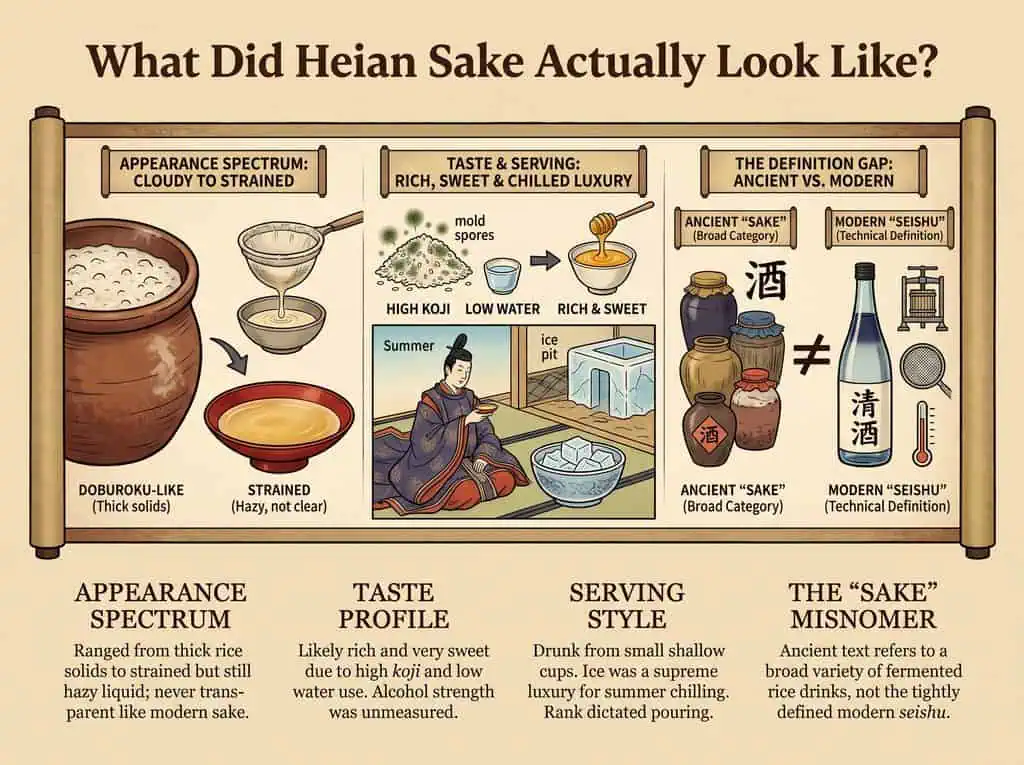
Early sake was not a single appearance. Some of it stayed thick with rice solids, closer to what Japan later called doburoku. Other preparations went through straining and settling, which produced a clearer liquid. Words meaning clear sake appear in early poetry and records, so separation was clearly practiced.
Court sake sat at the refined end of that spectrum. Even so, clear in the tenth century did not mean clear as a modern bottle. There were no fine filters, no charcoal fining as later brewers used it, and no pressure equipment. In appearance alone, a modern nigori sake may offer a better analogy than a transparent daiginjo, although the production method and the flavor would differ greatly.
Sweetness and Strength
Sweetness runs through the descriptions repeatedly. High koji proportions, low water, and sake used in place of water all push in that direction. So the court’s best drinks were probably rich and sweet by modern standards.
Alcohol strength is harder. Some researchers suggest low figures compared with today’s sake, and repeated shiori cycles would have raised it. Honestly, though, nobody measured anything at the time. Any specific percentage you see quoted is an estimate built on reconstruction, not a recorded value.
How It Was Served
Small details of service survive here and there. The Japan Sake and Shochu Makers Association notes that the emperor and aristocrats enjoyed sake chilled with ice in summer. Ice came from pits packed during winter, which made it a luxury of the highest order. Cups were shallow and small rather than tall glasses.
Picture one possible court serving. A sweet, lightly hazy drink, perhaps lower in alcohol than many modern sake, offered cool in a shallow cup. Rank decided who poured for whom, which mattered as much as the liquid itself.
Why the Word Sake Misleads
Modern seishu is a legal and technical category, defined by its ingredients and its production process. Most commercial sake is pressed, filtered, pasteurized, and made under carefully controlled conditions, although unpasteurized namazake also exists. Note as well that filtration starts with separating the mash from the lees, rather than the fine filtering many readers picture.
None of that framework applies to the tenth century. When a Heian text says sake, it means a rice-based fermented drink of some kind. Keeping that distinction in mind prevents a lot of confusion. Our guide to types of Japanese sake covers where the modern categories come from.
Brewing Techniques in the Nara and Heian Periods
We can describe several techniques with reasonable confidence. Others remain guesswork, so this section sticks to what the sources support.
Rice, Water, and Proportion
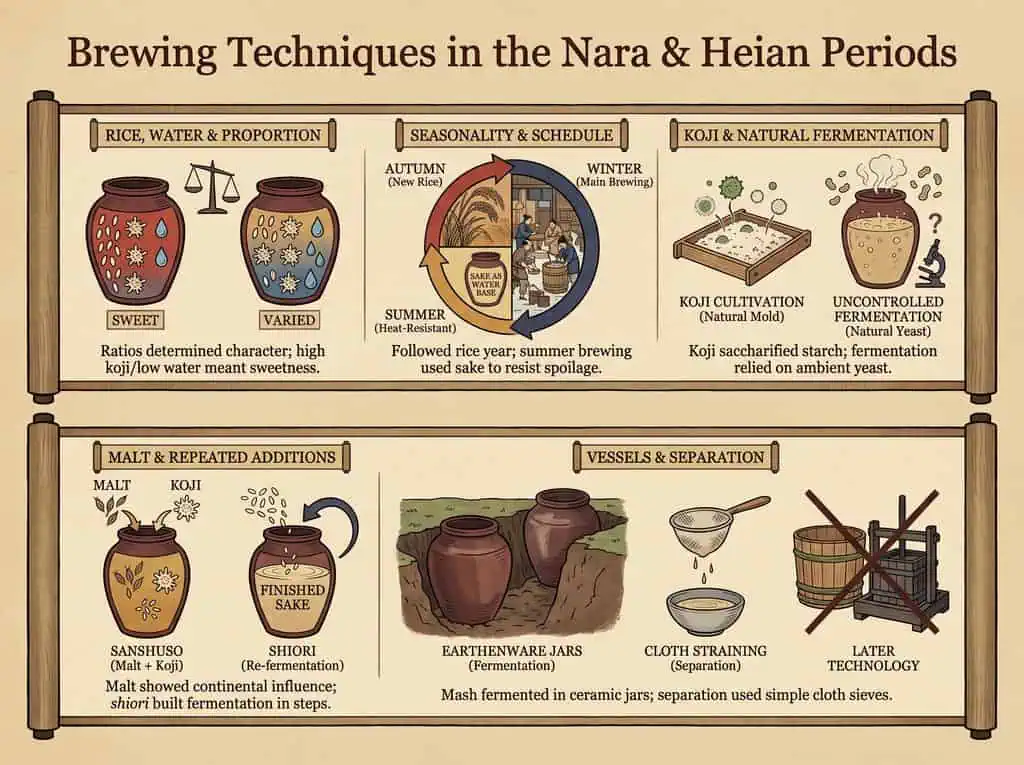
Steamed rice formed the backbone, as it still does. The Engishiki gives quantities of rice, koji, and water for each preparation. Because those figures survive, we can compare the relative richness of different drinks. A high koji share and a low water share point toward sweetness, for instance.
Seasonality
Court brewing followed the rice year rather than the calendar of convenience. Accounts of the schedule describe production ramping up once the new rice arrived in autumn, then running through the colder months. Certain preparations, however, belonged to summer. Using sake in place of water would have helped those batches survive the heat, since a more alcoholic liquid resists spoilage. Winter brewing as a dominant habit came much later, so the Heian office worked nearly all year.
Koji and Saccharification
Koji makes sake possible, since yeast cannot eat raw starch. An eighth-century provincial gazetteer from Harima records mold growing on offered rice, followed by brewing. That passage is usually cited as the earliest written hint of mold-based brewing in Japan. By the Heian period, koji preparation was clearly routine at court. If you want the biology, see our koji guide.
Fermentation Without Microbiology
Nobody in this period knew what yeast was. Brewers worked with observation, timing, and inherited habit instead. Naturally occurring yeast from the ingredients, vessels, and brewing environment carried out the fermentation. Without isolated starter cultures or microbiological control, results were probably less consistent than in modern brewing. Our article on sake fermentation explains the process that they were operating without being able to see it.
Malt Alongside Koji
One preparation breaks the pattern in a useful way. Sanshuso used malt as well as rice koji, and it drew on glutinous rice and millet. Malt saccharification belongs to the brewing traditions of the continent, so its presence hints at exchange and experiment. Japanese brewing eventually settled firmly on koji, yet the tenth-century court was clearly still trying more than one route.
Repeated Additions
Shiori documents an early awareness that fermentation could be built up through repeated brewing operations. Later brewers developed the staged mash, adding rice and koji to one tank in several instalments. The two are not the same, since shiori restarts fermentation inside finished sake. So it should not be treated as a direct precursor of the staged mash, even though both show brewers building fermentation in steps.
Vessels and Separation
Large ceramic jars held the fermenting mash, and their settings survive in the ground at Nara. Straining used cloth and sieves rather than machinery. Records describe filtering ritual sake through a large sieve, and settling would have done the rest. Wooden vats and heavy pressing boxes belong to later centuries.
Temples, Shrines, and Brewing Outside the Court
The palace never held a true monopoly, and that matters for what comes next.
Religious Institutions as Landholders
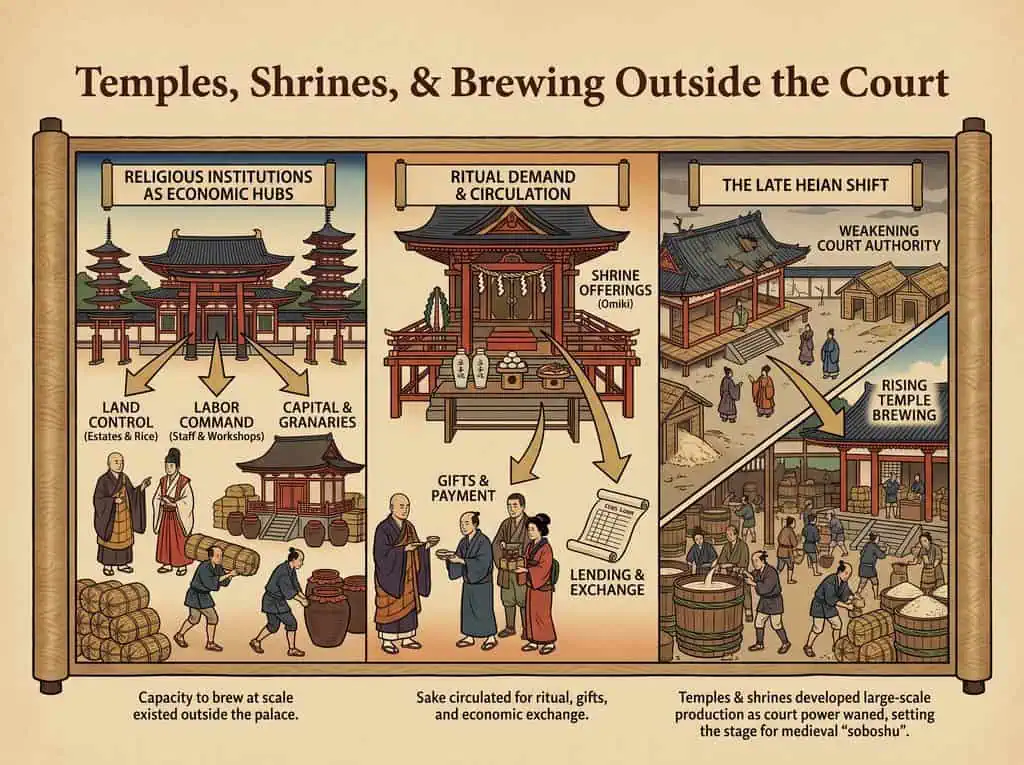
Major temples and shrines were economic institutions as well as religious ones. They controlled estates, collected rice, and commanded labor. Brewing requires exactly those three things. So the capacity to brew at scale existed outside the palace long before anyone called it an industry.
The scale is easy to underestimate. Great temples in Nara and around the capital ran workshops, granaries, and large staffs. They functioned not only as religious centers, but also as major landholding and production organizations.
Ritual Demand
Shrines needed sake for offerings, and temples needed it for their own occasions. Sake also circulated as a gift and as a form of payment. Written tales from the period even mention temple sake being lent out, which implies real quantities changing hands.
Shrine sake also kept its own name and its own logic. Omiki, the sake offered to deities, remains a fixture of Japanese shrines today. Anyone who has received a small cup at a shrine visit has touched the oldest layer of this whole story.
The Slow Shift of the Late Heian
Court authority weakened through the later Heian period. Estates grew powerful, warrior families rose, and palace finances suffered. Meanwhile, temples and shrines increasingly became important centers of organized brewing. Their estates, rice supplies, labor, and ritual demand gave them the resources to develop production on a larger scale.
That shift sets up the medieval story of soboshu, the celebrated sake brewed at temples. Documentary records of temple brewing grow much clearer in the medieval centuries, so this article stops at the threshold.
From Court Brewing to Commercial Brewing
Step back and the shape of the whole transition becomes visible.
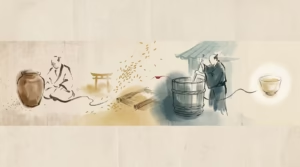
Household and ritual drink▶Court production under the ritsuryo state▶Temple and shrine brewing▶Commercial brewing
Each stage kept something from the one before it. Ritual meaning survived into court practice, and court technique fed institutional brewing. Later, commercial brewers inherited both the methods and the ceremonial associations. Our wider history of sake traces that chain to the present day.
What Did Not Transfer
Plenty fell away as well. The elaborate variety of court preparations did not survive as a living catalogue, and several named sake exist now only on the page. Ritual specialties stayed inside ritual, rather than spreading to ordinary drinkers. Commercial brewing later chased consistency and volume instead, which pushed the tradition toward a narrower range of products.
One thing did change fundamentally. Sake moved from something a community made for itself toward something specialists made for others. That shift, not any single recipe, is the real legacy of the Nara and Heian centuries.
What the Evidence Shows and What Remains Unknown
Popular sake history often flattens the uncertainty here. Separating the categories keeps the picture honest.
Documented
A court brewing office existed within the ritsuryo system
Staff categories and duties appear in legal texts
The Engishiki records named sake with quantities
Ritual use at court ceremonies is recorded
Excavated wells, jar settings, and wooden tablets confirm the site
Reasonable interpretation
Brewing grew more specialized across the period
Administrative control raised consistency at court
Institutional knowledge became easier to pass on
Court sake was sweeter and richer than most sake today
Unknown
How any of it actually tasted
Precise alcohol strength
How far village sake differed from court sake
How widely court techniques spread
That middle column deserves respect, since interpretation is not the same as invention. Historians build it from converging evidence. The right response to the third column, meanwhile, is simply to say so.
Claims Worth Correcting
The imperial court invented sake.
Rice-based drinks predate the court by centuries. What the court created was an organized system for making them.
The Engishiki is a recipe book for all Japanese sake.
It regulates court production only, using official rice supplies for palace purposes.
Heian sake was basically modern nihonshu.
It was probably sweeter and less clear, and it was made without modern equipment or microbiological control.
The government controlled all brewing.
Villages, shrines, and temples kept brewing independently throughout both periods.
Nara and Heian Sake Timeline
The table gathers the landmarks in order, with the usual caution about early dates.
Period
Development
Late 7th century
Court brewing administration begins to take shape
689
Date traditionally associated with a court brewing division, under the Asuka Kiyomihara Code
701
The Taiho Code systematizes palace offices, including brewing
710
The capital moves to Heijo-kyo, site of the excavated brewing office
713 onward
Provincial gazetteers record mold-based brewing
794
The capital moves to Heian-kyo, today’s Kyoto
927
Compilation of the Engishiki is completed
Late Heian
Temples and shrines grow into significant brewing centers
Read 689 as a marker in a chronology rather than a founding ceremony. The evidence supports gradual institutional growth, not a sudden launch.
Final Thoughts
Ancient Japan gave sake its meaning, tying fermented rice to gods and harvests. The Nara and Heian court gave it something less romantic and just as important: structure. An office, a staff, a calendar, and a written procedure turned brewing into a practice that could be taught, checked, and repeated.
That structure outlived the court that built it. As palace authority and finances declined, temples and shrines took over much of the organized brewing, and commercial producers followed centuries later. Modern sake still echoes the period, from the ceremonial cup at a shrine to the rich style of kijoshu.
There is a certain pleasure in the gaps, too. We can read a tenth-century official telling us exactly how much rice to weigh out. We cannot ask him what it tasted like. The next chapter in this series follows the story into the medieval centuries, when temple breweries and early commercial brewing changed everything again.
Frequently Asked Questions About Nara and Heian Sake
What was sake like during the Nara and Heian periods?
It was a rice-based fermented drink made with koji, and it varied a great deal. Some versions stayed thick with rice solids, while court preparations went through straining and settling. Descriptions point toward sweetness rather than dryness. Nothing in either period resembled a modern bottle of clear sake.
What was the Miki no Tsukasa?
The Miki no Tsukasa (造酒司) was the imperial court’s brewing office, placed under the ministry that managed the imperial household. Japanese sources read the same name as Sake no Tsukasa. Its staff brewed, stored, and distributed drinks for the emperor, for ceremonies, and for other offices. Because it worked under written regulation, its procedures survive better than any other early brewing record.
Who brewed sake for the imperial court?
Workers known as sakabe carried out the brewing inside the office. Japan’s National Tax Agency gives their establishment strength as sixty. Households called shuko supplied that labor, drawn mainly from the Yamato and Kawachi areas and serving in rotation. Officials of proper court rank supervised the operation from above.
What does the Engishiki tell us about sake?
The Engishiki (延喜式), completed in 927, records the court brewing office in unusual detail. It names individual sake, gives quantities of rice, koji, and water, and states which occasions each one served. Procedures such as repeated straining and refermentation appear as well. It says nothing about flavor, aroma, or strength, and it describes palace practice rather than brewing across Japan.
Was Heian sake clear or cloudy?
Both existed, depending on the preparation. Court brewers strained and settled their best sake, so those versions counted as clear at the time. Others kept plenty of rice solids. Without modern equipment, though, even the clearest would look hazy beside a bottle on a shop shelf today.
How strong was Heian-period sake?
Nobody knows, because nobody measured it. Researchers offer estimates based on the recorded proportions, and repeated refermentation would have pushed alcohol higher in some preparations. Any specific percentage you see quoted is a reconstruction rather than a recorded value. Treating it as a fact goes beyond the evidence.
Did ordinary people drink court sake?
No. Palace sake used official rice supplies and specialized labor, and access followed court rank and occasion. Ordinary people drank locally made rice drinks instead. Village brewing rarely entered the written record, so our picture of it stays thin. That silence reflects documentation, not absence.
How did court brewing influence later sake production?
It turned brewing into a documented, staffed, and scheduled operation. Written procedures made knowledge transferable, which matters more than any single recipe. As court finances weakened, temples and shrines became the leading centers of organized brewing. Commercial production developed from that institutional base in later centuries.
Ryo Iwa is the founder and editor of foodinjapan.org. Born and raised in Japan, he writes from regional travel, market visits, and Japanese-language primary sources that rarely reach English readers, including brewing institute publications and industry glossaries. Where a figure cannot be traced to a source, the article says so.
He has been a Google Maps Local Guide for over 10 years, with more than 1,800 reviews and over 41,000 photos viewed hundreds of millions of times. He previously spent two decades as an IT consultant in Japan, the US, and the UK.











Comments