Most sake brands are known for a taste, a rice, or a famous bottle. Masumi is known for something you cannot see: a yeast. In 1946, researchers isolated a yeast from sake fermenting at this Nagano brewery. The strain was later distributed to breweries across Japan as Brewing Association Yeast No. 7.
Masumi therefore offers a clear entry point into the history of modern sake brewing. This guide covers where the brand comes from, how No. 7 works in plain language, which bottles to try first, and what to expect in the glass.
Quick Facts: Masumi Sake
Japanese name
真澄 (Masumi)
Brewery
Miyasaka Brewing Company (宮坂醸造)
Location
Suwa City, Nagano Prefecture, central Japan; a second brewery in Fujimi
Founded
1662, according to the brewery
Known for
The brewery where Brewing Association Yeast No. 7 was isolated in 1946
Yeast today
Proprietary strains related to No. 7, the focus since 2019
Rice
About 80% from Nagano and 20% from Hyogo (brewery figures)
Good first bottles
KURO or SHIRO for everyday drinking; Nanago for the No. 7 story
TOC
What Is Masumi Sake?
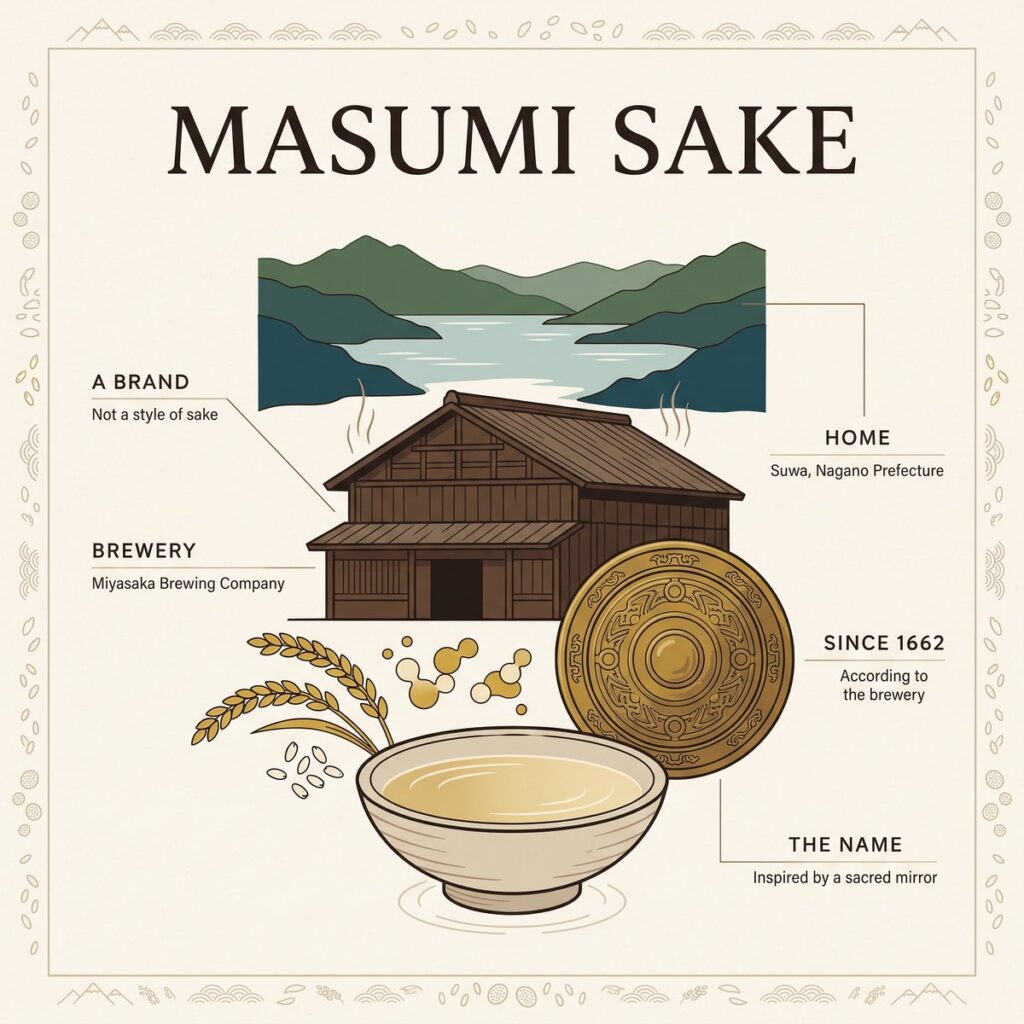
Masumi (真澄) is a sake brand, not a style of sake. Miyasaka Brewing Company makes it in Suwa, a lakeside city in the mountains of Nagano Prefecture. The brewery traces its sake making back to 1662.
Three names often get tangled together, so it helps to separate them early. Miyasaka Brewing is the company, and Masumi is the brand on the label. Association Yeast No. 7, by contrast, is a yeast strain that Japan’s brewing association distributes to many breweries. It is not a Masumi product, even though its story begins in a Masumi tank. If yeast is new to you, our guide to sake yeast covers the basics.
What Does the Name Mean?
The name comes from the Masumi-no-kagami, a sacred mirror associated with Suwa Taisha, one of Japan’s oldest shrines. According to the brewery, the mirror is kept at the shrine’s Upper Shrine. The two kanji suggest something truly clear, like still water or a polished mirror.
In its English materials, the brewery translates Masumi as “Mirror of Truth,” reflecting the ideas of clarity and purity tied to the name. It is an interpretive translation rather than a literal one, but it captures the feeling well.
Which Masumi Should You Try First?
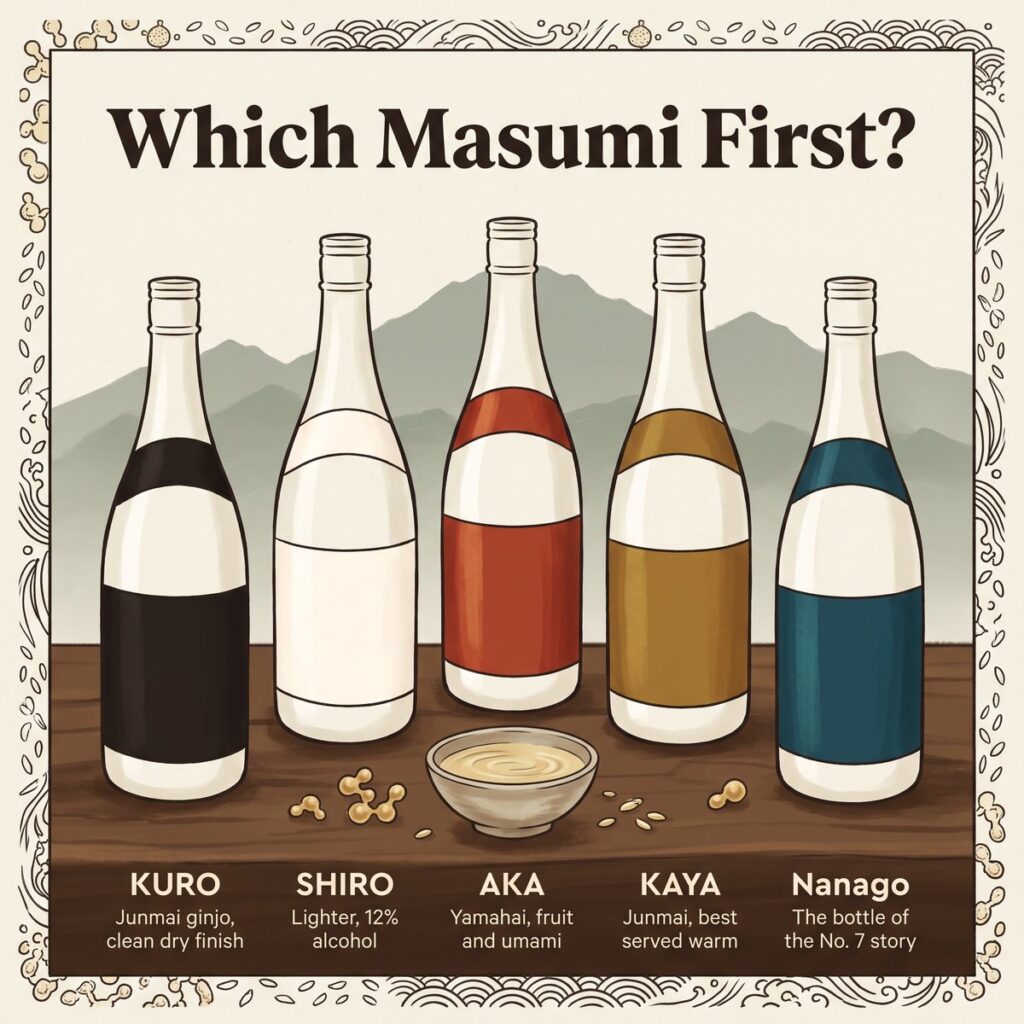
Before the history, a practical answer. Masumi makes many bottles, and they differ more than the shared yeast might suggest. So the best start depends on whether you want balance, lightness, yamahai depth, or the clearest link to Yeast No. 7. Here is a short guide based on the brewery’s own product notes:
KURO (漆黒): a junmai ginjo with subtle apple and banana aromas and a clean, dry finish. A good all-round start.
SHIRO (白妙): a lighter junmai ginjo at 12% alcohol, gently sweet with balancing acidity.
AKA (真朱): a yamahai junmai ginjo with subtle fruit and dairy aromas, refreshing acidity, and savory umami.
KAYA (茅色): a junmai with brown-rice and cream aromas that the brewery recommends serving warm.
Nanago (七號): the bottle that tells the No. 7 story, combining local rice, yamahai brewing, and the brewery’s own yeast.
The flagship four form the brand’s everyday range. Nanago, by contrast, sits in the premium line. If you can, taste two side by side, which reveals the range more clearly than any single set of notes.
Masumi’s History from 1662 to 1943
Masumi’s historical importance rests less on its age than on what happened after a long decline. Still, the story starts much earlier, with a family that changed careers.
From Swords to Sake
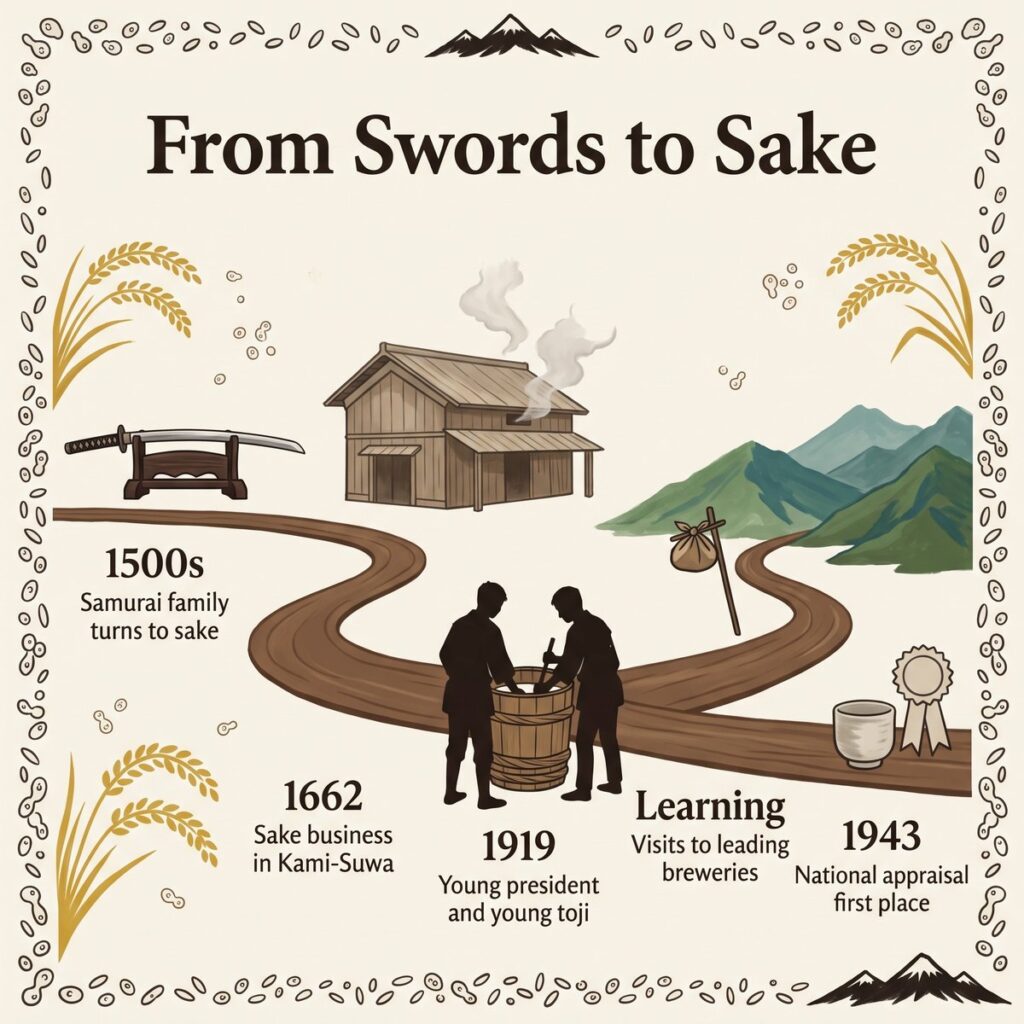
According to the brewery, the Miyasaka family were samurai who served the lords of the Suwa area. Then, in the wars of the 16th century, the Suwa clan clashed with warlords such as Takeda Shingen and Oda Nobunaga. In that turmoil, the family put down its swords and turned to sake.
Later, by 1662, the brewery says, its sake business was established in Kami-Suwa. Its Japanese history adds that it served as an official sake supplier to the local Takashima domain. The family also tells of praise from Matsudaira Tadateru, a son of the first Tokugawa shogun, and from Otaka Gengo, one of the famous 47 ronin. These stories come from family tradition rather than independent records, so they are best read that way.
1919: The Beginning of Masumi’s Revival
From the late Edo period into the early 1900s, the brewery went through a long, hard stretch. At one point, the family even considered closing for good.
In 1919, however, the young president Masaru Miyasaka refused to give up. He appointed Chisato Kubota, an equally young brewery worker, as toji, or master brewer. According to the brewery, Miyasaka declared that the only way to survive was to make the best sake in Japan. It was an ambitious goal for a struggling regional brewery.
Learning from Leading Brewers Across Japan
After that, the two men did something practical. Each year, they traveled across Japan to visit leading breweries, listened to sharp criticism, and brought new ideas home to Suwa. So Masumi’s later success did not come from one lucky discovery. Instead, it grew out of more than two decades of steady work.
National Recognition in 1943
The brewery’s long quality drive culminated, it reports, in first place at a national sake appraisal in 1943. Its Japanese history names the event as the 全国清酒鑑評会. Japan has run more than one kind of national sake judging over the years, though, so the result is best treated as the brewery’s own record.
According to the brewery, the recognition brought Masumi to the attention of government brewing researchers. It helped set the stage for the events of 1946.
How Masumi Became the Birthplace of Yeast No. 7
After that recognition came the moment that put Masumi into sake history. In 1946, a yeast strain from sake fermenting at the brewery was isolated. It was later distributed nationwide as Brewing Association Yeast No. 7, often called Kyokai No. 7 or simply K7.
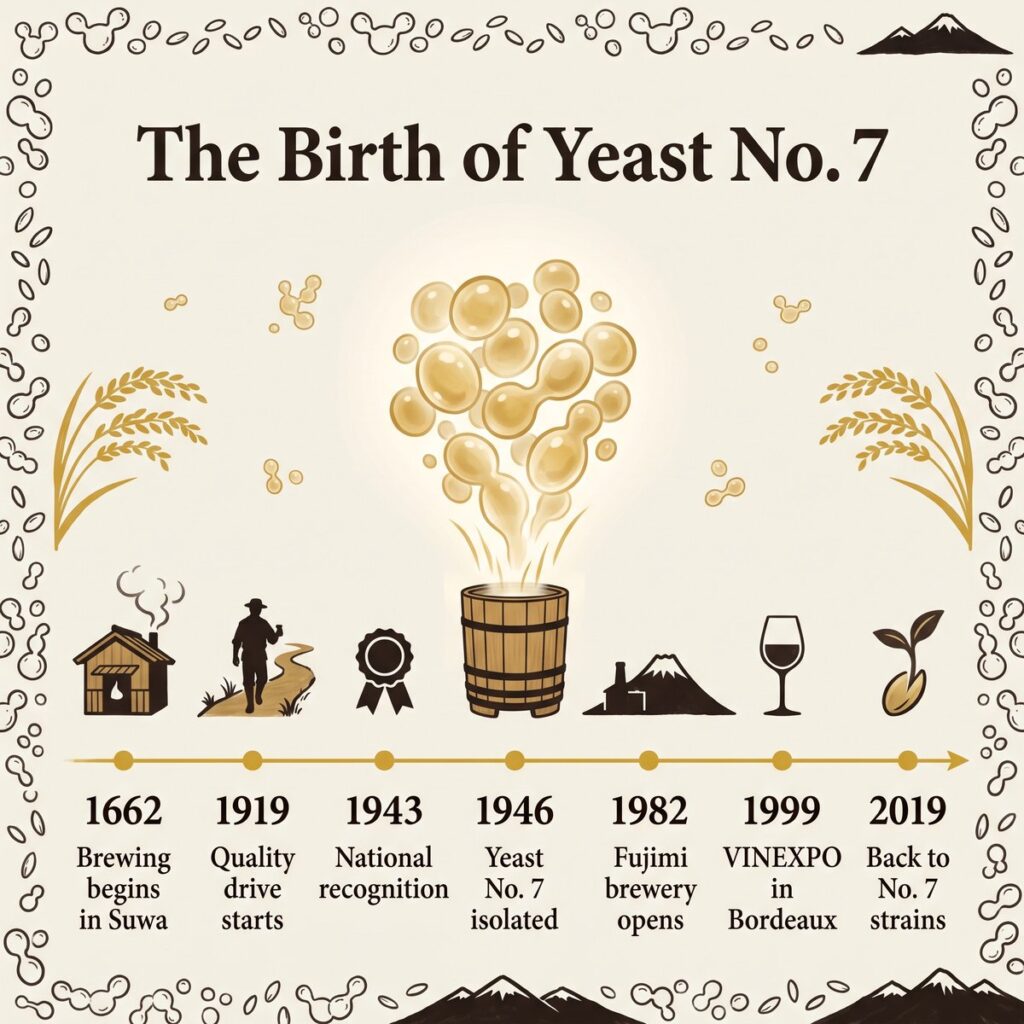
1662The Miyasaka family’s sake business begins in Kami-Suwa, according to the brewery.
1919Masaru Miyasaka appoints Chisato Kubota as toji and begins a quality drive.
1943The brewery reports first place at a national sake appraisal.
1946Researchers isolate a yeast from Masumi’s sake; it becomes Association Yeast No. 7.
1982The Fujimi brewery opens at about 1,000 meters.
1999Masumi exhibits at VINEXPO in Bordeaux, France.
2019The brewery refocuses on its own No. 7-related yeast strains.
What Happened in 1946?
According to Masumi, Dr. Shoichi Yamada, a yeast researcher at the government’s brewing institute, noticed the brewery’s run of top results. He visited in 1946 and identified a promising yeast in the fermentation tanks. At the time, the institute belonged to the Ministry of Finance.
Japan’s National Research Institute of Brewing, the institute’s modern successor, gives an independent account. It states that Kyokai No. 7 was isolated in 1946 at a sake brewery in Nagano Prefecture, and that the Brewing Society of Japan distributes it.
So Masumi did not invent No. 7, and it does not sell it. Instead, the strain was identified in sake being fermented at the brewery. Researchers at the government brewing institute subsequently isolated the strain, and the Brewing Society of Japan distributed it to other producers.
Why No. 7 Mattered
Before breweries could obtain standardized pure cultures, keeping a dependable yeast population was harder. Fermentation depended heavily on each brewery’s microbial conditions. As a result, unwanted organisms or poorly performing yeast could disrupt a batch.
No. 7, however, was isolated at a brewery whose sake had earned national recognition, and breweries anywhere in Japan could order it. In short, a quality first found in one Suwa brewery became available to the whole industry. Still, yeast was only one part of the postwar story. Rice polishing, koji making, temperature control, and hygiene all improved too.
The Science of Yeast No. 7
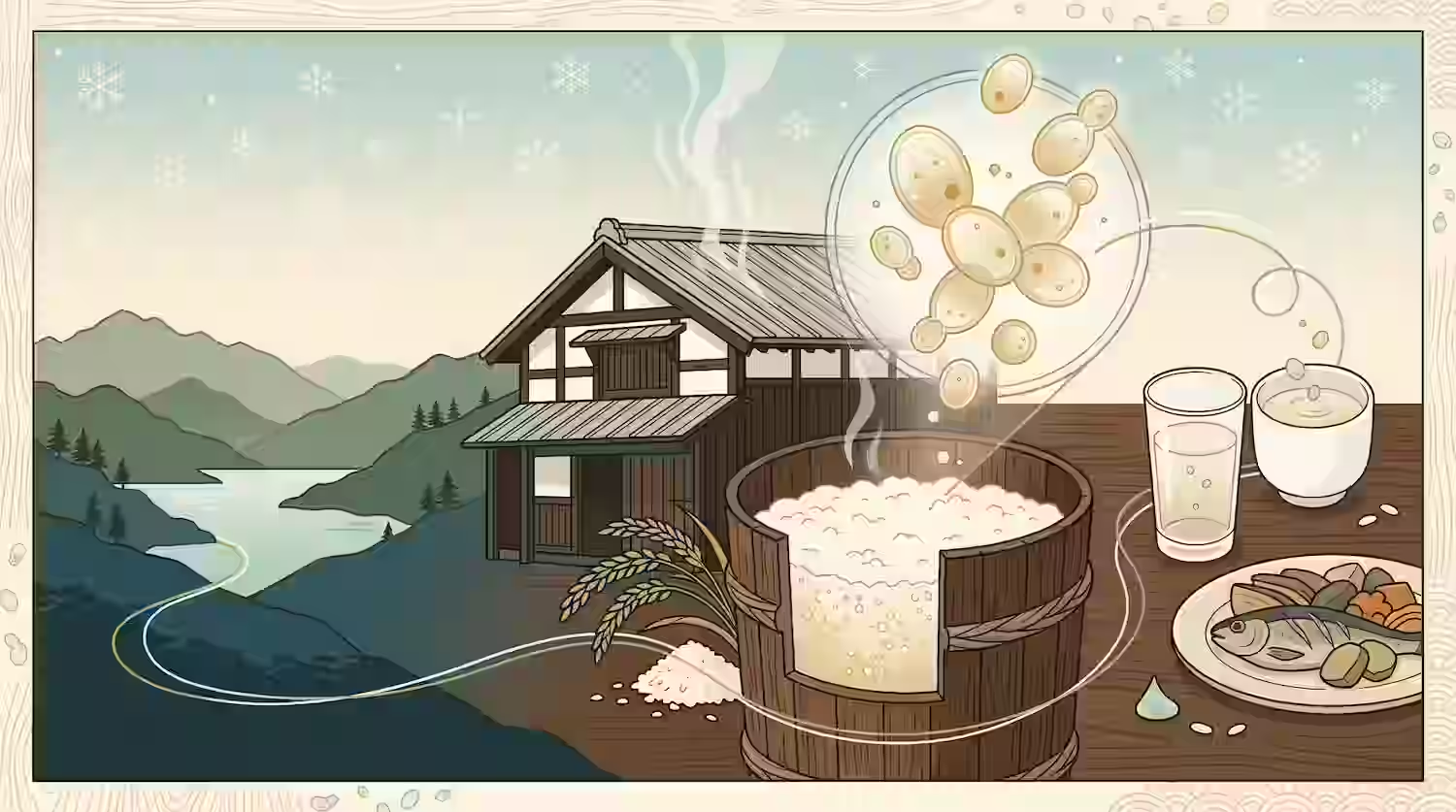
Most sake yeasts are strains of Saccharomyces cerevisiae, a species that also includes many yeasts used for bread, beer, and wine. In sake, however, yeast works alongside koji, a mold grown on steamed rice.
What Yeast Does in Sake
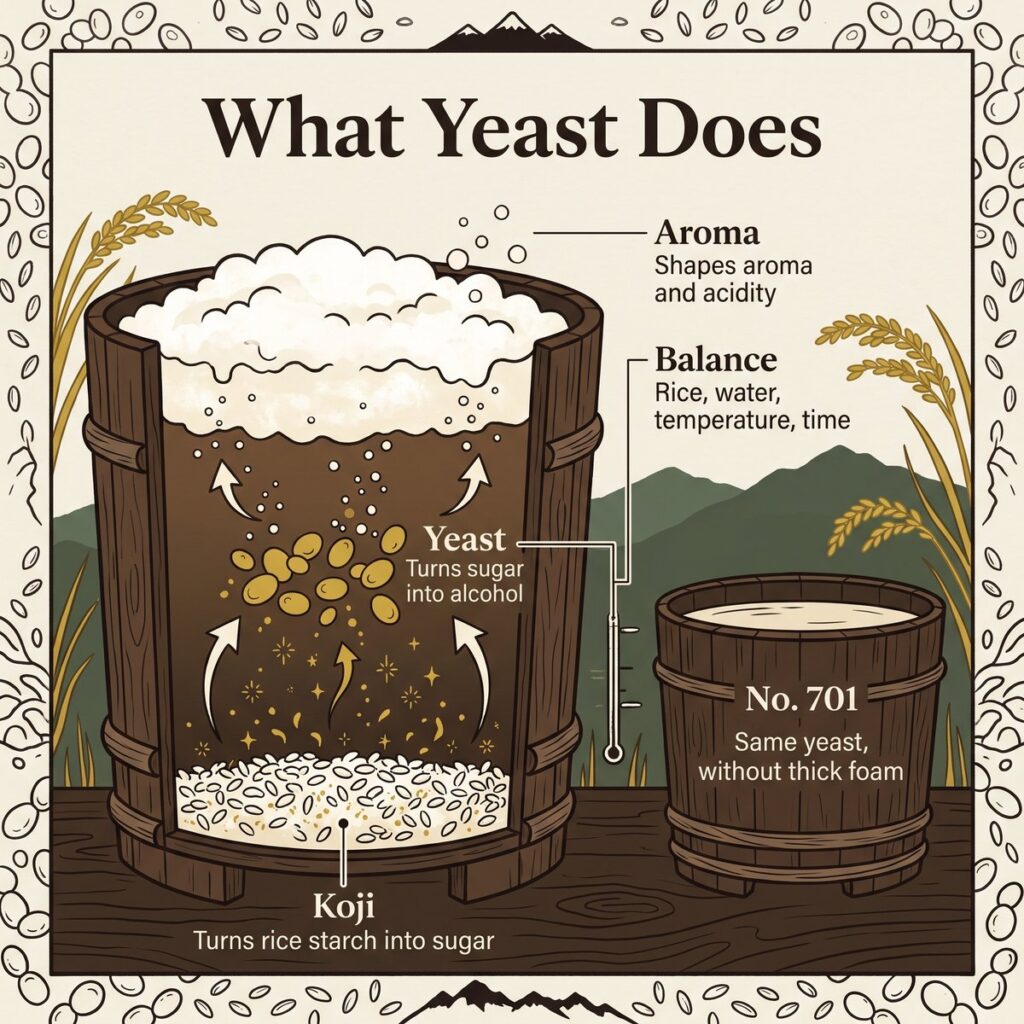
Koji enzymes continually turn rice starch into sugars, while yeast turns those sugars into alcohol at the same time. Because both happen together in one mash, brewers call it multiple parallel fermentation. Yeast also produces organic acids, esters, and other compounds that shape aroma and flavor.
KojiKoji enzymes break rice starch into sugars.
YeastAt the same time, yeast turns those sugars into alcohol.
AromaYeast also shapes aroma, acidity, and many flavors.
BalanceRice, water, temperature, and time shape the final style.
Sake yeasts are suited to the conditions of sake mash. For example, they work through long fermentations at fairly low temperatures, and they can produce high alcohol levels, sometimes approaching 20%. For more on the process, see our guide to sake fermentation.
Character, Foam and No. 701
The Brewing Society of Japan currently describes No. 7 as having a bright, attractive aroma and suiting both ginjo and everyday sake. Masumi, meanwhile, works with its own No. 7-related strains, and fermentation conditions shape the result further. So a standard strain and a brewery’s selected strain need not taste the same.
No. 7 also has a trait that brewers know well. Like most traditional sake yeasts, it forms a thick layer of foam on the fermenting mash, which takes up tank space. A 2002 study linked this foaming ability to a gene called AWA1. Breweries that want to avoid thick surface foam can use No. 701, a non-foaming mutant of No. 7 with otherwise very similar traits.
No. 7 has also become a research reference. In 2011, a team led by Japan’s brewing research institute published a draft whole-genome sequence of the strain, describing it as a commonly used sake yeast.
How No. 7 Spread Across Japan
The Brewing Society of Japan began producing and distributing pure-culture yeast in 1906, and breweries across the country came to rely on these association yeasts. No. 7 was isolated in 1946 and later added to that program. The National Research Institute of Brewing calls it one of the most widely used strains in sake brewing.
Masumi’s English site goes further and calls it the most widely used sake yeast in the world. That stronger claim, however, comes without published usage figures. Either way, smaller regional breweries could now work with the same proven yeast used by better-known breweries.
Worth Knowing
A shared yeast does not create identical sake. Rice variety, polishing, water, koji, the yeast starter, temperature, and pressing all change the result. No. 7 gave breweries a reliable foundation, not a single flavor.
Suwa: Place, Water and Rice
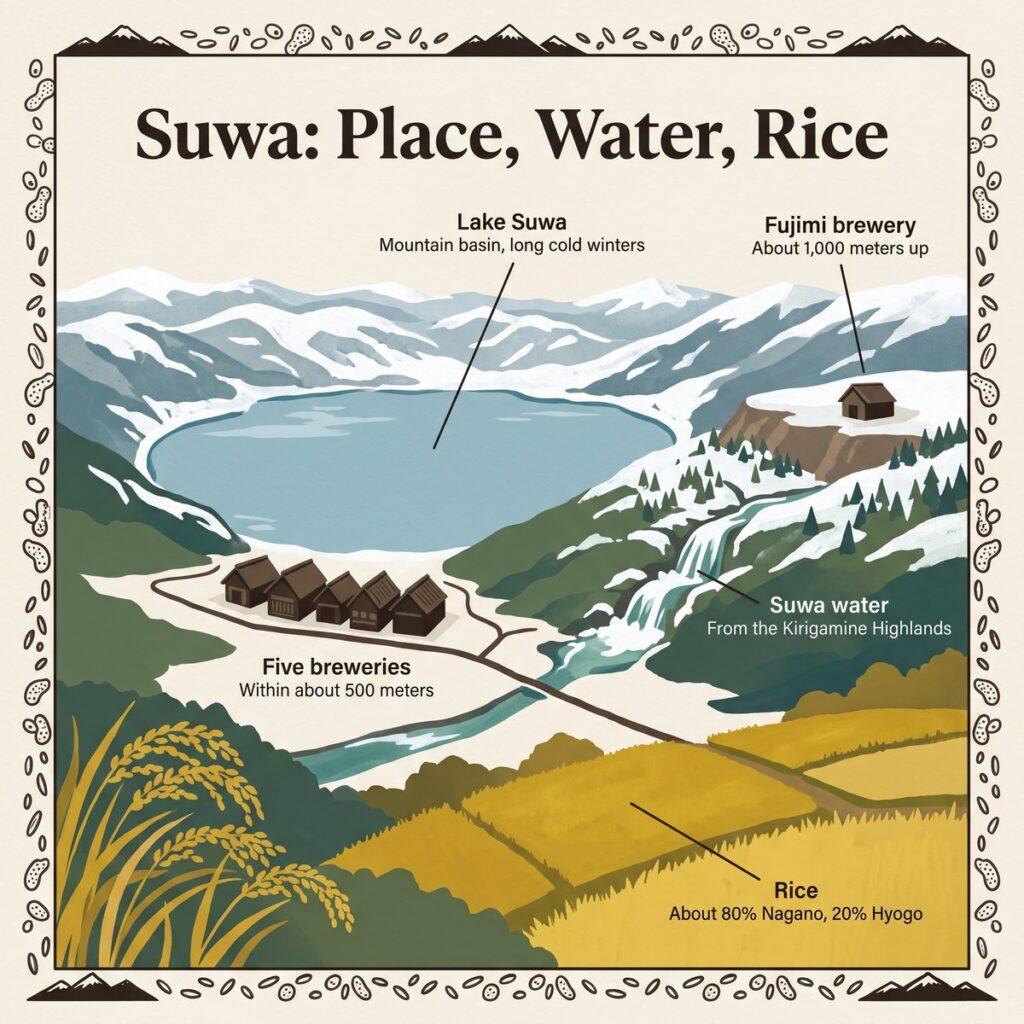
Suwa sits in a mountain basin around Lake Suwa, in the middle of Nagano Prefecture. Winters are long and cold, which suits traditional winter brewing. Our Nagano sake guide covers the wider region.
Five Breweries on One Street
Masumi is one of five breweries clustered along the old Koshu Kaido highway in Kami-Suwa. According to Nagano’s official tourism site, they stand within about 500 meters of each other. Their brands are Maihime, Reijin, Honkin, Yokobue, and Masumi, the oldest of the five.
Despite sitting on such a short stretch of the same town, the five breweries produce distinct styles. That small street shows a simple idea well. Place matters, but people and choices matter just as much.
Water and Two Breweries
Masumi draws water from its own wells. The Suwa brewery uses water from the Kirigamine Highlands, while the Fujimi brewery draws on Mount Nyukasa in the Southern Japan Alps.
The brewery describes the water as low in minerals and says it contributes to a soft, light, and flavorful style. For more on why minerals matter, see our guide to water in sake brewing.
Meanwhile, the original Suwa brewery still stands in Motomachi, the old part of town. Then, in 1982, rising demand led to a second brewery in the highland town of Fujimi, at about 1,000 meters. Today Fujimi is the main production center, with a rice-polishing plant, a shochu distillery, and an amazake factory.
Rice from Nagano and Hyogo
According to the brewery, about 80% of its rice comes from Nagano and about 20% from Hyogo, and it polishes all of it in-house. So not every Masumi bottle uses Nagano rice.
Rice
Grown in
How the brewery describes it
Miyama Nishiki
Nagano (Kami-Ina, Azumino, Daihoku)
Nagano’s best-known sake rice; clean, sharp, with a flinty minerality
Hitogokochi
Nagano (Kami-Ina)
A hardy alpine variety with large grains, often used for koji
Sankei Nishiki
Nagano
A newer variety seen as the heir to Miyama Nishiki; full yet clean
Kinmon Nishiki
Nagano (Kijimadaira)
Grown in only a few places; clear and rich
Yamada Nishiki
Hyogo (Yamaguni area)
Often called the king of sake rice; soft and full
Aiyama
Hyogo (Yoshikawa)
Grown in one area; adds subtle sweetness and acidity
Descriptions summarize the brewery’s own notes. Rice use differs by product and can change from year to year.
Kinmon Nishiki is central to Nanago, while Yamada Nishiki is used in Yumedono and Sanka. Polishing also changes from bottle to bottle, from 35% for Yumedono to 70% for KAYA. Our guides to sake rice and rice polishing explain these terms.
Yamahai and the 2019 Return to No. 7
Two choices define Masumi’s modern style: an old starter method used in selected bottles, and a renewed focus on its own yeast family.
What Yamahai Means
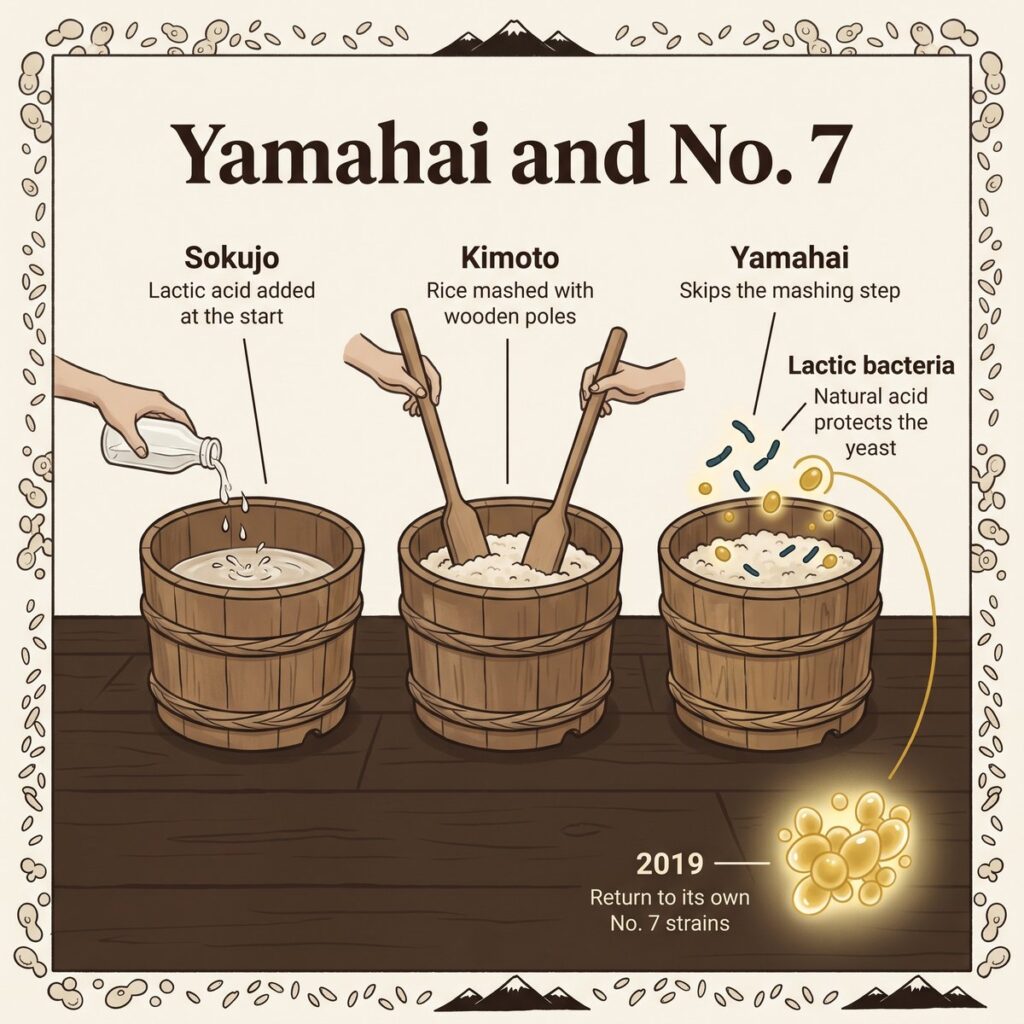
Before the main fermentation, brewers make a yeast starter called moto. Many modern breweries use the quick sokujo method, which adds lactic acid at the start. By contrast, the kimoto family lets lactic acid bacteria produce the acid that protects the young yeast.
Yamahai omits yama-oroshi, the labor-intensive mashing of rice and koji with paddles in a traditional kimoto starter. Its name is short for yama-oroshi haishi, meaning “abolition of yama-oroshi.” Even so, it still needs careful control of temperature and timing, as our yamahai guide explains.
Where Masumi Uses Yamahai
However, Masumi uses yamahai only in selected bottles. In the current range, they include Nanago, AKA, and the autumn Hiyaoroshi release. Yamahai is often linked with deeper acidity and savory notes, but the method alone does not set the flavor.
From Aromatic Yeasts Back to No. 7
The brewery describes the 1980s as a period when richer foods and more aromatic sake gained popularity. In response, Masumi adopted newer high-aroma yeasts too. As a result, the yeast that made the brewery famous risked being pushed aside in its own home.
In the 2010s, a new generation of Masumi brewers began developing yeasts based on No. 7. Then, in 2019, the company committed to building its range around its own No. 7-related strains. Nearly every sake in its main current range now lists those strains, although Karakuchi Kiippon also lists association yeast No. 1801.
A return to roots can sound like going backward. Here, though, the brewery kept modern equipment and fermentation science while choosing a yeast family with deep local history. In other words, it reinterpreted an old strength for today’s tables.
The Masumi Product Range
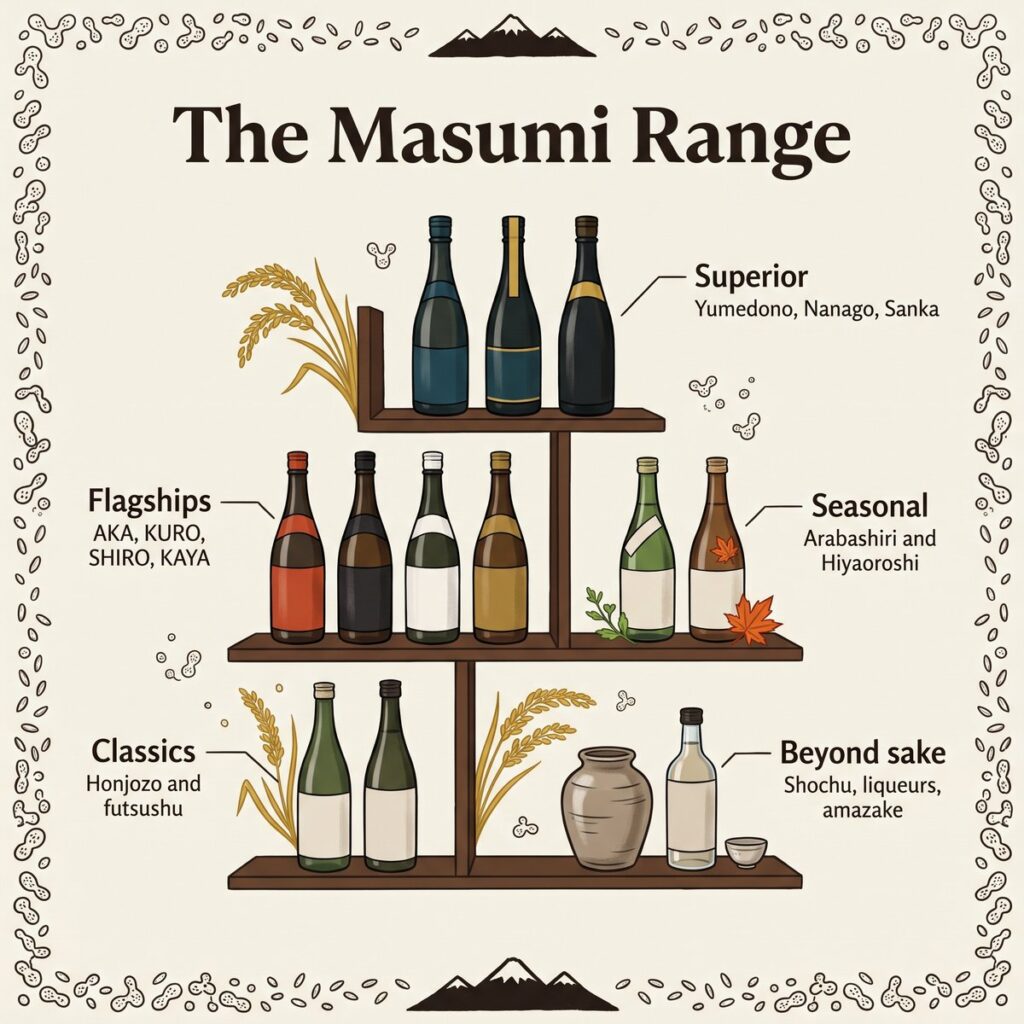
Its English-language site groups the range into lines such as Superior, Flagships, Seasonal, and Classics. The table below covers the main bottles. Specifications can change, so check the label; our guide to reading a sake label can help.
Sake
Line
Type
Polishing
Notes
Yumedono (夢殿)
Superior
Junmai daiginjo
35%
Yamada Nishiki; collected by dripping from cloth bags
Nanago (七號)
Superior
Yamahai junmai daiginjo
40%
Kinmon Nishiki from Nagano
Sanka (山花)
Superior
Junmai daiginjo
45%
Yamada Nishiki from Hyogo
AKA (真朱)
Flagship
Yamahai junmai ginjo
55%
Fruit and dairy-like aromas; firm acidity
KURO (漆黒)
Flagship
Junmai ginjo
55%
Balanced, dry finish
SHIRO (白妙)
Flagship
Junmai ginjo
55%
Light-bodied; 12% alcohol
KAYA (茅色)
Flagship
Junmai
70%
Nagano rice; suited to warming
Karakuchi Kiippon
Classic
Junmai ginjo
55%
No. 1801 plus Masumi No. 7 yeast
From the brewery’s product pages, checked October 2026. Among the eight products listed here, all except Karakuchi Kiippon list only Masumi’s proprietary No. 7-related yeast strains.
The Superior Line
Yumedono is the brand’s top junmai daiginjo. The sake is collected as it drips from suspended cloth bags, with little or no outside pressure. The English product page calls this “drip filtration,” though “bag-dripped” better describes how the liquid separates from the lees.
Nanago, meaning “No. 7,” ties the whole story together. Meanwhile, Sanka completes the line with Yamada Nishiki; the brewery’s tasting notes mention white peach, banana, and steamed rice.
Flagships, Seasonal and Classic Bottles
The flagship bottles take their names from traditional Japanese colors: vermilion red, lacquer black, and soft white. KAYA, according to the brewery, is named for the brown and gold of rice fields at the autumn harvest. Seasonal releases include a fresh Arabashiri and an autumn Hiyaoroshi. The classic line covers honjozo and futsushu, Japan’s everyday table sake. Beyond sake, Masumi makes shochu from sake lees, fruit liqueurs, and non-alcoholic amazake.
What Does Masumi Sake Taste Like?
There is no single Masumi taste, because each bottle has its own design. Yumedono and the everyday KAYA are built for different moments. Even so, a few threads run through the brand.
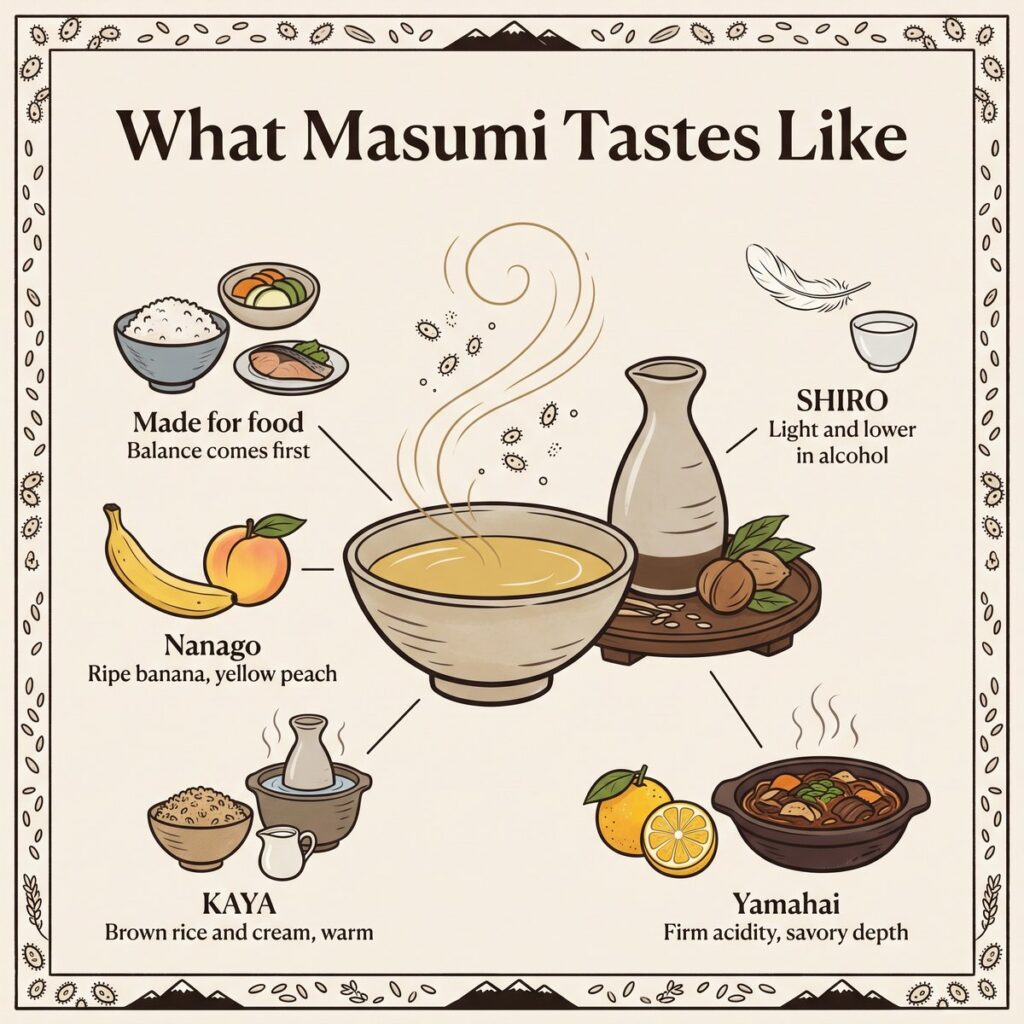
The brewery aims for sake that accompanies food, and its home page says the sake is created to match the foods and moods of every season. In practice, the range generally emphasizes balance and compatibility with food. Aroma intensity, however, varies a lot by bottle. Nanago’s notes mention ripe banana and yellow peach, while KAYA leans toward brown rice and cream.
Method and design matter too. For example, yamahai bottles such as Nanago and AKA show firmer acidity and savory depth in the brewery’s notes. By contrast, SHIRO is deliberately built around lower alcohol and a lighter profile.
Temperature is also worth exploring. The brewery recommends KURO and SHIRO chilled but notes they are good warm, while KAYA is best served warm. Our guide on how to taste sake walks through a simple tasting.
Masumi and Food Pairing
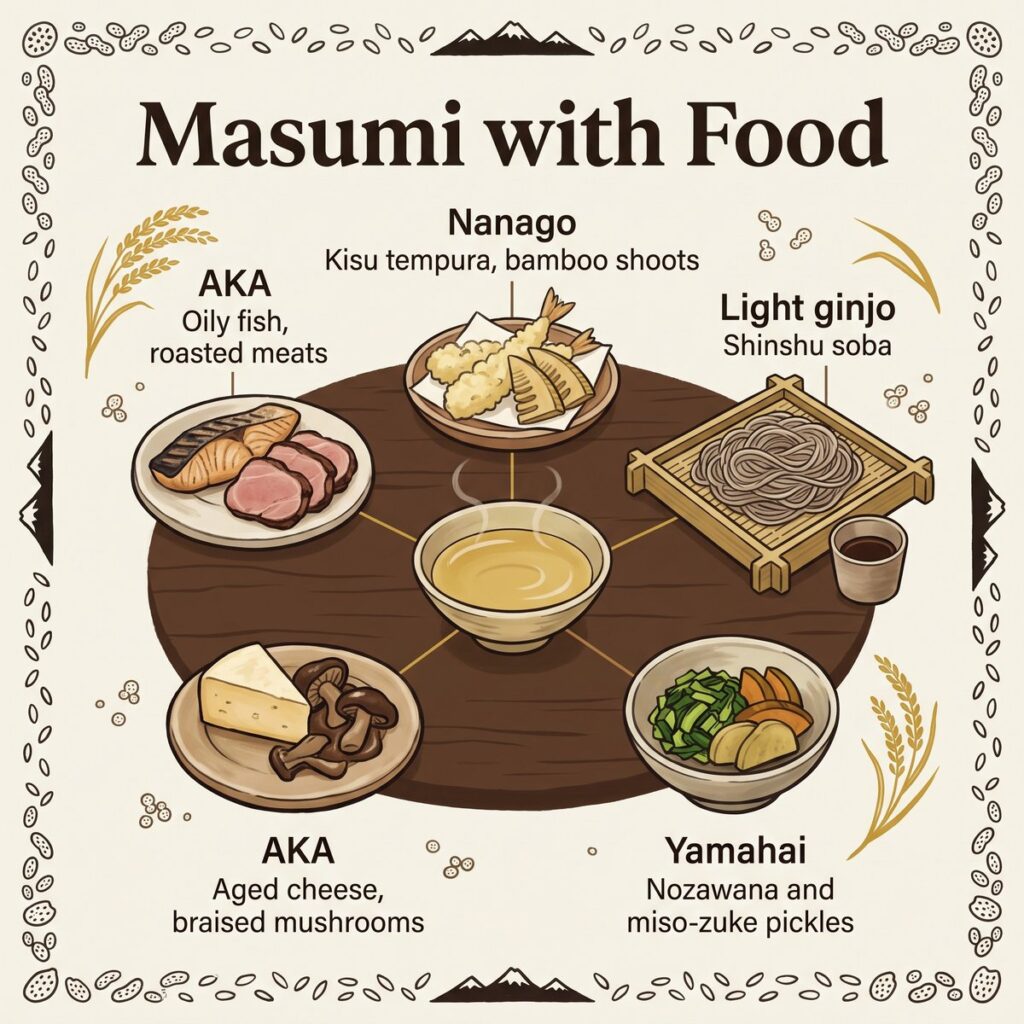
Because Masumi aims to sit beside food, pairing is the natural way to drink it. The brewery’s own suggestions give a sense of range. For AKA, it lists oily fish, roasted meats with bold sauces, braised mushrooms, and aged cheese. For Nanago, it suggests kisu tempura (a delicate white fish) and stewed bamboo shoots.
As a regional pairing to try, a lighter junmai ginjo can work with Shinshu soba. For something more assertive, consider pickles such as nozawana or miso-zuke with one of the yamahai bottles.
These are starting points, not rules. For the logic behind good matches, see our sake and food pairing guide.
Masumi Abroad
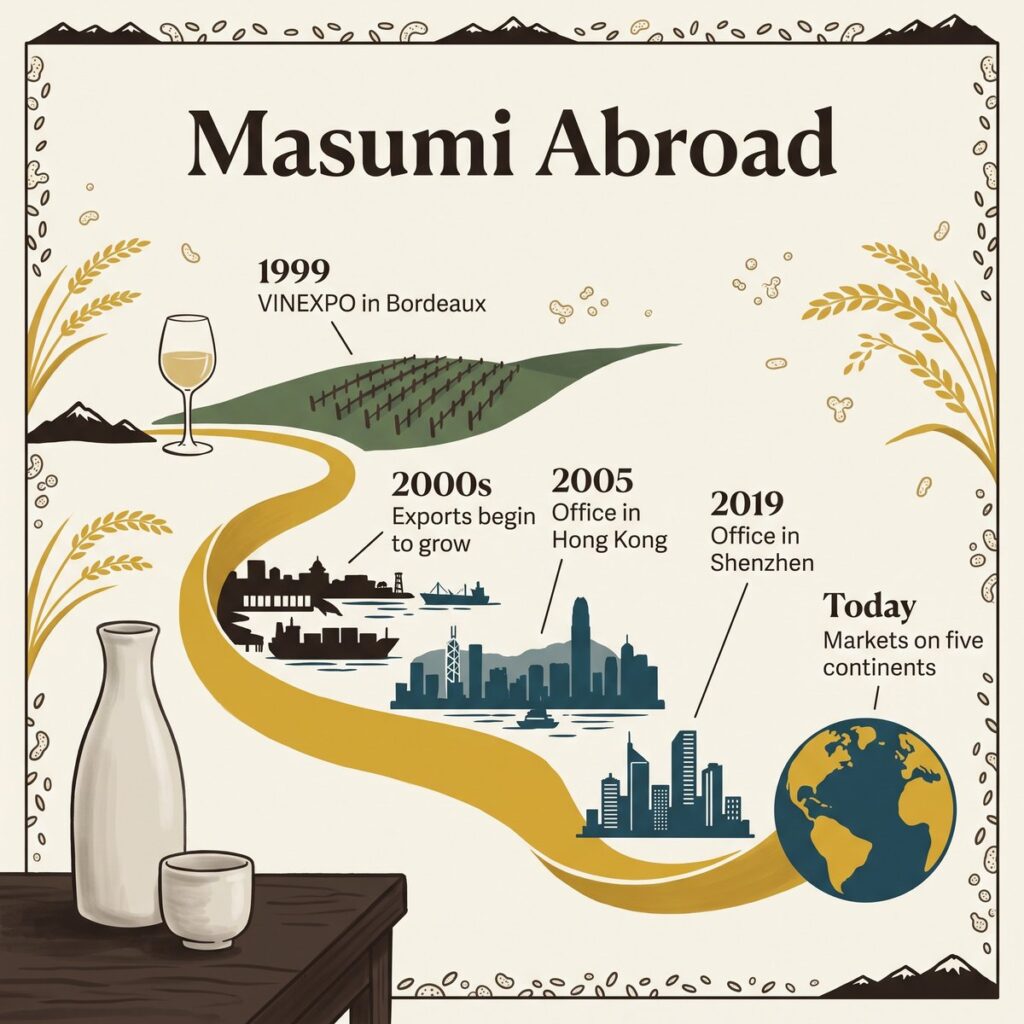
In the late 1990s, Masumi began a more deliberate push into international markets. In 1999, it exhibited at VINEXPO in Bordeaux, France, as part of an early effort to introduce sake to wine audiences.
According to the brewery, exports grew from the 2000s and now reach markets on five continents. It also opened sales offices in Hong Kong in 2005 and Shenzhen in 2019. That outward push fits a wider pattern in contemporary sake, where many breweries now explain their history in English.
Common Misconceptions About Masumi
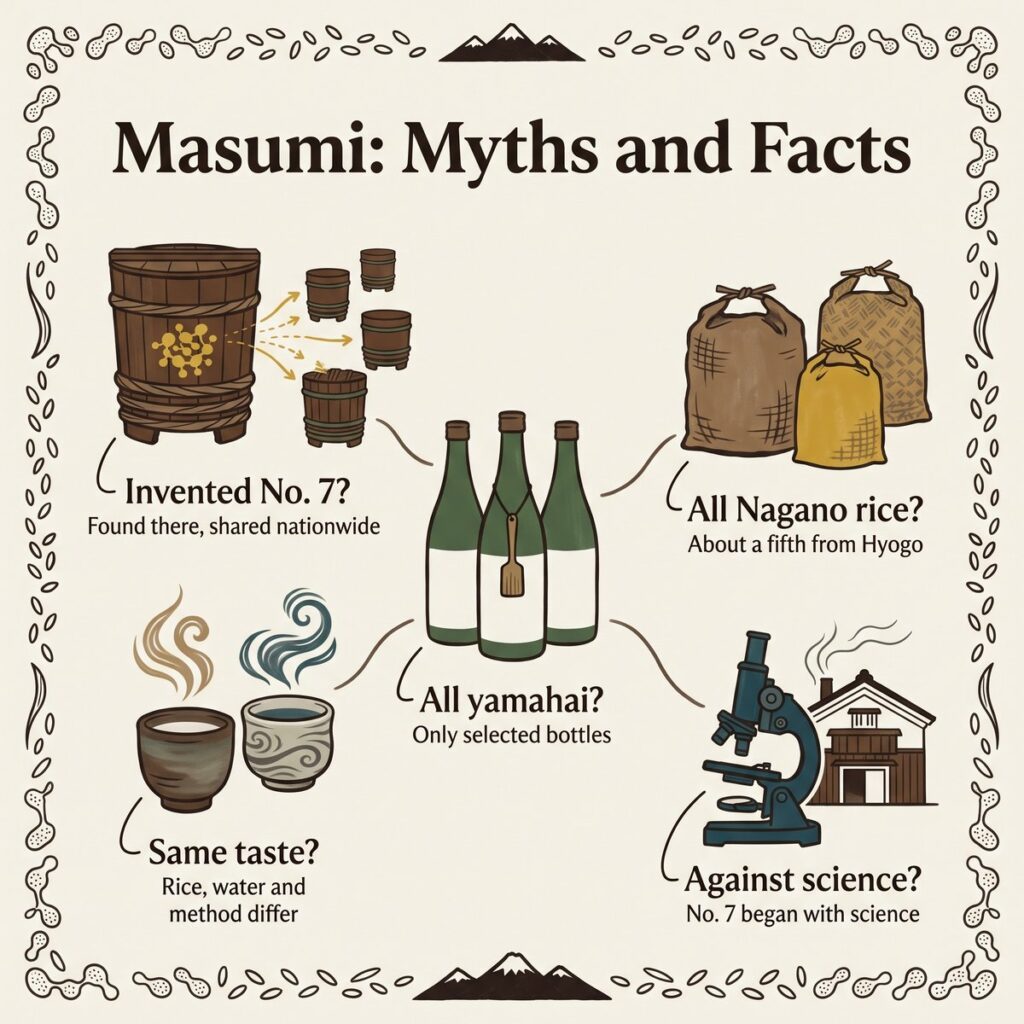
Every well-known brand has its own focus. Dassai, Hakkaisan, and Kubota are each known for different things, while Masumi stands out for yeast history. That story is easy to oversimplify, though:
“Masumi invented No. 7.” The strain was identified in sake brewed there, then isolated and distributed through the brewing association.
“All No. 7 sake tastes the same.” Rice, water, koji, and method create large differences.
“Every Masumi bottle is yamahai.” Only selected bottles, such as Nanago and AKA, use it.
“All Masumi rice comes from Nagano.” About a fifth comes from Hyogo, including Yamada Nishiki.
“Tradition means rejecting science.” The No. 7 story itself began with science.
Visiting Suwa
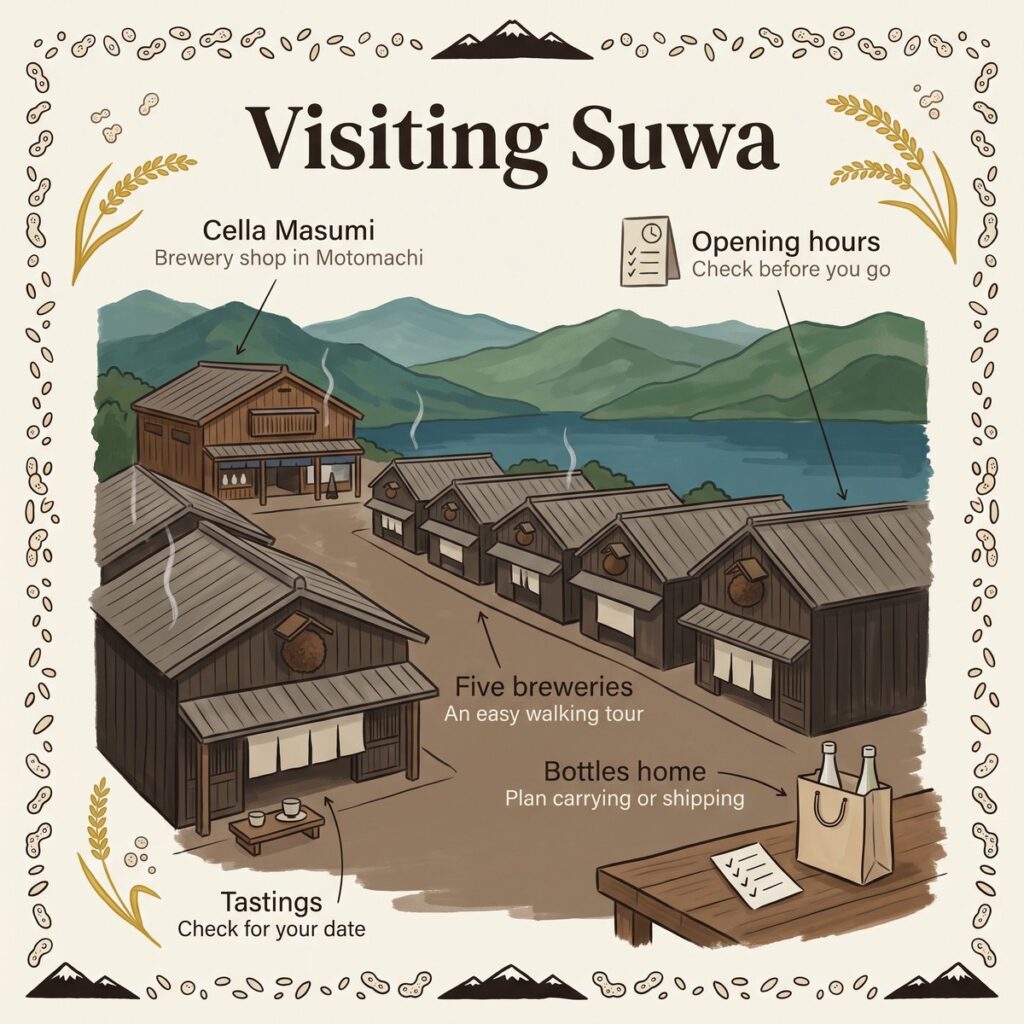
In Japan, a visit to Suwa adds real context. According to Nagano’s official tourism site, the brewery’s shop, Cella Masumi (セラ真澄), sells its products in Suwa. It stands in the Motomachi district, home to the original Suwa brewery. Since four other breweries stand nearby, the street also makes an easy walking tour. Before you go, check:
The shop’s current opening hours and holidays
Whether tastings are offered on your date
Which seasonal bottles are in stock
How you will carry bottles home, or whether shipping is available
Final Thoughts
Masumi’s value does not rest on age alone. Its story runs from near-collapse to a reported first-place result at a national appraisal, then to a yeast that reached breweries across Japan. Decades later, the brewery returned to that yeast family and rebuilt its style around food.
To taste that story, Nanago is the most direct bottle, while KURO or SHIRO makes an easier start. Either way, try it with a simple meal. Then explore our Japanese sake guide for more breweries and styles.
Facts and product specifications in this article were last checked in October 2026.
Frequently Asked Questions About Masumi Sake
What is Masumi sake?
Masumi is a sake brand made by Miyasaka Brewing Company in Suwa, Nagano Prefecture. It is best known for its link to Brewing Association Yeast No. 7, which was isolated at the brewery in 1946.
What is Association Yeast No. 7?
It is a sake yeast strain, often called Kyokai No. 7 or K7, distributed by the Brewing Society of Japan. Japan’s brewing research institute calls it one of the most widely used strains in sake brewing.
How was Yeast No. 7 discovered?
According to Masumi, Dr. Shoichi Yamada of the government’s brewing institute identified the promising yeast at the brewery in 1946. The strain was then isolated and distributed as Association Yeast No. 7.
Is No. 7 yeast still used today?
Yes. The Brewing Society of Japan still distributes No. 7. Also, Masumi uses its own No. 7-related strains across nearly all of its main current range.
Which Masumi should a beginner try?
KURO or SHIRO is a good start, since both belong to the everyday flagship range. Nanago is the bottle that best tells the No. 7 story.
Does every Masumi use yamahai?
No. Yamahai appears only in selected bottles, such as Nanago, AKA, and the seasonal Hiyaoroshi.
DNA Research – Akao, T., Yashiro, I., Hosoyama, A., Kitagaki, H., et al. (2011). Whole-Genome Sequencing of Sake Yeast Saccharomyces cerevisiae Kyokai no. 7. DNA Research, 18(6), 423–434 (Accessed October 2026)
Applied and Environmental Microbiology – Shimoi, H., Sakamoto, K., Okuda, M., Atthi, R., Iwashita, K., & Ito, K. (2002). The AWA1 Gene Is Required for the Foam-Forming Phenotype and Cell Surface Hydrophobicity of Sake Yeast. 68(4), 2018–2025 (Accessed October 2026)
Ryo Iwa is the founder and editor of foodinjapan.org. Born and raised in Japan, he writes from regional travel, market visits, and Japanese-language primary sources that rarely reach English readers, including brewing institute publications and industry glossaries. Where a figure cannot be traced to a source, the article says so.
He has been a Google Maps Local Guide for over 10 years, with more than 1,800 reviews and over 41,000 photos viewed hundreds of millions of times. He previously spent two decades as an IT consultant in Japan, the US, and the UK.





-300x169.avif "Moto (酒母): The Yeast Starter of Sake")



Comments