



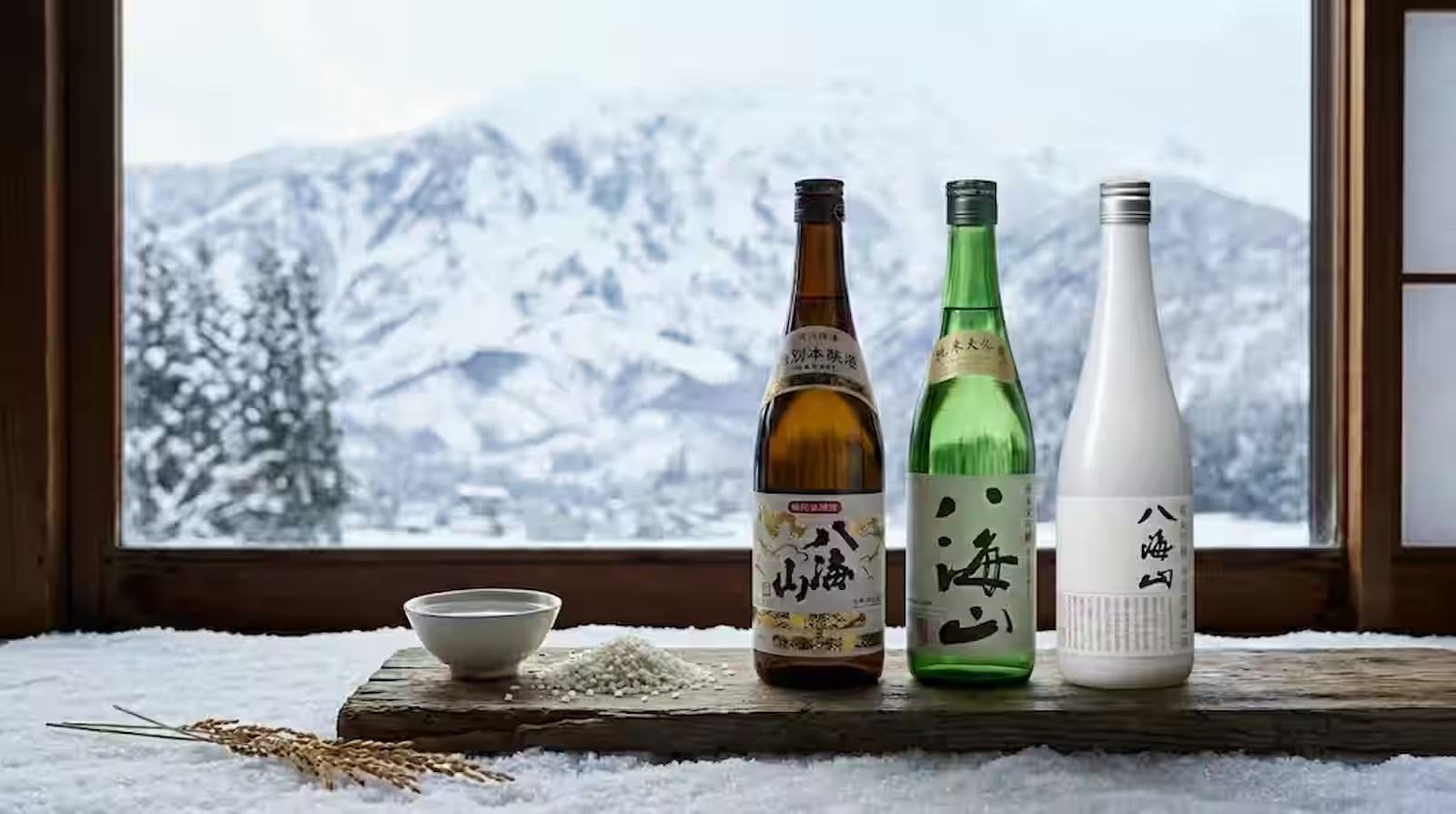

Order Kubota at an izakaya, a casual Japanese pub, and you will usually get a restrained, smooth sake with a clean, quick finish. Kubota sake is a Niigata brand made by Asahi-Shuzo and first released in 1985. It became one of the best-known names tied to tanrei-karakuchi, the clean and dry style of Niigata sake.
This guide looks at where the brand came from and what tanrei-karakuchi really means. It also covers the main bottles, food pairing, and the 2020 renewal, so you can choose a bottle with more confidence.
What Is Kubota Sake?
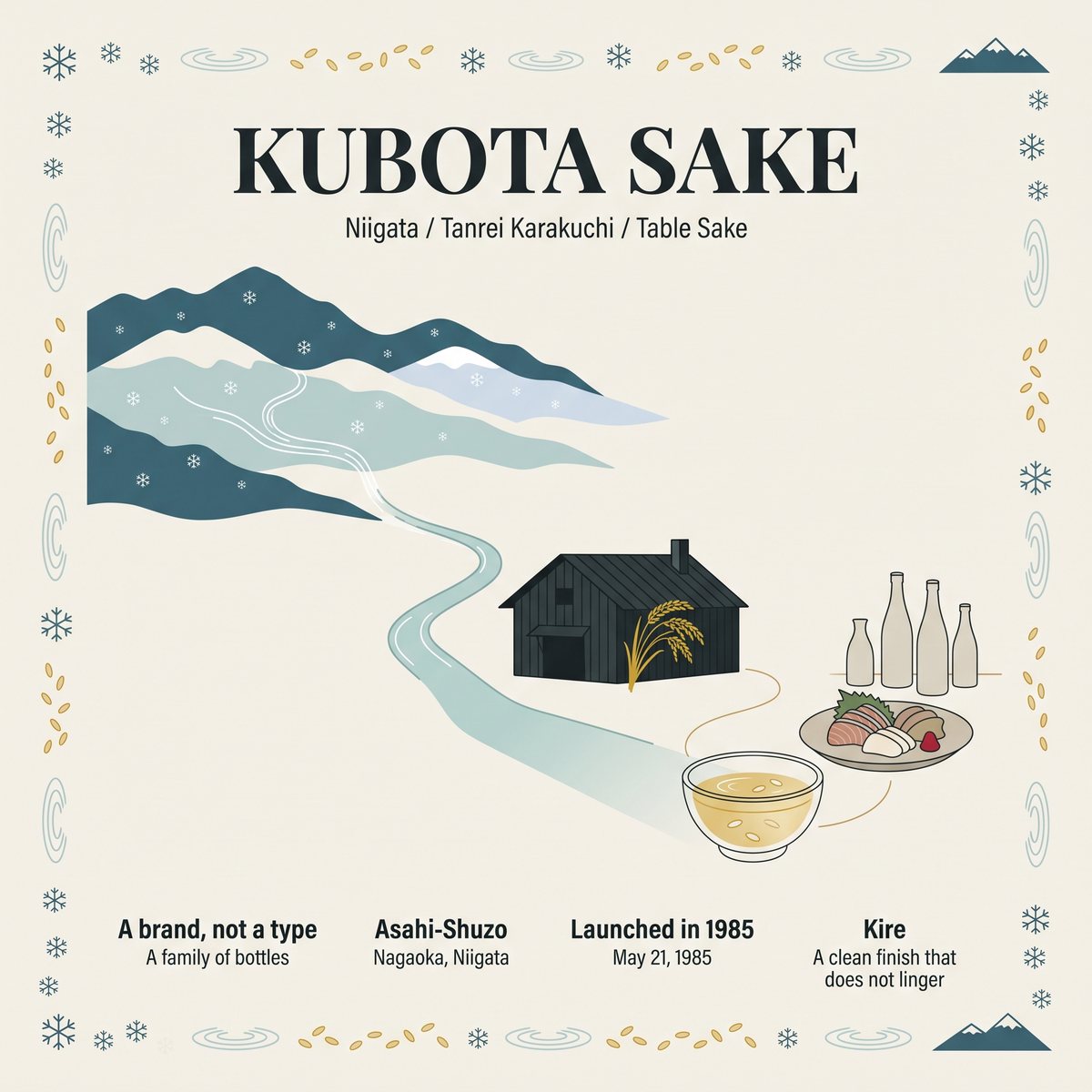
Kubota is a sake brand, not a type of sake. It is produced by Asahi-Shuzo (also written Asahi Shuzo), a brewery based in the Koshiji area of Nagaoka City. Niigata Prefecture sits on the Sea of Japan coast, north of Tokyo, and is a major rice-growing region. The brand launched on May 21, 1985, and its core identity centers on kire, a clean finish that does not linger heavily.
Quick Facts: Kubota Sake
- Brand
- Kubota (久保田)
- Brewery
- Asahi-Shuzo (朝日酒造), Nagaoka, Niigata
- Brewery roots
- 1830, under the house name Kubotaya
- Brand launch
- May 21, 1985, with Senjyu and Hyakujyu
- Premium flagship
- Manjyu, added in 1986
- Signature style
- Tanrei-karakuchi: clean, dry, and food-oriented
- Key sake rice
- Gohyakumangoku (use varies by bottle)
So why does the difference between brand and category matter? Kubota functions as a brand name in the same way that Dassai and Hakkaisan do. In other words, it names a family of bottles, and those bottles fall into different legal categories.
For example, Senjyu is a Ginjo, Hyakujyu is a Tokubetsu Honjozo, and Manjyu is a Junmai Daiginjo. The brand links them through a shared idea of clean, food-friendly sake. Still, each bottle has its own rice, polishing ratio, and taste.
The brewery also makes an older label, Asahiyama. By contrast, Kubota came much later, as a deliberate new brand. If the types of Japanese sake feel confusing, that guide is a good companion to this one.
What Does the Name “Kubota” Mean?
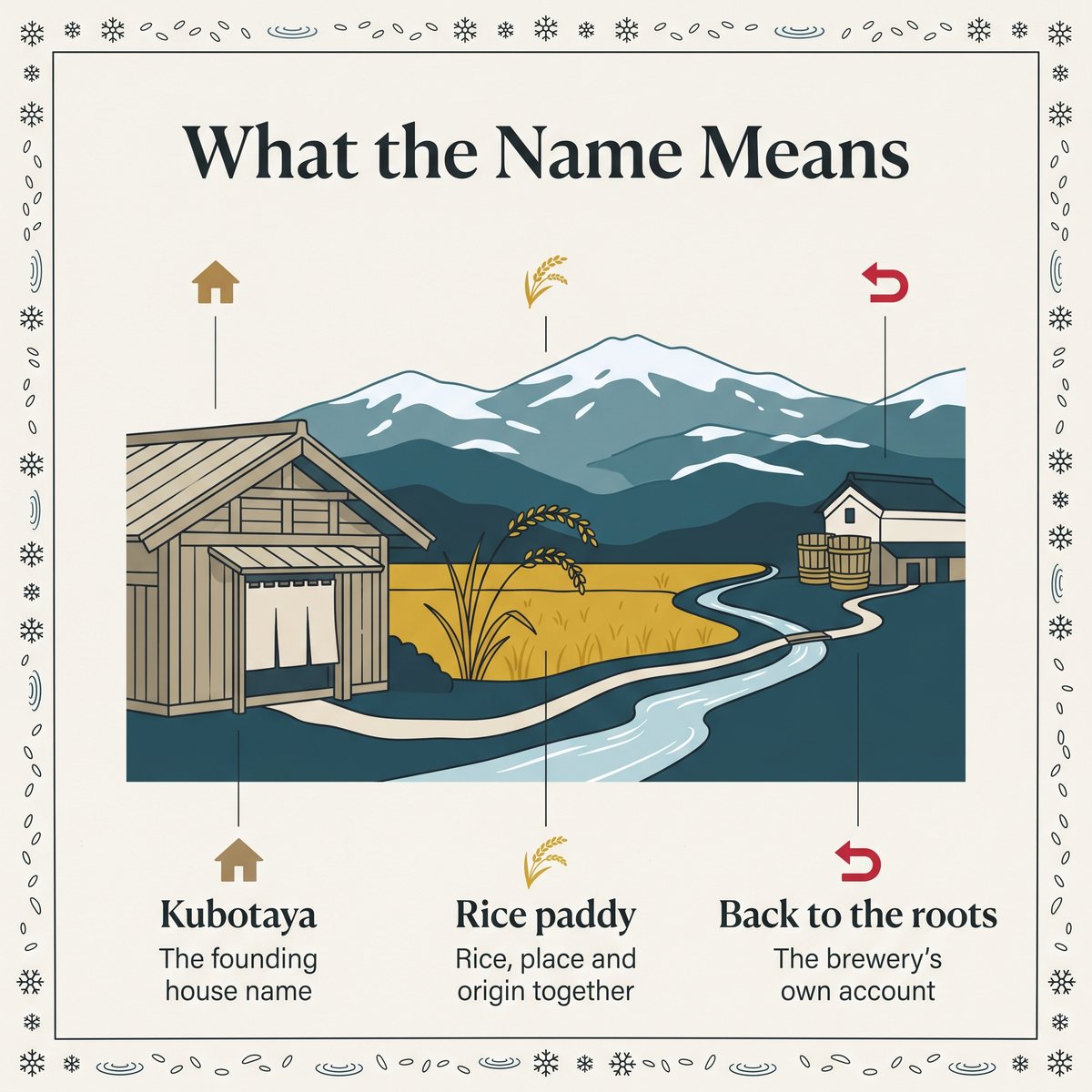
The name itself comes straight from the brewery’s past. According to Asahi-Shuzo, Kubota recalls Kubotaya, the house name of the founding Hirasawa family. The company says it chose the name to return to its founding spirit.
Asahi-Shuzo also ties the name to the land. The character 田 means rice paddy, and the company describes it as the foundation of the brand. In other words, the name points to rice, place, and origin all at once.
It is a small detail, but it still explains a lot. Rather than invent a modern-sounding label, the company reached back into its own history. Other origin stories circulate online, but this guide sticks to the brewery’s own account.
Asahi-Shuzo: A Brewing History Dating Back to 1830
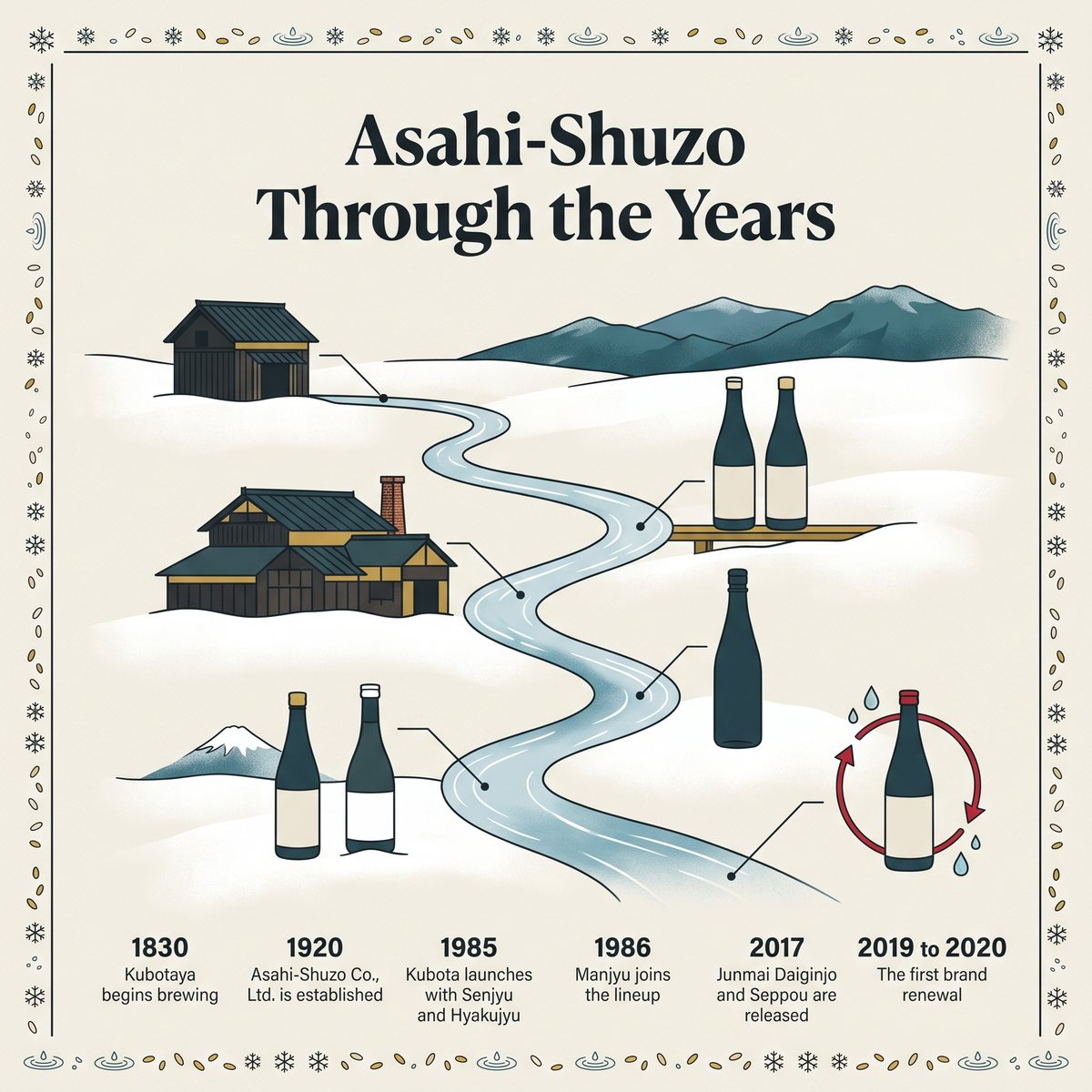
Asahi-Shuzo traces its brewing history to 1830. That year, a small brewery called Kubotaya started work in what was then Asahi village. Its long-established Asahiyama label takes its name from that home area, and it is still sold today.
In 1920, the business was formally incorporated as Asahi-Shuzo Co., Ltd. However, the Kubota brand itself would not appear for another 65 years.
Asahi-Shuzo and Kubota at a Glance
- 1830Kubotaya begins brewing in Asahi village
- 1920Asahi-Shuzo Co., Ltd. is established
- 1985Kubota launches with Senjyu and Hyakujyu (May 21)
- 1986Manjyu joins the lineup
- 2017Kubota Junmai Daiginjo and Seppou (雪峰) are released
- 2019 to 2020The brand’s first renewal rolls out
So why build a new brand on top of an old brewery? The answer has to do with timing. By the early 1980s, the sake market looked very different from earlier decades.
Besides timing, the brewery’s base mattered too. For one thing, it already had local rice, very soft water, and skilled brewers in Koshiji. Kubota grew out of those resources rather than replacing them.
Why Was Kubota Launched in 1985?
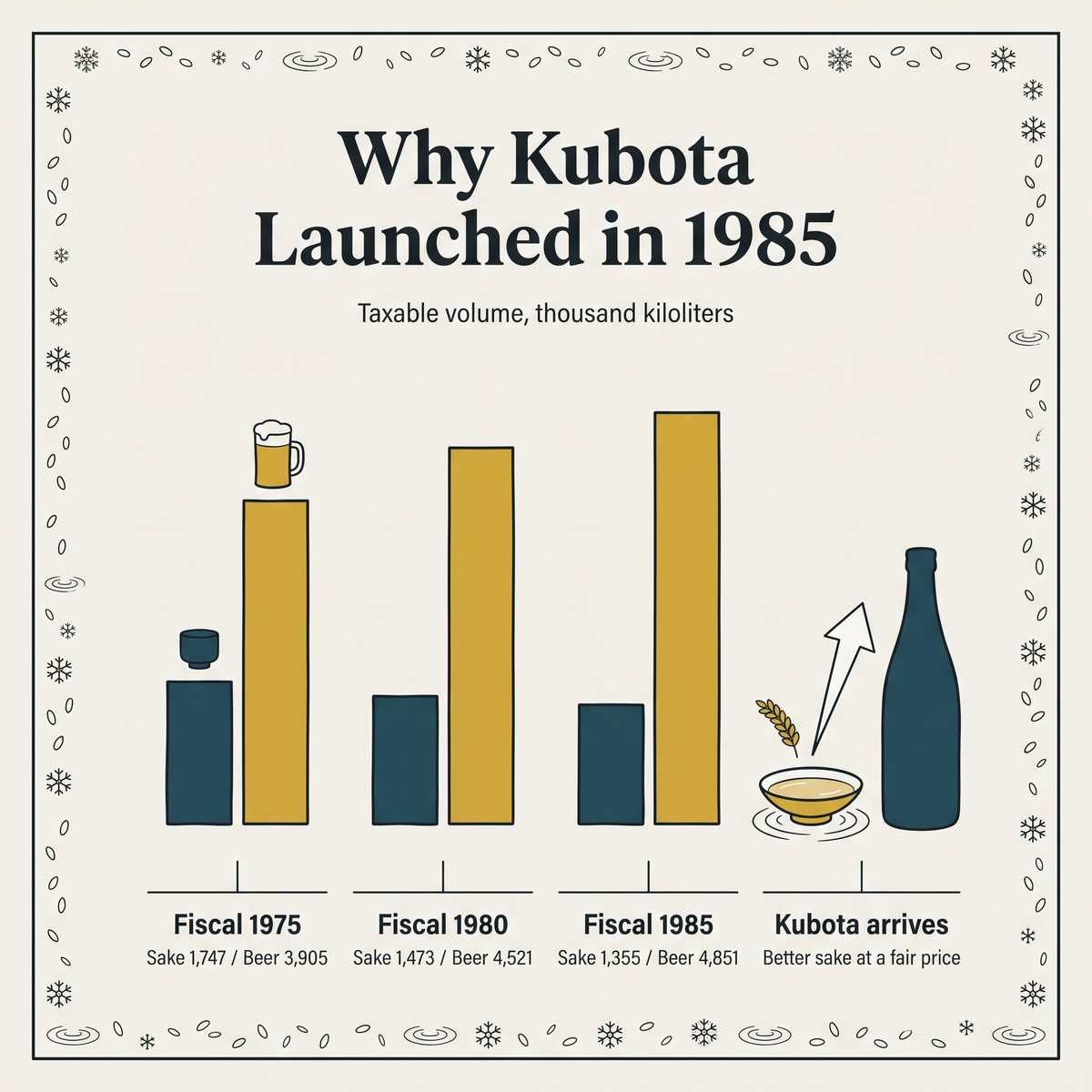
In short, Kubota arrived when sake volume was falling, beer was growing, and the industry was caught in price competition. Asahi-Shuzo set out to offer better sake at a fair price, in a clean style suited to changing lifestyles.
A Shrinking Sake Market
To begin with, the mid-1980s were a tough time for sake. National Tax Agency figures show taxable sake volume fell from 1,747 thousand kiloliters in fiscal 1975 to 1,355 thousand in fiscal 1985. Over the same decade, beer climbed from 3,905 to 4,851 thousand kiloliters.
Taxable Volume in Japan (thousand kiloliters)
| Fiscal year | Sake | Beer |
|---|---|---|
| 1975 | 1,747 | 3,905 |
| 1980 | 1,473 | 4,521 |
| 1985 | 1,355 | 4,851 |
Source: National Tax Agency, Sake no Shiori 2025, Table 8 (taxable volume handled by regional tax bureaus, excluding customs). Unit: thousand kiloliters. Fiscal years run from April to March. These figures track taxation, not retail sales.
These are taxable-volume figures rather than retail sales, so they indicate a broad market trend rather than exact drinking habits. Even so, the direction is clear. Sake was shrinking while beer kept growing, and the alcohol market was becoming more varied.
On top of that, price was a problem. In its 2019 announcement, Asahi-Shuzo recalled an industry caught in low-price competition. It also described concern within the industry that consumers were moving away from sake.
What the Brewery Set Out to Do
Kubota was the brewery’s response. The company says it aimed to offer high-quality sake at a fair price and to win back ground for sake as a national drink. On May 21, 1985, it released the first two bottles, Senjyu and Hyakujyu.
Asahi-Shuzo’s account also links the new style to changing lives. Fewer people did heavy physical work, and more people sat at desks. Meanwhile, diets grew more varied and took in more Western-style dishes.
A Niigata cultural history, prepared with the prefectural brewing institute, tells a similar story. It notes that sweet sake suited an era of physical labor. As desk work and rich Western food spread, drinkers wanted something crisp with a clean finish.
Still, lifestyle change alone did not create Kubota. The brand also drew on decades of local technical work, which the next section explains.
Tanrei-Karakuchi: The Style at the Heart of Kubota
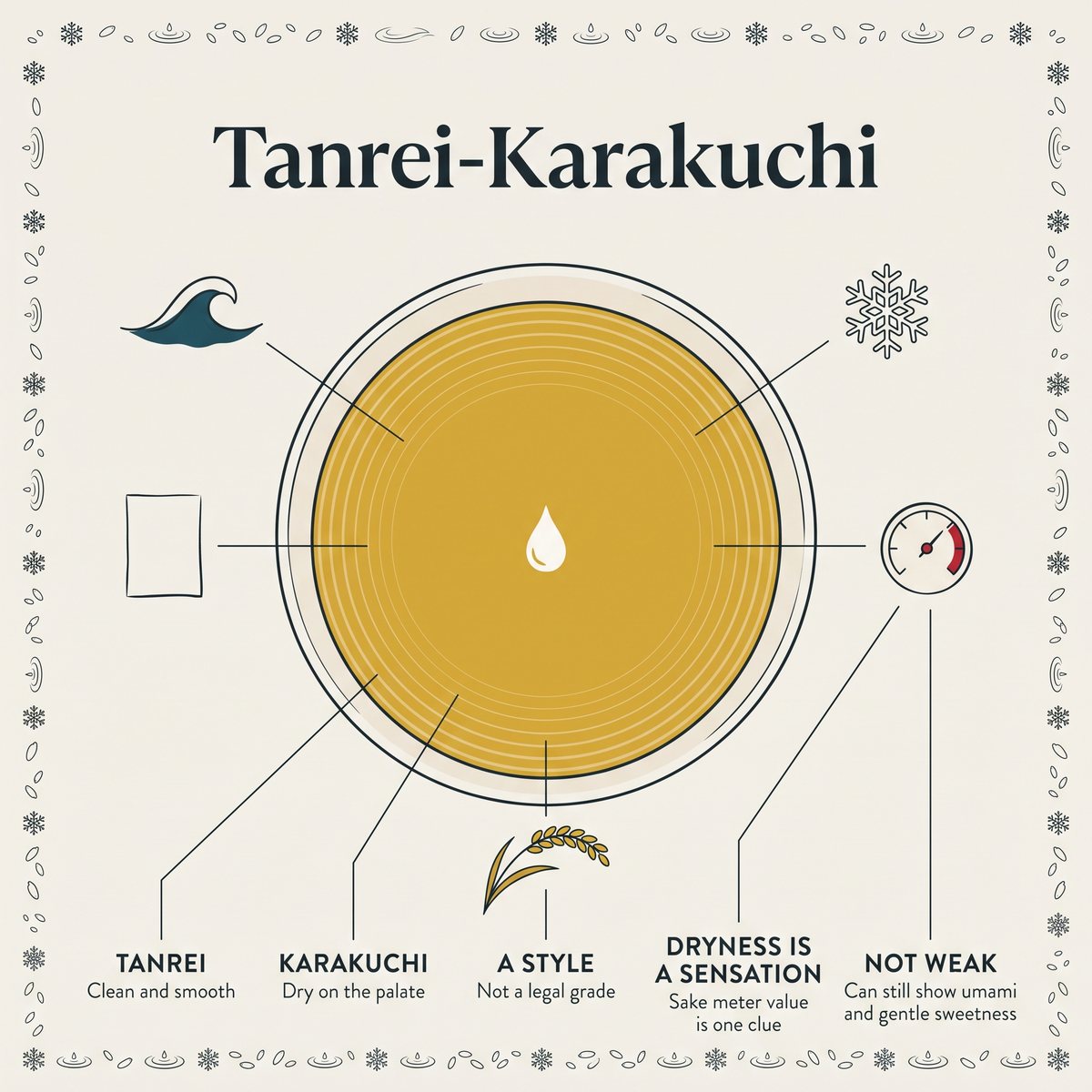
If you remember only one phrase from this guide, make it tanrei-karakuchi (淡麗辛口). People often translate it as “light and dry,” which is close but a little misleading. In fact, it describes an overall style, not a single measurable property.
Key Point
Tanrei-karakuchi is a style description, not one of Japan’s legally defined sake categories. You will not find it as a grade in the way you find Ginjo or Junmai on a label.
Tanrei as a Sensory Style
Tanrei refers to how clean and smooth a sake feels. In its GI Niigata standard, Japan’s National Tax Agency describes Niigata sake as generally tanrei. It pairs a light aroma and a clean, smooth taste with gentle sweetness that fades softly.
In other words, tanrei does not mean flavorless or watery. A tanrei sake can still carry sweetness and umami. The point is that nothing feels rough or heavy.
Keep in mind, too, that the GI was designated in 2022. It describes Niigata sake today, not a rule that existed in 1985. Even so, it gives a useful official picture of what tanrei means.
What Karakuchi Really Means
Karakuchi means dry, but dryness in sake is a sensation, not a fixed number. The sake meter value, or nihonshu-do, is only one clue. It reflects a sake’s density, and higher numbers often point toward a drier style. Higher acidity can make a sake taste drier, while more glucose can make it taste sweeter.
In fact, a 2004 study from Japan’s National Research Institute of Brewing used glucose and acidity to predict how tasters judged sweetness and dryness. The Japan Sake and Shochu Makers Association’s glossary treats sweetness and dryness in the same way. So a dry sake can still contain some sugar, and it can still taste of rice.
Dry does not mean harsh, either, so do not expect a sharp burn. A well-made karakuchi sake usually feels crisp and tidy rather than sharp. Honestly, the first sip can seem almost too quiet, at least until the food arrives.
How Niigata Built a Regional Sake Identity
Kubota did not create Niigata’s dry-sake identity by itself. A 2021 study published by Niigata University traces tanrei-karakuchi to decades of shared work across the prefecture’s brewing industry. It points to research bodies, training, and market change rather than one brand.
Some of that groundwork is easy to date. The prefecture opened its brewing research station in 1930, and the Gohyakumangoku rice variety was named in 1957. Then, in 1984, the Niigata Sake School began training brewery workers.
By the Showa 50s (1975 to 1984), according to the Niigata cultural history, Niigata sake was widely known as tanrei-karakuchi. Before that, the same source says, people often saw it as sweet and ordinary. The Niigata University study also highlights an “All Niigata” direction that the Niigata Sake Brewers Association set out in 1985.
Even so, Niigata is not one flavor. The prefecture has many breweries, and each keeps its own style. Our Niigata sake guide covers that wider picture in more depth.
Why Kubota’s 1985 Launch Mattered
So where does Kubota fit? Its launch coincided with the year that direction was set out, although no source shows that one caused the other. Rather than invent dry sake, Kubota gave the style a clearly defined commercial identity at a pivotal moment. As a result, it became one of the best-known brands associated with Niigata’s tanrei-karakuchi image.
Rice and Water Behind Kubota
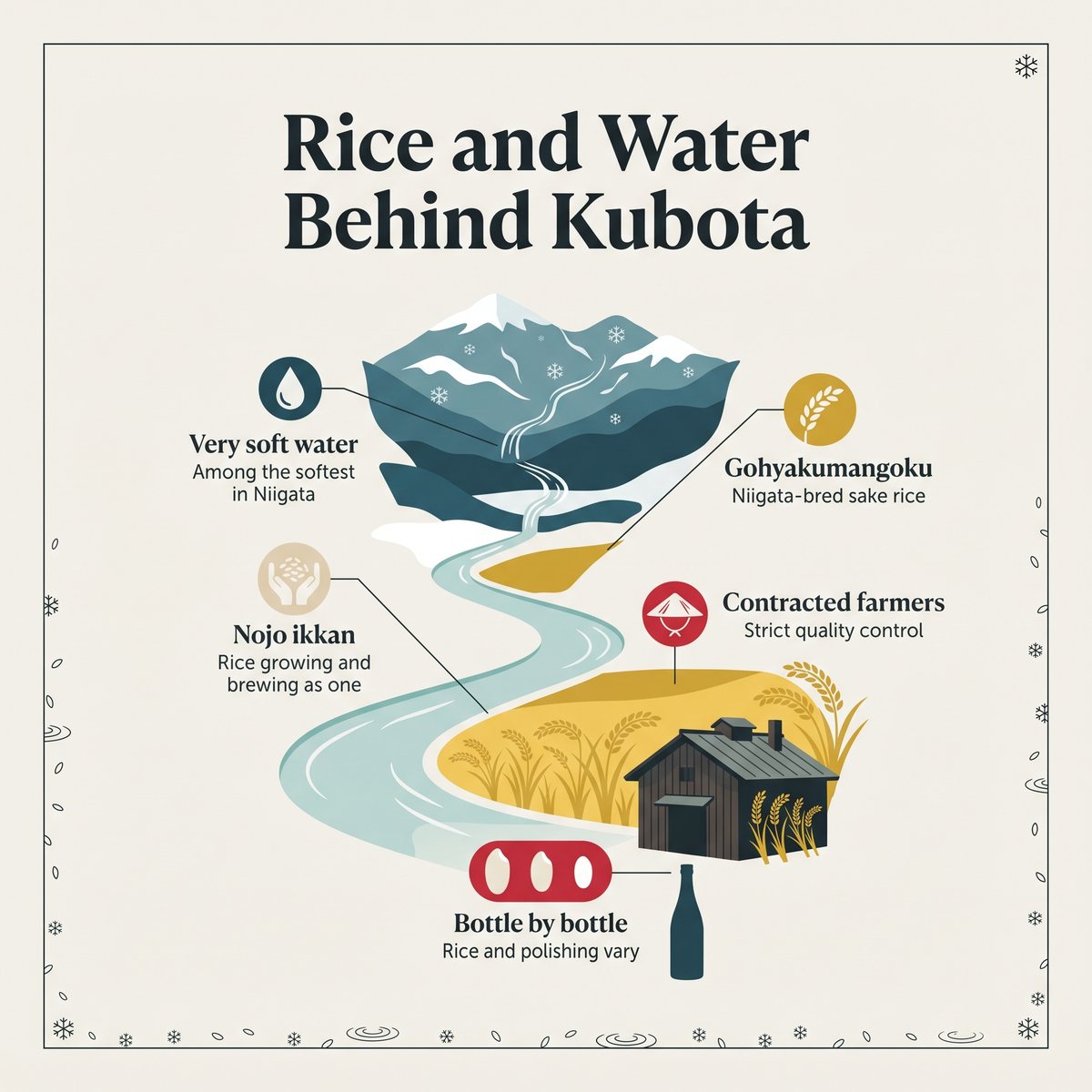
Asahi-Shuzo puts heavy weight on Niigata water and rice. The brewery says its water is very soft, among the softest in the prefecture. Soft brewing water generally holds fewer minerals that support yeast. As a result, fermentation may run more gently and need careful control, as our guide to water in sake brewing explains.
As for rice, the brand leans on Gohyakumangoku, a sake rice bred in Niigata. According to the brewery, contracted local farmers grow most of it under strict quality control. The brewery describes a close, integrated relationship between rice cultivation and brewing, which it calls nojo ikkan (農醸一貫).
Gohyakumangoku also has a long local story of its own. The prefecture’s brewing and agricultural research stations developed it together. Because of that, it ties Kubota to local research as much as to local fields.
However, not every bottle uses the same rice in the same way. Senjyu uses Gohyakumangoku for both the koji rice and the remaining rice. Hyakujyu and Manjyu, by contrast, pair Gohyakumangoku koji rice with other Niigata-grown rice.
Polishing ratios, likewise, differ from bottle to bottle. That is why it pays to check each product page or label rather than assume one recipe. Our rice polishing guide explains what those percentages mean.
One more caution. Soft water and Gohyakumangoku do not decide flavor on their own. Instead, they give brewers conditions to work with through polishing, koji making, fermentation, and aging. Koji is steamed rice grown with a mold that turns starch into sugar for the yeast.
Brewing Philosophy: Precision, Consistency, and Research
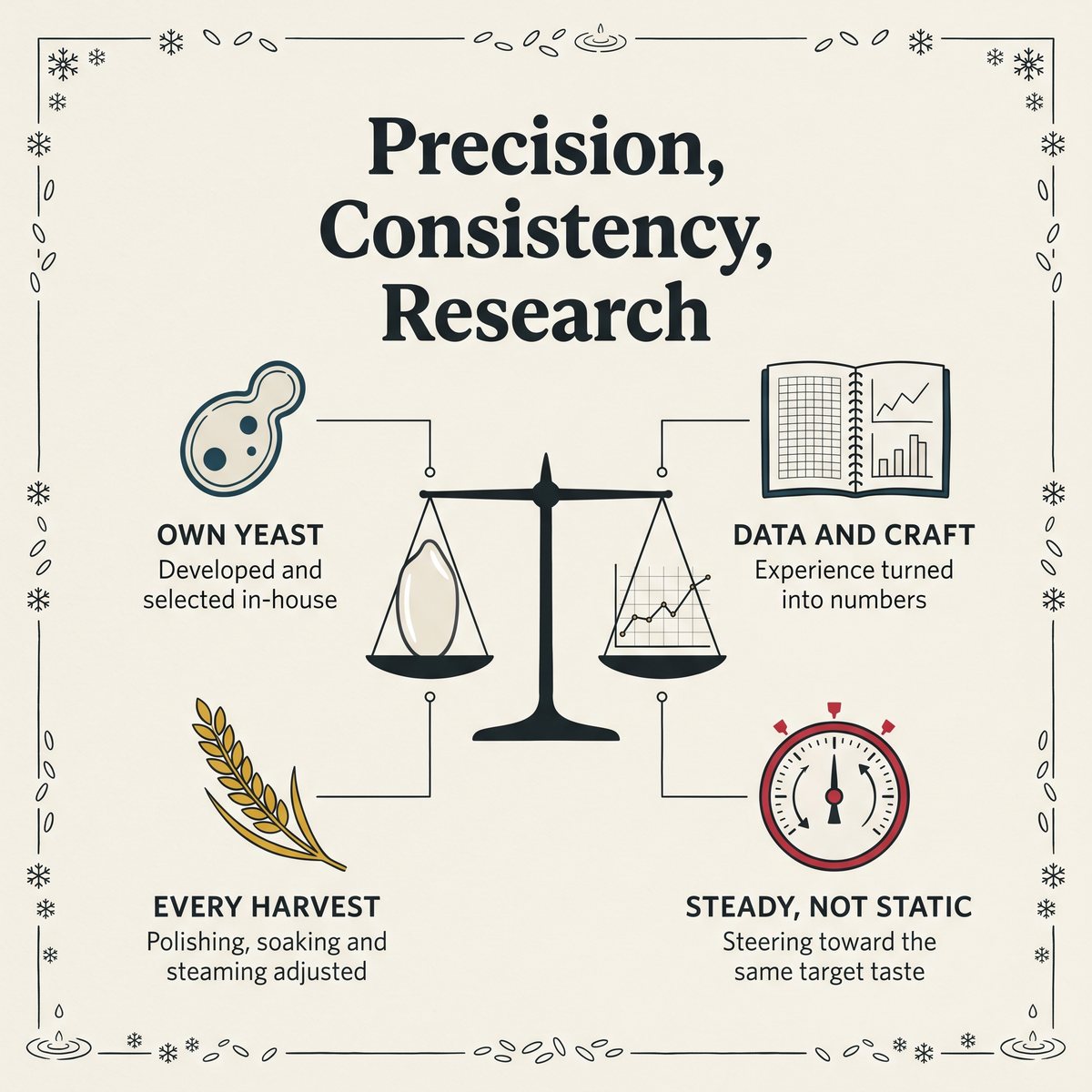
How does a brewery keep a style steady for four decades? Asahi-Shuzo’s answer combines craft and data. On its brand page, the company says it develops and selects proprietary yeast strains while researching the basic science of brewing.
Beyond that, the brewery describes turning brewers’ experience into numbers. That way, decisions about rice, water, and timing rest on more than memory. Of course, rice quality varies by harvest year, so the brewery adjusts polishing, soaking, and steaming to suit each crop.
This mix matters because consistency is not the same as standing still. A recipe that never changed would drift as the rice changed. Instead, a skilled toji with good data can steer toward the same target taste.
Similarly, the prefecture’s brewing institute studies microbes, filtration, storage, and sensory evaluation. Kubota’s in-house research fits that wider regional habit. For the basic steps, see our guide to how sake is made.
Kubota Senjyu: The Everyday Anchor
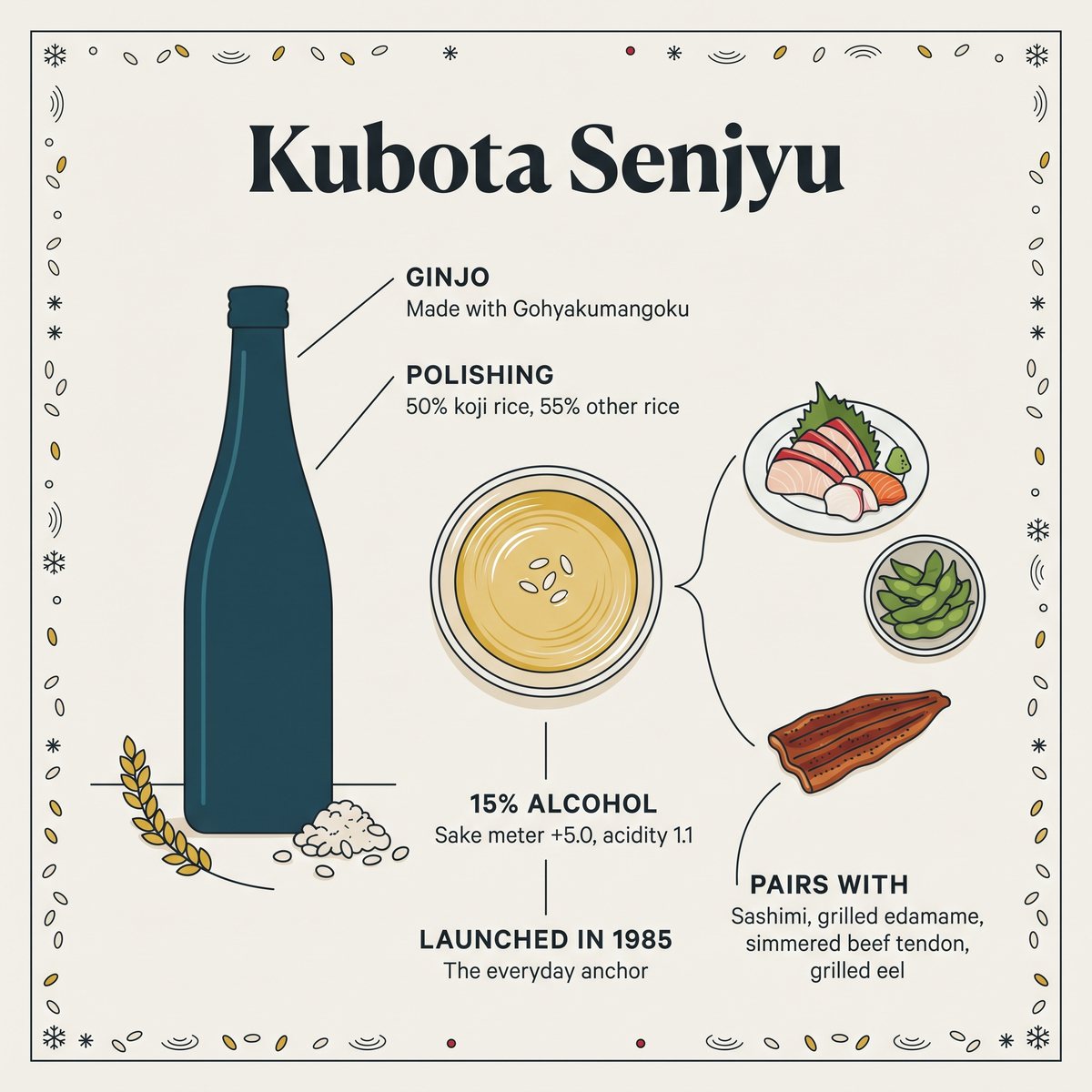
Senjyu (千寿, often spelled Senju in English) sits at the core of the brand’s daily line. It launched with the brand on May 21, 1985. Asahi-Shuzo calls it a ginjo meant to be enjoyed with meals.
The current Senjyu is a Ginjo made with Gohyakumangoku. The koji rice is polished to 50%, and the remaining rice to 55%. It sits at 15% alcohol, with a sake meter value of +5.0 and acidity of 1.1.
On the palate, the brewery describes a clean, light-bodied sake with a calm aroma. Rice umami, acidity, and a faint sweetness show up on the finish. Overall, it is built to support food rather than compete with it.
For food, suggested pairings include seasonal sashimi, grilled edamame, simmered beef tendon, and grilled eel. That range is telling, because it moves from delicate fish to rich, sweet-glazed dishes.
One caution here. Today’s Senjyu is not identical to the 1985 bottle, since Asahi-Shuzo adjusted its brewing in 2020. The Senjyu line also includes other bottles, such as a Junmai Ginjo, so check the full name on the label.
Kubota Hyakujyu: The Basic Form of the Brand
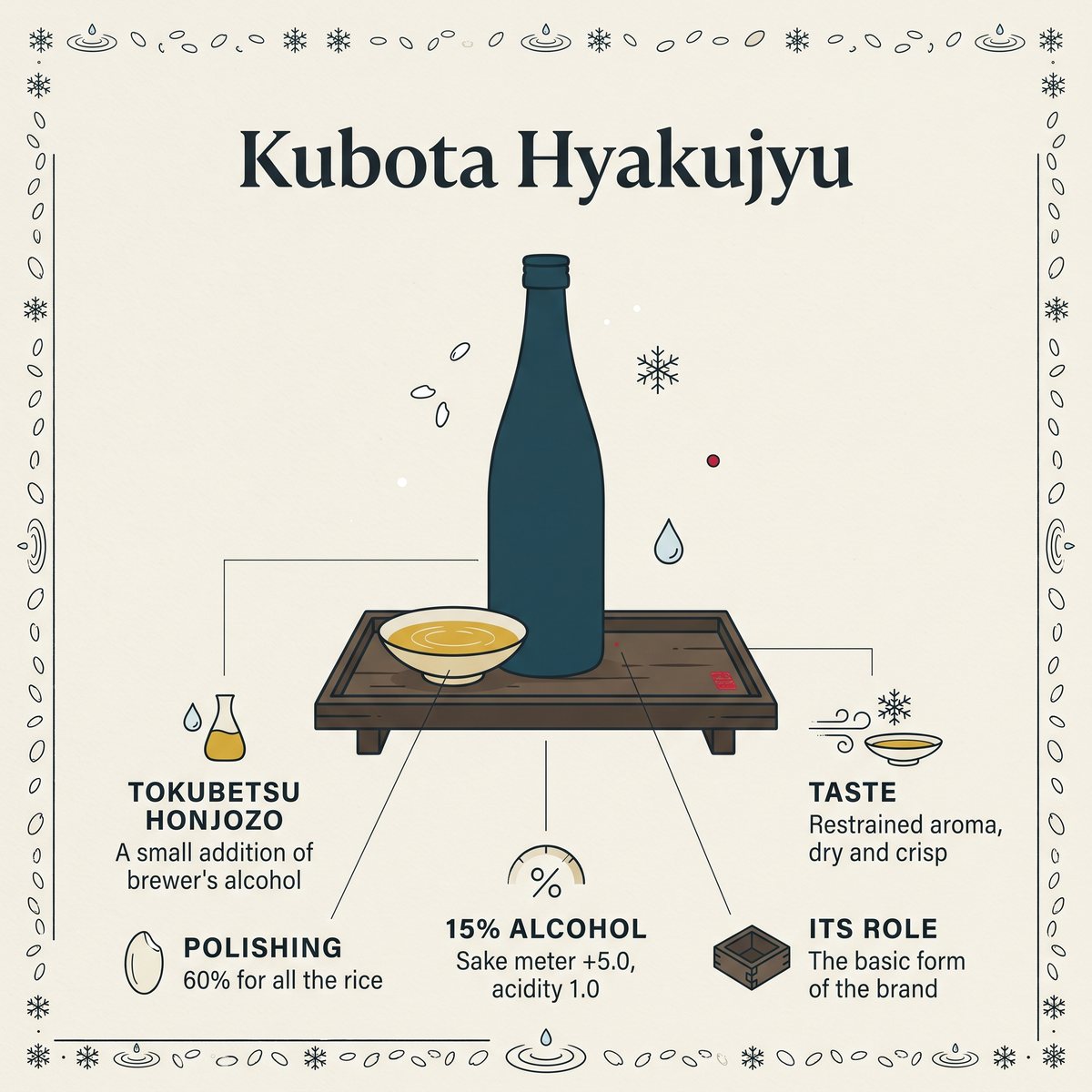
Hyakujyu (百寿, also spelled Hyakuju) launched alongside Senjyu in 1985. Even so, it tends to get less attention than its two siblings, which feels like a bit of a shame. Asahi-Shuzo calls it the basic form of Kubota.
Officially, it is a Tokubetsu Honjozo, a category made with a small addition of brewer’s alcohol. The koji rice is Gohyakumangoku and the remaining rice is Niigata-grown, both polished to 60%. Alcohol sits at 15%, the sake meter value at +5.0, and acidity at 1.0.
The brewery describes Hyakujyu as having a restrained aroma and a dry, easy-drinking profile. Its dryness is supported by moderate body and acidity, followed by a crisp finish. It is the kind of sake that does not tire the palate.
It is tempting to label Hyakujyu a starter sake, but the brewery does not frame it that way. Its role is closer to a reference point. If you want to know what the brand’s dry backbone tastes like, this bottle shows it plainly.
Kubota Manjyu: The Premium Side of the Brand
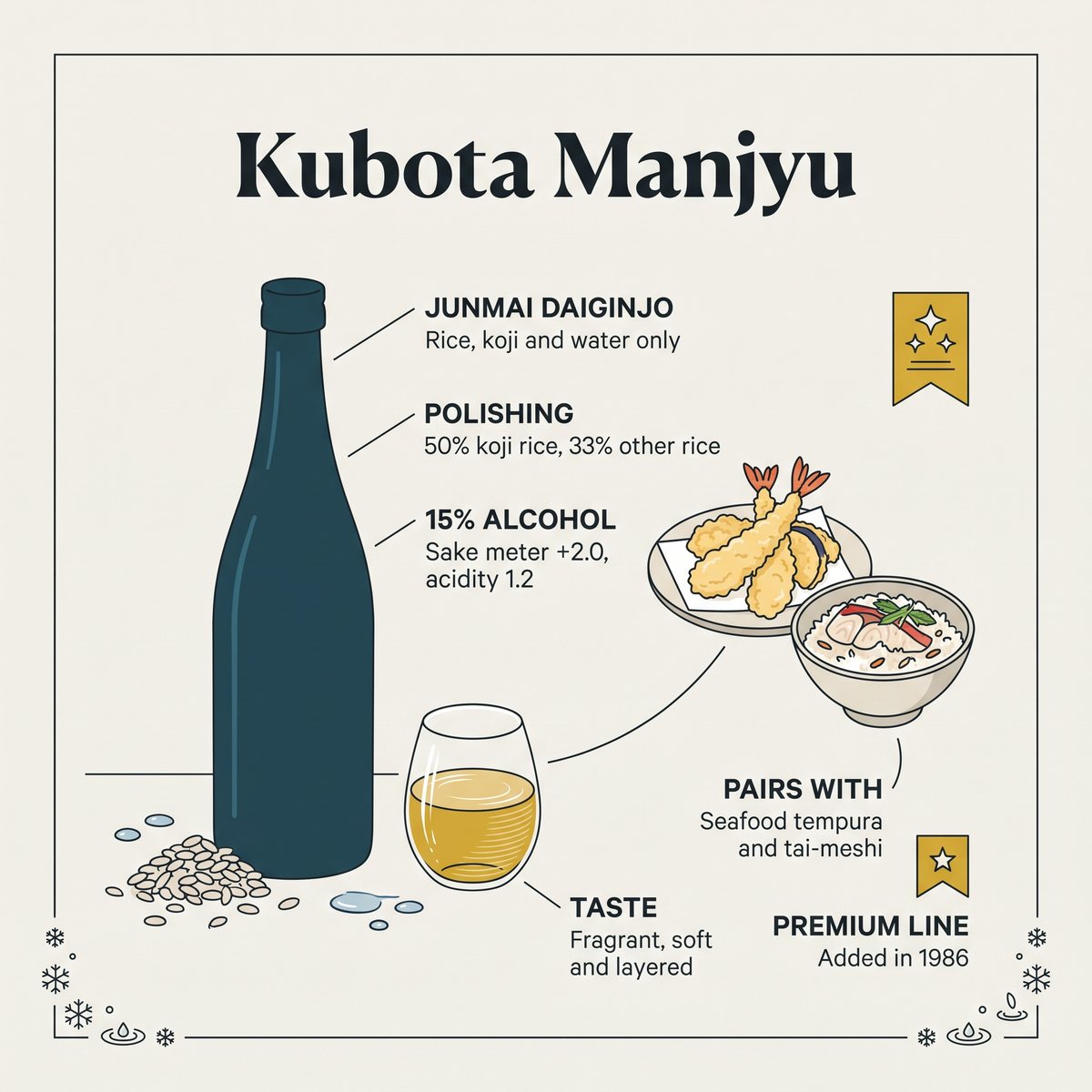
Manjyu (萬寿, often spelled Manju) arrived in 1986, a year after the brand launched. It is a Junmai Daiginjo, and since the 2019 to 2020 renewal it has led the premium line. Asahi-Shuzo presents it as a sake for special occasions.
Even the specs set it apart. The koji rice is Gohyakumangoku polished to 50%, while the remaining Niigata rice goes down to 33%. Alcohol is 15%, and acidity is 1.2.
Manjyu lists a sake meter value of +2.0, compared with +5.0 for Senjyu and Hyakujyu. However, the number alone does not prove that Manjyu will taste less dry. Perceived dryness also depends on acidity, glucose, aroma, and serving temperature. In the brewery’s own description, Manjyu emphasizes a fragrant aroma, a soft and rounded body, and a balance of umami, sweetness, and acidity.
Manjyu is also a junmai, made only from rice, koji, and water. Senjyu, by contrast, includes added brewer’s alcohol, and the brewery’s web magazine links part of Senjyu’s cleaner, lighter feel to it. So Manjyu is not simply a stronger Senjyu. Instead, it widens the brand beyond a narrowly dry profile while keeping a clean finish. The official pairings include seafood tempura and tai-meshi, a sea bream rice dish.
Is it the best Kubota? That depends on what you want. A premium designation reflects rice, polishing, and craft, not your personal taste, and our Daiginjo guide explains the grade itself. Plenty of drinkers still prefer Senjyu with an everyday dinner.
Types of Kubota Sake: The Wider Lineup
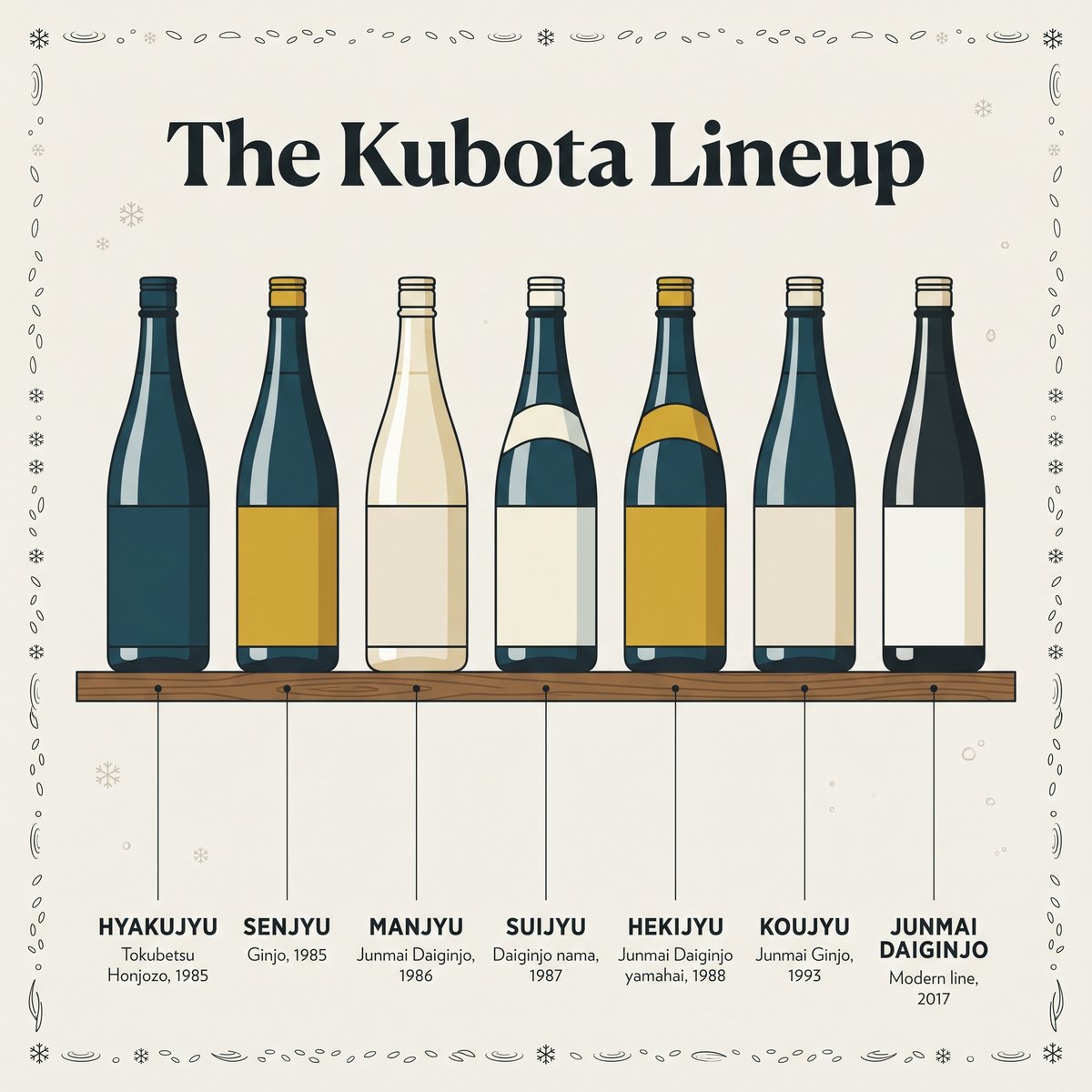
Since 1985, Kubota has grown well beyond the three classic names into a broad family. Asahi-Shuzo’s web magazine counted 17 sake products in November 2025. Lineups change, though, so treat that number as a snapshot and check the official site for the current range.
| Bottle | Designation | First released | Role in the brand |
|---|---|---|---|
| Hyakujyu (百寿) | Tokubetsu Honjozo | 1985 | The basic form; restrained and dry |
| Senjyu (千寿) | Ginjo | 1985 | Daily line for meals; clean and calm |
| Manjyu (萬寿) | Junmai Daiginjo | 1986 | Premium line; fragrant, soft, layered |
| Suijyu (翠寿) | Daiginjo, nama | 1987 | Unpasteurized; shipped April to September; keep cold |
| Hekijyu (碧寿) | Junmai Daiginjo, yamahai | 1988 | Made with the traditional yamahai starter |
| Koujyu (紅寿) | Junmai Ginjo | 1993 | First released as a Junmai; now listed as Junmai Ginjo |
| Junmai Daiginjo | Junmai Daiginjo | 2017 | Modern line; sake meter value ±0 |
Designations follow Asahi-Shuzo’s product pages as of October 2026. Lineups may change, so check the official site before buying.
Notice how the newer Kubota Junmai Daiginjo differs from Manjyu. Although both share a legal category, they are separate products. The newer bottle uses Gohyakumangoku polished to 50% throughout, with a sake meter value of ±0 and acidity of 1.3.
Moreover, its official pairings go well beyond classic washoku, or traditional Japanese cuisine. Beef tartare, carpaccio, and even fruit cake appear on the list. For a brand known for dryness, that is quite a statement.
There are also seasonal and limited bottles, such as an autumn Senjyu and an undiluted, unfiltered Manjyu. These come and go, and some are namazake that need cold storage. When in doubt, read the label first; our guide to reading a sake label can help.
What Does Kubota Sake Taste Like?
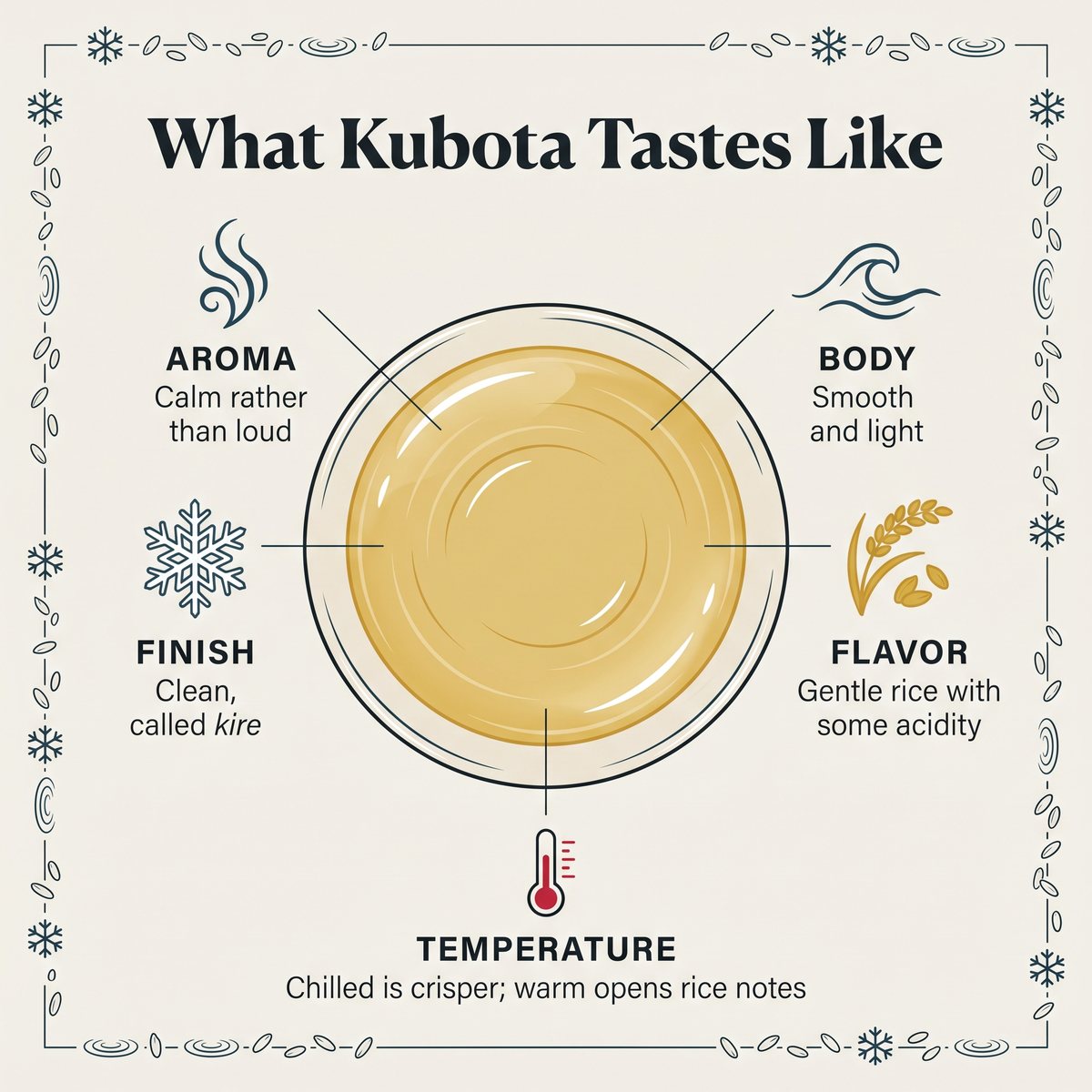
Judging by the brewery’s own descriptions, a few traits keep coming back across the range. The aroma tends to be calm rather than loud. The body feels smooth, and the finish ends cleanly, which the brewery calls kire.
In general, expect gentle rice flavor rather than heavy richness. The classic bottles pair rice umami with some acidity, so they do not feel flat. With Senjyu and Hyakujyu, the brewery points to a dry, clean finish.
That said, not every bottle tastes the same. Manjyu brings more aroma, softness, and sweetness. Meanwhile, the newer Junmai Daiginjo leans toward fragrance and a touch of sweetness, with a sharp close.
Texture is easy to overlook, too. A light-bodied sake is not the same as a thin one. Admittedly, that lightness can seem simple at first, so it is worth tasting Kubota with food rather than on its own.
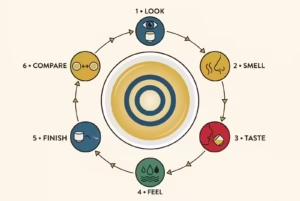
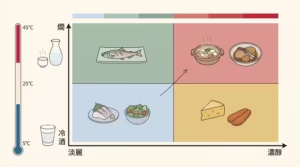
Finally, serving temperature changes the picture. Chilled sake tends to feel crisper, while a gently warmed sake can open up rice notes. If you want to compare carefully, our guide on how to taste sake walks through the steps.
Why Kubota Works Well With Food
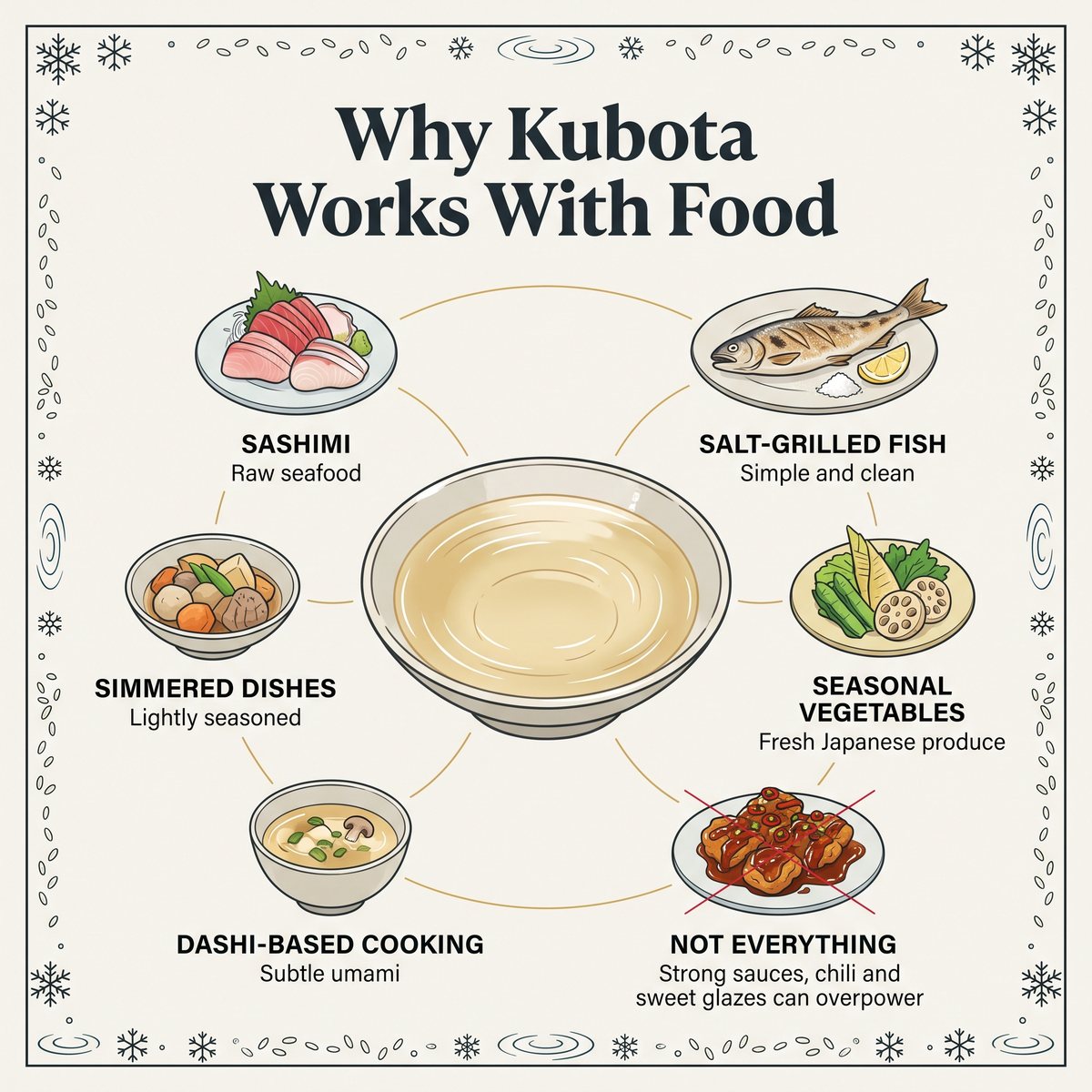
From the start, Kubota was designed around meals, and the brewery still says so. Its brand page also talks about sake that stays close to food and shared time at the table. That aim explains a lot about the style.
Put simply, a clean, dry sake tends to leave room for the dish. It does not bury delicate flavors under heavy sweetness or strong aroma. For that reason, Kubota often works well with:
- Sashimi and other raw seafood
- Salt-grilled fish
- Lightly seasoned simmered dishes
- Seasonal Japanese vegetables
- Dashi-based cooking with subtle umami
Still, saying it goes with everything would be an overstatement. Strong sauces, chili heat, or very sweet glazes can push a light sake aside. Pairing also depends on the bottle, the serving temperature, and how a dish is seasoned.
Niigata’s own table also offers good matches. Try Senjyu with hegi soba or with Koshihikari rice and local fish. For the logic behind good matches, see our sake and food pairing guide.
This food-first aim also fits how Japanese meals changed. The GI Niigata standard notes that local brewers aimed for a style suited to Western-influenced lifestyles. Today, Kubota pairings run from washoku to carpaccio, which echoes a wider theme in modern sake history.
The 2020 Brand Renewal: Evolving Without Losing Its Identity

In September 2019, Asahi-Shuzo announced the first formal renewal in Kubota’s history. It was timed for 2020, which marked both the brand’s 35th anniversary and the company’s centenary. The rollout began in October 2019 and continued into 2020.
Its new message was “constantly evolving deliciousness.” Manjyu became the premium line for special occasions, and Senjyu the daily line for meals. The company also planned an experimental line, tentatively called KUBOTA LAB.
Importantly, the changes went beyond packaging. From shipments starting April 1, 2020, Senjyu moved to lower-temperature, more precise fermentation to cut off-flavors. The brewery also made fuller use of koji to add flavor while keeping the light, clean profile.
Likewise, Manjyu received its own set of changes. The team refined koji making for more roundness and softness, then chilled the sake quickly after pasteurization. It also lowered storage temperature by 5°C to protect the aroma.
In addition, labels gained English text, which hints at a wider audience. These are the brewery’s descriptions of its own intent, and the release includes no side-by-side tasting data. So it is fairer to say the brewery reshaped the taste in a chosen direction than to call it objectively better.
What stayed the same? The core idea of kire, a clean finish that does not linger heavily. Brand consistency does not mean freezing everything, as the story of contemporary sake shows. The challenge is to improve the experience while keeping what made the brand recognizable.
How to Choose a Kubota Sake
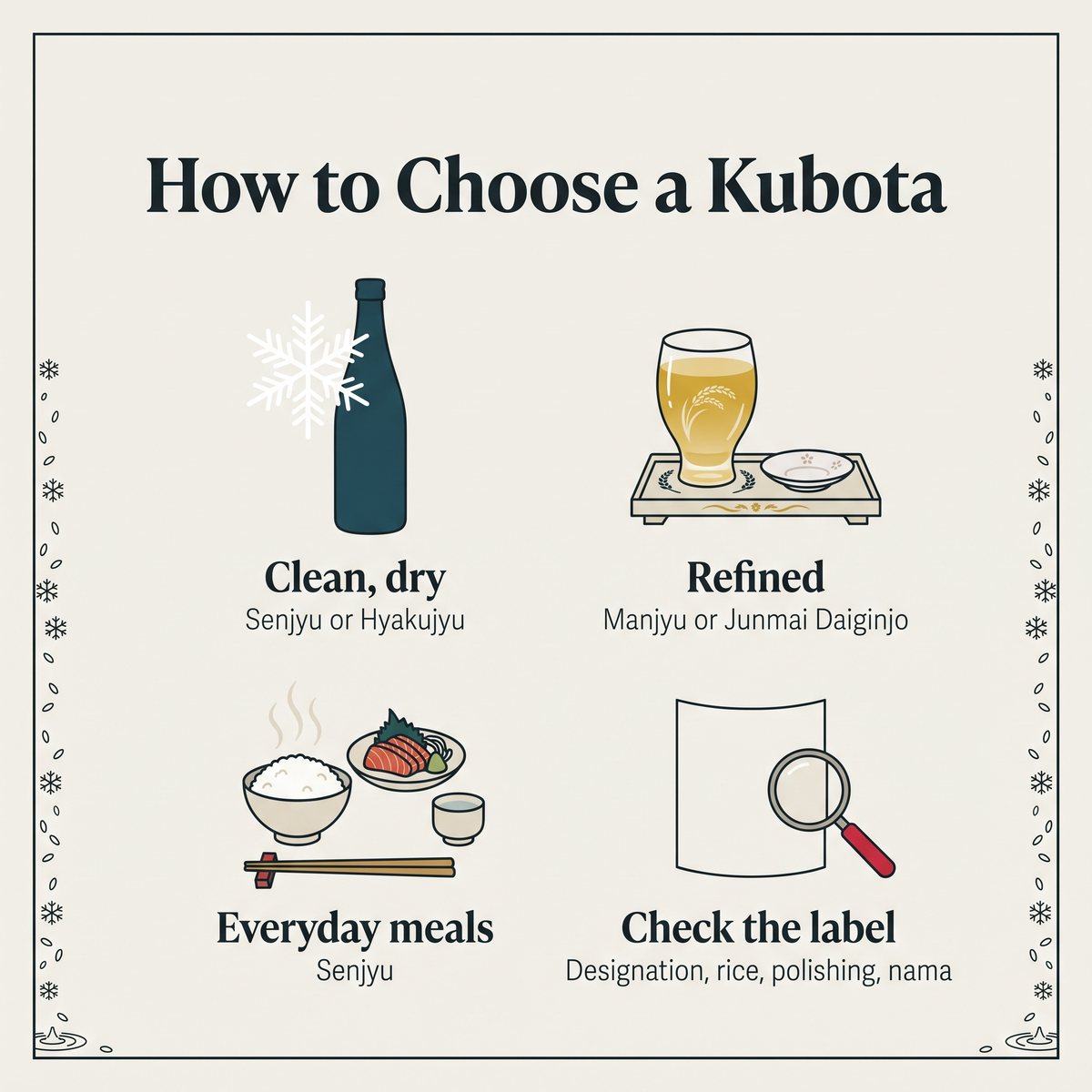
There is no single right bottle, and price alone will not tell you much. Instead, match the bottle to the moment and to what you enjoy.
| Bottle | Designation | Polishing (koji / other rice) | Sake meter value | Acidity |
|---|---|---|---|---|
| Hyakujyu | Tokubetsu Honjozo | 60% / 60% | +5.0 | 1.0 |
| Senjyu | Ginjo | 50% / 55% | +5.0 | 1.1 |
| Manjyu | Junmai Daiginjo | 50% / 33% | +2.0 | 1.2 |
| Junmai Daiginjo | Junmai Daiginjo | 50% / 50% | ±0 | 1.3 |
Specs from Asahi-Shuzo’s product pages, checked October 2026. Specs may change, so confirm on the official site. The sake meter value alone does not predict how dry a sake tastes.
For a Clean, Dry Style
In that case, start with Senjyu or Hyakujyu. The brewery describes both as dry with a clean finish. Hyakujyu is presented as restrained, while Senjyu also shows rice umami and a faint sweetness.
For a More Refined Experience
For a special meal, look at Manjyu or the Kubota Junmai Daiginjo instead. Manjyu offers depth and softness, whereas the Junmai Daiginjo leans aromatic and modern. Both suit an occasion, although they feel quite different.
For Everyday Meals
Here, Senjyu is the natural pick. It sits beside grilled fish, simmered dishes, and rice without demanding attention. For a weeknight table, it is dependable.
For Comparing Styles
Do not judge by the name alone. Instead, check four things on the label or product page:
- Designation, such as Ginjo or Junmai Daiginjo
- Rice variety and polishing ratio
- Sake meter value and acidity
- Whether the sake is nama (unpasteurized) or seasonal
Once a bottle is open, keep it cold and finish it while it still tastes fresh. Our guide on how to store sake covers the details.
What Makes Kubota Different, and Common Misconceptions
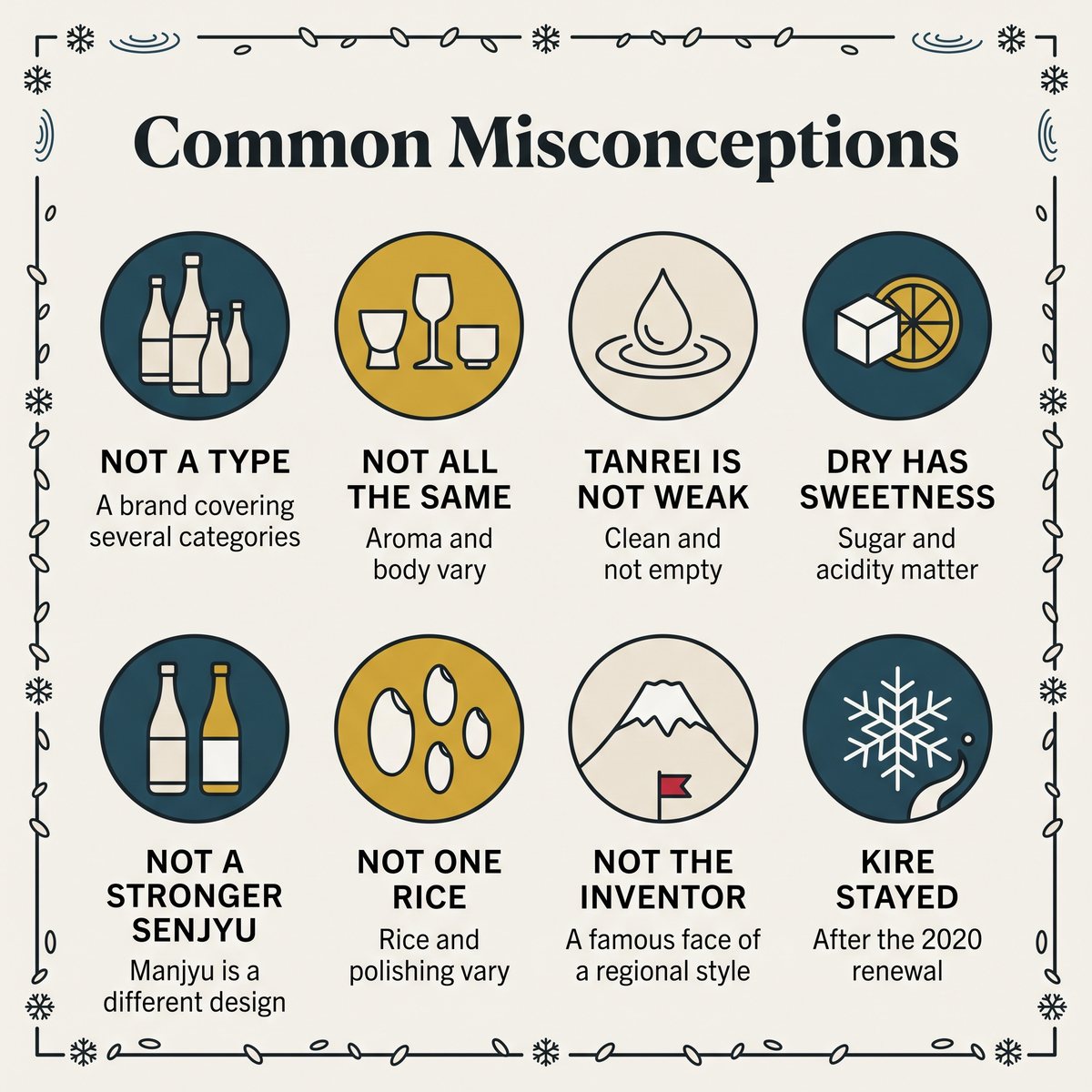
Kubota stands out less for one technique than for a clear idea: clean, food-oriented sake with a crisp finish. That idea is easy to oversimplify, though, so a few myths are worth clearing up.
What Is Distinctive
Of course, each famous brand tells a different story. Dassai centers on Junmai Daiginjo and high polishing, while Hakkaisan leans on snow-country nature. Akita’s Aramasa and Yamagata’s Juyondai (14dai) show yet another direction. By comparison, Kubota’s story is mostly about style, food, and market change.
Common Misconceptions
- “Kubota is a type of sake.”
- It is a brand made by Asahi-Shuzo, covering several sake categories.
- “Every Kubota tastes the same.”
- Aroma, sweetness, and body vary from bottle to bottle.
- “Tanrei-karakuchi means weak flavor.”
- Tanrei means clean and smooth, not empty.
- “Dry sake has no sweetness.”
- Perceived dryness reflects sugar, acidity, and more.
- “Manjyu is just a stronger Senjyu.”
- It is a different design, with its own rice, polishing, and flavor goals.
- “All Kubota uses the same rice.”
- Rice and polishing ratios differ by bottle.
- “Kubota invented dry sake.”
- It became one of the best-known faces of a regional style built over decades.
- “The 2020 renewal changed everything.”
- The core kire identity stayed in place.
Final Thoughts

In short, Kubota’s story starts with an old brewery and a new problem. In 1985, sake volume was falling, beer was rising, and drinkers’ lives were changing. Asahi-Shuzo responded with a clear, food-oriented style built on Niigata rice, soft water, and research.
Kubota did not invent dry sake, yet it gave that clean, food-oriented direction a clearly defined brand. Its story is really about adapting a traditional drink to changing tastes while keeping a recognizable identity. If you are curious, a bottle of Senjyu next to a simple meal is a good place to start. After that, our Japanese sake guide can take you further.
Frequently Asked Questions About Kubota Sake
About the Brand
- What is Kubota sake?
-
Kubota is a sake brand from Asahi-Shuzo in Nagaoka, Niigata Prefecture. Its bottles span several legal categories, from Tokubetsu Honjozo to Junmai Daiginjo. The brand is best known for a clean, food-friendly style.
- When was the Kubota brand launched?
-
Asahi-Shuzo launched Kubota on May 21, 1985, with Senjyu and Hyakujyu. Manjyu followed in 1986 as the premium bottle. The brewery itself is much older and traces its history to 1830.
- Did Kubota help popularize tanrei-karakuchi?
-
Kubota became one of the best-known brands tied to Niigata’s tanrei-karakuchi image. However, the style grew from decades of shared work by Niigata breweries, researchers, and training programs.
Style and Bottles
- What does tanrei-karakuchi mean?
-
Tanrei describes a clean, smooth sake with little roughness, and karakuchi means it tastes dry. Together, they name an overall style rather than a legal grade. Such a sake can still show umami and gentle sweetness.
- What is the difference between Kubota Senjyu and Manjyu?
-
Senjyu is a Ginjo designed to feel lighter and crisper with meals. Manjyu is a Junmai Daiginjo that the brewery describes as softer, more aromatic, and more layered. Their sake meter values differ, but that number alone does not explain the sensory difference.
- Is Kubota a junmai sake?
-
Only some bottles are. Manjyu, the Kubota Junmai Daiginjo, Hekijyu, and Koujyu are junmai, made from rice, koji, and water alone. Senjyu (a Ginjo) and Hyakujyu (a Tokubetsu Honjozo) include added brewer’s alcohol, so check the label if junmai matters to you.
Drinking and Choosing
- Is Kubota a dry sake?
-
Most classic Kubota bottles lean dry, and the brand centers on a clean finish. Still, the style varies, so newer bottles such as the Junmai Daiginjo put more weight on aroma and sweetness. Taste each one rather than assume a single profile.
- What food pairs well with Kubota sake?
-
Kubota suits sashimi, grilled fish, lightly seasoned simmered dishes, and dashi-based cooking. The brewery also pairs Senjyu with richer dishes such as grilled eel. However, very spicy or heavily sauced food can overpower lighter bottles.
- Should Kubota be served cold or warm?
-
There is no single rule, since the brewery’s product pages do not set one temperature for every bottle. Chilled sake tends to feel crisper, while gentle warming can bring out rice notes. Unpasteurized bottles such as Suijyu should stay refrigerated.
- Is Kubota suitable for beginners?
-
Its clean, food-friendly style can make Kubota an easy place to start, and Senjyu is a sensible first bottle with a meal. Even so, the brewery does not use beginner as a category.
References
- Asahi-Shuzo – Our Journey (Accessed October 2026)
- Asahi-Shuzo – Kubota (Brand Page) (Accessed October 2026)
- Asahi-Shuzo – Kubota Senjyu (Accessed October 2026)
- Asahi-Shuzo – Kubota Hyakujyu (Accessed October 2026)
- Asahi-Shuzo – Kubota Manjyu (Accessed October 2026)
- Asahi-Shuzo – Kubota Junmai Daiginjo (Accessed October 2026)
- KUBOTAYA (Asahi-Shuzo Web Magazine) – How Do Manjyu and Senjyu Differ? Brewing and Taste Explained (2021) (Accessed October 2026)
- KUBOTAYA (Asahi-Shuzo Web Magazine) – The First Kubota Products: 17 Sakes in Order of Release (2025) (Accessed October 2026)
- PR TIMES – Kubota at 35: The Brand’s First Renewal (Asahi-Shuzo release, September 20, 2019) (Accessed October 2026)
- PR TIMES – Quality Upgrade of Kubota Manjyu and Kubota Senjyu (Asahi-Shuzo release, February 3, 2020) (Accessed October 2026)
- National Tax Agency – Appendix 1: Production Standard for the Geographical Indication “Niigata” (Accessed October 2026)
- National Tax Agency – Sake no Shiori 2025, Table 8: Trends in Taxable Alcohol Volume (Regional Tax Bureaus) (Accessed October 2026)
- Niigata Prefecture – Guide to the Niigata Prefectural Sake Research Institute (Accessed October 2026)
- Niigata Bunka Monogatari – File 30: Niigata Tanrei, Why Niigata Sake Tastes Good (Accessed October 2026)
- Japan Sake and Shochu Makers Association – Classification of Sake (Accessed October 2026)
- Japan Sake and Shochu Makers Association – Glossary of Sake (Accessed October 2026)
- Niigata University Repository – Yuda, K., Kishi, Y., & Tseng, K. (2021). The Birth of Tanrei-karakuchi: The Identity of Niigata Sake Created by the “All-Niigata Direction.” The Journal of Economics Niigata University, 111, 53–76 (Accessed October 2026)
- J-STAGE – Utsunomiya, H., Isogai, A., & Iwata, H. (2004). On the Sweetness and Dryness Classification of Sake. Journal of the Brewing Society of Japan, 99(12), 882–889 (Accessed October 2026)
Related Articles
- Dassai Sake (Surveyed: October 2026)
- Hakkaisan Sake (Surveyed: October 2026)
- Niigata Sake (新潟地酒) (Surveyed: October 2026)
- Aramasa (Surveyed: October 2026)
- Juyondai (14dai) (Surveyed: October 2026)
- Types of Japanese Sake (Surveyed: October 2026)
- Junmai Daiginjo (Surveyed: October 2026)
- Tokubetsu Honjozo (Surveyed: October 2026)
- Sake Rice (Surveyed: October 2026)
- Rice Polishing in Sake (Surveyed: October 2026)
- How to Read a Sake Label (Surveyed: October 2026)
- Sake and Food Pairing (Surveyed: October 2026)





Comments