



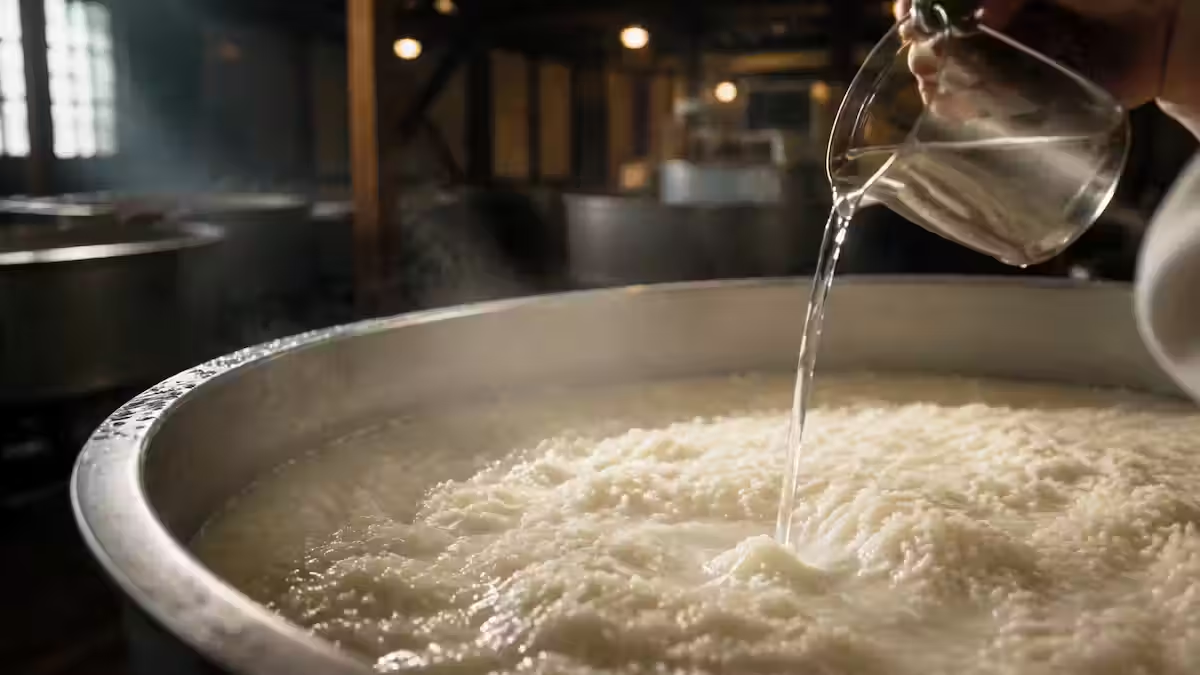
Nearly every bottle of sake you drink starts the same way. It begins with a yeast starter called moto. So what is sokujo in sake brewing? Sokujo is the modern method for making that starter. Brewers add food-grade lactic acid right at the start. This protects the mash quickly and reliably. In short, sokujo sake brewing is the fast, modern starter method that uses added lactic acid.
Today, this method dominates the sake world. The vast majority of sake uses it. It is faster than the older kimoto and yamahai methods. For the wider picture, see our guides to moto and sake fermentation. Let me walk you through this essential modern craft.
Quick Facts About Sokujo
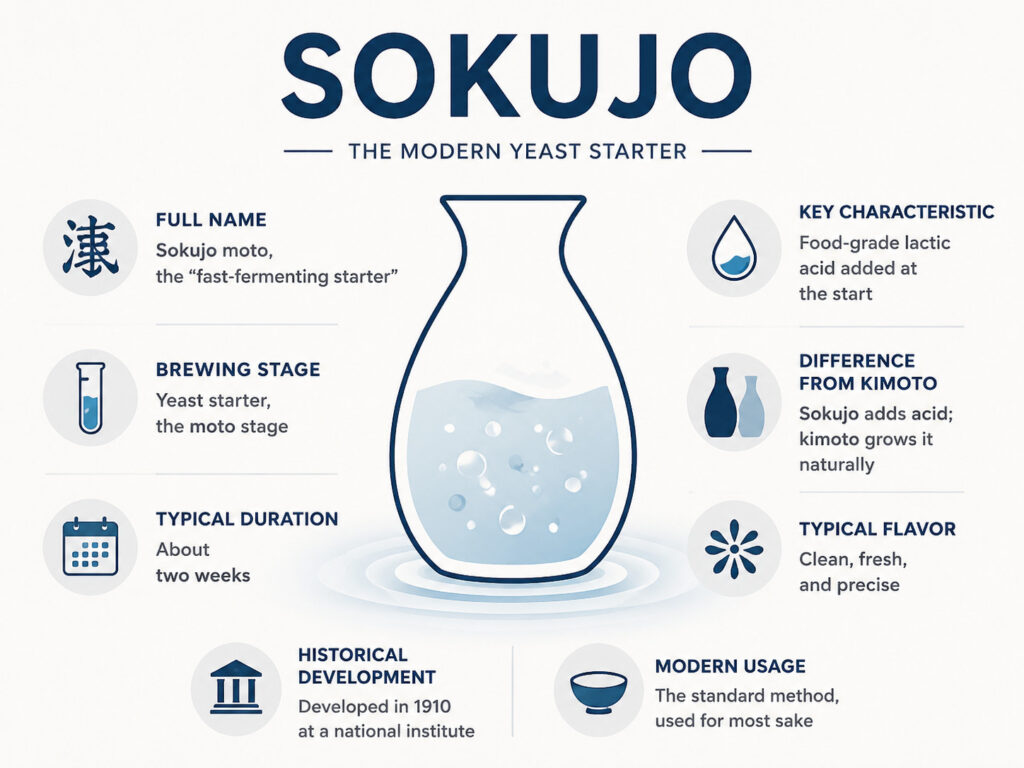
Here is a fast snapshot before the details begin.
| Japanese Name | 速醸 (sokujo) |
| Full Name | Sokujo moto, the “fast-fermenting starter” |
| Brewing Stage | Yeast starter, the moto stage |
| Type | A modern moto method |
| Historical Development | Developed in 1910 at a national institute |
| Key Characteristic | Food-grade lactic acid added at the start |
| Typical Duration | About two weeks |
| Difference from Kimoto | Sokujo adds acid; kimoto grows it naturally |
| Typical Flavor | Clean, fresh, and precise |
| Modern Usage | The standard method, used for most sake |
What Is Sokujo in Sake Brewing?
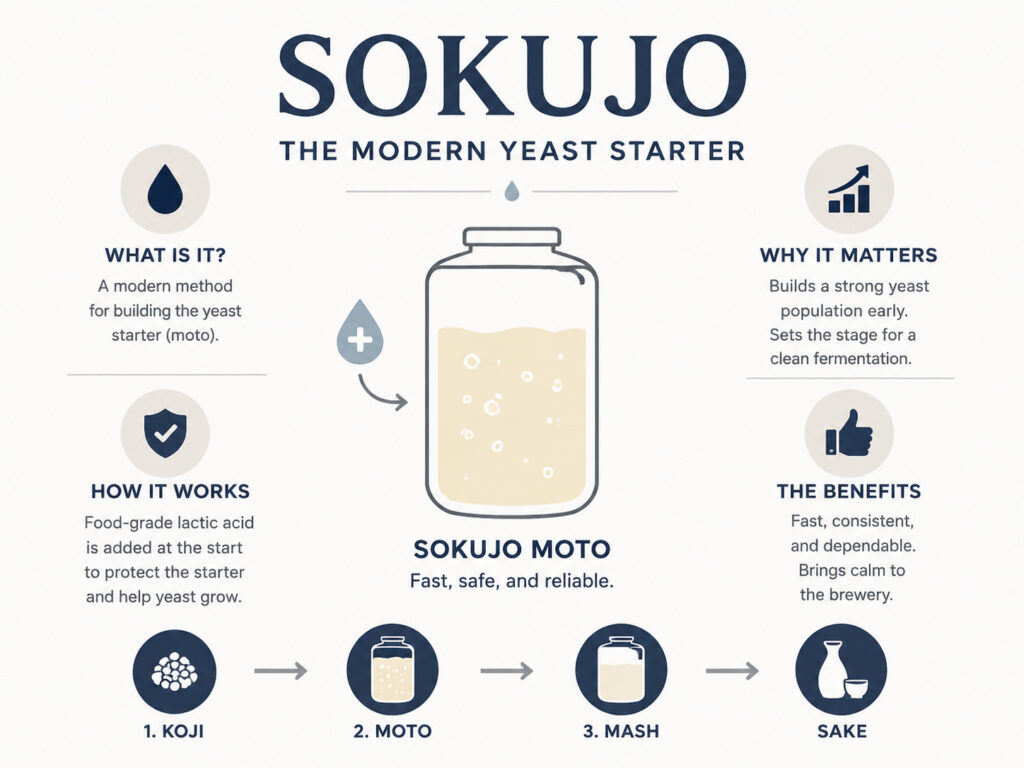
Sokujo is a method for building the yeast starter. That starter is called the moto, or shubo. Brewers grow a strong yeast population in it. They then use it to drive the main fermentation. Sokujo therefore sits at the very start of brewing.
One point deserves real emphasis here. Sokujo is not a type of sake at all. Rather, it is a brewing technique, not a flavor category. Most bottles never even mention the word. Indeed, sokujo is so standard that labels usually stay silent. By contrast, kimoto and yamahai often appear proudly on labels.
The defining feature is simple yet powerful. Brewers add food-grade lactic acid at the very beginning. This acid protects the starter from the first moment. So the yeast can grow safely and quickly. For the traditional alternatives, see our kimoto and yeast guides. The rest of this article explores how and why.
There is a useful saying in the brewing world. It runs “first koji, second moto, third the mash.” In other words, the starter ranks among the most vital steps. So even the modern sokujo method demands real care. Speed never means carelessness here.
The starter may look humble in the tank. Yet it carries the whole fate of the sake. A weak moto can doom an entire batch. A strong one sets up a clean fermentation. So brewers treat this stage with real respect.
Sokujo earns that respect through reliability. It builds a healthy starter almost every time. Older methods could fail without warning. By contrast, the modern method rarely surprises the brewer. So it brought a new calm to the cellar.
The word sokujo itself hints at its nature. It points to fast, efficient fermentation. The full term is sokujo moto, the rapid starter. So the name and the method match perfectly. This clarity helps newcomers grasp it quickly.
The History of Sokujo
Sake history stretches back many centuries. For most of that time, brewers had no microscopes. They could not see the microbes at work. Yet they still built careful, living systems. Sokujo arrived only after science caught up.
The late 1800s brought rapid change to Japan. New industries and ideas swept the country. Brewing felt this wave of modernization too. Scientists began studying fermentation seriously. So the stage was set for a breakthrough.
A National Effort
Sokujo was born from a national effort. In 1904, the government founded a brewing institute. Its mission was to improve sake quality. So science entered the brewing world in force.
The government took a direct interest in sake. After all, sake taxes funded much of the state. Better brewing meant a stronger economy. So officials invested in real research. This support shaped the methods we use today.
At the time, sake quality was unstable. Spoilage from wild microbes was a constant threat. A whole batch could turn sour overnight. Brewers badly needed a reliable solution. As a result, researchers studied the starter closely.
The Spoilage Problem
Spoilage was more than an occasional setback. It could ruin weeks of careful work. The traditional starter sat exposed for days. During that time, invaders sometimes won the race. So brewers lived with real, costly uncertainty. This fear drove the search for something better.
The 1910 Breakthrough
The new institute gathered talented researchers. They studied yeast, bacteria, and acidity closely. They tested ideas under careful conditions. Slowly, they unlocked the secrets of the starter. So tradition met laboratory science at last.
The key breakthrough came in 1910. A researcher named Kamajiro Eda developed sokujo. He worked at a brewery in Aichi Prefecture. His idea was elegant and simple. He added lactic acid directly to the starter.
This single change solved an old problem. The added acid protected the mash instantly. So brewers no longer waited for wild bacteria. The institute had refined yamahai just a year earlier. For that story, see our yamahai guide. Together, these advances reshaped sake forever.
Their work changed brewing in just a few years. First came the yamahai method in 1909. Then came sokujo the very next year. Together, these advances modernized the craft. So a single decade reshaped centuries of practice.
A Gift to the Industry
Eda made a remarkable choice with his work. He did not patent the method for profit. Instead, he shared it freely with brewers. He even traveled the country to teach it. So the technique spread quickly across Japan. This generosity earned him deep, lasting respect.
Born in Niigata, Eda devoted his life to brewing. Some admirers later called him a “sake saint.” His method cut costs and lifted quality nationwide. It also eased the brewer’s hard labor. So his name still carries weight today. Few people have shaped sake so deeply.
The brewing institute did more than invent methods. It also trained brewers across the country. Experts traveled to teach the new techniques. So good practice spread far and wide. This outreach lifted quality everywhere.
Why Was Sokujo Developed?
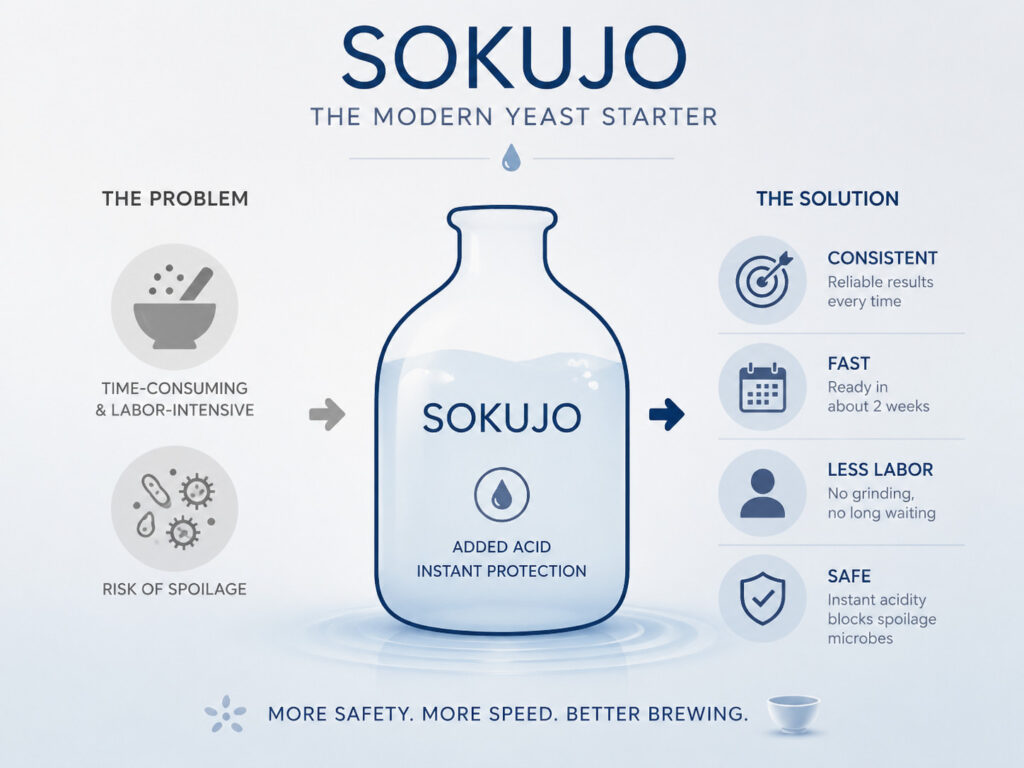
Why did brewers need a new method? The older starters worked, after all. Yet they carried real risks and burdens. Sokujo answered several pressing problems at once.
- Consistency: added acid gives reliable results every time
- Speed: the starter finishes in about two weeks
- Less labor: no grueling grinding or long waiting
- Safety: instant acidity blocks spoilage microbes
Spoilage was the biggest worry of all. A ruined batch meant weeks of lost work. The traditional starter sat exposed for days. Sokujo, by contrast, was protected immediately. As a result, brewers gained both safety and speed. This reliability changed the whole industry.
How Sokujo Works Step by Step
The sokujo process is quick and orderly. It takes about two weeks to finish. That is roughly half the time of kimoto. Each step builds toward a strong, clean starter.
- Prepare the water: brewers add lactic acid to the brewing water
- Mix in koji and rice: steamed rice and koji join the acidic water
- Add the yeast: the chosen yeast enters the protected mash
- Let it dissolve: koji enzymes turn the rice into sugar
- Control the temperature: brewers guide the warmth carefully
- Grow the yeast: the population multiplies day by day
- Mature the starter: the moto becomes dense and ready
Let us follow the sokujo starter day by day. The first day begins with acidic water. Brewers dissolve lactic acid into the brewing water. Then they add the koji and steamed rice. So the mash starts out already protected.
Early on, the koji enzymes get to work. They break the rice starch into sugar. Meanwhile, the yeast begins to multiply. The acid keeps invaders away the whole time. So the young starter stays clean and safe.
Over the next days, the yeast grows stronger. Brewers watch the temperature with great care. They may warm the mash gently in stages. So the yeast population swells steadily. By the end, the starter is dense and ready.
Notice the key difference from tradition. Brewers add the yeast very early here. In kimoto, the yeast waits for natural acid first. With sokujo, the acid is already there. So the yeast can start almost at once. This is why the method works so fast.
How Much Lactic Acid?
The amount of acid is small but precise. It brings the mash to about half a percent acidity. In practice, brewers use roughly 700 milliliters per 100 liters of starter. The acid itself must meet strict purity rules. Industry standards require a purity of 90 percent or more. So the additive stays clean, safe, and consistent.
The added acid follows strict quality rules. Brewers cannot use just any lactic acid. The acid must reach a high level of purity. Industry standards set this bar carefully. So the additive stays safe and food-grade.
The Temperature Curve
Temperature still guides the whole process. Brewers often start the mash fairly cool. Then they raise the warmth in careful steps. A warming tool, the dakidaru, can help here. So the yeast grows strong and steady. Even a fast method needs a watchful eye.
A warming tool helps with this delicate task. Brewers lower it gently into the mash. It nudges the temperature upward by degrees. So the yeast grows at a steady pace. This hands-on care persists even in a modern method.
The Role of Lactic Acid
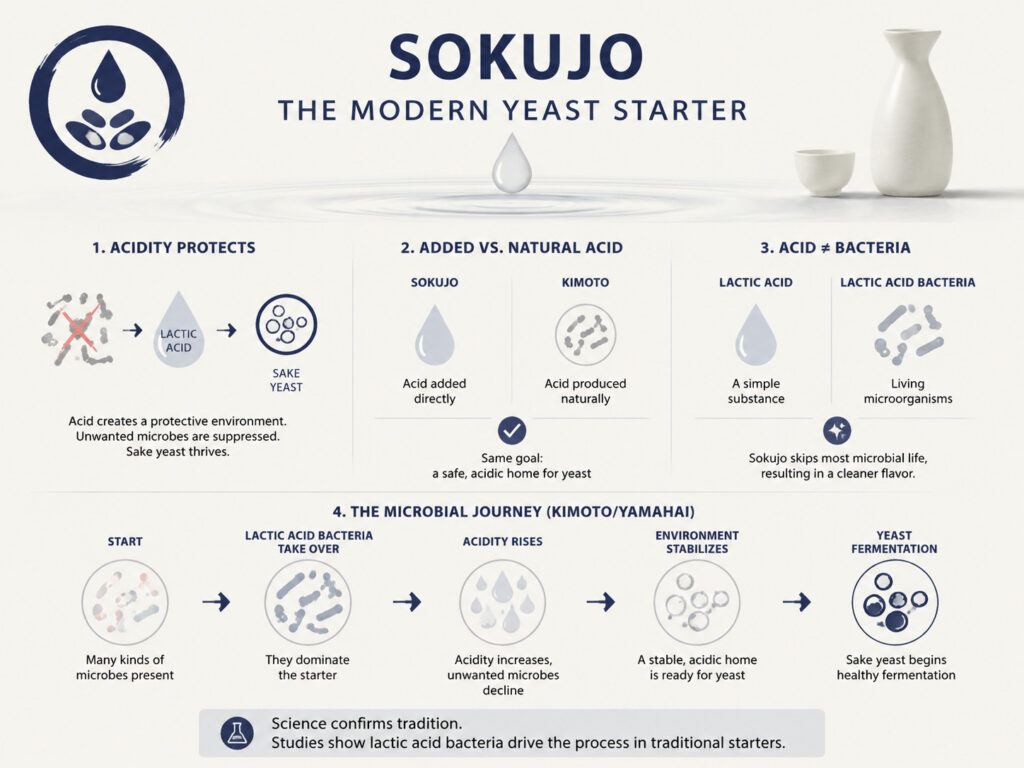
Lactic acid is the heart of sokujo. This single ingredient defines the method. So it deserves a closer look. Let us explore why it matters so much.
Why Acidity Protects the Starter
A fresh starter is a tempting target. Wild bacteria and stray yeast want to invade. Lactic acid makes the mash sharply acidic. Most unwanted microbes cannot survive that acidity. Sake yeast, however, tolerates it well. So the acid clears the field for the right organism.
The protection arrives the moment acid goes in. There is no anxious wait for nature to act. This speed is exactly the point of sokujo. So the method removes the riskiest gap. In kimoto, that gap can last for days.
The exact amount is measured with care. Brewers aim for a precise acidity level. Too little acid leaves the mash exposed. Too much can stress the delicate yeast. So the dose must strike a fine balance.
Added Versus Natural Acid
Here lies a common point of confusion. In kimoto, wild bacteria make the acid slowly. In sokujo, brewers add the acid directly. Yet the goal is exactly the same. Both methods create a protective, acidic home. So the acid plays one role in either case.
The added acid is food-grade and pure. Quality standards keep it clean and safe. So sokujo is not artificial or lesser. It simply reaches the same place faster. Both paths can lead to excellent sake. The method is a choice, not a verdict on quality.
Acid Is Not the Same as Bacteria
One detail trips up many newcomers. Lactic acid and lactic acid bacteria differ greatly. The bacteria are living microbes. The acid, by contrast, is a simple substance. So adding acid is not the same as adding bacteria.
This difference shapes the whole flavor story. Kimoto hosts a busy community of microbes. Studies of traditional starters show many bacteria at work. Those microbes leave many subtle compounds behind. Sokujo skips most of that microbial life. As a result, its flavor often tastes cleaner. So the gap is about biology, not quality.
Researchers have studied this microbial world closely. In traditional starters, lactic acid bacteria slowly take over. They suppress unwanted microbes and ready the mash for yeast. Modern sequencing has even traced these shifts in detail. So science now confirms what brewers long sensed. The added acid in sokujo simply skips that slow, living contest.
One detailed study followed a yamahai starter closely. Scientists sequenced its bacteria stage by stage. They found lactic acid bacteria dominating throughout. They also watched the chemistry shift over time. So the living relay of microbes became visible at last.
Sokujo and Fermentation Science
Sokujo connects to every other brewing stage. It does not stand alone in the process. Instead, it feeds directly into the main mash. Understanding it therefore clarifies the whole craft.
The starter relies on koji and yeast together. Koji makes sugar from the rice starch. Yeast then turns that sugar into alcohol. Once the sokujo starter matures, it joins the moromi. There, multiple parallel fermentation runs at full scale, as our moromi guide explains. Sokujo is therefore the reliable first link in a chain.
The goal matches every other starter method. Each one aims to grow healthy yeast. So sokujo, kimoto, and yamahai share a purpose. They simply take different paths to reach it. In the end, they all feed the main fermentation.
The starter also shapes the yeast itself. A healthy moto gives a dense, active population. That vigor carries into the main mash. So a strong start supports a strong finish. In this way, the moto guides everything that follows.
How Sokujo Influences Flavor
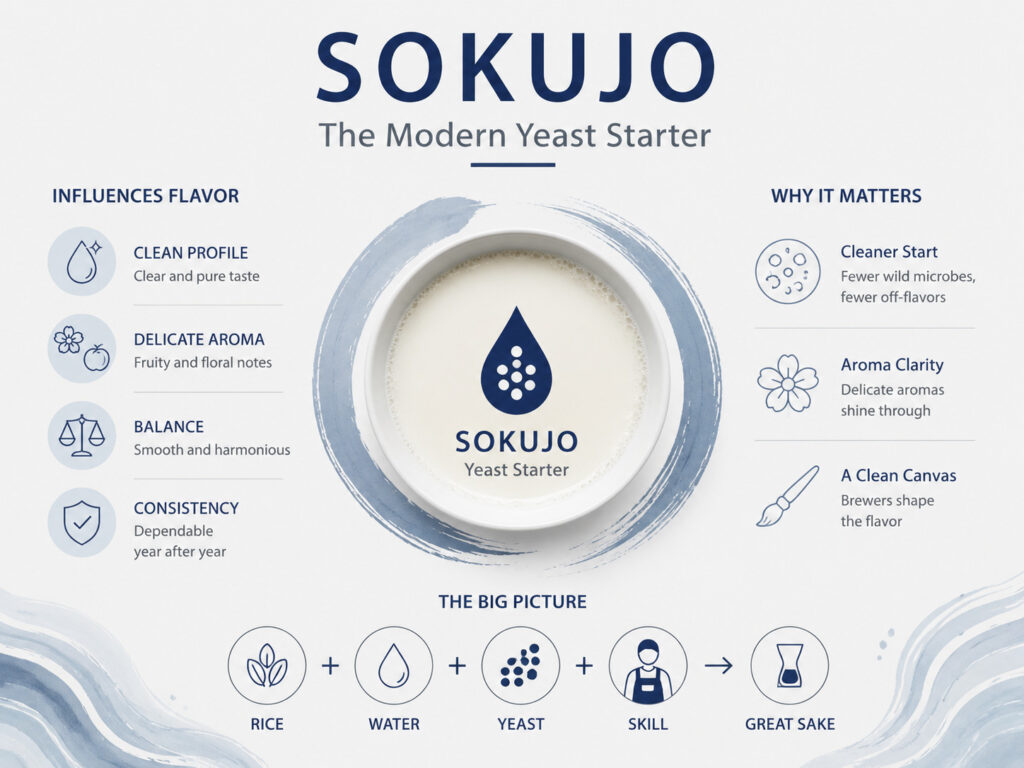
Sokujo leaves its own mark on flavor. The clean process favors a clear profile. So the resulting sake often tastes precise. Let us look at the typical traits.
- Clean profile: a clear, pure taste without heaviness
- Delicate aroma: room for fruity and floral notes
- Balance: a smooth, harmonious impression
- Consistency: a dependable result year after year
The clean starter explains much of this. With fewer wild microbes, fewer odd flavors form. So delicate aromas can shine through clearly. This makes sokujo ideal for fragrant styles. A ginjo or daiginjo often relies on it.
Still, the starter is only one factor. Rice, yeast, water, and skill all matter greatly. So sokujo does not force a single taste. It simply offers a clean, flexible canvas. Brewers then paint the flavor they want.
Think of it like a sheet of white paper. A clean page shows fine detail clearly. A busy, textured page hides it instead. Sokujo gives that clean page to the brewer. So subtle, fruity aromas can stand out beautifully.
The acid also breaks down during fermentation. Yeast and other reactions reshape the mash. So the final sake is far more than its starter. Many flavors form long after the moto stage. This is why the starter is only one part of the story.
How to Drink Sokujo Sake
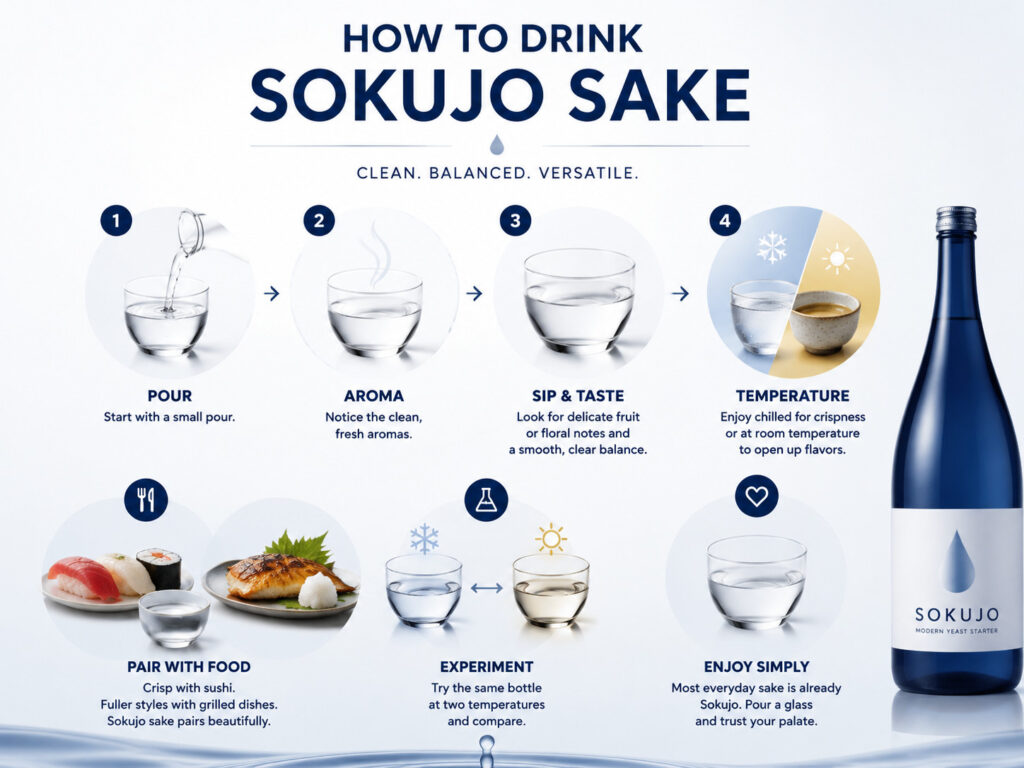
Most sake you order is sokujo sake. So the serving advice is wonderfully broad. The clean profile suits many temperatures. Yet a few tips help you enjoy it best.
Let us think about how to taste sokujo sake. Start by pouring a small amount. Notice the aroma before you sip. Many sokujo styles smell clean and fresh. So the first impression is often crisp and bright.
Take a slow sip and let it settle. Look for delicate fruit or floral notes. Feel the balance between sweetness and acidity. A good sokujo sake tastes smooth and clear. So the flavors arrive in tidy, gentle waves.
Fragrant ginjo styles often shine when chilled. Cool service keeps their delicate aromas crisp. Lighter, drier sake also tastes refreshing cold. Some fuller styles, however, open up at room temperature. So a little experimenting rewards your curiosity. Try the same bottle at two temperatures and compare.
Food makes the tasting even richer. Pair a crisp junmai with sushi. Try a fuller one beside grilled fish. The clean profile rarely fights the food. So sokujo suits almost any meal.
Do not overthink the choice, though. Most everyday sake is already sokujo. So you have likely enjoyed it many times. Simply pour a glass and trust your palate. The method quietly supports a huge range of styles.
Sokujo vs Kimoto vs Yamahai
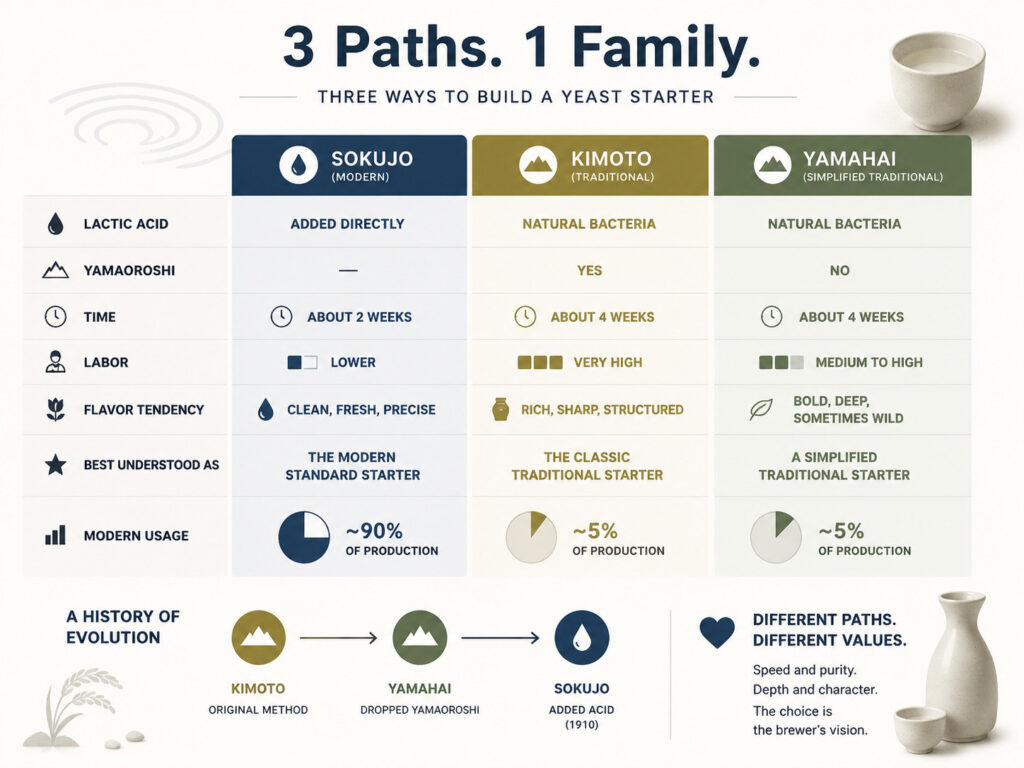
These three methods form one family. They all build the yeast starter. Yet they differ in clear, meaningful ways. A table makes the contrast easy to see.
| Point | Sokujo | Kimoto | Yamahai |
|---|---|---|---|
| Lactic acid | Added directly | Natural bacteria | Natural bacteria |
| Yamaoroshi | No | Yes | No |
| Time | About 2 weeks | About 4 weeks | About 4 weeks |
| Labor | Lower | Very high | Medium to high |
| Flavor tendency | Clean, fresh, precise | Rich, sharp, structured | Bold, deep, sometimes wild |
| Best understood as | The modern standard starter | The classic traditional starter | A simplified traditional starter |
| Modern usage | Most production | Small | Small to moderate |
The history flows in a clear line. Kimoto came first, as the original method. Yamahai then dropped the grueling yamaoroshi step. Sokujo followed in 1910, with added acid. For the full origins, see our kimoto guide. Each method therefore built on the one before.
One point matters most of all. None of these methods is simply better. Each reflects a different balance of values. Sokujo prizes speed and clean reliability. Kimoto and yamahai prize natural depth and character. So the choice depends on the brewer’s vision.
The numbers show how the field stands today. Sokujo accounts for roughly 90 percent of production. Yamahai makes up most of the rest. Pure kimoto remains a tiny, prized share. So tradition survives, even as sokujo leads.
It also helps to picture the trade-offs. Sokujo saves time, labor, and risk. Kimoto and yamahai spend all three for depth. Neither path is right for every brewer. So the method becomes a creative decision.
It helps to compare the cost of each method. Sokujo needs about two weeks and little extra labor. Kimoto needs about four weeks and grueling work. So the modern method saves time, money, and effort. These savings let breweries brew more, more reliably.
Yet tradition still holds a special value. Some drinkers love the depth of natural starters. Some brewers cherish the old, demanding craft. So kimoto and yamahai endure beside sokujo. The three methods now coexist in harmony.
Why Sokujo Became the Industry Standard
Sokujo rose to dominance for good reasons. It solved the brewer’s oldest fears. So most breweries adopted it gladly. Several practical strengths drove this shift.
Reliability stood at the top of the list. The method gave steady results every season. It also scaled well for larger production. Meanwhile, it cut labor and saved time. As a result, costs fell and quality rose. So sokujo made good business sense too.
Year-to-year consistency mattered enormously. Customers expected the same taste each time. Sokujo delivered that dependable result. So it suited the modern market well. This blend of safety and steadiness sealed its lead.
There was also a human cost to consider. The old methods demanded brutal winter labor. Crews worked long, freezing nights for weeks. Sokujo eased that burden greatly. So the change improved life inside the brewery.
Sokujo in Modern Craft Brewing
Sokujo is far more than a budget option. Many top breweries rely on it daily. They use it for their finest bottles. So the method spans every tier of sake.
Premium ginjo and daiginjo often use sokujo. Its clean base lets delicate aromas shine. Small craft producers value it too. Modern quality control makes it even more precise. As a result, sokujo appears in award-winning sake. So it is a tool for excellence, not a shortcut.
Modern brewers refine the method further every year. They fine-tune temperature with precise equipment. They also select yeast strains with great care. So even a standard starter keeps evolving. In this way, sokujo stays at the cutting edge.
Regional Use of Sokujo
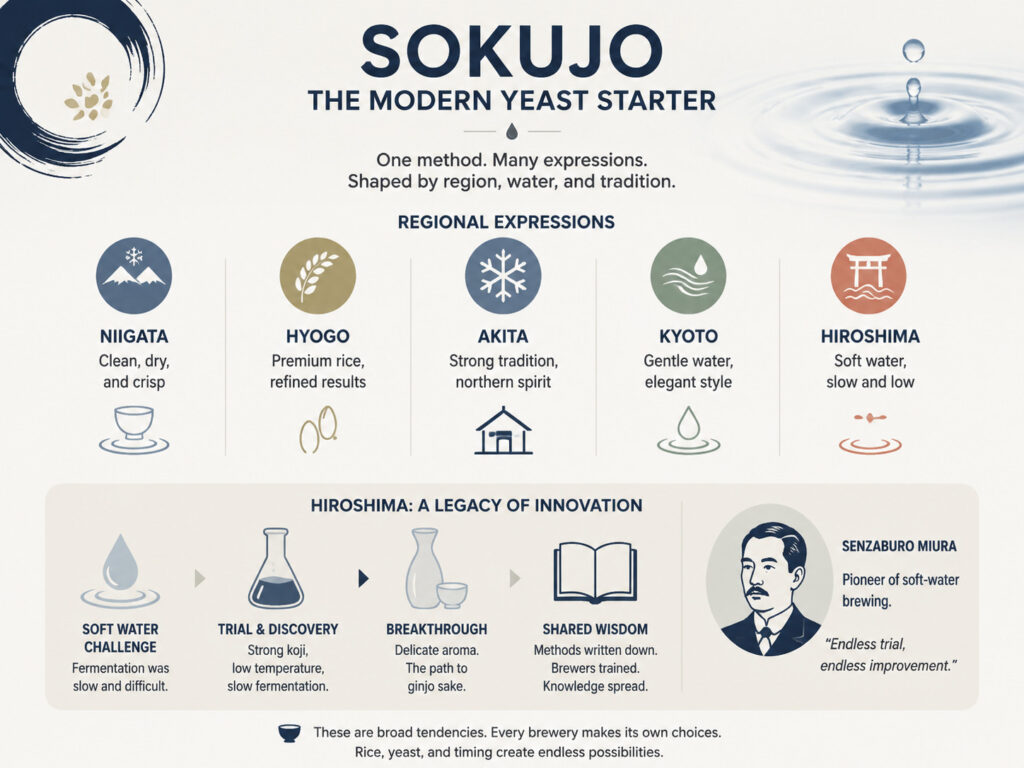
Sokujo appears across every sake region. Yet each area uses it in its own way. Climate, water, and tradition all shape the result.
Niigata is famous for clean, dry sake. Its breweries use sokujo for crisp results, as our Niigata sake guide shows. Hyogo, home of great sake rice, pairs it with premium grain. Akita keeps strong northern traditions. Kyoto’s gentle water suits elegant styles. So each region bends sokujo to its goals.
Hiroshima and Soft-Water Brewing
Hiroshima holds a special place in this story. Its water is famously soft and gentle. Long ago, soft water made brewing harder. Fermentation ran slowly and often failed.
A brewer named Senzaburo Miura changed that. In the late 1800s, he perfected soft-water brewing. He studied the water and the temperature closely. Through trial, he learned to grow especially strong koji. He then fermented slowly at low temperatures. So even gentle water could yield fine sake.
His breakthrough did more than save local sake. It helped lay the groundwork for ginjo brewing. Low, slow fermentation became a path to delicate aroma. So his patient work echoes in modern premium sake. Many fragrant bottles trace back to his ideas.
Miura also shared his knowledge freely. He wrote his methods down for other brewers. He trained many craftsmen in his region. So his ideas spread far beyond Hiroshima. Today, his influence reaches every fragrant ginjo. His motto urged endless trial and improvement.
These regional notes are broad tendencies only. Individual breweries make their own choices. They vary rice, yeast, and timing freely. So even neighbors can craft very different sake.
What Happens After the Starter
After the starter is ready, the real work begins. Brewers move the moto into a larger tank. They add more rice, koji, and water in stages. So the small starter grows into the main mash. This staged build is the next great step.
From there, the mash ferments for weeks. The yeast turns sugar into alcohol steadily. Aromas and flavors develop day by day. Then brewers press the mash to separate the sake. So the starter’s work flows into the finished bottle.
It is worth pausing on this connection. The starter you cannot taste shapes everything. Its health decides the whole fermentation. Its cleanliness shows in the final flavor. So the humble moto truly deserves its respect.
This is why brewers learn the starter first. Mastering the moto is a rite of passage. A skilled brewer reads it like a book. So years of practice go into each batch. The craft runs deep, even in a modern method.
Common Misconceptions About Sokujo
Sokujo invites several common myths. Let us clear them up plainly.
- Is sokujo artificial? No. The added acid simply speeds a natural goal.
- Is added lactic acid unsafe? No. It is food-grade and carefully measured.
- Is sokujo lower quality than kimoto? No. It is different, not inferior.
- Can premium sake use sokujo? Yes. Many top bottles rely on it.
- Does sokujo erase tradition? No. Kimoto and yamahai still thrive alongside it.
The quality myth causes the most harm. So hold on to the central idea. Sokujo reaches the same goal as kimoto. It simply uses added acid to get there. Keep that clear, and the rest makes sense.
Another myth deserves a quick word too. Some assume sokujo means cheap, mass sake. Yet many treasured bottles use it daily. So price and method are not the same thing. Judge each sake by taste, not by its starter.
Final Thoughts
Sokujo transformed the craft of sake brewing. It made the starter faster and far safer. Yet it never sacrificed the chance for great flavor. So sokujo sake brewing balances speed with quality. It is neither better nor worse than its neighbors. Instead, it reflects a different brewing philosophy. Above all, remember the heart of the matter. Sokujo, kimoto, and yamahai share one goal. Each grows a healthy yeast starter for fermentation. Understand sokujo, and you understand modern sake.
Sokujo Sake Brewing FAQ
What is sokujo in sake brewing?
Sokujo is the modern yeast starter method. Brewers add lactic acid at the start. This protects the mash quickly and reliably. It is a method, not a sake style.
What does sokujo mean?
Sokujo means “fast-fermenting” in Japanese. The name points to its speed. It finishes in about two weeks. That is roughly half the time of kimoto.
Why is lactic acid added?
The acid makes the mash sharply acidic. This blocks unwanted microbes from the start. Sake yeast, though, tolerates the acid well. So it protects the starter quickly.
Is the added lactic acid artificial?
No, it is food-grade and carefully purified. It plays the same role as natural acid. Kimoto grows that acid slowly instead. The end result is very similar.
How much lactic acid is used?
Only a small, careful amount is added. It reaches about half a percent of the mash. That is roughly 700 milliliters per 100 liters. The acid must be highly pure.
How is sokujo different from kimoto?
Kimoto grows natural lactic acid the slow way. Sokujo adds the acid directly instead. Kimoto also uses the hard yamaoroshi step. Sokujo is faster and cleaner.
How is sokujo different from yamahai?
Yamahai grows its lactic acid naturally. Sokujo adds the acid at the start. Yamahai therefore takes about four weeks. Sokujo finishes in about two.
Is sokujo the most common method?
Yes, by a wide margin. It accounts for roughly 90 percent of sake. Most bottles you drink use it. Tradition methods make up the small rest.
Does sokujo affect flavor?
It tends to give a clean, precise profile. This lets delicate aromas shine through. Still, many other factors shape flavor. Rice, yeast, and skill all matter.
Can premium sake be made with sokujo?
Yes, absolutely. Many top ginjo and daiginjo use it. Its clean base suits fragrant styles. So it appears in award-winning sake.
When was sokujo developed?
It was developed in 1910. A researcher named Kamajiro Eda created it. He worked at a national brewing institute. He shared the method freely with brewers.
Is sokujo a type of sake?
No, sokujo is a brewing method. It describes how the yeast starter is made. Most labels do not even mention it. It is a process, not a flavor category.
References
- Japan Sake and Shochu Makers Association, glossary of sake terms (sokujo, shubo, lactic acid). (Surveyed: June 2026)
- National Research Institute of Brewing, history and science of the sokujo yeast starter. (Surveyed: June 2026)
- Brewing Society of Japan, modern yeast starters and brewing science. (Surveyed: June 2026)
- National Tax Agency of Japan, sake manufacturing and quality standards. (Surveyed: June 2026)
- Koyanagi et al., Bioscience, Biotechnology, and Biochemistry, “Tracing microbiota changes in yamahai-moto, the traditional Japanese sake starter,” Vol. 80 (2016). (Surveyed: June 2026)
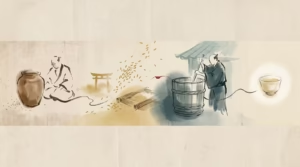
-300x169.avif "Moto (酒母): The Yeast Starter of Sake")



Comments