


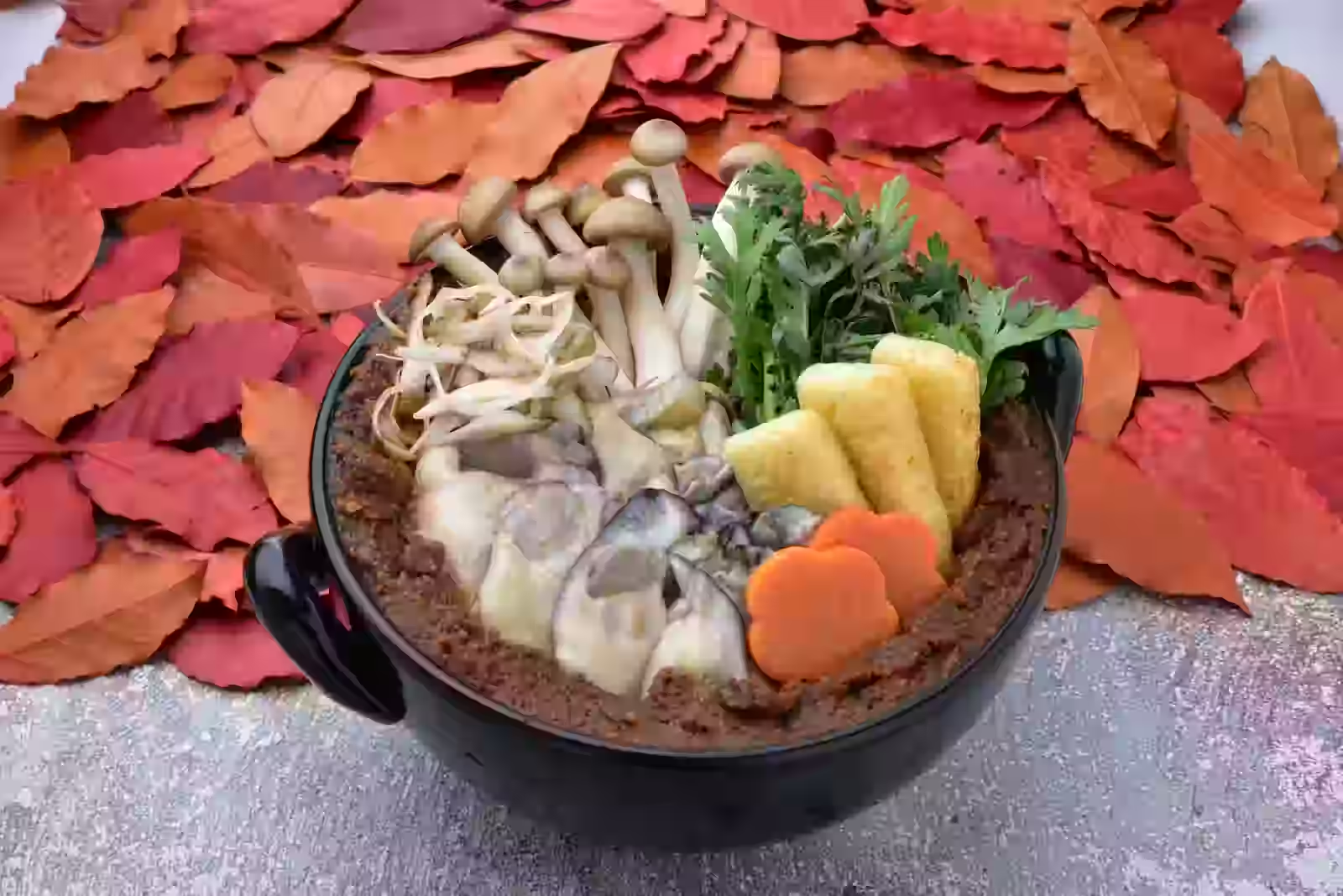


Picture a clay pot on a winter table in Hiroshima, its inner rim coated with a thick ridge of miso. That ridge is the whole point of Kaki no Dotenabe, a Hiroshima oyster hot pot. Oysters, tofu, and vegetables simmer in dashi broth, and diners scrape the miso down bit by bit to season it.
This guide explains what the dish is and why the miso sits on the rim. It also covers the three stories behind the name, the ingredients, oyster safety, and where to look for it in Hiroshima.
What Is Kaki no Dotenabe?
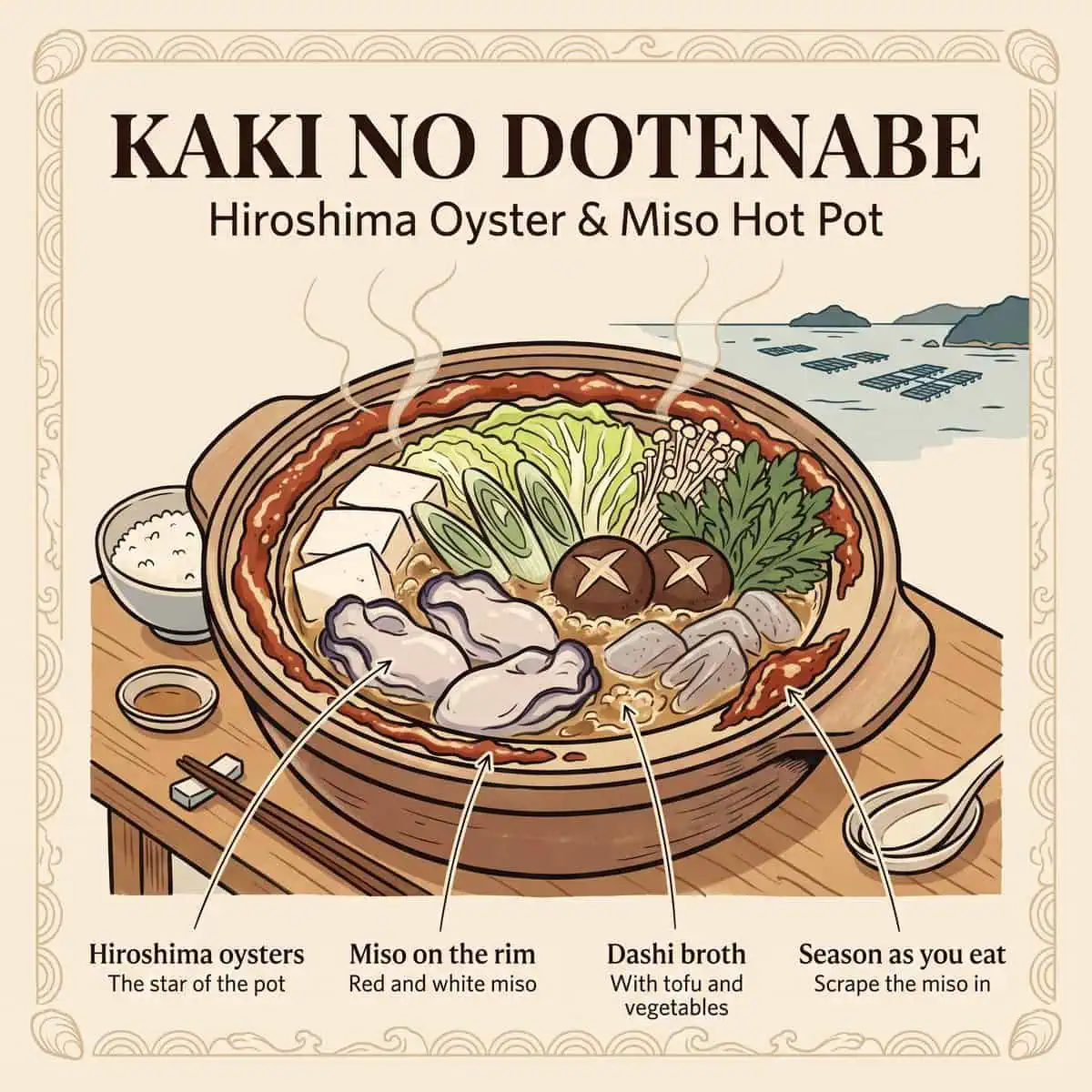
Kaki no Dotenabe (かきの土手鍋, also written Kaki no Dote Nabe) is a winter miso oyster hot pot from Hiroshima Prefecture. Japan’s Ministry of Agriculture, Forestry and Fisheries (MAFF) describes it as oysters and vegetables cooked in an earthenware pot. Cooks spread a blend of red and white miso around the inside rim. Diners then break it into the broth to adjust the flavor.
Quick Facts: Kaki no Dotenabe
- Japanese name
- かきの土手鍋 (kaki no dotenabe)
- What it is
- Oyster hot pot with miso spread around the pot’s rim
- Region
- Hiroshima Prefecture, on the Seto Inland Sea
- Traditional areas
- Hiroshima City, Etajima, Miyajima, Kure, and the Ondo area
- Season
- Winter; MAFF links it to January and February
- Key seasoning
- Red and white miso, mixed with sake, mirin, and sugar
- Recognition
- “100-Year Food” (traditional category), Agency for Cultural Affairs, fiscal 2023
What “Kaki,” “Dote,” and “Nabe” Mean
The name breaks down neatly. Kaki (牡蠣) means oyster, dote (土手) means an earthen bank or embankment, and nabe (鍋) means pot or hot pot. Literally, the parts mean “oyster,” “embankment,” and “pot,” although “Hiroshima oyster hot pot” describes the dish better in English.
One small warning for learners of Japanese: kaki can also mean persimmon (柿). The two words sound alike but use different kanji. For the fruit, see our article on kaki persimmons.
Where Hiroshima Fits on the Map
Hiroshima sits in western Honshu, Japan’s main island. It faces the Seto Inland Sea, the calm sea between Honshu, Shikoku, and Kyushu. In fact, MAFF names Hiroshima City, Etajima, Miyajima, Kure, and the Ondo area (now part of Kure) as its traditional home. The wider coastal region is also closely tied to Hiroshima oyster farming.
In fiscal 2023, Japan’s Agency for Cultural Affairs added Kaki no Dotenabe to its “100-Year Food” program. The program recognizes regional dishes passed down across generations. The agency also describes Dotenabe as a local dish continuing since the Edo period. However, the award honors living tradition; it does not prove an exact date of origin.
Why Is Miso Spread Around the Pot?
Short Answer
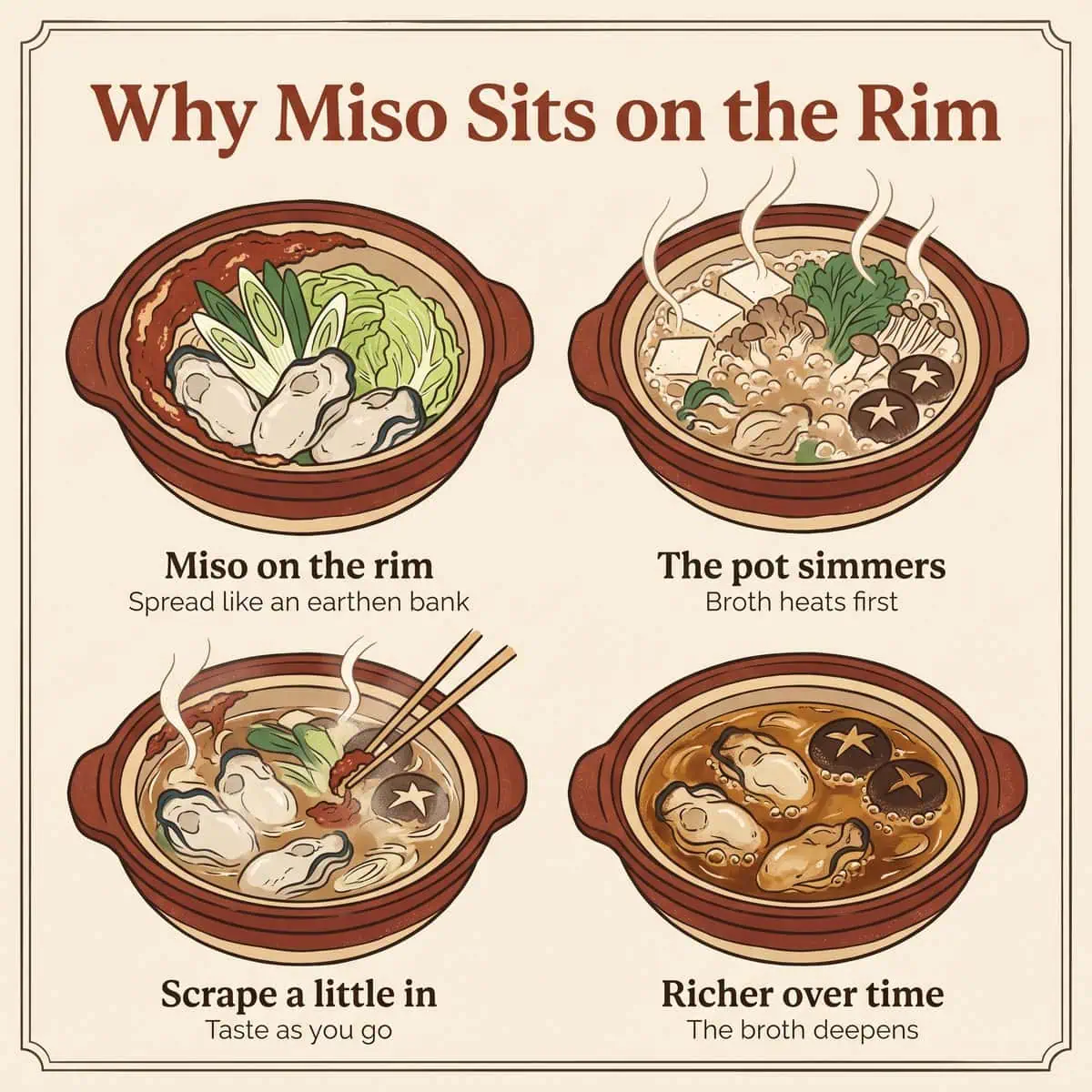
The miso is spread around the inside rim of the pot like an earthen bank. As the pot simmers, diners scrape a little into the broth at a time. That way, they adjust the flavor as they eat.
Most miso hot pots start with the miso already stirred into the soup. Dotenabe, however, works differently. The miso mixture stays visible on the rim, so it can go into the broth gradually.
How Diners Adjust the Broth
MAFF’s description is simple: once the pot boils, you break up the miso to suit your taste. In practice, that turns seasoning into part of the meal. A group may add more miso early for a stronger broth, or keep the seasoning lighter at first.
When the miso goes in gradually, the broth tends to grow richer as the meal goes on. Official sources do not explain why cooks first chose this method. Even so, the effect is easy to see, and it gives the table something to do together.
What Goes Into the Miso Mixture
The MAFF recipe blends white miso and red miso with small amounts of sake, mirin, and sugar. Red miso, or aka miso, is usually darker and more robust. By contrast, shiro miso is lighter and often sweeter, so the blend balances the two. These are broad color categories rather than specific regional brands, and flavor varies by the miso used.
Why Is It Called Kaki no Dotenabe? Three Traditional Stories
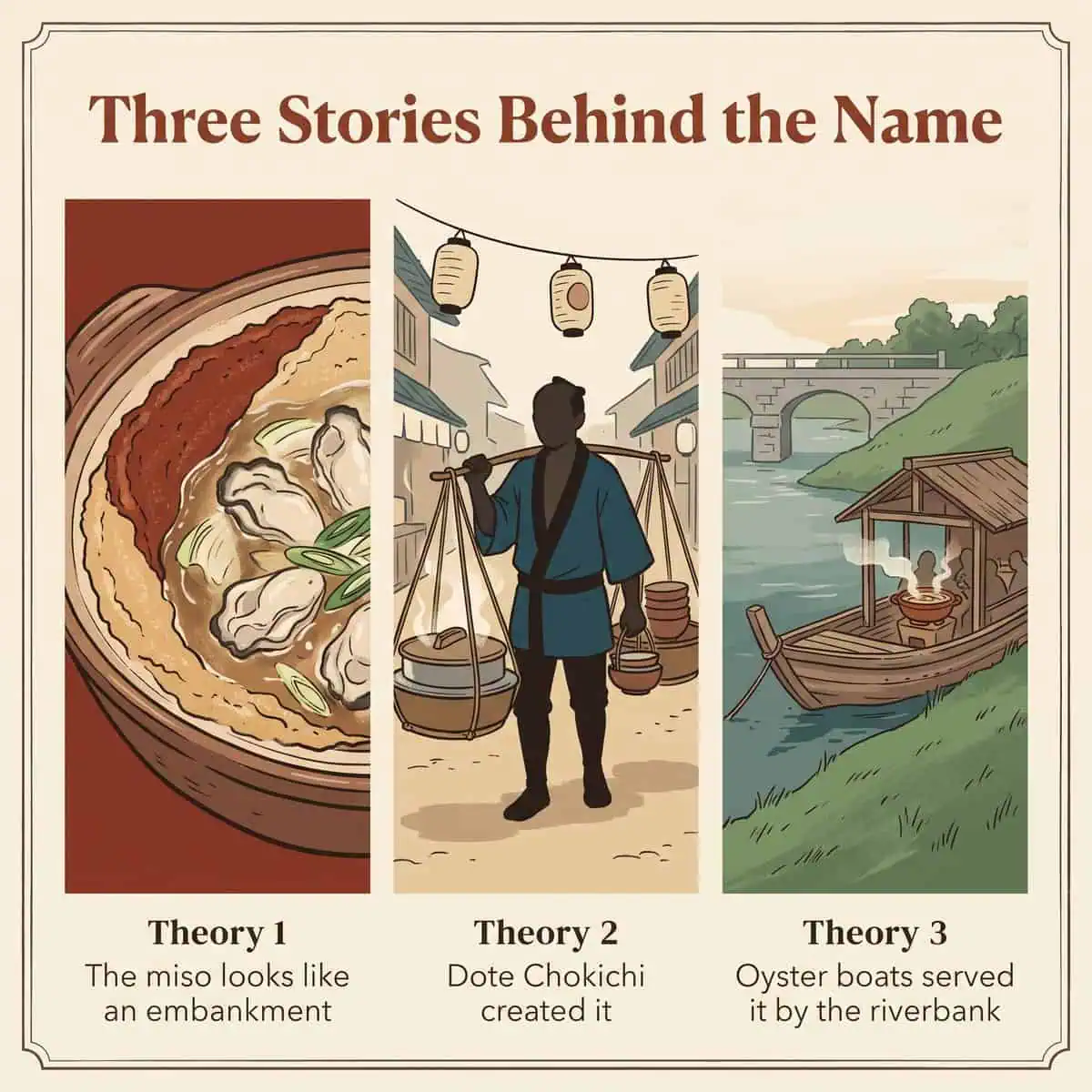
Even official sources do not settle on a single origin for the name. MAFF presents three traditional explanations, and the Agency for Cultural Affairs says plainly that several theories exist. None of them has been proven, so it is best to read them as local lore.
Theory 1
The miso looks like an embankment
The miso is spread on the inside of the pot like a dote, or earthen bank. This is the most visual explanation, and both MAFF and the Agency for Cultural Affairs mention it.
Theory 2
A man named Dote Chokichi created it
MAFF also records a story that a person called Dote Chokichi (土手長吉) invented the dish. However, no one has confirmed an independent historical record of him.
Theory 3
Oyster boats served it by the riverbank
In the Edo period, oyster boats carried Hiroshima oysters to Osaka. One story says their crews served the hot pot on or below the river embankments there.
The boat trade itself appears in both official accounts of the Edo period (1603 to 1868). The Agency for Cultural Affairs adds a traditional detail: the boats served oyster hot pot while moored below embankments near bridges.
Still, the idea that this practice gave Dotenabe its name remains one of several theories. Honestly, the uncertainty is part of the charm. After all, each story points to something true about the dish: its look, its people, and its ties to the sea.
Oysters in Hiroshima: The Background to the Dish
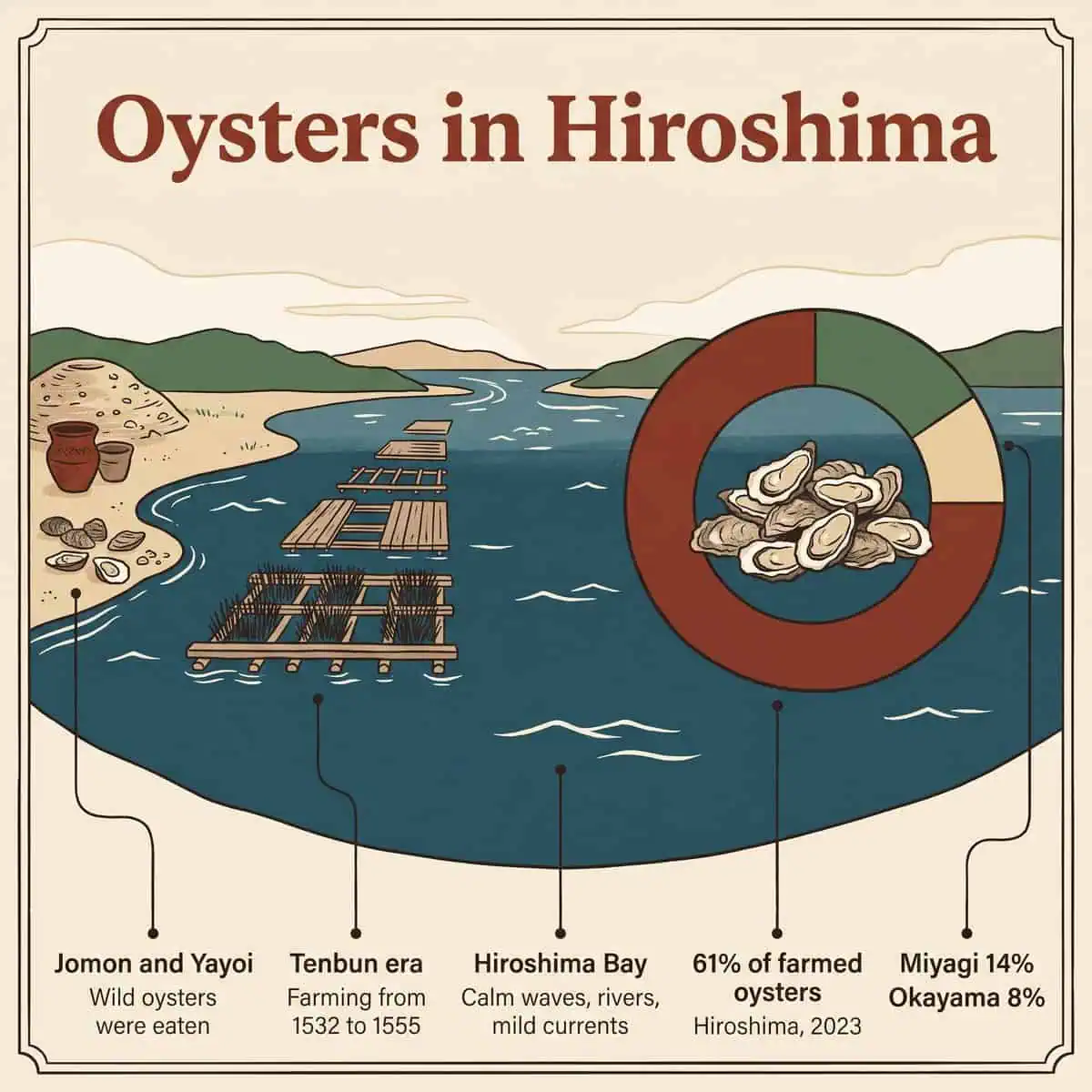
Kaki no Dotenabe only makes sense against Hiroshima’s long history with oysters. For example, MAFF notes that shells in ancient shell mounds show people ate wild oysters in Japan’s prehistoric Jomon and Yayoi periods.
The Beginning of Oyster Farming
Farming, by contrast, came much later. Hiroshima City traces oyster farming in Hiroshima Bay to the Tenbun era (1532 to 1555), in the late Muromachi period. That gives the local industry a history of more than 450 years. Still, no single year marks the exact start.
Conditions in Hiroshima Bay
MAFF points to calm waves, moderate currents, and fresh water from rivers as helpful conditions. Hiroshima City adds that the Ota River flows into the bay from the forested Chugoku Mountains. The city also monitors water temperature, salinity, dissolved oxygen, and an indicator of phytoplankton, which oysters feed on.
Together, these conditions form the setting for the industry. Even so, it would be too simple to say they alone guarantee quality. Farming methods, handling, and hygiene rules matter as well.
Hiroshima’s Place in Japan’s Oyster Production
Hiroshima is Japan’s leading oyster-producing prefecture. According to a November 2025 Fisheries Agency report, Hiroshima produced 61% of Japan’s farmed oysters in 2023. Miyagi followed with 14%, and Okayama with 8%.
Kaki no Dotenabe Ingredients
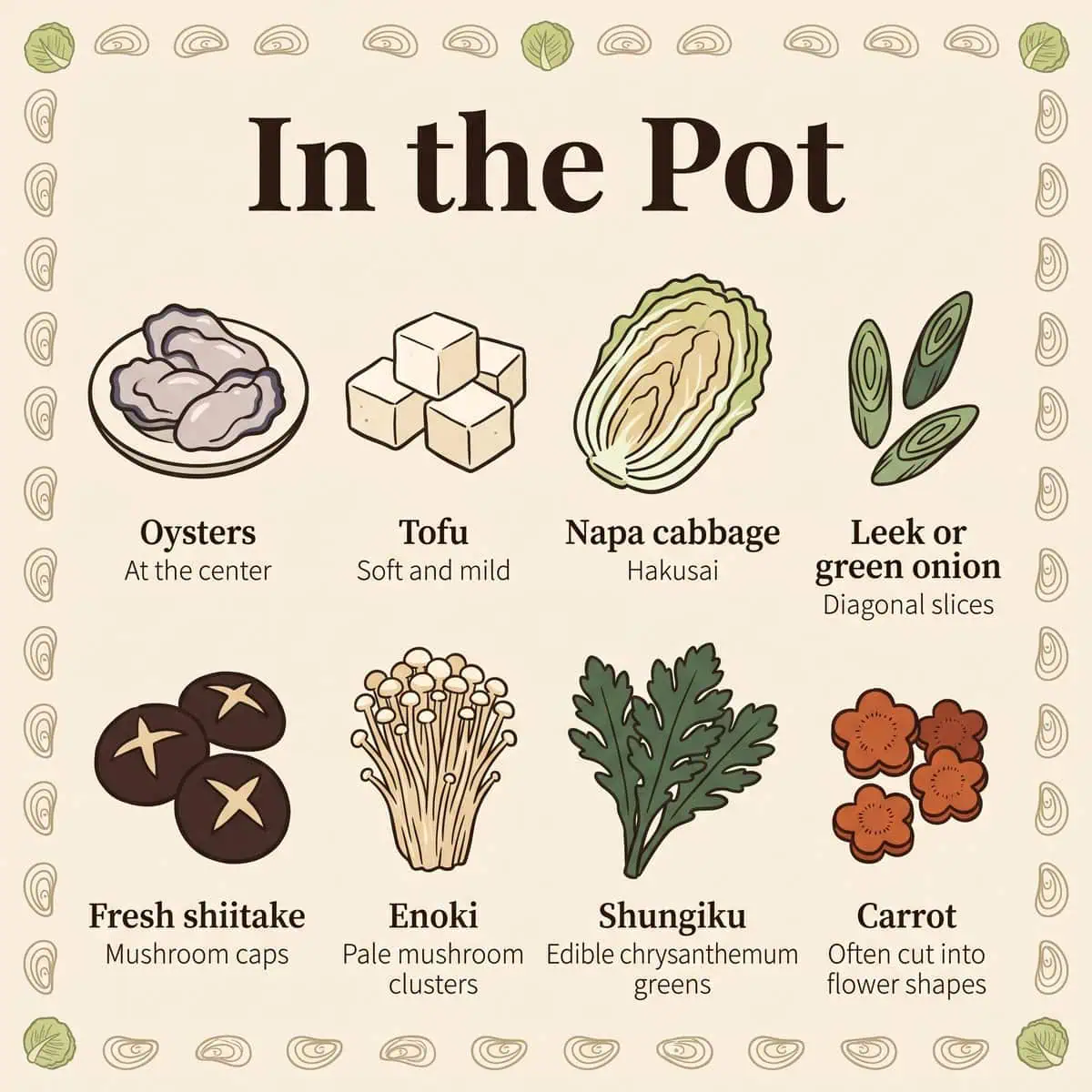
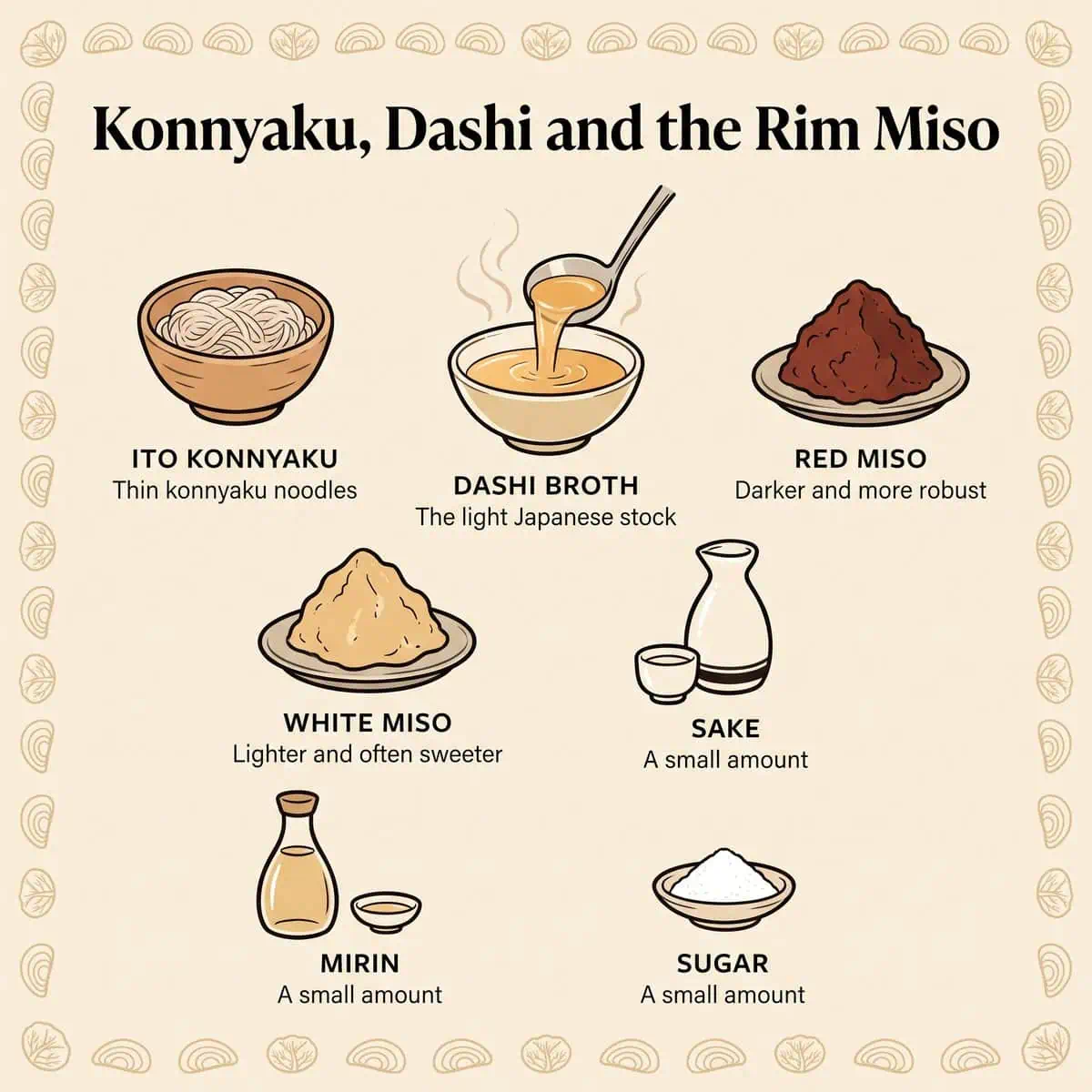
Recipes differ by family and by area, and MAFF says so directly. Its sample version for four people uses 300 g of oysters and 100 g each of red and white miso. The full list looks like this:
In the pot
- Oysters
- Tofu
- Napa cabbage (hakusai)
- Japanese leek or green onion
- Fresh shiitake mushrooms
- Enoki mushrooms
- Shungiku (edible chrysanthemum greens)
- Carrot, often cut into flower shapes
- Ito konnyaku (thin konnyaku noodles)
- Dashi broth
On the rim
- Red miso
- White miso
- Sake
- Mirin
- Sugar
Based on MAFF’s sample recipe. Amounts and vegetables vary from household to household.
Of course, a few items may be unfamiliar outside Japan. Shungiku is a leafy green with a slightly bitter, herbal edge. Ito konnyaku are thin, translucent noodles made from konnyaku, a food produced from the corm of the konjac plant. Meanwhile, dashi is the light Japanese stock behind many soups. Finally, tofu adds a soft, mild contrast.
How Kaki no Dotenabe Is Made
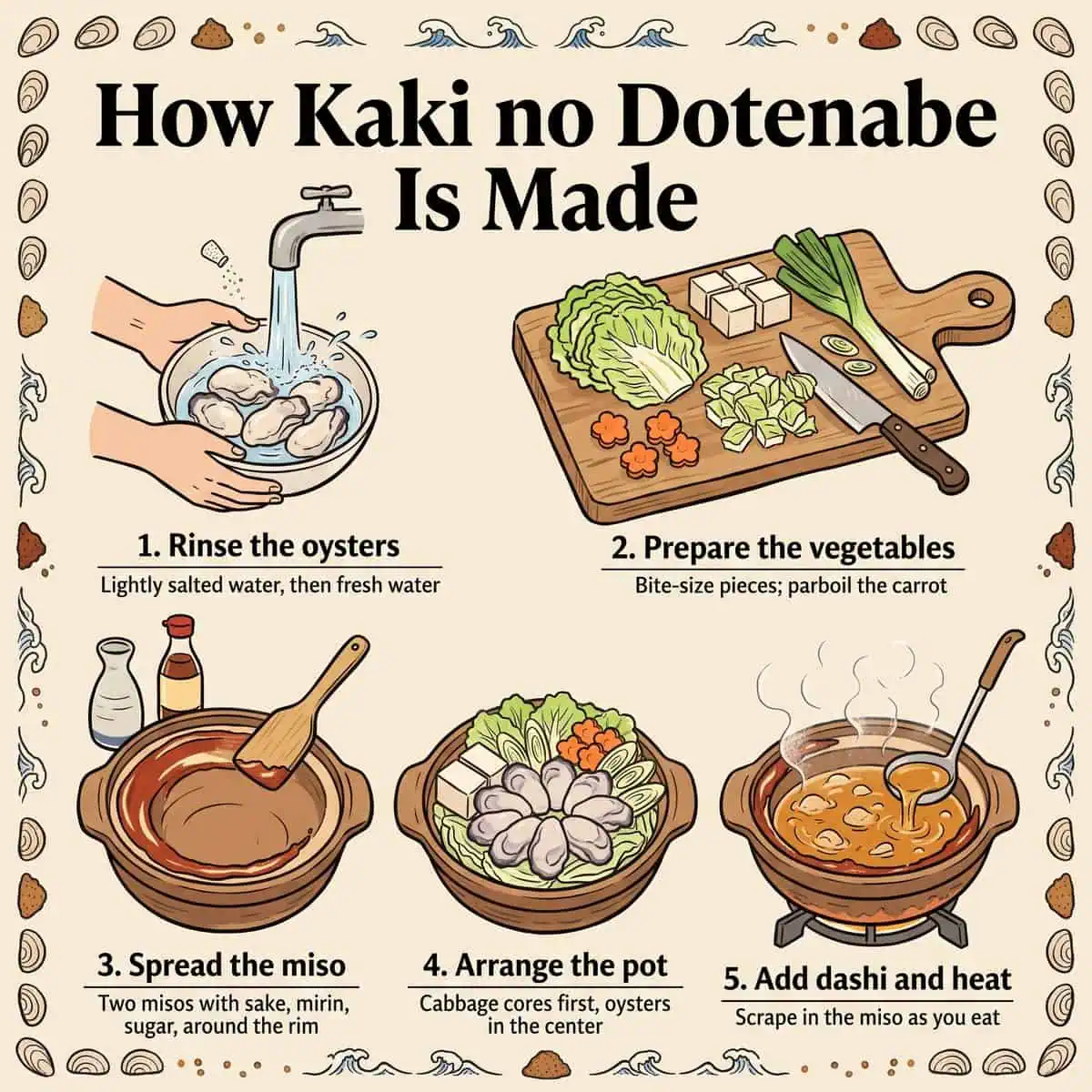
MAFF’s method takes only a few steps. Here is the order, in summary:
- Rinse the oysters gently in lightly salted water, rinse again in fresh water, and drain.
- Cut the vegetables and tofu into bite-size pieces. Parboil the carrot.
- Mix the two misos with sake, mirin, and sugar, then spread the mixture around the pot’s rim.
- Lay the cabbage cores on the bottom, arrange the other ingredients, and place the oysters in the center.
- Pour in the dashi and heat. Once it boils, scrape in the miso as you eat.
Two details are worth noticing. First, the cabbage cores have a practical job: MAFF notes that they help keep the pot from scorching. Notice, too, that the oysters go in the center, where they cook in full view of everyone at the table.
Oyster Safety Basics
- Cook thoroughly. For food that may carry norovirus, Japan’s Ministry of Health recommends heating the center to 85 to 90°C for at least 90 seconds.
- Read the label. In Japan, oysters are sold as either for raw eating (生食用) or for cooking (加熱用). Treat any oyster not marked for raw eating as one that must be cooked.
- Prevent cross-contamination. Wash your hands after handling raw oysters. Keep knives and cutting boards used for raw shellfish away from foods that will not be cooked.
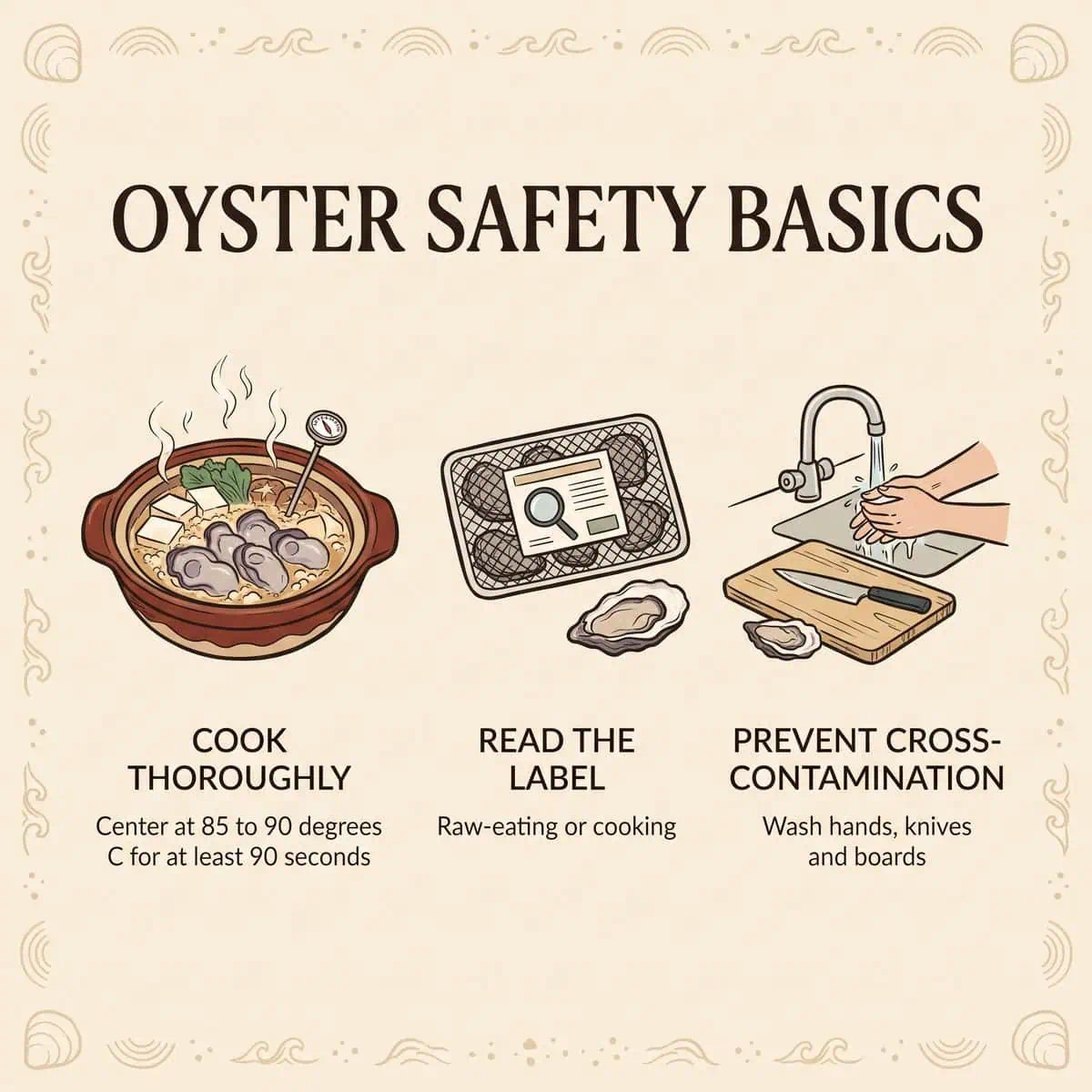
The two labels can be confusing. Hiroshima Prefecture explains that both types are equally fresh. Instead, the difference lies in where they come from and how they are handled. Oysters from some sea areas, for instance, may only be sold for cooking. Equal freshness does not make the two types interchangeable, though. For a hot pot, it makes sense to cook every oyster through, whatever the label says.
How to Eat Kaki no Dotenabe
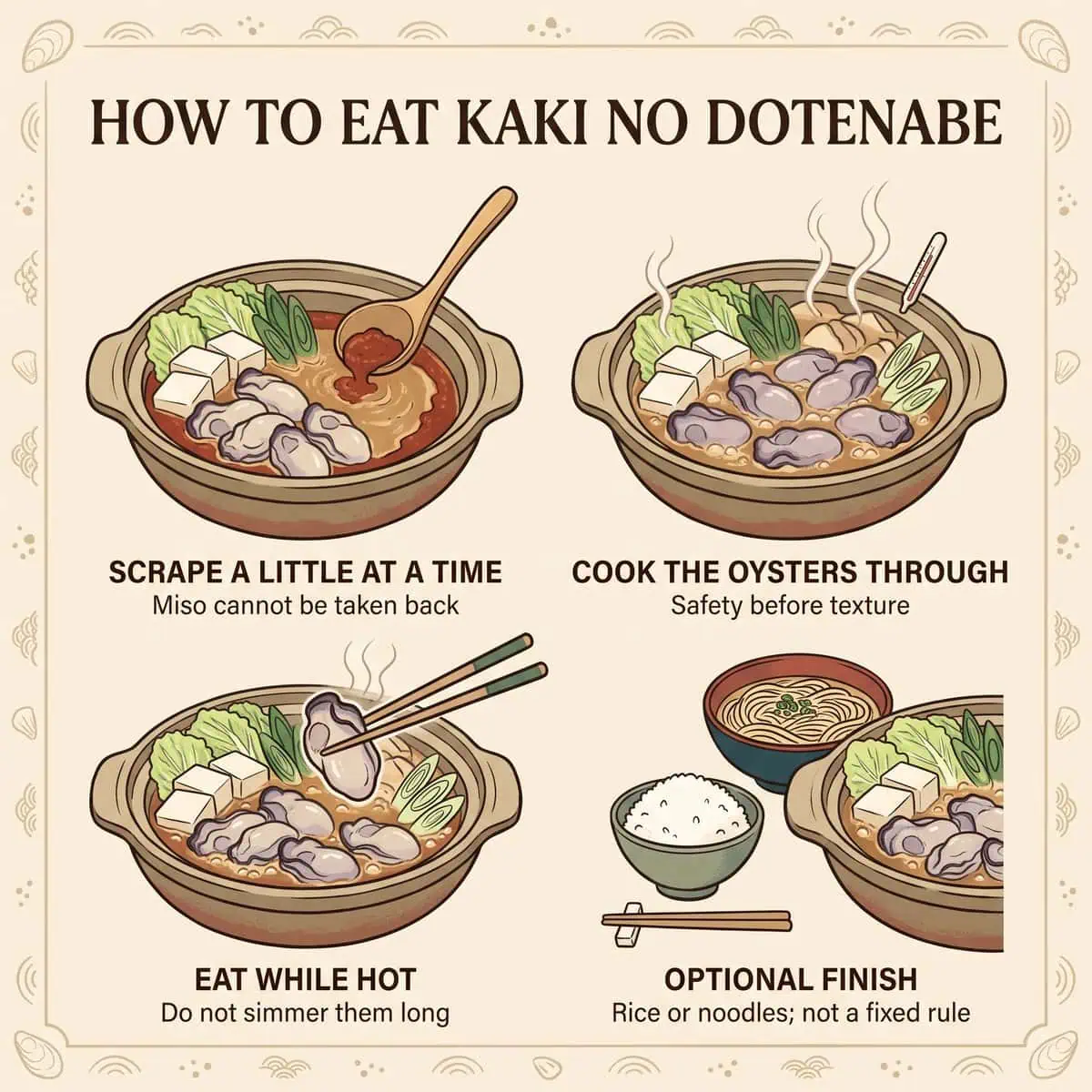
Eating Dotenabe is a little like tuning an instrument as you play. Shared hot pots come with some table manners, and our guide to nabe etiquette covers them. For this dish in particular, the rhythm usually goes like this.
Scrape Down the Miso a Little at a Time
First, use a ladle or chopsticks to push some miso from the rim into the simmering broth. Taste, then add more if the table agrees. Since the miso cannot be taken back out, it pays to go slowly.
Cook the Oysters Through, Then Eat Promptly
As oysters cook, they shrink and firm up. Make sure they are heated through first, since safety comes before texture. After that, eat them while they are hot rather than leaving them to simmer for a long time.
Optional Ways to Finish the Meal
Many Japanese nabe meals end with rice or noodles cooked in the leftover broth. However, MAFF does not describe this step for Dotenabe. So treat it as a common hot pot habit, not a fixed rule.
Kaki no Dotenabe vs a Typical Miso-Based Nabe
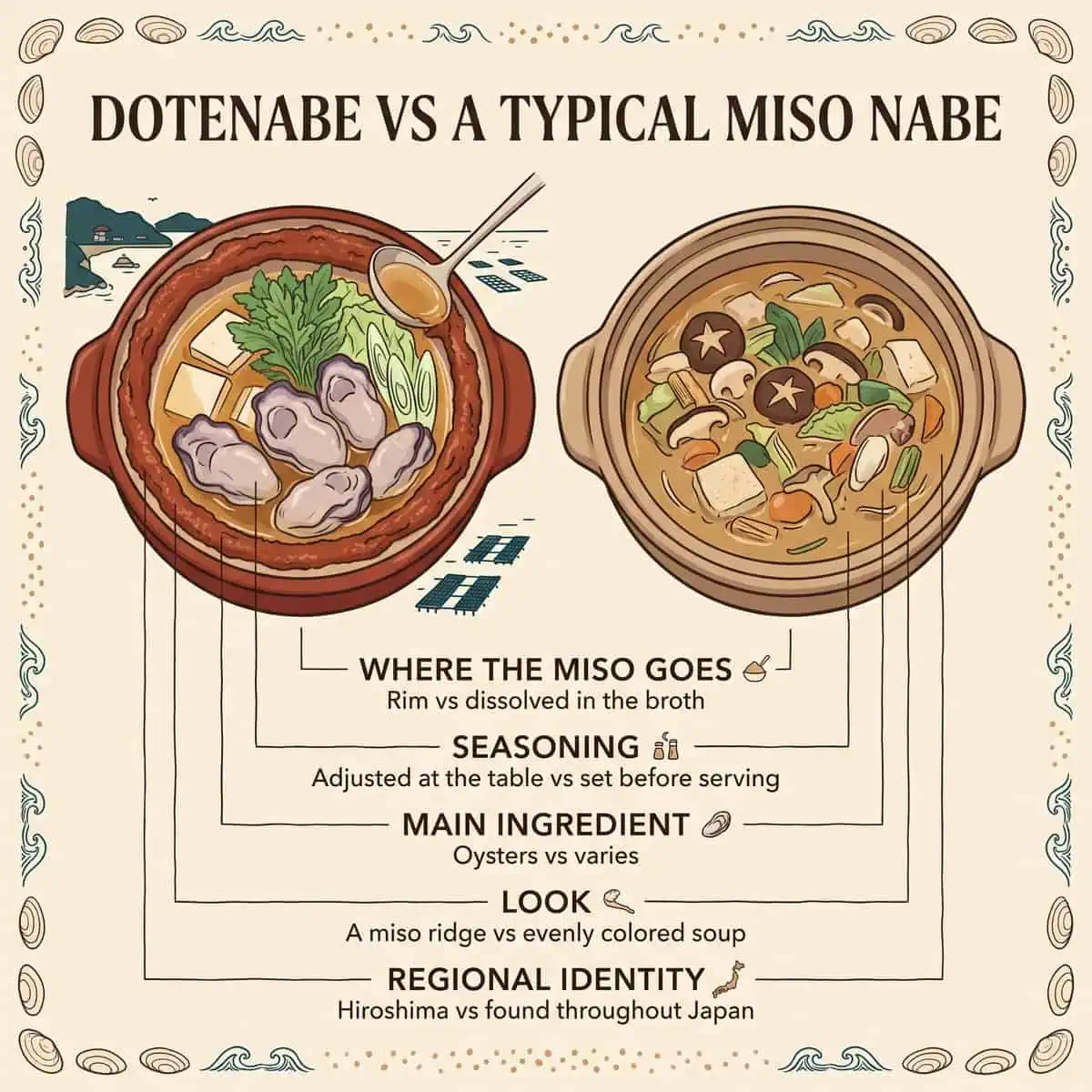
Because miso hot pots vary widely across Japan, the comparison below is a general one. Still, it shows what makes Dotenabe stand out.
| Feature | Kaki no Dotenabe | A typical miso-based nabe |
|---|---|---|
| Where the miso goes | Spread around the inner rim of the pot | Usually dissolved into the broth |
| Seasoning | Adjusted gradually at the table | Mostly set before serving |
| Main ingredient | Oysters | Varies: meat, seafood, or vegetables |
| Look | A visible miso ridge around the rim | Evenly colored soup |
| Regional identity | Strongly tied to Hiroshima | Found throughout Japan |
A general editorial comparison. Miso-based nabe recipes differ widely by region and household.
What Does Kaki no Dotenabe Taste Like?
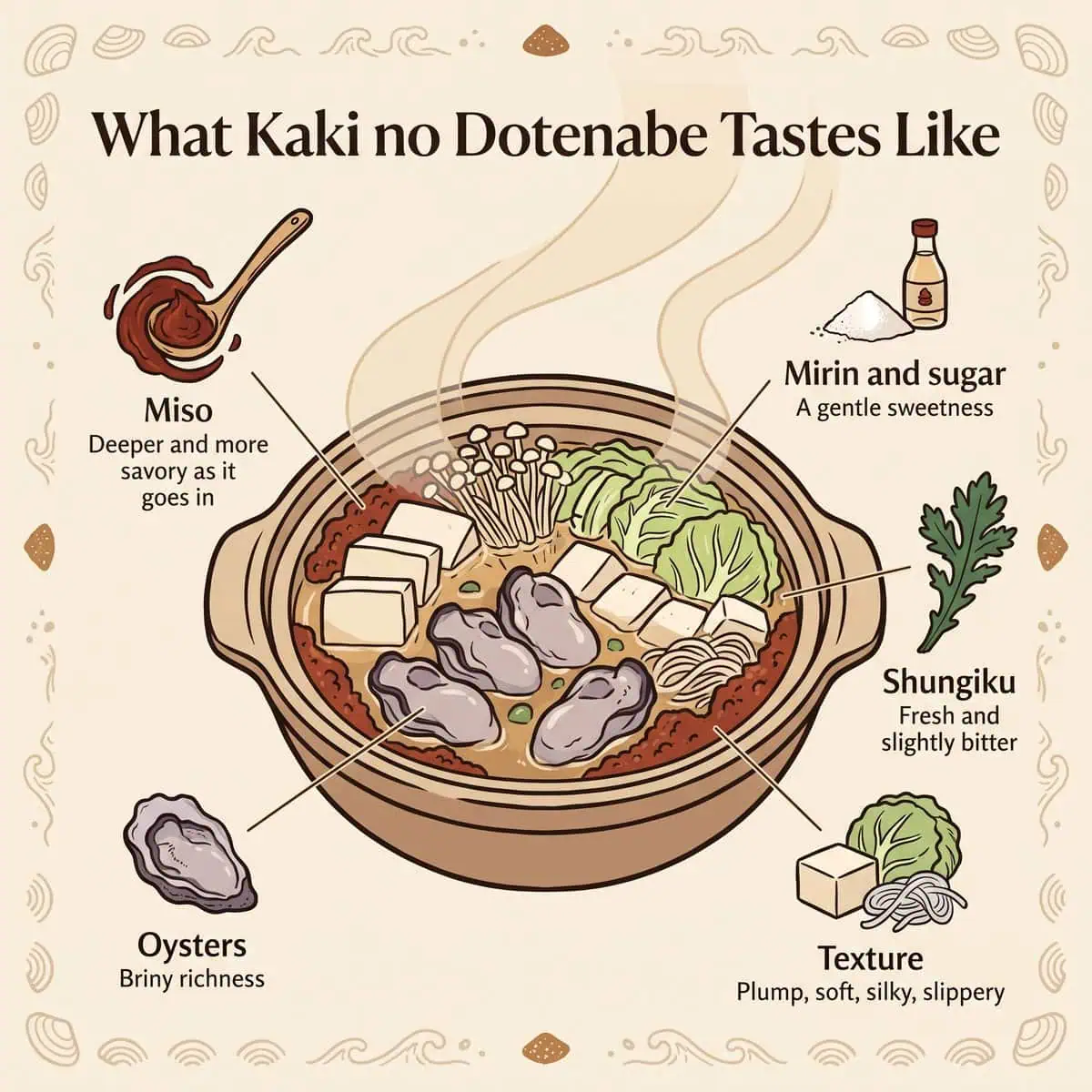
Official sources say little about flavor beyond the adjustable miso. So what follows is a general description. The flavor is a moving target, which makes it oddly hard to describe. As more miso goes in, the broth usually turns deeper and more savory.
On top of that, the oysters bring their own briny richness. MAFF describes Hiroshima oysters as large and rich in flavor, and that richness tends to stand up well to miso. Meanwhile, the sugar and mirin in the miso mixture suggest a gentle sweetness behind the salt.
Texture matters as well. Plump oysters sit beside soft tofu, silky cabbage, and slippery konnyaku noodles. The shungiku adds a fresh, slightly bitter note that keeps the pot from feeling too heavy.
Admittedly, the taste depends a great deal on how much miso goes in and how long the pot simmers. In fact, the same pot can taste quite different at the start and the end of the meal. That change is part of the fun.
When and Where to Eat Kaki no Dotenabe
When to Eat It
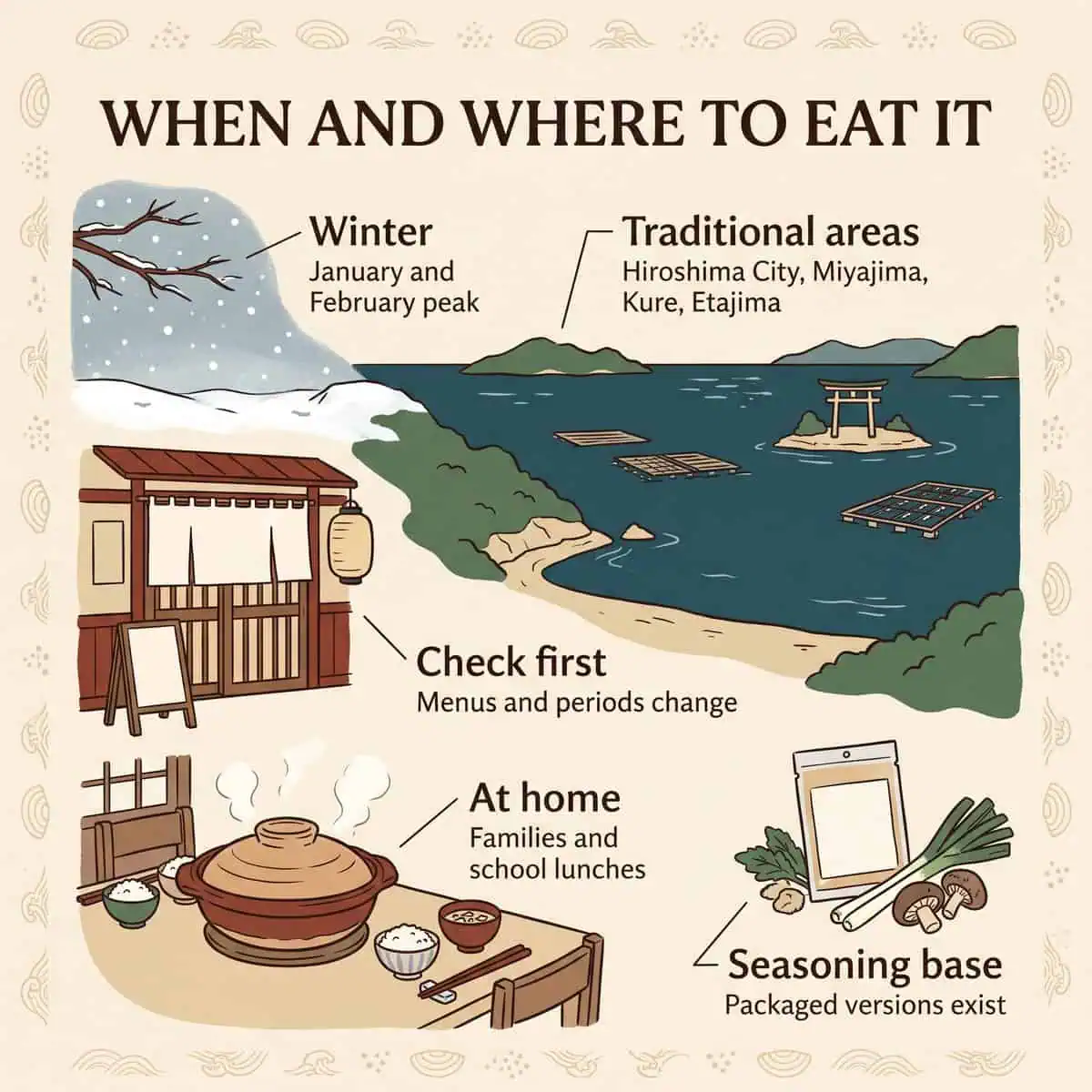
Dotenabe is a winter dish. MAFF associates the dish with January and February, which it identifies as the oysters’ seasonal peak. It also says both restaurants and homes serve it. For other seasonal dishes, see our guide to Japanese winter food.
Keep in mind that the traditional season, the oyster shipping period, and restaurant menus are not the same thing. Some places may serve the dish outside midwinter, while others offer it only for a short time.
Where to Look for Kaki no Dotenabe
The traditional areas are a good starting point: Hiroshima City, Miyajima, Kure and the Ondo area, and Etajima. MAFF notes that many local restaurants serve the dish in winter and that it is popular with visitors.
That said, menus, prices, and serving periods change every year. So check a restaurant’s official site or ask directly before you go. Beyond Dotenabe, our list of what to eat in Hiroshima is a good place to start exploring.
Taking the Flavor Home
Dotenabe is not only restaurant food. According to MAFF, families cook it at home and it appears on school lunch menus. In addition, a local maker sells a packaged seasoning base.
Hiroshima City lists one such product, Shinjyo Miso’s かきの土手鍋の素 (Kaki no Dotenabe base), among its certified “The Hiroshima Brand” specialties. According to the city, it blends three types of miso with Hiroshima oyster extract and is sold seasonally. Its page, updated in August 2025, shows a 150 g pack at 302 yen (about $1.91) including tax. Prices and sales periods may change, so check the maker’s official site. Approximate US dollar amounts use the October 10, 2026 exchange rate of 1 yen ≈ 0.00632 US dollars; exchange rates change.
How to Order It
On a Japanese menu, look for かきの土手鍋 or 牡蠣の土手鍋. To order, simply say “Kaki no dotenabe o kudasai.” It means “Kaki no Dotenabe, please.” Also, because it is a shared pot, ask how many people one order serves.
MAFF lists Dotenabe alongside grilled oysters and kaki fry (breaded fried oysters) as popular ways of enjoying oysters. If you want to compare styles, look for those dishes during your stay as well.
Final Thoughts on Hiroshima’s Oyster Hot Pot
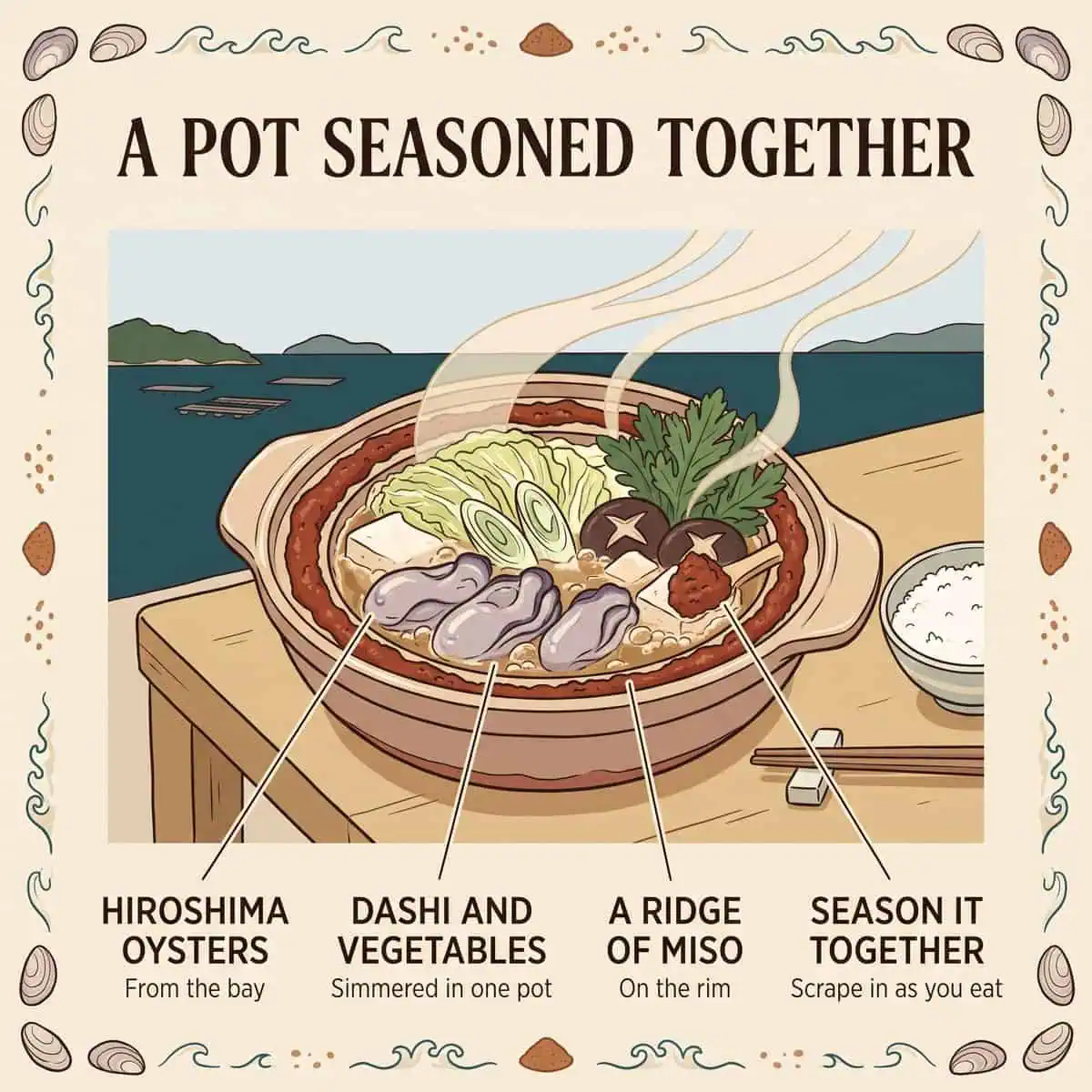
Kaki no Dotenabe is simple at heart: Hiroshima oysters, vegetables, dashi, and miso in one clay pot. Even so, the ridge of miso on the rim sets it apart, since everyone can season the broth as the meal unfolds.
Its name may come from that miso bank, from Dote Chokichi, or from Edo-period oyster boats. However, none of these has been proven. Whichever version you prefer, the dish carries centuries of Hiroshima’s life with the sea. If you visit in winter, try it, and then explore more of Hiroshima food culture.
Frequently Asked Questions About Kaki no Dotenabe
About the Dish
- What is Kaki no Dotenabe?
-
Kaki no Dotenabe is an oyster hot pot from Hiroshima Prefecture. Oysters, tofu, and vegetables simmer in dashi inside an earthenware pot. Cooks spread red and white miso around the rim, and diners then scrape it into the broth.
- What does “dote” mean in Dotenabe?
-
Dote (土手) means an earthen bank or embankment. One theory connects the word to the ridge of miso around the pot. Two other accounts credit a man named Dote Chokichi or link the name to oyster boats and riverbanks.
- When is Kaki no Dotenabe eaten?
-
It is a winter dish. MAFF associates it with January and February, which it identifies as the oysters’ seasonal peak. Restaurant serving periods vary, so check before you visit.
Cooking and Safety
- How long should oysters cook in Dotenabe?
-
Cook them until they are hot all the way through. For food that may carry norovirus, Japan’s Ministry of Health recommends heating the center to 85 to 90°C for at least 90 seconds. Exact times depend on oyster size and how many go into the pot at once.
- Are raw-eating oysters safer for hot pot?
-
Raw-eating oysters must meet extra rules on harvest areas and handling, but that is no reason to undercook them. Hiroshima Prefecture explains that both types are equally fresh and differ mainly in where they are harvested. For a hot pot, cook every oyster thoroughly, whatever the label says.
- Can I make Kaki no Dotenabe without a donabe?
-
The dish is traditionally made in a donabe, a Japanese earthenware pot, and MAFF describes it that way. A wide, heavy pot can also hold the miso rim. However, the look and the way it holds heat will differ from a clay pot.
- Is Kaki no Dotenabe safe for people with allergies?
-
No general safety guarantee is possible. Oysters are mollusks, the miso normally contains soy, and the dashi may contain fish. Some products include other allergens, so check labels and ask the restaurant about every component.
Eating and Buying in Hiroshima
- Where can I eat Kaki no Dotenabe in Hiroshima?
-
Start with the areas MAFF names: Hiroshima City, Miyajima, Kure and the Ondo area, and Etajima. MAFF notes that many local restaurants serve it in winter. Menus and prices change, so confirm on each restaurant’s official site.
- Can I buy a Kaki no Dotenabe seasoning base?
-
Yes, packaged bases exist. For example, Hiroshima City lists Shinjyo Miso’s かきの土手鍋の素 as a certified “The Hiroshima Brand” product. It blends three types of miso with Hiroshima oyster extract. It is sold seasonally, so check the maker’s official site for current availability.
- What other oyster dishes should I try in Hiroshima?
-
Other popular Hiroshima oyster dishes include grilled oysters and kaki fry, or breaded fried oysters. MAFF presents these as popular ways of eating oysters, not as required side dishes. Comparing them is an easy way to explore Hiroshima’s oyster culture.
References
- Ministry of Agriculture, Forestry and Fisheries (MAFF) – Our Regional Cuisines: Kaki no Dotenabe, Hiroshima (Accessed October 2026)
- Agency for Cultural Affairs – 100-Year Foods: Hiroshima Prefecture (Accessed October 2026)
- Hiroshima City – Guidance on Hiroshima Oyster Farming (Accessed October 2026)
- Fisheries Agency – The Current Situation of Oyster Aquaculture (November 2025) (Accessed October 2026)
- Hiroshima City – The Hiroshima Brand: Kaki no Dotenabe no Moto (Shinjyo Miso) (Accessed October 2026)
- Hiroshima Prefecture – Hygiene Measures for Hiroshima Oysters (Accessed October 2026)
- Ministry of Health, Labour and Welfare – Q&A on Norovirus (Accessed October 2026)
- Ministry of Agriculture, Forestry and Fisheries (MAFF) – Norovirus: Food Poisoning Encyclopedia (Accessed October 2026)
Related Articles
- Hiroshima Kaki (広島かき) (Surveyed: October 2026)
- Kaki Fry (Surveyed: October 2026)
- Lemon Nabe (レモン鍋) (Surveyed: October 2026)
- What to Eat in Hiroshima (Surveyed: October 2026)
- Hiroshima’s Food Culture (Surveyed: October 2026)
- Nabe (Surveyed: October 2026)
- Aka Miso (赤味噌) (Surveyed: October 2026)
- Shiro Miso (白みそ) (Surveyed: October 2026)
- Dashi (Surveyed: October 2026)
- Chugoku Food Guide (Surveyed: October 2026)




Comments