Pour a glass of sake and take a sip. Then try to say what you noticed. Most people stall right there, because nobody taught them what to look for. This guide on how to taste sake fixes that gap with six simple steps.
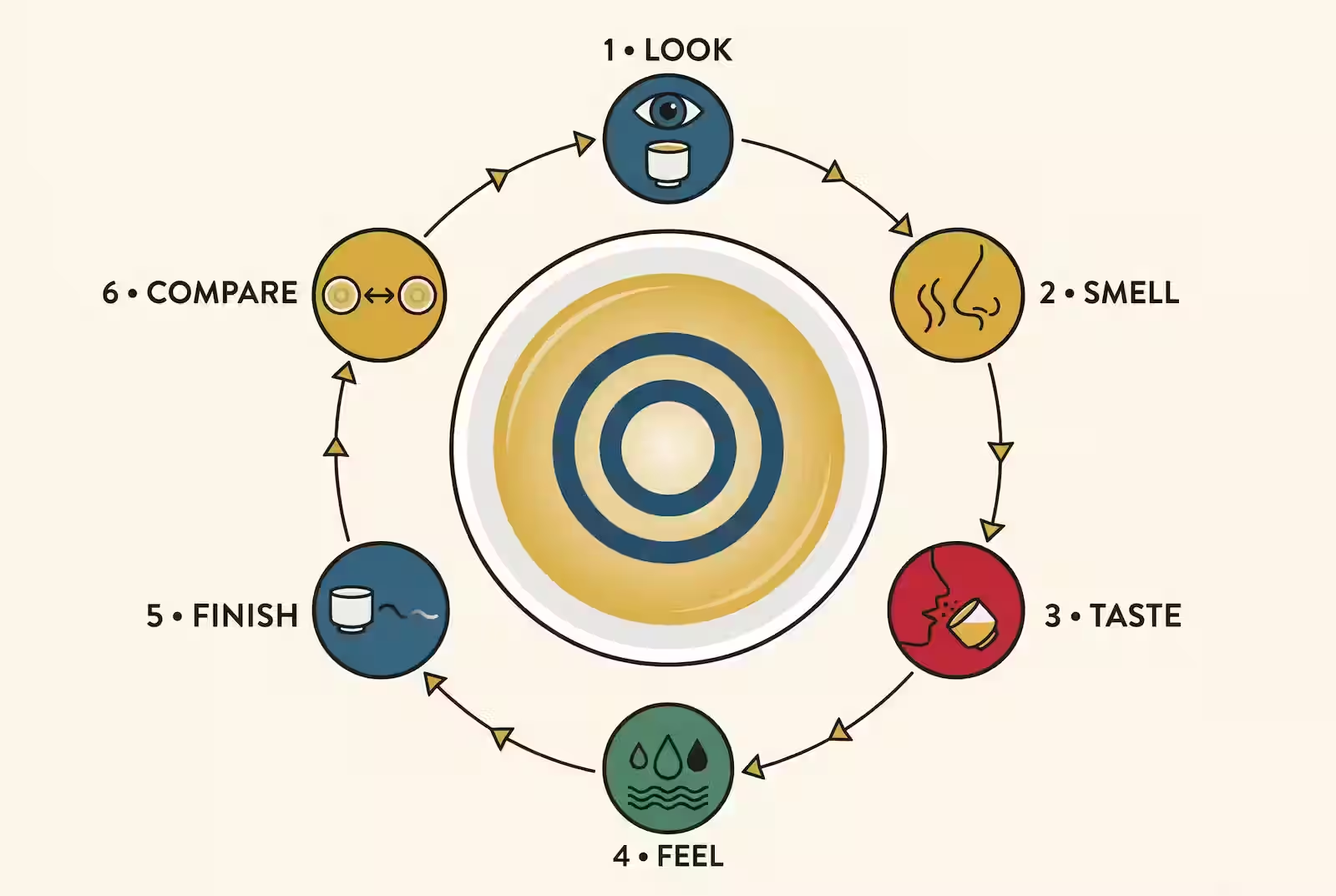
To taste sake, first look at its color and clarity. Next, smell it while the glass is still. Then take a small sip and notice sweetness, acidity, umami, alcohol and texture. Finally, wait for the aftertaste, and taste again to compare.
TOC
You Don’t Need to Be a Sake Expert
Tasting sake is observation, not an exam. Japan’s National Research Institute of Brewing (NRIB) maintains a standardized vocabulary for professional evaluation. However, the same institute has also studied how non-expert consumers describe sake. In other words, the professional system exists, but beginners do not need to master it first.
Quick Facts
The six steps
Look, smell, taste, feel, finish, compare
What to notice
Appearance, aroma, sweetness and acidity, umami and bitterness, body and texture, aftertaste
Traditional tasting cup
Kiki-choko: a white porcelain cup with blue concentric rings
Reference sip
About 5 ml in the brewers’ association tasting guide
Two kinds of aroma
Orthonasal (above the glass) and retronasal (through the mouth)
Key idea
Describing a sake is not the same as ranking it
There Is No Single Required Vocabulary
Professionals use shared reference samples and standardized terms, which make their evaluations more consistent and comparable. Even so, a 1989 paper in the Journal of the Brewing Society of Japan argued for terms that general consumers can understand. For a personal tasting note, there is no fixed set of words you must use. Your first job is simply to record what you notice, and to do so consistently. Honestly, that is harder than it sounds, which is exactly why a routine helps.
Observation Comes Before Judgment
The NRIB’s standard vocabulary deliberately leaves out value words such as good and bad. Its terms describe a sake’s characteristics, and judgment comes separately. Borrow that habit, and tasting becomes much less stressful. You can describe a sake before deciding whether you want another glass.
Tasting Can Be Casual
Drinking is about enjoyment, company and the meal. Tasting, by contrast, is about attention and comparison. Still, the two overlap, and tasting can happen halfway through dinner. It takes a minute of focus, not a quiet laboratory.
The Six Parts of a Sake Tasting
Professional sake evaluation separates aroma, basic tastes, mouthfeel, the sweet-to-dry balance, body and aftertaste into different attributes. The NRIB terminology system, for instance, sorts 86 terms into 16 classes. You do not need all 86 terms for a first tasting. So this guide uses six steps.
01
Look
02
Smell
03
Taste
04
Feel
05
Finish
06
Compare
The first five steps identify features of the sake. The sixth, compare, helps you understand those features more clearly. Here is what each of the first five asks you to notice.
Look: color, clarity and any cloudiness or sediment
Smell: what you smell above the glass, and the aromas that return through the nose after a sip
Taste: sweetness and acidity, then umami, bitterness and alcohol warmth
Feel: body and texture, from light to full and from silky to viscous
Finish: what stays after you swallow, and how it leaves
Temperature sits outside this list, because it can change every item on it. We give it a section of its own later. First, let’s take the steps in order.
Step 1: Look at the Sake
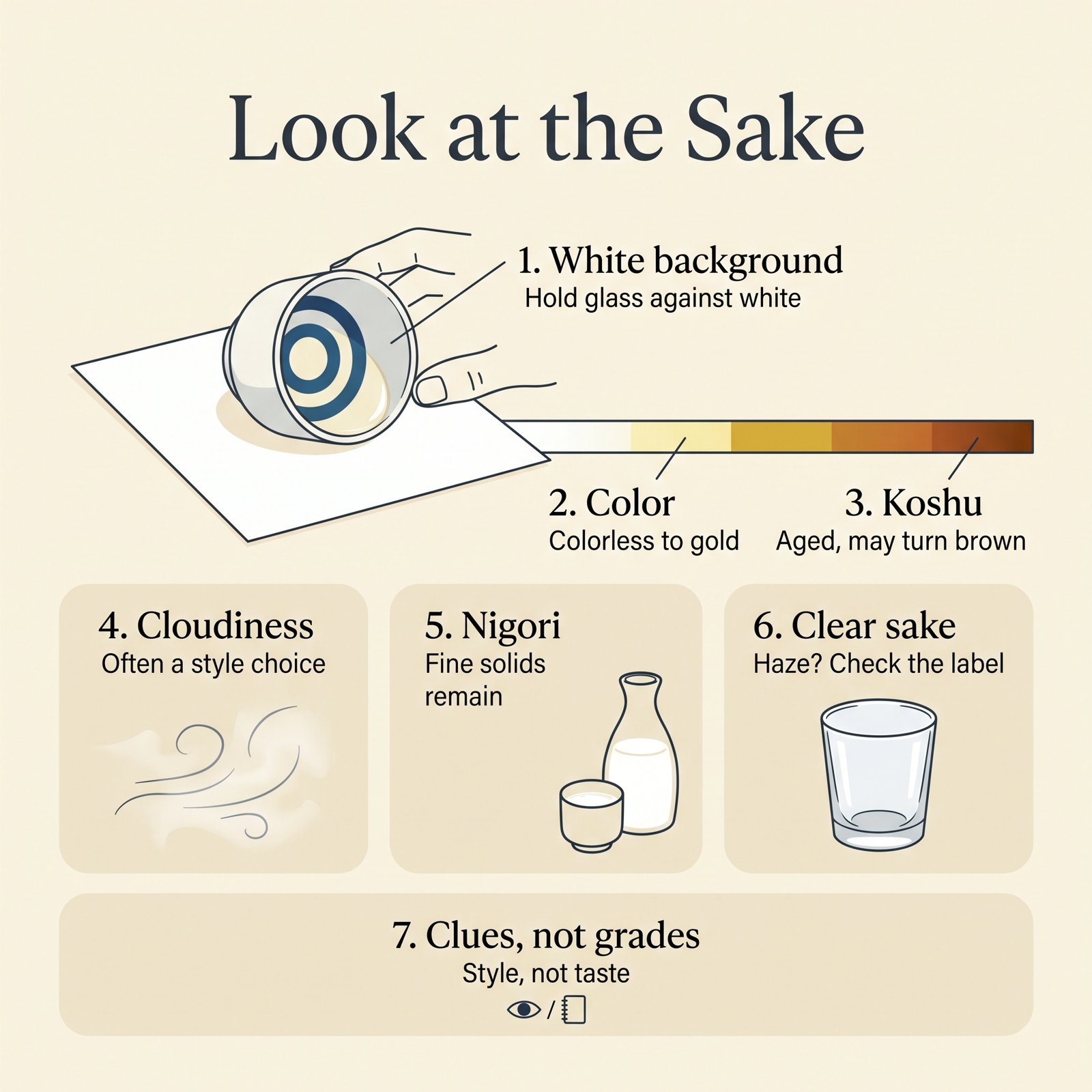
Hold the glass against something white and look down into it. The tasting guide from the Japan Sake and Shochu Makers Association starts here: observe the color and the clarity. That is the whole task, and it takes only a few seconds.
Color
The guide asks you to check the degree of color. Some sakes look almost colorless, while others show a yellow tint. Some aged sake, known as koshu, develops deeper yellow, gold or brown tones. Not every aged bottle darkens the same way, though, so treat color as a hint.
Cloudiness and Sediment
Cloudiness is often a style choice rather than a flaw. Brewers filter nigori sake through a relatively coarse material, so fine solids remain. According to the NRIB, those lees contain rice, koji, their breakdown products and yeast. Sediment can therefore be normal in nigori and other bottles sold with lees.
Clear sake is a different case. If sediment or haze surprises you there, check the label and the producer’s storage notes before you draw conclusions.
Appearance gives clues, not grades
A pale, brilliant sake is not automatically better than a cloudy one. Appearance tells you about style and handling. It does not tell you how the sake tastes.
Step 2: Smell the Sake
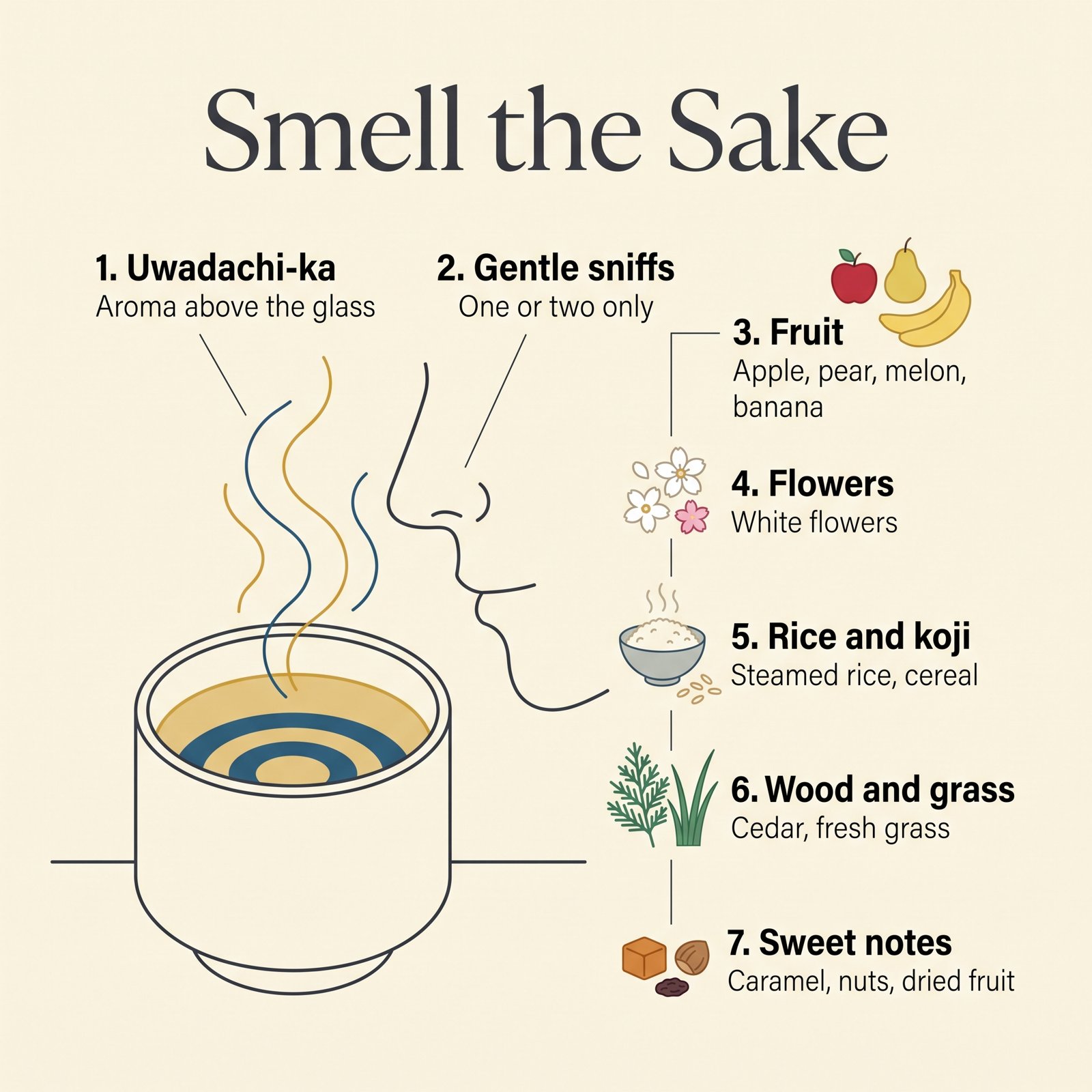
Bring the glass close to your nose while it is still. The brewers’ association guide describes exactly that step. You gently bring the cup toward the nose and check the uwadachi-ka, the aroma rising from the surface. Try one or two gentle sniffs. That last tip is a practical suggestion, not part of the formal instructions.
Smell First, Then Move the Glass
If you use a larger glass, you can then move it very gently and smell again. Sometimes the impression shifts. Sometimes nothing changes. Either result is worth a note. However, swirling is not part of the association’s procedure, so think of it as an optional experiment.
What You Might Notice
Fruit is an easy aroma family to recognize, especially in many ginjo-style sakes. Apple, pear, melon and banana are typical examples. Beyond fruit, you may find steamed rice, cereal, flowers, cedar, caramel or nuts. The list below is a starting point, not a test.
Apple, pear, melon, banana
White flowers
Steamed rice, cereal, koji
Cedar, fresh grass
Caramel, nuts, dried fruit
You Do Not Have to Name the Fruit
Here is a relief for beginners. In 2006, NRIB researchers ran a sensory study with consumers. They organized the consumers’ descriptions into eight broad, familiar aroma groups. Those groups included apple, banana, rice and koji, and wood and grass. Therefore, “fruity” is a perfectly good note. “Green apple with a hint of pear” is nice, but optional.
Aroma Categories in Sake
Grouping aromas makes them easier to remember. The categories below borrow from the NRIB flavor wheel and then simplify it. They are useful descriptive buckets, not an official classification.
Fruity
Apple, pear, banana, melon. Often associated with ginjo-style sake.
Floral
White flowers and light perfume. Often sits beside the fruit.
Rice and grain
Steamed rice, cereal, koji. These can appear across many styles, especially when fruit is restrained.
Woody and grassy
Cedar, fresh grass, nuts and spice. According to the NRIB, cedar aroma comes from cedar casks.
Mature
Caramel, honey, nuts, dried fruit. Aromas of deliberately aged sake.
Other personal notes
Mushroom, dried leaves, mineral-like. Personal descriptions, not fixed categories.
Where the Fruit Comes From
Fruity sake does not contain fruit. Instead, many of those aromas come from compounds that sake yeast produces during fermentation. The NRIB’s aroma reference names two examples. Isoamyl acetate recalls banana, and ethyl caproate recalls apple. Labels for daiginjo and other ginjo styles often highlight this fruity character.
Grain-like aromas may recall steamed rice, cereal or koji, the mold whose enzymes break rice starch into fermentable sugars. Their intensity depends on the raw materials and brewing choices. As a result, you cannot predict it from the rice polishing ratio alone.
Mature Is Not the Same as Stale
Long-aged sake can show caramel-like aromas, and the NRIB calls that matured aroma. A different term, hine-ka, covers storage-related aromas. The official glossary compares hine-ka to rotten cabbage or pickled radish, and it treats the two as distinct. Mushroom needs similar care. The NRIB links a mushroom-like note to koji, yet its English glossary uses “mushroomy” for a moldy smell. So explain what you mean when you use that word.
Step 3: Taste the Sake
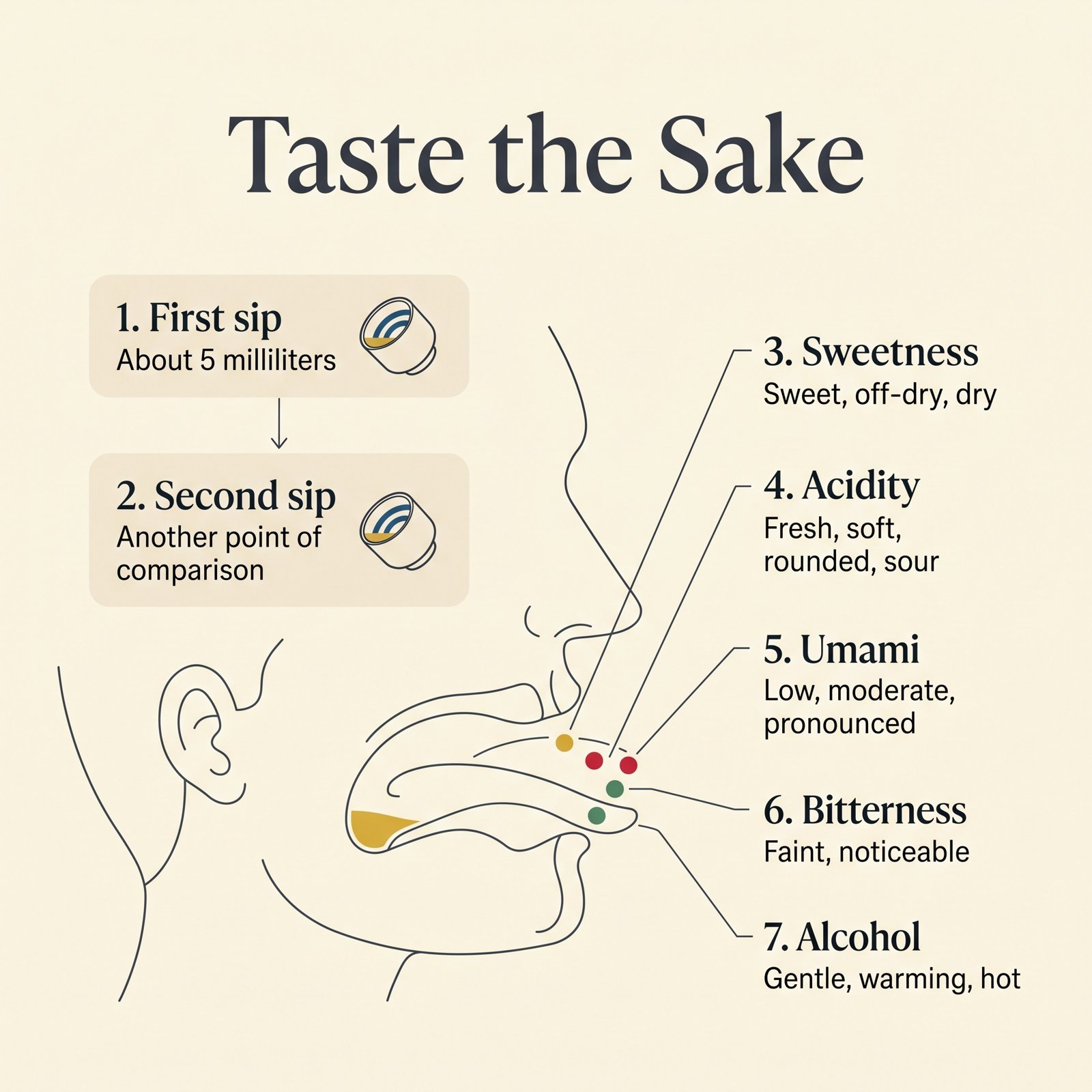
Now take a small sip. The association’s kikizake guide uses about 5 milliliters as a reference amount. Let the sake spread across your tongue, and give it a moment before forming an opinion.
What to Notice in the First Sip
Several impressions may arrive almost together. First, notice the balance of sweetness and acidity. Then pay attention to umami, bitterness, alcohol warmth and texture as the sip develops. Do not worry about identifying them in a fixed order, because no rule says they must line up.
Take a Second Sip
A second sip gives you another point of comparison. You may notice details that escaped you the first time. However, the second impression is not automatically more accurate. It is simply more information, and more information makes a better note.
Element
What to look for
Easy words
Sweetness
A sweet impression, judged against the acidity
Sweet, off-dry, dry
Acidity
The sour-taste component that adds freshness
Fresh, soft, rounded, sour
Umami
Savory taste, sometimes broth-like
Low, moderate, pronounced
Bitterness
A slight grip or edge
Faint, noticeable
Alcohol
Warmth, sometimes a tingle
Gentle, warming, hot
Sweetness and Dryness
Ask ten people whether a sake is sweet or dry, and you may get ten answers. That is not because they are wrong. Dryness in sake is a balance, not a sugar reading. The NRIB puts it plainly: the balance between sugar and acidity explains most of the sweet-to-dry impression.
Why Dry Does Not Mean No Sugar
In the official sake vocabulary, dry has two meanings. Either the sense of sweetness is low, or acidity and alcohol feel more prominent than sweetness. So a dry sake can still contain sugar. With the same sugar, higher acidity makes sweetness harder to notice. The NRIB adds that aroma and mouthfeel also shape the impression.
Nihonshu-do Is a Clue, Not a Score
Sake labels often print a number called nihonshu-do, or sake meter value. Analysts derive it from the specific gravity of the sake at 15°C. Positive values generally go with a lighter, drier profile. Negative values, by contrast, often go with a denser, sweeter one. Still, it measures density, not sugar, and it cannot fully predict taste.
The NRIB later proposed a classification that uses glucose and acidity together. That proposal reflects the same point: density alone cannot describe perceived sweetness and dryness. Not every brewery uses the newer scale, though.
Key idea
Read the number, then trust your mouth. Two sakes with the same meter value can taste quite different. Our guide to reading a sake label explains the other figures.
Acidity: The Shape of the Flavor
Acidity in sake is often less obvious to beginners than sweetness or aroma. Yet it plays an important role in balance. When acidity feels restrained, sweetness and body may appear broader or softer. When it is more noticeable, the sake may feel brighter or more defined.
Freshness, Lift and Structure
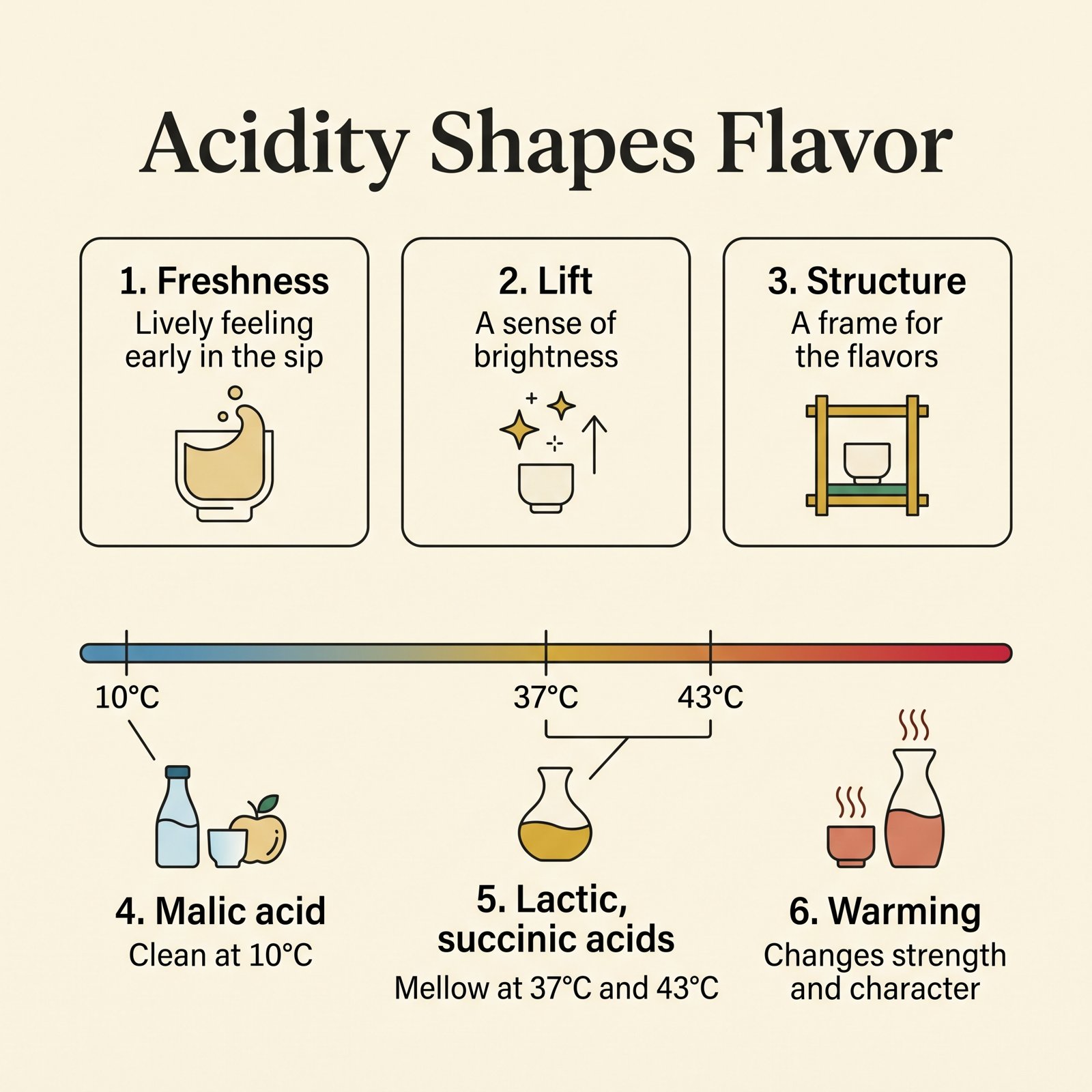
Acidity is the sour-taste component, but “sour” rarely captures what it does. So try a few other words. Freshness is a lively feeling early in the sip. Lift is a sense of brightness. Structure is the impression that the flavors have a frame. These are editorial descriptions rather than official sake terms.
Acidity Also Changes With Temperature
A 2009 study in the Journal of Cookery Science of Japan looked at this question. It used the main organic acids found in sake, and a trained panel tasted them at several temperatures. The panel found malic acid refreshing and clean at 10°C. Lactic and succinic acids, by contrast, felt soft and mellow at 37°C and 43°C.
Interestingly, some acids also tasted stronger when warm. So warming does not simply soften acidity. It can change both how strong the acidity seems and what character it has. Because the study used model solutions, commercial sake may behave differently.
Umami: The Savory Taste
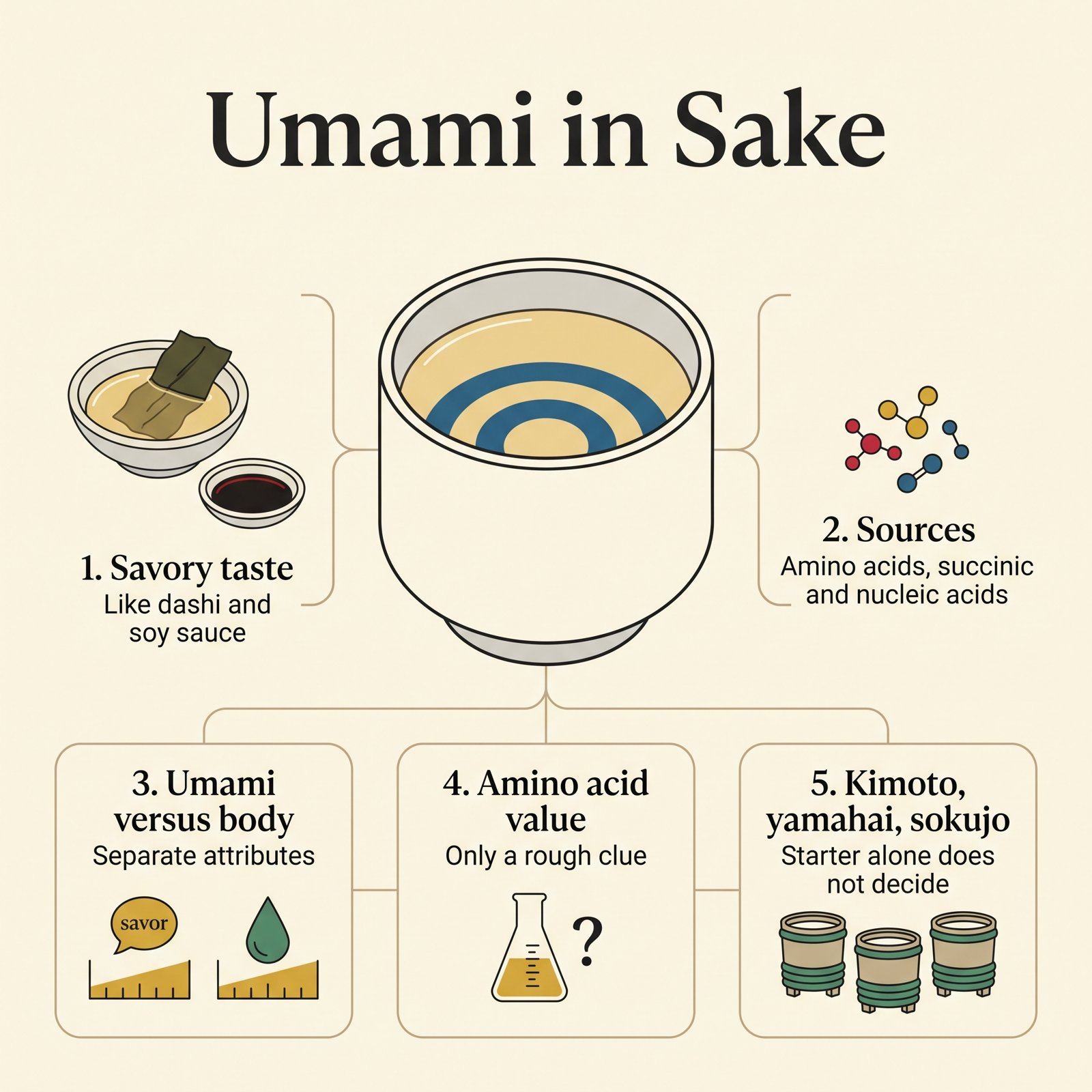
Umami is the basic savory taste you know from dashi and soy sauce. Sake has it too, which is one reason it sits so comfortably beside Japanese food. The NRIB defines umami in sake as the savory taste of amino acids, succinic acid and nucleic acids.
What Umami Is and Is Not
Umami may contribute to a sense of depth. However, depth and body also depend on sweetness, acidity, alcohol, aroma and texture. Professional sensory frameworks therefore treat umami and body as separate attributes. A sake can taste savory and still feel light.
Reading the Clues
Some labels list an amino acid value. It offers a rough analytical clue, but it does not predict perceived umami or body by itself. Similarly, kimoto, yamahai and sokujo sakes can make an interesting comparison. Even so, the starter method alone does not determine umami.
Step 4: Feel the Texture and Body
This step is about the physical side of tasting. Rather than a flavor, it concerns how the liquid sits and moves in the mouth. Two ideas help here: body and texture.
Body
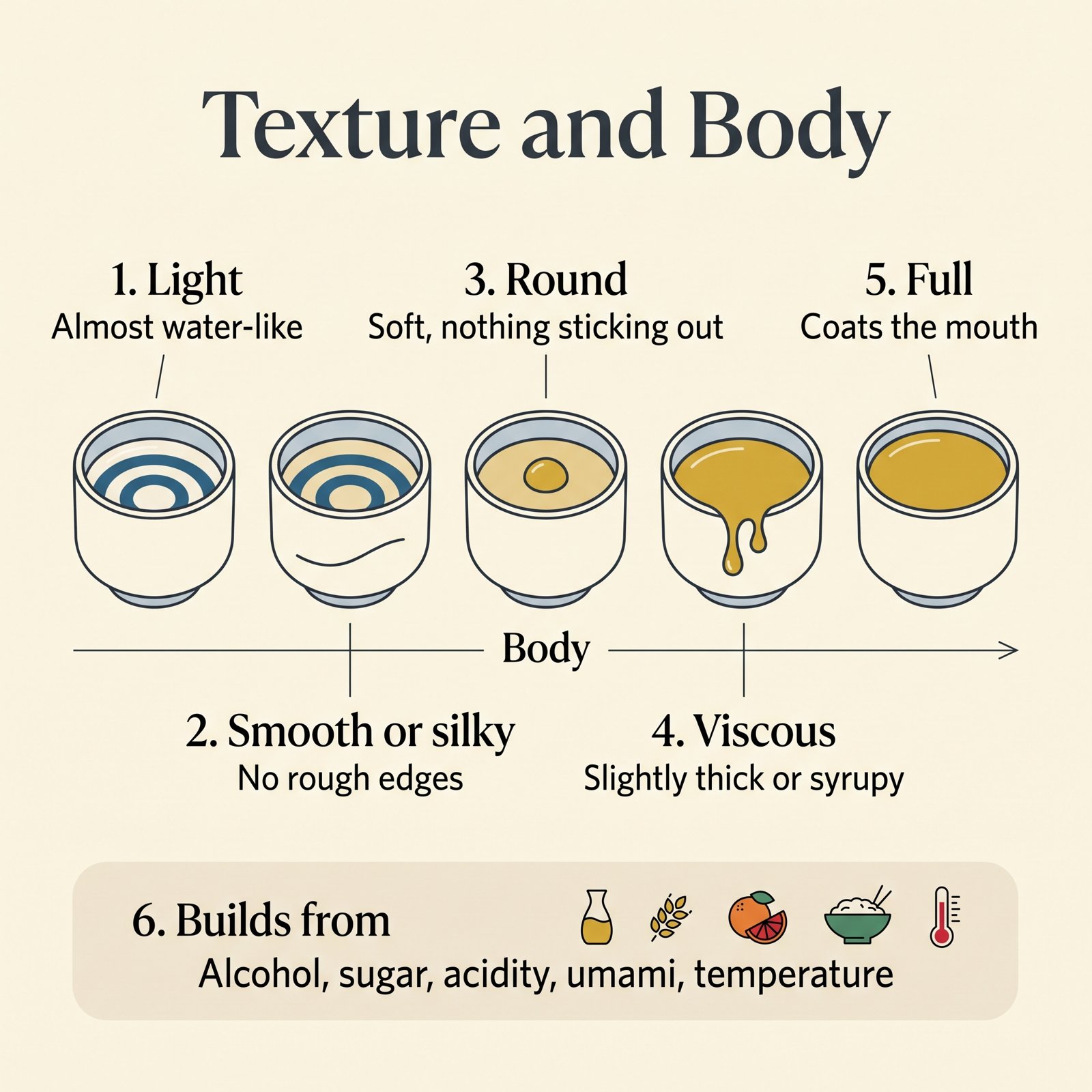
Body is the overall sense of weight, concentration and presence in the mouth. It is not the same as flavor complexity or umami. A light-bodied sake feels relatively delicate, although it may still have a long aftertaste. A full-bodied one feels weightier. The official vocabulary covers this with words such as koku and fukurami.
Texture Words That Help
Light: low in weight, almost water-like
Smooth or silky: no rough edges
Round: soft, with nothing sticking out
Viscous: slightly thick or syrupy
Full: coats the mouth
Smooth, silky and round all appear in the NRIB’s English glossary. “Crisp” is different. It is a broad tasting word rather than a single measurable attribute. It usually suggests noticeable acidity, a defined structure and a relatively clean finish.
What Builds Mouthfeel
Alcohol, sugar, acidity, umami compounds and temperature can all contribute. For example, higher alcohol, as in some undiluted genshu, may increase warmth. Sweetness may add a rounded impression, while noticeable acidity may make the sake feel more defined. The final texture comes from their interaction rather than any single component.
Step 5: Pay Attention to the Finish
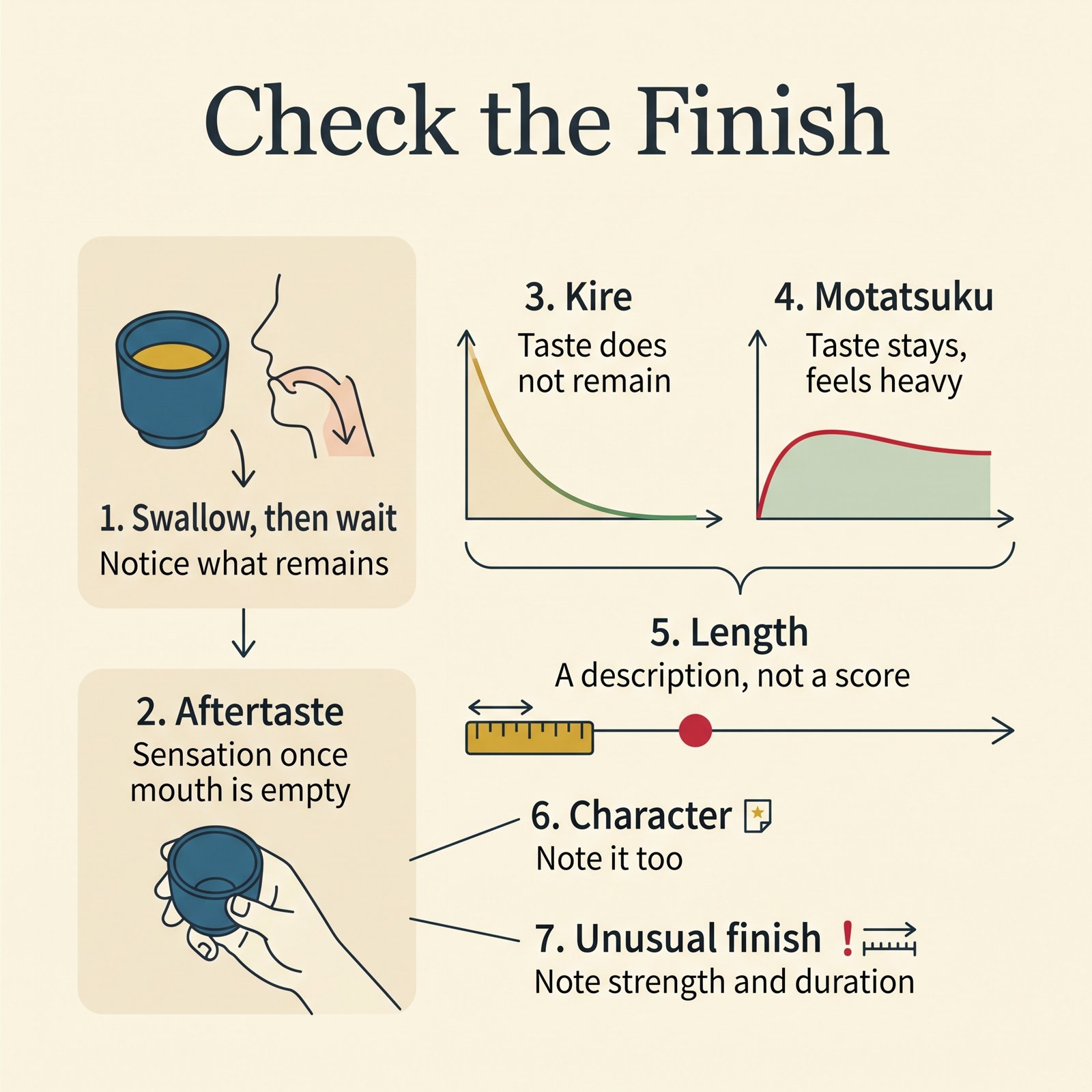
Swallow, then wait. The NRIB defines aftertaste as the sensation that remains once the mouth is empty. The brewers’ association guide calls this step checking the kire. Many English tasting notes simply call it the finish.
Kire and Its Opposite
The official vocabulary has two terms for how taste leaves the mouth. Kire means the taste does not remain. Motatsuku means it stays, usually with a sense of heaviness. The association’s guide says quality shows in overall harmony and kire. Even so, a longer aftertaste is not automatically a defect. Its suitability depends on the style and on what remains.
Length Is Only One Description
You will see short, medium and long finishes in many tasting notes. Those are handy labels, but they are not standard sake categories, and length is not a quality score. So note the length, and then note the character.
Watch for this
If the finish feels bitter, hot, sour or otherwise unusual, note both its intensity and how long it lasts.
Retronasal Aroma: Why Sake Smells Different in Your Mouth
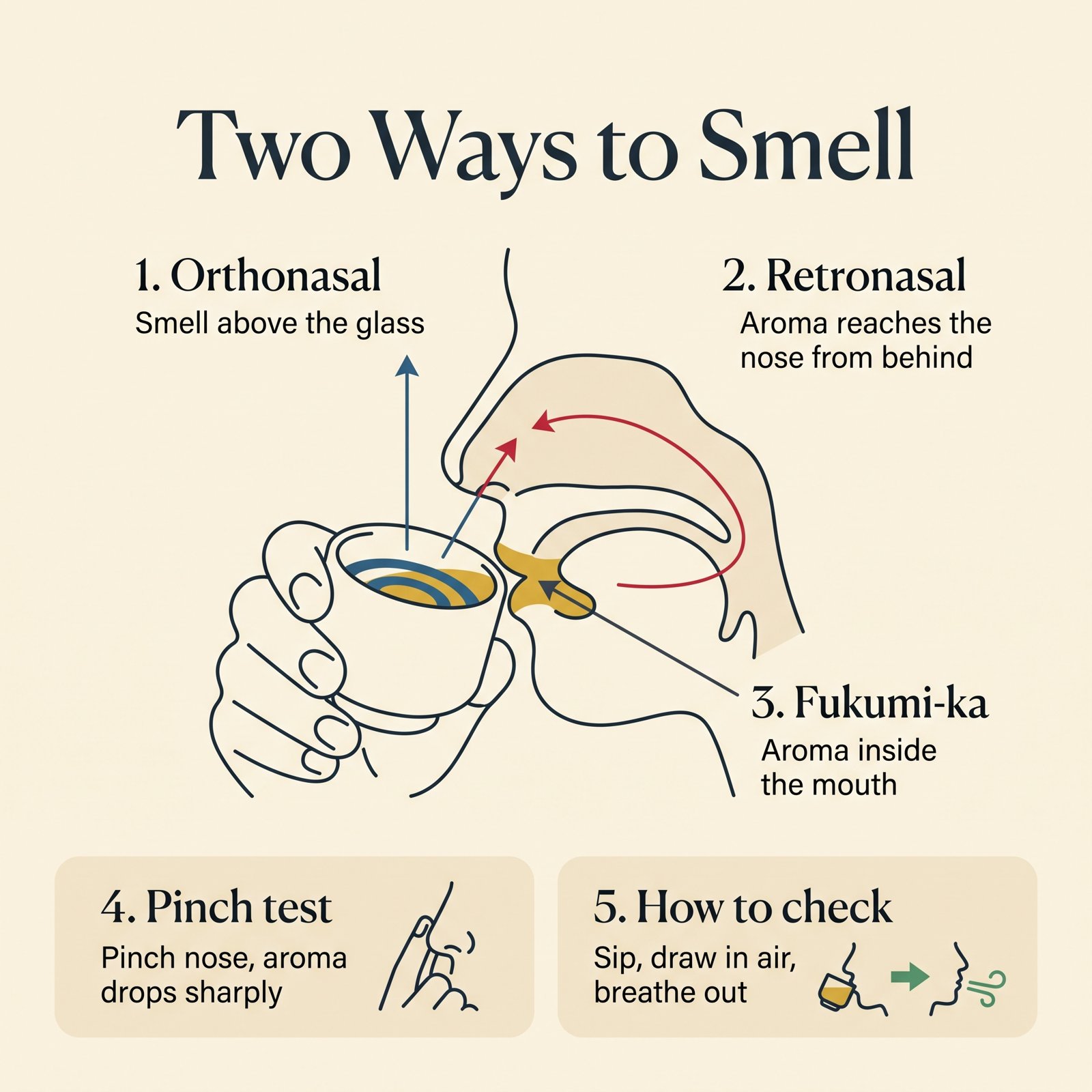
Smell happens twice. First you smell above the glass, which scientists call orthonasal aroma. Then, once the sake is in your mouth, aroma reaches the nose from behind. That second route is retronasal aroma. The NRIB glossary matches these to the Japanese terms uwadachi-ka and fukumi-ka.
Smell Versus Flavor
A 2024 review in the Japanese Journal of Taste and Smell Research covers this topic. It describes flavor as the integration of retronasal smell and taste. In other words, much of what people casually call taste includes aroma. Pinch your nose while sipping, and the aroma component drops sharply. That makes the role of retronasal smell easy to notice.
How to Check It
The brewers’ association guide gives a simple method. Take a small sip, draw in a little air, and then breathe out through the nose. The aroma you notice then is the fukumi-ka. It may differ from what you smelled above the glass.
Temperature and Sake Tasting
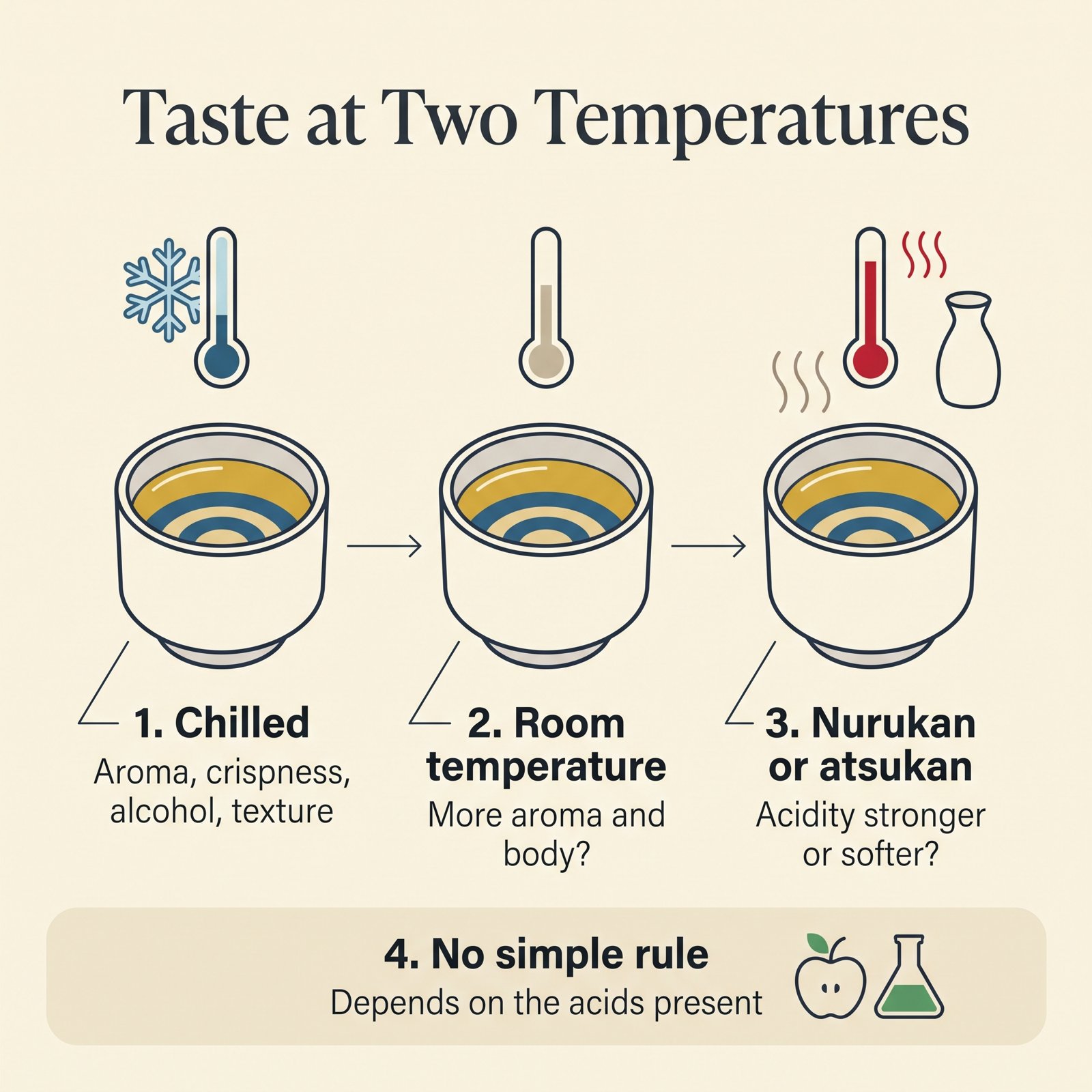
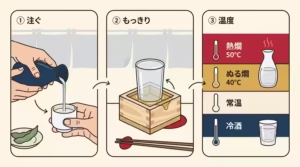
Temperature is the easiest variable to change. Rather than memorizing a chart, taste one sake at two temperatures and notice the difference yourself. The table below lists questions, not answers. Our guide to drinking sake in Japan covers serving styles in more detail.
Temperature
What to compare
Chilled
Aroma intensity, crispness, alcohol impression and texture
Room temperature
Whether more aroma and body become noticeable
Gently warmed (nurukan) or hot (atsukan)
Whether acidity feels stronger or softer, and whether texture feels rounder
Why There Is No Simple Rule
The 2009 acid study found that temperature effects depend on which acids are present. Therefore, a rule like “warming makes sake sweeter” is too simple. Temperature can also change how strongly you notice alcohol and aroma. Room temperature is a practical neutral starting point at home. Many labels also suggest serving temperatures, so check the bottle first.
How the Sake Vessel Changes Your Perception
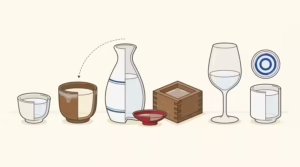
The cup can change what is easiest to notice. A small ochoko encourages small servings and frequent sips. A wider vessel, on the other hand, gives more room to explore aroma.
Ochoko, Guinomi and Wine Glass
The brewers’ association explains it simply. An ochoko suits sake you drink in one sip. A guinomi has a wider mouth, so you can enjoy the aroma as well. A wine glass has a wide mouth too, which helps with complex aromas. These are practical observations rather than results of a controlled comparison. Our guide to sake glasses and cups goes deeper.
Step 6: Compare the Sake
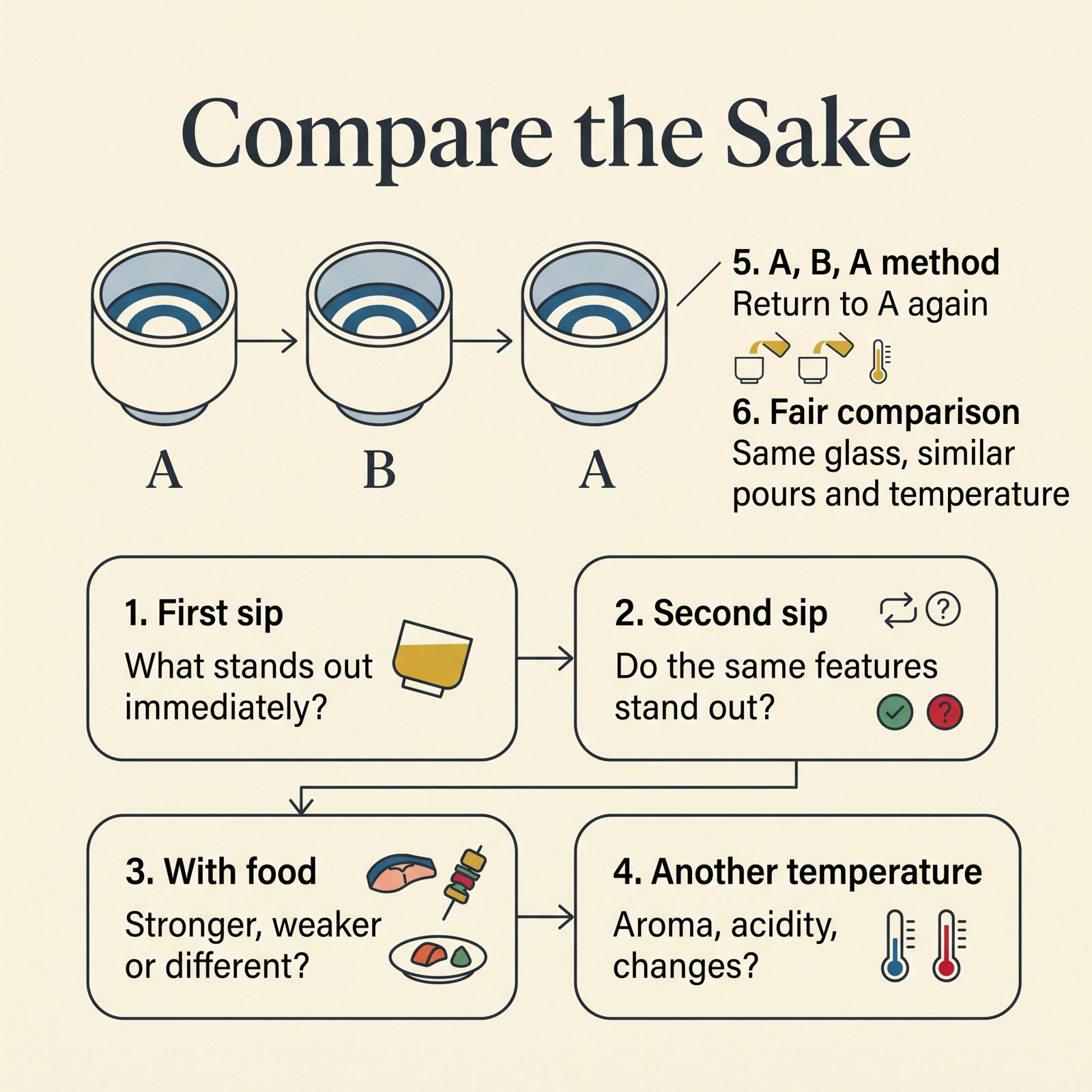
Comparison is the fastest way to learn, because differences are easier to notice than absolutes. It is also central to formal tasting exercises. In Japan’s national sake tasting championship, for example, contestants taste the same seven sakes twice, in different orders. They rank the sakes by preference each time, and the scoring rewards a consistent ranking. The championship is open to amateurs.
Compare a Sake With Itself
A first impression is not the whole sake. So start by tasting one sake at several moments, and ask a question each time.
Moment
Question to ask
First sip
What stands out immediately?
Second sip
Do the same features still stand out?
With food
What becomes stronger, weaker or different?
At another temperature
How do aroma, acidity, alcohol and texture change?
Compare Two Sakes
Next, pour two sakes side by side. Pick three elements, such as aroma, sweetness and finish, and ignore everything else for now. For a vivid first comparison, try an aroma-forward ginjo-style sake beside a less aromatic, savory one. A knowledgeable retailer can help you choose a clear contrast.
The A, B, A Method
One useful beginner exercise is A, then B, then A again. After tasting the contrasting sake, the return to A may reveal something you missed. This is not a formal requirement in Japanese evaluation. It simply gives you a second reference point.
Keep the Comparison Fair
For a fair comparison, use the same type of glass, pour similar amounts and keep the sakes at similar temperatures. Water and a plain cracker can help reset your mouth. Also, avoid perfume and strongly scented food while you check aroma. For a beginner, two or three sakes are easier to compare than a large flight. These are practical suggestions, not official rules.
How to Write Simple Sake Tasting Notes
A tasting note is a memory aid, not an essay. Five short lines are enough. Use the structure below, and fill each line with whatever words come naturally.
Sample tasting note
Appearance: clear, pale gold
Aroma: apple, pear, a little steamed rice
Taste: lightly dry, fresh acidity, moderate umami
Texture: smooth, light-bodied
Finish: clean, medium length
Keep the Words You Actually Use
You will drift toward a personal vocabulary, and that is fine. The point is consistency, because consistent notes let you compare bottles months apart. Also add the name, the temperature and the style, such as junmai, honjozo or namazake. Then the note becomes genuinely useful.
Separate Description From Verdict
Write what you observed first. Then, on a separate line, write whether you liked it. The two often disagree. You may describe a sake as full, savory and long, and still prefer the lighter one beside it. That disagreement is information, not a mistake.
Professional Sake Tasting and the Kiki-Choko
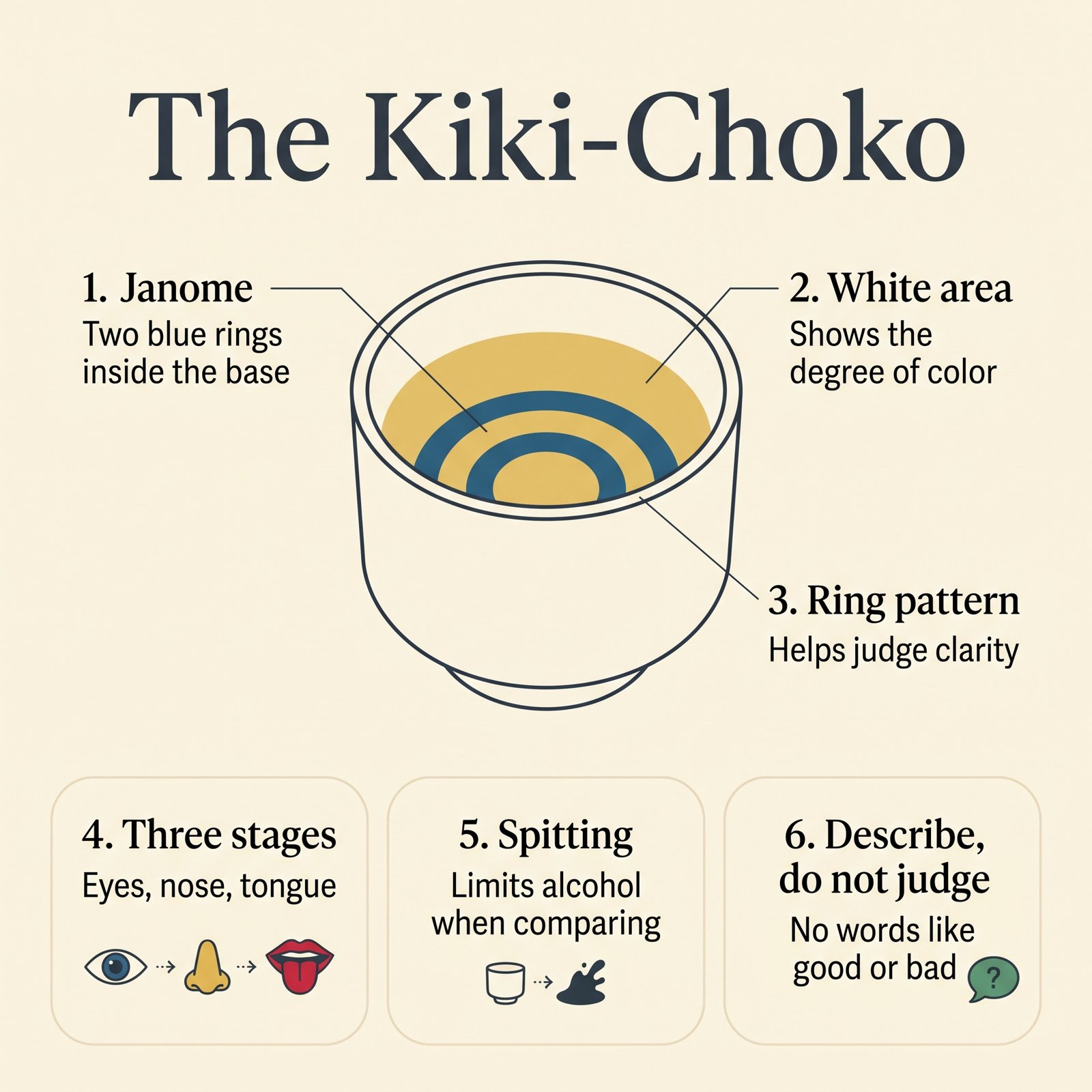
Formal tasting, called kikizake, follows the same path as this guide with stricter tools and shared terms. The brewers’ association guide sets out three stages: eyes, nose and tongue. Formal exercises may also use standardized vessels, a reference sip amount and repeated comparison rounds.
The Cup
A traditional vessel for sake evaluation is the kiki-choko. It is a white porcelain cup with two blue concentric rings on the inside base, a pattern called janome. According to the association, the white area shows the degree of color. The ring pattern, meanwhile, helps the taster observe clarity.
Why Tasters Spit
In the association’s guide, the taster checks the aftertaste after spitting the sake out. With one or two sakes at home, you can simply swallow. If you compare several bottles, however, spitting is a practical way to limit how much alcohol you drink.
Description Without Judgment
Professionals describe what they find using the NRIB’s shared vocabulary and reference samples. The system deliberately leaves out words like good or bad. Its job is description, and judgment comes separately. That split is the most useful idea a beginner can borrow.
Tasting Sake With Food
Food can shift the balance you perceive in sake. A 1994 study in the Journal of the Brewing Society of Japan tested this with a trained panel. Panelists held a reference taste solution in the mouth and then evaluated sake. Those residual tastes changed how they rated sweetness and dryness, body, smoothness and cleanness.
Observe Rather Than Predict
For example, the panel judged sake as drier after a sweet solution. A real dish is far more complex than a laboratory solution, though. So treat the effect as something to observe rather than predict. Taste before eating, during the meal and after a bite. Then ask what became stronger, weaker or newly noticeable.
Resist the urge to rank pairings during a tasting. Our dedicated article on sake and food pairing handles the recommendations.
What a Tasting Note Cannot Tell You
A good note describes. It does not decide. In particular, a note cannot settle the points below.
Your own reaction, since liking is separate from describing
Which sake on the table is “best”
Value for money, because price is not a sensory attribute
Exactly how the sake will taste to another person
Two people can write nearly identical notes and reach opposite verdicts. That is normal, because preference lives outside the description.
A Five-Minute Beginner Sake Tasting
Here is the whole method compressed into five minutes. Use any glass and any sake. A notebook helps, but the back of a receipt works too.
Min 1Look. Hold the glass against something white. Note color and clarity.
Min 2Smell. One or two gentle sniffs with the glass still. Pick one or two words.
Min 3Taste and feel. A small sip. Notice sweetness, acidity, umami, body and texture.
Min 4Finish. Swallow and wait. How does the taste leave?
Min 5Compare. Taste again after a short pause, with food or beside a second sake. Write what changed.
Repeat with another bottle next week, and compare the two notes. After a month, you will have a small record of what you like, and more importantly, why.
Common Mistakes When Tasting Sake
None of these are crimes. They just hide information.
Drinking too quickly. A gulp skips every step after the first.
Hunting for every aroma. One or two clear impressions beat a guessed list of ten.
Treating numbers as taste scores. Nihonshu-do and acidity are clues, not verdicts.
Assuming expensive means better. Price reflects production, ingredients, aging, supply and market factors, not your preference.
Ignoring temperature. The same sake can read quite differently when warm.
Judging after one sip. Give it a second sip before you decide.
Final Thoughts: Look, Smell, Taste, Feel, Finish, Compare
Use the same six steps as a simple routine: look, smell, taste, feel, finish and compare. You do not have to follow it rigidly. However, keeping the same order makes different tastings easier to compare.
The professional system behind these steps is detailed, and it helps to know it exists. But you do not need to find the “right” answer. You only need to notice what the sake is doing, and write it down in your own words. Do that a few times, and the vocabulary will arrive by itself. Our sake section explains the main styles you can practice on.
Frequently Asked Questions
Getting Started
How do you taste sake?
Look at the color and clarity, then smell with the glass still. Next, take a small sip and notice sweetness, acidity, umami and texture. Finally, pay attention to the aftertaste, and taste again to compare.
What should sake taste like?
Sake can range from delicate and lightly sweet to dry, savory, acidic, rich or matured. Common elements include sweetness, acidity, umami and alcohol warmth. However, there is no single required profile.
What does fruity sake mean?
Fruity sake has aromas that remind the taster of apple, pear, banana or melon. The sake does not contain those fruits. Instead, yeast produces many of these aroma compounds during fermentation.
Can you taste sake like wine?
Yes, the basic sequence of looking, smelling, tasting and noting the finish is similar. However, sake has its own vocabulary, serving temperatures and traditional tools. So wine terms do not always transfer exactly.
Terms and Tools
What does dry sake taste like?
Dry sake gives a low sense of sweetness, or its acidity and alcohol feel more prominent. It can still contain sugar. In the official sake vocabulary, dryness describes that balance rather than an absence of sugar.
Should sake be tasted cold or warm?
Room temperature is a practical starting point, because it avoids extreme chilling or heating. After that, try the same sake at another temperature. Then note what changes in aroma, acidity, alcohol and texture.
What is a kiki-choko?
It is a traditional tasting cup used in Japanese sake evaluation. The white porcelain shows the sake’s color. Blue rings on the inside base help the taster observe clarity.
What is a clean finish in sake?
A clean finish means the taste does not remain heavily after the sake leaves the mouth. The Japanese term kire often describes this quality. It is a description, though, not a rule that shorter is always better.
References
National Research Institute of Brewing (NRIB) – Utsunomiya, Isogai, Iwata and Nakano, Quality Evaluation Terms and Standard Samples for Sake Flavor in Sensory Analysis [editor’s translation] (Accessed October 2026)
National Research Institute of Brewing (NRIB) – On the Sweet-Dry Classification Display for Sake [editor’s translation]; related paper in Journal of the Brewing Society of Japan, Vol. 99, 2004 (Accessed October 2026)
Journal of Cookery Science of Japan (J-STAGE) – Shimazu, Fujiwara, Watanabe and Ota, The Effect of Drinking Temperature on the Sourness of Organic Acids in Sake, Vol. 42, No. 5, 2009 (Accessed October 2026)
Journal of the Brewing Society of Japan (J-STAGE) – Kawase et al., Effect of Coexisting Tastes on the Sensory Evaluation of Sake, Vol. 89, No. 1, 1994 [editor’s translation] (Accessed October 2026)
Japanese Journal of Taste and Smell Research (J-STAGE) – Shioya and Aoki, Differences in Olfactory Pathways and Neural Circuit Mechanisms in Flavor Perception, Vol. 31, No. 2, 2024 [editor’s translation] (Accessed October 2026)
Ryo Iwa is the founder and editor of foodinjapan.org. Born and raised in Japan, he writes from regional travel, market visits, and Japanese-language primary sources that rarely reach English readers, including brewing institute publications and industry glossaries. Where a figure cannot be traced to a source, the article says so.
He has been a Google Maps Local Guide for over 10 years, with more than 1,800 reviews and over 41,000 photos viewed hundreds of millions of times. He previously spent two decades as an IT consultant in Japan, the US, and the UK.











Comments