


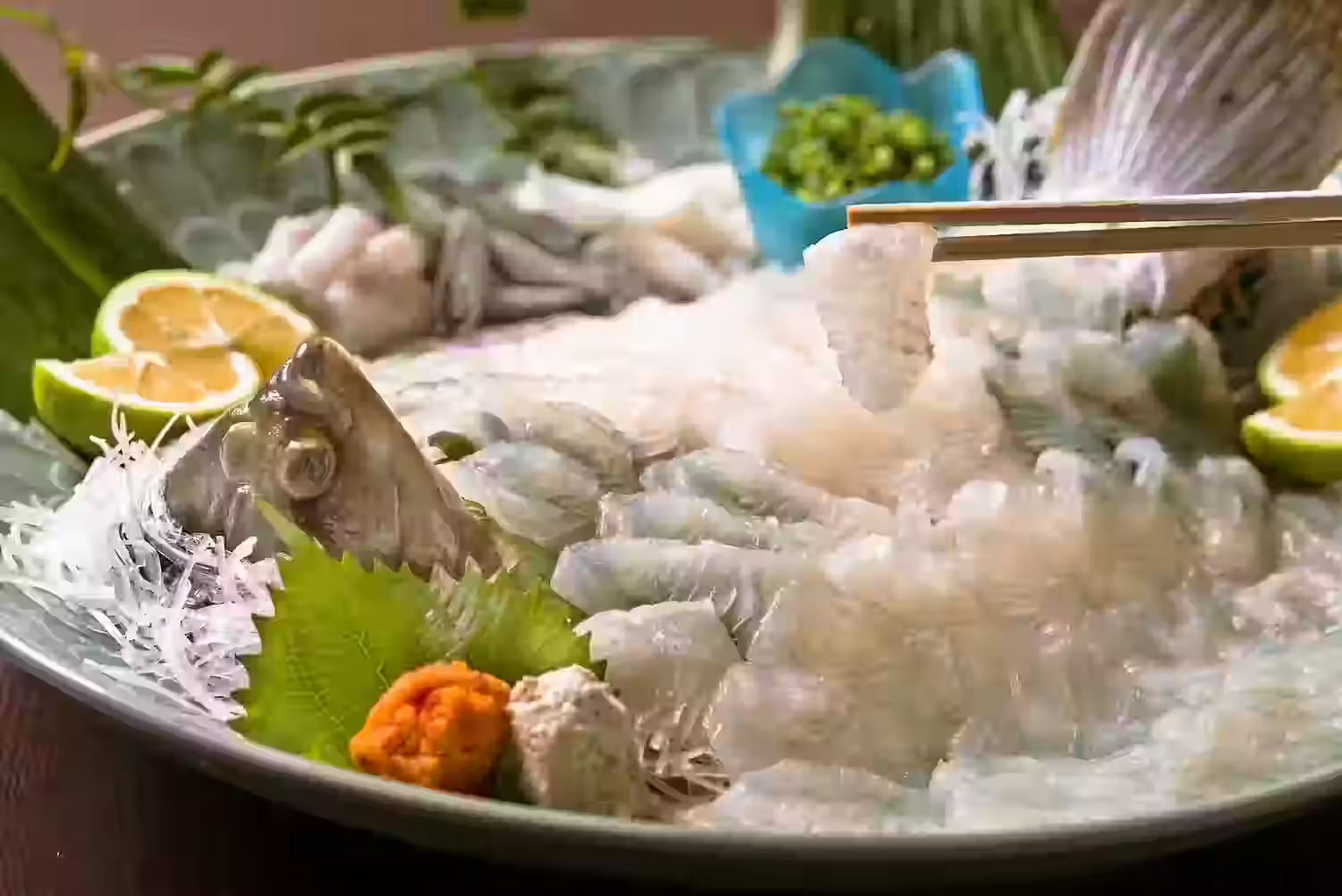

Below the ruins of a castle on Beppu Bay, fresh water seeps up through the seabed. Hiji Town in Oita Prefecture gives its local marbled flounder a name of its own: Shiroshita Karei. It is not a separate species, but a regional name shaped by place, history, and local food culture.
This guide explains what the name means, what the fish tastes like, and where the castle comes in. It also covers the season, the classic dishes, the festival, and why the fish has become harder to find.
What Is Shiroshita Karei?
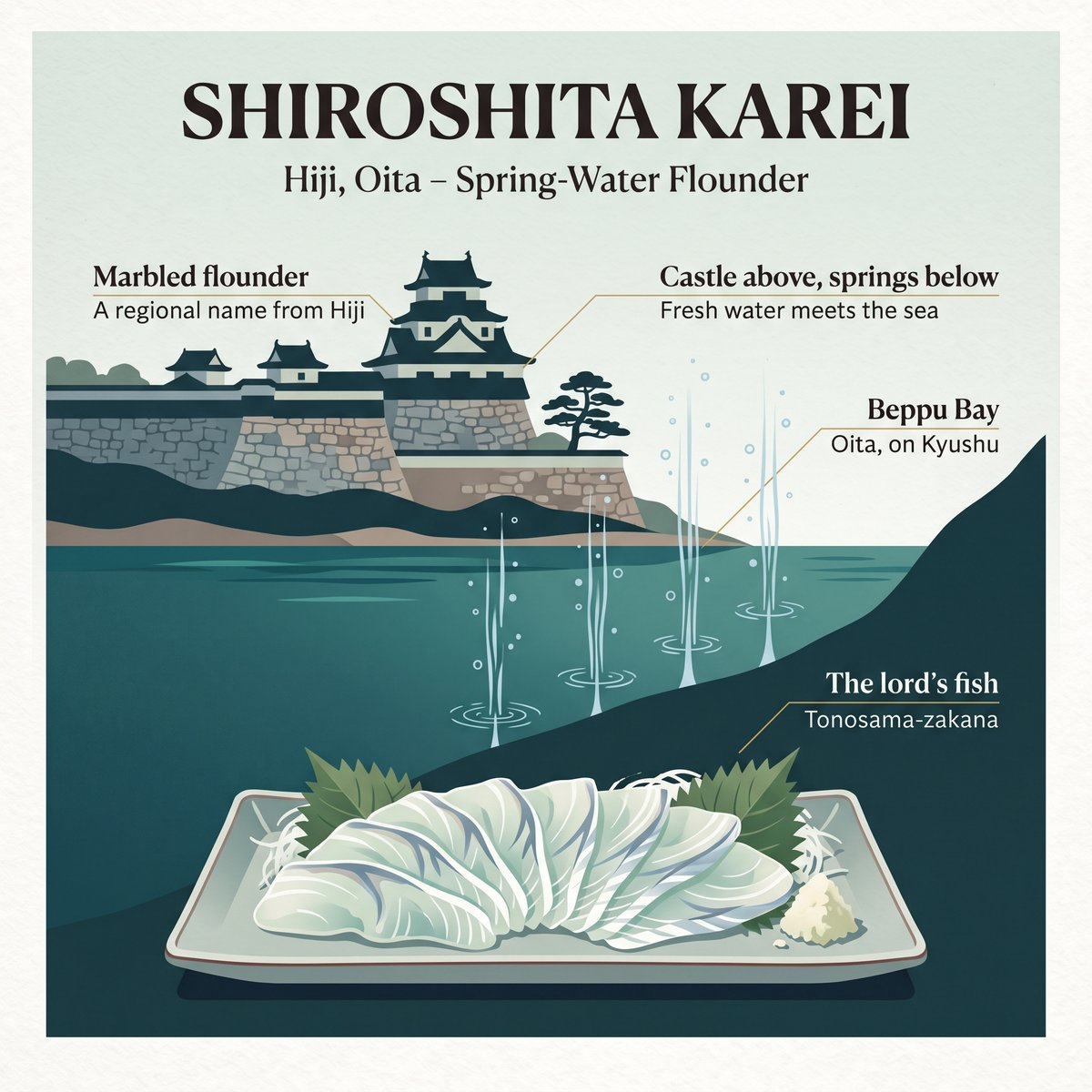
Shiroshita Karei (城下かれい) is Hiji Town’s name for locally produced marbled flounder. Hiji sits on Beppu Bay in Oita Prefecture, on the island of Kyushu. The name is especially tied to the sea below the old Hiji Castle, where fresh water rises from the seabed.
Quick Facts: Shiroshita Karei
- Japanese name
- 城下かれい (shiroshita karei)
- Species
- Marbled flounder, Pseudopleuronectes yokohamae (makogarei)
- Where it comes from
- Hiji Town, Oita Prefecture, on Beppu Bay
- Local setting
- Associated with the waters below the Hiji Castle ruins, where freshwater springs occur on the seabed
- Season
- About April to September; best from May to early July (local tourism association)
- Classic dishes
- Sashimi, karaage, and nitsuke (simmered fish)
- Nickname
- Tonosama-zakana, or “the lord’s fish”
The species itself is not unique to Hiji. Instead, the local name, the coastal setting, its culinary reputation, and its history set it apart.
English Name and Fish Species
In English, the species is usually called marbled flounder. Its scientific name is Pseudopleuronectes yokohamae, and in Japanese it is makogarei (マコガレイ). Biodiversity databases such as GBIF also list “marbled sole” as an alternative name.
That second name can confuse people. Marbled flounder belongs to the righteye flounder family, Pleuronectidae, rather than to the true soles. So “flounder” is the clearer word in English.
Karei vs Hirame on Japanese Menus
Japanese menus use two common words for flatfish. Karei usually means righteye flounders like this one, while hirame refers to olive flounder, a different fish. A well-known saying helps: “hidari hirame, migi karei,” or “left for hirame, right for karei.”
| Feature | Karei (e.g., Shiroshita Karei) | Hirame |
|---|---|---|
| Typical English name | Righteye flounder; marbled flounder for makogarei | Olive flounder, or Japanese flounder |
| Side the eyes face | Usually the right side | Usually the left side |
A general guide for diners. There are exceptions, and naming can vary by region.
Why Is It Linked to Hiji Castle?
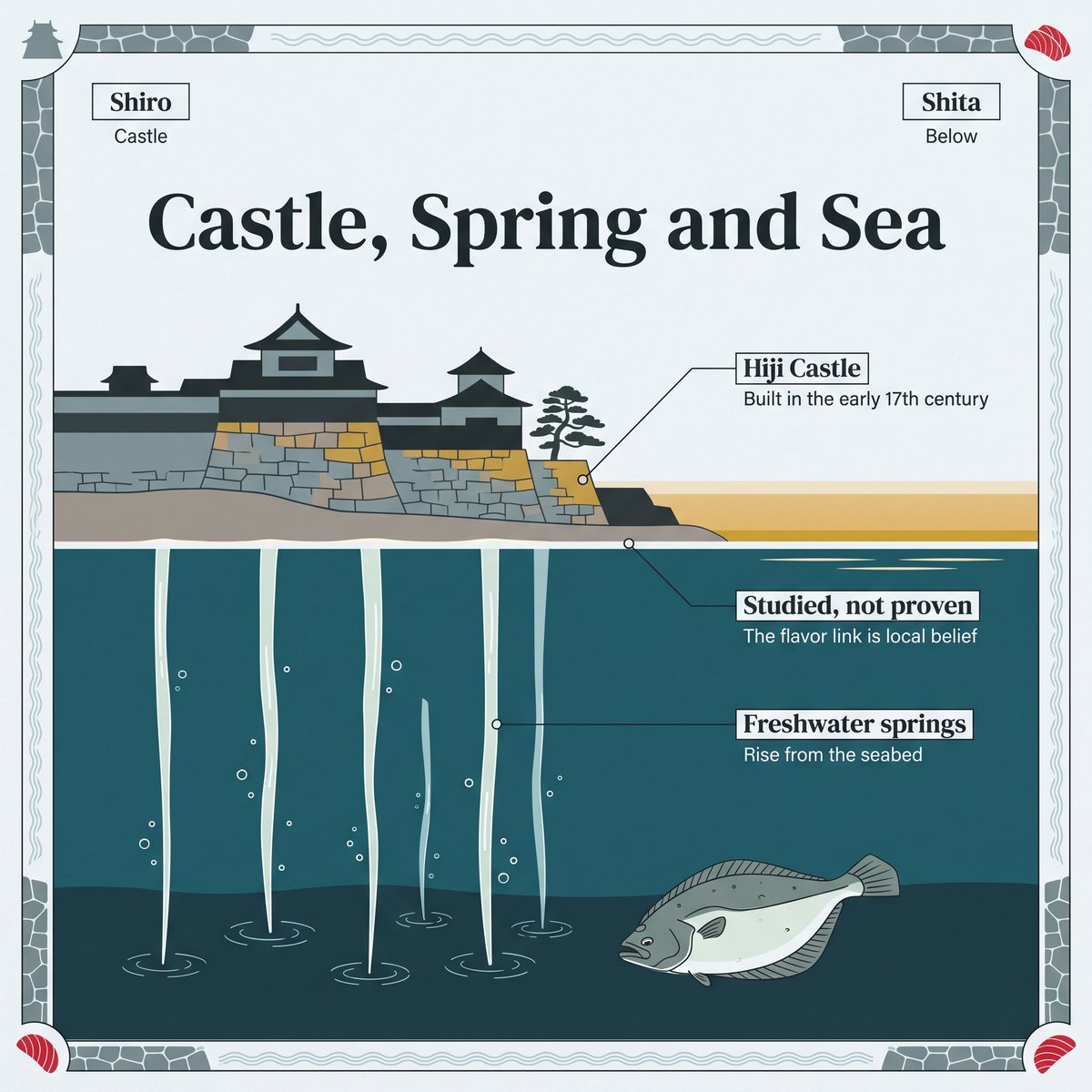
“Shiroshita” combines shiro (城), meaning castle, and shita (下), meaning below. The same kanji are usually read jōka, as in “castle town,” but the fish uses the reading shiroshita.
According to Japan’s Tourism Agency, the feudal lord Hosokawa Tadaoki built Hiji Castle in the early 17th century for his relative Kinoshita Nobutoshi. Today an elementary school stands on the site. Meanwhile, Hiji Town says flounder from the spring-fed water below tasted so good that the name stuck.
Fresh Water Beneath Beppu Bay
Hiji’s tourism association describes rain falling on nearby mountains, filtering underground for years, and emerging across the town and offshore. Hiji Town’s fisheries page confirms that fresh water wells up from the seabed below the castle ruins.
Scientists have looked into this as well. For example, a 1992 Nagasaki University study used LANDSAT-5 thermal infrared data to investigate submarine springs along the Hiji coast. Their paper treated the habitat of the town’s flatfish as linked to that groundwater.
Worth Knowing
The springs are real and have been studied. However, no study has shown that the spring water by itself creates the fish’s flavor. That link is a strong local belief rather than a proven fact.
What Does Shiroshita Karei Taste Like?
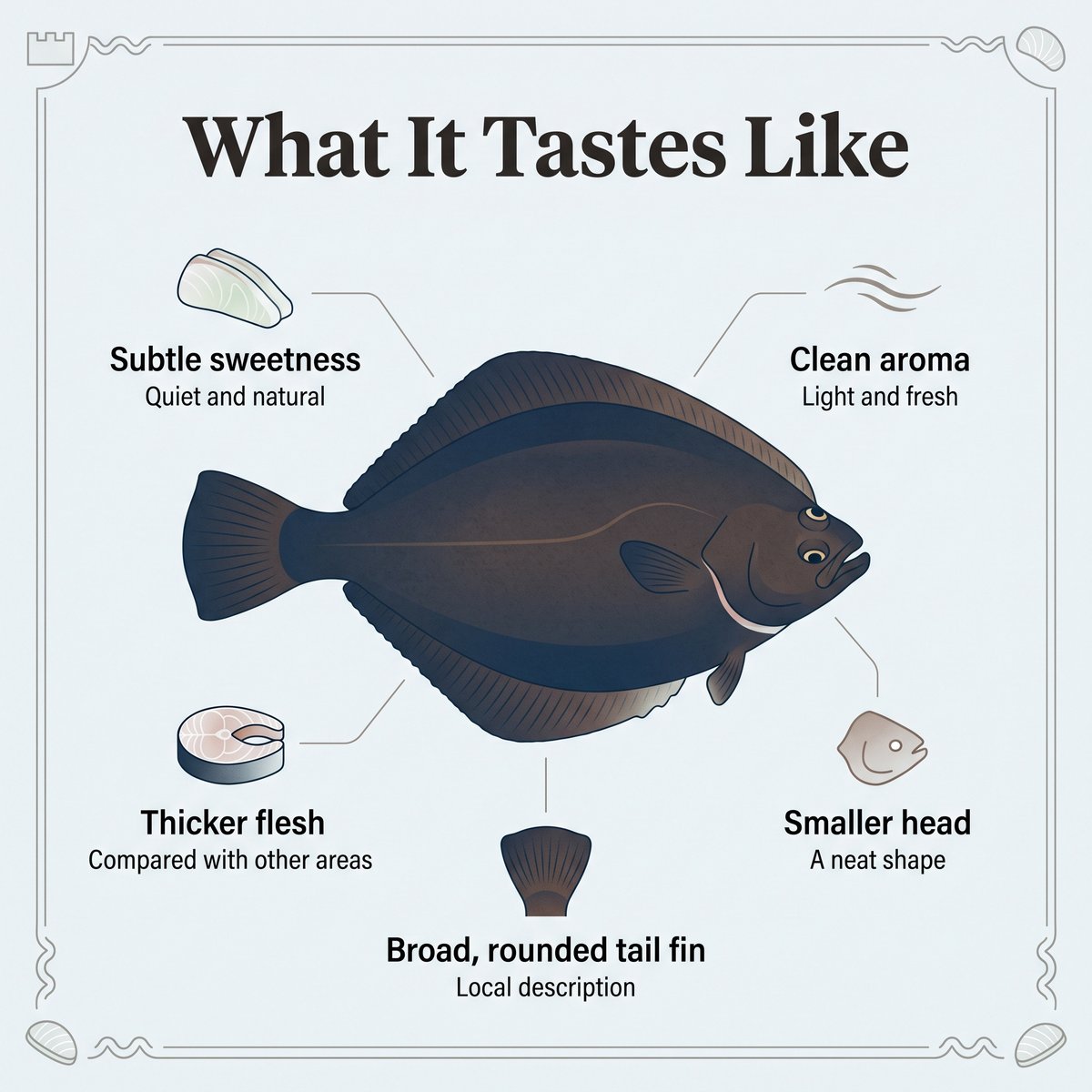
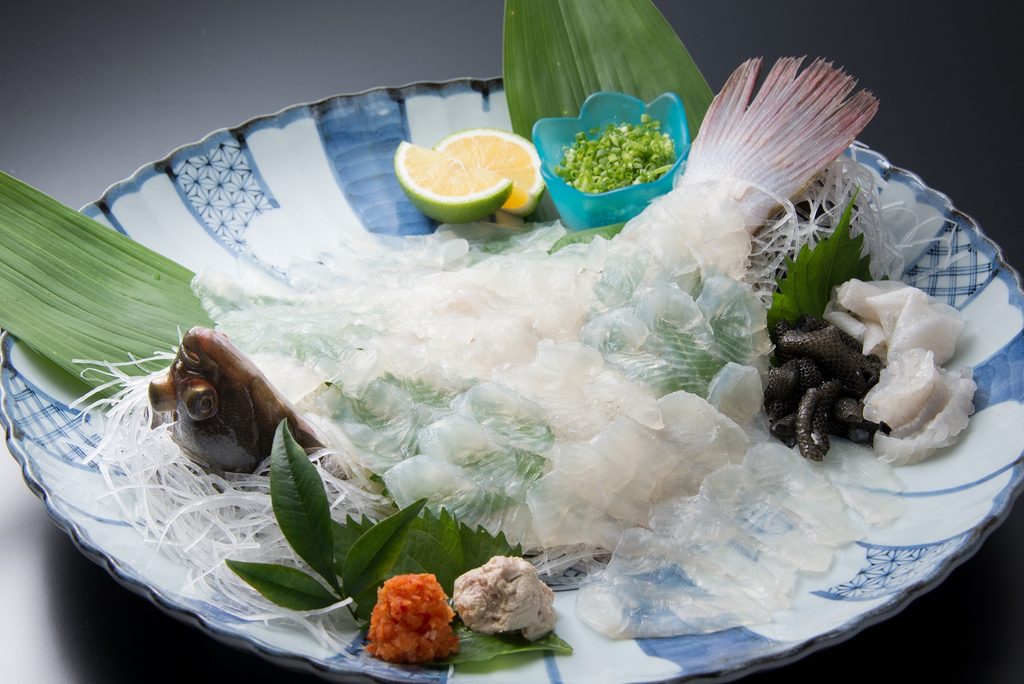
Local descriptions emphasize a subtle sweetness and a clean aroma. The tourism association says sashimi shows these qualities best. Compared with marbled flounder from other areas, it also describes thicker flesh and a smaller head. In addition, the tail fin is said to be broad and rounded.
Admittedly, “sweet” may sound odd for a white fish, and it can take a moment to picture. Here it means a quiet, natural sweetness rather than anything sugary. Locals also serve the fish simmered and fried, which brings out a different side of it.
Still, these are regional evaluations, not results from a controlled taste test. In fact, marbled flounder in general is not usually known for a strong muddy odor. Even so, Hiji presents the clean flavor as part of what makes its local fish stand out.
History and Local Traditions
Shiroshita Karei has long been treated as a luxury fish. That status rests on several things. They include historical prestige, a strong tie to Hiji, a reputation for quality, and today, limited availability.
Tribute to the Shogun and “the Lord’s Fish”
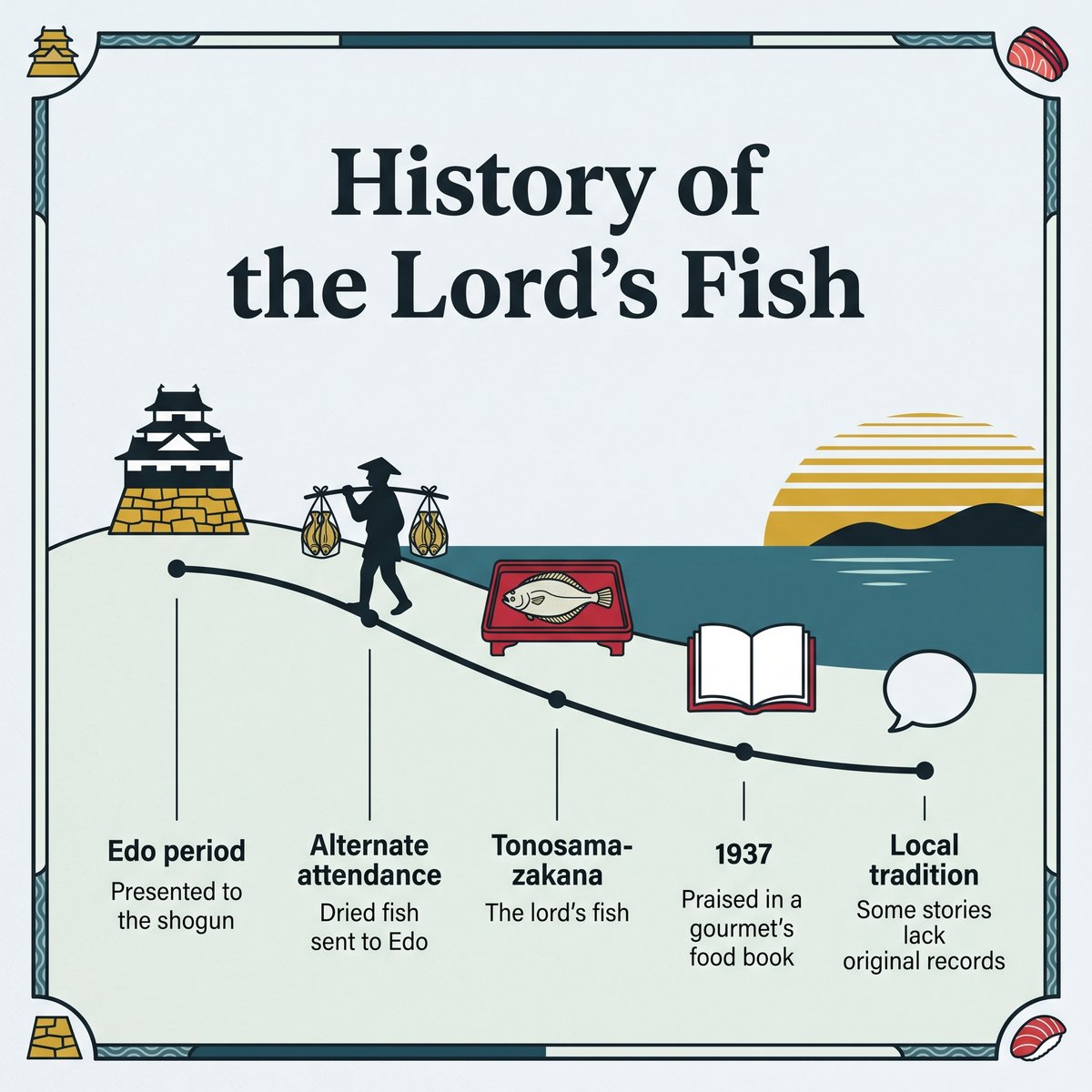
Hiji Town states that the fish was once fine enough to present to the shogun in Edo, now Tokyo. The tourism association adds that dried fish went to the shogunate under alternate attendance, when regional lords traveled to Edo.
The association also shares two more vivid stories. In one, live fish traveled to Edo in leap years, in time for the Boys’ Day festival in early summer. In the other, the nickname tonosama-zakana, or “the lord’s fish,” came from a rule said to punish commoners who ate it. However, this research found no original domain records for these details. So they are best read as local tradition.
Recognition in a 1937 Food Book
Its reputation continued into the modern period. According to the tourism association, politician and gourmet Kinoshita Kenjiro praised the fish in a 1937 book on fine food. He reportedly included it in a selection of notable Japanese dishes.
When Is Shiroshita Karei in Season?
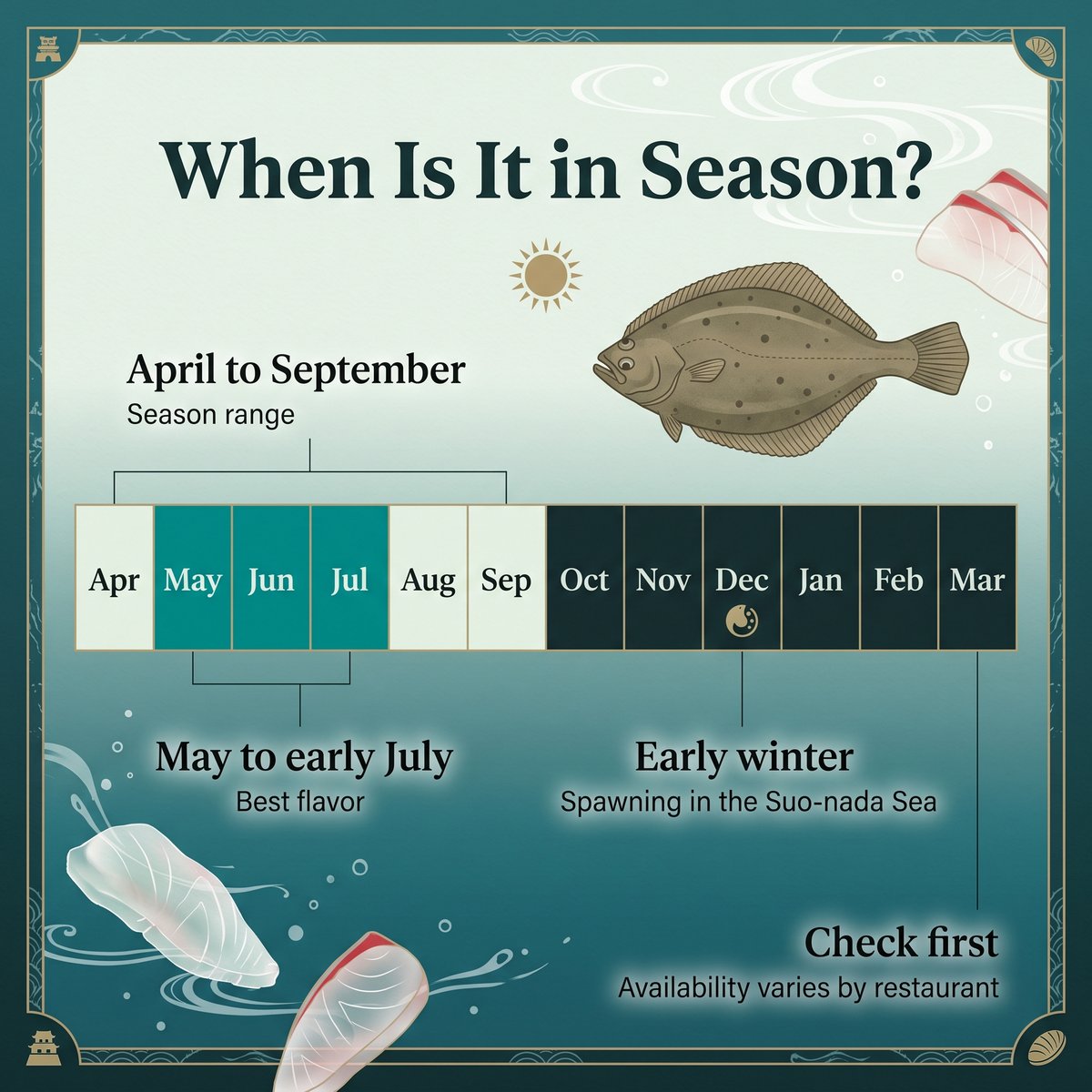
Hiji’s tourism association puts the season at roughly April to September. Within that window, the fish is said to taste best from May to early July. So late spring and early summer are the time to plan a visit.
This culinary season is when restaurants traditionally promote the fish for flavor. By contrast, Oita’s fisheries research in the Suo-nada Sea, off northern Oita, found the species spawning in early winter. Actual availability still varies by restaurant and date.
How Is Shiroshita Karei Eaten?
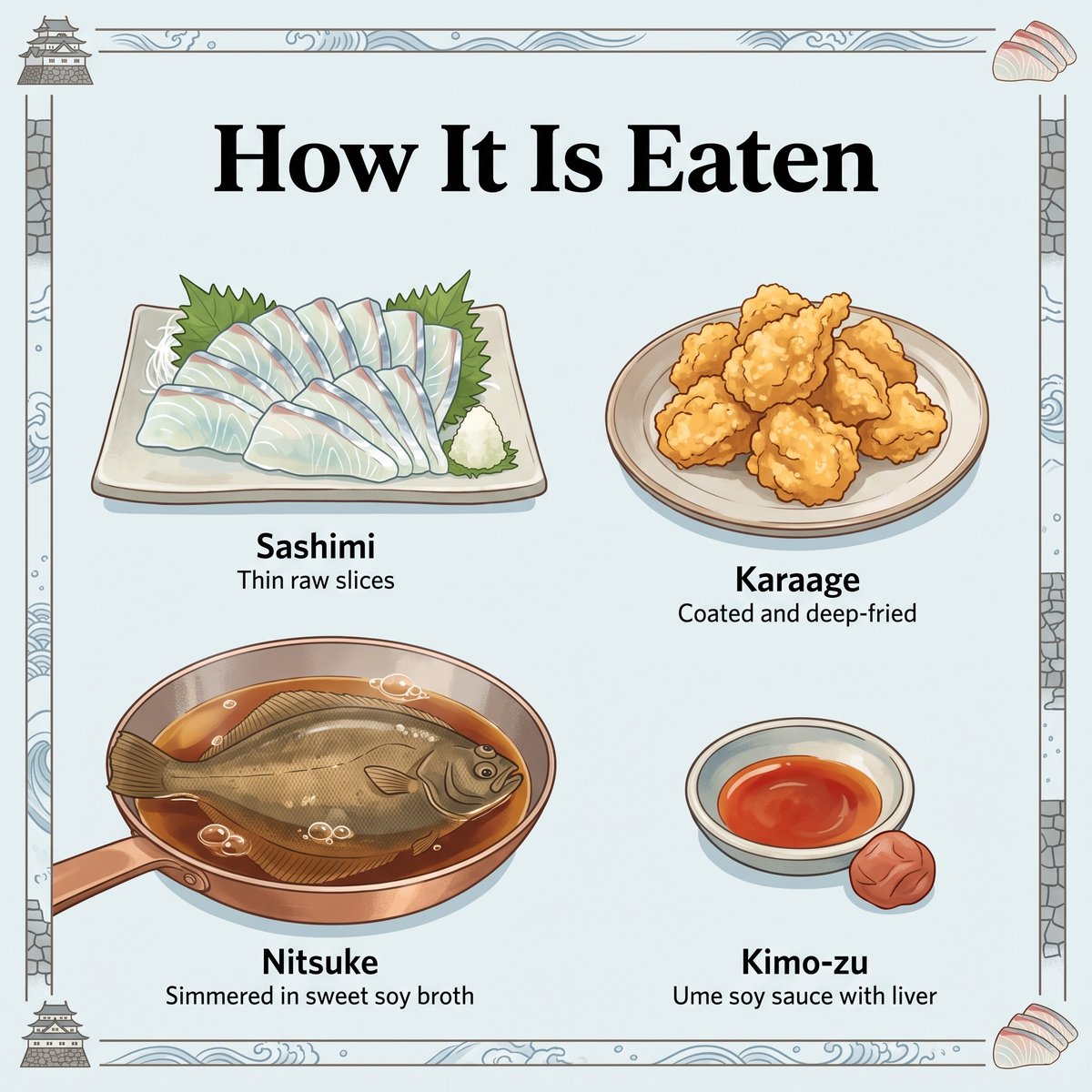
Hiji serves the fish in many forms, from formal multi-course kaiseki meals to simpler lunch sets. Local tourism information especially recommends sashimi as the way to taste its sweetness. These are the classic choices:
- Sashimi: thin raw slices, recommended locally as the best introduction. See our guide to sashimi.
- Karaage: coated and deep-fried. Our karaage article explains the method.
- Nitsuke: simmered in a sweet soy-based broth, which gives the flesh a softer texture.
In Japan, flatfish sashimi is often cut thin, and the slices can look almost translucent. Also, a 1985 study of Hiji’s flounder cooking describes a traditional dipping sauce, kimo-zu. It combines soy sauce seasoned with ume, a Japanese pickled plum, and the fish’s liver. Present-day preparations may vary by restaurant.
For a first visit, start with sashimi. Then, if the restaurant offers a set, add karaage or nitsuke. Trying two styles side by side makes the contrast in texture especially clear. As with any raw seafood, choose an established restaurant and follow its advice on how the fish is served.
Where to Look for Shiroshita Karei
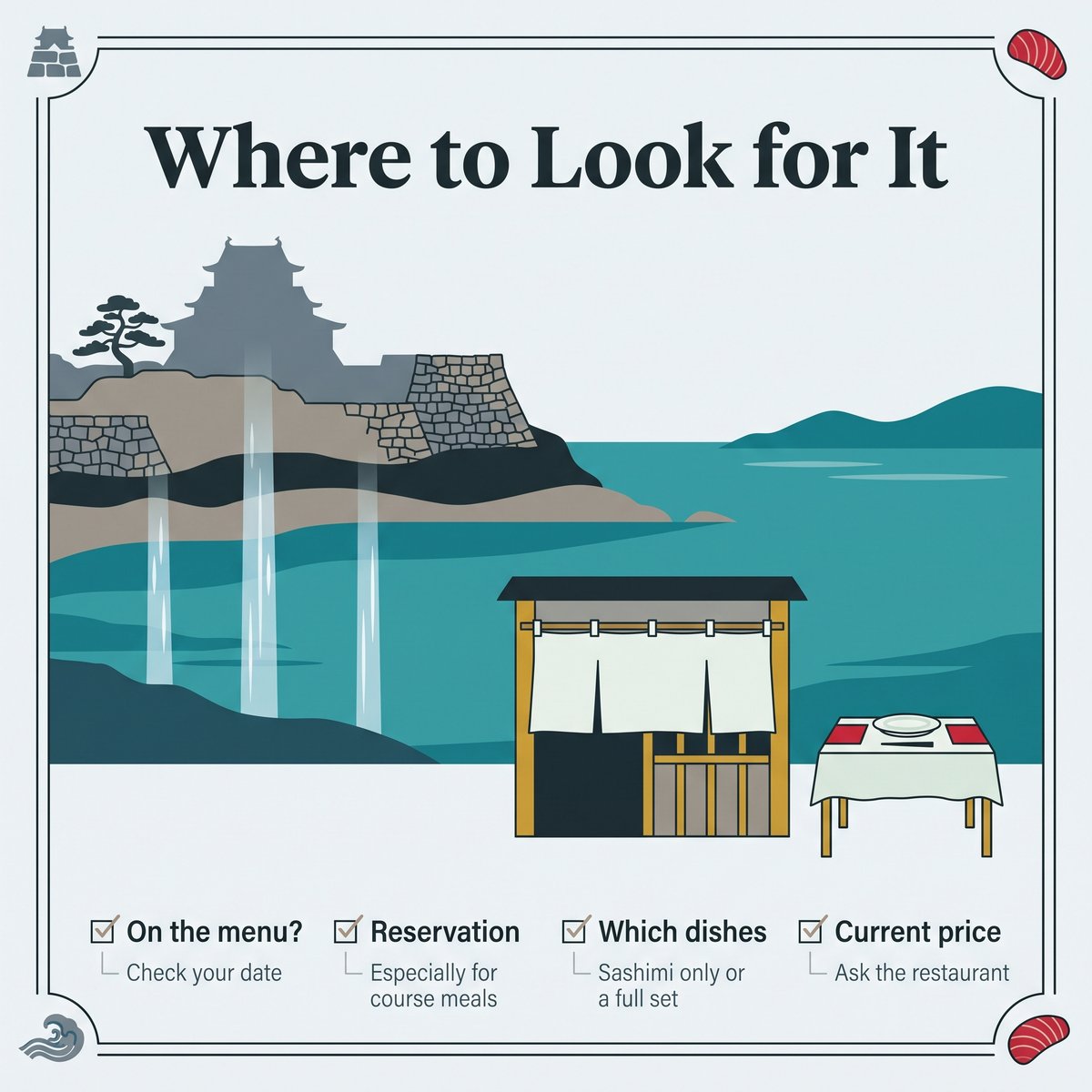
Hiji Town says the fish can be enjoyed at restaurants in the town. Eating it there also adds context, because the castle ruins, the spring-fed coast, and the restaurants sit close together. Since Hiji borders Beppu, it also fits easily into a hot spring trip.
Restaurant names, menus, and prices change from year to year, so this guide does not list specific shops. Instead, check Hiji’s official tourism site for current information, then confirm the following with the restaurant:
- Whether Shiroshita Karei is on the menu on your date
- Whether you need a reservation, especially for course meals
- Which dishes are offered, such as sashimi only or a full set
- The current price
While you are in the area, Oita has plenty of other local food. Look out for Seki saba, toriten, and the steam-cooked jigokumushi of Beppu.
The Shiroshita Karei Festival
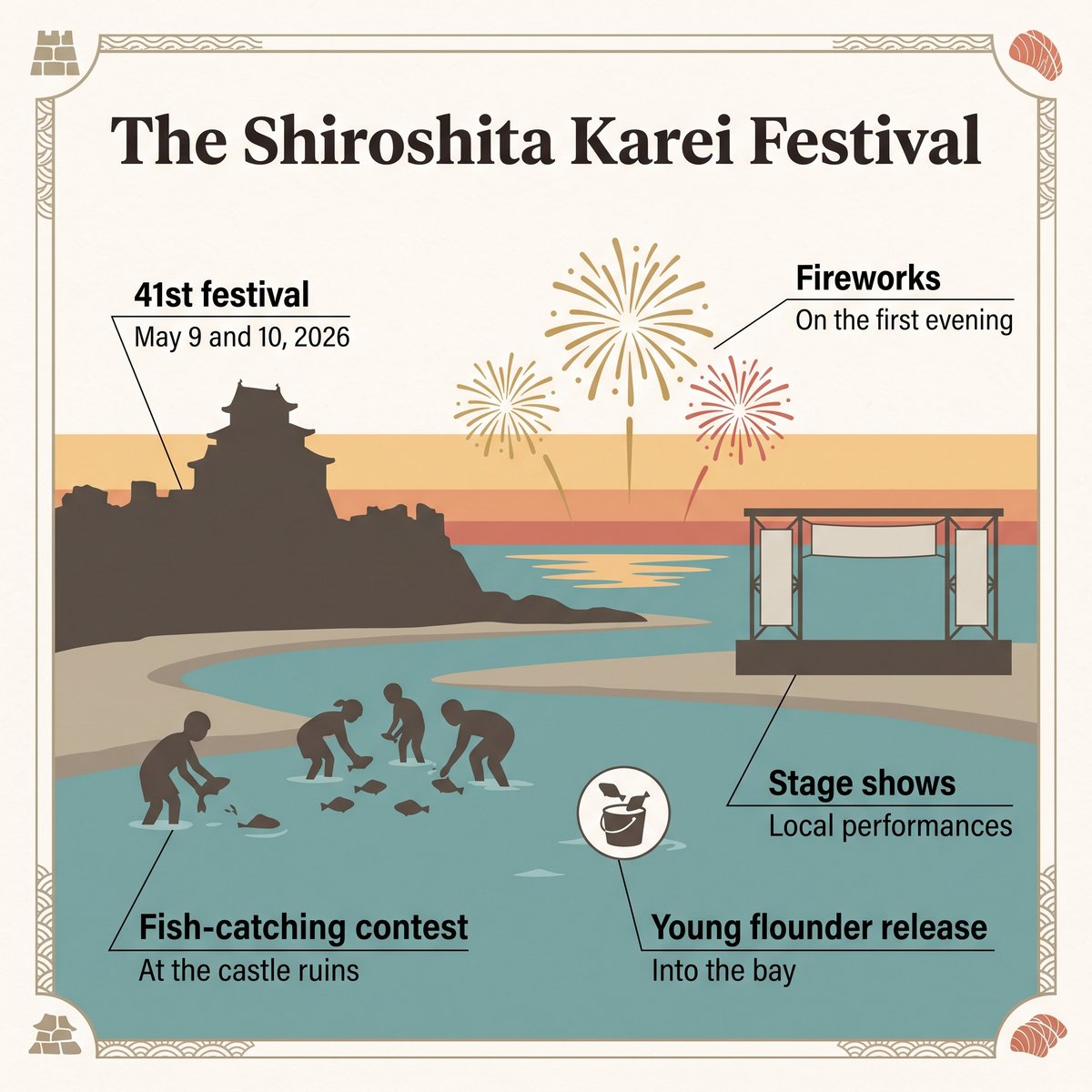
For many years, Hiji has celebrated the fish with a festival around the castle ruins. The 41st festival was held on May 9 and 10, 2026, according to Oita’s official tourism site.
The program included a fish-catching contest, a chance to release young flounder, stage shows, and fireworks on the first evening. Local broadcaster TOS reported that the festival aims to protect the fish and pass it on to future generations. It also reported continued declines in catches. In addition, it noted that the special-price tasting event was again not held in 2026.
Future dates should be checked on Hiji Town’s or Tourism Oita’s official website.
Is Shiroshita Karei Sustainable?
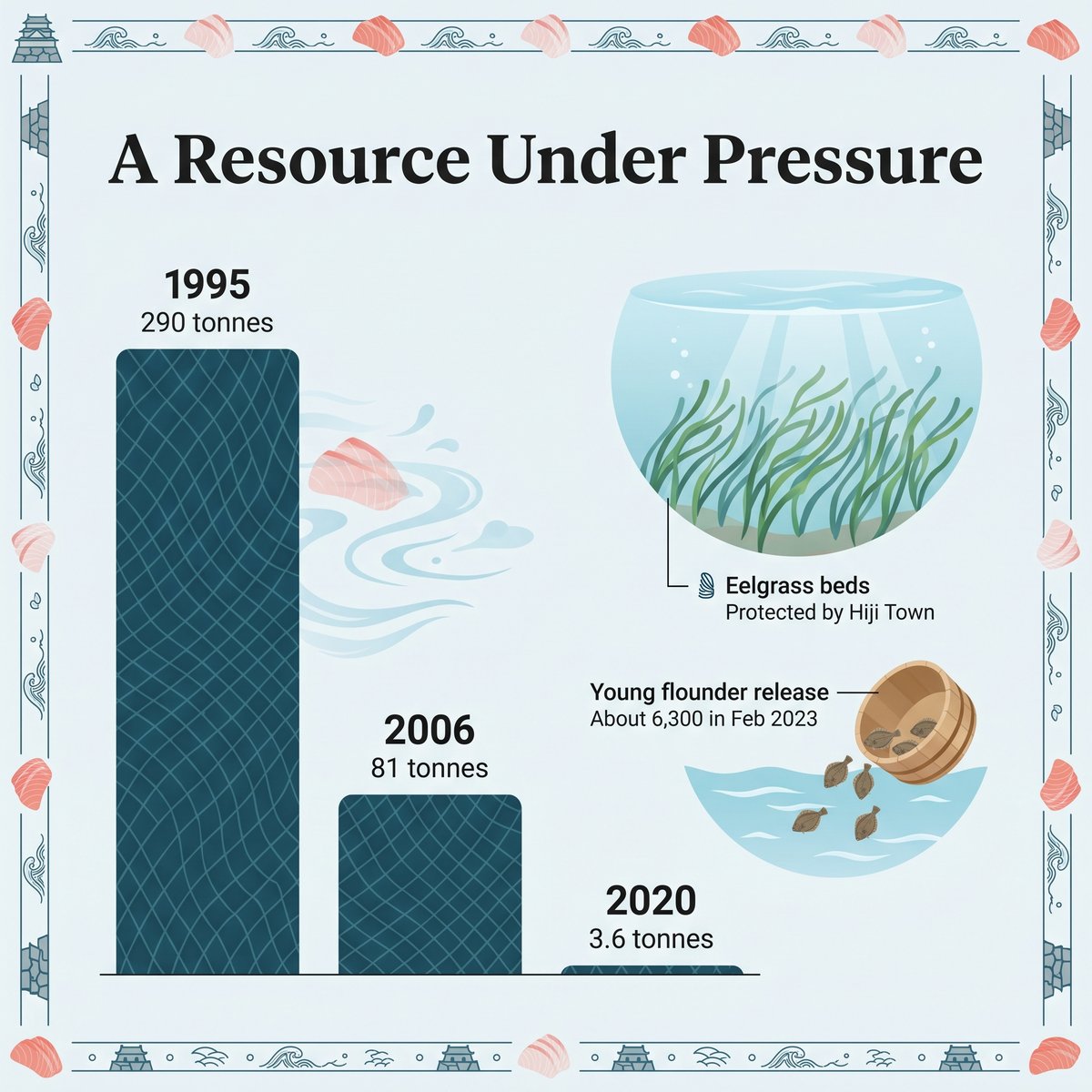
The available evidence does not allow us to call it a sustainable choice with confidence. What is clear is that Oita’s marbled flounder resource has fallen sharply and remains under pressure.
The State of the Resource
A report published in 2023 by Oita Prefecture’s fisheries research division compiled catch data showing a steep decline. The figures below cover the prefecture as a whole, not Hiji alone.
Marbled Flounder Catch in Oita Prefecture
| Year | Catch |
|---|---|
| 1995 | 290 tonnes |
| 2006 | 81 tonnes |
| 2020 | 3.6 tonnes |
Source: Oita Prefectural Agriculture, Forestry and Fisheries Research Center (report published 2023; latest catch year shown is 2020). Figures cover Oita Prefecture, mainly the Suo-nada and Iyo-nada seas off northern and northeastern Oita.
The report points to several pressures rather than one cause. They include warmer water, low-oxygen water masses, and degraded seabed habitat.
What Hiji Is Doing
First, Hiji Town works with local fishers to protect and expand eelgrass beds, which it calls “the cradle of the sea.” Released young flounder grow up in these beds, the town says. Citing a Ministry of the Environment survey, the town adds that Seto Inland Sea eelgrass shrank by about 70% over 30 years.
Second, the town raises juvenile flounder to a larger size before release. This approach is intended to improve their survival. In two releases in February 2023, it released about 6,300 juveniles in total. Still, releases are only one part of the picture. Habitat quality, water temperature, oxygen levels, and fishing management all affect long-term recovery.
How Visitors Can Help
Above all, visitors can respect limited availability and avoid pressuring restaurants when the fish is not on the menu. Festival release events are a good chance to learn about local fisheries and habitat work. However, recovery depends on long-term conservation rather than any single event.
Why Shiroshita Karei Is Worth Seeking Out
Shiroshita Karei is marbled flounder with a sense of place. In the end, its name ties it to a castle, its setting to undersea springs, and its reputation to local pride.
It is not always easy to find, and that scarcity is now part of its story. If you visit Hiji in late spring or early summer, ask about it and try the sashimi first. Afterward, explore more of Kyushu food.
Facts in this article were last checked in October 2026.
Frequently Asked Questions About Shiroshita Karei
About the Fish
- Is Shiroshita Karei a separate species?
-
No. It is a regional name for marbled flounder (Pseudopleuronectes yokohamae) from Hiji and its coastal fishing culture. The species itself also lives elsewhere in Japan.
- What is Shiroshita Karei called in English?
-
The species is called marbled flounder. Some databases also list “marbled sole,” but it belongs to the flounder family rather than the true soles.
- Why is Shiroshita Karei considered a luxury fish?
-
Several factors explain it. These include its history as a tribute to the shogun, its tie to Hiji, its local reputation, and limited availability today. So scarcity is only part of the reason.
Eating Shiroshita Karei
- When is Shiroshita Karei in season?
-
Hiji’s tourism association gives a season of roughly April to September, with the best flavor from May to early July. Availability still varies, so check before you travel.
- Why is Shiroshita Karei hard to find?
-
Catches have fallen sharply. According to a 2023 Oita Prefecture report, the prefecture’s catch dropped from 290 tonnes in 1995 to 3.6 tonnes in 2020. Supply at individual restaurants also varies by date.
- Do I need a reservation?
-
It is a good idea, especially for course meals. Ask whether the fish is on the menu for your date, since it is not always available.
Visiting Hiji
- Is there a Shiroshita Karei festival?
-
Yes. Hiji has held the festival around the castle ruins for many years. The 41st edition ran on May 9 and 10, 2026. Check the official tourism site for future dates.
- Can I visit Hiji from Beppu?
-
Yes. Hiji Town borders Beppu on Beppu Bay, so it fits easily into a hot spring trip. Even so, confirm that a restaurant is serving the fish before you go.
References
- Hiji Town – Marine Products of Hiji Town (Accessed October 2026)
- Hiji Town – Conservation and Expansion of Eelgrass Beds (Accessed October 2026)
- Hiji Town – Flounder Fry Release (Special Edition) (Accessed October 2026)
- Hiji Town Tourism Association – The Charm of Hiji: Shiroshita Karei (Accessed October 2026)
- Japan Tourism Agency – Multilingual Commentary Database: Remains of Hiji Castle (Accessed October 2026)
- Tourism Oita – 41st Shiroshita Karei Festival (Accessed October 2026)
- TOS (Television Oita System) – Shiroshita Karei Festival Begins, Including a Marbled Flounder Release (May 9, 2026) (Accessed October 2026)
- GBIF – Pseudopleuronectes yokohamae (Günther, 1877) (Accessed October 2026)
- Oita Prefecture – Wada, S. (2023). Ecological Studies on Marbled Flounder Near the Southern Edge of Their Distribution. Research Report of the Oita Prefectural Agriculture, Forestry and Fisheries Research Center, No. 8 (Accessed October 2026)
- J-STAGE – Yuto, Y., Goto, K., & Kusano, K. (1992). Survey of the Relationship between Shirosita Sole and Submarine Springs in Hiji-machi, Oita Prefecture Using Satellite Remote Sensing Data. Journal of the Japan Society of Photogrammetry and Remote Sensing, 31(1), 31–39 (Accessed October 2026)
- J-STAGE – Abe, T. (1985). 大分県日出の城下カレイ料理 [Shiroshita karei cuisine of Hiji, Oita Prefecture]. Chori Kagaku (Journal of Cookery Science), 18(3), 167–171 (Accessed October 2026)
Main image credit: Copyright © Hiji tourism association. All Rights Reserved.
Related Articles
- Seki Saba (関サバ) (Surveyed: October 2026)
- Toriten (とり天) (Surveyed: October 2026)
- Jigokumushi (地獄蒸し) (Surveyed: October 2026)
- Tai Chazuke Ureshino (鯛茶漬けうれしの) (Surveyed: October 2026)
- Saiki Sushi (佐伯寿司) (Surveyed: October 2026)
- Beppu Reimen (別府冷麺) (Surveyed: October 2026)
- Naruto Sea Bream (Surveyed: October 2026)
- Sashimi (Surveyed: October 2026)
- Karaage (Surveyed: October 2026)
- Kyushu Food Guide (Surveyed: October 2026)




Comments