


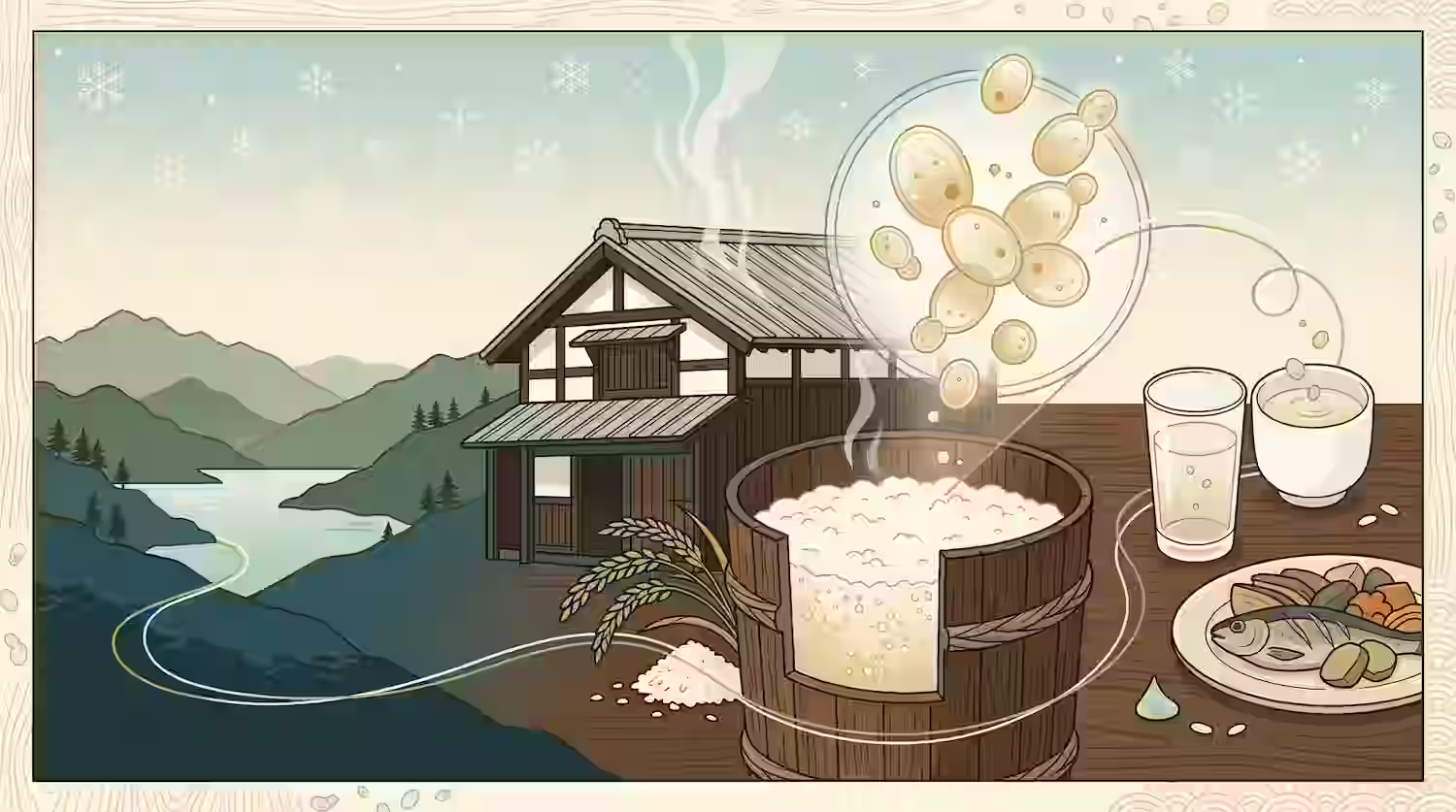



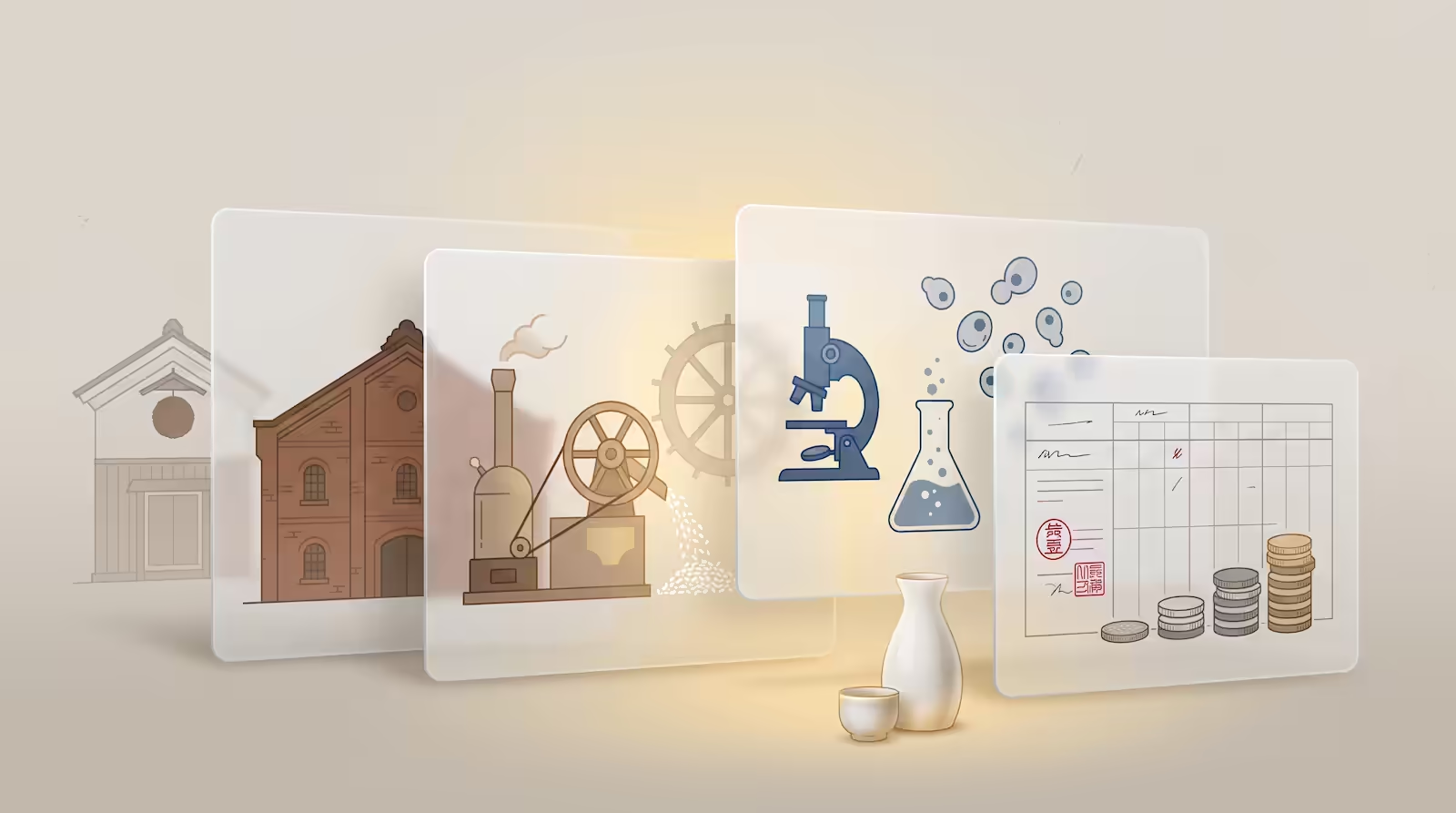
In 1899, Japan’s liquor tax overtook the land tax as the largest source of national revenue. In other words, brewing changed enormously in a single generation. Meiji era sake, the nihonshu brewed between 1868 and 1912, still began with rice, koji, and water. Around it, however, the state, the steam engine, and the laboratory had all arrived.
First, this guide traces how Japanese industrialization reached a drink often called Japanese rice wine in English. It asks why a young government came to depend so heavily on sake revenue. It also follows how laboratory science began to measure and formalize a traditional fermentation that brewers had refined empirically over centuries.
Key Takeaways
- In 1871, the Meiji government replaced Edo brewing shares with state licenses. Entry widened, but supervision tightened.
- By 1899, liquor tax was Japan’s largest national tax, so stable brewing became a fiscal priority.
- The Ministry of Finance opened the Brewing Experimental Station in 1904. There, researchers developed the yamahai and sokujō starters around 1909.
- Science measured and formalized existing brewing rather than replacing it. Meanwhile, winter brewing, wooden vats, and the toji system all continued.
When Sake Entered the Modern Age
In this article, Meiji era sake refers broadly to sake brewed between the political transformations of 1868 and the death of Emperor Meiji in 1912. During those years, brewing moved from a traditionally licensed trade to a nationally regulated and scientifically studied industry.
- Period Covered
- 1868 to 1912, with the key changes between 1871 and 1911.
- Key Laws
- The 1871 licensing rules, the 1875 and 1880 tax regulations, and the 1896 Brewing Tax Law.
- Key Institution
- The Brewing Experimental Station, opened by the Ministry of Finance in Tokyo in 1904.
- Key Technologies
- Steam-powered rice polishing, glass bottles, isolated yeast, and new starter methods.
- Main Centers
- Nada and Nishinomiya in Hyōgo, Fushimi in Kyoto, and a widening set of regional producers.
Above all, the new government needed money for an army, railways, and schools, and sake was the country’s largest traditional industry. So the state drew brewing into its machinery almost at once. Science arrived more slowly, first through foreign chemists in the 1870s and then through a state laboratory in 1904.
Edo brewers had already built a large commercial business, as the full history of Japanese sake from ancient rice brews to modern nihonshu shows. Still, Meiji did not throw that inheritance away. Instead, it wrapped a modern state, a tax system, and eventually a laboratory around it.
From the Edo System to the Meiji State
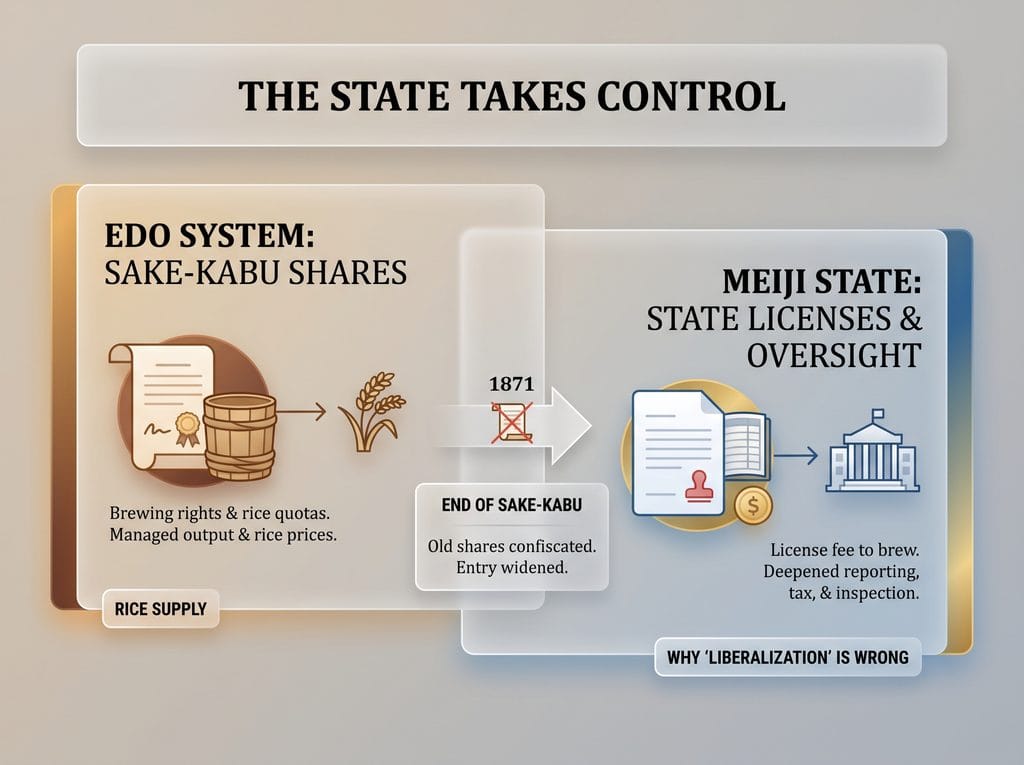
Under the Tokugawa shogunate, the right to brew depended on a sake-kabu (a brewing share). In addition, each share fixed how much rice a brewery could use. Through these shares, the shogunate managed both sake output and the rice supply.
The Sake Museum explains why that mattered. Rice paid the salaries of the shogunate, the domains, and the samurai, so bad harvests were a political problem. Therefore, limiting the rice that brewers could use was one way to keep grain prices in balance.
The End of the Sake-kabu in 1871
The year the old brewing shares ended
In 1871, the new government finally confiscated the old shares. According to the National Tax Agency, anyone who paid a license fee could now brew, and the fee for refined sake was ten ryō. Landowners, in particular, moved into the trade once inherited shares no longer blocked the way.
At first, little changed in practice. The agency’s commentary on its Meiji tax records says the 1871 rules differed only slightly from Edo-era taxation. From around 1877, however, successive revisions reached into the production process itself.
The same agency also notes a less flattering result. For example, new entrants multiplied, competition for sales intensified, and some established houses struggled. Its tax-history pages even link the rush of newcomers to falling quality.
Why “Liberalization” Is the Wrong Word
Some English-language sources call 1871 deregulation. Yet the records point the other way. The agency’s exhibit reproduces an 1877 instruction from Sakai Prefecture. Under it, for instance, brewers had to declare planned output, obtain permission, and accept official inspection.
The Key Distinction
Entry widened. Oversight deepened. The Meiji government replaced inherited shares with state licenses, and then built taxation, reporting, and inspection on top of them.
Why the New Government Needed Sake Tax
The land tax carried most of the early Meiji budget, but it was politically sensitive and hard to raise. Sake, by contrast, was a widely consumed commercial product that could be taxed at the point of production. Besides, breweries were fixed buildings with large vessels, and officials could count their output in koku (a volume unit of about 180 liters).
A note on terms. Official statistics speak of liquor tax, a category covering all alcoholic drinks. In this article, “sake tax” means the burden on sake brewers, while “brewing tax” and “zōseki tax” name specific Meiji levies.
1899: Liquor Tax Reaches First Place
The year liquor tax became Japan’s largest national tax
According to the National Tax Agency, liquor tax overtook the land tax in 1899 and took first place among national taxes for the first time. The agency’s tax-history newsletter gives its share that year as 35.5 percent of national revenue, up from roughly 6 percent in the late 1870s.
That rise was deliberate. The agency’s commentary on its Meiji tax records states that the sake tax rate rose six times between 1896 and 1908, from 7 to 20 yen per koku. Meanwhile, wars with China and Russia only added to the pressure.
Once liquor tax supplied such a large share of revenue, stable and predictable production became a matter of fiscal importance. After all, spoiled batches and failed breweries could reduce taxable output. This helps explain why brewing research later came under the Ministry of Finance.
The Weight of Meiji Sake Tax
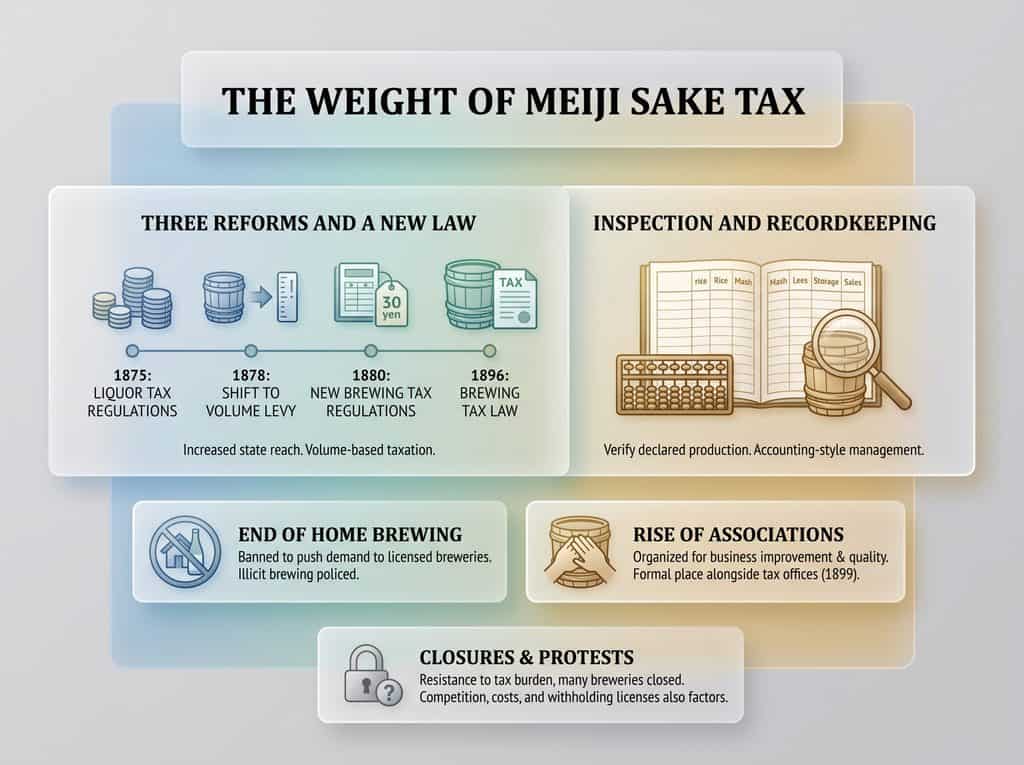
Three Reforms and a New Law
Tax law changed repeatedly in the first Meiji decades, and each step reached further into the brewery. As a result, the National Tax Agency’s records show a clear sequence.
- 1875: The Liquor Tax Regulations created a business tax on brewers, a brewing tax on their sake, and a tax on retailers.
- 1878: The brewing tax shifted from a share of sales value to a levy on volume produced.
- 1880: New Brewing Tax Regulations charged 30 yen per brewery and set the zōseki tax (a tax on volume brewed).
- 1896: The Brewing Tax Law folded the license tax into the volume tax, which now decided almost the whole bill.
Inspection and Recordkeeping
A volume-based tax required the state to verify declared production. In turn, that encouraged more systematic inspection and recordkeeping inside breweries. Research by Doi on the ledgers of a Nada brewing house shows books tracking rice purchases, mash volumes, lees, storage, and sales.
Doi and Shimizu also connect the 1878 shift to a rise in quantitative, accounting-style management. One brewery cannot stand for the whole country, of course. Still, the direction of change is clear.
The End of Home Brewing and the Rise of Associations
The state also closed a loophole at home. The National Tax Agency’s exhibit notes that home brewing for household use was banned in the Meiji period. Tax-free farmhouse sake had long competed with taxed sake, so the ban pushed that demand toward licensed breweries. Illicit brewing, in turn, became a social problem that officials policed for decades.
Brewers responded by organizing. According to the agency, they soon formed brewers’ associations to improve their business and the quality of their sake. Rules issued in 1899 then gave these associations a formal place alongside the new tax offices.
Closures and Protests
The burden provoked resistance, and brewers organized petitions and campaigns against tax increases. Many breweries also closed in the early 1880s. Some accounts give exact counts for those years, but we could not confirm them against the original tables.
Tax alone probably did not close these businesses. Instead, competition, bad seasons, spoilage, and equipment costs all played a part. Moreover, the agency notes that rules from 1890 withheld licenses from tax defaulters who could not post security.
Who Became a Brewer in Meiji Japan?
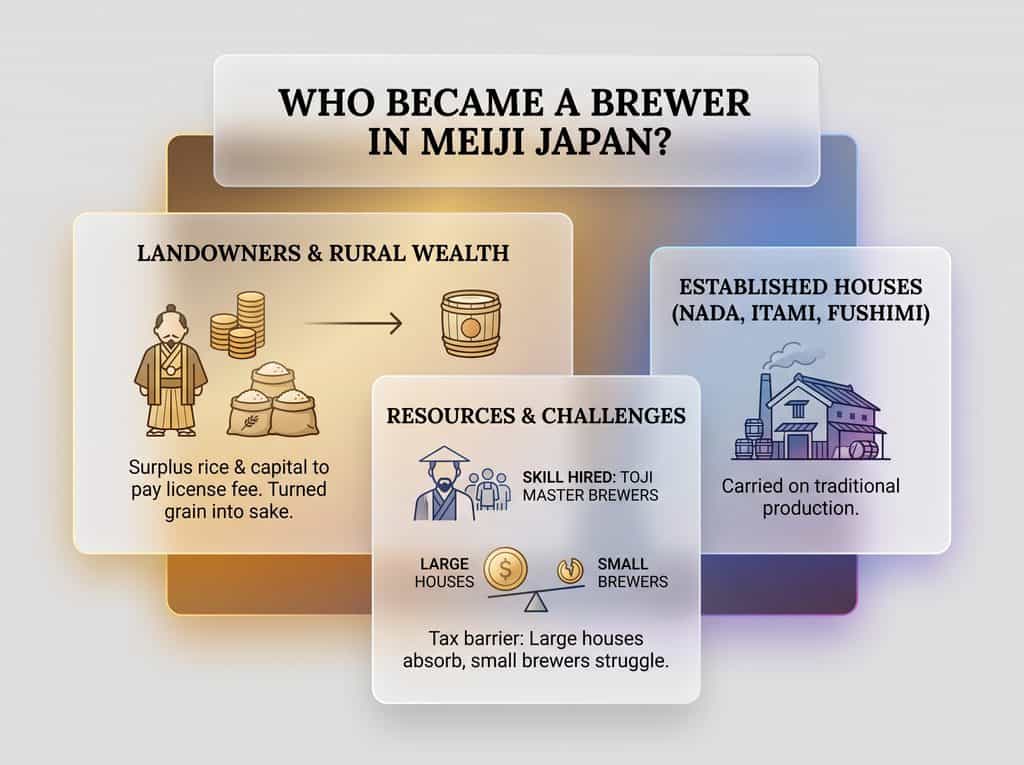
After 1871, the National Tax Agency’s answer is short: landowners. Specifically, wealthy rural families with large rice holdings could pay the fee and turn surplus grain into sake. Meanwhile, established houses in Nada, Itami, and Fushimi carried on beside them.
Rice and capital mattered more than skill. Brewing tied up grain for months, while a landowner collecting rent in rice had that surplus. Skill was easier to hire, because the toji, the master brewers who lead seasonal brewing crews, already moved between breweries each winter.
Tax obligations could also arise before a brewery had recovered its costs through sales. So the license fee was never the only barrier. Large Nada houses could absorb rate rises and buy new equipment, while many small regional brewers could not.
Rice Polishing Enters the Industrial Age
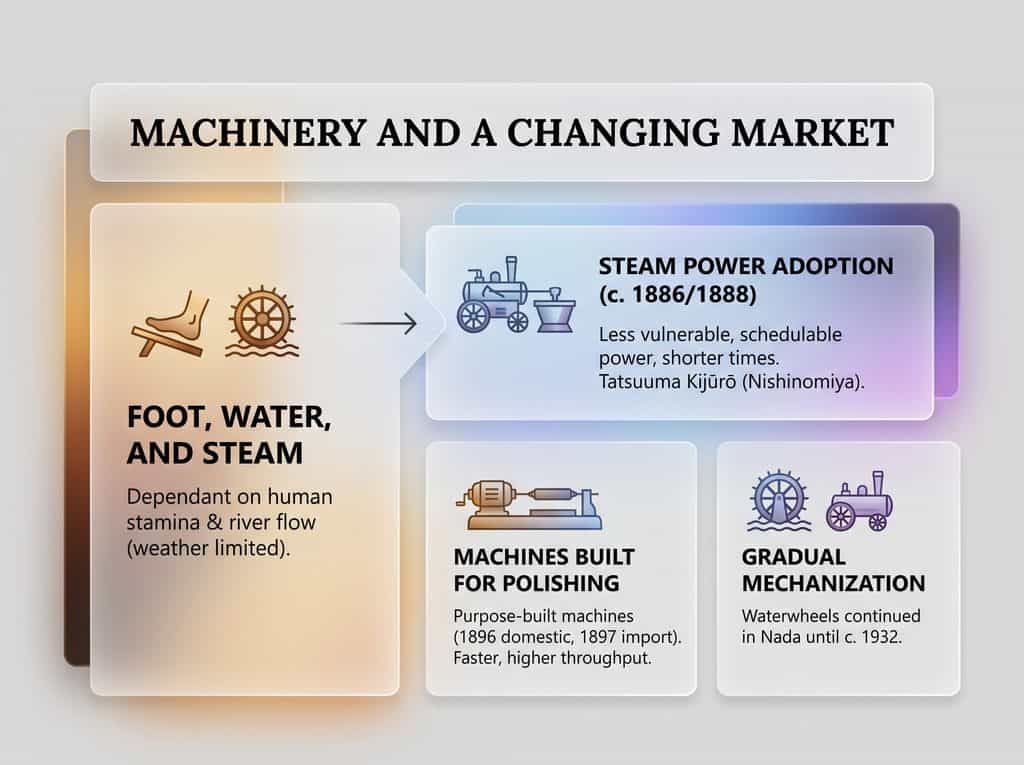
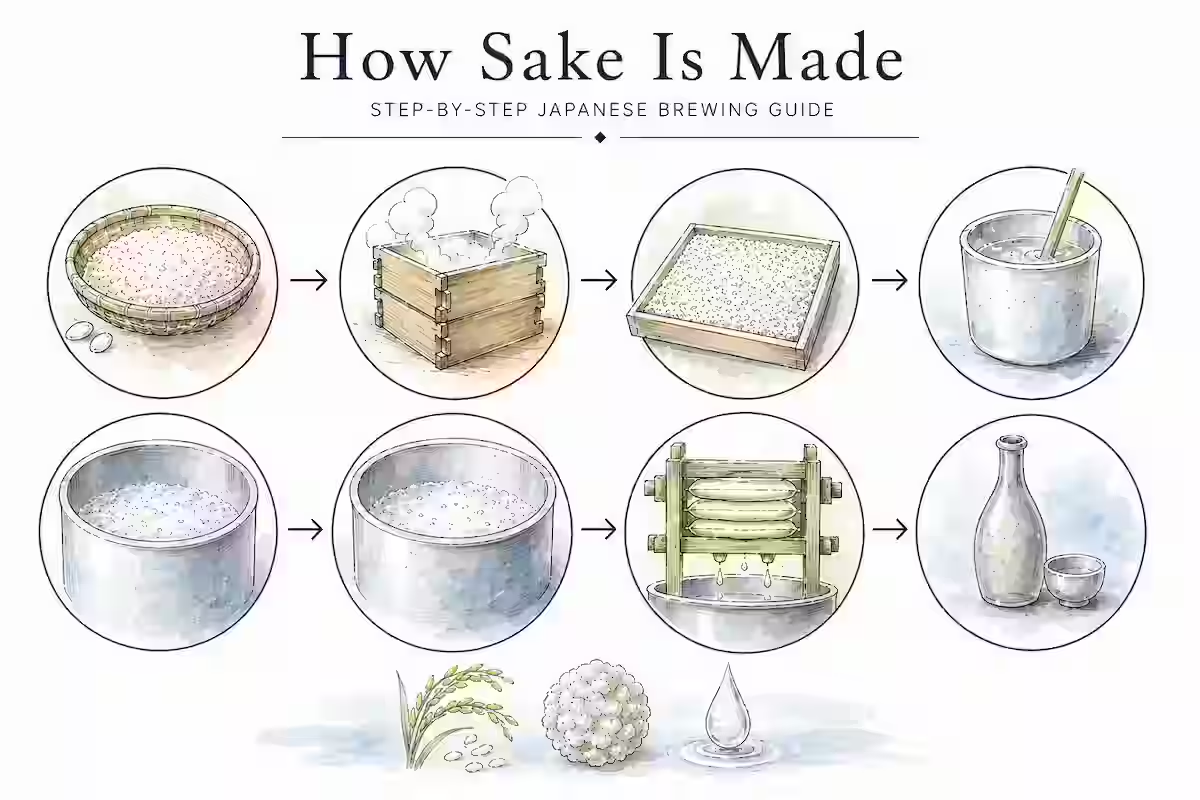
Polishing removes the outer layers of the rice grain, and deeper polishing generally gives cleaner sake. The rice polishing ratio printed on modern sake labels is a later concern. In the Meiji period, the question was simpler: how to power the mill at all.
Foot, Water, and Steam
Into the Meiji period, breweries still polished rice with foot treadles and waterwheels. However, the Sake Museum in Nishinomiya explains their limits plainly. Treadles depended on human stamina, while waterwheels slowed whenever dry weather lowered the rivers.
According to the museum, steam engines first powered rice polishing around 1886, reportedly in Sakai. Firmer documentation appears two years later. In 1888, the Nishinomiya brewer Tatsuuma Kijūrō brought steam polishing into a district that still depended on river flow.
That change was more than mechanical. Above all, it made polishing less vulnerable to dry weather and helped turn power into something a brewery could schedule. A review by Wakai in the Journal of the Brewing Society of Japan confirms the 1888 date and notes shorter polishing times.
At first, brewers worried that boiler smoke might taint the sake. Eventually, the museum reports, the worry proved groundless, and adoption spread.
Machines Built for Polishing
At first, steam simply drove the old mortars and pestles. Purpose-built machines followed, and Wakai records the import of a powered horizontal polisher in 1897. The museum also credits Satake Riichi of Hiroshima with a domestic machine in 1896.
Overall, new power shortened polishing time and raised throughput. Whether Meiji rice also became more uniform is plausible, although the sources do not measure it. Mechanization was gradual, too, since Wakai notes that waterwheel polishing continued in Nada until about 1932.
Glass Bottles and a Changing Market
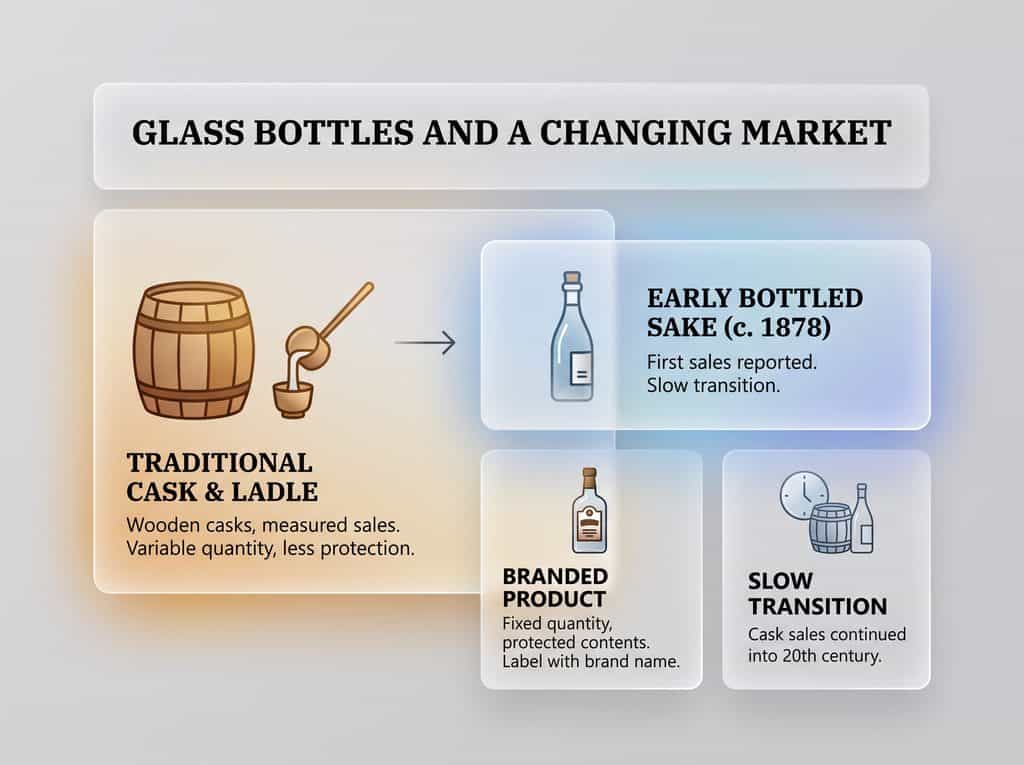
For centuries, sake traveled in wooden casks and reached customers by the ladle. The Japan Sake and Shochu Makers Association’s chronology records that bottled sake first went on sale in 1878. That date rests mainly on an industry record, so it is best read as widely reported rather than proven.
By contrast, a sealed bottle held a fixed quantity, protected the contents, and carried a label with a name. Together, these features nudged sake toward being a branded product. Even so, the change was slow, and industry accounts indicate that measured sales from the cask lasted well into the twentieth century.
Sake and Japan’s Opening to the World
Meiji Japan entered its products in the great international exhibitions, and sake went too. Similarly, the same chronology records a shipment of sake overseas in 1872 for the Austrian exposition. Since the Vienna World Exposition opened in 1873, that date most likely marks the dispatch of exhibits, not a commercial sale.
For most of the period, foreign interest in sake was scientific rather than commercial. In fact, the more important traffic ran the other way. The openness that sent sake to Vienna also brought European chemistry to Tokyo.
Western Science Meets Traditional Brewing
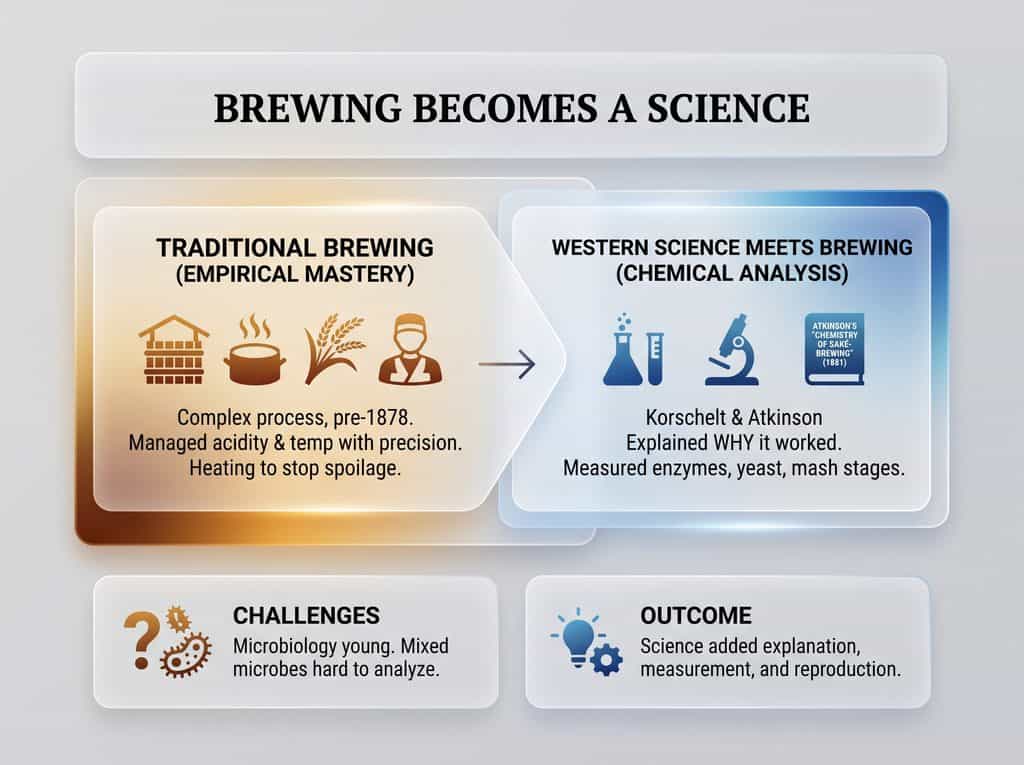
When European chemists first studied Japanese brewing, they did not find a rudimentary craft awaiting rescue. Instead, they found a complex, multi-stage process that already worked. Their task, as they saw it, was to explain why.
Korschelt, Atkinson, and the First Chemical Studies
The key early figures were Oskar Korschelt, a German chemist in Tokyo, and Robert William Atkinson, a British chemistry professor at Tokyo University. Later, the university published Atkinson’s The Chemistry of Saké-Brewing in 1881. Its preface states that no scientific account of sake brewing existed before 1878, when Korschelt published the first detailed report.
Before that, Europeans knew sake mainly through translation. Atkinson’s preface mentions a Dutch rendering of a Japanese encyclopedia entry from 1714. So the leap from description to chemical analysis took place in Meiji Tokyo.
Atkinson’s contents read like a modern brewing course. For instance, he covered rice, koji and its enzymes, the starter, the main mash, fermentation, filtration, and preservation. Every stage already existed, so he was measuring the process rather than designing it.
Empirical Is Not the Same as Crude
Several practices impressed the visitors. For example, brewers heated sake to stop spoilage, grew a mold on rice to turn starch into sugar, and built the mash in stages. None of this needed a chemist to work, although it did need one to be explained.
Empirical Is Not Crude
A brewer who cannot name a bacterium can still control one. Meiji brewers managed acidity, temperature, and timing with real precision. Science added the ability to explain, measure, reproduce, and teach those controls.
Explanation still came slowly. Sake ferments through two processes at once, as koji enzymes release sugar while yeast turns it into alcohol. After all, in the 1870s microbiology was young, and the mixed microbes of a starter tank resisted simple analysis.
The Discovery and Study of Sake Yeast
Before the 1890s, the yeast in a brewery simply lived there. It arrived with the air, the tools, and the previous batch, while brewers cultivated it indirectly through an acidic starter. That method worked well, yet nobody controlled which yeast did the work.
1895: Yeast Isolated From the Mash
Sake yeast isolated from the mash
In 1895, Yabe Kikuji, working with Kozai Yoshinao, isolated yeast from sake mash and studied its form and properties. Later, a biographical article in the Journal of the Brewing Society of Japan credits Yabe as the discoverer of sake yeast. The name Saccharomyces sake Yabe later became attached to this work, although its formal naming history is more tangled.
Isolation mattered because brewers could now compare, select, and grow a yeast in pure culture. Yabe later helped prepare the national brewing laboratory and became its first head of operations. The Osaka Science Museum’s brewing guide traces an early standard strain to a Nada brewery’s starter in 1906, a step toward the selected sake yeasts that shape aroma and fermentation today.
The Birth of the Brewing Experimental Station
The Brewing Experimental Station opens
On May 9, 1904, the Ministry of Finance opened the Brewing Experimental Station, the predecessor of today’s National Research Institute of Brewing. Specifically, it stood in Takinogawa, in what is now Tokyo’s Kita Ward. According to the institute’s official history, the station aimed to improve, through science, brewing that had relied only on inherited technique.
The station’s red-brick brewing hall of 1904 still stands as an Important Cultural Property. In 1905, the station opened its first brewing course for the sons of brewing families, and it held one every year after that. Then, in 1907, a national sake competition followed.
Why a Finance Ministry Ran a Laboratory
The National Tax Agency’s exhibit places the station within the story of tax administration. Indeed, national tax offices, brewers’ associations, and the laboratory all took shape within a few years of each other. The agency’s own history of its technical officers, the kanteikan, dates the first posts to 1896.
That history is unusually frank about motive. For example, it describes stable production and supply of sake as a paramount national goal for securing revenue. Accordingly, it says the kanteikan posts existed to serve that mission.
How tax administration and brewing science became intertwined
- Sake was a large, visible product that was easy to tax.
- A volume tax required measurement, ledgers, and inspection.
- Measurement gave the state detailed knowledge of production.
- Stable output protected revenue, which supported funding for research and training.
- Research produced new starters, analysis, appraisal, and technical guidance.
Each link in that chain rests on a record, yet the chain still simplifies. The station’s stated purpose also named research and the training of technicians. It would therefore be too strong to say the ministry founded brewing science only to collect tax.
How Scientific Training Reached Breweries
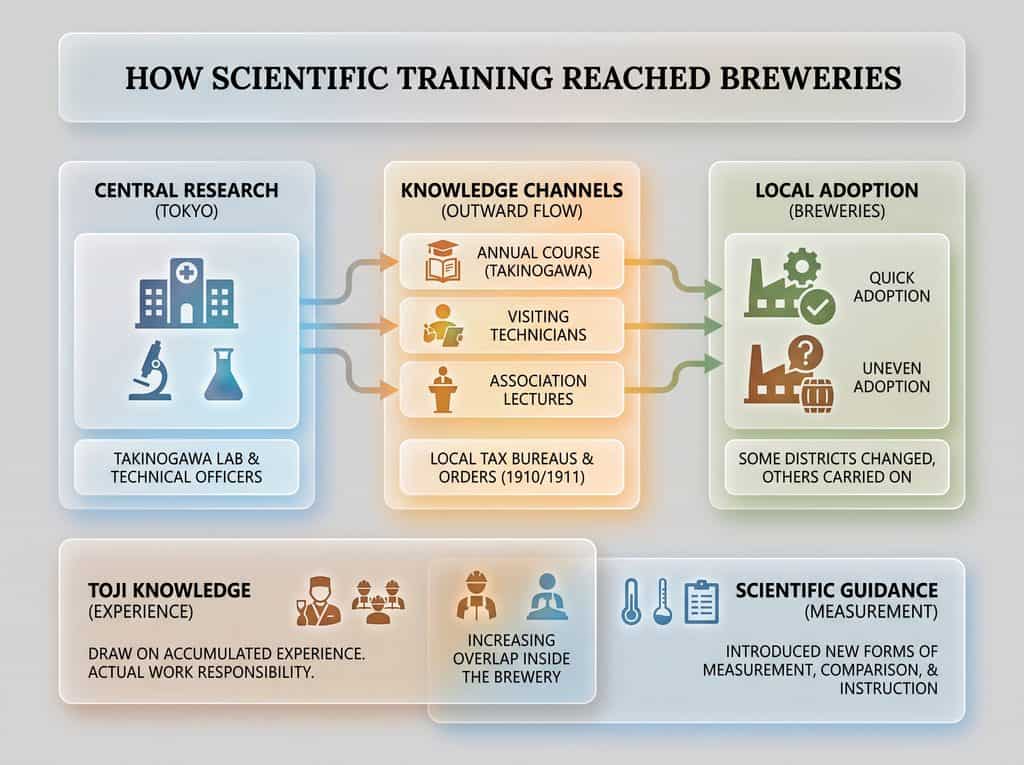
A laboratory in Tokyo changes nothing unless its findings reach a cold brewery in Niigata or Hiroshima. According to the National Tax Agency, technical officers at the station and at regional tax bureaus instructed brewers in local districts. Later, the first formal orders for on-site guidance came in 1910.
Three channels carried knowledge outward: the annual Takinogawa course, visiting technicians, and association lectures. A 1911 ministry order even explained how associations could request guidance through the local tax office. Adoption remained uneven, however, and some districts changed quickly while others carried on much as before.
Toji Knowledge and Scientific Guidance Meet
The toji and kurabito (brewery workers) remained responsible for the actual work of brewing. In practice, they drew on experience accumulated over many seasons. Government laboratories and technical officers, meanwhile, introduced new forms of measurement, comparison, and instruction. Over time, these systems increasingly overlapped inside the brewery itself.
Yamahai and Sokujō: A New Generation of Sake Starters
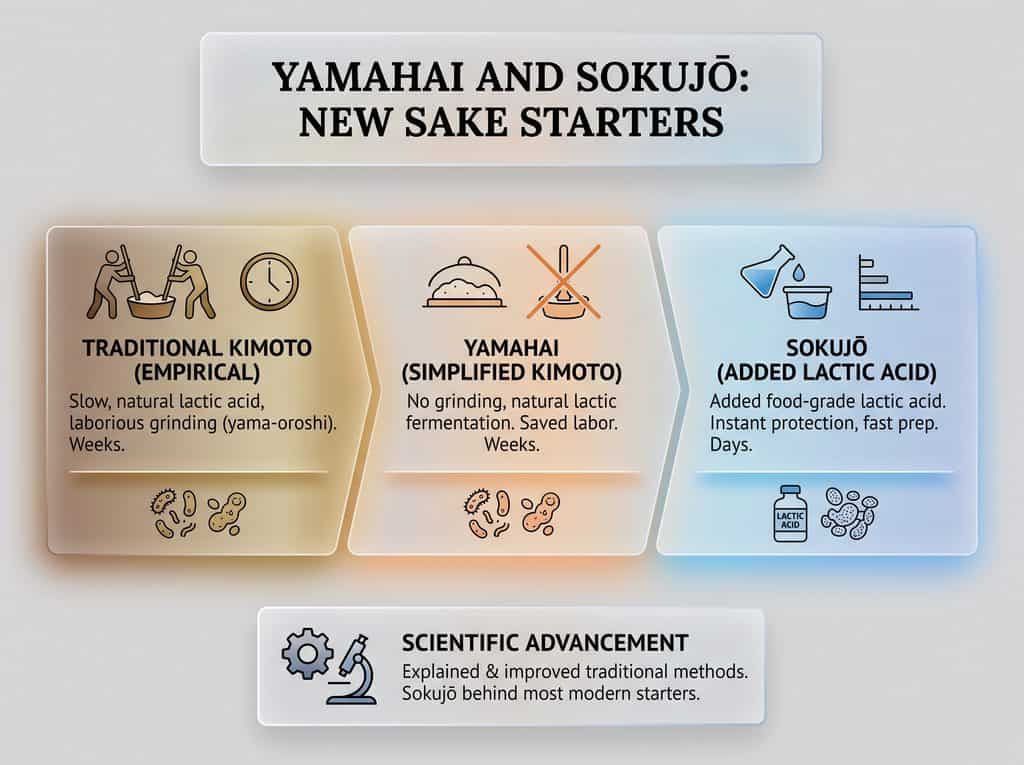
The best-known achievement of late Meiji brewing science is a pair of new starter methods. Both changed how brewers built the moto, the concentrated yeast starter that seeds the main mash. A starter must turn acidic before wild microbes spoil it, and it must grow a dense yeast population.
Before then, the traditional kimoto method let naturally occurring lactic acid bacteria acidify the starter over several weeks. It worked, but it was slow, laborious, and prone to failure in a warm year. In particular, part of that labor was yama-oroshi, in which workers ground rice and koji with long poles through the cold night.
Yamahai: Dropping the Grinding Step
However, research at the station showed that koji enzymes could dissolve the rice on their own, given time. So brewers could drop the grinding. The result was the yamahai starter, a simplified descendant of kimoto, which kept natural lactic fermentation while saving an exhausting step.
Sokujō: Adding Lactic Acid Directly
Sokujō went further. Instead of waiting for bacteria, the brewer added food-grade lactic acid at the start. The starter was acidic from day one, which protected it at once and sharply shortened preparation.
The Osaka Science Museum credits Eda Kamajirō with the method and notes that most starters today follow it. That is why the sokujō method behind most modern sake starters matters so much. Yet neither method came from nowhere. Yamahai is kimoto with a step removed, while sokujō replaces its slowest phase with a purchased ingredient.
1909 or 1910?
Where the sources disagree
| Source | Yamahai | Sokujō |
|---|---|---|
| National Tax Agency and the institute’s chronology | 1909 | 1909 |
| Japan Sake and Shochu Makers Association | 1909 | 1910 |
| Osaka Science Museum | Not stated | 1910 |
The National Tax Agency and the institute’s official chronology place both methods in 1909. However, the Japan Sake and Shochu Makers Association and the Osaka Science Museum date sokujō to 1910. Either way, the station developed both at the very end of the Meiji era.
Quality Appraisal at the End of the Meiji Era
The first national appraisal of new sake
In 1911, the station held the first Zenkoku Shinshu Kanpyōkai, a national appraisal of newly brewed sake. Both the National Tax Agency and the institute’s chronology confirm the date. Moreover, the appraisal established a national evaluation tradition that continues today.
Even so, it did not appear from nothing. Since 1907, the station had held a national competition for finished sake every two years. The Brewing Society of Japan had also run its own national competition since October 1907, and the tax agency describes the new appraisal as ranking alongside it.
The same institutional culture of measurement and comparison created a setting for judging sake against shared standards. Brewers learned where they stood, and the station learned what the country produced. Because the Meiji era ended in July 1912, the first appraisal fell in its final months.
Tradition and Industry in the Meiji Brewery
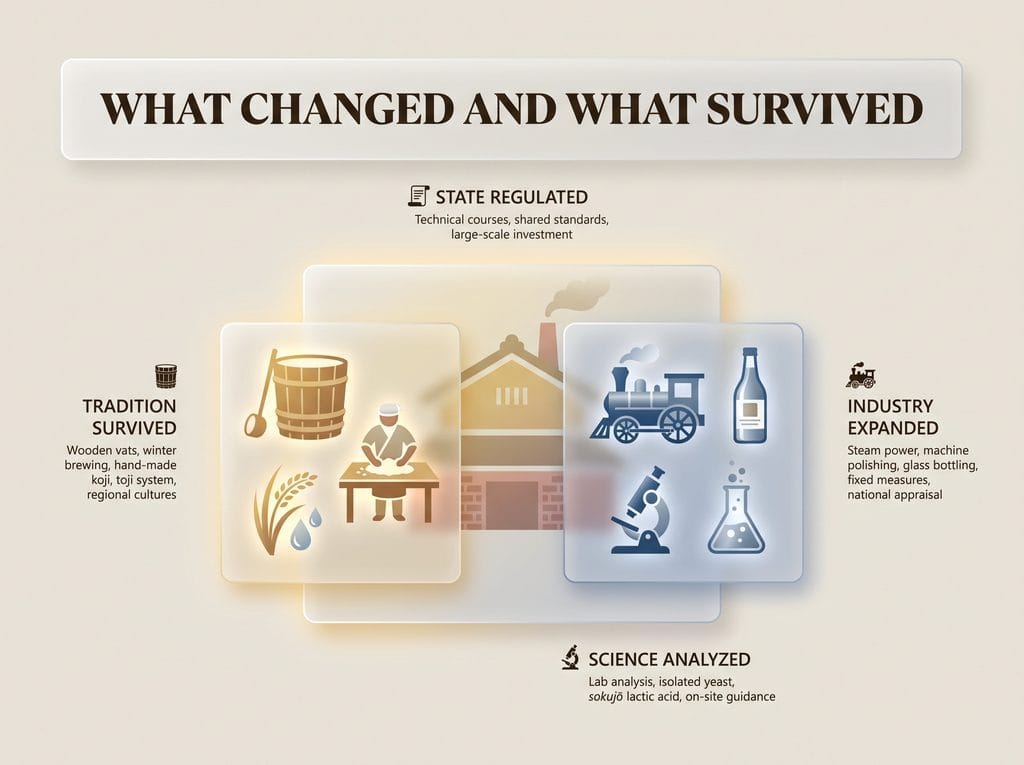
The contrast is not between traditional sake and modern sake. Rather, it lies between an established brewing system and the machinery, measurement, and institutions built around it.
What survived
- Rice, koji, and water as the principal materials, with yeast cultivated through the starter
- Winter brewing, or kan-zukuri
- Wooden vats and tools
- Kimoto starters, now joined by yamahai
- Koji made by hand in the koji room
- The toji and kurabito system
- Regional brewing cultures, above all Nada and Fushimi
What expanded
- Steam power and machine rice polishing
- Glass bottling and fixed measures
- Laboratory analysis of rice, mash, and sake
- Isolated and, later, distributed yeast
- Sokujō starters using added lactic acid
- Technical courses and on-site guidance
- National appraisal against shared standards
Most Meiji innovations changed how sake was powered, analyzed, taught, and regulated. Yet they rarely replaced its basic brewing logic. Adoption also depended on scale, because large houses could invest in change while small brewers often could not.
What Meiji Sake May Have Tasted Like
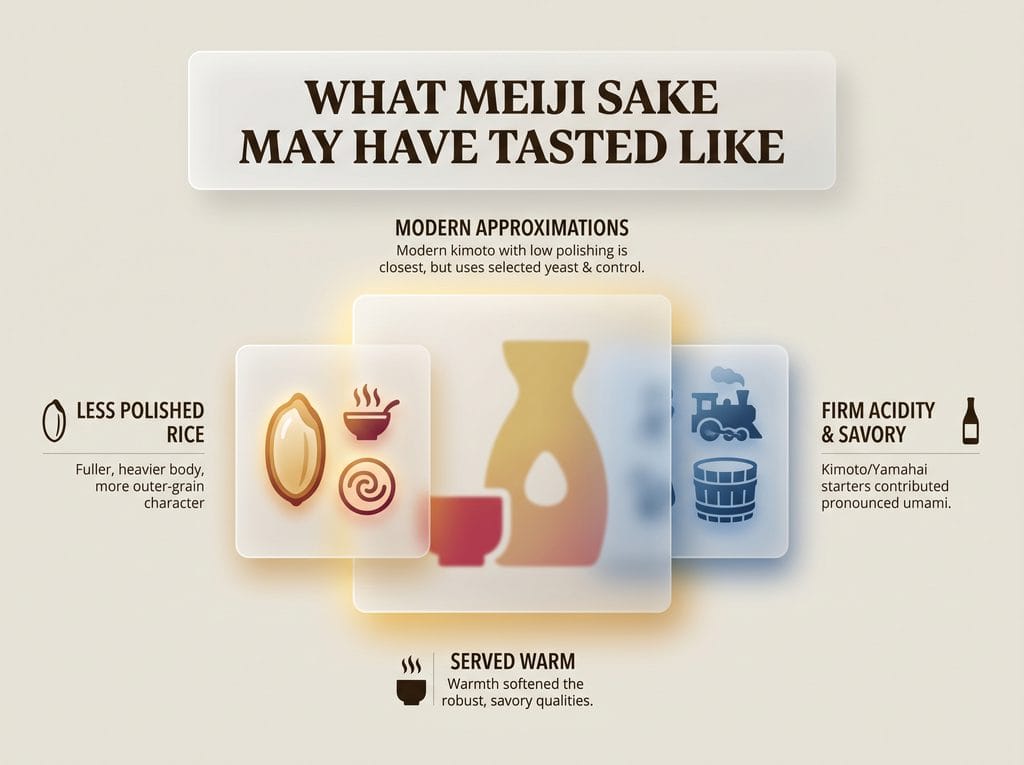
To be clear, we have no securely documented, drinkable sample of ordinary Meiji-era sake. Tasting notes from the period are also rare and impressionistic. Still, the technical record allows a few careful guesses.
Probably Fuller, More Savory, and Usually Served Warm
Even with steam power, brewers polished rice far less than they do today. That points toward fuller, heavier sake with more character from the outer grain. Kimoto, and later yamahai, likely contributed firm acidity and a more pronounced savory character, although results varied greatly by brewery and batch.
People also usually drank sake warm. The Japan Sake and Shochu Makers Association notes that warm sake was the year-round norm through the Edo period and well into the twentieth century. Warmth softens exactly the qualities described above. Modern kimoto bottles made with low polishing and wooden vats probably come closest. Yet they use selected yeast, controlled temperatures, and modern hygiene, so they remain approximations.
Evidence and Historical Uncertainty
Meiji is well documented compared with earlier periods, because the state that taxed sake also recorded it. The evidence is still uneven, so the summary below shows where the firm ground ends.
Well documented
- The 1871 abolition of the sake-kabu and the new license system
- Tax laws of 1875, 1880, and 1896
- Steam polishing in Nishinomiya from 1888
- Liquor tax reaching first place in 1899
- The 1904 station, its 1905 courses, and the 1911 appraisal
Supported but less precise
- Steam polishing in Sakai from around 1886
- Bottled sake on sale from 1878
- Sake sent abroad in 1872 for the 1873 Vienna exposition
- Whether sokujō dates to 1909 or 1910
Hard to generalize
- How ordinary Meiji sake actually tasted
- How quickly individual breweries adopted machinery
- Exact brewery counts in the early 1880s
- Regional differences in tax burden and technique
Meiji Era Sake Timeline
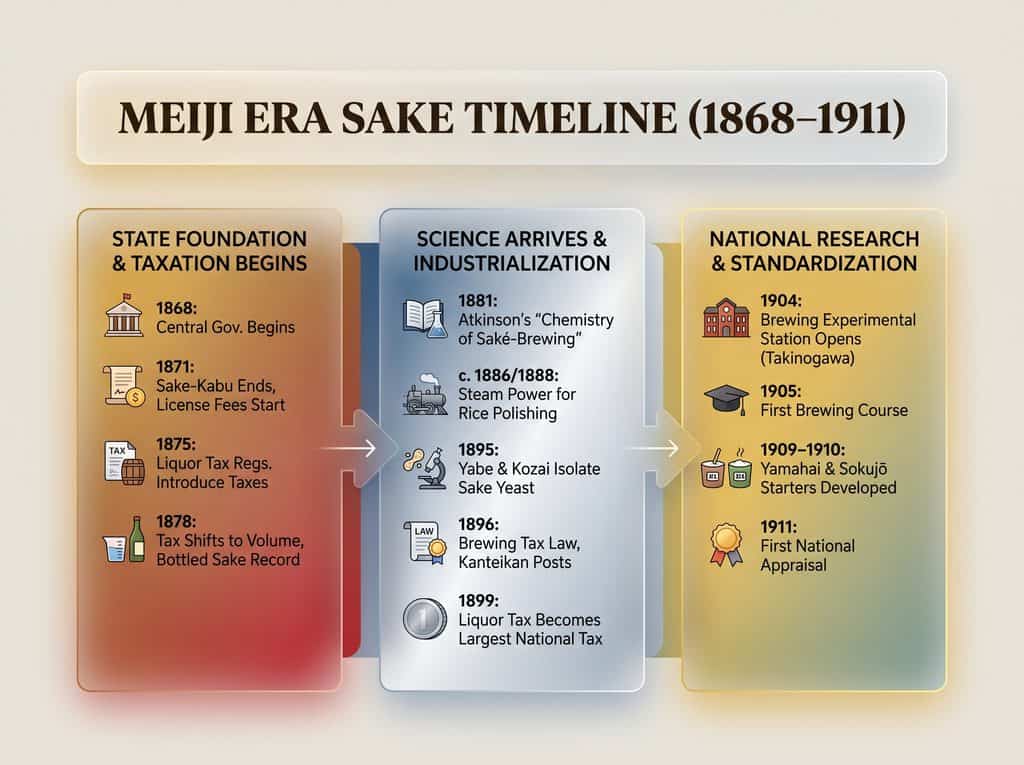
The dates below combine records from the National Tax Agency, the National Research Institute of Brewing, the Japan Sake and Shochu Makers Association, and the Sake Museum.
| Year | Development |
|---|---|
| 1868 | A centralized national government begins to take shape |
| 1871 | The sake-kabu system ends and state license fees govern entry |
| 1872 | An industry chronology records sake going overseas for the 1873 Vienna exposition |
| 1875 | Liquor Tax Regulations introduce brewing, business, and retail taxes |
| 1878 | Bottled sake goes on sale, by industry record, and the brewing tax shifts to volume |
| 1880 | Brewing Tax Regulations set a per-brewery license tax and the zōseki tax |
| 1881 | Atkinson publishes The Chemistry of Saké-Brewing at Tokyo University |
| c. 1886 | Steam power reportedly begins to drive rice polishing in Sakai |
| 1888 | A Nishinomiya brewer adopts steam-powered rice polishing |
| 1895 | Yabe Kikuji and Kozai Yoshinao isolate sake yeast from mash |
| 1896 | The Brewing Tax Law passes, and the first kanteikan posts appear |
| 1899 | Liquor tax overtakes the land tax as Japan’s largest national tax |
| 1904 | The Brewing Experimental Station opens in Takinogawa on May 9 |
| 1905 | The station holds its first brewing course |
| 1909 to 1910 | The station develops the yamahai and sokujō starter methods |
| 1911 | The station holds the first national appraisal of new sake |
Common Misconceptions About Meiji Era Sake
- “Meiji Japan invented modern sake.” It built the institutions around modern sake, while legal categories, standard polishing, and selected strains came later.
- “1871 deregulated brewing.” Inherited shares gave way to state licenses, and taxation and inspection then grew tighter.
- “Western science replaced traditional brewing.” Chemists studied a system that already worked, and Japanese researchers carried the science forward.
- “Every brewery mechanized rapidly.” Waterwheel polishing continued in Nada into the 1930s.
- “Bottles replaced casks in 1878.” Bottling began then, but bulk sales from the cask lasted for decades.
Frequently Asked Questions About Meiji Era Sake
Tax and the State
- What happened to sake brewing after the Meiji Restoration?
-
The state replaced Edo brewing shares with licenses in 1871 and then taxed brewing heavily. Anyone who paid the fee could brew, and many landowners entered the trade. Inspection and recordkeeping grew stricter over the following decades. Oversight tightened rather than loosened.
- Why was sake tax so important in Meiji Japan?
-
Sake tax mattered because liquor tax became Japan’s largest national tax in 1899. Sake was the largest traditional industry and easy to measure in koku. The state needed money for its army, railways, and schools. It raised the sake tax rate six times between 1896 and 1908.
- Why did the Ministry of Finance establish a brewing laboratory?
-
The ministry did so because sake tax had become its largest revenue source, and stable production protected that revenue. It opened the Brewing Experimental Station in 1904. The station also existed to research brewing and train technicians. Tax administration and brewing science grew up together.
Technology and Science
- When did machines begin polishing sake rice?
-
Steam power began driving sake rice polishing in the late 1880s. The Sake Museum reports use in Sakai from around 1886, and a Nishinomiya brewer adopted it in 1888. Purpose-built polishing machines followed in the late 1890s. Waterwheels nevertheless stayed in use in Nada until about 1932.
- When was sake yeast isolated?
-
Researchers isolated sake yeast in 1895. Yabe Kikuji and Kozai Yoshinao took it from sake mash and studied its properties. The name Saccharomyces sake Yabe later became attached to their work. Its formal naming history, however, is more complex than most timelines suggest.
- What are yamahai and sokujō?
-
They are two yeast starter methods that the Brewing Experimental Station developed around 1909. Yamahai keeps natural lactic fermentation but drops kimoto’s yama-oroshi grinding step. Sokujō adds lactic acid directly, which sharply shortens starter time. Some sources date sokujō to 1910 instead.
Taste and Significance
- Did Meiji sake taste like modern sake?
-
Probably not, since Meiji sake was likely fuller and more savory than most modern sake. Brewers polished rice far less, and kimoto and yamahai starters likely added firm acidity. People usually drank it warm. Quality also varied widely between breweries and batches.
- Why is the Meiji period important in sake history?
-
The Meiji period built the institutional and scientific framework that modern sake still works within. National licensing, volume taxation, a state research station, technical training, and national appraisal all began then. Yeast isolation and new starters opened the way to modern microbiology. Edo built the industry, and Meiji built the system around it.
Final Thoughts
It is tempting to tell the Meiji story as a clean break between old and new sake. The records refuse that version. The brewers of 1912 still washed rice by hand, grew koji on wooden trays, and waited through cold nights for a starter to sour.
What had changed was everything around them. There was a license on the wall, a ledger on the desk, and a steam mill down the road. Edo built the commercial industry, and Meiji built the modern institutional and scientific framework around it.
Control and support were two faces of the same fiscal dependence. The system that burdened brewers also helped finance research, training, and national appraisal. Perhaps the most striking result is that the state’s search for revenue produced institutions that outlasted the tax policies behind them. The next glass you pour still carries a little of 1904 in it.
References
Government and Institutional Sources
- Sake Tax in the Early Meiji Period (Special Exhibit “Meiji Sake Tax”), National Tax Agency, National Tax College Tax History Room. Accessed September 2026.
- Special Exhibit “Meiji Sake Tax”: Introduction, National Tax Agency, National Tax College Tax History Room. Accessed September 2026.
- The Founding of the Brewing Experimental Station (Special Exhibit “Meiji Sake Tax”), National Tax Agency, National Tax College Tax History Room. Accessed September 2026.
- Special Exhibit “When Sake Tax Supported the Nation”: Introduction, National Tax Agency, National Tax College Tax History Room. Accessed September 2026.
- The Era of First Place (Special Exhibit “When Sake Tax Supported the Nation”), National Tax Agency, National Tax College Tax History Room. Accessed September 2026.
- Commentary on the Sake Tax Historical Documents Collection I, Meiji Period, National Tax Agency, National Tax College. Accessed September 2026.
- The Brewing Experimental Station 25th Anniversary Commemorative Postcards (Network Tax History No. 258), National Tax Agency. Accessed September 2026.
- On the Brewing Year (Network Tax History No. 284), National Tax Agency. Accessed September 2026.
- Tax History Quiz: Security for the Zōseki Tax, National Tax Agency, National Tax College. Accessed September 2026.
- Office of Analysis and Brewing Technology: Career Guide (PDF), National Tax Agency. Accessed September 2026.
- History of the Institute, National Research Institute of Brewing. Accessed September 2026.
Academic Sources
- Atkinson, R. W. (1881). The Chemistry of Saké-Brewing. Memoirs of the Science Department, Tokio Daigaku, No. 6, International Research Center for Japanese Studies Repository. Accessed September 2026.
- Wakai, Y. (2004). A Century of Progress in Sake Rice Research, Breeding, and Polishing Technology. Journal of the Brewing Society of Japan, 99(10), 701-706, J-STAGE. Accessed September 2026.
- Yanagisawa, Y. (1997). Dr. Yabe Kikuji, Discoverer of Sake Yeast. Journal of the Brewing Society of Japan, 92(5), 367-368, J-STAGE. Accessed September 2026.
- Doi, T. (2024). Sake Brewery Management Seen Through the Distinctive Ledgers of Meiji-Period Brewing: The Product and Sales Books of a Nada Brewer, Nakamura Gakuen University Repository. Accessed September 2026.
- Doi, T. and Shimizu, Y. (2022). A Study of Meiji-Period Brewing Accounting. Kokumin Keizai Zasshi, 225(2), 45-64 (PDF), Kobe University Repository. Accessed September 2026.
Museum and Industry Sources
- Edo Shogunate and Sake Industry, Sake Museum (Hakushika Memorial Museum of Sake). Accessed September 2026.
- The History of Rice Polishing: Modern Era, Sake Museum (Hakushika Memorial Museum of Sake). Accessed September 2026.
- The History of Sake, Japan Sake and Shochu Makers Association. Accessed September 2026.
- The History of Japanese Sake, Japan Sake and Shochu Makers Association. Accessed September 2026.
- The Science of Sake Brewing, Universe, October 2024 (PDF), Osaka Science Museum. Accessed September 2026.
Related Articles
- History of Sake: From Ancient Rice Fermentation to Modern Nihonshu
- Ancient Sake in Japan: Rice, Ritual and Origins
- Medieval Sake in Japan: Temple Breweries, Sake Shops, and Brewing Innovation
- Rice Polishing (精米歩合)
- Koji (麹)
- Yeast (酵母)
- Fermentation (発酵)
- Moto (酒母): The Yeast Starter of Sake
- Kimoto (生酛): The Traditional Yeast Starter
- Yamahai (山廃): The Simplified Traditional Starter
- Sokujo (速醸): The Modern Yeast Starter
- Kan-zukuri (寒造り): Why Sake Is Traditionally Brewed in Winter
- Toji (杜氏): The Master Brewer Behind Every Bottle of Sake
- Pasteurization (火入れ / Hiire): Stabilizing Sake with Gentle Heat
- Bottling (瓶詰め): How Sake Becomes a Product





Comments