


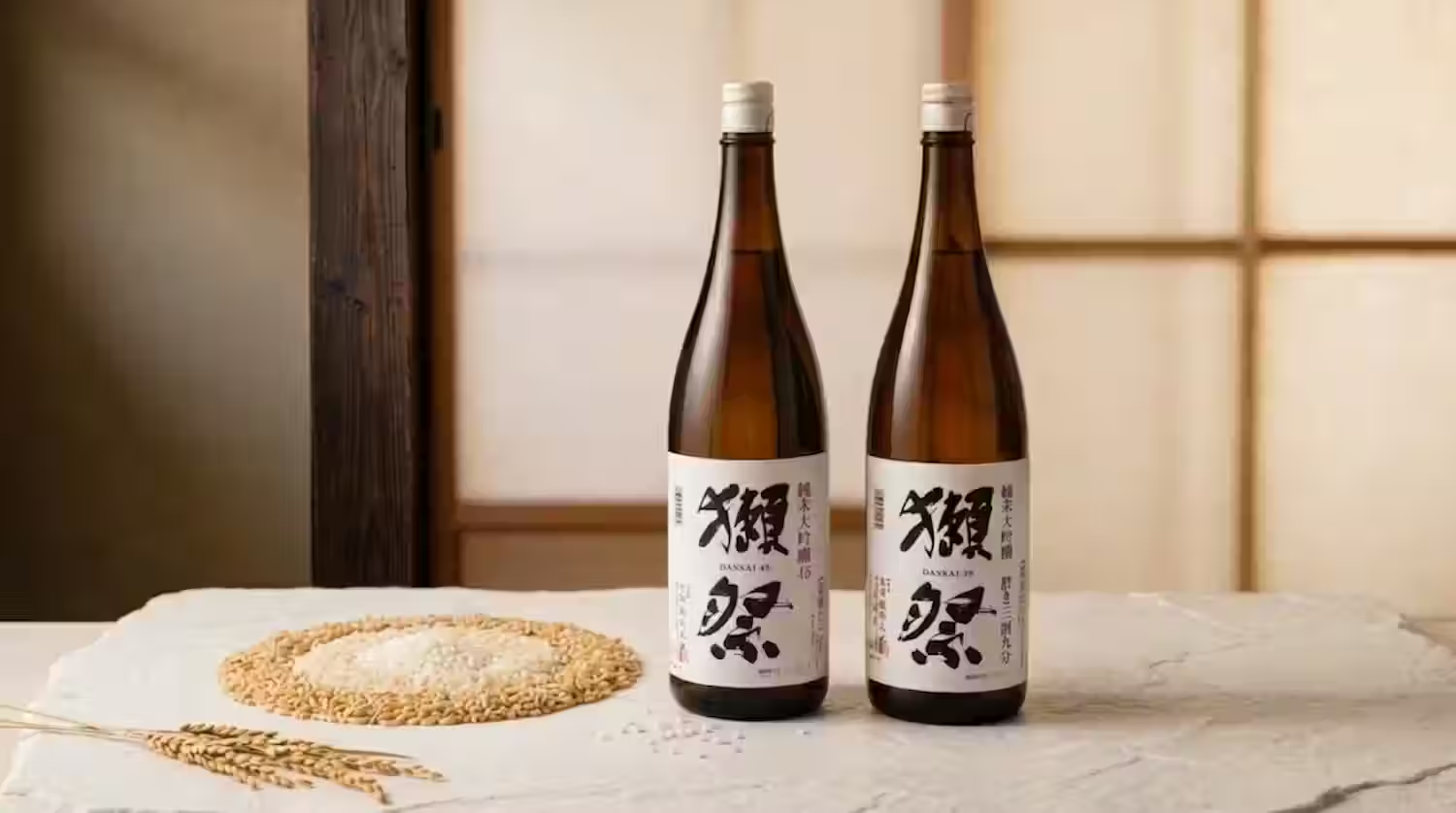
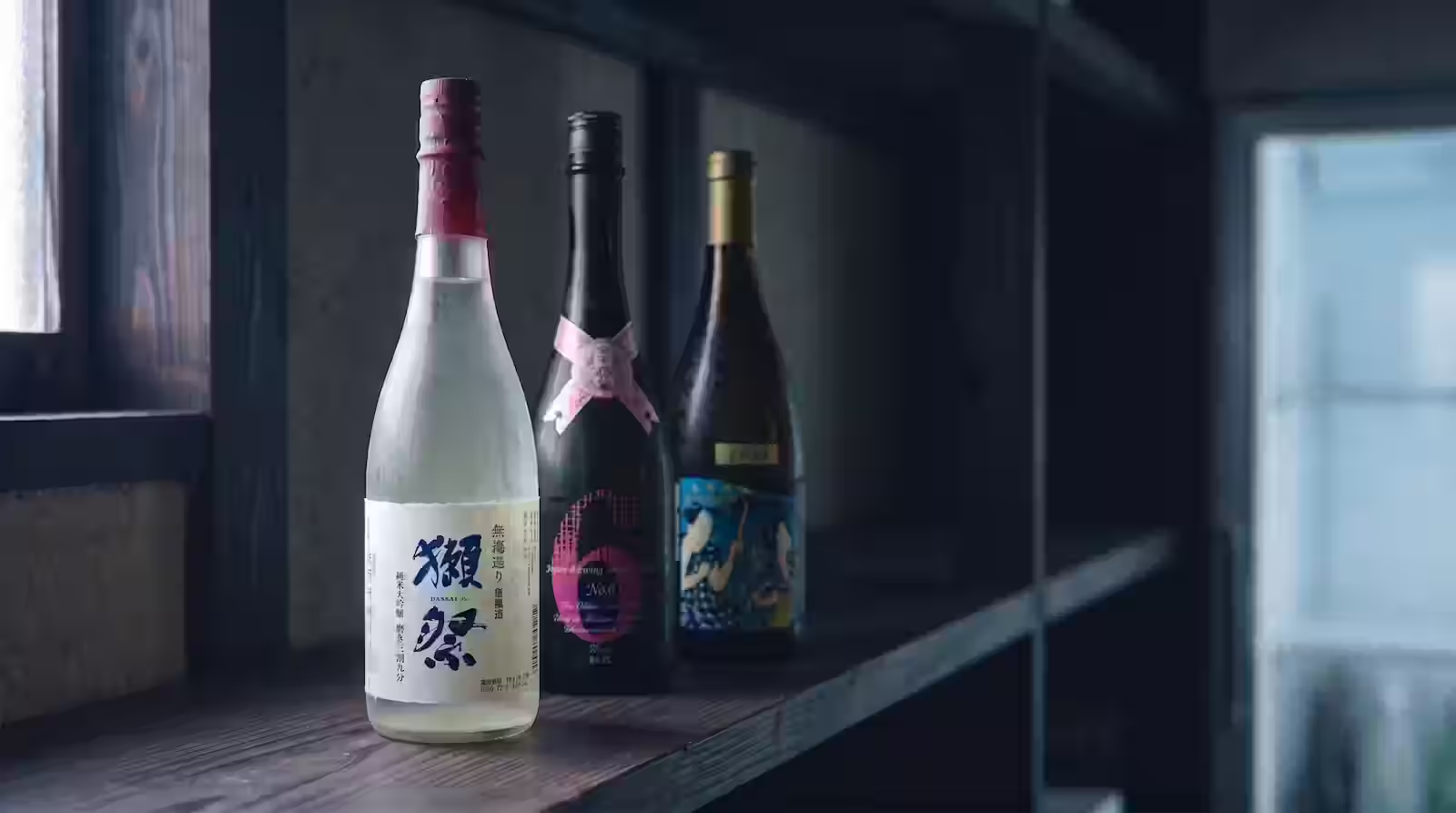

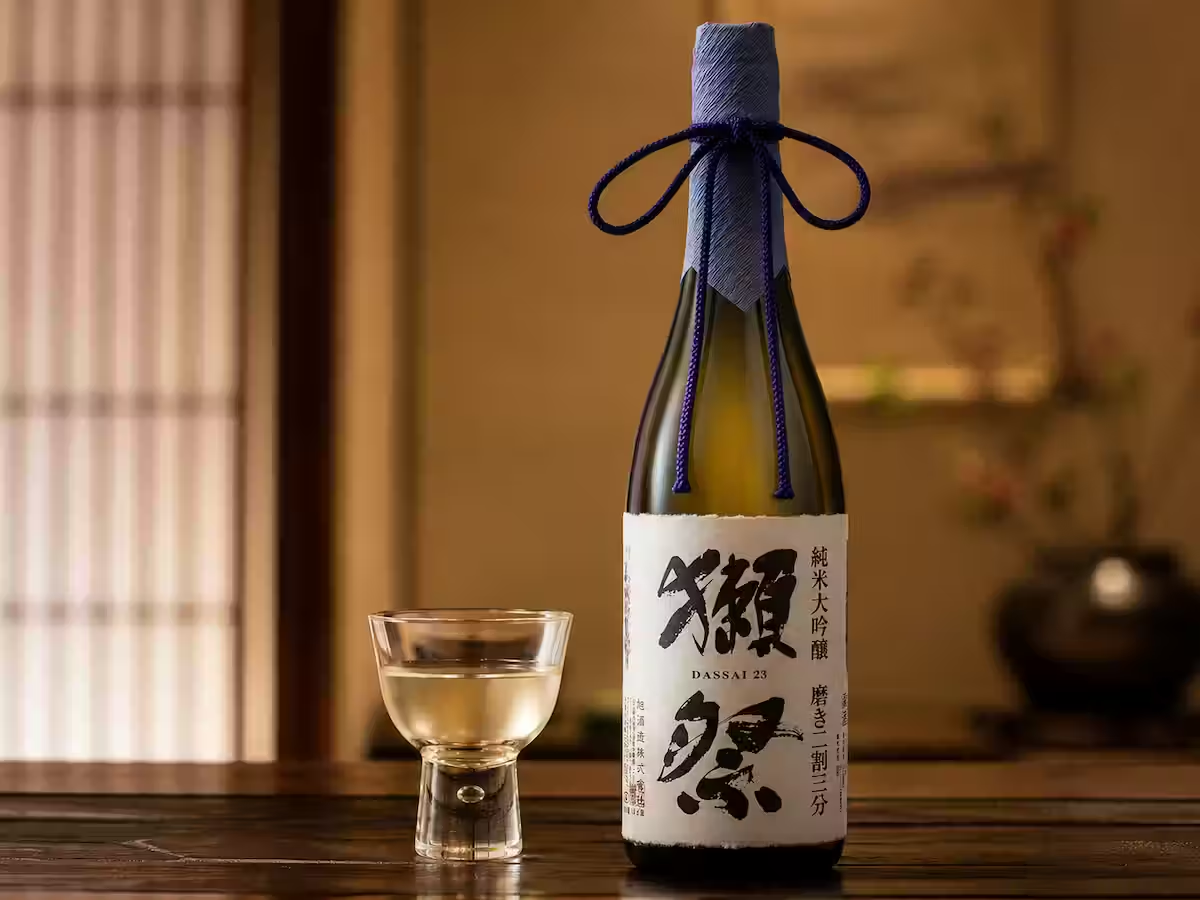
Bottles with a bold “23” on the label appear on sake lists in Japan and overseas. The figure is easy to mistake for alcohol strength, but it means something else. Dassai sake is a Junmai Daiginjo brand from Iwakuni in Yamaguchi Prefecture, in western Japan, and the number is a rice polishing ratio.
This guide looks past the fame. It covers the name, the history, the rice, the data-led brewery, the three core bottles and the New York offshoot, Dassai Blue. Along the way, it separates what the company says from what outside sources confirm.
What Is Dassai Sake?
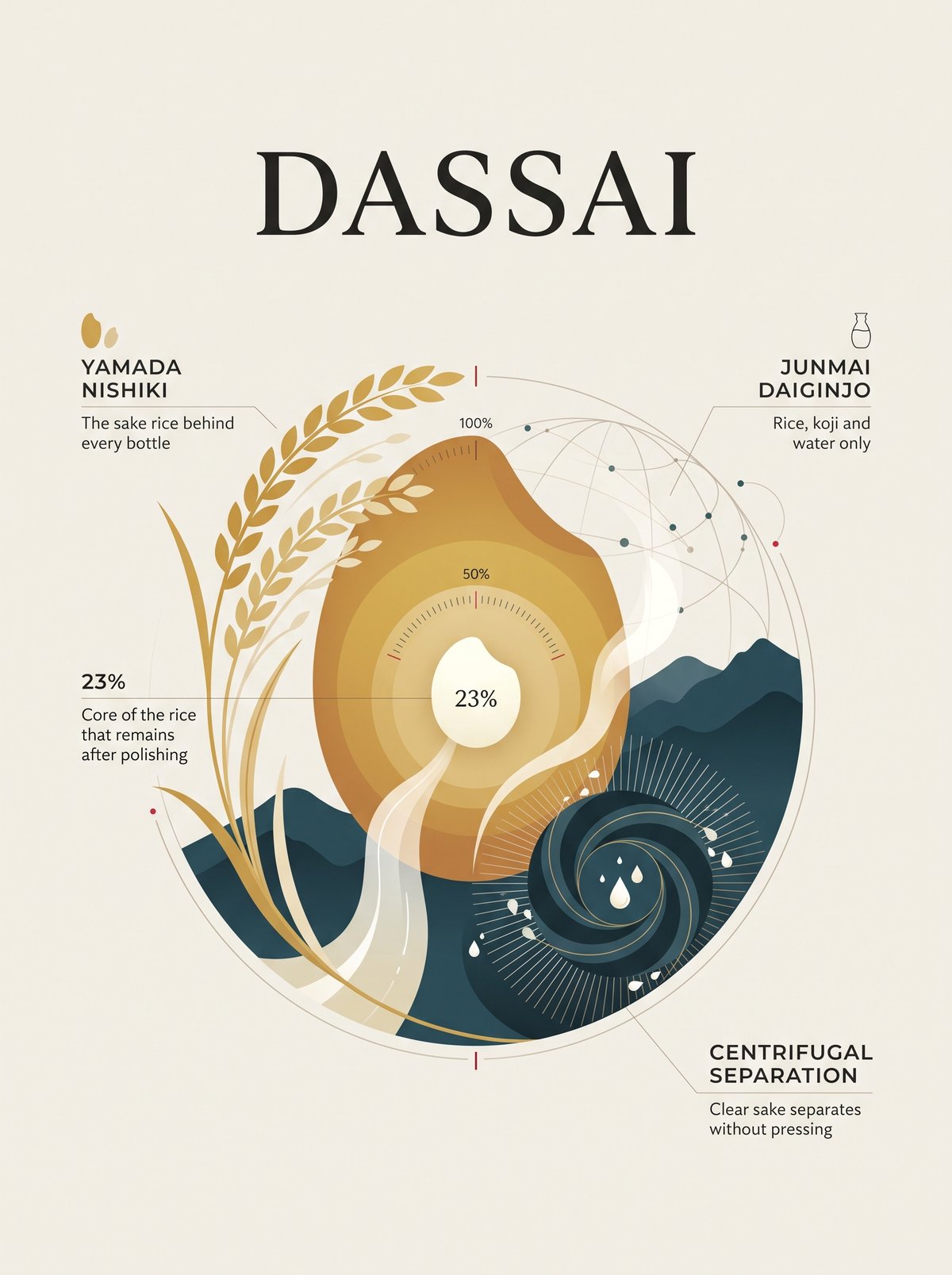
Dassai (獺祭) is a brand name, not a type of sake. Its maker, DASSAI Inc., brews in Osogoe, a mountain district of Iwakuni. Until June 1, 2025, the company traded as Asahi Shuzo, so older articles and company materials still use that name.
Quick Facts
- Brand
- Dassai (獺祭)
- Producer
- DASSAI Inc. (Asahi Shuzo until June 1, 2025)
- Home
- Osogoe, Shuto-cho, Iwakuni, Yamaguchi Prefecture
- Founded
- 1948, according to the company profile
- Brand launch
- 1990, according to a Yamaguchi Prefecture listing
- Style
- Junmai Daiginjo
- Rice
- Yamada Nishiki
- Core bottles
- Dassai 45, Dassai 39, Dassai 23
- Overseas brewery
- Dassai Blue, Hyde Park, New York
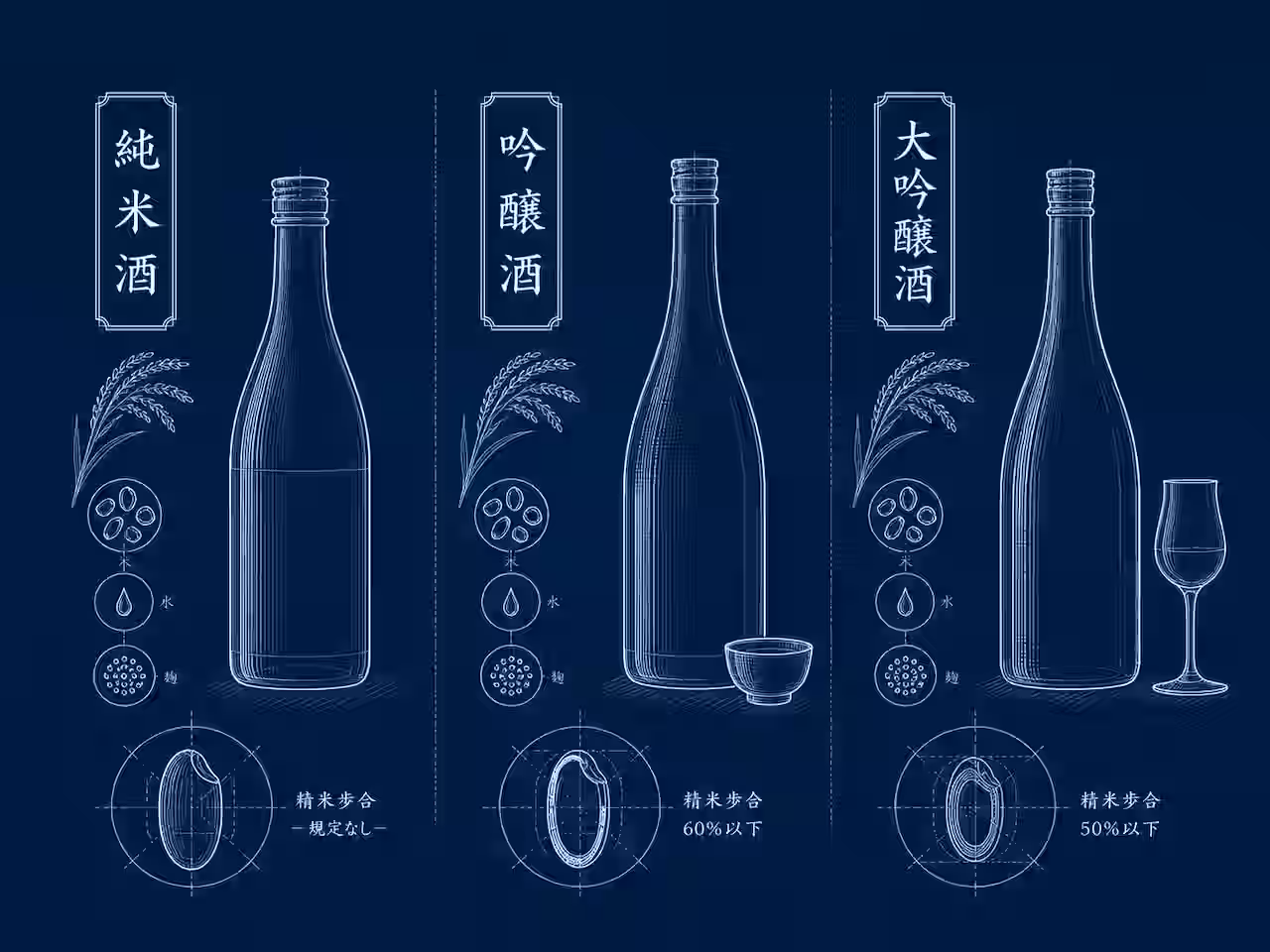
So what sits inside the bottle? The category is Junmai Daiginjo, a legally defined premium grade. Brewers use only rice, rice koji and water, with rice polished to 50% or less. In addition, the sake must meet the requirements for the Daiginjo name. Many breweries offer the grade as one part of a broader range. Dassai, however, built its core sake identity on it.
That choice explains why people confuse the brand with the category. If you are new to sake grades, our guide to the types of Japanese sake sets out the wider map. Here, the focus stays on one producer and the decisions behind it.
What Does the Name “Dassai” Mean?
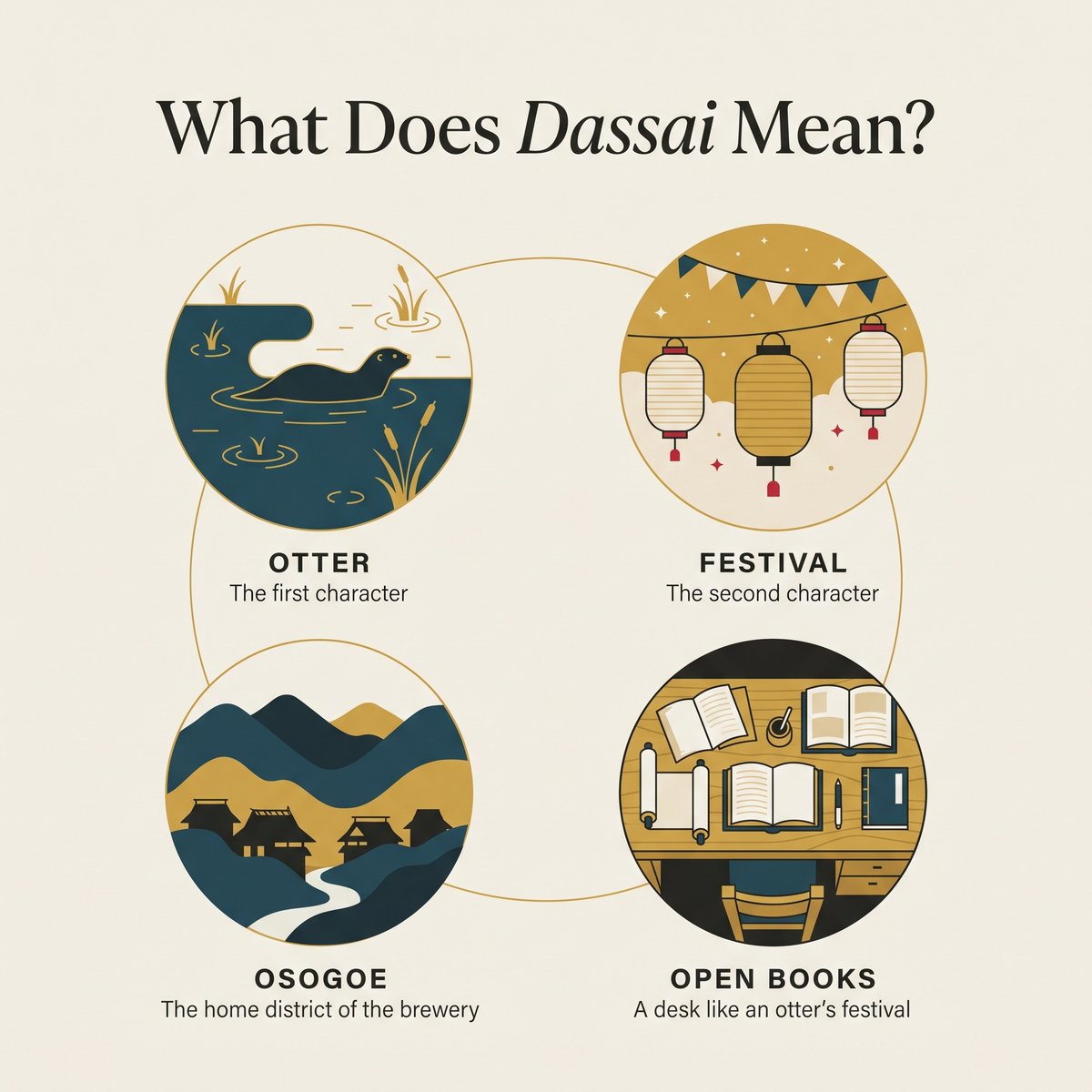
The two characters read “otter” (獺) and “festival” (祭). According to the brewery, the name borrows one character from Osogoe (獺越), its home district. The company also cites an old local record for the place name. In that telling, an aged otter tricked village children and chased them over the hill.
The word also has a literary life. An otter supposedly lays out its catch along the riverbank, as if holding a festival. Writers therefore used “dassai” for a desk covered in open reference books. The Meiji poet Masaoka Shiki even signed himself as the master of the “Dassai study.”
The company links that image to its own outlook. It says it wants to improve sake through change rather than lean on the word “traditional.” Still, treat the otter story as a naming account, not as zoology. We could not check the original village record ourselves, so we attribute it to the brewery.
The History Behind Dassai Sake
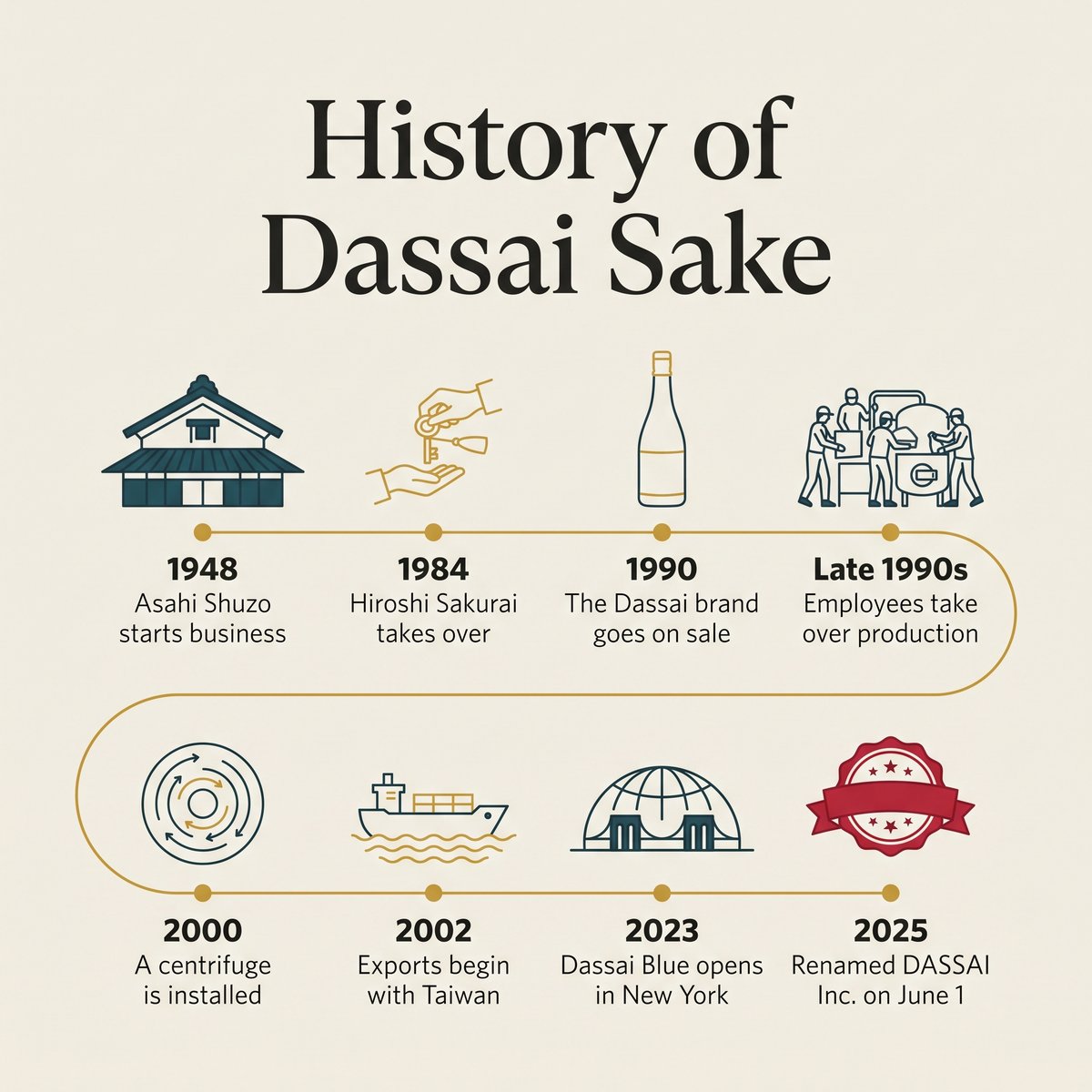
The story begins modestly. Specifically, the company profile gives 1948 as the founding year of Asahi Shuzo. Its American sister site traces the family brewing roots further back, although it cites no document. For that reason, 1948 is the safer date to quote.
- 1948Asahi Shuzo starts business in Iwakuni, according to the company profile.
- 1984Hiroshi Sakurai takes over the family brewery.
- 1990The Dassai brand goes on sale, according to a Yamaguchi Prefecture listing.
- Late 1990sThe master brewer leaves, by the chairman’s account, and employees take over production.
- 2000The brewery installs a centrifuge, according to the company.
- 2002Exports begin with shipments to Taiwan.
- 2023Dassai Blue opens in Hyde Park, New York.
- 2025Asahi Shuzo renames itself DASSAI Inc. on June 1.
A Crisis That Changed the Method
Hiroshi Sakurai inherited a struggling regional brewery in 1984. Meanwhile, Japan’s sake market had already begun its long decline, as our modern sake history article explains. A small maker in a quiet valley therefore had few easy options.
The turning point came in the late 1990s. In a 2018 lecture reported by SAKETIMES, Sakurai said a side venture in restaurants had failed. Afterward, the toji, or master brewer, and his seasonal crew left. This is the owner’s own account, and we found no independent record of the details.
Consequently, the company faced a blunt choice. It could hire another master brewer, or it could train its own staff. It chose the second path and began recording each step in numbers. Later, a modern building allowed brewing in every season instead of winter alone.
From Asahi Shuzo to DASSAI Inc.
The name change in 2025 completed that shift. In its announcement, the company said it wanted the brand name to carry its future abroad. Kazuhiro Sakurai, the son of Hiroshi Sakurai, now leads it as representative director.
Why Dassai Became a Global Sake Name
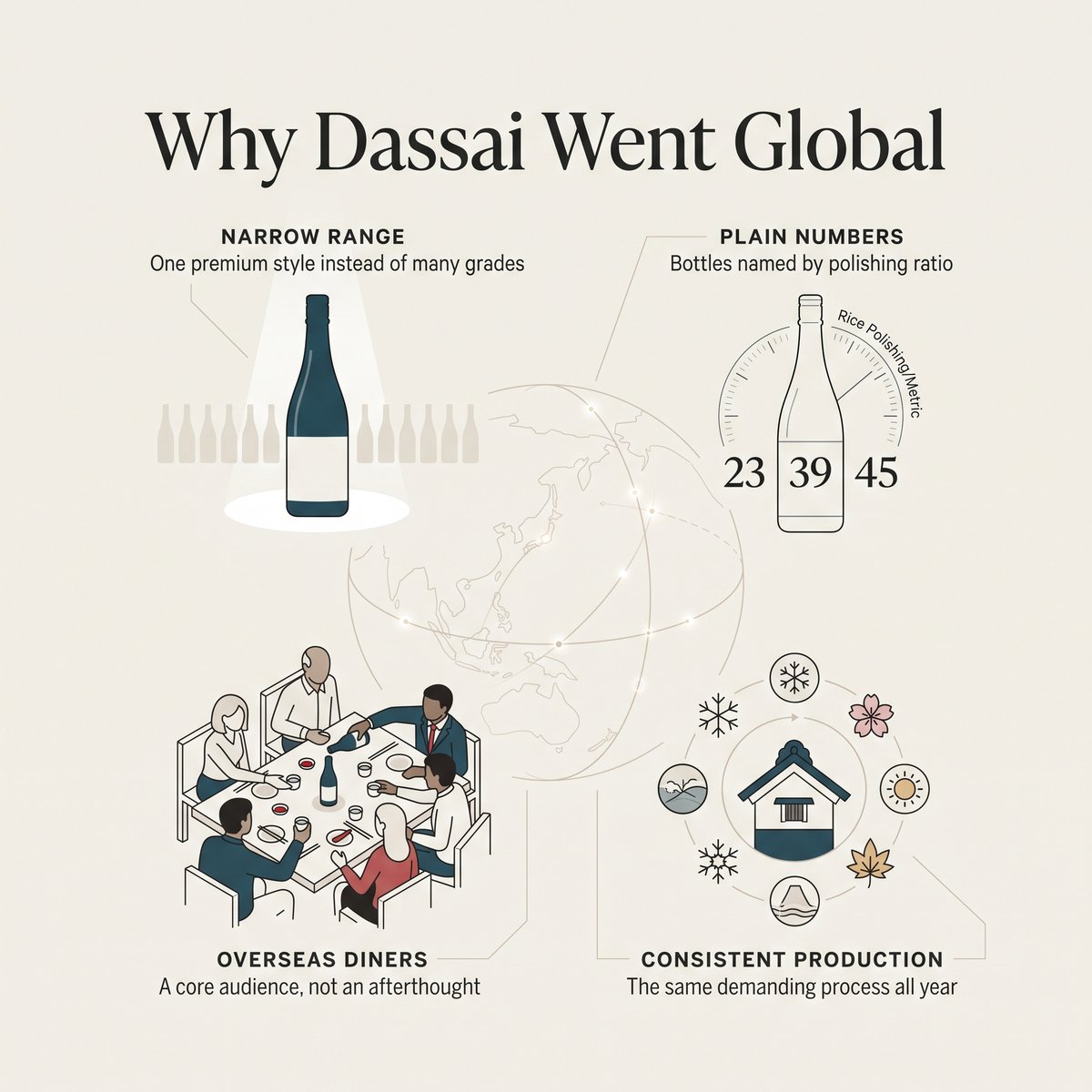
The global growth of Dassai sake reflects several connected choices. These include a narrow premium range, numbered labels, consistent production and steady attention to overseas markets. Fame alone does not explain much, so each choice deserves a look.
First, the company narrowed its range instead of widening it. Second, it named bottles with plain numbers that any drinker can read. Third, it treated overseas diners as a core audience rather than an afterthought. As a result, the brand travels well across languages.
Restaurant service may be another factor. A numbered bottle is easy for staff to explain in a few words, although this reading is our own.
Is it the best sake in Japan? That question has no honest answer, because taste is personal. Japan’s labeling rules also restrict unsupported superlative claims such as “best” or “number one” on a label. Therefore, this article avoids rankings. Its significance lies in the way the brand connects brewing, technology and global demand.
Statements marked “the company says” come from the producer. Figures from ministries and prefectures appear with their source. Analysis is ours, and we flag it as such.
Why Dassai Focuses on Junmai Daiginjo
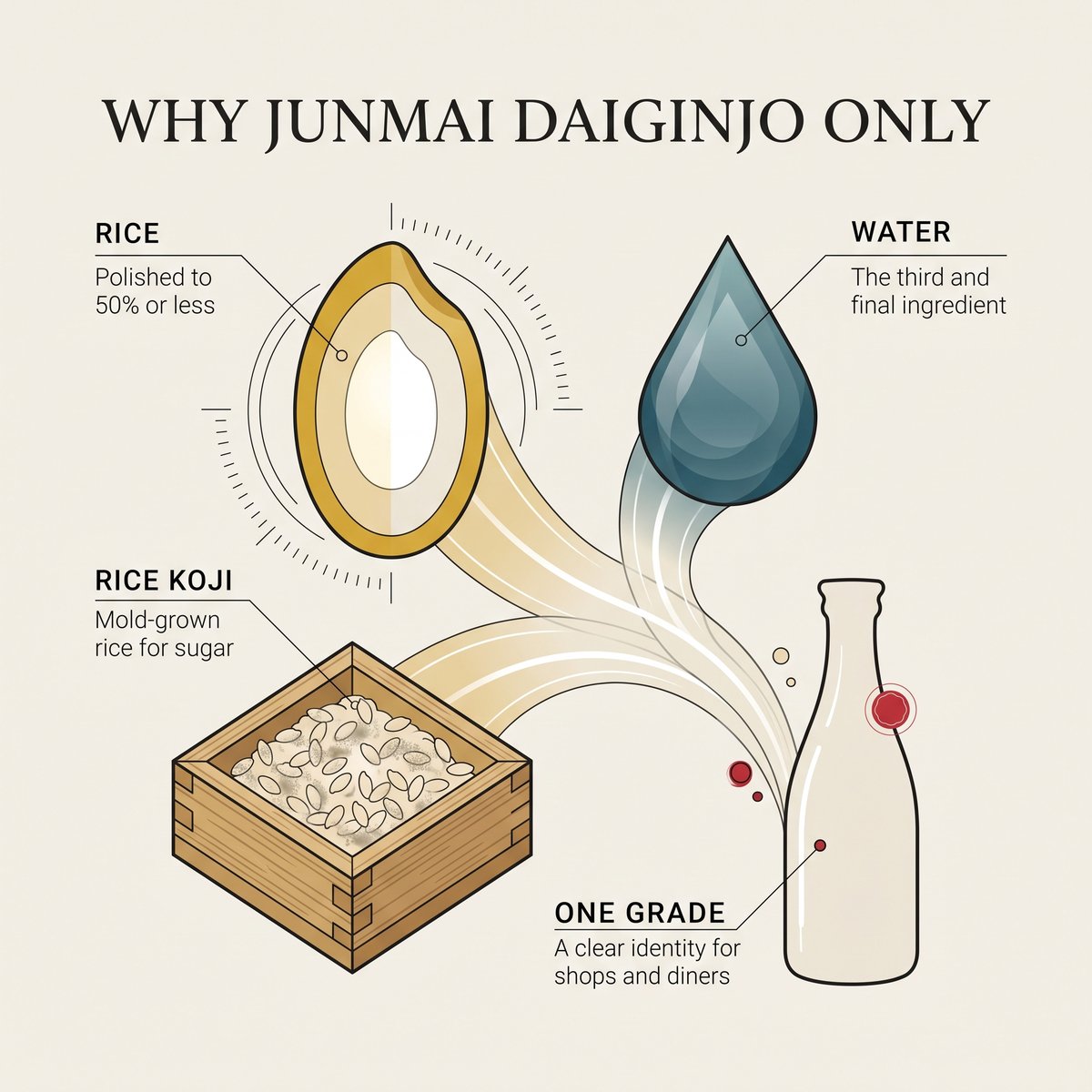
A single grade gives the brand a clear identity. Most breweries sell a ladder of grades, from everyday table sake up to a prestige bottle. Dassai removed the lower rungs. The company has built its core sake business around Junmai Daiginjo from Yamada Nishiki rice. It also sells a few side products, such as umeshu (plum liqueur) and shochu, a distilled spirit.
Why give up cheaper bottles that sell in volume? One answer is clarity. A single grade tells shops, restaurants and drinkers exactly what the name stands for. Moreover, it lets the brewery repeat one demanding process many times a year. Repeating one style all year also lets staff build experience quickly.
There is a market logic as well. For a small regional brewery, competing with large national producers on price would have been difficult. A narrow premium range, in contrast, gave a small company something distinct to offer. That reading is our analysis rather than a company statement.
A narrow focus certainly carries risk. A brewery with one style depends heavily on one rice and one kind of customer. We explain the grade itself in our Ginjo and Daiginjo guides, so this section stays with the strategy.
Yamada Nishiki: The Rice Behind Dassai
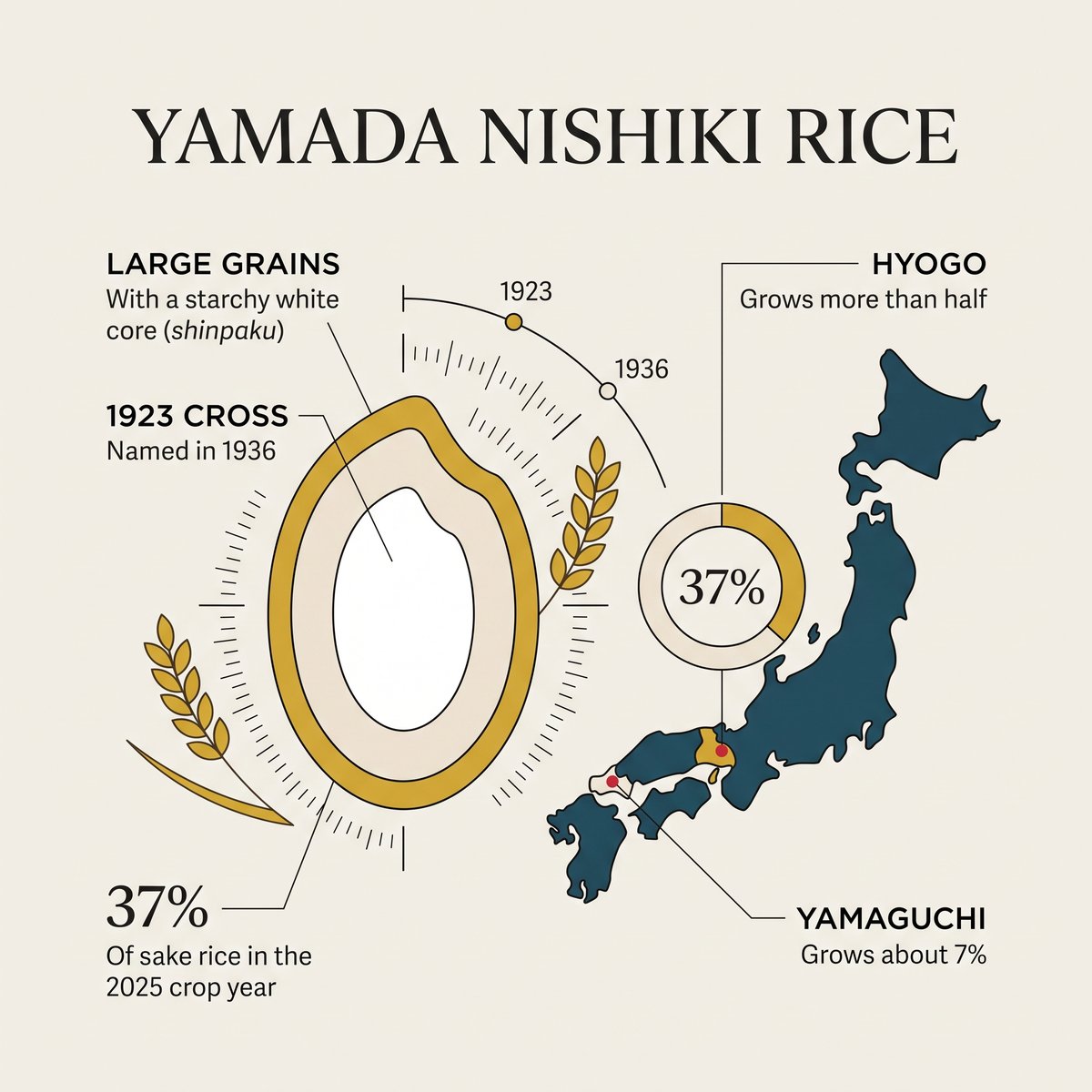
The three core bottles in this guide all use one rice. Yamada Nishiki is one of Japan’s most widely used brewing varieties. The agriculture ministry estimated that it made up 37% of sake-specific rice grown in the 2025 crop year. Hyogo Prefecture grew more than half of it, while Yamaguchi contributed about 7%.
The ministry’s magazine traces the variety to a 1923 cross in Hyogo, with the name following in 1936. Brewers especially value its large grains and its starchy white core, called shinpaku. In addition, its low protein content helps limit rough flavors. Our sake rice guide covers the variety family in detail.
A Different Idea of the Ideal Grain
Here the brewery departs from convention. Since 2019 it has run a contest for Yamada Nishiki farmers. The company says entries rose from 45 in the first year to 144 in 2023. Since 2021, however, its judges have favored a white core that is small and centered.
That sounds odd at first, because a large core usually earns praise. The reason is mechanical. The company says big cores cracked when it polished grains down to very small sizes. Plant scientists have also reported a related pattern. A 2009 study in Plant Production Science tied kernel breakage during polishing to the structure of the white core.
Excellent rice does not guarantee excellent sake. It only widens what careful brewers can achieve.
Supply matters too. The ministry notes that growers mostly sell brewing rice through contracts. A producer that uses one variety therefore depends on long relationships with farmers.
Reliance on one variety therefore creates a specific supply risk, even when the rice comes from several regions. A poor nationwide harvest could matter more than it would for a brewery with several varieties.
Understanding Dassai 45, 39 and 23
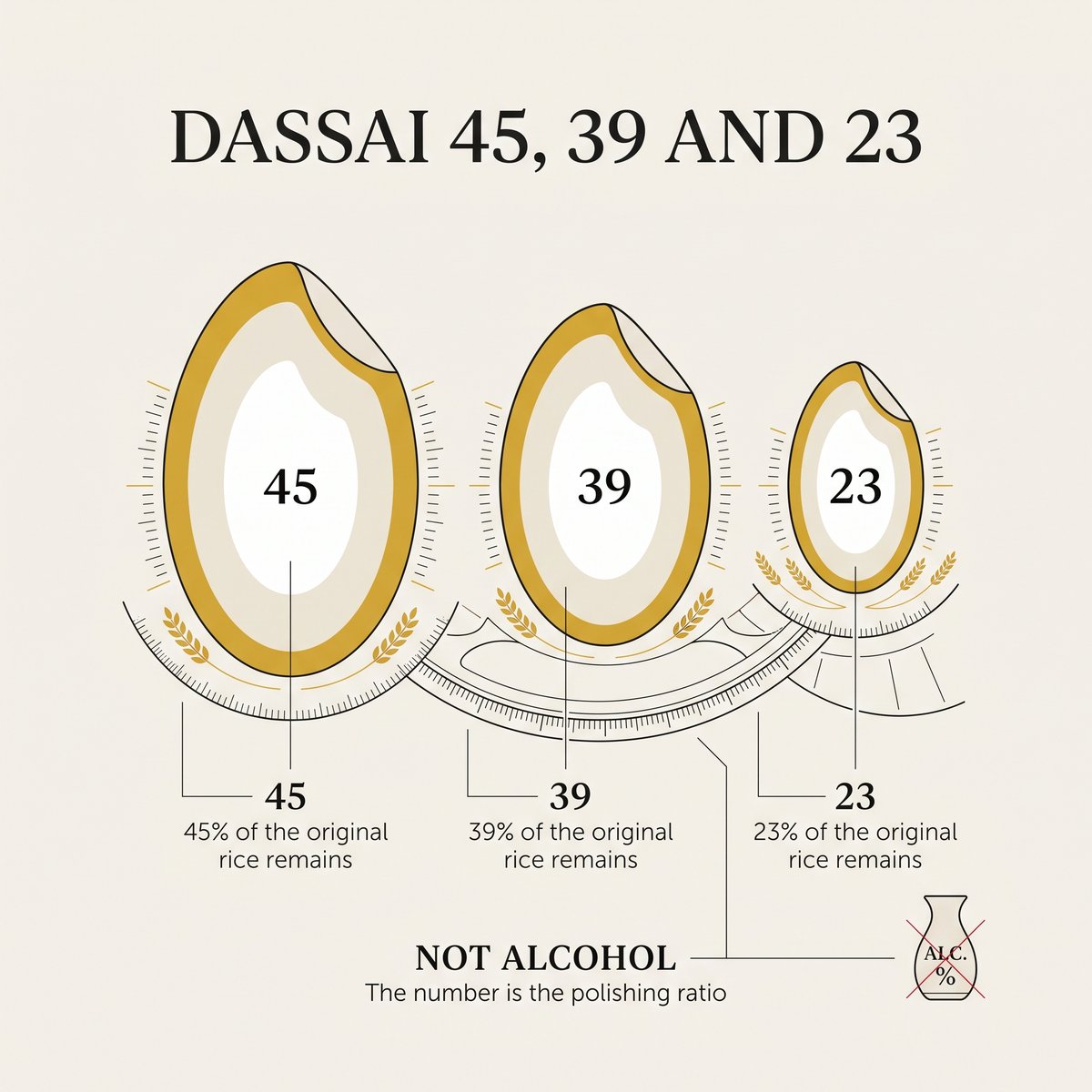
The numbers on Dassai sake are not alcohol levels. Each one states the rice polishing ratio. Under Japan’s labeling standards, that ratio is the weight of the polished rice as a percentage of the original brown rice. A lower figure means the mill removed more of the rice.
| Bottle | Polishing ratio | What the number means | How the producer describes it |
|---|---|---|---|
| Dassai 45 | 45% | The polished rice weighs 45% of the original brown rice. | The standard bottle, with delicate rice sweetness. |
| Dassai 39 | 39% | The polished rice weighs 39% of the original brown rice. | Fragrant, balanced and long on the finish. |
| Dassai 23 | 23% | The polished rice weighs 23% of the original brown rice. | Bright aroma, honey-like sweetness and a clean finish. |
Why polish at all? The outer layers of rice hold more fat, minerals and protein. According to Japan’s National Research Institute of Brewing, too much of these can cause unpleasant flavors. Our rice polishing article explains the mechanics.
Why 23 and Not 25?
The famous figure has a human story. By the company’s account, the plan was a sake polished to 25%. Then staff learned that a rival already sold one at 24%. Sakurai reportedly ordered two more points off, and 23 stuck.
Polishing that far takes about a week of milling, by the company’s figures. Afterward, the dry grains rest for more than a month before washing. So the low number signals time and lost rice as much as flavor.
Does a Lower Number Mean Better Sake?
Not automatically. The law requires a ratio of 50% or less, together with other requirements, for the Daiginjo name. It does not rank 23 above 39. Some drinkers may prefer the 23, while others may prefer the fuller impression of the 45. Both preferences are equally valid. Notably, no independent tasting trial settles the matter.
Think of the three as different cuts rather than steps on a podium. Besides, your mood and the food on the table shape the result.
How Dassai Sake Is Brewed
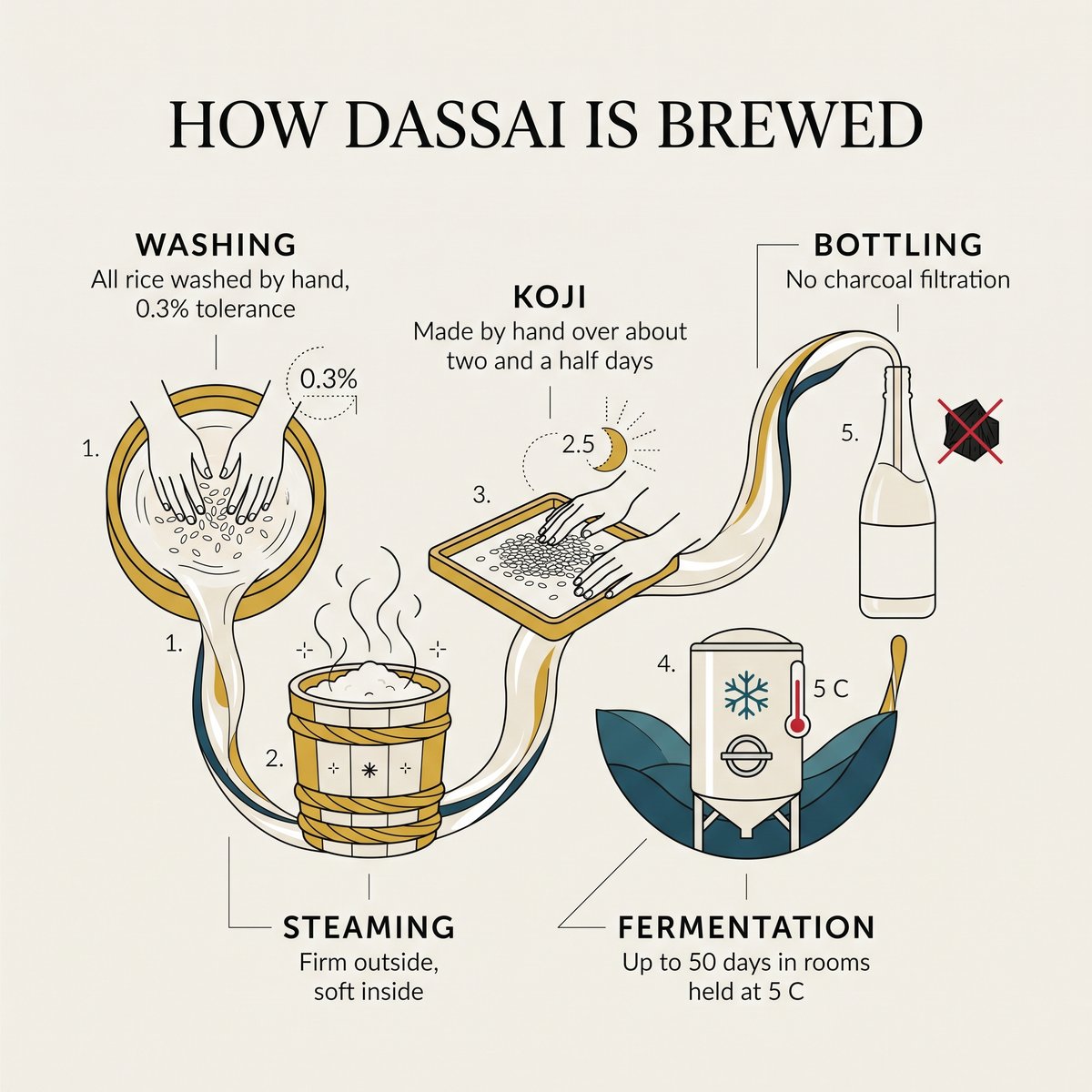
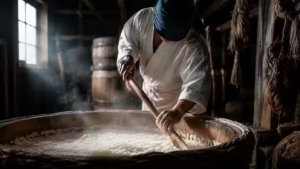
Dassai sake follows the standard brewing sequence, but staff do much of the work by hand. The basic steps match any sake brewery, and our guide to how sake is made walks through them. What differs is where this company spends labor. On its process page, the company describes practices that include the following.
- Washing: Staff wash all the rice by hand, because machines cannot control water uptake as finely. The target is a tolerance of 0.3%.
- Steaming: A traditional vat steams the rice so each grain stays firm outside and soft inside.
- Koji: Workers make all koji, the mold-grown rice that turns starch into sugar, by hand over about two and a half days. Four people rotate through the night.
- Fermentation: The mash ferments slowly for up to 50 days in rooms held at 5°C all year.
- Bottling: The company skips charcoal filtration, then pasteurizes in the bottle at 65°C and chills it quickly.
These figures are the producer’s stated process targets, so they may not describe every product or batch. Even so, a ministry magazine reported similar practices after visiting in 2018. Long, cold fermentation is standard for aromatic styles, and here it runs in every season.
The Centrifuge
One machine deserves a mention. Conventional pressing squeezes the moromi, or main mash, through cloth under pressure, as our pressing article describes. In 2000 this brewery added a centrifuge, which spins the liquid out instead. The company says it was the first commercial use in Japan’s sake industry.
The method is costly and yields less sake. Therefore, it appears only in selected bottles, such as a centrifuge edition of the 23. The company says the gentler handling protects aroma and body. Independent comparative evidence is limited, so treat that as the producer’s assessment.
Data-Driven Brewing and the Role of Human Skill

At Dassai, employees brew as a team, and recorded data supports their judgment. It is tempting to assume that computers make this sake. That picture is wrong, and the brewery itself rejects it. People still wash, steam, stir and taste. Data records conditions, allows comparison and supports their decisions. It does not make brewing automatic.
The agriculture ministry’s magazine described the system in 2018. It reported that the brewery logged detailed figures at every stage and that year-round employees, rather than a seasonal toji team, did the brewing. In other words, knowledge moved from one master’s memory into shared records.
What the Numbers Cannot Do
Sakurai has been frank about the limits. In his 2018 lecture, he said deeper analysis showed how hard prediction really is. Rice, koji and yeast are living things, so they never return to the same state. Data therefore helps the team read the present rather than forecast the result.
This point matters, because it answers a common worry that measurement kills craft. The available evidence suggests otherwise here. The company says more than 200 employees now work in production. That figure shows how much hands-on work remains.
What changed is the structure of responsibility. A seasonal master once held the recipe in his head. Now a salaried team shares it, supported by accumulated records. Whether that counts as tradition or a break from it depends on your definition, and reasonable people disagree.
Moreover, the company now speaks of a second stage. Since it has reached consistency, it says it wants smaller selected teams to pursue more creative brewing.
Modern production systems can support craftsmanship rather than replace it.
What Does Dassai Sake Taste Like?
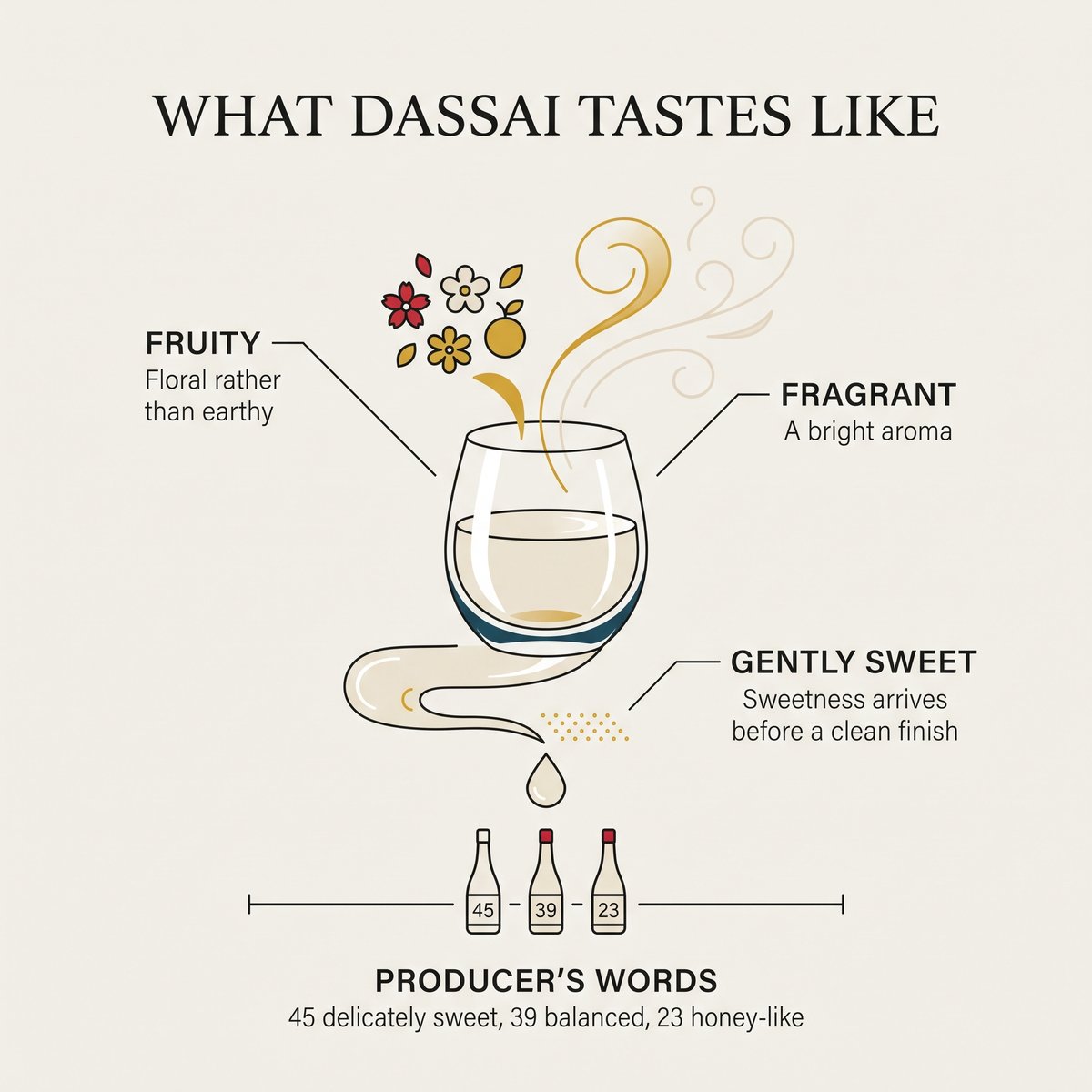
Dassai sake is typically fruity, fragrant and gently sweet. Expect a floral style rather than an earthy one. Its producer speaks of a bright, fragrant aroma. The texture tends to feel smooth, and a gentle sweetness arrives before a clean finish.
Across the producer’s descriptions, the three core bottles share that broad profile. Even so, the company presents each one differently. The producer describes the 45 as delicately sweet, the 39 as balanced, and the 23 as honey-like with a long finish. Those are the company’s words, not lab results.
The size of the difference in the glass varies by drinker. Side by side, some people may perceive the 23 as lighter or more refined. Alone, on a busy evening with food, the gap can shrink. These are impressions rather than fixed results of the polishing ratio. That is part of the charm, and a little humbling too.
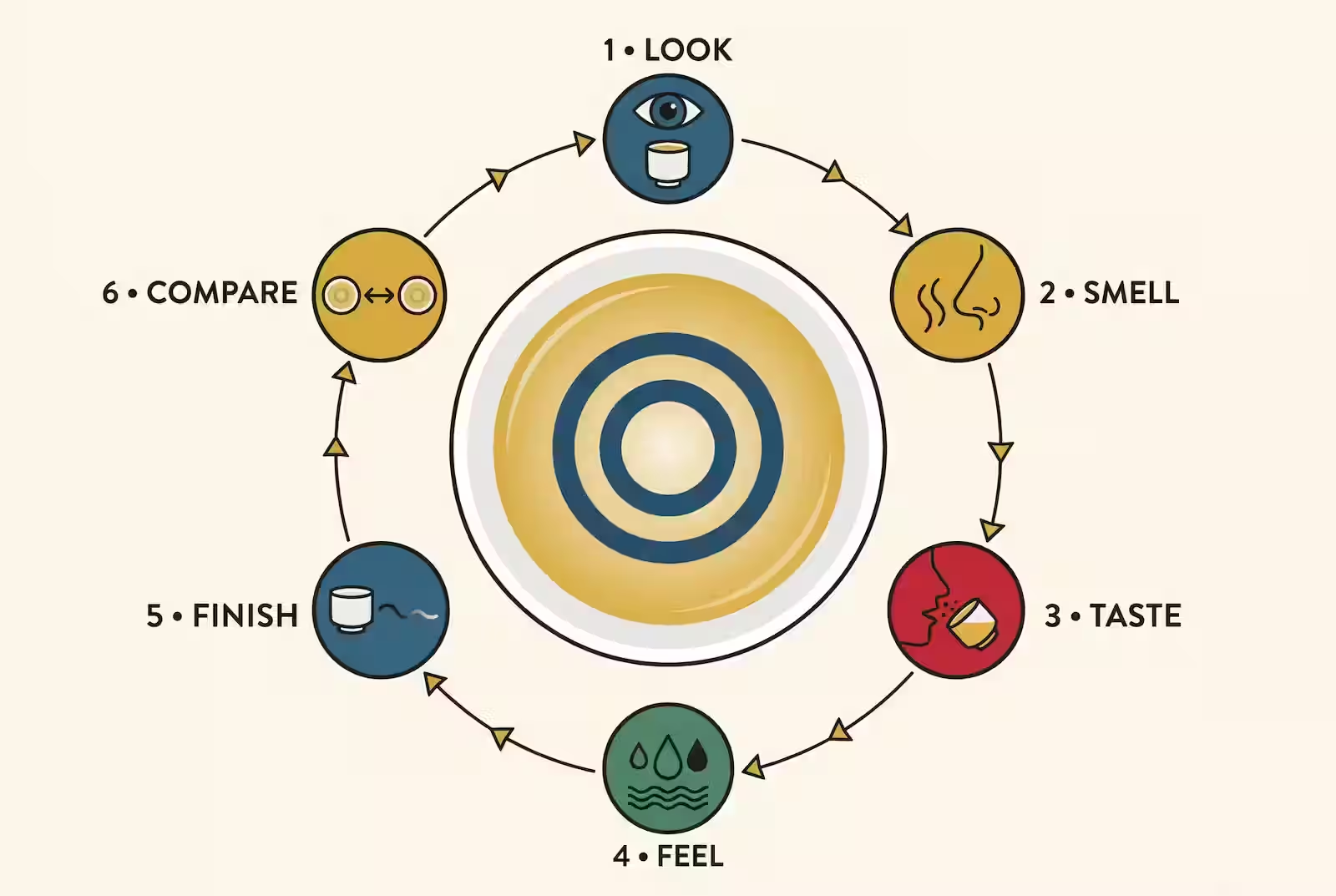
Conditions also change the picture. Temperature, storage and time since opening all shift aroma. For example, long exposure to heat or light can dull delicate aromas. Serving temperature, meanwhile, changes how sweetness and fragrance come across. Our guide on how to taste sake offers a simple method for comparing bottles.
Not everyone enjoys this profile. Fans of dry, savory, rice-forward sake sometimes find it too perfumed. That reaction is fair, and it says nothing about quality.
Dassai as a Modern Premium Sake Brand
Sake labels can be hard for newcomers, because many carry dense kanji and poetic names. Dassai, in contrast, offers something simpler. A newcomer can see three numbers and guess how they relate.
That clarity helps beginners and restaurants alike. A server can explain the range in one sentence. Similarly, a traveler can reorder the same bottle in another country. Our guide to reading a sake label shows how unusual such plain labeling is.
Scale has followed. A Yamaguchi Prefecture listing recorded sales of about 19.5 billion yen for fiscal 2024 and 328 employees in May 2025. The firm grew from a rural brewery, but it is no longer small in operational terms.
Reputation and preference remain separate things, though. A well-known name can make a purchase feel less uncertain, yet it cannot predict your taste. Researchers make a related point about luxury. A study in the journal Luxury argues that local sake draws its authenticity from community and environment, whereas wine relies more on the product itself.
Where does a large, export-minded brand fit in that picture? We are not sure, and the question seems worth leaving open.
The same consistency invites two readings. Some drinkers may find it polished and reliable, while others may prefer a less predictable sake.
From Japan to the World
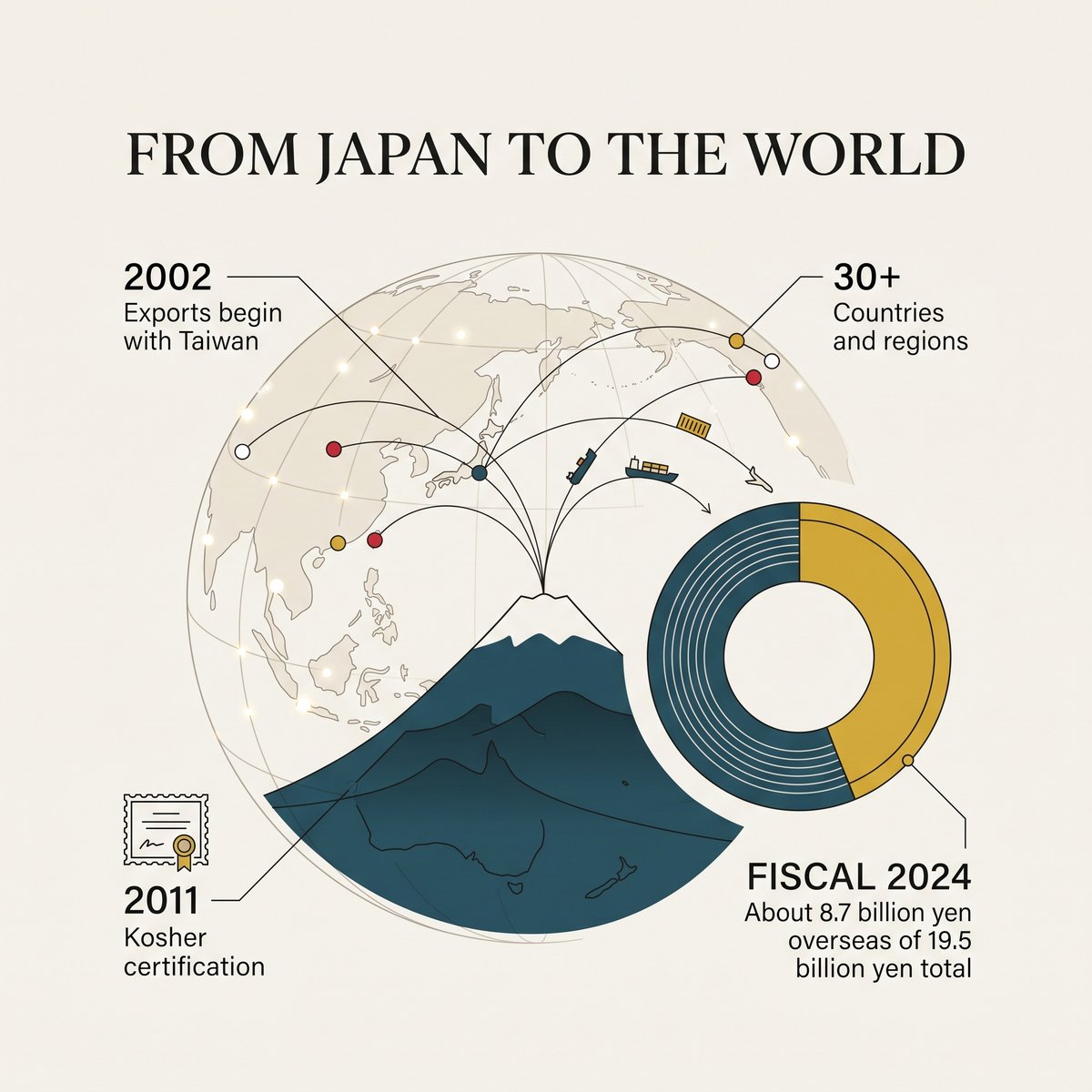
Exports began in 2002 with Taiwan, according to a profile from the agriculture ministry’s regional office. The same profile lists more than 30 countries and regions as destinations. It also notes kosher certification in 2011, which opened doors in some markets.
By fiscal 2022, the profile recorded export value of about 7 billion yen. The profile also gives China 56% of exports and the United States 14%. However, it does not state the reference year, so treat those shares as a snapshot.
The numbers are large for a single brewery. The company told SAKETIMES that overseas sales reached about 8.7 billion yen in fiscal 2024. Its total was roughly 19.5 billion yen, so nearly half came from abroad. Meanwhile, the whole industry has leaned on exports, a shift we trace in our contemporary sake article.
Not a Smooth Success Story
It would be easy to tell this as a triumph. The chairman does not. In a 2025 interview, Hiroshi Sakurai said growth was not smooth and that the team works with a sense of crisis.
Taste is one obstacle. He pointed out that many American diners favor much sweeter flavors, so a delicate sake needs explaining. Language is another. Words such as Junmai or polishing ratio mean little without context. Consequently, education sits beside sales in every new market.
What does that teach other producers? Shipping bottles is only one part of overseas expansion, whereas building understanding takes longer. Helping a stranger understand why rice can taste of fruit takes far longer. Whether Dassai has changed how the world sees sake remains hard to measure. No survey we found proves it.
Dassai Blue: Brewing Sake in the United States
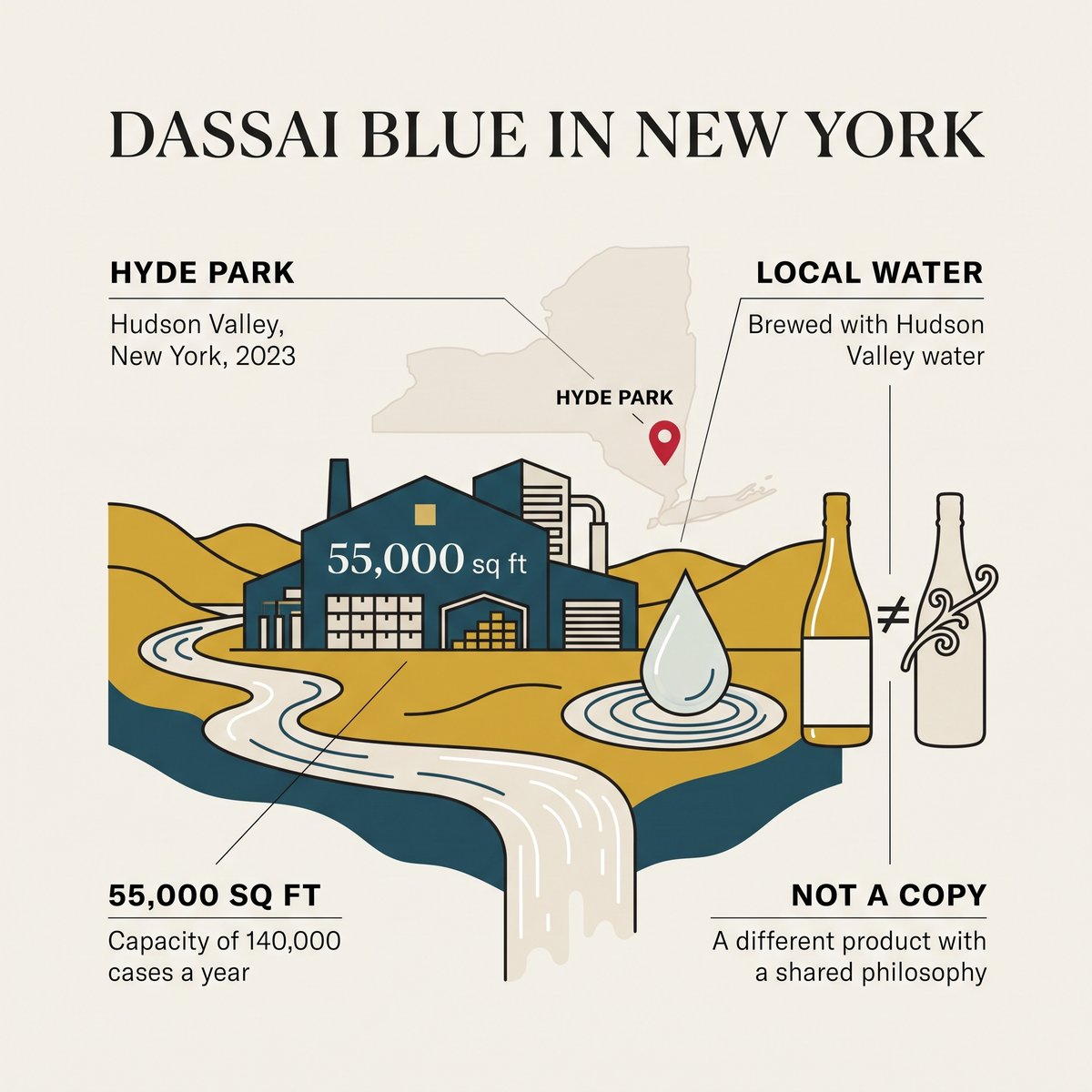
In 2023 the company opened a brewery in Hyde Park, in New York’s Hudson Valley. Its sake carries a separate name, Dassai Blue. The brewery’s own site describes a 55,000-square-foot facility with capacity for 140,000 cases a year.
One practical effect of local production is a shorter distance to market. The project also has a broader aim, which is adapting brewing knowledge to American rice, water and staff. A business school case from Ivey Publishing adds that pandemic delays pushed the cost far above the first estimate.
Related, but Not Identical
The company is explicit on one point. Its site states that Dassai Blue is not a copy of the sake it makes in Japan. Instead, the team works with Hudson Valley water and the New York climate. Veteran staff from Iwakuni brew alongside local recruits.
Rice is the most interesting variable. The brewery says it uses Yamada Nishiki from Japan and from Arkansas, where it works with Isbell Farms. Because sourcing can differ by product and batch, check each label. The range uses its own names too, such as Type 23, Type 35 and Type 50.
The site also offers tours and tastings. However, hours and booking rules can change, so confirm them on the official website before you travel.
| Point | Dassai | Dassai Blue |
|---|---|---|
| Brewed in | Iwakuni, Yamaguchi, Japan | Hyde Park, New York, United States |
| Rice | Yamada Nishiki | Yamada Nishiki from Japan and the United States |
| Core names | 45, 39, 23 | Type 50, Type 35, Type 23 |
| Description | Japanese Junmai Daiginjo | New York sake that the brewery sells as Junmai Daiginjo |
One wording issue deserves care. In Japan, the protected term “nihonshu” applies only to sake brewed in Japan from Japanese rice. Dassai Blue is therefore best described as sake brewed in New York. It is a different product with a shared philosophy.
Dassai and Yamaguchi Prefecture
Dassai sake still comes from Iwakuni in Yamaguchi Prefecture, at the western end of Japan’s main island. For all its travel, the brand has not left home. Its head brewery still stands in Osogoe, a mountain district of the city.
The local commitment is growing rather than shrinking. In June 2026, Yamaguchi Prefecture announced a third brewery for the company in Iwakuni. Trade reports put the investment at about 9.8 billion yen, with operation planned for 2028. Check official sources for updates, because schedules can change.
Jobs follow from that. Several hundred people now work for the company. In addition, Yamaguchi farmers grow a share of the nation’s Yamada Nishiki, although the brewery also buys from other regions.
The valley has tested the company, too. In July 2018, torrential rain across western Japan badly damaged the brewery, as SAKETIMES reported. Nevertheless, the firm rebuilt and stayed put.
Visiting the Brewery
Travelers can tour the head brewery, but only with a reservation. As of October 10, 2026, the official site listed English tours on weekdays from 13:00. The fee was 1,000 yen per person, with an optional tasting for 500 yen. Each slot takes up to five people, and a company store stands beside the brewery. These details can change, so confirm them on the official website before you go.
This brand tries to be both local and global. Its Japanese labels identify the producer and the place, while its newer name points outward. Our Yamaguchi sake article covers the prefecture’s other breweries. If you visit the city, Iwakuni sushi makes a fitting local meal.
How to Choose a Dassai Sake Bottle
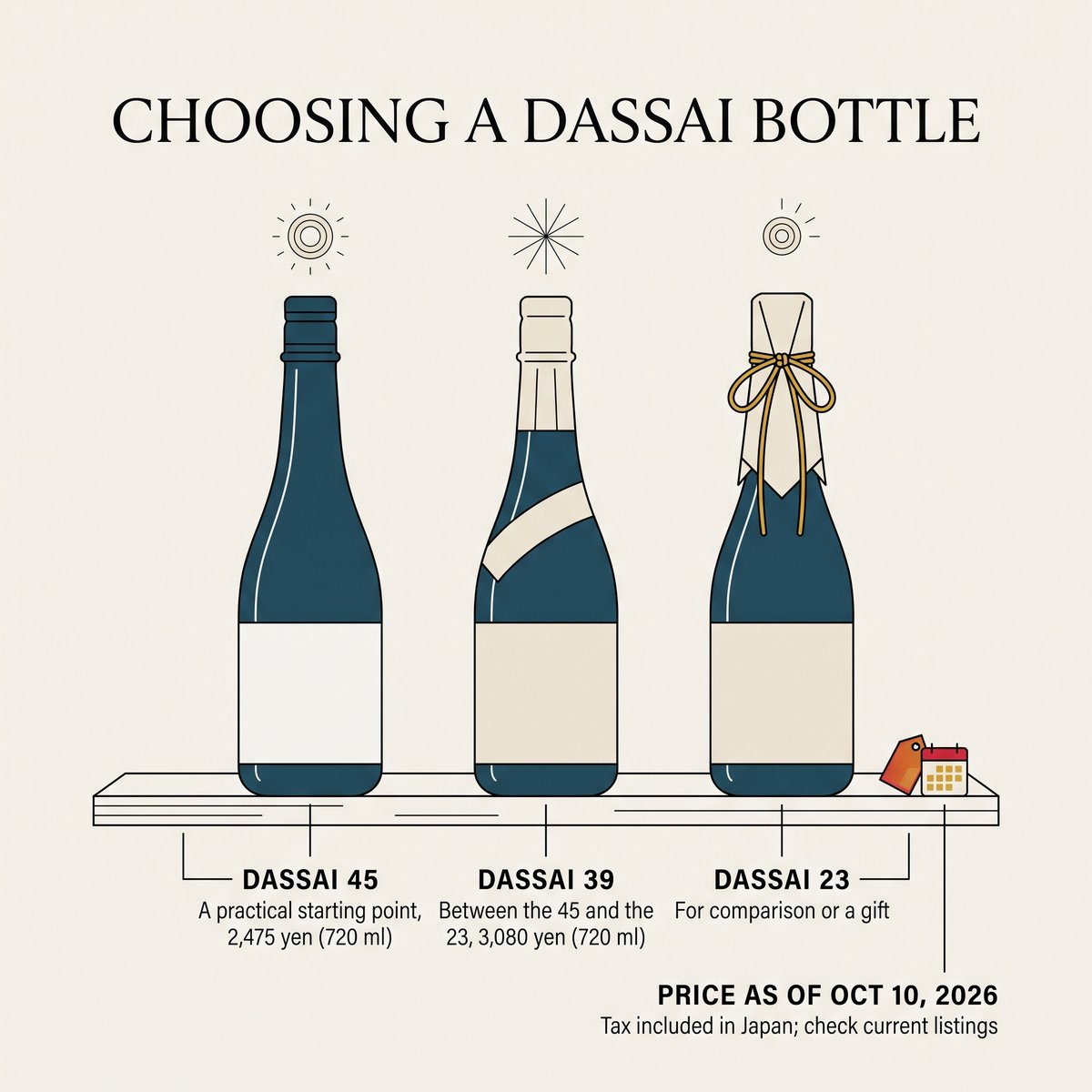
To choose a Dassai sake, start with the occasion rather than the price. All three core bottles share one rice and one grade, so none is a wrong choice.
- Dassai 45: A practical starting point for exploring the core house style.
- The 39: A bottle that sits between the 45 and the 23 in polishing ratio and price.
- Dassai 23: An option for a focused comparison, a gift or an occasion where the polishing story matters.
Price alone is a poor guide. The most highly polished bottle is not automatically the best choice for every drinker. If you enjoy fuller flavor, the 45 may please you more.
Prices give a rough sense of the steps. On October 10, 2026, the official Japanese site listed the 720 ml Dassai 45 at 2,475 yen. The 39 cost 3,080 yen in the same size, tax included. The 23 costs more, and prices outside Japan differ, so check current listings.
Size is another practical point. Depending on the product and market, the core range comes in several sizes. Smaller formats are therefore useful for comparing two numbers without much waste.
Condition matters as much as the number. Look for a shop that keeps bottles cool and away from bright light. Also check the bottling date when the label shows one. Our guide on how to store sake explains what heat and light do.
Finally, read the label for the place of production. A Dassai Blue bottle from New York is a different product, even when the number looks familiar.
Serving Dassai Sake and Pairing It with Food

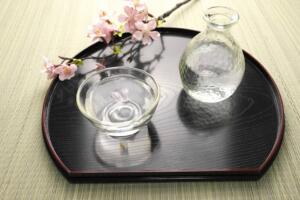
Serve the core range chilled, then let it warm slightly in the glass if you want more aroma. Exact advice varies by product, so check the bottle or current producer guidance. A wine glass can make the aroma easier to notice, although it is not essential. Our sake glasses and cups guide compares the options.
After opening, keep the bottle in the refrigerator and drink it while the aroma stays fresh. Dassai Blue’s FAQ suggests about a week for its own sake. Follow product-specific guidance where it exists, especially for unpasteurized or sparkling bottles. Although the brand does sell a seasonal bottle for warming, heat can mute the fruit in the core range. Since delicate aromas fade fast, pour small amounts and refill often.
For food, think light and clean. For example, sashimi, white fish, crab and lightly salted vegetables all work. Likewise, the style suits simple Western dishes such as fresh cheese or carpaccio. Very heavy sauces or intense spice may hide its delicate aromas, although preference matters more than any rule.
No study proves these matches, so treat them as starting points. Our sake and food pairing guide explains the reasoning, and how to drink sake in Japan covers etiquette.
What Makes Dassai Different, and What Does Not?
What sets the brand apart is a combination of choices, not any single technique. A brand article can slide into advertising. To avoid that, it helps to sort the claims into two piles.
What makes it distinctive
- A range built on a single grade, Junmai Daiginjo.
- One rice variety, with its own grain standards.
- Bottle names that state the polishing ratio.
- Team brewing supported by recorded data.
- A working brewery outside Japan.
What should not be assumed
- Lower ratios do not always taste better.
- Bottles differ, even within one range.
- Fame cannot predict your palate.
- Many of its techniques also exist elsewhere.
The last point deserves a word. Hand-washed rice, handmade koji and cold fermentation are not unique to one brewery. Similarly, very low polishing ratios exist elsewhere. What sets this company apart is the combination, and the scale at which it repeats it.
Other famous names took different routes. For example, Juyondai (14dai) is famously hard to find. Dassai chose availability instead, and each approach has its admirers.
Then again, scale itself draws criticism from people who equate small with authentic. We do not share that assumption, although we understand where it comes from.
Common Misconceptions About Dassai Sake
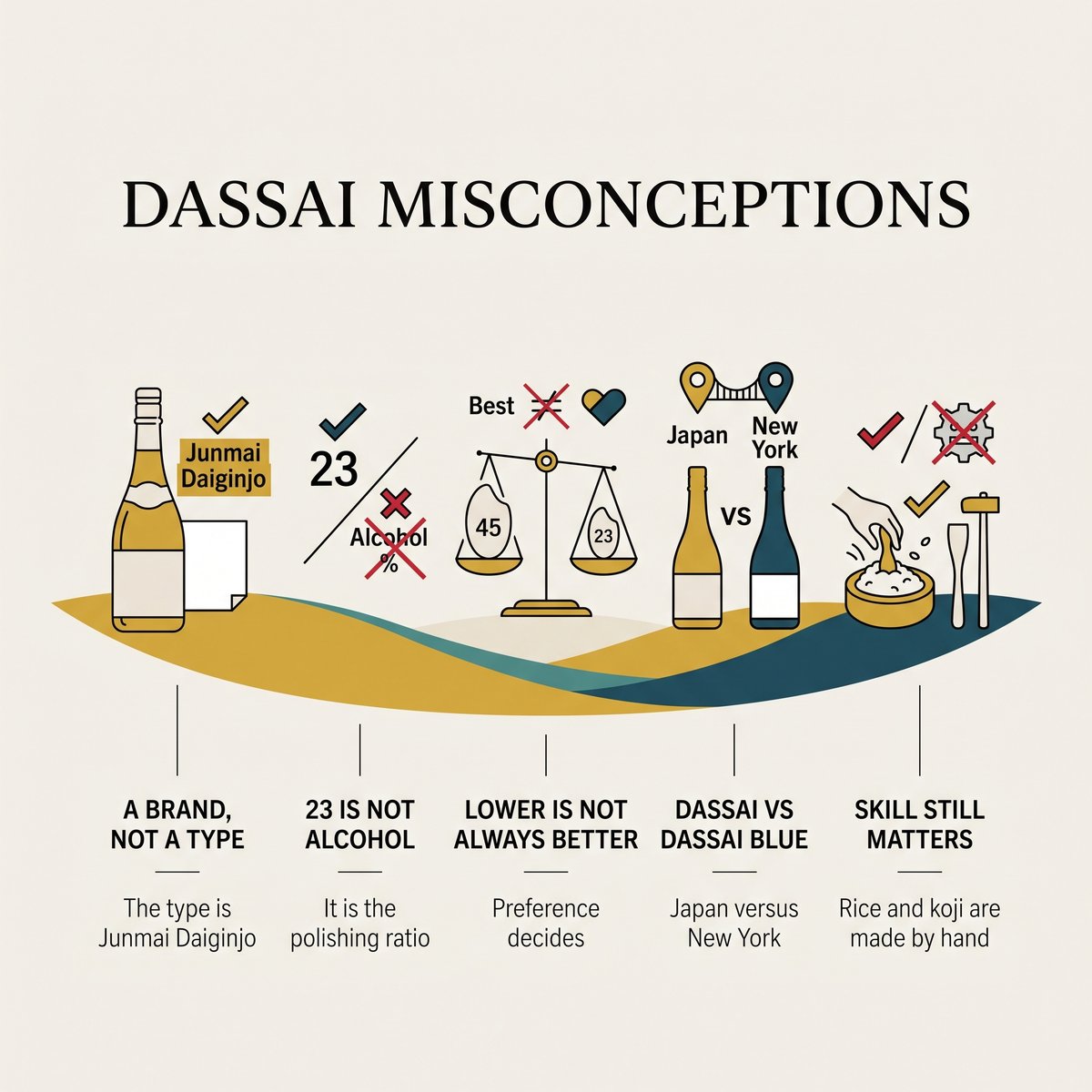
- “Dassai is a type of sake.” It is a brand. The type is Junmai Daiginjo.
- “Dassai 23 means 23% alcohol.” The figure is the polishing ratio. Check the label for alcohol content.
- “A lower ratio guarantees better sake.” Preference decides, as explained above.
- “All Dassai tastes identical.” The bottles share a style, yet they differ in weight and aroma.
- “Dassai and Dassai Blue come from one country.” The first comes from Japan, while the second comes from New York.
- “Machines make it, so skill no longer matters.” Staff still wash rice and make koji by hand.
- “The most expensive bottle is the right one.” The right bottle is the one that fits your taste and meal.
Most of these mix-ups vanish once you read the label slowly. After all, the producer, the place, the grade and the ratio all appear there.
Final Thoughts
Dassai is easy to reduce to a number on a bottle. The fuller picture, however, is more interesting. A rural brewery faced business pressure and the loss of its seasonal brewing team. It rebuilt production around year-round employees, shared records, Yamada Nishiki and a core Junmai Daiginjo identity.
Each part matters less alone than together. Because of that, the brand works as a case study in how sake has changed since the 1980s.
Will you like it? Only a glass can answer that. If you get the chance, try the 45 beside one sake from a smaller Yamaguchi brewery. The comparison teaches more than any ranking.
Meanwhile, the questions it raises stay open. How large can a craft brewer grow? Can sake brewed abroad still feel Japanese? Nobody knows yet, and that uncertainty is part of the appeal.
Frequently Asked Questions
The Bottles
- What is Dassai sake?
-
Dassai is a sake brand from Iwakuni in Yamaguchi Prefecture, western Japan. DASSAI Inc., formerly Asahi Shuzo, brews it. Its core range is Junmai Daiginjo from Yamada Nishiki rice.
- What does the number on a Dassai bottle mean?
-
It shows the rice polishing ratio, not the alcohol content. For Dassai 23, the polished rice weighs 23% of the original brown rice. The 39 and 45 follow the same logic.
- What is the difference between Dassai 45, 39 and 23?
-
They use the same rice at three polishing levels. The producer describes the 45 as delicately sweet and the 23 as honey-like and long. However, perceived differences vary by drinker, temperature and storage.
- Is Dassai Blue the same as Japanese Dassai?
-
No. The two ranges share a philosophy, but they come from different breweries. Rice sourcing, water and product names also differ, so read the label.
Buying, Visiting and Serving
- How much does Dassai cost in Japan?
-
On October 10, 2026, the official site listed the 720 ml Dassai 45 at 2,475 yen. The 39 cost 3,080 yen in that size, tax included. Prices change and differ abroad, so check current listings.
- Can I visit the Dassai brewery?
-
Yes, with a reservation. As of October 10, 2026, the official site listed weekday English tours at 13:00 for 1,000 yen. Confirm dates and rules on the official website, because they can change.
- How should I serve and store Dassai?
-
Serve it chilled, and check the bottle for product-specific advice. Keep an opened bottle in the refrigerator and drink it while the aroma stays fresh. Light seafood dishes are a common starting point.
- Is Dassai suitable for sake beginners?
-
Its fruity profile and numbered labels may make it easier for some beginners to approach. However, preference varies, and no consumer survey settles the question. The 45 is one practical starting point.
References
- National Tax Agency (Japan) – Production Standards for the Geographical Indication “Nihonshu” (Accessed October 2026)
- National Tax Agency (Japan) – Standards for Manufacturing Methods and Quality Labeling of Sake (Notice No. 8) (Accessed October 2026)
- DASSAI Inc. – Company Profile (Accessed October 2026)
- DASSAI Inc. – Notice of Company Name Change (Accessed October 2026)
- DASSAI Inc. – Origin of the Name Dassai (Accessed October 2026)
- DASSAI Inc. – How Dassai Is Made (Accessed October 2026)
- DASSAI Inc. – Product Lineup (Accessed October 2026)
- DASSAI Inc. – Dassai Junmai Daiginjo 45 (Accessed October 2026)
- DASSAI Inc. – Dassai Junmai Daiginjo 39 (Accessed October 2026)
- DASSAI Inc. – Brewery Tour (Accessed October 2026)
- DASSAI Inc. – Dassai Junmai Daiginjo 23 Centrifuge (Accessed October 2026)
- DASSAI Inc. – Dassai Ambition (Accessed October 2026)
- DASSAI Inc. – The Story Behind Dassai 23 (Accessed October 2026)
- Dassai Blue – Our Story (Accessed October 2026)
- Dassai Blue – Yamada-Nishiki (Accessed October 2026)
- Dassai Blue – FAQ (Accessed October 2026)
- Ministry of Agriculture, Forestry and Fisheries – Situation of Rice for Sake Brewing (August 2026) (Accessed October 2026)
- Ministry of Agriculture, Forestry and Fisheries – aff, December 2018 Issue: Feature on Sake (Accessed October 2026)
- MAFF Chugoku-Shikoku Regional Agricultural Administration Office – Export Case Profile: Asahi Shuzo (Accessed October 2026)
- Yamaguchi Prefecture – Manufacturing Company Bank: DASSAI Inc. (Accessed October 2026)
- Yamaguchi Prefecture Business Location Guide – New Third Brewery of DASSAI Inc. (Accessed October 2026)
- Automation News – Dassai to Build Third Brewery in Iwakuni (Accessed October 2026)
- National Research Institute of Brewing – The Story of Sake 2: The Integration of Science and Technology (Accessed October 2026)
- SAKETIMES – Chairman Sakurai on the Path to Data-Based Brewing (September 2018) (Accessed October 2026)
- SAKETIMES – Chairman Sakurai on the Present and Future of Dassai (January 2025) (Accessed October 2026)
- Plant Production Science – Tamaki, M., Itani, T., & Suetsugu, M. (2009). Relationship between the Starch Properties of White-Core Tissue and Polishing Characteristics in Brewers’ Rice Kernels, 12(2), 233–236 (Accessed October 2026)
- Journal of Cookery Science of Japan – Mizuma, T. (2013). Cooking Quality of Sake Rice Variety “Yamadanishiki”, 46(3), 213–220 (Accessed October 2026)
- Luxury: History, Culture, Consumption – Ishizuka, C., Tseng, K.-C., & Sato, H. Luxury Concepts for the Future of Tradition-Bound Products: Cases of Japanese Saké Breweries (Accessed October 2026)
- Ivey Publishing – Taira, Y., Cavanaugh, L., & Basto da Silva, R. J. B. (2024). Dassai: Opening a Sake Brewery in the United States (Accessed October 2026)
Related Articles
- Junmai Daiginjo (純米大吟醸) (Surveyed: October 2026)
- Yamaguchi Sake (山口の酒) (Surveyed: October 2026)
- Sake Rice (酒米): The Foundation of Premium Sake (Surveyed: October 2026)
- Rice Polishing (精米歩合) (Surveyed: October 2026)
- Toji (杜氏): The Master Brewer Behind Every Bottle of Sake (Surveyed: October 2026)
- Pressing (上槽 / Joso): How Moromi Becomes Sake (Surveyed: October 2026)
- How to Read a Japanese Sake Label: A Beginner’s Guide (Surveyed: October 2026)
- Contemporary Sake in Japan: Craft, Globalization, and a Living Tradition (Surveyed: October 2026)




Comments