In 2025, Japan exported about 45.9 billion yen of sake to a record 81 countries and regions. Meanwhile, the country’s own sake drinkers kept buying less, as they have almost every year since 1973. Contemporary sake is the story of how those two lines pulled apart, and why the gap matters more than either number alone.
This guide follows sake from the market shocks of the 1990s to the UNESCO inscription of December 2024. Along the way, it covers regional identity, new generations of brewers, technology, new styles, exports, and brewery tourism. It also looks at the agriculture behind every bottle. It is the final chapter in our series on the history of Japanese sake.
TOC
What Is Contemporary Sake?
In this article, contemporary sake means sake in Japan from roughly the 1990s to the present. The term describes a historical period rather than a style or a flavor. It picks up where our guide to modern sake ends, so the labeling reform of 1990 and the end of grading in 1992 mark the border.
Quick Facts
Period covered
Roughly the 1990s to the present
Starting point
Labeling standards applied from April 1990; old tax grades abolished in 1992
Domestic peak
Fiscal 1973 (April to March): about 1.77 million kL of taxable shipments
Domestic shipments
Fiscal 2023: about 390,000 kL, under a quarter of the peak
Active brewing sites
2024 brewing year (July 2024 to June 2025): 1,104 production sites made sake
Exports
Calendar year 2025: 45.9 billion yen and 33,549 kL, to 81 countries and regions
Sake GIs
National GI “Nihonshu” since December 2015; 19 sake GIs as of March 2025
UNESCO inscription
December 4, 2024: traditional knowledge and skills of sake-making with koji mold
Why start in the 1990s rather than in 2000? Because the rules changed then. The National Tax Agency’s labeling standards took effect on April 1, 1990, and then the wartime grading system ended in 1992. From that point, a label described method and ingredients instead of a tax class. That shift gave premium and regional sake a shared language, and the rest of this story grew from it.
How Contemporary Sake Differs From Modern Sake
The two periods overlap, so it helps to see what each one emphasizes. Modern sake was about scale. Contemporary sake, by contrast, is about value and about where that value comes from.
Modern sake (1912 to 1990s)
Industrialization and factory-scale brewing
Wartime controls and alcohol addition
Mass production and national brands
Scientific standardization
Labels defined by tax grade
Contemporary sake (1990s to today)
Premium categories and rising unit prices
Regional identity and geographical indications
Small and medium breweries as brand builders
Exports, tourism, and cultural heritage
Experimentation alongside revived tradition
One caution before going further. Contemporary sake is not simply a smaller version of the old domestic industry. The market shrank, but the way sake creates value changed at the same time. So keeping both facts in view is the whole point of this chapter.
Part 1A Smaller, Sharper Market
The Market After the 1973 Peak
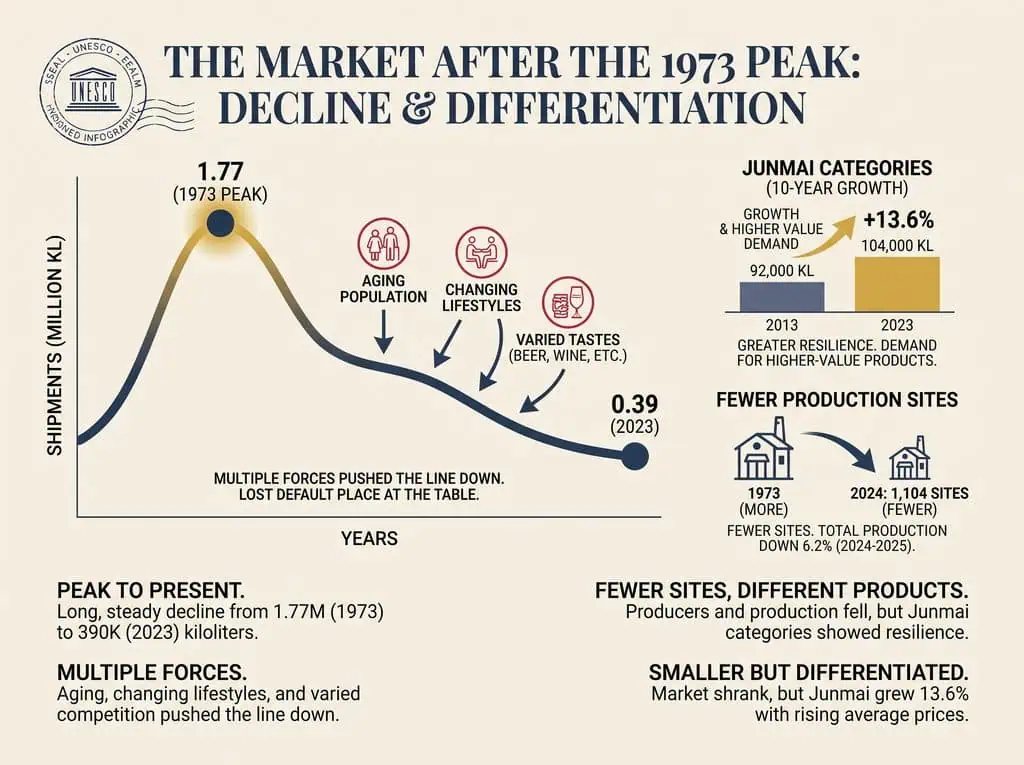
Sake shipments for taxation peaked in fiscal 1973 at about 1.77 million kiloliters, according to the National Tax Agency. By fiscal 2023, the figure had fallen to roughly 390,000 kiloliters, less than a quarter of the peak. That is a long, steady decline rather than a sudden collapse.
Several forces pushed the line down together. The agency points to an aging population, changing lifestyles, more varied tastes, and price-conscious shoppers. Beer, whisky, shochu, wine, and canned cocktails also competed for the same evening. So no single rival “killed” sake. Instead, the drink lost its default place at the table.
Fewer Production Sites, Different Products
The number of producers fell as well. In the 2024 brewing year, which ran from July 2024 to June 2025, 1,104 production sites reported making sake. That was thirteen fewer than the year before. Total production came to about 285,600 kiloliters, down 6.2 percent in a single year. Those are sobering figures for anyone who loves the drink, and they are worth pausing on.
Yet the same survey shows something else. Junmai sake rose 1.2 percent to about 46,600 kiloliters, while junmai ginjo held steady at about 50,900. Both figures use a 20-percent-alcohol basis. By contrast, honjozo fell more than 10 percent, and several other categories also declined sharply. This suggests greater resilience among the two largest junmai categories, although the figures do not show why consumers chose them.
Smaller but More Differentiated
Here is the sentence that sums up the period: the sake market became much smaller, but it also became more differentiated. Between the 2013 and 2023 brewing years, for example, taxable shipments of junmai and junmai ginjo grew about 13.6 percent. They rose from 92,000 to 104,000 kiloliters. At the same time, the average shipment price kept rising, which the tax agency reads as demand for higher-value products.
That pattern explains almost everything that follows. When volume no longer pays, brewers look for other things to sell: place, method, story, and experience.
From Jizake to Regional Identity
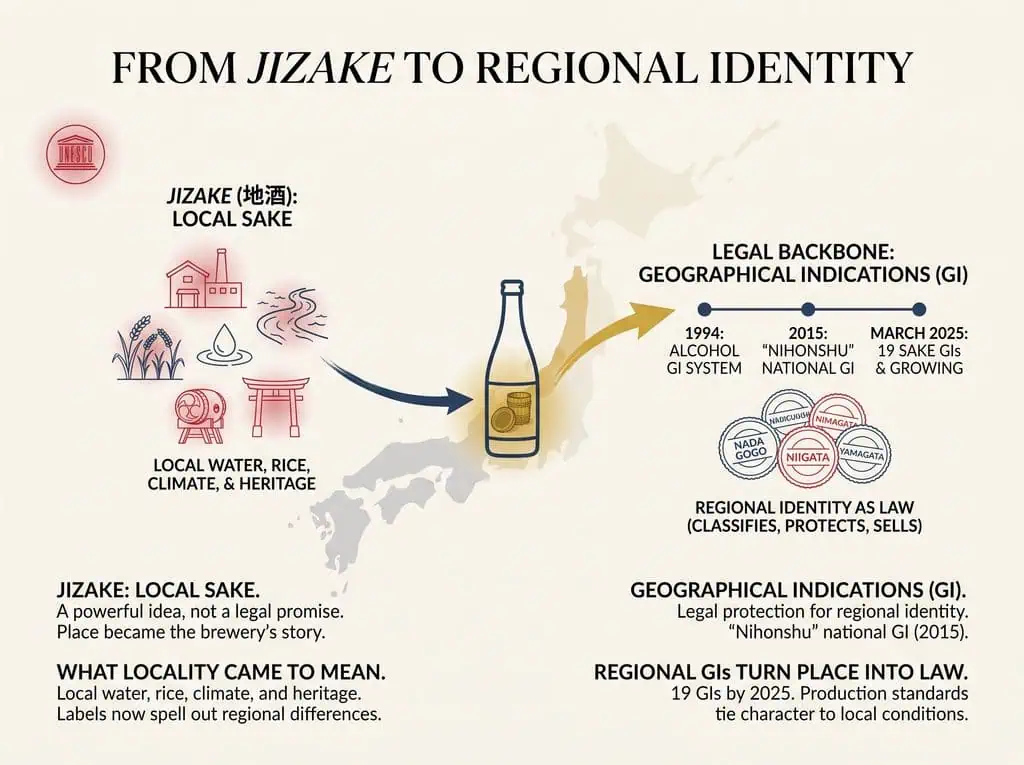
Jizake (地酒) simply means local sake. The word carries no legal definition and no promise of quality, either. Still, it became one of the most powerful ideas of the contemporary period. Why? Because once national brands stopped buying bulk sake from small regional breweries, those breweries had to sell under their own names. Place was the story they already owned.
What Locality Came to Mean
A regional brewery could point to its water, its rice, its climate, and often a named toji from a local guild. It could also show old wooden buildings and long ties with local shrines and festivals. Our guide to sake regions shows how differently Niigata, Hiroshima, or Akita talk about their sake. In the 1970s those differences were mostly private knowledge. By the 2000s, however, labels spelled them out.
It is worth being careful here. Jizake does not mean artisan sake, and it does not mean small. Some local breweries are large, and some use very modern equipment. The word describes association with a place, nothing more.
Geographical Indications Turn Place Into Law
Locality also gained a legal backbone in the same decades. Japan created a geographical indication system for alcohol in 1994. Then, in December 2015, the National Tax Agency designated “Nihonshu” as a national GI, and the 2015 reform extended the system to all categories of alcohol.
Regional GIs followed. By March 2025, Japan had 19 sake GIs, including Nada Gogo, Harima, Yamagata, Niigata, Nagano, and Iwate. More designations, such as Kyoto, Tottori, and Fukuoka, followed in October 2025. Each one also publishes production standards that tie sake character to local conditions. For example, the standard for Nada Gogo describes balanced flavor and a clean finish shaped by the Rokko mountains and local water. Regional identity, in short, moved beyond being a place of production. Instead, it became part of how the law classifies, protects, explains, and sells sake.
Why Small Breweries Mattered Again
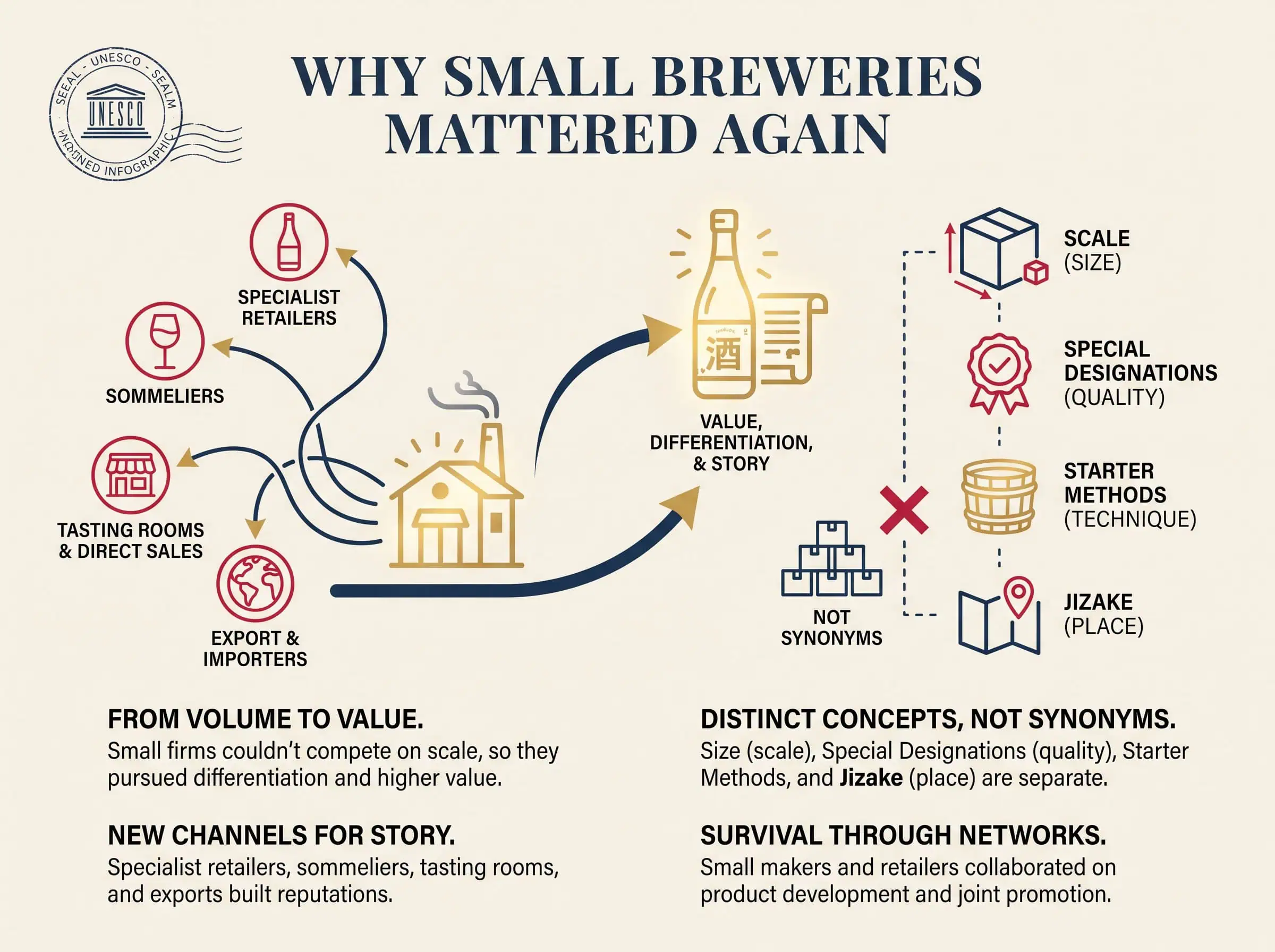
Mass-market brands dominated the 1960s and 1970s, so smaller brewers could not compete on volume. Yet the contemporary market rewarded a different game. The National Tax Agency notes that most of the industry consists of small and medium firms. The ones growing, it adds, are those pursuing differentiation, higher value, and overseas sales.
Several channels made that possible. Specialist retailers built reputations on rare regional bottles. Restaurant sommeliers, meanwhile, began writing brewery names on menus. Breweries then opened shops and tasting rooms and sold directly to visitors. Later, export importers came looking for exactly the kind of story a family brewery could tell.
Scale and Quality Are Different Things
A quick word of caution, because the romance of the small kura can mislead. Size describes scale. Special designations describe legally defined ingredients and production conditions. Kimoto and yamahai describe starter methods. Jizake describes association with a place. These four ideas overlap, but they are not the same, and a brewery can hold any combination of them.
A peer-reviewed case study of Hiroshima, for instance, describes how small and medium makers and retailers formed networks from the 1990s. They developed demand together through product development and joint promotion. That is the more accurate picture. Small breweries survived by choosing an axis other than volume, not because smallness itself guarantees good sake.
The Rise of Premium Sake
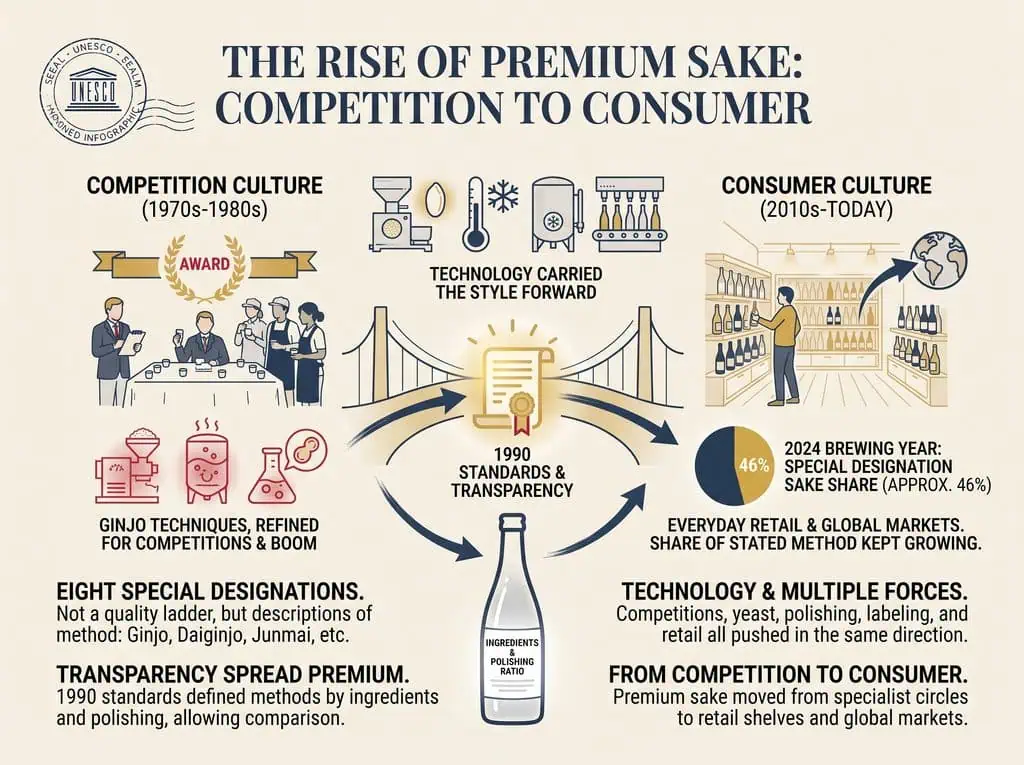
Premium sake did not begin in the 1990s. Brewers had refined ginjo techniques for decades, mostly for competitions, and then the 1980s brought a ginjo boom. Instead, the contemporary period moved premium sake from specialist and competition circles into everyday retail. The 1990 standards defined ginjo, junmai, and honjozo by ingredients and polishing ratio, so a shopper could finally compare bottles on method.
Eight Special Designations
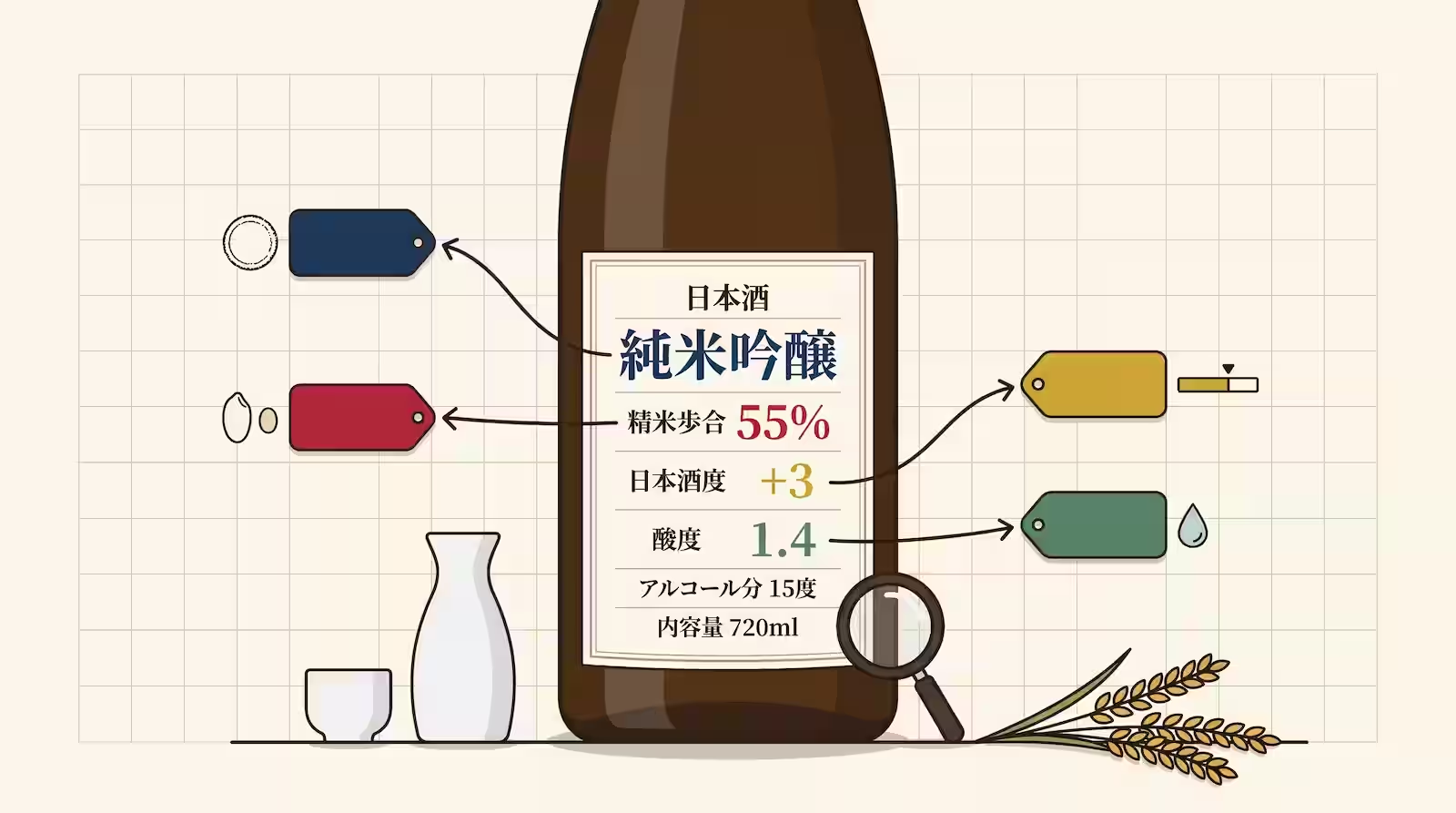
Today the National Tax Agency recognizes eight special designation categories. They are ginjo, daiginjo, junmai, junmai ginjo, junmai daiginjo, tokubetsu junmai, honjozo, and tokubetsu honjozo. Our guides to junmai, daiginjo, and tokubetsu junmai explain each one. The categories are not a quality ladder. Rather, they describe how the sake was made, and that transparency is what let premium brewing spread.
Technology carried the style forward. Precise rice polishing, aromatic yeast strains, cold fermentation, refrigerated storage, and better bottling all mattered, too. Notably, no single policy created the premium market. Competitions, yeast research, polishing machines, labeling rules, and retail culture all pushed in the same direction.
From Competition Culture to Consumer Culture
The most useful way to put it is this: premium sake moved from competition culture into consumer culture. In the 1970s, highly polished ginjo-style sake was still linked largely to brewery competitions and technical achievement. By the 2010s, though, it sat on ordinary retail shelves in Japan and in wine shops abroad.
Even the numbers reflect the shift. In the 2024 brewing year, special designation sake made up about 130,500 of Japan’s 285,600 kiloliters, roughly 46 percent. A generation earlier, the share was far lower. So the market shrank, but the share of sake made to a stated method kept growing.
Part 2People, Knowledge, and Innovation
New Generations of Kuramoto and Toji
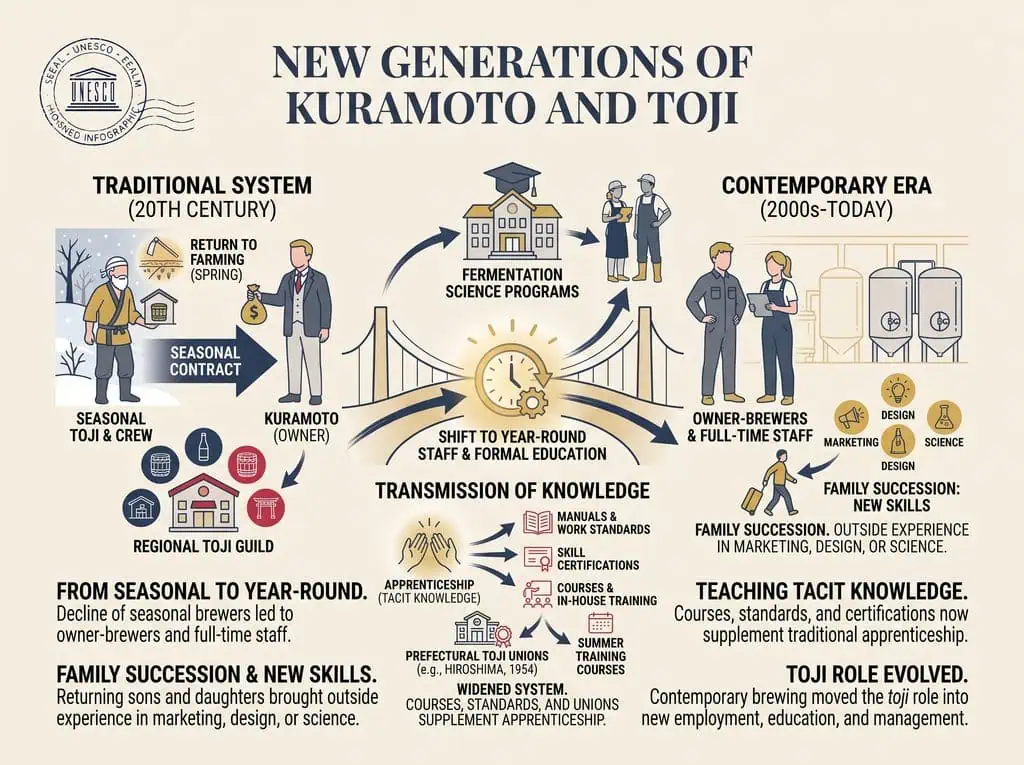
For most of the twentieth century, a brewery owner, or kuramoto, hired a seasonal toji who arrived each winter with his crew of kurabito. The toji belonged to a regional guild and then returned to farming in spring. That system did not vanish, but it changed shape in the contemporary period.
From Seasonal Crews to Year-Round Staff
The National Research Institute of Brewing has warned for more than thirty years that skilled seasonal brewers were declining in number. As a result, many breweries shifted to brewing by their own owners and full-time employees. Some kuramoto now serve as their own toji, while others hire young brewers straight from university programs in fermentation science.
This is where the family succession story comes in. Sons and daughters who had left for Tokyo returned to inherit breweries in the 2000s and 2010s. Many brought outside experience in marketing, design, or science. Some rebuilt the product line around junmai and ginjo, while others revived local rice varieties or old starter methods. The pattern is real, even if reliable national statistics on “young kuramoto” do not exist.
Teaching What Was Once Learned by Feel
Traditional brewing skill includes a great deal of tacit knowledge, the kind that manuals struggle to capture. So the transmission system has widened. Courses, work standards, skill certifications, and in-house training now supplement apprenticeship, for example. Prefectural toji unions, such as the Hiroshima Toji Union founded in 1954, still run summer training courses for brewery staff.
UNESCO’s 2024 description captures the same picture. It notes that toji lead kurabito in both practice and transmission, that apprenticeship remains central, and that regional unions and two national organizations support systematic teaching. Contemporary brewing did not eliminate the toji. Instead, it moved the role into new employment structures, formal education, and year-round management.
Tradition and Technology Can Coexist
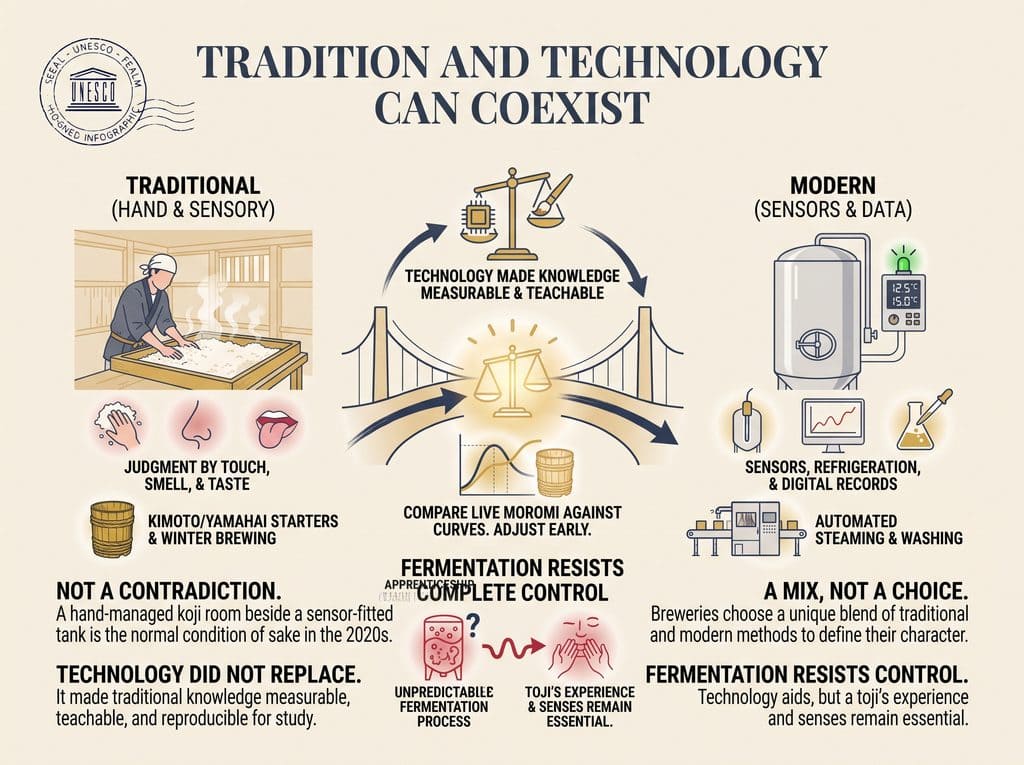
Walk into a contemporary kura and you may find a hand-managed koji room beside a tank fitted with temperature sensors. That is not a contradiction. Rather, it is the normal condition of sake in the 2020s.
Traditional
Hand koji-making and close sensory control
Kimoto and yamahai starters
Winter brewing that follows the season
Judgment by touch, smell, and taste
Modern
Temperature sensors and refrigeration
Automated rice steaming and washing
Digital fermentation records
Laboratory analysis of koji, mash, and aroma
What Technology Actually Did
The research institute publishes databases that model koji conditions, mash temperature, fermentation curves, aroma compounds, and pressing timing. So a brewer can compare a live moromi against those curves and adjust early. Yet the same institute stresses that a toji’s experience and senses remain essential, even with precise computer control.
The clearest summary is this. Technology did not simply replace traditional knowledge. Instead, it made parts of that knowledge measurable, teachable, and reproducible, and it opened them to scientific study. What it did not do, however, is make every traditional technique fully reproducible on demand. Fermentation, however, still resists complete control.
A brewery does not choose between the two columns above. It chooses a mix instead, and that mix often gives a house its character.
The Return of Forgotten Techniques
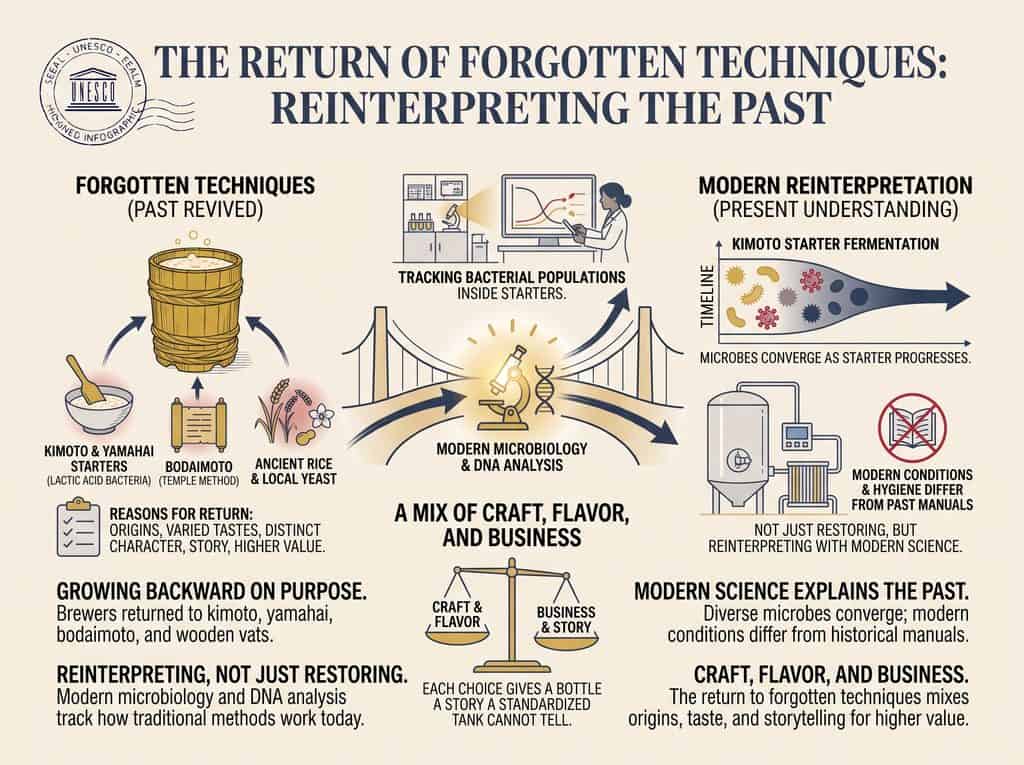
Something unexpected happened in the same decades. As technology advanced, a growing number of brewers went backward on purpose. The kimoto and yamahai starters, which grow their own lactic acid bacteria, came back into fashion. So, too, did bodaimoto, the medieval temple method, and wooden fermentation vats.
Why Brewers Looked Back
The National Research Institute of Brewing lists the reasons brewers give for returning to kimoto-style starters. They include a return to origins, more varied consumer tastes, and distinctive sake character. The story value of lactic acid bacteria and higher added value also appear. Notice that the list mixes craft, flavor, and business. That mix is typical of the period.
Ancient rice varieties and old yeast strains returned, too. Some breweries now grow heirloom rice under contract, while others brew with yeast isolated from local flowers or from their own buildings. Each choice also gives a bottle a story that a tank of standardized sake cannot tell.
Reinterpreted, Not Just Restored
Here the story becomes genuinely modern. Institute researchers used DNA analysis to track how bacterial populations shift inside today’s kimoto starters. They found that the diverse microbes of early stages converge as the starter progresses, regardless of the brewery. They also noted a catch: because equipment and hygiene differ from the past, following an old manual does not guarantee the same microbial path.
So brewers are not merely restoring historical techniques. They are reinterpreting them with modern microbiology under modern brewery conditions. Our guides to the yeast starter and to sake fermentation explain the biology behind that reinterpretation.
New Styles of Sake
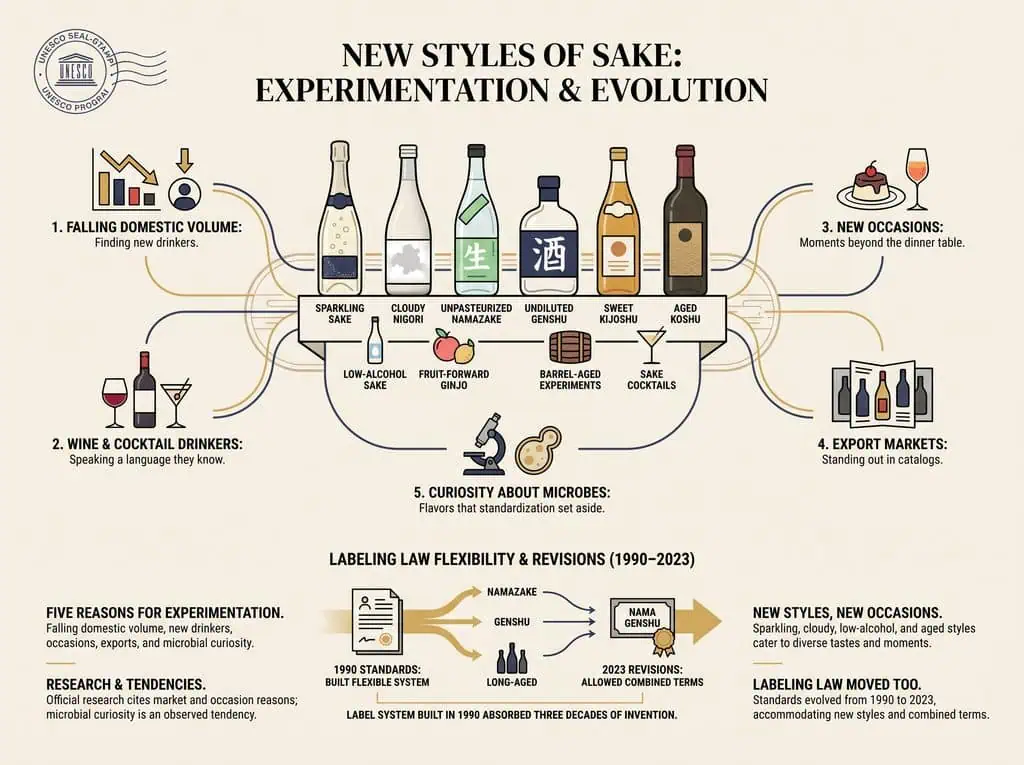
The contemporary shelf holds sparkling sake, cloudy nigori, unpasteurized namazake, undiluted genshu, sweet kijoshu, and aged koshu. Low-alcohol sake, fruit-forward ginjo, barrel-aged experiments, and sake cocktails sit beside them. A list like that is easy to make, though. The more interesting question is why brewers are experimenting at all.
Five Reasons Brewers Experiment
Falling domestic volume: a shrinking market pushes brewers to find drinkers who never ordered sake before.
Wine and cocktail drinkers: sparkling, low-alcohol, and aromatic styles speak a language those consumers already know.
New occasions: aperitifs, desserts, and cocktails create moments for sake beyond the dinner table.
Export markets: a distinctive style stands out in a crowded importer’s catalog.
Curiosity about microbes: old techniques and unusual yeasts offer flavors that modern standardization set aside.
Of these, the first three reasons appear in official research on new product development, including work on low-alcohol sake and aroma control. The last two are observations from individual breweries, so treat them as tendencies rather than statistics.
The Rules Moved Too
Labeling law followed the products. Current standards define terms such as namazake, nama-chozo, genshu, and long-aged sake. Then revisions that took effect in 2023 even allowed combined terms like “nama genshu” on the label. Our guide to sake types covers the vocabulary. The point is that the label system built in 1990 proved flexible enough to absorb three decades of invention.
Part 3Sake Goes Global
Sake and the Globalization of Japanese Cuisine
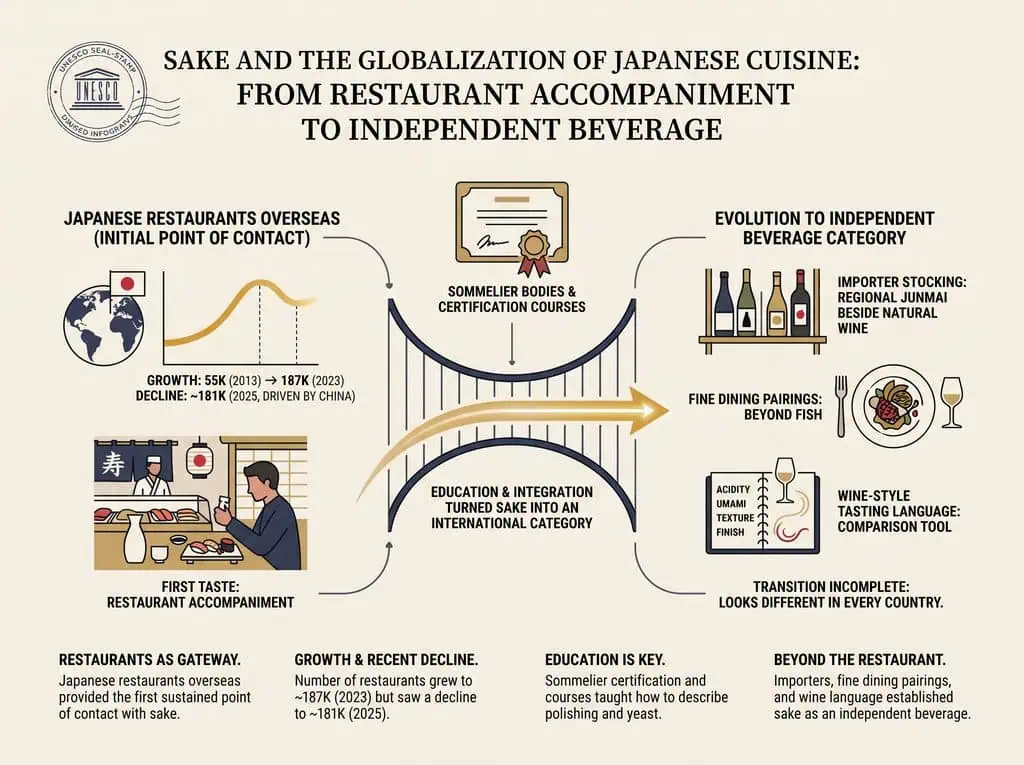
Sake went abroad in the luggage of Japanese food. Japan’s agriculture ministry counted about 55,000 Japanese restaurants overseas in 2013 and roughly 187,000 in 2023. By 2025 the count had slipped to about 181,000. That was the first decline in the ministry’s published series since 2013, driven largely by closures in China.
Those restaurants gave many overseas consumers their first sustained point of contact with sake. A traveler who had never tasted it might order a carafe with sushi in New York or Paris, for instance. However, restaurant growth alone did not turn sake into an international category. It created points of introduction, and then something else had to happen.
From Restaurant Drink to Beverage Category
That something was education. Sommelier bodies added sake to their programs. Certification courses then taught retailers how to describe rice polishing and yeast character. Importers also began stocking regional junmai beside natural wine. And fine dining chefs outside Japan started pairing sake with dishes that had nothing to do with fish.
Wine-style tasting language helped as well. Words such as acidity, umami, texture, and finish gave foreign drinkers a way to compare bottles. Slowly, then, sake moved from being a Japanese restaurant accompaniment to being an independent beverage category. That transition is still incomplete, and it looks different in every country.
Japanese Sake Becomes a Global Export
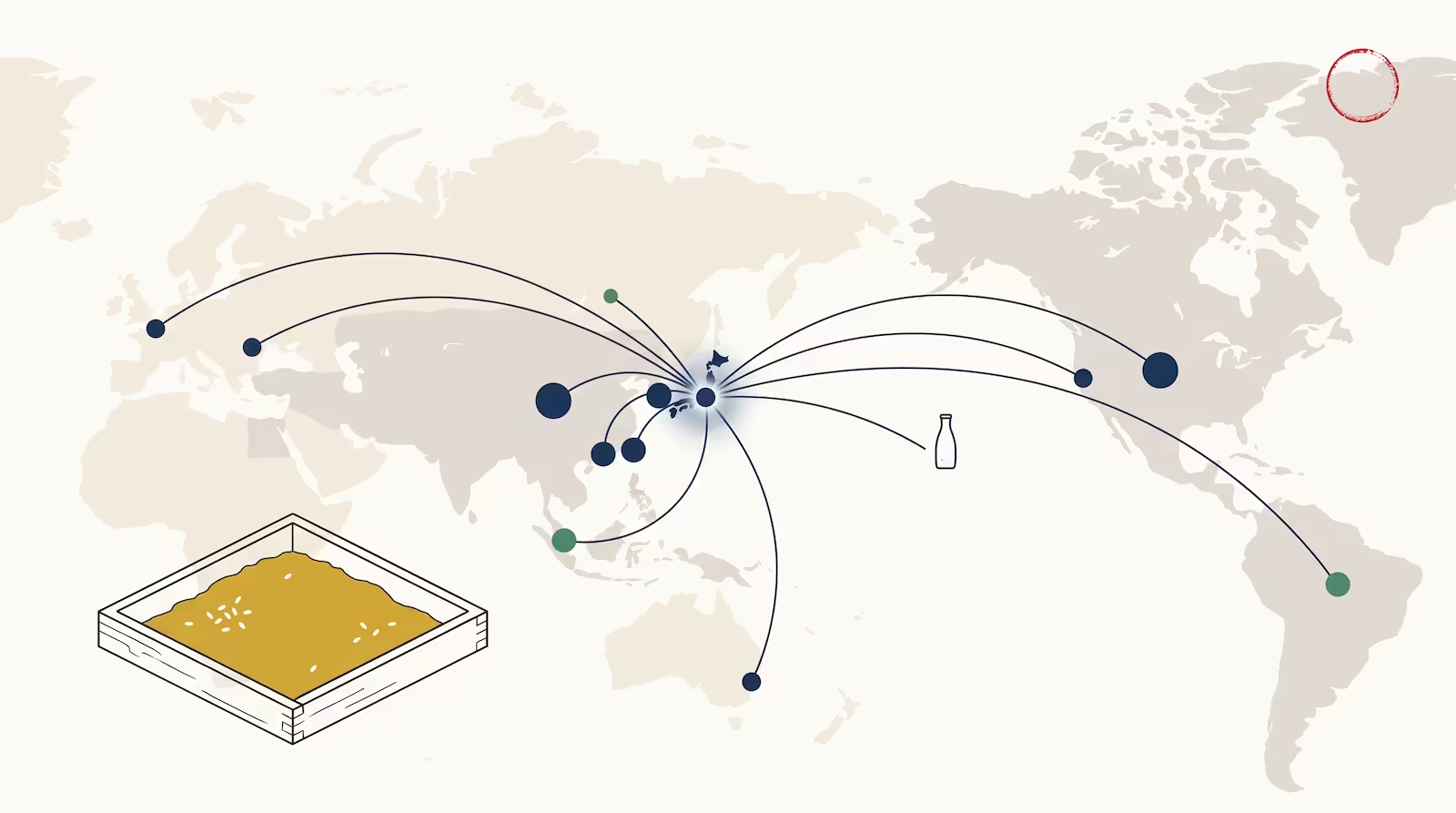
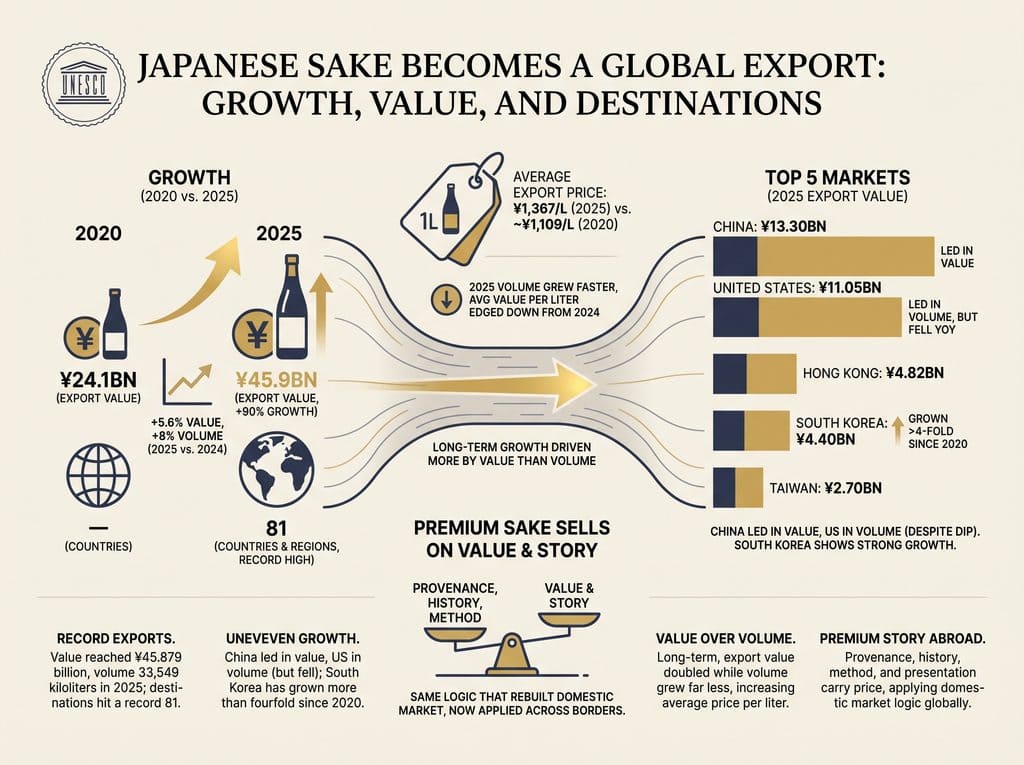
Now the numbers. According to Japan’s trade statistics, sake exports reached 45.879 billion yen and 33,549 kiloliters in 2025. That was up 5.6 percent in value and about 8 percent in volume from 2024, when exports totaled 43.456 billion yen. The number of destination markets also hit a record 81.
¥24.1bnExport value, 2020
¥45.9bnExport value, 2025
81Countries and regions, 2025
¥1,367/LAverage export price, 2025
The growth is not evenly spread. China led in value in 2025, while the United States led in volume. Exports to the United States actually fell in 2025, however, reflecting a weaker second half of the year. South Korea, by contrast, has grown more than fourfold since 2020.
Market
2025 export value
2024 export value
China
¥13.30 billion
¥11.67 billion
United States
¥11.05 billion
¥11.44 billion
Hong Kong
¥4.82 billion
¥5.12 billion
South Korea
¥4.40 billion
¥3.74 billion
Taiwan
¥2.70 billion
¥2.67 billion
Long-Term Growth Driven More by Value Than Volume
Here is the detail that matters most. Export value roughly doubled from about 24.1 billion yen in 2020 to 45.9 billion yen in 2025. Volume, however, grew far less. Dividing value by volume gives an average export price of about 1,367 yen per liter in 2025, against about 1,109 yen in 2020.
The pattern was not uniform every year, however. In 2025, export volume grew faster than export value, so the average value per liter edged down from its 2024 level. The value story holds over five years, not in every single year.
So premium sake increasingly sells abroad on value and story rather than on volume alone. Provenance, brewery history, method, and presentation all carry price, too. That is the same logic that rebuilt the domestic market, now applied across borders.
How Overseas Markets Changed Sake’s Presentation
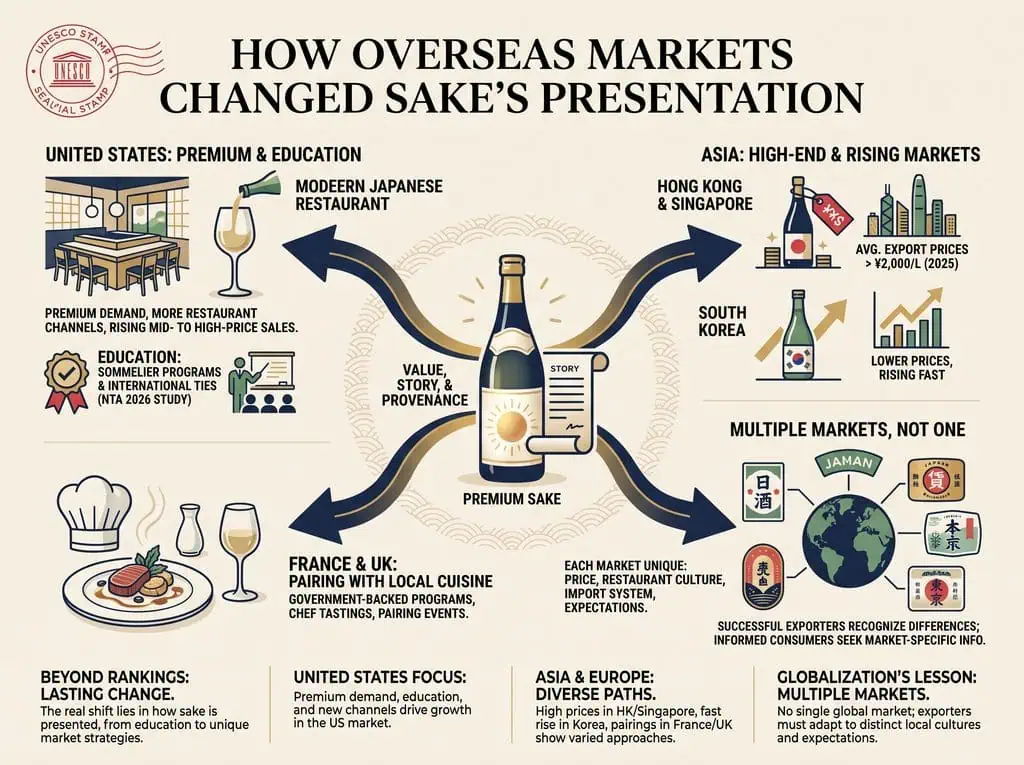
Country rankings make headlines, but the more lasting change lies in how sellers present sake to people. Take the United States as one example. A 2026 National Tax Agency market study describes American growth as built on premium demand, more Japanese restaurant channels, and rising mid- to high-price sales. Education matters too: the brewers’ association runs programs with international sommelier organizations.
Other markets tell different stories. In Hong Kong and Singapore, average export prices exceed 2,000 yen per liter, according to the brewers’ association’s 2025 figures. South Korea, by comparison, shows lower prices that are rising fast. In France and the United Kingdom, meanwhile, government-backed programs have run chef tastings and pairing events with local cuisine.
Several Markets, Not One
The lesson is that globalization produced multiple sake markets, each with its own price structure, restaurant culture, import system, and expectations. A label that works in Shanghai may say nothing to a shopper in Los Angeles. Successful exporters tend to recognize these differences. Informed consumers, meanwhile, increasingly look for market-specific information on labels and menus.
Sake Beyond Japanese Food
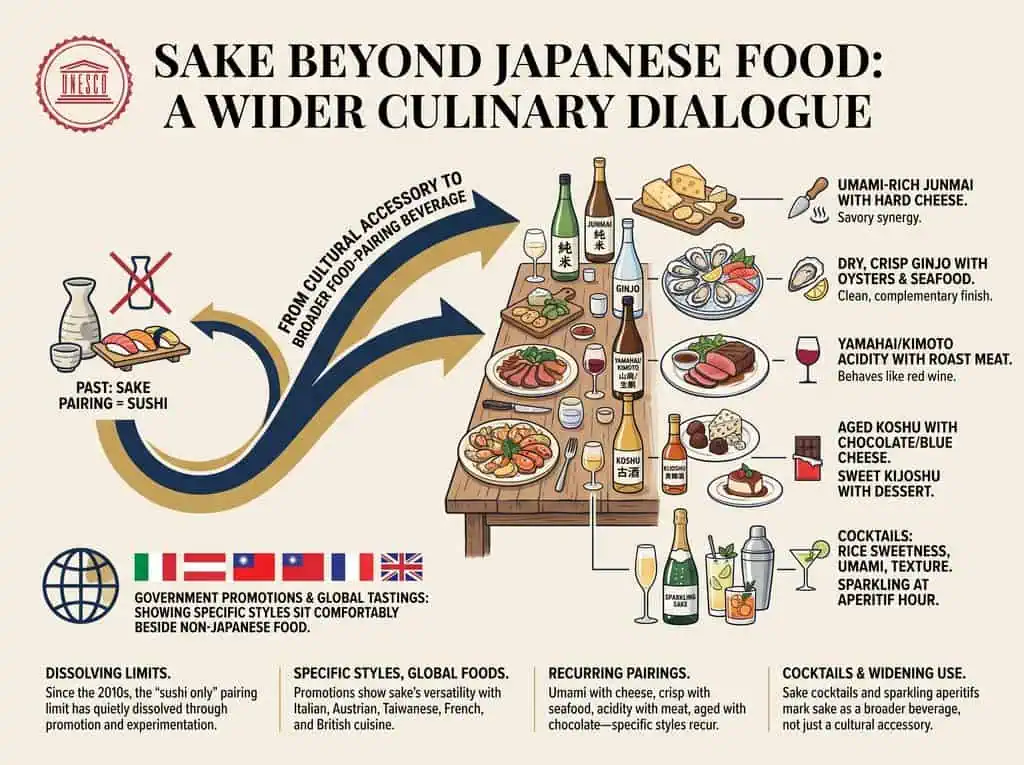
For a long time, sake pairing meant sushi. Since the 2010s, that limit has quietly dissolved. Government-supported promotions have paired specific sakes with Italian, Austrian, and Taiwanese dishes, presented cultural stories in France, and run tastings for chefs in Britain. None of that claims sake goes with everything. Rather, it shows that specific styles can sit comfortably beside non-Japanese food.
Where Sake Works Surprisingly Well
A few pairings recur across menus. Umami-rich junmai with hard cheese, for instance. Dry, crisp ginjo with oysters and raw seafood. Aged koshu with chocolate or blue cheese. Sweet kijoshu, likewise, with dessert. Yamahai and kimoto styles with roast meat, where their acidity behaves a little like a red wine.
Cocktails opened another door. Sake can bring rice-derived sweetness, umami, and a relatively soft texture to cocktails built around citrus, herbs, or fruit. Sparkling sake has also found a place at aperitif hour. In each case, sake behaves as a broader food-pairing beverage rather than a cultural accessory. That widening of use is one of the clearest marks of the contemporary period.
Part 4Place, Community, and Heritage
Brewery Tourism and the New Sake Experience
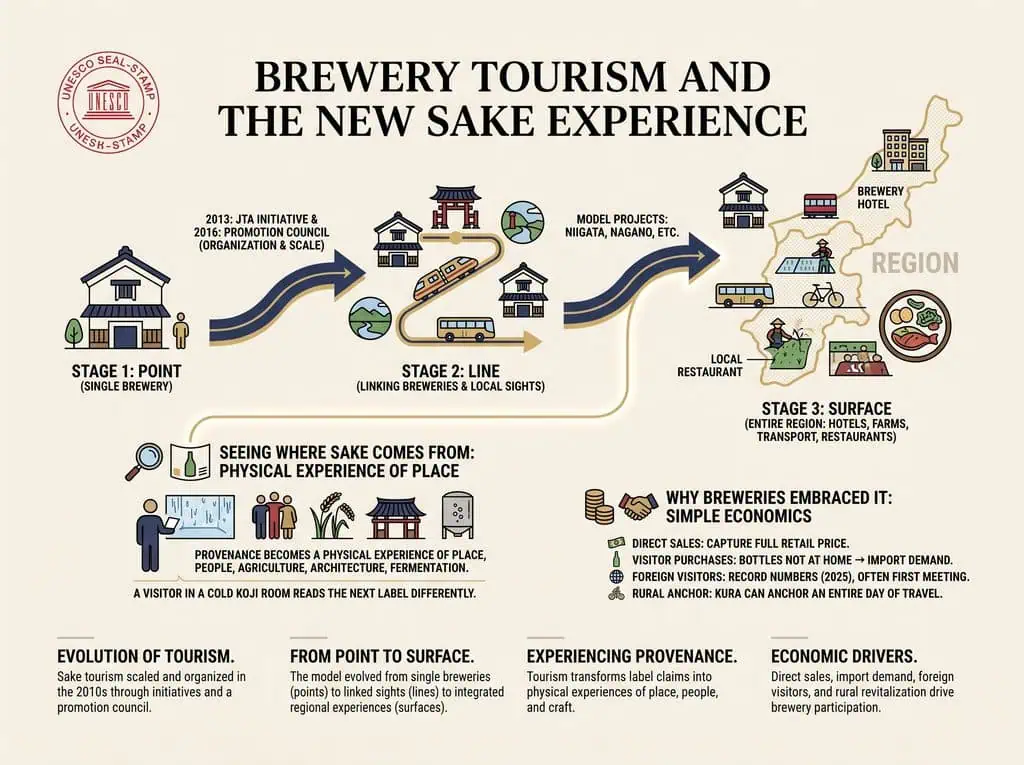
Sake tourism is older than the word. Nada and Fushimi drew visitors a century ago, after all. What changed in the 2010s was scale and organization. In 2013 the Japan Tourism Agency began a brewery tourism initiative. Then, in November 2016, a Sake Brewery Tourism Promotion Council brought together ministries, local governments, the brewers’ association, and dozens of breweries.
From a Point to a Line to a Region
A National Tax Agency report describes the model in three stages. First, a single brewery is a point. Linking several breweries and local sights then makes a line. Finally, tying the whole region together, with hotels, farms, transport, and restaurants, creates a surface. Model projects in Niigata, Nagano, and elsewhere combined tastings with rice fields, brewery hotels, and local food.
The key phrase is seeing where sake comes from. In other words, brewery tourism turns provenance from a label claim into a physical experience of place, people, agriculture, architecture, and fermentation. After that, a visitor who has stood in a cold koji room reads the next label differently.
Why Breweries Embraced It
The economics are simple. Direct sales at the brewery capture the full retail price. Visitors also buy bottles they cannot find at home and then ask their local shop to import them. Foreign visitors, who reached record numbers in 2025, often meet sake for the first time on such a trip, too. And in rural regions with few other draws, a kura can anchor an entire day of travel.
Sake, Food, and Local Communities
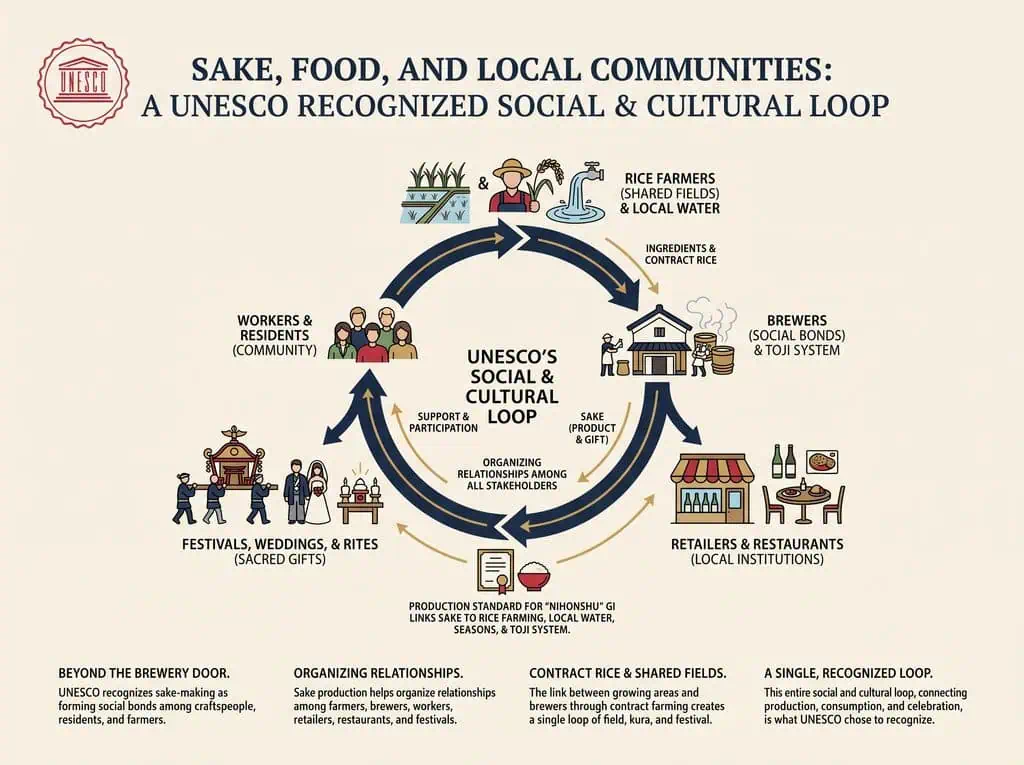
UNESCO’s 2024 description does not stop at the brewery door. Instead, it notes that sake-making forms social bonds among craftspeople and with the residents and farmers who supply ingredients. It also records the drink’s role in festivals, weddings, and rites of passage, where people treat sake as a sacred gift from deities.
That framing matters because it widens the picture. Sake is not only produced in a community. In many regions, moreover, its production helps organize relationships among rice farmers, brewers, workers, retailers, restaurants, festivals, and local institutions. The production standard for the national GI “Nihonshu” makes a similar point, linking sake to rice farming, local water, the seasons, and the toji system.
Contract Rice and Shared Fields
A concrete example is the link between growing areas and brewers. The agriculture ministry’s sake rice survey tracks which producing areas supply which brewers. Many breweries also contract with growers for specific sake rice varieties. Where that happens, the field, the kura, and the festival form a single loop, and that loop is part of what UNESCO chose to recognize.
Rice, Climate, and Sustainability
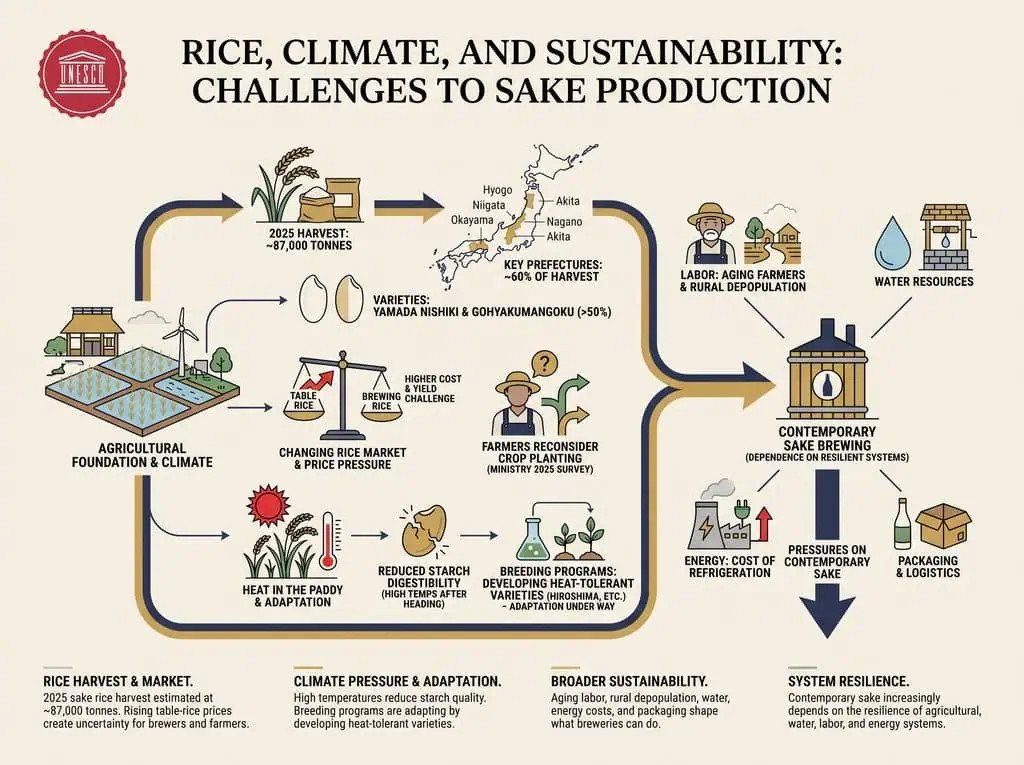
Every bottle begins in a paddy, and paddies are under pressure. Currently, Japan’s agriculture ministry estimates the 2025 harvest of sake-brewing rice at about 87,000 tonnes. Hyogo, Niigata, Okayama, Nagano, and Akita grow about 60 percent of it, and just two varieties, Yamada Nishiki and Gohyakumangoku, make up more than half.
A Changing Rice Market
The market has become harder to read. The ministry’s 2025 demand survey notes that soaring table-rice prices make it hard for brewers to forecast the 2026 crop. Brewing rice has always cost more than table rice, because it yields less and is harder to grow. When table rice prices jump, some farmers reconsider which crop to plant.
Heat in the Paddy
Climate is the other pressure. Prefectural research stations have found that high temperatures after heading reduce the starch digestibility of sake rice. Brewers depend on that quality. Breeding programs in Hiroshima and elsewhere are therefore developing heat-tolerant brewing varieties. This is not a prediction of disaster. Rather, it describes adaptation already under way.
Labor, water, energy, and packaging round out the list. Aging farmers, rural depopulation, and the cost of refrigeration also shape what a brewery can do. Taken together, these pressures show that contemporary sake increasingly depends on the resilience of the agricultural, water, labor, and energy systems that surround brewing.
Part 5Recognition and Meaning
Sake and UNESCO: 2024 as a Cultural Turning Point
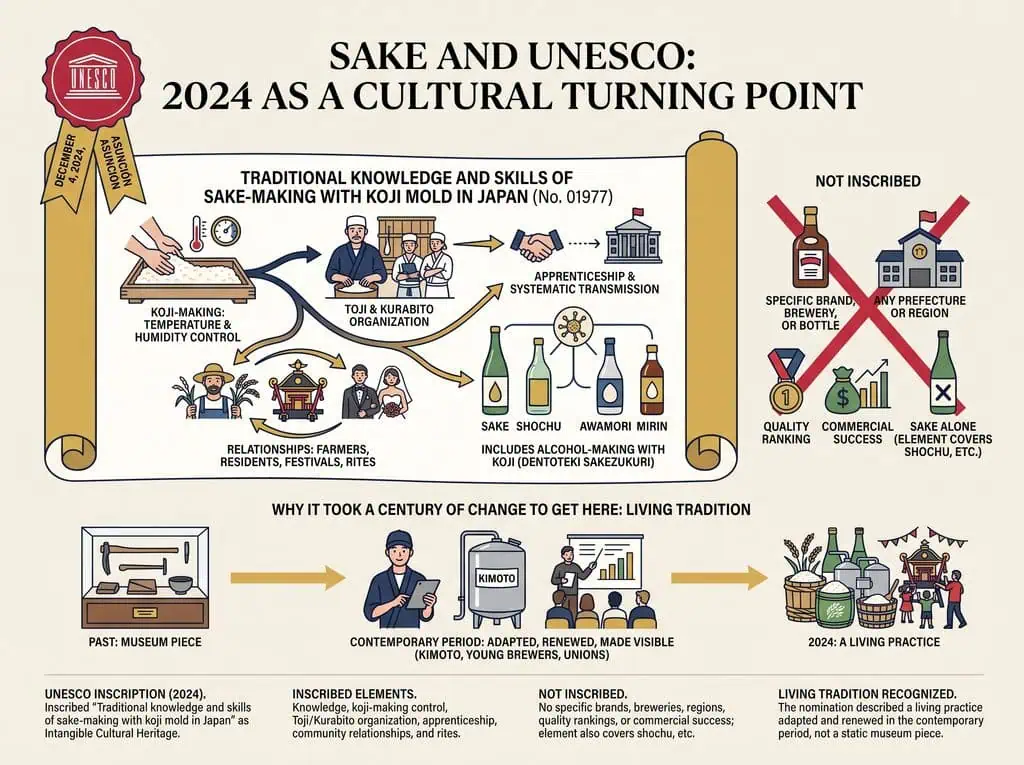
On December 4, 2024, at its session in Asunción, Paraguay, UNESCO’s intergovernmental committee inscribed “Traditional knowledge and skills of sake-making with koji mold in Japan” on the Representative List of the Intangible Cultural Heritage of Humanity. In Japan, because of the time difference, the news broke on December 5. The element carries the number 01977, and it also became the country’s 23rd inscription on the list.
What UNESCO Actually Recognized
Precision matters here, because the headlines got it wrong. UNESCO did not designate sake as a World Heritage product. Instead, it inscribed a body of knowledge and skill. The official description focuses on how craftspeople use koji mold to convert starch into sugar, managing temperature and humidity so the mold grows well. It also names the toji who lead and the kurabito who follow. And it describes transmission through apprenticeship, regional unions, and national organizations.
Inscribed
Traditional knowledge and brewing skills
Koji-making and its temperature and humidity control
The organization of toji and kurabito
Apprenticeship and systematic transmission
Relationships with farmers and local residents
Roles in festivals, weddings, and rites of passage
Not inscribed
Any specific brand, brewery, or bottle
Any prefecture or region
A quality ranking of sake
The commercial success of the industry
Sake alone: the element also covers shochu, awamori, and mirin made with koji
That last point surprises many readers. The Japanese name of the element, dentoteki sakezukuri, actually covers traditional alcohol-making with koji in general. Sake sits at its center, but shochu, awamori, and mirin belong to the same nomination. So the inscription recognized a wider body of knowledge, within which sake-making holds a central place.
Why It Took a Century of Change to Get Here
Read against the earlier sections, the timing makes sense. By 2024, Japan could show a living tradition rather than a museum piece. Kimoto starters were back in tanks. Young brewers were learning koji by hand. Regional unions still trained apprentices. Farmers and breweries had renewed their ties. In effect, then, the nomination described a living practice that the contemporary period had adapted, renewed, and made newly visible.
What UNESCO Changes and What It Does Not
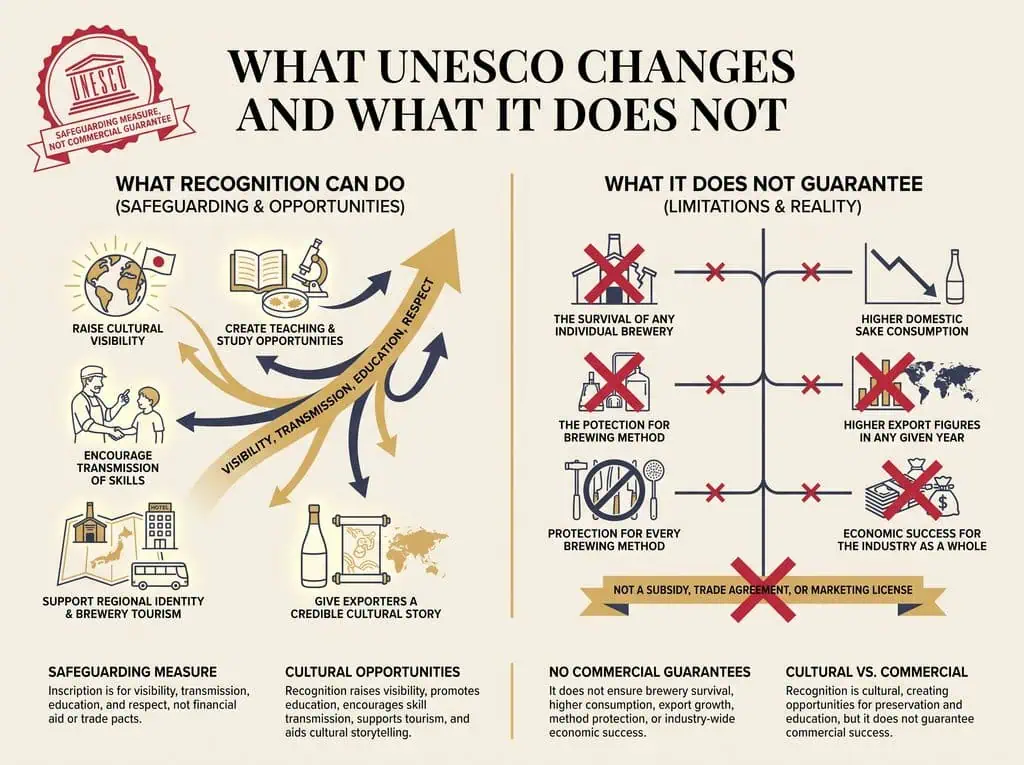
An inscription on the Representative List is a safeguarding measure. Its purpose is visibility, transmission, education, and respect. It is not, however, a subsidy, a trade agreement, or a marketing license. Keeping that in mind prevents a lot of wishful thinking.
What Recognition Can Do
Raise cultural visibility inside and outside Japan
Create teaching and study opportunities around koji and brewing
Encourage the transmission of skills to a new generation
Support regional identity and brewery tourism
Give exporters a credible cultural story
What It Does Not Guarantee
The survival of any individual brewery
Higher domestic sake consumption
Higher export figures in any given year
Protection for every brewing method
Economic success for the industry as a whole
The brewers’ association did credit the inscription with heightened international interest in 2025, and that is plausible. Still, exports to the United States fell in the same year, and domestic production dropped again. Recognition is cultural. It may create opportunities for preservation, education, and communication, but it does not guarantee commercial success.
Women and the Transmission of Sake-Making Skills
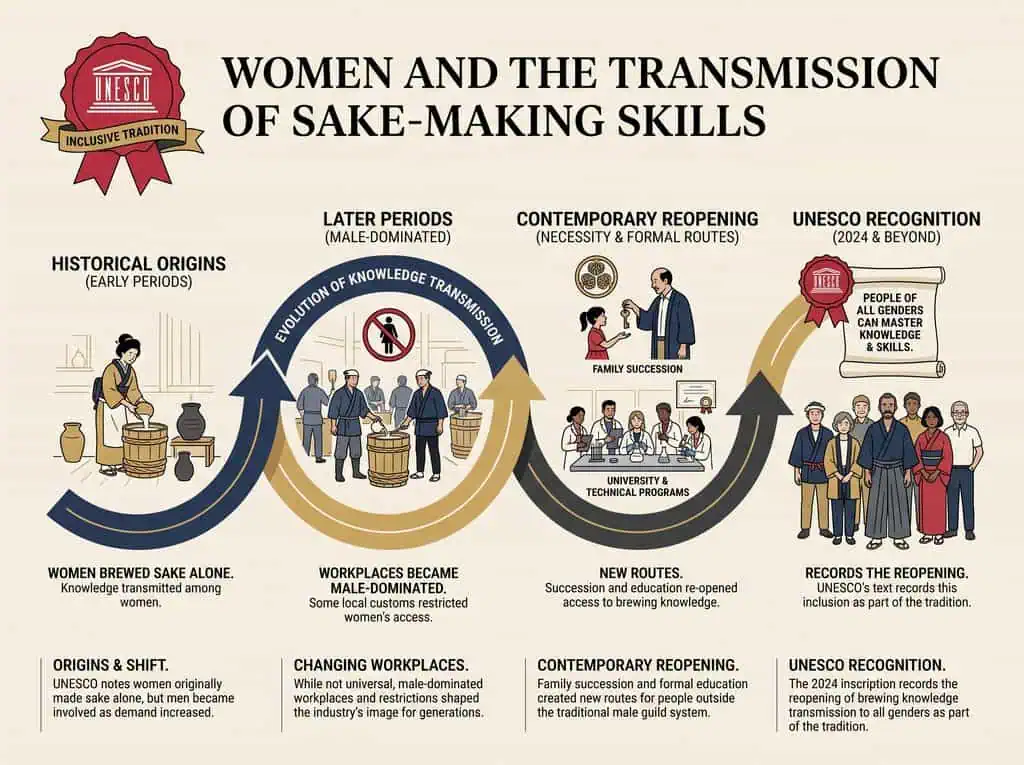
One short line in the UNESCO description deserves its own section, though. It states that women originally made sake alone, and that men became involved as demand increased. Today, it adds, people of all genders can master the knowledge and skills. That is a remarkable summary for an industry so often pictured as entirely male.
Old Assumptions, Changing Workplaces
In later periods, many brewery workplaces became strongly male-dominated, and some local customs restricted women’s access to production spaces. These practices were not universal, but they shaped the public image of sake brewing for generations. The contemporary period loosened that image, partly through necessity. Family succession brought some daughters into ownership. University and technical programs also created more formal routes into brewing for people outside the traditional male guild system.
This article will not try to count female toji or attach a percentage to the trend. Reliable national figures are thin, and the numbers would age quickly anyway. Instead, the useful point is narrower. The question of who may inherit and transmit brewing knowledge has reopened. UNESCO’s text now records that reopening as part of the tradition itself.
Sake as Living Cultural Heritage
By the 2020s, sake existed simultaneously as a beverage, an agricultural product, a craft, an industry, a cultural practice, a ritual object, a regional identity, and an export. Earlier periods held many of those roles, too. What distinguishes the contemporary period is their simultaneous visibility in markets, policy, tourism, and cultural heritage.
That multiplicity is the defining feature of contemporary sake. A bottle of junmai from a small Tohoku brewery can be a shrine offering in January, a tourist purchase in May, a sommelier’s pairing in London in September, and a line in the export statistics all year. The bottle may be the same, but its meanings stack up around it.
Whether that stacking is stable is an open question. One risk is that heritage framing could freeze the craft. Another is that export logic could flatten regional character. Both concerns are reasonable, and the tension between them may shape the next chapter.
What Changed and What Survived
Three Eras Compared
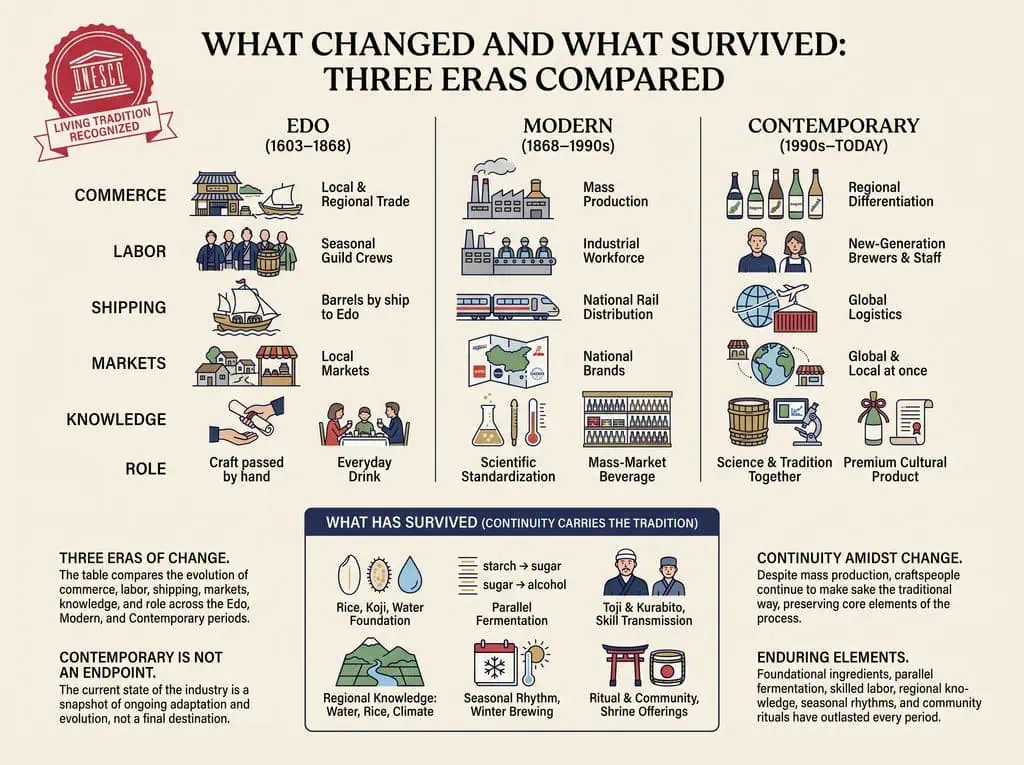
The table below compares the same features across three periods of this series.
Edo
Modern
Contemporary
Commerce
Local and regional trade
Mass production
Regional differentiation
Labor
Seasonal guild crews
Industrial workforce
New-generation brewers and staff
Shipping
Barrels by ship to Edo
National rail distribution
Global logistics
Markets
Local markets
National brands
Global and local at once
Knowledge
Craft passed by hand
Scientific standardization
Science and tradition together
Role
Everyday drink
Mass-market beverage
Premium cultural product
For the earlier columns, see our chapters on Edo period sake and Meiji era sake. The contemporary column is not an endpoint. It is simply where the line stands today.
What Has Survived
Change makes the headlines, but continuity carries the tradition. UNESCO’s own description notes that although sake is mass-produced today, craftspeople continue to make it the traditional way. The following elements have outlasted every period in this series.
Rice, koji, and water as the foundation of every batch
Parallel fermentation, with koji breaking down starch while yeast converts sugar
The toji and kurabito as the people who hold and pass on skill
Regional knowledge about water, rice, and climate
Seasonal rhythm, since many breweries still brew in winter
Ritual and community, from shrine offerings to festival barrels
Even the tools carry memory. A modern enamel tank does the same job as an Edo cedar vat. A digital thermometer answers the same question a toji once asked with a bare hand. The winter brewing calendar still shapes the year for many houses, even those with year-round refrigeration.
Contemporary Sake Timeline
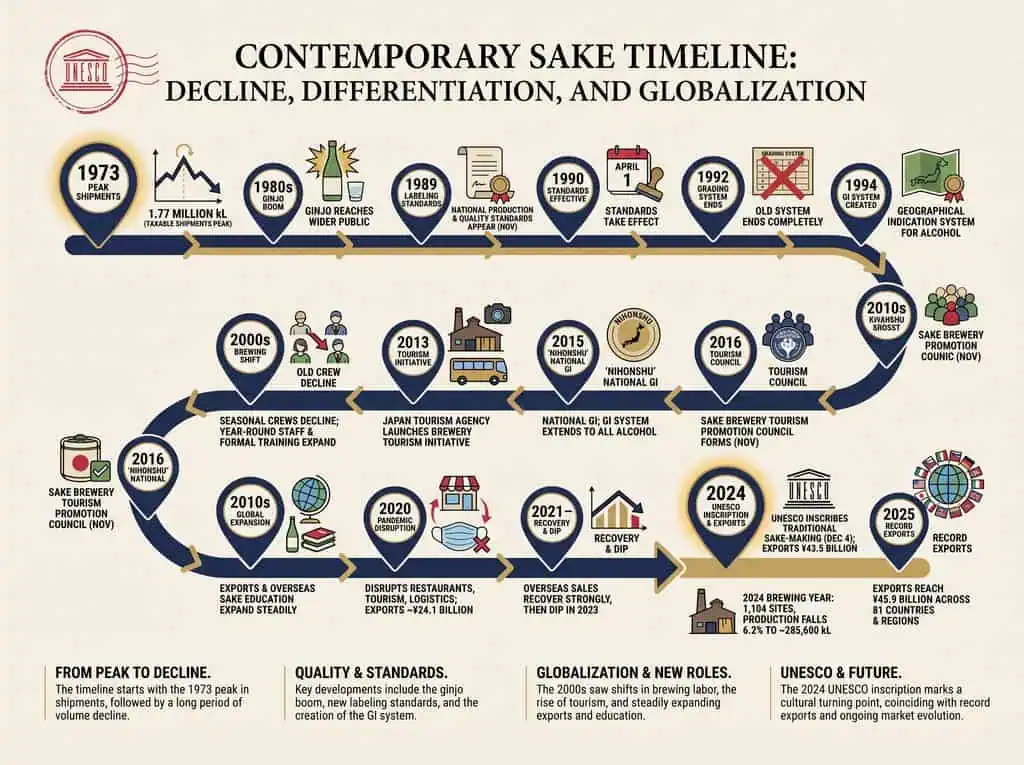
Year
Development
1973
Taxable sake shipments peak at about 1.77 million kL
1980s
Ginjo reaches a wider public in the “ginjo boom”
1989
National labeling standards for sake production and quality appear in November
1990
The standards take effect on April 1
1992
The old grading system ends completely
1994
Japan creates a geographical indication system for alcohol
2000s
Seasonal brewing crews decline; year-round staff brewing and formal training expand
2013
The Japan Tourism Agency launches a brewery tourism initiative
2015
“Nihonshu” becomes a national GI; the GI system extends to all alcohol
2016
A Sake Brewery Tourism Promotion Council forms in November
2010s
Exports and overseas sake education expand steadily
2020
The pandemic disrupts restaurants, tourism, and logistics; exports total about ¥24.1 billion
2021 to 2023
Overseas sales recover strongly, then dip in 2023
2024
Exports reach ¥43.5 billion; UNESCO inscribes traditional sake-making on December 4
2024 brewing year
1,104 production sites make sake; production falls 6.2 percent to about 285,600 kL
2025
Exports reach ¥45.9 billion across 81 countries and regions
Common Misconceptions About Contemporary Sake
“Sake is declining, so the industry is dying.” Domestic volume has fallen for fifty years. Yet exports, premium categories, tourism, and cultural recognition have all grown. Shrinking and disappearing are different things.
“UNESCO made sake a World Heritage Site.” UNESCO inscribed traditional knowledge and skills of sake-making with koji mold on its Representative List of intangible heritage. It designated no product, brand, or place.
“Jizake means artisanal sake.” Jizake means local or regional sake. Quality, scale, and method are separate questions.
“Small breweries are always more traditional.” Some small breweries run highly digital operations, while some large ones still brew with kimoto starters.
“Export growth means domestic consumption has recovered.” The two markets move independently. Exports hit records in 2025, while domestic production kept falling.
“Modern technology is replacing traditional sake-making.” Research now uses genetics and fermentation models to understand and stabilize traditional methods, not to erase them.
Final Thoughts
Step back and the whole series comes into view. Ancient sake began with rice, fermentation, and ritual. Nara and Heian brewers served a court. Medieval temples and merchants turned skill into commerce. Edo built an industry under regulation and urban demand. Meiji added taxation and science. The modern era brought mass production, war, and standardization, then the first premium revival.
Contemporary sake added regional identity, globalization, and cultural heritage. It did so while the home market shrank every year. That is not a story of decline, and it is not quite a story of revival either. Domestic volume contracted while value, differentiation, place, exports, education, and recognition developed along their own paths.
Contemporary sake is not the end of sake history. It is another stage in a tradition that has repeatedly adapted to new economic, technological, and cultural conditions. The next time you pour a glass, you are holding the latest draft of a very long conversation about what sake is for.
Frequently Asked Questions About Contemporary Sake
Definitions and Markets
What is contemporary sake?
In this series, contemporary sake means sake in Japan from roughly the 1990s to the present. It is therefore a historical period rather than a style. Premium categories, regional identity, exports, brewery tourism, and cultural recognition define the era, all against a shrinking domestic market.
When did contemporary sake begin?
Strictly speaking, there is no official start date. We use the 1990 labeling standards and the 1992 abolition of the old grading system as the turning point. Those reforms let labels describe method and ingredients, so premium and regional sake gained a shared vocabulary.
Why has sake consumption declined in Japan?
The National Tax Agency cites several causes: an aging and shrinking population, changing lifestyles, more varied tastes, and price sensitivity. Beer, shochu, wine, and canned cocktails also compete for the same glass. No single rival explains the decline on its own.
What is jizake?
Jizake means local or regional sake. The word has no legal definition, so it does not by itself promise quality, small scale, or traditional methods. It simply describes a brewery’s association with a place.
Brewing and Exports
Is traditional sake brewing still practiced?
Yes. Hand koji-making, kimoto and yamahai starters, and winter brewing all continue, and some have even grown more common since the 1990s. Most breweries combine them with sensors, refrigeration, and laboratory analysis. UNESCO’s 2024 inscription recognized exactly this living practice.
Why are sake exports growing?
Over the five years from 2020 to 2025, value grew much faster than volume, so premium sake increasingly sells on provenance, method, and story. Overseas Japanese restaurants provided an entry point. Education, fine dining, and importers then helped turn sake into a category of its own.
Which countries import the most Japanese sake?
In 2025, China led in export value at about 13.3 billion yen, followed by the United States at about 11.0 billion yen. Hong Kong, South Korea, and Taiwan came next, while the United States led in volume. South Korea, meanwhile, showed the fastest growth.
UNESCO and the Future
What did UNESCO recognize about sake in 2024?
On December 4, 2024, UNESCO inscribed “Traditional knowledge and skills of sake-making with koji mold in Japan” on its Representative List of the Intangible Cultural Heritage of Humanity. The element covers koji-making, brewing skills, the toji and kurabito system, apprenticeship, and ties to farmers and festivals. It names no specific commercial brand, brewery, bottle, or region, and it also covers shochu, awamori, and mirin made with koji.
What challenges does the sake industry face today?
Domestic demand keeps falling, and only 1,104 production sites made sake in the 2024 brewing year. Brewing rice, meanwhile, faces price swings and heat stress from a warming climate. Aging farmers and brewers, labor shortages, and energy costs add further pressure.
What is the future of traditional sake-making?
Nobody can say with confidence. Still, the most likely path combines continued domestic contraction with growth in value, exports, tourism, and education. Whether heritage recognition strengthens or freezes the craft will depend on the brewers who inherit it.
References
Primary and official sources
National Tax Agency – Sake Report, July 2025: Domestic Trends in Alcohol Consumption (Accessed September 2026)
National Tax Agency – Sake Production Conditions, 2024 Brewing Year (January 2026) (Accessed September 2026)
National Tax Agency – Recent Export Trends for Japanese Alcoholic Beverages (2025) (Accessed September 2026)
National Tax Agency – List of Geographical Indications for Alcoholic Beverages (Accessed September 2026)
National Tax Agency – Geographical Indications for Alcohol Guide (March 2025) (Accessed September 2026)
National Tax Agency – Production Standard for the Geographical Indication Nada Gogo (Accessed September 2026)
National Tax Agency – Report on Branding and Brewery Tourism for Japanese Alcohol (Accessed September 2026)
Cabinet Office of Japan – Sake Brewery Tourism Promotion Council (Cool Japan Alcohol Working Group) (Accessed September 2026)
Hiroshima Prefecture – Cooperation with the Hiroshima Toji Union (Accessed September 2026)
National Tax Agency – Market Survey of Japanese Alcohol in Priority Overseas Markets, FY2025 (March 2026) (Accessed September 2026)
Nippon.com – Sake Exports Reach 45.9 Billion Yen in 2025 (Japan Data, February 2026) (Accessed September 2026)
Research institutes and academic sources
National Research Institute of Brewing – Takahashi, M. Microbial Diversity in Kimoto-Style Starters and the Possibility of Control (Accessed September 2026)
Ryo Iwa is the founder and editor of foodinjapan.org. Born and raised in Japan, he writes from regional travel, market visits, and Japanese-language primary sources that rarely reach English readers, including brewing institute publications and industry glossaries. Where a figure cannot be traced to a source, the article says so.
He has been a Google Maps Local Guide for over 10 years, with more than 1,800 reviews and over 41,000 photos viewed hundreds of millions of times. He previously spent two decades as an IT consultant in Japan, the US, and the UK.











Comments