Open a well-chilled bottle of Kaze no Mori sake, and the first sip may prickle gently. It feels more like a lively young white wine than a sparkling drink. However, nobody added that gas. Instead, it is left over from fermentation and stays dissolved in this unpasteurized sake from Gose in Nara Prefecture.
Yucho Shuzo has made Kaze no Mori since 1998, using mostly Nara rice and minimal handling after pressing. Its labels also carry numbers such as 807, 657 and 507. Those numbers do not rank quality. Instead, the first two digits show how much of each rice grain remains after polishing.
TOC
What Is Kaze no Mori Sake?
Kaze no Mori (風の森) is a junmai sake brand made by Yucho Shuzo in Gose, Nara. For its core range, the brewery skips filtration and added water after pressing, and it does not pasteurize. As a result, some bottles keep a light prickle of natural fermentation gas when first opened.
Quick Facts: Kaze no Mori Sake
Japanese name
風の森 (Kaze no Mori, literally “forest of wind”)
Brewery
Yucho Shuzo (油長酒造), Gose, Nara Prefecture
Brand launched
1998 (the brewery’s official founding year is 1719)
Name origin
Kaze no Mori Pass, a mountain pass in Gose
Core style
Muroka (no filtration after pressing), mukasui (no water added after pressing), namazake (unpasteurized)
Signature trait
A light prickle from dissolved fermentation gas in some freshly opened bottles
Water
Very hard well water, which the brewery reports at over 250 mg/L
Key rice
Akitsuho, a Nara-grown table rice, plus several sake rice varieties
Core series
807, 657 and 507; the first two digits match 80%, 65% and 50% polishing ratios
Alcohol
16% ABV across the eight regular bottlings (check each label)
Where to buy
Selected retailers listed by the brewery; no regular sales at the brewery
Brand vs Brewery
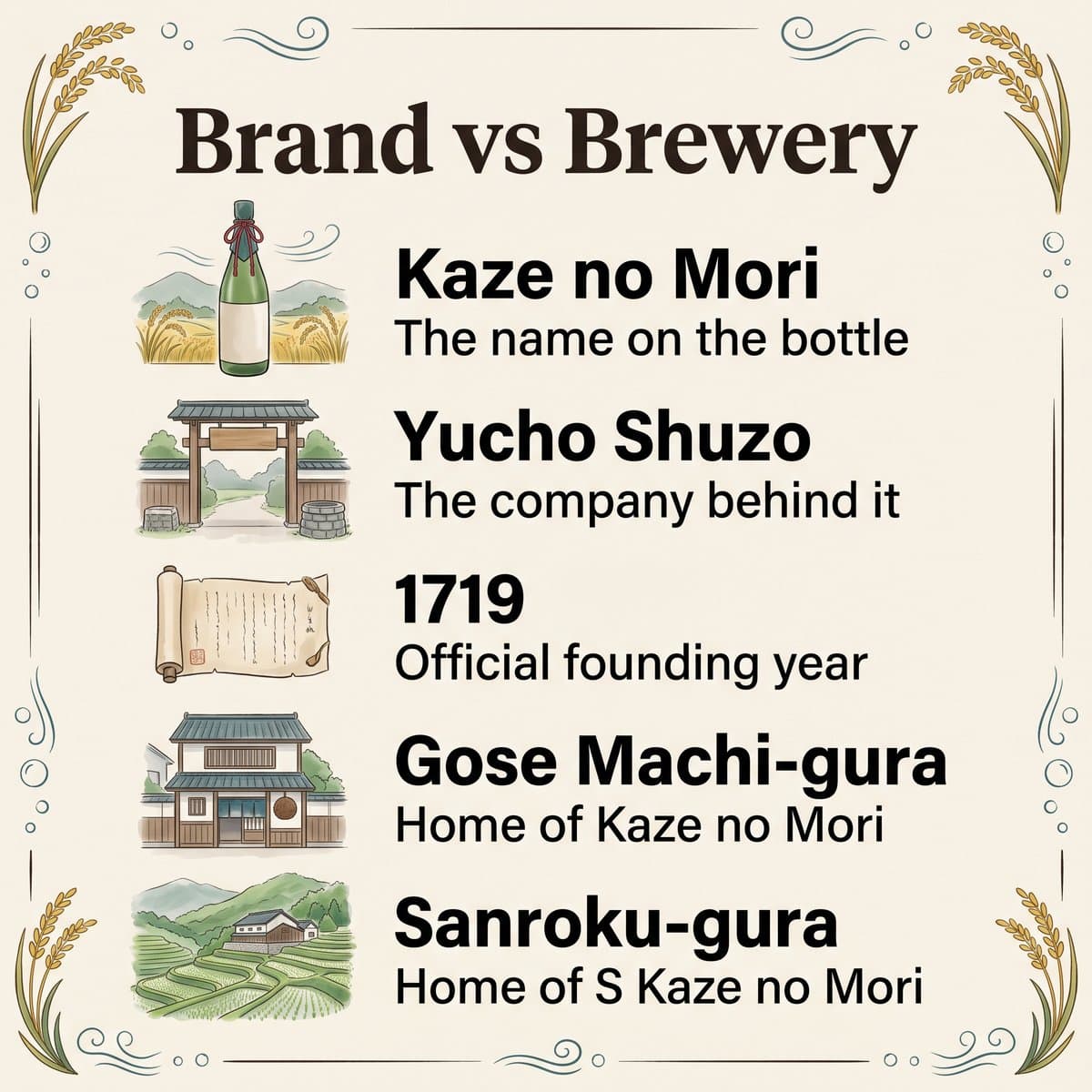
First, Kaze no Mori is the name on the bottle, while Yucho Shuzo is the company behind it. The company gives 1719 as its official founding year, based on an old document about a sale of brewing tools. It also believes the family was brewing by the late 1600s. Meanwhile, its name comes from Aburaya Chobei, a former trade name tied to oil pressing.
Today, Yucho Shuzo runs three sake breweries and a gin distillery. Of these, Kaze no Mori comes from the Gose Machi-gura in town. A related but separate series, S Kaze no Mori, comes from the newer Sanroku-gura in the hills.
Where the Name Comes From
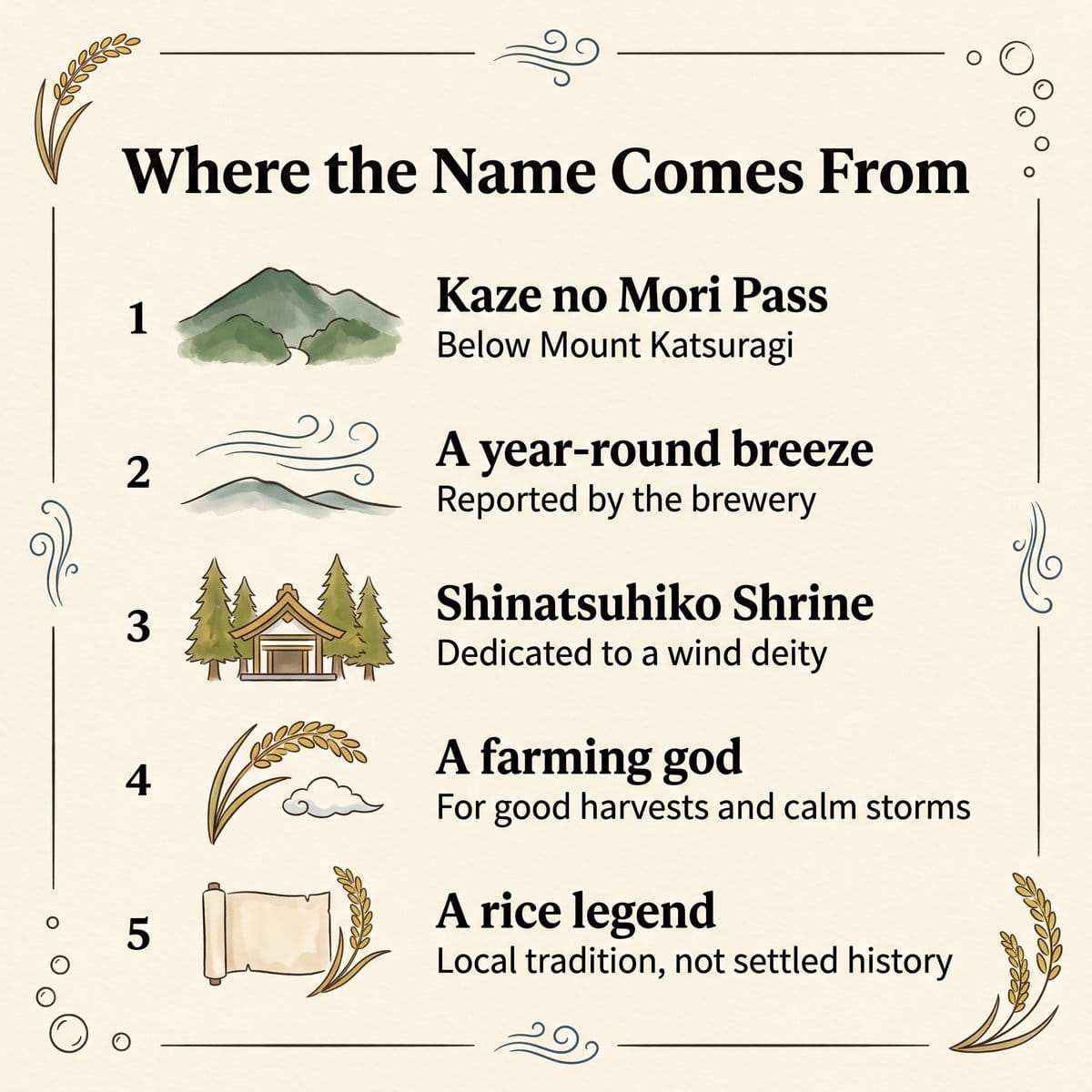
Kaze no Mori literally means “forest of wind,” though that is a translation, not an official English name. The name comes from Kaze no Mori Pass, below Mount Katsuragi, where, the brewery says, a breeze blows all year. At the summit, according to Gose City, stands Shinatsuhiko Shrine, dedicated to a wind deity.
Moreover, locals honor the deity as a farming god, the city adds, for good harvests and protection from storms. The city also mentions a local tradition that wet-rice farming in Japan began nearby. That is a legend rather than settled history. Still, a sake named after a wind pass in rice country feels rather fitting.
How Kaze no Mori Began
Kaze no Mori began as a fix for a local problem: people in Gose rarely drank their own brewery’s sake. So the brand set out to give them something only brewery workers usually tasted, sake straight from the press.
Late 1600sThe family was probably already brewing sake, by its own account.
1719Official founding year, based on a document about sake tools.
1970s to 1990sMass production, mostly sold to larger sake companies.
1998Kaze no Mori launches with local Akitsuho rice.
2019300th anniversary and a new brewery mission.
2024The Sanroku-gura brewery opens in the Katsuragi foothills.
From the 1970s through the 1990s, Yucho Shuzo says, much of its output went to larger sake companies. As a result, the brewery had no real home market in Gose. Eventually, the 12th-generation head, Chobei Yamamoto, saw this as a problem. So he chose to bottle freshly pressed, unpasteurized sake made with Akitsuho rice grown near Kaze no Mori Pass. The new sake went on sale in 1998.
In other words, Kaze no Mori did not start as a rare luxury product. Rather, it started as a way to reconnect a brewery with its neighbors.
Muroka, Mukasui and Namazake: Three Steps Kaze no Mori Skips
In short, Kaze no Mori is defined partly by what it leaves out. For its core range, Yucho Shuzo skips filtration and added water after pressing. It also ships the sake unpasteurized. Since each term describes a different stage, it pays to keep them apart.
無濾過
Muroka
The mash is pressed, but the sake skips the later filtration step. It is not the same as cloudy nigori.
無加水
Mukasui
No water is added after pressing to adjust the finished sake.
生酒
Namazake
No heat treatment after the sake is made, so careful cold storage matters.
Muroka: Not Filtered After Pressing
Muroka is often translated as “unfiltered,” but “not filtered after pressing” is more precise here. First, after fermentation, brewers press the mash, called moromi, to separate liquid sake from the lees. Many breweries then filter the sake to adjust color and flavor. Muroka sake skips that later step. However, it is still pressed, so it is not the same as nigori sake, which keeps visible rice solids.
Mukasui: No Water After Pressing
Typically, brewers add a little water after pressing to fine-tune alcohol and balance, a step called warimizu. Kaze no Mori, however, leaves it out. The idea is close to genshu, but the two are not identical. Under NTA rules, a genshu label still allows water adjustment worth less than one percentage point of alcohol.
Namazake: Unpasteurized Sake
According to Japan’s National Tax Agency (NTA), other sake is usually heat-treated twice: before storage and before shipping. Brewers call this hiire, or pasteurization. Namazake skips it entirely, so the NTA requires storage or drinking instructions on the label. In short, “nama” signals a style that needs care, not a higher grade.
Why Kaze no Mori Can Feel Slightly Fizzy
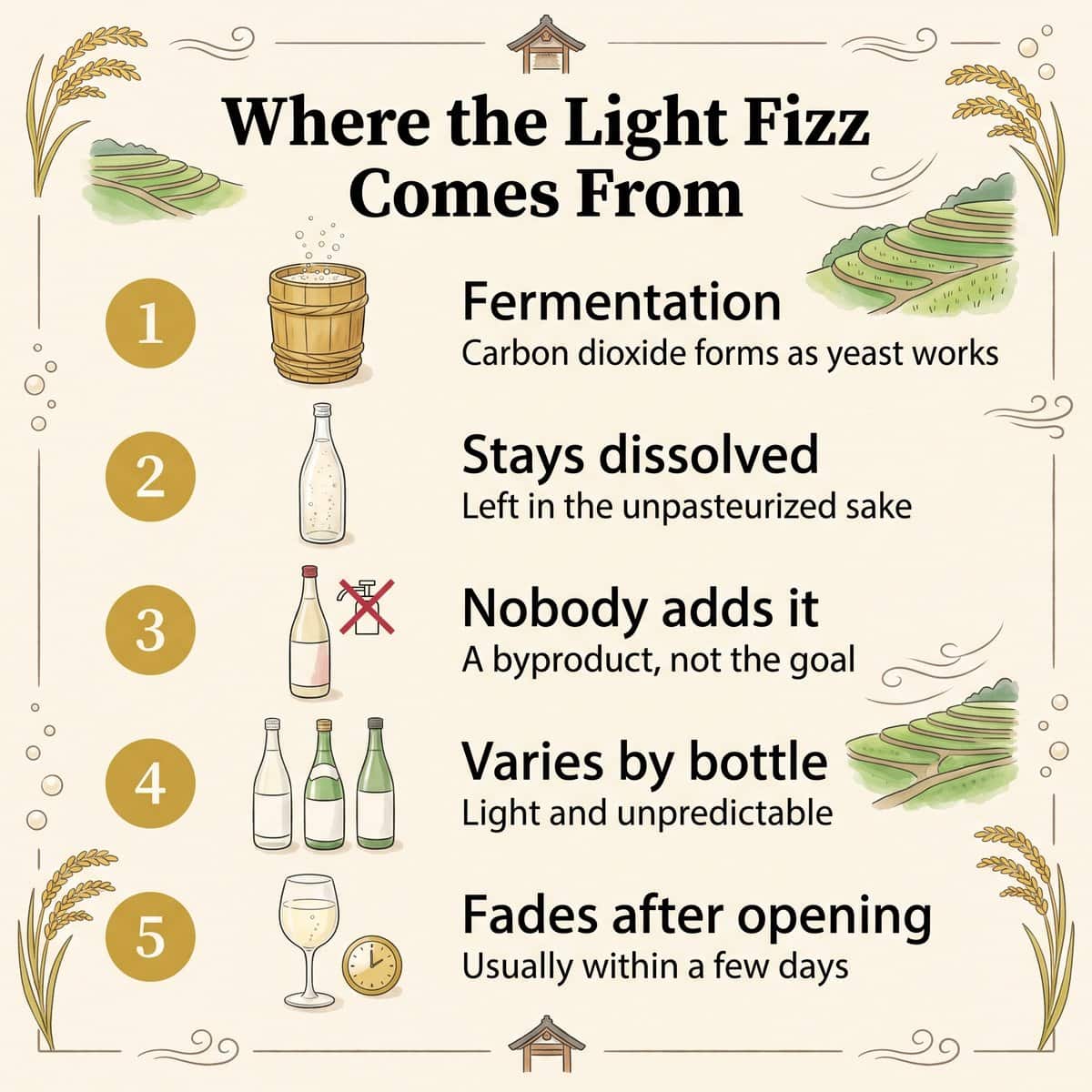
Kaze no Mori may prickle when first opened because carbon dioxide from fermentation can stay dissolved in the sake. Nobody adds it, and the brewery calls it a byproduct rather than the goal. Also, the sensation varies from bottle to bottle and fades after opening.
One Bottle, Two Experiences
Interestingly, Yucho Shuzo does not insist that the fizziest moment is the best one. It even notes that plenty of gas can make the sake’s own flavor harder to read. So the brewery suggests coming back to the bottle after the gas fades, usually within a few days.
Just opened
A light prickle in some bottles
A lively, fresh first impression
Flavor details can feel hidden
A few days later
After the gas fades
Rice-driven richness, umami and sweetness
Fruit-like aromas from the yeast
Acidity becomes easier to notice
That description comes from the brewery, not from a lab study. Still, it gives a good reason to taste the same bottle on day one and again a few days later.
Kaze no Mori vs Sparkling Sake vs Nigori
Point
Kaze no Mori (core range)
Sparkling sake
Nigori
Bubbles
Leftover fermentation gas; light, variable and temporary
Carbonation is a defining, intended feature
Not defined by bubbles
Look
Pressed; not a cloudy nigori style
Varies by product
Cloudy with rice solids
Heat treatment
Unpasteurized
Varies by product
Varies by product
Storage
Keep cold; follow the label
Follow the label
Follow the label
For bottles made with bubbles as the main event, see our guide to sparkling sake.
The Hard Water Behind Kaze no Mori
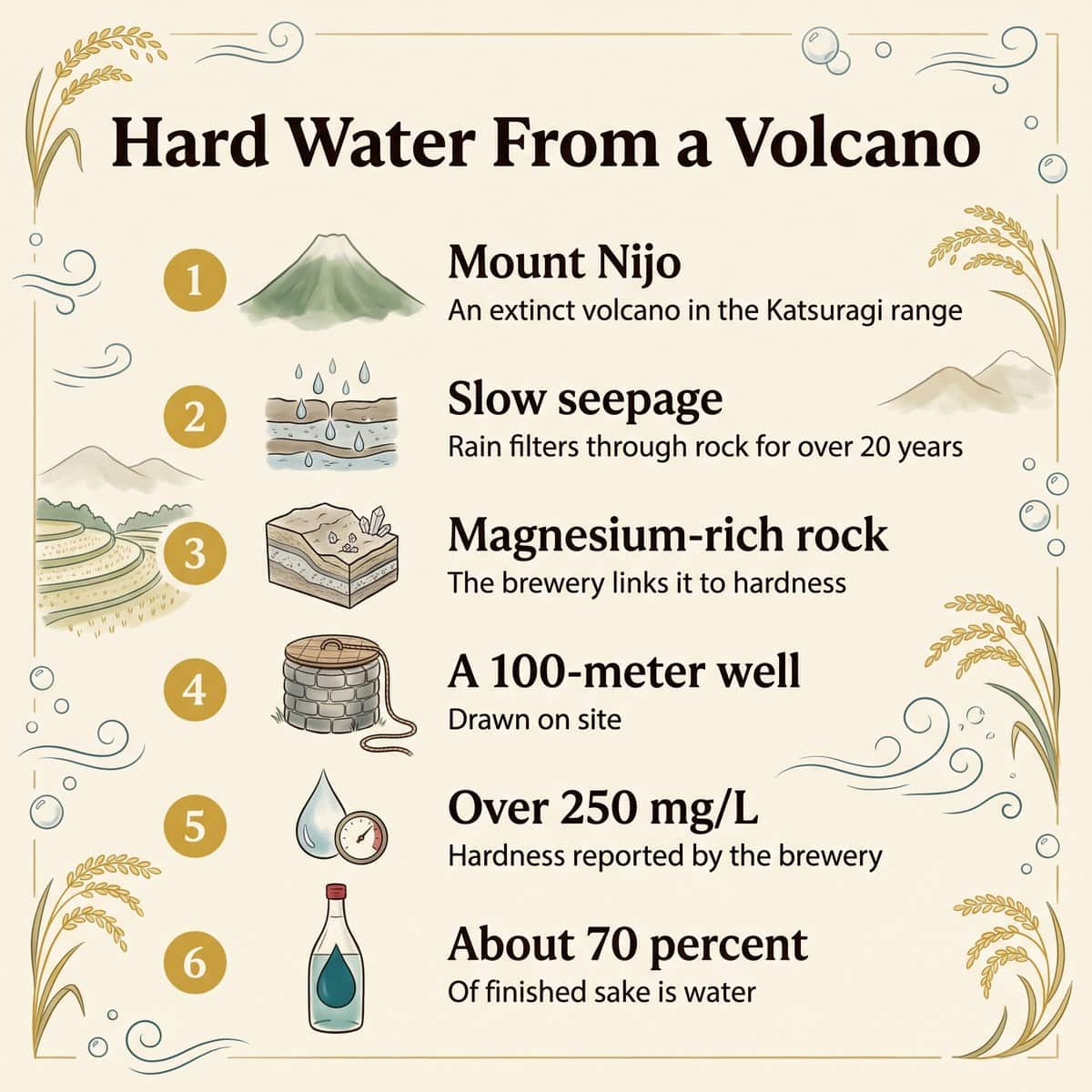
Notably, Kaze no Mori relies on unusually hard water. Specifically, Yucho Shuzo draws it from a 100-meter well on site and reports a hardness above 250 mg/L. The brewery itself calls the water exceptionally hard.
The brewery traces this hardness to Mount Nijo, an extinct volcano at the northern end of the Katsuragi range. Rainwater, it explains, seeps for more than 20 years through magnesium-rich volcanic rock before reaching the well. Since about 70 percent of finished sake comes from this water, the brewery links it to a slightly thick texture. It also says the minerals encourage lively fermentation, so the yeast produces more acidity.
Of course, these are the brewery’s own explanations rather than independent measurements. Even so, they help explain the house style. Alongside rice and freshness, the water is part of why Kaze no Mori often tastes layered and acid-driven.
The Rice Behind Kaze no Mori
Kaze no Mori actually uses several rice varieties rather than a single house rice. The brewery says about 80 percent of its rice is Nara-grown Akitsuho, Tsuyuhakaze or Nanatsuyu. The rest includes Yamada Nishiki and Aiyama from Hyogo and Omachi from Okayama.
Akitsuho: A Table Rice at the Center
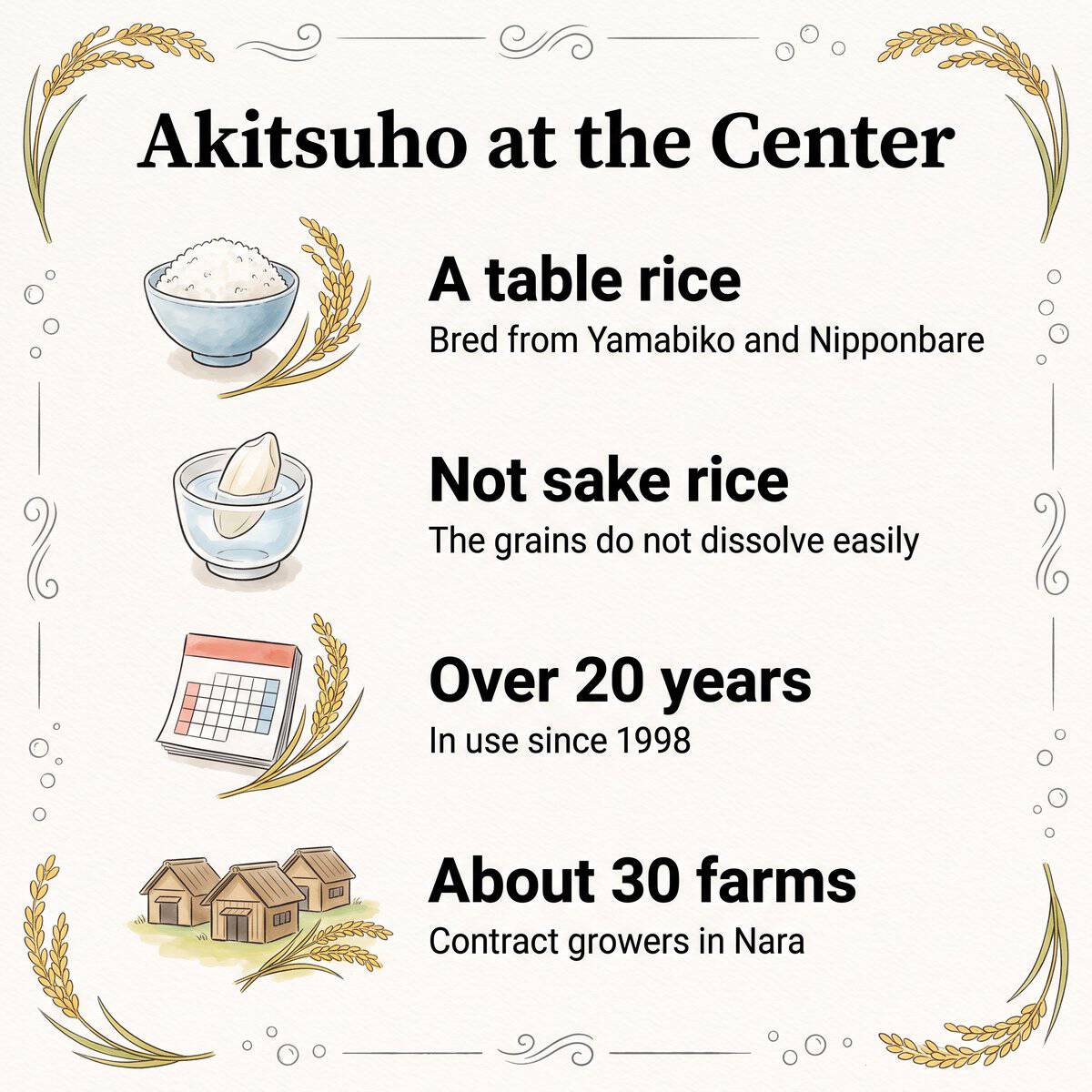
Above all, Akitsuho is the rice that started it all. Yucho Shuzo describes it as a table rice bred from Yamabiko and Nipponbare. In other words, it is not shuzo-kotekimai, or sake-brewing rice. The brewery also notes that the grains do not dissolve easily during fermentation.
So why use it? The brewery says Akitsuho suits its methods and gives sake a clear, transparent character. In fact, it has used the variety for over 20 years. Today, about 30 contract farms in Nara grow it. Rather than a weakness, the rice became the brand’s signature.
Tsuyuhakaze, Nanatsuyu and Rice From Beyond Nara
Tsuyuhakaze, meanwhile, has an unusual history. Aichi’s agricultural experiment station bred it in 1963, yet today, the brewery says, it grows only in Nara. Nanatsuyu, on the other hand, is far newer. It debuted in 2024 as the first sake rice developed in Nara Prefecture, after over ten years of work.
Rice
Grown in
Bred for
Brewery’s notes
Akitsuho
Nara
Eating
Brand’s original rice; clear, transparent sake
Tsuyuhakaze
Nara
Sake brewing
Complexity, rich texture, acidity
Nanatsuyu
Nara
Sake brewing
Nara’s first developed sake rice (2024)
Yamada Nishiki
Hyogo
Sake brewing
Used in the 807 series
Aiyama
Hyogo
Sake brewing
Used in the 807 series
Omachi
Okayama
Sake brewing
Used in the 807 series
As a result, each label names its rice, and the line-up changes over time. For more on the most famous variety here, see our guide to Hyogo sake.
Rethinking Rice Polishing
Traditionally, many sake guides treat heavy polishing as a shortcut to quality. Kaze no Mori, however, pushes back on that idea. Yucho Shuzo states plainly that it sees no inherent superiority in a higher or lower polishing ratio.
What Does an 80% Polishing Ratio Mean?
Simply put, the polishing ratio shows how much of each grain remains after milling. Japan’s NTA defines it as the weight of polished rice relative to the original brown rice. So 80% means 80 percent remains, while milling removes the other 20 percent.
How Much of the Grain Remains
807 series80%
657 series65%
507 series50%
Longer bar = more of the rice grain kept.
In the brewery’s view, 80% polishing tends to bring out complexity, while 50% leans toward a smoother, cleaner taste. Is that a universal law? Probably not, since yeast, water and fermentation matter too. Still, it is a useful reminder: a bigger number on the bottle does not mean a rougher sake.
Why the Labels Say “Nara-shu Junmai-shu”
Yucho Shuzo labels its products “Nara-shu Junmai-shu,” meaning Nara sake, pure rice sake, rather than ginjo or daiginjo. However, this is a brand philosophy, not a change to Japanese law. Export labels may also differ, so check the bottle you buy.
Under NTA rules, ginjo needs a polishing ratio of 60% or less and daiginjo 50% or less. Both also require ginjo-style brewing and set flavor standards, so a 50% ratio alone does not make a sake daiginjo. Junmai, by contrast, has no polishing requirement. Our guide on how to read a sake label explains these terms further.
Understanding the 807, 657 and 507 Series
On its product page, Yucho Shuzo groups the core range into 807, 657 and 507. The first two digits correspond to polishing ratios of 80, 65 and 50 percent. However, the page does not explain the final digit, so this article does not assign it a meaning.
807
80% polishing
Lightly polished rice, aimed at depth and rice-driven complexity.
657
65% polishing
Home of the long-selling flagship, Akitsuho 657.
507
50% polishing
More highly polished rice, aimed at a cleaner, smoother profile.
Current Bottlings and the Brewery’s Tasting Notes
The table covers the eight regular bottlings on the brewery’s Japanese product page, checked in October 2026. All eight are sold at 16% alcohol by volume (ABV). Also, the descriptions are the producer’s, not ratings by our team. The same page also shows Akitsuho 807, labeled as discontinued. Since individual bottlings may be reissued or seasonal, check current listings before buying.
Bottling
Rice
Polishing
Alcohol
Brewery’s description
Akitsuho 657
Akitsuho
65%
16% ABV
Flagship; melon and pear-like aroma, sweetness with complexity
Nanatsuyu 657
Nanatsuyu
65%
16% ABV
Strawberry and floral notes, sweeter than Akitsuho, pleasant acidity
Sweetest of the 807s; ripe melon aroma, full-bodied
Aiyama 807
Aiyama
80%
16% ABV
Focused on clarity; white grape aroma
However, specifications can change by batch or for export. Check the individual bottle label for the final specification.
Limited Releases and Old Nara Techniques
Beyond the core range, the brewery also releases seasonal and experimental bottles. For example, a 2026 Akitsuho 657 Nakadori used only sake that dripped from the press unforced, the brewery says. Then it spent six months below freezing. Nakadori generally means the middle portion of a pressing, though methods vary.
Limited release
Rice
Polishing
Alcohol
Notes
Akitsuho 657 Nakadori (2026)
Akitsuho (Nara)
65%
16% ABV
Unforced drip portion; stored below freezing for six months
Similarly, the separate “alpha” line goes further. Since 2022, every alpha bottling has used bodaimoto. This yeast starter relies on soyashi-mizu, water soured by lactic acid bacteria. According to tradition, both methods developed at Shoryakuji, a temple in Nara. For background, see our guide to moto, the yeast starter.
What Does Kaze no Mori Taste Like?
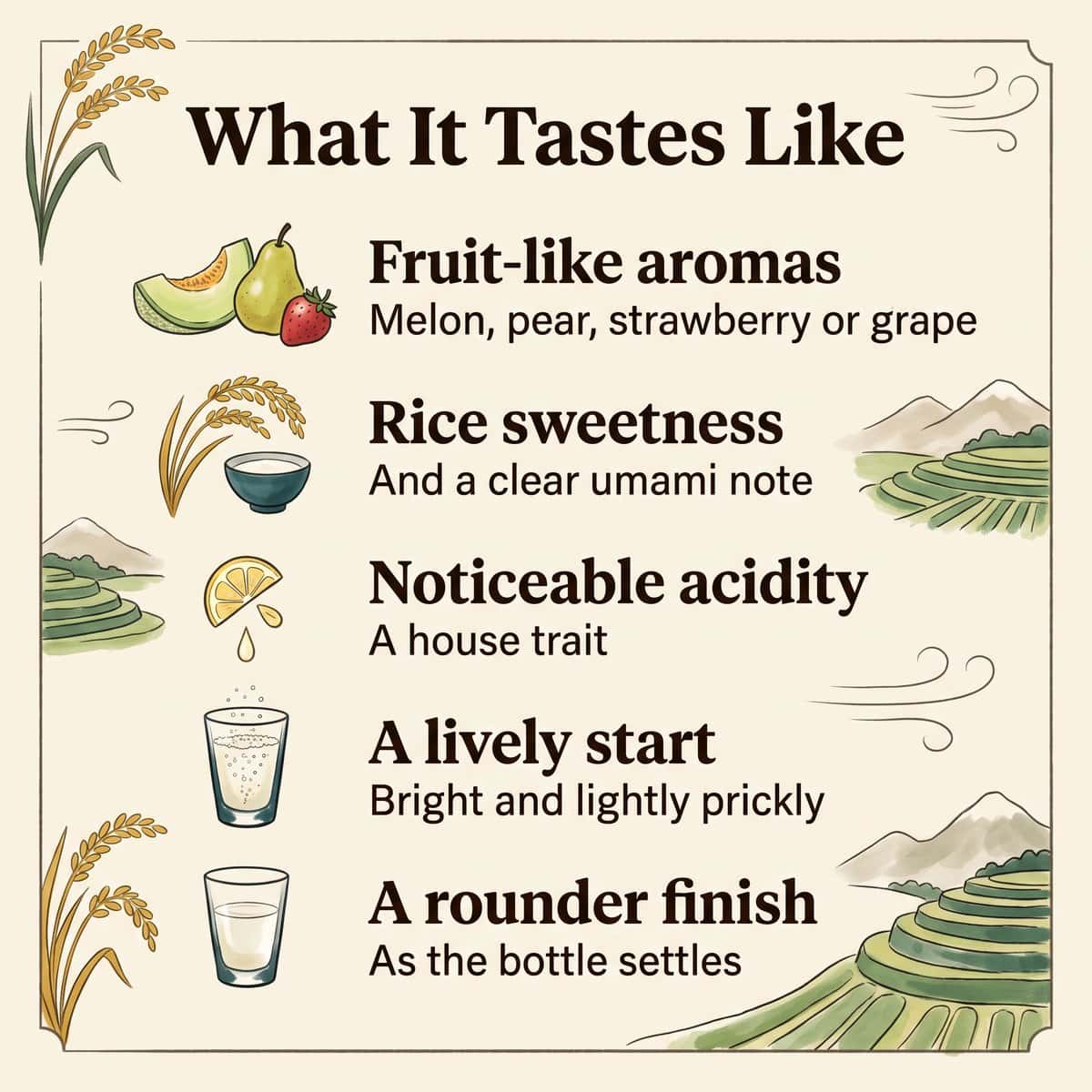
Kaze no Mori often pairs fruit-like aromas with rice-driven sweetness, umami and noticeable acidity, plus a lively texture at first. Still, the balance depends on rice and polishing. A dry Yamada Nishiki 807 and a sweet Omachi 807 can feel like different drinks.
The brewery’s notes lean on fruit comparisons such as melon, pear, strawberry, grape and green banana. Of course, no fruit goes into the sake. Similarly, Japan’s National Research Institute of Brewing lists banana, apple, pear, melon, strawberry and citrus as standard fruit-like sake terms. The same research also separates sweet aroma from sweet taste. That helps when a pear-like nose meets a fairly dry palate.
Likewise, texture shifts as the bottle ages. At first, some bottles feel bright and lightly prickly. Later, the sake settles into a rounder feel. That gradual change is one of the brand’s more interesting traits. Our guide on how to taste sake walks through the basics.
How to Serve, Store and Pair Kaze no Mori
Above all, treat Kaze no Mori as a fresh product. Because it is unpasteurized, cold storage and gentle handling matter more than with most sake. For that reason, the instructions on your bottle always come first.
Storage and Serving Temperature
First, keep the bottle refrigerated, upright and away from light, including on the way home. Start tasting it well chilled. Then let a small glass warm a little and notice how the aroma and texture change. We could not confirm one official serving temperature for every release, so follow the label. Our guide on how to store sake covers the details.
Opening Safely and Tasting Over Several Days
Keep the bottle upright and well chilled, and do not shake it.
Loosen the cap slowly over a sink, pausing if pressure pushes liquid up.
Taste a small glass on day one and notice any prickle.
Reseal the bottle and return it to the fridge.
Taste again a few days later and compare aroma, sweetness, acidity and texture.
Also, a wine glass can help you pick up aroma. For other options, see our guide to sake glasses and cups.
Food Pairing by Style
Since Yucho Shuzo publishes no pairing list, these are our editorial starting points, matched to style.
Clean and dry, such as Akitsuho 507: white fish sashimi or lightly salted grilled fish.
Sweet and full, such as Omachi 807: yakitori with sweet soy tare or glazed pork.
Acid-forward bottlings: fried foods or grilled chicken with citrus.
Just opened and lively: light appetizers and raw or lightly cooked seafood.
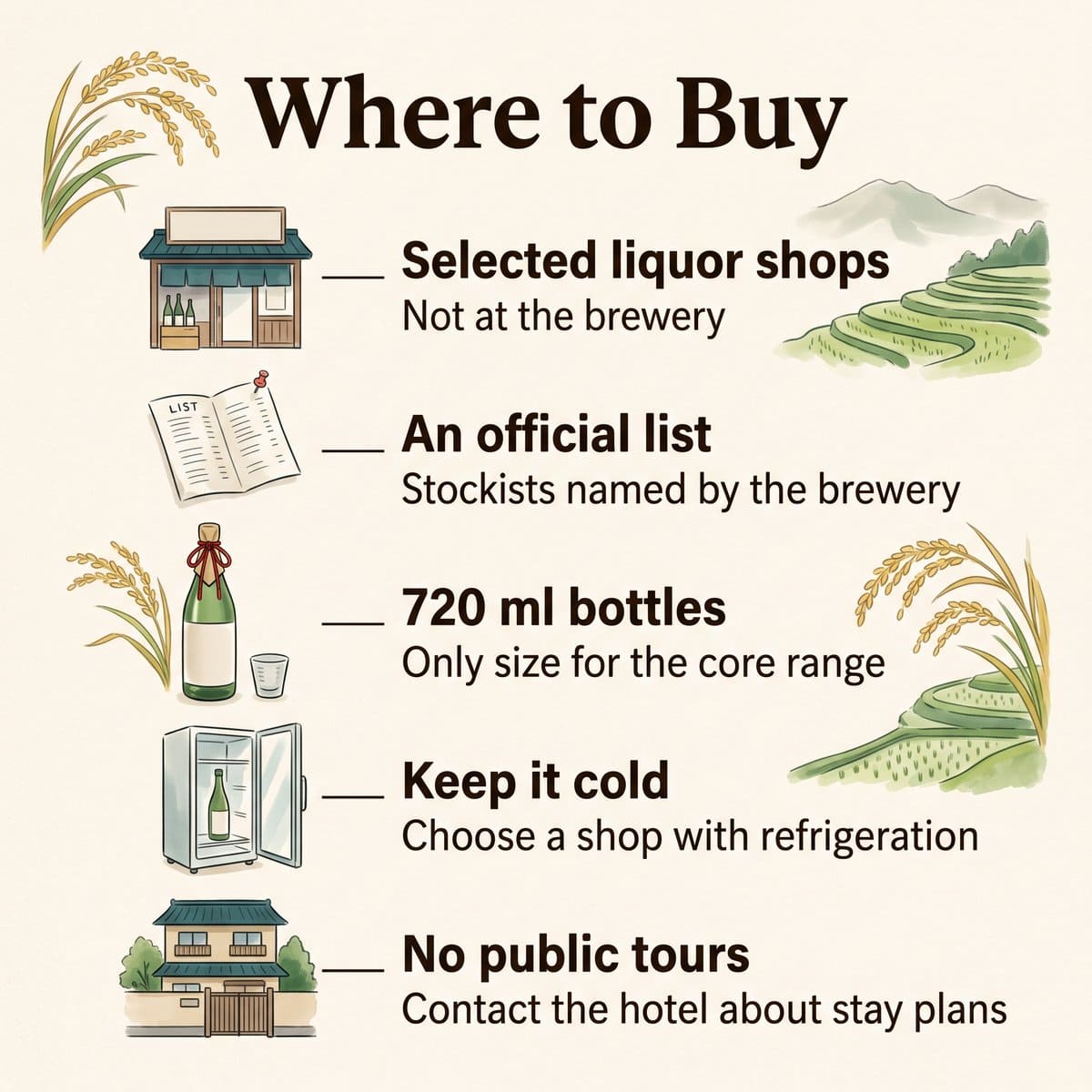
In general, you buy Kaze no Mori through selected liquor shops, not at the brewery. Yucho Shuzo says its partner retailers can keep the sake in good condition and explain it. Moreover, it sells the core range only in 720 ml bottles.
Buying in Japan and Visiting the Brewery
According to its company page, the brewery does not normally sell sake directly. Instead, it points shoppers to an official stockist list. Because prices vary by bottling, shop and season, we have not listed one. Before you buy, check that the shop keeps the bottle refrigerated.
Can you visit? Generally, no. Yucho Shuzo does not offer public tours. However, its company page mentions gose sento hotel, in the same town, which runs a monthly stay-and-tour plan. Since details may change, contact the hotel before planning a trip.
Which Bottle Should a Beginner Try?
Classic starting pointAkitsuho 657The long-selling flagship, with sweetness and complexity
Cleaner and drierAkitsuho 507Pear-like aroma and a crisp, dry finish
Fuller and sweeterOmachi 807The sweetest 807, with ripe melon notes
Driest of the 807sYamada Nishiki 807Grape and muscat notes, sharp and clean
These picks follow the brewery’s descriptions, not a tasting by our team. Even so, they give a sensible map for a first purchase.
The Sanroku-gura and the Satoyama Community
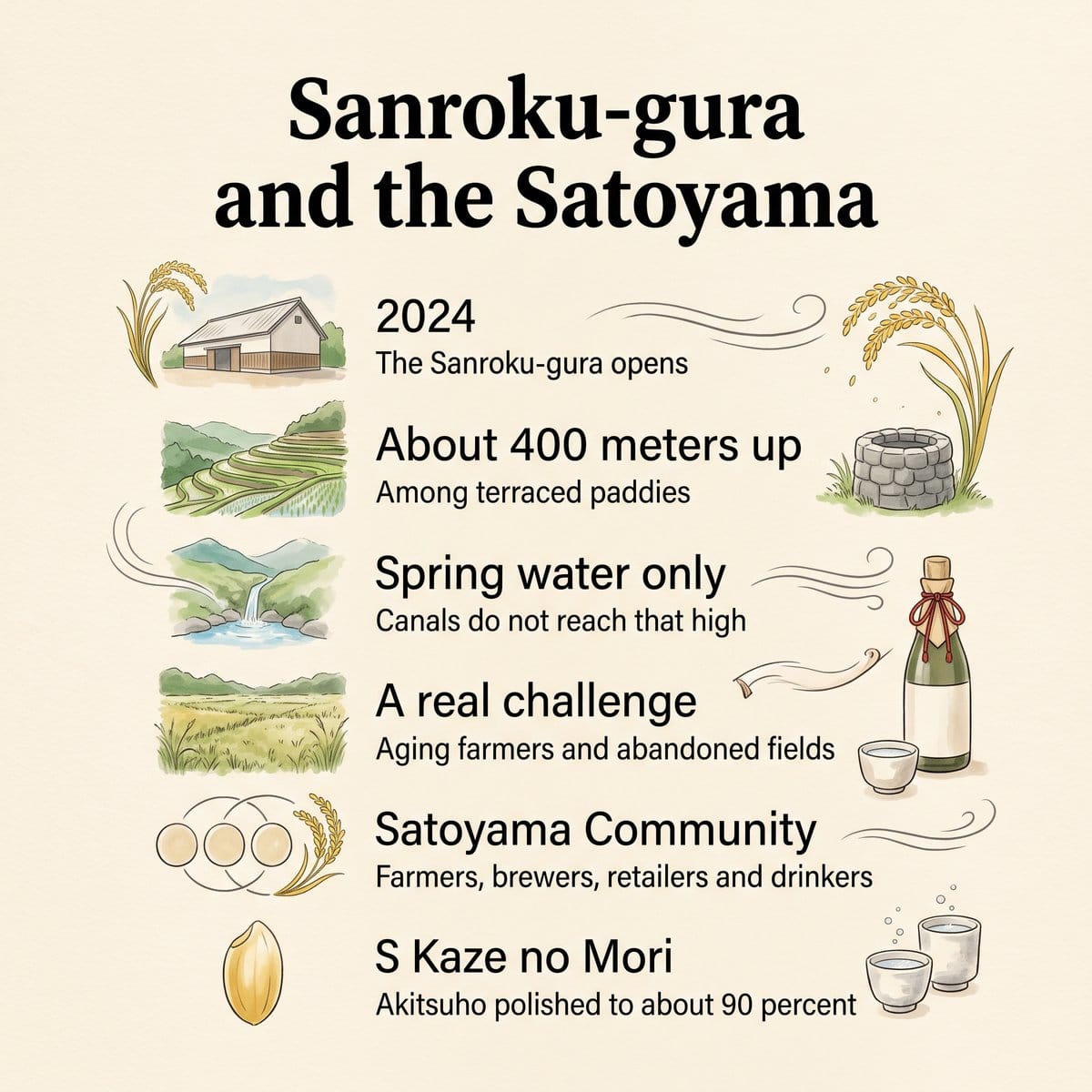
In 2024, Yucho Shuzo opened the Sanroku-gura among terraced paddies in the Katsuragi foothills, about 400 meters up. Irrigation canals do not reach that high, so the Akitsuho there grows on mountain spring water alone. The area, however, faces aging farmers and abandoned fields.
In response, the brewery launched the “Kaze no Mori Satoyama Community,” linking farmers, brewers, retailers and drinkers. Satoyama means the farmed hills and woodland at the edge of Japanese villages. Meanwhile, the new brewery makes S Kaze no Mori from local Akitsuho polished only to about 90 percent. Also, an interview hosted on the Nara Prefecture website adds a farmer’s view. In it, a Gose grower said he had grown the brewery’s sake rice for about 15 years.
What Not to Assume About Kaze no Mori
Myth: Kaze no Mori is a type of sake.
Fact: It is a brand made by Yucho Shuzo in Gose, Nara.
Myth: Every bottle is strongly sparkling.
Fact: Some freshly opened bottles show a light prickle, and it fades.
Myth: 80% polishing means milling removed 80%.
Fact: It means 80% of the grain remains.
Myth: More polishing always makes better sake.
Fact: The brewery treats polishing as a style choice, not a ranking.
Myth: Muroka sake is always cloudy.
Fact: It is still pressed; it just skips the later filtration step.
Myth: Every bottle uses Akitsuho.
Fact: Bottlings use several rice varieties from Nara, Hyogo and Okayama.
Final Thoughts on Kaze no Mori Sake
Kaze no Mori began with a simple wish: let people in Gose drink sake straight from the press. Even now, that idea still shapes it. The core range is unpasteurized, with no filtration or water added after pressing, and it leans on local Akitsuho rice.
Its other lesson, meanwhile, is about numbers. Yucho Shuzo does not claim less polishing is better. Instead, it treats each ratio as a different side of the rice. If you find a bottle, try it twice, a few days apart. Then compare it with a highly polished brand such as Dassai, and see which approach you prefer.
Frequently Asked Questions About Kaze no Mori Sake
The Brand and Its Style
Who makes Kaze no Mori sake?
Yucho Shuzo makes it in Gose, Nara Prefecture, at its Gose Machi-gura. Although the brewery gives 1719 as its official founding year, it launched Kaze no Mori only in 1998.
Is Kaze no Mori a sparkling sake?
No, not in the usual sense. Some freshly opened bottles show a light prickle from leftover fermentation gas, which fades within a few days. Sparkling sake, by contrast, presents carbonation as a defining, intended feature.
What does muroka mean on a Kaze no Mori bottle?
It means the sake skips a filtration step after the mash has been pressed. It does not mean the sake was never separated from the mash. So it is not automatically cloudy like nigori.
Labels and Rice
What do 807, 657 and 507 mean?
The first two digits correspond to polishing ratios of 80, 65 and 50 percent. So an 807 bottle keeps 80 percent of each rice grain. The brewery links lighter polishing to complexity and heavier polishing to a cleaner taste.
Is Akitsuho a sake rice?
No. Yucho Shuzo describes Akitsuho as a table rice, yet values it for how well it works in its brewery. About 30 contract farms in Nara grow it today.
Why doesn’t Kaze no Mori use ginjo or daiginjo labels?
Yucho Shuzo labels its products “Nara-shu Junmai-shu” instead, because it does not treat polishing ratio as a quality ranking. This is a brand choice. It does not change Japan’s legal sake categories.
Buying and Drinking
Where can I buy Kaze no Mori in Japan?
Selected liquor shops sell it, and the brewery also lists them on its official website. Yucho Shuzo does not normally sell bottles at the brewery. Choose a shop that keeps the bottles refrigerated.
Should Kaze no Mori be kept and served cold?
Yes, keep it refrigerated and start tasting it well chilled. Because it is unpasteurized, refrigeration keeps it in its intended condition. Always follow the storage and drinking instructions on your bottle, since releases may differ.
References
Yucho Shuzo – Kaze no Mori: About Our Products (Accessed October 2026)
Yucho Shuzo – Our Philosophy and Company History (Accessed October 2026)
Yucho Shuzo – Our Sake Brewing: Water, Rice, Polishing and Labeling (Accessed October 2026)
Yucho Shuzo – Company Overview (Accessed October 2026)
Yucho Shuzo – S Kaze no Mori and the Sanroku-gura (Accessed October 2026)
Yucho Shuzo – Kaze no Mori Akitsuho 657 Nakadori Release, September 2026 (Accessed October 2026)
Yucho Shuzo – List of Retailers (Accessed October 2026)
National Research Institute of Brewing – Utsunomiya, H., Isogai, A., Iwata, H. and Nakano, S. (2006), Flavor Terminology and Reference Standards for Sensory Analysis of Sake (Accessed October 2026)
National Tax Agency of Japan – Overview of the Labeling Standards for Sake Production Methods and Quality (Accessed October 2026)
Gose City – Shinatsuhiko Shrine (Accessed October 2026)
Nara Prefecture website – [Interview No. 6 with a Gose satoyama farmer], PDF (Accessed October 2026)
Ryo Iwa is the founder and editor of foodinjapan.org. Born and raised in Japan, he writes from regional travel, market visits, and Japanese-language primary sources that rarely reach English readers, including brewing institute publications and industry glossaries. Where a figure cannot be traced to a source, the article says so.
He has been a Google Maps Local Guide for over 10 years, with more than 1,850 reviews and over 42,000 photos viewed hundreds of millions of times. He previously spent two decades as an IT consultant in Japan, the US, and the UK.
















Comments