


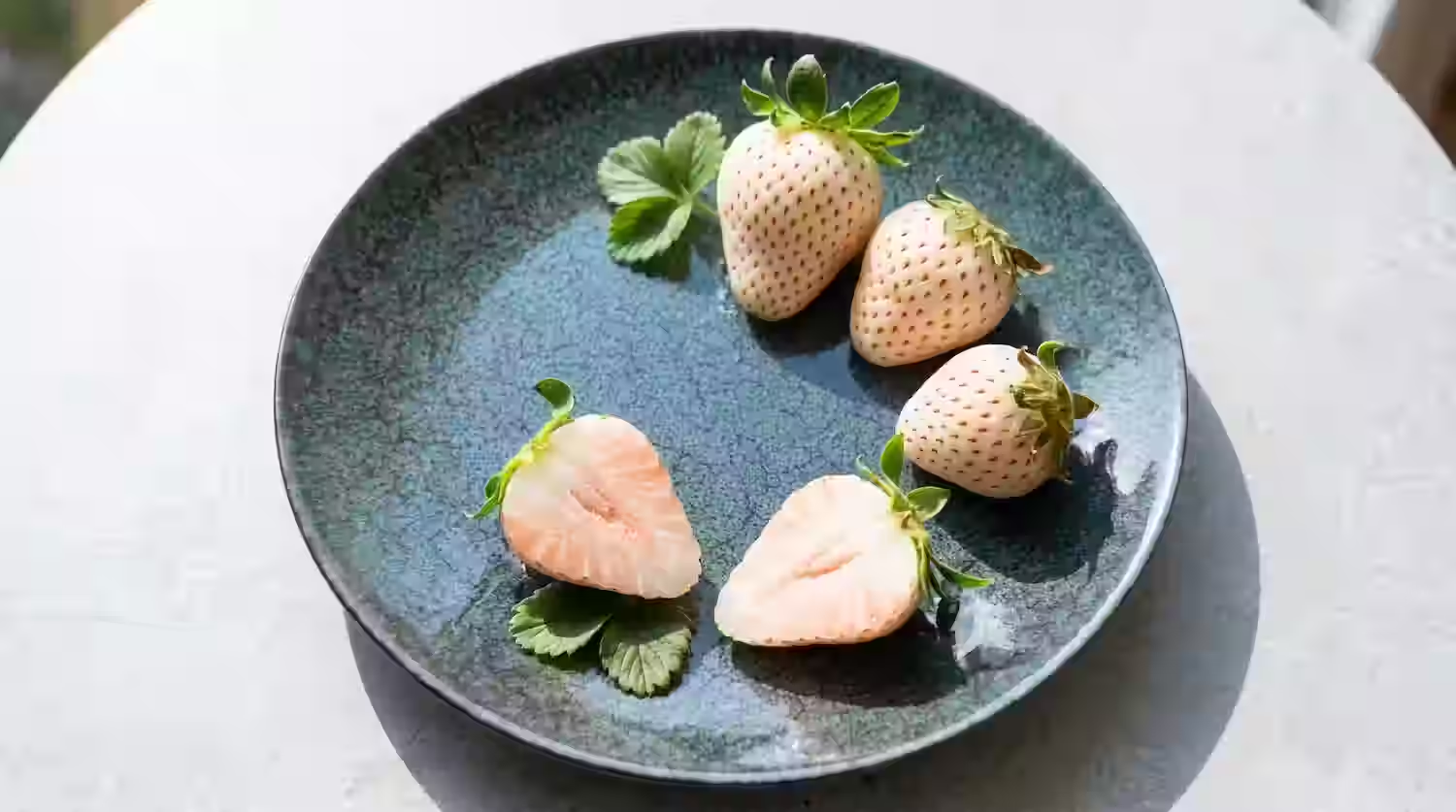


Imagine opening a Japanese fruit gift box and finding strawberries that look almost white instead of red, each one large and dotted with little red seeds. In Japan, people say those dots look like the red eyes of a white rabbit in the snow. That is the Yuki Usagi strawberry (雪うさぎ), a Japanese white strawberry from Karatsu in Saga Prefecture. Despite the name, ripe fruit is usually pinkish white rather than pure white.
It stands out for its size, its gentle sweetness, and a fruity aroma that sellers often compare to peach. Below, we combine Japan’s official plant variety record with local Saga reports, growers’ listings, and fruit guides, and we say which is which. This guide covers where it comes from, why it stays pale, how it tastes, when to find it, and how it compares with other white strawberries.
What Is Yuki Usagi Strawberry?
Yuki Usagi is a registered Japanese strawberry cultivar with pale, pinkish-white skin and white flesh. Japan registered it in 2014, and a small group of farmers grows it in Karatsu, Saga Prefecture. Its name means “snow rabbit.”
Quick Facts: Yuki Usagi Strawberry
- Japanese name
- 雪うさぎ (Yuki Usagi, “snow rabbit”)
- Status
- Registered cultivar; Yuki Usagi is its official variety name
- Registration
- Filed December 2011; registered November 18, 2014 (registration 23750)
- Where it grows
- Karatsu, Saga Prefecture, northern Kyushu
- Official traits
- Extremely large, conical, glossy; pinkish-white skin; white flesh and core
- Typical size
- About 35 g per berry, according to farm and fruit-guide reports
- Taste
- Sweet with low acidity; aroma often described as peach-like
- Season
- Winter through spring; timing varies by farm and year
- Growers
- A small group of farms in Karatsu, reported as five
Is Yuki Usagi a Variety or a Brand?
Unlike some Japanese strawberries, Yuki Usagi is the official variety name itself, not just a market name. Japan’s plant variety register lists it under exactly that name. So when you see “Yuki Usagi” on a box, you are reading the cultivar’s registered name.
Where the Name Comes From
Most accounts say the name describes the fruit itself. The pale berry suggests a white rabbit, and the red surface dots suggest its eyes. A fruit guide reports this explanation, and a 2018 farm report hints at it too. However, the official registry does not record the reason for the name, so treat it as the popular story rather than a documented fact.
One small note for English speakers. A “yuki usagi” is also a classic Japanese winter craft: a little rabbit shaped from snow, with red berries for eyes. If you search the term alone, you may find those first. Adding “strawberry” helps.
Where Does Yuki Usagi Come From?
Yuki Usagi comes from Karatsu, a coastal city in Saga Prefecture on Kyushu, Japan’s southwestern main island. A 2017 local report described it as grown only within Karatsu. The same area is also known for Yobuko squid, from the port of Yobuko.
How the Variety Was Developed
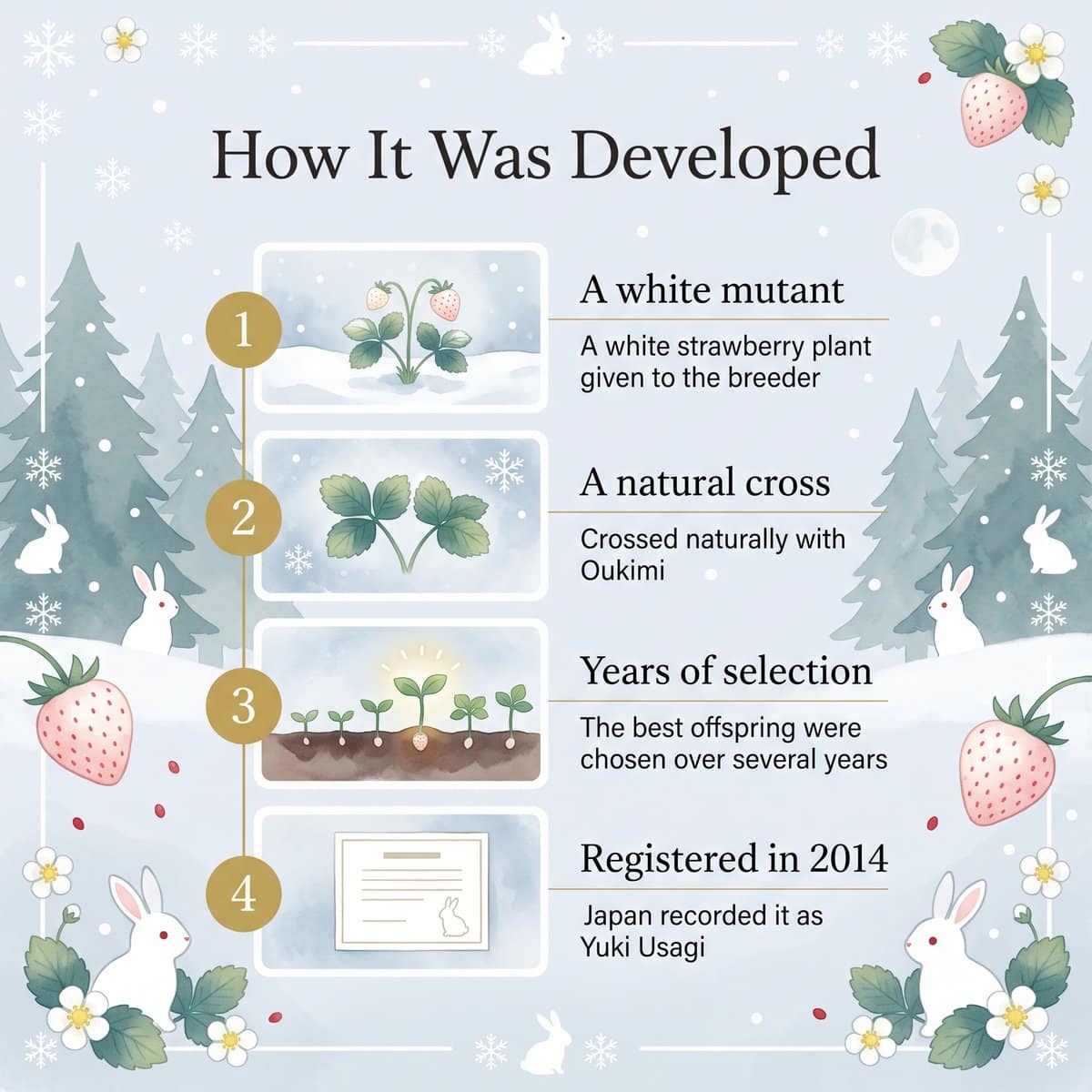
According to a Japanese fruit guide, Shigeo Ide (井手重夫) of Saga bred Yuki Usagi. The guide says it began with a white strawberry plant, a natural mutant, that an acquaintance gave him. Next, that plant crossed naturally with Oukimi, a commercially grown strawberry, and he selected the best offspring over several years.
Even so, the guide itself notes that the detailed history is unclear. This account comes from fruit reference sources rather than the official record, which does not describe the parents or method. Separately, a 2017 Saga news report says the variety was registered by the head of the Karatsu Snow Berry Association, the local growers’ group. So the broad story is consistent, but the fine details rest on secondary sources.
Registration Timeline
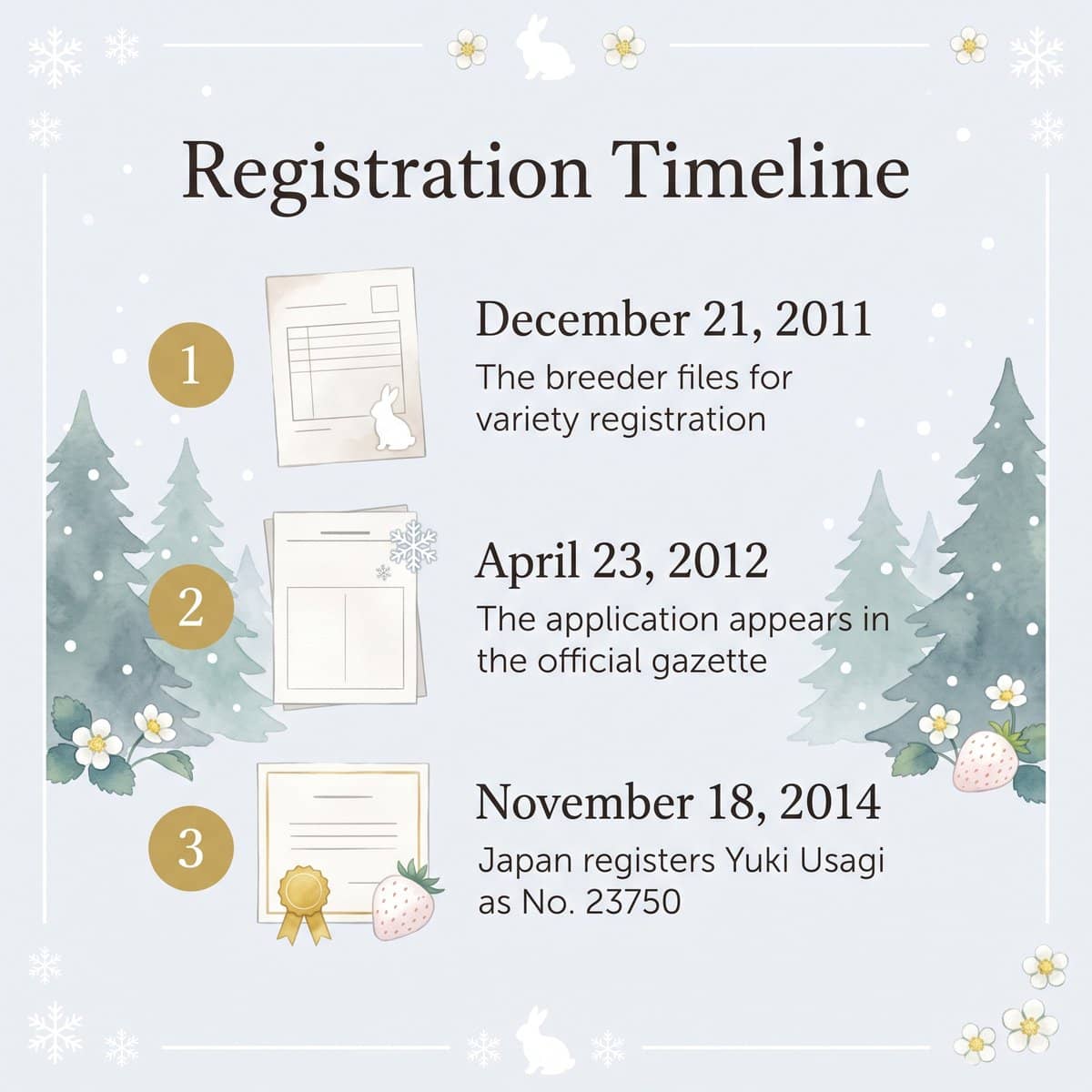
December 21, 2011
The breeder files for variety registration.
April 23, 2012
The application appears in the official gazette.
November 18, 2014
Japan registers Yuki Usagi as variety number 23750.
These are registry dates, not harvest or sales dates. In other words, they tell you when the variety gained legal protection, not when the first berry went on sale.
Why Does Yuki Usagi Stay Pale?
In short, Yuki Usagi stays pale because paleness is a trait of the cultivar, not because it is picked unripe. No published study appears to have measured its pigments. In strawberries generally, though, red color comes mainly from anthocyanin pigments, and paler fruit tends to have less of them.
What Science Says About Strawberry Color
A 2002 study of 20 Japanese strawberry cultivars, published by the Japanese Society for Horticultural Science, linked fruit color to total anthocyanin concentration. It also found pelargonidin 3-glucoside to be the main red pigment. That is general background only. Yuki Usagi was not tested, so we cannot say exactly how much pigment it holds.
Growing conditions may matter too. A 2018 report from one Karatsu farm noted that its greenhouse used UV-cut film to suit white strawberries. That is one farm’s practice, however. The main reason for the pale color is still the cultivar itself.
Pinkish-White Skin, White Flesh, and Red Achenes
Strictly speaking, the official record calls the skin “pinkish white,” not pure white. The flesh and core, on the other hand, are recorded as white. The red dots on the surface are achenes, small dry fruits that each hold a seed, though most people simply call them seeds.
Why Some Fruit Turns Pink in Spring
Later in the season, some berries take on a pale pink blush. The fruit guide says this happens more easily as the weather warms, and that such berries are also sold as “Sakura Ichigo,” or cherry-blossom strawberries. Ripeness and growing conditions may also play a part, so color varies from berry to berry.
What Does Yuki Usagi Taste Like?
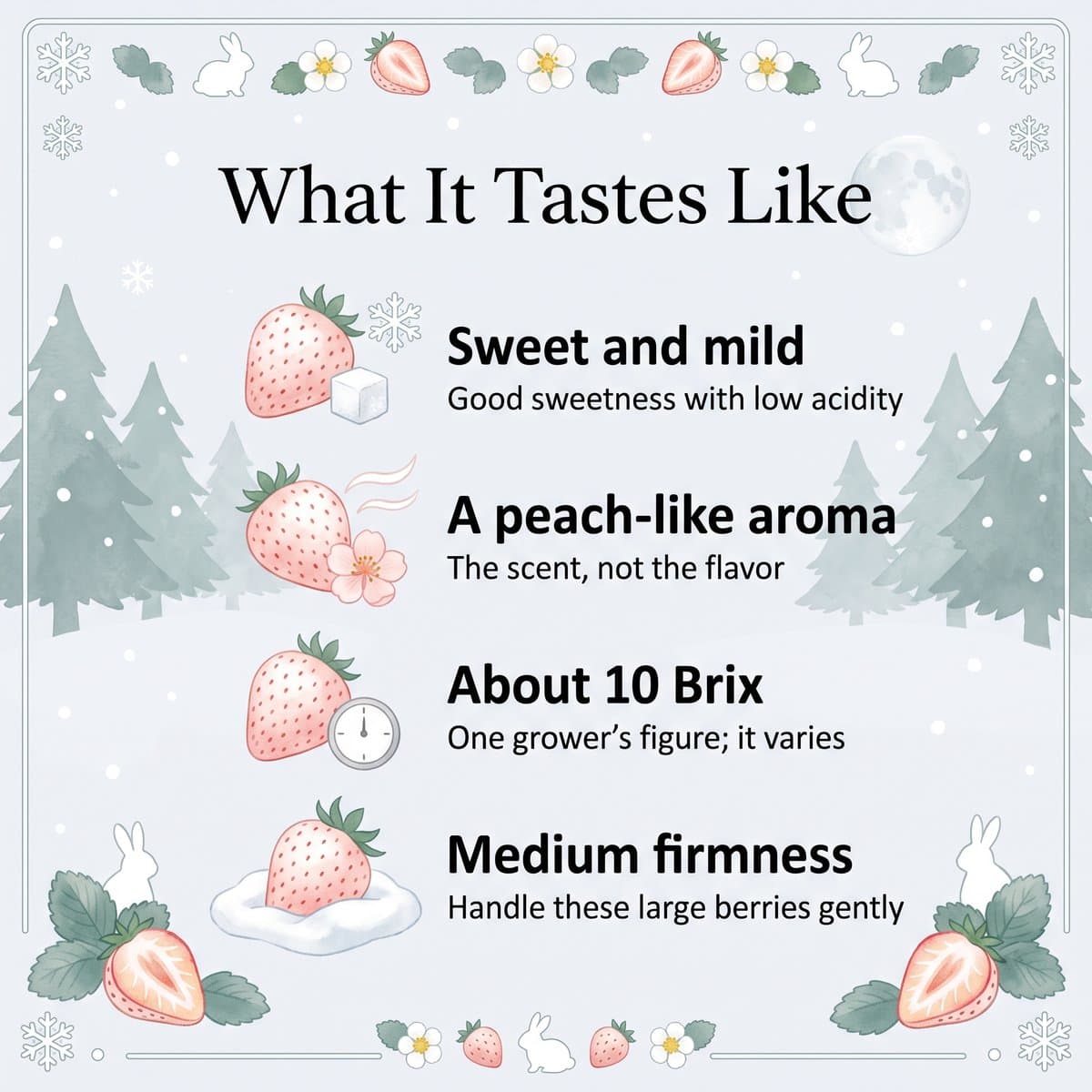
Yuki Usagi is generally described as a sweet, low-acid white strawberry with a fragrant aroma that sellers often compare to peach. Compared with most red strawberries, it comes across as milder and more aromatic rather than dramatically sweeter. Keep in mind that these are producer, retailer, and reviewer descriptions, because nobody has published a laboratory taste study.
Sweetness and Mild Acidity
The fruit guide describes good sweetness and low acidity. Similarly, one Karatsu grower’s hometown tax listing mentions a rich aroma, low sourness, and a clean, refreshing sweetness. Interestingly, the 2018 farm report spoke of a fine balance between sweetness and acidity instead. So expect a mild berry, but not a one-note sugary one.
What about numbers? One grower describes the sugar content as around 10 degrees Brix. That figure comes from a single farm, though, and sugar levels shift with harvest time and weather. We would not treat it as a fixed trait.
One Japanese food reference adds a useful reality check. Its writer measured 7.7 to 10.6 degrees Brix in berries they bought and noted that white strawberries generally lack the strong sweetness and aroma of red ones. Even so, the writer felt the sweet scent made the fruit taste sweeter than the numbers suggested.
A Peach-Like Aroma, Not a Peach Flavor
The “peach” comparison deserves a little care. Sellers use it to describe the scent, not to say the berry tastes like a peach. It still tastes like a strawberry, just a softer, more fragrant one. Honestly, that subtlety is part of the appeal.
Texture and Firmness
Japan’s variety register rates the fruit’s firmness as medium and its gloss as strong. Some fruit guides call the skin firm and good for shipping. Still, the official rating is medium, so handle these large berries gently.
How Big Is a Yuki Usagi Strawberry?
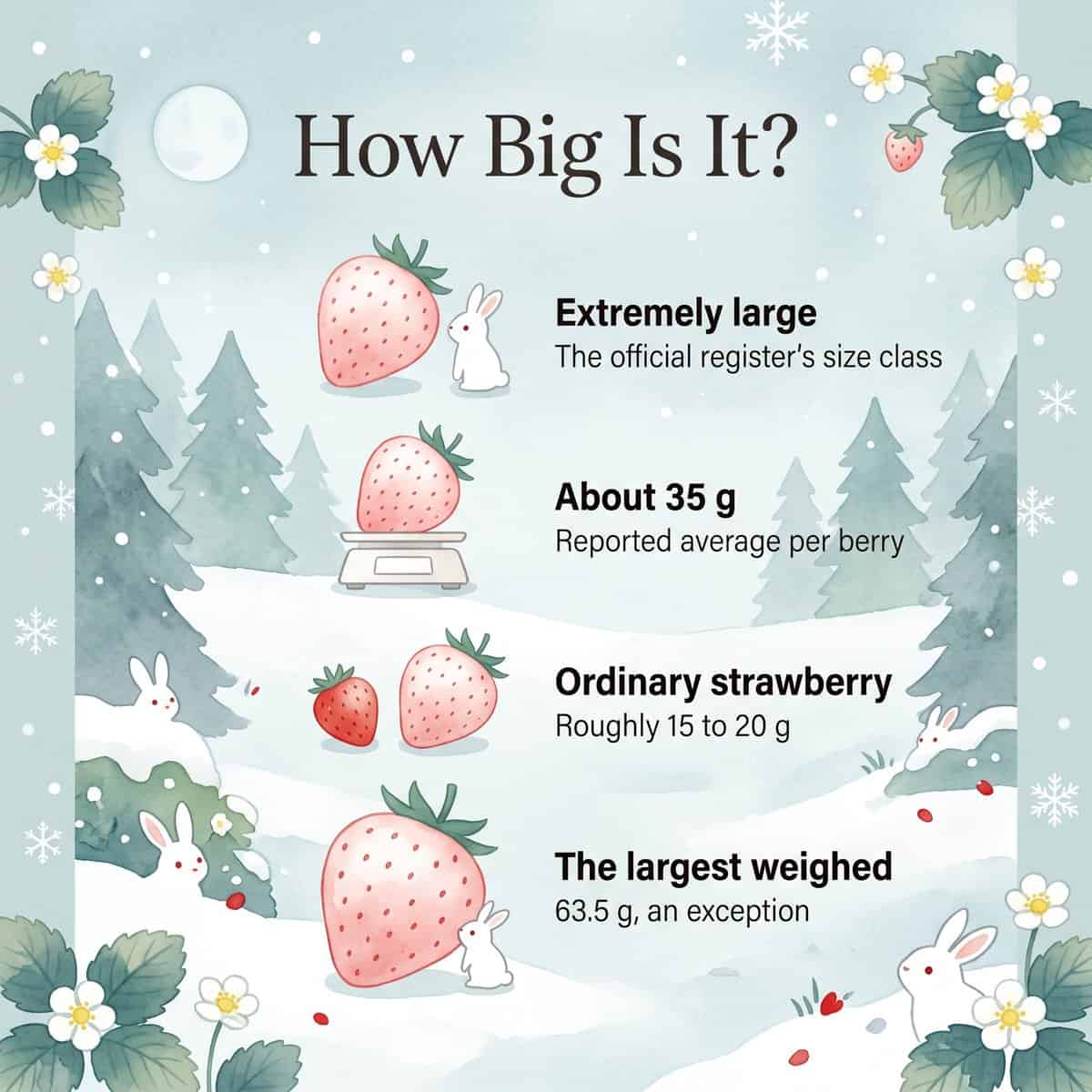
Very big, at least by strawberry standards. The official register classes the fruit size as “extremely large,” and it lists that size as one trait that sets Yuki Usagi apart from Wada Hatsukoi, an older white strawberry.
For an actual figure, the 2018 farm report and the fruit guide both give an average of about 35 g per berry. The farm report compared that with roughly 15 to 20 g for an ordinary strawberry. Sizes vary by grade, farm, and harvest, though, so not every berry in a box will match. The largest berry one food writer weighed came to 63.5 g, which is an exception rather than the norm.
When Is Yuki Usagi Strawberry in Season?
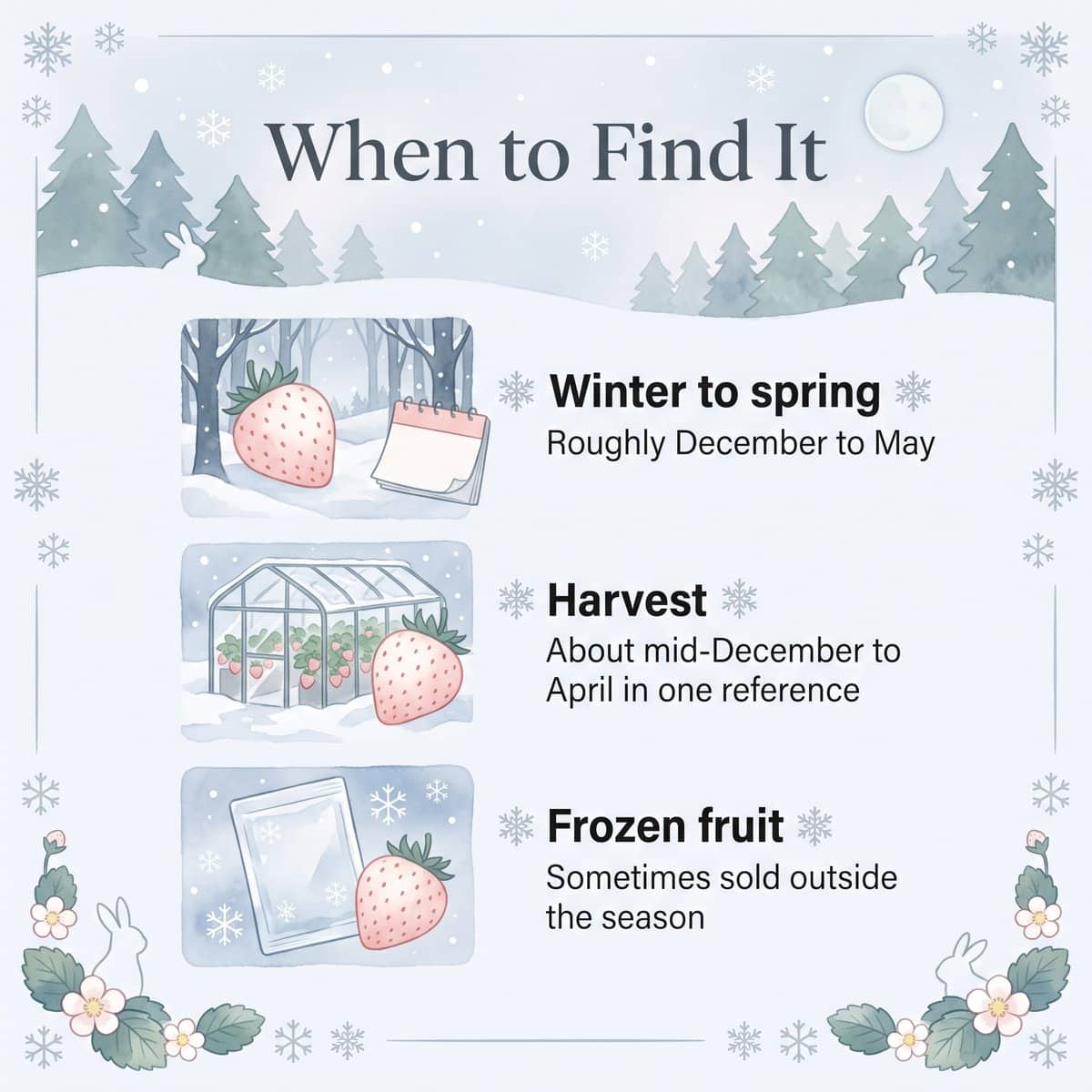
Yuki Usagi is generally available from winter through spring. The fruit guide gives roughly December to May, while another food reference says harvest runs from about mid-December to April. Exact shipping windows differ by farm and year, and some sellers ship only in a shorter part of that period.
Outside the season, you may still find frozen Yuki Usagi. For instance, one Karatsu farm offers a 2 kg frozen pack through the hometown tax system. It includes uneven sizes and some cut berries, so it suits smoothies or desserts rather than gifts.
How to Choose and Store Yuki Usagi Strawberries
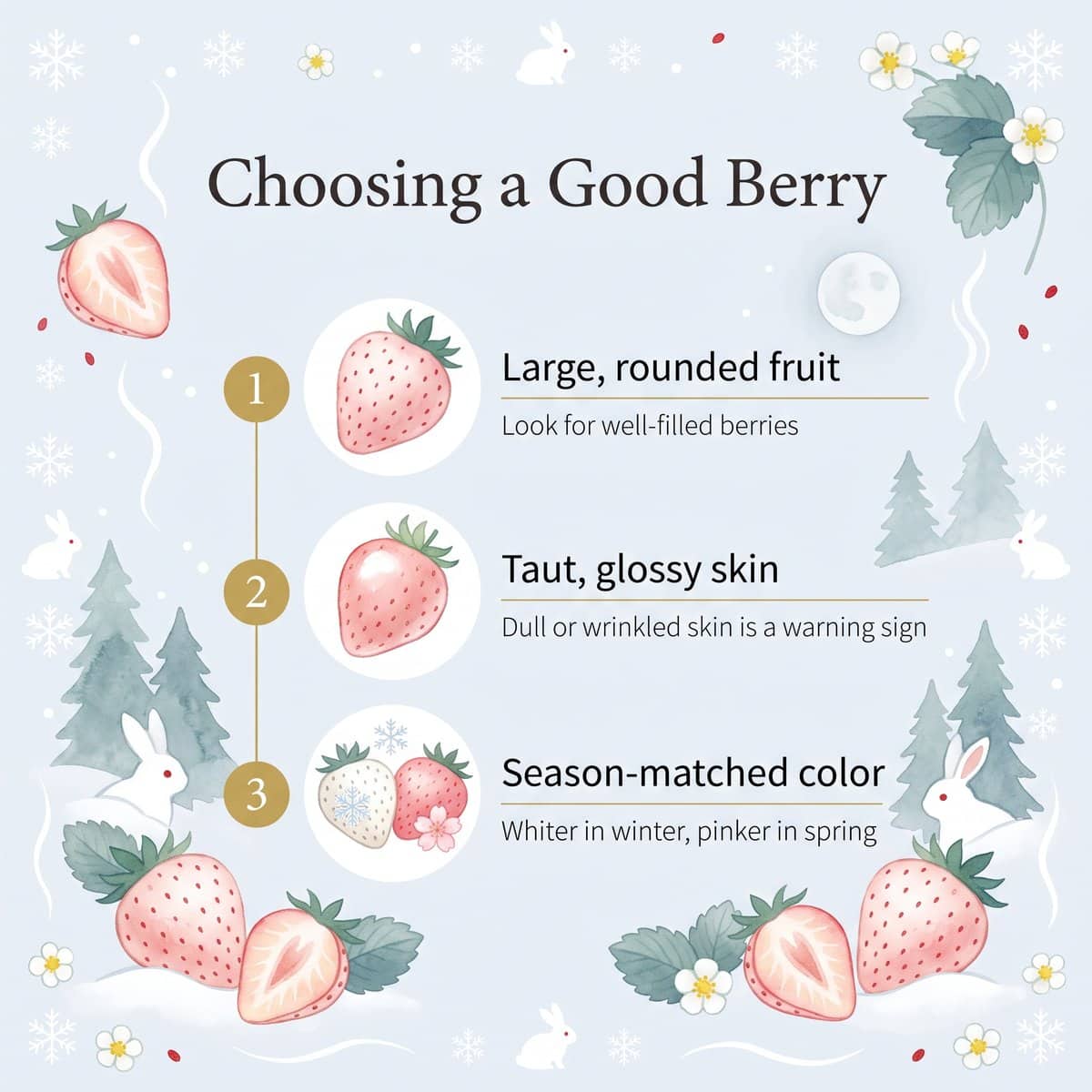
Since Yuki Usagi never turns fully red, you need other clues. The fruit guide suggests a few simple checks.
- Large, rounded fruit. Look for well-filled berries with a full shape.
- Taut, glossy skin. The register notes strong gloss, so dull or wrinkled skin is a warning sign.
- Color that fits the season. Expect whiter skin in cold months and a pinker tone as spring arrives.
In practice, sellers offer most Yuki Usagi in gift boxes, so you may not get to choose individual berries. For a sense of scale, one food writer’s box held nine berries weighing over 450 g in total.
Storage Tips
The fruit guide recommends keeping the berries in their cushioned pack, placing the pack in a plastic bag, and storing it in the fridge’s vegetable drawer. Even though they keep fairly well, eat them soon after buying. Rinse them gently just before serving, and always follow the grower’s own label if it gives different advice.
How to Eat Yuki Usagi Strawberry
Above all, fresh and simple is best. A large, gently sweet berry like this is easy to overwhelm, so heavy cream or sweet sauces can hide its aroma. Instead, serve it chilled on its own, perhaps sliced to show the white flesh inside.
For a celebration, pair it with a red strawberry. In Japan, red and white together, called kohaku, signal good fortune and appear at weddings and New Year. Japanese confectioners have used it too. In 2017, for example, Tirol Choco released a white strawberry chocolate made with Yuki Usagi from Karatsu. According to the grower interviewed, it gave a use to berries too misshapen or marked to sell fresh.
How Is Yuki Usagi Different From Ordinary Red Strawberries?
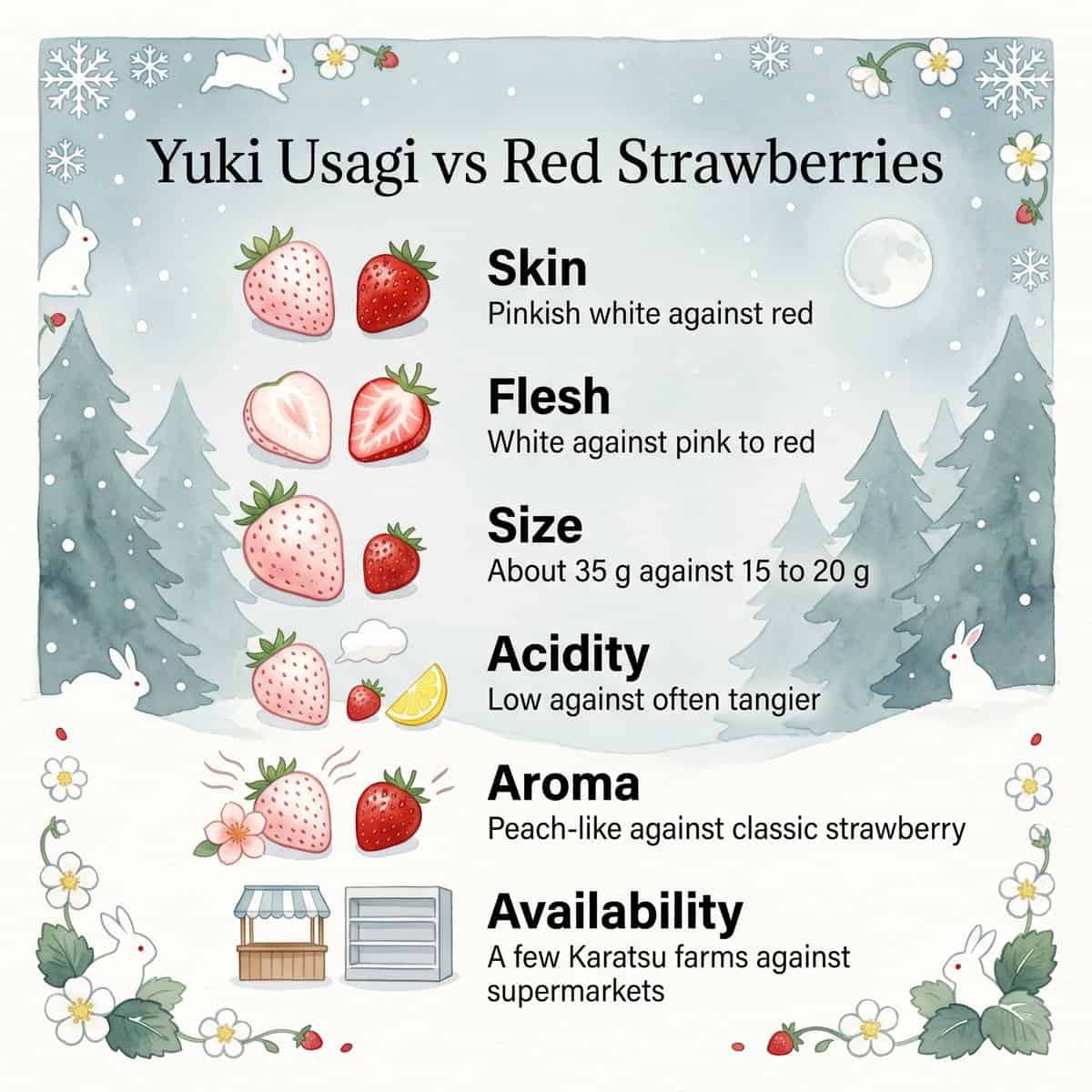
The short answer: it is paler, larger, gentler, and much harder to find. The table sums up the main differences, using the sources noted in this guide.
| Feature | Yuki Usagi | Typical red strawberry |
|---|---|---|
| Skin color | Pinkish white (official record) | Red |
| Flesh | White (official record) | Varies, often pink to red |
| Size | About 35 g average (farm reports) | About 15 to 20 g, per the same 2018 report |
| Acidity | Low, per growers and sellers | Varies; many are tangier |
| Aroma | Often compared to peach | Classic strawberry scent |
| Availability | A few farms in Karatsu; mostly gift boxes | Widely sold in supermarkets |
Are White Strawberries Genetically Modified?
No public source indicates that Yuki Usagi is genetically modified. Fruit guides describe it as the result of natural crossing and selection, starting from a white mutant plant. The official registry does not describe the breeding method, though, so that account rests on secondary sources.
Why Is Yuki Usagi So Rare and Expensive?
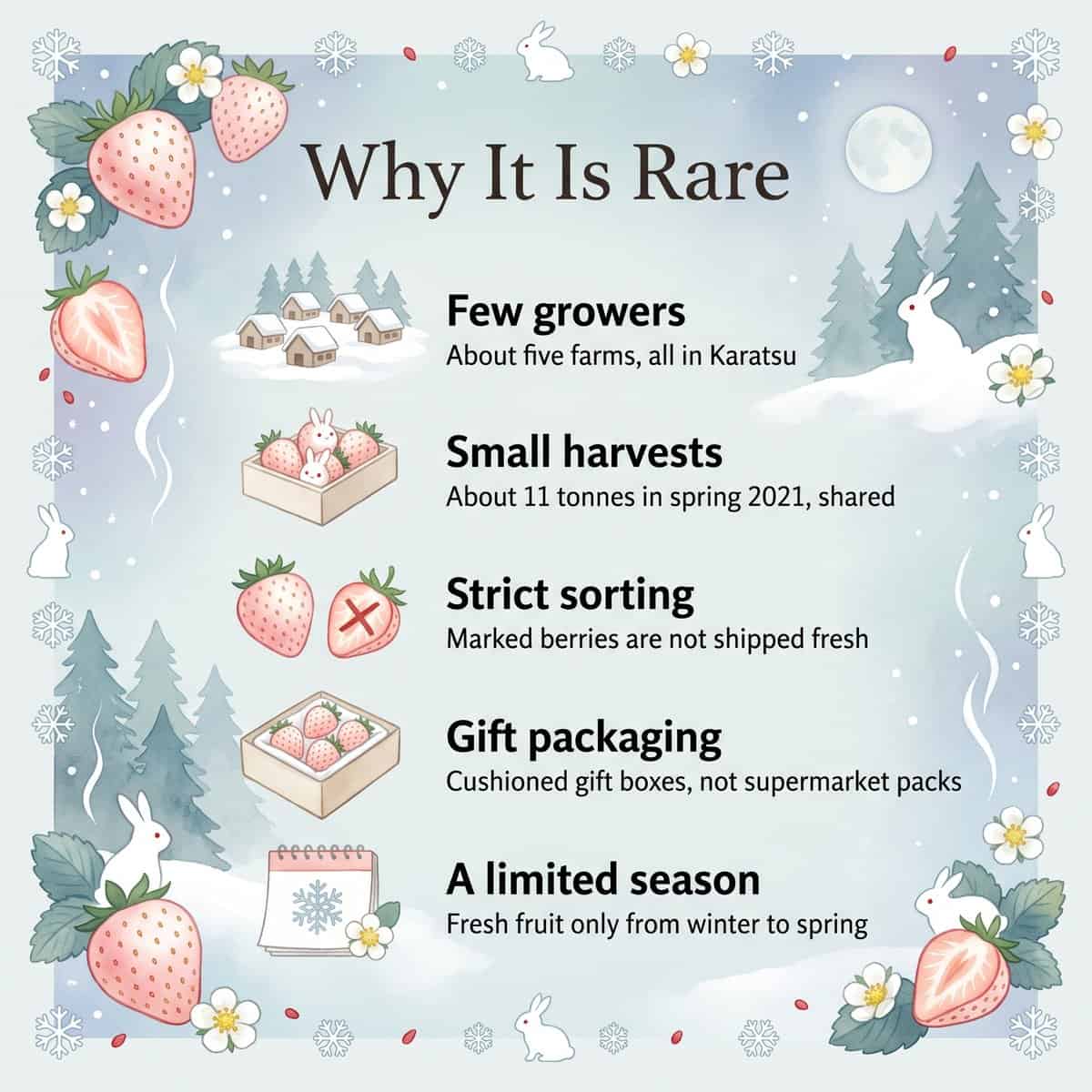
In short, very few farms grow it. Local media and grower sources have reported about five participating farms in recent years. A 2018 farm report named five farms in the Karatsu Snow Berry Association, a food reference gave the same number as of 2021, and a grower’s current listing still says five. The number may change, though.
Volumes are small, too. The same food reference says the association produced about 11 tonnes in spring 2021, and that figure includes Tenshi no Mi, another white strawberry it grows.
Put together, several factors keep supply tight and prices high.
- Few growers. Reports describe about five farms, all in Karatsu.
- Small harvests. One reference puts the association’s 2021 spring output at about 11 tonnes, shared with another variety.
- Strict sorting. A grower said misshapen or marked berries cannot be shipped fresh.
- Gift packaging. Most fruit is sold in cushioned gift boxes rather than supermarket packs.
- A limited season. Fresh fruit is available only from winter to spring.
Limited Production and Careful Growing
The farm visited in 2018 grew about 6,500 white strawberry plants in a 1,000-square-meter greenhouse. One current grower also describes mountain greenhouses, spring water for irrigation, and Saga’s special cultivation program with reduced pesticides and chemical fertilizers. These are individual farm practices, not rules for every grower. Still, they show how much care goes into a small harvest.
How Much Does It Cost?
Fresh Yuki Usagi sells mainly in premium gift boxes, and prices change by season, grade, and seller. We could not verify a current fresh-fruit price, so we have not listed a typical one. As one verified example, checked in October 2026, a Karatsu farm’s 2 kg frozen pack was offered for a ¥16,000 hometown tax donation. That is a donation amount, not a shop price, and frozen fruit differs from fresh gift boxes.
Why pay so much for a strawberry? In Japan, premium fruit is a common gift for thanks, visits, and seasonal greetings, so appearance and packing matter. Famous red berries such as Amaou follow the same gift-fruit logic.
Yuki Usagi vs Other Japanese White Strawberries
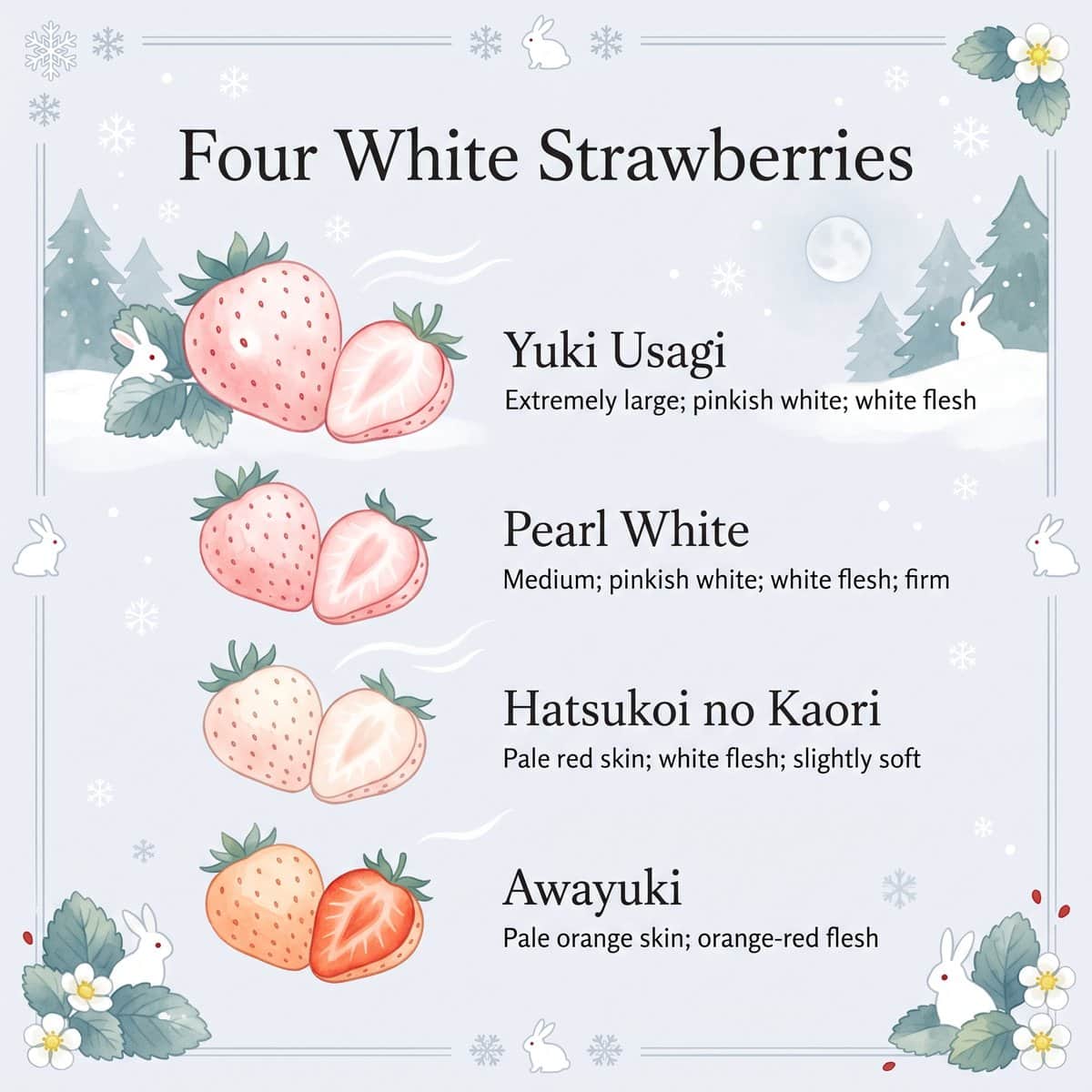
Japan’s variety register describes each cultivar using the same system. That makes it a fair way to compare pale strawberries side by side.
| Cultivar | Registered | Size | Skin | Flesh | Firmness |
|---|---|---|---|---|---|
| Yuki Usagi | 2014 | Extremely large | Pinkish white | White | Medium |
| Pearl White (Iroha-001) | 2015 | Medium | Pinkish white | White | Firm |
| Hatsukoi no Kaori (Wada Hatsukoi) | 2009 | Not compared here | Pale red | White | Slightly soft |
| Awayuki | 2013 | Slightly large | Pale orange | Orange-red | Slightly firm |
Real fruit varies with ripeness and light, so treat the table as a starting point. Also, no study has compared these berries’ sweetness or aroma under the same conditions. For that reason, we do not rank them.
Yuki Usagi vs Hatsukoi no Kaori
Hatsukoi no Kaori is the trade name of Wada Hatsukoi, an older white strawberry registered in 2009. In fact, the register used it as the comparison variety when approving Yuki Usagi. The key difference it noted was size: Yuki Usagi’s fruit is extremely large.
Yuki Usagi vs Awayuki and Pearl White
On paper, Awayuki is quite different, with pale orange skin and orange-red flesh. Pearl White, from Nara, shares Yuki Usagi’s pinkish-white skin and white flesh, but its fruit is medium-sized and firmer. As for Tenshi no Mi and other names you may see online, we could not confirm their registry details, so we left them out.
Where Can You Buy Yuki Usagi Strawberries?
Within Japan, the main routes are grower sales, online fruit retailers, and hometown tax gifts from Karatsu. Because volumes are small and most fruit goes into gift boxes, it is unlikely to be a regular item at ordinary supermarkets. Because volumes are small, stock sells out and changes every season. Check current listings rather than relying on old store lists. We could not confirm specific shops in Karatsu that stock it every season, so if you are visiting, ask locally or check growers’ own pages first.
Can Yuki Usagi Be Shipped Overseas?
Possibly, but it depends on the seller and the destination. In 2018, a Karatsu farm said the berries had reached markets such as Hong Kong and Singapore. Fresh strawberries, however, must meet each country’s plant-quarantine and pesticide-residue rules. Japan’s agricultural research agency, NARO, stresses checking the importing country’s latest rules before any export.
Plants, however, are a separate matter. Japan’s variety register shows an export restriction for Yuki Usagi, which concerns plants and other propagating material, not the fruit you eat. Likewise, the agriculture ministry warns that growing a registered variety’s plants without the rights holder’s permission infringes breeder’s rights. Seeds sold online cannot reliably reproduce the registered cultivar, so do not assume they will produce authentic Yuki Usagi fruit.
Common Misconceptions About Yuki Usagi
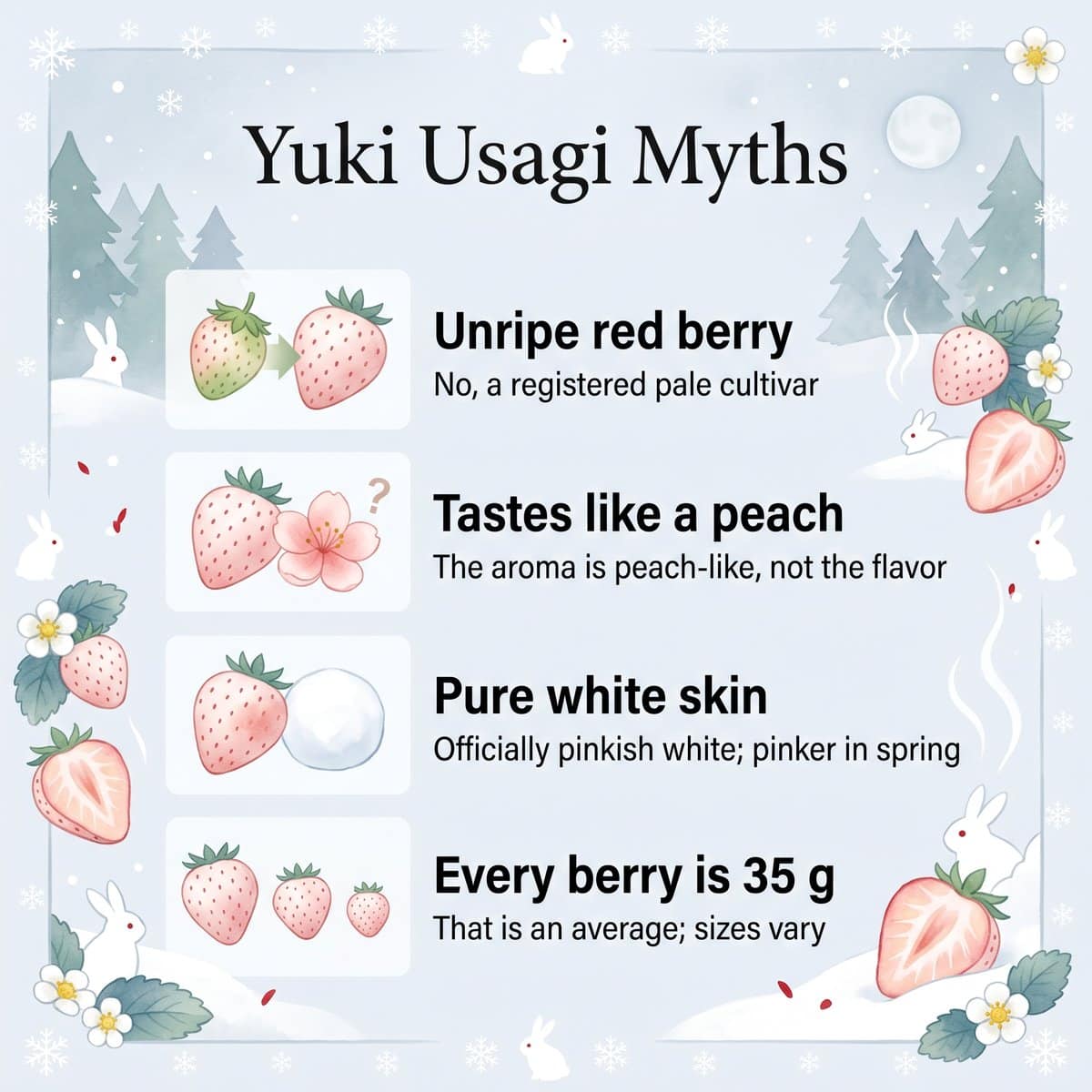
Myth: It is an unripe red strawberry.
Fact: It is a registered pale-fruited cultivar with white flesh.
Myth: It tastes like a peach.
Fact: Sellers compare its aroma to peach; it still tastes like a strawberry.
Myth: Its skin is pure white.
Fact: The official record calls it pinkish white, and it can turn pinker in spring.
Myth: Every berry weighs 35 g.
Fact: About 35 g is a reported average; sizes vary by grade and harvest.
Final Thoughts on Yuki Usagi Strawberry
Yuki Usagi is a small Karatsu story. A handful of farms grow a registered white cultivar with extremely large fruit, white flesh, and red “rabbit eye” seeds. Its gentle sweetness and peach-like aroma set it apart from tart red berries, while its size sets it apart from most other white strawberries.
If you are in Kyushu between winter and spring, look for it alongside a red strawberry and taste the two together. While you are in Saga, it is also worth exploring Saga beef and the prefecture’s sake.
Frequently Asked Questions About Yuki Usagi Strawberry
The Variety and Its Taste
- What is Yuki Usagi strawberry?
-
Yuki Usagi is a Japanese white strawberry grown in Karatsu, Saga Prefecture. Japan registered it as a cultivar in 2014. The fruit is extremely large, with pinkish-white skin, white flesh, and red seeds.
- Is Yuki Usagi naturally white?
-
Yes, its pale color is a trait of the registered cultivar, not a sign of unripe fruit. However, no published study has measured its pigments. Some fruit also turns pale pink later in the season.
- Is Yuki Usagi a cultivar or a brand name?
-
It is a cultivar. Japan’s plant variety register lists it under the name Yuki Usagi, registration number 23750. Some later-season berries with a pink blush are also sold as Sakura Ichigo.
- Does Yuki Usagi taste like peach?
-
Not exactly. Sellers compare its aroma to peach, but the flavor is still a strawberry’s. Expect gentle sweetness and low acidity.
- Are white strawberries sweeter than red strawberries?
-
Not necessarily. Yuki Usagi is described as milder and lower in acid rather than much sweeter. One food writer measured 7.7 to 10.6 degrees Brix, yet felt its sweet aroma made it taste sweeter.
- Is Yuki Usagi genetically modified?
-
We found no evidence that Yuki Usagi was developed using genetic modification. Available sources describe it as a conventionally bred cultivar, the result of natural crossing and selection, registered in Japan in 2014. However, the official registration record does not specifically discuss breeding methods or genetic engineering.
Season, Buying, and Shipping
- When is Yuki Usagi in season?
-
Generally from winter through spring. A fruit guide gives roughly December to May, but shipping windows vary by farm and year. Frozen berries are sometimes available outside the season.
- How should Yuki Usagi strawberries be stored?
-
Keep them refrigerated in their cushioned pack, inside a plastic bag. Rinse them gently just before eating. Eat them soon, and follow the grower’s label if it says otherwise.
- Can fresh Yuki Usagi strawberries be shipped overseas?
-
It depends on the seller and the destination’s quarantine and pesticide rules. Some fruit has reached overseas markets in the past. Exporting plants is a separate matter, and the registry restricts it.
References
Official and Government Sources
- Ministry of Agriculture, Forestry and Fisheries (MAFF) – Plant Variety Registration Database: Yuki Usagi (Accessed October 2026)
- Ministry of Agriculture, Forestry and Fisheries (MAFF) – Plant Variety Registration Database: Iroha-001 (Pearl White) (Accessed October 2026)
- National Agriculture and Food Research Organization (NARO) – Pest Control Manual for Exporting Fresh Strawberries (Accessed October 2026)
- Ministry of Agriculture, Forestry and Fisheries (MAFF) – Plant Variety Registration Database: Awayuki (Accessed October 2026)
- Ministry of Agriculture, Forestry and Fisheries (MAFF) – Is That Seed Really Safe? On Breeder’s Rights Infringement (Accessed October 2026)
- Ministry of Agriculture, Forestry and Fisheries (MAFF) – Plant Variety Registration Database: Wada Hatsukoi (Accessed October 2026)
Producer, Media, and Guide Sources
- Kudamono Navi – Yuki Usagi Strawberry (Accessed October 2026)
- EDITORS SAGA – A Visit to the Yuki Usagi Harvest in Karatsu, January 2018 (Accessed October 2026)
- EDITORS SAGA – Chocolate Made with Karatsu’s Yuki Usagi Goes on Sale, December 2017 (Accessed October 2026)
- Foodslink Food Encyclopedia – Yuki Usagi White Strawberry (Accessed October 2026)
- Furusato Choice – Karatsu City Frozen Yuki Usagi, 2 kg (Accessed October 2026)
- Pocket Marche – Yamanaka Farm Producer Profile, Karatsu (Accessed October 2026)
Academic Research
- J-STAGE – Yoshida, Y., Koyama, N., & Tamura, H. (2002). Color and Anthocyanin Composition of Strawberry Fruit: Changes during Fruit Development and Differences among Cultivars. Journal of the Japanese Society for Horticultural Science, 71(3), 355–361 (Accessed October 2026)
Related Articles
- Hatsukoi no Kaori (初恋の香り) (Surveyed: October 2026)
- Awayuki Strawberries (淡雪いちご) (Surveyed: October 2026)
- Amaou Strawberry(あまおう): Japan’s King of Fruits (Surveyed: October 2026)
- Yobuko Ika (呼子イカ) (Surveyed: October 2026)
- Saga Beef (佐賀牛) (Surveyed: October 2026)
- Saga sake (佐賀の酒) (Surveyed: October 2026)






Comments