


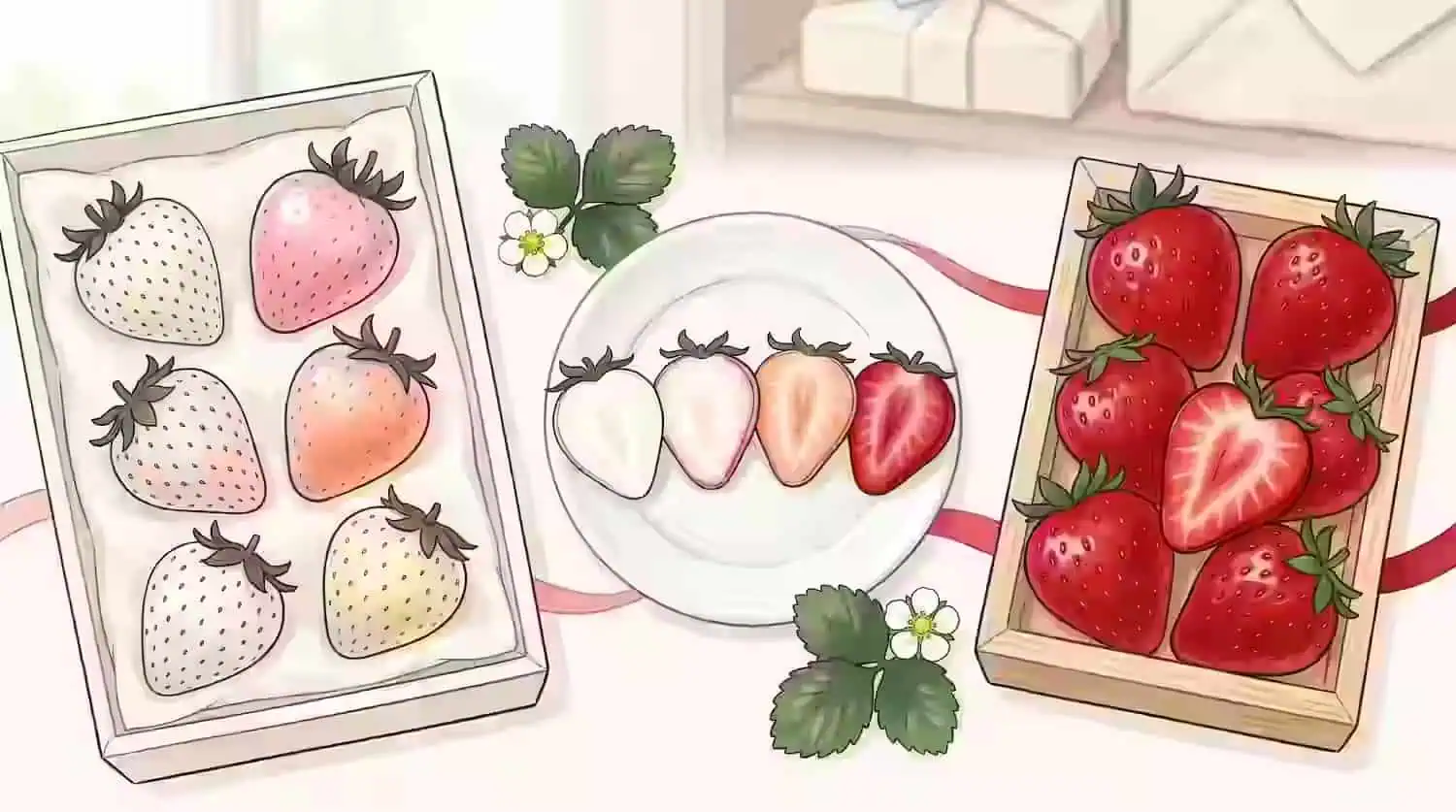

Walk into a Tokyo department store food hall in February, and the fruit counter can look more like a jewelry case. Glossy red berries sit in neat rows beside strawberries so pale they look almost unripe. Some shops even sell them one at a time. Breeders develop Japanese strawberries for sweetness, aroma and looks, and those pale berries are not unripe at all.
Short on time? For a first white strawberry, Awayuki is a sensible pick, while Hatsukoi no Kaori suits aroma lovers. On the red side, Amaou and Tochiaika are easy places to start. Below, we compare five white varieties and two red favorites, then cover strawberry season in Japan, prices and where to buy them in Tokyo. Along the way, we flag what official records confirm and what is simply marketing.
What Makes Japanese Strawberries Special?
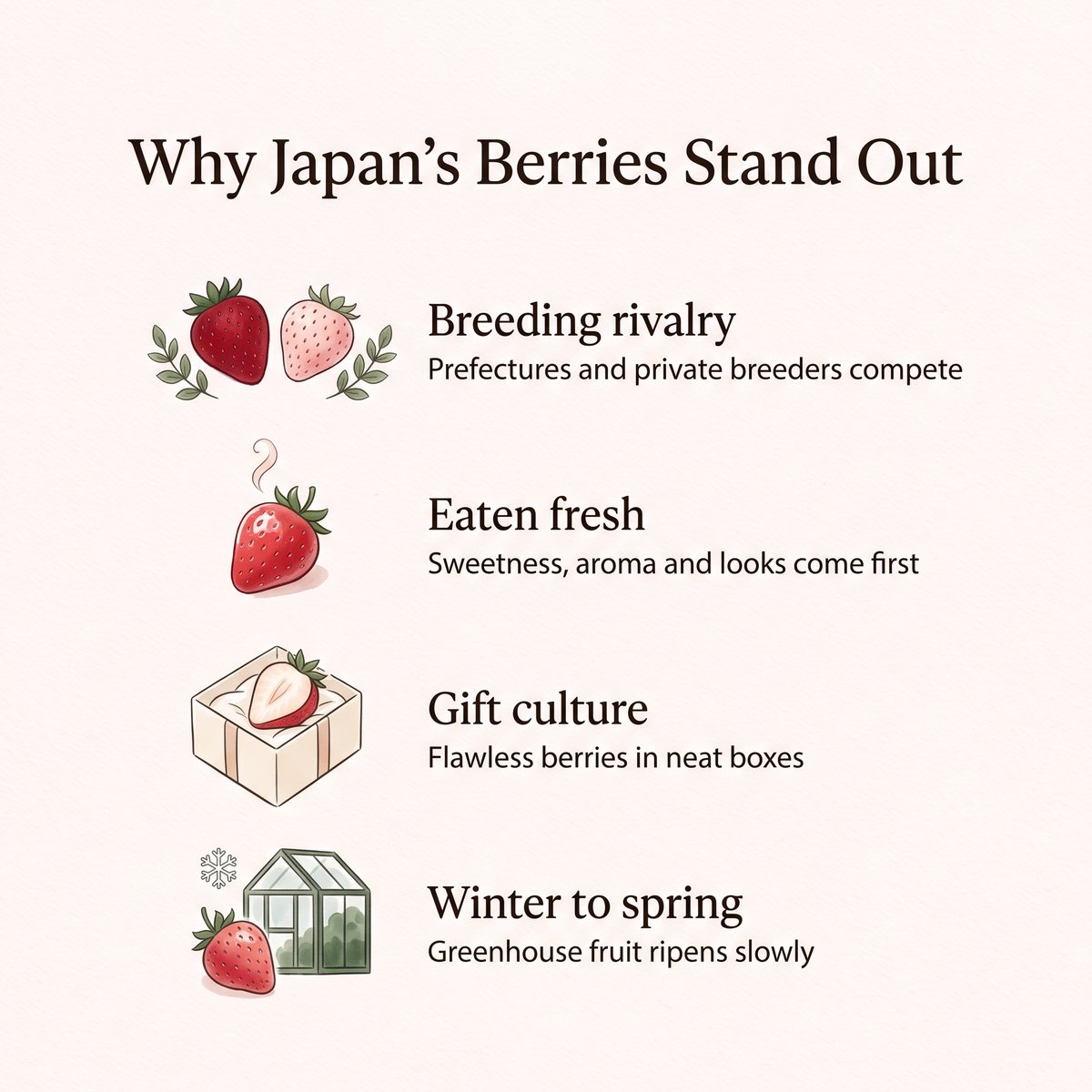
Japanese strawberries stand out because prefectures and private breeders compete hard to create new varieties. Breeders aim them mainly at eating fresh. As a result, size, sweetness, aroma and appearance matter as much as yield. Shops sell most of them from winter to spring, when greenhouse fruit ripens slowly.
Quick Facts: Japanese Strawberries
- Main season
- December to May; Tokyo market arrivals peak around March
- Top producers
- Tochigi and Fukuoka shipped the most strawberries in 2021
- White varieties here
- Hatsukoi no Kaori, Pearl White, Awayuki, Yuki Usagi, Milky Berry
- Red varieties here
- Amaou (Fukuoka) and Tochiaika (Tochigi)
- Why white berries stay pale
- Much less red pigment, not unripeness
- Brand vs cultivar
- Many famous names are trademarks; the registered name can differ
- Where to buy in Tokyo
- Depachika fruit counters, specialty fruit shops and supermarkets
- Taking them abroad
- Depends on your destination’s plant-quarantine rules
Flavor, Looks and Japan’s Gift-Fruit Culture
In Japan, fruit often works as a gift. For example, people bring it on hospital visits, send it as seasonal thanks and buy it for celebrations. Naturally, that habit rewards berries that look flawless in a box. Meanwhile, prefectures keep breeding their own varieties. Tochigi, for instance, began breeding strawberries for its own climate in 1969, its experiment station reported in 1985.
Today, in fact, the competition feels almost like sport. Fukuoka has Amaou, Tochigi has Tochiaika, and Niigata keeps its soft, juicy Echigo hime mostly at home. According to ALIC, a government agricultural agency, Tochigi shipped 22,900 tonnes in 2021. Fukuoka followed with 15,800 tonnes, the second-highest total in Japan. So each name on a label tells you something about place, a bit like reading a wine list.
When Is Strawberry Season in Japan?
Strawberry season in Japan runs mainly from December to May. In Tokyo’s central wholesale market, Tochigi berries start arriving in November. Then, in December, Fukuoka, Ibaraki, Shizuoka and Saga join in and volume jumps. Arrivals then peak around March and continue into May, ALIC reports. After that, supply drops sharply until autumn.
Strawberry Supply in Tokyo, Month by Month
Based on Tokyo Central Wholesale Market arrivals in 2021, as summarized by ALIC. Individual varieties and farms differ.
Still, that timing surprises some visitors. Until the 1960s, Japan’s strawberry season ran around May and June, ALIC notes. Greenhouse growing later moved the harvest toward Christmas and New Year demand, however. Want a strawberry in midsummer? A few everbearing cultivars fill the gap, such as Nagano’s Saika strawberry.
Why Japanese Strawberries Can Be Expensive
Price reflects labor as much as rarity. First, growers usually pick by hand and sort by size and shape. Then they often pack premium fruit so berries never touch. For example, Nara Ichigo Lab, a group of five growers, relies on strict sorting and shock-absorbing packaging. MAFF’s Kinki office described that approach in a 2024 report. In addition, gift grades cost more around Christmas and New Year, when demand spikes.
What Are Japanese White Strawberries?
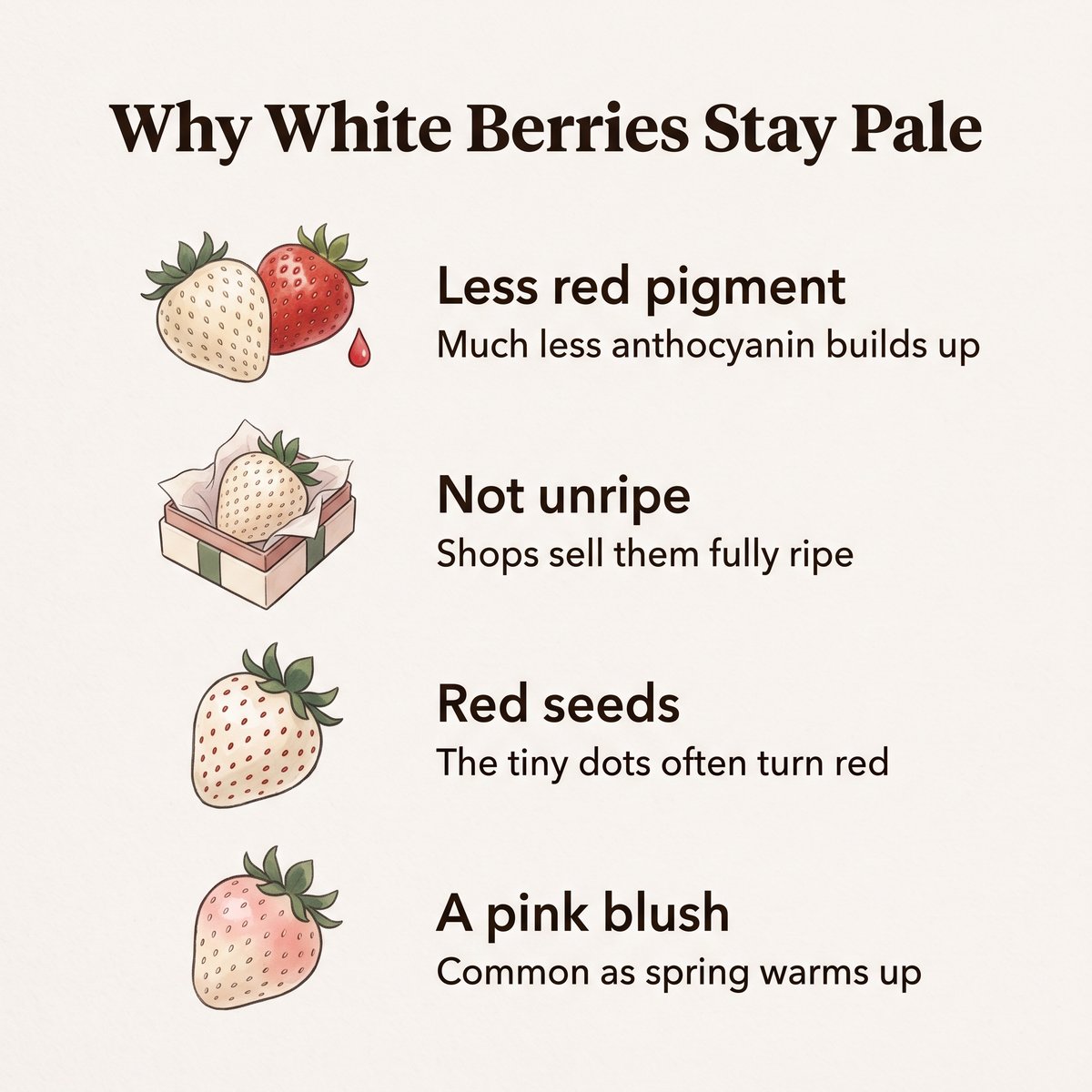
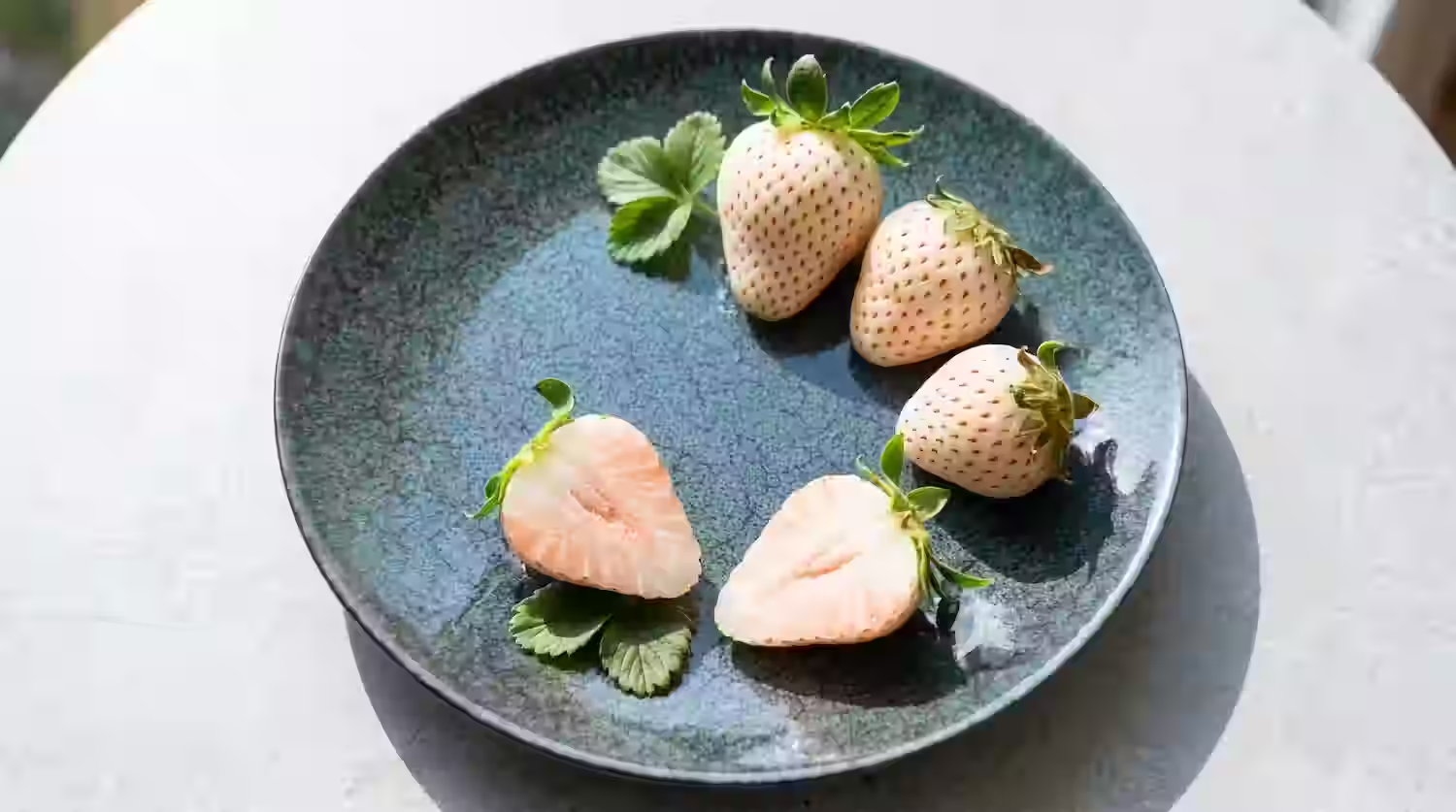
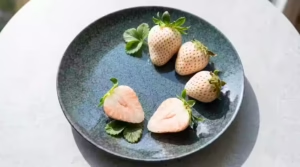
Japanese white strawberries are specially bred cultivars that ripen white, cream or pale pink rather than red. Their tiny achenes, the seed-like dots on the surface, often turn red. As a result, the contrast creates a striking speckled look. Importantly, shops sell them fully ripe.
Why White Strawberries Stay Pale
White strawberries stay pale because they build up much less anthocyanin, the red pigment in ordinary strawberries. In a 2020 study, Tochigi’s agricultural experiment station found that skin color tracked anthocyanin content closely. One pigment, pelargonidin 3-glucoside, made up about 82.9 percent of the total in the berries it tested. Similarly, red cultivars look pale before they color up. White cultivars, by contrast, stay light because they accumulate much less pigment at maturity.
Does that mean zero pigment? Not quite, because the line is blurry. Many white berries still show a pink blush, especially as spring warms up. Honestly, “white” works best as a loose market label rather than a strict color. That study also looked at research populations, not these exact five varieties, so it explains the general idea only.
Do White Strawberries Taste Different From Red Ones?
Usually, yes, but less than their looks suggest. White strawberries still taste like strawberries. However, many have lower acidity, so they often seem milder and gentler. Sellers sometimes compare their aroma to peach, as with Yuki Usagi.
Are they sweeter, then? Not always in sugar terms. Tochigi’s trials, for instance, found Milky Berry’s sugar level similar to the red Tochiotome. Its acidity, though, ran lower, so the sugar-acid ratio came out higher. That ratio, rather than sugar alone, explains why many white berries taste softer and sweeter.
Brand Names vs Registered Cultivar Names
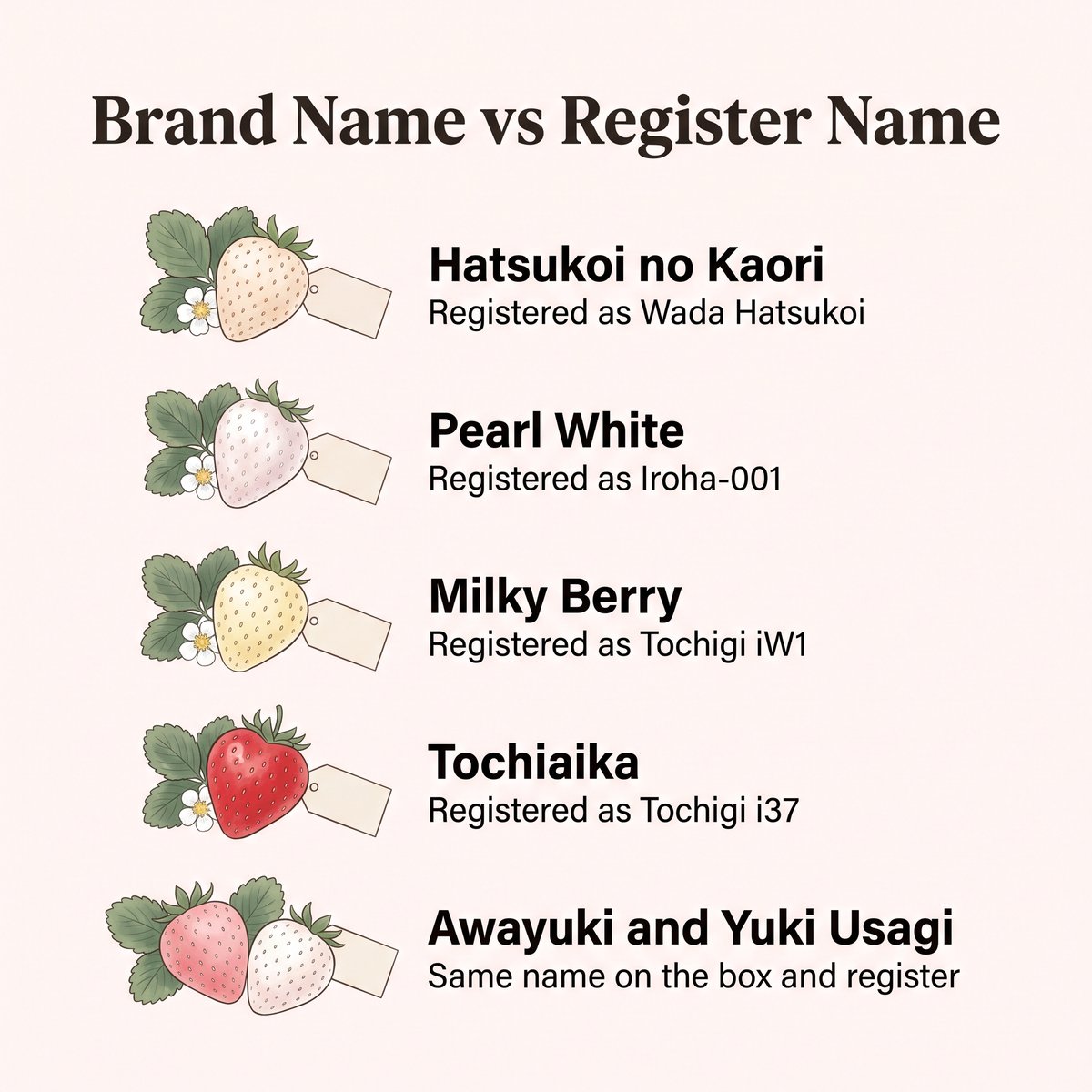
Here is where shoppers often get confused. Japan’s plant variety register lists new cultivars under official names. However, those names can differ from the box. Milky Berry, for example, is a trademark; the register knows it as Tochigi iW1. In short, the box tells you the brand, while the register tells you the plant.
- Hatsukoi no Kaori: registered as Wada Hatsukoi (No. 18011)
- Pearl White: registered as Iroha-001 (No. 24429)
- Milky Berry: registered as Tochigi iW1 (No. 30256)
- Tochiaika: registered as Tochigi i37 (No. 30257)
- Awayuki and Yuki Usagi: the same name appears on the box and in the register
5 Japanese White Strawberries to Know
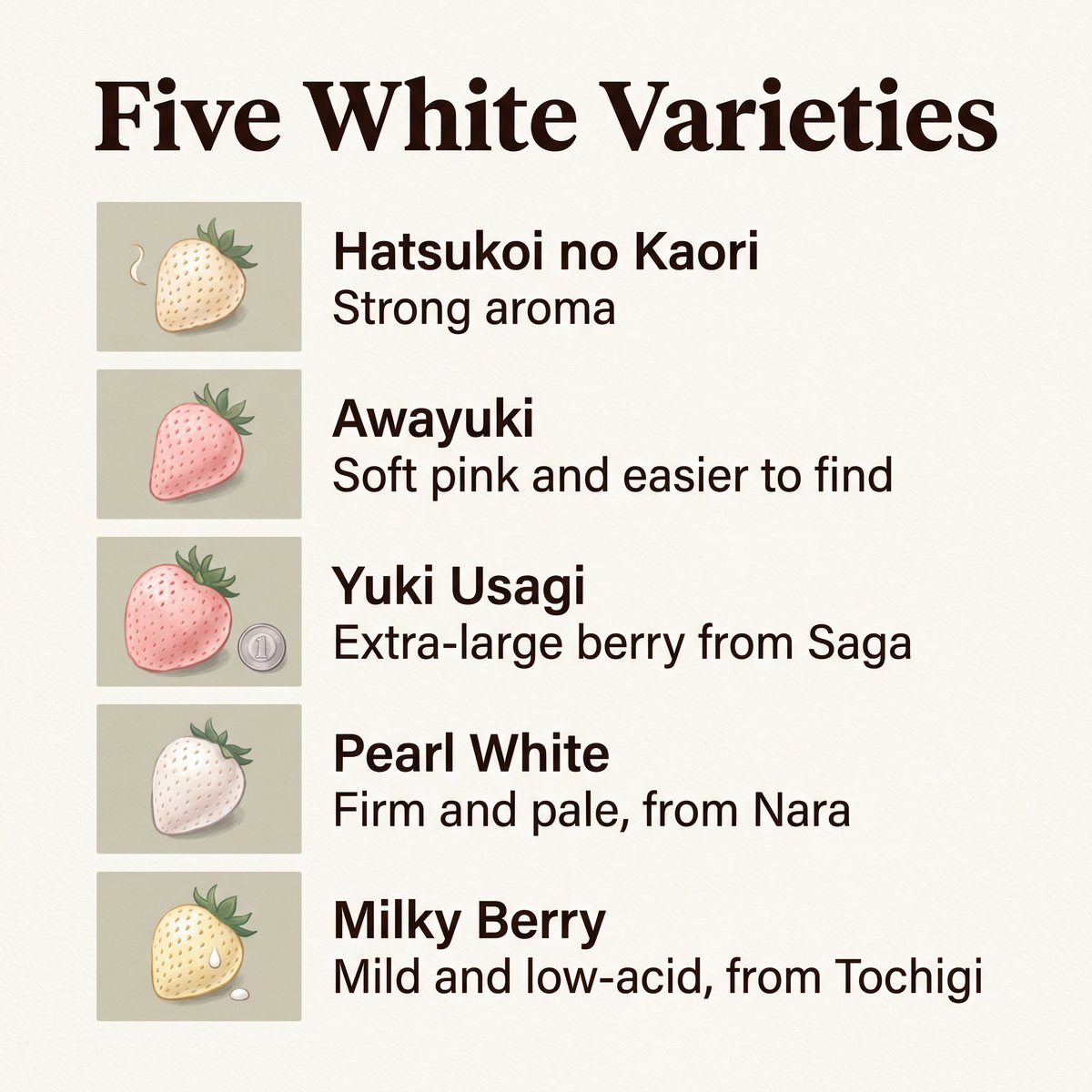
Of course, Japan grows more white strawberries than these five. Still, these names come up most often in English searches and in Tokyo fruit shops. Below, we list them in order of registration, oldest first. Each card also notes what the official record says, so you can compare them fairly.
Hatsukoi no Kaori (初恋の香り): The Benchmark White Berry
Hatsukoi no Kaori 初恋の香り
Hatsukoi no Kaori means roughly “the scent of first love.” Its developer, Miyoshi Agritech in Yamanashi, describes about 20 years of breeding. The company also markets it as the world’s first white strawberry. We could not confirm that claim in academic or government sources. Even so, its influence is easy to see.
For instance, Japan’s register later compared both Awayuki and Pearl White against Wada Hatsukoi. Tochigi even bred Milky Berry from a seedling line of this variety. Overall, expect a strong, sweet aroma, gentle acidity and tender flesh. So handle the box carefully on the way home.
Awayuki (淡雪): Soft Pink and Easier to Find
Awayuki 淡雪
Awayuki means “light snow,” yet it often looks soft pink rather than white. In fact, that color fits the record. Japan’s register describes pale orange skin and orange-red flesh, not a pure white berry. In shops, though, Awayuki usually sits with the white strawberries.
Is it a good first white strawberry? We think so, partly because growers in several regions produce it. The blush also makes ripeness easier to judge. Still, that is our editorial view, not an official ranking.
Yuki Usagi (雪うさぎ): The Extra-Large Berry From Saga
Yuki Usagi 雪うさぎ
Yuki Usagi means “snow rabbit.” Most accounts link the pale berry and red achenes to a white rabbit’s red eyes. However, the register does not record why breeders chose the name. What it does record is size: Japan registered the cultivar in 2014 and classed its fruit as extremely large.
Only a small group of Karatsu farms grows it, so supply stays tight. Sellers often compare its aroma to peach, though. Keep in mind that the comparison describes scent, not taste. It still tastes like a strawberry, just a gentler and more fragrant one.
Pearl White (パールホワイト): Firm, Pale and Made in Nara
Pearl White パールホワイト
Pearl White comes from Nara, where a local breeder named Maeda developed it, a prefectural newsletter says. Nara Ichigo Lab grows it alongside Awayuki and Nara’s red Kotoka. The group ships premium boxes to Hong Kong, Taiwan, Thailand, Singapore and the United States. In 2024, it also reached a luxury department store in the UK.
Sellers often describe the taste as gently sweet with little tartness. However, the official record lists no sugar or acid values. So treat claims of “zero acidity” with some caution. Its firm flesh, at least, helps it survive long trips.
Milky Berry (ミルキーベリー): Tochigi’s White Strawberry
Milky Berry ミルキーベリー
Milky Berry is Tochigi Prefecture’s white strawberry. Its breeders crossed a firm white seedling line from Wada Hatsukoi with a pale red line, the experiment station says. Tochigi’s variety application became public in 2018, and the name followed in 2019. The official registration, however, only came in June 2024. The name came from 3,155 public suggestions. Fittingly, it refers to a milk-white color and a mellow sweetness.
Here the data gets more specific. Tochigi’s trials found sugar levels similar to Tochiotome but lower acidity, so the sugar-acid ratio runs higher. Average fruit weight also tops 20 g. On the downside, the pale skin can turn yellowish after bumps in transit. Tochigi’s trials found that cushioning fruit caps reduce that damage.
2 Red Japanese Strawberries to Taste Alongside
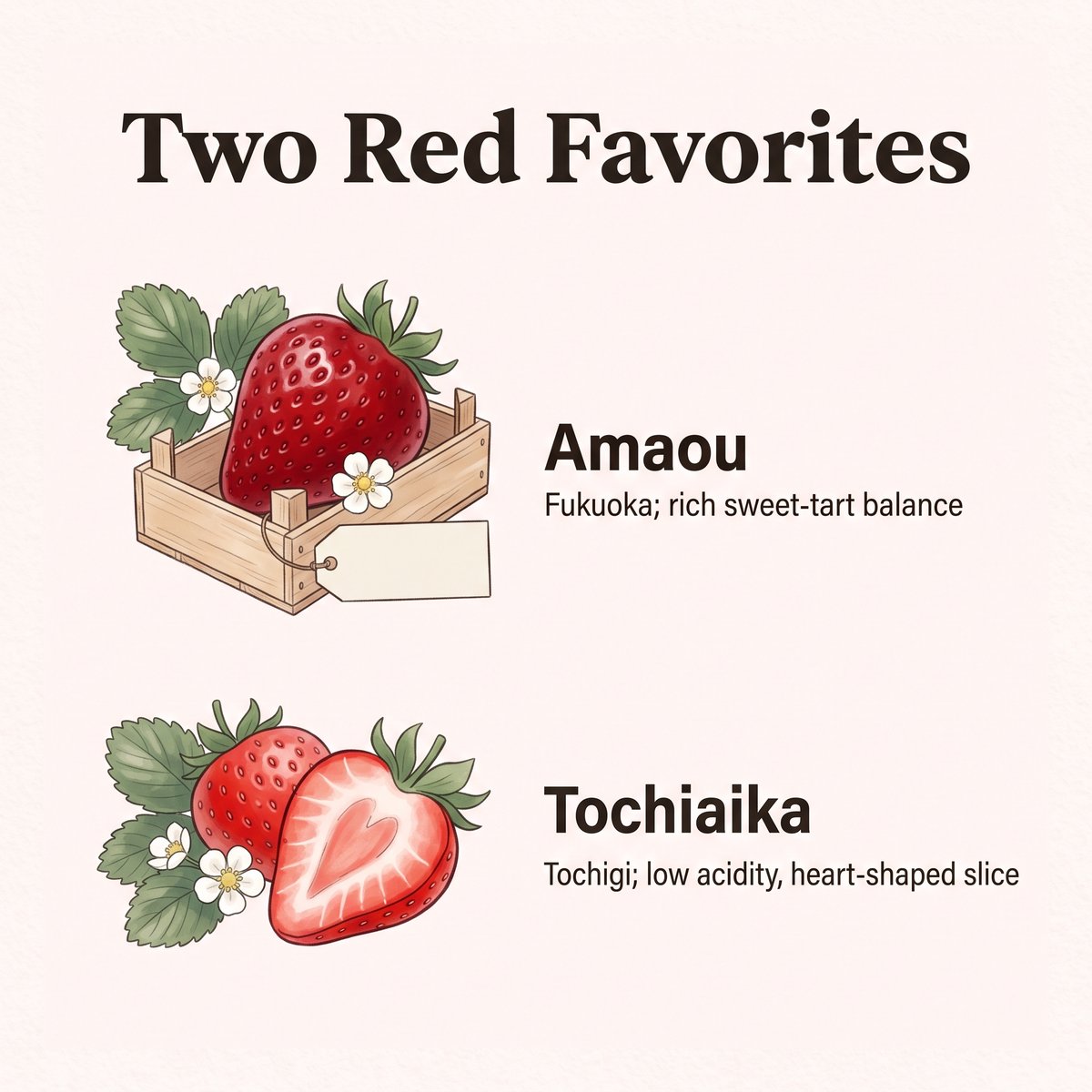
In practice, white berries make more sense next to a red one. When you taste them together, the difference in acidity becomes obvious within a bite or two. Two red varieties make especially good partners: Fukuoka’s Amaou and Tochigi’s Tochiaika.
Amaou (あまおう): Fukuoka’s Big, Rich Red
Amaou あまおう
Amaou takes its name from four Japanese words: akai, marui, ookii and umai. Together they mean red, round, big and delicious, JA Zennoh Fukuren explains. The name is a registered trademark, and Fukuoka’s JA group sells the fruit as Hakata Amaou.
Rather than pure sweetness, Amaou aims for a rich, sweet-tart balance. Meanwhile, its deep red skin and generous size make it a classic gift fruit. If you want a strawberry that tastes unmistakably like strawberry, this one rarely disappoints.
Tochiaika (とちあいか): Tochigi’s Heart-Shaped Berry
Tochiaika とちあいか
Tochiaika is Tochigi’s newer star. The prefecture bred it to succeed Tochiotome. By 2024, it covered about 60 percent of Tochigi’s strawberry acreage, according to MAFF materials. The fruit itself is heart-shaped, so a lengthwise slice often shows a heart too.
Is it sweeter than Amaou? That depends on what “sweet” means to you. Tochigi’s data show sugar levels close to Tochiotome but lower acidity. As a result, the sweetness simply feels more obvious on the tongue.
Amaou vs Tochiaika: Which Should You Pick?
Amaou
Choose it for size, richness and a classic sweet-tart flavor.
Tochiaika
Choose it for mellow, low-acid sweetness and a heart-shaped slice.
Still can’t decide? Buy one pack of each, plus one white variety. A three-way tasting shows how much acidity shapes flavor, and it turns a hotel-room snack into a small event.
Japanese Strawberry Comparison Chart
Use this chart to compare the best Japanese strawberry varieties at a glance. The color notes follow official registration records or prefectural data. The price column, however, shows editorial value tiers rather than shop prices.
Swipe the table sideways to see every column.
| Strawberry | Prefecture | Registered name (registration year, where confirmed) | Official color notes | Stand-out trait | Price tier |
|---|---|---|---|---|---|
| Hatsukoi no Kaori | Yamanashi (developer) | Wada Hatsukoi (2009) | Pale red skin, white flesh | Strong aroma | ¥¥¥ |
| Awayuki | Kyushu, Nara and others | Awayuki (2013) | Pale orange skin, orange-red flesh | Soft pink look | ¥¥ |
| Yuki Usagi | Saga | Yuki Usagi (2014) | Pinkish-white skin, white flesh | Extremely large | ¥¥¥ |
| Pearl White | Nara | Iroha-001 (2015) | Pinkish-white skin, white flesh | Firm texture | ¥¥¥ |
| Milky Berry | Tochigi | Tochigi iW1 (2024) | Yellowish-white skin, white flesh | Low acidity | ¥¥ |
| Amaou | Fukuoka | Fukuoka S6 | Deep red, glossy skin | Rich sweet-tart taste | ¥¥ |
| Tochiaika | Tochigi | Tochigi i37 (2024) | Bright red skin | Heart-shaped slice | ¥ |
About the price tiers: These are editorial value tiers showing relative rarity and premium positioning, not verified store prices. One yen sign suggests everyday supermarket packs, while three usually means gift boxes or single berries. Actual prices change by season, grade, pack size and store, so please check labels in person.
How Much Do Japanese Strawberries Cost?
Japanese strawberry prices range from everyday supermarket packs to gift berries sold by the piece. As a baseline, Tokyo’s wholesale market averaged ¥1,757 per kilogram in 2021. Variety matters, but so do grade, packaging and timing. Below, we start with hard market data and then move to the shop floor.
What the Market Data Shows
In 2021, Tokyo’s central wholesale market paid between ¥929 and ¥2,663 per kilogram for domestic fresh strawberries. The yearly average came to ¥1,757 per kilogram, ALIC reports. Prices tend to fall from January as supply grows, bottom out around April and May, then climb in summer. Remember, though, that these wholesale figures combine every variety. Shop prices run higher, and premium white berries likely sit well above that average.
Supermarket Packs vs Department Store Gifts
Generally, supermarkets stock red varieties in simple plastic packs. Department stores, on the other hand, sell graded fruit in cushioned boxes and sometimes by the piece. For example, a Nihonbashi Mitsukoshi fruit shop listed one Hatsukoi no Kaori berry at ¥648 in February 2021, tax included. That figure is historical, so use it as a sense of scale rather than a current price.
Why White Strawberries Cost More
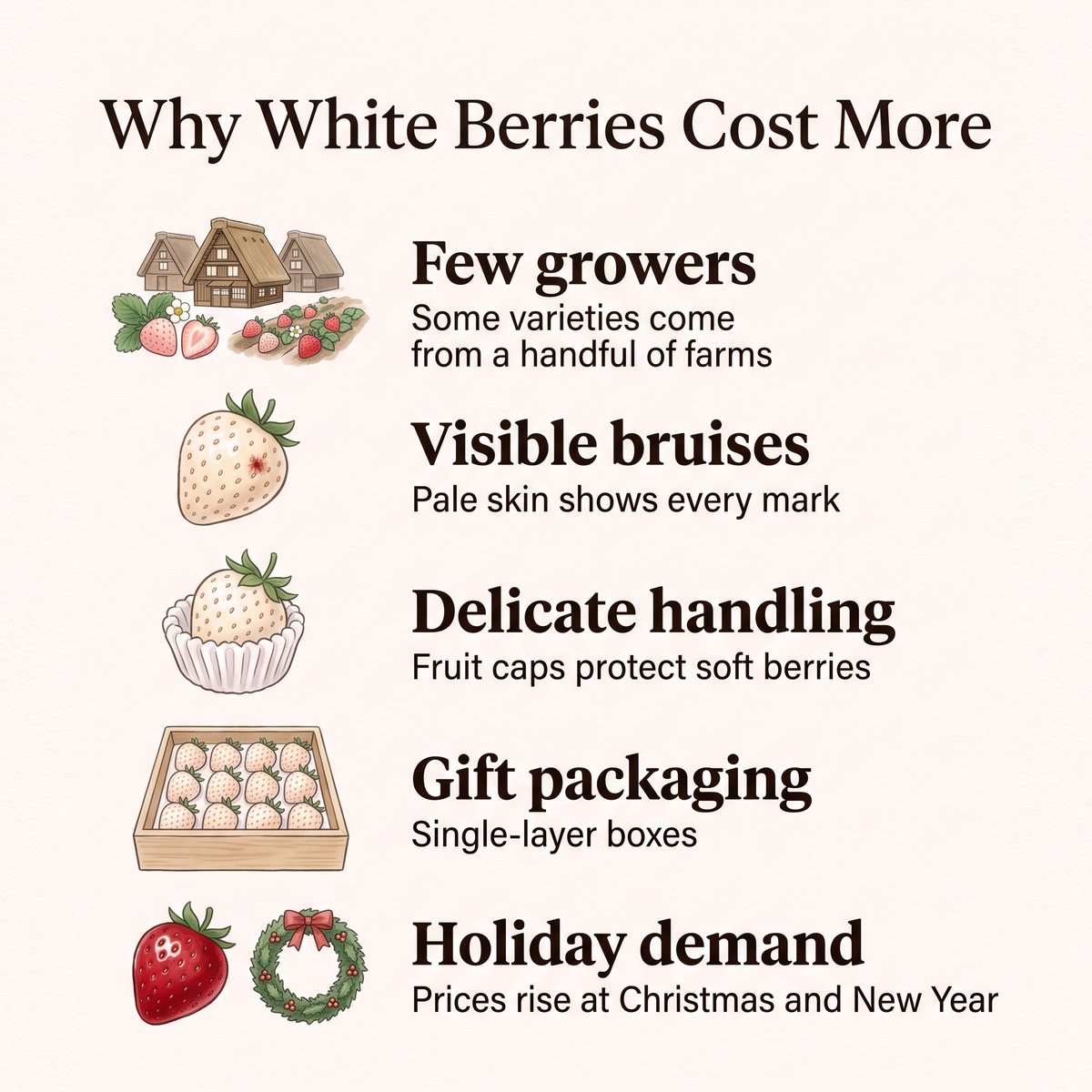
- Few growers: Yuki Usagi, for instance, comes from a small group of farms in Karatsu.
- Visible bruises: Pale skin shows every mark, so growers discard more fruit.
- Delicate handling: Milky Berry can turn yellowish after knocks, which calls for fruit caps.
- Gift packaging: Many white berries reach shops in single-layer boxes.
- Holiday demand: Prices often rise around Christmas and New Year.
Where to Buy Japanese Strawberries in Tokyo
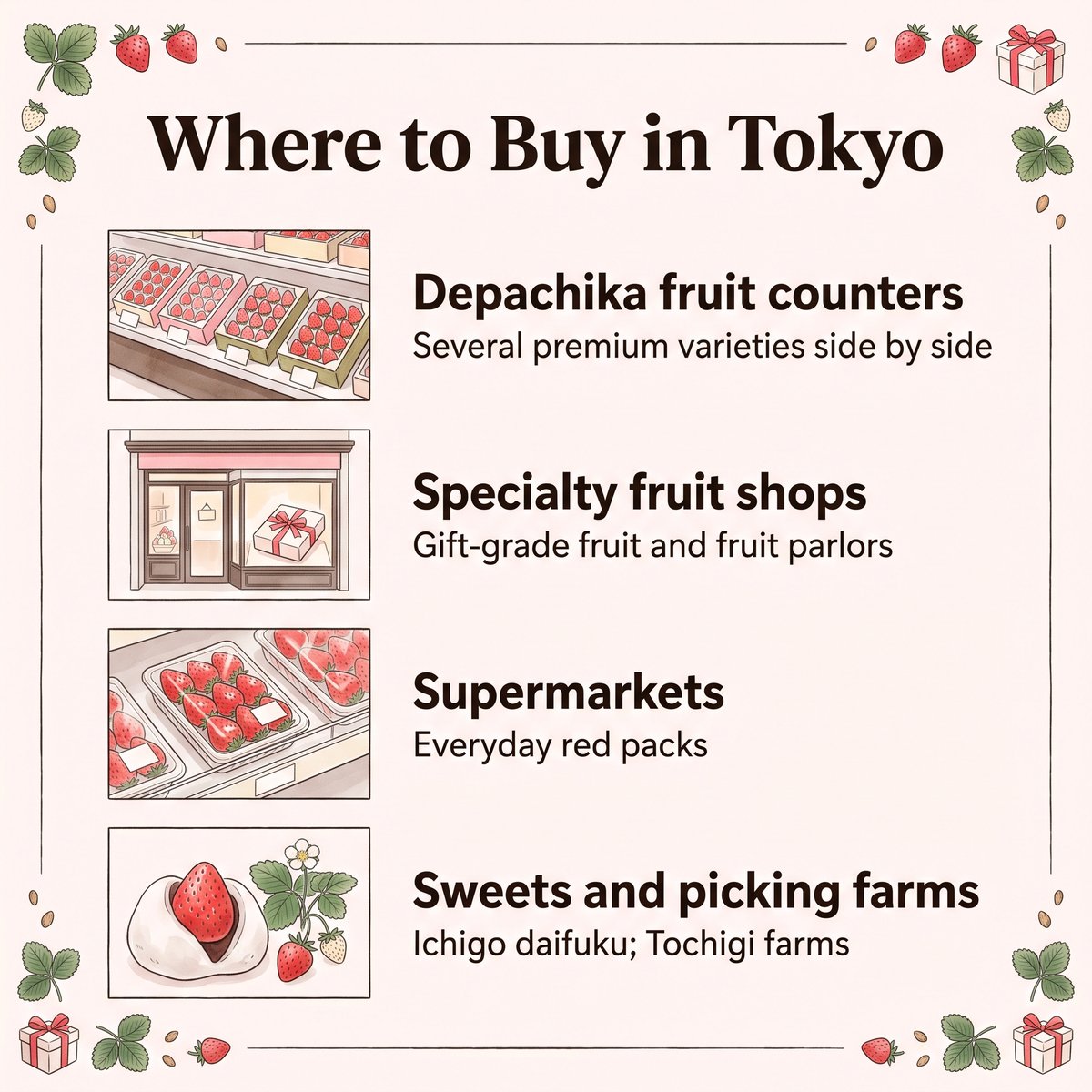
You can buy Japanese strawberries in Tokyo at department store food halls, specialty fruit shops and ordinary supermarkets. Stock changes week to week, though, and no shop guarantees a specific variety. If you have your heart set on one name, ask staff or check the shop’s website first.
Depachika Fruit Counters
Depachika, the basement food halls of department stores, are the easiest place to see several premium varieties at once. Major stores such as Isetan Shinjuku, Mitsukoshi in Nihombashi and Ginza, and Takashimaya Nihombashi all have fruit sections. These are the same halls where families shop for New Year osechi. In season, you may find white and red berries close together, which makes comparing easy.
Specialty Fruit Shops
Long-established fruit shops such as Sembikiya and Shinjuku Takano focus on gift-grade fruit. Expect carefully packed gift boxes. Both also run fruit parlors, so you can taste strawberries in a parfait before committing to a whole box.
Supermarkets for Everyday Packs
For value, try a local supermarket such as Life or Ozeki. In season, red varieties like Tochiaika, Amaou and Tochiotome are common sights. Seijo Ishii, a premium grocery chain, may carry less common names. White strawberries show up less often here, but it is worth a look.
Strawberry Sweets and Picking Farms
Not every strawberry needs to come in a box. Ichigo daifuku, a whole berry wrapped in sweet bean paste and mochi, appears at wagashi shops all winter. Japan’s strawberry shortcake also peaks at Christmas, as our Japanese Christmas cake guide explains.
Want to pick your own? Tochigi, about an hour north of Tokyo by Shinkansen, has many strawberry farms. Some farms there have offered tasting plans with Milky Berry and the rare Tochihime. Plans and prices change every season, so check the farm’s official site before you go.
How to Choose and Store Japanese Strawberries
Good strawberries look glossy, smell sweet and wear a fresh green calyx, the leafy cap. White varieties need a slightly different eye, though. Below are simple checks for each, plus storage tips from producers.
Choosing Red Strawberries
Look for deep, even color right up to the calyx. Glossy skin usually signals freshness, and a bright green, perky cap is a good sign too. Also, check the bottom of the pack. A single wet or squashed berry can spoil its neighbors quickly.
Choosing White Strawberries
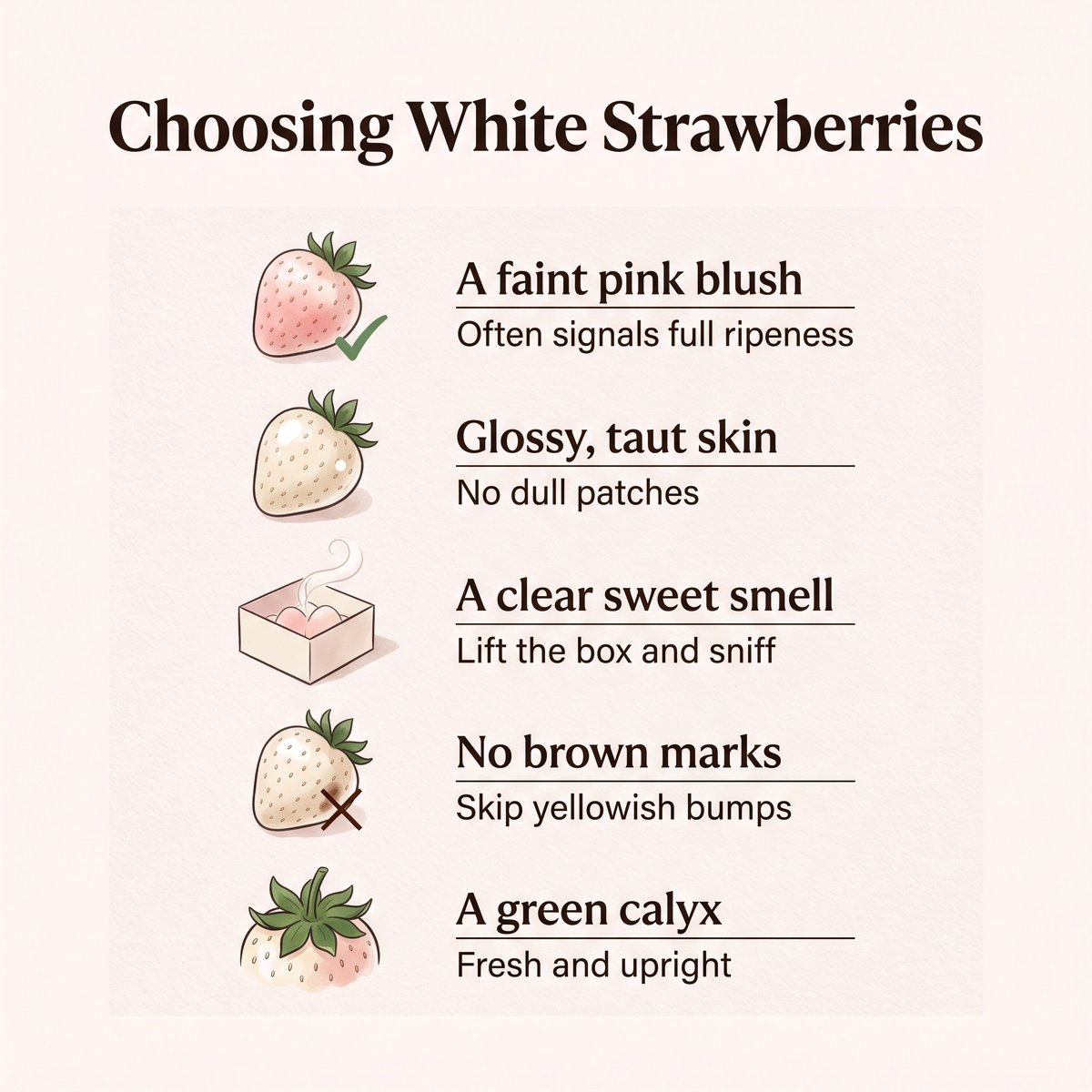
White strawberry checklist
- A faint pink blush, which often signals full ripeness
- Glossy, taut skin with no dull patches
- A clear, sweet smell when you lift the box
- No brown or yellowish marks from bumps
- A fresh, upright green calyx
Color alone, however, can mislead you with white berries. So trust your nose as much as your eyes. If a box has almost no smell, consider another one.
How to Store Japanese Strawberries
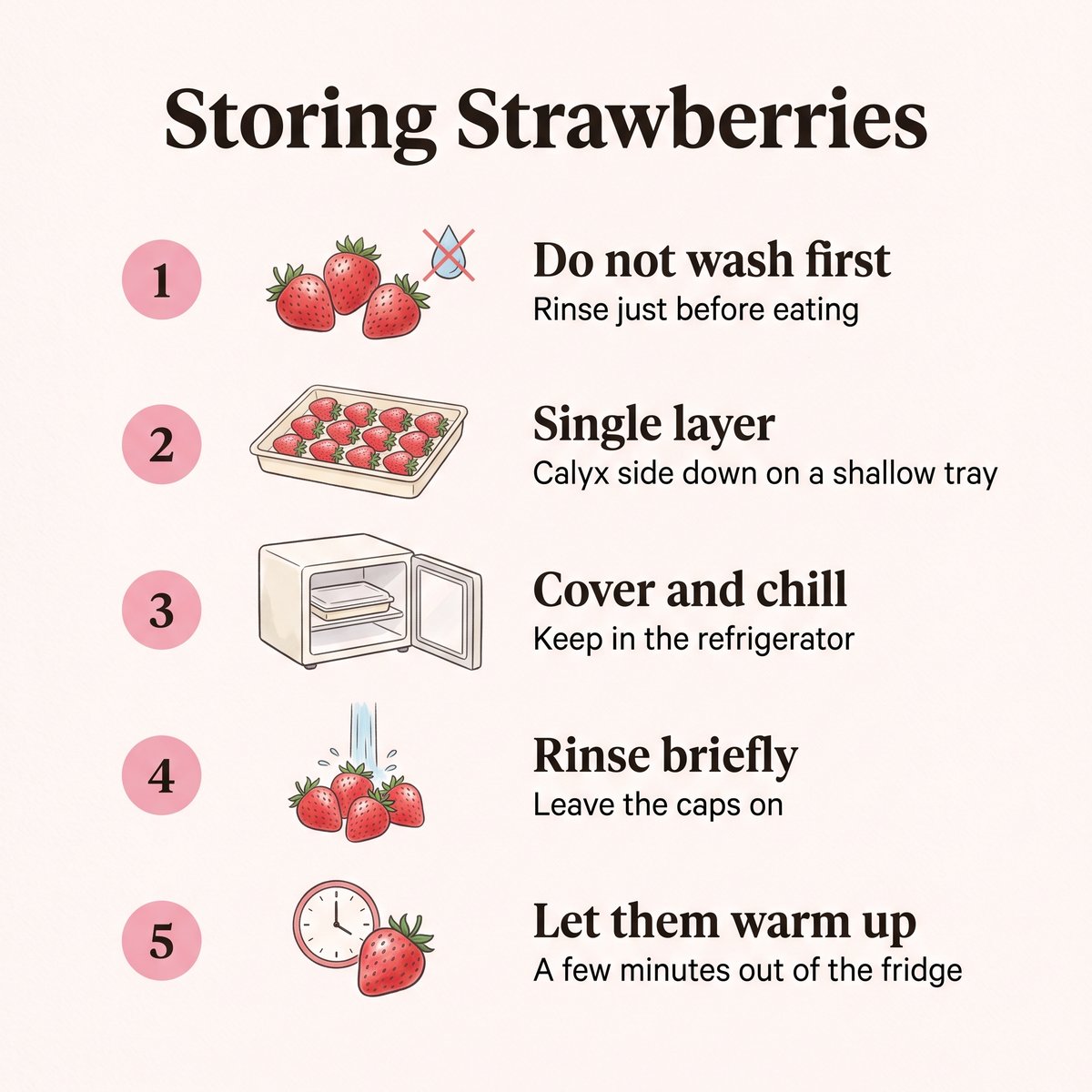
JA Zennoh Fukuren, Fukuoka’s farm cooperative federation, recommends a few simple steps. They work for any variety.
- Do not wash the berries before storing them.
- Move them to a shallow tray in a single layer, calyx side down.
- Cover the tray and keep it in the refrigerator.
- Rinse them quickly just before eating, with the caps still on.
Even with good storage, soft varieties fade fast. So eat white strawberries within a few days if you can. Also, let them sit out for a few minutes first, since very cold fruit tends to smell less.
Which Japanese Strawberry Should You Buy?
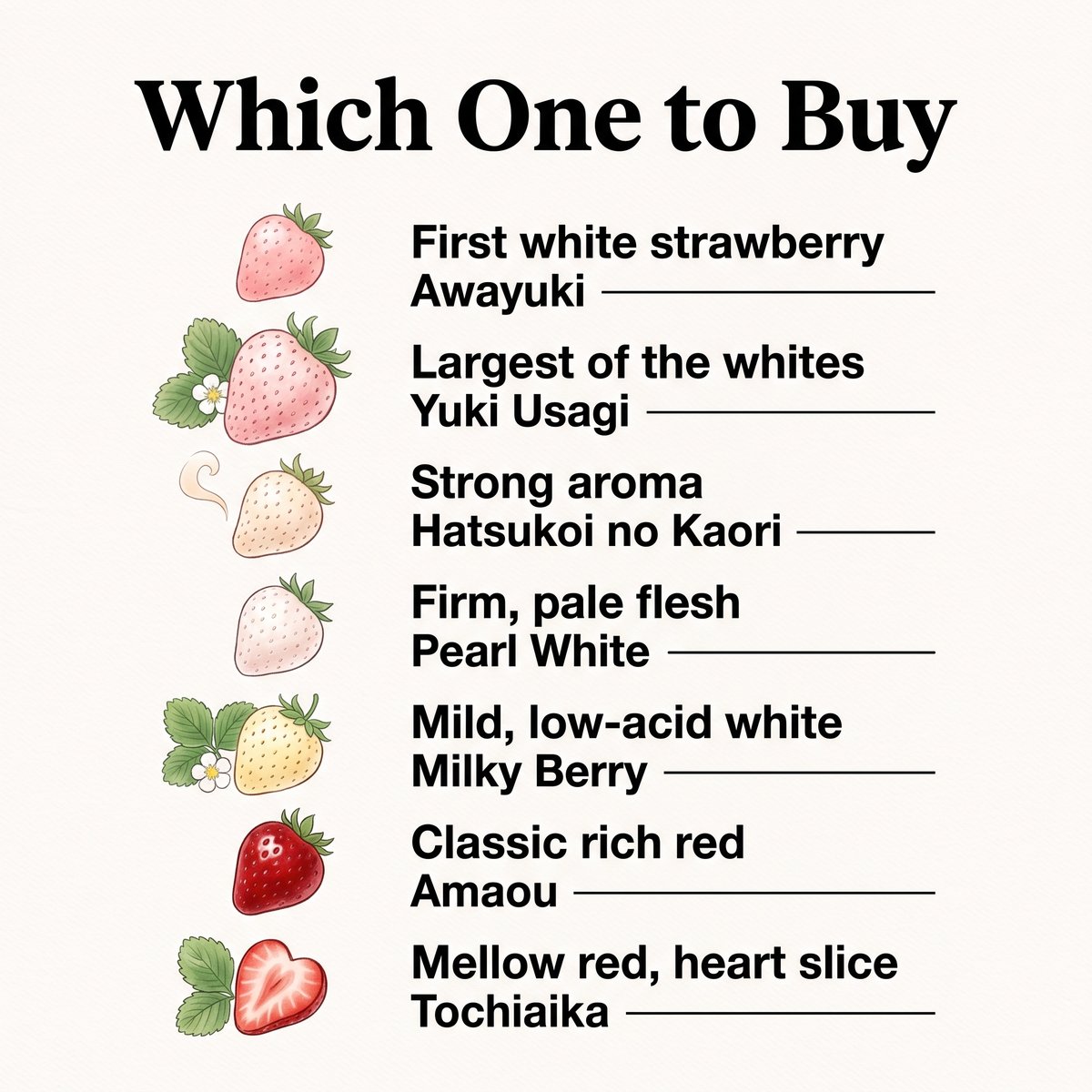
Still unsure? Start with what you want from the experience. This quick picker reflects our editorial view, not an official ranking.
- First white strawberryAwayuki
- Largest of the five whitesYuki Usagi
- Strong aromaHatsukoi no Kaori
- Firm, pale fleshPearl White
- Mild, low-acid whiteMilky Berry
- Classic rich redAmaou
- Mellow red, heart sliceTochiaika
Final Thoughts on Japanese Strawberries
Ultimately, Japanese strawberries reward a little curiosity. White varieties show how far conventional breeding in Japan has come, offering a new look and a softer flavor. Red stars like Amaou and Tochiaika, meanwhile, show how much flavor a classic red berry can still offer.
If you visit between December and May, try at least one white and one red side by side. Then decide for yourself whether the pale ones justify the price. We suspect you will have a favorite by the second bite. For more seasonal picks, browse our Japanese fruit guides or our list of best Japanese winter foods.
Frequently Asked Questions About Japanese Strawberries
Prices and Shopping
- Why are Japanese strawberries so expensive?
-
Growers pick, sort and pack premium berries by hand, often in single-layer gift boxes. Rare varieties also come from only a few farms. In addition, demand spikes around Christmas and New Year. Everyday supermarket packs, however, cost far less than gift grades.
- Where can I buy Japanese strawberries in Tokyo?
-
Department store food halls such as Isetan Shinjuku often show several premium varieties side by side. Specialty shops like Sembikiya focus on gift-grade fruit. For everyday packs, try a local supermarket. Stock changes weekly, so ask staff about specific names.
White Strawberries
- Do white strawberries taste like pineapple?
-
Not usually. The pineapple idea comes mostly from pineberries, a different white strawberry grown mainly outside Japan. Japanese white varieties still taste mainly like strawberries. Their main difference is lower acidity, often with an aroma that sellers compare to peach.
- Is Hatsukoi no Kaori the first white strawberry?
-
Its developer markets it as the world’s first white strawberry. We could not confirm that claim in academic or government sources. Japan registered it as Wada Hatsukoi in 2009. Later white cultivars, though, used it as their comparison variety.
- What is the difference between Awayuki and Pearl White?
-
Awayuki usually looks soft pink, and its record lists pale orange skin with orange-red flesh. In contrast, Pearl White looks paler, with pinkish-white skin and white flesh. Pearl White is also firmer and medium-sized. Nara Ichigo Lab grows both, and Nara growers sometimes pack several colors together in gift sets.
Red Varieties and Travel
- Is Amaou sweeter than Tochiaika?
-
Not necessarily. Amaou offers a rich sweet-tart balance, while Tochiaika has notably low acidity. Because of that, Tochiaika’s sweetness can feel more obvious. Tasting both side by side is the best way to decide.
- Can I find white strawberries at Japanese airports?
-
Sometimes, but availability is unpredictable. Tokyo department store food halls and specialty fruit shops are more dependable places to look. So if you want a specific variety such as Awayuki, Pearl White or Milky Berry, buy it before heading to the airport.
- Can tourists take Japanese strawberries out of Japan?
-
It depends on your destination’s plant-quarantine rules. Some countries ban fresh fruit, while others require an export inspection or certificate. Japan’s Plant Protection Station can inspect items before departure when needed. Check your home country’s current rules before you buy.
References
- MAFF Plant Variety Protection Database – Registered Variety No. 18011, Wada Hatsukoi (Accessed October 2026)
- MAFF Plant Variety Protection Database – Registered Variety No. 22821, Awayuki (Accessed October 2026)
- MAFF Plant Variety Protection Database – Registered Variety No. 23750, Yuki Usagi (Accessed October 2026)
- MAFF Plant Variety Protection Database – Registered Variety No. 24429, Iroha-001 (Accessed October 2026)
- Tochigi Prefecture – Tochigi i37 (Trademark: Tochiaika) (Accessed October 2026)
- Tochigi Prefecture – Variety Registration of Tochiaika (Tochigi i37) and Milky Berry (Tochigi iW1), June 2024 (Accessed October 2026)
- Tochigi Prefectural Agricultural Experiment Station – Strawberry Research and Variety Development (Tochiaika, Milky Berry) (Accessed October 2026)
- Tochigi Prefectural Agricultural Experiment Station – Registered Varieties: Tochigi iW1 (No. 30256) and Tochigi i37 (No. 30257) (Accessed October 2026)
- Tochigi Prefectural Agricultural Experiment Station News No. 389 – Breeding of the White Strawberry Tochigi iW1 (Milky Berry), November 2019 (Accessed October 2026)
- Tochigi Prefectural Agricultural Experiment Station – Cultivation Techniques for the White Strawberry Milky Berry, Research Results No. 41 (Accessed October 2026)
- Ministry of Agriculture, Forestry and Fisheries (MAFF) – Intellectual Property Award Case: Tochigi Prefecture, 2025 (Accessed October 2026)
- Fukuoka Prefecture – Amaou (Fukuoka S6) Brand Information (Accessed October 2026)
- JA Zennoh Fukuren – Fukuoka Strawberries (Hakata Amaou) (Accessed October 2026)
- Agriculture and Livestock Industries Corporation (ALIC) – Strawberry Supply and Demand Trends, Vegetable Information, December 2022 (Accessed October 2026)
- MAFF Kinki Regional Agricultural Administration Office – Expanding Exports of Premium Strawberries: Nara Ichigo Lab, 2024 (Accessed October 2026)
- Nara Prefecture – Ganbaru Nara Farmers Vol. 29 (Nara Ichigo Lab and Pearl White) (Accessed October 2026)
- Tasaki, K. et al. (2020) – Genome-Wide Association Study for Fruit Skin Color Using Everbearing Strawberry MAGIC Population, Bulletin of the Tochigi Prefectural Agricultural Experiment Station No. 81 (Accessed October 2026)
- Akagi, H. et al. (1985) – On the New Strawberry Cultivar Nyoho, Bulletin of the Tochigi Prefectural Agricultural Experiment Station No. 31 (Accessed October 2026)
- Strawberry Kingdom Tochigi – Strawberry Variety Lineup (Accessed October 2026)
- MAFF Plant Protection Station – FAQ on Export Inspection (Accessed October 2026)
- MAFF Plant Protection Station – Taking Plants and Other Goods Out of Japan, Leaflet for Travelers (Accessed October 2026)
Related Articles
- Hatsukoi no Kaori (初恋の香り) (Surveyed: October 2026)
- Awayuki Strawberries (淡雪いちご) (Surveyed: October 2026)
- Yuki Usagi Strawberry (雪うさぎ) (Surveyed: October 2026)
- Pearl White Strawberry (パールホワイト) (Surveyed: October 2026)
- Milky Berry Strawberry (ミルキーベリー) (Surveyed: October 2026)
- Amaou Strawberry (あまおう): Japan’s King of Fruits (Surveyed: October 2026)
- Tochi otome (とちおとめ) (Surveyed: October 2026)
- Tochihime (とちひめ) (Surveyed: October 2026)
- Echigo hime (越後ひめ) (Surveyed: October 2026)
- Saika Strawberry (彩夏) (Surveyed: October 2026)
- Ichigo Daifuku (いちご大福) (Surveyed: October 2026)
- Japanese Christmas Cake: A Complete Guide to Japan’s Holiday Tradition (Surveyed: October 2026)





Comments