


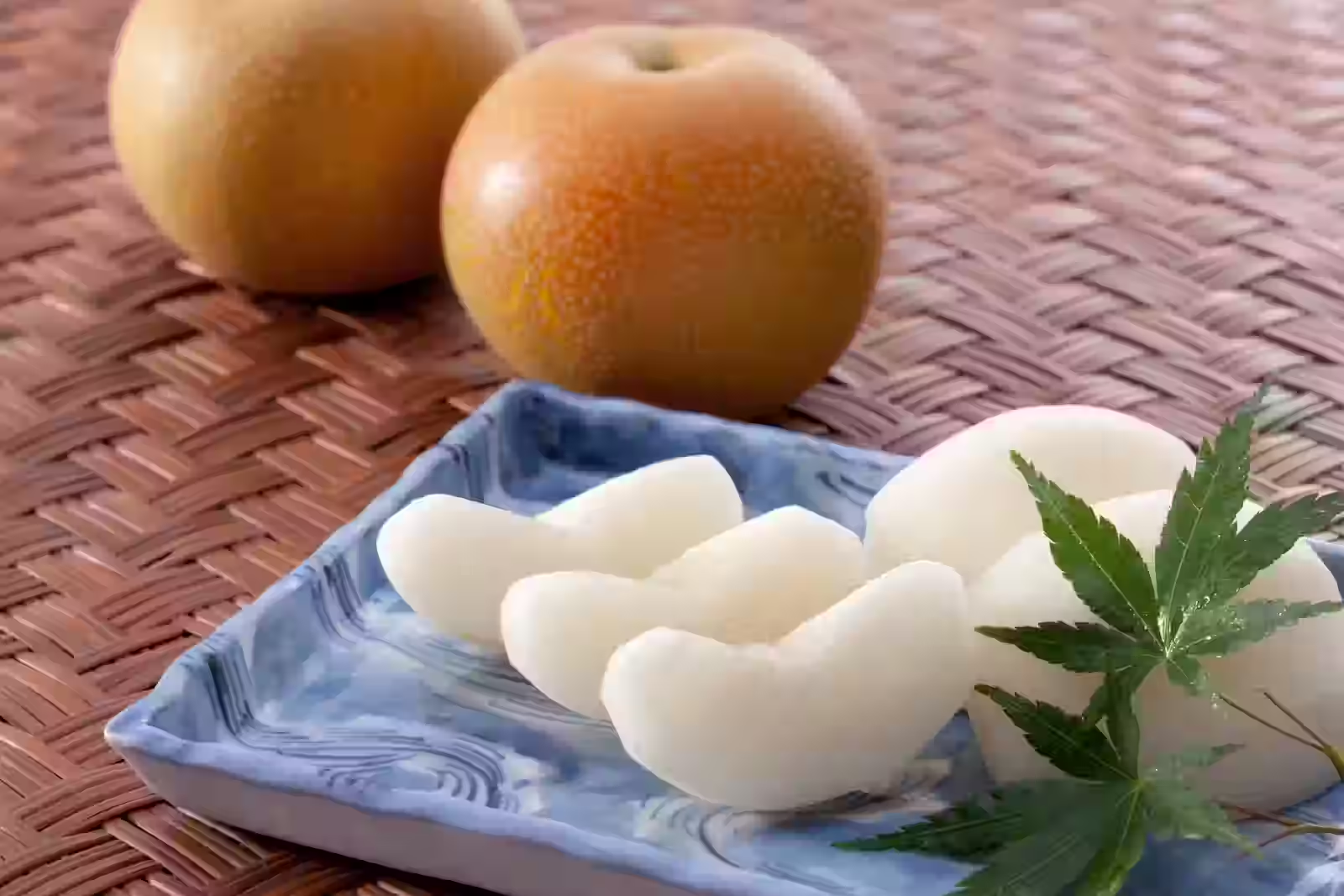

Bite into a ripe Kureha pear on a hot August afternoon, and the juice runs down your wrist before you finish the first mouthful. There is no dignified way to eat one. Kureha nashi is the branded Japanese pear of the Kureha Hills in Toyama City, and growers there are known for bagless cultivation, letting the fruit mature without the protective paper bags used in many Japanese orchards.
That choice shapes how the district talks about its fruit. This guide covers the landscape behind the orchards, the four varieties that relay through autumn, the farmer who started it all, and where travelers can buy pears at their peak.
Quick Facts About Kureha Nashi
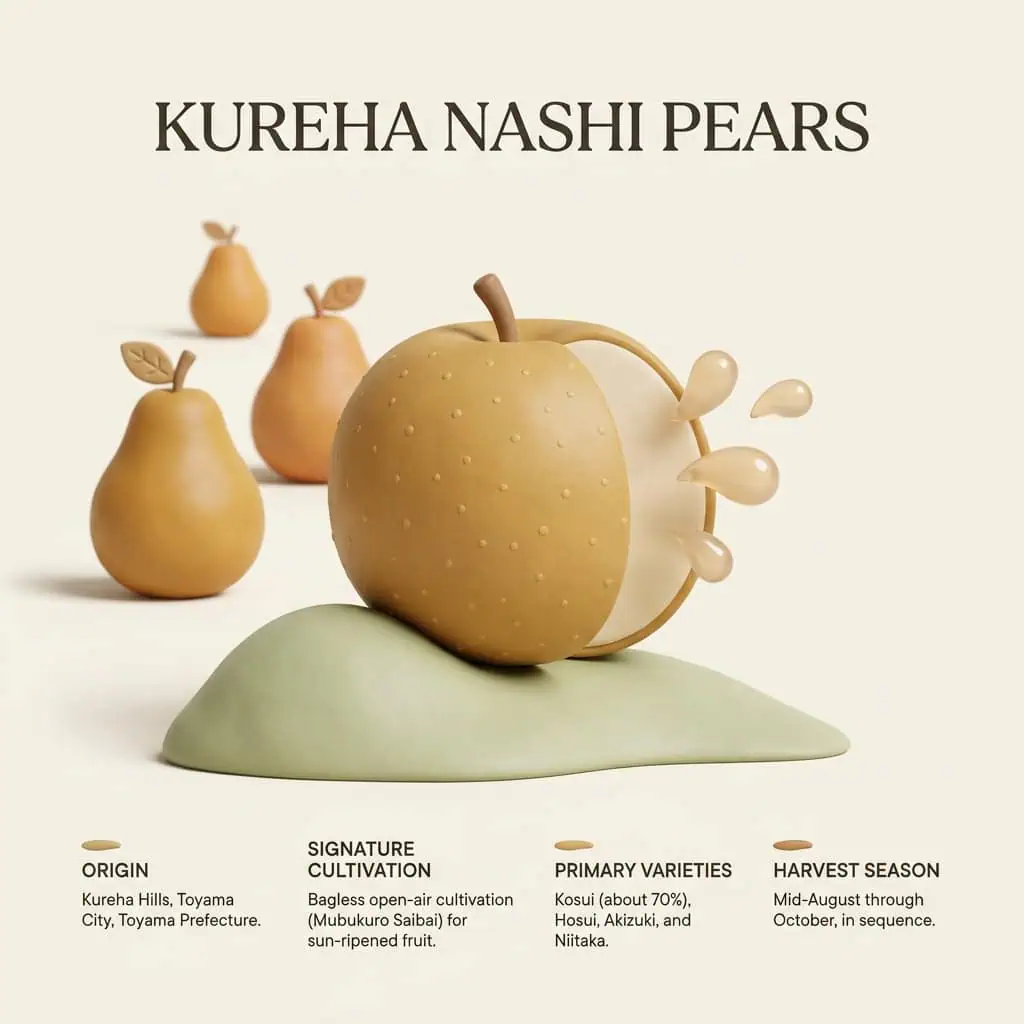
Kureha nashi is a regional brand of Japanese pears grown mainly around the Kureha Hills in Toyama City. It is not a single cultivar. The name covers varieties including Kosui, Hosui, Akizuki, and Niitaka, which growers harvest in sequence from mid-August into October.
- Origin & Region
- Kureha Hills (呉羽丘陵), Toyama City, Toyama Prefecture.
- Botanical Classification
- Pyrus pyrifolia var. culta (Japanese pear, also called Asian pear or nashi).
- Harvest Season
- Mid-August through October, opening with Kosui and closing with Niitaka.
- Signature Cultivation
- Bagless open-air cultivation (無袋栽培 / Mubukuro Saibai).
- Environmental Commitment
- Every pear grower in the district obtained Eco-Farmer certification, a district-wide achievement that JA reporting highlighted in 2019. Japan has since replaced the national framework behind that scheme.
- Production Scale
- Approximately 135 hectares and nearly 2,000 tons shipped, based on 2018 figures published by Toyama Prefecture.
- Primary Varieties
- Kosui (about 70% of output), Hosui, Akizuki, and Niitaka.
What Is Kureha Nashi?
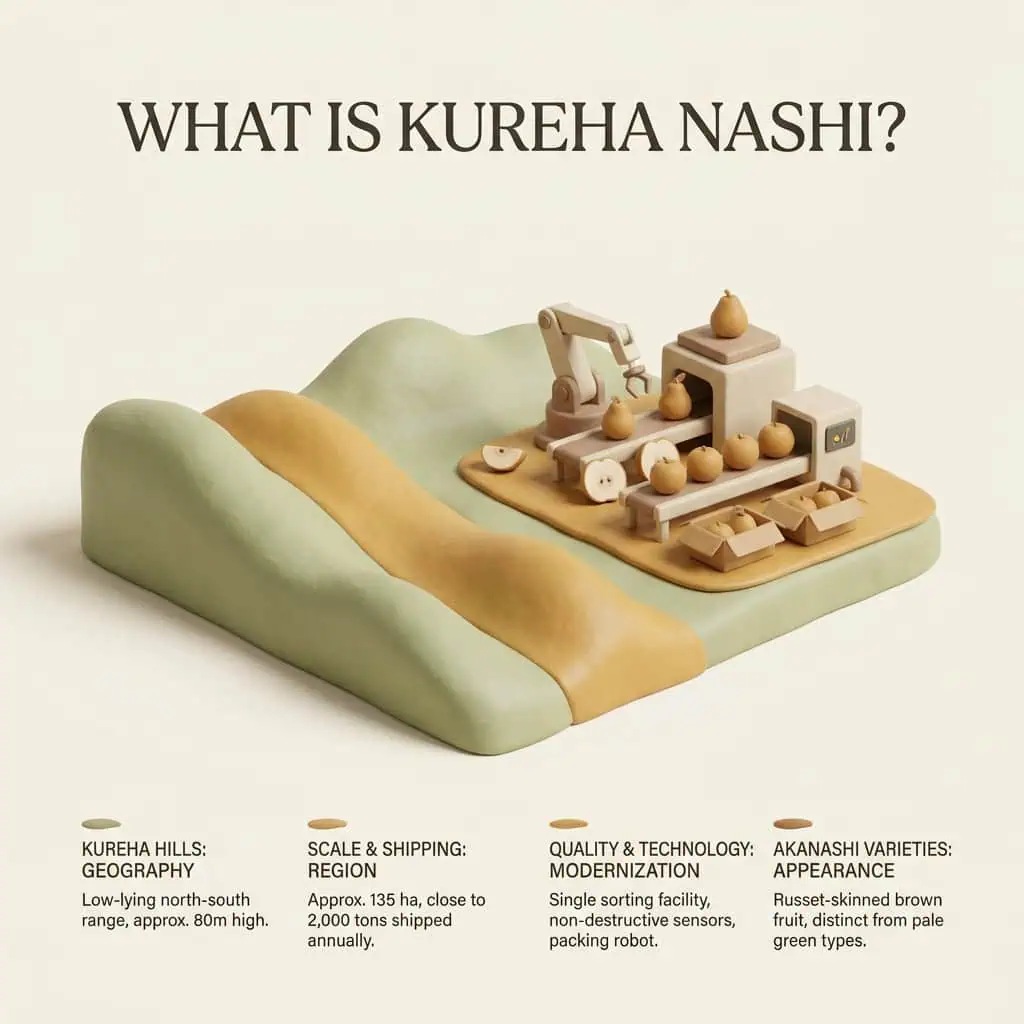
The Kureha Hills run north to south through the middle of Toyama Prefecture, although they rise only about 80 meters above the surrounding plain. Toyama Prefecture’s official food portal puts the Kureha growing area at roughly 135 hectares, shipping close to 2,000 tons in 2018. Local reporting places the prefecture’s total pear acreage at around 200 hectares, so Kureha accounts for the larger share of it.
All four main varieties belong to the akanashi group, meaning russet-skinned Asian pears. Their brown, lightly russeted skins look quite different from the pale green surface of aonashi cultivars such as Nijisseiki. Fruit from the district ships under a single brand name, so one box carries the reputation of the whole area.
JA Nanohana also consolidated two older sorting depots into a single facility. According to JA Zen-Noh reporting, that center uses non-destructive sensors to assess external appearance, internal quality, and sugar content before packing, alongside a box-packing robot.
What Does It Taste Like?
A Kureha pear tastes sweet and clean, with a crisp granular crunch and a great deal of juice. Texture comes first. A Japanese pear never melts the way a Bartlett does; instead, it snaps, closer to a very crunchy apple. English speakers sometimes call it an apple pear, and the nickname fits the texture better than the flavor.
Then the juice arrives, and there is a lot of it. Kosui in particular carries little acidity, so the sweetness lands clean and faintly floral. The aroma, though, stays subtle enough that first-time eaters sometimes expect more from it. That restraint is arguably the point, which explains why people in Toyama eat pears cold on a humid afternoon rather than saving them for dessert.
Why Pear Growing Took Root in the Kureha Hills
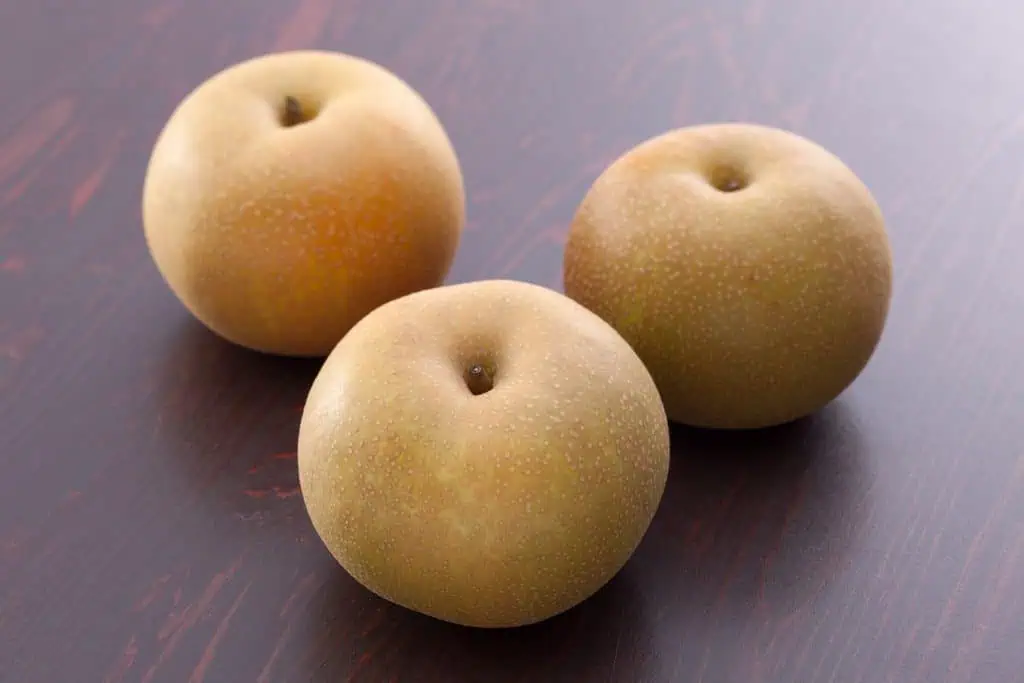
The defining advantage of the Kureha Hills is drainage. Pears took hold here because rice could not, and that constraint pushed local farmers toward orchard crops more than a century ago.
Drainage Instead of Irrigation
At roughly 80 meters above the plain, the district historically lacked the reliable water supply that flooded paddies require. Toyama Prefecture’s tourism association describes the hills as well drained and difficult for rice. Those same conditions suit deep-rooting fruit trees, which struggle in waterlogged ground.
So the limitation became the opportunity. Farmers experimented with orchard crops on land that would never support a decent rice yield. Japanese pears eventually became the district’s defining product, and they still are.
The Gamble That Followed
Workable ground, though, was only the starting point. Plenty of regions grow good pears while still wrapping each one in paper. Kureha went the other way, and that decision is what the district is known for today.
The Signature Practice: Bagless Cultivation (Mubukuro Saibai)
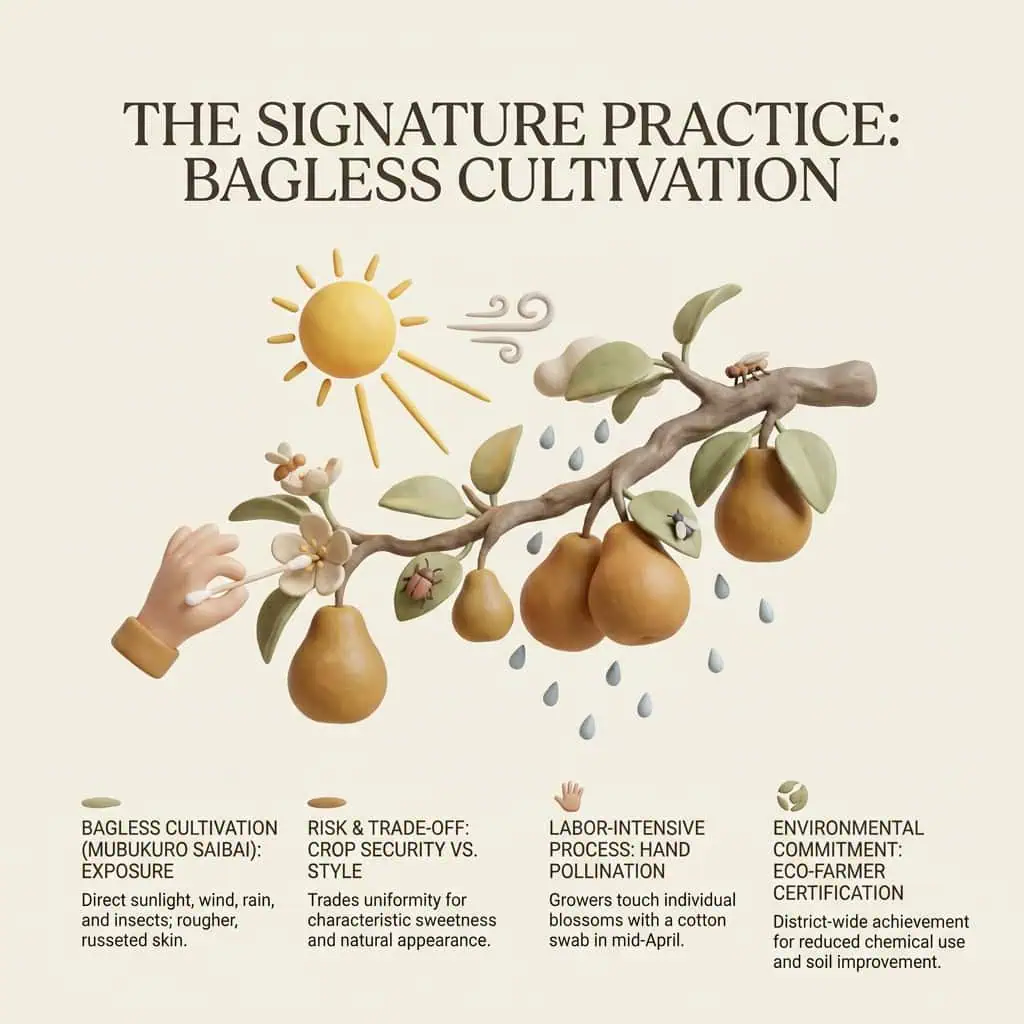
Mubukuro saibai (無袋栽培) means growing fruit fully in the open air, without the paper bags that many orchards tie over each pear from early summer until harvest. Those bags guard against insects, disease, and surface blemishes. Kureha growers skip them.
What Bagless Growing Actually Means
Bagless cultivation exposes the fruit directly to sunlight, wind, rain, insects, and temperature changes. Kureha growers associate the method with the region’s characteristic sweetness and natural appearance, although the effects of bagging on sugar content vary by cultivar, bag material, growing conditions, and harvest timing.
What Growers Give Up
Bagless growing trades crop security and cosmetic uniformity for the district’s preferred style of fruit. Here is the question a curious visitor should ask. Why leave a whole crop exposed? Rain marks the skin, insects find the fruit, and hail in April can erase a season before it starts.
A hot summer, similarly, can scorch pears while they hang on the branch. In exchange for the risk, growers spend more hours on pest monitoring and pruning. Appearance changes too, because unbagged skin develops a rougher, more russeted surface than the pale fruit sold in department stores.
Eco-Farmer Certification and Sensor Sorting
Eco-Farmer was a prefectural certification for growers who cut chemical fertilizer and pesticide use while improving soil through approved methods. Every pear grower in the Kureha district obtained it, which made the area one of Japan’s earliest large-scale examples of district-wide environmentally conscious pear production. Japan replaced the law behind that scheme in July 2022, so the credential now reads as a record of commitment rather than a current-year certificate.
How Kureha Pears Are Grown and Graded
- Bagless open-air cultivation across the district’s orchards
- Non-destructive sensors checking appearance, internal quality, and sugar content before packing
- Hand pollination of individual blossoms with cotton swabs in mid-April
- Same-day harvesting and selling at many roadside stands
- District-wide Eco-Farmer certification, obtained by every local pear grower
Hand Pollination: Why Japanese Fruit Costs So Much
Japanese pears are expensive largely because people, not insects, do much of the pollinating. In mid-April, once the cherry blossoms finish, the hills turn white for roughly a week. During that narrow window, growers touch a cotton swab to thousands of individual flowers, one at a time.
Miss the window, and the year is gone. Families therefore hire seasonal help, and thinning follows in May, when most young fruit gets removed so the survivors grow large. Seen that way, the price of a gift-grade pear looks less like luxury markup and more like labor.
The Autumn Harvest Relay: Four Seasonal Varieties
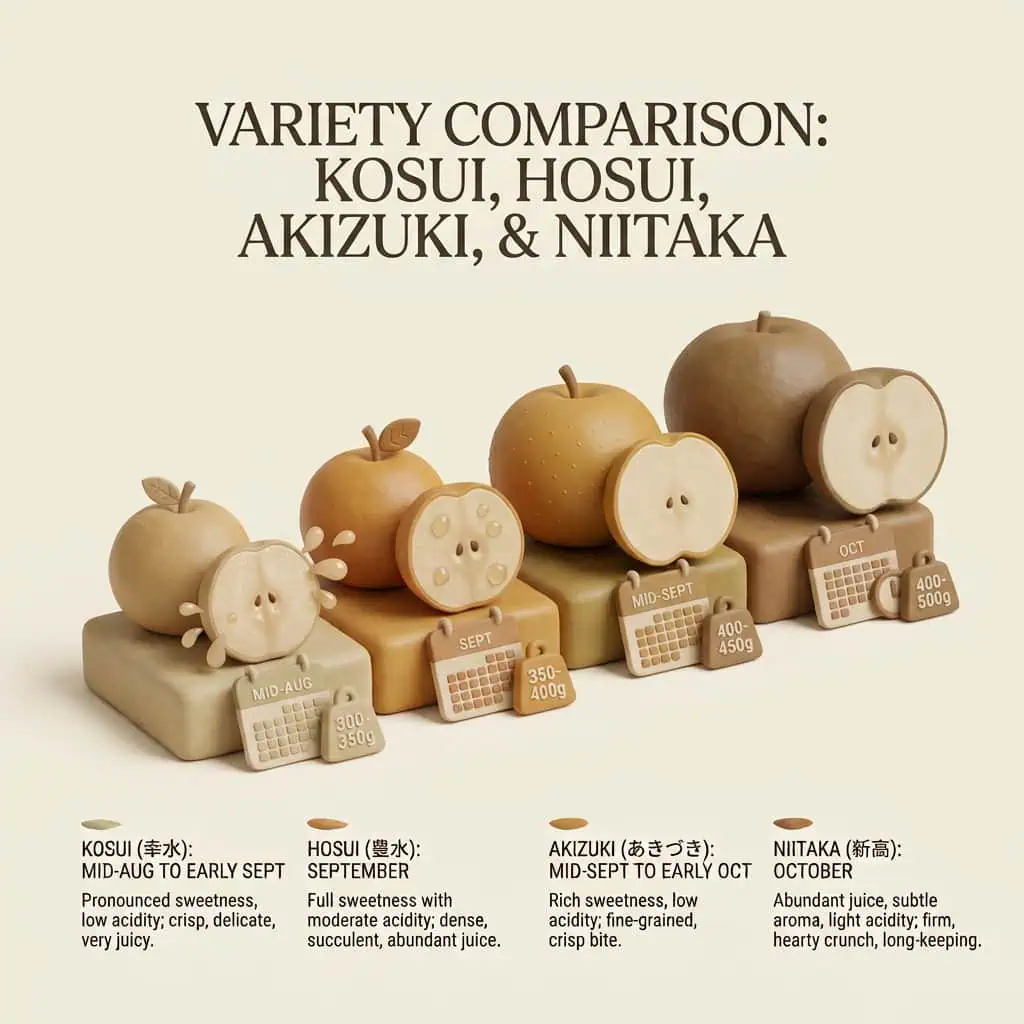
Four varieties hand the season off in sequence, running from mid-August into October. Every handoff changes the eating experience. Locals track the switch closely, since a favorite pear may only sit on the stalls for two or three weeks.
1. Kosui (幸水): Mid-August to Early September
Kosui opens the season and dominates it. Toyama Prefecture reports that Kosui makes up about 70 percent of Kureha production, with fruit weighing 300 to 350 grams. Prefectural descriptions emphasize plentiful juice, a good bite, and low acidity. However, the window is short, often just two to three weeks at any given stall.
2. Hosui (豊水): September
Hosui follows in September, wearing a warmer amber-brown skin. Fruit typically runs 350 to 400 grams, so it feels noticeably larger than Kosui. The prefecture describes it as juicy and full-flavored, with a moderate acidity behind the sweetness. Visitors who find Kosui a little one-note often settle on Hosui as their favorite.
3. Akizuki (あきづき): Mid-September to Early October
Akizuki was developed by crossing Kosui with an experimental selection descended from Hosui and Niitaka, and it was registered as a cultivar in 2001 by Japan’s national fruit tree research institute, now part of NARO. Fruit in Kureha weighs 400 to 450 grams. Toyama describes it as juicy and crisp like Kosui, with low acidity and rich sweetness. Its name means autumn moon, which suits the round shape.
4. Niitaka (新高): October
Niitaka closes the season, and it is the largest of the four. Kureha fruit commonly reaches 400 to 500 grams, while gift specimens grown elsewhere in Japan can run far heavier. The prefecture describes abundant juice, a subtle aroma, and a light acidity that gives the fruit a refreshing finish. Because Niitaka also keeps well, it lingers in Toyama kitchens after the season ends.
Variety Comparison: Kosui vs. Hosui vs. Akizuki vs. Niitaka
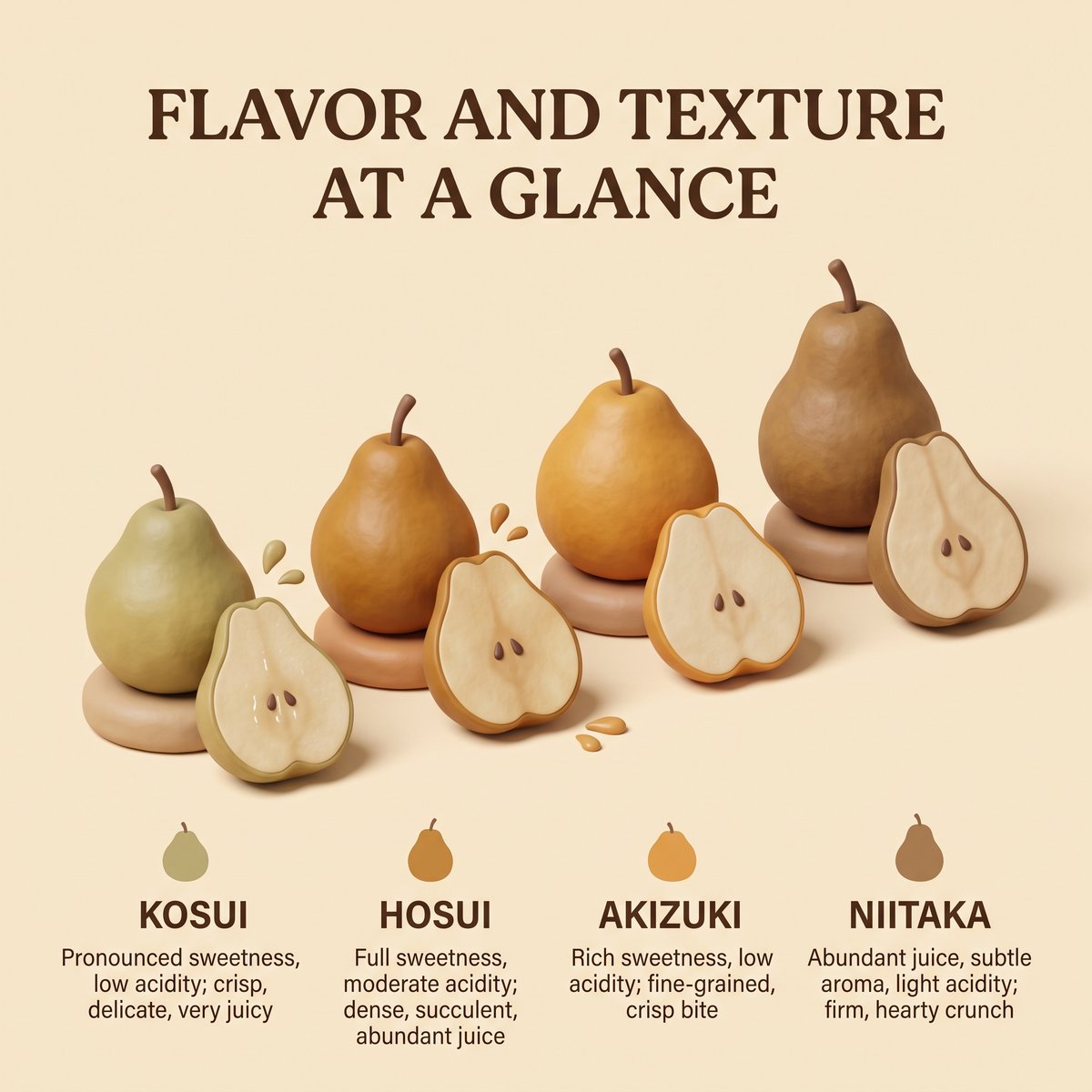
The table below lines the four varieties up side by side, at least for planning purposes. Use it to decide when to visit rather than as a ranking, because growers themselves rarely agree on a favorite.
| Variety | Harvest Window | Average Weight | Flavor Profile | Flesh Texture |
|---|---|---|---|---|
| Kosui (幸水) | Mid-Aug to early Sept | 300 to 350 g | Pronounced sweetness, low acidity | Crisp, delicate, very juicy |
| Hosui (豊水) | September | 350 to 400 g | Full sweetness with moderate acidity | Dense, succulent, abundant juice |
| Akizuki (あきづき) | Mid-Sept to early Oct | 400 to 450 g | Rich sweetness, low acidity | Fine-grained, crisp bite |
| Niitaka (新高) | October | 400 to 500 g | Abundant juice, subtle aroma, light acidity | Firm, hearty crunch, long-keeping |
Historical Roots: How Yajiro Doike Transformed the Hills
Pear cultivation in Kureha began around the turn of the twentieth century, during the late Meiji period, and accounts differ on the exact year. Back then, these hills were awkward land: too high for easy irrigation, too free-draining for paddies, and not productive enough to keep families fed.
Yajiro Doike traveled to farms around the country, searching for a crop that suited the ground. Eventually he carried Japanese pear saplings back from Tokyo, planting the Chojuro variety on the slopes. Success took several years to arrive. After that, neighbors copied the method, and orchards spread across the hills.
The Kosui Turning Point
The second turning point came much later. Japan’s rice production controls, launched in 1971, pushed farmers toward alternative crops, and Kureha growers expanded their pear acreage in response. More importantly, they adopted Kosui early, while the variety was still new nationally.
That bet defined the brand. Kosui’s juiciness matched what the market wanted, and the Kureha name traveled with it. A monument honoring Yajiro Doike stands beside the Kureha pear sorting center in the Yoshizukuri district, and Toyama’s tourism association points visitors toward it.
How to Select, Store, and Savor Kureha Pears
Buy a heavy pear, keep it refrigerated, peel it thinly, and eat it while it is fresh. Japanese pears confuse visitors who grew up on European varieties, since these are normally sold ready to eat.
- Check the weight. Select fruit that feels dense and heavy for its size, which suggests plenty of juice inside.
- Skip the softening wait. Kureha pears are harvested ready to eat, so leaving them on the counter does not improve the texture.
- Refrigerate, then temper. Store the pear in the refrigerator to slow moisture loss, and let it sit at room temperature for 10 to 15 minutes before serving for a fuller aroma.
- Peel thinly. The layer directly beneath the skin holds much of the concentrated sweetness.
No Post-Harvest Ripening (Tsuijuku)
Tsuijuku (追熟) means post-harvest ripening, the softening period that European pears need before eating. Unlike Bartlett or La France, the Kureha cultivars covered here are normally harvested ready to eat, and a kitchen counter does nothing for them. Japanese pear ripening behavior differs by cultivar, as a 1991 study by Downs and colleagues showed, but consumers should simply treat Kureha pears as ready-to-eat fruit.
Storage is straightforward. Keep the fruit wrapped loosely in the refrigerator’s vegetable drawer. Kosui is the most delicate of the four, while Niitaka keeps considerably longer, so ask the seller how long their fruit will hold if you buy a mixed box.
Where to Experience Kureha Nashi in Toyama
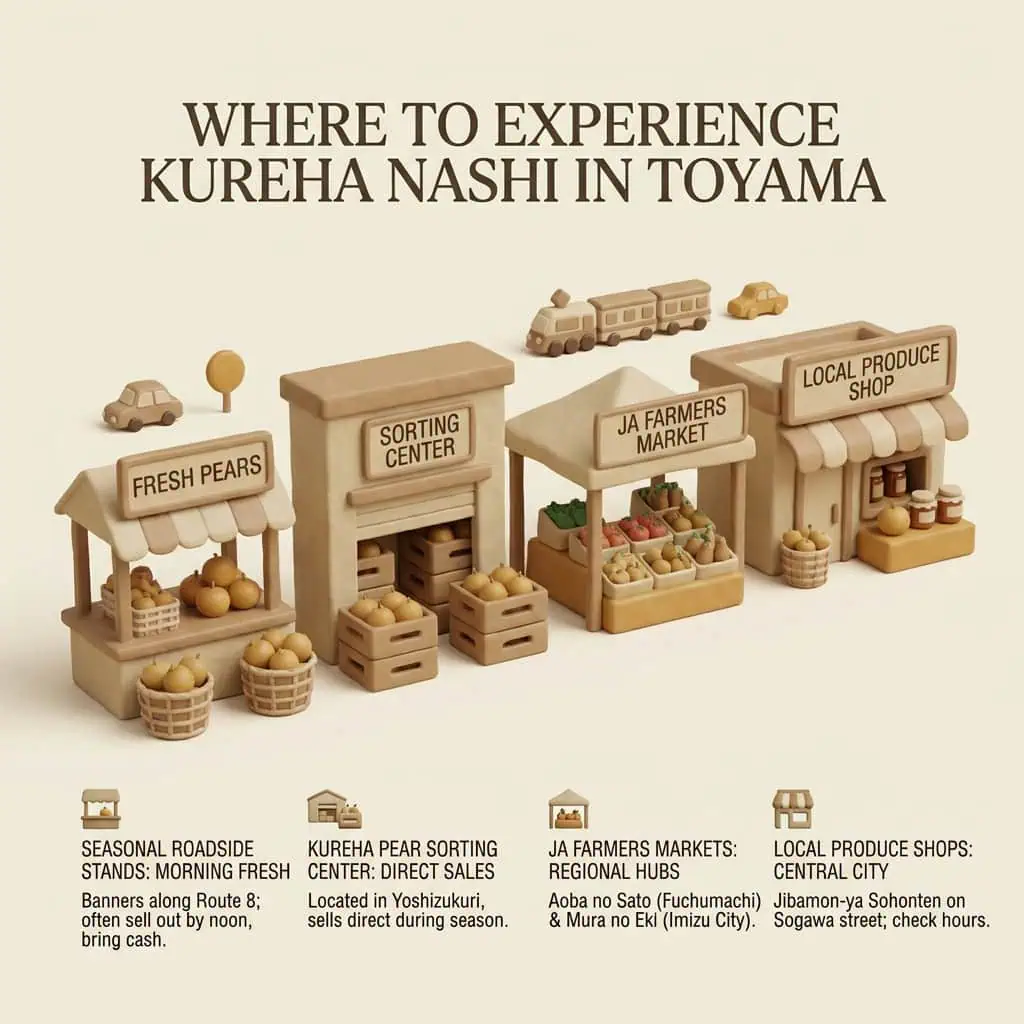
Pear season turns the Kureha area into a string of small roadside operations. Banners and hand-painted signs appear along National Route 8 and the orchard lanes, and many stands sell only what came off the trees that morning.
Where to Buy Kureha Pears: Stalls, Sorting Center, and Farmers Markets
Seasonal stands in front of farmhouses and orchards offer the freshest fruit, though they appear only during harvest. Toyama’s tourism association also recommends several fixed options, listed below. Arrive early, because stalls often open around nine and close once the day’s fruit sells out.
- Kureha Pear Sorting Center (呉羽梨選果場) in Yoshizukuri, Toyama City, which also sells direct during the season.
- Aoba no Sato Hohoemi-kan, a JA farmers market in Fuchumachi, Toyama City.
- Mura no Eki Nacchan, Taikoyama branch, a JA farmers market in Kurokawa, Imizu City.
- Jibamon-ya Sohonten, a local produce shop on Sogawa shopping street in central Toyama.
Opening hours shift with the season and the harvest, so check the official website or call before visiting. Local shops also turn pears into jelly, jam, juice, and packaged confections. One butcher in Kureha even sells a pear croquette from August to October.
How to Get to the Kureha Pear District from Toyama Station
The train ride from Toyama Station to Kureha Station takes about 4 to 5 minutes on the Ainokaze Toyama Railway. Most orchard stands require a further taxi or car journey from the station. A rental car suits stall hopping much better, because the orchards spread across hillside lanes with no sidewalks.
Plan a morning rather than an afternoon, and carry cash, since many stands do not take cards. In mid-April, similarly, the hills reward an early visit, when pear blossoms turn the slopes white.
Building a Toyama Food Itinerary
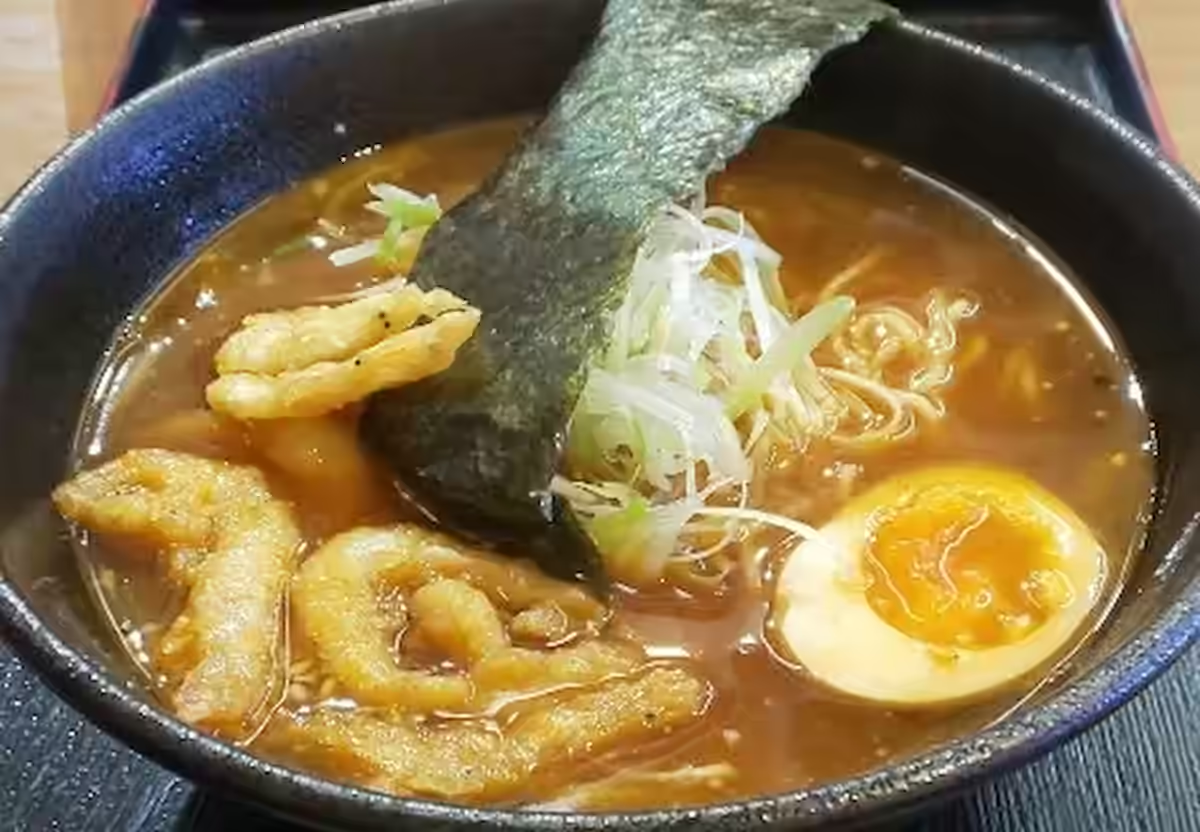
Pears pair naturally with the rest of Toyama’s table. In spring, the bay delivers Hotaru Ika (firefly squid), while Shiro Ebi (white shrimp) appears through much of the year. Autumn brings Koshi no Aka-gani (Toyama Bay red snow crab), and a bowl of Toyama Black Ramen makes a salty counterweight to all that fruit.
Summary
Kureha nashi exists because one farmer refused to accept that a dry hillside was worthless. More than a century later, the district still makes an unusual choice: no paper bags, full exposure, and a reputation staked on the fruit itself rather than on flawless skin. That decision costs growers marked and bruised fruit every season.
For a traveler, the payoff is a few weeks each year when Toyama fills with ripe pears. So buy one at a roadside stall, chill it, and eat it standing up somewhere you do not mind dripping. That is the whole experience, and it does not need improving.
Frequently Asked Questions About Kureha Nashi
- What is Kureha nashi?
-
Kureha nashi is a regional brand of Japanese pears from the Kureha Hills in Toyama City. It is not one cultivar. The name covers Kosui, Hosui, Akizuki, and Niitaka, all grown without protective paper bags.
- When is Kureha pear season?
-
The season runs from mid-August into October. Kosui opens it, Hosui follows in September, and Akizuki arrives from mid-September. Niitaka then closes the relay in October.
- Which variety should first-time visitors try?
-
Start with Kosui if your trip falls in late August, since it defines the brand. September travelers should reach for Hosui instead, because its acidity gives the sweetness more shape. Akizuki suits anyone wanting the Kosui character in a larger pear.
- Where can I buy Kureha pears?
-
Seasonal roadside stands along National Route 8 offer the freshest fruit. The Kureha sorting center in Yoshizukuri and JA farmers markets such as Aoba no Sato Hohoemi-kan also stock the brand. Check hours before visiting, as they change with the harvest.
- Do Kureha pears ripen after picking?
-
No. Growers harvest these pears ready to eat, so leaving them on a counter does not soften them the way it does a Bartlett. Refrigerate the fruit instead, then let it warm briefly before serving.
- Can international travelers take them home?
-
Many countries restrict or require declaration of fresh fruit, and the rules differ by destination. Check the official customs and plant-quarantine guidance for the country you are entering. When in doubt, enjoy the pears in Japan and choose packaged pear jelly, jam, juice, or confections as souvenirs.
References
- Nashi (Kureha Nashi): Toyama Ingredient Search, Ecchu Toyama Shoku no Okoku, Toyama Prefecture. Accessed September 2026.
- Kureha Nashi: Toyama City Specialty, Direct Stalls and Variety Guide, Toyama Tourism Organization. Accessed September 2026.
- Rebuilding the Kureha Pear Brand: Eco-Farmer Certification and Sorting Center Consolidation, JA Zen-Noh Weekly. Accessed September 2026.
- History and Culture of Kureha Nashi, Toyama City Kita Society of Commerce and Industry, Kureha Branch. Accessed September 2026.
- Akizuki: Japanese Pear Cultivar Profile, National Agriculture and Food Research Organization (NARO). Accessed September 2026.
- Eco-Farmer Certification and the Repeal of the Sustainable Agriculture Act, Akita Prefecture. Accessed September 2026.
- Downs, C. G., Brady, C. J., Campbell, J., & McGlasson, W. B. (1991). Normal ripening cultivars of Pyrus serotina are either climacteric or non-climacteric. Scientia Horticulturae, 48(3-4), 213-221. Accessed September 2026.
Image Credits
- Photographs of firefly squid and Toyama Bay: ©公益社団法人とやま観光推進機構 (Toyama Tourism Organization), https://www.info-toyama.com/ (Surveyed: August 2026)
- Photo library and usage terms: Toyama Tourism Organization Photo Library, https://www.info-toyama.com/business/images (Surveyed: August 2026)
Related Articles
- Koshi no Aka-gani (Toyama Bay Red Snow Crab) (Surveyed: September 2026)
- White Shrimp (Shiro Ebi) (Surveyed: September 2026)
- Firefly Squid (Hotaru Ika) (Surveyed: September 2026)
- Toyama Black Ramen (Surveyed: September 2026)





Comments